EP0549326B1 - Method and apparatus for halftoning of images - Google Patents
Method and apparatus for halftoning of images Download PDFInfo
- Publication number
- EP0549326B1 EP0549326B1 EP92311697A EP92311697A EP0549326B1 EP 0549326 B1 EP0549326 B1 EP 0549326B1 EP 92311697 A EP92311697 A EP 92311697A EP 92311697 A EP92311697 A EP 92311697A EP 0549326 B1 EP0549326 B1 EP 0549326B1
- Authority
- EP
- European Patent Office
- Prior art keywords
- cell
- screen pattern
- function
- pixels
- pixel
- Prior art date
- Legal status (The legal status is an assumption and is not a legal conclusion. Google has not performed a legal analysis and makes no representation as to the accuracy of the status listed.)
- Expired - Lifetime
Links
- 238000000034 method Methods 0.000 title claims description 55
- 238000012216 screening Methods 0.000 claims description 49
- 230000000694 effects Effects 0.000 claims description 8
- 230000004048 modification Effects 0.000 claims description 4
- 238000012986 modification Methods 0.000 claims description 4
- 230000001174 ascending effect Effects 0.000 claims description 3
- 238000005315 distribution function Methods 0.000 claims description 3
- 230000006870 function Effects 0.000 description 74
- 238000009792 diffusion process Methods 0.000 description 15
- 238000012545 processing Methods 0.000 description 11
- 239000011159 matrix material Substances 0.000 description 8
- 230000008569 process Effects 0.000 description 5
- 238000005070 sampling Methods 0.000 description 5
- 239000000976 ink Substances 0.000 description 3
- 230000003993 interaction Effects 0.000 description 3
- 239000007787 solid Substances 0.000 description 3
- 238000010420 art technique Methods 0.000 description 2
- 238000004364 calculation method Methods 0.000 description 2
- 238000002474 experimental method Methods 0.000 description 2
- 238000003384 imaging method Methods 0.000 description 2
- 238000005457 optimization Methods 0.000 description 2
- 230000000737 periodic effect Effects 0.000 description 2
- 238000009825 accumulation Methods 0.000 description 1
- 230000015572 biosynthetic process Effects 0.000 description 1
- 230000008859 change Effects 0.000 description 1
- 230000003247 decreasing effect Effects 0.000 description 1
- 238000010586 diagram Methods 0.000 description 1
- 238000011156 evaluation Methods 0.000 description 1
- 238000001914 filtration Methods 0.000 description 1
- 230000000644 propagated effect Effects 0.000 description 1
- 238000009877 rendering Methods 0.000 description 1
- 238000012163 sequencing technique Methods 0.000 description 1
Images

Classifications
-
- H—ELECTRICITY
- H04—ELECTRIC COMMUNICATION TECHNIQUE
- H04N—PICTORIAL COMMUNICATION, e.g. TELEVISION
- H04N1/00—Scanning, transmission or reproduction of documents or the like, e.g. facsimile transmission; Details thereof
- H04N1/40—Picture signal circuits
- H04N1/405—Halftoning, i.e. converting the picture signal of a continuous-tone original into a corresponding signal showing only two levels
- H04N1/4055—Halftoning, i.e. converting the picture signal of a continuous-tone original into a corresponding signal showing only two levels producing a clustered dots or a size modulated halftone pattern
- H04N1/4058—Halftoning, i.e. converting the picture signal of a continuous-tone original into a corresponding signal showing only two levels producing a clustered dots or a size modulated halftone pattern with details for producing a halftone screen at an oblique angle
Definitions
- the present invention is concerned with the field of image processing, such as the halftoning of photographic images, and more particularly, the present invention relates to a method and apparatus for generating a halftone screened image from an original.
- images are typically stored in a memory by representing tone values for each pixel of the original image.
- the stored pixels represent the grayscale value corresponding to each pixel.
- each color plane is stored as an array of pixels each representing the tone value for each pixel of the image in each respective color plane. For example, if each of the pixels of a black and white image is represented by an 8 bit digital word, then the tone value for a given image pixel may be one of 256 values between the black level and the white level.
- Continuous tone images do not print well on most printing devices where typically the absence or presence of the ink on the paper is used to represent the printed image.
- the original image is screened to produce a pattern, such as a variable size dots which appear to the human eye as a halftone image.
- the screen consists of an array of dots, or halftone cells, each of which represents one section of continuous tone in the original image as a single dot of variable size and shape.
- a halftone cell in turn, consists of an array of smaller screen pixels, or samples, each having individual values against which the input pixels derived from the original image will be compared.
- the individual values of the smaller screen pixels, or samples, of the repeating halftone cell which form the variable dots is referred to herein as a spot function.
- the halftone screening step consists of a screen pattern generating step, and a comparison step between the input image and the screen pattern.
- the screen is usually stored as a fairly small pattern that repeats itself or is repeatedly generated by programming.
- the output is marked.
- the output is not marked.
- the value of the image pixel is greater than corresponding value of the screen cell, a mark is generated by the marking engine, whereas if the value of the image pixel is less or equal to the screen cell value, then no mark is generated by the marking engine, or vice versa. In this way, the final screened image, composed of dots, is produced.
- color printing there are four separate steps of halftone screening, one each for the cyan, magenta, yellow, and black inks.
- irrational numbers such as the tangent 15 or tangent 75 degrees.
- Rational numbers can be represented as the ratio of two integers; irrational numbers are endless non-repeating decimals. Both rational tangent and irrational tangent digital screening systems are known.
- a screen pattern cell which can be a one dimensional strip, a band, or any two dimensional area, such as a square, that contains a section of the final screen.
- the screening method will repeatedly generate the screen pattern cell, resulting in a final screen of the desired ruling and angle.
- the critical step in halftone screening is the generation of the screen pattern cell which will be repeated to form the final screen covering the entire input image area.
- Examples of prior art techniques include rational tangent (US-A-4, 149,194 to Holladay), rational supercell (EP-A-0 427 380 - Schiller) irrational tangent (US-A-4,499,489 to Gall et al, and US-A-4,350,996 to Rosenfeld).
- three alternative screening techniques are described in EP-A 0 531 129 published 10/03/93 and EP-A-0 540 169 published 05/01/93.
- a 3500 dpi printer system has both cost and speed disadvantages as compared to a 1270 dpi printer.
- the present invention has particular application to reducing internal moire artifacts, thereby permitting a faster, less expensive digital screening system to produce high quality halftone images.
- a first screen pattern cell is created by any suitable prior art technique. Whatever first screen pattern cell is chosen, it will contain screen pattern pixel values arranged in some first grayscale order between lightest to darkest. That is, one screen pixel will be the lightest pixel in the cell, another pixel will be the second lightest, and so on. It is possible that two pixels will be exactly the same gray shade, but because pixels in the cell are calculated with trigonometric functions (for angled irrational screens) and 24 bit arithmetic for example, it would be the exception rather than the rule for two pixels to have equal gray shade values. If, by some rare chance two pixels do have the same gray shade, then the first one encountered is assigned the next place in the grayscale order.
- a second screen pattern cell is created from the first screen pattern cell by rearranging the order of grayscale levels of said stored first screen pattern pixels of said stored first screen pattern cell to generate the second screen pattern cell having a second grayscale order of stored screen pattern pixels.
- the effect of rearranging the order of the grayscale levels in the screen pattern cell is to diffuse the internal moire artifacts in the final halftone to nearby pixels, thereby rendering the internal moire less noticeable. Also, since errors are diffused in the grayscale dimension (rather than along the raster scan spatial dimension), spatial artifacts are diffused equally in all directions, i.e. isotropically.
- British patent specification GB-A-2,169,171 discloses a method and apparatus for generating a halftone screened image from an original image, in which method and apparatus the generation of a screen for halftone screening an original image includes digitally-generating an initial screen pattern cell of a prescribed height and width comprising an array of pixels having respective grayscale values, and modifying said initial screen pattern cell for reducing moire effects, and using said modified screen pattern cell for the generation of a screen for the halftone screening of said original image.
- the modifying of the initial screen pattern is done by a spatial modification of halftone dot areas or compartments of dot areas whose shape is changed. The spatial modification is achieved by introducing a random element into screen coordinate values.
- the present invention is directed to modifying grayscale values as already indicated above.
- the method set forth in the preceding paragraph is characterised in that:
- the invention also provides apparatus according to Claim 17.
- the predetermined function diffuses spatial artifacts isotropically.
- the pixels of the modified screen pattern cell are assigned grayscale values according to the second order and this assignment may be used to achieve a normalized distribution of grayscale values.
- the function applied in the described embodiments is a bump function, more particularly a Gaussian-shaped distribution function. It is expressed in terms of grayscale value and is applied to the initial screen pattern cell by addition to each of the selected pixels and its adjacent pixels.
- the selection of the next pixel in sequence after an application of the bump function is done on the grayscale value order of the pixels of the initial screen pattern cell as altered by the previous application of the bump function, this selection excluding previously selected pixels.
- the procedure is continued for all pixels in the array forming the initial screen pattern cell. In practice, the selection of pixels is in the order of ascending grayscale value, that is starting from the lightest.
- the present invention can be used with screen pattern cells produced by a variety of different screening techniques, including rational supercells (Schiller), irrational cells (Gall et al), and alternative screen pattern cells. It is expected that the present invention will be applicable to other screening techniques as well.
- each dot would ideally be 18.24 darkened pixels.
- the dots in the final halftone can consist only of an integral number of pixels.
- the final halftone will have dots almost entirely of 18 and 19 pixels, resulting in a higher quality halftone.
- the pattern of 19 pixel dots versus 18 pixel dots will be dispersed or diffused. Specifically, most 19 pixel dots will be surrounded by 18 pixel dots, to the greatest extent possible. Large clusters of 18 pixel dots or clusters of 19 pixel dots will not be present in the final halftone.
- the bump function is added to each successive pixel thereby darkening the nearby pixels in the pattern.
- the bump function has a center maximum with decreasing values at all distances from the center. Therefore, it is most likely that the next chosen pixel (next in order of grayscale) will not be near, i.e. will be some distance away from the present chosen pixel.
- each halftone cell (dot) in the screen pattern cell is chosen in succession, causing an even distribution of pixels as the dots in the screen pattern cell grow in size along the grayscale from lightest to darkest.
- the grayscale values in the new cell can thus be characterized by the fact that small grayscale increments are distant, i.e. spatially separated. In prior art cells, small grayscale increments have an equal chance of being near or distant.
- Counting the number of darkened pixels in each dot is not meaningful when the dots are not individually distinguishable, for example, exactly at the 50% gray with a conventional square dot shape, or with gray values between 40% and 60% using an elliptical shape, or with any gray value in a straight line screen.
- the preferred method of the present invention because it is based on a novel isotropic error diffusion technique, will produce halftones of greatly increased quality under all conditions.
- each pixel is the result of a comparison between the original image and the spot function. One comparison occurs for each output pixel.
- the final halftone image can be regarded as a sampling of an ideal halftone at which the comparisons are performed at all points in the image plane, i.e. infinite resolution.
- the sampling frequency is equivalent to the spatial resolution of the output device.
- Prior art photomechanical systems do not have a similar problem because the spatial resolution of the output device is equivalent to the much finer resolution of the film grain.
- the reference cell contains the sum of the old cell and a lowpass filtered version of the error arising from previous pixel choices.
- the lowpass filtered version of the error is substantially the same as the artifacts in the corresponding final halftone.
- the spatial frequency content of the ideal halftone is qualitatively similar to that of a square wave or pulse wave.
- the artifact level in the final halftone is proportional to the reciprocal of the square of the screening ratio.
- the screening ratio is the output resolution divided by the screen ruling. For example, if the output resolution is 1270 dpi, and the screen ruling is 133 lines per inch, then the screening ratio is 9.549, and the internal moire artifacts are about ⁇ 0.011 of the entire tone range.
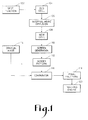
- FIG. 1 A system for making a halftone is shown in figure 1 where a spot function 102 is used to create an "old" cell 104, which is used in turn as the input to an internal moire diffusion process 106.
- the result of the internal moire process 106 is new cell 108, which in turn is used by screen generation process 110 to produce screen pattern 112.
- Original image 114 is compared against screen pattern 112 by comparator 116, producing final halftone 118.
- Final halftone 118 is conveyed to marking engine 120, which records the final halftone as an image on film or paper or some other imaging carrier.
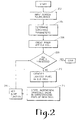
- a flow chart illustrating the process for generating a new cell from an old cell is shown in figure 2.
- the desired screen ruling and angle are input in step 202.
- the screening parameters are determined in step 204.
- the nature of screening parameters depends on the screening technique used. For example, in rational supercell screening (EP-A-0 0 427 380 - Schiller), the screening parameters include the width and height of the cell, as well as the horizontal. shift of each successive row of cells. In EP-A-0 531 129 published 10/03/93, the screening parameters include the width and height of the cell, as well as the jt, ut, and vt tables used for error vector calculations. A different screen pattern cell would be created for each combination of screen ruling and angle.
- the prior art screen pattern cell is created in step 206 as the old cell using a suitable spot function, and provided to an internal moire diffusion process, to create a new cell.
- the lightest pixel in the old cell is identified in step 212.
- the incremental grayscale value is stored in the corresponding pixel in the new cell.
- a bump function is then added to the reference cell at the chosen (lightest) pixel.
- the process continues sequencing up the grayscale excluding previously chosen pixels, until all pixels in the old screen pattern cell have been processed at step 220. Steps 212, 214, 216 and 218 for creating the new cell from the old cell are further detailed in figure 6.
- Figures 3a and 3b illustrates the use of the present invention in a rational supercell, i.e. a screen pattern cell containing a section of a final screen with a plurality of whole or fractional halftone dots at a prescribed angle and screen ruling, and repeated with rows offset to tile a complete halftone screen.
- a rational supercell i.e. a screen pattern cell containing a section of a final screen with a plurality of whole or fractional halftone dots at a prescribed angle and screen ruling, and repeated with rows offset to tile a complete halftone screen.
- the halftone dots in the screen pattern substantially match up to form a continuous halftone dot pattern.
- Halftone 302 is a solid shade of gray consisting of consisting of the repetition of a halftone cell with two black pixels 306 and 308, which shade corresponds the second increment along the grayscale.
- Figure 3b shows the screen pattern cell 304 (which is, in this case, a 24 x 8 cell of 192 pixels) used to generate halftone 302.
- the lightest pixel, 0, corresponds to pixel 306 in the halftone.
- the next lightest pixel, 1, corresponds to the pixel 308 in the halftone.
- the screen pattern cell 304 in figure 3b illustrates a typical order of grayscale resulting from the use of the present invention.
- pixel 1 it is noted that the next pixel 2 (next along the grayscale) is near (near in the spatial dimension) to pixel 0, while next pixel 3 is near to pixel 1.
- next pixel 4 is near to pixel 0.
- the alternation of pixels in grayscale order between the halftone dots centered at pixels 306 and 308 results in more uniform dot formation as the input shade varies along the grayscale.
- the darkest pixel 191 and next darkest pixel 190 are also uniformly placed in the spatial dimension.
- the order in which pixels are chosen in the new cell is equivalent to the order in which pixels are darkened in the final halftone as the input image goes from lightest to darkest.
- the exact order of the choices of pixels determines the dot shapes of the various shades of gray, as well as the presence or absence of artifacts.
- the error diffusion step used in the practice of the present invention consists of adding a bump function, centered upon the chosen pixel, to the reference cell.
- the bump function is typically represented as a 61 x 61 square matrix.
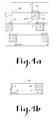
- Figure 4a shows that a square area 404 where the bump function will be added is centered on pixel 406 in the halftone cell 402. If the square area 404, positioned so that its center coincides with the chosen pixel 406, were to fall entirely within the cell, then it could be added to the cell unambiguously. However, as shown, the square area 404 falls partially outside the halftone cell 402, and a decision must be made on how to account for the portions A, B and C that fall outside the cell and overlap the neighboring halftone cells. The portion D of square area 404 which falls inside halftone cell 402 can be simply added to the contents of the reference cell.
- FIG. 4b illustrates how the bump function centered at pixel 406, is added to the screen pattern cell 408. Area D is added directly. Area C wraps around to the opposite side of screen pattern 408, and areas A and B wrap around to the opposite side of screen pattern 408 with suitable offsets to compensate for the shift between adjacent rows of the supertile making up the complete halftone screen.
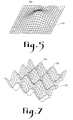
- Figure 5 is an isometric view of the bump function 504 with a maximum value or peak value 502.
- a typical maximum 502 may be 20% of grayscale.
- Figure 7 is an isometric view of a halftone screen 702 containing several halftone dots. The height of the surface shown represents the grayscale value of the screen pixels. For example, peak values 704, 706 represent the darkest pixel values of the spot function in the halftone screen 702.
- the screen pattern consists of periodic repetitions of the cell. Therefore, any sections of the square area 404 falling outside the cell 408 would fall unambiguously within an adjoining cells. Therefore, the preferred method is to add the portions of the square matrix that fall outside the cell to the regions corresponding to those regions in adjoining cells in the screen pattern.
- the relation between adjoining regions can be expressed mathematically, as follows. If one begins at point (x, y) in a cell in the screen pattern, and moves dx pixels to the right and dy pixels down, then one will arrive at the point (x1, y1) in a cell, perhaps within the same cell, perhaps a different cell.
- the method for determination of the x1 and y1 depends on the exact nature of the rational supercell.
- a supercell constructed according to U.S. Patent 4,149,194 Helladay.
- the width of the cell is w
- the height is h.
- the horizontal shift from one row of cells to the next is s.
- x1 (x + dx + (((y mod h) + dy) div h) ⁇ s) mod w
- y1 (y + dy) mod h
- div represents integer division, i.e. truncating the fractional part.
- the step of choosing an x,y pixel with a minimum reference[x,y] value must exclude any x,y pixel that has been previously chosen.
- bump function to perform the error diffusion step.
- the two-dimensional Gaussian bell function is radially symmetrical, which is to say that is not changed by a rotation about the origin. Therefore, the error diffusion process used in the present invention is isotropic, which is to say the same in all directions. No one dimension is preferred. Known prior art error diffusion techniques are anisotropic, which is to say that some directions are preferred above others. Specifically, error can not be propagated upward, in other words contrary to the secondary scanning direction, because all pixels above the present scan line have already been determined, and cannot be changed, as a result of processing the image in raster scan order.
- the error diffusion process of the present invention iterates through grayscale values, rather than in raster scan order, and is thus capable of using an isotropic error distribution, such as the two-dimensional Gaussian bell function.
- the present invention can also be practiced in conjunction with irrational angled screens such as can be generated by Gall et al (US-A-4,499,489) and also by the alternative screening techniques, cited above.
- adding a bump function to an irrational angled screen when the bump function falls outside the screen pattern cell, is more complex than adding a bump function to a rational angled screen under the same conditions.
- the reason for the added complexity is that the screen values in adjacent cells used to determine wrap around values are not deterministic in an irrational angled screen, but occur with appear with some relative probability.
- the bump function is distributed to each of the possible pixels values in accordance with the relative probability of occurrence of that particular pixel value.
- the following treatment is presented in a general fashion, so that it will work with all screening methods that share the important basic properties.
- the main loop described with reference to Fig. 2 - and to be further explained with reference to Fig. 6 - is modified so as to distribute some portion of the error (i.e. bump function) to each of the (x1,y1) pixels.
- the exact portion is based on the relative probability of occurrence of that particular (x1,y1) found at offset (dx,dy) to the original pixel (x,y).
- the relative probability of finding pixel (x1,y1) at an offset (dx,dy) from (x,y) is denoted as p(x,y, dx,dy, x1,y1).
- the function p can be calculated as follows: scan through the entire final screen pattern, and count the number of occurrences of screen pixel (x,y). Also, for each point in the final halftone in which screen pixel (x,y) is found, compare the point offset by (dx,dy) to determine if it is occupied by screen pixel (x1,y1), and count the number of occurrences. The ratio of the latter divided by the former is equal to the value of p(x,y, dx,dy, x1,y1).
- each pixel in the reference cell has received an equal amount of error.
- the exact values of p(x,y, dx,dy, x1,y1) depend on the screening technique, as well as the screen ruling and angle.
- the nature of the screening method and its corresponding p() function will cause the bump function to be added in very fragmented form.
- the bump function will be primarily added to screen pixels that will be nearby in the final screen pattern, rather than pixels that are nearby in the cell.
- the bump function will in general not be highly fragmented, since nearby pixels in the cell also tend to be nearby in the final screen pattern, especially if the height of the cell is comparable to the extent of the bump function.
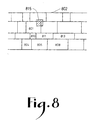
- Figure 8 shows a section of an irrational screen, assembled from a plurality of strips of an ideal angled screen as disclosed in EP-A-0 531 129.
- Screen pattern cells 804, 806 and 808 represent different length strips of an ideal angled screen having a given height.
- screen pattern cells 810, 811 and 813 represent shorter height, and different length strips of an ideal angled screen.
- a bump function represented by area 815 is to be added to a pixel in strip 801, which bump function overlaps the different height and different length strip 802 above.
- different length and height strips appear in a number of different relative positions, creating the complexity in calculating wrap around bump function in terms of probabilities.
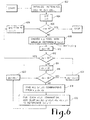
- FIG. 6 shows a flowchart of the internal moire diffusion process, corresponding to steps 212, 214, 216 and 220 in Figure 2.
- Processing begins with step 602, in which the contents of a reference cell are initialized to duplicate the contents of the old cell 104, which contains pixel values generated from a spot function. Then, in step 604, the variables g, representing the gray shade to be assigned the next chosen pixel, and i, an index variable for counting the number of iterations through main loop (consisting of steps 606 through 626) are both initialized to zero.
- step 606 Upon every iteration of the main loop, step 606 checks to determine whether all iterations have been performed. If so, processing is complete. If not, processing continues with step 608, in which minimum pixel is chosen in the reference cell, and the coordinates of the chosen pixel are stored in the variables x and y. In addition, the corresponding chosen pixel in the new cell is set to the value of g. Step 608 excludes from consideration all pixels that have been chosen in previous iterations, thus ensuring that, upon completion, each pixel will have been chosen exactly once.
- Steps 610, 612, 614, 616, 622, and 624 effectively iterate steps 618 and 620 over all combinations of values of dx and dy, each within a range from -30 to 30.
- the variable dy is initialized to -30.
- the value of dy is compared with 30, and if the former does not exceed the latter, processing continues with step 614, in which dx is initialized to -30.
- Step 616 correspondingly, compares the value of dx with 30, and if the former does not exceed the latter, continues with step 618.
- step 618 all combinations of (x1,y1) are determined from moving an offset (dx,dy) from an occurrence of screen pixel (x,y) in the screen pattern 112. Then, in step 620, for each such combination of (x1,y1), the quantity bump(dx,dy) ⁇ p(x1,y1, -dx,-dy, x,y) is added to the contents of the reference cell pixel addressed by the coordinates (x1,y1). Steps 618 and 620 add the bump function to the reference cell, with wrap around areas and relative probabilities of occurrence of pixel values in the wrap around areas taken into account.
- step 622 After performing steps 618 and 620 for one combination of values of dx and dy, the next value of dx is determined in step 622. If, in step 616, it is then determined that dx does not exceed 30, then steps 618 through 622 are repeated until dx does in fact exceed 30. Then, the next value of dy is determined in step 624. If, in step 612, dy does not exceed 30, then steps 614 through 624 are repeated until dy does exceed 30. Processing then continues at step 626, at which point all combinations of dx and dy, each in the range of -30 to 30, will have been iterated. In step 626, the next incremental gray shade is determined, and stored in the variable g.
- the main loop counter i is incremented, and the main loop is repeated, beginning at step 606, until all iterations of the main loop have been performed, at which point processing is complete.
- the net result is a new screen pattern cell with having a grayscale order of stored screen pattern pixels different from the grayscale order of the old screen pattern cell.
- a screen pattern cell once created, may be used to screen any number of halftones. As long as the screening speed is adequate, the speed of creation of the screen pattern cell may be relatively slow.
- a variety of optional techniques to improve the calculation speed of the p(x,y, dx,dy, x1,y1) function is briefly described.
- xb,y1 a list of xb,y1 values, and their relative probabilities p(0,y, 0,dy, xb,y1).
- the height of the cell is 40, and if the range of values of dy is -30..30 (for a total of 61 total values), then there are 2440 (40 times 61) total combinations.
- An array is constructed that contains the number of (xb,y1) values for each of the 2440 combinations. Then, a maximum of 39040 (2440 times 16) values for xb,y1 are stored in a separate array.
- a table of pointers to the reference cell is constructed. Each pointer is numbered from 0 to w ⁇ h - 1. The table of pointers is then sorted in order of the addressed values in the reference cell. Any well known efficient sorting algorithm, such as quicksort, may be used. Then, for iteration number i, the pointers numbered from i to i+1000 (or the end of the table, whichever comes first) are searched for the minimum addressed value in the reference cell. The minimum so determined almost always corresponds to the minimum in the entire reference cell. To update the table of pointers for the next iteration, the chosen pointer is replaced by the pointer numbered i in the table. Thus, every pointer will be chosen exactly once.
- the separated bump function table containing the values eg ⁇ e - am ⁇ dx 2 ⁇ z 1024 , for all values of dx in the range -30..30, and all values of z in the range 0..1024.
- eg and am are parameters to the bump function. Instead of storing merely p(x,y, dx,dy, x1,y1) in the tables, rather int(1024 ⁇ e - am ⁇ dy 2 ⁇ p ( x , y , dx , dy , x1 , y1 )) is stored instead.
- the function int(x) denotes the largest integer that is still not greater than x, for any x, i.e. truncating the fractional part.
- a value from this new table would be read into the variable z, replacing the step in which the value from the old table was read into the variable p.
Landscapes
- Engineering & Computer Science (AREA)
- Multimedia (AREA)
- Signal Processing (AREA)
- Facsimile Image Signal Circuits (AREA)
- Image Processing (AREA)
Applications Claiming Priority (2)
| Application Number | Priority Date | Filing Date | Title |
|---|---|---|---|
| US07/814,880 US5276535A (en) | 1991-12-24 | 1991-12-24 | Method and apparatus for halftoning of images using grayscale error diffusion |
| US814880 | 1991-12-24 |
Publications (2)
| Publication Number | Publication Date |
|---|---|
| EP0549326A1 EP0549326A1 (en) | 1993-06-30 |
| EP0549326B1 true EP0549326B1 (en) | 1999-02-24 |
Family
ID=25216242
Family Applications (1)
| Application Number | Title | Priority Date | Filing Date |
|---|---|---|---|
| EP92311697A Expired - Lifetime EP0549326B1 (en) | 1991-12-24 | 1992-12-22 | Method and apparatus for halftoning of images |
Country Status (4)
| Country | Link |
|---|---|
| US (1) | US5276535A (enExample) |
| EP (1) | EP0549326B1 (enExample) |
| JP (1) | JPH05276366A (enExample) |
| DE (1) | DE69228469T2 (enExample) |
Families Citing this family (25)
| Publication number | Priority date | Publication date | Assignee | Title |
|---|---|---|---|---|
| DE4038056C2 (de) * | 1990-11-29 | 1997-05-15 | Hell Ag Linotype | Verfahren zur Generierung und Speicherung von digitalisierten Dichteschwellwerten zur Rasterung einer Halbton-Bildvorlage |
| US5341228A (en) | 1990-12-04 | 1994-08-23 | Research Corporation Technologies | Method and apparatus for halftone rendering of a gray scale image using a blue noise mask |
| GB9122154D0 (en) * | 1991-10-18 | 1991-11-27 | Crosfield Electronics Ltd | Improvements relating to image screening |
| US5855433A (en) * | 1992-04-28 | 1999-01-05 | Velho; Luiz C. | Method of color halftoning using space filling curves |
| US5602943A (en) * | 1992-04-28 | 1997-02-11 | Velho; Luiz C. | Digital halftoning space filling curves |
| US5657137A (en) * | 1992-05-04 | 1997-08-12 | Hewlett-Packard Company | Color digital halftoning using black and secondary color replacement |
| US5406379A (en) * | 1992-11-23 | 1995-04-11 | Xerox Corporation | Method of hybrid halftone printing by limiting the number of gray pixels and gray pixel levels |
| US5515180A (en) * | 1992-11-24 | 1996-05-07 | Sharp Kabushiki Kaisha | Image processing device |
| DE69422353T2 (de) * | 1993-09-03 | 2000-06-21 | Agfa-Gevaert N.V., Mortsel | Verfahren zur Herstellung eines frequenzmodulierten Halbtonrasters |
| US6411745B1 (en) * | 1994-03-09 | 2002-06-25 | Eastman Kodak Company | Method and apparatus to reduce cross-interference in reproduction of scanned halftone images |
| US5557709A (en) * | 1994-07-01 | 1996-09-17 | Seiko Epson Corporation | Method and apparatus for dither array generation to reduce artifacts in halftoned images |
| US6067406A (en) * | 1995-05-03 | 2000-05-23 | Agfa-Gevaert N.V. | Automatic calibration for output devices based on device output mode |
| US5737453A (en) * | 1996-05-17 | 1998-04-07 | Canon Information Systems, Inc. | Enhanced error-diffusion method for color or black-and-white reproduction |
| SE513365C2 (sv) * | 1998-03-05 | 2000-09-04 | Forskarpatent I Linkoeping Ab | Rastreringsförfarande baserat på förberäknade mallar |
| US6356362B1 (en) | 1998-11-02 | 2002-03-12 | Canon Kabushiki Kaisha | Halftoning by enhanced error diffusion |
| US7277203B1 (en) * | 1999-10-18 | 2007-10-02 | Sharp Laboratories Of America, Inc. | Method of improving start-up behavior for color error diffusion digital half-toning |
| DE60044150D1 (de) * | 2000-02-06 | 2010-05-20 | Hewlett Packard Indigo Bv | Rasterungsverfahren, was Selbst-Störung zwischen einem Zellengitter und Pixelgitter vermeidet |
| US7492480B2 (en) * | 2001-08-27 | 2009-02-17 | Phototype Engraving Company | System for halftone screen production |
| US20030107768A1 (en) * | 2001-12-04 | 2003-06-12 | Crounse Kenneth R. | Halftoning with uniformly dispersed dot growth |
| US7551323B2 (en) * | 2003-04-16 | 2009-06-23 | Lexmark International, Inc. | Systems and methods for error diffusion |
| US9167130B2 (en) * | 2004-11-12 | 2015-10-20 | Hewlett-Packard Development Company, L.P. | AM-FM halftone screen design |
| US7639887B2 (en) * | 2004-12-14 | 2009-12-29 | Intel Corporation | Error diffusion-based image processing |
| JP4396896B2 (ja) * | 2005-01-07 | 2010-01-13 | 大日本スクリーン製造株式会社 | 閾値マトリクス生成方法、閾値マトリクス生成装置および記録媒体 |
| US20080117464A1 (en) * | 2006-11-20 | 2008-05-22 | Monotype Imaging, Inc. | Method and system for reducing auto-moire artifacts in periodic halftone screening |
| TWI394094B (zh) * | 2010-06-22 | 2013-04-21 | Univ Nat Taiwan Science Tech | 半色調影像處理之順序矩陣與擴散權重的共同優化方法與系統 |
Family Cites Families (24)
| Publication number | Priority date | Publication date | Assignee | Title |
|---|---|---|---|---|
| US4051536A (en) * | 1975-03-14 | 1977-09-27 | Xerox Corporation | Electronic halftone imaging system |
| US4245258A (en) * | 1979-11-05 | 1981-01-13 | Xerox Corporation | Method and apparatus for reduction of false contours in electrically screened images |
| US4246614A (en) * | 1979-12-26 | 1981-01-20 | Xerox Corporation | Binary graphic printer system having an electronic screen with shift control suited for rescreening |
| US4633327A (en) * | 1983-11-10 | 1986-12-30 | Xerox Corporation | Enhancement halftoning |
| ATE29815T1 (de) * | 1983-11-14 | 1987-10-15 | Hell Rudolf Dr Ing Gmbh | Verfahren und einrichtung zur herstellung gerasterter druckformen. |
| JPH0657049B2 (ja) * | 1984-12-07 | 1994-07-27 | 大日本スクリ−ン製造株式会社 | 網点形成方法 |
| US4654721A (en) * | 1985-04-12 | 1987-03-31 | International Business Machines Corporation | System for reproducing multi-level digital images on a bi-level printer of fixed dot size |
| GB8628238D0 (en) * | 1986-11-26 | 1986-12-31 | Crosfield Electronics Ltd | Generating half-tone representations |
| US4823189A (en) * | 1987-05-08 | 1989-04-18 | Tektronix, Inc. | Method and apparatus for creating a dither pattern |
| US5014333A (en) * | 1988-07-21 | 1991-05-07 | Eastman Kodak Company | Image processor with smooth transitioning between dither and diffusion processes |
| US4924301A (en) * | 1988-11-08 | 1990-05-08 | Seecolor Corporation | Apparatus and methods for digital halftoning |
| US4918622A (en) * | 1988-11-16 | 1990-04-17 | Eastman Kodak Company | Electronic graphic arts screener |
| US4916545A (en) * | 1988-11-16 | 1990-04-10 | Eastman Kodak Company | Electronic graphic arts screener that suppresses Moire patterns using pseudo-random font selection |
| US4977458A (en) * | 1988-11-16 | 1990-12-11 | Eastman Kodak Company | Apparatus for addressing a font to suppress Moire patterns occurring thereby and a method for use therein |
| US5053887A (en) * | 1989-06-27 | 1991-10-01 | Ibm Corporation | Technique for producing a fine grained dithered halftone image having an increased number of gray levels |
| US4985779A (en) * | 1989-09-19 | 1991-01-15 | Intergraph Corporation | Improved method and apparatus for generating halftone images |
| US5155588A (en) * | 1990-02-06 | 1992-10-13 | Levien Raphael L | Color correction and apparatus for photographic reproduction |
| DE69120588T2 (de) * | 1990-04-25 | 1997-02-13 | Bayer Ag | Verfahren zur Steuerung der Rasterpunktform während des Punktwachsens |
| DE69120591T2 (de) * | 1990-04-25 | 1997-02-13 | Bayer Ag | Verfahren zum Aufbrechen der Symmetrie von Matrixelementen in einem elektronischen Rasterungsprozess |
| DE69120590T2 (de) * | 1990-04-25 | 1997-02-13 | Bayer Ag | Rasterfrequenzmultiplikationsverfahren in einem elektronischen Rasterungsprozess |
| DE69117092T2 (de) * | 1990-04-26 | 1996-10-02 | Bayer Ag | RGB-Farbdatenbank und Verfahren zu ihrer Erzeugung |
| EP0454275B1 (en) * | 1990-04-26 | 1996-07-03 | Bayer Corporation | Color separation method |
| US5111310A (en) * | 1990-12-04 | 1992-05-05 | Research Technologies Corporation, Inc. | Method and apparatus for halftone rendering of a gray scale image using a blue noise mask |
| US5124803A (en) * | 1991-02-25 | 1992-06-23 | Ecrm | Method and apparatus for generating digital, angled halftone screens using pixel candidate lists and screen angle correction to prevent moire patterns |
-
1991
- 1991-12-24 US US07/814,880 patent/US5276535A/en not_active Expired - Fee Related
-
1992
- 1992-12-22 EP EP92311697A patent/EP0549326B1/en not_active Expired - Lifetime
- 1992-12-22 DE DE69228469T patent/DE69228469T2/de not_active Expired - Fee Related
- 1992-12-24 JP JP4344861A patent/JPH05276366A/ja active Pending
Also Published As
| Publication number | Publication date |
|---|---|
| DE69228469D1 (de) | 1999-04-01 |
| JPH05276366A (ja) | 1993-10-22 |
| EP0549326A1 (en) | 1993-06-30 |
| DE69228469T2 (de) | 1999-09-09 |
| US5276535A (en) | 1994-01-04 |
Similar Documents
| Publication | Publication Date | Title |
|---|---|---|
| US5276535A (en) | Method and apparatus for halftoning of images using grayscale error diffusion | |
| KR100629704B1 (ko) | 협대역, 이방성의 확률적 하프톤 패턴 및 생성 방법 및 그사용법 | |
| EP0749231B1 (en) | Method and apparatus for halftone rendering of a gray scale image using a blue noise mask | |
| US6714320B1 (en) | Image processor and color image processor | |
| US5726772A (en) | Method and apparatus for halftone rendering of a gray scale image using a blue noise mask | |
| US5463720A (en) | Blue noise based technique for use in a halftone tile oriented screener for masking screener induced image artifacts | |
| EP0238034B1 (en) | Pixel-density conversion technique for continuous-tone image | |
| US5150428A (en) | Method for generating halftone image data with randomly selected threshold array | |
| Lau et al. | Digital color halftoning with generalized error diffusion and multichannel green-noise masks | |
| US5602653A (en) | Pixel pair grid halftoning for a hyperacuity printer | |
| US8995023B2 (en) | Amplification modulation screening method and apparatus | |
| EP0405052A2 (en) | A technique for producing a fine grained dithered halftone image having an increased number of gray levels | |
| JP2002057898A (ja) | グレーレベルハーフトーン処理 | |
| WO1993000656A1 (en) | Improved error diffusion system | |
| US4758886A (en) | Optimal color half-tone patterns for raster-scan images | |
| EP0514478B1 (en) | Digital halftoning with correlated minimum visual modulation patterns | |
| JPH0785273A5 (enExample) | ||
| US5315406A (en) | Screen generation for halftone screening of images using arbitrary distribution of transformed screen coordinates | |
| US5259042A (en) | Binarization processing method for multivalued image and method to form density pattern for reproducing binary gradations | |
| US5499305A (en) | Method and apparatus for coalescing a grayscale image and rendering the coalesced grayscale image as a binary image | |
| US5572600A (en) | Color image processing apparatus capable of suppressing moire | |
| US5425112A (en) | Method for optimizing frequency-modulated rasters upon utilization of threshold hills | |
| US5602971A (en) | Multilevel halftoning using a randomised bayer matrix | |
| JP2009514274A (ja) | マルチビット深度の画像装置でfm/am混在格子点及び格子点形状を制御する方法 | |
| EP0266824A1 (en) | A method of reconstructing a dither matrix |
Legal Events
| Date | Code | Title | Description |
|---|---|---|---|
| PUAI | Public reference made under article 153(3) epc to a published international application that has entered the european phase |
Free format text: ORIGINAL CODE: 0009012 |
|
| AK | Designated contracting states |
Kind code of ref document: A1 Designated state(s): DE DK FR GB |
|
| 17P | Request for examination filed |
Effective date: 19931125 |
|
| 17Q | First examination report despatched |
Effective date: 19951221 |
|
| GRAG | Despatch of communication of intention to grant |
Free format text: ORIGINAL CODE: EPIDOS AGRA |
|
| GRAG | Despatch of communication of intention to grant |
Free format text: ORIGINAL CODE: EPIDOS AGRA |
|
| GRAH | Despatch of communication of intention to grant a patent |
Free format text: ORIGINAL CODE: EPIDOS IGRA |
|
| GRAH | Despatch of communication of intention to grant a patent |
Free format text: ORIGINAL CODE: EPIDOS IGRA |
|
| GRAA | (expected) grant |
Free format text: ORIGINAL CODE: 0009210 |
|
| AK | Designated contracting states |
Kind code of ref document: B1 Designated state(s): DE DK FR GB |
|
| REF | Corresponds to: |
Ref document number: 69228469 Country of ref document: DE Date of ref document: 19990401 |
|
| PG25 | Lapsed in a contracting state [announced via postgrant information from national office to epo] |
Ref country code: DK Free format text: LAPSE BECAUSE OF FAILURE TO SUBMIT A TRANSLATION OF THE DESCRIPTION OR TO PAY THE FEE WITHIN THE PRESCRIBED TIME-LIMIT Effective date: 19990524 |
|
| ET | Fr: translation filed | ||
| PGFP | Annual fee paid to national office [announced via postgrant information from national office to epo] |
Ref country code: FR Payment date: 19991208 Year of fee payment: 8 |
|
| PGFP | Annual fee paid to national office [announced via postgrant information from national office to epo] |
Ref country code: GB Payment date: 19991222 Year of fee payment: 8 |
|
| PGFP | Annual fee paid to national office [announced via postgrant information from national office to epo] |
Ref country code: DE Payment date: 19991230 Year of fee payment: 8 |
|
| PLBE | No opposition filed within time limit |
Free format text: ORIGINAL CODE: 0009261 |
|
| STAA | Information on the status of an ep patent application or granted ep patent |
Free format text: STATUS: NO OPPOSITION FILED WITHIN TIME LIMIT |
|
| 26N | No opposition filed | ||
| PG25 | Lapsed in a contracting state [announced via postgrant information from national office to epo] |
Ref country code: GB Free format text: LAPSE BECAUSE OF NON-PAYMENT OF DUE FEES Effective date: 20001222 |
|
| GBPC | Gb: european patent ceased through non-payment of renewal fee |
Effective date: 20001222 |
|
| PG25 | Lapsed in a contracting state [announced via postgrant information from national office to epo] |
Ref country code: FR Free format text: LAPSE BECAUSE OF NON-PAYMENT OF DUE FEES Effective date: 20010831 |
|
| REG | Reference to a national code |
Ref country code: FR Ref legal event code: ST |
|
| PG25 | Lapsed in a contracting state [announced via postgrant information from national office to epo] |
Ref country code: DE Free format text: LAPSE BECAUSE OF NON-PAYMENT OF DUE FEES Effective date: 20011101 |