EP0541093B1 - Package capable of being sealed by heat-fusing - Google Patents
Package capable of being sealed by heat-fusing Download PDFInfo
- Publication number
- EP0541093B1 EP0541093B1 EP92118981A EP92118981A EP0541093B1 EP 0541093 B1 EP0541093 B1 EP 0541093B1 EP 92118981 A EP92118981 A EP 92118981A EP 92118981 A EP92118981 A EP 92118981A EP 0541093 B1 EP0541093 B1 EP 0541093B1
- Authority
- EP
- European Patent Office
- Prior art keywords
- heat
- laminate
- package
- layer
- easily peelable
- Prior art date
- Legal status (The legal status is an assumption and is not a legal conclusion. Google has not performed a legal analysis and makes no representation as to the accuracy of the status listed.)
- Expired - Lifetime
Links
- 239000010410 layer Substances 0.000 claims abstract description 96
- 239000012793 heat-sealing layer Substances 0.000 claims abstract description 6
- 229920003002 synthetic resin Polymers 0.000 claims abstract description 6
- 239000000057 synthetic resin Substances 0.000 claims abstract description 6
- 229920005989 resin Polymers 0.000 claims description 13
- 239000011347 resin Substances 0.000 claims description 13
- 239000012790 adhesive layer Substances 0.000 claims description 5
- 239000004820 Pressure-sensitive adhesive Substances 0.000 claims description 3
- 238000004806 packaging method and process Methods 0.000 abstract 1
- 235000014347 soups Nutrition 0.000 description 13
- 240000008042 Zea mays Species 0.000 description 12
- 235000005824 Zea mays ssp. parviglumis Nutrition 0.000 description 12
- 235000002017 Zea mays subsp mays Nutrition 0.000 description 12
- 235000005822 corn Nutrition 0.000 description 12
- 239000000853 adhesive Substances 0.000 description 10
- 230000001070 adhesive effect Effects 0.000 description 10
- -1 polyethylene Polymers 0.000 description 10
- 238000007789 sealing Methods 0.000 description 10
- 230000002159 abnormal effect Effects 0.000 description 8
- JOYRKODLDBILNP-UHFFFAOYSA-N Ethyl urethane Chemical compound CCOC(N)=O JOYRKODLDBILNP-UHFFFAOYSA-N 0.000 description 6
- 239000004743 Polypropylene Substances 0.000 description 6
- 235000021438 curry Nutrition 0.000 description 6
- 239000000463 material Substances 0.000 description 6
- 229920006267 polyester film Polymers 0.000 description 6
- 229920001155 polypropylene Polymers 0.000 description 6
- 235000015067 sauces Nutrition 0.000 description 6
- 239000000758 substrate Substances 0.000 description 6
- 238000002474 experimental method Methods 0.000 description 5
- 230000002269 spontaneous effect Effects 0.000 description 5
- 239000004698 Polyethylene Substances 0.000 description 4
- 239000011248 coating agent Substances 0.000 description 4
- 238000000576 coating method Methods 0.000 description 4
- 235000013305 food Nutrition 0.000 description 4
- 238000000034 method Methods 0.000 description 4
- 229920000573 polyethylene Polymers 0.000 description 4
- 239000008399 tap water Substances 0.000 description 4
- 235000020679 tap water Nutrition 0.000 description 4
- 229920000178 Acrylic resin Polymers 0.000 description 3
- 239000004925 Acrylic resin Substances 0.000 description 3
- 239000003814 drug Substances 0.000 description 3
- 229940079593 drug Drugs 0.000 description 3
- 238000010030 laminating Methods 0.000 description 3
- XLYOFNOQVPJJNP-UHFFFAOYSA-N water Substances O XLYOFNOQVPJJNP-UHFFFAOYSA-N 0.000 description 3
- NIXOWILDQLNWCW-UHFFFAOYSA-N acrylic acid group Chemical group C(C=C)(=O)O NIXOWILDQLNWCW-UHFFFAOYSA-N 0.000 description 2
- XAGFODPZIPBFFR-UHFFFAOYSA-N aluminium Chemical compound [Al] XAGFODPZIPBFFR-UHFFFAOYSA-N 0.000 description 2
- 229910052782 aluminium Inorganic materials 0.000 description 2
- 230000004888 barrier function Effects 0.000 description 2
- 239000005038 ethylene vinyl acetate Substances 0.000 description 2
- 239000011888 foil Substances 0.000 description 2
- 239000007788 liquid Substances 0.000 description 2
- 235000021056 liquid food Nutrition 0.000 description 2
- 229920006284 nylon film Polymers 0.000 description 2
- 229920001200 poly(ethylene-vinyl acetate) Polymers 0.000 description 2
- 229920000098 polyolefin Polymers 0.000 description 2
- 230000003014 reinforcing effect Effects 0.000 description 2
- 239000007787 solid Substances 0.000 description 2
- 230000001954 sterilising effect Effects 0.000 description 2
- 238000004659 sterilization and disinfection Methods 0.000 description 2
- 125000000391 vinyl group Chemical group [H]C([*])=C([H])[H] 0.000 description 2
- 229920002554 vinyl polymer Polymers 0.000 description 2
- 240000008415 Lactuca sativa Species 0.000 description 1
- 235000007688 Lycopersicon esculentum Nutrition 0.000 description 1
- 239000004677 Nylon Substances 0.000 description 1
- 240000007594 Oryza sativa Species 0.000 description 1
- 235000007164 Oryza sativa Nutrition 0.000 description 1
- 239000004952 Polyamide Substances 0.000 description 1
- 240000003768 Solanum lycopersicum Species 0.000 description 1
- 238000007664 blowing Methods 0.000 description 1
- 239000002131 composite material Substances 0.000 description 1
- 150000001875 compounds Chemical class 0.000 description 1
- 239000012141 concentrate Substances 0.000 description 1
- 238000010411 cooking Methods 0.000 description 1
- 230000000694 effects Effects 0.000 description 1
- 229920001971 elastomer Polymers 0.000 description 1
- 238000001125 extrusion Methods 0.000 description 1
- 238000010438 heat treatment Methods 0.000 description 1
- 239000011256 inorganic filler Substances 0.000 description 1
- 229910003475 inorganic filler Inorganic materials 0.000 description 1
- 239000012948 isocyanate Substances 0.000 description 1
- 150000002513 isocyanates Chemical class 0.000 description 1
- 235000008960 ketchup Nutrition 0.000 description 1
- 239000000113 methacrylic resin Substances 0.000 description 1
- 239000000203 mixture Substances 0.000 description 1
- 229920001778 nylon Polymers 0.000 description 1
- 229920003023 plastic Polymers 0.000 description 1
- 239000004033 plastic Substances 0.000 description 1
- 229920002647 polyamide Polymers 0.000 description 1
- 229920006122 polyamide resin Polymers 0.000 description 1
- 229920000728 polyester Polymers 0.000 description 1
- 229920006149 polyester-amide block copolymer Polymers 0.000 description 1
- 229920005862 polyol Polymers 0.000 description 1
- 150000003077 polyols Chemical class 0.000 description 1
- 229920001296 polysiloxane Polymers 0.000 description 1
- 239000011241 protective layer Substances 0.000 description 1
- 239000000376 reactant Substances 0.000 description 1
- 239000012779 reinforcing material Substances 0.000 description 1
- 235000009566 rice Nutrition 0.000 description 1
- 235000012045 salad Nutrition 0.000 description 1
- 238000000926 separation method Methods 0.000 description 1
- 230000035939 shock Effects 0.000 description 1
- 229920002050 silicone resin Polymers 0.000 description 1
- 235000011888 snacks Nutrition 0.000 description 1
- 235000021055 solid food Nutrition 0.000 description 1
- 239000000126 substance Substances 0.000 description 1
- 238000010998 test method Methods 0.000 description 1
- 229920002803 thermoplastic polyurethane Polymers 0.000 description 1
- 235000021419 vinegar Nutrition 0.000 description 1
- 239000000052 vinegar Substances 0.000 description 1
Images



Classifications
-
- B—PERFORMING OPERATIONS; TRANSPORTING
- B65—CONVEYING; PACKING; STORING; HANDLING THIN OR FILAMENTARY MATERIAL
- B65D—CONTAINERS FOR STORAGE OR TRANSPORT OF ARTICLES OR MATERIALS, e.g. BAGS, BARRELS, BOTTLES, BOXES, CANS, CARTONS, CRATES, DRUMS, JARS, TANKS, HOPPERS, FORWARDING CONTAINERS; ACCESSORIES, CLOSURES, OR FITTINGS THEREFOR; PACKAGING ELEMENTS; PACKAGES
- B65D75/00—Packages comprising articles or materials partially or wholly enclosed in strips, sheets, blanks, tubes or webs of flexible sheet material, e.g. in folded wrappers
- B65D75/52—Details
- B65D75/58—Opening or contents-removing devices added or incorporated during package manufacture
- B65D75/5855—Peelable seals
-
- B—PERFORMING OPERATIONS; TRANSPORTING
- B65—CONVEYING; PACKING; STORING; HANDLING THIN OR FILAMENTARY MATERIAL
- B65D—CONTAINERS FOR STORAGE OR TRANSPORT OF ARTICLES OR MATERIALS, e.g. BAGS, BARRELS, BOTTLES, BOXES, CANS, CARTONS, CRATES, DRUMS, JARS, TANKS, HOPPERS, FORWARDING CONTAINERS; ACCESSORIES, CLOSURES, OR FITTINGS THEREFOR; PACKAGING ELEMENTS; PACKAGES
- B65D81/00—Containers, packaging elements, or packages, for contents presenting particular transport or storage problems, or adapted to be used for non-packaging purposes after removal of contents
-
- B—PERFORMING OPERATIONS; TRANSPORTING
- B65—CONVEYING; PACKING; STORING; HANDLING THIN OR FILAMENTARY MATERIAL
- B65D—CONTAINERS FOR STORAGE OR TRANSPORT OF ARTICLES OR MATERIALS, e.g. BAGS, BARRELS, BOTTLES, BOXES, CANS, CARTONS, CRATES, DRUMS, JARS, TANKS, HOPPERS, FORWARDING CONTAINERS; ACCESSORIES, CLOSURES, OR FITTINGS THEREFOR; PACKAGING ELEMENTS; PACKAGES
- B65D33/00—Details of, or accessories for, sacks or bags
- B65D33/16—End- or aperture-closing arrangements or devices
- B65D33/25—Riveting; Dovetailing; Screwing; using press buttons or slide fasteners
- B65D33/2508—Riveting; Dovetailing; Screwing; using press buttons or slide fasteners using slide fasteners with interlocking members having a substantially uniform section throughout the length of the fastener; Sliders therefor
- B65D33/2516—Riveting; Dovetailing; Screwing; using press buttons or slide fasteners using slide fasteners with interlocking members having a substantially uniform section throughout the length of the fastener; Sliders therefor comprising tamper-indicating means, e.g. located within the fastener
- B65D33/2525—Riveting; Dovetailing; Screwing; using press buttons or slide fasteners using slide fasteners with interlocking members having a substantially uniform section throughout the length of the fastener; Sliders therefor comprising tamper-indicating means, e.g. located within the fastener located between the fastener and the product compartment
-
- B—PERFORMING OPERATIONS; TRANSPORTING
- B65—CONVEYING; PACKING; STORING; HANDLING THIN OR FILAMENTARY MATERIAL
- B65D—CONTAINERS FOR STORAGE OR TRANSPORT OF ARTICLES OR MATERIALS, e.g. BAGS, BARRELS, BOTTLES, BOXES, CANS, CARTONS, CRATES, DRUMS, JARS, TANKS, HOPPERS, FORWARDING CONTAINERS; ACCESSORIES, CLOSURES, OR FITTINGS THEREFOR; PACKAGING ELEMENTS; PACKAGES
- B65D33/00—Details of, or accessories for, sacks or bags
- B65D33/16—End- or aperture-closing arrangements or devices
- B65D33/25—Riveting; Dovetailing; Screwing; using press buttons or slide fasteners
- B65D33/2508—Riveting; Dovetailing; Screwing; using press buttons or slide fasteners using slide fasteners with interlocking members having a substantially uniform section throughout the length of the fastener; Sliders therefor
- B65D33/2516—Riveting; Dovetailing; Screwing; using press buttons or slide fasteners using slide fasteners with interlocking members having a substantially uniform section throughout the length of the fastener; Sliders therefor comprising tamper-indicating means, e.g. located within the fastener
- B65D33/2533—Riveting; Dovetailing; Screwing; using press buttons or slide fasteners using slide fasteners with interlocking members having a substantially uniform section throughout the length of the fastener; Sliders therefor comprising tamper-indicating means, e.g. located within the fastener the slide fastener being located between the product compartment and the tamper indicating means
Definitions
- This invention relates to a package which is capable of being sealed by heat-fusing, as defined in the preamble of claim 1.
- a package can accommodate foods, medicines, electric parts and any other articles.
- the heat-sealing strength has to be rather low. Thus, it is neither suitable to pack a liquid or heavy substance nor to retort a package. Also, since the heat-sealing strength along the portion where the pouch is to be opened is not uniform, the pouch may not be opened smoothly. If one tries to open the pouch by force, it may get broken, so that the contents may scatter about and become useless.
- a package as defined in the preamble of claim 1 is known from BE-A-570 672.
- This prior art package bag is closed by heat-fusing the walls of the bag to an interposed closure-strip which is a paper-strip laminated on both sides with polyethylene.
- an interposed closure-strip which is a paper-strip laminated on both sides with polyethylene.
- For opening the bag the entire closure-strip is torn off from the opening of the bag, rather than peeling the layers of the closure-strips from each other, which would not be easily possible because the polyethylene layers interlock with the fibres of the paper and will not be easily peelable therefrom.
- the laminate comprising the easily peelable intermediate layer may be formed by co-extruding synthetic resins or by thermal bonding.
- the laminate of easily peelable tapes may protrude farther into the package body than the heat-sealed portion of the package body.
- the laminate of easily peelable tapes may have its inner end inside the package body covered by the heat-bonding layers.
- a fastener comprising a male part and a female part may be provided inside or outside of the laminate of easily peelable tapes. It allows the package to be re-sealed after it has been opened. It will not have any undue effect on any other property of the package.
- the package can be opened easily from outside by hands. Also, when the package is heated in a microwave oven, ply separation will occur between the easily peelable tapes provided at the heat-sealing portion due to a sharp thermal expansion of water contained in the contents, so that the package can be opened automatically. When this happens, the contents in the sealing package would be pushed down and the package be deformed into a more stable shape. This prevents the contents from scattering about and soiling the surroundings.
- the pouch is sealed by heat-fusing whereby the contents are sealed reliably.
- the laminate of easily peelable tapes protruding into the pouch body, its sealability can be increased further to such an extent that the package can withstand the impact when it is dropped.
- the easy-to-open package according to the present invention has its laminate of easily peelable tapes inserted in the heat-sealing portion of the package body by heat-fusing.
- the easily peelable layers are peeled from each other.
- the easily peelable tapes protrude farther inwardly than the heat-sealed portion. This arrangement serves to increase the compressive strength, drop impact strength and heat-sealing strength of the package.
- the easy-to-open package according to this invention can be opened easily without fail, is sufficiently strong and is easy and convenient to handle. Further, it is fairly cheap.
- Figs. 1 and 2 are front views of easy-to-open pouches 1.
- the pouches are heat-sealed at 2 to hermetically seal a content 3.
- the heat-sealed portion 2 consists of the outer heat-bonding layer (to be described later) in a laminate 4 of tapes which can be peeled easily from each other and heat-sealing layers 5 which are parts of the pouch body.
- Figs. 3 and 4 are sectional views of the heat-sealed portions of Figs. 1 and 2.
- the laminate 4 of tapes which can be peeled easily from each other is disposed between laminates 5 of the pouch body and heat-fused therebetween. If it is desired to avoid the contact between an easily peelable layer 43 and the content, the inner side end of the laminate 4 may be melted and hardened to cover the easily peelable layer 43 with outer heat-bonding layers 41 and 42. We have confirmed that this covering scarcely resists the breakage stress exerted when opening the pouch in a manner as will be described below.
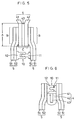
- Figs. 5 and 6 show the heat-sealed portions of other embodiments in which a fastener 10 comprising a male part 11 and a female part 12 is provided inside and outside, respectively, of the laminate 4.
- the fastener makes it possible to re-seal the package even after it has been opened.
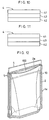
- Fig. 7 shows the structure of the laminate 4 of easily peelable tapes. It comprises layers 41 and 42 to be heat-fused to the laminates 5 of the pouch body and an easily peelable layer 43 interposed between the layers 41 and 42.
- Substrates 411 and 421 of the layers 41 and 42 should be made of polyester, nylon (trade name), polypropylene, polyethylene or a composite thereof.
- Their heat-bonding layers 412, 422 may be made of a resin heat-fusible to the laminates 5 of the pouch body, such as a polyolefin including polyethylene and polypropylene, an ethylene-vinyl acetate copolymer, polyester or polyamide.
- the heat-bonding layers 412, 422 may be omitted.
- Printed layers or colored layers may be disposed between the substrates 411 and 412 or between 421 and 422.
- the easily peelable layer 43 comprises a resin layer 431 and an adhesive layer 432.
- the resin layer 431 is made by pattern coating a material having a relatively low bond strength, such as vinyl resin, urethane resin, acrylic resin, methacrylic resin, polyamide resin, silicone resin or a mixture thereof. This layer may be in the form of patterns so that the non-coated portion will form dots (Fig. 8a), lines (Fig. 8b) or a lattice (Fig. 8c).
- the adhesive layer 432 should be preferably made of an adhesive whose bond strength drops little even if subjected to retort sterilization treatment.
- adhesives include a two-part hardenable urethane adhesive for dry bonding which can produce reactants of known polyol components and isocyanate components.
- a pressure-sensitive adhesive also can be used for the adhesive layer 432 and is not restricted to a specific type but may be any one of acrylic, rubber, vinyl and silicone types. But, the repeelable type is preferable to the permanent bond type. Also, for easiness in taking out the content, resealability of the pouch and the shock resistance, the adhesive having a high holding power but low in bond strength and tack is preferable.
- Fig. 9 shows the structure of one of the laminates 5 of the pouch body shown in Figs. 3 and 4. It comprises a substrate 51 and a heat-sealing layer 52.
- the substrate 51 is a laminate consisting of a surface protective layer 511, a gas barrier layer 512 and a reinforcing layer 513. Printed layers or colored layers may be added.
- the laminates 5 may have a different structure according to their intended use. For example, the gas barrier layer 512 or the reinforcing layer 513 may be omitted or the relative position of the layers 512 and 513 may be reversed.
- the heat sealing layer 52 is typically made of a polyolefin or an ethylene-vinyl acetate copolymer but may be made of any other material so long as it is heat-fusible to the heat-bonding layers 412 and 422 of the laminate 4 of easily peelable tapes. If the substrate 51 has a heat fusibility, this layer 52 may be omitted.
- the laminate 4 of easily peelable tapes has its inner end protruding inwardly beyond the heat-sealing portions B. Also, as shown in Fig. 3, it may protrude outwardly from the pouch. In such a case, the laminate 4 should be separated into two parts at a portion outside the pouch. The portion of the easily peelable laminate 4 protruding from the pouch serves as finger pickup tabs. By pinching the layers 41 and 42 with fingers and pulling them in opposite directions, the easily peelable layer 43 will be broken, so that the pouch can be opened easily. In Fig. 3, the easily peelable layer 43 does not exist at the finger pickup tabs which comprises separated layers 41 and 42. But this layer may be provided over the entire length of the layers 41 and 42 and the pickup tabs may be formed later by partially removing the layer 43.
- the inwardly protruding portion of the laminate 4 of easily peelable tapes serves to increase the compressive strength, drop impact strength and heat-sealing strength of the pouch. Since these stresses concentrate on the heat-fused portion C, normal internal pressure cannot break the easily peelable layer 43. The presence of the protruding portion presumably serves to prevent the breakage of the layer 43.
- the laminate 4 protrudes inwardly into the pouch by a length of 1 - 30 mm.
- the bond strength of the layer 43 it is possible to adjust the bond strength of the layer 43 to be in a range from about 10 to about 200 g/15 mm width so that the pouch will open automatically when the internal pressure rises sharply by heating the pouch in a microwave oven. In such a case, there is no need to have the easily peelable laminate 4 protruding outwardly from the pouch as shown in Fig. 3. Rather, it is preferable not to provide such protruding portion in order to prevent the pouch from being opened by mistake.
- Figs. 10 and 11 show other embodiments of the laminate 4 of easily peelable tapes.
- the easily peelable laminate 4 in Fig. 10 is formed by co-extruding synthetic resin. Resins should be selected so that at least one of the interlaminar bond strength between layers 41 and 43, the interlaminar bond strength between layers 42 and 43 and the cohesive strength of the layer 43 is lower than the others.
- the laminate 4 of easily peelable tapes in Fig. 11 is formed by laminating layers 41, 42 and 43 by thermal bonding.
- This embodiment is similar to the embodiment of Fig. 10 in that resins are selected so that at least one of the interlaminar bond strength between layers 41 and 43, the interlaminar bond strength between layers 42 and 43 and the cohesive strength of the layer 43 is lower than the others.
- the laminate 4 may be formed first by laminating layers 41 and 43 or layers 42 and 43 together by dry bonding or by co-extrusion and then laminating the layer 42 or 41 thereon by thermal bonding. Also, instead of providing the easily peelable laminate 4 beforehand, materials 41, 42 and 43, prepared separately, may be inserted into the pouch and thermal-bonded together when forming the pouch.
- a synthetic resin layer containing a large amount of inorganic filler may be provided.
- the laminate 4 of easily peelable tapes is provided to extend the entire length of the upper part of the pouch 1. But it may be provided partially.
- Figs. 1 and 2 show flat pouches.
- Fig. 12 shows a different embodiment in the form of a self-standing pouch.
- a laminate 4 of easily peelable tapes is inserted in the upper part of the self-standing pouch.
- a heat-sealed portion 2a is provided on the back side of the pouch by the laminate 5 of the pouch body and the laminate 4 of easily peelable tapes. But no such heat-sealed portion similar to 2a is formed on the front side of the pouch.
- a heat-sealing portion may be formed.
- the heat-sealed portion 2a is formed beforehand on the back side of the pouch. But, this portion may also be formed after putting a content into the pouch.
- Such an easy-to-open pouch can accommodate solid foods such as snacks, liquid foods such as soup, and foods comprising solid and liquid contents such as curry and gruel. It is particularly suited for accommodating liquid foods and liquid-solid mixed foods that are to be subjected to retort sterilization.
- This pouch can also accommodate medicines and electronic parts that are relatively heavy or have sharp parts.
- the laminate 4 of easily peelable tapes comprises layers 411, 421 in the form of 25 ⁇ m thick polyester films, layers 412, 422 in the form of 60 ⁇ m thick non-orientated polypropylene, and a layer 431 made of an acrylic resin and formed by pattern coating in the pattern shown in Fig. 8a.
- the layer 432 is made of a two-part hardening type urethane dry bonding adhesive for retorting.
- the laminates 5 of the pouch body see Fig.
- the layers are laminated together by means of a two-part hardening type urethane dry bonding adhesive for retorting.
- the laminate 4 of easily peelable tapes were made up of layers 411, 421 in the form of 25 ⁇ m thick polyester films, layers 412, 422 in the form of 60 ⁇ m thick non-orientated polypropylene film and a layer 431 formed by pattern coating an acrylic resin in the pattern shown in Fig. 8b.
- the layer 432 was made of a two-part hardening type urethane dry bonding adhesive for retorting.
- Each of the laminates 5 of the pouch body see Fig.
- an acrylic repeelable type adhesive was used for layer 432 and the layer 511 was a 25 ⁇ m thick polyester film, layer 512 was a 7 ⁇ m thick aluminum foil and layer 513 was a 25 ⁇ m thick polyester film. These layers were laminated together using a two-part hardening type urethane dry bond adhesive.
- the self-standable pouches thus obtaied were filled with water and sealed. Their compressive strength and drop strength were measured.
- the pouches were heated in a microwave oven. The results are shown in Table 3. As for spontaneous opening, those having a length of protrusion of 30 mm or shorter showed good results.
Landscapes
- Engineering & Computer Science (AREA)
- Mechanical Engineering (AREA)
- Bag Frames (AREA)
- Packages (AREA)
- Package Specialized In Special Use (AREA)
- Laminated Bodies (AREA)
Abstract
Description
- This invention relates to a package which is capable of being sealed by heat-fusing, as defined in the preamble of claim 1. Such a package can accommodate foods, medicines, electric parts and any other articles.
- Heretofore, in order to open a hermetically sealed pouch having a content heat sealed therein, one of the following methods was used:
- (1) breaking the heat-sealed portions, or
- (2) ripping open the pouch from a notch or similar rip-starting mark formed in the pouch.
- In order to form an opening according to the former method, the heat-sealing strength has to be rather low. Thus, it is neither suitable to pack a liquid or heavy substance nor to retort a package. Also, since the heat-sealing strength along the portion where the pouch is to be opened is not uniform, the pouch may not be opened smoothly. If one tries to open the pouch by force, it may get broken, so that the contents may scatter about and become useless.
- With the latter method, ripping requires a considerable force and it is difficult to rip open the pouch in a desired direction, i.e. to open the pouch at a desired portion. This increases the possibility of the scattering of contents. In order to solve this problem, various proposals have been made, e.g. using a material which is orientated strongly in a direction substantially parallel to the direction in which the pouch is intended to be torn apart, forming perforations to restrict the tear direction, or using a plastic reinforcing material. These measures all push up the cost of the pouch and are still not very effective.
- A package as defined in the preamble of claim 1 is known from BE-A-570 672. This prior art package bag is closed by heat-fusing the walls of the bag to an interposed closure-strip which is a paper-strip laminated on both sides with polyethylene. For opening the bag the entire closure-strip is torn off from the opening of the bag, rather than peeling the layers of the closure-strips from each other, which would not be easily possible because the polyethylene layers interlock with the fibres of the paper and will not be easily peelable therefrom.
- It is an object of this invention to provide an easy-to-open sealed package which can accommodate foods, medicines, electronic parts and any other goods, which can be easily opened by breaking the hermetically heat-sealed portion without the fear of scattering the contents.
- According to the invention the object is solved by a package as defined in claim 1.
- The laminate comprising the easily peelable intermediate layer may be formed by co-extruding synthetic resins or by thermal bonding.
- The laminate of easily peelable tapes may protrude farther into the package body than the heat-sealed portion of the package body.
- The laminate of easily peelable tapes may have its inner end inside the package body covered by the heat-bonding layers.
- A fastener comprising a male part and a female part may be provided inside or outside of the laminate of easily peelable tapes. It allows the package to be re-sealed after it has been opened. It will not have any undue effect on any other property of the package.
- By providing the laminate with an easily peelable intermediate layer at a portion where an opening is to be formed, the package can be opened easily from outside by hands. Also, when the package is heated in a microwave oven, ply separation will occur between the easily peelable tapes provided at the heat-sealing portion due to a sharp thermal expansion of water contained in the contents, so that the package can be opened automatically. When this happens, the contents in the sealing package would be pushed down and the package be deformed into a more stable shape. This prevents the contents from scattering about and soiling the surroundings.
- On the other hand, the pouch is sealed by heat-fusing whereby the contents are sealed reliably. By having the laminate of easily peelable tapes protruding into the pouch body, its sealability can be increased further to such an extent that the package can withstand the impact when it is dropped.
- The easy-to-open package according to the present invention has its laminate of easily peelable tapes inserted in the heat-sealing portion of the package body by heat-fusing. To open the package, the easily peelable layers are peeled from each other. Thus, the peeling strength is stable and the package can be opened very easily and without fail by hands or by the pressure increase in the package. The easily peelable tapes protrude farther inwardly than the heat-sealed portion. This arrangement serves to increase the compressive strength, drop impact strength and heat-sealing strength of the package.
- Namely, the easy-to-open package according to this invention can be opened easily without fail, is sufficiently strong and is easy and convenient to handle. Further, it is fairly cheap.
- Other features and objects of the present invention will become apparent from the following description taken with reference to the accompanying drawings, in which:
- Fig. 1 is a front view of the pouch of one embodiment of this invention;
- Fig. 2 is a front view of the pouch of another embodiment;
- Fig. 3 is an enlarged vertical sectional view of the heat-sealed portion of the pouch of Fig. 1;
- Fig. 4 is an enlarged vertical sectional view of the heat-sealed portion of the pouch of Fig. 2;
- Figs. 5 and 6 are enlarged vertical sectional views of the heat-sealed portions of other embodiments of the pouch according to the present invention;
- Fig. 7 is a sectional view of the laminate of easily peelable tapes;
- Fig. 8 is a plan view showing coating patterns of the resin layer of the same;
- Fig. 9 is a sectional view of the laminate of the pouch body;
- Fig. 10 is a sectional view of another embodiment of the laminate of easily peelable tapes;
- Fig. 11 is a sectional view of still another embodiment of the laminate of easily peelable tapes; and
- Fig. 12 is a perspective view of a self-standing pouch.
- Figs. 1 and 2 are front views of easy-to-open pouches 1. The pouches are heat-sealed at 2 to hermetically seal a
content 3. At portion A, the heat-sealedportion 2 consists of the outer heat-bonding layer (to be described later) in alaminate 4 of tapes which can be peeled easily from each other and heat-sealinglayers 5 which are parts of the pouch body. - Figs. 3 and 4 are sectional views of the heat-sealed portions of Figs. 1 and 2. As shown, the
laminate 4 of tapes which can be peeled easily from each other is disposed betweenlaminates 5 of the pouch body and heat-fused therebetween. If it is desired to avoid the contact between an easilypeelable layer 43 and the content, the inner side end of thelaminate 4 may be melted and hardened to cover the easilypeelable layer 43 with outer heat-bonding layers - Figs. 5 and 6 show the heat-sealed portions of other embodiments in which a
fastener 10 comprising amale part 11 and afemale part 12 is provided inside and outside, respectively, of thelaminate 4. The fastener makes it possible to re-seal the package even after it has been opened. - Fig. 7 shows the structure of the
laminate 4 of easily peelable tapes. It compriseslayers laminates 5 of the pouch body and an easilypeelable layer 43 interposed between thelayers Substrates 411 and 421 of thelayers bonding layers 412, 422 may be made of a resin heat-fusible to thelaminates 5 of the pouch body, such as a polyolefin including polyethylene and polypropylene, an ethylene-vinyl acetate copolymer, polyester or polyamide. If thesubstrates 411 and 421 are heat-fusible to thelaminates 5 of the pouch body, the heat-bondinglayers 412, 422 may be omitted. Printed layers or colored layers may be disposed between thesubstrates - The easily
peelable layer 43 comprises aresin layer 431 and an adhesive layer 432. Theresin layer 431 is made by pattern coating a material having a relatively low bond strength, such as vinyl resin, urethane resin, acrylic resin, methacrylic resin, polyamide resin, silicone resin or a mixture thereof. This layer may be in the form of patterns so that the non-coated portion will form dots (Fig. 8a), lines (Fig. 8b) or a lattice (Fig. 8c). - The adhesive layer 432 should be preferably made of an adhesive whose bond strength drops little even if subjected to retort sterilization treatment. Such adhesives include a two-part hardenable urethane adhesive for dry bonding which can produce reactants of known polyol components and isocyanate components.
- A pressure-sensitive adhesive also can be used for the adhesive layer 432 and is not restricted to a specific type but may be any one of acrylic, rubber, vinyl and silicone types. But, the repeelable type is preferable to the permanent bond type. Also, for easiness in taking out the content, resealability of the pouch and the shock resistance, the adhesive having a high holding power but low in bond strength and tack is preferable.
- Fig. 9 shows the structure of one of the
laminates 5 of the pouch body shown in Figs. 3 and 4. It comprises asubstrate 51 and a heat-sealing layer 52. Thesubstrate 51 is a laminate consisting of a surfaceprotective layer 511, a gas barrier layer 512 and a reinforcinglayer 513. Printed layers or colored layers may be added. Thelaminates 5 may have a different structure according to their intended use. For example, the gas barrier layer 512 or the reinforcinglayer 513 may be omitted or the relative position of thelayers 512 and 513 may be reversed. Theheat sealing layer 52 is typically made of a polyolefin or an ethylene-vinyl acetate copolymer but may be made of any other material so long as it is heat-fusible to the heat-bondinglayers 412 and 422 of thelaminate 4 of easily peelable tapes. If thesubstrate 51 has a heat fusibility, thislayer 52 may be omitted. - As shown in Figs. 3 and 4, the
laminate 4 of easily peelable tapes has its inner end protruding inwardly beyond the heat-sealing portions B. Also, as shown in Fig. 3, it may protrude outwardly from the pouch. In such a case, thelaminate 4 should be separated into two parts at a portion outside the pouch. The portion of the easilypeelable laminate 4 protruding from the pouch serves as finger pickup tabs. By pinching thelayers peelable layer 43 will be broken, so that the pouch can be opened easily. In Fig. 3, the easilypeelable layer 43 does not exist at the finger pickup tabs which comprises separatedlayers layers layer 43. - Also, the inwardly protruding portion of the
laminate 4 of easily peelable tapes serves to increase the compressive strength, drop impact strength and heat-sealing strength of the pouch. Since these stresses concentrate on the heat-fused portion C, normal internal pressure cannot break the easilypeelable layer 43. The presence of the protruding portion presumably serves to prevent the breakage of thelayer 43. - Preferably, the
laminate 4 protrudes inwardly into the pouch by a length of 1 - 30 mm. - It is possible to adjust the bond strength of the
layer 43 to be in a range from about 10 to about 200 g/15 mm width so that the pouch will open automatically when the internal pressure rises sharply by heating the pouch in a microwave oven. In such a case, there is no need to have the easilypeelable laminate 4 protruding outwardly from the pouch as shown in Fig. 3. Rather, it is preferable not to provide such protruding portion in order to prevent the pouch from being opened by mistake. - Figs. 10 and 11 show other embodiments of the
laminate 4 of easily peelable tapes. The easilypeelable laminate 4 in Fig. 10 is formed by co-extruding synthetic resin. Resins should be selected so that at least one of the interlaminar bond strength betweenlayers layers layer 43 is lower than the others. - The
laminate 4 of easily peelable tapes in Fig. 11 is formed by laminatinglayers layers layers layer 43 is lower than the others. - The
laminate 4 may be formed first by laminatinglayers layers layer peelable laminate 4 beforehand,materials - In order to reduce the cohesion force of the easily
peelable layer 43, a synthetic resin layer containing a large amount of inorganic filler may be provided. - In Figs. 1 and 2, the
laminate 4 of easily peelable tapes is provided to extend the entire length of the upper part of the pouch 1. But it may be provided partially. - Figs. 1 and 2 show flat pouches. Fig. 12 shows a different embodiment in the form of a self-standing pouch. A
laminate 4 of easily peelable tapes is inserted in the upper part of the self-standing pouch. In the figure, a heat-sealedportion 2a is provided on the back side of the pouch by thelaminate 5 of the pouch body and thelaminate 4 of easily peelable tapes. But no such heat-sealed portion similar to 2a is formed on the front side of the pouch. After putting a content into the pouch through this unsealedportion 100, a heat-sealing portion may be formed. In this embodiment, the heat-sealedportion 2a is formed beforehand on the back side of the pouch. But, this portion may also be formed after putting a content into the pouch. - The above embodiments are all related to pouches but this invention is also applicable to flexible bottles that are formed by blowing. In this case, too, a
laminate 4 of easily peelable tapes is inserted in the bottle at a portion where the opening is to be formed and heat-sealed to the bottle. - Such an easy-to-open pouch can accommodate solid foods such as snacks, liquid foods such as soup, and foods comprising solid and liquid contents such as curry and gruel. It is particularly suited for accommodating liquid foods and liquid-solid mixed foods that are to be subjected to retort sterilization. This pouch can also accommodate medicines and electronic parts that are relatively heavy or have sharp parts.
- We shall now describe experiments conducted on the easy-to-open pouch according to this invention.
- A flat pouch as shown in Figs. 1 and 3 were prepared. The
laminate 4 of easily peelable tapes (see Fig. 7) compriseslayers 411, 421 in the form of 25µm thick polyester films, layers 412, 422 in the form of 60µm thick non-orientated polypropylene, and alayer 431 made of an acrylic resin and formed by pattern coating in the pattern shown in Fig. 8a. The layer 432 is made of a two-part hardening type urethane dry bonding adhesive for retorting. Thelaminates 5 of the pouch body (see Fig. 9) comprise each alayer 511 in the form of a 12µm thick polyester film, a layer 512 in the form of a 7µm thick aluminum foil, alayer 513 in the form of a 15µm thick nylon film and alayer 52 in the form of a 60µm thick non-orientated polypropylene film. The layers are laminated together by means of a two-part hardening type urethane dry bonding adhesive for retorting. - The following items were packed separately in the pouches and the pouches were sealed: tap water, curry on the market (packed in a retort pouch), Chinese sauce on the market (packed in a retort pouch) and compound sauce (salad oil: vinegar: tomato ketchup = 1:1:1). After subjecting them to retorting for 30 minutes at 121 C or for 10 minutes at 135 C, they were tested for heat-sealing strength, drop strength, compressive strength and leakage according to JIS Z 0238 test method B. The results are shown in Table 1. The pouches could be opened very easily without spilling the contents or getting the hands soiled with contents.
- Self-standing pouches as shown in Figs. 2 and 4 were prepared. The
laminate 4 of easily peelable tapes (see Fig. 7) were made up oflayers 411, 421 in the form of 25µm thick polyester films, layers 412, 422 in the form of 60µm thick non-orientated polypropylene film and alayer 431 formed by pattern coating an acrylic resin in the pattern shown in Fig. 8b. The layer 432 was made of a two-part hardening type urethane dry bonding adhesive for retorting. Each of thelaminates 5 of the pouch body (see Fig. 9) was composed of alayer 511 in the form of a 12-micron thick polyester film, alayer 513 in the form of a 15-micron thick nylon film and alayer 52 in the form of a 60-micron thick non-orientated polypropylene film. The adjacent layers were laminated together by means of a two-part hardening type urethane dry bonding adhesive for retorting. - The following items were packed in these pouches and the pouches were sealed: tap water, curry on the market, cooking materials on the market for rice bowls and corn soup on the market, each 120g. After subjecting them to retort treatment for 30 minutes at 121 C, they were heated in a microwave oven. The test results are shown in Table 2. As for the spontaneous opening of the pouch, those having their
laminates 4 protruding inwardly for a length of 30mm or less showed especially good results. - In a similar structure to
Experiment 2, an acrylic repeelable type adhesive was used for layer 432 and thelayer 511 was a 25µm thick polyester film, layer 512 was a 7µm thick aluminum foil andlayer 513 was a 25µm thick polyester film. These layers were laminated together using a two-part hardening type urethane dry bond adhesive. - The self-standable pouches thus obtaied were filled with water and sealed. Their compressive strength and drop strength were measured. The pouches were heated in a microwave oven. The results are shown in Table 3. As for spontaneous opening, those having a length of protrusion of 30 mm or shorter showed good results.
[Table 1] Retort Condition 121 °C, 30 minutes 135 °C, 10 minutes Content Tap water Curry Chinese sauce Mixed sauce Tap water Curry Chinese sauce Mixed sauce Appearance Nothing abnormal Nothing abnormal Nothing abnormal Nothing abnormal Nothing abnormal Nothing abnormal Nothing abnormal Nothing abnormal Heat seal strength (N/15 mm wide) 44 45 37 42 43 40 42 39 Drop strength ○ ○ ○ ○ ○ ○ ○ ○ Compressive strength ○ ○ ○ ○ ○ ○ ○ ○ Leakage (B method) No leak No leak No leak No leak No leak No leak No leak No leak [Table 2] Length of protrusion into pouch (in mm) Content Not subjected to retorting Subjected to retorting Spontaneous opening State after retort Spontaneous opening 0 Water ○ Leak found 0 Curry ○ Leak found 0 Material for domburi ○ Leak found 0 Corn soup ○ Leak found 1 Corn soup ○ No leak ○ 3 Corn soup ○ No leak ○ 5 Corn soup ○ No leak ○ 10 Corn soup ○ No leak ○ 15 Corn soup ○ No leak ○ 20 Corn soup ○ No leak ○ 25 Corn soup ○ No leak ○ 30 Corn soup ○ No leak ○ 35 Corn soup X No leak X 40 Corn soup X No leak X Table 3 Length of protrusion into pouch (in mm) Compressive strength Drop strength Spontaneous opening when heated in microwave oven 0 ○ Leak found ○ 1 ○ No leak ○ 3 ○ No leak ○ 5 ○ No leak ○ 10 ○ No leak ○ 15 ○ No leak ○ 20 ○ No leak ○ 25 ○ No leak ○ 30 ○ No leak ○ 35 ○ No leak X 40 ○ No leak X
Claims (9)
- A package capable of being sealed by heat-fusing, comprising a package body (1) having a heat-sealing layer (52) and a laminate (4) of tapes provided at a heat-sealed portion (2) of the package (1) where an opening is to be formed, said laminate (4) of tapes comprising outer heat-bonding layers (41, 42) heat-fusible to heat-sealing layers (52) provided on the package body (1) and an intermediate layer (43) disposed between said heat bonding layers (41, 42), characterized in that said intermediate layer (43) is an easily peelable layer made of a synthetic resin.
- A package as claimed in claim 1 wherein said easily peelable layer (43) comprises a resin layer (431) pattern-coated on one of said outer heat-bonding layers (41, 42) and an adhesive layer (432) covering said resin layer (431), said resin layer having a lower bond strength than said adhesive layer.
- A package as claimed in claim 1 wherein said easily peelable layer (43) comprises a resin layer (431) pattern-coated on one of said outer heat-bonding layers (41, 42) and a pressure-sensitive adhesive layer (431) covering said resin layer, said resin layer having a lower bond strength than said pressure-sensitive adhesive layer.
- A package as claimed in claim 1 wherein said laminate (4) of easily peelable tapes are formed by co-extruding synthetic resins.
- A package as claimed in claim 1 wherein said laminate (4) of easily peelable tapes are formed by thermal bonding.
- A package as claimed in any of claims 1 - 5 wherein said laminate (4) of easily peelable tapes protrudes farther into the package body (1) than said heat-sealed portion (2) of the package body.
- A package as claimed in claim 6 wherein said laminate (4) of easily peelable tapes has its inner end inside the package body (1) covered by said heat-bonding layers (41, 42).
- A package as claimed in claim 1, further comprising a fastener member (10) provided outside of said laminate (4) of easily peelable tapes so as to be parallel to said laminate (4).
- A package as claimed in claim 1, further comprising a fastener member (10) provided inside of said laminate (4) of easily peelable tapes so as to be parallel to said laminate (4).
Applications Claiming Priority (8)
| Application Number | Priority Date | Filing Date | Title |
|---|---|---|---|
| JP29315191 | 1991-11-08 | ||
| JP293151/91 | 1991-11-08 | ||
| JP4102392A JPH05246442A (en) | 1992-02-27 | 1992-02-27 | Packaging bag |
| JP41023/92 | 1992-02-27 | ||
| JP63793/92 | 1992-03-19 | ||
| JP4063793A JP2510807B2 (en) | 1991-11-08 | 1992-03-19 | Package |
| JP18681792A JPH0632359A (en) | 1992-07-14 | 1992-07-14 | Packaging bag |
| JP186817/92 | 1992-07-14 |
Publications (2)
| Publication Number | Publication Date |
|---|---|
| EP0541093A1 EP0541093A1 (en) | 1993-05-12 |
| EP0541093B1 true EP0541093B1 (en) | 1997-02-26 |
Family
ID=27460985
Family Applications (1)
| Application Number | Title | Priority Date | Filing Date |
|---|---|---|---|
| EP92118981A Expired - Lifetime EP0541093B1 (en) | 1991-11-08 | 1992-11-05 | Package capable of being sealed by heat-fusing |
Country Status (6)
| Country | Link |
|---|---|
| US (1) | US5330269A (en) |
| EP (1) | EP0541093B1 (en) |
| KR (1) | KR930009878A (en) |
| AT (1) | ATE149132T1 (en) |
| CA (1) | CA2082374A1 (en) |
| DE (1) | DE69217609T2 (en) |
Families Citing this family (59)
| Publication number | Priority date | Publication date | Assignee | Title |
|---|---|---|---|---|
| US6019923A (en) * | 1992-08-25 | 2000-02-01 | Hp-Chemie Pelzer Research & Development Ltd. | Process for manufacturing decorable moulded parts |
| JPH07112746A (en) * | 1993-10-19 | 1995-05-02 | Idemitsu Petrochem Co Ltd | Easily openable sealed bag |
| US5647671A (en) * | 1994-04-11 | 1997-07-15 | Reynolds Consumer Products, Inc. | Closure arrangement having a peelable seal |
| US5904425A (en) * | 1994-04-11 | 1999-05-18 | Reynolds Consumer Products, Inc. | Closure arrangement having a peelable seal |
| US5470156A (en) * | 1994-04-11 | 1995-11-28 | Reynolds Consumer Products, Inc. | Closure arrangement having a peelable seal |
| US5725312A (en) * | 1994-04-11 | 1998-03-10 | Reynolds Consumer Products, Inc. | Closure arrangement having a peelable seal |
| FR2725957B1 (en) * | 1994-10-19 | 1997-01-10 | Flexico France Sarl | PERFECTED INVIOLABLE AND CLOSABLE BAG |
| US5492411A (en) * | 1995-01-18 | 1996-02-20 | Reynolds Consumer Products Inc. | Tamper evident peelable seal |
| US5882789A (en) * | 1995-06-07 | 1999-03-16 | Pechiney Recherche | Packaging material for forming an easy-opening reclosable packaging material and package |
| US5882749A (en) * | 1995-06-08 | 1999-03-16 | Pechiney Recherche | Easy-opening reclosable package |
| CA2203086A1 (en) * | 1996-04-29 | 1997-10-29 | Illinois Tool Works Inc. | Controlled peel seal with indicating feature |
| US5851070A (en) * | 1996-12-05 | 1998-12-22 | Tenneco Packaging Inc. | Seals for plastic bags |
| US6376035B1 (en) | 1996-12-05 | 2002-04-23 | Pactiv Corporation | Zipper fins for plastic bags |
| US5919535A (en) * | 1996-12-05 | 1999-07-06 | Tenneco Packaging | Fins for plastic bags |
| US6270255B1 (en) * | 1997-04-18 | 2001-08-07 | Kraft Foods, Inc. | Opening system for beverage container |
| US6059456A (en) * | 1997-04-23 | 2000-05-09 | Reynolds Consumer Products, Inc. | Reclosable profile arrangement using slidable closure strip |
| GB9715922D0 (en) * | 1997-07-28 | 1997-10-01 | Mars Uk Ltd | Beverage-producing packages |
| GB9715921D0 (en) * | 1997-07-28 | 1997-10-01 | Mars Uk Ltd | Beverage-producing packages |
| US6131248A (en) * | 1998-03-13 | 2000-10-17 | Reynolds Consumer Products, Inc. | Peelable seal on closure mechanism and method therefor |
| DE59805411D1 (en) * | 1998-05-13 | 2002-10-10 | Alcan Tech & Man Ag | Packaging container with a packaging film with integrated opening and reclosing system |
| US5972396A (en) | 1998-05-15 | 1999-10-26 | Recot, Inc. | Flexible package having a re-closable zipper |
| DE19922676B4 (en) | 1999-05-18 | 2005-02-24 | Mars, Inc. | Use of a gripper device for the row-wise detection of pouches |
| DE19946257C2 (en) * | 1999-09-27 | 2001-10-04 | Letsch Klaus Peter | Packaging for holding two halves of bread rolls with a sandwich bag in between and a device for emptying them |
| GB9923986D0 (en) * | 1999-10-12 | 1999-12-15 | Supreme Plastics Group Ltd | Plastic bags |
| US6499878B1 (en) | 1999-12-21 | 2002-12-31 | Pactiv Corporation | Reclosable packages with barrier properties |
| US6280085B1 (en) * | 2000-03-20 | 2001-08-28 | Fres-Co System Usa, Inc. | Flexible package with peel-away covering |
| US6485177B2 (en) * | 2001-03-07 | 2002-11-26 | Gary M. Bell | Flexible stand-up pouch constructions for dispensing liquids |
| US6611996B2 (en) | 2001-07-02 | 2003-09-02 | Pactiv Corporation | Slider for reclosable fastener |
| US6713152B2 (en) | 2001-09-07 | 2004-03-30 | Pactiv Corporation | Fins and profiles for plastic bags |
| US7159282B2 (en) | 2002-03-01 | 2007-01-09 | Pactiv Corporation | Reclosable fasteners or zippers for use with polymeric bags |
| FR2838722B1 (en) * | 2002-04-22 | 2004-07-16 | Saint Andre Plastique | FOOD PACKAGE COMPRISING AT LEAST ONE LOWER STRENGTH SEALING AREA |
| GB0217946D0 (en) * | 2002-08-02 | 2002-09-11 | Supreme Plastics Holdings Ltd | Improvements in reclosable bags and like containers |
| US8590282B2 (en) | 2002-09-19 | 2013-11-26 | Poppack, Llc | Package with unique opening device and method for opening package |
| US20050008266A1 (en) * | 2003-07-10 | 2005-01-13 | Crunkleton Gregory H. | Reclosable package having internal seal made of double-sided adhesive tape |
| JP4569249B2 (en) * | 2003-11-28 | 2010-10-27 | 東洋製罐株式会社 | Packaging container for microwave oven |
| US7331160B2 (en) * | 2003-12-19 | 2008-02-19 | Reynolds Consumer Products, Inc. | Top filled reclosable package with separate membrane and method for forming and filling the same |
| US6845598B1 (en) * | 2003-12-19 | 2005-01-25 | Reynolds Consumer Products, Inc. | Top filled reclosable package and method for forming and filling the same |
| US20060141241A1 (en) * | 2004-12-23 | 2006-06-29 | Carespodi Dennis L | Peelable breakaway multi-layered structures and methods and compositions for making such structures |
| US7422782B2 (en) * | 2005-02-01 | 2008-09-09 | Curwood, Inc. | Peelable/resealable packaging film |
| DK1762378T3 (en) * | 2005-09-07 | 2008-12-08 | Alcan Tech & Man Ltd | Process for preparing a laminate for a packaging container |
| GB0519320D0 (en) * | 2005-09-22 | 2005-11-02 | Paragon Flexible Packaging Ltd | Film for packaging |
| US20070104398A1 (en) * | 2005-11-10 | 2007-05-10 | Ours David C | Container With Peelable Seal Assembly and Method of Making |
| CN102744946A (en) * | 2006-06-27 | 2012-10-24 | 出光统一科技株式会社 | Laminated tape, package, and process for producing laminated tape |
| WO2008051813A1 (en) * | 2006-10-19 | 2008-05-02 | Wm. Wrigley, Jr. Company | Reclosable packages for confectionery products |
| DK2093153T3 (en) * | 2006-12-08 | 2012-12-10 | Seisan Nipponsha Ltd | Open-function synthetic resin bag body |
| ES2357151T3 (en) * | 2007-07-20 | 2011-04-19 | Goglio S.P.A. | VERTICAL PACKAGE, EASY TO OPEN AND CLOSE FLEXIBLE MATERIAL, PARTICULARLY FOR LIQUID, VISCOSE, PASTABLE, GRANULAR OR POWDERED PRODUCTS. |
| NL1035016C2 (en) * | 2008-02-12 | 2009-08-13 | Wezel Verpakkingen Breda B V Van | Package for packaging of perishable goods i.e. foodstuff e.g. meat, has reusable closure for sealing opening of container, where container is formed from sheet of foil, and seal is fitted along all open edges of foil |
| EP2669211B1 (en) | 2008-04-23 | 2015-01-28 | Reynolds Presto Products Inc. | Package closure for withstanding internal forces |
| US20100147724A1 (en) * | 2008-12-12 | 2010-06-17 | Ujjaini Mitra-Shah | Tamper indicator for reclosable packages |
| US20100278462A1 (en) * | 2009-05-01 | 2010-11-04 | Poppack, Llc | Package With One or More Access Points For Breaking One or More Seals and Accessing the Contents of the Package |
| IT1395210B1 (en) * | 2009-07-28 | 2012-09-05 | Wild Parma S R L | ENVELOPE TO KEEP AT LEAST ONE SUBSTANCE, BAG FOR PACKAGING INCLUDING THIS ENVELOPE AND METHODS OF MANUFACTURING THESE |
| DE202011005157U1 (en) * | 2011-04-12 | 2014-07-30 | Rwr Patentverwaltung Gbr (Vertreten Durch Josef Und Michael Rothen, Harald Wallner) | Material composite, use of a composite material, as well as packaging with composite material |
| IN2014DE01925A (en) * | 2014-07-10 | 2015-07-31 | Ashok Chaturvedi | |
| US9930945B2 (en) * | 2015-10-08 | 2018-04-03 | Nice Touch, LLC | Systems and methods for a protective sleeve for electronic devices |
| DE102016109461A1 (en) * | 2016-05-23 | 2017-11-23 | Südpack Verpackungen GmbH & Co. KG | packaging |
| US11377265B1 (en) * | 2018-09-12 | 2022-07-05 | Lisa M. Litts | Bag closing seal |
| US11724866B2 (en) | 2019-02-15 | 2023-08-15 | Poppack Llc | Package with unique opening device and method of producing packages |
| US11383909B2 (en) | 2019-02-27 | 2022-07-12 | Poppack Llc | Easy to open package with controlled dispensing device |
| US12473122B2 (en) * | 2021-06-15 | 2025-11-18 | Totani Corporation | Bag |
Family Cites Families (12)
| Publication number | Priority date | Publication date | Assignee | Title |
|---|---|---|---|---|
| BE570672A (en) * | 1957-08-29 | |||
| US4190154A (en) * | 1978-02-06 | 1980-02-26 | Bausch & Lomb Incorporated | Sterile package |
| ZA833340B (en) * | 1982-10-08 | 1984-01-25 | Grace W R & Co | Easy open bag having rupture strip |
| US4709397A (en) * | 1985-12-24 | 1987-11-24 | John H. Harland Company | Tamper-evident envelope with indicia-forming cohesive layers |
| US4782951A (en) * | 1986-03-20 | 1988-11-08 | Oscar Mayer Foods Corporation | Reclosable package and method of making reclosable package |
| US4925316A (en) * | 1986-08-11 | 1990-05-15 | Minigrip, Inc. | Reclosable bag having an outer reclosable zipper type closure and inner non-reclosable closure |
| US4758099A (en) * | 1987-01-29 | 1988-07-19 | Kcl Corporation | Flexible container having resealable closure |
| AU606168B2 (en) * | 1987-05-20 | 1991-01-31 | Toyo Seikan Kaisha Ltd. | Easily openable sealed container |
| US5060848A (en) * | 1988-05-13 | 1991-10-29 | Frederick R. Ewan | Tamper indicating containers and seals |
| US4905298A (en) * | 1988-12-12 | 1990-02-27 | Walor Curtis J | Resealable closure |
| US4966470A (en) * | 1989-02-24 | 1990-10-30 | Oscar Mayer Foods Corporation | Tamper-evident, reclosable, flexible packages |
| GB2243143B (en) * | 1990-03-23 | 1994-08-10 | Minnesota Mining & Mfg | Flexible bag having means for indicating tampering |
-
1992
- 1992-11-05 KR KR1019920020672A patent/KR930009878A/en not_active Ceased
- 1992-11-05 EP EP92118981A patent/EP0541093B1/en not_active Expired - Lifetime
- 1992-11-05 DE DE69217609T patent/DE69217609T2/en not_active Expired - Fee Related
- 1992-11-05 AT AT92118981T patent/ATE149132T1/en not_active IP Right Cessation
- 1992-11-06 CA CA002082374A patent/CA2082374A1/en not_active Abandoned
- 1992-11-06 US US07/972,891 patent/US5330269A/en not_active Expired - Fee Related
Also Published As
| Publication number | Publication date |
|---|---|
| CA2082374A1 (en) | 1993-05-09 |
| US5330269A (en) | 1994-07-19 |
| EP0541093A1 (en) | 1993-05-12 |
| DE69217609T2 (en) | 1997-07-17 |
| KR930009878A (en) | 1993-06-21 |
| DE69217609D1 (en) | 1997-04-03 |
| ATE149132T1 (en) | 1997-03-15 |
Similar Documents
| Publication | Publication Date | Title |
|---|---|---|
| US5330269A (en) | Package | |
| US6244748B1 (en) | Plastic package with fastener | |
| EP0648687B1 (en) | Easily-openable, hermetically-sealed, packaging bag | |
| DE3877962D1 (en) | BAG FOR HEATABLE FOOD. | |
| JP5508900B2 (en) | Microwave oven cooking bag | |
| JPS6183039A (en) | Flexible packaging multilayer film | |
| GB2133382A (en) | Flexible thermoplastic bag | |
| EP2540187A1 (en) | Zipper tape and package bag with zipper tape | |
| JP4010038B2 (en) | Sealed packaging bag having an opening / closing part | |
| JP4366772B2 (en) | Packaging for microwave oven | |
| JP4811558B2 (en) | Packaging bag with zipper | |
| EP1010632B1 (en) | Plastic container with fastener | |
| JPH10147352A (en) | Plastic container with fastener | |
| JP4088996B2 (en) | Multi-room pouch | |
| JPH05246442A (en) | Packaging bag | |
| EP2004513A1 (en) | Gusseted pouch | |
| JP3867474B2 (en) | Easy-open composite film and packaging container | |
| JP2510807B2 (en) | Package | |
| JPH0632359A (en) | Packaging bag | |
| JP2007331805A (en) | Chuck and heat sterilized bag using the same | |
| JPH06312751A (en) | Packing body | |
| JP7176250B2 (en) | pouch | |
| JP7176251B2 (en) | pouch | |
| JP2023042192A (en) | packaging bag | |
| EP1323642A1 (en) | Cushioning packaging method, cushioning package body, and cushioning package bag |
Legal Events
| Date | Code | Title | Description |
|---|---|---|---|
| PUAI | Public reference made under article 153(3) epc to a published international application that has entered the european phase |
Free format text: ORIGINAL CODE: 0009012 |
|
| AK | Designated contracting states |
Kind code of ref document: A1 Designated state(s): AT CH DE FR GB IT LI |
|
| 17P | Request for examination filed |
Effective date: 19931018 |
|
| 17Q | First examination report despatched |
Effective date: 19941227 |
|
| GRAG | Despatch of communication of intention to grant |
Free format text: ORIGINAL CODE: EPIDOS AGRA |
|
| GRAH | Despatch of communication of intention to grant a patent |
Free format text: ORIGINAL CODE: EPIDOS IGRA |
|
| GRAH | Despatch of communication of intention to grant a patent |
Free format text: ORIGINAL CODE: EPIDOS IGRA |
|
| GRAA | (expected) grant |
Free format text: ORIGINAL CODE: 0009210 |
|
| AK | Designated contracting states |
Kind code of ref document: B1 Designated state(s): AT CH DE FR GB IT LI |
|
| REF | Corresponds to: |
Ref document number: 149132 Country of ref document: AT Date of ref document: 19970315 Kind code of ref document: T |
|
| REG | Reference to a national code |
Ref country code: CH Ref legal event code: EP |
|
| REF | Corresponds to: |
Ref document number: 69217609 Country of ref document: DE Date of ref document: 19970403 |
|
| REG | Reference to a national code |
Ref country code: CH Ref legal event code: NV Representative=s name: KIRKER & CIE SA |
|
| ITF | It: translation for a ep patent filed | ||
| ET | Fr: translation filed | ||
| PLBE | No opposition filed within time limit |
Free format text: ORIGINAL CODE: 0009261 |
|
| STAA | Information on the status of an ep patent application or granted ep patent |
Free format text: STATUS: NO OPPOSITION FILED WITHIN TIME LIMIT |
|
| 26N | No opposition filed | ||
| PGFP | Annual fee paid to national office [announced via postgrant information from national office to epo] |
Ref country code: GB Payment date: 19981008 Year of fee payment: 7 |
|
| PGFP | Annual fee paid to national office [announced via postgrant information from national office to epo] |
Ref country code: FR Payment date: 19981019 Year of fee payment: 7 |
|
| PGFP | Annual fee paid to national office [announced via postgrant information from national office to epo] |
Ref country code: AT Payment date: 19981119 Year of fee payment: 7 |
|
| PGFP | Annual fee paid to national office [announced via postgrant information from national office to epo] |
Ref country code: CH Payment date: 19981126 Year of fee payment: 7 |
|
| PGFP | Annual fee paid to national office [announced via postgrant information from national office to epo] |
Ref country code: DE Payment date: 19990120 Year of fee payment: 7 |
|
| PG25 | Lapsed in a contracting state [announced via postgrant information from national office to epo] |
Ref country code: GB Free format text: LAPSE BECAUSE OF NON-PAYMENT OF DUE FEES Effective date: 19991105 Ref country code: AT Free format text: LAPSE BECAUSE OF NON-PAYMENT OF DUE FEES Effective date: 19991105 |
|
| PG25 | Lapsed in a contracting state [announced via postgrant information from national office to epo] |
Ref country code: LI Free format text: LAPSE BECAUSE OF NON-PAYMENT OF DUE FEES Effective date: 19991130 Ref country code: CH Free format text: LAPSE BECAUSE OF NON-PAYMENT OF DUE FEES Effective date: 19991130 |
|
| GBPC | Gb: european patent ceased through non-payment of renewal fee |
Effective date: 19991105 |
|
| REG | Reference to a national code |
Ref country code: CH Ref legal event code: PL |
|
| PG25 | Lapsed in a contracting state [announced via postgrant information from national office to epo] |
Ref country code: FR Free format text: LAPSE BECAUSE OF NON-PAYMENT OF DUE FEES Effective date: 20000731 |
|
| PG25 | Lapsed in a contracting state [announced via postgrant information from national office to epo] |
Ref country code: DE Free format text: LAPSE BECAUSE OF NON-PAYMENT OF DUE FEES Effective date: 20000901 |
|
| REG | Reference to a national code |
Ref country code: FR Ref legal event code: ST |
|
| PG25 | Lapsed in a contracting state [announced via postgrant information from national office to epo] |
Ref country code: IT Free format text: LAPSE BECAUSE OF NON-PAYMENT OF DUE FEES Effective date: 20051105 |