EP0533579A1 - Nouveaux dérivés de la trimétazidine, leur procédé de préparation et les compositions pharmaceutiques les contenant - Google Patents
Nouveaux dérivés de la trimétazidine, leur procédé de préparation et les compositions pharmaceutiques les contenant Download PDFInfo
- Publication number
- EP0533579A1 EP0533579A1 EP92402566A EP92402566A EP0533579A1 EP 0533579 A1 EP0533579 A1 EP 0533579A1 EP 92402566 A EP92402566 A EP 92402566A EP 92402566 A EP92402566 A EP 92402566A EP 0533579 A1 EP0533579 A1 EP 0533579A1
- Authority
- EP
- European Patent Office
- Prior art keywords
- radical
- hydroxy
- piperazine
- trimethoxybenzyl
- derivatives
- Prior art date
- Legal status (The legal status is an assumption and is not a legal conclusion. Google has not performed a legal analysis and makes no representation as to the accuracy of the status listed.)
- Granted
Links
- 0 CC(C1*)*=C(*)C2=C1OC(C)(*)CC2 Chemical compound CC(C1*)*=C(*)C2=C1OC(C)(*)CC2 0.000 description 3
Classifications
-
- C—CHEMISTRY; METALLURGY
- C07—ORGANIC CHEMISTRY
- C07D—HETEROCYCLIC COMPOUNDS
- C07D295/00—Heterocyclic compounds containing polymethylene-imine rings with at least five ring members, 3-azabicyclo [3.2.2] nonane, piperazine, morpholine or thiomorpholine rings, having only hydrogen atoms directly attached to the ring carbon atoms
- C07D295/04—Heterocyclic compounds containing polymethylene-imine rings with at least five ring members, 3-azabicyclo [3.2.2] nonane, piperazine, morpholine or thiomorpholine rings, having only hydrogen atoms directly attached to the ring carbon atoms with substituted hydrocarbon radicals attached to ring nitrogen atoms
- C07D295/08—Heterocyclic compounds containing polymethylene-imine rings with at least five ring members, 3-azabicyclo [3.2.2] nonane, piperazine, morpholine or thiomorpholine rings, having only hydrogen atoms directly attached to the ring carbon atoms with substituted hydrocarbon radicals attached to ring nitrogen atoms substituted by singly bound oxygen or sulfur atoms
- C07D295/096—Heterocyclic compounds containing polymethylene-imine rings with at least five ring members, 3-azabicyclo [3.2.2] nonane, piperazine, morpholine or thiomorpholine rings, having only hydrogen atoms directly attached to the ring carbon atoms with substituted hydrocarbon radicals attached to ring nitrogen atoms substituted by singly bound oxygen or sulfur atoms with the ring nitrogen atoms and the oxygen or sulfur atoms separated by carbocyclic rings or by carbon chains interrupted by carbocyclic rings
-
- A—HUMAN NECESSITIES
- A61—MEDICAL OR VETERINARY SCIENCE; HYGIENE
- A61P—SPECIFIC THERAPEUTIC ACTIVITY OF CHEMICAL COMPOUNDS OR MEDICINAL PREPARATIONS
- A61P9/00—Drugs for disorders of the cardiovascular system
-
- A—HUMAN NECESSITIES
- A61—MEDICAL OR VETERINARY SCIENCE; HYGIENE
- A61P—SPECIFIC THERAPEUTIC ACTIVITY OF CHEMICAL COMPOUNDS OR MEDICINAL PREPARATIONS
- A61P9/00—Drugs for disorders of the cardiovascular system
- A61P9/10—Drugs for disorders of the cardiovascular system for treating ischaemic or atherosclerotic diseases, e.g. antianginal drugs, coronary vasodilators, drugs for myocardial infarction, retinopathy, cerebrovascula insufficiency, renal arteriosclerosis
-
- C—CHEMISTRY; METALLURGY
- C07—ORGANIC CHEMISTRY
- C07D—HETEROCYCLIC COMPOUNDS
- C07D295/00—Heterocyclic compounds containing polymethylene-imine rings with at least five ring members, 3-azabicyclo [3.2.2] nonane, piperazine, morpholine or thiomorpholine rings, having only hydrogen atoms directly attached to the ring carbon atoms
- C07D295/04—Heterocyclic compounds containing polymethylene-imine rings with at least five ring members, 3-azabicyclo [3.2.2] nonane, piperazine, morpholine or thiomorpholine rings, having only hydrogen atoms directly attached to the ring carbon atoms with substituted hydrocarbon radicals attached to ring nitrogen atoms
- C07D295/08—Heterocyclic compounds containing polymethylene-imine rings with at least five ring members, 3-azabicyclo [3.2.2] nonane, piperazine, morpholine or thiomorpholine rings, having only hydrogen atoms directly attached to the ring carbon atoms with substituted hydrocarbon radicals attached to ring nitrogen atoms substituted by singly bound oxygen or sulfur atoms
- C07D295/084—Heterocyclic compounds containing polymethylene-imine rings with at least five ring members, 3-azabicyclo [3.2.2] nonane, piperazine, morpholine or thiomorpholine rings, having only hydrogen atoms directly attached to the ring carbon atoms with substituted hydrocarbon radicals attached to ring nitrogen atoms substituted by singly bound oxygen or sulfur atoms with the ring nitrogen atoms and the oxygen or sulfur atoms attached to the same carbon chain, which is not interrupted by carbocyclic rings
- C07D295/088—Heterocyclic compounds containing polymethylene-imine rings with at least five ring members, 3-azabicyclo [3.2.2] nonane, piperazine, morpholine or thiomorpholine rings, having only hydrogen atoms directly attached to the ring carbon atoms with substituted hydrocarbon radicals attached to ring nitrogen atoms substituted by singly bound oxygen or sulfur atoms with the ring nitrogen atoms and the oxygen or sulfur atoms attached to the same carbon chain, which is not interrupted by carbocyclic rings to an acyclic saturated chain
-
- C—CHEMISTRY; METALLURGY
- C07—ORGANIC CHEMISTRY
- C07D—HETEROCYCLIC COMPOUNDS
- C07D307/00—Heterocyclic compounds containing five-membered rings having one oxygen atom as the only ring hetero atom
- C07D307/77—Heterocyclic compounds containing five-membered rings having one oxygen atom as the only ring hetero atom ortho- or peri-condensed with carbocyclic rings or ring systems
- C07D307/78—Benzo [b] furans; Hydrogenated benzo [b] furans
- C07D307/79—Benzo [b] furans; Hydrogenated benzo [b] furans with only hydrogen atoms, hydrocarbon or substituted hydrocarbon radicals, directly attached to carbon atoms of the hetero ring
- C07D307/81—Radicals substituted by nitrogen atoms not forming part of a nitro radical
-
- C—CHEMISTRY; METALLURGY
- C07—ORGANIC CHEMISTRY
- C07D—HETEROCYCLIC COMPOUNDS
- C07D333/00—Heterocyclic compounds containing five-membered rings having one sulfur atom as the only ring hetero atom
- C07D333/50—Heterocyclic compounds containing five-membered rings having one sulfur atom as the only ring hetero atom condensed with carbocyclic rings or ring systems
- C07D333/52—Benzo[b]thiophenes; Hydrogenated benzo[b]thiophenes
- C07D333/54—Benzo[b]thiophenes; Hydrogenated benzo[b]thiophenes with only hydrogen atoms, hydrocarbon or substituted hydrocarbon radicals, directly attached to carbon atoms of the hetero ring
- C07D333/58—Radicals substituted by nitrogen atoms
Definitions
- the subject of the present invention is new derivatives of trimetazidine, their preparation process and the pharmaceutical compositions containing them.
- reaction of derivatives II and III can be carried out without solvent, with an excess of derivative III which acts as an acceptor of the acid formed during the reaction, at a temperature between 80 and 180 ° C. .
- such a reaction is carried out in a solvent chosen from aromatic hydrocarbons such as, for example, toluene and xylene, and polar aprotic solvents such as methyl cyanide, dimethylformamide and dimethylacetamide, operating at a temperature between 80 and 130 ° C., in the presence of an acceptor of the ZH acid formed during the reaction - this acceptor being either a sodium or potassium carbonate, or triethylamine, or an excess of derivative III .
- aromatic hydrocarbons such as, for example, toluene and xylene
- polar aprotic solvents such as methyl cyanide, dimethylformamide and dimethylacetamide
- the hydrolysis of the reaction product in the case where R7 is an acyl group, is carried out by heating for a few hours in basic medium or in dilute acid medium, in a low molecular weight alcohol, depending on the nature of R.
- the products thus obtained are purified by crystallization of salts in polar solvents or more generally by chromato-flash on silica support (35-70 ⁇ ) by eluting with appropriate systems such as: CH2Cl2 / CH3OH, CH3COOC2H5 / CH3OH, CH3COOC2H5 / acetone, CH2Cl2 / CH3COOC2H5.
- the derivatives of general formula I can be converted into addition salts with acids, salts which are, as such, part of the invention.
- acids which can be used for the formation of these salts there may be mentioned, for example, in the mineral series hydrochloric, hydrobromic, nitric, sulfuric, phosphoric acids and in the organic series, acetic, propionic, maleic, fumaric, tartaric acids, oxalic, benzoic, sulphonic methane and isethionic.
- the derivatives of the present invention have interesting pharmacological and therapeutic properties. In particular for these derivatives, the following have been highlighted:
- the derivatives of the present invention can also be used in the cerebral field, in particular for the treatment of cerebrovascular accident and deficit manifestations linked to chronic cerebral circulatory disorders; in the ophthalmological field: in particular for the treatment of retinal disorders of vascular origin; and in neurosensory manifestations of ischemic origin.
- antioxidant properties of these products also make them useful for the prevention or treatment of pathologies in which lipid peroxidation plays an initiating and / or aggravating role: such as, for example, in addition to the ischemic heart diseases already mentioned, atherosclerotic vascular lesions in particular in the context of dyslipidaemia (oxidative changes in LDL currently appearing to constitute an important mechanism for the formation and extension of atherosclerotic vascular lesions), reperfusion of organs including transplanted patients, ischemic, traumatic or degenerative diseases of the central or peripheral nervous system, acute or chronic inflammatory diseases and autoimmune diseases.
- the present invention also relates to pharmaceutical compositions containing as active ingredient a derivative of general formula I or one of its physiologically tolerable salts, mixed or associated with one or more suitable pharmaceutical excipients.
- compositions thus obtained are generally in dosage form. They can for example take the form of tablets, dragees, capsules, suppositories, injectable or drinkable solutions and be administered by the oral, rectal or parenteral route.
- the dosage can vary significantly depending on the age and weight of the patient, the route of administration, the nature of the disease and the associated treatments and ranges from 1 to 200 mg of active principle, 2 to 3 times a day.
- the melting points are determined using the capillary tube (cap) or the kofler heating plate (K).
- the cardiac protective activity of the products of the present invention has been demonstrated on the one hand in vitro: on hearts isolated from rats subjected to a cycle of hypoxia reoxygenation as well as on cardiac cells of rats subjected to oxidative necrosis and d on the other hand in vivo: during episodes of myocardial ischemia induced by coronary stenosis in pigs.
- these compounds in vitro: their vascular relaxing activity on vessels isolated from rats, and their protective activity against LDL on human LDL subjected to an oxidative modification induced by copper sulphate.
- the hearts of male Wistar rats (325-375 g - Charles River farm) anesthetized intraperitoneally with sodium pentobarbital (30 mg / kg) are taken after injection of heparin IV (1 ml / kg) and rapidly perfused according to the technique of Langendorff at a constant pressure of 76 mmHg and electrically stimulated at 5 Hz. Isovolumetric contractions are recorded via a polyethylene balloon connected to a pressure sensor (P23-Gould) introduced into the left ventricle and inflated to obtain a diastolic pressure of approximately 10 mmHg.
- P23-Gould pressure sensor
- the physiological solution used thermostatically controlled at 37 ° C., has the following composition (mM): NaCl 118; KCl 4.7; KH2PO4 1.2; MgCl2 1.2; CaCl2 1.3; NaHCO3 25; Glucose 8, pH 7.4 / 95% O2 + 5% CO2.
- the heart is subjected to hypoxia for 60 minutes (performed by 95% N2 + 5% CO2; P O2 ⁇ 40 mmHg) followed by reoxygenation for 30 minutes; the product is incubated 15 minutes before and for the duration of the hypoxia.
- the heart cells of rat-newborns are used between the 5th and 6th days after cultivation.
- Oxidative necrosis is induced by the enzyme system producing free radicals hypoxanthine (HX, 1mM) and xanthine oxidase (XO, 10 mU / ml).
- HX hypoxanthine
- XO xanthine oxidase
- the necrosis is evaluated 4 hours after the addition of XO / HX by spectrophotometrically measuring the cytosolic activity ⁇ -hydroxy-butyrate dehydrogenase ( ⁇ -HBDH) released in the supernatant.
- the cells are treated with the molecules tested 16 hours and 1 hour before the start of the experiment after renewal of the medium. At the start of the experiment, the treatment is repeated one last time.
- the physiological solution used, thermostatically controlled at 37 ° C., has the following composition (mM): NaCl 112; KCl 5; KH2PO4 1; MgSO4 1.2; CaCl2 2.5; NaHCO3 25; Glucose 11.5; EDTA 0.026.
- the aortic rings are subjected to a hyperpotassium medium (80 mM KCl and 37 mM NaCl).
- a hyperpotassium medium 80 mM KCl and 37 mM NaCl.
- Human LDL are incubated for 24 hours in the presence of copper sulphate (5.10 ⁇ 6 M) and in the absence or in the presence of the tested compounds (10 ⁇ 7 M to 10 ⁇ 4 M). After incubation, LDL peroxidation is evaluated by agar gel electrophoresis and by the formation of one of the products of lipid peroxidation: malondialdehyde, (MDA), (Parthasarathy S., Young SG, Witztum JL, Pittman RC and Steinberg, D.; J. Clin. Invest. 77 ; 641-644, 1986). The activity of the compounds tested is evaluated by calculating the concentrations reducing by 50% (IC50) the production of MDA compared to the control experiments in the absence of product.
- MDA malondialdehyde
- Table 3 groups together the indexes of necrosis of cardiac cells induced by the hypoxanthine / xanthine oxidase system alone or in the presence of increasing concentrations of the derivatives of the invention. Protection, dependent concentration, against necrosis is observed.
- the compounds, in particular examples, 1, 3, 9 and 10 prove to be protective from the concentration of 10 ⁇ 7 M. Most of the compounds reduce necrosis by more than 70% at the concentration of 10 ⁇ 5 M.
- the compounds presented in table 4 have a vascular relaxing activity with respect to a contraction induced by potassium depolarization, their IC50 being between 2 and 5.10 ⁇ 6 M.
- Table 5 brings together the IC50s, assessing the inhibitory power of the lipid peroxidation of human LDL induced by copper sulphate, which are between 3.10 ⁇ 8 M and 3.10 ⁇ 6 M.
- Table 1 Effects of compounds (I) on contracture developed during hypoxia reoxygenation of hearts isolated from rats.
- the study is carried out on "Large White” pigs of both sexes, 3 months old and weighing 21 to 26 kg.
- the animals are tranquilized with midazolam (1 mg / kg IM), then anesthetized with thiopental sodium (8 mg / kg IV).
- Anesthesia is maintained by an infusion of 6 to 8 mg / kg / h. They are immediately intubated and ventilated with an air + O2 mixture.
- a "T" thoracotomy is performed by longitudinal section of the sternum and incision between the 4th and 5th rib.
- the heart is suspended in a pericardial cradle made by section and fixation of the pericardium at four points to the thoracic muscles.
- An electromagnetic flow ring is placed around the anterior ventricular branch of the left coronary, a pneumatic balloon is placed immediately downstream of this ring.
- This set being intended for the production of coronary stenosis under flow control.
- Piezoelectric crystals connected to a Triton sonomicrometer are implanted in the sub-endocardium of the left ventricular wall in a circumferential plane perpendicular to the cardiac axis. These crystals are intended for recording regional myocardial contractility and endocardial ECGs in the area supplied by the stenosed coronary artery. In these areas are also recorded epicardial ECGs via electrodes attached to the myocardium.
- the compound of Example 10 in particular, administered intravenously at a dose of 1 mg / kg before the second coronary stenosis reduces by 45% the elevation of the ST segments of both the epicardial and endocardial electrocardiograms compared to the first coronary stenosis, and causes a 50% improvement in regional contractility in ischemic zone compared to the effect of the first coronary stenosis. (see table 6 and 7).
- Example 10 Effect of the compound of Example 10 on the modifications of epicardial and endocardial ECG during myocardial ischemia in pigs COMPOUND ST elevation (mV) Epicardial ECG ST elevation (mV) endocardial ECG ST1 ST2 ST1 ST2 Control 3.87 ⁇ 0.98 3.16 ⁇ 1.2 2.28 ⁇ 0.48 2.4 ⁇ 0.51
- Example 10 (1 mg / kg / IV) 4.6 ⁇ 1.0 2.5 ⁇ 0.6 3.4 ⁇ 0.4 1.9 ⁇ 0.5
- Example 10 (1 mg / kg / IV) 20.4 ⁇ 3.3 29.4 ⁇ 2.6
Landscapes
- Chemical & Material Sciences (AREA)
- Organic Chemistry (AREA)
- Health & Medical Sciences (AREA)
- Engineering & Computer Science (AREA)
- Bioinformatics & Cheminformatics (AREA)
- Animal Behavior & Ethology (AREA)
- Nuclear Medicine, Radiotherapy & Molecular Imaging (AREA)
- Cardiology (AREA)
- Heart & Thoracic Surgery (AREA)
- Chemical Kinetics & Catalysis (AREA)
- General Chemical & Material Sciences (AREA)
- Medicinal Chemistry (AREA)
- Veterinary Medicine (AREA)
- Pharmacology & Pharmacy (AREA)
- Life Sciences & Earth Sciences (AREA)
- Public Health (AREA)
- General Health & Medical Sciences (AREA)
- Urology & Nephrology (AREA)
- Vascular Medicine (AREA)
- Pharmaceuticals Containing Other Organic And Inorganic Compounds (AREA)
- Saccharide Compounds (AREA)
Abstract
Description
- La présente invention a pour objet de nouveaux dérivés de la trimétazidine, leur procédé de préparation et les compositions pharmaceutiques les renfermant.
- Elle concerne plus particulièrement les dérivés de la trimétazidine de formule générale I :

dans laquelle : - R₁ et R₄, identiques ou différents, représentent chacun un atome d'hydrogène, un radical méthyle ou un radical méthoxy ;
- R₂ et R₃, identiques ou différents, représentent chacun un radical alkyle ou alkoxy contenant chacun de 1 à 6 atomes de carbone en chaine droite ou ramifiée ;
- R₅ et R₆, identiques ou différents, représentent chacun un atome d'hydrogène ou un radical méthyle ;
- R₇ représente un atome d'hydrogène ou un radical acyle de formule : R′₇-CO- dans laquelle R′₇ représente un radical alkyle de 1 à 5 atomes de carbone en chaine droite ou ramifiée, un radical phényle ou phénylméthyle chacun éventuellement substitué, sur le cycle benzénique, par un radical alkyle ou alkoxy ayant chacun de 1 à 5 atomes de carbone en chaine droite ou ramifiée ;
- R₈ représente un atome d'hydrogène ou un radical alkyle contenant de 1 à 5 atomes de carbone, en chaine droite ou ramifiée ;
- X représente une liaison simple, un atome d'oxygène ou un atome de soufre, et
- lorsque X représente un atome d'oxygène ou un atome de soufre, R₁ et R₅ peuvent, (en plus de leur signification précédemment définie) représenter ensemble un groupement CH₂, et
- A représente une chaine hydrocarbonée droite ou ramifiée contenant de 2 à 6 atomes de carbone éventuellement substituée par un radical hydroxy.
- Dans le cas où A comporte un carbone chiral, les dérivés correspondants peuvent exister sous forme d'énantiomères ou de diastéréoisomères qui font également partie de la présente invention.
- L'état antérieur de la technique le plus proche de la présente invention est illustré :
- par la demande de brevet européen publiée sous le n° 0202580, laquelle concerne, entre autres, les composés du 3,4-dihydrobenzopyrane dont les produits les plus proches de la présente invention ont pour formule :
- R′₁ et R′₄ sont hydrogène ou alkyle inférieur,
- R′₂ est hydrogène, alkoxy inférieur ou alcényloxy inférieur, mais n'est jamais hydroxy
- R′₃ est hydrogène, alkyl inférieur ou alkoxy inférieur,
- n est zéro, un ou deux,
- X₂ peut être entre autres CH₂,
- R′₅ peut être un benzyl polysubstitué, entre autres, par des radicaux alkoxy inférieur ;
- par la demande de brevet PCT, publiée sous le n° WO 87/05020 le 27 août 1987, qui a pour objet des dérivés du 3,4-dihydro-2H-benzopyrane de formule :
- m représente 1, 2 ou 3 et
- R représente, entre autres,
- Des modifications de structure ont conduit aux dérivés de formule I de la présente invention, lesquels présentent une activité antihypoxique et anti ischémique particulièrement intéressante.
- La présente invention a également pour objet le procédé de préparation des dérivés de formule générale I caractérisé en ce que :
- l'on fait réagir un dérivé de formule générale II :

R₁, R₂, R₃, R₄, R₅, R₆, R₇ et A ont les significations précédemment définies,
et- Z représente un atome d'halogène, tel qu'un atome de chlore ou de brome ou un radical tosyloxy,
- avec un dérivé de formule générale III :
- Dans certains cas, la réaction des dérivés II et III peut s'effectuer sans solvant, avec un excès de dérivé III qui sert d'accepteur de l'acide formé au cours de la réaction, à une température comprise entre 80 et 180 °C.
- Dans la plupart des cas, une telle réaction s'effectue dans un solvant choisi parmi les hydrocarbures aromatiques comme par exemple, le toluène et le xylène, et les solvants aprotiques polaires comme le cyanure de méthyle, le diméthylformamide et le diméthylacétamide, en opérant à une température comprise entre 80 et 130 °C, en présence d'un accepteur de l'acide ZH formé au cours de la réaction -cet accepteur étant soit un carbonate de sodium ou de potassium, soit la triéthylamine, soit un excès du dérivé III.
- L'hydrolyse du produit de la réaction, dans le cas où R₇ est un groupe acyle est réalisée par chauffage pendant quelques heures en milieu basique ou en milieu acide dilué, dans un alcool à bas poids moléculaire, selon la nature de R.
- Les produits ainsi obtenus sont purifiés par cristallisation de sels au sein de solvants polaires ou plus généralement par chromato-flash sur support de silice (35-70µ) en éluant avec des systèmes appropriés tels que : CH₂Cl₂/CH₃OH, CH₃COOC₂H₅/CH₃OH, CH₃COOC₂H₅/acétone, CH₂Cl₂/CH₃COOC₂H₅.
- Les dérivés de formule générale I peuvent être transformés en sels d'addition avec les acides, sels qui font, à ce titre, partie de l'invention. Comme acides utilisables pour la formation de ces sels, on peut citer, par exemple, dans la série minérale les acides chlorhydrique, bromhydrique, nitrique, sulfurique, phosphorique et dans la série organique, les acides acétique, propionique, maléique, fumarique, tartrique, oxalique, benzoïque, méthane sulfonique et iséthionique.
- Les dérivés de la présente invention possèdent des propriétés pharmacologiques et thérapeutiques intéressantes. En particulier pour ces dérivés, ont été mises en évidence :
- d'une part : leur activité antihypoxique prévenant la dysfonction de coeurs isolés de rats au cours de protocoles d'hypoxie réoxygénation et leur activité relaxante vasculaire, d'autre part : leur capacité à protéger les cellules cardiaques vis à vis d'une nécrose oxydative et les LDL humaines (lipoprotéines de faible densité assurant le transport du cholestérol) vis à vis des modifications oxydatives induites par le cuivre,
- leur activité antiischémique au cours de protocoles d'ischémie myocardique induite par sténose coronaire chez le porc.
- Ces propriétés permettent l'utilisation des dérivés de la présente invention comme médicaments dans le traitement préventif et curatif des pathologies ischémiques, notamment dans le domaine cardiovasculaire : angine de poitrine, infarctus du myocarde, et les conséquences des cardiopathies ischémiques (trouble du rythme, insuffisance cardiaque) et de la pathologie vasculaire périphérique.
- Les dérivés de la présente invention peuvent également être utilisés dans le domaine cérébral, notamment pour le traitement de l'accident vasculaire cérébral et des manifestations déficitaires liées aux troubles circulatoires cérébraux chroniques ; dans le domaine ophtalmologique : notamment pour le traitement des troubles rétiniens d'origine vasculaire ; et dans les manifestations neurosensorielles d'origine ischémique.
- Les propriétés antioxydantes de ces produits les rendent en outre intéressants pour la prévention ou le traitement des pathologies dans lesquelles une peroxydation lipidique joue un rôle initiateur et/ou aggravant : telles que, par exemple, outre les cardiopathies ischémiques déjà citées, les lésions vasculaires athéroscléreuses notamment dans le cadre des dyslipidémies, (les modifications oxydatives des LDL apparaissant en effet actuellement constituer un mécanisme important de la formation et de l'extension des lésions vasculaires athéroscléreuses), la reperfusion d'organes y compris transplantés, les pathologies ischémiques, traumatiques ou dégénératives du système nerveux central ou périphérique, les maladies inflammatoires aigües ou chroniques et les maladies auto-immunes.
- La présente invention a également pour objet les compositions pharmaceutiques contenant comme principe actif un dérivé de formule générale I ou un de ses sels physiologiquement tolérable, mélangé ou associé à un ou plusieurs excipients pharmaceutiques appropriés.
- Les compositions pharmaceutiques ainsi obtenues se présentent généralement sous forme dosée. Elles peuvent par exemple revêtir la forme de comprimés, dragées, gélules, suppositoires, solutions injectables ou buvables et être administrées par la voie orale, rectale ou parentérale.
- La posologie peut varier notablement selon l'âge et le poids du patient, la voie d'administration, la nature de la maladie et les traitements associés et s'échelonne de 1 à 200 mg de principe actif, 2 à 3 fois par jour.
- Les exemples suivants illustrent l'invention. Les points de fusion sont déterminés au tube capillaire (cap) ou à la platine chauffante de kofler (K).
-

On chauffe, pendant 15 heures à reflux, une solution de 8,4 g de 3-(4-acétoxy-2,3,5-triméthylphénoxy)-1-bromo propane fondant (K) à 51 °C et de 17,6 g de 1-(2,3,4-triméthoxybenzyl) pipérazine dans 200 ml d'acétonitrile, en présence de 0,2 g d'iodure de potassium. Lorsque la réaction est terminée, on évapore le solvant sous pression réduite et purifie le résidu huileux obtenu par chromatoflash sur 600 g de silice en éluant avec CH₂Cl₂-CH₃OH (96-4). On obtient 11 g de 4-(2,3,4-triméthoxybenzyl) -1 -[3 -(4 -acétoxy -2,3,5 -triméthylphénoxy) propyl]pipérazine, fondant (K) à 95 °C.
On hydrolyse ce composé par chauffage à reflux pendant 1 heure dans une solution de 200 ml de méthanol contenant 23,1 ml de soude normale. Après évaporation du solvant, le résidu est repris dans 200 ml d'éther et la solution est lavée à l'eau plusieurs fois. Après évaporation, on obtient 9,6 g d'un produit huileux que l'on transforme en difumarate au sein de l'éthanol. On obtient finalement 12,5 g de difumarate de 4-(2,3,4-triméthoxybenzyl) -1 -[3- (4 -hydroxy -2,3,5 -triméthylphénoxy) propyl]pipérazine, sous forme de cristaux fondant (K) à 200 °C. -

On chauffe pendant 15 heures à reflux, une solution de 9 g de 3-[4-hydroxy-3,5-ditert-butylphénylthio] -3,3-diméthyl-1-tosyloxy propane, fondant (K) à 94 °C, et de 10,07 g de 1-(2,3,4-triméthoxybenzyl)pipérazine, dans 200 ml d'acétonitrile, en présence de 0,2 g d'iodure de potassium.
Lorsque la réaction est terminée, on évapore le solvant sous pression réduite, reprend le résidu huileux par 150 ml de CH₂Cl₂, lave à l'eau et évapore. On obtient un produit huileux que l'on purifie par chromatoflash sur 300 g de silice en éluant avec CH₂Cl₂-acétone (90-10). On recueille finalement 3 g de produit que l'on transforme en difumarate au sein de l'éthanol. On obtient finalement 3 g de difumarate de 4-(2,3,4-triméthoxybenzyl) -1 -[3 -(4 -hydroxy -3,5 -ditert -butylphénylthio) -3,3-diméthylpropyl] pipérazine, sous forme de cristaux fondant (K) à 204 °C. - En opérant comme décrit dans l'un et/ou l'autre des exemples ci-dessus, ont été préparés les dérivés suivants :
- 3) 4-(2,3,4-triméthoxybenzyl)-1-[3-(4-hydroxy-3,5-ditert-butylphénoxy)propyl] pipérazine, P.F. (cap) du dichlorhydrate correspondant : 250-254 °C.
- 4) 4-(2,3,4-triméthoxybenzyl)-1-[3-(4-hydroxy-3,5 ditert-butylphényl)propyl] pipérazine, P.F. (cap) du dichlorhydrate correspondant : 225-228 °C.
- 5) 4-(2,3,4-triméthoxybenzyl)-1-[3-(4-hydroxy-3,5-ditert-butylphénoxy)-2-hydroxypropyl]pipérazine, P.F. (K) du dichlorhydrate correspondant : 208 °C
- 6) 4-(2,3,4-triméthoxybenzyl)-1-[3-(4-hydroxy-3,5-ditert-butylphénylthio)-2-hydroxypropyl] pipérazine, P.F. (K) du difumarate correspondant : 178 °C.
- 7) 4 -(2,3,4 -triméthoxybenzyl) -1 -[3 -(4 -hydroxy-3,5 -ditert-butyl-phénylthio) propyl] pipérazine, P.F. (K) du difumarate correspondant : 192 °C.
- 8) 4-(2,3,4-triméthoxybenzyl)-1-[5-(4-hydroxy-3,5-ditert-butylphénoxy)pentyl] pipérazine, P.F. (K) du difumarate correspondant : 210 °C.
- 9) 4-(2,3,4-triméthoxybenzyl)-1-[5-(4-hydroxy-3,5-ditert-butylphénylthio)pentyl] pipérazine, P.F. (K) du difumarate correspondant : 190 °C.
- 10) 4-(2,3,4-triméthoxybenzyl)-1-[5-(4-hydroxy-2,3,5-triméthylphénoxy)pentyl] pipérazine, P.F. (K) du difumarate correspondant : 176 °C.
- 11) 4-(2,3,4-triméthoxybenzyl)-1-[3-(4-hydroxy-2,3,5-triméthylphénoxy)-2-hydroxypropyl]pipérazine, P.F. (K) du difumarate correspondant : 192 °C.
- 12) 4 -(2,3,4 -triméthoxybenzyl) -1 -[3 -(4 -hydroxy -3,5 -ditert-butyl-phénylthio)-2,2-diméthylpropyl] pipérazine P.F. (K) du difumarate correspondant : 180 °C.
- 13) 4-(2,3,4-triméthoxybenzyl)-1-[3-(4-hydroxy-2,3,5-triméthylphénylthio)-2-hydroxypropyl] pipérazine, P.F. (K) du difumarate correspondant : 158 °C.
- 14) 4 -(2,3,4-triméthoxybenzyl)-1-[3-(4-hydroxy-2,3,5-triméthylphénylthio) propyl] pipérazine, P.F. (K) du dichlorhydrate 0,7 H₂O correspondant : 200 °C.
- 15) 4 -(3,4,5 -triméthoxybenzyl) -1 -[3-(4-hydroxy-2,3,5-triméthylphénoxy) propyl] pipérazine.
- 16) 4 -(2,4,6 -triméthoxybenzyl) -1 -[3-(4-hydroxy-2,3,5-triméthylphénoxy) propyl] pipérazine.
- 17) 4 -(2,3,4 -triméthoxybenzyl) -1 -[(5 -hydroxy -2,4,6,7-tétraméthyl-2,3-dihydrobenzofuran-2-yl) propyl] pipérazine, dont le dichlorhydrate est un produit amorphe.
- 18) 4- (2,3,4 -triméthoxybenzyl) -1 -[(5 -hydroxy -2,4,6,7 -tétraméthyl - 2,3-dihydrobenzothién-2-yl) méthyl] pipérazine.
- 19) 4-(2-hydroxy-3,4-diméthoxy benzyl)-1-[3-(4-hydroxy-2,3,5-triméthyl - phénylthio)-2-hydroxypropyl] pipérazine.
- 20) 4-(2,3,4-triméthoxybenzyl)-1-[3-(4-acétoxy-2,3,5-triméthylphénylthio)-2-hydroxypropyl] pipérazine.
- 21) (R⁻) 4-(2,3,4-triméthoxybenzyl)-1-[3-(4-hydroxy-2,3,5-triméthylphénylthio)-2-hydroxypropyl] pipérazine, et son bis méthanesulfonate correspondant, dont PF(K) = 164 °C et α²¹D, = -19,9 ° (C=1 %, C₂H₅OH).
- 22) (S⁺) 4-(2,3,4-triméthoxybenzyl)-1-[3-(4-hydroxy-2,3,5-triméthylphénylthio)-2-hydroxypropyl] pipérazine et son bis méthanesulfonate correspondant, dont PF(K) = 165 °C, et α²¹D = + 21,1 ° (C=1 %, C₂H₅OH).
- Certaines des matières premières halogénées ou toxyloxy utilisées pour synthétiser les dérivés I, sont décrites dans la demande de brevet européen publiée sous le n° 0.433.167 A₁, pages 10 et 11. Les autres sont répertoriées ci-après.


- Tous ces dérivés ont été préparés comme mentionné, en pages 10 et 11 de la demande de brevet européen n° 0.433.167 A₁, pour la préparation de dérivés analogues.
- L'activité protectrice cardiaque des produits de la présente invention a été démontrée d'une part in vitro : sur des coeurs isolés de rats soumis à un cycle d'hypoxie réoxygénation ainsi que sur des cellules cardiaques de rats soumises à une nécrose oxydative et d'autre part in vivo : au cours d'épisodes d'ischémie myocardique induite par sténose coronaire chez le porc.
En outre, ont été démontrées pour ces composés in vitro : leur activité relaxante vasculaire sur vaisseaux isolés de rats, et leur activité protectrice des LDL sur des LDL humaines soumises à une modification oxydative induite par le sulfate de cuivre. - Les coeurs de rats mâles Wistar (325-375 g - élevage Charles River) anesthésiés par voie intrapéritonéale au pentobarbital sodique (30 mg/kg) sont prélevés après injection d'héparine IV (1 ml/kg) et rapidement perfusés selon la technique de Langendorff à une pression constante de 76 mmHg et stimulés électriquement à 5 Hz. Les contractions isovolumétriques sont enregistrées par l'intermédiaire d'un ballonnet en polyéthylène relié à un capteur de pression (P23-Gould) introduit dans le ventricule gauche et gonflé de manière à obtenir une pression diastolique d'environ 10 mmHg. La solution physiologique utilisée, thermostatée à 37 °C, a la composition suivante (mM) : NaCl 118 ; KCl 4,7 ; KH₂PO₄ 1,2 ; MgCl₂ 1,2 ; CaCl₂ 1,3 ; NaHCO3 25 ; Glucose 8, pH 7,4/95 % O₂ + 5 % CO₂.
- Après une période de stabilisation de 15 à 30 minutes, le coeur est soumis à une hypoxie de 60 minutes (réalisée par 95 % N₂ + 5 % CO₂ ; PO2<40 mmHg) suivie par une réoxygénation de 30 minutes ; le produit est mis en incubation 15 minutes avant et pendant la durée de l'hypoxie.
- Les cellules cardiaques de rats-nouveau-nés sont utilisées entre les 5ème et 6ème jours après la mise en culture. La nécrose oxydative est induite par le système enzymatique producteur de radicaux libres hypoxanthine (HX, 1mM) et xanthine-oxydase (XO, 10 mU/ml). La nécrose est évaluée 4 heures après l'adjonction de XO/HX en mesurant spectrophotométriquement l'activité cytosolique a-hydroxy-butyrate deshydrogénase (α-HBDH) libérée dans le surnageant. Les cellules sont traitées avec les molécules testées 16 heures et 1 heure avant le début de l'expérimentation après renouvellement du milieu. En début d'expérience, le traitement est renouvelé une dernière fois.
- L'aorte thoracique de rats Wistar (325-375 g) anesthésiés par voie intrapéritonénale au pentobarbital sodique (30 mg/kg) est prélevée et disséquée en anneaux de 3 mm de longueur ; l'endothélium est éliminé par légère abrasion à l'aide d'un morceau de bois. Chaque anneau est accroché à un capteur de tension Statham (UC2-Gould).
La tension initiale appliquée est de 2.5 g. La solution physiologique utilisée, thermostatée à 37 °C, a la composition suivante (mM) : NaCl 112; KCl 5 ; KH₂PO₄ 1 ; MgSO₄ 1,2 ; CaCl₂ 2,5 ; NaHCO₃ 25 ; Glucose 11,5 ; EDTA 0,026.
Après une période de stabilisation de 90 minutes, les anneaux aortiques sont soumis à un milieu hyperpotassique (80 mM KCl et 37 mM NaCl). Quand la contraction est stable, des concentrations cumulatives de produit sont additionnées au milieu toutes les 15 minutes. Les valeurs de relaxations obtenues permettent le calcul de l'IC50. - Les LDL humaines sont incubées 24 heures en présence de sulfate de cuivre (5.10⁻⁶ M) et en absence ou en présence des composés testés (10⁻⁷ M à 10⁻⁴ M).
Après incubation, la peroxydation des LDL est évaluée par électrophorèse sur gel d'agar et par la formation de l'un des produits de la peroxydation lipidique : le malondialdéhyde, (MDA), (Parthasarathy S., Young S.G., Witztum J.L., Pittman R.C. et Steinberg, D. ; J. Clin. Invest. 77 ; 641-644, 1986).
L'activité des composés testés est évaluée par le calcul des concentrations réduisant de 50 % (IC50) la production de MDA par rapport aux expériences contrôles en absence de produit. -
- Les composés des exemples 1 (3.10⁻⁷ M), 10 (10⁻⁷ M) et 13 (7.10⁻⁷ M) en particulier, réduisent la contracture se développant de 35 à 58 % notamment au bout de 60 minutes d'hypoxie, et de plus de 70 % au terme de 30 minutes de réoxygénation (tableau 1). Ils permettent une meilleure récupération fonctionnelle des coeurs au cours de la réoxygénation supérieure à 70 % comparée à 40 % au cours des expériences contrôles (tableau 2).
- Le tableau 3 regroupe les index de nécrose de cellules cardiaques induite par le système hypoxanthine/xanthine-oxydase seul ou en présence de concentrations croissantes des dérivés de l'invention.
Une protection, concentration dépendante, vis à vis de la nécrose est observée. Les composés, notamment des exemples, 1, 3, 9 et 10 s'avèrent protecteurs dès la concentration de 10⁻⁷ M. La plupart des composés réduisent la nécrose de plus de 70 % à la concentration de 10⁻⁵ M. - Les composés présentés dans le tableau 4 ont une activité relaxante vasculaire vis à vis d'une contraction induite par dépolarisation potassique, leur IC50 se situant entre 2 et 5.10⁻⁶ M.
- Le tableau 5 rassemble les IC50, appréciant le pouvoir inhibiteur de la peroxidation lipidique des LDL humaines induite par le sulfate de cuivre, qui se situent entre 3.10⁻⁸ M et 3.10⁻⁶ M.
Tableau 1 Effets des composés (I) sur la contracture développée au cours d'une hypoxie réoxygénation de coeurs isolés de rats. COMPOSES CONTRACTURE (mm Hg) HYPOXIE REOXYGENATION 10 min 30 min 60 min 15 min 30 min Contrôle 23,7±6,8 33,7±8,9 32,3±7,4 20,6±7,8 12,3±6,1 Exemple 1 (3.10-7 M) 21,0±5,8 22,5±2,5 21,0±3,9 12,5±5,1 2,5+2,5 Exemple 10 (10-7 M) 15,3±3,7 16,0±6,4 14,7±4,4 7,3±5,5 2,7±2,7 Exemple 13 (7.10-7 M) 11,0±4,4 15,0±6,1 13,5±6,3 6,0±6,0 3,5±3,5 Tableau 2 Effet des composés (I) sur la récupération fonctionnelle de coeurs isolés de rats après hypoxie COMPOSES Pression ventriculaire gauche 30 minutes après réoxygénation (exprimée en % de la valeur initiale avant hypoxie) Contrôle 41,6±8,8 Exemple 1 (3.10⁻⁷M) 80,5±15 Exemple 10 (10⁻⁷M) 75,9±2,1 Exemple 13 (7.10⁻⁷M) 113,7±18 Tableau 3 Effets des composés (I) sur la nécrose oxydative de cellules cardiaques COMPOSES CONTROLE XO+HX 10⁻⁷M XO+HX 10⁻⁶M XO+HO 10⁻⁵M XO+HX Exemple 1 100,0±12,6 70,4±2,5 55,4±6,4 13,9±5,3 Exemple 3 100,0±6,2 72,6±5,7 16,9±1,1 37,6±2,7 Exemple 4 100,0±14,7 102,9±12,0 22,3±6,5 10,2±3,1 Exemple 6 100,0±2,5 99,5±7,5 7,7±0,1 8,3±1,4 Exemple 7 100,0±4,2 85,9±1,7 19,3±0,9 27,9±3,4 Exemple 8 100,0±1,1 91,4±3,1 21,6±4,2 27,2±2,0 Exemple 9 100,0±1,0 53,0±5,5 15,2±2,0 33,3±6,6 Exemple 10 100,0±8,3 88,8±0,4 18,8±3,7 12,6±1,3 Exemple 11 100,0±5,1 114,0±5,2 70,9±8,3 18,0±2,9 Exemple 13 100,0±6,1 100,1±4,8 64,7±0,4 15,1±0,6 Tableau 4 Effet relaxant vasculaire des composés (I) sur l'aorte de rat contractée par le potassium (80 mM) COMPOSES IC 50 (M) Exemple 1 5,0.10⁻⁶ Exemple 6 2,7.10⁻⁶ Exemple 10 2,0.10⁻⁶ Exemple 13 4,3.10⁻⁶ Tableau 5 Effet inhibiteur des composés (I) sur la modification des LDL humaines induite par le cuivre COMPOSES IC 50 (M) Exemple 1 9.10⁻⁸ Exemple 2 3.10⁻⁶ Exemple 3 5.10⁻⁷ Exemple 4 2.10⁻⁶ Exemple 5 9.10⁻⁷ Exemple 6 3.10⁻⁷ Exemple 7 6.10⁻⁷ Exemple 8 10⁻⁶ Exemple 9 8.10⁻⁸ Exemple 10 3.10⁻⁸ Exemple 11 6.10⁻⁷ Exemple 12 8.10⁻⁷ Exemple 13 7.10⁻⁸ - L'étude est réalisée sur des porcs "Large White" des deux sexes agés de 3 mois et pesant 21 à 26 kg.
Les animaux sont tranquilisés au midazolam (1 mg/kg IM), puis anesthésiés au thiopental sodique (8 mg/kg IV). L'anesthésie est maintenue par une perfusion de 6 à 8 mg/kg/h.
Ils sont immédiatement intubés et ventilés avec un mélange air + O₂. Une thoracotomie en "T" est réalisée par section longitudinale du sternum et incision entre la 4ème et la 5ème côte.
Le coeur est suspendu dans un berceau péricardique réalisé par section et fixation du péricarde en quatre points aux muscles thoraciques. - Une bague de débit électromagnétique est placée autour de la branche interventriculaire antérieure de la coronaire gauche, un ballonnet pneumatique est placé immédiatement en aval de cette bague. Cet ensemble étant destiné à la réalisation de sténose coronaire sous contrôle du débit.
Des cristaux piezo-électriques reliés à un sonomicromètre Triton sont implantés dans le sous endocarde de la paroi ventriculaire gauche selon un plan circonférentiel perpendiculaire à l'axe cardiaque. Ces cristaux sont destinés à l'enregistrement de la contractilité régionale myocardique et d'ECG endocardiques dans la zone irriguée par l'artère coronaire sténosée. Dans ces zones sont également enregistrés des ECG épicardiques par l'intermédiaire d'électrodes fixées sur le myocarde. - L'ischémie myocardique est réalisée par inflation du ballonet induisant une réduction de débit de 50 à 60 %.
Deux sténoses identiques de 3 minutes aux effets reproductibles et réversibles sont réalisées, séparées par un intervalle de récupération de 55 minutes.
Le traitement est administré par voie veineuse 10 minutes avant la sténose en perfusion de 5 minutes : - . perfusion de solvant avant la première sténose
- . perfusion du produit ou solvant avant la deuxième sténose.
-
- . La contractilité myocardique régionale est appréciée par la fraction de raccourcissement systolique des longueurs segmentaires comprises entre les cristaux piézo-électriques.
- . L'hypokinésie en zone ischémique est exprimé en pourcentage de variation par rapport à la contractilité mesurée en période contrôle.
- . La modification des ECG épicardique et endocardique en zone ischémique consiste en une surélévation du segment S.T. mésurée en millivolt (mV).
- Aucune différence n'est observée entre les effets des deux sténoses coronaires provoquées dans le groupe contrôle sur les électrocardiogrammes, sur la contractilité régionale, une dégradation supérieure est même observée lors de la seconde sténose coronaire. Par contre, le composé de l'exemple 10 en particulier, administré par voie intraveineuse à la dose de 1 mg/kg avant la seconde sténose coronaire réduit de 45 % la surélévation des segments ST des électrocardiogrammes tant épicardique qu'endocardique par rapport à la première sténose coronaire, et provoque une amélioration de 50 % de la contractilité régionale en zone ischémique par rapport à l'effet de la première sténose coronaire. (cf tableau 6 et 7).
Tableau 6 Effet du composé de l'exemple 10 sur les modifications des ECG épicardique et endocardique au cours d'une ischémie myocardique chez le porc COMPOSE Surélévation ST (mV) ECG épicardique Surélévation ST (mV) ECG endocardique ST1 ST2 ST1 ST2 Contrôle 3,87±0,98 3,16±1,2 2,28±0,48 2,4±0,51 Exemple 10 (1 mg/kg/IV) 4,6±1,0 2,5±0,6 3,4±0,4 1,9±0,5 Tableau 7 Effet du composé de l'exemple 10 sur la contractilité régionale myocardique de zones ischémiques chez le porc COMPOSE % de contractilité myocardique résiduelle ST1 ST2 Contôle 33,2±2,5 25,2±3,0 Exemple 10 (1 mg/kg/IV) 20,4±3,3 29,4±2,6 - Les résultats rapportés démontrent que les composés de l'invention ont une activité protectrice du tissu cardiaque in vitro vis à vis de stress hypoxique ou oxydatif, et in vivo vis à vis d'un épisode ischémique, ainsi que des activités antispastiques vasculaires et protectrices vis à vis des modifications oxydatives des LDL impliquées dans l'athérogénèse.

dans laquelle :
de tels composés inhibent l'ulcère peptique et ont une activité antitussive et/ou antiexpectorante ; et

dans laquelle :
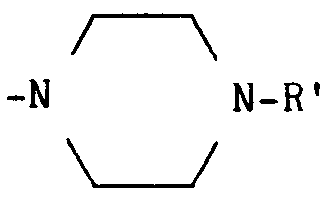
R′ étant, entre autres, un radical aralkyle éventuellement substitué ;
Ces dits dérivés étant utilisables comme médicaments.

dans laquelle R₈ a la signification précédemment défine, et dans le cas où R₇ représente un radical acyle, le produit de la réaction peut, si on le désire, être hydrolysé pour donner le dérivé hydroxylé correspondant.
Claims (8)

- l'on fait réagir un dérivé de formule générale II :

R₁, R₂, R₃, R₄, R₅, R₆, R₇ et A ont les significations définies dans la revendication 1,
et
- Z représente un atome d'halogène ou un radical tosyloxy,
- avec un dérivé de formule générale III :

Applications Claiming Priority (2)
| Application Number | Priority Date | Filing Date | Title |
|---|---|---|---|
| FR9111469A FR2681324B1 (fr) | 1991-09-18 | 1991-09-18 | Nouveaux derives de la trimetazidine, leur procede de preparation et les compositions pharmaceutiques les contenant. |
| FR9111469 | 1991-09-18 |
Publications (2)
| Publication Number | Publication Date |
|---|---|
| EP0533579A1 true EP0533579A1 (fr) | 1993-03-24 |
| EP0533579B1 EP0533579B1 (fr) | 1996-12-04 |
Family
ID=9417037
Family Applications (1)
| Application Number | Title | Priority Date | Filing Date |
|---|---|---|---|
| EP92402566A Expired - Lifetime EP0533579B1 (fr) | 1991-09-18 | 1992-09-18 | Nouveaux dérivés de la trimétazidine, leur procédé de préparation et les compositions pharmaceutiques les contenant |
Country Status (14)
| Country | Link |
|---|---|
| US (1) | US5283246A (fr) |
| EP (1) | EP0533579B1 (fr) |
| JP (1) | JPH0676396B2 (fr) |
| AT (1) | ATE145899T1 (fr) |
| AU (1) | AU647964B2 (fr) |
| CA (1) | CA2078520C (fr) |
| CY (1) | CY2142B1 (fr) |
| DE (1) | DE69215626T2 (fr) |
| DK (1) | DK0533579T3 (fr) |
| ES (1) | ES2097299T3 (fr) |
| FR (1) | FR2681324B1 (fr) |
| GR (1) | GR3022322T3 (fr) |
| NZ (1) | NZ244370A (fr) |
| ZA (1) | ZA927165B (fr) |
Cited By (5)
| Publication number | Priority date | Publication date | Assignee | Title |
|---|---|---|---|---|
| EP0617027A1 (fr) * | 1993-03-24 | 1994-09-28 | Adir Et Compagnie | Nouveaux composés de N-benzylpipérazine leur procédé de préparation et les compositions pharmaceutiques les renfermant |
| WO1997007109A1 (fr) * | 1995-08-21 | 1997-02-27 | Takeda Chemical Industries, Ltd. | Compose de quinone, sa production et son utilisation |
| FR2805463A1 (fr) * | 2000-02-25 | 2001-08-31 | Adir | UTILISATION DE LA TRIMETAZIDINE POUR L'OBTENTION DE COMPOSITIONS PHARMACEUTIQUES DESTINEES A INHIBER L'ACYL-CoA ACETYLTRANSFERASE |
| CN1073563C (zh) * | 1994-04-11 | 2001-10-24 | 中外制药株式会社 | 4,6-二叔丁基-2,3-二氢苯并噻吩衍生物 |
| EP2394644A2 (fr) | 2010-05-04 | 2011-12-14 | Sanovel Ilac Sanayi ve Ticaret A.S. | Formulation de trimetazidine avec différents profils de distribution |
Families Citing this family (12)
| Publication number | Priority date | Publication date | Assignee | Title |
|---|---|---|---|---|
| WO1993002062A1 (fr) * | 1991-07-19 | 1993-02-04 | Zeria Pharmaceutical Co., Ltd. | Derive de piperazine et medicament contenant ce derive |
| IL117149A0 (en) * | 1995-02-23 | 1996-06-18 | Schering Corp | Muscarinic antagonists |
| FR2757164B1 (fr) * | 1996-12-16 | 1999-01-22 | Adir | Nouveaux derives de n-benzylpiperazine, leur procede de preparation et les compositions pharmaceutiques qui les contiennent |
| JPH10265386A (ja) * | 1997-03-21 | 1998-10-06 | Toshio Sato | 抗酸化作用を有する抗アレルギー剤 |
| EP1829535A3 (fr) * | 1999-10-27 | 2007-10-24 | Tanox, Inc. | Antagonistes de facteur de tissus et leurs procédés d'utilisation |
| CA2387857A1 (fr) * | 1999-10-27 | 2001-05-03 | Sunol Molecular Corporation | Antagonistes de facteur tissulaire et leurs procedes d'utilisation |
| FR2802424B1 (fr) * | 1999-12-17 | 2002-02-15 | Adir | Comprime matriciel permettant la liberation prolongee de trimetazidine apres administration par voie orale |
| FR2827284B1 (fr) * | 2001-07-16 | 2003-10-31 | Servier Lab | Nouveaux derives de n-benzylpiperazine, leur procede de preparation et les compositions pharmaceutiques qui les contiennent |
| WO2003037323A2 (fr) * | 2001-10-26 | 2003-05-08 | MEDIGENE AG Gesellschaft für Molekularbiologische Kardiologie und Onkologie | Inhibiteurs de l'oxydation des acides gras pour la prophylaxie et le traitement des maladies liees a un dysfonctionnement mitochondrial |
| WO2007116243A2 (fr) * | 2006-04-10 | 2007-10-18 | Mintails Limited | Procede de traitement de la fibromyalgie et de pathologies apparentees |
| CN103554057B (zh) * | 2013-11-13 | 2016-04-20 | 武汉武药科技有限公司 | 曲美他嗪衍生物及其制备方法 |
| WO2018093839A1 (fr) | 2016-11-15 | 2018-05-24 | University Of Pittsburgh - Of The Commonwealth System Of Higher Education | Thérapie pour des troubles de bêta-oxydation et de transport d'acides gras mitochondriaux |
Citations (3)
| Publication number | Priority date | Publication date | Assignee | Title |
|---|---|---|---|---|
| FR2347359A1 (fr) * | 1976-04-09 | 1977-11-04 | Nippon Shinyaku Co Ltd | Derives de trialcoxybenzylpiperazine n-substituee et leurs utilisations pharmaceutiques, notamment pour leur action vasodilatatrice |
| EP0202580A2 (fr) * | 1985-05-13 | 1986-11-26 | Kuraray Co., Ltd. | Dérivés de 3,4-dihydrobenzopyranes |
| WO1987005020A1 (fr) * | 1986-02-21 | 1987-08-27 | Kuraray Co., Ltd. | Derives de 3,4-dihydro-2h-benzopyranne et leur usage medicinal |
Family Cites Families (1)
| Publication number | Priority date | Publication date | Assignee | Title |
|---|---|---|---|---|
| GB1187706A (en) * | 1968-06-07 | 1970-04-15 | Ciba Ltd | 2-Aminomethyl-2,3-Dihydro-Benzofurans |
-
1991
- 1991-09-18 FR FR9111469A patent/FR2681324B1/fr not_active Expired - Fee Related
-
1992
- 1992-09-17 US US07/946,933 patent/US5283246A/en not_active Expired - Fee Related
- 1992-09-17 AU AU24537/92A patent/AU647964B2/en not_active Ceased
- 1992-09-17 NZ NZ244370A patent/NZ244370A/en unknown
- 1992-09-17 CA CA002078520A patent/CA2078520C/fr not_active Expired - Fee Related
- 1992-09-18 DE DE69215626T patent/DE69215626T2/de not_active Expired - Fee Related
- 1992-09-18 ES ES92402566T patent/ES2097299T3/es not_active Expired - Lifetime
- 1992-09-18 EP EP92402566A patent/EP0533579B1/fr not_active Expired - Lifetime
- 1992-09-18 DK DK92402566.1T patent/DK0533579T3/da active
- 1992-09-18 AT AT92402566T patent/ATE145899T1/de not_active IP Right Cessation
- 1992-09-18 ZA ZA927165A patent/ZA927165B/xx unknown
- 1992-09-18 JP JP4293636A patent/JPH0676396B2/ja not_active Expired - Fee Related
-
1997
- 1997-01-21 GR GR970400086T patent/GR3022322T3/el unknown
-
1999
- 1999-11-19 CY CY9900038A patent/CY2142B1/xx unknown
Patent Citations (3)
| Publication number | Priority date | Publication date | Assignee | Title |
|---|---|---|---|---|
| FR2347359A1 (fr) * | 1976-04-09 | 1977-11-04 | Nippon Shinyaku Co Ltd | Derives de trialcoxybenzylpiperazine n-substituee et leurs utilisations pharmaceutiques, notamment pour leur action vasodilatatrice |
| EP0202580A2 (fr) * | 1985-05-13 | 1986-11-26 | Kuraray Co., Ltd. | Dérivés de 3,4-dihydrobenzopyranes |
| WO1987005020A1 (fr) * | 1986-02-21 | 1987-08-27 | Kuraray Co., Ltd. | Derives de 3,4-dihydro-2h-benzopyranne et leur usage medicinal |
Cited By (7)
| Publication number | Priority date | Publication date | Assignee | Title |
|---|---|---|---|---|
| EP0617027A1 (fr) * | 1993-03-24 | 1994-09-28 | Adir Et Compagnie | Nouveaux composés de N-benzylpipérazine leur procédé de préparation et les compositions pharmaceutiques les renfermant |
| FR2703048A1 (fr) * | 1993-03-24 | 1994-09-30 | Adir | Nouveaux composés N-Benzylpiperazine, leur procédé de préparation et les compositions pharmaceutiques les renfermant. |
| CN1073563C (zh) * | 1994-04-11 | 2001-10-24 | 中外制药株式会社 | 4,6-二叔丁基-2,3-二氢苯并噻吩衍生物 |
| WO1997007109A1 (fr) * | 1995-08-21 | 1997-02-27 | Takeda Chemical Industries, Ltd. | Compose de quinone, sa production et son utilisation |
| FR2805463A1 (fr) * | 2000-02-25 | 2001-08-31 | Adir | UTILISATION DE LA TRIMETAZIDINE POUR L'OBTENTION DE COMPOSITIONS PHARMACEUTIQUES DESTINEES A INHIBER L'ACYL-CoA ACETYLTRANSFERASE |
| WO2001064220A1 (fr) * | 2000-02-25 | 2001-09-07 | Les Laboratoires Servier | UTILISATION DE TRIMETAZIDINE POUR INHIBER L'ACYL-CoA ACETYLTRANSFERASE |
| EP2394644A2 (fr) | 2010-05-04 | 2011-12-14 | Sanovel Ilac Sanayi ve Ticaret A.S. | Formulation de trimetazidine avec différents profils de distribution |
Also Published As
| Publication number | Publication date |
|---|---|
| AU2453792A (en) | 1993-03-25 |
| ES2097299T3 (es) | 1997-04-01 |
| US5283246A (en) | 1994-02-01 |
| EP0533579B1 (fr) | 1996-12-04 |
| DK0533579T3 (da) | 1997-05-26 |
| GR3022322T3 (en) | 1997-04-30 |
| CA2078520A1 (fr) | 1993-03-19 |
| NZ244370A (en) | 1994-09-27 |
| JPH05194451A (ja) | 1993-08-03 |
| DE69215626T2 (de) | 1997-06-12 |
| JPH0676396B2 (ja) | 1994-09-28 |
| AU647964B2 (en) | 1994-03-31 |
| ATE145899T1 (de) | 1996-12-15 |
| FR2681324B1 (fr) | 1993-10-29 |
| DE69215626D1 (de) | 1997-01-16 |
| ZA927165B (en) | 1993-03-24 |
| FR2681324A1 (fr) | 1993-03-19 |
| CY2142B1 (en) | 2002-06-21 |
| CA2078520C (fr) | 2001-04-24 |
Similar Documents
| Publication | Publication Date | Title |
|---|---|---|
| EP0533579B1 (fr) | Nouveaux dérivés de la trimétazidine, leur procédé de préparation et les compositions pharmaceutiques les contenant | |
| EP0526342B1 (fr) | Isoquinolein-5-yl sulfonamides, leur procédé de préparation et les compositions pharmaceutiques qui les contiennent | |
| FR2581993A1 (fr) | Derives de (benzoyl-4 piperidino)-2 phenyl-1 alcanols, leur preparation et leur application en therapeutique | |
| EP0691339A1 (fr) | Dérivés amines de 1,3-dihydro-2H-pyrrolo(2,3-b)pyridin-2-ones et oxazolo(4,5-b)pyridin-2(3H)-ones, leur procédé de préparation et les compositions pharmaceutiques qui les contiennent | |
| EP0037778A1 (fr) | Benzodioxanne 1,4 méthoxy-2 propanolamines, leur préparation et leur application en tant que médicaments | |
| EP0479631B1 (fr) | Dérivés du spiro [4.5]décane leur procédé de préparation et les compositions pharmaceutiques les renfermant | |
| EP0566446B1 (fr) | Dérivés d'indane-1, 3-dione et d'indane-1,2,3-trione, leurs procédés de préparation et leur application en thérapeutique | |
| EP0025727B1 (fr) | Dérivés de l'indole, procédé pour leur préparation et médicaments les contenant | |
| EP0312432B1 (fr) | Dérivés du diméthyl-2,2 chromène, procédé d'obtention et compositions/pharmaceutiques en contenant | |
| EP0452204B1 (fr) | Nouveaux dérivés du 3-aminochromane, leur procédé de préparation et les compositions pharmaceutiques qui les contiennent | |
| EP0150139B1 (fr) | Dérivés de l'indole éthénylphénol, leurs sels, procédé de préparation, application à titre de médicaments,et compositions les renfermant | |
| EP0487423A1 (fr) | Nouveaux dérivés de la benzosélénazolinone, leur procédé de préparation et les compositions pharmaceutiques qui les contiennent | |
| EP0527079B1 (fr) | N-(isoquinolein-5 YL) sulfonyl azacycloalcanes, leur procédé de préparation et les compositions pharmaceutiques les contenant | |
| EP0433167B1 (fr) | Nouveaux dérivés de la pipéridine, leur procédé de préparation et les compositions pharmaceutiques les renfermant | |
| CA2045849A1 (fr) | Derives d'oxazolo pyridines, leur procede de preparation et les compositions pharmaceutiques qui les contiennent | |
| EP0094283B1 (fr) | Forme médicamenteuse de théophylline à action prolongée | |
| EP0138684B1 (fr) | 2-(N-pyrrolidino)-3-isobutoxy-N-phenyl substitué N-benzyl propylamines, leur préparation et leur application pharmaceutique | |
| EP0209435B1 (fr) | Dérivés de l'hydroxy alkoxy 4-phénylpropyl indole, leurs sels, procédé et intermédiaires de préparation, application à titre de médicaments et compositions les renfermant | |
| EP1957490B1 (fr) | Nouveaux derives d'indolizine, leur procede de preparation et les compositions therapeutiques les comprenant | |
| EP0275762B1 (fr) | Dérivés de l'indole carboxamide ainsi que leurs sels, procédé et intermédiaires de préparation, application à titre de médicaments de ces dérivés et compositions les renfermant | |
| EP0220104A2 (fr) | Dérivés d'amino-5 pentanenitrile, leurs procédés de préparation et les compositions pharmaceutiques qui les contiennent | |
| BE896797A (fr) | Nouveaux composes heterocycliques, leur preparation et leur utilisation comme medicaments. | |
| BE856055A (fr) | Derives de 4-hydroxyphenylalcanolamine et leur preparation | |
| EP0078735A1 (fr) | Nouveaux dérivés appartenant à la famille des 3-amino-1-hétéroaryloxy-2-propanols, utilisation en thérapeutique et procédé de préparation | |
| BE837569A (fr) | Nouvelles perhalogenoalcoylamidines substituees comme stimulants cardiaques |
Legal Events
| Date | Code | Title | Description |
|---|---|---|---|
| PUAI | Public reference made under article 153(3) epc to a published international application that has entered the european phase |
Free format text: ORIGINAL CODE: 0009012 |
|
| 17P | Request for examination filed |
Effective date: 19920923 |
|
| AK | Designated contracting states |
Kind code of ref document: A1 Designated state(s): AT BE CH DE DK ES FR GB GR IE IT LI LU NL PT SE |
|
| 17Q | First examination report despatched |
Effective date: 19950703 |
|
| GRAG | Despatch of communication of intention to grant |
Free format text: ORIGINAL CODE: EPIDOS AGRA |
|
| GRAH | Despatch of communication of intention to grant a patent |
Free format text: ORIGINAL CODE: EPIDOS IGRA |
|
| GRAH | Despatch of communication of intention to grant a patent |
Free format text: ORIGINAL CODE: EPIDOS IGRA |
|
| GRAA | (expected) grant |
Free format text: ORIGINAL CODE: 0009210 |
|
| ITF | It: translation for a ep patent filed | ||
| AK | Designated contracting states |
Kind code of ref document: B1 Designated state(s): AT BE CH DE DK ES FR GB GR IE IT LI LU NL PT SE |
|
| REF | Corresponds to: |
Ref document number: 145899 Country of ref document: AT Date of ref document: 19961215 Kind code of ref document: T |
|
| REG | Reference to a national code |
Ref country code: CH Ref legal event code: NV Representative=s name: A. BRAUN, BRAUN, HERITIER, ESCHMANN AG PATENTANWAE |
|
| REF | Corresponds to: |
Ref document number: 69215626 Country of ref document: DE Date of ref document: 19970116 |
|
| REG | Reference to a national code |
Ref country code: IE Ref legal event code: FG4D Free format text: 70831 |
|
| GBT | Gb: translation of ep patent filed (gb section 77(6)(a)/1977) |
Effective date: 19970305 |
|
| REG | Reference to a national code |
Ref country code: PT Ref legal event code: SC4A Free format text: AVAILABILITY OF NATIONAL TRANSLATION Effective date: 19961206 Ref country code: GR Ref legal event code: FG4A Free format text: 3022322 |
|
| REG | Reference to a national code |
Ref country code: ES Ref legal event code: FG2A Ref document number: 2097299 Country of ref document: ES Kind code of ref document: T3 |
|
| REG | Reference to a national code |
Ref country code: DK Ref legal event code: T3 |
|
| PLBE | No opposition filed within time limit |
Free format text: ORIGINAL CODE: 0009261 |
|
| STAA | Information on the status of an ep patent application or granted ep patent |
Free format text: STATUS: NO OPPOSITION FILED WITHIN TIME LIMIT |
|
| 26N | No opposition filed | ||
| REG | Reference to a national code |
Ref country code: CH Ref legal event code: PFA Free format text: ADIR ET COMPAGNIE TRANSFER- LES LABORATOIRES SERVIER |
|
| REG | Reference to a national code |
Ref country code: FR Ref legal event code: TP |
|
| REG | Reference to a national code |
Ref country code: GB Ref legal event code: 732E |
|
| REG | Reference to a national code |
Ref country code: GB Ref legal event code: IF02 |
|
| NLS | Nl: assignments of ep-patents |
Owner name: LES LABORATOIRES SERVIER |
|
| REG | Reference to a national code |
Ref country code: PT Ref legal event code: PC4A Free format text: LES LABORATOIRES SERVIER FR Effective date: 20011105 |
|
| PGFP | Annual fee paid to national office [announced via postgrant information from national office to epo] |
Ref country code: PT Payment date: 20030703 Year of fee payment: 12 Ref country code: AT Payment date: 20030703 Year of fee payment: 12 |
|
| PGFP | Annual fee paid to national office [announced via postgrant information from national office to epo] |
Ref country code: IE Payment date: 20030704 Year of fee payment: 12 |
|
| PGFP | Annual fee paid to national office [announced via postgrant information from national office to epo] |
Ref country code: GR Payment date: 20030718 Year of fee payment: 12 |
|
| PGFP | Annual fee paid to national office [announced via postgrant information from national office to epo] |
Ref country code: SE Payment date: 20030808 Year of fee payment: 12 |
|
| PGFP | Annual fee paid to national office [announced via postgrant information from national office to epo] |
Ref country code: LU Payment date: 20030811 Year of fee payment: 12 |
|
| PGFP | Annual fee paid to national office [announced via postgrant information from national office to epo] |
Ref country code: BE Payment date: 20030910 Year of fee payment: 12 |
|
| PGFP | Annual fee paid to national office [announced via postgrant information from national office to epo] |
Ref country code: GB Payment date: 20030917 Year of fee payment: 12 |
|
| PGFP | Annual fee paid to national office [announced via postgrant information from national office to epo] |
Ref country code: NL Payment date: 20030924 Year of fee payment: 12 Ref country code: FR Payment date: 20030924 Year of fee payment: 12 Ref country code: DK Payment date: 20030924 Year of fee payment: 12 |
|
| PGFP | Annual fee paid to national office [announced via postgrant information from national office to epo] |
Ref country code: DE Payment date: 20030926 Year of fee payment: 12 |
|
| PGFP | Annual fee paid to national office [announced via postgrant information from national office to epo] |
Ref country code: CH Payment date: 20030930 Year of fee payment: 12 |
|
| PGFP | Annual fee paid to national office [announced via postgrant information from national office to epo] |
Ref country code: ES Payment date: 20031008 Year of fee payment: 12 |
|
| PG25 | Lapsed in a contracting state [announced via postgrant information from national office to epo] |
Ref country code: LU Free format text: LAPSE BECAUSE OF NON-PAYMENT OF DUE FEES Effective date: 20040918 Ref country code: GB Free format text: LAPSE BECAUSE OF NON-PAYMENT OF DUE FEES Effective date: 20040918 Ref country code: AT Free format text: LAPSE BECAUSE OF NON-PAYMENT OF DUE FEES Effective date: 20040918 |
|
| PG25 | Lapsed in a contracting state [announced via postgrant information from national office to epo] |
Ref country code: SE Free format text: LAPSE BECAUSE OF NON-PAYMENT OF DUE FEES Effective date: 20040919 |
|
| PG25 | Lapsed in a contracting state [announced via postgrant information from national office to epo] |
Ref country code: IE Free format text: LAPSE BECAUSE OF NON-PAYMENT OF DUE FEES Effective date: 20040920 Ref country code: ES Free format text: LAPSE BECAUSE OF NON-PAYMENT OF DUE FEES Effective date: 20040920 |
|
| PG25 | Lapsed in a contracting state [announced via postgrant information from national office to epo] |
Ref country code: LI Free format text: LAPSE BECAUSE OF NON-PAYMENT OF DUE FEES Effective date: 20040930 Ref country code: DK Free format text: LAPSE BECAUSE OF NON-PAYMENT OF DUE FEES Effective date: 20040930 Ref country code: CH Free format text: LAPSE BECAUSE OF NON-PAYMENT OF DUE FEES Effective date: 20040930 Ref country code: BE Free format text: LAPSE BECAUSE OF NON-PAYMENT OF DUE FEES Effective date: 20040930 |
|
| PG25 | Lapsed in a contracting state [announced via postgrant information from national office to epo] |
Ref country code: PT Free format text: LAPSE BECAUSE OF NON-PAYMENT OF DUE FEES Effective date: 20050318 |
|
| BERE | Be: lapsed |
Owner name: LES LABORATOIRES *SERVIER Effective date: 20040930 |
|
| PG25 | Lapsed in a contracting state [announced via postgrant information from national office to epo] |
Ref country code: NL Free format text: LAPSE BECAUSE OF NON-PAYMENT OF DUE FEES Effective date: 20050401 Ref country code: DE Free format text: LAPSE BECAUSE OF NON-PAYMENT OF DUE FEES Effective date: 20050401 |
|
| PG25 | Lapsed in a contracting state [announced via postgrant information from national office to epo] |
Ref country code: GR Free format text: LAPSE BECAUSE OF NON-PAYMENT OF DUE FEES Effective date: 20050405 |
|
| EUG | Se: european patent has lapsed | ||
| GBPC | Gb: european patent ceased through non-payment of renewal fee |
Effective date: 20040918 |
|
| REG | Reference to a national code |
Ref country code: CH Ref legal event code: PL |
|
| PG25 | Lapsed in a contracting state [announced via postgrant information from national office to epo] |
Ref country code: FR Free format text: LAPSE BECAUSE OF NON-PAYMENT OF DUE FEES Effective date: 20050531 |
|
| REG | Reference to a national code |
Ref country code: PT Ref legal event code: MM4A Free format text: LAPSE DUE TO NON-PAYMENT OF FEES Effective date: 20050318 |
|
| NLV4 | Nl: lapsed or anulled due to non-payment of the annual fee |
Effective date: 20050401 |
|
| REG | Reference to a national code |
Ref country code: DK Ref legal event code: EBP |
|
| REG | Reference to a national code |
Ref country code: IE Ref legal event code: MM4A |
|
| REG | Reference to a national code |
Ref country code: FR Ref legal event code: ST |
|
| PG25 | Lapsed in a contracting state [announced via postgrant information from national office to epo] |
Ref country code: IT Free format text: LAPSE BECAUSE OF NON-PAYMENT OF DUE FEES;WARNING: LAPSES OF ITALIAN PATENTS WITH EFFECTIVE DATE BEFORE 2007 MAY HAVE OCCURRED AT ANY TIME BEFORE 2007. THE CORRECT EFFECTIVE DATE MAY BE DIFFERENT FROM THE ONE RECORDED. Effective date: 20050918 |
|
| REG | Reference to a national code |
Ref country code: ES Ref legal event code: FD2A Effective date: 20040920 |
|
| BERE | Be: lapsed |
Owner name: LES LABORATOIRES *SERVIER Effective date: 20040930 |