EP0533197A2 - Laserdiode mit Streifenstruktur und verbessertem Wirkungsgrad bezüglich der Strombegrenzung - Google Patents
Laserdiode mit Streifenstruktur und verbessertem Wirkungsgrad bezüglich der Strombegrenzung Download PDFInfo
- Publication number
- EP0533197A2 EP0533197A2 EP92116024A EP92116024A EP0533197A2 EP 0533197 A2 EP0533197 A2 EP 0533197A2 EP 92116024 A EP92116024 A EP 92116024A EP 92116024 A EP92116024 A EP 92116024A EP 0533197 A2 EP0533197 A2 EP 0533197A2
- Authority
- EP
- European Patent Office
- Prior art keywords
- layer
- ingaaip
- stripe
- type
- grown
- Prior art date
- Legal status (The legal status is an assumption and is not a legal conclusion. Google has not performed a legal analysis and makes no representation as to the accuracy of the status listed.)
- Withdrawn
Links
Images













Classifications
-
- H—ELECTRICITY
- H10—SEMICONDUCTOR DEVICES; ELECTRIC SOLID-STATE DEVICES NOT OTHERWISE PROVIDED FOR
- H10H—INORGANIC LIGHT-EMITTING SEMICONDUCTOR DEVICES HAVING POTENTIAL BARRIERS
- H10H20/00—Individual inorganic light-emitting semiconductor devices having potential barriers, e.g. light-emitting diodes [LED]
- H10H20/80—Constructional details
- H10H20/81—Bodies
- H10H20/822—Materials of the light-emitting regions
- H10H20/824—Materials of the light-emitting regions comprising only Group III-V materials, e.g. GaP
- H10H20/8242—Materials of the light-emitting regions comprising only Group III-V materials, e.g. GaP characterised by the dopants
-
- G—PHYSICS
- G11—INFORMATION STORAGE
- G11B—INFORMATION STORAGE BASED ON RELATIVE MOVEMENT BETWEEN RECORD CARRIER AND TRANSDUCER
- G11B7/00—Recording or reproducing by optical means, e.g. recording using a thermal beam of optical radiation by modifying optical properties or the physical structure, reproducing using an optical beam at lower power by sensing optical properties; Record carriers therefor
- G11B7/12—Heads, e.g. forming of the optical beam spot or modulation of the optical beam
- G11B7/125—Optical beam sources therefor, e.g. laser control circuitry specially adapted for optical storage devices; Modulators, e.g. means for controlling the size or intensity of optical spots or optical traces
- G11B7/126—Circuits, methods or arrangements for laser control or stabilisation
-
- G—PHYSICS
- G11—INFORMATION STORAGE
- G11B—INFORMATION STORAGE BASED ON RELATIVE MOVEMENT BETWEEN RECORD CARRIER AND TRANSDUCER
- G11B7/00—Recording or reproducing by optical means, e.g. recording using a thermal beam of optical radiation by modifying optical properties or the physical structure, reproducing using an optical beam at lower power by sensing optical properties; Record carriers therefor
- G11B7/12—Heads, e.g. forming of the optical beam spot or modulation of the optical beam
- G11B7/125—Optical beam sources therefor, e.g. laser control circuitry specially adapted for optical storage devices; Modulators, e.g. means for controlling the size or intensity of optical spots or optical traces
- G11B7/127—Lasers; Multiple laser arrays
-
- H—ELECTRICITY
- H01—ELECTRIC ELEMENTS
- H01S—DEVICES USING THE PROCESS OF LIGHT AMPLIFICATION BY STIMULATED EMISSION OF RADIATION [LASER] TO AMPLIFY OR GENERATE LIGHT; DEVICES USING STIMULATED EMISSION OF ELECTROMAGNETIC RADIATION IN WAVE RANGES OTHER THAN OPTICAL
- H01S5/00—Semiconductor lasers
- H01S5/20—Structure or shape of the semiconductor body to guide the optical wave ; Confining structures perpendicular to the optical axis, e.g. index or gain guiding, stripe geometry, broad area lasers, gain tailoring, transverse or lateral reflectors, special cladding structures, MQW barrier reflection layers
- H01S5/22—Structure or shape of the semiconductor body to guide the optical wave ; Confining structures perpendicular to the optical axis, e.g. index or gain guiding, stripe geometry, broad area lasers, gain tailoring, transverse or lateral reflectors, special cladding structures, MQW barrier reflection layers having a ridge or stripe structure
- H01S5/223—Buried stripe structure
- H01S5/2232—Buried stripe structure with inner confining structure between the active layer and the lower electrode
-
- H—ELECTRICITY
- H01—ELECTRIC ELEMENTS
- H01S—DEVICES USING THE PROCESS OF LIGHT AMPLIFICATION BY STIMULATED EMISSION OF RADIATION [LASER] TO AMPLIFY OR GENERATE LIGHT; DEVICES USING STIMULATED EMISSION OF ELECTROMAGNETIC RADIATION IN WAVE RANGES OTHER THAN OPTICAL
- H01S5/00—Semiconductor lasers
- H01S5/30—Structure or shape of the active region; Materials used for the active region
- H01S5/305—Structure or shape of the active region; Materials used for the active region characterised by the doping materials used in the laser structure
-
- H—ELECTRICITY
- H01—ELECTRIC ELEMENTS
- H01S—DEVICES USING THE PROCESS OF LIGHT AMPLIFICATION BY STIMULATED EMISSION OF RADIATION [LASER] TO AMPLIFY OR GENERATE LIGHT; DEVICES USING STIMULATED EMISSION OF ELECTROMAGNETIC RADIATION IN WAVE RANGES OTHER THAN OPTICAL
- H01S5/00—Semiconductor lasers
- H01S5/30—Structure or shape of the active region; Materials used for the active region
- H01S5/32—Structure or shape of the active region; Materials used for the active region comprising PN junctions, e.g. hetero- or double- heterostructures
- H01S5/323—Structure or shape of the active region; Materials used for the active region comprising PN junctions, e.g. hetero- or double- heterostructures in AIIIBV compounds, e.g. AlGaAs-laser, InP-based laser
- H01S5/32308—Structure or shape of the active region; Materials used for the active region comprising PN junctions, e.g. hetero- or double- heterostructures in AIIIBV compounds, e.g. AlGaAs-laser, InP-based laser emitting light at a wavelength less than 900 nm
- H01S5/32325—Structure or shape of the active region; Materials used for the active region comprising PN junctions, e.g. hetero- or double- heterostructures in AIIIBV compounds, e.g. AlGaAs-laser, InP-based laser emitting light at a wavelength less than 900 nm red laser based on InGaP
-
- H—ELECTRICITY
- H10—SEMICONDUCTOR DEVICES; ELECTRIC SOLID-STATE DEVICES NOT OTHERWISE PROVIDED FOR
- H10H—INORGANIC LIGHT-EMITTING SEMICONDUCTOR DEVICES HAVING POTENTIAL BARRIERS
- H10H20/00—Individual inorganic light-emitting semiconductor devices having potential barriers, e.g. light-emitting diodes [LED]
- H10H20/01—Manufacture or treatment
- H10H20/011—Manufacture or treatment of bodies, e.g. forming semiconductor layers
- H10H20/013—Manufacture or treatment of bodies, e.g. forming semiconductor layers having light-emitting regions comprising only Group III-V materials
-
- H—ELECTRICITY
- H01—ELECTRIC ELEMENTS
- H01S—DEVICES USING THE PROCESS OF LIGHT AMPLIFICATION BY STIMULATED EMISSION OF RADIATION [LASER] TO AMPLIFY OR GENERATE LIGHT; DEVICES USING STIMULATED EMISSION OF ELECTROMAGNETIC RADIATION IN WAVE RANGES OTHER THAN OPTICAL
- H01S5/00—Semiconductor lasers
- H01S5/20—Structure or shape of the semiconductor body to guide the optical wave ; Confining structures perpendicular to the optical axis, e.g. index or gain guiding, stripe geometry, broad area lasers, gain tailoring, transverse or lateral reflectors, special cladding structures, MQW barrier reflection layers
- H01S5/22—Structure or shape of the semiconductor body to guide the optical wave ; Confining structures perpendicular to the optical axis, e.g. index or gain guiding, stripe geometry, broad area lasers, gain tailoring, transverse or lateral reflectors, special cladding structures, MQW barrier reflection layers having a ridge or stripe structure
- H01S5/223—Buried stripe structure
- H01S5/2232—Buried stripe structure with inner confining structure between the active layer and the lower electrode
- H01S5/2234—Buried stripe structure with inner confining structure between the active layer and the lower electrode having a structured substrate surface
-
- H—ELECTRICITY
- H01—ELECTRIC ELEMENTS
- H01S—DEVICES USING THE PROCESS OF LIGHT AMPLIFICATION BY STIMULATED EMISSION OF RADIATION [LASER] TO AMPLIFY OR GENERATE LIGHT; DEVICES USING STIMULATED EMISSION OF ELECTROMAGNETIC RADIATION IN WAVE RANGES OTHER THAN OPTICAL
- H01S5/00—Semiconductor lasers
- H01S5/20—Structure or shape of the semiconductor body to guide the optical wave ; Confining structures perpendicular to the optical axis, e.g. index or gain guiding, stripe geometry, broad area lasers, gain tailoring, transverse or lateral reflectors, special cladding structures, MQW barrier reflection layers
- H01S5/22—Structure or shape of the semiconductor body to guide the optical wave ; Confining structures perpendicular to the optical axis, e.g. index or gain guiding, stripe geometry, broad area lasers, gain tailoring, transverse or lateral reflectors, special cladding structures, MQW barrier reflection layers having a ridge or stripe structure
- H01S5/223—Buried stripe structure
- H01S5/2232—Buried stripe structure with inner confining structure between the active layer and the lower electrode
- H01S5/2234—Buried stripe structure with inner confining structure between the active layer and the lower electrode having a structured substrate surface
- H01S5/2235—Buried stripe structure with inner confining structure between the active layer and the lower electrode having a structured substrate surface with a protrusion
-
- H—ELECTRICITY
- H01—ELECTRIC ELEMENTS
- H01S—DEVICES USING THE PROCESS OF LIGHT AMPLIFICATION BY STIMULATED EMISSION OF RADIATION [LASER] TO AMPLIFY OR GENERATE LIGHT; DEVICES USING STIMULATED EMISSION OF ELECTROMAGNETIC RADIATION IN WAVE RANGES OTHER THAN OPTICAL
- H01S5/00—Semiconductor lasers
- H01S5/20—Structure or shape of the semiconductor body to guide the optical wave ; Confining structures perpendicular to the optical axis, e.g. index or gain guiding, stripe geometry, broad area lasers, gain tailoring, transverse or lateral reflectors, special cladding structures, MQW barrier reflection layers
- H01S5/22—Structure or shape of the semiconductor body to guide the optical wave ; Confining structures perpendicular to the optical axis, e.g. index or gain guiding, stripe geometry, broad area lasers, gain tailoring, transverse or lateral reflectors, special cladding structures, MQW barrier reflection layers having a ridge or stripe structure
- H01S5/223—Buried stripe structure
- H01S5/2237—Buried stripe structure with a non-planar active layer
-
- H—ELECTRICITY
- H01—ELECTRIC ELEMENTS
- H01S—DEVICES USING THE PROCESS OF LIGHT AMPLIFICATION BY STIMULATED EMISSION OF RADIATION [LASER] TO AMPLIFY OR GENERATE LIGHT; DEVICES USING STIMULATED EMISSION OF ELECTROMAGNETIC RADIATION IN WAVE RANGES OTHER THAN OPTICAL
- H01S5/00—Semiconductor lasers
- H01S5/20—Structure or shape of the semiconductor body to guide the optical wave ; Confining structures perpendicular to the optical axis, e.g. index or gain guiding, stripe geometry, broad area lasers, gain tailoring, transverse or lateral reflectors, special cladding structures, MQW barrier reflection layers
- H01S5/22—Structure or shape of the semiconductor body to guide the optical wave ; Confining structures perpendicular to the optical axis, e.g. index or gain guiding, stripe geometry, broad area lasers, gain tailoring, transverse or lateral reflectors, special cladding structures, MQW barrier reflection layers having a ridge or stripe structure
- H01S5/223—Buried stripe structure
- H01S5/2238—Buried stripe structure with a terraced structure
-
- H—ELECTRICITY
- H01—ELECTRIC ELEMENTS
- H01S—DEVICES USING THE PROCESS OF LIGHT AMPLIFICATION BY STIMULATED EMISSION OF RADIATION [LASER] TO AMPLIFY OR GENERATE LIGHT; DEVICES USING STIMULATED EMISSION OF ELECTROMAGNETIC RADIATION IN WAVE RANGES OTHER THAN OPTICAL
- H01S5/00—Semiconductor lasers
- H01S5/30—Structure or shape of the active region; Materials used for the active region
- H01S5/305—Structure or shape of the active region; Materials used for the active region characterised by the doping materials used in the laser structure
- H01S5/3077—Structure or shape of the active region; Materials used for the active region characterised by the doping materials used in the laser structure plane dependent doping
-
- H—ELECTRICITY
- H01—ELECTRIC ELEMENTS
- H01S—DEVICES USING THE PROCESS OF LIGHT AMPLIFICATION BY STIMULATED EMISSION OF RADIATION [LASER] TO AMPLIFY OR GENERATE LIGHT; DEVICES USING STIMULATED EMISSION OF ELECTROMAGNETIC RADIATION IN WAVE RANGES OTHER THAN OPTICAL
- H01S5/00—Semiconductor lasers
- H01S5/30—Structure or shape of the active region; Materials used for the active region
- H01S5/32—Structure or shape of the active region; Materials used for the active region comprising PN junctions, e.g. hetero- or double- heterostructures
- H01S5/321—Structure or shape of the active region; Materials used for the active region comprising PN junctions, e.g. hetero- or double- heterostructures having intermediate bandgap layers
-
- Y—GENERAL TAGGING OF NEW TECHNOLOGICAL DEVELOPMENTS; GENERAL TAGGING OF CROSS-SECTIONAL TECHNOLOGIES SPANNING OVER SEVERAL SECTIONS OF THE IPC; TECHNICAL SUBJECTS COVERED BY FORMER USPC CROSS-REFERENCE ART COLLECTIONS [XRACs] AND DIGESTS
- Y10—TECHNICAL SUBJECTS COVERED BY FORMER USPC
- Y10S—TECHNICAL SUBJECTS COVERED BY FORMER USPC CROSS-REFERENCE ART COLLECTIONS [XRACs] AND DIGESTS
- Y10S148/00—Metal treatment
- Y10S148/095—Laser devices
Definitions
- the present invention generally relates to laser diodes and more particularly to an improvement of a laser diode having a stripe structure.
- the laser diode In the optical information storage systems that record and reproduce information on and from a recording media by means of a finely focused optical beam, the laser diode is required to have a small astigmatism in addition to the usual requirement of low threshold current, high output power and high reliability.
- the optical beam In the optical information storage systems in particular, the optical beam is required to have a very small round beam shape when focused on a recording medium such as an optical disk.
- the optical beam does not form the desired round beam spot but forms an elongated spot wherein the direction of elongation changes depending on the focusing state. In order to eliminate or minimize the problem of astigmatism, various efforts have been made so far.
- FIG.1 shows the basic structure of a typical conventional laser diode of the so-called ridge type that produces an output optical beam in the visible wavelength region.
- the laser diode is constructed on the (100)-oriented upper major surface of a GaAs substrate 101 doped to the n-type.
- a buffer layer 102 of n-type GaAs is grown epitaxially on the (100)-oriented surface of the GaAs substrate 101, and an intermediate layer 103 of n-type InGaP is grown further on the buffer layer 102 epitaxially.
- a clad layer 104 of n-type InGaAIP is grown epitaxially, and an active layer 105 of undoped InGaP is grown epitaxially on the clad layer 104.
- the active layer 105 in turn is covered by a clad layer 106 of p-type InGaAIP, and an etching stopper layer 107 of p-type InGaP is grown on the clad layer 106.
- a clad layer 109 of p-type InGaAIP and an intermediate layer 110 of InGaP are grown consecutively to form a layered semiconductor body, and a silicon oxide layer (not shown) is deposited further on the layer 110.
- the silicon oxide layer is patterned in correspondence to the ridge structure to be formed to form a patterned silicon oxide mask, and the layered semiconductor body obtained previously is subjected to a wet etching process while using the patterned silicon oxide mask.
- a ridge structure including the layers 109 - 110 is formed on the etching stopper layer 107.
- a deposition of n-type GaAs is made such that the foregoing ridge structure is laterally supported by a pair of n-type GaAs regions formed as a result of the foregoing deposition of n-type GaAs.
- the layers 109 - 111 form a ridge structure supported laterally by the n-type GaAs regions 108a and 108b as already noted, and the ridge structure thus constructed forms a loss guide structure for guiding therethrough the optical beam produced in the active layer 105.
- the GaAs regions at both sides of the ridge structure absorbs the optical beam and changes the refractive index in response thereto.
- the band gap of GaAs is much smaller than the band gap of InGaP or InGaAIP.
- such a ridge structure, supported laterally by the p-type GaAs regions 108a and 108b, causes a confinement of the drive current within the ridge.
- the laser diode of FIG.1 is characterized by a low threshold current.
- InGaP for the material of the active layer 105, one can realize a laser oscillation at the wavelength of about 680 nm.
- the laser diode of FIG.1 is capable of producing output optical beam with a visible wavelength.
- the laser diode of FIG.1 has a problem in that there appears an astigmatism in the optical beam produced from the device. More specifically, there arises a discrepancy in the focal point of the optical beam that is emitted at the edge surface of the laser diode with a horizontal plane of beam divergence and the optical beam that is emitted at the same edge surface with a vertical plane of beam divergence.
- FIG.2 shows such a situation wherein two focal points, f 1 and f 2 , exist in the optical beam produced from the laser diode.
- the optical beam spreads in the vertical plane from the first focal point fi, while the optical beam spreads in the horizontal plane from the second focal point f 2 , wherein the focal point f 2 is offset from the focal point f 1 by several microns.
- the beam spot of the optical beam has an elongated elliptical shape that is not desirable for optical storage of information such as the optical disk systems as already described. It will be noted that the direction of elongation of the elliptical beam spot changes depending on the focusing state of the optical beam.
- the foregoing astigmatism occurring in the laser diode of FIG.1 is caused mainly by the difference in the degree of optical confinement between the vertical plane and the horizontal plane. As long as the loss guide structure that lacks the refractive structure for efficient lateral optical confinement is used, one cannot avoid the problem of astigmatism.
- FIG.3 shows the laser diode proposed previously by the present inventors.
- the laser diode is constructed on a GaAs substrate 201 doped for example to the p-type.
- the substrate 201 has a (100)-oriented upper major surface, and a mesa structure 201 a that is characterized by a (100)-oriented upper major surface and a pair of (111 )B-oriented side walls, is formed on the upper major surface as illustrated.
- the (100) surface of the mesa structure 201 a extends in the longitudinal direction of the laser diode and forms the basis of the stripe structure.
- a current confinement layer 202 of n-type GaAs is grown epitaxially while protecting the upper major surface of the mesa structure 201 a by a mask such as silicon oxide.
- a (311)B surface develops preferentially because of the slow rate of crystal growth in this crystal orientation.
- the epitaxial layer 202 thus grown is characterized by the well-developed (311)B surface that extends obliquely to the (100) surface of GaAs at both sides of the mesa structure 201a. Thereby, the (311)B surface forms another mesa structure that extends coincident to the stripe structure of the laser diode.
- a buffer layer 203 of p-type GaAs is grown epitaxially for providing an improved crystal surface for the subsequent epitaxial processes, and an intermediate layer 204 of p-type InGaP corresponding to the intermediate layer 110 is grown further on the buffer layer 203. Further, a clad layer 205 of p-type InGaAIP is grown epitaxially on the intermediate layer 204, and an active layer of undoped InGaP is grown epitaxially on the clad layer 205.
- a clad layer 207 of n-type InGaAIP is grown epitaxially, and an intermediate layer 208 of n-type InGaP corresponding to the intermediate layer 103 of FIG.1 is grown further thereon.
- a contact layer 208 of n -type GaAs is grown on the intermediate layer 110 epitaxially, and upper and lower electrode layers (not shown) are provided respectively on the upper major surface of the contact layer 209 and the lower major surface of the substrate 201.
- the epitaxial layers are grown by the MOCVD process for exact control of composition, and dopants are incorporated into the epitaxial layers as necessary during the epitaxial process.
- Zn is used for the p-type dopant, while Se or Si is used for the n-type dopant.
- Zn may be incorporated by admixing dimethylzinc ((CH 3 ) 2 Zn) to the source gas of the epitaxial layers, while Se is incorporated by admixing hydrogen selenide (H 2 Se).
- Si a gas of silane (SiH 4 ) or disilane Si 2 H e ) is used.
- a forward bias voltage is applied across the upper and lower electrodes to inject carriers into the active layer 206.
- holes are injected into the p-type substrate 201 and transported to the active layer 206 through the mesa structure 201 a due to the current confinement that is achieved by the n-type GaAs layer 202 at both sides of the mesa structure 201 a.
- the holes are injected preferentially at the central part of the clad layer 205 and transferred further to the active layer 206 for recombination with electrons that are injected from the upper electrode and transported to the active layer 206 via the layers 209 - 207.
- Such a recombination of electrons and holes initiates the well known stimulated emission process, and the stimulated emission process causes an amplification of the optical beam when reflectors are provided at both longitudinal ends of the laser diode for reflecting the optical beam back and forth through the laser diode.
- the stimulated emission process causes an amplification of the optical beam when reflectors are provided at both longitudinal ends of the laser diode for reflecting the optical beam back and forth through the laser diode.
- each layer 203 through 209 are all formed in conformity with the surface morphology of the second mesa structure in that each layer includes an elongated stripe region characterized by a (100) surface and extending in correspondence to the (100) surface of the mesa structure 201a.
- each stripe region is laterally defined by a pair of lateral regions located at both sides of the elongated (100) stripe surface and characterized by the (311)B surface in correspondence to the (311)B surface of the layer 202.
- the (100) surface is flat and extend parallel with the upper major surface of the mesa structure 201 a, while the (311)B surface extends obliquely to the (100) surface. Because of the lateral confinement of the optical beam in the stripe region of the active layer wherein the recombination of the carriers occurs predominantly, the problem of astigmatism is successfully eliminated in the device of FIG.3.
- each epitaxial layer includes crystallographically non-equivalent surfaces
- the nature or property of the epitaxial layers changes depending on the orientation of the crystal surface.
- the clad layer 205 is formed of three distinct regions characterized by respective, three crystallographically distinct surfaces, the first region characterized by the (100) surface and the second and third regions characterized by the (311)B surfaces, wherein the second and third regions are located at both sides of the first region and extend in the longitudinal direction of the laser diode together with the first region.
- concentration level of the dopant changes depending on the first through third regions of the clad layer 205. More specifically, the concentration level of Zn is higher in the second and third regions that is characterized by the (311)B surface as compared with the first region that is characterized by the (100) surface.
- the conventional laser diode of FIG.3 has a problem of large resistivity due to the relatively small Zn content in the epitaxial layer. More specifically, the small Zn content in the epitaxial layer causes the problem of small concentration of holes in the p-type layers, and the conventional laser diode has suffered from the problem of large resistivity and limited operational power. It should be noted that the laser diode would generate intolerable heat due to the large resistivity of the p-type layers, particularly when the injection current is increased. It is thought that this problem arises from the large vapor pressure of Zn that is in equilibrium with the crystal phase during the MOCVD process.
- Zn tends to concentrate more in the vapor phase than in the crystal as a result of the evaporation, and such a tendency is enhanced when the temperature of the epitaxial process is increased.
- the foregoing tendency contradicts with the requirement of large dopant concentration level in the epitaxial layers of the laser diode.
- Another and more specific object of the present invention is to provide a laser diode operational in the visible wavelength with a reduced astigmatism and with an improved current confinement.
- Another object of the present invention is to provide a process for fabricating a laser diode on a substrate that is formed with a stripe structure defined by crystallographically distinct surfaces and extending in a predetermined direction, wherein the device has a reduced resistivity associated with a high dopant concentration level in the clad layer.
- Another object of the present invention is to provide a simple process for forming an effective current confinement structure in a laser diode.
- Another object of the present invention is to provide a process for fabricating a laser diode, comprising the steps of: forming a first stripe structure defined by a plurality of crystallographically distinct surfaces each extending parallel with each other in a predetermined direction on an upper major surface of a semiconductor substrate; forming a layer of InGaAIP on said semiconductor substrate including said first stripe structure by a decomposition of organic source materials of In, Ga, AI and P while maintaining an epitaxial relationship with respect to said semiconductor substrate such that said layer of InGaAIP is formed with a second stripe structure corresponding to said first stripe structure, said layer of InGaAIP being formed such that said second stripe structure is formed of a plurality of crystallographically distinct surfaces corresponding to said plurality of crystallographically distinct surfaces that form said first stripe structure; and doping said InGaAIP layer to the p-type by incorporating Mg while growing said InGaAIP by admixing a gaseous source material of Mg into said source materials of
- the present invention one can obtain a relatively uniform distribution of Mg in the clad layer irrespective of the crystal surface on which the clad layer is grown.
- the uniform distribution of Mg is achieved even when the clad layer is formed on the stripe structure that includes crystallographically distinct surfaces, contrary to the conventional process wherein Zn is used for the dopant.
- the present invention is particularly useful for eliminating the spreading of the drive current in the stripe laser diodes wherein the GaAs substrate is formed with such a stripe structure.
- the use of Mg as the p-type dopant enables a high level doping that is advantageous for reducing the resistivity of the laser diode.
- the clad layer doped with Mg By growing the clad layer doped with Mg before an undoped active layer is grown, one can obtain a sharp boundary of conductivity type in correspondence to the interface between the clad layer and the active layer that is grown on the clad layer. By interrupting the supply of Mg, the incorporation of Mg into the clad layer is stopped immediately. On the other hand, when the Mg-doping is applied to the clad layer that is grown on the active layer formed already, there tends to appear a delay in the incorporation of Mg into the clad layer even when the supply of Mg is started, and the boundary of the conductivity type, which is essential for the double-hetero structure of the laser diode, may shift from the physical interface between the active layer and the clad layer.
- Another object of the present invention is to provide a process for fabricating a laser diode, comprising the steps of: forming a first stripe structure defined by a plurality of crystallographically distinct crystal surfaces including the (100) surface on an upper major surface of a semiconductor substrate, each of said crystal surfaces being formed to extend parallel with each other in a predetermined direction of said semiconductor substrate; forming a layer of InGaAIP on said semiconductor substrate including said first stripe structure by a decomposition of organic source materials of In, Ga, AI and P while maintaining an epitaxial relationship with respect to said semiconductor substrate such that said layer of InGaAIP is formed with a second stripe structure corresponding to said first stripe structure, said layer of InGaAIP being formed such that said second stripe structure is formed of a plurality of crystallographically distinct crystal surfaces corresponding to said plurality of crystal surfaces that form said first stripe structure; and doping said InGaAIP layer by incorporating a p-type dopant and an n-type dopant simultaneously while growing
- Mg or Zn as the p-type dopant
- Se as the n-type dopant
- the doping level of the p-type dopant and the n-type dopant appropriately.
- the morphology of the stripe structure characterized by the crystallographically distinct stripe surfaces is transferred to the clad layer, and the part of the active layer that is grown on the first stripe surface of the clad layer is supported laterally by a pair of sloped surfaces of the clad layer that are formed in correspondence to other stripe surfaces with an angle with respect to the first stripe surface.
- the optical radiation produced in the active layer is confined therein laterally by the first or second clad layer, and the problem of astigmatism is substantially eliminated.
- Another object of the present invention is to provide a process for fabricating a laser diode, comprising the steps of: forming a crystal surface on an upper major surface of a semiconductor substrate such that said crystal surface has a crystal orientation different from said upper major surface; and forming a clad layer on said substrate while maintaining an epitaxial relationship between said clad layer and said substrate; wherein said step of forming the clad layer comprises a step of incorporating a p-type dopant and an n-type dopant simultaneously.
- one can obtain a clad layer wherein the conductivity type is changed selectively therein by a single deposition step. Thereby, one can fabricate a laser diode having an excellent confinement of current easily.
- Another object of the present invention is to provide a stripe laser diode, comprising: a substrate of a semiconductor material having an upper major surface and a lower major surface and extending in a longitudinal direction from a first end to a second, opposite end; a stripe structure formed on said upper major surface of said substrate as a part of said substrate, said stripe structure comprising a first stripe surface formed of the (100) surface and extending in said longitudinal direction and a pair of different stripe surfaces each having a crystal orientation different from the (100) surface and extending in said longitudinal direction at both lateral sides of said first stripe surface; a first clad layer of InGaAIP doped provided on said substrate to extend in said longitudinal direction from a first end to a second, opposite end, said first clad layer having upper and lower major surfaces and including a stripe structure formed therein in conformity with said stripe structure of said substrate; an active layer of undoped semiconductor material having a band gap smaller than said first clad layer and provided on said first clad layer to
- Mg can be doped into the clad layer with increased concentration level as compared with Zn, one can increase the conductivity of the laser diode with respect to the drive current.
- the stripe structure of the active layer is laterally sandwiched by the first or second clad layer in the stripe laser diode, one can minimize the problem of astigmatism.
- Another object of the present invention is to provide stripe laser diode, comprising: a semiconductor substrate doped to a first conductivity type, said substrate having an upper major surface and a lower major surface and extending in a longitudinal direction of the laser diode from a first end to a second, opposite end; a first stripe structure formed on said upper major surface of said semiconductor substrate as a part of said substrate, said first stripe structure comprising a first stripe surface formed of the (100) surface and extending in said longitudinal direction and a pair of side surfaces each formed of a crystal surface different from the (100) surface and extending in said longitudinal direction at both lateral sides of said first stripe surface; a first clad layer of InGaAIP having upper and lower major surfaces and provided on said semiconductor substrate to extend in said longitudinal direction from a first end to a second, opposite end; a second stripe structure formed on said upper major surface of said first clad layer to extend in said longitudinal direction as a part of said first clad layer and in conformity with said first stripe structure
- concentration level of the p-type dopant and the n-type dopant such that the carrier concentration level increases at said first stripe region or such that the conductivity type changes at said first stripe region.
- the property or nature of the semiconductor material changes depending on the crystal surface or orientation. This applies not only to the physical property of the crystal known as anisotropy but also to the crystal growth conducted by the epitaxial processes.
- the composition of the semiconductor material tends to change depending on the crystal surface. For example, it is reported that the content of Zn incorporated into the InGaAIP crystal grown by the MOCVD process increases with increasing offset angle of the crystal surface on which the epitaxial growth occurs, with respect to the (100) surface.
- FIG.4 shows the concentration level of Zn and Mg that are added to an epitaxial layer of InGaAIP as a dopant for various crystal surfaces, wherein the data for Zn and Mg is discovered for the first time by the inventors of the present invention (Kondo, M., Anayama, C., Tanahashi, T. and Yamazaki S., Sixth International Conference on Metalorganic Vapor Phase Epitaxy, IEEE Catalog #92TH0459-8, June 8 - 11, 1992). In FIG.4, the data for Zn by other references are also illustrated.
- doping of Mg or Zn is achieved while growing the InGaAIP layer by the MOCVD process, by admixing a gaseous source such as dimethylzinc ((CH 3 ) 2 Zn) or bis(cyclo-penta-dienyl)magnesium ((CsHs) 2 Mg) to the source gas of Al, In, Ga and P.
- a gaseous source such as dimethylzinc ((CH 3 ) 2 Zn) or bis(cyclo-penta-dienyl)magnesium ((CsHs) 2 Mg)
- the solid and open circles as well as the solid and open squares represent the data that is obtained by the experiment by the inventors of the present invention, wherein the open circles and open squares represent the result of the SIMS analysis, while the solid circles and solid squares represent the result of the C-V measurement.
- TABLE I The condition of the MOCVD process is summarized in TABLE I below.
- the Zn content increases steeply with increasing tilt angle of the crystal surface toward the (111)A surface (designated as A direction in FIG.4) from the (100) reference surface and then decreases with a further increase of the offset angle, wherein the peak of the Zn concentration appears generally in coincidence to the (311)A surface.
- the (311) surface that is offset or tilted toward the (111)A surface exposes the Ga surface and hence forms the (111)A surface.
- the (311) surface tilted toward the (311)B surface exposes the As surface and forms the (311)B surface.
- the Mg concentration level remains substantially constant even when the crystal surface is tilted toward the (311)B surface.
- the content of Mg is substantially the same in the (100) surface and the (311)B surface.
- the Mg content increases with increasing tilt angle of the crystal surface.
- the Mg content is much larger than the Zn content in any of the crystal surfaces.
- FIG.5 shows the content of Se incorporated into the InGaAIP layer for various crystal surfaces.
- the growth of the InGaAIP layer is achieved by the MOCVD process with the condition identical with the condition of TABLE I.
- the Se content increases slightly in the (311)B surface as compared with the (100) surface and increases steeply when the offset angle exceeds the angle corresponding to the (311)B surface.
- the Se content decreases steeply with increasing offset angle from the (100) surface.
- FIG.6 shows the effect of Mg doping on the (100) surface of the InGaAIP crystal.
- the hole concentration level of about 4 X 10 17 cm -3 by setting the mole ratio of the (CsHs)- 2 Mg gas with respect to the source gases of the group III elements, to about 3 X 10- 4.
- the mole ratio may be set to 1 X 10 -3 cm -3 .
- Mg occupies the site of the group III elements in the crystal of InGaAIP and acts as the p-type dopant that releases a hole.
- FIG.7 is a diagram similar to FIG.6 and shows the effect of Zn doping on the various crystal surfaces of InGaAIP.
- the Zn content increases with increasing mole ratio of the Zn source gas and changes depending on the crystal surfaces.
- the concentration level of the holes is much smaller than that of Mg shown in FIG.6 in conformity with the result of FIG.4.
- the oblique part of the layer 205 that is grown on the (311)B surface is doped with a larger concentration level of Zn as compared with the flat part grown on the (100) surface as illustrated in FIG.8.
- the carrier density decreases in correspondence to the (100) part that forms the stripe structure
- the resistivity of the clad layer 205 increases in correspondence to the stripe part on which the essential part of the active layer is formed.
- the current injected at the bottom electrode inevitably circumvents the stripe part of the active layer 206 wherein the recombination of carriers should occur, and the efficiency of the laser oscillation is deteriorated inevitably.
- FIG.4 indicates further that the problem of unwanted increase of the resistivity of the InGaAIP layer in correspondence to the (100) surface can be eliminated when the Mg doping is applied in place of the Zn doping.
- FIG.9 shows the Mg concentration level as well as the corresponding hole concentration level together with the resistivity distribution realized in the InGaAIP layer that is grown on the mesa structure having the (100) surface and a pair of (311)B surfaces at both sides of the (100) surface.
- the Mg content and hence the hole concentration level remains substantially constant throughout the InGaAIP layer irrespective of the crystal surfaces.
- the laser diode is constructed on a p-type GaAs substrate 301 that may be doped by Zn to have a carrier concentration level of 1 X 10 19 cm -3 .
- the GaAs substrate 301 has an upper major surface and a lower major surface each having the (100) orientation, and a mesa structure 301 a is formed on the upper major surface to extend in the longitudinal direction of the laser diode that is set coincident to the (011) direction of the substrate 301.
- the mesa structure is defined laterally by sloped surfaces 301 b i and 301 b 2 each having the (111)B orientation, and there extends a stripe surface 301 having the (100) orientation in coincidence to the longitudinal direction of the laser diode.
- a current confinement layer 302 of n-type GaAs is grown epitaxially with a thickness of about 1 ⁇ m such that the stripe surface 301 extends in the longitudinal direction of the laser diode.
- the current confinement layer 302 is doped by Si or Se to a carrier concentration level of about 5 X 10 18 cm -3 and forms a pair of well developed oblique surfaces 303bi and 303b 2 at both sides of the exposed stripe surface 301 c of the GaAs substrate.
- the oblique surfaces 303bi and 303b 2 are equivalent with each other and forms a (311)B surface.
- a second mesa structure above the first mesa structure with an (100) oriented stripe surface formed coincident to the (100) oriented stripe surface 301 c, and a pair of oblique or sloped surfaces 303bi and 303b 2 each having the (311)B orientation are formed to extend at both sides of the stripe surface 301 c in the longitudinal direction of the device.
- the substrate 301 and the current confinement layer 302 forms a substrate structure 300, and the essential part of the laser diode is constructed on the substrate structure 300 by an MOCVD process.
- TMI trimethylindium
- TMG trimethylgallium
- AI is supplied in the form of triethylaluminum (TEA)
- As is supplied in the form of arsine
- P is supplied in the form of phosphine, as commonly practiced in the art, with a condition similar to the condition given in TABLE I.
- a buffer layer 303 of GaAs doped to the p-type by Zn and/or Mg with the carrier concentration level of 1 X 10 18 cm -3 is grown epitaxially by a MOCVD process with a thickness of about 0.1 - 0.2 ⁇ m, and a first intermediate layer 304 of InGaP, doped to the p-type by Zn and/or Mg with the carrier concentration level of 1 X 10 18 cm -3 , is grown on the buffer layer 303 epitaxially with a thickness of about 0.1 ⁇ m also by a MOCVD process.
- the morphology of the second mesa structure of the substrate structure 300 is transferred to the epitaxial layers 303 and 304, and the InGaP layer 304 thus grown has a corresponding mesa structure of the upper major surface such that there is formed a (100) oriented stripe surface and a pair of (311)B oriented sloped surfaces extending in the longitudinal direction of the device or the (011) direction at both sides of the (100) oriented stripe surface.
- the intermediate layer 304 acts similar to the intermediate layers 110 and 204 and reduces the kink or spike appearing in the valence band for facilitating the transport of the carriers.
- a first clad layer 305 of p-type InGaAIP that forms the essential part of the present embodiment and having a composition of (Al o . 7 Ga o . 3 ) o . s ln o . s , is grown epitaxially by a MOCVD process with a thickness of about 1 ⁇ m.
- the doping of the first clad layer 305 is achieved by incorporating bis(cyclo-pentadienyl)magnesium into the source gases of TMI, TEG, TMA and phosphine, with a flowrate determined based upon the relationship of FIG.6 such that a carrier concentration level of 1 X 10 18 cm -3 is achieved.
- the mesa morphology of the substrate structure 300 is transferred further to the upper major surface of the first clad layer 305.
- the upper major surface of the clad layer 305 includes the stripe-like (100) surface corresponding to the apex of the mesa and two (311)B surfaces extending obliquely at both sides of the (100) stripe surface.
- an active layer of undoped InGaP is grown with a thickness of 0.07 /1 .m.
- the mesa morphology on the upper major surface of the clad layer 305 is transferred to the upper major surface of the active layer 306.
- the active layer 306 includes an (100) stripe surface and two oblique surfaces having the (311)B orientation in correspondence to the mesa structure.
- a second clad layer 307 of InGaAIP doped to the n-type is grown epitaxially by an MOCVD process with a thickness of about 1 ⁇ m.
- the doping to the n-type is achieved by incorporating hydrogen selenide or silane such as monosilane or disilane into the source gases of In, Ga, AI and P with the condition similar to the condition of TABLE I.
- hydrogen selenide or silane such as monosilane or disilane
- the active layer 306 is laterally bounded by the sloped surfaces of the clad layer 307.
- a second intermediate layer 308 of n-type InGaP, doped by Se or Si to the carrier concentration level of about 1 X 10 18 cm- 3 is grown epitaxially with a thickness of about 0.1 ⁇ m, and a contact layer of n-type GaAs, doped to the carrier concentration level of 3 X 1018 cm-3 is grown with a thickness of about 1 /1.m.
- the second intermediate layer 308 also reduces the spike in the conduction band, similarly to the first intermediate layer 304.
- an upper electrode 310 and a lower electrode 311 are deposited respectively on the upper major surface of the contact layer 309 and the lower major surface of the substrate 301 in ohmic contact therewith. Further, it will be noted that the edge surfaces opposing with each other at the longitudinal ends form the reflectors of the laser diode as usual.
- Mg doping to the second clad layer 307 instead of doping the same to the n-type by Se or Si.
- FIG.11 (A) shows the sequence of doping for incorporating Mg into the clad layer 307 by the MOCVD process in the device that is constructed on the n-type GaAs substrate.
- the deposition of the clad layer 307 is started after the active layer 306 of undoped InGaP is grown, wherein it will be noted that the incorporation of Mg into the clad layer 307 occurs after a substantial time elapsed from the commencement of growth of the clad layer 307. This in turn means that the part of the clad layer 307 that contacts with the active layer remains in the undoped state, unless additional doping process is employed simultaneously. When the clad layer 307 is undoped, it will be easily understood that the injection of the carriers to the active layer 306 does not occur.
- the process of FIG.11 (A) employs a doping of Zn in order to compensate for the depletion of Mg in the foregoing part of the clad layer 307.
- Zn is supplied for example in the form of dimethylzinc together with the gaseous source materials for Al, Ga, In and P.
- the incorporation of Zn occurs immediately and the p-type conductivity is guaranteed for the clad layer 307.
- the supply of Zn is interrupted and Mg starts to be incorporated into the clad layer 307 with a substantial concentration level.
- the growth of the GaAs buffer layer 303 is achieved on the p-type substrate structure 300 with the doping to the p-type by incorporating Zn into the layer 303.
- the supply of Mg is started by admixing bis(cyclo-penta-dienyl)magnesium into the source gases of the GaAs layer 303.
- the content of Mg increases with the growth of the GaAs buffer layer 303 and becomes stationary when the growth of the first intermediate layer 304 is started on the buffer layer 303.
- the supply of Zn is interrupted.
- the incorporation of Zn into the layer 303 stops immediately when the supply of Zn is terminated.
- the growth of the intermediate layer 304 is completed, the growth of the first clad layer 305 is started while continuing the supply of Mg.
- the concentration level of the holes in the layers 304 and 305 remains substantially constant.
- the clad layer 305 is grown to the predetermined thickness, the supply of Mg is interrupted, and the composition of the source material for the epitaxial layer is changed simultaneously. Thereby, the growth of undoped active layer 306 is started.
- the second clad layer 307 of Se- or Si-doped InGaAIP is grown as usual.
- FIG.11 (B) it will be noted that one can obtain a sharp boundary of conductivity type in correspondence to the physical boundary between the first clad layer 305 and the active layer 306 that is grown thereon, without employing additional doping process by Zn to the layer 305.
- the process of FIG.11 (B) corresponding to the structure described with reference to FIG.10 is more preferable to the process of FIG.11 (A) wherein the conductivity type of the substrate as well as the epitaxial layers is reversed, although this does not deny the usefulness of the process of FIG.11 (A).
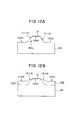
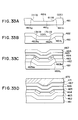
- FIG.10 Next, the fabrication process of the structure of FIG.10 will be described with reference to FIGS.12(A) - 12(D).
- a silicon oxide layer is provided on the (100) upper major surface of the p-type GaAs substrate 301 and patterned subsequently to form a silicon oxide stripe 21 such that the silicon oxide stripe 21 extends in the (011) direction. Further, while protecting the upper major surface of the substrate 301 by the silicon oxide stripe 21 thus formed, the substrate 301 is subjected to an wet etching process conducted in a mixture of H 2 S0 4 , H 2 0 2 and H 2 0 to form a mesa structure that corresponds to the mesa structure 301 a and includes a (100) stripe surface extending in the (011) direction at the top thereof with a width of about 5 ⁇ m.
- the mesa structure 301 a is laterally bounded by a pair of oblique surfaces both characterized by the (111)B surface.
- the (100) upper major surface of the GaAs substrate 301 extends parallel to the (100) stripe surface of the mesa structure 301 a.
- the deposition of the n-type GaAs layer 302 is achieved by the MOCVD process while protecting the (100) stripe surface of the mesa structure 301 a by the mask 21.
- the mask 21 is made of silicon oxide, the growth of the epitaxial layer does not occur on the mask 21, while the layer 302 grows on the (100) upper major surface of the GaAs substrate 301 extending at both sides of the mesa structure 301 a.
- oblique layers 303b i and 303b 2 characterized by the (311)B crystal surface develops on the upper major surface of the layer 302 at both sides of the (100) stripe region as shown in FIG.12(B) in correspondence to the (111)B surface of the mesa structure 301 a.
- the (311)B surfaces 303bi and 303b 2 form a second mesa structure together with the (100) stripe surface.
- the epitaxial growth of the layers 303 through 309 is achieved by the MOCVD process consecutively on the structure of FIG.12(B) as already described, wherein the growth of the layers 304 and 305 is achieved by the process described already with reference to FIG.11 (B). Thereby, one obtains a layered semiconductor body shown in FIG.12(C).
- upper and lower electrodes 310 and 311 are deposited respectively on the upper major surface of the contact layer 309 and on the lower major surface of the substrate 301. Thereby, the layered structure of the laser diode formed as shown in FIG.12(D).
- the construction for confining the injection current according to the first embodiment is effective also when the conductivity type of the epitaxial layers is reversed. More specifically, when one uses the n-type GaAs substrate in place of the p-type substrate 301, the conductivity type is reversed in each of the epitaxial layers. There, the process of FIG.11 (A) is applied to the growth of the p-type clad layer 307 rather than the n-type clad layer 305.
- FIGS.13(A) and 13(B) show the principle of the second embodiment.
- the concentration level of Se increases slightly in the (311)B surface as compared with the (100) surface.
- the concentration level of Se and hence the electron density decrease slightly in the InGaAIP layer in correspondence to the (100) surface as compared with the (311)B surface that forms the mesa structure together with the (100) surface.
- the concentration level of Mg and hence the hole density remains substantially constant in the same InGaAIP crystal irrespective of the crystal surfaces.
- the concentration level of Mg is larger than the concentration level of Se, doped simultaneously to Mg, in any of the (311)B surface and (100) surface, such that the InGaAIP crystal is doped to the p-type irrespective of the crystal surface, while it should be noted that there appears a difference in the resistivity depending on the crystal surface because of the different carrier concentration level in the (311)B surface and in the (100) surface. More specifically, the hole density increases in correspondence to the (100) surface as compared with the (311)B surface because of the reduced electron density in the (100) surface. Using the principle of FIG.13(A), one can decrease the resistivity of the clad layer selectively in correspondence to the (100) stripe region while increasing the resistivity in correspondence to the (311)B side walls of the mesa structure.
- FIG.13(B) shows another principle of the second embodiment device wherein the concentration level of simultaneously doped Mg and Se is adjusted such that the conductivity type of InGaAIP changes depending on the crystal surface.
- concentration level of simultaneously doped Mg and Se is adjusted such that the conductivity type of InGaAIP changes depending on the crystal surface.
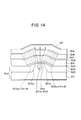
- FIG.14 shows the transversal cross section of the laser diode of the second embodiment wherein the foregoing principle is applied for realizing a current confinement structure.
- the device has essentially the same structure as the device of FIG.10, only the essential part of the device will be described.
- the first clad layer 305 is formed by the epitaxial process with the simultaneous doping of Mg and Se such that Mg has a concentration larger than Se for both the (311)B surface and the (100) surface as explained with reference to FIG.13(A).
- Mg has a concentration larger than Se for both the (311)B surface and the (100) surface as explained with reference to FIG.13(A).
- concentration level of Mg and Se in the respective parts of the InGaAIP clad layer 305 as shown in TABLE II below.
- the resistivity of the clad layer 305 increases in correspondence to the part grown on the (311)B surface as indicated in FIG.14 by the hatching, and the drive current, supplied at the electrode 311 and confined laterally by the n-type GaAs layer 302, is selectively injected to the stripe part of the active layer 306 through the low-resistivity (100) region of the clad layer 305 located immediately above the (100) stripe surface of the mesa structure.
- the drive current supplied at the electrode 311 and confined laterally by the n-type GaAs layer 302
- the doping level of Mg and Se may be set as shown in the following TABLE III.
- the current confinement structure is formed within the clad layer that is formed immediately adjacent to the active layer.
- the divergence of the drive current after the current confinement is minimized.
- the device of FIG.14 is improved further over the device of FIG.10 with respect to the lateral current confinement.
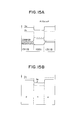
- FIGS.15(A) and 15(B) show the principle of construction of such a current confinement structure, wherein FIG.15(A) shows the case in which the InGaAIP layer 307 is doped to the n-type irrespective of whether the layer 307 is grown on the (100) surface or (311)B surface, while FIG.15(B) shows the case where the conductivity type changes in the layer 307 depending on the crystal surface.
- the resistivity changes, although the conductivity type does not change, such that the electron density decreases at the part grown on the (311)B surface as compared with the part that is grown on the (100) surface.
- the drive current flows selectively through the mesa region grown on the (100) stripe surface as shown in FIG.14, and the degree of current confinement is even more improved as compared with the embodiment wherein the current confinement structure is provided only in the first clad layer 305.
- FIG.16 shows the concentration level of Zn incorporated in a GaAs layer grown by a MOCVD process for various crystal surfaces on which the GaAs layer is grown
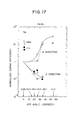
- FIG.17 shows the concentration level of Se that is incorporated in the GaAs layer for various crystal surfaces.
- the Zn content increases with increasing offset angle to the (111)A surface and shows a maximum generally in correspondence to the (311)A surface, while the Se content decreases monotonously with increasing offset angle to the (111)A surface.
- FIG.18 shows the change of the conductivity type that can be achieved in a GaAs layer grown by the MOCVD process.
- a high resistivity layer when the GaAs layer is grown on the (100) surface and doped simultaneously by Se and Zn with the equal concentration level of about 1 X 10 18 CM - 3.
- the Zn content decreases gradually and the GaAs layer shows the n-type conductivity.
- the concentration level of Se is set slightly smaller than Zn
- the GaAs layer grown on the (100) surface shows the p-type conductivity due to the excess in the holes produced by Zn.
- the Zn content decreases gradually and the conductivity type reverses in correspondence to the offset angle of about 10 degrees as can be seen in FIG.18.
- FIG.19 shows the structure of the laser diode of the third embodiment, wherein a GaAs current confinement layer is provided within the clad layer.
- the laser diode has a structure similar to the device of FIG.10 or FIG.14 except for one point that the intermediate layers 304 and 308 are omitted.
- those parts that correspond to the parts described in the previous embodiments will be designated by the same reference numerals and the description will be omitted.
- a thin GaAs layer 312 is provided within the clad layer 305 such that the clad layer 305 is split into a lower part 305a and an upper part 305b.
- the GaAs layer has a thickness of about 8 nm and is divided into three distinct regions, a first, stripe-like region 312a formed on the (100) surface and extending in correspondence to the mesa structure, a pair of second regions 312b, and 312b 2 formed on the (311)B surface in correspondence to the mesa structure and extending at both sides of the region 312a.
- the GaAs layer 312 is grown by the MOCVD process and doped simultaneously by Zn and Se such the region 312a is doped to the p-type while the regions 312b, and 312b 2 are doped to the n-type.
- a doping of the layer 312 can be achieved by setting the concentration level of Zn and Se as shown in FIG.18. More specifically, one may admix dimethylzinc and hydrogen selenide into the source gases of TEG and arsine for growing the GaAs layer 312 with respective concentration levels such that a Zn concentration level of about 1 X 10 18 cm- 3 and a Se concentration level of about 5 X 10 17 cm- 3 are achieved in the (100) surface.
- the n-type regions 312b i and 312b 2 are doped to the n-type and act to block the current injected to the active layer 306, and the effect of the current confinement is enhanced substantially.
- FIG.20 shows a modification of the third embodiment.
- the device has a structure similar to the device of FIG.19 except for the point that the conductivity type of each epitaxial layers as well as the conductivity type of the GaAs substrate is reversed. More specifically, the device is constructed on an n-type GaAs substrate 321 that has a mesa structure 321 a corresponding to the mesa structure 301 a of the substrate 301. On the substrate 321, epitaxial layers 322 through 329 are grown in correspondence to the epitaxial layers 302 - 309 of FIG.19 except for the conductivity type.
- the construction of the device of FIG.20 is obvious from the construction of the device of FIG.19, further description about the details will be omitted.
- a thin GaAs layer 331 having a thickness of about 8 nm is provided within the p-type clad layer 327 of InGaAIP such that the clad layer 327 is divided into a first layer 327a located below the layer 331 and a second layer 327b located above the layer 331.
- the layer 331 is doped simultaneously by Zn and Se such that the layer 327 is divided into a p-type region 331 a formed in correspondence to the (100) stripe surface of the mesa structure and two n-type regions 331b, and 331 b 2 formed at both sides of the n-type region 327a in correspondence to the (311)B surface.
- the doping of the GaAs layer 331 can be achieved similarly to the layer 312 and the description will be omitted.
- FIG.21 shows another modification of the third embodiment, wherein the device is constructed on a p-type GaAs substrate 341 covered by an n-type GaAs current blocking layer 342 that corresponds to the layer 302, wherein there is provided a groove 341 a on the upper major surface of the layer 342 such that the groove penetrates through the layer 342 and reaches the substrate 341.
- the groove 341 a forms a negative mesa structure characterized by a (100) oriented stripe-like bottom surface 341 formed of an exposed surface of the GaAs substrate 341 and a pair of (111)B surfaces 341 bi and 341 b 2 at the both sides of the (100) stripe-like bottom surface.
- the (100) stripe surface has a width of 5 ⁇ m similarly to the previous embodiments.
- a p-type GaAs layer is grown epitaxially while protecting the upper major surface of the n-type GaAs layer 342, except for the mesa structure 341 a, by a silicon oxide mask 52. See FIG.22(A).
- a p-type region 343 is grown selectively in correspondence to the exposed surface of the negative mesa structure 341 a such that the p-type region 343 forms a second negative mesa structure 341 a corresponding to the first mesa structure 341 a and is characterized by a (100) stripe surface 343a at the bottom and a pair of (311)B surfaces 343b i and 343b 2 at both sides of the stripe surface 343a.
- the p-type GaAs substrate 341, the n-type GaAs layer 342 and the p-type GaAs layer 343 form a substrate structure 340 on which the essential part of the laser diode is constructed.
- a buffer layer 344 of p-type GaAs is grown epitaxially with a thickness of about 0.2 /1 .m and in conformity with the morphology of the second mesa structure, and a first clad layer 345 of p-type InGaAIP is grown on the buffer layer 344 in conformity with the morphology of the second mesa structure.
- the clad layer 345 may be doped by incorporating Mg as described in the first embodiment or by incorporating Mg and Se simultaneously as described in the second embodiment.
- a current blocking layer 346 of p-type GaAs is grown epitaxially with the doping achieved simultaneously by Zn and Se, such that the layer 346 has the p-type in correspondence to the region that is grown on the (100) surface and such that the layer 346 has the n-type in correspondence to the region that is grown on the (311)B surface.
- a second clad layer 347 of p-type InGaAIP is grown on the current blocking layer 346 thus grown, and an active layer 348 of undoped InGaP is grown on the clad layer 347 thus formed.
- an n-type clad layer 349 is grown on the active layer 348 and a contact layer 350 of n-type GaAs is grown on the clad layer 349 as indicated in FIG.22(B).
- a contact layer 350 of n-type GaAs is grown on the clad layer 349 as indicated in FIG.22(B).
- the foregoing process for growing the epitaxial layers is achieved by the known MOCVD process.
- an upper electrode 351 and a lower electrode 352 are provided respectively on the upper major surface of the contact layer 350 and the lower major surface of the substrate 341, and the structure shown in FIG.21 is obtained.
- the concentration level of Mg and Se in the p-type InGaAIP clad layers 345 and 347 such that the clad layers have the p-type conductivity in correspondence to the region grown on the (100) strip surface of the mesa structure and the n-type conductivity in correspondence to the region grown on the (311)B surface.
- the diagram shows the carrier concentration level in an InGaAIP layer grown on various crystal surfaces and doped by Zn or Se, wherein the solid circles represent the change of the concentration level of electrons released from Se as a function of the increasing tilt angle toward the (111)A surface, while the open circles represent the change of the concentration level of the holes released from Zn. Further, the solid and open triangles represent respectively the change of the electron concentration level and the hole concentration level for the case wherein the InGaAIP layer is doped simultaneously by Zn and Se.
- the electrons released from Se are predominant over holes that are released from Zn for the layer that is grown on the (100) surface, while this relationship is reversed in the epitaxial layer grown on the (311)A surface, in conformity with the relationship of FIGS.4 and 5. More specifically, the layer grown on the (311)A surface is doped to the p-type in contrast to the layer grown on the (100) surface that is doped to the n-type under the same doping condition.
- an electron concentration level of about 1 X 1018 cm-3 and a hole concentration level of about 2 X 1016 cm-3 are achieved on the (100) surface, while an electron concentration level of about 6 X 10 6 cm -3 and an electron concentration level of about 1 X 10 18 cm -3 is achieved on (311)A surface in the same condition.
- the relationship of FIG.23 is effective for controlling the conductivity type of the InGaAIP layer based upon the orientation on the crystal surface on which the layer is grown.
- the principle of FIG.23 can be applied to the various embodiments described heretofore, by merely setting the direction of elongation of the (100) stripe surface in the (011) direction such that the (311)A surface is exposed at the side surface of the mesa structure in place of the (311)A surface.
- the magnitude of change of the carrier concentration level is larger in the (311)A surface than in the (311)B surface, a more effective current confinement can be achieved by using the (311)A surface.
- the embodiments described heretofore take the advantage of the above mentioned feature of large magnitude of change of the carrier concentration level.
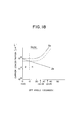
- FIG.24(A) shows the change of the electron concentration level and the resistivity corresponding to a first setting of the concentration level of Zn and Se, wherein the concentration levels of Zn and Se are set such that there occurs no change of the conductivity type between the part grown on the (100) surface and the part grown on the (311)A surface.
- the carrier concentration level and hence the resistivity increases substantially in correspondence to the part of the epitaxial layer grown on the (100) surface and one can achieve an effective concentration of current when the doping scheme of FIG.24(A) is applied for the fabrication of the clad structure of the laser diode.
- FIG.24(B) shows, on the other hand, a second scheme of doping wherein the concentration levels of Zn and Se are set such that there occurs a reversal of the conductivity type depending on the part of the InGaAIP layer grown on the (100) surface and the part grown on the (311)A surface. There, the Se concentration level exceeds the Zn concentration level in the part of the InGaAIP layer grown on the (100) surface, while the relationship reverses in the part that is grown on the (311)A surface.
- the laser diode of the present embodiment is constructed on a p-type GaAs substrate structure 401.
- the substrate structure 401 is formed with a mesa structure 401 a corresponding to the mesa structure 301 a such that the mesa structure 401 a is defined by a (100) oriented stripe surface 401 c extending in the (01 T) direction and laterally bounded by a pair of side surfaces 401b, and 401 b 2 both having the (311)A orientation, and a buffer layer 402 of p-type GaAs is grown on the substrate structure 400 in correspondence to the buffer layer 301.
- an intermediate layer 403 corresponding to the intermediate layer 304 is grown on the buffer layer 402.
- a clad layer 404 corresponding to the clad layer 305 is grown with a doping achieved by Mg such that the clad layer 404 is doped to the p-type uniformly.
- an undoped active layer 405 is grown epitaxially as in the previous embodiments, and a first clad layer 406 of n-type InGaAIP is grown further on the active layer 405 with a doping achieved by Se such that the layer 406 is doped to the n-type uniformly for the entirety of the layer 406.
- another clad layer 407 of n-type InGaAIP is grown on the clad layer 406 epitaxially such that the clad layer 407 incorporates Zn and Se simultaneously while it is grown on the clad layer 406 by the MOCVD process.
- the concentration level of Zn and Se is set as shown in FIG.24(A) or FIG.24(B) such that the clad layer 407 shows an increased resistivity in correspondence to the part that is grown on the (311)A surface and designated in FIG.25 as 407bi and 407b 2 , or such that the clad layer 407 shows a p-type conductivity in correspondence to the foregoing regions 407bi and 407b 2 .
- an n-type intermediate layer 408 of InGaP is grown in correspondence to the intermediate layer 308 of the previous embodiments, and a current blocking layer 409 of p-type GaAs is grown further on the intermediate layer 408.
- the layer 409 is patterned such that the intermediate layer 408 is exposed in correspondence to the mesa structure, and a contact layer 410 of n-type GaAs is grown on the current blocking layer 409 in contact with the exposed upper major surface of the intermediate layer 408.
- an upper electrode 411 and a lower electrode 412 are deposited respectively in ohmic contact with the upper major surface of the layer 410 and with the lower major surface of the substrate 401.
- FIG.26 is a diagram showing a modification of the fourth embodiment that uses an n-type substrate 421 in place of the p-type substrate 401.
- the substrate 421 includes a mesa structure 421 a defined by the (100) oriented stripe-like surface 421 c laterally defined by a pair of (111)A oriented surfaces 421 b 1 and 421 b 2 , wherein a p-type GaAs layer 422 is grown on the substrate 421 similarly to the layer 322 of FIG.20.
- the p-type GaAs layer 422 has a second mesa structure similar to the layer 322 such that the second mesa structure is characterized by the (100) oriented stripe-like top surface and a pair of (311)A oriented side surfaces 423b i and 423b 2 , and a buffer layer 423 of n-type GaAs is grown on the layer 422. Further, an intermediate layer 424 of n-type InGaAIP is grown on the buffer layer 423, and a first clad layer 425, of n-type InGaAIP is grown on the intermediate layer 424.
- the layer 425 is doped simultaneously by Zn and Se such that the layer 425 is divided into a first region 425a grown on the (100) surface of the mesa structure 421 a and a pair of second regions 425bi and 425b 2 formed at both sides of the first region 425a in correspondence to the (311)A oriented surfaces of the second mesa structure, similarly to the previous embodiments.
- another clad layer 425b 2 of n-type InGaAIP is grown on the layer 425b 1 with the doping by Se, and an active layer 426 of undoped InGaP is grown on the layer 425 2 epitaxially and in conformity with the morphology of the mesa structure.
- an active layer 426 of undoped InGaP is grown on the layer 425 2 epitaxially and in conformity with the morphology of the mesa structure.
- a clad layer 427 of p-type InGaAIP is grown epitaxially, and an intermediate layer 428 of p-type InGaP is grown further on the clad layer 427.
- a contact layer 429 of p-type GaAs is grown on the layer 428 as usual.
- an upper electrode 430 is provided on the upper major surface of the p-type GaAs contact layer 429 and a lower electrode 431 is provided on the lower major surface of the n-type GaAs substrate 421.
- FIG.27 shows another modification of the fourth embodiment, wherein the device is constructed on an n-type GaAs substrate 441 that is covered by a current confinement layer 442 of p-type GaAs.
- the layer 442 as well as the substrate 441 are formed with a negative mesa structure 441 a similar to the mesa structure 341 a of FIG.21, and an intermediate layer 443 of n-type InGaP is grown on the layer 442 to cover the mesa structure 441 a.
- a first clad layer 444, of n-type InGaAIP is grown epitaxially, wherein the layer 444, is doped simultaneously by Zn and Se with the concentration level set as indicated in FIG.24(A) or FIG.24(B).
- the clad layer 444 is divided into a low resistivity n-type region 444a corresponding to the (100) stripe surface and a pair of high resistivity n-type regions 444b i and 444b 2 respectively grown on the (311)A surface of the mesa structure.
- the clad layer 444 achieves an efficient current confinement.
- the region 444a is doped to the n-type while the regions 444b i and 444b 2 are doped to the p-type.
- the regions 444b i and 444b 2 block the injection current, and the construction of the latter is useful also for achieving an efficient current confinement.
- another clad layer 444 2 of n-type InGaAIP is grown epitaxially, and an active layer 445 of undoped InGaP is grown on the layer 444 2 Further, a clad layer 446 of p-type InGaAIP is grown on the upper major surface of the active layer 445, and an intermediate layer 447 of p-type InGaP is grown on the layer 446. On the layer 446, a p-type contact layer 448 is grown as illustrated. Further, an electrode 451 and an electrode 452 are provided respectively on the upper major surface of the clad layer 448 and on the lower major surface of the substrate 441.
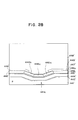
- FIG.28 shows another modification of the fourth embodiment, wherein the device of FIG.28 is constructed on a p-type substrate structure 441' that has a construction similar to the structural unit of FIG.27 formed of the GaAs substrate 441 and the GaAs layer 442 expect that the conductivity type is reversed, wherein the substrate structure 441' has a negative mesa similar to the mesa 441 a.
- the epitaxial layers 443' - 448' corresponding to the epitaxial layers of FIG.27 are grown consecutively with the reversed conductivity type such that the epitaxial layer 443' corresponds to the epitaxial layer 443, the epitaxial layer 444' corresponds to the epitaxial layer 444, the epitaxial layer 445 corresponds to the epitaxial layer 445', the epitaxial layer 446' corresponds to the epitaxial layer 446, the epitaxial layer 447' corresponds to the epitaxial layer 447, the epitaxial layer 448' corresponds to the epitaxial layer 448, and the epitaxial layer 449' corresponds to the epitaxial layer 449.
- the conductivity type of the epitaxial layers are reversed with respect to each other except for the active layer 445 and 445' that form the undoped active layers.
- the construction of the layer 444' is different from the layer 444 in that the layer 444' is formed of a single layer of p-type InGaAIP.
- the construction of the layer 446' is different from the construction of the layer 446 in that the layer 446' is formed of stacking of two layers, a first, lower layer 446, and a second, upper layer 446 2 .
- the layer 446 is doped to the n-type uniformly by incorporating Se, while the layer 446 2 is doped to the n-type by incorporating Zn and Se simultaneously.
- concentration level of Zn and Se according to the relationship of FIG.24(A)
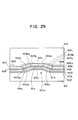
- FIG.29 showing a device having a structure similar to FIG.25.
- the device of FIG.29 will be designated by the same reference numerals for those parts that correspond to the device of FIG.25, and the description thereof will be omitted.
- the clad layer 406 is divided into a lower layer 406, and an upper layer 406 2 , wherein the upper layer 406 2 is doped uniformly to the n-type by incorporation of Se, while the lower layer 406, is doped simultaneously by Zn and Se such that the layer 406, has a first region 61 a of the n-type that is laterally sandwiched by a pair of second regions 61 b i and 61 b 2 of the p-type.
- FIG.30 shows a modification of the fifth embodiment wherein the laser diode has a structure similar to the device of FIG.26, except that the clad layer 425 2 is divided into a lower layer 425 21 doped to the n-type by Se and an upper layer 425 22 doped by Zn and Se simultaneously, wherein the layer 425 22 is divided into a first region 425 22 a of the n-type corresponding to the (100) stripe of the mesa structure and a pair of regions 425 22 b 1 and 425 22 b 2 of the p-type formed at both sides of the region 425 22 in correspondence to the (311)A surface.
- FIG.31 shows another modification of the fifth embodiment wherein the laser diode has a structure similar to the device of FIG.27, except that the clad layer 444 2 is divided into a lower layer 444 2 , doped to the n-type by Se and an upper layer 444 22 that is doped simultaneously by Zn and Se.
- the upper layer 444 22 is divided into a first region 444 22 a corresponding to the (100) stripe of the mesa structure and doped to the n-type and a pair of regions 444 22 bi and 444 22 b 2 corresponding to the (311)A surface and doped to the p-type.
- the device is constructed on an n-type substrate 461 of GaAs.
- the substrate 461 is formed with a negative mesa structure 461 a that is defined by a (100) stripe surface 461 c at the bottom surface and a pair of (311)A surfaces 461 1 and 461 b 2 that form the side wall of the mesa structure 461 a.
- a buffer layer 462 of n-type GaAs is grown epitaxially.
- the second mesa structure in the buffer layer 462 in correspondence to the mesa structure 461 a such that the second mesa structure has a (100) oriented stripe surface at the bottom and a pair of (311)A oriented side walls that define the (100) oriented stripe surface at the bottom.
- a clad layer 463 of n-type InGaAIP is grown epitaxially while doping simultaneously by Zn and Se such that a pair of p-type regions designated as 463b i and 463b 2 are formed in the layer 462 in correspondence to the (311)A surface.
- the rest of the layer 463 is doped to the n-type.
- an active layer 464 of undoped InGaP is grown epitaxially on the clad layer 463, and a p-type clad layer 465 of InGaAIP is grown further on the active layer 454.
- the clad layer 465 is formed with a positive mesa structure 465a that projects upward in correspondence to the negative mesa structure 461a, and an intermediate layer 466 of p-type InGaP is grown in correspondence to the mesa structure 465a. Further, another intermediate layer 467 of p-type GaAs is formed on the layer 466 as a continuation of the mesa structure 465a.
- the mesa structure 465a including the InGaP layer 466 and the GaAs layer 467 grown thereon are laterally supported by an n-type region 468 of GaAs for current confinement, and a p-type contact layer 469 of GaAs is grown on the layer 468 in contact with the upper major surface of the layer 467.
- the mesa structure 465a in correspondence to the clad layer 465, the effect of the current confinement is increased even more.
- FIG.32 Next, the fabrication process of the structure of FIG.32 will be described briefly with reference to FIGS.33(A) - 33(M).
- the mesa structure 461 a is formed on the upper major surface of the n-type substrate 461 as a groove extending in the (011) direction such that the groove is defined by the bottom surface 461 c and a pair of side walls 461b, and 461 b 2 . Further, the epitaxial growth of the n-type GaAs layer 462 is achieved on the structure thus obtained such that the second mesa structure is formed in correspondence to the mesa structured 461 c such that the mesa structure is laterally defined by a pair of (311)A side walls as shown in FIG.33(B).
- the layers 463 through 467 are grown consecutively by the MOCVD process with respective conductivity types as shown in FIG.33(C).
- the layer 463 is doped to the n-type except for the obliquely extending surface part that is doped to the p-type, while the layers 465 - 467 are doped to the n-type.
- a silicon oxide mask 471 is deposited on the upper major surface of the layer 467 as shown in FIG.33(D), and a photoresist 471 is deposited on the mask 471. It should be noted that there is formed a depression or groove on the upper major surface of the layer 467 and hence on the upper major surface of the layer 471 in correspondence to the mesa structure 461c, and the photoresist fills the groove thus formed.
- the photoresist 472 is subjected to an ashing process using oxygen plasma, such that the photoresist 472 is removed except for those parts that fills the groove.
- the silicon oxide mask 471 is subjected to an etching process while using the remaining photoresist 472 as a mask, and the photoresist 472 is removed subsequently as shown in FIG.33(G).
- FIG.33(G) is subjected to a wet etching process using an aqueous solution of NH 4 and H 2 0 2 as the etching agent, wherein the layer 467 is etched selectively as shown in FIG.33(H). Further, the silicon oxide layer 471 projecting outward form the patterned layer 467 is removed by a wet etching process that uses a buffered HF solution as the etching agent as shown in FIG.33(1).
- the intermediate layer 466 is removed by a wet etching process using a mixture of Br, HBr and H 2 0 while using the patterned layer 467 as a mask, and the layer 465 is etched subsequently by using a HCI etching solution. Thereby, the structure shown in FIG.33(J) is obtained.
- the deposition of n-type GaAs is achieved by the MOCVD process to form the GaAs layer 468 as shown in FIG.33(K). Further, the mask 471 is removed in the step of FIG.33(L), and the p-type GaAs contact layer 469 is deposited on the structure of FIG.33(L) as shown in FIG.33(M). Thereby, the structure of FIG.32 is obtained.
- FIG.34 shows a stripe laser diode according to the seventh embodiment, wherein the device is constructed on a GaAs substrate 501 doped by Si to the n-type with the carrier concentration level of 4 X 10 18 cm -3 .
- the substrate 501 has a (100)-oriented upper major surface as usual, wherein the upper major surface is formed with a step 501 a that extends in the longitudinal direction of the laser diode coincident to the ⁇ 01 1 > direction of GaAs crystal.
- the step 501 a is formed of a (311)A oriented stripe surface 501 c extending in the foregoing (011) direction with a step height of typically 1 ⁇ m, and the step 501a divides the upper major surface of the substrate 501 to a first (100) region 501b, and a second (100) region 501 b 2 .
- the step 501 a can be formed on the planar (100) surface of the GaAs substrate 501 by providing a silicon oxide mask and apply a wet etching process using a HF solution as the etching agent.
- the concentration level of Se is changed depending on the crystal surface as already explained with reference to FIG.17.
- the Se concentration level is about 3 X 10 17 cm -3 on the part grown on the (100) surface, while the Se concentration level changes to about 1.2 X 10 17 cm -3 in correspondence to the part grown on the (311)A surface. See the relationship of FIG.17.
- the stepped structure of the upper major surface of the substrate 501 is transferred to the upper major surface of the buffer layer 502.
- an intermediate layer 503 of n-type InGaP is grown epitaxially by a MOCVD process.
- the layer 503 has a composition of Ga o . 5 1n o . 5 P and doped by Se or Si, wherein the concentration level of Se changes, when Se is used for the dopant, depending on the crystal surface such that the Se content takes a value of 3.7 X 10 17 cm -3 on the (100) surface while a value of about 7 X 10 16 cm- 3 on the (311)A surface.
- the thickness of the layer 503 becomes about 0.1 ⁇ m on the (100) surface while the thickness is about 0.25 ⁇ m on the (311)A surface.
- a clad layer 504 of n-type InGaAIP is grown with a composition of (Al 0.7 Ga 0.3 ) 0.5 In 0.5 P, wherein the layer 504 is doped by Se or Si to the n-type.
- the thickness of the layer 504 may change slightly depending on the crystal surface such that the layer 504 has a thickness of about 0.3 ⁇ m for the part grown on the (100) surface while the layer 504 has a thickness of about 0.6 ⁇ m for the part grown on the (311)A surface.
- an optical guide layer 505 of n-type InGaAIP is grown on the layer 504 with a composition of (Al 0.4 Ga 0.6 ) 0.5 In 0.5 P, wherein the layer 505 is doped by Se or Si to the n-type.
- the thickness of the layer 505 changes depending on the crystal surface on which the layer is grown such that the part of the layer 505 grown on the (100) surface has a thickness of 0.2 ⁇ m while the part grown on the (311)A surface has a thickness of about 0.4 ⁇ m.
- an active layer 506 of undoped InGaP is grown on the layer 505 with a composition of Ga o . 5 1n o . 5 P.
- the thickness of the layer 506 changes depending on the crystal surface on which the layer is grown such that the part of the layer 506 grown on the (100) surface has a thickness of 0.015 ⁇ m while the part grown on the (311)A surface has a thickness of 0.03 ⁇ m.
- a p-type clad layer 507 of InGaAIP is grown with a composition of (Al 0.7 Ga 0.3 ) 0.5 In 0.5 P.
- the layer 507 is doped by Mg or Zn and has a thickness of 0.3 ⁇ m in correspondence to the part grown on the (100) surface and a thickness of 0.6 ⁇ m in correspondence to the part grown on the (311)A surface.
- another clad layer 508 of InGaAIP is grown on the layer 507 while doping simultaneously by Zn and Se such that the layer 507 is divided into a p-type first region 508a having a composition of (Al 0.7 Ga 0.3 ) 0.5 In 0.5 P and a thickness of 0.4 ⁇ m and a pair of n-type second regions 508bi and 508b 2 located at both sides of the region 508a with a thickness of 0.2 ⁇ m.
- the region 508a is enriched in Zn than Se and shows the p-type conductivity type while the regions 508b i and 508b 2 are enriched in Se than Zn and shows the n-type conductivity type.
- an intermediate layer 509 of p-type InGaAIP having a composition of (Al o .,Ga o .g)- 0.5 In 0.5 P is grown with a thickness of 0.04 ⁇ m in correspondence to the part grown on the (100) surface and a thickness of 0.08 ⁇ m in correspondence to the part grown on the (311)A surface.
- another intermediate layer 510 of p-type InGaAIP is grown on the layer 509 with a composition of (Al 0.4 Ga 0.6 ) 0.5 In 0.5 P such that the layer 510 has a thickness of 0.1 ⁇ m in correspondence to the part grown on the (100) surface and a thickness of 0.2 ⁇ m in correspondence to the part grown on the (311)A surface.
- both the layers 509 and 510 are doped by Mg or Zn and shows the p-type conductivity irrespective of the crystal surface.
- a contact layer 511 of p-type GaAs is provided on the layer 510 with a thickness of 5 - 10 ⁇ m.
- the layer 511 may be doped by Zn with a concentration level of 1 - 6 X 10 18 cm -3 .
- doping is achieved by admixing the gaseous material containing the desired dopant into the source gas of the epitaxial layer similarly to the previous embodiments.
- Se alone is introduced as in the layers 502 - 505
- hydrogen selenide is added for example with a mole ratio of Se with respect to the group V elements set to about 2 X 10- 6 such that an electron concentration level of about 8 X 10 17 cm -3 is achieved on the part grown on the (100) surface and an electron concentration level of about 1.5 X 10 17 cm -3 in correspondence tot he part grown on the (311)A surface.
- the mole ratio of dimethylzinc used for the source of Zn is set to 0.1 with respect to the gaseous source of the group III elements, wherein dimethylzinc is supplied with a concentration level such that the Zn content in the layer 508 becomes to about 5 X 10 16 cm -3 in correspondence to the part grown on the (100) surface and such that the Zn content becomes to about 5 X 10 17 cm -3 in correspondence to the part grown on the (311)A surface.
- an upper electrode 512 and a lower electrode 513 are provided respectively on the upper major surface of the GaAs contact layer 511 and a lower major surface of the GaAs substrate 501.
- the device of FIG.34 too, one can obtain an efficient current confinement in the region 508a and an efficient laser oscillation is obtained in the active layer in correspondence to the stripe region grown on the (311)A surface.
- the device is formed by a simple repetition of the epitaxial process once the substrate 501 is formed with the step 501 a.
- FIG.35 shows a modification of the device of FIG.34, wherein a remote junction is formed within the clad layer 507.
- the layer 507 is formed of a lower layer part 507, and an upper layer part 507 2 , wherein the lower layer part 507, is divided into a first region 507a of p-type formed in correspondence to the (311)A surface and a pair of second regions 507bi and 507b 2 , both doped to the n-type.
- Such a doping of the layer 507 is achieved by employing the simultaneous doping of Zn and Se as already described.
- the upper layer part 507 2 is doped to the p-type throughout. With the formation of the remote junction at the interface between the n-type region 507b i or 507b 2 and the p-type upper layer 507 2 , one can enhance the effect of the current confinement further.
- FIG.36 shows another modification of the laser diode of FIG.34, wherein the device is constructed on an n-type GaAs substrate 601 that has an upper major surface 601 b tilted from the (100) surface toward the (111)A surface by about + degrees, wherein the positive angle of tilting indicates the tilting of the surface in the clockwise direction.
- the substrate 601 is formed with a groove or negative mesa 601 a to extend in the (011) direction, wherein the negative mesa 601a a is defined by a (311)A oriented side wall 601 c and an opposing side wall 601 d that is tilted from the (100) surface toward the (111)A surface by a tilt angle of -9 degrees.
- the surface 601 d forms a crystallographically equivalent surface to the upper major surface 601 b of the substrate 601.
- epitaxial layers 602 - 606 are grown consecutively, wherein the layer 602 corresponds to the clad layer 502, the layer 603 corresponds to the active layer 506, the layer 604 corresponds to the clad layer 507, the layer 605 corresponds to the clad layer 508, and the layer 606 corresponds to the layer 509. Further, a contact layer 607 of p-type GaAs is formed on the layer 606 in correspondence to the contact layer 511. On the upper major surface of the layer 607, an upper electrode 608 is formed, while a lower electrode 609 is formed on the lower major surface of the substrate 601.
- the layer 602 is doped to the n-type by Se or Si, while the layers 604 and 606 are doped by Mg or Zn to the p-type, similarly to the previous embodiment.
- the clad layer 605 is doped simultaneously by Zn and Se.
- the clad layer 605, doped by Zn and Se simultaneously is divided into three distinct parts or regions, a first region 605a grown on the (311)A stripe surface, and second and third regions 605bi and 605b 2 formed at both lateral sides of the first region 605a, wherein the first region 605a has the p-type conductivity while the second and third regions 605bi and 605b 2 have the n-type conductivity type.
- the region 605b i forming the side wall of the mesa 601 a has a crystal surface equivalent to the crystal surface of the region 605b 2 that is formed on the upper major surface of the substrate, because of the foregoing tilting of the upper major surface.
- the drive current is confined selectively into the stripe part of the active layer 603 formed in correspondence to the (311)A surface, and the laser oscillation occurs preferentially in this stripe part.
- the laser oscillation in the other stripe part corresponding to the surface 601 d is suppressed because of the depletion of the drive current.
- the principle of the laser diode as set forth in FIG.36 can be applied to the form a structure for avoiding melting of the edge surface in the laser diode known as catastrophic optical damage.
- the laser diodes there is a tendency that impurity states at the edge surface of the laser diode absorbs the optical beam, and such an optical absorption causes a temperature rise at the edge part of the laser diode.
- the band gap of the active layer is narrowed and ultimately cause a short circuit. Thereby, the current flows along the edge surface and induces a melting.
- the conventional high power laser diodes uses a wide band gap material at the edge part.
- the electrode is formed such that the injection of the current does not occur in correspondence to the edge part.
- these conventional measure is complex and not practical for fabricating the laser diode in the actual production line.
- FIGS.37 and 38 show the process for fabricating a laser diode wherein the problem of the catastrophic optical absorption is eliminated, based upon the principle explained with reference to FIG.36.
- a substrate 701 of n-type GaAs is prepared such that the substrate 701 has upper and lower major surfaces characterized by a crystal surface that is tilted with respect to the (100) surface of the GaAs crystal toward the (111)A surface by +8 degrees. Further, the upper major surface of the substrate 701 is covered by a silicon oxide layer 702 that is patterned as shown in FIG.37. There, the oxide layer 702 forms a mask and has a pair of projecting patterns 702a and 702b in correspondence to the both longitudinal edges of the substrate 701.
- FIG.38 shows the state after the mask 702 is removed.
- the upper major surface of the substrate 701 is divided into a first surface 703a forming a stripe region and characterized by the (311)A surface and a pair of flat surfaces 703bi and 703b 2 formed at both sides of the stripe region 703a and characterized by the same tilted crystal surface as the original upper major surface of the substrate 701.
- an oblique surface 704a characterized by the crystal surface offset from the (311)A surface is formed in alignment with the stripe surface 703a such that the surface 704a is laterally bounded by surfaces 704b i and 704b 2 , wherein the surfaces 704, and 704b 2 are formed by the same crystal surface as the tilted upper major surface 703b i or 7093b 2 of the substrate 701.
- epitaxial layers are grown by the MOCVD process similarly to the device of FIG.36.
- the epitaxial layer grown on the stripe surface 703a is not equivalent to the epitaxial layer grown on the stripe surface 704a.
- the relationship between the epitaxial layer grown on the stripe surface 703a and epitaxial layer grown on the stripe surface 704a is similar to the relationship between the epitaxial layer 605a and the epitaxial layer 605b i of FIG.36.
- FIG.39 shows the essential part of the epitaxial layers grown on the structure of FIG.38, wherein an n-type InGaAIP clad layer 705a, an undoped InGaP active layer 706a and a p-type InGaAIP clad layer 707a are grown consecutively on the essential part of the structure of FIG.39 including the surfaces 703a and 703bi, 703b 2 .
- the clad layer 705a is doped by Se to the n-type throughout, while the layer 707a is doped simultaneously by Zn and Se such that the part of the layer 707a grown on the (311)A surface is doped to the p-type while the rest of the layer 707a is doped to the n-type.
- epitaxial layers 705b - 707b are grown consecutively on the edge part of the structure of FIG.38 including the surfaces 704a, 704bi and 704b 2 simultaneously to the corresponding layers 705a - 707a, wherein it will be noted that none of these surfaces include the (311)A surface.
- the clad layers 705b and 707b are both doped to the n-type and the double hetero junction essential for the laser diode is no longer formed in the edge part of the laser diode. Thereby, the laser oscillation at the edge part of the laser diode is prohibited even when the electrode is provided uniformly on the upper and lower major surface of the laser diode structure thus formed, and the problem of the catastrophic optical damage is avoided successfully.
Landscapes
- Physics & Mathematics (AREA)
- Optics & Photonics (AREA)
- Condensed Matter Physics & Semiconductors (AREA)
- General Physics & Mathematics (AREA)
- Electromagnetism (AREA)
- Geometry (AREA)
- Semiconductor Lasers (AREA)
Applications Claiming Priority (12)
| Application Number | Priority Date | Filing Date | Title |
|---|---|---|---|
| JP24153391 | 1991-09-20 | ||
| JP241533/91 | 1991-09-20 | ||
| JP342825/91 | 1991-12-25 | ||
| JP34282591 | 1991-12-25 | ||
| JP46547/92 | 1992-03-04 | ||
| JP4654792 | 1992-03-04 | ||
| JP5156392 | 1992-03-10 | ||
| JP51563/92 | 1992-03-10 | ||
| JP68000/92 | 1992-03-26 | ||
| JP6800092 | 1992-03-26 | ||
| JP13230492 | 1992-05-25 | ||
| JP132304/92 | 1992-05-25 |
Publications (2)
| Publication Number | Publication Date |
|---|---|
| EP0533197A2 true EP0533197A2 (de) | 1993-03-24 |
| EP0533197A3 EP0533197A3 (en) | 1993-11-03 |
Family
ID=27550236
Family Applications (1)
| Application Number | Title | Priority Date | Filing Date |
|---|---|---|---|
| EP19920116024 Withdrawn EP0533197A3 (en) | 1991-09-20 | 1992-09-18 | Stripe laser diode having an improved efficiency for current confinement |
Country Status (2)
| Country | Link |
|---|---|
| US (2) | US5436194A (de) |
| EP (1) | EP0533197A3 (de) |
Cited By (4)
| Publication number | Priority date | Publication date | Assignee | Title |
|---|---|---|---|---|
| FR2709612A1 (fr) * | 1993-08-30 | 1995-03-10 | Fujitsu Ltd | Laser à semi-conducteur et son procédé de fabrication. |
| EP0665618A1 (de) * | 1993-12-28 | 1995-08-02 | Fujitsu Limited | Halbleiterlaser mit gestuftem Substrat zur Lichtemission aus dem schrägstehenden Abschnitt |
| EP0637086A3 (de) * | 1993-07-30 | 1996-03-06 | Sharp Kk | Lichtemitierendes Halbleiterbauelement und lichtunterstütztes Abscheideverfahren zu seiner Herstellung. |
| CN101882755B (zh) * | 2009-01-22 | 2012-06-06 | 索尼公司 | 半导体激光器元件和半导体激光器器件 |
Families Citing this family (16)
| Publication number | Priority date | Publication date | Assignee | Title |
|---|---|---|---|---|
| JP3171307B2 (ja) * | 1995-06-26 | 2001-05-28 | 富士通株式会社 | 半導体レーザ装置及びその製造方法 |
| KR0185498B1 (ko) * | 1996-05-22 | 1999-03-20 | 박원훈 | 고출력 양자세선 어레이 레이저 다이오드 구조 제작방법 |
| US5923696A (en) * | 1996-12-27 | 1999-07-13 | Motorola, Inc. | Visible light emitting vertical cavity surface emitting laser with gallium phosphide contact layer and method of fabrication |
| DE69914540T2 (de) * | 1998-07-07 | 2005-02-17 | Mitsubishi Chemical Corp. | P-typ GaAs-Einkristall und Verfahren zu seiner Herstellung |
| JP2000031600A (ja) * | 1998-07-14 | 2000-01-28 | Nec Corp | 半導体レーザの製造方法 |
| US6778575B2 (en) * | 2001-03-22 | 2004-08-17 | Sanyo Electric Co., Ltd. | AlGaInP-based high-output red semiconductor laser device |
| GB0128743D0 (en) * | 2001-11-30 | 2002-01-23 | Epiic Ltd | Method of producing integrated semiconductor components on a semiconductor substrate |
| JP4170679B2 (ja) * | 2002-06-13 | 2008-10-22 | 松下電器産業株式会社 | 半導体発光装置及びその製造方法 |
| US7558305B2 (en) * | 2003-12-31 | 2009-07-07 | Wisconsin Alumni Research Foundation | Intersubband mid-infrared electroluminescent semiconductor devices |
| JP4751024B2 (ja) * | 2004-01-16 | 2011-08-17 | シャープ株式会社 | 半導体レーザおよびその製造方法 |
| JP2005236024A (ja) * | 2004-02-19 | 2005-09-02 | Fuji Photo Film Co Ltd | 半導体レーザ素子 |
| JP4461980B2 (ja) * | 2004-09-22 | 2010-05-12 | 住友電気工業株式会社 | 半導体光素子 |
| US7403552B2 (en) * | 2006-03-10 | 2008-07-22 | Wisconsin Alumni Research Foundation | High efficiency intersubband semiconductor lasers |
| US7457338B2 (en) * | 2006-04-19 | 2008-11-25 | Wisconsin Alumni Research Foundation | Quantum well lasers with strained quantum wells and dilute nitride barriers |
| JPWO2011070760A1 (ja) * | 2009-12-09 | 2013-04-22 | パナソニック株式会社 | 半導体素子の製造方法 |
| DE102015104206A1 (de) * | 2015-03-20 | 2016-09-22 | Osram Opto Semiconductors Gmbh | Laserdiode |
Family Cites Families (16)
| Publication number | Priority date | Publication date | Assignee | Title |
|---|---|---|---|---|
| JPS55158691A (en) * | 1979-05-30 | 1980-12-10 | Sumitomo Electric Ind Ltd | Semiconductor light emitting device manufacture thereof |
| JPS5723292A (en) * | 1980-07-16 | 1982-02-06 | Sony Corp | Semiconductor laser device and manufacture thereof |
| US4792958A (en) * | 1986-02-28 | 1988-12-20 | Kabushiki Kaisha Toshiba | Semiconductor laser with mesa stripe waveguide structure |
| US4839307A (en) * | 1986-05-14 | 1989-06-13 | Omron Tateisi Electronics Co. | Method of manufacturing a stripe-shaped heterojunction laser with unique current confinement |
| US4785457A (en) * | 1987-05-11 | 1988-11-15 | Rockwell International Corporation | Heterostructure semiconductor laser |
| JPH0646669B2 (ja) * | 1987-07-28 | 1994-06-15 | 日本電気株式会社 | 半導体レ−ザ及びその製造方法 |
| US5185289A (en) * | 1988-06-28 | 1993-02-09 | International Business Machines Corporation | Process for the selective growth of GaAs |
| JP2806951B2 (ja) * | 1988-11-28 | 1998-09-30 | 富士通株式会社 | ストライプ型半導体レーザの製造方法 |
| US5219785A (en) * | 1989-01-27 | 1993-06-15 | Spectra Diode Laboratories, Inc. | Method of forming current barriers in semiconductor lasers |
| JPH02294089A (ja) * | 1989-05-08 | 1990-12-05 | Mitsubishi Electric Corp | 半導体レーザ |
| EP0403293B1 (de) * | 1989-06-16 | 1995-12-06 | Kabushiki Kaisha Toshiba | Verfahren zur Herstellung eines III-V-Verbindungshalbleiterbauelementes |
| US5065200A (en) * | 1989-12-21 | 1991-11-12 | Bell Communications Research, Inc. | Geometry dependent doping and electronic devices produced thereby |
| JP2893827B2 (ja) * | 1990-03-27 | 1999-05-24 | ソニー株式会社 | 半導体レーザ |
| US5202285A (en) * | 1990-04-26 | 1993-04-13 | Fujitsu Limited | Semiconductor laser having double heterostructure and method of producing same |
| EP0454476A3 (en) * | 1990-04-26 | 1992-04-01 | Fujitsu Limited | Semiconductor laser having double heterostructure and method of producing the same |
| US5227015A (en) * | 1990-07-30 | 1993-07-13 | Matsushita Electric Industrial Co., Ltd. | Method of fabricating semiconductor laser |
-
1992
- 1992-09-18 EP EP19920116024 patent/EP0533197A3/en not_active Withdrawn
-
1994
- 1994-04-15 US US08/228,453 patent/US5436194A/en not_active Expired - Lifetime
-
1995
- 1995-04-24 US US08/427,352 patent/US5621748A/en not_active Expired - Fee Related
Cited By (10)
| Publication number | Priority date | Publication date | Assignee | Title |
|---|---|---|---|---|
| EP0637086A3 (de) * | 1993-07-30 | 1996-03-06 | Sharp Kk | Lichtemitierendes Halbleiterbauelement und lichtunterstütztes Abscheideverfahren zu seiner Herstellung. |
| US5581116A (en) * | 1993-07-30 | 1996-12-03 | Sharp Kabushiki Kaisha | Semiconductor device manufactured by selectively controlling growth of an epitaxial layer without a mask |
| US5854089A (en) * | 1993-07-30 | 1998-12-29 | Sharp Kabushiki Kaisha | Semiconductor device by selectively controlling growth of an epitaxial layer without a mask |
| FR2709612A1 (fr) * | 1993-08-30 | 1995-03-10 | Fujitsu Ltd | Laser à semi-conducteur et son procédé de fabrication. |
| US5814531A (en) * | 1993-08-30 | 1998-09-29 | Fujitsu Limited | Method for forming semiconductor laser emitting light from slant plane |
| EP0665618A1 (de) * | 1993-12-28 | 1995-08-02 | Fujitsu Limited | Halbleiterlaser mit gestuftem Substrat zur Lichtemission aus dem schrägstehenden Abschnitt |
| EP0806823A3 (de) * | 1993-12-28 | 1997-11-19 | Fujitsu Limited | Halbleiterlaser mit gestuftem Substrat zur Lichtemission aus dem schrägstehenden Abschnitt |
| EP0808003A3 (de) * | 1993-12-28 | 1997-11-26 | Fujitsu Limited | Halbleiterlaser mit gestuftem Substrat zur Lichtemission aus dem schrägstehenden Abschnitt |
| US5799027A (en) * | 1993-12-28 | 1998-08-25 | Fujitsu Limited | Stepped substrate semiconductor laser for emitting light at slant portion |
| CN101882755B (zh) * | 2009-01-22 | 2012-06-06 | 索尼公司 | 半导体激光器元件和半导体激光器器件 |
Also Published As
| Publication number | Publication date |
|---|---|
| US5436194A (en) | 1995-07-25 |
| EP0533197A3 (en) | 1993-11-03 |
| US5621748A (en) | 1997-04-15 |
Similar Documents
| Publication | Publication Date | Title |
|---|---|---|
| US5436194A (en) | Stripe laser diode having an improved efficiency for current confinement | |
| US6984840B2 (en) | Optical semiconductor device having an epitaxial layer of III-V compound semiconductor material containing N as a group V element | |
| US7768030B2 (en) | Nitride based semiconductor device with film for preventing short circuiting | |
| US5496767A (en) | Semiconductor laser and manufacturing method of the same | |
| US20100317136A1 (en) | Method for producing semiconductor light emitting device, method for producing semiconductor device, method for producing device, method for growing nitride type iii-v group compound semiconductor layer, method for growing semiconductor layer, and method for growing layer | |
| JP2555881B2 (ja) | A▲l▼GaInP系結晶の結晶成長方法および半導体レ−ザ | |
| US5375136A (en) | Semiconductor laser of patterned-substrate type and structure thereof | |
| US7893454B2 (en) | Method for producing structured substrate, structured substrate, method for producing semiconductor light emitting device, semiconductor light emitting device, method for producing semiconductor device, semiconductor device, method for producing device, and device | |
| US5528617A (en) | Semiconductor laser with alinp or algainp burying layer | |
| US5270246A (en) | Manufacturing method of semiconductor multi-layer film and semiconductor laser | |
| JP2945546B2 (ja) | ストライプレーザダイオードおよびその製造方法 | |
| US6577662B1 (en) | Semiconductor laser, and manufacturing method thereof, semiconductor device and manufacturing method thereof | |
| US6901097B2 (en) | Semiconductor laser diode and method for fabricating the same | |
| US8134171B2 (en) | Method of manufacturing semiconductor device and semiconductor device | |
| JPH0567836A (ja) | AlGaInP系半導体レーザ素子 | |
| JPH0766495A (ja) | 半導体レーザおよびその製造方法 | |
| JPH05259566A (ja) | 半導体発光装置 | |
| JP3783244B2 (ja) | Iii−v族化合物半導体発光素子の製造方法 | |
| JP3005998B2 (ja) | 半導体レーザの製造方法 | |
| JPH0567839A (ja) | 半導体レーザ装置 | |
| JPH08125285A (ja) | 半導体発光装置 | |
| JP2910115B2 (ja) | 半導体レーザ | |
| JP2005260277A (ja) | 半導体発光装置 | |
| JPH0722697A (ja) | 半導体レーザ素子およびその製造方法 | |
| JPH07147451A (ja) | 半導体発光素子の製造方法 |
Legal Events
| Date | Code | Title | Description |
|---|---|---|---|
| PUAI | Public reference made under article 153(3) epc to a published international application that has entered the european phase |
Free format text: ORIGINAL CODE: 0009012 |
|
| AK | Designated contracting states |
Kind code of ref document: A2 Designated state(s): DE FR GB NL |
|
| PUAL | Search report despatched |
Free format text: ORIGINAL CODE: 0009013 |
|
| AK | Designated contracting states |
Kind code of ref document: A3 Designated state(s): DE FR GB NL |
|
| 17P | Request for examination filed |
Effective date: 19940429 |
|
| 17Q | First examination report despatched |
Effective date: 19951128 |
|
| 18D | Application deemed to be withdrawn |
Effective date: 19970402 |