EP0528359A1 - Process for regenerating clogged filters - Google Patents
Process for regenerating clogged filters Download PDFInfo
- Publication number
- EP0528359A1 EP0528359A1 EP92113815A EP92113815A EP0528359A1 EP 0528359 A1 EP0528359 A1 EP 0528359A1 EP 92113815 A EP92113815 A EP 92113815A EP 92113815 A EP92113815 A EP 92113815A EP 0528359 A1 EP0528359 A1 EP 0528359A1
- Authority
- EP
- European Patent Office
- Prior art keywords
- filter
- hydrogen peroxide
- filters
- solid carbonaceous
- aqueous solution
- Prior art date
- Legal status (The legal status is an assumption and is not a legal conclusion. Google has not performed a legal analysis and makes no representation as to the accuracy of the status listed.)
- Withdrawn
Links
Images

Classifications
-
- B—PERFORMING OPERATIONS; TRANSPORTING
- B01—PHYSICAL OR CHEMICAL PROCESSES OR APPARATUS IN GENERAL
- B01D—SEPARATION
- B01D41/00—Regeneration of the filtering material or filter elements outside the filter for liquid or gaseous fluids
- B01D41/04—Regeneration of the filtering material or filter elements outside the filter for liquid or gaseous fluids of rigid self-supporting filtering material
-
- B—PERFORMING OPERATIONS; TRANSPORTING
- B01—PHYSICAL OR CHEMICAL PROCESSES OR APPARATUS IN GENERAL
- B01D—SEPARATION
- B01D41/00—Regeneration of the filtering material or filter elements outside the filter for liquid or gaseous fluids
-
- B—PERFORMING OPERATIONS; TRANSPORTING
- B01—PHYSICAL OR CHEMICAL PROCESSES OR APPARATUS IN GENERAL
- B01D—SEPARATION
- B01D2201/00—Details relating to filtering apparatus
- B01D2201/08—Regeneration of the filter
- B01D2201/085—Regeneration of the filter using another chemical than the liquid to be filtered
Definitions
- the present invention relates to a process for regenerating a filter which has been clogged and rendered non-solid carbonaceous materials contained in heavy oils or pitches derived from petroleum or coal, and, in particular, to a process for regenerating a filter, which has been clogged and rendered compatible by solid carbonaceous materials contained in heavy oils or pitches derived from petroleum or coal, comprising immersing the filter in an aqueous solution of hydrogen peroxide with heating, thus removing the solid carbonaceous materials clogging the filter.
- One preferred embodiment of the process of the present ivention relates to a process for regenerating a filter, which has been clogged and rendered non-regenerating a filter, which has been clogged and rendered non-regenerating a filter, which has been clogged and rendered non-regenerating a filter, which has been clogged and rendered non-regenerating a filter, which has been clogged and rendered non-regenerating a filter, which has been clogged and rendered opaque by solid carbonaceous materials contained in heavy oils or pitches derived from petroleum or coal, comprising immersing the filter in an aqueous solution of hydrogen peroxide, heating it at a temperature between 50 - 100°C, removing the aqueous solution of hydrogen peroxide, then, if required, further treating the filter by an ultrasonic wash, thus removing the solid carbonaceous materials clogging the filter.
- Various types of carbon or graphite materials such as binder pitches, electrodes, graphite blocks, carbon fibers, and the like are manufactured from heavy oils such as residuum of the crude oil vacuum distillation unit, decant oil obtained in FCC unit, naphtha tar, i.e., bottom oil of ethylene plant, or the like; coal tars and the like produced in coke ovens; or pitches obtained from any of these, as raw materials.
- undesired components such as components of an extremely high molecular weight contained in the raw material, free carbon, coke or extremely heavy components produced during the manufacturing process, as well as solid materials, are conventionally removed to ensure a higher quality of the target products.
- an intermediate product obtained by removing the above-mentioned undesired components is subjected to a thermal polymerization process under specific conditions to recover only components polymerized by the thermal polymerization.
- the raw material, the intermediate product, or the thermally polymerized component contained in the intermediate product from which undesired component has been removed is generally dissolved in a suitable solvent or melted by heating to deposit such undesired components or polymerized components and to remove or recover them as undissolved or unmelted components.
- these undissolved or unmelted components are removed or recovered by means of a filter.
- the major portion of the undissolved or unmelted components is made up of carbonaceous compounds consisting of carbon and hydrogen, even though it contains small amounts of metallic compounds, or nitrogen, sulfur, and silicon compounds, particularly in the case where they are derived from deposition of undesired components.
- the undissolved or unmelted components both in the case where they are derived from deposition of undesirable components which are to be removed and in the case where they are deposited polymerized components which are the target material, are herein referred to as "solid carbonaceous materials".
- the abovementioned heavy oils such as the crude oil vacuum distillation residuum, FCC decant oil, naphtha tar, or the like; coal tars and the like produced in coke ovens; or pitches obtained from these heavy oils or coal tars, as well as intermediate products from the manufacturing process and the materials from the thermal polymerization process for the intermediate product from which the undesired components have been removed, are collectively referred to as "heavy oils or pitches derived from petroleum or coal".
- a filter medium such as materials such as metals, glass, polymers, papers, or the like are used as a filter medium.
- These filter media can be provided in many forms, such as a woven or non-woven fabric, or a porous member formed from sintered or bound particles.
- a metal, particularly stainless steel, or glass is mainly used as the filter medium for removing solid carbonaceous materials contained in heavy oils or pitches derived from petroleum or coal.
- Stainless steel filters include stainless steel in the form of sheets of woven or non-woven fabric, a sintered metal formed by sintering minute particles of stainless steel, and the like.
- Methods hitherto used to remove the solid carbonaceous materials which have penetrated into the filter medium and caused clogging include washing the filter with an organic solvent, for example, immersing it in quinoline which is reputed to most efficiently dissolve heavy oils, then ultrasonically washing it or washing it under heating; ultrasonically washing the filter with an alkaline washing agent, e.g., with Contaminon (a product of Wako Pure Chemical Industries, Ltd., a kind of non-ionic surfactant, pH: ca. 10), etc.; and the like.
- Contaminon a product of Wako Pure Chemical Industries, Ltd., a kind of non-ionic surfactant, pH: ca. 10
- the filter medium is made of glass, it is known to be possible to completely remove the solid carbonaceous materials by immersing the filter medium in a solution containing chromic acid, but the effect on the environment of the chromium ions contained in the waste liquid is a problem. Significant cost is involved in disposing of this waste liquid.
- the regeneration with a chromic acid solution cannot be applicable to the treatment, for example, of pitch used to manufacture carbon fiber, since a metallic filter medium with a sufficient strength must be used for such a filtration.
- the gist of the present invention resides in a process for regenerating a filter medium clogged with solid carbonaceous materials contained in heavy oils or pitches (heavy oils), characterized by treating said filter medium in an aqueous solution of hydrogen peroxide with heating.
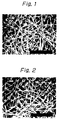
- Figure 1 is a scanning electron microscopic (hereinafter abbreviated as SEM) photograph of a filter medium with 5 micron apertures which had been regenerated by immersion in a 5 wt% aqueous solution of hydrogen peroxide, followed by ultrasonic washing in water, in Example 1.
- SEM scanning electron microscopic
- Figure 2 is an SEM photograph of a filter medium with 5 micron apertures which had been regenerated by immersion in a 30 wt% aqueous solution of hydrogen peroxide, in Example 1.
- Figure 3 is an SEM photograph of a filter medium with 5 micron apertures which had been regenerated by ultrasonic washing in quinoline, in Example 1.
- the process of the present invention is suited for regenerating a filter with a layered or laminated construction or a filter having a certain degree of thickness, made of a metal, in particular stainless steel, or glass. There are, of course, absolutely no problems in applying the process of the present invention to the regeneration of a filter medium of normal thickness.
- solid carbonaceous materials built up on the surface of the filter medium which was used for the filtration of heavy oils to remove solid carbonaceous materials and clogged with the solid carbonaceous materials are firstly removed, for example, by scraping them away, by washing with a solvent, or by ultrasonically washing, and then the process of the present invention is applied by immersing the filter in a 0.5 to 40 wt% aqueous solution of hydrogen peroxide and heating it to 50 - 100°C.
- This conjecture is based on the fact that when a filter used to filter pitch for manufacturing carbon fiber by melt spinning, for example, is immersed in a 30 wt% aqueous solution of hydrogen peroxide and heated to 90°C, the production of bubbles which is believed to be produced by the decomposition of hydrogen peroxide is observed, and, after 15 minutes, the bubble generation becomes violent, the hydrogen peroxide solution forms a black suspension, which after 30 minutes turns almost colorless.
- the concentration of the aqueous solution of hydrogen peroxide depends on the degree of clogging of the filter medium being regenerated. Specifically, this relates to the amount of solid carbonaceous materials existing within the filter medium. No particular problems occur in the regeneration of the filter if this concentration is within the range of 0.5 to 40 wt%, with 3 to 30 wt% being preferable. If this concentration is less than 0.5 wt%, the oxidation rate of the carbonaceous materials by hydrogen peroxide, and the generation of bubbles due to the oxidation by and decomposition of the hydrogen peroxide are very slight so that satisfactory regeneration of the filter medium does not occur.
- the temperature used in the treatment with hydrogen peroxide is perferably in the range of 50 - 100°C. If lower than 50°C, the oxidation by the hydrogen peroxide does not sufficiently proceed, and no bubbles are created by the decomposition of the hydrogen peroxide or the amount of bubbles is too small. If the temperature exceeds this range the water is evaporated so rapidly, making it necessary to carry out the treatment under an increased pressure. In addition, the generation of gas from the decomposition of the hydrogen peroxide and the generation of gas produced by the oxidation of the solid carbonaceous materials become too violent, imparing the safety of the process operation.
- solvents which can be used for this purpose include hexane, acetone, methyl alcohol, ethyl alcohol, benzene, toluene, xylene, cresol, benzene chloride, pyridine, quinoline, oils having a boiling point of lower than 350°C obtained from coal tar or petroleum, and the like.
- solvents in which heavy oils are highly soluble such as benzene, toluene, xylene, quinoline, pyridine, and the like, are preferable.
- the treatment by the aqueous solution of hydrogen peroxide is usually continued until the generation of bubbles has almost ceased. For example, about one hour is required with a hydrogen peroxide concentration of 3 to 6 wt% at a temperature of 90°C. This also depends on the amount of solid carbonaceous materials deposited in the filter. Even though there is no particular problem if the process is halted while bubbles are still being generated, the effects of the present invention cannot be exhibited unless the treatment is continued at least about 10 minutes.
- an acidic material such as acetic acid
- acetic acid it is possible to add an acidic material such as acetic acid to the aqueous solution of hydrogen peroxide so as to accelerate the oxidation reaction and increase the decomposition rate of hydrogen peroxide.
- washing the filter treated by hydrogen peroxide with water or, further, washing it ultrasonically, to remove the solid carbonaceous materials which have been stripped away from the filter media but remain in the filter is desirous in achieving a more complete regeneration of the filter.
- This ultrasonic washing may be performed in water. Either, the ultrasonic washing may be carried out in benzene, toluene, xylene, quinoline, pyridine, or the like with no problem. The ultrasonic washing for 5 minutes to one hour is generally satisfactory.
- a black suspension of solid carbonaceous materials flow out from the filter during the ultrasonic washing, it is more preferable that the water is changed to continue the washing until there is no further flow of this black suspension.
- Hydrogen peroxide is contained in the waste liquid after the hydrogen peroxide treatment, but the concentration is rather low. In particular, if the treatment is continued until the generation of bubbles is ceased, only a minute amount of hydrogen peroxide is present in the waste liquid.
- This waste liquid can be easily processed by decomposing the small amount of contained hydrogen peroxide into water and oxygen using a hydrogen peroxide decomposition catalyst such as manganese dioxide, so that there is absolutely no adverse effect on the environment.
- SUS 304 Disk-shaped stainless steel
- coal tar in order to remove sooty materials (referred to as free carbon) or to remove extremely high molecular weight components contained in coal tar, coal tar was mixed with 3 times by weight of quinoline and filtered through a G4 glass filter with a diameter of 20 mm and a thickness of 2 mm to remove the above-mentioned sooty materials and extremely high molecular weight components. After the filtration, the solid carbonaceous materials accumulated on the upper surface of the filter were firstly removed front the G4 glass filter by scraping, and then the filter was washed ultrasonically in quinoline for one hour to remove the soluble material existed in the filter.
- sooty materials referred to as free carbon
- the filter was then removed with acetone and the acetone was removed by a further water wash to regenerate the filter.
- the filter Prior to use, the filter was white, but after use, even after the above-mentioned operation had been performed, the filter was black due to the solid carbonaceous materials not completely removed.
- the filter was immersed in a 5 wt% aqueous solution of hydrogen peroxide. When heated to 90°C, the generation of bubbles and formation of a black suspension were observed, and after one hour, the bubble generation in the black suspension almost ceased. After this treatment, the filter was ultrasonically washed in water, at which time the black suspension was observed to flow.
- the process of the present invention can be applied for regenerating a filter which has been used to remove solid carbonaceous materials contained in heavy oils and can completely remove the solid carbonaceous materials which have caused clogging of the filter medium, restoring the performance of the filter equivalent to that of a new filter.
- the waste liquid from the process of the present invention can be easily treated so that it has no adverse effect on the environment.
- FIGS 1 to 3 are SEM photographs of the 5 micron aperture filter leaves which had been immersed in the 5 wt% aqueous solution of hydrogen peroxide, followed by ultrasonic washing in water; immersed in a 30 wt% aqueous solution of hydrogen peroxide; and ultrasonically washed in quinoline, respectively.
- Table 1 gives data on the relationship between the methods of treatment and the phtographs.
- Table 1 Concentration of hydrogen peroxide (% by weight) Ultrasonic water washing after hydrogen peroxide treatment Figure No. 5 Performed 1 30 Not performed 2 Ultrasonic washing in quinoline for one hour 3
- Example 1 One gram of the pitch used in Example 1 was mixed with 30 ml of pyridine to dissolve. About 40 wt% of the pitch remained insoluble in pyridine and formed a suspension. This suspension was filtered through a G4 glass filter with a diameter of 20 mm and a thickness of 2 mm. After filtration, the solid carbonaceous materials accumulated on the surface of the filter were firstly removed by scraping, then the filter was washed ultrasonically in quinoline for one hour to remove the soluble material existed in the filter. The quinoline was then removed with acetone and the acetone was removed by a further water wash to regenerate the filter. Prior to use, the filter was white, but became black after use and remained black even after the above-mentioned operation.
- the G4 glass filter which had been subjected to the above-mentioned operation was immersed in a 5 wt% aqueous solution of hydrogen peroxide and heated to 90°C for one hour and 30 minutes. This filter was then ultrasonically washed in water to confirm that the filter became completely white.
- one liter of water was passed through the respective filters under a reduced pressure to measure the time required for the pass. The time required for the pass for the filter prior to use and for the filter regenerated by means of the process of the present invention was 2 minutes and 30 seconds, while the filter which was regenerated by washing with quinoline required 6 minutes for the pass.
- the filter treated by process (1) of the present invention had a silver-white color, the same as that before use, after the regeneration, while the filter subjected to burning in an air stream by process (2) was partly reddish-brown in color due to rust formation and formed cracks so that it was no longer usable.
- a water filtration test was carried out to compare the performance of three filters.
- the first filter was a new filter
- the second filter was the filter regenerated by the process of the present invention
- the third filter was the filter regenerated only by ultrasonic wash in quinoline.
- the cylindrical filter was placed in a container full of water.
- the opening of the filter for taking out the filtrate was positioned above the water surface so that water could not enter through this opening.
- the water was allowed to permeate through the filter into the internal section to measure the time required for the water levels inside and outside of the filter to equalize. This took about one minute for both the new filter and the filter which had been regenerated by the above process (1) of the present invention.
- the water level inside the filter had only reached about 2/3 of the external level even after 10 minutes.
- Example 3 One part by weight of the pitch used in Example 3 was mixed with 3 times its weight of quinoline, and a solid portion was roughly removed by means of a continuous centrifuge.
- the solution was filtered by a cylindrical stainless steel random fiber filter (Filterlite Dynalloy Cartridge, manufactured by Nihon Memutec Co.), maximum diameter 50 mm, length 250 mm, apertures 3 micron, filtration area 0.19 m2, with ribs to provide a large filtration area, for 8 hours at a rate of 100 liter/hour, during which time the pressure differential rose from 0.01 MPa (0.1 Kg/cm2) to 0.5 MPa (5 Kg/cm2).
- the solid materials accumulated on the surface of the filter were removed, and the filter was washed ultrasonically in quinoline.
- the filter was then immersed in a 5 wt% aqueous solution of hydrogen peroxide and heated to 90°C for one hour, followed by an ultrasonic wash in water, according to the process of the present invention.
- Another filter which had been washed ultlrasonically in quinoline in the same way as above was immersed for one hour in molten salt (NeoSK-SALT: tradename, a product of Soken Chemical Co., Ltd.; composition: 40 wt% sodium sulfite, 53 wt% potassium nitrate, and 7 wt% sodium nitrate) at 500°C to burn out the solid materials, then washed with water.
- molten salt NaSK-SALT: tradename, a product of Soken Chemical Co., Ltd.; composition: 40 wt% sodium sulfite, 53 wt% potassium nitrate, and 7 wt% sodium nitrate
- the filter regenerated by the process of the present invention took on a silver-white color, the same as the color of a new filter.
- the random fiber was oxidized and tattered so that the filter could not be reused.
- the performance of these regenerated filters was measured by the method used in Example 3.
- the water levels inside and outside of the filter equalized in about three seconds for both a new filter and the filter which had been regenerated by the process of the present invention, while it took about three minutes for the filter regenerated only by ultrasonic washing in quinoline.
Landscapes
- Chemical & Material Sciences (AREA)
- Chemical Kinetics & Catalysis (AREA)
- Filtering Materials (AREA)
Applications Claiming Priority (2)
| Application Number | Priority Date | Filing Date | Title |
|---|---|---|---|
| JP3229431A JPH0747101B2 (ja) | 1991-08-15 | 1991-08-15 | 目詰まりしたフィルターの再生方法 |
| JP229431/91 | 1991-08-15 |
Publications (1)
| Publication Number | Publication Date |
|---|---|
| EP0528359A1 true EP0528359A1 (en) | 1993-02-24 |
Family
ID=16892123
Family Applications (1)
| Application Number | Title | Priority Date | Filing Date |
|---|---|---|---|
| EP92113815A Withdrawn EP0528359A1 (en) | 1991-08-15 | 1992-08-13 | Process for regenerating clogged filters |
Country Status (7)
| Country | Link |
|---|---|
| US (1) | US5240613A (enExample) |
| EP (1) | EP0528359A1 (enExample) |
| JP (1) | JPH0747101B2 (enExample) |
| KR (1) | KR960001382B1 (enExample) |
| AU (1) | AU652652B2 (enExample) |
| CA (1) | CA2075700A1 (enExample) |
| TW (1) | TW286291B (enExample) |
Cited By (1)
| Publication number | Priority date | Publication date | Assignee | Title |
|---|---|---|---|---|
| RU2217234C2 (ru) * | 2001-10-08 | 2003-11-27 | Открытое акционерное общество Ангарская нефтехимическая компания | Способ очистки пор фильтрующих элементов |
Families Citing this family (10)
| Publication number | Priority date | Publication date | Assignee | Title |
|---|---|---|---|---|
| GB9307321D0 (en) * | 1993-04-07 | 1993-06-02 | Knight Scient Ltd | Method of separating particles from a filter |
| US5372653A (en) * | 1993-05-28 | 1994-12-13 | Courtaulds Fibres (Holdings) Limited | Cleaning of filters |
| US5487836A (en) * | 1993-06-23 | 1996-01-30 | Basf Corporation | Method of cleaning a sintered powdered metal filter |
| JP2003059884A (ja) * | 2001-08-20 | 2003-02-28 | Tokyo Electron Ltd | 基板処理装置及び基板処理方法 |
| DE10343460A1 (de) * | 2002-10-04 | 2004-04-15 | Saurer Gmbh & Co. Kg | Vorrichtung zum Spinnen und Aufwickeln zumindest eines synthetischen Fadens |
| JP5165427B2 (ja) * | 2007-03-23 | 2013-03-21 | 富士フイルム株式会社 | 溶液製膜方法 |
| US9789520B2 (en) | 2010-06-22 | 2017-10-17 | Phillips 66 Company | Method for cleaning porous metallic filters using a steam-ultrasonic technique |
| KR101495601B1 (ko) * | 2013-04-24 | 2015-02-26 | 위덕대학교 산학협력단 | 막 재생장치 |
| US10632505B2 (en) * | 2016-04-06 | 2020-04-28 | Asml Netherlands B.V. | System method and apparatus for high pressure liquid jet cleaning of sintered filters |
| CN109734143B (zh) * | 2019-02-27 | 2024-07-05 | 中交上海航道勘察设计研究院有限公司 | 一种解决生态治理工程中介质层堵塞的方法及其装置 |
Citations (3)
| Publication number | Priority date | Publication date | Assignee | Title |
|---|---|---|---|---|
| US2101012A (en) * | 1937-05-11 | 1937-11-30 | Texas Co | Cleaning of filter surfaces |
| DE3627932A1 (de) * | 1985-09-26 | 1987-03-26 | Skoda Kp | Einrichtung zur reinigung von gegenstaenden, insbesondere von zylindrischen filtereinsaetzen, durch ein nahes ultraschallfeld |
| GB2248559A (en) * | 1990-09-10 | 1992-04-15 | Kemira Oy | Cleaning filters |
Family Cites Families (7)
| Publication number | Priority date | Publication date | Assignee | Title |
|---|---|---|---|---|
| JPS5822999B2 (ja) * | 1976-09-13 | 1983-05-12 | 日揮株式会社 | 放射性廃水の「ろ」過に使用した「ろ」材の再生方法 |
| JPS55129107A (en) * | 1979-03-28 | 1980-10-06 | Nitto Electric Ind Co Ltd | Washing method of selective permeable membrane |
| JPS55159808A (en) * | 1979-05-31 | 1980-12-12 | Osaka Gas Co Ltd | Cleaning method of membrane |
| JPS60175504A (ja) * | 1984-02-22 | 1985-09-09 | Kurita Water Ind Ltd | 膜分離装置の洗浄方法 |
| US4740308A (en) * | 1984-04-26 | 1988-04-26 | Champion International Corporation | Membrane cleaning process |
| JPS61122227A (ja) * | 1984-11-16 | 1986-06-10 | Nitto Chem Ind Co Ltd | 菌体,固定化菌体または固定化酵素を使用して得られる反応液の精製方法 |
| US4865752A (en) * | 1988-12-05 | 1989-09-12 | Jacobs Albert L | Separation and filtration membranes and their regeneration |
-
1991
- 1991-08-15 JP JP3229431A patent/JPH0747101B2/ja not_active Expired - Lifetime
-
1992
- 1992-08-06 TW TW081106233A patent/TW286291B/zh active
- 1992-08-07 AU AU20850/92A patent/AU652652B2/en not_active Ceased
- 1992-08-07 US US07/926,816 patent/US5240613A/en not_active Expired - Fee Related
- 1992-08-12 CA CA002075700A patent/CA2075700A1/en not_active Abandoned
- 1992-08-13 EP EP92113815A patent/EP0528359A1/en not_active Withdrawn
- 1992-08-14 KR KR1019920014702A patent/KR960001382B1/ko not_active Expired - Lifetime
Patent Citations (3)
| Publication number | Priority date | Publication date | Assignee | Title |
|---|---|---|---|---|
| US2101012A (en) * | 1937-05-11 | 1937-11-30 | Texas Co | Cleaning of filter surfaces |
| DE3627932A1 (de) * | 1985-09-26 | 1987-03-26 | Skoda Kp | Einrichtung zur reinigung von gegenstaenden, insbesondere von zylindrischen filtereinsaetzen, durch ein nahes ultraschallfeld |
| GB2248559A (en) * | 1990-09-10 | 1992-04-15 | Kemira Oy | Cleaning filters |
Non-Patent Citations (2)
| Title |
|---|
| DATABASE WPI Section Ch, Week 7820, Derwent Publications Ltd., London, GB; Class D04, AN 78-35491A & JP-A-53 035 899 (JGC CORP. & NOMURA MICROSCIENCE K.) 3 April 1978 * |
| SOVIET INVENTIONS ILLUSTRATED Section Ch, Week 8406, Derwent Publications Ltd., London, GB; Class J01, AN 84-035471 & SU-A-1 007 702 (V.P.ZUEV) 30 March 1983 * |
Cited By (1)
| Publication number | Priority date | Publication date | Assignee | Title |
|---|---|---|---|---|
| RU2217234C2 (ru) * | 2001-10-08 | 2003-11-27 | Открытое акционерное общество Ангарская нефтехимическая компания | Способ очистки пор фильтрующих элементов |
Also Published As
| Publication number | Publication date |
|---|---|
| JPH05111608A (ja) | 1993-05-07 |
| KR930003950A (ko) | 1993-03-22 |
| AU652652B2 (en) | 1994-09-01 |
| JPH0747101B2 (ja) | 1995-05-24 |
| AU2085092A (en) | 1993-02-18 |
| KR960001382B1 (ko) | 1996-01-26 |
| CA2075700A1 (en) | 1993-02-16 |
| TW286291B (enExample) | 1996-09-21 |
| US5240613A (en) | 1993-08-31 |
Similar Documents
| Publication | Publication Date | Title |
|---|---|---|
| US5240613A (en) | Process for regenerating clogged filters | |
| KR20130026431A (ko) | 원유 정제 잔류물에서 촉매 금속을 회수하는 방법 | |
| EP0545858B1 (en) | Electrolytic treatment of an acid solution | |
| EP0369351A2 (de) | Reinigung polymerbehafteter Teile | |
| JPH10505364A (ja) | 残留炭化水素油の品質を向上させる方法 | |
| JP3715893B2 (ja) | 水素化処理触媒の再生方法 | |
| CA2071152C (en) | Removal of iron sulfide particles from alkanolamine solutions | |
| US9040754B2 (en) | Product recovery process in the filtration of polyether polyols | |
| JP4225911B2 (ja) | コーキングプロセスにおける収率の増大方法 | |
| DE19649013B4 (de) | Verfahren zur Reinigung einer Polymerschmelze-Filtrationsvorrichtung | |
| CA1210746A (en) | Recovering metal compounds from used catalysts obtained from hydroprocessing hydrocarbon feedstocks | |
| JPS5812931B2 (ja) | 口金フイルタ−の洗浄方法 | |
| EP0034853B1 (en) | Process for the removal of vanadium-containing acid from an acid-extracted deactivated demetallization catalyst | |
| US1808938A (en) | Sulphur sludge treatment | |
| US4452707A (en) | Process for manufacturing a filter aid | |
| JPS6219300A (ja) | 水溶性調質圧延液の回収、再生方法 | |
| Yin et al. | Surface Modification of Polyimide Oil-Water Separation Membrane by Fe3+ Cross-Linked Tannic Acid Coating to Enhance Flux | |
| JP4115034B2 (ja) | 石油精製装置における原料油のフィルター洗浄方法 | |
| SU1369763A1 (ru) | Способ очистки свечевых фильтров | |
| JPH0784679B2 (ja) | 電解亜鉛めっき浴の精製法 | |
| JPH0126729B2 (enExample) | ||
| JPH0431493A (ja) | 超清浄炭素質ピッチの製造方法 | |
| JPH10337423A (ja) | 重質油濾過器の逆洗方法 | |
| WO1998005411A1 (fr) | Procede non polluant de regeneration de pieces en ceramique utilisees en fonderie de l'aluminium | |
| JPS5924847B2 (ja) | 金属フイルタ−の再生方法 |
Legal Events
| Date | Code | Title | Description |
|---|---|---|---|
| PUAI | Public reference made under article 153(3) epc to a published international application that has entered the european phase |
Free format text: ORIGINAL CODE: 0009012 |
|
| AK | Designated contracting states |
Kind code of ref document: A1 Designated state(s): BE CH DE FR GB IT LI NL |
|
| 17P | Request for examination filed |
Effective date: 19930701 |
|
| 17Q | First examination report despatched |
Effective date: 19940812 |
|
| GRAH | Despatch of communication of intention to grant a patent |
Free format text: ORIGINAL CODE: EPIDOS IGRA |
|
| 18D | Application deemed to be withdrawn |
Effective date: 19960625 |