EP0528241B1 - Kontinuierliches Verfahren zur umweltfreundlichen Trocknung und Reinigung von Benzanthron - Google Patents
Kontinuierliches Verfahren zur umweltfreundlichen Trocknung und Reinigung von Benzanthron Download PDFInfo
- Publication number
- EP0528241B1 EP0528241B1 EP92113158A EP92113158A EP0528241B1 EP 0528241 B1 EP0528241 B1 EP 0528241B1 EP 92113158 A EP92113158 A EP 92113158A EP 92113158 A EP92113158 A EP 92113158A EP 0528241 B1 EP0528241 B1 EP 0528241B1
- Authority
- EP
- European Patent Office
- Prior art keywords
- benzanthrone
- melt
- purification
- continuous process
- stirred kettle
- Prior art date
- Legal status (The legal status is an assumption and is not a legal conclusion. Google has not performed a legal analysis and makes no representation as to the accuracy of the status listed.)
- Expired - Lifetime
Links
- HUKPVYBUJRAUAG-UHFFFAOYSA-N 7-benzo[a]phenalenone Chemical compound C1=CC(C(=O)C=2C3=CC=CC=2)=C2C3=CC=CC2=C1 HUKPVYBUJRAUAG-UHFFFAOYSA-N 0.000 title claims description 28
- 238000001035 drying Methods 0.000 title claims description 7
- 238000010924 continuous production Methods 0.000 title claims description 4
- 238000000746 purification Methods 0.000 title claims 3
- 239000000155 melt Substances 0.000 claims description 7
- XLYOFNOQVPJJNP-UHFFFAOYSA-N water Chemical compound O XLYOFNOQVPJJNP-UHFFFAOYSA-N 0.000 claims description 6
- 239000007787 solid Substances 0.000 claims description 4
- 238000002844 melting Methods 0.000 claims 2
- 230000008018 melting Effects 0.000 claims 2
- 238000004806 packaging method and process Methods 0.000 claims 2
- 238000007599 discharging Methods 0.000 claims 1
- 238000000034 method Methods 0.000 description 8
- 238000011049 filling Methods 0.000 description 5
- 239000000047 product Substances 0.000 description 5
- IJGRMHOSHXDMSA-UHFFFAOYSA-N Atomic nitrogen Chemical compound N#N IJGRMHOSHXDMSA-UHFFFAOYSA-N 0.000 description 4
- 238000010438 heat treatment Methods 0.000 description 4
- 239000002184 metal Substances 0.000 description 4
- 229910052751 metal Inorganic materials 0.000 description 4
- 238000004140 cleaning Methods 0.000 description 3
- 238000007654 immersion Methods 0.000 description 3
- 238000000859 sublimation Methods 0.000 description 3
- 230000008022 sublimation Effects 0.000 description 3
- 230000015572 biosynthetic process Effects 0.000 description 2
- 238000009833 condensation Methods 0.000 description 2
- 230000005494 condensation Effects 0.000 description 2
- 239000000428 dust Substances 0.000 description 2
- 239000012535 impurity Substances 0.000 description 2
- 229910052757 nitrogen Inorganic materials 0.000 description 2
- 238000003786 synthesis reaction Methods 0.000 description 2
- 206010040844 Skin exfoliation Diseases 0.000 description 1
- 230000002009 allergenic effect Effects 0.000 description 1
- 238000011109 contamination Methods 0.000 description 1
- 238000001816 cooling Methods 0.000 description 1
- 230000035618 desquamation Effects 0.000 description 1
- 238000010586 diagram Methods 0.000 description 1
- 238000005429 filling process Methods 0.000 description 1
- 239000012065 filter cake Substances 0.000 description 1
- 238000001914 filtration Methods 0.000 description 1
- 239000007789 gas Substances 0.000 description 1
- UQSXHKLRYXJYBZ-UHFFFAOYSA-N iron oxide Inorganic materials [Fe]=O UQSXHKLRYXJYBZ-UHFFFAOYSA-N 0.000 description 1
- 235000013980 iron oxide Nutrition 0.000 description 1
- VBMVTYDPPZVILR-UHFFFAOYSA-N iron(2+);oxygen(2-) Chemical class [O-2].[Fe+2] VBMVTYDPPZVILR-UHFFFAOYSA-N 0.000 description 1
- 239000007788 liquid Substances 0.000 description 1
- 238000011068 loading method Methods 0.000 description 1
- 238000004519 manufacturing process Methods 0.000 description 1
- 239000000463 material Substances 0.000 description 1
- 235000011837 pasties Nutrition 0.000 description 1
- 238000010079 rubber tapping Methods 0.000 description 1
- 150000004760 silicates Chemical class 0.000 description 1
- 238000013022 venting Methods 0.000 description 1
- 238000005406 washing Methods 0.000 description 1
Images

Classifications
-
- C—CHEMISTRY; METALLURGY
- C09—DYES; PAINTS; POLISHES; NATURAL RESINS; ADHESIVES; COMPOSITIONS NOT OTHERWISE PROVIDED FOR; APPLICATIONS OF MATERIALS NOT OTHERWISE PROVIDED FOR
- C09B—ORGANIC DYES OR CLOSELY-RELATED COMPOUNDS FOR PRODUCING DYES, e.g. PIGMENTS; MORDANTS; LAKES
- C09B67/00—Influencing the physical, e.g. the dyeing or printing properties of dyestuffs without chemical reactions, e.g. by treating with solvents grinding or grinding assistants, coating of pigments or dyes; Process features in the making of dyestuff preparations; Dyestuff preparations of a special physical nature, e.g. tablets, films
- C09B67/0096—Purification; Precipitation; Filtration
-
- C—CHEMISTRY; METALLURGY
- C09—DYES; PAINTS; POLISHES; NATURAL RESINS; ADHESIVES; COMPOSITIONS NOT OTHERWISE PROVIDED FOR; APPLICATIONS OF MATERIALS NOT OTHERWISE PROVIDED FOR
- C09B—ORGANIC DYES OR CLOSELY-RELATED COMPOUNDS FOR PRODUCING DYES, e.g. PIGMENTS; MORDANTS; LAKES
- C09B3/00—Dyes with an anthracene nucleus condensed with one or more carbocyclic rings
- C09B3/02—Benzathrones
-
- C—CHEMISTRY; METALLURGY
- C09—DYES; PAINTS; POLISHES; NATURAL RESINS; ADHESIVES; COMPOSITIONS NOT OTHERWISE PROVIDED FOR; APPLICATIONS OF MATERIALS NOT OTHERWISE PROVIDED FOR
- C09B—ORGANIC DYES OR CLOSELY-RELATED COMPOUNDS FOR PRODUCING DYES, e.g. PIGMENTS; MORDANTS; LAKES
- C09B67/00—Influencing the physical, e.g. the dyeing or printing properties of dyestuffs without chemical reactions, e.g. by treating with solvents grinding or grinding assistants, coating of pigments or dyes; Process features in the making of dyestuff preparations; Dyestuff preparations of a special physical nature, e.g. tablets, films
- C09B67/0001—Post-treatment of organic pigments or dyes
- C09B67/0003—Drying, e.g. sprax drying; Sublimation of the solvent
Definitions
- the invention relates to a continuous process for the environmentally friendly drying and cleaning of benzanthrone.
- Benzanthrone an intermediate dye product, is manufactured in two different product grades - raw benzanthrone and pure benzanthrone.
- Raw benzanthrone is currently separated from the synthesis stage using filter presses, washed out with water and pressed to a solids content of approximately 50% by weight.
- the water-moist filter cake is then dried in batches in vacuum paddle dryers at approximately 150 ° C. and 600 mbar (absolute) to a residual water content of approximately 1% by weight.
- the dry raw benzanthrone still contains approx. 15% by weight of solid impurities, for example iron oxides and silicates, from the synthesis stage.
- the subsequent cleaning of the dried raw benzanthrone to pure benzanthrone is carried out in sulbimation furnaces at approx. 400 ° C and 1 mbar (absolute).
- the dried raw benzanthrone is manually filled into metal trays and placed in the sublimation furnaces.
- the benzanthrone evaporates from the metal troughs and desublimates on the water-cooled container wall of the sublimation oven, where it has to be knocked off the wall manually after each batch.
- the partly hard residue (impurities) remains on the sheets, which must also be cleaned by hand after each batch.
- the object was therefore to enable the production of benzanthrone without the disadvantages mentioned above.
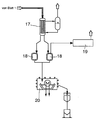
- the drawing shows a simplified process diagram consisting of sheets 1 and 2.
- pressed material P containing benzanthrone is filled from a filter press by means of trays and mechanical transport devices into a container 10 equipped with a mixer.
- the paste is continuously metered into a melt 13 present in a stirred tank 12 using a conveying element 11 - preferably an eccentric screw pump.
- the paste introduced into the stirred kettle is intensively mixed with the melt by means of the stirrer arranged in the stirred kettle - preferably an impeller stirrer, the paste being spontaneously dewatered and melted.
- the heat energy required for this is supplied to the stirred tank via a heating coil immersed in the melt and via the outer jacket by means of steam.
- the water vapors emerging from the stirred tank are condensed - preferably in a jet washer 14 - and reused as washing liquid in the filtration stage.
- the process step described above takes place at a pressure of 1 bar.
- the melted crude benzanthrone melt is, on the one hand, continuously discharged from the stirred tank via a bottom drain valve onto a roller 15, preferably onto an immersion roller, the degree of filling of the immersing roller serving as a specification for the discharge speed from the stirred tank.
- the immersion roller uses cooled immersion rollers and heated tubs.
- the resulting scales are filled into containers as quality raw benzanthrone. To prevent dust and gas emissions when filling the shed, conventional suction devices with fans and filters are advantageous.
- the melted crude benzanthrone melt is discharged in batches via a bottom drain valve from the stirred kettle onto a vacuum dryer 16 - preferably onto a discothermic vacuum dryer (hereinafter referred to as the dryer) - the degree of filling of the dryer being approximately 80% by volume.
- the dryer is then evacuated to approx. 8 mbar (absolute).
- the dryer is heated with thermal oil.
- the heating wall temperature in the final drying phase can be increased to max. 330 ° C can be increased.
- the benzanthrone vapors emerging from the dryer during drying are condensed out in a vertically arranged tube bundle condenser 17.
- the condensation takes place in the tubes of the tube bundle, the steam flowing downwards.
- the condensate is collected in alternately operated containers 18.
- the heat of condensation is generated by indirect evaporative cooling at 180 ° C, i.e. H. removed by steam generation (9 bar abs.) around the tubes in the tube bundle condenser.
- the vacuum is generated via a multi-stage vacuum system 19, consisting of a two-stage steam jet vacuum pump, a condenser and a water ring vacuum pump.
- the desquamation of the pure benzanthrone melt - present in the containers 18 - takes place on the scale roller 20 operating in continuous operation as in the case of the raw benzanthrone flake.
- the expected purity of the pure benzanthrone obtained is approximately 98% by weight.
- the resulting scales are filled into containers as pure benzanthrone quality.
- the granular-powdery residue remaining in the dryer 16 after the end of drying is pyrophoric in the hot state. After venting the dryer with nitrogen, the residue is ejected via a gas-tight bottom drain valve in a water-cooled paddle dryer 21, which has been rendered inert with nitrogen, cooled there to about 50 ° C. and then filled into containers.
Landscapes
- Chemical & Material Sciences (AREA)
- Organic Chemistry (AREA)
- Chemical Kinetics & Catalysis (AREA)
- Drying Of Solid Materials (AREA)
Description
- Die Erfindung betrifft ein kontinuierliches Verfahren zur umweltfreundlichen Trocknung und Reinigung von Benzanthron.
- Benzanthron, ein Farbstoffzwischenprodukt, wird in zwei verschiedenen Produktqualitäten - Rohbenzanthron und Reinbenzanthron - hergestellt.
- Derzeit wird Rohbenzanthron aus der Synthesestufe über Filterpressen abgetrennt, mit Wasser ausgewaschen und auf einen Feststoffgehalt von ca. 50 Gew.-% ausgepreßt. Der wasserfeuchte Filterkuchen wird anschließend in Vakuumschaufeltrocknern bei ca. 150°C und 600 mbar (absolut) bis auf einen Restwassergehalt von ca. 1 Gew.-% chargenweise getrocknet. Das trockene Rohbenzanthron enthält noch ca. 15 Gew.-% an festen Verunreinigungen, beispielsweise Eisenoxide und Silikate, aus der Synthesestufe.
- Die anschließende Reinigung des getrockneten Rohbenzanthrons zu Reinbenzanthron erfolgt in Sulbimationsöfen bei ca. 400°C und 1 mbar (absolut). Dazu wird das getrocknete Rohbenzanthron manuell in Blechwannen gefüllt und in die Sublimationsöfen gestellt. Beim Aufheizen und Evakuieren dampft das Benzanthron aus den Blechwannen aus und desublimiert an der wassergekühlten Behälterwand des Sublimationsofen, wo es nach jeder Charge manuell von der Wand abgeschlagen werden muß. Der zum Teil harte Rückstand (Verunreinigungen) bleibt auf den Blechen zurück, die ebenfalls nach jeder Charge von Hand gereinigt werden müssen.
- Der Nachteil des praktizierten Verfahrens besteht darin, daß man sowohl bei dem getrockneten Rohbenzanthron stark staubende, allergene Produkte erhält, die sowohl innerhalb des praktizierten Verfahrens als auch bei weiterverarbeitenden Betrieben zu erheblichen Problemen führen. Innerhalb des Verfahrens betrifft dies die offene arbeitsintensive Handhabung des Produktes beim Befüllen und Entleeren der Vakuumschaufeltrockner, beim Einfüllen der Trockenware auf die Blechwannen, beim Reinigen dieser Blechwannen und beim Abklopfen des desublimierten Produktes von den Behälterwänden der Sublimationsöfen. Diese manuellen Tätigkeiten sind mit erheblichen Staubbelästigungen und Kontaminationsgefahr des Betriebspersonals verbunden.
- Es stellte sich daher die Aufgabe, die Herstellung von Benzanthron ohne die vorgenannten Nachteile zu ermöglichen.
- Die Aufgabe wird durch die kennzeichnenden Merkmale der Ansprüche 1 und 2 gelöst.
- Das erfindungsgemäße Verfahren mit den wesentlichen Verfahrensmerkmalen ist in der Zeichnung dargestellt und wird im folgenden näher beschrieben.
- Die Zeichnung zeigt ein vereinfachtes Verfahrensschema, bestehend aus Blatt 1 und 2.
- Gemäß dem Verfahrensschema wird Benzanthron enthaltendes Preßgut P aus einer Filterpresse mittels Wannen und mechanischen Transporteinrichtungen in einen mit einem Mischer ausgerüsteten Behälter 10 eingefüllt. Nach Erreichen eines pastösen, pumpfähigen Zustandes wird die Paste mit einem Förderorgan 11 - vorzugsweise einer Exzenterschneckenpumpe - kontinuierlich auf eine in einem Rührkessel 12 vorliegende Schmelze 13 zudosiert. Die in den Rührkessel eingetragene Paste wird mittels des im Rührkessel angeordneten Rührers - vorzugsweise eines Impellerrührers - mit der Schmelze intensiv vermischt, wobei die Paste spontan entwässert und aufgeschmolzen wird. Die hierfür notwendige Wärmeenergie wird dem Rührkessel über eine in die Schmelze eintauchende Heizschlange sowie über den Außenmantel mittels Dampf zugeführt. Die aus dem Rührkessel austretenden Wasserbrüden werden kondensiert - vorzugsweise in einem Strahlwäscher 14 - und als Waschflüssigkeit in der Filtrationsstufe wiederverwendet. Der vorab beschriebene Verfahrensschritt erfolgt bei einem Druck von 1 bar. Die aufgeschmolzene Rohbenzanthronschmelze wird einerseits kontinuierlich über ein Bodenablaßventil aus dem Rührkessel auf eine Walze 15 - vorzugsweise auf eine Tauchwalze - abgelassen, wobei der Füllungsgrad der Tauchwalze als Vorgabe für die Ablaßgeschwindigkeit aus dem Rührkessel gilt. Bei der Tauchwalze kommen gekühlte Eintauchwalzen und beheizte Wannen zur Ausführung. Die entstehenden Schuppen werden als Qualität Rohbenzanthron in Container abgefüllt. Zur Verhinderung von Staub- und Gasemissionen bei der Abfüllung der Schuppen sind übliche Absaugeinrichtungen mit Ventilator und entsprechendem Filter vorteilhaft.
- Andererseits wird die aufgeschmolzene Rohbenzanthronschmelze chargenweise über ein Bodenablaßventil aus dem Rührkessel auf einen Vakuumtrockner 16 - vorzugsweise auf einen Discothermvakuumtrockner (im folgenden Trockner genannt) - abgelassen, wobei der Füllungsgrad des Trockners ca. 80 Vol.-% beträgt. Während des Einfüllvorgangs herrschen im Trockner Normaldruck und eine Heizwandtemperatur von ca. 300°C. Danach wird der Trockner auf ca. 8 mbar (absolut) evakuiert. Die Beheizung des Trockners erfolgt mit Thermalöl. Zum Erreichen einer möglichst niedrigen Restbeladung von Benzanthron im Rückstand kann die Heizwandtemperatur in der Trocknungsendphase auf max. 330°C erhöht werden.
- Die während der Trocknung aus dem Trockner austretenden Benzanthrondämpfe werden in einem senkrecht angeordneten Rohrbündelkondensator 17 auskondensiert. Die Kondensation erfolgt in den Rohren des Rohrbündels, wobei der Dampf abwärts strömt. Das Kondensat wird in wechselweise betriebenen Behältern 18 gesammelt. Die Kondensationswärme wird durch indirekte Siedekühlung bei 180°C, d. h. durch Wasserdampferzeugung (9 bar abs.) um die Rohre im Rohrbündelkondensator abgeführt.
- Die Vakuumerzeugung erfolgt über eine mehrstufige Vakuumanlage 19, bestehend aus einer zweistufigen Dampfstrahlvakuumpumpe, einem Kondensator und einer Wasserringvakuumpumpe.
- Die Abschuppung der Reinbenzanthronschmelze - in den Behältern 18 vorliegend - auf der im Dauerbetrieb arbeitenden Schuppenwalze 20 erfolgt wie bei der Rohbenzanthronschuppung. Die zu erwartende Reinheit des gewonnenen Reinbenzanthrons beträgt ca. 98 Gew.-%. Die entstehenden Schuppen werden als Qualität Reinbenzanthron in Containern abgefüllt.
- Der nach Trocknungsende im Trockner 16 verbleibende körnig-pulverige Rückstand ist im heißen Zustand pyrophor. Nach Belüften des Trockners mit Stickstoff wird der Rückstand über ein gasdichtes Bodenablaßventil in einem mit Stickstoff inertisierten, wassergekühlten Schaufeltrockner 21 ausgeworfen, dort auf ca. 50°C abgekühlt und anschließend in Container abgefüllt.
Claims (2)
- Kontinuierliches Verfahren zur umweltfreundlichen Trocknung und Reinigung von Benzanthron, gekennzeichnet durch folgende Verfahrensschritte- Aufgeben einer pumpfähigen, Benzanthron enthaltenden Paste auf eine in einem Rührkessel vorliegenden Schmelze,- Entwässern und Aufschmelzen der Paste mittels Dampf,- Kondensieren der aus dem Rührkessel austretenden Wasserbrüden,- Abschuppen der im Rührkessel vorliegenden Schmelze mittels einer Walze und- Abfüllen der bei der Abschuppung entstehenden Schuppen.
- Kontinuierliches Verfahren zur umweltfreundlichen Trocknung und Reinigung von Benzanthron, gekennzeichnet durch folgende Verfahrensschritte- Aufgeben einer pumpfähigen, Benzanthron enthaltenden Paste auf eine in einem Rührkessel vorliegenden Schmelze,- Entwässern und Aufschmelzen der Paste mittels Dampf,- Kondensieren der aus dem Rührkessel austretenden Wasserbrüden,- Aufgeben der Schmelze auf einen bei ca. 300°C betriebenen Vakuumtrockner,- Kondensieren der beim Evakuieren aus dem Vakuumtrockner austretenden Benzanthrondämpfe und Sammeln des Kondensatproduktes in Zwischenbehältern,- Abschuppen des in den Zwischenbehältern vorliegenden Kondensatproduktes mittels einer Walze und- Abfüllen der bei der Abschuppung entstehenden Schuppen.
Applications Claiming Priority (2)
| Application Number | Priority Date | Filing Date | Title |
|---|---|---|---|
| DE4127110A DE4127110A1 (de) | 1991-08-16 | 1991-08-16 | Kontinuierliches verfahren zur umweltfreundlichen trocknung und reinigung von benzanthron |
| DE4127110 | 1991-08-16 |
Publications (3)
| Publication Number | Publication Date |
|---|---|
| EP0528241A2 EP0528241A2 (de) | 1993-02-24 |
| EP0528241A3 EP0528241A3 (en) | 1993-03-17 |
| EP0528241B1 true EP0528241B1 (de) | 1996-03-13 |
Family
ID=6438441
Family Applications (1)
| Application Number | Title | Priority Date | Filing Date |
|---|---|---|---|
| EP92113158A Expired - Lifetime EP0528241B1 (de) | 1991-08-16 | 1992-08-01 | Kontinuierliches Verfahren zur umweltfreundlichen Trocknung und Reinigung von Benzanthron |
Country Status (3)
| Country | Link |
|---|---|
| US (1) | US5281729A (de) |
| EP (1) | EP0528241B1 (de) |
| DE (2) | DE4127110A1 (de) |
Families Citing this family (3)
| Publication number | Priority date | Publication date | Assignee | Title |
|---|---|---|---|---|
| CN1057076C (zh) * | 1997-08-19 | 2000-10-04 | 马骋 | 升华法精制苯绕蒽酮工艺 |
| DE19961966A1 (de) * | 1999-12-22 | 2001-07-12 | Basf Ag | Verfahren zur Überführung von organischen Rohpigmenten in eine für die Anwendung geeignete Pigmentform |
| EP2709775B1 (de) * | 2011-05-18 | 2015-10-14 | Basf Se | Vorrichtung und verfahren zum entleeren und spülen von mit fluid gefüllten behältern |
Family Cites Families (6)
| Publication number | Priority date | Publication date | Assignee | Title |
|---|---|---|---|---|
| US1365024A (en) * | 1920-01-09 | 1921-01-11 | Nat Aniline & Chem Co Inc | Method of purifying benzanthrone |
| US1591715A (en) * | 1920-04-02 | 1926-07-06 | Nat Aniline & Chem Co Inc | Method of sublimation |
| US1794848A (en) * | 1928-02-06 | 1931-03-03 | Newport Chemical Corp | Method for the purification of benzanthrones |
| US1900972A (en) * | 1929-01-25 | 1933-03-14 | Gen Aniline Works Inc | Purifying benzanthrone |
| US2138048A (en) * | 1935-03-04 | 1938-11-29 | Harmon Color Works Inc | Making dry, free-running pigment powders |
| DE3811635A1 (de) * | 1988-04-07 | 1989-10-26 | Basf Ag | Verfahren zur reinigung von benzanthron |
-
1991
- 1991-08-16 DE DE4127110A patent/DE4127110A1/de not_active Withdrawn
-
1992
- 1992-08-01 DE DE59205658T patent/DE59205658D1/de not_active Expired - Fee Related
- 1992-08-01 EP EP92113158A patent/EP0528241B1/de not_active Expired - Lifetime
- 1992-08-13 US US07/928,607 patent/US5281729A/en not_active Expired - Fee Related
Also Published As
| Publication number | Publication date |
|---|---|
| EP0528241A3 (en) | 1993-03-17 |
| US5281729A (en) | 1994-01-25 |
| EP0528241A2 (de) | 1993-02-24 |
| DE4127110A1 (de) | 1993-02-18 |
| DE59205658D1 (de) | 1996-04-18 |
Similar Documents
| Publication | Publication Date | Title |
|---|---|---|
| US4675133A (en) | Process for apparatus for the recovery of fats and oils | |
| US5484201A (en) | System for the recovery of oil and catalyst from a catalyst/oil mix | |
| EP0329820B1 (de) | Verfahren und Vorrichtung zur Behandlung von Abfallmaterial | |
| CN1679729A (zh) | 一种中药制备工艺及其成套设备 | |
| GB1562220A (en) | Method and an apparatus for extracting oils from vegetable raw materials | |
| CN101596373B (zh) | 旋液式连续萃取工艺及装置 | |
| DE4125891C2 (de) | Verfahren zur Reinigung verschmutzter Teile | |
| DE3018664A1 (de) | Verfahren und vorrichtung zum regenerieren von schwefelsaeure | |
| EP0528241A2 (de) | Kontinuierliches Verfahren zur umweltfreundlichen Trocknung und Reinigung von Benzanthron | |
| CN101215014A (zh) | 钛白粉生产排出废渣液的处理方法 | |
| US3109833A (en) | Conserving polyol in fusion cooking of polymeric polyesters | |
| DE2923382C2 (de) | Verfahren zur Gewinnung von getrockneter Terephthalsäure | |
| DE2018047C3 (de) | ||
| EP0012410A1 (de) | Vorrichtung zur Zuführung der Aufheizenergie oder zur Abführung der Reaktionswärme bei der Polymerisation von Monomeren | |
| CN111548644B (zh) | 一种酞菁蓝染料的合成方法 | |
| DE68923677T2 (de) | Dreistufenverfahren und Vorrichtung zur Nachbehandlung von geschmolzenem Stahl. | |
| Singleton et al. | Continuous countercurrent vacuum bleaching | |
| RU2166533C2 (ru) | Способ экстракции растительных масел и устройство для его осуществления | |
| CN214553498U (zh) | 一种快速带走杂质的反应装置 | |
| CN221310653U (zh) | 具有过滤装置的反应釜 | |
| US4389344A (en) | Process for separating solid 1,5- and/or 1,8-dinitroanthraquinone and liquid nitrobenzene | |
| DE2309378C2 (de) | Verfahren zur Herstellung von Anthrachinonen durch Trocknung von Aroylbenzoesäuren | |
| JPS6153324A (ja) | ポリアリ−レン・サルフアイド反応液スラリ−から溶媒を回収する方法 | |
| CN224056691U (zh) | 一种3,4-二氟苯腈减压精馏釜 | |
| DE1493063A1 (de) | Verfahren zum Reinigen einer verdampfbaren,normalerweise festen Saeure |
Legal Events
| Date | Code | Title | Description |
|---|---|---|---|
| PUAI | Public reference made under article 153(3) epc to a published international application that has entered the european phase |
Free format text: ORIGINAL CODE: 0009012 |
|
| PUAL | Search report despatched |
Free format text: ORIGINAL CODE: 0009013 |
|
| AK | Designated contracting states |
Kind code of ref document: A2 Designated state(s): CH DE FR GB IT LI |
|
| AK | Designated contracting states |
Kind code of ref document: A3 Designated state(s): CH DE FR GB IT LI |
|
| 17P | Request for examination filed |
Effective date: 19930223 |
|
| 17Q | First examination report despatched |
Effective date: 19950706 |
|
| GRAA | (expected) grant |
Free format text: ORIGINAL CODE: 0009210 |
|
| AK | Designated contracting states |
Kind code of ref document: B1 Designated state(s): CH DE FR GB IT LI |
|
| REF | Corresponds to: |
Ref document number: 59205658 Country of ref document: DE Date of ref document: 19960418 |
|
| GBT | Gb: translation of ep patent filed (gb section 77(6)(a)/1977) |
Effective date: 19960329 |
|
| ITF | It: translation for a ep patent filed | ||
| ET | Fr: translation filed | ||
| PLBE | No opposition filed within time limit |
Free format text: ORIGINAL CODE: 0009261 |
|
| STAA | Information on the status of an ep patent application or granted ep patent |
Free format text: STATUS: NO OPPOSITION FILED WITHIN TIME LIMIT |
|
| 26N | No opposition filed | ||
| PGFP | Annual fee paid to national office [announced via postgrant information from national office to epo] |
Ref country code: FR Payment date: 19970722 Year of fee payment: 6 |
|
| PGFP | Annual fee paid to national office [announced via postgrant information from national office to epo] |
Ref country code: GB Payment date: 19970801 Year of fee payment: 6 |
|
| PGFP | Annual fee paid to national office [announced via postgrant information from national office to epo] |
Ref country code: CH Payment date: 19970805 Year of fee payment: 6 |
|
| PGFP | Annual fee paid to national office [announced via postgrant information from national office to epo] |
Ref country code: DE Payment date: 19970818 Year of fee payment: 6 |
|
| PG25 | Lapsed in a contracting state [announced via postgrant information from national office to epo] |
Ref country code: GB Free format text: LAPSE BECAUSE OF NON-PAYMENT OF DUE FEES Effective date: 19980801 |
|
| PG25 | Lapsed in a contracting state [announced via postgrant information from national office to epo] |
Ref country code: LI Free format text: LAPSE BECAUSE OF NON-PAYMENT OF DUE FEES Effective date: 19980831 Ref country code: CH Free format text: LAPSE BECAUSE OF NON-PAYMENT OF DUE FEES Effective date: 19980831 |
|
| GBPC | Gb: european patent ceased through non-payment of renewal fee |
Effective date: 19980801 |
|
| REG | Reference to a national code |
Ref country code: CH Ref legal event code: PL |
|
| PG25 | Lapsed in a contracting state [announced via postgrant information from national office to epo] |
Ref country code: FR Free format text: LAPSE BECAUSE OF NON-PAYMENT OF DUE FEES Effective date: 19990430 |
|
| PG25 | Lapsed in a contracting state [announced via postgrant information from national office to epo] |
Ref country code: DE Free format text: LAPSE BECAUSE OF NON-PAYMENT OF DUE FEES Effective date: 19990601 |
|
| REG | Reference to a national code |
Ref country code: FR Ref legal event code: ST |
|
| PG25 | Lapsed in a contracting state [announced via postgrant information from national office to epo] |
Ref country code: IT Free format text: LAPSE BECAUSE OF NON-PAYMENT OF DUE FEES;WARNING: LAPSES OF ITALIAN PATENTS WITH EFFECTIVE DATE BEFORE 2007 MAY HAVE OCCURRED AT ANY TIME BEFORE 2007. THE CORRECT EFFECTIVE DATE MAY BE DIFFERENT FROM THE ONE RECORDED. Effective date: 20050801 |