EP0522591A2 - Datenbankauffindungssystem zur Beantwortung natursprachlicher Fragen mit dazugehörigen Tabellen - Google Patents
Datenbankauffindungssystem zur Beantwortung natursprachlicher Fragen mit dazugehörigen Tabellen Download PDFInfo
- Publication number
- EP0522591A2 EP0522591A2 EP92111820A EP92111820A EP0522591A2 EP 0522591 A2 EP0522591 A2 EP 0522591A2 EP 92111820 A EP92111820 A EP 92111820A EP 92111820 A EP92111820 A EP 92111820A EP 0522591 A2 EP0522591 A2 EP 0522591A2
- Authority
- EP
- European Patent Office
- Prior art keywords
- database
- retrieval
- natural language
- phrases
- formula
- Prior art date
- Legal status (The legal status is an assumption and is not a legal conclusion. Google has not performed a legal analysis and makes no representation as to the accuracy of the status listed.)
- Granted
Links
Images












Classifications
-
- G—PHYSICS
- G06—COMPUTING OR CALCULATING; COUNTING
- G06F—ELECTRIC DIGITAL DATA PROCESSING
- G06F16/00—Information retrieval; Database structures therefor; File system structures therefor
- G06F16/20—Information retrieval; Database structures therefor; File system structures therefor of structured data, e.g. relational data
- G06F16/24—Querying
- G06F16/245—Query processing
- G06F16/2452—Query translation
- G06F16/24522—Translation of natural language queries to structured queries
-
- G—PHYSICS
- G06—COMPUTING OR CALCULATING; COUNTING
- G06F—ELECTRIC DIGITAL DATA PROCESSING
- G06F16/00—Information retrieval; Database structures therefor; File system structures therefor
- G06F16/20—Information retrieval; Database structures therefor; File system structures therefor of structured data, e.g. relational data
- G06F16/24—Querying
- G06F16/245—Query processing
- G06F16/2452—Query translation
- G06F16/24526—Internal representations for queries
-
- Y—GENERAL TAGGING OF NEW TECHNOLOGICAL DEVELOPMENTS; GENERAL TAGGING OF CROSS-SECTIONAL TECHNOLOGIES SPANNING OVER SEVERAL SECTIONS OF THE IPC; TECHNICAL SUBJECTS COVERED BY FORMER USPC CROSS-REFERENCE ART COLLECTIONS [XRACs] AND DIGESTS
- Y10—TECHNICAL SUBJECTS COVERED BY FORMER USPC
- Y10S—TECHNICAL SUBJECTS COVERED BY FORMER USPC CROSS-REFERENCE ART COLLECTIONS [XRACs] AND DIGESTS
- Y10S707/00—Data processing: database and file management or data structures
- Y10S707/99931—Database or file accessing
Definitions
- This invention relates generally to database retrieval systems for retrieving information stored in a database, and, more particularly, to database retrieval systems for retrieving information stored in a database using natural language expressions.
- Fig. 1 is a diagram illustrating a conventional database retrieval system for retrieving data from a table formatted database in response to a natural language query.
- a natural language query is a request for data that is set forth in a natural language, such as English, Japanese, French, etc.
- the illustrated database retrieval system is described in more detail in "Kinukawa, A Natural Language Interface Processor Based on the Hierarchical-Tree Structure Model of Relation Table. Journal of Information Processing Society of Japan , Vol.27, No.5 (1986), pp.499-509." This system is designed to process queries in Japanese. For the examples described below, the English translations of Japanese words and phrases are provided in parenthesis.
- the database retrieval system shown in Fig. 1 includes an input unit 2, such as a keyboard, for entering a natural language query 1.
- the system also includes a communications controller 3 for forwarding the natural language query 1 to a retrieval sentence analysis unit 5.
- the retrieval sentence analysis unit 5 processes the input query 1 to produce a hierarchical model of the query.
- the system additionally includes a word dictionary 4, that is constructed on the basis of the content of a database 9, and a hierarchical table model 6 for hierarchically expressing the content of the database.
- the dictionary 4 and hierarchical table model 6 are used by the retrieval sentence analysis unit 5 in analyzing the natural language query 1.
- the retrieval sentence analysis unit 5 performs both vocabulary analysis and syntactic/semantic analysis on the natural language query 1.
- the retrieval sentence analysis unit 5 produces a retrieval sentence analysis result 7 as output that is forwarded to a retrieval processing unit 8.
- the retrieval processing unit 8 uses the retrieval sentence analysis result 7 to retrieve data from the database 9.
- the depiction of the conventional database retrieval system shown in Fig. 1 is a functional description intended to show the interaction between the respective components of the system.
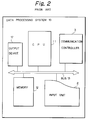
- the components shown in Fig. 1 are, in fact, implemented in a data processing system 10, such as that shown in Fig. 2.
- the data processing system 10 includes a central processing unit (CPU) 11, a memory 12, the communications controller 3, an output device 17 and the input unit 2. Each of these components is coupled to a bus 13.
- the retrieval sentence analysis unit 5 and the retrieval processing unit 8 are implemented in software that is executed by the CPU 11 (Fig. 2).
- the software is stored in the memory 12.
- the word dictionary 4 (Fig. 1), the hierarchical model table 6 and the database 9 are stored within the memory 12 (Fig. 2).
- Fig. 3a provides a more detailed depiction of an example of the word dictionary 4.
- the dictionary includes a plurality of entries, and each entry includes three fields.
- the header field identifies the term or phrase associated with the entry, whereas the part of speech field identifies the part of speech of the term or phrase.
- the type field identifies the type of term or phrase that is used. In the example shown in Fig. 3a, the types are "item name" and "data expression word”.
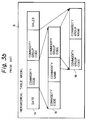
- Fig. 3b provides a more detailed depiction of the hierarchical table model 6.
- This model 6 sets forth the hierarchical relationship between the respective tables.
- Each table specifies a number of attributes.
- table 14 includes the attributes of "date”, “commodity code”, “commodity group code”, and "sales".
- the "commodity code” attribute is also an attribute in table 16, which is hierarchically related with table 14.
- the attribute of "commodity group code” is an attribute of both table 16 and table 18.
- the table 14 is a higher order table than tables 16 and 18.
- table 16 is a higher order than table 18.
- This hierarchical table model is consistent with the relational model for data proposed by E. F. Todd in "A Relational Model of Data for Large Shared Data Banks," Communications of the ACM , June 1970, pp. 377-387.
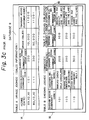
- Table 3c provides illustration of the database 9.
- the database 9 includes table A, table B and table C.
- Each of the tables A, B, C includes different types of information.
- table A contains sales information
- table B includes commodity information
- table C includes commodity group information.
- a natural language query 1 is entered using the input unit 2.
- the query is entered simply by typing the query.
- the query 1 is then passed to the conversation control unit 3, which forwards the query to the retrieval sentence analysis unit 5.
- the retrieval sentence analysis unit 5 parses the query into a hierarchical structure of words or phrases that is output as the retrieval sentence analysis result 7.
- the retrieval sentence analysis unit 5 first chops the query into words or phrases.
- the query is chopped into the phrases "chokoreeto rui" and "uriage”.
- the terms "no" and “ha” are zyoshi, whose significance will be described in more detail below.
- the retrieval sentenced analysis unit 5 references the word dictionary 4 to determine that "chokoreeto rui" (chocolates and the like) is a data expression word (see Fig. 3a).
- the retrieval sentence analysis unit 5 also determines that "uriage” (sales) is an attribute item name, respectively.
- the word dictionary 4 indicates that both of these phrases are nouns.
- the dictionary 2 is not referenced for the zyoshi "ha” and "no".
- Syntax and semantic analysis is then performed on the query.
- syntactic analysis is performed to process the syntax or the query in order to understand the role each phrase serves in the query.
- Semantic analysis is performed to understand what is being requested by the query.
- semantic analysis is performed to relate the meaning of the query to the database entries.
- the semantic analysis relies on the hierarchical table model 6 (see Fig. 3b) to ascertain that "chokoreeto rui” (chocolates and the like) is an attribute data expression word of a commodity group in table 18 (i.e., table C in Fig. 3c) and "uriage" (sales) is an item name in the table 14 (i.e. table A in Fig. 13c).
- the hierarchical table model 6 indicates that table 14 is a higher order table than table 18.
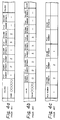
- Figs. 4a, 4b and 4c show dictionaries used in a second conventional database retrieval system, as disclosed in Japanese Patent Laid-Open Publication No. 59-99539.
- information on column name in a file, information on data item name, and information on a file name that possesses a common column name or data name are stored according to file names of a data file that is contained in a database.
- Fig. 4a represents a dictionary in which one of the database files contains the column name of a file. The dictionary also holds information regarding the order in which the column is contained in the file and additionally holds information regarding synonyms of the column name (i.e., file numbers and column attribute numbers of columns that are synonymous with the named column).
- Fig. 4a represents a dictionary in which one of the database files contains the column name of a file.
- the dictionary also holds information regarding the order in which the column is contained in the file and additionally holds information regarding synonyms of the column name (i.e., file numbers and column attribute numbers of columns that are synonymous with the
- FIG. 4b shows an analogous dictionary in which one of the files contains a data column name, and the dictionary stores a position at which the named column is contained in the file. Lastly, the dictionary stores information regarding synonyms of the data column name.
- Fig. 4c shows a dictionary holding information as to semantically identical data columns that are connected as synonyms.
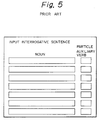
- Fig. 5 is the designated format for input queries for the second conventional system. This format requires that queries be entered as a number of entries, wherein each entry includes two fields; a noun filed and a particle or auxiliary field.
- queries be entered as a number of entries, wherein each entry includes two fields; a noun filed and a particle or auxiliary field.
- the input query for the second conventional system would be as follows. The first noun field would be entered as "chokoreeto rui" and the corresponding particle field would be entered as "no”. Further, the second noun field would be entered as "uriage” and the particle field would be entered as "ha”.
- the information retrieval system of the present invention is used for retrieving information from a database.
- the information retrieval system includes a parser for parsing a natural language input query into constituent phrases.
- the parser outputs a syntax analysis result.
- the system also includes a virtual table for converting phrases of the natural language query to retrieval keys that are possessed by the database.
- the virtual table accounts for particles that modify the phrases in the input query.
- a collating unit is provided in the system for preparing a database retrieval formula from the syntax analysis result by selecting a virtual table that it is used to convert the phrases to the keys possessed by the database.
- the system includes a retrieval execution unit for retrieving data from the database on the basis of the database retrieval formula.
- the information retrieval system may also include an additional table for converting an undetermined value phrase in the natural language query into a determined value phrase in the database based on the syntax analysis result. Still further, the information retrieval system may include a terminology dictionary for identifying entries in the virtual table that are to be used in converting phrases of the natural language query. The dictionary includes words representing times and the dictionary is used by the parser in obtaining the syntax analysis result. When the terminology dictionary is used, the system may also include a time interval definition table in the virtual table for defining dates corresponding to words representing time. Lastly, the system may include a database retrieval formula conversion unit for generating a formula in a database retrieval language from the database retrieval formula.
- Fig. 6 shows the construction and flow of processing of a first preferred embodiment of the present invention which provides a database retrieval system that responds to a natural language query 1.
- the system may be implemented on a data processing system as shown in Fig. 2.
- This first preferred embodiment includes an input unit 2, a conversation control unit 3 and a database 9 like that employed in the conventional system of Fig. 1.
- These components are implemented in the data processing system 2 as discussed for the first conventional system.
- the preferred embodiment differs from the conventional system in several respects. These distinctions are highlighted below.
- the first preferred embodiment also includes a parser 22 for parsing an input natural language query into its constituent parts.
- the parser 22 uses a grammar table 24 and a terminology dictionary 26.
- the grammar table 24 holds information for regulating the relation in a Japanese sentence
- the terminology dictionary 26 defines the part of speech and meaning of each word in the query 22.
- the terminology dictionary 26 is similar to the conventional word dictionary 4 shown in Fig. 1, the terminology dictionary of Fig. 6 differs in that is includes a column for a semantic marker (see Fig. 7). The role of the semantic marker is described in more detail below.
- a column for a semantic ID (see Fig. 7) and a column for a correspondence item are also provided.
- the parser analyzes the input query 22 to determine the subject, predicates and other parts of speech in the input natural language query 22.
- the system of Fig. 6 differs substantially from the conventional system of Fig. 1 in that the system of Fig. 6 includes a virtual table 28.
- the virtual table is a natural language conversion virtual table held in memory 12 (Fig. 2), for designating which table in the database 9 is to be searched to find the data requested in the query 22.
- variable data which continuously changes in accordance with "event”.
- Variable data is also referred to as a cumulative file.
- Fixed data having the same characteristics are grouped to form a virtual table. Further, a virtual table is formed by adding variable data to those fixed data items which are strongly related thereto.
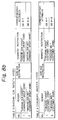
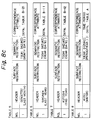
- the virtual table 28 is composed of a number of tables (i.e. tables 1 - 8) as shown in Figs. 8a - 8c. Each one of the entries in these tables includes a field for a "surface restriction” (see Figs. 8a - 8c) and a field for a "correspondence attribute" is included for each entry.
- the surface restriction field is filled with data only for variable data.
- the surface restriction field is used to store particles which modify each header word of the input natural language and which determine the value of the "correspondence attribute" in combination with the header word. That is, the surface restriction is an item that is provided for performing a further selection when a plurality of corresponding attributes are possible for a header word.
- the correspondence attribute may designate another virtual table, a database entity table, or an operation entity table. Designation of another virtual table indicates that detailed data are stored in the other table. Further, the storage in this fashion is used in an algorithm for selecting a virtual table. Specifically, if a virtual table is designated in a correspondence attribute field, the designated virtual table is selected with priority.
- the system of Fig. 6 also includes a collating unit for retrieving data from the database 9 by referencing the virtual table 28 using the analysis result that is output from the parser 5.
- the collating unit may be implemented in software that is executed by the CPU 11 (Fig. 2) and stored in memory 12.
- the system further includes a database formula generation unit 32 for converting an entity table logic formula from the collating unit into a database retrieval formula.
- the database retrieval formula is used by a retrieval unit that retrieves data from the database 9.
- zyoshi modifies the phrase “Chokoreeto rui” (chocolates and the like) to indicate that "Chokoreeto rui” is the object of a prepositional phrase.
- the zyoshi “no” follows the word “sengetsu” to indicate that "sengetsu” is the object of a prepositional phrase.
- zyoshi modifies the term “uriage” (sales) to indicate that "uriage” is the subject of the query.
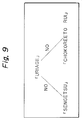
- the zyoshi help to construct the hierarchical model shown in Fig. 9 that is output from the parser 22.
- the natural language input query 20 (Fig. 6) is input by the input unit 2 and received by the communications controller 3.
- the communication controller directs the input query to the parser 22.
- the grammar table 24 is used by the parser 22 to examine grammatical rules that help to parse the table into an appropriate syntax tree like that shown in Fig. 9.
- the parser 22 also uses the terminology dictionary 26 to determine which of the tables in the virtual table 28 should be examined. Specifically, the "item" column of the terminology dictionary, as shown in Fig. 7, is examined.
- the collating unit 30 determines which of the tables in the virtual table 28 will be utilized. For the example of natural language query 20, table 1 (see Fig. 8a) is examined. The entries for the corresponding terms are examined in the table. The correspondence attribute field of the entries specify the table in the database 9 (Fig. 6) and entry where information regarding the term of interest may be found, another correspondence table or an indication that the desired data is calculated as a mathematical function.
- the information retrieved by the collating unit 30 i.e., the entity table logical formula
- the database retrieval formula is passed from the database formula generation unit 32 to the retrieval unit 34, which retrieves the appropriate data from the database 9.
- the retrieved data is then output to the output device 17 (Fig. 2).
- a natural language query 1 "Chokoreeto rui no sengetsu no uriage ha?” (Sales of chocolates and the like in the last month?) is entered using the input unit 2.
- the communications controller 3 passes this query to the parser 22.
- Retrieval order and operation order of the retrieval language are defined at the communications controller 3.
- the parser 22 parses the query according to known strategies for parsing Japanese queries to produce a syntax analysis result (like syntax tree shown in Fig. 9).
- the parser 5 uses the grammar table 34 and the terminology dictionary 26 in performing its parsing.
- the grammar table 24 is a set of extended context-free grammatical rules such as outlined in "Iwanami Koza, Zyoho Kagaku 23: Kazu to Shiki to Bun no Shori", Chapter 5 'Kikai Honyaku', Iwanami Shoten".
- the terminology dictionary 26 also has a format as outlined in the above described article. This format is shown in Fig. 7. To eliminate ambiguities in the meaning of a word, a semantic ID is given to each word. The semantic ID helps to associate the input term or words with term or words that are understandable to the database 9 (Fig. 6). For example, since there is no retrieval key for "shoohin” (commodity), "shoohin mei” (commodity name) is designated as the semantic ID for "shoohin”.
- the database 9 (Fig. 6) includes information regarding the commodity name. Analogously, since there is no entry for "choko rui” (chocolates and the like) in the database, “chokoreeto rui” (chocolates and the like) is designated as its semantic ID.
- Each entry in the terminology dictionary 26 also includes a semantic marker.
- the semantic marker is provided to connect an ambiguous word (i.e., not directly defined in the virtual table) to a correspondence attribute. Further, the semantic marker serves to combine words that are identical under the semantic restriction in the virtual table. For example, since there are no such retrieval keys for "sengetsu" (last month) in the virtual table 28 (Fig. 6), the semantic marker for this term is month (date), hence, indicating that this term is an indication of date on a monthly basis. Similarly, the term “Kyonen (last year), "hi” (day) and “toshi” (year) are also assigned semantic markers that indicate that the terms refer to date.
- a plurality of semantic markers may be allowed for a word (e.g. "uriage” in Fig. 7).
- the item in the virtual table 28 (Fig. 6) that is capable of corresponding to a retrieval key of the database 9 is searched by following semantic restriction on the virtual table designated by the semantic marker.
- a column for corresponding items e.g. the "ITEM” column in Fig. 7 is provided for designating which one of the tables of the virtual table 28 (Fig. 6) should be referenced.
- a correspondence attribute is determined by the modifying-modified relation thereof or a semantic marker for units of numerical values.
- an actual value is determined in accordance with the definition of an entity table.
- the construction of the query is identified and the object of the interrogation is known. It is necessary to conform the object of interrogation to an item possessed by the database. While several methods may be employed for this purpose, the most effective method is one in which the virtual table is provided to associate similar meanings which are referenced as different words in the database. By providing a virtual table, alteration and/or addition of the system is easy compared to a method in which the retrieval object item of the database is directly entered into a terminology dictionary. Further, a variety of different natural Japanese queries may be correctly processed and the queries may employ various different modifier representations.
- the parser 22 (Fig. 6), thus, produces a hierarchical syntax tree like that shown in Fig. 9. This result indicates that the sales (i.e. "uriage") are what is sought.
- the term "Chokoreeto rui” (chocolate and the like) specifies the commodity group for which sales are sought, and the term “sengetsu” (last month) indicates the time frame for which the sales data is sought.
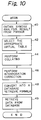
- This syntax tree is passed to the collating unit as the syntax analysis result (see step 40 in Fig. 10).
- the syntax tree is not directly converted into a database retrieving logic formula, but rather is converted into an intermediate representation known as a virtual table logic formula. Then an appropriate table in the virtual table 28 (Fig. 6) is selected (step 42 in Fig. 10).
- the terminology dictionary 26 (Fig. 7) is referenced.
- the "item” field is examined for "sengetsu” (last month).
- the item field points to Table 5 in the virtual table 28 (Fig. 6).
- Table 5 (Fig. 8c) in the virtual table 28 (Fig. 6) is examined.
- the entry for "sengetsu” has a correspondence attribute pointing to Definition Table B-21. Accordingly, the entry with argument 21 in Definition Table B is examined (see Fig. 11a).
- This table entry sets forth the method of calculation for "sengetsu”.
- "sengetsu" (the last month) is a value which varies according to the point in time of input and, therefore, must be calculated.
- the current data is an 8 decimal digit number with digits 8-5 holding the year (e.g. "1992"), digits 4 and 3 holding the month (e.g. "07", for July) and bits 2 and 1 holding the date (e.g. "11").
- an example format for the date of July 11, 1992 is "19920711”.
- the Definition Table B tells the system how to calculate the last month (i.e. June or "06"). First one is subtracted from the month digits 4 and 3. Hence, a result of (07-1) or 06 is obtained. Then, the system checks whether the result is 00. In this case, the result is not zero. If the result of the subtraction is 00, it is an indication that the last month was December of the previous year. Therefore, the month digits 4 and 3 are replaced with the digit 12 for December, and the year digits 8-5 (the high order digits) are decremented by one. Lastly, the day digits 1 and 2 are replaced with 00.
- a table in the virtual table 28 (Fig. 6) for "sengetsu” (last month) is selected.
- a plurality of virtual tables are designated for "chokoreeto rui” (chocolates and the like). Specifically, Tables 1 and 3 are designated.
- An entry in the terminology dictionary 28 is also examined for the term “uriage” (sales). The entry for "uriage” (sales) designates Table 1. Given that both the entry for "Chokoreeto rui" and the entry for "uriage” specify Table 1 of the virtual table 28, Table 1 is selected.
- an intermediate representation is formed by the collating process (step 44 in Fig. 10) performed by the collating unit 30.
- the collating unit 30 internally comprises: a virtual table selection unit 60, for selecting a table in the virtual table 28 (Fig. 6); an actual value calculation/combination unit 62 (Fig. 14) for performing calculations and combination; and an interrogative structure determining unit 64 for determining the structure of interrogations that are passed to the database formula generation unit 32.
- the collating process involves incorporating the contents of a dictionary referenced by the input natural language query into the table of the virtual table that was selected at step 42 in Fig. 14 or by performing attribute coupling between virtual tables.
- two virtual tables have been selected: Table 1 (by the entries in the terminology dictionary for "uriage” and “Chokoreeto rui") and Table 5 (by the entry for "sengetsu”).
- a natural language correspondence logic formula 50 is generated as shown in Fig. 12.
- the correspondence logic formula 50 is a table that sets forth what information is known from the query and what additional information is needed to complete the query. Specifically, it sets forth the relevant variables and any values of these variables that are known.
- step 46 of Fig. 10 a necessary virtual table is added to access the database 9 (Fig. 6).
- table 3 (Fig. 8b) of the virtual table 28 (Fig. 6) is selected based on correspondence attribute of "shoohin gun mei" 7 (commodity group name) in table 1 (Fig. 8a), which specifies Table 3-2.
- the entry in table 3 directs the user to Database Table entry 3-2 (e.g. DB 3-2).
- the actual value of "sengetsu" (last month) is calculated from the Definition Table B (as was discussed above).
- the table, thus, provided is indicated by 52 in Fig. 13.
- the data shown assumes that the current date is in May 1990. Hence, the last month is April 1990 or "19900400".
- the commodity group code serves as the attribute for connecting Table 1 and the commodity group master table, and it possesses "Code" as an undetermined variable.
- This table 52 is converted into a database retrieval formula by the database formula generation unit 32 (Fig. 6) at step 48 (Fig. 10). Retrievals are performed sequentially by the retrieval unit 34 (Fig. 6) based on the retrieval formula to fill the undetermined variables in the table 52 (Fig. 13).
- the undetermined variable "Code" is determined from commodity group master table 19 (i.e., table C in Fig. 3c) to be 200, which corresponds to "chokoreeto rui" (chocolates and the like).
- the query must be converted into a query set forth in a database retrieval language to retrieve data from the database.
- a database retrieval language To replace the structure of the Japanese natural language query with database retrieval formulas, it is necessary to put together the restrictions and grammar possessed by the database retrieval language in the terminology definition table 26 (Fig. 6). Construction of the queries in the database retrieval language are made by referring to this terminology definition table as described above. Further, having a separate grammar definition table 24 produces the advantage that all the changes to the database retrieval language may be absorbed by the grammar definition table, even when the present invention is applied to a system using a different database retrieval language.
- a database is designated and a conversion is made into a retrieval logic formula which is suitable even when an ambiguous word is included in the query or an omission occurs in the input query.
- the collating unit can designate a highly probable database file by selecting a suitable virtual table even for an ambiguous input query.
- the term "sengetsu” (last month) was included in the natural language query. This term was an ambiguous word related to time.
- the system also has the capability of properly analyzing other ambiguous terms relating to time.
- the Japanese input sentence is "Kotoshi no haru no uriage ha" (Sale for the spring of this year?).
- the parser 22 (Fig. 6) decomposes this sentence into its constituent part "uriage” (sales) and “kotoshi no haru” (the spring of this year). Further, the parser 22 knows that "kotoshi no haru” modifies "uriage”.
- the parser 22 looks up the term "kotoshi no haru” in the terminology dictionary 26 and is directed to an appropriate table in the virtual table 28.
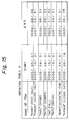
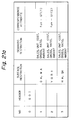
- the entry in the virtual table directs the user to entry 3 in Definition Table A as shown in Fig. 15. This entry indicates that spring extends from 03/01 to 05/31.
- the word "kotoshi no haru” (the spring of this year) contained in the syntax analysis result is replaced by "1990 nen 3 gatsu 1 nichi - 1990 nen 5 gatsu 31 nichi” (March 1 1990 - May 31 1990).
- any combination of time words to be used must be recorded on a terminology dictionary as a single word.
- “kotoshi” (this year) and “haru” (spring) be combined “kotoshi no haru” (the spring of this year)
- a terminology dictionary must be prepared for each user.
- an alternative embodiment as shown in Figs. 16a and 16b may be employed.
- This alternative embodiment differs from the first embodiment in that it includes: a point in time calculation unit 70, for calculating a specific point in time from the current date, a time interval definition table reference unit 80, and a combining unit 82 for adding the reference result of the time interval definition table reference unit 80 and the calculated result of a point in time. Further, a system timer 68 is provided.
- a syntax analysis result 72 i.e., a syntax tree
- the syntax analysis result contains "sakunen” (last year) and "fuyu” (winter), which are time words.
- the definition of the word "sakunen” (the last year) is obtained by time calculation, and the definition of the word “fuyu” (winter) is designated to be described in the time interval definition table 82 (Fig. 16b).
- the syntax analysis result 72 is passed to the collating unit 30, where the result is received by the point in time calculation unit 70.
- a point in time calculation is performed with respect to the current date (e.g., "19901224") that is obtained by a system timer 68.
- the actual calculation method performed is selected from the definition provided in Definition Table B in Fig. 11. The definition that is chosen depends on the value in the argument column in the terminology dictionary.
- an 8-digit integer value indicating the year “sakunen” (last year), "19890000”, is obtained from the calculation method, corresponding to the value "11" in the argument column of "sakunen” (the last year), which states, "Subtract 1 from the four high order digits and replace the four low order digits with "0000". Subsequently, the calculated integer value is substituted for the portion of "sakunen” (the last year) in the syntax analysis result 72 to obtain a point in time calculation result 74.
- the time interval definition reference unit 80 contains the actual dates corresponding to "fuyu” (winter). It obtains these dates by referring the time interval definition table 84. Hence, as shown in Fig. 15, “fuyu” is defined as starting at "00001201” (i.e., December 1) and ending at "00010331” i.e., March 31 of the next year).
- the time interval definition table reference unit 80 substitutes the retrieved value 86 for "fuyu" (winter) in the point in time calculation result 24 to obtain a time interval definition table reference result 76.
- the combining unit 82 combines the actual dates corresponding to "sakunen” (the last year) and "fuyu” (winter) by addition to obtain a complete 8 digit range for dates for the interval as shown in the calculation result 78. Specifically, the year “19890000” is added to the dates of "fuyu” "00001201” - “00010331” to obtain “19891201” - "19900331”. The calculation result "19891201-19900331" means "from December 1, 1989 to March 31, 1990". The calculation result 78 is then processed as discussed in the first embodiment.
- the user may obtain a calculation result in accordance with definition without altering the terminology dictionary 26 (Fig. 16a). That is, it is possible for users to share a terminology dictionary and manage the time interval definition table individually. This benefit of sharing a terminology dictionary is more apparent when it is appreciated that a terminology dictionary is large in size and amendment of a terminology dictionary is difficult. Moreover, if words containing many modifiers are to be defined, storage requirements are large. Hence, providing a separate terminology dictionary for every user is cumbersome.
- the example input natural language queries 1 (Fig. 6) and 66 (Fig. 16a) requested sales information that could be readily reproduced by the system.
- the system is capable of handling more sophisticated queries that require reasoning. For example, suppose that the Japanese input query is a sentence "Sengetsu no uriage yori kongetsu no uriage ga ooi tokuisaki ha" (What customer had more sales in this month than sales in the last month?).
- the system produces a retrieving logic formula, also known as the entity table logic formula 14, in the form 140 shown in Fig. 17a.
- the formula 140 includes a result table 142 for storing the final results of the retrieved data.
- the result table 142 includes a location for storing the customer's name and tables for storing the total sales of this month and the total sales of last month.
- the entity table logic formula 140 includes a GT table, which is a table in the virtual table that performs a logical operation on parameters to determine if one parameter (the left side) is greater than the other (the right side).
- the total sales of the last month table includes a pointer pointing to a last month's intermediate result table 144 that holds the results of intermediate calculations that are necessary to determine the total sales of the last month. Similarly, the total sales of this month's table points to this month's intermediate result table 146. Both of the intermediate result tables 144 and 146 seek to have information regarding the customer code and the total sales for their respective months. In order to calculate the total sales of the last month, it is necessary to determine the calculation object (i.e., what kind of information is being sought). In addition, it is necessary to determine the amount of orders that were received during the month from that customer. Accordingly, there is an additional table, the total sales of the last month's intermediate result table 148.
- a total sales in this month's intermediate result table 151 that seeks similar information for this month's sale, is also provided.
- the amount of received order for this month and last month for the specified customer code are requested and passed to the database formula generation unit 32 which converts the logic formula into a database retrieval formula 157 using the database retrieval word grammar definition table 155.
- the result table and the various intermediate result tables 144, 146, 148 and 151 are passed to the database formula generation unit 32.
- equality tables (denoted as EQ tables) are passed to the database formula generation unit 32.
- EQ Tables 3 and 4 are passed to the database formula generation unit 32, EQ Table 3 seeks to determine if the received order file date is equal to the last month date, and EQ Table 4 seeks to determine if the received order file date is equal to today's date.
- the entity table logic formula 140 is processed by the database formula generation unit 32 (Fig. 17c) which uses the database retrieval word grammar definition table to process the logic formula 140.
- the database retrieval word grammar definition table is examined by the database formula generation unit 32 with respect to the retrieval logic formula 140.
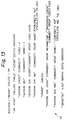
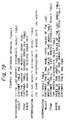
- the database retrieval word definition table initially processes result table as indicated in Fig. 18. In particular, the system is directed to select the SELECT (item) FROM (reference table) WHERE (condition). Thus, the result table is converted into a database retrieval formula of ⁇ interrogation 3> of Fig. 19.
- the retrieval word grammar definition table 155 has a similar entry for the intermediate result tables 144 and 146. Further, the database formula generation unit 32 investigates the executing order of the specified operations with respect to another.
- the system proceeds to process each of the interrogations as indicated in Fig. 19.
- interrogation 1 which is interrogation for the last month's intermediate result table
- the customer table in the database 9 (Fig. 17c) is retrieved using retrieval unit 34 to obtain the customer code information.
- the system seeks to sum the amount fields in the received order file of the database 9. In order to perform this calculation, the system sums the amount entries having the appropriate customer code and which meet the date limitations of last month.
- the EQ table 3 is used to ensure that the date requirements are fulfilled. In this fashion, the intermediate result table is filled in with the relevant information.
- Interrogation 2 involves the processing for this month's intermediate result table.
- the processing is the same as interrogation 1 except that different date requirements are utilized. Specifically, the date must correspond to the limitations for this month. In this fashion, the information for this month's intermediate result table is completed.
- interrogation 3 is processed.
- the interrogation 3 is the interrogation for the result table.
- Fig. 19 indicates, the customer table in the database customer and name are selected, as are the total sales of this last month table and the total sales of this month table. This information is retrieved from the customer table in the database 9 (Fig. 17c) and from the last month's intermediate result table 144 (Fig. 17b) and this month's intermediate result table 146.
- the sales of this month table must be greater than the sales of last month table and the customer code of this month's intermediate result table must equal the customer table and code.
- this approach provides the additional advantage a plurality of sequenced data retrievals are possible by way of intermediate results.
- the system also provides the advantage that it is possible to readily conform to a different database retrieval language by altering the grammar definition table.
- the database retrieval formula for a new retrieval language may be generated and an extensive rewriting thereof is not necessary. Rather, a simple change in the description of (item), (reference table), (condition) or SELECT, FROM, WHERE of the designated item to the result table of the grammar definition table is all that is required.
- Figs. 20a and 20b are helpful in explaining the structure of a syntax tree that is produced for an input query which requires a plurality of logic formula groups.
- the input sentence is broken down by the parser 22 (Fig.
- Fig. 20a shows the syntax tree for the first example query
- Fig. 20b shows the syntax tree for the second example query.
- Particles are detected and the elements are forcibly divided at the parser 22 (Fig. 6).
- "ji" refers to a word serving as a key
- "fu" is a modifier.
- the modifier is used to refer to the surface restriction or is regarded as a special modifier in searching the virtual table.
- the first example query seek to compare sales of two entities. As such, two tables have to be selected. If a table is selected so that a comparison cannot be made. Two tables can be selected by dividing the syntax tree into groups.
- a virtual table (see Fig. 21a) corresponding to a comparison expression like the "ooi hyo" shown in Fig. 20a is provided and a virtual table logic formula for comparison is generated by indicating the relation between the two tables with the comparison virtual table.
- the comparison virtual table can be used for converting a word indicating a comparison meaning in any language to an expression such as, [GT] (greater than).
- the two virtual table logic formulas are set by Group (a) in Fig. 20a.
- interrogatives may be dealt with to some extent by providing an item for surface restriction in the virtual table and by investigating the items relative to the surface restriction. For example, with respect to an input sentence "Nani wo uttaka” (What was sold?), since only a commodity name or commodity group name falls under those with the surface restriction "wo" in “uru hyo”, it is possible to assume that "nani” (what) refers to one of them.
- a response format selection unit may be provided in the retrieval unit. This unit should provide at least two types of formats, i.e., a tabular format and sentence format, as the outputting format.
- system may be adjusted to operate on natural language queries that are formulated in languages other than Japanese. Further, the system may be implemented on data processing system other than that shown in Fig. 2.
Landscapes
- Engineering & Computer Science (AREA)
- Theoretical Computer Science (AREA)
- Computational Linguistics (AREA)
- Data Mining & Analysis (AREA)
- Databases & Information Systems (AREA)
- Physics & Mathematics (AREA)
- General Engineering & Computer Science (AREA)
- General Physics & Mathematics (AREA)
- Artificial Intelligence (AREA)
- Information Retrieval, Db Structures And Fs Structures Therefor (AREA)
Applications Claiming Priority (3)
| Application Number | Priority Date | Filing Date | Title |
|---|---|---|---|
| JP17121791 | 1991-07-11 | ||
| JP3171217A JP2596260B2 (ja) | 1990-07-18 | 1991-07-11 | 対応表使用データベース検索装置 |
| JP171217/91 | 1991-07-11 |
Publications (3)
| Publication Number | Publication Date |
|---|---|
| EP0522591A2 true EP0522591A2 (de) | 1993-01-13 |
| EP0522591A3 EP0522591A3 (en) | 1993-11-03 |
| EP0522591B1 EP0522591B1 (de) | 2000-03-22 |
Family
ID=15919214
Family Applications (1)
| Application Number | Title | Priority Date | Filing Date |
|---|---|---|---|
| EP92111820A Expired - Lifetime EP0522591B1 (de) | 1991-07-11 | 1992-07-10 | Datenbankauffindungssystem zur Beantwortung natursprachlicher Fragen mit dazugehörigen Tabellen |
Country Status (3)
| Country | Link |
|---|---|
| US (1) | US5442780A (de) |
| EP (1) | EP0522591B1 (de) |
| DE (1) | DE69230814T2 (de) |
Cited By (13)
| Publication number | Priority date | Publication date | Assignee | Title |
|---|---|---|---|---|
| EP0585079A1 (de) * | 1992-08-21 | 1994-03-02 | Canon Kabushiki Kaisha | Verfahren und Vorrichtung zur Verarbeitung von Signalen |
| US5495604A (en) * | 1993-08-25 | 1996-02-27 | Asymetrix Corporation | Method and apparatus for the modeling and query of database structures using natural language-like constructs |
| WO2000007117A3 (en) * | 1998-07-30 | 2000-05-18 | British Telecomm | An index to a semi-structured database |
| US6202064B1 (en) | 1997-06-20 | 2001-03-13 | Xerox Corporation | Linguistic search system |
| DE19952769A1 (de) * | 1999-11-02 | 2001-05-03 | Sap Ag | System und Verfahren zum Abrufen von Informationen mit Abfragen in natürlicher Sprache |
| GB2358937A (en) * | 1999-09-03 | 2001-08-08 | Ibm | Hierarchical translation of a natural language statement to a formal command in a computer system |
| WO2001040989A3 (de) * | 1999-10-28 | 2002-07-18 | Kiwilogic Com Ag | Verfahren zur erweiterung einer datenbank bestehend aus datenpaaren aus einander zugeordneter erkennung und antwort |
| WO2002010981A3 (en) * | 2000-07-28 | 2003-12-31 | Easyask Inc | Distributed search system and method |
| WO2004012066A3 (en) * | 2002-07-29 | 2004-07-29 | Electronic Data Syst Corp | Interactive natural language query processing system and method |
| US7246116B2 (en) * | 2004-04-22 | 2007-07-17 | International Business Machines Corporation | Method, system and article of manufacturing for converting data values quantified using a first measurement unit into equivalent data values when quantified using a second measurement unit in order to receive query results including data values measured using at least one of the first and second measurement units |
| WO2007044434A3 (en) * | 2005-10-05 | 2007-07-26 | Piper Communications Inc | Systems and methods for electronic searching of automotive parts database |
| US7362075B2 (en) | 2004-06-08 | 2008-04-22 | Friwo Geraetebau Gmbh | Battery charger with charge state detection on the primary side |
| CN106021232A (zh) * | 2016-05-24 | 2016-10-12 | 北京工商大学 | 一种基于依存句法关系的微博马甲账号识别方法 |
Families Citing this family (194)
| Publication number | Priority date | Publication date | Assignee | Title |
|---|---|---|---|---|
| US5434777A (en) * | 1992-05-27 | 1995-07-18 | Apple Computer, Inc. | Method and apparatus for processing natural language |
| JP3476237B2 (ja) * | 1993-12-28 | 2003-12-10 | 富士通株式会社 | 構文解析装置 |
| US5748841A (en) * | 1994-02-25 | 1998-05-05 | Morin; Philippe | Supervised contextual language acquisition system |
| US5748974A (en) * | 1994-12-13 | 1998-05-05 | International Business Machines Corporation | Multimodal natural language interface for cross-application tasks |
| JP3571408B2 (ja) * | 1995-03-31 | 2004-09-29 | 株式会社日立製作所 | 文書加工方法および装置 |
| US5887120A (en) | 1995-05-31 | 1999-03-23 | Oracle Corporation | Method and apparatus for determining theme for discourse |
| US5694523A (en) * | 1995-05-31 | 1997-12-02 | Oracle Corporation | Content processing system for discourse |
| US5899989A (en) * | 1996-05-14 | 1999-05-04 | Sharp Kabushiki Kaisha | On-demand interface device |
| US5909677A (en) | 1996-06-18 | 1999-06-01 | Digital Equipment Corporation | Method for determining the resemblance of documents |
| US5924089A (en) * | 1996-09-03 | 1999-07-13 | International Business Machines Corporation | Natural language translation of an SQL query |
| US6085162A (en) * | 1996-10-18 | 2000-07-04 | Gedanken Corporation | Translation system and method in which words are translated by a specialized dictionary and then a general dictionary |
| US5836771A (en) | 1996-12-02 | 1998-11-17 | Ho; Chi Fai | Learning method and system based on questioning |
| US6272495B1 (en) * | 1997-04-22 | 2001-08-07 | Greg Hetherington | Method and apparatus for processing free-format data |
| US6460034B1 (en) | 1997-05-21 | 2002-10-01 | Oracle Corporation | Document knowledge base research and retrieval system |
| US6038560A (en) * | 1997-05-21 | 2000-03-14 | Oracle Corporation | Concept knowledge base search and retrieval system |
| US5940821A (en) * | 1997-05-21 | 1999-08-17 | Oracle Corporation | Information presentation in a knowledge base search and retrieval system |
| US6230154B1 (en) * | 1997-07-15 | 2001-05-08 | Morphometrix Technologies Inc. | Database element retrieval by example |
| US5895466A (en) * | 1997-08-19 | 1999-04-20 | At&T Corp | Automated natural language understanding customer service system |
| US6119087A (en) * | 1998-03-13 | 2000-09-12 | Nuance Communications | System architecture for and method of voice processing |
| JPH11327879A (ja) * | 1998-05-15 | 1999-11-30 | Fujitsu Ltd | 変数検索装置及び方法並びに変数検索プログラムを記録したコンピュータ読取り可能な記録媒体 |
| US6219643B1 (en) | 1998-06-26 | 2001-04-17 | Nuance Communications, Inc. | Method of analyzing dialogs in a natural language speech recognition system |
| US7082397B2 (en) | 1998-12-01 | 2006-07-25 | Nuance Communications, Inc. | System for and method of creating and browsing a voice web |
| US7263489B2 (en) | 1998-12-01 | 2007-08-28 | Nuance Communications, Inc. | Detection of characteristics of human-machine interactions for dialog customization and analysis |
| US6748374B1 (en) * | 1998-12-07 | 2004-06-08 | Oracle International Corporation | Method for generating a relational database query statement using one or more templates corresponding to search conditions in an expression tree |
| US7801913B2 (en) * | 1998-12-07 | 2010-09-21 | Oracle International Corporation | System and method for querying data for implicit hierarchies |
| US6587856B1 (en) | 1998-12-07 | 2003-07-01 | Oracle International Corporation | Method and system for representing and accessing object-oriented data in a relational database system |
| US6233556B1 (en) | 1998-12-16 | 2001-05-15 | Nuance Communications | Voice processing and verification system |
| US6430531B1 (en) | 1999-02-04 | 2002-08-06 | Soliloquy, Inc. | Bilateral speech system |
| US6513027B1 (en) * | 1999-03-16 | 2003-01-28 | Oracle Corporation | Automated category discovery for a terminological knowledge base |
| US6584464B1 (en) | 1999-03-19 | 2003-06-24 | Ask Jeeves, Inc. | Grammar template query system |
| US7143042B1 (en) | 1999-10-04 | 2006-11-28 | Nuance Communications | Tool for graphically defining dialog flows and for establishing operational links between speech applications and hypermedia content in an interactive voice response environment |
| US6665666B1 (en) * | 1999-10-26 | 2003-12-16 | International Business Machines Corporation | System, method and program product for answering questions using a search engine |
| US6615223B1 (en) | 2000-02-29 | 2003-09-02 | Oracle International Corporation | Method and system for data replication |
| US8645137B2 (en) | 2000-03-16 | 2014-02-04 | Apple Inc. | Fast, language-independent method for user authentication by voice |
| JP2001325252A (ja) * | 2000-05-12 | 2001-11-22 | Sony Corp | 携帯端末及びその情報入力方法、辞書検索装置及び方法、媒体 |
| US20020152202A1 (en) * | 2000-08-30 | 2002-10-17 | Perro David J. | Method and system for retrieving information using natural language queries |
| US6461166B1 (en) | 2000-10-17 | 2002-10-08 | Dennis Ray Berman | Learning system with learner-constructed response based testing methodology |
| US7957986B1 (en) | 2001-04-09 | 2011-06-07 | Trover Solutions, Inc. | System and method for managing account processing |
| US20030004706A1 (en) * | 2001-06-27 | 2003-01-02 | Yale Thomas W. | Natural language processing system and method for knowledge management |
| US7191337B2 (en) * | 2001-06-30 | 2007-03-13 | International Business Machines Corporation | Apparatus for wildcarded security policy and method therefor |
| US7074128B2 (en) | 2001-08-03 | 2006-07-11 | Drb Lit Ltd. | Method and system for enhancing memorization by using a mnemonic display |
| JP2003271389A (ja) * | 2002-03-19 | 2003-09-26 | Shuichi Araki | 自然言語によるソフトウェア・オブジェクトの操作方法及びそのためのプログラム |
| US7840422B1 (en) | 2002-04-09 | 2010-11-23 | Trover Solutions, Inc. | Systems and methods for managing insurance claims |
| US7574427B2 (en) * | 2002-05-17 | 2009-08-11 | Delefevre Patrick Y | Neutral sales consultant |
| US20040167875A1 (en) * | 2003-02-20 | 2004-08-26 | Eriks Sneiders | Information processing method and system |
| US7357640B2 (en) * | 2003-07-02 | 2008-04-15 | Drb Lit Ltd. | Lock-In Training system |
| TWM249950U (en) * | 2004-01-02 | 2004-11-11 | Cvc Technologies Inc | Cap tightening machine capable of controlling tightening torque |
| JP2005242416A (ja) * | 2004-02-24 | 2005-09-08 | Shogakukan Inc | 自然言語文の検索方法および検索装置 |
| CN101228521B (zh) * | 2004-03-15 | 2013-02-13 | 雅虎公司 | 用于将用户门户页面订阅到聚合馈信的系统和方法 |
| US7364432B2 (en) * | 2004-03-31 | 2008-04-29 | Drb Lit Ltd. | Methods of selecting Lock-In Training courses and sessions |
| US7925658B2 (en) * | 2004-09-17 | 2011-04-12 | Actuate Corporation | Methods and apparatus for mapping a hierarchical data structure to a flat data structure for use in generating a report |
| US9390132B1 (en) | 2009-10-16 | 2016-07-12 | Iqor Holdings, Inc. | Apparatuses, methods and systems for a universal data librarian |
| US9405800B1 (en) | 2004-12-13 | 2016-08-02 | Iqor Holdings Inc. | Apparatuses, methods and systems for a universal payment integrator |
| US7644021B2 (en) * | 2005-02-10 | 2010-01-05 | The Kroger Co. | Electronically assisted enterprise journal system |
| US8046348B1 (en) | 2005-06-10 | 2011-10-25 | NetBase Solutions, Inc. | Method and apparatus for concept-based searching of natural language discourse |
| US8677377B2 (en) | 2005-09-08 | 2014-03-18 | Apple Inc. | Method and apparatus for building an intelligent automated assistant |
| US9318108B2 (en) | 2010-01-18 | 2016-04-19 | Apple Inc. | Intelligent automated assistant |
| US20080104257A1 (en) * | 2006-10-26 | 2008-05-01 | Yahoo! Inc. | System and method using a refresh policy for incremental updating of web pages |
| US8745183B2 (en) * | 2006-10-26 | 2014-06-03 | Yahoo! Inc. | System and method for adaptively refreshing a web page |
| US20080104502A1 (en) * | 2006-10-26 | 2008-05-01 | Yahoo! Inc. | System and method for providing a change profile of a web page |
| US8977255B2 (en) | 2007-04-03 | 2015-03-10 | Apple Inc. | Method and system for operating a multi-function portable electronic device using voice-activation |
| US8131740B2 (en) * | 2007-10-09 | 2012-03-06 | International Business Machines Corporation | User-specific search indexing within a virtual environment |
| US9330720B2 (en) | 2008-01-03 | 2016-05-03 | Apple Inc. | Methods and apparatus for altering audio output signals |
| JP5159375B2 (ja) | 2008-03-07 | 2013-03-06 | インターナショナル・ビジネス・マシーンズ・コーポレーション | メタバースにおけるオブジェクトの真贋判断システム、方法及びそのコンピュータ・プログラム |
| US8996376B2 (en) | 2008-04-05 | 2015-03-31 | Apple Inc. | Intelligent text-to-speech conversion |
| US10496753B2 (en) | 2010-01-18 | 2019-12-03 | Apple Inc. | Automatically adapting user interfaces for hands-free interaction |
| US20100030549A1 (en) | 2008-07-31 | 2010-02-04 | Lee Michael M | Mobile device having human language translation capability with positional feedback |
| WO2010067118A1 (en) | 2008-12-11 | 2010-06-17 | Novauris Technologies Limited | Speech recognition involving a mobile device |
| US8095524B2 (en) * | 2009-03-18 | 2012-01-10 | International Business Machines Corporation | Method and system for integrating personal information search and interaction on web/desktop applications |
| US9858925B2 (en) | 2009-06-05 | 2018-01-02 | Apple Inc. | Using context information to facilitate processing of commands in a virtual assistant |
| US10241752B2 (en) | 2011-09-30 | 2019-03-26 | Apple Inc. | Interface for a virtual digital assistant |
| US10706373B2 (en) | 2011-06-03 | 2020-07-07 | Apple Inc. | Performing actions associated with task items that represent tasks to perform |
| US10241644B2 (en) | 2011-06-03 | 2019-03-26 | Apple Inc. | Actionable reminder entries |
| US9431006B2 (en) | 2009-07-02 | 2016-08-30 | Apple Inc. | Methods and apparatuses for automatic speech recognition |
| US9454576B1 (en) | 2009-10-16 | 2016-09-27 | Iqor Holdings Inc., Iqor US Inc. | Apparatuses, methods and systems for an employee onboarding automator |
| US9405799B1 (en) | 2009-10-16 | 2016-08-02 | Iqor Holdings, Inc. | Apparatuses, methods and systems for an employee referral facilitator |
| US9053146B1 (en) | 2009-10-16 | 2015-06-09 | Iqor U.S. Inc. | Apparatuses, methods and systems for a web access manager |
| US9063978B1 (en) | 2009-10-16 | 2015-06-23 | Igor US Inc. | Apparatuses, methods and systems for a financial transaction tagger |
| US9396232B1 (en) | 2009-10-16 | 2016-07-19 | Iqor Holdings, Inc. | Apparatuses, methods and systems for a rule-integrated virtual punch clock |
| US9043355B1 (en) | 2009-10-16 | 2015-05-26 | Iqor U.S. Inc. | Apparatuses, methods and systems for a journal entry automator |
| US9098509B1 (en) | 2009-10-16 | 2015-08-04 | Iqor Holding Inc., Igor U.S. Inc. | Apparatuses, methods and systems for a call restrictor |
| US9672281B1 (en) | 2009-10-16 | 2017-06-06 | Iqor US. Inc. | Apparatuses, methods and systems for a call searcher |
| US9454577B1 (en) | 2009-10-16 | 2016-09-27 | Iqor Holdings Inc, Iqor US Inc. | Apparatuses, methods and systems for an employee reimbursement evaluator |
| US8812482B1 (en) | 2009-10-16 | 2014-08-19 | Vikas Kapoor | Apparatuses, methods and systems for a data translator |
| US10553209B2 (en) | 2010-01-18 | 2020-02-04 | Apple Inc. | Systems and methods for hands-free notification summaries |
| US10679605B2 (en) | 2010-01-18 | 2020-06-09 | Apple Inc. | Hands-free list-reading by intelligent automated assistant |
| US10276170B2 (en) | 2010-01-18 | 2019-04-30 | Apple Inc. | Intelligent automated assistant |
| US10705794B2 (en) | 2010-01-18 | 2020-07-07 | Apple Inc. | Automatically adapting user interfaces for hands-free interaction |
| WO2011102246A1 (ja) | 2010-02-18 | 2011-08-25 | 株式会社ニコン | 情報処理装置、携帯型装置及び情報処理システム |
| US8682667B2 (en) | 2010-02-25 | 2014-03-25 | Apple Inc. | User profiling for selecting user specific voice input processing information |
| US8346775B2 (en) | 2010-08-31 | 2013-01-01 | International Business Machines Corporation | Managing information |
| US10762293B2 (en) | 2010-12-22 | 2020-09-01 | Apple Inc. | Using parts-of-speech tagging and named entity recognition for spelling correction |
| US9262612B2 (en) | 2011-03-21 | 2016-02-16 | Apple Inc. | Device access using voice authentication |
| US9280535B2 (en) | 2011-03-31 | 2016-03-08 | Infosys Limited | Natural language querying with cascaded conditional random fields |
| US10057736B2 (en) | 2011-06-03 | 2018-08-21 | Apple Inc. | Active transport based notifications |
| US8994660B2 (en) | 2011-08-29 | 2015-03-31 | Apple Inc. | Text correction processing |
| US10134385B2 (en) | 2012-03-02 | 2018-11-20 | Apple Inc. | Systems and methods for name pronunciation |
| US9483461B2 (en) | 2012-03-06 | 2016-11-01 | Apple Inc. | Handling speech synthesis of content for multiple languages |
| US9280610B2 (en) | 2012-05-14 | 2016-03-08 | Apple Inc. | Crowd sourcing information to fulfill user requests |
| US9721563B2 (en) | 2012-06-08 | 2017-08-01 | Apple Inc. | Name recognition system |
| US9495129B2 (en) | 2012-06-29 | 2016-11-15 | Apple Inc. | Device, method, and user interface for voice-activated navigation and browsing of a document |
| US10430406B2 (en) * | 2012-08-13 | 2019-10-01 | Aria Solutions, Inc. | Enhanced high performance real-time relational database system and methods for using same |
| US9576574B2 (en) | 2012-09-10 | 2017-02-21 | Apple Inc. | Context-sensitive handling of interruptions by intelligent digital assistant |
| US9547647B2 (en) | 2012-09-19 | 2017-01-17 | Apple Inc. | Voice-based media searching |
| US20140143254A1 (en) * | 2012-11-16 | 2014-05-22 | Ritendra Datta | Category and Attribute Specifications for Product Search Queries |
| US10394816B2 (en) | 2012-12-27 | 2019-08-27 | Google Llc | Detecting product lines within product search queries |
| KR102579086B1 (ko) | 2013-02-07 | 2023-09-15 | 애플 인크. | 디지털 어시스턴트를 위한 음성 트리거 |
| US9368114B2 (en) | 2013-03-14 | 2016-06-14 | Apple Inc. | Context-sensitive handling of interruptions |
| WO2014144579A1 (en) | 2013-03-15 | 2014-09-18 | Apple Inc. | System and method for updating an adaptive speech recognition model |
| KR101759009B1 (ko) | 2013-03-15 | 2017-07-17 | 애플 인크. | 적어도 부분적인 보이스 커맨드 시스템을 트레이닝시키는 것 |
| WO2014197334A2 (en) | 2013-06-07 | 2014-12-11 | Apple Inc. | System and method for user-specified pronunciation of words for speech synthesis and recognition |
| WO2014197336A1 (en) | 2013-06-07 | 2014-12-11 | Apple Inc. | System and method for detecting errors in interactions with a voice-based digital assistant |
| US9582608B2 (en) | 2013-06-07 | 2017-02-28 | Apple Inc. | Unified ranking with entropy-weighted information for phrase-based semantic auto-completion |
| WO2014197335A1 (en) | 2013-06-08 | 2014-12-11 | Apple Inc. | Interpreting and acting upon commands that involve sharing information with remote devices |
| JP6259911B2 (ja) | 2013-06-09 | 2018-01-10 | アップル インコーポレイテッド | デジタルアシスタントの2つ以上のインスタンスにわたる会話持続を可能にするための機器、方法、及びグラフィカルユーザインタフェース |
| US10176167B2 (en) | 2013-06-09 | 2019-01-08 | Apple Inc. | System and method for inferring user intent from speech inputs |
| HK1220313A1 (zh) | 2013-06-13 | 2017-04-28 | 苹果公司 | 用於由语音命令发起的紧急呼叫的系统和方法 |
| CN105453026A (zh) | 2013-08-06 | 2016-03-30 | 苹果公司 | 基于来自远程设备的活动自动激活智能响应 |
| US9606977B2 (en) * | 2014-01-22 | 2017-03-28 | Google Inc. | Identifying tasks in messages |
| US9620105B2 (en) | 2014-05-15 | 2017-04-11 | Apple Inc. | Analyzing audio input for efficient speech and music recognition |
| US10592095B2 (en) | 2014-05-23 | 2020-03-17 | Apple Inc. | Instantaneous speaking of content on touch devices |
| US9502031B2 (en) | 2014-05-27 | 2016-11-22 | Apple Inc. | Method for supporting dynamic grammars in WFST-based ASR |
| US10289433B2 (en) | 2014-05-30 | 2019-05-14 | Apple Inc. | Domain specific language for encoding assistant dialog |
| US9785630B2 (en) | 2014-05-30 | 2017-10-10 | Apple Inc. | Text prediction using combined word N-gram and unigram language models |
| US9842101B2 (en) | 2014-05-30 | 2017-12-12 | Apple Inc. | Predictive conversion of language input |
| US9734193B2 (en) | 2014-05-30 | 2017-08-15 | Apple Inc. | Determining domain salience ranking from ambiguous words in natural speech |
| US9430463B2 (en) | 2014-05-30 | 2016-08-30 | Apple Inc. | Exemplar-based natural language processing |
| US9633004B2 (en) | 2014-05-30 | 2017-04-25 | Apple Inc. | Better resolution when referencing to concepts |
| EP3480811A1 (de) | 2014-05-30 | 2019-05-08 | Apple Inc. | Verfahren zur eingabe von mehreren befehlen mit einer einzigen äusserung |
| US9760559B2 (en) | 2014-05-30 | 2017-09-12 | Apple Inc. | Predictive text input |
| US10078631B2 (en) | 2014-05-30 | 2018-09-18 | Apple Inc. | Entropy-guided text prediction using combined word and character n-gram language models |
| US9715875B2 (en) | 2014-05-30 | 2017-07-25 | Apple Inc. | Reducing the need for manual start/end-pointing and trigger phrases |
| US10170123B2 (en) | 2014-05-30 | 2019-01-01 | Apple Inc. | Intelligent assistant for home automation |
| US9460075B2 (en) | 2014-06-17 | 2016-10-04 | International Business Machines Corporation | Solving and answering arithmetic and algebraic problems using natural language processing |
| US10659851B2 (en) | 2014-06-30 | 2020-05-19 | Apple Inc. | Real-time digital assistant knowledge updates |
| US9338493B2 (en) | 2014-06-30 | 2016-05-10 | Apple Inc. | Intelligent automated assistant for TV user interactions |
| US9514185B2 (en) * | 2014-08-07 | 2016-12-06 | International Business Machines Corporation | Answering time-sensitive questions |
| US10446141B2 (en) | 2014-08-28 | 2019-10-15 | Apple Inc. | Automatic speech recognition based on user feedback |
| US9818400B2 (en) | 2014-09-11 | 2017-11-14 | Apple Inc. | Method and apparatus for discovering trending terms in speech requests |
| US10789041B2 (en) | 2014-09-12 | 2020-09-29 | Apple Inc. | Dynamic thresholds for always listening speech trigger |
| US9430557B2 (en) * | 2014-09-17 | 2016-08-30 | International Business Machines Corporation | Automatic data interpretation and answering analytical questions with tables and charts |
| US9606986B2 (en) | 2014-09-29 | 2017-03-28 | Apple Inc. | Integrated word N-gram and class M-gram language models |
| US10127911B2 (en) | 2014-09-30 | 2018-11-13 | Apple Inc. | Speaker identification and unsupervised speaker adaptation techniques |
| US9886432B2 (en) | 2014-09-30 | 2018-02-06 | Apple Inc. | Parsimonious handling of word inflection via categorical stem + suffix N-gram language models |
| US9668121B2 (en) | 2014-09-30 | 2017-05-30 | Apple Inc. | Social reminders |
| US9646609B2 (en) | 2014-09-30 | 2017-05-09 | Apple Inc. | Caching apparatus for serving phonetic pronunciations |
| US10074360B2 (en) | 2014-09-30 | 2018-09-11 | Apple Inc. | Providing an indication of the suitability of speech recognition |
| US10552013B2 (en) | 2014-12-02 | 2020-02-04 | Apple Inc. | Data detection |
| US9711141B2 (en) | 2014-12-09 | 2017-07-18 | Apple Inc. | Disambiguating heteronyms in speech synthesis |
| US9865280B2 (en) | 2015-03-06 | 2018-01-09 | Apple Inc. | Structured dictation using intelligent automated assistants |
| US10567477B2 (en) | 2015-03-08 | 2020-02-18 | Apple Inc. | Virtual assistant continuity |
| US9721566B2 (en) | 2015-03-08 | 2017-08-01 | Apple Inc. | Competing devices responding to voice triggers |
| US9886953B2 (en) | 2015-03-08 | 2018-02-06 | Apple Inc. | Virtual assistant activation |
| US9899019B2 (en) | 2015-03-18 | 2018-02-20 | Apple Inc. | Systems and methods for structured stem and suffix language models |
| US9842105B2 (en) | 2015-04-16 | 2017-12-12 | Apple Inc. | Parsimonious continuous-space phrase representations for natural language processing |
| US10083688B2 (en) | 2015-05-27 | 2018-09-25 | Apple Inc. | Device voice control for selecting a displayed affordance |
| US10127220B2 (en) | 2015-06-04 | 2018-11-13 | Apple Inc. | Language identification from short strings |
| US10101822B2 (en) | 2015-06-05 | 2018-10-16 | Apple Inc. | Language input correction |
| US10186254B2 (en) | 2015-06-07 | 2019-01-22 | Apple Inc. | Context-based endpoint detection |
| US11025565B2 (en) | 2015-06-07 | 2021-06-01 | Apple Inc. | Personalized prediction of responses for instant messaging |
| US10255907B2 (en) | 2015-06-07 | 2019-04-09 | Apple Inc. | Automatic accent detection using acoustic models |
| US10747498B2 (en) | 2015-09-08 | 2020-08-18 | Apple Inc. | Zero latency digital assistant |
| US10671428B2 (en) | 2015-09-08 | 2020-06-02 | Apple Inc. | Distributed personal assistant |
| US9697820B2 (en) | 2015-09-24 | 2017-07-04 | Apple Inc. | Unit-selection text-to-speech synthesis using concatenation-sensitive neural networks |
| US11010550B2 (en) | 2015-09-29 | 2021-05-18 | Apple Inc. | Unified language modeling framework for word prediction, auto-completion and auto-correction |
| US10366158B2 (en) | 2015-09-29 | 2019-07-30 | Apple Inc. | Efficient word encoding for recurrent neural network language models |
| US11587559B2 (en) | 2015-09-30 | 2023-02-21 | Apple Inc. | Intelligent device identification |
| US10691473B2 (en) | 2015-11-06 | 2020-06-23 | Apple Inc. | Intelligent automated assistant in a messaging environment |
| US10049668B2 (en) | 2015-12-02 | 2018-08-14 | Apple Inc. | Applying neural network language models to weighted finite state transducers for automatic speech recognition |
| JP6070809B1 (ja) * | 2015-12-03 | 2017-02-01 | 国立大学法人静岡大学 | 自然言語処理装置及び自然言語処理方法 |
| US10223066B2 (en) | 2015-12-23 | 2019-03-05 | Apple Inc. | Proactive assistance based on dialog communication between devices |
| US10446143B2 (en) | 2016-03-14 | 2019-10-15 | Apple Inc. | Identification of voice inputs providing credentials |
| US11025741B2 (en) | 2016-05-25 | 2021-06-01 | International Business Machines Corporation | Dynamic cognitive user interface |
| US9934775B2 (en) | 2016-05-26 | 2018-04-03 | Apple Inc. | Unit-selection text-to-speech synthesis based on predicted concatenation parameters |
| US9972304B2 (en) | 2016-06-03 | 2018-05-15 | Apple Inc. | Privacy preserving distributed evaluation framework for embedded personalized systems |
| US10249300B2 (en) | 2016-06-06 | 2019-04-02 | Apple Inc. | Intelligent list reading |
| US10049663B2 (en) | 2016-06-08 | 2018-08-14 | Apple, Inc. | Intelligent automated assistant for media exploration |
| DK179309B1 (en) | 2016-06-09 | 2018-04-23 | Apple Inc | Intelligent automated assistant in a home environment |
| US10067938B2 (en) | 2016-06-10 | 2018-09-04 | Apple Inc. | Multilingual word prediction |
| US10192552B2 (en) | 2016-06-10 | 2019-01-29 | Apple Inc. | Digital assistant providing whispered speech |
| US10490187B2 (en) | 2016-06-10 | 2019-11-26 | Apple Inc. | Digital assistant providing automated status report |
| US10586535B2 (en) | 2016-06-10 | 2020-03-10 | Apple Inc. | Intelligent digital assistant in a multi-tasking environment |
| US10509862B2 (en) | 2016-06-10 | 2019-12-17 | Apple Inc. | Dynamic phrase expansion of language input |
| DK201670540A1 (en) | 2016-06-11 | 2018-01-08 | Apple Inc | Application integration with a digital assistant |
| DK179343B1 (en) | 2016-06-11 | 2018-05-14 | Apple Inc | Intelligent task discovery |
| DK179415B1 (en) | 2016-06-11 | 2018-06-14 | Apple Inc | Intelligent device arbitration and control |
| DK179049B1 (en) | 2016-06-11 | 2017-09-18 | Apple Inc | Data driven natural language event detection and classification |
| US10593346B2 (en) | 2016-12-22 | 2020-03-17 | Apple Inc. | Rank-reduced token representation for automatic speech recognition |
| DK179745B1 (en) | 2017-05-12 | 2019-05-01 | Apple Inc. | SYNCHRONIZATION AND TASK DELEGATION OF A DIGITAL ASSISTANT |
| DK201770431A1 (en) | 2017-05-15 | 2018-12-20 | Apple Inc. | Optimizing dialogue policy decisions for digital assistants using implicit feedback |
| US10864443B2 (en) | 2017-12-22 | 2020-12-15 | Activision Publishing, Inc. | Video game content aggregation, normalization, and publication systems and methods |
| US11106642B2 (en) | 2018-12-26 | 2021-08-31 | Io-Tahoe LLC. | Cataloging database metadata using a probabilistic signature matching process |
| US11347813B2 (en) | 2018-12-26 | 2022-05-31 | Hitachi Vantara Llc | Cataloging database metadata using a signature matching process |
| US11712627B2 (en) | 2019-11-08 | 2023-08-01 | Activision Publishing, Inc. | System and method for providing conditional access to virtual gaming items |
Family Cites Families (8)
| Publication number | Priority date | Publication date | Assignee | Title |
|---|---|---|---|---|
| US4688195A (en) * | 1983-01-28 | 1987-08-18 | Texas Instruments Incorporated | Natural-language interface generating system |
| JPS6140672A (ja) * | 1984-07-31 | 1986-02-26 | Hitachi Ltd | 多品詞解消処理方式 |
| US4887212A (en) * | 1986-10-29 | 1989-12-12 | International Business Machines Corporation | Parser for natural language text |
| JP2664915B2 (ja) * | 1988-01-12 | 1997-10-22 | 株式会社日立製作所 | 情報検索システム |
| US4994966A (en) * | 1988-03-31 | 1991-02-19 | Emerson & Stern Associates, Inc. | System and method for natural language parsing by initiating processing prior to entry of complete sentences |
| US5197005A (en) * | 1989-05-01 | 1993-03-23 | Intelligent Business Systems | Database retrieval system having a natural language interface |
| JPH03218570A (ja) * | 1989-11-07 | 1991-09-26 | Sharp Corp | 文字列検索装置 |
| US5175814A (en) * | 1990-01-30 | 1992-12-29 | Digital Equipment Corporation | Direct manipulation interface for boolean information retrieval |
-
1992
- 1992-07-08 US US07/910,764 patent/US5442780A/en not_active Expired - Fee Related
- 1992-07-10 EP EP92111820A patent/EP0522591B1/de not_active Expired - Lifetime
- 1992-07-10 DE DE69230814T patent/DE69230814T2/de not_active Expired - Fee Related
Cited By (21)
| Publication number | Priority date | Publication date | Assignee | Title |
|---|---|---|---|---|
| EP0585079A1 (de) * | 1992-08-21 | 1994-03-02 | Canon Kabushiki Kaisha | Verfahren und Vorrichtung zur Verarbeitung von Signalen |
| WO1994004978A1 (en) * | 1992-08-21 | 1994-03-03 | Canon Inc | Signal processing method and apparatus |
| US5870701A (en) * | 1992-08-21 | 1999-02-09 | Canon Kabushiki Kaisha | Control signal processing method and apparatus having natural language interfacing capabilities |
| US5495604A (en) * | 1993-08-25 | 1996-02-27 | Asymetrix Corporation | Method and apparatus for the modeling and query of database structures using natural language-like constructs |
| EP0715739A4 (de) * | 1993-08-25 | 1998-04-01 | Asymetrix Corp | Verfahren und gerät zur modellierung und abfrage von datenbankenstrukturen mit natürlichen sprachartigen konstruktionen |
| US6202064B1 (en) | 1997-06-20 | 2001-03-13 | Xerox Corporation | Linguistic search system |
| WO2000007117A3 (en) * | 1998-07-30 | 2000-05-18 | British Telecomm | An index to a semi-structured database |
| US7409381B1 (en) | 1998-07-30 | 2008-08-05 | British Telecommunications Public Limited Company | Index to a semi-structured database |
| GB2358937A (en) * | 1999-09-03 | 2001-08-08 | Ibm | Hierarchical translation of a natural language statement to a formal command in a computer system |
| GB2358937B (en) * | 1999-09-03 | 2004-03-17 | Ibm | Method and system for natural language understanding |
| WO2001040989A3 (de) * | 1999-10-28 | 2002-07-18 | Kiwilogic Com Ag | Verfahren zur erweiterung einer datenbank bestehend aus datenpaaren aus einander zugeordneter erkennung und antwort |
| DE19952769B4 (de) * | 1999-11-02 | 2008-07-17 | Sap Ag | Suchmaschine und Verfahren zum Abrufen von Informationen mit Abfragen in natürlicher Sprache |
| DE19952769A1 (de) * | 1999-11-02 | 2001-05-03 | Sap Ag | System und Verfahren zum Abrufen von Informationen mit Abfragen in natürlicher Sprache |
| US6741959B1 (en) | 1999-11-02 | 2004-05-25 | Sap Aktiengesellschaft | System and method to retrieving information with natural language queries |
| WO2002010981A3 (en) * | 2000-07-28 | 2003-12-31 | Easyask Inc | Distributed search system and method |
| WO2004012066A3 (en) * | 2002-07-29 | 2004-07-29 | Electronic Data Syst Corp | Interactive natural language query processing system and method |
| US7246116B2 (en) * | 2004-04-22 | 2007-07-17 | International Business Machines Corporation | Method, system and article of manufacturing for converting data values quantified using a first measurement unit into equivalent data values when quantified using a second measurement unit in order to receive query results including data values measured using at least one of the first and second measurement units |
| US7362075B2 (en) | 2004-06-08 | 2008-04-22 | Friwo Geraetebau Gmbh | Battery charger with charge state detection on the primary side |
| WO2007044434A3 (en) * | 2005-10-05 | 2007-07-26 | Piper Communications Inc | Systems and methods for electronic searching of automotive parts database |
| CN106021232A (zh) * | 2016-05-24 | 2016-10-12 | 北京工商大学 | 一种基于依存句法关系的微博马甲账号识别方法 |
| CN106021232B (zh) * | 2016-05-24 | 2019-06-28 | 北京工商大学 | 一种基于依存句法关系的微博马甲账号识别方法 |
Also Published As
| Publication number | Publication date |
|---|---|
| EP0522591B1 (de) | 2000-03-22 |
| EP0522591A3 (en) | 1993-11-03 |
| US5442780A (en) | 1995-08-15 |
| DE69230814T2 (de) | 2000-11-02 |
| DE69230814D1 (de) | 2000-04-27 |
Similar Documents
| Publication | Publication Date | Title |
|---|---|---|
| US5442780A (en) | Natural language database retrieval system using virtual tables to convert parsed input phrases into retrieval keys | |
| US6081774A (en) | Natural language information retrieval system and method | |
| US5732274A (en) | Method for compilation using a database for target language independence | |
| US5555169A (en) | Computer system and method for converting a conversational statement to computer command language | |
| EP1399842B1 (de) | Erstellung von strukturierten daten aus unformatiertem text | |
| US5424947A (en) | Natural language analyzing apparatus and method, and construction of a knowledge base for natural language analysis | |
| US5123103A (en) | Method and system of retrieving program specification and linking the specification by concept to retrieval request for reusing program parts | |
| US6272495B1 (en) | Method and apparatus for processing free-format data | |
| EP0610760B1 (de) | Dokumentenerkennungssystem mit verbesserter Wirksamkeit der Dokumentenerkennung | |
| US6766330B1 (en) | Universal output constructor for XML queries universal output constructor for XML queries | |
| US5197005A (en) | Database retrieval system having a natural language interface | |
| KR100396462B1 (ko) | 메시지 변환 선택 툴 및 그 방법 | |
| US6523172B1 (en) | Parser translator system and method | |
| US6493663B1 (en) | Document summarizing apparatus, document summarizing method and recording medium carrying a document summarizing program | |
| JP3266586B2 (ja) | データ分析システム | |
| US20100250598A1 (en) | Graph based re-composition of document fragments for name entity recognition under exploitation of enterprise databases | |
| JP2008033931A (ja) | テキストを追補する方法、クエリーに応答してテキストを取得する方法、およびシステム | |
| Beckwith et al. | Implementing a lexical network | |
| CN108766507A (zh) | 一种基于CQL与标准信息模型openEHR的临床质量指标计算方法 | |
| JP2596260B2 (ja) | 対応表使用データベース検索装置 | |
| CN120011385A (zh) | 基于自然语言的数据库查询方法、装置、设备及介质 | |
| Kellogg | On-line translation of natural language questions into artificial language queries | |
| AU774729B2 (en) | Method and apparatus for processing free-format data | |
| JP3014237B2 (ja) | 日本語解析装置 | |
| Wachowiak | Introduction to Text Analysis In R |
Legal Events
| Date | Code | Title | Description |
|---|---|---|---|
| PUAI | Public reference made under article 153(3) epc to a published international application that has entered the european phase |
Free format text: ORIGINAL CODE: 0009012 |
|
| 17P | Request for examination filed |
Effective date: 19920710 |
|
| AK | Designated contracting states |
Kind code of ref document: A2 Designated state(s): DE FR GB |
|
| PUAL | Search report despatched |
Free format text: ORIGINAL CODE: 0009013 |
|
| AK | Designated contracting states |
Kind code of ref document: A3 Designated state(s): DE FR GB |
|
| 17Q | First examination report despatched |
Effective date: 19980602 |
|
| GRAG | Despatch of communication of intention to grant |
Free format text: ORIGINAL CODE: EPIDOS AGRA |
|
| RIC1 | Information provided on ipc code assigned before grant |
Free format text: 6G 06F 17/30 A |
|
| GRAG | Despatch of communication of intention to grant |
Free format text: ORIGINAL CODE: EPIDOS AGRA |
|
| GRAH | Despatch of communication of intention to grant a patent |
Free format text: ORIGINAL CODE: EPIDOS IGRA |
|
| GRAH | Despatch of communication of intention to grant a patent |
Free format text: ORIGINAL CODE: EPIDOS IGRA |
|
| GRAA | (expected) grant |
Free format text: ORIGINAL CODE: 0009210 |
|
| AK | Designated contracting states |
Kind code of ref document: B1 Designated state(s): DE FR GB |
|
| REF | Corresponds to: |
Ref document number: 69230814 Country of ref document: DE Date of ref document: 20000427 |
|
| ET | Fr: translation filed | ||
| PLBE | No opposition filed within time limit |
Free format text: ORIGINAL CODE: 0009261 |
|
| STAA | Information on the status of an ep patent application or granted ep patent |
Free format text: STATUS: NO OPPOSITION FILED WITHIN TIME LIMIT |
|
| 26N | No opposition filed | ||
| REG | Reference to a national code |
Ref country code: GB Ref legal event code: IF02 |
|
| PGFP | Annual fee paid to national office [announced via postgrant information from national office to epo] |
Ref country code: GB Payment date: 20060705 Year of fee payment: 15 |
|
| PGFP | Annual fee paid to national office [announced via postgrant information from national office to epo] |
Ref country code: DE Payment date: 20060706 Year of fee payment: 15 |
|
| PGFP | Annual fee paid to national office [announced via postgrant information from national office to epo] |
Ref country code: FR Payment date: 20060719 Year of fee payment: 15 |
|
| GBPC | Gb: european patent ceased through non-payment of renewal fee |
Effective date: 20070710 |
|
| PG25 | Lapsed in a contracting state [announced via postgrant information from national office to epo] |
Ref country code: DE Free format text: LAPSE BECAUSE OF NON-PAYMENT OF DUE FEES Effective date: 20080201 |
|
| PG25 | Lapsed in a contracting state [announced via postgrant information from national office to epo] |
Ref country code: GB Free format text: LAPSE BECAUSE OF NON-PAYMENT OF DUE FEES Effective date: 20070710 |
|
| REG | Reference to a national code |
Ref country code: FR Ref legal event code: ST Effective date: 20080331 |
|
| PG25 | Lapsed in a contracting state [announced via postgrant information from national office to epo] |
Ref country code: FR Free format text: LAPSE BECAUSE OF NON-PAYMENT OF DUE FEES Effective date: 20070731 |