EP0521679B1 - Burned refractories with low water soluble chromium(VI)oxide content - Google Patents
Burned refractories with low water soluble chromium(VI)oxide content Download PDFInfo
- Publication number
- EP0521679B1 EP0521679B1 EP92305961A EP92305961A EP0521679B1 EP 0521679 B1 EP0521679 B1 EP 0521679B1 EP 92305961 A EP92305961 A EP 92305961A EP 92305961 A EP92305961 A EP 92305961A EP 0521679 B1 EP0521679 B1 EP 0521679B1
- Authority
- EP
- European Patent Office
- Prior art keywords
- additive
- chromium
- refractory
- silica
- soluble chromium
- Prior art date
- Legal status (The legal status is an assumption and is not a legal conclusion. Google has not performed a legal analysis and makes no representation as to the accuracy of the status listed.)
- Expired - Lifetime
Links
- XLYOFNOQVPJJNP-UHFFFAOYSA-N water Substances O XLYOFNOQVPJJNP-UHFFFAOYSA-N 0.000 title claims description 16
- 239000011819 refractory material Substances 0.000 title description 16
- WGLPBDUCMAPZCE-UHFFFAOYSA-N Trioxochromium Chemical compound O=[Cr](=O)=O WGLPBDUCMAPZCE-UHFFFAOYSA-N 0.000 title description 5
- VYZAMTAEIAYCRO-UHFFFAOYSA-N Chromium Chemical compound [Cr] VYZAMTAEIAYCRO-UHFFFAOYSA-N 0.000 claims description 85
- 239000011651 chromium Substances 0.000 claims description 79
- 229910052804 chromium Inorganic materials 0.000 claims description 78
- MCMNRKCIXSYSNV-UHFFFAOYSA-N Zirconium dioxide Chemical compound O=[Zr]=O MCMNRKCIXSYSNV-UHFFFAOYSA-N 0.000 claims description 62
- VYPSYNLAJGMNEJ-UHFFFAOYSA-N Silicium dioxide Chemical compound O=[Si]=O VYPSYNLAJGMNEJ-UHFFFAOYSA-N 0.000 claims description 60
- 239000000654 additive Substances 0.000 claims description 40
- 230000000996 additive effect Effects 0.000 claims description 38
- JKQOBWVOAYFWKG-UHFFFAOYSA-N molybdenum trioxide Chemical compound O=[Mo](=O)=O JKQOBWVOAYFWKG-UHFFFAOYSA-N 0.000 claims description 33
- 239000000377 silicon dioxide Substances 0.000 claims description 30
- 238000000034 method Methods 0.000 claims description 20
- 229910052845 zircon Inorganic materials 0.000 claims description 16
- GFQYVLUOOAAOGM-UHFFFAOYSA-N zirconium(iv) silicate Chemical compound [Zr+4].[O-][Si]([O-])([O-])[O-] GFQYVLUOOAAOGM-UHFFFAOYSA-N 0.000 claims description 16
- 239000000463 material Substances 0.000 claims description 13
- 239000000203 mixture Substances 0.000 claims description 12
- 235000008733 Citrus aurantifolia Nutrition 0.000 claims description 9
- 235000011941 Tilia x europaea Nutrition 0.000 claims description 9
- 239000004571 lime Substances 0.000 claims description 9
- 238000010998 test method Methods 0.000 claims description 8
- 230000007613 environmental effect Effects 0.000 claims description 6
- 239000004927 clay Substances 0.000 claims description 5
- 238000010304 firing Methods 0.000 claims description 5
- 239000001095 magnesium carbonate Substances 0.000 claims description 5
- 229910000021 magnesium carbonate Inorganic materials 0.000 claims description 5
- 150000001845 chromium compounds Chemical class 0.000 claims description 4
- 238000002156 mixing Methods 0.000 claims description 4
- 239000002245 particle Substances 0.000 claims 4
- 239000010419 fine particle Substances 0.000 claims 1
- 238000007792 addition Methods 0.000 description 12
- 230000003247 decreasing effect Effects 0.000 description 6
- 239000002585 base Substances 0.000 description 5
- KRVSOGSZCMJSLX-UHFFFAOYSA-L chromic acid Substances O[Cr](O)(=O)=O KRVSOGSZCMJSLX-UHFFFAOYSA-L 0.000 description 5
- 230000000694 effects Effects 0.000 description 5
- AWJWCTOOIBYHON-UHFFFAOYSA-N furo[3,4-b]pyrazine-5,7-dione Chemical compound C1=CN=C2C(=O)OC(=O)C2=N1 AWJWCTOOIBYHON-UHFFFAOYSA-N 0.000 description 5
- 239000011449 brick Substances 0.000 description 4
- 229910052681 coesite Inorganic materials 0.000 description 3
- 150000001875 compounds Chemical class 0.000 description 3
- 229910052906 cristobalite Inorganic materials 0.000 description 3
- CPLXHLVBOLITMK-UHFFFAOYSA-N magnesium oxide Inorganic materials [Mg]=O CPLXHLVBOLITMK-UHFFFAOYSA-N 0.000 description 3
- 235000012239 silicon dioxide Nutrition 0.000 description 3
- 229910052682 stishovite Inorganic materials 0.000 description 3
- 229910052905 tridymite Inorganic materials 0.000 description 3
- UQSXHKLRYXJYBZ-UHFFFAOYSA-N Iron oxide Chemical compound [Fe]=O UQSXHKLRYXJYBZ-UHFFFAOYSA-N 0.000 description 2
- 239000003513 alkali Substances 0.000 description 2
- 229910000423 chromium oxide Inorganic materials 0.000 description 2
- 238000002386 leaching Methods 0.000 description 2
- ZLNQQNXFFQJAID-UHFFFAOYSA-L magnesium carbonate Chemical compound [Mg+2].[O-]C([O-])=O ZLNQQNXFFQJAID-UHFFFAOYSA-L 0.000 description 2
- 235000014380 magnesium carbonate Nutrition 0.000 description 2
- 239000000395 magnesium oxide Substances 0.000 description 2
- 239000002893 slag Substances 0.000 description 2
- 229910052770 Uranium Inorganic materials 0.000 description 1
- 239000002253 acid Substances 0.000 description 1
- PNEYBMLMFCGWSK-UHFFFAOYSA-N aluminium oxide Inorganic materials [O-2].[O-2].[O-2].[Al+3].[Al+3] PNEYBMLMFCGWSK-UHFFFAOYSA-N 0.000 description 1
- 229910052787 antimony Inorganic materials 0.000 description 1
- 229910052785 arsenic Inorganic materials 0.000 description 1
- 230000015572 biosynthetic process Effects 0.000 description 1
- 229910052797 bismuth Inorganic materials 0.000 description 1
- 229910052796 boron Inorganic materials 0.000 description 1
- 229910052794 bromium Inorganic materials 0.000 description 1
- 238000006243 chemical reaction Methods 0.000 description 1
- 229910052801 chlorine Inorganic materials 0.000 description 1
- 239000000470 constituent Substances 0.000 description 1
- QDOXWKRWXJOMAK-UHFFFAOYSA-N dichromium trioxide Chemical compound O=[Cr]O[Cr]=O QDOXWKRWXJOMAK-UHFFFAOYSA-N 0.000 description 1
- 238000000605 extraction Methods 0.000 description 1
- 239000007789 gas Substances 0.000 description 1
- 239000003673 groundwater Substances 0.000 description 1
- 229910052500 inorganic mineral Inorganic materials 0.000 description 1
- 229910052740 iodine Inorganic materials 0.000 description 1
- 238000002844 melting Methods 0.000 description 1
- 230000008018 melting Effects 0.000 description 1
- 229910052751 metal Inorganic materials 0.000 description 1
- 239000002184 metal Substances 0.000 description 1
- 150000002739 metals Chemical class 0.000 description 1
- 239000011707 mineral Substances 0.000 description 1
- 235000010755 mineral Nutrition 0.000 description 1
- 229910052758 niobium Inorganic materials 0.000 description 1
- 229910052757 nitrogen Inorganic materials 0.000 description 1
- 229910052762 osmium Inorganic materials 0.000 description 1
- 229910052698 phosphorus Inorganic materials 0.000 description 1
- 238000003825 pressing Methods 0.000 description 1
- 229910052702 rhenium Inorganic materials 0.000 description 1
- 229910052707 ruthenium Inorganic materials 0.000 description 1
- 229910052711 selenium Inorganic materials 0.000 description 1
- 229910052717 sulfur Inorganic materials 0.000 description 1
- 229910052713 technetium Inorganic materials 0.000 description 1
- 229910052714 tellurium Inorganic materials 0.000 description 1
- 230000001988 toxicity Effects 0.000 description 1
- 231100000419 toxicity Toxicity 0.000 description 1
- 229910052721 tungsten Inorganic materials 0.000 description 1
Images
Classifications
-
- C—CHEMISTRY; METALLURGY
- C04—CEMENTS; CONCRETE; ARTIFICIAL STONE; CERAMICS; REFRACTORIES
- C04B—LIME, MAGNESIA; SLAG; CEMENTS; COMPOSITIONS THEREOF, e.g. MORTARS, CONCRETE OR LIKE BUILDING MATERIALS; ARTIFICIAL STONE; CERAMICS; REFRACTORIES; TREATMENT OF NATURAL STONE
- C04B35/00—Shaped ceramic products characterised by their composition; Ceramics compositions; Processing powders of inorganic compounds preparatory to the manufacturing of ceramic products
- C04B35/01—Shaped ceramic products characterised by their composition; Ceramics compositions; Processing powders of inorganic compounds preparatory to the manufacturing of ceramic products based on oxide ceramics
- C04B35/03—Shaped ceramic products characterised by their composition; Ceramics compositions; Processing powders of inorganic compounds preparatory to the manufacturing of ceramic products based on oxide ceramics based on magnesium oxide, calcium oxide or oxide mixtures derived from dolomite
- C04B35/04—Shaped ceramic products characterised by their composition; Ceramics compositions; Processing powders of inorganic compounds preparatory to the manufacturing of ceramic products based on oxide ceramics based on magnesium oxide, calcium oxide or oxide mixtures derived from dolomite based on magnesium oxide
- C04B35/043—Refractories from grain sized mixtures
- C04B35/047—Refractories from grain sized mixtures containing chromium oxide or chrome ore
Definitions
- This invention relates to chromium containing refractories and, more particularly, it concerns an improved burned refractory with low levels of soluble chromium.
- Chromium in its various oxide forms is a useful constituent of refractories because of its high melting point and its relative inertness when in contact with corrosive slags, gases, and molten metals.
- the main forms of chromium used in refractories are the mineral chromite -- a complex oxide consisting of about 30-60% Cr2O3 -- and pigment-grade chromium oxide (Cr2O3). Under certain conditions, the acid form of chromium, chromic acid (CrO3), can form from these materials. After use, routine disposal of these refractories is of concern since CrO3 (chromium VI) can be dissolved by water. Simple leaching of used chrome-bearing refractories by rain water or ground water may dissolve CrO3 present in the refractory.
- the U.S Environmental Protection Agency has issued test methods to determine the level of water-soluble chromium from various materials and has specified a current (Yr. 1990) maximum allowable level of total water-soluble chromium (all valence states of chromium) to be no more than 5 mg/l (or 5 ppm).
- the test methods used to determine soluble chromium have evolved from the earliest method, the EP Method (Extraction Procedure), to the present method, the TCLP Method (Toxicity Characteristic Leaching Procedure - Method 1311).
- Japanese Patent Publication JP-A-50133208 discloses a chromium oxide-magnesia refractory in which has been included molybdenum trioxide in order to improve slag resistance of the refractory.
- the refractory exemplified contained 1.0% molybdenum trioxide, 76% magnesia, 10.6% chromium oxide, 6.8% alumina, 4.2% iron oxide, 1.0% lime and 1.1% silica. That is, this refractory had a lime/silica ratio of less than 1.
- a principal object of the present invention is to provide a burned refractory with low soluble chromium.
- Another and more specific object of the invention is the provision of a method of reducing the soluble chromium levels of burned refractories.
- an additive which is selected from one or more of zirconia, silica, zircon, molybdic oxide, siliceous clay and a siliceous additive to lower the water soluble chromium content of a burned chromium-containing refractory, whose base mix has a lime/silica weight ratio greater than 1.1, to less than 5 ppm total water soluble chromium as defined by the Environmental Protection Agency's Test Method 1311.
- the additive is one or more of zirconia, silica, zircon and molybdic oxide. Therefore in accordance with a particularly preferred embodiment of the invention an additive is used which is fine zirconia, silica, molybdic oxide and/or zircon to lower the soluble chromium content of a burned chromium-containing refractory to less than 5 ppm total soluble chromium, the additive being used in amounts of up to 10 wt. %.
- the additive may even be used in amounts less than 3 wt. %, or even less than 2%. Generally the additive will be used in amounts of at least 0.05 wt. %.
- the additive is preferably one or more of fine zirconia, zircon and molybdic oxide, most preferably being zirconia and/or molybdic oxide.
- the refractory may be any refractory composition but is preferably a magnesite-chrome or chrome-magnesite refractory.
- the invention also includes a method for lowering the water soluble chromium content of used chromium-containing refractories whose base mix has a lime/silica weight ratio greater than 1.1 to less than 5 ppm total water soluble chromium as defined by the Environmental Protection Agency's Test Method 1311 comprising crushing the used refractory, adding to the crushed material an additive selected from one or more of zirconia, silica, zircon, molybdic oxide, siliceous clay and a siliceous additive blending the crushed material and firing to a sufficient temperature to react the above additive with the water soluble chromium compounds present in the used refractory.
- the invention also includes the novel chromium-containing refractories obtainable by this process and having reduced total water soluble chromium content of less than 5 ppm as defined by the EPA's Test Method 1311.
- a burned 60% magnesite/40% chrome ore brick which otherwise could have soluble chrome levels well in excess of 5 ppm, has a reduced soluble chromium level below the mandated 5 ppm maximum by either adding less than 2 wt. % zirconia, less than 0.5 wt. % silica, or less than 5 wt. % molybdic oxide.
- These amounts are meant to be illustrative rather than restrictive since it is readily apparent that compositions with higher amounts of soluble chromium may require larger amounts of these additives in order to reduce the level of soluble chromium to acceptable levels.
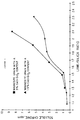
- Fig. 1 is a graphical representation of the influence of lime/silica ratio on soluble chromium in a burned 60% magnesite/40% chrome ore brick.
- Some commercially available magnesite-chrome bricks have levels of soluble chromium that exceed the EPA guideline of 5 ppm or less.
- it is possible to produce such a refractory with an acceptable level of soluble chromium by adding minor amounts of zirconia, silica, zircon and/or molybdic oxide to the base mix.
- Table II illustrates the effect of 0 to 3% fine zirconia in a burned 60/40 magnesite-chrome shape. Increasing the zirconia level to amounts greater than 1% had a dramatic effect on decreasing the level of soluble chromium. The relative fineness of the zirconia addition did not appear to be as important as the quantity of zirconia.
- Table III shows the effect of fine silica additions to the base mix on the level of soluble chromium. Small additions of silica in amounts less than 0.5% were effective in significantly decreasing the amount of soluble chromium.
- zirconia in accordance with the present invention tend to decrease the amount of soluble chromium.
- zirconia has a stronger affinity for alkaline earth compounds (such as CaO) than chromium. Therefore, chromium in the presence of lime and zirconia tends to stay in the stable insoluble Cr2O3 form.
- molybdic oxide was also found to be effective in decreasing the level of soluble chromium.
- MoO3 appears to be effective because it is stable in the +6 state, it is chemically similar to CrO3, and it may have a higher affinity for alkalies or alkaline earth compounds than chromium.
- additions of, for example, zirconia, silica and molybdic oxide can be used not only to lower the soluble chromium content of unused refractories, but are also useful in decreasing the soluble chromium content of used refractories.
- used chromium-bearing refractories could be crushed, mixed with the aforementioned additives, and burned to reduce their soluble chromium content.
- the soluble chromium content of used chromium containing refractories is lowered to less than 5 ppm total soluble chromium as defined by the Environmental Protection Agency's Test Method 1311 by crushing the used refractory, adding to the crushed material appropriate amounts of fine zirconia, silica, siliceous clay, siliceous additive, molybdic oxide, and/or zircon, blending and/or pressing the crushed material, and firing the material to a sufficient temperature to react to the above additions with soluble chromium compounds present in the used refractory.
- the above-mentioned additions are preferably sized minus 200 ⁇ m (-65 mesh and even more preferably minus 40 ⁇ m (-325 mesh).
Landscapes
- Engineering & Computer Science (AREA)
- Chemical & Material Sciences (AREA)
- Ceramic Engineering (AREA)
- Manufacturing & Machinery (AREA)
- Materials Engineering (AREA)
- Structural Engineering (AREA)
- Organic Chemistry (AREA)
- Compositions Of Oxide Ceramics (AREA)
- Furnace Housings, Linings, Walls, And Ceilings (AREA)
- Ceramic Products (AREA)
Description
- This invention relates to chromium containing refractories and, more particularly, it concerns an improved burned refractory with low levels of soluble chromium.
- Chromium in its various oxide forms is a useful constituent of refractories because of its high melting point and its relative inertness when in contact with corrosive slags, gases, and molten metals. The main forms of chromium used in refractories are the mineral chromite -- a complex oxide consisting of about 30-60% Cr₂O₃ -- and pigment-grade chromium oxide (Cr₂O₃). Under certain conditions, the acid form of chromium, chromic acid (CrO₃), can form from these materials. After use, routine disposal of these refractories is of concern since CrO₃ (chromium VI) can be dissolved by water. Simple leaching of used chrome-bearing refractories by rain water or ground water may dissolve CrO₃ present in the refractory.
- The U.S Environmental Protection Agency has issued test methods to determine the level of water-soluble chromium from various materials and has specified a current (Yr. 1990) maximum allowable level of total water-soluble chromium (all valence states of chromium) to be no more than 5 mg/l (or 5 ppm). The test methods used to determine soluble chromium have evolved from the earliest method, the EP Method (Extraction Procedure), to the present method, the TCLP Method (Toxicity Characteristic Leaching Procedure - Method 1311).
- Since the EPA guidelines were announced, producers and consumers of chrome-bearing materials have been involved with determining the level of soluble chromium in their products. It is now apparent that different products containing similar levels of total chromium can differ in their soluble chromium levels. Therefore, a good correlation between total chromium and soluble chromium is not immediately apparent.
- Japanese Patent Publication JP-A-50133208 discloses a chromium oxide-magnesia refractory in which has been included molybdenum trioxide in order to improve slag resistance of the refractory. The refractory exemplified contained 1.0% molybdenum trioxide, 76% magnesia, 10.6% chromium oxide, 6.8% alumina, 4.2% iron oxide, 1.0% lime and 1.1% silica. That is, this refractory had a lime/silica ratio of less than 1.
- In light of the foregoing, there is a need for an improved refractory and method having a decreased level of soluble chromium, and in particular, a burned refractory having a level of soluble chromium reduced to below 5 ppm.
- Accordingly, a principal object of the present invention is to provide a burned refractory with low soluble chromium. Another and more specific object of the invention is the provision of a method of reducing the soluble chromium levels of burned refractories. Other objects and further scope of applicability of the present invention will become apparent from the detailed description to follow in conjunction with the accompanying drawings and tables.
- In accordance with the present invention, it has been unexpectedly discovered that minor additions of fine zirconia, silica, zircon and/or molybdic oxide to burned chrome-containing refractories are effective in lowering the soluble chromium level of these compositions to acceptable values. This discovery is noteworthy, since it allows control of soluble chromium in a variety of chrome-bearing products. For example, products containing unacceptable levels of soluble chromium may now be made to contain low, acceptable levels of soluble chromium.
- Thus, in accordance with this invention, an additive is used which is selected from one or more of zirconia, silica, zircon, molybdic oxide, siliceous clay and a siliceous additive to lower the water soluble chromium content of a burned chromium-containing refractory, whose base mix has a lime/silica weight ratio greater than 1.1, to less than 5 ppm total water soluble chromium as defined by the Environmental Protection Agency's Test Method 1311.
- In accordance with a particularly preferred embodiment of the invention, the additive is one or more of zirconia, silica, zircon and molybdic oxide. Therefore in accordance with a particularly preferred embodiment of the invention an additive is used which is fine zirconia, silica, molybdic oxide and/or zircon to lower the soluble chromium content of a burned chromium-containing refractory to less than 5 ppm total soluble chromium, the additive being used in amounts of up to 10 wt. %.
- The additive may even be used in amounts less than 3 wt. %, or even less than 2%. Generally the additive will be used in amounts of at least 0.05 wt. %.
- The additive is preferably one or more of fine zirconia, zircon and molybdic oxide, most preferably being zirconia and/or molybdic oxide.
- The refractory may be any refractory composition but is preferably a magnesite-chrome or chrome-magnesite refractory.
- The invention also includes a method for lowering the water soluble chromium content of used chromium-containing refractories whose base mix has a lime/silica weight ratio greater than 1.1 to less than 5 ppm total water soluble chromium as defined by the Environmental Protection Agency's Test Method 1311 comprising crushing the used refractory, adding to the crushed material an additive selected from one or more of zirconia, silica, zircon, molybdic oxide, siliceous clay and a siliceous additive blending the crushed material and firing to a sufficient temperature to react the above additive with the water soluble chromium compounds present in the used refractory.
- The invention also includes the novel chromium-containing refractories obtainable by this process and having reduced total water soluble chromium content of less than 5 ppm as defined by the EPA's Test Method 1311.
- In accordance with an exemplary embodiment of the present invention, a burned 60% magnesite/40% chrome ore brick, which otherwise could have soluble chrome levels well in excess of 5 ppm, has a reduced soluble chromium level below the mandated 5 ppm maximum by either adding less than 2 wt. % zirconia, less than 0.5 wt. % silica, or less than 5 wt. % molybdic oxide. These amounts are meant to be illustrative rather than restrictive since it is readily apparent that compositions with higher amounts of soluble chromium may require larger amounts of these additives in order to reduce the level of soluble chromium to acceptable levels.
- Fig. 1 is a graphical representation of the influence of lime/silica ratio on soluble chromium in a burned 60% magnesite/40% chrome ore brick.
- Some commercially available magnesite-chrome bricks have levels of soluble chromium that exceed the EPA guideline of 5 ppm or less. In accordance with the present invention, it is possible to produce such a refractory with an acceptable level of soluble chromium by adding minor amounts of zirconia, silica, zircon and/or molybdic oxide to the base mix.
- As shown in Table I, as little as 0.5% zirconia was quite effective in preventing formation of soluble chromium in a shape containing 1.3% CaO+SiO₂. An addition of 2% zirconia was sufficient to decrease the level of the soluble chromium to under 1 ppm in a shape containing 2% CaO+SiO₂.

- Table II illustrates the effect of 0 to 3% fine zirconia in a burned 60/40 magnesite-chrome shape. Increasing the zirconia level to amounts greater than 1% had a dramatic effect on decreasing the level of soluble chromium. The relative fineness of the zirconia addition did not appear to be as important as the quantity of zirconia.

- Table III shows the effect of fine silica additions to the base mix on the level of soluble chromium. Small additions of silica in amounts less than 0.5% were effective in significantly decreasing the amount of soluble chromium.

- The influence of the lime/silica ratio on the level of soluble chromium is diagrammed in Figure 1.
- To determine if other oxides, such as molybdic oxide would produce a similar effect, additions of fine MoO₃ were made to the base mix ranging from 0 to 20% (Table IV). It is apparent that molybdic oxide was also effective in decreasing the level of soluble chromium. Two percent MoO₃ was required to decrease soluble chromium to less than 1 ppm.

- The above descriptions clearly illustrate the pronounced effect that minor additions of silica, zirconia, and molybdic oxide have on the soluble chromium content of fired magnesite-chrome refractories. Since both zirconia and silica work to lower soluble chromium levels, then zircon (ZrO₂·SiO₂) would also be effective at low levels. It is also obvious that these additions would be effective in other burned chrome-bearing refractories such as chrome-magnesite shapes. It is conjectured that chromium 3+ (the most stable form of chromium) may convert to
Cr 6+ in a high temperature environment, such as in a kiln. This conversion appears to be accelerated in the presence of an alkali or an alkaline earth compound. - The above examples clearly show that additions of zirconia in accordance with the present invention tend to decrease the amount of soluble chromium. Possibly, zirconia has a stronger affinity for alkaline earth compounds (such as CaO) than chromium. Therefore, chromium in the presence of lime and zirconia tends to stay in the stable insoluble Cr₂O₃ form.
- In accordance with another embodiment of the present invention, molybdic oxide was also found to be effective in decreasing the level of soluble chromium. MoO₃ appears to be effective because it is stable in the +6 state, it is chemically similar to CrO₃, and it may have a higher affinity for alkalies or alkaline earth compounds than chromium.
- Furthermore, additions of, for example, zirconia, silica and molybdic oxide can be used not only to lower the soluble chromium content of unused refractories, but are also useful in decreasing the soluble chromium content of used refractories. For example, used chromium-bearing refractories could be crushed, mixed with the aforementioned additives, and burned to reduce their soluble chromium content.
- In accordance with an exemplary embodiment of the present invention, the soluble chromium content of used chromium containing refractories is lowered to less than 5 ppm total soluble chromium as defined by the Environmental Protection Agency's Test Method 1311 by crushing the used refractory, adding to the crushed material appropriate amounts of fine zirconia, silica, siliceous clay, siliceous additive, molybdic oxide, and/or zircon, blending and/or pressing the crushed material, and firing the material to a sufficient temperature to react to the above additions with soluble chromium compounds present in the used refractory. Although it is not required, the above-mentioned additions are preferably sized minus 200µm (-65 mesh and even more preferably minus 40µm (-325 mesh).
- Based upon these and other considerations, various forms of other elements theoretically could be used to decrease the levels of water-soluble chromium. These elements are: S, W, U, Ba, V, Nb, Ta, Fe, Eu, Mn, Tc, N, Cl, Se, Br, I, Re, Ru, Os, B, D, P, As, Sb, Te and Bi.
- Thus, it will be appreciated that as a result of the present invention, a magnesite-chrome brick having acceptable levels of soluble chromium is provided by which the principal object and others are completely fulfilled.
Claims (22)
- Use of an additive which is selected from one or more of zirconia, silica, molybdic oxide, zircon, siliceous clay and a siliceous additive to lower the water soluble chromium content of a burned chromium-containing refractory, whose base mix has a lime/silica weight ratio greater than 1.1, to less than 5 ppm total water soluble chromium.
- Use of an additive according to claim 1 in which the additive has a fine particle size and is used in amounts of up to 10 wt. %.
- Use according to claim 1 or claim 2 in which the additive is zirconia, silica, molybdic oxide and/or zircon, the additive being used in amounts of up to 10 wt. %.
- Use according to any preceding claim wherein the additive is used in amounts less than 3 wt. %, preferably less than 2 wt. %.
- Use according to any preceding claim wherein the additive has particle size -65 mesh (200µm).
- Use according to claim 5 wherein the particle size of the additive is -325 mesh (40µm).
- Use according to any preceding claim wherein the additive is zirconia, preferably used in amounts below 2 wt. %.
- Use according to any of claims 1 to 7 wherein the additive is silica, preferably used in amounts below 0.5 wt. %.
- Use according to any of claims 1 to 7 wherein the additive is molybdic oxide, preferably used in amounts below 3 wt. %.
- Use according to any of claims 1 to 7 wherein the additive is zircon, preferably used in amounts below 5 wt. %.
- Use according to claim 3 in which the additive comprises a mixture of fine zirconia, zircon and molybdic oxide.
- Use according to claim 3 wherein the additive is any combination of fine zirconia and molybdic oxide.
- Use according to any preceding claim in which the refractory is a magnesite-chromium or chromium-magnesite composition.
- A method of lowering the water soluble chromium content of a used chromium-containing refractory whose base mix has a lime/silica weight ratio greater than 1.1, to less than 5 ppm total water soluble chromium as defined by the Environmental Protection Agency's Test Method 1311 comprising crushing the used refractory, adding to the crushed base material an additive selected from fine zirconia, silica, molybdic oxide, zircon, siliceous clay and/or a siliceous additive, blending the crushed material and firing to a sufficient temperature to react the additive with the water soluble chromium compounds present in the used refractory.
- A method according to claim 14 in which the additive is added to the crushed base material in an amount up to 10 wt. %.
- A method according to claim 14 or claim 15 wherein the additive is fine zirconia, silica, molybdic oxide and/or zircon.
- A method according to any of claims 14 to 16 wherein the additive has a particle size -65 mesh (200 µm).
- A method according to claim 17 wherein the particle size of the additive is -325 mesh (40 µm).
- A method according to any of claims 14 to 18 wherein the additive is used in amounts above 0.05% and less than 3 wt. %, preferably less than 2 wt. %.
- A method according to any of claims 14 to 19 in which prior to firing, the crushed, used refractory and additive are blended and pressed.
- A chromium-containing refractory obtainable by a process according to any of claims 14 to 20.
- A chromium-containing refractory obtainable by a process comprising crushing a used chromium-containing refractory, adding to the crushed material an additive in an amount up to 10 wt. % of fine zirconia, silica, molybdic oxide and/or zircon, blending the crushed material and firing to a sufficient temperature to react the additive with the water soluble chromium compound present in the used refractory and wherein the refractory has a total water soluble chromium content of less than 5 ppm as defined by the Environmental Protection Agency's Test Method 1311.
Applications Claiming Priority (2)
| Application Number | Priority Date | Filing Date | Title |
|---|---|---|---|
| US72249691A | 1991-06-27 | 1991-06-27 | |
| US722496 | 1991-06-27 |
Publications (2)
| Publication Number | Publication Date |
|---|---|
| EP0521679A1 EP0521679A1 (en) | 1993-01-07 |
| EP0521679B1 true EP0521679B1 (en) | 1996-03-20 |
Family
ID=24902096
Family Applications (1)
| Application Number | Title | Priority Date | Filing Date |
|---|---|---|---|
| EP92305961A Expired - Lifetime EP0521679B1 (en) | 1991-06-27 | 1992-06-29 | Burned refractories with low water soluble chromium(VI)oxide content |
Country Status (5)
| Country | Link |
|---|---|
| US (1) | US5322827A (en) |
| EP (1) | EP0521679B1 (en) |
| CA (1) | CA2063357A1 (en) |
| DE (1) | DE69209171T2 (en) |
| MX (1) | MX9201865A (en) |
Cited By (1)
| Publication number | Priority date | Publication date | Assignee | Title |
|---|---|---|---|---|
| CN109053171A (en) * | 2018-08-27 | 2018-12-21 | 佛山石湾鹰牌陶瓷有限公司 | Adobe and ink-jet infiltration spend beautiful matter polished bricks |
Families Citing this family (3)
| Publication number | Priority date | Publication date | Assignee | Title |
|---|---|---|---|---|
| US6174509B1 (en) * | 1997-02-11 | 2001-01-16 | Corning Incorporated | Pure fused silica, furnace and method |
| US6574991B1 (en) | 1998-08-13 | 2003-06-10 | Corning Incorporated | Pure fused silica, furnace and method |
| EP1982965A1 (en) * | 2005-05-30 | 2008-10-22 | Refractory Intellectual Property GmbH & Co. KG | Refractory ceramic product |
Family Cites Families (13)
| Publication number | Priority date | Publication date | Assignee | Title |
|---|---|---|---|---|
| CA446474A (en) * | 1948-01-27 | E. J. Lavino And Company | Refractory | |
| GB873765A (en) * | 1958-12-15 | 1961-07-26 | Oughtibridge Silica Firebrick | Process for the production of basic refractory bricks or shapes |
| US3309209A (en) * | 1963-08-26 | 1967-03-14 | Kaiser Aluminium Chem Corp | Refractory |
| GB1089354A (en) * | 1965-09-06 | 1967-11-01 | Steetley Refractory Brick Comp | Magnesite-chrome refractory bricks |
| US3528830A (en) * | 1968-03-05 | 1970-09-15 | Dresser Ind | Refractory composition |
| US3522065A (en) * | 1968-10-22 | 1970-07-28 | Bethlehem Steel Corp | Magnesia chrome ore basic refractory shape and a method for manufacturing same |
| US3751273A (en) * | 1971-06-22 | 1973-08-07 | Corhart Refractories Co | Burned basic refractory and batch therefor |
| GB1573316A (en) * | 1976-04-28 | 1980-08-20 | Didier Werke Ag | Sinter material |
| GB1580036A (en) * | 1976-05-27 | 1980-11-26 | Raychem Corp | Heat-recoverable composite coupling devices |
| SU798077A1 (en) * | 1979-03-05 | 1981-01-23 | Рижский Ордена Трудового Красногознамени Политехнический Институт | Composition for making chemically resistant ceramic material |
| JPS5845174A (en) * | 1981-09-14 | 1983-03-16 | 川崎製鉄株式会社 | Refractories and protection of heating furnace material therewith |
| SU1085961A1 (en) * | 1982-05-06 | 1984-04-15 | Восточный научно-исследовательский и проектный институт огнеупорной промышленности | Refractory composition |
| DE3340849C2 (en) * | 1983-11-11 | 1985-10-24 | Didier-Werke Ag, 6200 Wiesbaden | Process for reclaiming magnesite chromite or chromite magnesite quarries and using the reclaimed quarry |
-
1992
- 1992-03-18 CA CA002063357A patent/CA2063357A1/en not_active Abandoned
- 1992-04-22 MX MX9201865A patent/MX9201865A/en not_active IP Right Cessation
- 1992-06-29 EP EP92305961A patent/EP0521679B1/en not_active Expired - Lifetime
- 1992-06-29 DE DE69209171T patent/DE69209171T2/en not_active Expired - Fee Related
-
1993
- 1993-01-22 US US08/008,767 patent/US5322827A/en not_active Expired - Fee Related
Non-Patent Citations (1)
| Title |
|---|
| Enviromental protection Agency's Test method 1311 * |
Cited By (1)
| Publication number | Priority date | Publication date | Assignee | Title |
|---|---|---|---|---|
| CN109053171A (en) * | 2018-08-27 | 2018-12-21 | 佛山石湾鹰牌陶瓷有限公司 | Adobe and ink-jet infiltration spend beautiful matter polished bricks |
Also Published As
| Publication number | Publication date |
|---|---|
| CA2063357A1 (en) | 1992-12-28 |
| US5322827A (en) | 1994-06-21 |
| DE69209171D1 (en) | 1996-04-25 |
| MX9201865A (en) | 1992-12-01 |
| DE69209171T2 (en) | 1996-07-25 |
| EP0521679A1 (en) | 1993-01-07 |
Similar Documents
| Publication | Publication Date | Title |
|---|---|---|
| US4990475A (en) | Alumina-spinal monolithic refractories | |
| US5219807A (en) | Burned high purity refractories with low soluble chromium | |
| DE68905030T2 (en) | FIRE-RESISTANT MATERIAL MADE OF MAGNESITE AND CARBON. | |
| US4849383A (en) | Basic refractory composition | |
| US4158568A (en) | Corrosion resistant refractory mix | |
| US5322827A (en) | Burned refractories with low soluble chromium | |
| EP0535233B1 (en) | Unshaped alumina spinel refractory | |
| CA2133934C (en) | Mgo-spinel refractory mix and shapes made therefrom | |
| CA1204792A (en) | Refractory gun mix | |
| EP0020022B1 (en) | Plastic refractories with fused alumina-chrome grog | |
| JP4328053B2 (en) | Magnesia-spinel brick | |
| US4999325A (en) | Rebonded fused brick | |
| JP2711758B2 (en) | Manganese sintered ore for steelmaking and refining and its production method | |
| JP2000178074A (en) | Castable refractory for blast furnace tapping spout | |
| EP0023768B1 (en) | Refractory gun mix | |
| JPH06256064A (en) | Dense castable refractory low in water content and capable of being cast | |
| US4574119A (en) | Chrome-magnesite refractories and method of preparation | |
| JP3985082B2 (en) | Refractories and how to use refractories | |
| KR19980046891A (en) | Fire-resistant adhesive for preventing oxidation of carbon-containing refractory bricks | |
| JP3780398B2 (en) | How to use refractories | |
| GB2288797A (en) | Fused spinel-zirconia grain and a refractory mix | |
| EP0547728B1 (en) | High purity fused grain in the system alumina-chromia-magnesia | |
| JPH1025167A (en) | Refractory for casting by using magnesia coarse particles | |
| KR20000043685A (en) | Slag coating material for converter | |
| JP2596668B2 (en) | Magnesia-mag-lime spray material |
Legal Events
| Date | Code | Title | Description |
|---|---|---|---|
| PUAI | Public reference made under article 153(3) epc to a published international application that has entered the european phase |
Free format text: ORIGINAL CODE: 0009012 |
|
| AK | Designated contracting states |
Kind code of ref document: A1 Designated state(s): DE FR GB |
|
| 17P | Request for examination filed |
Effective date: 19930702 |
|
| 17Q | First examination report despatched |
Effective date: 19941207 |
|
| RAP1 | Party data changed (applicant data changed or rights of an application transferred) |
Owner name: INDRESCO INC. |
|
| GRAH | Despatch of communication of intention to grant a patent |
Free format text: ORIGINAL CODE: EPIDOS IGRA |
|
| GRAA | (expected) grant |
Free format text: ORIGINAL CODE: 0009210 |
|
| AK | Designated contracting states |
Kind code of ref document: B1 Designated state(s): DE FR GB |
|
| REF | Corresponds to: |
Ref document number: 69209171 Country of ref document: DE Date of ref document: 19960425 |
|
| RAP2 | Party data changed (patent owner data changed or rights of a patent transferred) |
Owner name: HARBISON-WALKER REFRACTORIES COMPANY |
|
| ET | Fr: translation filed | ||
| PLBE | No opposition filed within time limit |
Free format text: ORIGINAL CODE: 0009261 |
|
| STAA | Information on the status of an ep patent application or granted ep patent |
Free format text: STATUS: NO OPPOSITION FILED WITHIN TIME LIMIT |
|
| 26N | No opposition filed | ||
| PGFP | Annual fee paid to national office [announced via postgrant information from national office to epo] |
Ref country code: FR Payment date: 19970320 Year of fee payment: 6 |
|
| PGFP | Annual fee paid to national office [announced via postgrant information from national office to epo] |
Ref country code: GB Payment date: 19970329 Year of fee payment: 6 |
|
| REG | Reference to a national code |
Ref country code: FR Ref legal event code: CD |
|
| PGFP | Annual fee paid to national office [announced via postgrant information from national office to epo] |
Ref country code: DE Payment date: 19970630 Year of fee payment: 6 |
|
| PG25 | Lapsed in a contracting state [announced via postgrant information from national office to epo] |
Ref country code: GB Free format text: LAPSE BECAUSE OF NON-PAYMENT OF DUE FEES Effective date: 19980629 |
|
| GBPC | Gb: european patent ceased through non-payment of renewal fee |
Effective date: 19980629 |
|
| PG25 | Lapsed in a contracting state [announced via postgrant information from national office to epo] |
Ref country code: FR Free format text: LAPSE BECAUSE OF NON-PAYMENT OF DUE FEES Effective date: 19990226 |
|
| PG25 | Lapsed in a contracting state [announced via postgrant information from national office to epo] |
Ref country code: DE Free format text: LAPSE BECAUSE OF NON-PAYMENT OF DUE FEES Effective date: 19990401 |
|
| REG | Reference to a national code |
Ref country code: FR Ref legal event code: ST |