EP0512293A1 - Copolymerisate für Klebstoffe - Google Patents
Copolymerisate für Klebstoffe Download PDFInfo
- Publication number
- EP0512293A1 EP0512293A1 EP92106599A EP92106599A EP0512293A1 EP 0512293 A1 EP0512293 A1 EP 0512293A1 EP 92106599 A EP92106599 A EP 92106599A EP 92106599 A EP92106599 A EP 92106599A EP 0512293 A1 EP0512293 A1 EP 0512293A1
- Authority
- EP
- European Patent Office
- Prior art keywords
- weight
- copolymer
- thiol groups
- copolymers
- compound
- Prior art date
- Legal status (The legal status is an assumption and is not a legal conclusion. Google has not performed a legal analysis and makes no representation as to the accuracy of the status listed.)
- Granted
Links
Classifications
-
- C—CHEMISTRY; METALLURGY
- C08—ORGANIC MACROMOLECULAR COMPOUNDS; THEIR PREPARATION OR CHEMICAL WORKING-UP; COMPOSITIONS BASED THEREON
- C08F—MACROMOLECULAR COMPOUNDS OBTAINED BY REACTIONS ONLY INVOLVING CARBON-TO-CARBON UNSATURATED BONDS
- C08F20/00—Homopolymers and copolymers of compounds having one or more unsaturated aliphatic radicals, each having only one carbon-to-carbon double bond, and only one being terminated by only one carboxyl radical or a salt, anhydride, ester, amide, imide or nitrile thereof
- C08F20/02—Monocarboxylic acids having less than ten carbon atoms, Derivatives thereof
- C08F20/10—Esters
- C08F20/12—Esters of monohydric alcohols or phenols
-
- C—CHEMISTRY; METALLURGY
- C08—ORGANIC MACROMOLECULAR COMPOUNDS; THEIR PREPARATION OR CHEMICAL WORKING-UP; COMPOSITIONS BASED THEREON
- C08F—MACROMOLECULAR COMPOUNDS OBTAINED BY REACTIONS ONLY INVOLVING CARBON-TO-CARBON UNSATURATED BONDS
- C08F2/00—Processes of polymerisation
- C08F2/38—Polymerisation using regulators, e.g. chain terminating agents, e.g. telomerisation
Definitions
- the invention further relates to the use of the copolymers in adhesives.
- tert-dodecyl mercaptan is known to be used as a regulator for reducing the molecular weight.
- DE-A-37 00 248 discloses aqueous dispersions of copolymers for use as pressure sensitive adhesives.
- the object of the present invention was therefore copolymers which bring about both good adhesion and cohesion in bonds.
- the copolymers according to the invention preferably also contain monomers B).
- the copolymers particularly preferably have a content of monomers A), B) and C).
- the content of monomers A) in the copolymer is 50 to 100% by weight, preferably 50 to 99.4% by weight and particularly preferably 70 to 99.4% by weight; that of the monomers B) is 0 to 40% by weight, preferably 0.1 to 10 and particularly preferably 0.1 to 5% by weight.
- the monomers C) are present in the copolymer in an amount of 0 to 50, preferably 0.5 to 40 and particularly preferably 0.5 to 25% by weight.
- the monomers A) are preferably C2-C10, particularly preferably C4-C10 alkyl acrylates.
- Monomers A) are preferably used whose homopolymers have glass transition temperatures below -20 ° C., preferably below -35 ° C.
- Examples of monomers A) include n-butyl acrylate, isobutyl acrylate, n-hexyl acrylate, 2-ethylhexyl acrylate, n-octyl acrylate or isooctyl acrylate.
- Suitable monomers B) are monoolefinically unsaturated compounds with at least one carboxylic acid, hydroxyl, amino or amido or imido, dicarboxylic anhydride, epoxy, keto or aldehyde group.
- Glycidyl acrylate and glycidyl methacrylate are of particular importance as compounds with at least one epoxy group.
- a compound with a dicarboxylic anhydride group is, for example, maleic anhydride.
- Monomers containing amino groups are e.g. (Meth) acrylic esters such as dimethylaminoethyl (meth) acrylate, diethylaminoethyl (meth) acrylate.
- Preferred monomers B) are monomers containing hydroxyl groups, in particular those with a hydroxyl group, preferably C1-C8-hydroxyalkyl (meth) acrylates such as e.g. 2-hydroxyethyl (meth) acrylate and 2-hydroxypropyl (meth) acrylate.
- the monomers B) are likewise preferably monoolefinically unsaturated carboxylic acids or dicarboxylic acids, in particular those having 3 to 5 carbon atoms, or amides or imides of these acids, the amides or imides on the nitrogen atom being additionally substituted by one or two C1-C6- Alkyl or hydroxyalkyl radicals can be substituted.
- Acrylic acid methacrylic acid, maleic acid, fumaric acid, maleimide, (meth) acrylamide or N-methylol (meth) acrylamide.
- C3-C5 carboxylic acids or dicarboxylic acids are very particularly preferred, but especially acrylic acid and methacrylic acid.
- Further copolymerizable olefinically unsaturated compounds C) are preferably monoolefinically unsaturated compounds whose homopolymers have glass transition temperatures above -20 ° C., preferably above -10 ° C. and in particular above + 5 ° C.
- monoolefinically unsaturated compounds whose homopolymers have glass transition temperatures above -20 ° C., preferably above -10 ° C. and in particular above + 5 ° C.
- the proportions of the monomers A), B) and C) are preferably chosen so that the glass transition temperature of the copolymer is below 0 ° C., particularly preferably between -25 ° C. and -50 ° C.
- the glass transition temperature can be adjusted using conventional methods, e.g. Determine from the measurement of the modulus of elasticity in the creep test as a function of temperature or with differential thermal analysis (DTA) (see A. Zosel, Aid und Lack 82 (1976), 125-134).
- the copolymer is prepared in the presence of 0.01 to 5% by weight, preferably 0.01 to 2% by weight, particularly preferably 0.02 to 1% by weight, based on the copolymer, of a compound having at least one two thiol groups in the molecule.
- the compound with at least two thiol groups is largely incorporated into the polymer structure during the polymerization.
- the compounds with at least two thiol groups in the molecule can be inorganic or organic low-molecular, oligomeric or polymeric compounds. It is also possible to use compounds in which the thiol groups are in situ before or during the polymerization, e.g. through hydrolysis reactions.
- aromatic thiols such as dimercaptobenzene, dimercaptotoluene, dimercaptoanisole and trimercaptobenzene or aliphatic thiols, e.g. C2-C12 alkanedithiols such as 1,2-ethanedithiol, 1,3-propanedithiol, 1,6-hexanedithiol, 1,9-nonanedithiol or cycloaliphatic thiols, e.g. 1,3,6-trimercaptocyclohexane.
- aromatic thiols such as dimercaptobenzene, dimercaptotoluene, dimercaptoanisole and trimercaptobenzene or aliphatic thiols, e.g. C2-C12 alkanedithiols such as 1,2-ethanedithiol, 1,3-propanedithiol, 1,6-hexanedithiol, 1,9
- connections include e.g. Dimercapto-1,8-dioxa-3,6-octane, bis (2-mercaptoethyl) sulfide or thioglycolic acid ester of dihydric or polyhydric alcohols or thiocarboxylic acid derivatives such as dithiosuccinic acid, 6-mercapto-thiohexanoic acid.
- Silanes or siloxanes with at least two thiol groups can be used. These silanes or siloxanes preferably do not contain any hydrolyzable substituents, e.g. Alkoxy groups.
- oligomers or polymers which contain at least two thiol groups as substituents e.g. are alkylene polysulfides (thiocols), but also polybutadienes, polyisobutylenes, polyethylene oxides, polytetrahydrofurans, polyvinyl ethers, polysiloxanes or thioglycolates of polyvinyl alcohols.
- organic compounds especially those with a molecular weight between 90 and 5,000 g / mol.
- copolymers according to the invention can be prepared by conventional polymerization methods such as solution polymerization, suspension polymerization, emulsion polymerization or bulk polymerization, the compound having at least two thiol groups and also the monomers in each case in full or in part or can be at least partially metered in batches or continuously to the polymerization batch.
- the copolymers are preferably prepared by emulsion polymerization.
- Peroxides such as sodium, potassium and ammonium peroxide, hydrogen peroxide or perborates are suitable.
- emulsifiers or dispersing aids e.g. Alkali salts of fatty acids, e.g. Sodium stearate or sodium oleate, alkali metal salts of sulfated oils, alkali metal salts of sulfonic acids, especially alkyl sulfonic acids, alkali metal salts of oxyalkylated alkylphenols, diphenyl ethers substituted by one or two alkyl sulfate groups, and polyadducts of alkylene oxides such as ethylene oxide, propylene oxide or their mixture with fatty acids, fatty alcohols or fatty alcohols, fatty amides are used.
- alkylene oxides such as ethylene oxide, propylene oxide or their mixture with fatty acids, fatty alcohols or fatty alcohols, fatty amides are used.
- regulators can also be used in the polymerization, by means of which the molar mass is reduced. Suitable are e.g. Compounds with a thiol group such as tert-butyl mercaptan or tert-dodecyl mercaptan. The proportion of these regulators can in particular be 0 to 0.3% by weight, based on the copolymer.
- the temperature in the emulsion polymerization is preferably 40 to 100 ° C, in particular 70 to 95 ° C.
- a feed process in which some of the monomers, in particular up to 10% by weight, together with water, emulsifiers, initiators and, if appropriate, regulators and, if appropriate, the compound having at least two thiol groups are initially introduced have proven particularly useful for emulsion polymerization.
- the remainder of the monomers and, if appropriate, also the remainder of the compound having at least two thiol groups in the molecule and optionally further amounts of regulator can be metered in in water, emulsified at the polymerization temperature, simultaneously with an aqueous solution of further amounts of initiator.
- the composition of the submitted and the metered monomer mixture can be the same or different.
- the aqueous dispersion finally obtained in the emulsion polymerization preferably has a solids content of 40 to 70% by weight.
- copolymers according to the invention or their aqueous dispersions are suitable as adhesives or adhesive dispersions.
- the aqueous copolymer dispersions are particularly suitable for the production of pressure sensitive adhesives.
- tackifying resins can be added to the aqueous dispersions, such as those e.g. from Adhesives Age, July 1987, pages 19-23 or Polym Mater. Sci. Eng., 61 (1989), pages 588-592 are known. These resins are, in particular, natural or synthetic resin acids or their esters in dispersion.
- the weight ratio of polymer according to the invention to tackifying resin is preferably between 5: 1 to 1: 5, particularly preferably between 2: 1 to 1: 1.
- the dispersions can contain customary amounts of thickeners, plasticizers and / or pigments.
- Inorganic or organic fillers can also be used as additives.
- examples of such fillers are chalk, micro-glass balls, mineral silicates or Teflon powder.
- the dispersions can be prepared in the usual way, e.g. by spraying, knife coating, rolling, pouring, rolling or dipping onto suitable substrates.
- the dispersions can include can be used for the production of adhesive labels or other self-adhesive articles.
- Films made of polyethylene, polypropylene, polyethylene glycol terephthalate, polyvinyl chloride and metal as well as paper are suitable as supports.
- the adhesive layers obtained are distinguished both by good adhesion to the substrate surfaces and by good cohesion.
- the initial charge was heated to 85 ° C. and 1% by weight of feed 1 and 20% by weight of feed 2 were added with stirring. After 15 minutes of polymerization, the two feeds were added over 3 hours. The polymerization was continued at 85 ° C. for about 1 h and then cooled. Then a pH of 7 was adjusted with a 25% ammonia solution.
- the dispersions were knife-coated onto polyester film (Hostaphan® RN 36, Hoechst) with an application weight of approx. 20 g / m2 and the coated films were dried for 3 minutes at 90 ° C. in a forced-air drying cabinet. The coated films were then cut into 2 cm wide test strips.
- polyester film Hostaphan® RN 36, Hoechst
- the 2.5 cm long adhesive strips were stuck to a V2A test plate, rolled up once with a 1 kg roll, stored for 24 hours and then loaded with a 1 kg weight while hanging.
- the measure of the shear strength was the time until the weight dropped; the average of 5 measurements was calculated. The adhesive layer was destroyed during these measurements (cohesive breakage).
- an adhesive strip was stuck to a V2A test sheet and rolled once with a 1 kg roll. It was then clamped with one end in the upper jaws of a tensile strain tester. The adhesive strip was removed from the test surface (V2A steel) at 300 mm / min at a 90 ° C angle and the force required was measured. The measure for the peel value was the force in N, which was the average of five measurements.
- the product of peel strength and shear strength served as a measure of the technical adhesive properties (high peel strength, ie adhesion and high shear strength, ie cohesion).
Landscapes
- Chemical & Material Sciences (AREA)
- Health & Medical Sciences (AREA)
- Chemical Kinetics & Catalysis (AREA)
- Medicinal Chemistry (AREA)
- Polymers & Plastics (AREA)
- Organic Chemistry (AREA)
- Adhesives Or Adhesive Processes (AREA)
- Addition Polymer Or Copolymer, Post-Treatments, Or Chemical Modifications (AREA)
- Polymerisation Methods In General (AREA)
Abstract
Description
- Die Erfindung betrifft Copolymerisate, erhältlich durch Copolymerisation eines Monomerengemischs, enthaltend
- A) 50 bis 100 Gew.-% mindestens eines C₁-C₁₆-Alkylacrylats,
- B) 0 bis 40 Gew.-% mindestens einer copolymerisierbaren monoolefinisch ungesättigten Verbindung mit mindestens einer Carbonsäure-, Hydroxyl-, Amino-, bzw. Amido- oder Imido, Dicarbonsäureanhydrid-, Epoxy-, Keto- oder Aldehydgruppe,
- C) 0 bis 50 Gew.-% weiterer copolymerisierbarer olefinisch ungesättigter Verbindungen
- Weiterhin betrifft die Erfindung die Verwendung der Copolymerisate in Klebstoffen.
- Verbindungen mit Thiolgruppen, z.B. tert.-Dodecylmercaptan werden bei Polymerisationen bekannterweise als Regler zur Verminderung des Molekulargewichts eingesetzt.
- Die Verwendung von Verbindungen mit mehr als einer Thiolgruppe für diesen Zweck ist in der Literatur kaum beschrieben. Aus einem Artikel von C.A. Uraneck und J.E. Burleigh in Journal of Applied Polym. Sci., 12 (1968), Seite 1075-1095, geht hervor, daß Dipentendithiol und 1,10-Decandithiol neben vielen anderen Thiolen versuchsweise als Regler bei der Copolymerisation von Butadien und Acrylnitril eingesetzt wurden. In der J 57028124 werden als mögliche Regler bei der Vinylchloridpolymerisation unter anderem auch solche mit zwei Thiolgruppen genannt.
- Anforderungen, die an Copolymerisate im Falle der Verwendung als Klebstoffe, z.B. Haftklebstoffe, gestellt werden, sind vor allem eine gute Haftung auf Oberflächen (Adhäsion) und eine gute innere Festigkeit (Kohäsion), um einen möglichst festen Verbund der Verklebungen zu erreichen. Diese beiden Anforderungen können kaum gleichermaßen gut erfüllt werden, da viele Maßnahmen, die z.B. eine gute Kohäsion bewirken, sich wiederum nachteilig auf die Adhäsion auswirken. So ist dem Fach z.B. bekannt, daß die Kohäsion mit steigendem Molekulargewicht zunimmt, die Adhäsion sich jedoch in entsprechendem Ausmaß gleichzeitig verschlechtert.
- Aus der DE-A-37 00 248 sind wäßrige Dispersionen von Copolymerisaten für die Verwendung als Haftklebstoffe bekannt.
- Diese Copolymerisate weisen als Klebstoffe jedoch noch den Mangel auf, daß bei ausreichender Adhäsion die Kohäsion noch unbefriedigend ist.
- Aufgabe der vorliegenden Erfindung waren daher Copolymerisate, welche in Verklebungen sowohl eine gute Adhäsion als auch Kohäsion bewirken.
- Demgemäß wurden die eingangs definierten Copolymerisate, sowie ihre Verwendung als Klebstoffe gefunden.
- Die erfindungsgemäßen Copolymerisate enthalten neben den oben definierten Monomeren A) vorzugsweise auch Monomere B). Besonders bevorzugt weisen die Copolymerisate einen Gehalt an Monomeren A), B) und C) auf. Der Gehalt an Monomeren A) im Copolymerisat beträgt 50 bis 100 Gew.-%, bevorzugt 50 bis 99,4 Gew.-% und besonders bevorzugt 70 bis 99,4 Gew.-; derjenige der Monomeren B) ist 0 bis 40 Gew.-%, bevorzugt 0,1 bis 10 und besonders bevorzugt 0,1 bis 5 Gew.-%. Die Monomeren C) sind zu 0 bis 50, bevorzugt 0,5 bis 40 und besonders bevorzugt zu 0,5 bis 25 Gew.-% im Copolymerisat enthalten.
- Bei den Monomeren A) handelt es sich bevorzugt um C₂-C₁₀-, besonders bevorzugt um C₄-C₁₀-Alkylacrylate. Vorzugsweise finden solche Monomeren A) Verwendung, deren Homopolymerisate Glasübergangstemperaturen unter -20°C, vorzugsweise unter -35°C aufweisen. Als Monomere A) genannt seien z.B. n-Butylacrylat, Isobutylacrylat, n-Hexylacrylat, 2-Ethylhexylacrylat, n-Octylacrylat oder Isooctylacrylat.
- Als Monomere B) kommen monoolefinisch ungesättigte Verbindungen mit mindestens einer Carbonsäure-, Hydroxyl-, Amino- bzw. Amido oder Imido-, Dicarbonsäureanhydrid-, Epoxy-, Keto- oder Aldehydgruppe in Betracht.
- Als Verbindungen mit mindestens einer Epoxygruppe sind Glycidylacrylat und Glycidylmethacrylat von besonderer Bedeutung.
- Eine Verbindung mit einer Dicarbonsäureanhydridgruppe ist z.B. Maleinsäureanhydrid.
- Als Verbindungen mit einer Keto- oder Aldehydgruppe sind z.B. Diacetonacrylamid oder Acetoacetoxyethylmethacrylat erwähnenswert. Aminogruppen enthaltende Monomere sind z.B. (Meth)acrylester wie Dimethylaminoethyl(meth)acrylat, Diethylaminoethyl(meth)acrylat.
- Bevorzugte Monomere B) sind Hydroxygruppen enthaltende Monomere, insbesondere solche mit einer Hydroxygruppe, vorzugsweise C₁-C₈-Hydroxyalkyl(meth)acrylate wie z.B. 2-Hydroxyethyl(meth)acrylat und 2-Hydroxypropyl(meth)acrylat.
- Ebenfalls bevorzugt handelt es sich bei den Monomeren B) um monoolefinisch ungesättigte Carbonsäuren oder Dicarbonsäuren, insbesondere solchen mit 3 bis 5 Kohlenstoffatomen, oder Amide bzw. Imide dieser Säuren, wobei die Amide oder Imide am Stickstoffatom zusätzlich durch ein bzw. zwei C₁-C₆-Alkyl- oder -Hydroxyalkylreste substituiert sein können.
- In Betracht kommen z.B. Acrylsäure, Methacrylsäure, Maleinsäure, Fumarsäure, Maleinimid, (Meth)acrylamid oder N-Methylol(meth)acrylamid.
- Ganz besonders bevorzugt sind C₃-C₅-Carbonsäuren oder -Dicarbonsäuren, insbesondere aber Acrylsäure und Methacrylsäure.
- Als weitere copolymerisierbare olefinisch ungesättigte Verbindungen C) kommen vorzugsweise monoolefinisch ungesättigte Verbindungen, deren Homopolymerisate Glasübergangstemperaturen oberhalb -20°C, bevorzugt oberhalb -10°C und insbesondere oberhalb +5°C aufweisen, in Betracht. Genannt seien z.B. Methyl(meth)acrylat, Ethylmethacrylat, tert.-Butylmethacrylat, Styrol, α-Methylstyrol, (Meth)acrylnitril, (Meth)acrylamid oder Vinylacetat.
- Die Anteile der Monomeren A), B) und C) werden vorzugsweise so gewählt, daß die Glasübergangstemperatur des Copolymerisats unter 0°C, besonders bevorzugt zwischen -25°C und -50°C liegt. Die Glastemperatur läßt sich nach üblichen Methoden, z.B. aus der Messung des E-Moduls im Kriechversuch als Funktion der Temperatur oder mit der Differentialthermoanalyse (DTA) bestimmen (s. dazu A. Zosel, Farbe und Lack 82 (1976), 125-134).
- Die Herstellung des Copolymerisats erfolgt in Gegenwart von 0,01 bis 5 Gew.-%, bevorzugt 0,01 bis 2 Gew.-%, besonders bevorzugt 0,02 bis 1 Gew.-%, bezogen auf das Copolymerisat, einer Verbindung mit mindestens zwei Thiolgruppen im Molekül. Die Verbindung mit mindestens zwei Thiolgruppen wird bei der Polymerisation in das Polymergerüst weitgehend mit eingebaut.
- Es ist anzunehmen, daß der Einbau weitgehend durch Mechanismen der Kettenübertragung und Kettenabbruch, wie sie für Polymerisationsregler wie z.B. tertiär Dodecylmercaptan allgemein bekannt sind, erfolgt. Auch Reaktionen der Thiolgruppen mit funktionellen Gruppen, welche über entsprechende Monomere im entstehenden Polymer eingebaut werden, sind möglich.
- Bei den Verbindungen mit mindestens zwei Thiolgruppen im Molekül kann es sich um anorganische oder organische niedemolekulare, oligomere oder polymere Verbindungen handeln. Es ist auch möglich, Verbindungen einzusetzen, bei denen die Thiolgruppen in situ vor oder während der Polymerisation, z.B. durch Hydrolysereaktionen, entstehen.
- Insbesondere zu erwähnen sind z.B. aromatische Thiole, wie Dimercaptobenzol, Dimercaptotoluol, Dimercaptoanisol und Trimercaptobenzol oder aliphatische Thiole, z.B. C₂-C₁₂-Alkandithiole wie 1,2-Ethandithiol, 1,3-Propandithiol, 1,6-Hexandithiol, 1,9-Nonandithiol oder cycloaliphatische Thiole, z.B. 1,3,6-Trimercaptocyclohexan.
- Als weitere Verbindungen kommen z.B. Dimercapto-1,8-dioxa-3,6-octan, Bis(2-mercaptoethyl)sulfid oder Thioglycolsäureester von zwei- oder mehrwertigen Alkoholen oder Thiocarbonsäurederivate wie Dithiobernsteinsäure, 6-Mercapto-thiohexansäure in Betracht.
- Weiterhin können auch z.B. Silane oder Siloxane mit mindestens zwei Thiolgruppen verwendet werden. Vorzugsweise enthalten diese Silane oder Siloxane keine hydrolysierbaren Substituenten, wie z.B. Alkoxygruppen.
- Bei Oligomeren oder Polymeren, welche mindestens zwei Thiolgruppen als Substituenten enthalten, kann es sich z.B. um Alkylenpolysulfide (Thiokole), aber auch um Polybutadiene, Polyisobutylene, Polyethylenoxide, Polytetrahydrofurane, Polyvinylether, Polysiloxane oder Thioglycolate von Polyvinylalkoholen handeln.
- Bevorzugt sind Verbindungen mit zwei bis drei, insbesondere mit zwei Thiolgruppen im Molekül.
- Ebenfalls bevorzugt sind organische Verbindungen, insbesondere solche mit einem Molekulargewicht zwischen 90 und 5.000 g/mol.
- Die erfindungsgemäßen Copolymerisate können durch übliche Polymerisationsmethoden wie Lösungspolymerisation, Suspensionspolymerisation, Emulsionspolymerisation oder Polymerisation in Substanz hergestellt werden, wobei die Verbindung mit mindestens zwei Thiolgruppen und auch die Monomeren jeweils in voller Menge oder teilweise vorgelegt oder auch zumindest teilweise dem Polymerisationsansatz in Chargen oder kontinuierlich zudosiert werden können.
- Bevorzugt erfolgt die Herstellung der Copolymerisate durch Emulsionspolymerisation.
- Als wasserlösliche Initiatoren sind bei der Emulsionspolymerisation z.B. Peroxide wie Natrium-, Kalium- und Ammoniumperoxid, Wasserstoffperoxid oder Perborate geeignet.
- Als Emulgatoren, bzw. Dispergierhilfsmittel können z.B. Alkalisalze von Fettsäuren, z.B. Natriumstearat oder Natriumoleat, Alkalisalze von sulfatierten Ölen, Alkalisalze von Sulfonsäuren, insbesondere Alkylsulfonsäuren, Alkalisalze von oxalkylierten Alkylphenolen, durch ein oder zwei Alkylsulfatgruppen substituierte Diphenylether sowie Polyadditionsprodukte von Alkylenoxiden wie Ethylenoxid, Propylenoxid oder deren Gemisch mit Fettsäuren, Fettalkoholen, Fettamiden oder Alkylphenolen eingesetzt werden.
- Weiterhin können bei der Polymerisation auch Regler eingesetzt werden, durch die die Molmasse verringert wird. Geeignet sind z.B. Verbindungen mit einer Thiolgruppe wie tert.-Butylmercaptan oder tert.-Dodecylmercaptan. Der Anteil dieser Regler kann insbesondere 0 bis 0,3 Gew.-%, bezogen auf das Copolymerisat, betragen.
- Die Temperatur bei der Emulsionspolymerisation beträgt vorzugsweise 40 bis 100°C, insbesondere 70 bis 95°C.
- Besonders bewährt für die Emulsionspolymerisation hat sich ein Zulauf-Verfahren, bei dem ein Teil der Monomeren, insbesondere bis zu 10 Gew.-%, zusammen mit Wasser, Emulgatoren, Initiatoren und gegebenenfalls Regler sowie gegebenenfalls die Verbindung mit mindestens zwei Thiolgruppen vorgelegt werden.
- Der Rest der Monomeren und, gegebenenfalls auch der Rest der Verbindung mit mindestens zwei Thiolgruppen im Molekül sowie gegebenenfalls weitere Mengen Regler können in Wasser emulgiert bei der Polymerisationstemperatur gleichzeitig mit einer wäßrigen Lösung weiterer Initiatormengen zudosiert werden. Dabei kann die Zusammensetzung der vorgelegten und des zudosierten Monomerengemischs gleich oder verschieden sein.
- Die bei der Emulsionspolymerisation schließlich erhaltene wäßrige Dispersion hat vorzugsweise einen Feststoffgehalt von 40 bis 70 Gew.-%.
- Die erfindungsgemäßen Copolymerisate bzw. deren wäßrige Dispersionen eignen sich als Klebstoffe bzw. Klebstoffdispersionen.
- Insbesondere eignen sich die wäßrigen Copolymerisatdispersionen zur Herstellung von Haftklebeerzeugnissen.
- Für diese Verwendung können den wäßrigen Dispersionen weitere sog. klebrig-machende Harze zugesetzt werden, wie sie z.B. aus Adhesives Age, Juli 1987, Seite 19-23 oder Polym Mater. Sci. Eng., 61 (1989), Seite 588-592 bekannt sind. Bei diesen Harzen handelt es sich insbesondere um in Dispersion vorliegende natürliche oder synthetische Harzsäuren oder deren Ester. Das Gewichtsverhältnis von erfindungsgemäßem Polymerisat zu klebrig machendem Harz liegt vorzugsweise zwischen 5 : 1 bis 1 : 5, besonders bevorzugt zwischen 2 : 1 bis 1 : 1.
- Als weitere Zusätze können die Dispersionen übliche Mengen an Verdickungsmitteln, Weichmachern und/oder Pigmenten enthalten.
- Ferner können anorganische oder organische Füllstoffe als Zusätze verwendet werden. Beispiele für derartige Füllstoffe sind Kreide, Micro-Glaskugeln, mineralische Silikate oder Teflonpulver.
- Zur Herstellung von Haftklebeerzeugnissen können die Dispersionen in üblicher Weise, z.B. durch Spritzen, Rakeln, Rollen, Gießen, Walzen oder Tauchen auf geeignete Substrate aufgetragen werden.
- Auch ein indirekter Auftrag der Dispersionen, z.B. nach dem Transferverfahren unter Mitverwendung eines silikonisierten Papieres ist möglich. Nach dem Auftrag werden die beschichteten Substrate in üblicher Weise getrocknet.
- Die Dispersionen können u.a. für die Herstellung von Klebeetiketten oder anderen selbstklebenden Artikeln verwendet werden. Als Träger kommen Folien aus Polyethylen, Polypropylen, Polyethylenglykolterephthalat, Polyvinylchlorid und Metall sowie Papier in Betracht.
- Die erhaltenen Klebstoffschichten zeichnen sich sowohl durch eine gute Adhäsion zu den Substratoberflächen als auch durch eine gute Kohäsion aus.
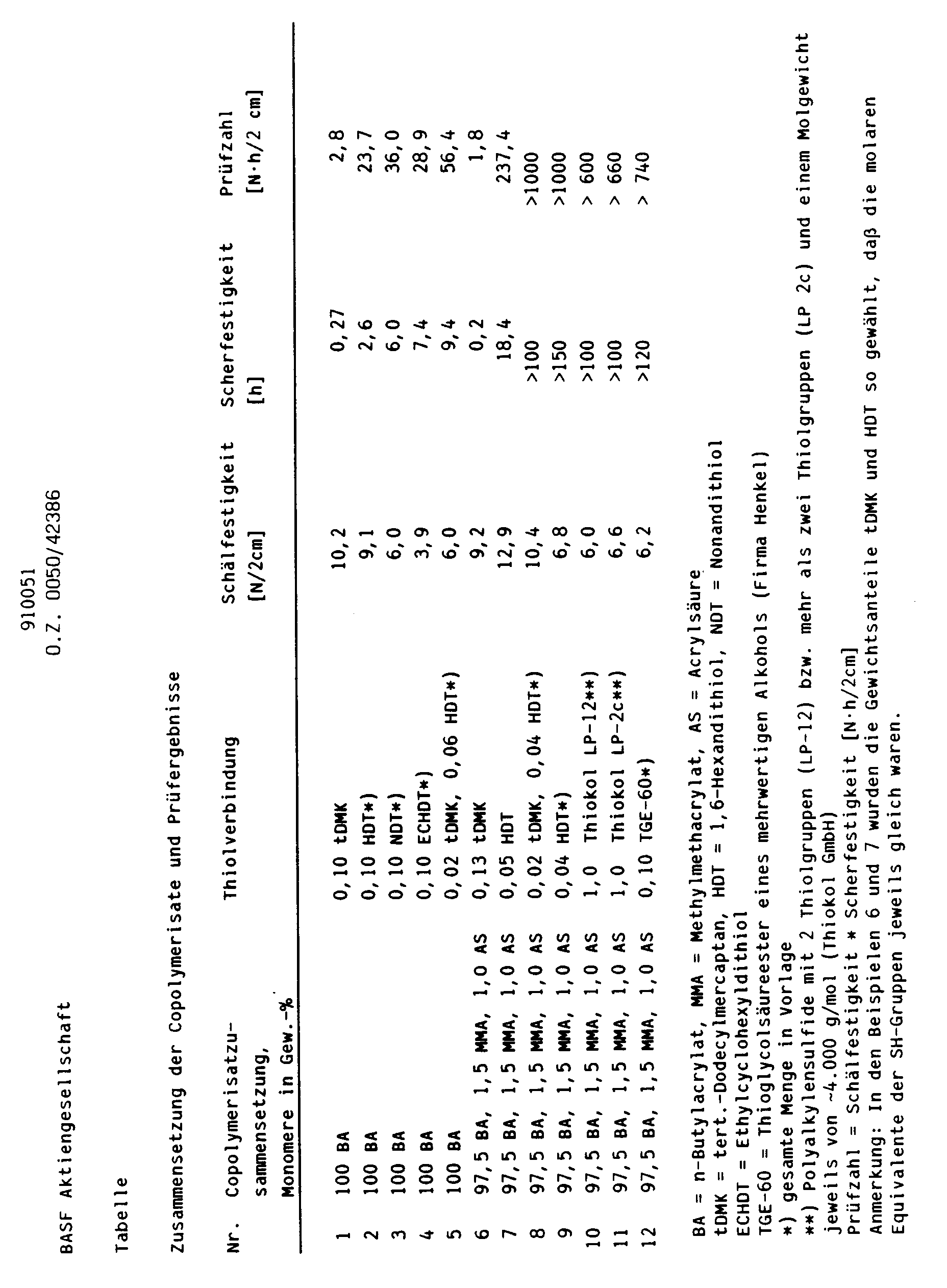
- In einem Reaktionsgefäß mit Rührer und zwei Zulaufgefäßen wurden 150 g Wasser und gegebenenfalls auch die Verbindung mit mindestens zwei Thiolgruppen vorgelegt.
- Die Zulaufgefäße enthielten folgende Gemische:
- Zulauf I:
- 550 g Monomerenmischung gemäß der Tabelle
5,5 g C₁₂-Alkyldiphenylethersulfonat (Dowfax 2A1), in Beispielen 1 bis 5 (bzw. 2,75 g in Beispielen 6 bis 12)
1,65 g Natriumlaurylsulfat in Beispielen 1 bis 5 (bzw. 0,55 g in Beispielen 6 bis 12)
150 g Wasser
Zusätzlich enthielt Zulauf I einen Regler und/oder eine Verbindung mit mindestens zwei Thiolgruppen gemäß Tabelle (in der Tabelle zusammenfassend als Thiolverbindung bezeichnet) - Zulauf II:
- 100 g Wasser
1,65 g Natriumperoxodisulfat - Die Vorlage wurde auf 85°C erhitzt und 1 Gew.-% des Zulaufs 1 sowie 20 Gew.-% des Zulaufs 2 unter Rühren zugegeben. Nach 15 min Anpolymerisieren wurden die beiden Zuläufe wärend 3 h zugegeben. Bei 85°C wurde noch ca. 1 h nachpolymerisiert und dann abgekühlt. Anschließend wurde mit einer 25 %igen Ammoniaklösung ein pH von 7 eingestellt.
- Zur Prüfung der anwendungstechnischen Eigenschaften wurden die Dispersionen mit einem Auftragsgewicht von ca. 20 g/m² auf Polyesterfolie (Hostaphan® RN 36, Firma Hoechst) gerakelt und die beschichtenen Folien 3 Minuten bei 90°C im Umluft-Trockenschrank getrocknet. Die beschichteten Folien wurden dann in 2 cm breite Prüfstreifen geschnitten.
- Zur Bestimmung der Scherfestigkeit wurden die Klebestreifen in 2,5 cm Länge auf ein V2A-Prüfblech geklebt, mit einer 1 kg schweren Rolle 1 mal angerollt, 24 h gelagert und anschließend im Hängen mit einem 1 kg Gewicht belastet. Das Maß für die Scherfestigkeit war die Zeit bis zum Abfallen des Gewichts; es wurde jeweils der Durchschnitt aus 5 Messungen berechnet. Bei diesen Messungen wurde die Klebeschicht zerstört (Kohäsionsbruch).
- Bei der Bestimmung der Schälfestigkeit (Adhäsion) wurde jeweils ein Klebestreifen auf ein V2A-Prüfblech geklebt und mit einer 1 kg schweren Rolle 1 mal angerollt. Er wurde dann mit einem Ende in die oberen Backen einer Zug-Dehnungs-Prüfapparatur eingespannt. Der Klebestreifen wurde mit 300 mm/min unter einem 90°C-Winkel von der Prüffläche (V2A-Stahl) abgezogen und der dazu benötigte Kraftaufwand gemessen. Das Maß für den Schälwert war die Kraft in N, die sich als Durchschnittswert aus fünf Messungen ergab.
- Die Prüfungen der Scher- und Schälfestigkeiten wurden bei 23°C und 50 % rel. Luftfeuchte durchgeführt.
- Als ein Maß für die klebtechnischen Eigenschaften (hohe Schälfestigkeit, d.h. Adhäsion und hohe Scherfestigkeit, d.h. Kohäsion) diente das Produkt aus Schälfestigkeit und Scherfestigkeit (Tabelle).
Claims (8)
- Copolymerisate, erhältlich durch Copolymerisation eines Monomerengemischs, enthaltendA) 50 bis 100 Gew.-% mindestens eines C₁-C₁₆-Alkylacrylats,B) 0 bis 40 Gew.-% mindestens einer copolymerisierbaren monoolefinisch ungesättigten Verbindung mit mindestens einer Carbonsäure-, Hydroxyl-, Amino-, bzw. Amido- oder Imido, Dicarbonsäureanhydrid-, Epoxy-, Keto oder AldehydgruppeC) 0 bis 50 Gew.-% weiterer copolymerisierbarer olefinisch ungesättigter Verbindungenin Gegenwart von 0,01 bis 5,0 Gew.-%, bezogen auf das Copolymerisat, einer Verbindung mit mindestens zwei Thiolgruppen im Molekül.
- Copolymerisate gemäß Anspruch 1, wobei es sich bei B) um eine monoolefinisch ungesättigte C₃-C₅-Carbonsäure oder -Dicarbonsäure, deren Amide oder Imide, welche am Stickstoffatom durch ein bzw. zwei C₁-C₆-Alkyl- oder -Hydroxyalkylreste substituiert sein können, oder um C₁-C₈-Hydroxyalkyl(meth)acrylate handelt.
- Copolymerisate gemäß Anspruch 1 oder 2, wobei es sich bei der Verbindung mit mindestens zwei Thiolgruppen im Molekül um ein C₂-C₁₂-Alkandithiol handelt.
- Copolymerisate gemäß einem der Ansprüche 1 bis 3, erhältlich durch Emulsionspolymerisation.
- Verfahren zur Herstellung eines Copolymerisats nach einem der Ansprüche 1 bis 4, dadurch gekennzeichnet, daß die Copolymerisation in Gegenwart von 0,01 bis 5 Gew.-%, bezogen auf das Copolymerisat, einer Verbindung mit mindestens zwei Thiolgruppen im Molekül durchgeführt wird.
- Verwendung eines Copolymerisats nach einem der Ansprüche 1 bis 5 als Klebstoff.
- Wäßrige Klebstoffdispersionen, enthaltend ein Copolymerisat nach einem der Ansprüche 1 bis 5.
- Mit einem Copolymerisat nach einem der Ansprüche 1 bis 5 beschichtete Substrate.
Applications Claiming Priority (2)
| Application Number | Priority Date | Filing Date | Title |
|---|---|---|---|
| DE4114640A DE4114640A1 (de) | 1991-05-04 | 1991-05-04 | Copolymerisate fuer klebstoffe |
| DE4114640 | 1991-05-04 |
Publications (2)
| Publication Number | Publication Date |
|---|---|
| EP0512293A1 true EP0512293A1 (de) | 1992-11-11 |
| EP0512293B1 EP0512293B1 (de) | 1995-10-11 |
Family
ID=6431014
Family Applications (1)
| Application Number | Title | Priority Date | Filing Date |
|---|---|---|---|
| EP92106599A Expired - Lifetime EP0512293B1 (de) | 1991-05-04 | 1992-04-16 | Copolymerisate für Klebstoffe |
Country Status (4)
| Country | Link |
|---|---|
| EP (1) | EP0512293B1 (de) |
| CA (1) | CA2067847A1 (de) |
| DE (2) | DE4114640A1 (de) |
| ES (1) | ES2077908T3 (de) |
Families Citing this family (1)
| Publication number | Priority date | Publication date | Assignee | Title |
|---|---|---|---|---|
| DE102005003303A1 (de) * | 2005-01-24 | 2006-07-27 | Röhm GmbH & Co. KG | Thio(meth)acrylate, Mischungen zur Herstellung transparenter Kunststoffe, transparente Kunststoffe sowie Verfahren zu deren Herstellung und Verwendung |
Citations (2)
| Publication number | Priority date | Publication date | Assignee | Title |
|---|---|---|---|---|
| EP0210309A1 (de) * | 1984-06-04 | 1987-02-04 | Hitachi Chemical Co., Ltd. | Durch Strahlung vernetzbare druckempfindliche Klebemittelzusammensetzung |
| EP0277413A2 (de) * | 1986-10-06 | 1988-08-10 | Kuraray Co., Ltd. | Klebemittel insbesondere für Dentalzwecke |
-
1991
- 1991-05-04 DE DE4114640A patent/DE4114640A1/de not_active Withdrawn
-
1992
- 1992-04-16 EP EP92106599A patent/EP0512293B1/de not_active Expired - Lifetime
- 1992-04-16 ES ES92106599T patent/ES2077908T3/es not_active Expired - Lifetime
- 1992-04-16 DE DE59203945T patent/DE59203945D1/de not_active Expired - Lifetime
- 1992-05-01 CA CA002067847A patent/CA2067847A1/en not_active Abandoned
Patent Citations (2)
| Publication number | Priority date | Publication date | Assignee | Title |
|---|---|---|---|---|
| EP0210309A1 (de) * | 1984-06-04 | 1987-02-04 | Hitachi Chemical Co., Ltd. | Durch Strahlung vernetzbare druckempfindliche Klebemittelzusammensetzung |
| EP0277413A2 (de) * | 1986-10-06 | 1988-08-10 | Kuraray Co., Ltd. | Klebemittel insbesondere für Dentalzwecke |
Non-Patent Citations (1)
| Title |
|---|
| WORLD PATENTS INDEX LATEST Section Ch, Week 8519, 3. Juli 1985 Derwent Publications Ltd., London, GB; Class A, Page 344, AN 85-112805/19 & JP-A-60 053 552 (DAINIPPON INK CHEM) 27. März 1985 * |
Also Published As
| Publication number | Publication date |
|---|---|
| ES2077908T3 (es) | 1995-12-01 |
| DE59203945D1 (de) | 1995-11-16 |
| DE4114640A1 (de) | 1992-11-05 |
| EP0512293B1 (de) | 1995-10-11 |
| CA2067847A1 (en) | 1992-11-05 |
Similar Documents
| Publication | Publication Date | Title |
|---|---|---|
| EP0625557B1 (de) | Geruchsarmer Dispersionshaftklebstoff | |
| DE69023292T2 (de) | Druckempfindliche klebstoffe auf basis von siloxanemulsionen. | |
| DE69008334T2 (de) | Emulsion druckempfindlicher klebepolymere mit ausgezeichnetem verhalten bei raum- und niedrigtemperaturen. | |
| DE69526802T2 (de) | Entfernbarer haftklebstoff und gegenstand damit | |
| DE3886470T2 (de) | Druckempfindliches Klebmittel. | |
| EP0574803B1 (de) | Verwendung von wässrigen Dispersionen als Heisssiegelkleber | |
| EP0927208B1 (de) | Verfahren zur herstellung wässriger polymerisatdispersionen | |
| DE69026927T2 (de) | Hohle Mikroperlen ohne Säuren von Acrylatpolymeren mit mehrfachem Leervolumen | |
| DE68926846T2 (de) | Hohle Acrylat-Polymer-Mikrokugeln | |
| DE69313623T2 (de) | Druckempfindliche emulsionsklebstoffpolymere welche eine hervorragende papierschneidemaschineneignung aufweisen | |
| EP0185356B1 (de) | Wärmefester Haftklebstoff | |
| EP2274349B1 (de) | Wässrige polymerdispersionen für haftklebstoffe | |
| EP0017986A1 (de) | Copolymerisate von Acrylestern, Vinylacetat und Äthylen, Verfahren zu deren Herstellung und deren Verwendung als Haftkleber | |
| EP0344659B1 (de) | Dispersionen von nicht-tertiären Butyl(meth)acrylatcopolymerisaten mit Glastemperaturen unter -10 Grad C | |
| EP0036170B1 (de) | Verfahren zur Herstellung von Synthesekautschuklatices, deren Verwendung als Haftklebstoffrohstoff bei der Herstellung von Haftklebemassen sowie Haftklebemassen | |
| DE2524064A1 (de) | Druckempfindliche emulsionsmischpolymerisate und ihre verwendung | |
| EP0863168B1 (de) | Verfahren zur Herstellung von wässrigen Dispersionen als Grundierung für Heisssiegelkleber | |
| WO1998006763A1 (de) | Haftklebstoffe mit geringen mengen styrol | |
| DE2160185A1 (de) | Druckempfindliche Klebstoffe | |
| DE69615123T2 (de) | Druckempfindliche Klebmittelzusammensetzung | |
| EP1169403B1 (de) | Haftklebstoffe | |
| DE2459160A1 (de) | Waessrige dispersionen von copolymerisaten nicht tertiaerer acrylsaeureester | |
| DE19912253C2 (de) | Verwendung einer wäßrigen Polymerdispersion auf Acrylatbasis zur Herstellung von wiederablösbaren Haftkleberfilmen | |
| DE3783979T2 (de) | Zinkcarboxylatenthaltende schmelzklebstoffe. | |
| DE69211134T2 (de) | Klebstoffe und verfahren zu deren herstellung |
Legal Events
| Date | Code | Title | Description |
|---|---|---|---|
| PUAI | Public reference made under article 153(3) epc to a published international application that has entered the european phase |
Free format text: ORIGINAL CODE: 0009012 |
|
| 17P | Request for examination filed |
Effective date: 19920822 |
|
| AK | Designated contracting states |
Kind code of ref document: A1 Designated state(s): DE ES FR GB IT NL |
|
| 17Q | First examination report despatched |
Effective date: 19940308 |
|
| GRAA | (expected) grant |
Free format text: ORIGINAL CODE: 0009210 |
|
| AK | Designated contracting states |
Kind code of ref document: B1 Designated state(s): DE ES FR GB IT NL |
|
| REF | Corresponds to: |
Ref document number: 59203945 Country of ref document: DE Date of ref document: 19951116 |
|
| GBT | Gb: translation of ep patent filed (gb section 77(6)(a)/1977) |
Effective date: 19951027 |
|
| REG | Reference to a national code |
Ref country code: ES Ref legal event code: FG2A Ref document number: 2077908 Country of ref document: ES Kind code of ref document: T3 |
|
| ITF | It: translation for a ep patent filed | ||
| ET | Fr: translation filed | ||
| PLBE | No opposition filed within time limit |
Free format text: ORIGINAL CODE: 0009261 |
|
| STAA | Information on the status of an ep patent application or granted ep patent |
Free format text: STATUS: NO OPPOSITION FILED WITHIN TIME LIMIT |
|
| 26N | No opposition filed | ||
| PGFP | Annual fee paid to national office [announced via postgrant information from national office to epo] |
Ref country code: FR Payment date: 19980312 Year of fee payment: 7 |
|
| PGFP | Annual fee paid to national office [announced via postgrant information from national office to epo] |
Ref country code: NL Payment date: 19980320 Year of fee payment: 7 |
|
| PGFP | Annual fee paid to national office [announced via postgrant information from national office to epo] |
Ref country code: ES Payment date: 19980413 Year of fee payment: 7 |
|
| PGFP | Annual fee paid to national office [announced via postgrant information from national office to epo] |
Ref country code: GB Payment date: 19980415 Year of fee payment: 7 |
|
| PGFP | Annual fee paid to national office [announced via postgrant information from national office to epo] |
Ref country code: DE Payment date: 19980427 Year of fee payment: 7 |
|
| PG25 | Lapsed in a contracting state [announced via postgrant information from national office to epo] |
Ref country code: GB Free format text: LAPSE BECAUSE OF NON-PAYMENT OF DUE FEES Effective date: 19990416 |
|
| PG25 | Lapsed in a contracting state [announced via postgrant information from national office to epo] |
Ref country code: ES Free format text: LAPSE BECAUSE OF NON-PAYMENT OF DUE FEES Effective date: 19990417 |
|
| PG25 | Lapsed in a contracting state [announced via postgrant information from national office to epo] |
Ref country code: DE Free format text: LAPSE BECAUSE OF THE APPLICANT RENOUNCES Effective date: 19990428 |
|
| PG25 | Lapsed in a contracting state [announced via postgrant information from national office to epo] |
Ref country code: NL Free format text: LAPSE BECAUSE OF NON-PAYMENT OF DUE FEES Effective date: 19991101 |
|
| GBPC | Gb: european patent ceased through non-payment of renewal fee |
Effective date: 19990416 |
|
| PG25 | Lapsed in a contracting state [announced via postgrant information from national office to epo] |
Ref country code: FR Free format text: LAPSE BECAUSE OF NON-PAYMENT OF DUE FEES Effective date: 19991231 |
|
| NLV4 | Nl: lapsed or anulled due to non-payment of the annual fee |
Effective date: 19991101 |
|
| REG | Reference to a national code |
Ref country code: FR Ref legal event code: ST |
|
| REG | Reference to a national code |
Ref country code: ES Ref legal event code: FD2A Effective date: 20010503 |
|
| PG25 | Lapsed in a contracting state [announced via postgrant information from national office to epo] |
Ref country code: IT Free format text: LAPSE BECAUSE OF NON-PAYMENT OF DUE FEES;WARNING: LAPSES OF ITALIAN PATENTS WITH EFFECTIVE DATE BEFORE 2007 MAY HAVE OCCURRED AT ANY TIME BEFORE 2007. THE CORRECT EFFECTIVE DATE MAY BE DIFFERENT FROM THE ONE RECORDED. Effective date: 20050416 |