EP0508618B1 - Methode zur Herstellung eines ohmschen Kontaktes auf einer Halbleitervorrichtung - Google Patents
Methode zur Herstellung eines ohmschen Kontaktes auf einer Halbleitervorrichtung Download PDFInfo
- Publication number
- EP0508618B1 EP0508618B1 EP92302306A EP92302306A EP0508618B1 EP 0508618 B1 EP0508618 B1 EP 0508618B1 EP 92302306 A EP92302306 A EP 92302306A EP 92302306 A EP92302306 A EP 92302306A EP 0508618 B1 EP0508618 B1 EP 0508618B1
- Authority
- EP
- European Patent Office
- Prior art keywords
- containing layer
- semiconductor
- layer
- deposition
- contact
- Prior art date
- Legal status (The legal status is an assumption and is not a legal conclusion. Google has not performed a legal analysis and makes no representation as to the accuracy of the status listed.)
- Expired - Lifetime
Links
Images
Classifications
-
- H—ELECTRICITY
- H10—SEMICONDUCTOR DEVICES; ELECTRIC SOLID-STATE DEVICES NOT OTHERWISE PROVIDED FOR
- H10H—INORGANIC LIGHT-EMITTING SEMICONDUCTOR DEVICES HAVING POTENTIAL BARRIERS
- H10H20/00—Individual inorganic light-emitting semiconductor devices having potential barriers, e.g. light-emitting diodes [LED]
- H10H20/80—Constructional details
- H10H20/81—Bodies
- H10H20/819—Bodies characterised by their shape, e.g. curved or truncated substrates
- H10H20/821—Bodies characterised by their shape, e.g. curved or truncated substrates of the light-emitting regions, e.g. non-planar junctions
-
- H—ELECTRICITY
- H01—ELECTRIC ELEMENTS
- H01L—SEMICONDUCTOR DEVICES NOT COVERED BY CLASS H10
- H01L21/00—Processes or apparatus adapted for the manufacture or treatment of semiconductor or solid state devices or of parts thereof
- H01L21/02—Manufacture or treatment of semiconductor devices or of parts thereof
- H01L21/04—Manufacture or treatment of semiconductor devices or of parts thereof the devices having potential barriers, e.g. a PN junction, depletion layer or carrier concentration layer
- H01L21/18—Manufacture or treatment of semiconductor devices or of parts thereof the devices having potential barriers, e.g. a PN junction, depletion layer or carrier concentration layer the devices having semiconductor bodies comprising elements of Group IV of the Periodic Table or AIIIBV compounds with or without impurities, e.g. doping materials
- H01L21/28—Manufacture of electrodes on semiconductor bodies using processes or apparatus not provided for in groups H01L21/20 - H01L21/268
- H01L21/283—Deposition of conductive or insulating materials for electrodes conducting electric current
- H01L21/285—Deposition of conductive or insulating materials for electrodes conducting electric current from a gas or vapour, e.g. condensation
- H01L21/28506—Deposition of conductive or insulating materials for electrodes conducting electric current from a gas or vapour, e.g. condensation of conductive layers
- H01L21/28575—Deposition of conductive or insulating materials for electrodes conducting electric current from a gas or vapour, e.g. condensation of conductive layers on semiconductor bodies comprising AIIIBV compounds
-
- H—ELECTRICITY
- H01—ELECTRIC ELEMENTS
- H01S—DEVICES USING THE PROCESS OF LIGHT AMPLIFICATION BY STIMULATED EMISSION OF RADIATION [LASER] TO AMPLIFY OR GENERATE LIGHT; DEVICES USING STIMULATED EMISSION OF ELECTROMAGNETIC RADIATION IN WAVE RANGES OTHER THAN OPTICAL
- H01S5/00—Semiconductor lasers
- H01S5/04—Processes or apparatus for excitation, e.g. pumping, e.g. by electron beams
- H01S5/042—Electrical excitation ; Circuits therefor
- H01S5/0425—Electrodes, e.g. characterised by the structure
- H01S5/04252—Electrodes, e.g. characterised by the structure characterised by the material
-
- H—ELECTRICITY
- H10—SEMICONDUCTOR DEVICES; ELECTRIC SOLID-STATE DEVICES NOT OTHERWISE PROVIDED FOR
- H10D—INORGANIC ELECTRIC SEMICONDUCTOR DEVICES
- H10D62/00—Semiconductor bodies, or regions thereof, of devices having potential barriers
- H10D62/80—Semiconductor bodies, or regions thereof, of devices having potential barriers characterised by the materials
- H10D62/85—Semiconductor bodies, or regions thereof, of devices having potential barriers characterised by the materials being Group III-V materials, e.g. GaAs
-
- H10D64/0116—
-
- H—ELECTRICITY
- H10—SEMICONDUCTOR DEVICES; ELECTRIC SOLID-STATE DEVICES NOT OTHERWISE PROVIDED FOR
- H10D—INORGANIC ELECTRIC SEMICONDUCTOR DEVICES
- H10D64/00—Electrodes of devices having potential barriers
- H10D64/60—Electrodes characterised by their materials
- H10D64/62—Electrodes ohmically coupled to a semiconductor
-
- H—ELECTRICITY
- H10—SEMICONDUCTOR DEVICES; ELECTRIC SOLID-STATE DEVICES NOT OTHERWISE PROVIDED FOR
- H10H—INORGANIC LIGHT-EMITTING SEMICONDUCTOR DEVICES HAVING POTENTIAL BARRIERS
- H10H20/00—Individual inorganic light-emitting semiconductor devices having potential barriers, e.g. light-emitting diodes [LED]
- H10H20/80—Constructional details
- H10H20/83—Electrodes
- H10H20/832—Electrodes characterised by their material
-
- H—ELECTRICITY
- H01—ELECTRIC ELEMENTS
- H01S—DEVICES USING THE PROCESS OF LIGHT AMPLIFICATION BY STIMULATED EMISSION OF RADIATION [LASER] TO AMPLIFY OR GENERATE LIGHT; DEVICES USING STIMULATED EMISSION OF ELECTROMAGNETIC RADIATION IN WAVE RANGES OTHER THAN OPTICAL
- H01S5/00—Semiconductor lasers
- H01S5/20—Structure or shape of the semiconductor body to guide the optical wave ; Confining structures perpendicular to the optical axis, e.g. index or gain guiding, stripe geometry, broad area lasers, gain tailoring, transverse or lateral reflectors, special cladding structures, MQW barrier reflection layers
- H01S5/22—Structure or shape of the semiconductor body to guide the optical wave ; Confining structures perpendicular to the optical axis, e.g. index or gain guiding, stripe geometry, broad area lasers, gain tailoring, transverse or lateral reflectors, special cladding structures, MQW barrier reflection layers having a ridge or stripe structure
- H01S5/223—Buried stripe structure
- H01S5/2237—Buried stripe structure with a non-planar active layer
-
- H—ELECTRICITY
- H01—ELECTRIC ELEMENTS
- H01S—DEVICES USING THE PROCESS OF LIGHT AMPLIFICATION BY STIMULATED EMISSION OF RADIATION [LASER] TO AMPLIFY OR GENERATE LIGHT; DEVICES USING STIMULATED EMISSION OF ELECTROMAGNETIC RADIATION IN WAVE RANGES OTHER THAN OPTICAL
- H01S5/00—Semiconductor lasers
- H01S5/20—Structure or shape of the semiconductor body to guide the optical wave ; Confining structures perpendicular to the optical axis, e.g. index or gain guiding, stripe geometry, broad area lasers, gain tailoring, transverse or lateral reflectors, special cladding structures, MQW barrier reflection layers
- H01S5/24—Structure or shape of the semiconductor body to guide the optical wave ; Confining structures perpendicular to the optical axis, e.g. index or gain guiding, stripe geometry, broad area lasers, gain tailoring, transverse or lateral reflectors, special cladding structures, MQW barrier reflection layers having a grooved structure, e.g. V-grooved, crescent active layer in groove, VSIS laser
-
- H—ELECTRICITY
- H10—SEMICONDUCTOR DEVICES; ELECTRIC SOLID-STATE DEVICES NOT OTHERWISE PROVIDED FOR
- H10H—INORGANIC LIGHT-EMITTING SEMICONDUCTOR DEVICES HAVING POTENTIAL BARRIERS
- H10H20/00—Individual inorganic light-emitting semiconductor devices having potential barriers, e.g. light-emitting diodes [LED]
- H10H20/80—Constructional details
- H10H20/81—Bodies
- H10H20/822—Materials of the light-emitting regions
- H10H20/824—Materials of the light-emitting regions comprising only Group III-V materials, e.g. GaP
-
- Y—GENERAL TAGGING OF NEW TECHNOLOGICAL DEVELOPMENTS; GENERAL TAGGING OF CROSS-SECTIONAL TECHNOLOGIES SPANNING OVER SEVERAL SECTIONS OF THE IPC; TECHNICAL SUBJECTS COVERED BY FORMER USPC CROSS-REFERENCE ART COLLECTIONS [XRACs] AND DIGESTS
- Y10—TECHNICAL SUBJECTS COVERED BY FORMER USPC
- Y10S—TECHNICAL SUBJECTS COVERED BY FORMER USPC CROSS-REFERENCE ART COLLECTIONS [XRACs] AND DIGESTS
- Y10S148/00—Metal treatment
- Y10S148/02—Contacts, special
Definitions
- This invention pertains to methods of making semiconductor devices. More particularly, it pertains to methods of making semiconductor devices based on III-V material, exemplarily InP-based photonic and electronic devices, e.g., lasers, LEDs and transistors.
- the '023 patent discloses depositing p-side Ti/Pt and n-side Ti/Pt onto the relevant surfaces of a semiconductor body, followed by an appropriate heat treatment that results in simultaneous formation of p-side and n-side ohmic contacts. See also A. Katz et al., J. Appl. Physics. Vol 66 (5), p. 2056 (Sept. '89) and EP-A-0 413 491, which report substantially the same subject matter as US-A- 5 036 023.
- JP-A-63095661 discloses a InGaAsP substrate of undisclosed conductivity type with a Au/Ti/Pt/Au layer structure thereon.
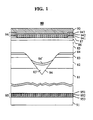
- FIG. 1 schematically depicts an exemplary device made according to the invention.
- the invention is as defined by the claims.
- the invention is a method of making an article that comprises a semiconductor device, exemplarily a semiconductor laser, optical amplifier, or light emitting diode.
- the method comprises providing a semiconductor body that comprises a p-doped first semiconductor material and an n-doped second semiconductor material. At least the first semiconductor material comprises as major constituents both indium and arsenic.
- the first and second semiconductor materials form a first and a second surface, respectively, of the semiconductor body.
- the method further comprises depositing first contact material onto the first surface, heat treating the semiconductor body with the contact material thereon, and carrying out one or more steps towards completion of the article.
- the first contact material-depositing step comprises depositing, in sequence, a first intermediate layer that comprises Au (and typically also comprises Be), a first conductor layer that comprises Ti, and a second conductor layer that comprises Pt.
- the method further comprises depositing, prior to said heat treating step, second contact material onto the second surface, the second contact material comprising third and fourth conductor layers that comprise Ti and Pt, respectively, with the fourth conductor layer being disposed on the third conductor layer.
- the heat treating step comprises a "rapid thermal processing" (RTP) step that comprises heating the semiconductor body with the contact material thereon to a temperature in the range 400-500°C for a time in the range 10-100 seconds, such that ohmic contacts to the first and second semiconductor materials are formed simultaneously.
- RTP rapid thermal processing
- the inventive process comprises depositing a second intermediate layer (typically comprising Au and Ge) on the second semiconductor surface, followed by deposition of the third and fourth conductor layers.
- a second intermediate layer typically comprising Au and Ge
- the semiconductor body with the first intermediate layer thereon is subjected to a heat treatment (exemplarily RTP) prior to deposition of the other layers.
- the inventive method also comprises a variety of conventional steps, exemplarily including epitaxial deposition of semiconductor layers on a semiconductor substrate, oxide deposition, photolithography, wet and/or dry etching, Au deposition, dicing or cleaving of a semiconductor wafer, AR-coating and mirror deposition, solder bonding and/or wire bonding, and device testing and packaging.
- steps require no detailed discussion.
- the discussion below will be primarily in terms of devices wherein the first and second surfaces are on opposite sides of the semiconductor body, as is the case in conventional semiconductor lasers and LEDs.
- the first and second surfaces are on the same side of the semiconductor body, and the inventive method can be particularly advantageously used to produce such devices as well as III-V-based transistors, as will be apparent to those skilled in the art.
- a significant aspect of the invention is the presence of In and As in at least the first semiconductor material.
- this material is the "contact layer" of the p-terminal of an inventive device.
- the contact layer is In 1-x Ga x As, with x typically in the range 0. 0.1-0.9, exemplarily 0.47.
- the presence of both In and As at the metal/semiconductor interface is thought to result in a relatively low Schottky barrier, and thus make possible a contact having a low specific contact resistance.
- the semiconductor body can be prepared in conventional manner, and this preparation thus does not require detailed discussion. Furthermore, many of the process steps can be as described in the '023 patent. This pertains, for instance, to the heat treatment after deposition of both contact material layers.
- the first and/or third conductor layers are not deposited directly onto the first and/or second semiconductor surfaces but instead are deposited onto a previously deposited Au-containing thin (typically ⁇ 100 nm) intermediate layer.
- a previously deposited Au-containing thin (typically ⁇ 100 nm) intermediate layer was discovered that use of such an intermediate layer in one or both of the contacts frequently results in increased device yield and/or lifetime.
- the p-side contact comprises a 5-80 nm thick AuBe intermediate layer
- the n-side contact comprises a 7-20 nm thick AuGe intermediate layer.
- Techniques for depositing AuBe and AuGe layers are well known in the art.
- all of the layers of both the first and second contact material can be deposited by means of electron beam evaporation.
- embodiments of the inventive method comprise an RTP step subsequent to the deposition of all the conductor layers
- some embodiments may comprise an optional heat treatment step (typically also RTP) prior to deposition of any of the conductor layers but subsequent to deposition of the first intermediate layer.
- FIG. 1 schematically depicts an exemplary device according to the invention, namely a channeled substrate buried heterostructure (CSBH) laser diode 80.
- the laser comprises n-InP substrate 81, semi-insulating Fe-doped InP layer 82, n-InP buffer layer 83 and 83', InGaAsP layer 84 and 84' (active layer), p-InP cladding layer 85, and p + InGaAs layer 86.
- the laser further comprises patterned SiO 2 layer 87 defining the p-contact region.
- Numerals 95 and 96 refer to the first and second contact material, respectively.
- Each contact material layer comprises an intermediate layer (941 and 951), Ti layer (942 or 952), and Pt layer (943 or 953).
- Gold layers 90 and 91 complete the p- and n-contact, respectively.
- n-InP (10 18 cm -3 sulfur doped) substrate is grown an epitaxial semi-insulating Fe-doped (resistance greater than 10 6 ⁇ cm) 2 ⁇ m thick InP layer by conventional organometallic vapor phase epitaxy (OMVPE).
- OMVPE organometallic vapor phase epitaxy
- a 0.3 ⁇ m thick SiO 2 layer is formed by plasma deposition, and 2 ⁇ m wide stripe windows opened in the SiO 2 layer by conventional photolithography and etching.
- V-grooves are formed also substantially as described in US patent 4, 595, 454, and the patterned SiO 2 layer is removed by conventional wet etching.
- a double heterostructure consisting of a 1 ⁇ m thick n-InP layer, an InGaAsP layer that is lattice matched to the InP and has a bandgap of 1.3 ⁇ m, a p-InP layer, and a p + InGaAs layer, is then grown by conventional liquid phase epitaxy (LPE) on the grooved surface of the wafer.
- LPE liquid phase epitaxy
- the p-contacts are formed.
- a 300 nm thick layer of SiO 2 is formed on the p-side surface by plasma deposition, and stripes, overlying the V-grooves, are opened in the SiO 2 layer by conventional photolithography and etching.
- a 20 nm thick AuBe layer is deposited, followed by an RTP treatment.
- a 50 nm thick Ti layer, followed by a 75 nm thick Pt layer are deposited by e-gun evaporation, followed by removal of unwanted contact material by conventional lift-off.
- the wafer is then thinned to about 80 ⁇ m by conventional lapping and wet etching. This is followed by formation of the n-contacts, including a 12 nm thick AuGe intermediate layer, in the same manner the p-contacts have been formed previously.
- the wafer is subjected to a RTP treatment, by heating in a forming gas (15% b.v. H 2 ) atmosphere to 440°C for 30 seconds.
Landscapes
- Physics & Mathematics (AREA)
- Condensed Matter Physics & Semiconductors (AREA)
- General Physics & Mathematics (AREA)
- Electromagnetism (AREA)
- Optics & Photonics (AREA)
- Engineering & Computer Science (AREA)
- Manufacturing & Machinery (AREA)
- Computer Hardware Design (AREA)
- Microelectronics & Electronic Packaging (AREA)
- Power Engineering (AREA)
- Electrodes Of Semiconductors (AREA)
- Led Devices (AREA)
- Semiconductor Lasers (AREA)
Claims (6)
- Verfahren zur Herstellung eines Gegenstandes mit einer Halbleitereinrichtung, wobei das Verfahren umfaßta) Bereitstellen eines Halbleiterkörpers (80), der ein erstes p-dotiertes Halbleitermaterial (86) enthält, welches In und As enthält und welches ferner ein n-dotiertes zweites Halbleitermaterial (81) enthält, wobei das erste und das zweite Halbleitermaterial eine erste bzw. eine zweite Oberfläche des Körpers bilden,b) Abscheiden von erstem Kontaktmaterial (96) an der ersten Oberfläche und von zweitem Kontaktmaterial (95) an der zweiten Oberfläche, wobei beide, das erste und das zweite Kontaktmaterial in Folge eine Ti-enthaltende Schicht (942, 952) und eine Pt-enthaltende Schicht (943, 953) enthalten,c) Wärmebehandeln des Halbleiterkörpers mit dem ersten und dem zweiten Kontaktmaterial an diesem, wobei die Wärmebehandlung das Erhitzen des Halbleiterkörpers mit den Kontaktmaterialien an diesem auf eine Temperatur in dem Bereich von 400 - 500°C während einer Zeitdauer im Bereich von 10 - 100 Sekunden enthält derart, daß Ohm'sche Kontakte zu dem ersten und dem zweiten Halbleitermaterial gleichzeitig ausgebildet werden undd) Vervollständigung der Herstellung des Gegenstandes, dadurch gekennzeichnet, daß Schritt b) das Abscheiden einer Au-enthaltenden Schicht (941) an der ersten Oberfläche vor dem Abscheiden der Ti-enthaltenden Schicht (942) umfaßt.
- Verfahren nach Anspruch 1, bei welchem Schritt b) ferner das Abscheiden einer Au-enthaltenden Schicht (951) an der zweiten Oberfläche vor dem Abscheiden der Ti-enthaltenden Schicht (952) umfaßt.
- Verfahren nach Anspruch 1, zusätzlich umfassend die Wärmebehandlung des Körpers mit der Au-enthaltenden Schicht (941) an der ersten Oberfläche vor dem Abscheiden der Ti-enthaltenden Schicht (942) an diesem.
- Verfahren nach Anspruch 3, bei welchem die zusätzliche Wärmebehandlung vor der Abscheidung der Ti-enthaltenden Schicht das Erhitzen des Halbleiterkörpers auf eine Temperatur in dem Bereich von 400 - 500°C während einer Zeitdauer im Bereich von 10 - 100 Sekunden umfaßt.
- Verfahren nach Anspruch 2, bei welchem die Au-enthaltende Schicht (941) an der ersten Oberfläche im wesentlichen aus Au und Be besteht, wobei die Au-enthaltende Schicht (951) an der zweiten Oberfläche im wesentlichen aus Au und Ge besteht und die Ti-enthaltenden und Pt-enthaltenden Schichten im wesentlichen aus Ti bzw. Pt bestehen.
- Verfahren nach Anspruch 2, ferner umfassend das Abscheiden einer Au-enthaltenden Schicht (90, 91) an jeder der Pt-enthaltenden Schichten.
Applications Claiming Priority (2)
| Application Number | Priority Date | Filing Date | Title |
|---|---|---|---|
| US07/675,304 US5100836A (en) | 1989-08-16 | 1991-03-26 | Method of making a semiconductor device |
| US675304 | 1991-03-26 |
Publications (3)
| Publication Number | Publication Date |
|---|---|
| EP0508618A2 EP0508618A2 (de) | 1992-10-14 |
| EP0508618A3 EP0508618A3 (en) | 1993-05-05 |
| EP0508618B1 true EP0508618B1 (de) | 1997-09-24 |
Family
ID=24709892
Family Applications (1)
| Application Number | Title | Priority Date | Filing Date |
|---|---|---|---|
| EP92302306A Expired - Lifetime EP0508618B1 (de) | 1991-03-26 | 1992-03-18 | Methode zur Herstellung eines ohmschen Kontaktes auf einer Halbleitervorrichtung |
Country Status (4)
| Country | Link |
|---|---|
| US (1) | US5100836A (de) |
| EP (1) | EP0508618B1 (de) |
| JP (1) | JP2633434B2 (de) |
| DE (1) | DE69222343T2 (de) |
Family Cites Families (5)
| Publication number | Priority date | Publication date | Assignee | Title |
|---|---|---|---|---|
| US4595454A (en) * | 1984-06-15 | 1986-06-17 | At&T Bell Laboratories | Fabrication of grooved semiconductor devices |
| JPS61150325A (ja) * | 1984-12-25 | 1986-07-09 | Fujitsu Ltd | 半導体装置の製造方法 |
| JPS6395661A (ja) * | 1986-10-13 | 1988-04-26 | Toshiba Corp | 半導体素子電極 |
| US5047832A (en) * | 1989-03-10 | 1991-09-10 | Sumitomo Electric Industries, Ltd. | Electrode structure for III-V compound semiconductor element and method of manufacturing the same |
| US5036023A (en) * | 1989-08-16 | 1991-07-30 | At&T Bell Laboratories | Rapid thermal processing method of making a semiconductor device |
-
1991
- 1991-03-26 US US07/675,304 patent/US5100836A/en not_active Expired - Lifetime
-
1992
- 1992-02-03 JP JP4637592A patent/JP2633434B2/ja not_active Expired - Lifetime
- 1992-03-18 EP EP92302306A patent/EP0508618B1/de not_active Expired - Lifetime
- 1992-03-18 DE DE69222343T patent/DE69222343T2/de not_active Expired - Fee Related
Also Published As
| Publication number | Publication date |
|---|---|
| DE69222343D1 (de) | 1997-10-30 |
| EP0508618A2 (de) | 1992-10-14 |
| EP0508618A3 (en) | 1993-05-05 |
| US5100836A (en) | 1992-03-31 |
| DE69222343T2 (de) | 1998-04-09 |
| JPH04320387A (ja) | 1992-11-11 |
| JP2633434B2 (ja) | 1997-07-23 |
Similar Documents
| Publication | Publication Date | Title |
|---|---|---|
| EP0413491B1 (de) | Verfahren zum Herstellen einer Halbleitervorrichtung | |
| KR100649777B1 (ko) | InAlGaN 발광 장치 및 수직 전도 AlInGaN 발광 장치 제조 방법 | |
| EP0390262B1 (de) | Strahlungemittierende Halbleiteranordnung und Verfahren zum Herstellen einer derartigen Halbleiteranordnung | |
| US5985687A (en) | Method for making cleaved facets for lasers fabricated with gallium nitride and other noncubic materials | |
| US7903709B2 (en) | Semiconductor laser device and method of manufacturing the same | |
| AU707420B2 (en) | Method of manufacturing a semiconductor surface emitting laser | |
| EP0552888B1 (de) | Mittels MOCVD auf einem strukturiertem Substrat aufgewachsene Laser mit vergrabener Heterostruktur | |
| US12368282B2 (en) | O-band silicon-based high-speed semiconductor laser diode for optical communication and its manufacturing method | |
| US8306086B2 (en) | Algainn-based lasers produced using etched facet technology | |
| Diaz et al. | InGaP/InGaAsP/GaAs 0.808 μm separate confinement laser diodes grown by metalorganic chemical vapor deposition | |
| US4441187A (en) | A semiconductor laser light source | |
| CN114006265B (zh) | 垂直腔面发射激光器及其制作方法 | |
| US4725112A (en) | Buried undercut mesa-like waveguide | |
| US20120228664A1 (en) | Nitride semiconductor light emitting device and method of manufacturing the same | |
| US5793788A (en) | Semiconductor light emitting element with p-type non-alloy electrode including a platinum layer and method for fabricating the same | |
| EP0312401B1 (de) | Halbleiteranordnungen und Herstellungsverfahren | |
| EP0508618B1 (de) | Methode zur Herstellung eines ohmschen Kontaktes auf einer Halbleitervorrichtung | |
| US5721751A (en) | Semiconductor laser | |
| US5887011A (en) | Semiconductor laser | |
| US5323412A (en) | Semiconductor laser device | |
| JP3665911B2 (ja) | 半導体光素子の製造方法,及び半導体光素子 | |
| JP3451818B2 (ja) | 半導体レーザー | |
| JPS63129687A (ja) | 半導体レ−ザ及びその製造方法 | |
| JPS6316689A (ja) | 半導体装置 | |
| JPH0750267A (ja) | Ii−vi族化合物半導体の成長方法 |
Legal Events
| Date | Code | Title | Description |
|---|---|---|---|
| PUAI | Public reference made under article 153(3) epc to a published international application that has entered the european phase |
Free format text: ORIGINAL CODE: 0009012 |
|
| AK | Designated contracting states |
Kind code of ref document: A2 Designated state(s): DE FR GB |
|
| PUAL | Search report despatched |
Free format text: ORIGINAL CODE: 0009013 |
|
| AK | Designated contracting states |
Kind code of ref document: A3 Designated state(s): DE FR GB |
|
| 17P | Request for examination filed |
Effective date: 19931021 |
|
| RAP3 | Party data changed (applicant data changed or rights of an application transferred) |
Owner name: AT&T CORP. |
|
| 17Q | First examination report despatched |
Effective date: 19951030 |
|
| GRAG | Despatch of communication of intention to grant |
Free format text: ORIGINAL CODE: EPIDOS AGRA |
|
| GRAH | Despatch of communication of intention to grant a patent |
Free format text: ORIGINAL CODE: EPIDOS IGRA |
|
| GRAH | Despatch of communication of intention to grant a patent |
Free format text: ORIGINAL CODE: EPIDOS IGRA |
|
| GRAA | (expected) grant |
Free format text: ORIGINAL CODE: 0009210 |
|
| AK | Designated contracting states |
Kind code of ref document: B1 Designated state(s): DE FR GB |
|
| REF | Corresponds to: |
Ref document number: 69222343 Country of ref document: DE Date of ref document: 19971030 |
|
| ET | Fr: translation filed | ||
| PLBE | No opposition filed within time limit |
Free format text: ORIGINAL CODE: 0009261 |
|
| STAA | Information on the status of an ep patent application or granted ep patent |
Free format text: STATUS: NO OPPOSITION FILED WITHIN TIME LIMIT |
|
| 26N | No opposition filed | ||
| PGFP | Annual fee paid to national office [announced via postgrant information from national office to epo] |
Ref country code: FR Payment date: 20010222 Year of fee payment: 10 |
|
| PGFP | Annual fee paid to national office [announced via postgrant information from national office to epo] |
Ref country code: DE Payment date: 20010330 Year of fee payment: 10 |
|
| REG | Reference to a national code |
Ref country code: GB Ref legal event code: IF02 |
|
| PG25 | Lapsed in a contracting state [announced via postgrant information from national office to epo] |
Ref country code: DE Free format text: LAPSE BECAUSE OF NON-PAYMENT OF DUE FEES Effective date: 20021001 |
|
| PG25 | Lapsed in a contracting state [announced via postgrant information from national office to epo] |
Ref country code: FR Free format text: LAPSE BECAUSE OF NON-PAYMENT OF DUE FEES Effective date: 20021129 |
|
| REG | Reference to a national code |
Ref country code: FR Ref legal event code: ST |
|
| PGFP | Annual fee paid to national office [announced via postgrant information from national office to epo] |
Ref country code: GB Payment date: 20110321 Year of fee payment: 20 |
|
| REG | Reference to a national code |
Ref country code: GB Ref legal event code: PE20 Expiry date: 20120317 |
|
| PG25 | Lapsed in a contracting state [announced via postgrant information from national office to epo] |
Ref country code: GB Free format text: LAPSE BECAUSE OF EXPIRATION OF PROTECTION Effective date: 20120317 |