EP0504920B1 - Die Anvulkanisation verzögernde Härtungs-/Vernetzungszusammensetzungen - Google Patents
Die Anvulkanisation verzögernde Härtungs-/Vernetzungszusammensetzungen Download PDFInfo
- Publication number
- EP0504920B1 EP0504920B1 EP92104885A EP92104885A EP0504920B1 EP 0504920 B1 EP0504920 B1 EP 0504920B1 EP 92104885 A EP92104885 A EP 92104885A EP 92104885 A EP92104885 A EP 92104885A EP 0504920 B1 EP0504920 B1 EP 0504920B1
- Authority
- EP
- European Patent Office
- Prior art keywords
- composition
- hydroquinone
- sulfur accelerator
- butylperoxy
- peroxide
- Prior art date
- Legal status (The legal status is an assumption and is not a legal conclusion. Google has not performed a legal analysis and makes no representation as to the accuracy of the status listed.)
- Expired - Lifetime
Links
- 239000000203 mixture Substances 0.000 title claims abstract description 274
- 238000004132 cross linking Methods 0.000 title claims abstract description 51
- 230000000979 retarding effect Effects 0.000 title claims description 32
- QIGBRXMKCJKVMJ-UHFFFAOYSA-N 1,4-Benzenediol Natural products OC1=CC=C(O)C=C1 QIGBRXMKCJKVMJ-UHFFFAOYSA-N 0.000 claims abstract description 113
- 150000002978 peroxides Chemical class 0.000 claims abstract description 77
- NINIDFKCEFEMDL-UHFFFAOYSA-N Sulfur Chemical compound [S] NINIDFKCEFEMDL-UHFFFAOYSA-N 0.000 claims abstract description 75
- 229910052717 sulfur Inorganic materials 0.000 claims abstract description 75
- 239000011593 sulfur Substances 0.000 claims abstract description 75
- 239000003999 initiator Substances 0.000 claims abstract description 56
- 150000003254 radicals Chemical class 0.000 claims abstract description 43
- -1 hydroquinone compound Chemical class 0.000 claims abstract description 34
- 229920001169 thermoplastic Polymers 0.000 claims abstract description 23
- NWVVVBRKAWDGAB-UHFFFAOYSA-N p-methoxyphenol Chemical compound COC1=CC=C(O)C=C1 NWVVVBRKAWDGAB-UHFFFAOYSA-N 0.000 claims description 49
- 229920000642 polymer Polymers 0.000 claims description 45
- XMNIXWIUMCBBBL-UHFFFAOYSA-N 2-(2-phenylpropan-2-ylperoxy)propan-2-ylbenzene Chemical compound C=1C=CC=CC=1C(C)(C)OOC(C)(C)C1=CC=CC=C1 XMNIXWIUMCBBBL-UHFFFAOYSA-N 0.000 claims description 37
- 239000000178 monomer Substances 0.000 claims description 31
- PGAXJQVAHDTGBB-UHFFFAOYSA-N dibutylcarbamothioylsulfanyl n,n-dibutylcarbamodithioate Chemical compound CCCCN(CCCC)C(=S)SSC(=S)N(CCCC)CCCC PGAXJQVAHDTGBB-UHFFFAOYSA-N 0.000 claims description 30
- 239000005038 ethylene vinyl acetate Substances 0.000 claims description 29
- 229920001200 poly(ethylene-vinyl acetate) Polymers 0.000 claims description 28
- JGSUMMPGKPITGK-UHFFFAOYSA-L zinc;n,n-dipentylcarbamodithioate Chemical compound [Zn+2].CCCCCN(C([S-])=S)CCCCC.CCCCCN(C([S-])=S)CCCCC JGSUMMPGKPITGK-UHFFFAOYSA-L 0.000 claims description 28
- BGNXCDMCOKJUMV-UHFFFAOYSA-N Tert-Butylhydroquinone Chemical compound CC(C)(C)C1=CC(O)=CC=C1O BGNXCDMCOKJUMV-UHFFFAOYSA-N 0.000 claims description 27
- DQXBYHZEEUGOBF-UHFFFAOYSA-N but-3-enoic acid;ethene Chemical group C=C.OC(=O)CC=C DQXBYHZEEUGOBF-UHFFFAOYSA-N 0.000 claims description 27
- 150000001875 compounds Chemical class 0.000 claims description 16
- BJELTSYBAHKXRW-UHFFFAOYSA-N 2,4,6-triallyloxy-1,3,5-triazine Chemical compound C=CCOC1=NC(OCC=C)=NC(OCC=C)=N1 BJELTSYBAHKXRW-UHFFFAOYSA-N 0.000 claims description 15
- 150000001451 organic peroxides Chemical class 0.000 claims description 15
- 125000000391 vinyl group Chemical group [H]C([*])=C([H])[H] 0.000 claims description 14
- 125000003903 2-propenyl group Chemical group [H]C([*])([H])C([H])=C([H])[H] 0.000 claims description 13
- 229920002554 vinyl polymer Polymers 0.000 claims description 13
- 239000012990 dithiocarbamate Substances 0.000 claims description 12
- 238000000034 method Methods 0.000 claims description 12
- ODBCKCWTWALFKM-UHFFFAOYSA-N 2,5-bis(tert-butylperoxy)-2,5-dimethylhex-3-yne Chemical compound CC(C)(C)OOC(C)(C)C#CC(C)(C)OOC(C)(C)C ODBCKCWTWALFKM-UHFFFAOYSA-N 0.000 claims description 11
- DMWVYCCGCQPJEA-UHFFFAOYSA-N 2,5-bis(tert-butylperoxy)-2,5-dimethylhexane Chemical compound CC(C)(C)OOC(C)(C)CCC(C)(C)OOC(C)(C)C DMWVYCCGCQPJEA-UHFFFAOYSA-N 0.000 claims description 11
- BUZICZZQJDLXJN-UHFFFAOYSA-N 3-azaniumyl-4-hydroxybutanoate Chemical compound OCC(N)CC(O)=O BUZICZZQJDLXJN-UHFFFAOYSA-N 0.000 claims description 11
- 229920001903 high density polyethylene Polymers 0.000 claims description 11
- 239000004700 high-density polyethylene Substances 0.000 claims description 11
- 239000004416 thermosoftening plastic Substances 0.000 claims description 11
- NALFRYPTRXKZPN-UHFFFAOYSA-N 1,1-bis(tert-butylperoxy)-3,3,5-trimethylcyclohexane Chemical compound CC1CC(C)(C)CC(OOC(C)(C)C)(OOC(C)(C)C)C1 NALFRYPTRXKZPN-UHFFFAOYSA-N 0.000 claims description 10
- AZQWKYJCGOJGHM-UHFFFAOYSA-N 1,4-benzoquinone Chemical compound O=C1C=CC(=O)C=C1 AZQWKYJCGOJGHM-UHFFFAOYSA-N 0.000 claims description 10
- GPMCZKILFBRNNY-UHFFFAOYSA-N 2,3-bis(2-methylbutan-2-yl)benzene-1,4-diol Chemical compound CCC(C)(C)C1=C(O)C=CC(O)=C1C(C)(C)CC GPMCZKILFBRNNY-UHFFFAOYSA-N 0.000 claims description 10
- 229910052751 metal Inorganic materials 0.000 claims description 10
- 239000002184 metal Substances 0.000 claims description 10
- 239000007788 liquid Substances 0.000 claims description 9
- 229920002943 EPDM rubber Polymers 0.000 claims description 8
- 230000008569 process Effects 0.000 claims description 8
- KUAZQDVKQLNFPE-UHFFFAOYSA-N thiram Chemical compound CN(C)C(=S)SSC(=S)N(C)C KUAZQDVKQLNFPE-UHFFFAOYSA-N 0.000 claims description 8
- KOMNUTZXSVSERR-UHFFFAOYSA-N 1,3,5-tris(prop-2-enyl)-1,3,5-triazinane-2,4,6-trione Chemical compound C=CCN1C(=O)N(CC=C)C(=O)N(CC=C)C1=O KOMNUTZXSVSERR-UHFFFAOYSA-N 0.000 claims description 7
- DEQZTKGFXNUBJL-UHFFFAOYSA-N n-(1,3-benzothiazol-2-ylsulfanyl)cyclohexanamine Chemical compound C1CCCCC1NSC1=NC2=CC=CC=C2S1 DEQZTKGFXNUBJL-UHFFFAOYSA-N 0.000 claims description 7
- 229960002447 thiram Drugs 0.000 claims description 7
- 239000011701 zinc Substances 0.000 claims description 7
- XEEYBQQBJWHFJM-UHFFFAOYSA-N Iron Chemical compound [Fe] XEEYBQQBJWHFJM-UHFFFAOYSA-N 0.000 claims description 6
- 150000004659 dithiocarbamates Chemical class 0.000 claims description 6
- 150000003557 thiazoles Chemical class 0.000 claims description 6
- 150000003585 thioureas Chemical class 0.000 claims description 6
- GRPURDFRFHUDSP-UHFFFAOYSA-N tris(prop-2-enyl) benzene-1,2,4-tricarboxylate Chemical compound C=CCOC(=O)C1=CC=C(C(=O)OCC=C)C(C(=O)OCC=C)=C1 GRPURDFRFHUDSP-UHFFFAOYSA-N 0.000 claims description 6
- 239000012991 xanthate Substances 0.000 claims description 6
- BOXSVZNGTQTENJ-UHFFFAOYSA-L zinc dibutyldithiocarbamate Chemical group [Zn+2].CCCCN(C([S-])=S)CCCC.CCCCN(C([S-])=S)CCCC BOXSVZNGTQTENJ-UHFFFAOYSA-L 0.000 claims description 6
- YVRDAWCTPKBUPY-UHFFFAOYSA-N 5,5-bis(2-tert-butylperoxypropan-2-yl)cyclohexa-1,3-diene Chemical compound CC(C)(C)OOC(C)(C)C1(C(C)(C)OOC(C)(C)C)CC=CC=C1 YVRDAWCTPKBUPY-UHFFFAOYSA-N 0.000 claims description 5
- 125000000217 alkyl group Chemical group 0.000 claims description 5
- BXIQXYOPGBXIEM-UHFFFAOYSA-N butyl 4,4-bis(tert-butylperoxy)pentanoate Chemical compound CCCCOC(=O)CCC(C)(OOC(C)(C)C)OOC(C)(C)C BXIQXYOPGBXIEM-UHFFFAOYSA-N 0.000 claims description 5
- 125000004432 carbon atom Chemical group C* 0.000 claims description 5
- HARQWLDROVMFJE-UHFFFAOYSA-N ethyl 3,3-bis(tert-butylperoxy)butanoate Chemical compound CCOC(=O)CC(C)(OOC(C)(C)C)OOC(C)(C)C HARQWLDROVMFJE-UHFFFAOYSA-N 0.000 claims description 5
- 238000002360 preparation method Methods 0.000 claims description 5
- HXKCUQDTMDYZJD-UHFFFAOYSA-N Methyl selenac Chemical compound CN(C)C(=S)S[Se](SC(=S)N(C)C)(SC(=S)N(C)C)SC(=S)N(C)C HXKCUQDTMDYZJD-UHFFFAOYSA-N 0.000 claims description 4
- PXHVJJICTQNCMI-UHFFFAOYSA-N Nickel Chemical compound [Ni] PXHVJJICTQNCMI-UHFFFAOYSA-N 0.000 claims description 4
- 229910052714 tellurium Inorganic materials 0.000 claims description 4
- PORWMNRCUJJQNO-UHFFFAOYSA-N tellurium atom Chemical compound [Te] PORWMNRCUJJQNO-UHFFFAOYSA-N 0.000 claims description 4
- 229920001897 terpolymer Polymers 0.000 claims description 4
- HSLFISVKRDQEBY-UHFFFAOYSA-N 1,1-bis(tert-butylperoxy)cyclohexane Chemical compound CC(C)(C)OOC1(OOC(C)(C)C)CCCCC1 HSLFISVKRDQEBY-UHFFFAOYSA-N 0.000 claims description 3
- WKKRYWQLVOISAU-UHFFFAOYSA-N 1,3,5-tris(2-tert-butylperoxypropan-2-yl)benzene Chemical compound CC(C)(C)OOC(C)(C)C1=CC(C(C)(C)OOC(C)(C)C)=CC(C(C)(C)OOC(C)(C)C)=C1 WKKRYWQLVOISAU-UHFFFAOYSA-N 0.000 claims description 3
- JJRDRFZYKKFYMO-UHFFFAOYSA-N 2-methyl-2-(2-methylbutan-2-ylperoxy)butane Chemical compound CCC(C)(C)OOC(C)(C)CC JJRDRFZYKKFYMO-UHFFFAOYSA-N 0.000 claims description 3
- PHIGUQOUWMSXFV-UHFFFAOYSA-N 2-methyl-2-[2-(2-methylbutan-2-ylperoxy)propan-2-ylperoxy]butane Chemical compound CCC(C)(C)OOC(C)(C)OOC(C)(C)CC PHIGUQOUWMSXFV-UHFFFAOYSA-N 0.000 claims description 3
- BIISIZOQPWZPPS-UHFFFAOYSA-N 2-tert-butylperoxypropan-2-ylbenzene Chemical compound CC(C)(C)OOC(C)(C)C1=CC=CC=C1 BIISIZOQPWZPPS-UHFFFAOYSA-N 0.000 claims description 3
- JNSWFNBIZLIBPH-UHFFFAOYSA-N 4-tert-butylperoxy-4-methylpentan-2-ol Chemical compound CC(O)CC(C)(C)OOC(C)(C)C JNSWFNBIZLIBPH-UHFFFAOYSA-N 0.000 claims description 3
- RYGMFSIKBFXOCR-UHFFFAOYSA-N Copper Chemical compound [Cu] RYGMFSIKBFXOCR-UHFFFAOYSA-N 0.000 claims description 3
- BKXRKRANFLFTFU-UHFFFAOYSA-N bis(prop-2-enyl) oxalate Chemical compound C=CCOC(=O)C(=O)OCC=C BKXRKRANFLFTFU-UHFFFAOYSA-N 0.000 claims description 3
- 229910052802 copper Inorganic materials 0.000 claims description 3
- 239000010949 copper Substances 0.000 claims description 3
- ZOUQIAGHKFLHIA-UHFFFAOYSA-L copper;n,n-dimethylcarbamodithioate Chemical compound [Cu+2].CN(C)C([S-])=S.CN(C)C([S-])=S ZOUQIAGHKFLHIA-UHFFFAOYSA-L 0.000 claims description 3
- MKGMCCVHOVSDTI-UHFFFAOYSA-N ethyl 2-(3,6,6,9,9-pentamethyl-1,2,4,5-tetraoxonan-3-yl)acetate Chemical compound CCOC(=O)CC1(C)OOC(C)(C)CCC(C)(C)OO1 MKGMCCVHOVSDTI-UHFFFAOYSA-N 0.000 claims description 3
- NICWAKGKDIAMOD-UHFFFAOYSA-N ethyl 3,3-bis(2-methylbutan-2-ylperoxy)butanoate Chemical compound CCOC(=O)CC(C)(OOC(C)(C)CC)OOC(C)(C)CC NICWAKGKDIAMOD-UHFFFAOYSA-N 0.000 claims description 3
- 229920000092 linear low density polyethylene Polymers 0.000 claims description 3
- 239000004707 linear low-density polyethylene Substances 0.000 claims description 3
- FBCQUCJYYPMKRO-UHFFFAOYSA-N prop-2-enyl 2-methylprop-2-enoate Chemical compound CC(=C)C(=O)OCC=C FBCQUCJYYPMKRO-UHFFFAOYSA-N 0.000 claims description 3
- UDWCKMMKPOGURO-UHFFFAOYSA-N 1,2-dihydropyrazolo[3,4-b]pyridin-4-one Chemical compound O=C1C=CNC2=C1C=NN2 UDWCKMMKPOGURO-UHFFFAOYSA-N 0.000 claims description 2
- JZODKRWQWUWGCD-UHFFFAOYSA-N 2,5-di-tert-butylbenzene-1,4-diol Chemical compound CC(C)(C)C1=CC(O)=C(C(C)(C)C)C=C1O JZODKRWQWUWGCD-UHFFFAOYSA-N 0.000 claims description 2
- TUAPLLGBMYGPST-UHFFFAOYSA-N 2,5-dimethyl-2,5-bis(2-methylbutan-2-ylperoxy)hexane Chemical compound CCC(C)(C)OOC(C)(C)CCC(C)(C)OOC(C)(C)CC TUAPLLGBMYGPST-UHFFFAOYSA-N 0.000 claims description 2
- WTPYFJNYAMXZJG-UHFFFAOYSA-N 2-[4-(2-hydroxyethoxy)phenoxy]ethanol Chemical compound OCCOC1=CC=C(OCCO)C=C1 WTPYFJNYAMXZJG-UHFFFAOYSA-N 0.000 claims description 2
- BXAAQNFGSQKPDZ-UHFFFAOYSA-N 3-[1,2,2-tris(prop-2-enoxy)ethoxy]prop-1-ene Chemical compound C=CCOC(OCC=C)C(OCC=C)OCC=C BXAAQNFGSQKPDZ-UHFFFAOYSA-N 0.000 claims description 2
- NNWNNQTUZYVQRK-UHFFFAOYSA-N 5-bromo-1h-pyrrolo[2,3-c]pyridine-2-carboxylic acid Chemical compound BrC1=NC=C2NC(C(=O)O)=CC2=C1 NNWNNQTUZYVQRK-UHFFFAOYSA-N 0.000 claims description 2
- 229920002574 CR-39 Polymers 0.000 claims description 2
- VYZAMTAEIAYCRO-UHFFFAOYSA-N Chromium Chemical compound [Cr] VYZAMTAEIAYCRO-UHFFFAOYSA-N 0.000 claims description 2
- BUGBHKTXTAQXES-UHFFFAOYSA-N Selenium Chemical compound [Se] BUGBHKTXTAQXES-UHFFFAOYSA-N 0.000 claims description 2
- ATJFFYVFTNAWJD-UHFFFAOYSA-N Tin Chemical compound [Sn] ATJFFYVFTNAWJD-UHFFFAOYSA-N 0.000 claims description 2
- OKKRPWIIYQTPQF-UHFFFAOYSA-N Trimethylolpropane trimethacrylate Chemical compound CC(=C)C(=O)OCC(CC)(COC(=O)C(C)=C)COC(=O)C(C)=C OKKRPWIIYQTPQF-UHFFFAOYSA-N 0.000 claims description 2
- HCHKCACWOHOZIP-UHFFFAOYSA-N Zinc Chemical compound [Zn] HCHKCACWOHOZIP-UHFFFAOYSA-N 0.000 claims description 2
- USBHFGNOYVOTON-UHFFFAOYSA-K bis(dimethylcarbamothioylsulfanyl)bismuthanyl n,n-dimethylcarbamodithioate Chemical compound [Bi+3].CN(C)C([S-])=S.CN(C)C([S-])=S.CN(C)C([S-])=S USBHFGNOYVOTON-UHFFFAOYSA-K 0.000 claims description 2
- KDQZPXCKTHKGQM-UHFFFAOYSA-L bis(dipentylcarbamothioylsulfanyl)lead Chemical compound [Pb+2].CCCCCN(C([S-])=S)CCCCC.CCCCCN(C([S-])=S)CCCCC KDQZPXCKTHKGQM-UHFFFAOYSA-L 0.000 claims description 2
- ZPOLOEWJWXZUSP-AATRIKPKSA-N bis(prop-2-enyl) (e)-but-2-enedioate Chemical compound C=CCOC(=O)\C=C\C(=O)OCC=C ZPOLOEWJWXZUSP-AATRIKPKSA-N 0.000 claims description 2
- FPODCVUTIPDRTE-UHFFFAOYSA-N bis(prop-2-enyl) hexanedioate Chemical compound C=CCOC(=O)CCCCC(=O)OCC=C FPODCVUTIPDRTE-UHFFFAOYSA-N 0.000 claims description 2
- 229910052797 bismuth Inorganic materials 0.000 claims description 2
- JCXGWMGPZLAOME-UHFFFAOYSA-N bismuth atom Chemical compound [Bi] JCXGWMGPZLAOME-UHFFFAOYSA-N 0.000 claims description 2
- 229910052793 cadmium Inorganic materials 0.000 claims description 2
- BDOSMKKIYDKNTQ-UHFFFAOYSA-N cadmium atom Chemical compound [Cd] BDOSMKKIYDKNTQ-UHFFFAOYSA-N 0.000 claims description 2
- GAQHRUGINNUYSO-UHFFFAOYSA-L cadmium(2+);n,n-dipentylcarbamodithioate Chemical compound [Cd+2].CCCCCN(C([S-])=S)CCCCC.CCCCCN(C([S-])=S)CCCCC GAQHRUGINNUYSO-UHFFFAOYSA-L 0.000 claims description 2
- 229910052804 chromium Inorganic materials 0.000 claims description 2
- 239000011651 chromium Substances 0.000 claims description 2
- 229910017052 cobalt Inorganic materials 0.000 claims description 2
- 239000010941 cobalt Substances 0.000 claims description 2
- GUTLYIVDDKVIGB-UHFFFAOYSA-N cobalt atom Chemical compound [Co] GUTLYIVDDKVIGB-UHFFFAOYSA-N 0.000 claims description 2
- 229940116901 diethyldithiocarbamate Drugs 0.000 claims description 2
- LMBWSYZSUOEYSN-UHFFFAOYSA-N diethyldithiocarbamic acid Chemical compound CCN(CC)C(S)=S LMBWSYZSUOEYSN-UHFFFAOYSA-N 0.000 claims description 2
- 150000002500 ions Chemical group 0.000 claims description 2
- 229910052742 iron Inorganic materials 0.000 claims description 2
- 239000011133 lead Substances 0.000 claims description 2
- QGTHALAWFUFVCU-UHFFFAOYSA-L n,n-dimethylcarbamodithioate;lead(2+) Chemical compound [Pb+2].CN(C)C([S-])=S.CN(C)C([S-])=S QGTHALAWFUFVCU-UHFFFAOYSA-L 0.000 claims description 2
- 229910052759 nickel Inorganic materials 0.000 claims description 2
- 229920002589 poly(vinylethylene) polymer Polymers 0.000 claims description 2
- 229910052711 selenium Inorganic materials 0.000 claims description 2
- 239000011669 selenium Substances 0.000 claims description 2
- 229910052718 tin Inorganic materials 0.000 claims description 2
- 239000011135 tin Substances 0.000 claims description 2
- XHGIFBQQEGRTPB-UHFFFAOYSA-N tris(prop-2-enyl) phosphate Chemical compound C=CCOP(=O)(OCC=C)OCC=C XHGIFBQQEGRTPB-UHFFFAOYSA-N 0.000 claims description 2
- 229910052725 zinc Inorganic materials 0.000 claims description 2
- RKQOSDAEEGPRER-UHFFFAOYSA-L zinc diethyldithiocarbamate Chemical compound [Zn+2].CCN(CC)C([S-])=S.CCN(CC)C([S-])=S RKQOSDAEEGPRER-UHFFFAOYSA-L 0.000 claims description 2
- 229940070710 valerate Drugs 0.000 claims 3
- NQPDZGIKBAWPEJ-UHFFFAOYSA-N valeric acid Chemical compound CCCCC(O)=O NQPDZGIKBAWPEJ-UHFFFAOYSA-N 0.000 claims 3
- 229910021645 metal ion Inorganic materials 0.000 claims 1
- 230000002195 synergetic effect Effects 0.000 abstract description 11
- 239000012815 thermoplastic material Substances 0.000 abstract description 4
- 125000000746 allylic group Chemical group 0.000 abstract description 3
- 239000013536 elastomeric material Substances 0.000 abstract description 3
- 238000010348 incorporation Methods 0.000 abstract description 3
- NIXOWILDQLNWCW-UHFFFAOYSA-N acrylic acid group Chemical group C(C=C)(=O)O NIXOWILDQLNWCW-UHFFFAOYSA-N 0.000 abstract description 2
- 125000005395 methacrylic acid group Chemical group 0.000 abstract description 2
- 150000001993 dienes Chemical class 0.000 abstract 1
- 239000000654 additive Substances 0.000 description 23
- 238000001723 curing Methods 0.000 description 21
- 239000000243 solution Substances 0.000 description 21
- 238000009472 formulation Methods 0.000 description 20
- 230000006872 improvement Effects 0.000 description 17
- 230000008859 change Effects 0.000 description 14
- 229920001971 elastomer Polymers 0.000 description 12
- 239000004615 ingredient Substances 0.000 description 12
- DKVNPHBNOWQYFE-UHFFFAOYSA-N carbamodithioic acid Chemical class NC(S)=S DKVNPHBNOWQYFE-UHFFFAOYSA-N 0.000 description 11
- 238000013329 compounding Methods 0.000 description 11
- 230000000694 effects Effects 0.000 description 9
- 150000005208 1,4-dihydroxybenzenes Chemical class 0.000 description 8
- 239000000945 filler Substances 0.000 description 8
- 239000005060 rubber Substances 0.000 description 8
- 239000004594 Masterbatch (MB) Substances 0.000 description 7
- 238000002156 mixing Methods 0.000 description 7
- 229920005989 resin Polymers 0.000 description 7
- 239000011347 resin Substances 0.000 description 7
- 150000003839 salts Chemical class 0.000 description 7
- 238000007792 addition Methods 0.000 description 6
- 230000000996 additive effect Effects 0.000 description 6
- 238000003556 assay Methods 0.000 description 6
- 239000003795 chemical substances by application Substances 0.000 description 6
- 239000007787 solid Substances 0.000 description 6
- 238000002844 melting Methods 0.000 description 5
- 230000008018 melting Effects 0.000 description 5
- 238000012545 processing Methods 0.000 description 5
- VTYYLEPIZMXCLO-UHFFFAOYSA-L Calcium carbonate Chemical compound [Ca+2].[O-]C([O-])=O VTYYLEPIZMXCLO-UHFFFAOYSA-L 0.000 description 4
- VYPSYNLAJGMNEJ-UHFFFAOYSA-N Silicium dioxide Chemical compound O=[Si]=O VYPSYNLAJGMNEJ-UHFFFAOYSA-N 0.000 description 4
- 239000003963 antioxidant agent Substances 0.000 description 4
- UHOVQNZJYSORNB-UHFFFAOYSA-N benzene Substances C1=CC=CC=C1 UHOVQNZJYSORNB-UHFFFAOYSA-N 0.000 description 4
- 239000003431 cross linking reagent Substances 0.000 description 4
- 239000000806 elastomer Substances 0.000 description 4
- 229920001684 low density polyethylene Polymers 0.000 description 4
- 239000004702 low-density polyethylene Substances 0.000 description 4
- 239000003921 oil Substances 0.000 description 4
- 229920000098 polyolefin Polymers 0.000 description 4
- ZNRLMGFXSPUZNR-UHFFFAOYSA-N 2,2,4-trimethyl-1h-quinoline Chemical compound C1=CC=C2C(C)=CC(C)(C)NC2=C1 ZNRLMGFXSPUZNR-UHFFFAOYSA-N 0.000 description 3
- QGJOPFRUJISHPQ-UHFFFAOYSA-N Carbon disulfide Chemical compound S=C=S QGJOPFRUJISHPQ-UHFFFAOYSA-N 0.000 description 3
- 230000002411 adverse Effects 0.000 description 3
- 230000032683 aging Effects 0.000 description 3
- 230000008901 benefit Effects 0.000 description 3
- 238000006243 chemical reaction Methods 0.000 description 3
- 229920001973 fluoroelastomer Polymers 0.000 description 3
- 238000013007 heat curing Methods 0.000 description 3
- 229910052739 hydrogen Inorganic materials 0.000 description 3
- 239000003112 inhibitor Substances 0.000 description 3
- 229920003023 plastic Polymers 0.000 description 3
- 239000004033 plastic Substances 0.000 description 3
- 238000003860 storage Methods 0.000 description 3
- 150000003463 sulfur Chemical class 0.000 description 3
- 238000004073 vulcanization Methods 0.000 description 3
- RWSOTUBLDIXVET-UHFFFAOYSA-N Dihydrogen sulfide Chemical class S RWSOTUBLDIXVET-UHFFFAOYSA-N 0.000 description 2
- VVQNEPGJFQJSBK-UHFFFAOYSA-N Methyl methacrylate Chemical compound COC(=O)C(C)=C VVQNEPGJFQJSBK-UHFFFAOYSA-N 0.000 description 2
- 239000004698 Polyethylene Substances 0.000 description 2
- GWEVSGVZZGPLCZ-UHFFFAOYSA-N Titan oxide Chemical compound O=[Ti]=O GWEVSGVZZGPLCZ-UHFFFAOYSA-N 0.000 description 2
- 230000009471 action Effects 0.000 description 2
- 238000013459 approach Methods 0.000 description 2
- 229910000019 calcium carbonate Inorganic materials 0.000 description 2
- CRQQGFGUEAVUIL-UHFFFAOYSA-N chlorothalonil Chemical compound ClC1=C(Cl)C(C#N)=C(Cl)C(C#N)=C1Cl CRQQGFGUEAVUIL-UHFFFAOYSA-N 0.000 description 2
- AUZONCFQVSMFAP-UHFFFAOYSA-N disulfiram Chemical compound CCN(CC)C(=S)SSC(=S)N(CC)CC AUZONCFQVSMFAP-UHFFFAOYSA-N 0.000 description 2
- 238000011156 evaluation Methods 0.000 description 2
- 238000001125 extrusion Methods 0.000 description 2
- 239000012467 final product Substances 0.000 description 2
- 239000007863 gel particle Substances 0.000 description 2
- 239000012456 homogeneous solution Substances 0.000 description 2
- 239000001257 hydrogen Substances 0.000 description 2
- 150000002432 hydroperoxides Chemical class 0.000 description 2
- 230000000977 initiatory effect Effects 0.000 description 2
- 125000001449 isopropyl group Chemical group [H]C([H])([H])C([H])(*)C([H])([H])[H] 0.000 description 2
- 239000000463 material Substances 0.000 description 2
- 239000008188 pellet Substances 0.000 description 2
- 229920000573 polyethylene Polymers 0.000 description 2
- 230000002829 reductive effect Effects 0.000 description 2
- 239000000377 silicon dioxide Substances 0.000 description 2
- 239000000126 substance Substances 0.000 description 2
- 239000011885 synergistic combination Substances 0.000 description 2
- 238000012360 testing method Methods 0.000 description 2
- 238000005979 thermal decomposition reaction Methods 0.000 description 2
- DUBNHZYBDBBJHD-UHFFFAOYSA-L ziram Chemical compound [Zn+2].CN(C)C([S-])=S.CN(C)C([S-])=S DUBNHZYBDBBJHD-UHFFFAOYSA-L 0.000 description 2
- 150000004057 1,4-benzoquinones Chemical class 0.000 description 1
- PZILQNGWHUGDLZ-UHFFFAOYSA-N 2-(2-acetyloxypropan-2-yldiazenyl)propan-2-yl acetate Chemical compound CC(=O)OC(C)(C)N=NC(C)(C)OC(C)=O PZILQNGWHUGDLZ-UHFFFAOYSA-N 0.000 description 1
- DIOZVWSHACHNRT-UHFFFAOYSA-N 2-(2-prop-2-enoxyethoxy)ethanol Chemical compound OCCOCCOCC=C DIOZVWSHACHNRT-UHFFFAOYSA-N 0.000 description 1
- ZFMFIBDSZCASNS-UHFFFAOYSA-N 2-pentylbenzene-1,4-diol Chemical compound CCCCCC1=CC(O)=CC=C1O ZFMFIBDSZCASNS-UHFFFAOYSA-N 0.000 description 1
- OCVLSHAVSIYKLI-UHFFFAOYSA-N 3h-1,3-thiazole-2-thione Chemical class SC1=NC=CS1 OCVLSHAVSIYKLI-UHFFFAOYSA-N 0.000 description 1
- DBCAQXHNJOFNGC-UHFFFAOYSA-N 4-bromo-1,1,1-trifluorobutane Chemical compound FC(F)(F)CCCBr DBCAQXHNJOFNGC-UHFFFAOYSA-N 0.000 description 1
- UDQCDDZBBZNIFA-UHFFFAOYSA-N 4-methyl-1,3-dihydrobenzimidazole-2-thione Chemical compound CC1=CC=CC2=C1NC(=S)N2 UDQCDDZBBZNIFA-UHFFFAOYSA-N 0.000 description 1
- CCOJJJCQUHWYAT-UHFFFAOYSA-N 4-methyl-4-(2-methylbutan-2-ylperoxy)pentan-2-ol Chemical compound CCC(C)(C)OOC(C)(C)CC(C)O CCOJJJCQUHWYAT-UHFFFAOYSA-N 0.000 description 1
- NIXOWILDQLNWCW-UHFFFAOYSA-M Acrylate Chemical compound [O-]C(=O)C=C NIXOWILDQLNWCW-UHFFFAOYSA-M 0.000 description 1
- BVKZGUZCCUSVTD-UHFFFAOYSA-L Carbonate Chemical compound [O-]C([O-])=O BVKZGUZCCUSVTD-UHFFFAOYSA-L 0.000 description 1
- 239000004709 Chlorinated polyethylene Substances 0.000 description 1
- 239000004606 Fillers/Extenders Substances 0.000 description 1
- 241001441571 Hiodontidae Species 0.000 description 1
- WOBHKFSMXKNTIM-UHFFFAOYSA-N Hydroxyethyl methacrylate Chemical compound CC(=C)C(=O)OCCO WOBHKFSMXKNTIM-UHFFFAOYSA-N 0.000 description 1
- UBUCNCOMADRQHX-UHFFFAOYSA-N N-Nitrosodiphenylamine Chemical compound C=1C=CC=CC=1N(N=O)C1=CC=CC=C1 UBUCNCOMADRQHX-UHFFFAOYSA-N 0.000 description 1
- DAKWPKUUDNSNPN-UHFFFAOYSA-N Trimethylolpropane triacrylate Chemical compound C=CC(=O)OCC(CC)(COC(=O)C=C)COC(=O)C=C DAKWPKUUDNSNPN-UHFFFAOYSA-N 0.000 description 1
- 150000001252 acrylic acid derivatives Chemical class 0.000 description 1
- 230000004913 activation Effects 0.000 description 1
- 239000004480 active ingredient Substances 0.000 description 1
- 229910052784 alkaline earth metal Inorganic materials 0.000 description 1
- 230000003078 antioxidant effect Effects 0.000 description 1
- 150000004982 aromatic amines Chemical class 0.000 description 1
- 239000011230 binding agent Substances 0.000 description 1
- JQRRFDWXQOQICD-UHFFFAOYSA-N biphenylen-1-ylboronic acid Chemical compound C12=CC=CC=C2C2=C1C=CC=C2B(O)O JQRRFDWXQOQICD-UHFFFAOYSA-N 0.000 description 1
- ZDNFTNPFYCKVTB-UHFFFAOYSA-N bis(prop-2-enyl) benzene-1,4-dicarboxylate Chemical compound C=CCOC(=O)C1=CC=C(C(=O)OCC=C)C=C1 ZDNFTNPFYCKVTB-UHFFFAOYSA-N 0.000 description 1
- PAKRLBFYNABWNT-UHFFFAOYSA-N butyl 4,4-bis(2-methylbutan-2-ylperoxy)pentanoate Chemical compound CCCCOC(=O)CCC(C)(OOC(C)(C)CC)OOC(C)(C)CC PAKRLBFYNABWNT-UHFFFAOYSA-N 0.000 description 1
- AXCZMVOFGPJBDE-UHFFFAOYSA-L calcium dihydroxide Chemical compound [OH-].[OH-].[Ca+2] AXCZMVOFGPJBDE-UHFFFAOYSA-L 0.000 description 1
- 239000000920 calcium hydroxide Substances 0.000 description 1
- 229910001861 calcium hydroxide Inorganic materials 0.000 description 1
- 229910052799 carbon Inorganic materials 0.000 description 1
- 239000006229 carbon black Substances 0.000 description 1
- 230000015556 catabolic process Effects 0.000 description 1
- 239000004927 clay Substances 0.000 description 1
- 229910052570 clay Inorganic materials 0.000 description 1
- 238000010960 commercial process Methods 0.000 description 1
- 238000007796 conventional method Methods 0.000 description 1
- 229920001577 copolymer Polymers 0.000 description 1
- 229920006037 cross link polymer Polymers 0.000 description 1
- 230000003247 decreasing effect Effects 0.000 description 1
- 238000006731 degradation reaction Methods 0.000 description 1
- 230000001419 dependent effect Effects 0.000 description 1
- LSXWFXONGKSEMY-UHFFFAOYSA-N di-tert-butyl peroxide Chemical compound CC(C)(C)OOC(C)(C)C LSXWFXONGKSEMY-UHFFFAOYSA-N 0.000 description 1
- 238000010790 dilution Methods 0.000 description 1
- 239000012895 dilution Substances 0.000 description 1
- REQPQFUJGGOFQL-UHFFFAOYSA-N dimethylcarbamothioyl n,n-dimethylcarbamodithioate Chemical compound CN(C)C(=S)SC(=S)N(C)C REQPQFUJGGOFQL-UHFFFAOYSA-N 0.000 description 1
- 238000004090 dissolution Methods 0.000 description 1
- GMSCBRSQMRDRCD-UHFFFAOYSA-N dodecyl 2-methylprop-2-enoate Chemical compound CCCCCCCCCCCCOC(=O)C(C)=C GMSCBRSQMRDRCD-UHFFFAOYSA-N 0.000 description 1
- 230000000550 effect on aging Effects 0.000 description 1
- STVZJERGLQHEKB-UHFFFAOYSA-N ethylene glycol dimethacrylate Substances CC(=C)C(=O)OCCOC(=O)C(C)=C STVZJERGLQHEKB-UHFFFAOYSA-N 0.000 description 1
- 238000002474 experimental method Methods 0.000 description 1
- 239000008187 granular material Substances 0.000 description 1
- 231100001261 hazardous Toxicity 0.000 description 1
- 150000002431 hydrogen Chemical class 0.000 description 1
- 229920002681 hypalon Polymers 0.000 description 1
- 229940060367 inert ingredients Drugs 0.000 description 1
- 239000011256 inorganic filler Substances 0.000 description 1
- 229910003475 inorganic filler Inorganic materials 0.000 description 1
- OWFXIOWLTKNBAP-UHFFFAOYSA-N isoamyl nitrite Chemical compound CC(C)CCON=O OWFXIOWLTKNBAP-UHFFFAOYSA-N 0.000 description 1
- 230000000670 limiting effect Effects 0.000 description 1
- 230000007774 longterm Effects 0.000 description 1
- 238000004519 manufacturing process Methods 0.000 description 1
- 239000011159 matrix material Substances 0.000 description 1
- 239000000155 melt Substances 0.000 description 1
- 150000002734 metacrylic acid derivatives Chemical class 0.000 description 1
- 238000003801 milling Methods 0.000 description 1
- 229920005615 natural polymer Polymers 0.000 description 1
- 150000002826 nitrites Chemical class 0.000 description 1
- 229910052757 nitrogen Inorganic materials 0.000 description 1
- 125000005634 peroxydicarbonate group Chemical group 0.000 description 1
- 150000002989 phenols Chemical class 0.000 description 1
- 239000004014 plasticizer Substances 0.000 description 1
- 239000000843 powder Substances 0.000 description 1
- 230000002028 premature Effects 0.000 description 1
- 230000002265 prevention Effects 0.000 description 1
- 239000000047 product Substances 0.000 description 1
- 150000004053 quinones Chemical class 0.000 description 1
- 238000010058 rubber compounding Methods 0.000 description 1
- AQHBWWRHIPVRBT-UHFFFAOYSA-N s-(1,3-thiazol-2-yl)thiohydroxylamine Chemical class NSC1=NC=CS1 AQHBWWRHIPVRBT-UHFFFAOYSA-N 0.000 description 1
- 150000003335 secondary amines Chemical class 0.000 description 1
- 229920002379 silicone rubber Polymers 0.000 description 1
- 239000004945 silicone rubber Substances 0.000 description 1
- 239000003381 stabilizer Substances 0.000 description 1
- 150000004763 sulfides Chemical class 0.000 description 1
- 229920001059 synthetic polymer Polymers 0.000 description 1
- 238000010998 test method Methods 0.000 description 1
- 125000002813 thiocarbonyl group Chemical group *C(*)=S 0.000 description 1
- 239000004408 titanium dioxide Substances 0.000 description 1
- 229940096522 trimethylolpropane triacrylate Drugs 0.000 description 1
- PLCFYBDYBCOLSP-UHFFFAOYSA-N tris(prop-2-enyl) 2-hydroxypropane-1,2,3-tricarboxylate Chemical compound C=CCOC(=O)CC(O)(CC(=O)OCC=C)C(=O)OCC=C PLCFYBDYBCOLSP-UHFFFAOYSA-N 0.000 description 1
- 125000002348 vinylic group Chemical group 0.000 description 1
- 230000000007 visual effect Effects 0.000 description 1
- 230000004580 weight loss Effects 0.000 description 1
Classifications
-
- C—CHEMISTRY; METALLURGY
- C08—ORGANIC MACROMOLECULAR COMPOUNDS; THEIR PREPARATION OR CHEMICAL WORKING-UP; COMPOSITIONS BASED THEREON
- C08K—Use of inorganic or non-macromolecular organic substances as compounding ingredients
- C08K5/00—Use of organic ingredients
- C08K5/36—Sulfur-, selenium-, or tellurium-containing compounds
- C08K5/39—Thiocarbamic acids; Derivatives thereof, e.g. dithiocarbamates
-
- C—CHEMISTRY; METALLURGY
- C08—ORGANIC MACROMOLECULAR COMPOUNDS; THEIR PREPARATION OR CHEMICAL WORKING-UP; COMPOSITIONS BASED THEREON
- C08K—Use of inorganic or non-macromolecular organic substances as compounding ingredients
- C08K5/00—Use of organic ingredients
- C08K5/0008—Organic ingredients according to more than one of the "one dot" groups of C08K5/01 - C08K5/59
- C08K5/0025—Crosslinking or vulcanising agents; including accelerators
-
- C—CHEMISTRY; METALLURGY
- C08—ORGANIC MACROMOLECULAR COMPOUNDS; THEIR PREPARATION OR CHEMICAL WORKING-UP; COMPOSITIONS BASED THEREON
- C08K—Use of inorganic or non-macromolecular organic substances as compounding ingredients
- C08K5/00—Use of organic ingredients
- C08K5/04—Oxygen-containing compounds
- C08K5/13—Phenols; Phenolates
-
- C—CHEMISTRY; METALLURGY
- C08—ORGANIC MACROMOLECULAR COMPOUNDS; THEIR PREPARATION OR CHEMICAL WORKING-UP; COMPOSITIONS BASED THEREON
- C08K—Use of inorganic or non-macromolecular organic substances as compounding ingredients
- C08K5/00—Use of organic ingredients
- C08K5/04—Oxygen-containing compounds
- C08K5/14—Peroxides
-
- C—CHEMISTRY; METALLURGY
- C08—ORGANIC MACROMOLECULAR COMPOUNDS; THEIR PREPARATION OR CHEMICAL WORKING-UP; COMPOSITIONS BASED THEREON
- C08K—Use of inorganic or non-macromolecular organic substances as compounding ingredients
- C08K5/00—Use of organic ingredients
- C08K5/36—Sulfur-, selenium-, or tellurium-containing compounds
Definitions
- This invention relates to the prevention of scorching prior to crosslinking of a peroxide or azo compound crosslinkable thermoplastic and/or elastomeric composition.
- a major difficulty in using organic peroxides or azo compounds in crosslinking (curing) elastomeric and thermoplastic materials applications is that they may initiate premature crosslinking (i.e. scorch) during compounding and/or processing prior to the actual phase in the overall process when curing is desired.
- scorch occurs when the time-temperature relationship results in a condition where the peroxide or azo initiator undergoes thermal decomposition, initiating the crosslinking reaction whereby gel particles in the mass of the compounded polymer may be formed. The presence of these gel particles leads to inhomogeneity of the final product. Excessive scorch reduces the plastic properties of the material so that it can no longer be processed, resulting in the loss of the entire batch.
- a further way of avoiding scorch is to lower the compounding and/or processing temperature to improve the scorch safety margin of the crosslinking agent. This option however may be somewhat limited in scope depending upon the polymer and/or process involved. In addition, curing at the lower temperature requires longer cure times and results in lower throughput.
- certain additives were incorporated into compositions which reduced the tendency for scorching.
- British patent 1,535,039 discloses the use of organic hydroperoxides as scorch inhibitors for peroxide-cured ethylene polymer compositions.
- patent 3,751,378 discloses the use of N-nitroso diphenylamine or N,N'-dinitroso-paraphenylamine as retarders incorporated in a polyfunctional acrylate crosslinking monomer for providing long Mooney scorch times in various elastomer formulations.
- U.S. patent 3,202,648 discloses the use of nitrites such as isoamylnitrite, tert-decyl nitrite and others as scorch inhibitors for polyethylene.
- U.S. patent 3,954,907 discloses the use of monomeric vinyl compounds as protection against scorch.
- patent 3,335,124 describes the use of aromatic amines, phenolic compounds, mercaptothiazole compounds, bis(N,N-disubstituted thiocarbonyl)sulfides, hydroquinones and dialkyldithiocarbamate compounds.
- the use of mixtures of the active compounds in preventing scorch is neither taught nor suggested.
- U.S. patent 4,632,950 discloses the use of mixtures of two metal salts of disubstituted dithiocarbamic acid, wherein one metal salt is based on copper. This reference does not teach the use of such mixtures with neat peroxides. For some applications, it is desirable or mandatory to use liquid or neat peroxides, as described in this current invention. One such application is in extruded compounding.
- a common commercial process technique employs a liquid peroxide which is sprayed onto polymer pellets or granules to coat them prior to extrusion compounding. This can provide increased production efficiency and eliminates physical handling of hazardous compounds.
- This reference patent teaches that at least one filler must be present.
- the scorch resistant systems described in this reference are not effective in polyolefins specifically LDPE, LLDPE, or HDPE.
- the present invention is effective in polyolefin systems.
- this reference does not teach the use of mixtures of hydroquinones and metal salts of disubstituted dithiocarbamic acid.
- the cure time and/or final crosslink density of the cured composition can be adversely affected, leading to a decrease in productivity and/or product performance.
- the present invention overcomes the disadvantages of the prior art in that an improvement in scorch at compounding temperatures is achieved without significant impact on the final cure time or crosslink density. This is achieved by incorporation of the cure retarding composition at low additive levels, thereby limiting the effect on properties.
- significant scorch protection is achieved, since the use of the combination of the hydroquinones and a sulfur accelerator of the dithiocarbamate or thiuram class results in a synergistic effect on scorch time at the low additive levels employed.
- the present invention provides in a first composition aspect a scorch retarding composition
- a hydroquinone and at least one sulfur accelerator selected from the group consisting of dithiocarbamates, thiurams, thiazoles, sulfenamides, thioureas, xanthates and mixtures thereof wherein the weight ratio of hydroquinone to sulfur accelerator is from 1:50 to 500:1, with the exception of compositions comprising 0.5 parts by weight N-cyclohexyl-2-benzothiazole sulfenamide and 1.5 parts by weight di-tert.amyl hydroquinone.
- composition aspect of the invention possess the inherent applied use characteristics of being scorch retarders showing greater effect than equivalent amounts of either component used separately when incorporated into polymeric compositions which are crosslinkable by free radical initiation while not substantially affecting final cure time or properties.
- the invention also provides in a second composition aspect a scorch retarding, curing/crosslinking composition comprising a free radical initiator selected from the group consisting of organic peroxides, azo compounds and mixtures thereof, and the scorch retarding composition of the first composition aspect of the invention.
- a scorch retarding, curing/crosslinking composition comprising a free radical initiator selected from the group consisting of organic peroxides, azo compounds and mixtures thereof, and the scorch retarding composition of the first composition aspect of the invention.
- tangible embodiments of this second composition aspect of the invention possess the inherent applied use characteristics, when blended into conventional thermoplastic and/or elastomeric polymers as a crosslinking agent, of providing improved scorch protection for the blended system while not substantially affecting final cure times or characteristics.
- This invention also provides in a third composition aspect a crosslinkable composition comprising a peroxide or azo compound crosslinkable thermoplastic and/or elastomeric polymer, and a scorch retarding curing/crosslinking composition as defined in the second composition aspect of the inventions.
- scorch retarding composition additionally comprises a coagent as defined above.
- the selected scorch retarding crosslinking composition is liquid
- the hydroquinone, peroxide, sulfur accelerator and optional coagent(s) either as individual portions, or the entire combined scorch retarding crosslinking composition may be dispersed on an inert filler (preferably an inorganic filler) for ease of addition during compounding such as on a rubber mill.
- a masterbatch on a polymeric binder may be used in the same fashion for the same purpose.
- the superior scorch resistance for peroxide and azo crosslinkable elastomeric and/or thermoplastic polymeric systems may be obtained by admixing, conveniently by employing conventional compounding means, with the thermoplastic and/or elastomeric polymer which is desired to be crosslinked, a scorch retarding crosslinking composition comprising a free radical initiator selected from the group consisting of organic peroxides, azo compounds and mixtures thereof, a hydroquinone compound, at least one sulfur accelerator selected from the group defined above, and optionally any of the known acrylic, methacrylic or allylic monomers.
- a scorch retarding crosslinking composition comprising a free radical initiator selected from the group consisting of organic peroxides, azo compounds and mixtures thereof, a hydroquinone compound, at least one sulfur accelerator selected from the group defined above, and optionally any of the known acrylic, methacrylic or allylic monomers.
- the scorch retarding curing/crosslinking composition may preferably be blended into the desired polymer as a preformed mixture or the individual ingredients thereof may be incorporated into the polymer separately or even as subcombinations of one or more but not all the ingredients. If incorporation as individual or subcombinations of ingredients is desired, it is preferred that the hydroquinone, monomers, and/or the sulfur accelerator be blended into the polymer prior to blending of the free radical initiator.
- azo initiators and/or organic peroxides which upon thermal decomposition generate free radicals that facilitate the curing/crosslinking reaction
- free radical initiators used as crosslinking agents the dialkyl peroxides and diperoxyketal initiators are preferred. A detailed description of these compounds may be found in the Encyclopedia of Chemical Technology, 3rd edition, Vol. 17, pp 27-90. (1982)
- dialkyl peroxides the preferred initiators are:
- the preferred initiators are:
- Suitable azo compounds include those described in U.S. Patents 3,862,107 and 4,129,531.
- the amount of the scorch retarding crosslinking composition aspect of this invention to be incorporated in a crosslinkable composition will readily be selected by one of skill in the art to be sufficient to afford the desired degree of crosslinking.
- the free radical initiator component is an organic peroxide
- the scorch retarding crosslinking composition may be employed in quantities to provide a concentration of peroxide in the crosslinkable composition ranging from 0.01 to 30 parts by weight, preferably, from 0.01 to 20 parts by weight, most preferably from 0.5 to 4.0 parts by weight for each 100 parts by weight of polymer.
- One sulfur accelerator class that is suitable for use in the practice of this invention comprises metal salts of disubstituted dithiocarbamates.
- the metal salts of disubstituted dithiocarbamic acid which are suitable in the practice of this invention , may be represented by the structure: wherein X is an ion derived from a metal selected from the group consisting of nickel, cobalt, iron, chromium, tin, zinc, copper, lead, bismuth, cadmium, selenium, and tellurium, n may vary from 1 to 6 and is equal to the formal valence of the metal, R1 and R2 are independently alkyl of 1 to 7 carbon atoms.
- metal salts of disubstituted dithiocarbamic acid are:
- a second sulfur accelerator class that is also suitable for use in the practice of this invention comprises the thiurams.
- Thiuram accelerators are prepared from secondary amines and carbon disulfide. They may be represented by the following structure: wherein R 3 is an alkyl group of 1 to 7 carbon atoms and n may have a positive value from greater than zero up to 6. Examples of thiuram type accelerators include:
- hydroquinones which are suitable in the practice of this invention are described in detail in the Encyclopedia of Chemical Technology, Third Edition, vol. 19 pp 572-606. Examples of hydroquinones particularly useful in the practice of this invention are:
- the sulfur accelerator and the hydroquinone are employed in amounts that are sufficient to achieve the desired balance in cure characteristics.
- the weight ratio of hydroquinone compound to sulfur accelerator is from 1:50 to 500:1 preferably from 1:25 to 250:1 more preferably from 1:25 to 25:1, still more preferably from 1:10 to 10:1 and most preferably from 1:1 to 5:1.
- the weight ratio of this blend to peroxide can range from 0.5:100 to 1:2, preferably from 1:100 to 1:2, more preferably from 1:100 to 1:4 and still more preferably from 1:25 to 1:20.
- crosslinking coagents Various vinyl and/or allyl monomers are used to enhance crosslinking and as such are often called crosslinking coagents.
- the effective coagents are generally difunctional or polyfunctional vinyl and/or allyl monomers.
- Blends of coagents may also be used in the practice of this invention wherein monofunctional monomers may be used in combination with the di- or poly-vinyl and/or allyl monomers.
- Representative monomers include but are not limited to the following: methyl methacrylate, lauryl methacrylate, allyl methacrylate, trimethylol propane triacrylate, triallyl cyanurate, triallyl isocynaurate, triallyl phosphate, tetraallyloxyethane, allyldiglycol, carbonate, triallyltrimellitate, triallylcitrate, diallyl adipate, diallylterephthalate, diallyl oxalate, diallyl fumarate, ethylene glycol dimethacrylate, 2-hydroxyethyl methacrylate.
- polyfunctional vinylic compounds such as liquid 1,2 - polybutadiene may also be used.
- Particular preferred monomers are selected from: allyl methacrylate, triallylcyanurate, triallyltrimellitate, triallylisocyanurate, allydiglycolcarbonate, diallyl oxalate, methyl methacrylate and blends thereof.
- the monomeric compounds when incorporated into any of the composition aspects of the invention, may be used in ratios of 100:1 to 1:100 preferably 50:1 to 1:50, most preferably 10:1 to 1:10 with respect to the combined amount of sulfur accelerators and quinones present.
- thermoplastic and/or elastomeric polymers encompassed in the present invention may be defined as those natural or synthetic polymers which are thermoplastic and/or elastomeric in nature, and which can be crosslinked (cured) through the action of a crosslinking agent.
- Polyolefins suitable for use in this invention are described in Modern Plastics Encyclopedia 89 pp 63-67, 74-75.
- Illustrative polymers include linear low density polyethylene, low density polyethylene high density polyethylene, chlorinated polyethylene, ethylene-propylene terpolymers, ethylene vinyl acetate ethylene-propylene copolymers, silicone rubber, chlorosulfonated polyethylene, fluoroelastomers.
- blends of two or more polymers may be employed.
- the polymers described above and the crosslinkable compositions prepared therefrom may contain various other additives known to those skilled in the art including fillers such as carbon black, titanium dioxide, and the alkaline earth metal carbonates.
- Monomeric co-agents such as triallylcyanurate, allyldiglycolcarbonate, triallylisocyanurate, trimethylolpropane diallylether, trimethylolpropane trimethacrylate, various allylic compounds, methacrylates and acrylate compounds may also be added separately to the various polymers above.
- polymer containing compositions in general may also contain antioxidants, stabilizers, plasticizers, and processing oils.
- the crosslinkable compositions of this invention may also contain such conventional additives.
- novel compositions can be incorporated into a masterbatch or carrier comprising various polyolefins and/or elastomers at levels from about 5 to 80 percent by weight.
- the scorch retarding crosslinking composition in the form of a homogenous liquid or meltable solid, may be dispersed on an inert filler such as CaCO 3 , silica or clay at levels from about 10 to 80 percent by weight.
- the scorch retarding crosslinking composition can be incorporated into a polymeric thermoplastic and/or elastomeric material, as a preformed mixture or with the addition of each component separately, resulting in improved scorch protection.
- the weight ratio of hydroquinone compound to sulfur accelerator in the first composition aspect of the invention may be from 1:50 to 500:1, preferably from 1:25 to 250:1, more preferably from 1:25 to 25:1, still more preferably from 1:10 to 10:1, and most preferably from 1:1 to 5:1.
- the weight ratio of the first composition aspect to peroxide in the second composition aspect of the invention may range from 0.5:100 to 1:2, preferably from 1:100 to 1:2, more preferably 1:100 to 1:4, and still more preferably 1:25 to 1:20.
- the peroxide, quinone, sulfur accelerator and optional coagent containing second composition aspect of the invention may be incorporated into the polymeric thermoplastic and/or elastomeric material in quantities to provide a peroxide concentration in the crosslinkable composition ranging from 0.01 to 30 parts by weight, preferably from 0.01 to 20 parts by weight, most preferably from 0.5 to 4.0 parts by weight for each 100 parts by weight of polymer.
- the crosslinkable composition may be heat cured to a time sufficient to obtain the desired degree of crosslinking.
- the heat curing has a temperature-time relationship which is primarily dependent on the polymeric compound and the peroxide initiator present, but that relationship may be affected by other ingredients in the formulation. It is customary to use a time equal to about 6 to 8 half-lives of the initiator, but this may be varied based on experience at the option of the operator depending on the exact properties desired in the final product.
- the inclusion of the scorch retarding compositions of this invention has no substantial effect on the time-temperature relationship when compared to the relationship in a similar system without the scorch retarding composition.
- Crosslinking may be carried out at a temperature of 100°-300°C or more.
- the cure time is inversely related to the temperature.
- Systems employing the preferred initiators heat cure at temperature-time relations of about 120°-200°C and 0.5 to 30 minutes.
- the heat curing may be carried out in any conventional fashion such as mold cures, oil bath cures (where oil does not harm the polymeric compound), oven cures, steam cures, or hot metal salt bath cures.
- Resin Type Temp high density polyethylene (HDPE) 140 low density polyethylene (LDPE) 110 linear low density PE (LLDPE) 125 ethylene-vinyl acetate (EVA) 105 or less ethylene-propylene-diene (EPDM) monomers terpolymer ambient temperature fluoroelastomer ambient temperature
- crosslinkable compositions except for the polymer, all components of the composition, for example, the peroxide, a disubstituted dithiocarbamic acid, and hydroquinone were weighed at the desired parts by weight resin into a ten dram vial and mixed to form a homogeneous solution.
- the quantity of each ingredient expressed in parts per 100 parts of polymer is listed in each example.
- thermoplastic and rubber (elastomeric) compositions 100 parts by weight of polymer were fluxed in the mixer using a mixing speed of 30 rpm at a mixing temperature designated in the specific examples.
- the preweighed component mixture in the vial was then slowly added to the fluxing resin.
- the composition was then allowed to mix for six (6) minutes, after which the composition was removed and subsequently pressed into a flat plaque (of no specific thickness), using a Carver laboratory press (Model C) set at the polymer melting point, folded and pressed at least six times to remove air bubbles and smooth out sample, and then the plaque was allowed to cool to room temperature.
- Model C Carver laboratory press
- This example illustrates the desirable increase in scorch time change, delta T S2 , when using a synergistic blend of a hydroquinone such as hydroquinone monomethyl ether (HQMME) and a dithiocarbamate such as zinc diamyldithiocarbamate (ZnDADTC) as a scorch retarding composition as compared to the use of these additives separately in a dicumyl peroxide cure of a LLDPE (Union Carbide DFDA7530).
- HQMME hydroquinone monomethyl ether
- ZnDADTC zinc diamyldithiocarbamate
- the equal weight usage of HQMME and ZnDADTC singly in compositions H and J provides a +2.1 and +0.2 improvement in scorch time respectively for a total change in scorch time ( ⁇ T S2 ) of only + 2.3 min. as compared to + 4.2 min. improvement in scorch time for the synergistic combination in composition L.
- Solubility of some additives varies in different classes of peroxides and also over time. This can be improved by adding a liquid or solid co-curing agent.
- the normal application of such co-curing agent (coagent) in improving the state of cure is useful here, but such agents appear to unexpectedly improve solubility and more importantly stability of additives, sometimes lowering melting point, and to increase ease of preparation of the peroxide solution without adding inert extenders.
- the table in this example shows two peroxide solutions with a small portion of the peroxide replaced with a coagent and a comparison of visual changes over time.
- This example shows the activity of solutions from the last example in a crosslinking reaction.
- the solutions were compared to a single peroxide control in crosslinking the same polymer before and after aging. Mixing and curing conditions in the Monsanto Rheometer were held constant at all times.
- a solution of 2,5-dimethyl 2,5-di(t-butyl peroxy) hexyne-3 with triallylcyanurate (TAC) and hydroquinone monomethyl ether (HQMME) represented by formulation “G” provides a slight improvement in scorch time as compared to the control (formulation “F”).
- TAC triallylcyanurate
- HQMME hydroquinone monomethyl ether
- formulation "H” actually results in an adverse effect on scorch time (a decrease in T S2 versus the control).
- a blend of these additives "I” results in a significant improvement in scorch time which cannot be attained by the additive effect of the materials used separately.
- This example describes the synergistic increase in scorch time protection that can be obtained when a sulfur accelerator of the thiazole sulfenamide class is used in combination with a hydroquinone type compound.
- a sulfur accelerator of the thiazole sulfenamide class is used in combination with a hydroquinone type compound.
- a scorch retarding crosslinking composition consisting of a homogeneous solution of dicumyl peroxide, N-cyclohexyl-2-benzothiazole sulfenamide and hydroquinone monomethyl ether.
- the two antioxidants used were supplied by R.T. Vanderbilt and are listed below.
Landscapes
- Chemical & Material Sciences (AREA)
- Health & Medical Sciences (AREA)
- Chemical Kinetics & Catalysis (AREA)
- Medicinal Chemistry (AREA)
- Polymers & Plastics (AREA)
- Organic Chemistry (AREA)
- Compositions Of Macromolecular Compounds (AREA)
- Addition Polymer Or Copolymer, Post-Treatments, Or Chemical Modifications (AREA)
- Processes Of Treating Macromolecular Substances (AREA)
- Acyclic And Carbocyclic Compounds In Medicinal Compositions (AREA)
- Medicinal Preparation (AREA)
- Fireproofing Substances (AREA)
- Orthopedics, Nursing, And Contraception (AREA)
- External Artificial Organs (AREA)
Claims (68)
- Eine die Anvulkanisation verzögernde Zusammensetzung, die ein Hydrochinon und einen Schwefelbeschleuniger, ausgewählt aus der Gruppe, bestehend aus Dithiocarbamaten, Thiuramen, Thiazolen, Sulfenamiden, Thioharnstoffen, Xanthaten und Mischungen davon, enthält, und worin das Gewichtsverhältnis von Hydrochinon zu Schwefelbeschleuniger von 1:50 bis 500:1 beträgt, mit der Ausnahme von Zusammensetzungen, die 0,5 Gewichtsteile N-Cyclohexyl-2-benzothiazolsulfenamid und 1,5 Gewichtsteile Di-tert.-amylhydrochinon enthalten.
- Eine wie in Anspruch 1 definierte Zusammensetzung, worin der Schwefelbeschleuniger ausgewählt ist aus Verbindungen, die durch die Struktur:dargestellt sind,
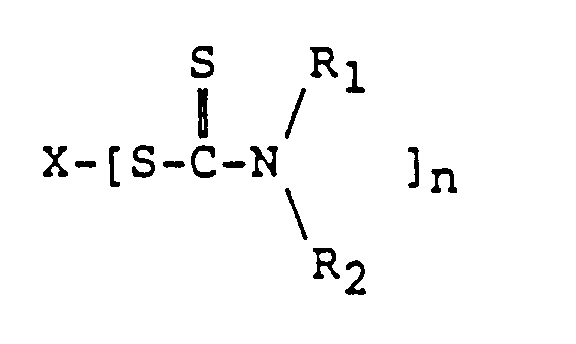
worin X ein Ion ist, abgeleitet von einem Metall, ausgewählt aus der Gruppe, bestehend aus Nickel, Cobalt, Eisen, Chrom, Zinn, Zink, Kupfer, Blei, Bismut, Cadmium, Selen und Tellur, n von 1 bis 6 variieren kann und gleich der formalen Valenz des Metallions ist, R1 und R2 unabhängig Alkyl mit 1 bis 7 Kohlenstoffatomen sind. - Eine wie in Anspruch 1 definierte Zusammensetzung, worin der Schwefelbeschleuniger ausgewählt ist aus der Gruppe, bestehend aus: Bismutdimethyldithiocarbamat, Cadmiumdiamyldithiocarbamat, Cadmiumdiethyldithiocarbamat, Kupferdimethyldithiocarbamat, Bleidiamyldithiocarbamat, Bleidimethyldithiocarbamat, Selendimethyldithiocarbamat, Tellurdiethyldithiocarbamat, Zinkdiamyldithiocarbamat, Zinkdiethyldithiocarbamat und Selendimethyldithiocarbamat.
- Eine wie in Anspruch 1 definierte Zusammensetzung, worin der Schwefelbeschleuniger ausgewählt ist aus Verbindungen, die durch die Formel:dargestellt sind,

worin R3 eine Alkylgruppe mit 1 bis 7 Kohlenstoffatomen ist und n einen positiven Wert von größer als null und bis zu 6 haben kann. - Eine wie in Anspruch 1 definierte Zusammensetzung, worin der Schwefelbeschleuniger ausgewählt ist aus der Gruppe, bestehend aus Tetrabutylthiuramdisulfid, Tetramethylthiuramdisulfid und Tetramethylthiurammonosulfid oder Mischungen davon.
- Eine wie in Anspruch 1 definierte Zusammensetzung, worin das Hydrochinon ausgewählt ist aus der Gruppe, bestehend aus Hydrochinon, Hydrochinondi(betahydroxyethyl)ether, Hydrochinonmonomethylether, Mono-t-butylhydrochinon, Di-t-butylhydrochinon und Di-t-amylhydrochinon oder Mischungen davon.
- Eine die Anvulkanisation verzögernde Zusammensetzung, die ein Hydrochinon und einen Schwefelbeschleuniger, ausgewählt aus der Gruppe, bestehend aus Dithiocarbamaten, Thiuramen, Thiazolen, Sulfenamiden, Thioharnstoffen, Xanthaten und Mischungen davon, enthält, und worin das Gewichtsverhältnis von Hydrochinon zu Schwefelbeschleuniger von 1:50 bis 500:1 beträgt, und die zusätzlich ein Koagens enthält, ausgewählt aus bifunktionellen Vinylmonomeren, bifunktionellen Allylmonomeren, polyfunktionellen Vinylmonomeren, polyfunktionellen Allylmonomeren, Mischungen davon oder aus einer Kombination von bifunktionellen Vinylmonomeren, bifunktionellen Allylmonomeren, polyfunktionellen Vinylmonomeren und/oder polyfunktionellen Allylmonomeren mit monofunktionellen Vinylmonomeren und/oder monofunktionellen Allylmonomeren, wobei das Koagens in Verhältnissen von 100:1 bis 1:100, bezogen auf die vereinte vorhandene Menge an Schwefelbeschleuniger und Chinon, verwendet wird.
- Eine wie in Anspruch 7 definierte Zusammensetzung, worin das Koagens ausgewählt ist aus der Gruppe, bestehend aus Allyldiglycolcarbonat, Triallylcyanurat, Triallylisocyanurat, Allylmethacrylat, Trimethylolpropantrimethacrylat, Diallyladipat, Diallyloxalat, Diallylfumarat, Triallylphosphat, Tetrallyloxyethan, Triallyltrimellitat und flüssigem 1,2-Polybutadien und Mischungen davon.
- Eine die Anvulkanisation verzögernde Vernetzungszusammensetzung, enthaltend einen Radikalinitiator, ausgewählt aus der Gruppe, bestehend aus organischen Peroxiden, Azoverbindungen und Mischungen davon, und eine Zusammensetzung, die ein Hydrochinon und einen Schwefelbeschleuniger, ausgewählt aus der Gruppe, bestehend aus Dithiocarbamaten, Thiuramen, Thiazolen, Sulfenamiden, Thioharnstoffen, Xanthaten und Mischungen davon, enthält, und worin das Gewichtsverhältnis von Hydrochinon zu Schwefelbeschleuniger von 1:50 bis 500:1 beträgt.
- Eine wie in Anspruch 9 definierte Zusammensetzung, worin der Radikalinitiator aus wenigstens einem organischen Peroxid besteht, und worin das Gewichtsverhältnis der wie in Anspruch 1 definierten Zusammensetzung und des organischen Peroxids von 0,5:100 bis 1:2 beträgt.
- Eine wie in Anspruch 10 definierte Zusammensetzung, worin das organische Peroxid ausgewählt ist aus der Gruppe, bestehend aus Dialkylperoxiden, Diperoxyketalen und Mischungen davon.
- Eine die Anvulkanisation verzögernde Vernetzungszusammensetzung, die eine wie in Anspruch 7 definierte die Anvulkanisation verzögernde Zusammensetzung und einen Radikalinitiator, ausgewählt aus der Gruppe, bestehend aus organischem Peroxid, Azoverbindungen und Mischungen davon, enthält.
- Eine wie in Anspruch 12 definierte Zusammensetzung, worin der Radikalinitiator aus wenigstens einem organischen Peroxid besteht, und worin das Gewichtsverhältnis der wie in Anspruch 7 definierten die Anvulkanisation verzögernden Zusammensetzung und des organischen Peroxids von 0,5:100 bis 1:2 beträgt.
- Eine wie in Anspruch 13 definierte Zusammensetzung, worin das organische Peroxid ausgewählt ist aus der Gruppe, bestehend aus Dialkylperoxiden, Diperoxyketalen und Mischungen davon.
- Eine wie in Anspruch 11 definierte Zusammensetzung, worin die Dialkylperoxide ausgewählt sind aus Dicumylperoxid, alpha,alpha-Bis(t-butylperoxy)diisopropylbenzol, t-Butylcumylperoxid, 2,5-Dimethyl-2,5-di(t-butylperoxy)hexan, 2,5-Dimethyl-2,5-di(t-amylperoxy)hexan, 2,5-Dimethyl-2,5-di(t-butylperoxy)hex-3-in, 2,5-Dimethyl-2,5-di(t-amylperoxy)hex-3-in, Di-t-amylperoxid, 1,3,5-Tri[(t-butylperoxy)isopropyl]benzol, 1,3-Dimethyl-3-(t-butylperoxy)butanol und Mischungen davon.
- Eine wie in Anspruch 11 definierte Zusammensetzung, worin die Diperoxyketal-Initiatoren ausgewählt sind aus der Gruppe, bestehend aus: 1,1-Di(t-butylperoxy)-3,3,5-trimethylcyclohexan, 1,1-Di(t-butylperoxy)cyclohexan, n-Butyl-4,4-di(t-amylperoxy)valerat, Ethyl-3,3-di(t-butylperoxy)butyrat, 2,2-Di(t-amylperoxy)propan, 3,6,6,9,9-Pentamethyl-3-ethoxycarbonylmethyl-1,2,4,5-tetraoxacyclononan, n-Butyl-4,4-bis(t-butylperoxy)valerat, Ethyl-3,3-di(t-amylperoxy)butyrat und Mischungen davon.
- Eine wie in Anspruch 14 definierte Zusammensetzung, worin die Dialkylperoxide ausgewählt sind aus Dicumylperoxid, alpha,alpha-Bis(t-butylperoxy)diisopropylbenzol, t-Butylcumylperoxid, 2,5-Dimethyl-2,5-di(t-butylperoxy)hexan, 2,5-Dimethyl-2,5-di(t-butylperoxy)hex-3-in, 2,5-Dimethyl-2,5-di(t-amylperoxy)hex-3-in, Di-t-amylperoxid, 1,3,5-Tri[(t-butylperoxy)isopropyl]benzol, 1,3-Dimethyl-3-(t-butylperoxy)butanol und Mischungen davon.
- Eine wie in Anspruch 14 definierte Zusammensetzung, worin die Diperoxyketal-Initiatoren ausgewählt sind aus der Gruppe, bestehend aus: 1,1-Di(t-butylperoxy)cyclohexan, n-Butyl-4,4-di(t-amylperoxy)valerat, Ethyl-3,3-di(t-butylperoxy)butyrat, 2,2-Di(t-amylperoxy)propan, 3,6,6,9,9-Pentamethyl-3-ethoxycarbonylmethyl-1,2,4,5-tetraoxacyclononan, n-Butyl-4,4-bis(t-butylperoxy)valerat, Ethyl-3,3-di(t-amylperoxy)butyrat und Mischungen davon.
- Eine wie in Anspruch 9 definierte Zusammensetzung, worin der Schwefelbeschleuniger ausgewählt ist aus wie in Anspruch 2 definierten Verbindungen.
- Eine wie in Anspruch 9 definierte Zusammensetzung, worin der Schwefelbeschleuniger ausgewählt ist aus wie in Anspruch 4 definierten Verbindungen.
- Eine vernetzbare Zusammensetzung, die eine wie in Anspruch 9 definierte Zusammensetzung und ein thermoplastisches und elastomeres Polymer, das durch Peroxid oder Azoverbindungen vernetzbar ist, enthält.
- Eine vernetzbare Zusammensetzung, die eine wie in Anspruch 9 definierte Zusammensetzung und ein thermoplastisches Polymer, das durch ein Peroxid oder eine Azoverbindung vernetzbar ist, enthält.
- Eine vernetzbare Zusammensetzung, die eine wie in Anspruch 9 definierte Zusammensetzung und ein elastomeres Polymer, das durch ein Peroxid oder eine Azoverbindung vernetzbar ist, enthält.
- Eine wie in Anspruch 12 definierte Zusammensetzung, worin der Schwefelbeschleuniger ausgewählt ist aus wie in Anspruch 2 definierten Verbindungen.
- Eine wie in Anspruch 12 definierte Zusammensetzung, worin der Schwefelbeschleuniger ausgewählt ist aus wie in Anspruch 4 definierten Verbindungen.
- Eine vernetzbare Zusammensetzung, die eine wie in Anspruch 12 definierte Zusammensetzung und ein thermoplastisches und elastomeres Polymer, das durch Peroxid oder Azoverbindungen vernetzbar ist, enthält.
- Eine vernetzbare Zusammensetzung, die eine wie in Anspruch 12 definierte Zusammensetzung und ein thermoplastisches Polymer, das durch ein Peroxid oder eine Azoverbindung vernetzbar ist, enthält.
- Eine vernetzbare Zusammensetzung, die eine wie in Anspruch 12 definierte Zusammensetzung und ein elastomeres Polymer, das durch Peroxid oder Azoverbindungen vernetzbar ist, enthält.
- Eine wie in Anspruch 1 definierte Zusammensetzung, worin das Hydrochinon Hydrochinonmonomethylether und der Schwefelbeschleuniger Zinkdiamyldithiocarbamat ist.
- Eine wie in Anspruch 9 definierte Zusammensetzung, worin das Hydrochinon Hydrochinonmonomethylether, der Schwefelbeschleuniger Zinkdiamyldithiocarbamat und der Radikalinitiator Dicumylperoxid ist.
- Eine wie in Anspruch 7 definierte Zusammensetzung, worin das Hydrochinon Hydrochinonmonomethylether und der Schwefelbeschleuniger Zinkdiamyldithiocarbamat ist.
- Eine wie in Anspruch 12 definierte Zusammensetzung, worin das Hydrochinon Hydrochinonmonomethylether, der Schwefelbeschleuniger Zinkdiamyldithiocarbamat und der Radikalinitiator Dicumylperoxid ist.
- Eine wie in Anspruch 22 definierte vernetzbare Zusammensetzung, worin das Hydrochinon Hydrochinonmonomethylether, der Schwefelbeschleuniger Zinkdiamyldithiocarbamat, der Radikalinitiator Dicumylperoxid und das thermoplastische Polymer Polyethylen niedriger Dichte mit linearer Struktur ist.
- Eine wie in Anspruch 1 definierte Zusammensetzung, worin das Hydrochinon Mono-t-butylhydrochinon und der Schwefelbeschleuniger Tetrabutylthiuramdisulfid ist.
- Eine wie in Anspruch 9 definierte Zusammensetzung, worin das Hydrochinon Mono-t-butylhydrochinon, der Schwefelbeschleuniger Tetrabutylthiuramdisulfid und der Radikalinitiator Dicumylperoxid ist.
- Eine wie in Anspruch 22 definierte vernetzbare Zusammensetzung, worin das Hydrochinon ein Mono-t-butylhydrochinon, der Schwefelbeschleuniger Tetrabutylthiuramdisulfid, der Radikalinitiator Dicumylperoxid und das thermoplastische Polymer Ethylenvinylacetat ist.
- Eine wie in Anspruch 9 definierte Zusammensetzung, worin das Hydrochinon Mono-t-butylhydrochinon, der Schwefelbeschleuniger Tetrabutylthiuramdisulfid und der Radikalinitiator 2,5-Dimethyl-2,5-di(t-butylperoxy)hexan ist.
- Eine wie in Anspruch 23 definierte vernetzbare Zusammensetzung, worin das Hydrochinon Mono-t-butylhydrochinon, der Schwefelbeschleuniger Tetrabutylthiuramdisulfid und das elastomere Polymer Ethylenvinylacetat ist.
- Eine wie in Anspruch 9 definierte Zusammensetzung, worin das Hydrochinon Hydrochinonmonomethylether, der Schwefelbeschleuniger Zinkdiamyldithiocarbamat, der Radikalinitiator 1,1-Bis-(t-butylperoxy)-3,3,5-trimethylcyclohexan ist.
- Eine wie in Anspruch 22 definierte vernetzbare Zusammensetzung, worin das Hydrochinon Hydrochinonmonomethylether, der Schwefelbeschleuniger Zinkdiamyldithiocarbamat, der Radikalinitiator 1,1-Bis-(t-butylperoxy)-3,3,5-trimethylcyclohexan und das thermoplastische Polymer ein Terpolymer aus Ethylen-, Propylen- und Dien-Monomeren ist.
- Eine wie in Anspruch 9 definierte Zusammensetzung, worin das Hydrochinon Hydrochinonmonomethylether, der Schwefelbeschleuniger Zinkdibutyldithiocarbamat und der Radikalinitiator eine Mischung aus Dicumylperoxid und 1,1-Di[(t-butylperoxy)isopropyl]benzol ist.
- Eine wie in Anspruch 27 definierte vernetzbare Zusammensetzung, worin das Hydrochinon Hydrochinonmonomethylether, der Schwefelbeschleuniger Zinkdiamyldithiocarbamat, der Radikalinitiator Dicumylperoxid und das thermoplastische Polymer Polyethylen niedriger Dichte mit linearer Struktur ist.
- Eine wie in Anspruch 7 definierte Zusammensetzung, worin das Hydrochinon Mono-t-butylhydrochinon und der Schwefelbeschleuniger Tetrabutylthiuramdisulfid ist.
- Eine wie in Anspruch 12 definierte Zusammensetzung, worin das Hydrochinon Mono-t-butylhydrochinon, der Schwefelbeschleuniger Tetrabutylthiuramdisulfid und der Radikalinitiator Dicumylperoxid ist.
- Eine wie in Anspruch 27 definierte vernetzbare Zusammensetzung, worin das Hydrochinon Mono-t-butylhydrochinon, der Schwefelbeschleuniger Tetrabutylthiuramdisulfid, der Radikalinitiator Dicumylperoxid und das thermoplastische Polymer Ethylenvinylacetat ist.
- Eine wie in Anspruch 12 definierte Zusammensetzung, worin das Hydrochinon Mono-t-butylhydrochinon, der Schwefelbeschleuniger Tetrabutylthiuramdisulfid und der Radikalinitiator 2,5-Dimethyl-2,5-di(t-butylperoxy)hexan ist.
- Eine wie in Anspruch 27 definierte vernetzbare Zusammensetzung, worin das Hydrochinon Mono-t-butylhydrochinon, der Schwefelbeschleuniger Tetrabutylthiuramdisulfid und das thermoplastische Polymer Ethylenvinylacetat ist.
- Eine wie in Anspruch 12 definierte Zusammensetzung, worin das Hydrochinon Hydrochinonmonomethylether, der Schwefelbeschleuniger Zinkdiamyldithiocarbamat, der Radikalinitiator 1,1-Bis-(t-butylperoxy)-3,3,5-trimethylcyclohexan ist.
- Eine wie in Anspruch 28 definierte vernetzbare Zusammensetzung, worin das Hydrochinon Hydrochinonmonomethylether, der Schwefelbeschleuniger Zinkdiamyldithiocarbamat, der Radikalinitiator 1,1-Bis-(t-butylperoxy)-3,3,5-trimethylcyclohexan und das elastomere Polymer ein Terpolymer aus Ethylen-, Propylen- und Dien-Monomeren ist.
- Eine wie in Anspruch 12 definierte Zusammensetzung, worin das Hydrochinon Hydrochinonmonomethylether, der Schwefelbeschleuniger Zinkdibutyldithiocarbamat und der Radikalinitiator eine Mischung aus Dicumylperoxid und 1,1-Di[(t-butylperoxy)isopropyl]benzol ist.
- Eine wie in Anspruch 7 definierte Zusammensetzung, worin das Koagens Triallylcyanurat ist.
- Eine wie in Anspruch 12 definierte Zusammensetzung, worin das Koagens Triallylcyanurat ist.
- Eine wie in Anspruch 7 definierte Zusammensetzung, worin das Koagens Triallyltrimellitat ist.
- Eine wie in Anspruch 12 definierte Zusammensetzung, worin das Koagens Triallyltrimellitat ist.
- Eine wie in Anspruch 54 definierte Zusammensetzung, worin das Hydrochinon Hydrochinonmonomethylether, der Schwefelbeschleuniger Zinkdiamyldithiocarbamat und der Radikalinitiator eine Mischung aus Dicumylperoxid und n-Butyl-4,4-bis(t-butylperoxy)valerat ist.
- Eine wie in Anspruch 52 definierte Zusammensetzung, worin das Hydrochinon Mono-t-butylhydrochinon, der Schwefelbeschleuniger Zinkdiamyldithiocarbamat und der Radikalinitiator eine Mischung aus Dicumylperoxid und Ethyl-3,3-di(t-butylperoxy)butyrat ist.
- Eine wie in Anspruch 52 definierte Zusammensetzung, worin das Hydrochinon Hydrochinonmonomethylether, der Schwefelbeschleuniger Tetramethylthiurammonosulfid und der Radikalinitiator 2,5-Dimethyl-2,5-di(t-butylperoxy)hex-3-in ist.
- Eine wie in Anspruch 27 definierte Zusammensetzung, worin das Polymer ein Niederdruckpolyethylen ist.
- Eine wie in Anspruch 58 definierte Zusammensetzung, worin das Hydrochinon ein Hydrochinonmonomethylether, der Schwefelbeschleuniger Tetramethylthiurammonosulfid, das Peroxid 2,5-Dimethyl-2,5-di(t-butylperoxy)hex-3-in und das Koagens Triallylcyanurat ist.
- Eine wie in Anspruch 58 definierte Zusammensetzung, worin das Hydrochinon Hydrochinonmonomethylether, der Schwefelbeschleuniger Tetrabutylthiuramdisulfid, das Peroxid 2,5-Dimethyl-2,5-di(t-butylperoxy)hex-3-in und das Koagens Triallylcyanurat ist.
- Eine wie in Anspruch 58 definierte Zusammensetzung, worin das Hydrochinon Hydrochinonmonomethylether und der Schwefelbeschleuniger Tetrabutylthiuramdisulfid ist, das Peroxid eine Mischung aus 2,5-Dimethyl-2,5-di(t-butylperoxy)hexan und 1,1-Di[(t-butylperoxy)isopropyl]benzol und das Koagens Triallylcyanurat ist.
- Eine wie in Anspruch 52 definierte Zusammensetzung, worin das Hydrochinon Hydrochinonmonomethylether, der Schwefelbeschleuniger Tetrabutylthiuramdisulfid und der Radikalinitiator eine Mischung aus Dicumylperoxid und Ethyl-3,3-di(t-butylperoxy)butyrat ist.
- Ein Verfahren zur Herstellung einer vernetzbaren Zusammensetzung, die ein Polymer, ausgewählt aus der Gruppe aus mit Peroxid oder Azoverbindung vernetzbaren thermoplastischen Polymeren, elastomeren Polymeren oder Mischungen davon, und einen Radikalinitiator, ausgewählt aus Peroxiden, Azoverbindungen oder Mischungen davon, enthält, bei dem das Polymer mit dem Radikalinitiator in Gegenwart einer wie in Anspruch 1 definierten die Anvulkanisation verzögernden Zusammensetzung compoundiert wird.
- Ein wie in Anspruch 63 definiertes Verfahren, bei dem die die Anvulkanisation verzögernde Zusammensetzung zusätzlich ein wie in Anspruch 7 definiertes Koagens enthält.
- Eine wie in Anspruch 52 definierte Zusammensetzung, worin das Hydrochinon Hydrochinonmonomethylether, der Schwefelbeschleuniger Tetrabutylthiuramdisulfid und der Radikalinitiator Dicumylperoxid ist.
- Eine wie in Anspruch 1 definierte Zusammensetzung, worin der Schwefelbeschleuniger N-Cyclohexyl-2-benzothiazolsulfenamid ist.
- Eine wie in Anspruch 66 definierte Zusammensetzung, die zusätzlich ein wie in Anspruch 7 definiertes Koagens enthält.
- Eine wie in Anspruch 9 definierte Zusammensetzung, worin der Schwefelbeschleuniger N-Cyclohexyl-2-benzothiazolsulfenamid ist.
Applications Claiming Priority (2)
| Application Number | Priority Date | Filing Date | Title |
|---|---|---|---|
| US673881 | 1984-11-21 | ||
| US67388191A | 1991-03-22 | 1991-03-22 |
Publications (3)
| Publication Number | Publication Date |
|---|---|
| EP0504920A2 EP0504920A2 (de) | 1992-09-23 |
| EP0504920A3 EP0504920A3 (en) | 1993-01-20 |
| EP0504920B1 true EP0504920B1 (de) | 1998-07-08 |
Family
ID=24704471
Family Applications (1)
| Application Number | Title | Priority Date | Filing Date |
|---|---|---|---|
| EP92104885A Expired - Lifetime EP0504920B1 (de) | 1991-03-22 | 1992-03-20 | Die Anvulkanisation verzögernde Härtungs-/Vernetzungszusammensetzungen |
Country Status (8)
| Country | Link |
|---|---|
| US (7) | US6069208A (de) |
| EP (1) | EP0504920B1 (de) |
| JP (1) | JP3182199B2 (de) |
| AT (1) | ATE168123T1 (de) |
| BR (1) | BR9200992A (de) |
| CA (1) | CA2063478A1 (de) |
| DE (1) | DE69226108T2 (de) |
| MX (1) | MX9201255A (de) |
Families Citing this family (40)
| Publication number | Priority date | Publication date | Assignee | Title |
|---|---|---|---|---|
| US5272213A (en) * | 1992-05-14 | 1993-12-21 | Air Products And Chemicals, Inc. | Scorch retardant polyacrylate elastomers |
| ITMI960029U1 (it) * | 1996-01-18 | 1997-07-18 | Atochem Elf Italia | Composizioni perossidiche con resistenza allo scorch |
| US6180706B1 (en) * | 1998-06-16 | 2001-01-30 | Union Carbide Chemicals & Plastics Technology Corporation | Crosslinkable high pressure low density polyethylene composition |
| US6300421B1 (en) | 1999-03-04 | 2001-10-09 | The Goodyear Tire & Rubber Company | Preparation of peroxide vulcanized rubber composition and articles having at least one component thereof |
| US6143822A (en) * | 1999-03-18 | 2000-11-07 | Union Carbide Chemicals & Plastics Technology Corporation | Polyethylene crosslinkable composition |
| US6277925B1 (en) * | 1999-03-18 | 2001-08-21 | Hercules Incorporated | Allyl compounds, compositions containing allyl compounds and processes for forming and curing polymer compositions |
| EP1036805B1 (de) * | 1999-03-18 | 2013-01-09 | Union Carbide Chemicals & Plastics Technology LLC | Eine vernetzbare Polyethylenzusammensetzung |
| US6180231B1 (en) | 1999-03-31 | 2001-01-30 | Union Carbide Chemicals & Plastics Technology Corporation | Crosslinkable polyethylene composition |
| US6191230B1 (en) * | 1999-07-22 | 2001-02-20 | Union Carbide Chemicals & Plastics Technology Corporation | Polyethylene crosslinkable composition |
| WO2001034680A1 (en) * | 1999-11-09 | 2001-05-17 | Atofina Chemicals, Inc. | Tack free surface cures of polymers by organic peroxides in the presence of air |
| EP1188788A1 (de) * | 2000-09-08 | 2002-03-20 | Borealis Technology Oy | Extrudieren von Polyolefinen |
| US6548600B2 (en) * | 2000-09-22 | 2003-04-15 | Dupont Dow Elastomers L.L.C. | Thermoplastic elastomer compositions rheology-modified using peroxides and free radical coagents |
| US6555019B2 (en) * | 2001-03-22 | 2003-04-29 | Atofina Chemicals, Inc. | Sulfur free, low color generating scorch time extending compositions for use in compounding and cure of free radical initiator curable polymers |
| FR2822472A1 (fr) * | 2001-03-23 | 2002-09-27 | Atofina | Compostion de reticulation et composition reticulable |
| US8101196B2 (en) * | 2001-06-26 | 2012-01-24 | Biointeractions, Ltd. | Polysaccharide biomaterials and methods of use thereof |
| US6767940B2 (en) | 2002-07-25 | 2004-07-27 | Acushnet Company | Golf ball compositions comprising stable free radicals |
| US7338994B2 (en) * | 2002-10-01 | 2008-03-04 | Dow Global Technologies Inc. | Rheology-modified thermoplastic elastomer compositions for extruded profiles |
| JP2006219505A (ja) * | 2005-01-13 | 2006-08-24 | Daiso Co Ltd | 塩素化ポリエチレン加硫用組成物 |
| US20080312381A1 (en) * | 2005-03-24 | 2008-12-18 | Stichting Dutch Polymer Institute | Scorch Delay in Free-Radical-Initiated Vulcanization Processes |
| JP2006337612A (ja) * | 2005-05-31 | 2006-12-14 | Nippon Zeon Co Ltd | 重合トナーの製造方法 |
| JP5044999B2 (ja) * | 2005-09-26 | 2012-10-10 | 旭硝子株式会社 | パーフルオロエラストマー組成物およびパーフルオロゴム成形品 |
| US7465769B2 (en) * | 2006-10-09 | 2008-12-16 | Dow Global Technologies Inc. | Nitroxide compounds for minimizing scorch in crosslinkable compositions |
| JP5501769B2 (ja) * | 2007-02-05 | 2014-05-28 | ダウ グローバル テクノロジーズ エルエルシー | 架橋可能なポリエチレン組成物、その製造方法及びそれから製造された物品 |
| CN101675099A (zh) * | 2007-03-15 | 2010-03-17 | 陶氏环球技术公司 | 可交联组合物中用于使焦化最小化的异氰酸酯、二异氰酸酯和(甲基)丙烯酸酯化合物及用于促进固化的二异氰酸酯化合物 |
| US7982137B2 (en) * | 2007-06-27 | 2011-07-19 | Hamilton Sundstrand Corporation | Circuit board with an attached die and intermediate interposer |
| WO2009088851A1 (en) * | 2008-01-04 | 2009-07-16 | C.R. Bard, Inc | Synthetic polyisoprene foley catheter |
| US8709191B2 (en) | 2008-05-15 | 2014-04-29 | Kimberly-Clark Worldwide, Inc. | Latent elastic composite formed from a multi-layered film |
| US8795573B2 (en) * | 2008-06-30 | 2014-08-05 | C.R. Bard, Inc. | Polyurethane/polyisoprene blend catheter |
| JP2010097070A (ja) * | 2008-10-17 | 2010-04-30 | Nitto Denko Corp | フラットパネルディスプレイ用透明粘着シート及びフラットパネルディスプレイ |
| JP5788751B2 (ja) * | 2011-09-26 | 2015-10-07 | 電気化学工業株式会社 | 積層体、架橋物及び成形部材 |
| CN104334630B (zh) * | 2012-06-04 | 2018-03-20 | 神华集团有限责任公司 | 一种加工性能改善的交联聚乙烯组合物 |
| US9617356B2 (en) | 2012-06-13 | 2017-04-11 | National Institute Of Clean-And-Low-Carbon Energy | Crosslinked polyethylene composition |
| WO2014003692A1 (en) * | 2012-06-28 | 2014-01-03 | Thai Plastic And Chemicals Public Co., Ltd. | Highly crosslinkable polyethylene composition |
| EP3230362A4 (de) | 2014-12-09 | 2018-07-25 | Arkema, Inc. | Flüssige und schmelzbare feststoffklassen von versengungsgeschützten peroxiden |
| MX2017007414A (es) * | 2014-12-09 | 2017-09-28 | Arkema Inc | Composiciones y metodos de reticulacion de polimeros en presencia de oxigeno atmosferico. |
| HU230824B1 (hu) * | 2015-10-21 | 2018-07-30 | Contitech Rubber Industrial Kft. | Vegyszer- és gázálló nagynyomású, nagy átmérőjű, kötött szerkezetű gumi flexibilis vezeték, és eljárás annak előállítására |
| JP2018127510A (ja) * | 2017-02-06 | 2018-08-16 | Nok株式会社 | 過酸化物架橋ゴム用遅延剤マスターバッチとその製造方法 |
| US20220056222A1 (en) * | 2018-12-17 | 2022-02-24 | Arkema France | Multi(meth)acrylate-functionalized resins as co-agents for crosslinking of thermoplastic polymers |
| IT202100014606A1 (it) | 2021-06-04 | 2022-12-04 | Rubber Conv Srl | Additivo devulcanizzante, relativo metodo di devulcanizzazione e prodotto devulcanizzato |
| TW202602848A (zh) * | 2024-03-29 | 2026-01-16 | 日商日油股份有限公司 | 固化劑、熱固性組合物、樹脂膜、預浸料、金屬層壓板及固化劑的製備方法 |
Citations (1)
| Publication number | Priority date | Publication date | Assignee | Title |
|---|---|---|---|---|
| US2954356A (en) * | 1955-10-17 | 1960-09-27 | Monsanto Chemicals | Metal stabilizers for rubber |
Family Cites Families (22)
| Publication number | Priority date | Publication date | Assignee | Title |
|---|---|---|---|---|
| US3144436A (en) * | 1961-01-04 | 1964-08-11 | Du Pont | Process for degrading stereoregular polymers |
| NL277028A (de) * | 1961-04-19 | |||
| NL124035C (de) * | 1961-11-08 | |||
| DE1302645B (de) * | 1963-11-15 | 1900-01-01 | ||
| US3522225A (en) * | 1969-03-05 | 1970-07-28 | Montedison Spa | Vulcanization of elastomeric olefinic copolymers with organic diperoxides |
| US3751378A (en) | 1971-03-31 | 1973-08-07 | Sartomer Ind Inc | Inhibiting prevulcanization of rubber with polyfunctional methacrylate monomers as cross-linking coagents with peroxides |
| IE36799B1 (en) * | 1971-12-14 | 1977-03-02 | Loctite Ltd | Cyanoacrylate adhesive composition |
| JPS5328949B2 (de) * | 1972-11-10 | 1978-08-17 | ||
| US3931090A (en) * | 1974-04-26 | 1976-01-06 | Xerox Corporation | Rubber composition for flexible belts |
| CA1047696A (en) * | 1974-11-27 | 1979-01-30 | Union Carbide Corporation | Compositions with dicumyl peroxide and process for avoiding scorching of ethylene polymer composition |
| US3954907A (en) | 1974-11-27 | 1976-05-04 | Union Carbide Corporation | Composition with selected vinyl compounds and process for avoiding scorching of ethylene polymer composition |
| DE2529891A1 (de) * | 1975-07-04 | 1977-01-27 | Henkel & Cie Gmbh | Bei sauerstoffausschluss erhaertende klebstoffe oder dichtungsmittel |
| JPS5286439A (en) * | 1975-12-19 | 1977-07-18 | Osaka Soda Co Ltd | Crosslinkable chlorinated polyethylene composition |
| WO1980002255A1 (fr) * | 1979-04-17 | 1980-10-30 | Teijin Ltd | Lamine a pellicule resistante a l'abrasion |
| US4406826A (en) * | 1981-03-05 | 1983-09-27 | W. R. Grace & Co. | Heat curable conductive ink |
| US4632950A (en) * | 1985-09-09 | 1986-12-30 | Pennwalt Corporation | Scorch resistant, crosslinkable composition containing mixture of copper and metal dithiocarbamates |
| US4983685A (en) | 1986-06-10 | 1991-01-08 | Sumitomo Chemical Company, Limited | Methods for production of crosslinked rubber products |
| JPS63221144A (ja) * | 1987-03-09 | 1988-09-14 | Bando Chem Ind Ltd | エチレン・プロピレンゴム組成物 |
| US5245084A (en) * | 1988-06-14 | 1993-09-14 | Luperox Gmbh | Mixture suited for crosslinking polymers and process for crosslinking polymers with extension of scorch time |
| DE3820252A1 (de) * | 1988-06-14 | 1989-12-21 | Luperox Gmbh | Zur vernetzung von polymeren geeignete mischung und verfahren zum vernetzen von polymeren unter verlaengerung der scorchzeit |
| US4948840A (en) | 1989-11-14 | 1990-08-14 | Himont Incorporated | Thermoplastic elastomer of propylene polymer material and crosslinked ethylene-propylene rubber |
| CN1071937A (zh) * | 1991-10-29 | 1993-05-12 | 阿克佐公司 | 轮胎和胶带组合物 |
-
1992
- 1992-03-19 CA CA002063478A patent/CA2063478A1/en not_active Abandoned
- 1992-03-20 DE DE69226108T patent/DE69226108T2/de not_active Expired - Lifetime
- 1992-03-20 EP EP92104885A patent/EP0504920B1/de not_active Expired - Lifetime
- 1992-03-20 MX MX9201255A patent/MX9201255A/es unknown
- 1992-03-20 BR BR929200992A patent/BR9200992A/pt not_active Application Discontinuation
- 1992-03-20 AT AT92104885T patent/ATE168123T1/de not_active IP Right Cessation
- 1992-03-23 JP JP09492392A patent/JP3182199B2/ja not_active Expired - Lifetime
-
1995
- 1995-06-07 US US08/482,606 patent/US6069208A/en not_active Expired - Lifetime
- 1995-06-07 US US08/484,437 patent/US6197213B1/en not_active Expired - Lifetime
- 1995-06-07 US US08/482,601 patent/US5912304A/en not_active Expired - Lifetime
- 1995-06-07 US US08/473,395 patent/US5849214A/en not_active Expired - Lifetime
- 1995-06-07 US US08/475,127 patent/US6765058B1/en not_active Expired - Lifetime
- 1995-06-07 US US08/482,607 patent/US5869580A/en not_active Expired - Lifetime
- 1995-06-07 US US08/475,126 patent/US5876624A/en not_active Expired - Lifetime
Patent Citations (1)
| Publication number | Priority date | Publication date | Assignee | Title |
|---|---|---|---|---|
| US2954356A (en) * | 1955-10-17 | 1960-09-27 | Monsanto Chemicals | Metal stabilizers for rubber |
Non-Patent Citations (2)
| Title |
|---|
| Rubber Technology, "Age Resistors"; 3rd Ed.; Van Nostrand Reinhold, New York, p. 50-53 * |
| The Vanderbilt Rubber Handbook, "Sulfur Vulcanization"; 13.Ed. (1990), R.T. Vanderbilt Comp. Inc., Norwalk, p. 12-15 * |
Also Published As
| Publication number | Publication date |
|---|---|
| BR9200992A (pt) | 1992-11-24 |
| JP3182199B2 (ja) | 2001-07-03 |
| US6069208A (en) | 2000-05-30 |
| EP0504920A3 (en) | 1993-01-20 |
| EP0504920A2 (de) | 1992-09-23 |
| DE69226108T2 (de) | 1999-03-11 |
| JPH05209085A (ja) | 1993-08-20 |
| US6197213B1 (en) | 2001-03-06 |
| CA2063478A1 (en) | 1992-09-23 |
| US5849214A (en) | 1998-12-15 |
| US6765058B1 (en) | 2004-07-20 |
| US5869580A (en) | 1999-02-09 |
| US5876624A (en) | 1999-03-02 |
| ATE168123T1 (de) | 1998-07-15 |
| DE69226108D1 (de) | 1998-08-13 |
| US5912304A (en) | 1999-06-15 |
| MX9201255A (es) | 1992-10-01 |
Similar Documents
| Publication | Publication Date | Title |
|---|---|---|
| US6765058B1 (en) | Scorch extending curing/crosslinking compositions | |
| US4632950A (en) | Scorch resistant, crosslinkable composition containing mixture of copper and metal dithiocarbamates | |
| US20090069469A1 (en) | Nitroxide Compounds for Minimizing Scorch in Crosslinkable Compositions | |
| US5994473A (en) | Scorch resistant peroxidic compositions | |
| US4547554A (en) | After-chlorinated ethylene/butene-1 copolymer and process for its production | |
| US20100174014A1 (en) | Crosslinkable compositions having reduced scortch inhibitor migration, method of reducing such migration, and articles made therefrom | |
| DE60107457T2 (de) | Vorvernetzungshemmende zusammensetzung | |
| US4774295A (en) | Polymer mixtures and covulcanizates produced therefrom | |
| US5502115A (en) | Fluoroelastomer compositions containing bromine and iodine in the polymeric chain with a reduced emission of toxic alkylhalo compounds during curing with the peroxide | |
| US20040198920A1 (en) | Scorch-retardant composition | |
| US5096947A (en) | Organic peroxide and organic sulfide antioxidant composition | |
| JP7608441B2 (ja) | 改善された電気的特性を有するポリオレフィン組成物 | |
| EP0426145A1 (de) | Antioxidationszusammensetzung aus organischen Peroxiden und organischen Sulfiden | |
| IT7353284A1 (it) | Procedimento per la preparazione di elastomero di acrilato vulganizzabile e relativo prodotto | |
| US5241010A (en) | Acrylic rubber composition containing trithiocganuric acid, a metal suit of dithiocarbamic acid and a thiuram sulfide | |
| US6207776B1 (en) | Peroxidic compositions | |
| JPS59215347A (ja) | エラストマ−加硫用組成物 | |
| DE3938175C2 (de) | Vernetzbare, fluorhaltige Elastomer-Zusammensetzung | |
| US6291617B1 (en) | Peroxidic compositions | |
| US3285867A (en) | Triethylene-tetramine-benzothiazyl disulfide vulcanizate of an acrylic acid ester-neutral haloalkyl vinyl compound interpolymer stabilized with a copper salt of a saturated straight chain fatty acid | |
| US3595841A (en) | Diiminosuccinonitrile as a vulcanization retarder | |
| JPH07207065A (ja) | 加硫可能なハロゲン含有ポリマーの早期硬化の制御 |
Legal Events
| Date | Code | Title | Description |
|---|---|---|---|
| PUAI | Public reference made under article 153(3) epc to a published international application that has entered the european phase |
Free format text: ORIGINAL CODE: 0009012 |
|
| AK | Designated contracting states |
Kind code of ref document: A2 Designated state(s): AT BE CH DE DK ES FR GB IT LI NL SE |
|
| RBV | Designated contracting states (corrected) |
Designated state(s): AT BE CH DE DK ES FR GB IT LI NL SE |
|
| PUAL | Search report despatched |
Free format text: ORIGINAL CODE: 0009013 |
|
| AK | Designated contracting states |
Kind code of ref document: A3 Designated state(s): AT BE CH DE DK ES FR GB IT LI NL SE |
|
| 17P | Request for examination filed |
Effective date: 19930330 |
|
| 17Q | First examination report despatched |
Effective date: 19950117 |
|
| GRAG | Despatch of communication of intention to grant |
Free format text: ORIGINAL CODE: EPIDOS AGRA |
|
| GRAG | Despatch of communication of intention to grant |
Free format text: ORIGINAL CODE: EPIDOS AGRA |
|
| GRAG | Despatch of communication of intention to grant |
Free format text: ORIGINAL CODE: EPIDOS AGRA |
|
| GRAH | Despatch of communication of intention to grant a patent |
Free format text: ORIGINAL CODE: EPIDOS IGRA |
|
| GRAH | Despatch of communication of intention to grant a patent |
Free format text: ORIGINAL CODE: EPIDOS IGRA |
|
| GRAA | (expected) grant |
Free format text: ORIGINAL CODE: 0009210 |
|
| ITF | It: translation for a ep patent filed | ||
| AK | Designated contracting states |
Kind code of ref document: B1 Designated state(s): AT BE CH DE DK ES FR GB IT LI NL SE |
|
| PG25 | Lapsed in a contracting state [announced via postgrant information from national office to epo] |
Ref country code: CH Free format text: LAPSE BECAUSE OF FAILURE TO SUBMIT A TRANSLATION OF THE DESCRIPTION OR TO PAY THE FEE WITHIN THE PRESCRIBED TIME-LIMIT Effective date: 19980708 Ref country code: BE Free format text: LAPSE BECAUSE OF FAILURE TO SUBMIT A TRANSLATION OF THE DESCRIPTION OR TO PAY THE FEE WITHIN THE PRESCRIBED TIME-LIMIT Effective date: 19980708 Ref country code: LI Free format text: LAPSE BECAUSE OF FAILURE TO SUBMIT A TRANSLATION OF THE DESCRIPTION OR TO PAY THE FEE WITHIN THE PRESCRIBED TIME-LIMIT Effective date: 19980708 Ref country code: AT Free format text: LAPSE BECAUSE OF FAILURE TO SUBMIT A TRANSLATION OF THE DESCRIPTION OR TO PAY THE FEE WITHIN THE PRESCRIBED TIME-LIMIT Effective date: 19980708 Ref country code: ES Free format text: THE PATENT HAS BEEN ANNULLED BY A DECISION OF A NATIONAL AUTHORITY Effective date: 19980708 |
|
| REF | Corresponds to: |
Ref document number: 168123 Country of ref document: AT Date of ref document: 19980715 Kind code of ref document: T |
|
| REG | Reference to a national code |
Ref country code: CH Ref legal event code: EP |
|
| REF | Corresponds to: |
Ref document number: 69226108 Country of ref document: DE Date of ref document: 19980813 |
|
| ET | Fr: translation filed | ||
| PG25 | Lapsed in a contracting state [announced via postgrant information from national office to epo] |
Ref country code: SE Free format text: LAPSE BECAUSE OF FAILURE TO SUBMIT A TRANSLATION OF THE DESCRIPTION OR TO PAY THE FEE WITHIN THE PRESCRIBED TIME-LIMIT Effective date: 19981008 Ref country code: DK Free format text: LAPSE BECAUSE OF FAILURE TO SUBMIT A TRANSLATION OF THE DESCRIPTION OR TO PAY THE FEE WITHIN THE PRESCRIBED TIME-LIMIT Effective date: 19981008 |
|
| REG | Reference to a national code |
Ref country code: CH Ref legal event code: PL |
|
| PLBE | No opposition filed within time limit |
Free format text: ORIGINAL CODE: 0009261 |
|
| STAA | Information on the status of an ep patent application or granted ep patent |
Free format text: STATUS: NO OPPOSITION FILED WITHIN TIME LIMIT |
|
| 26N | No opposition filed | ||
| REG | Reference to a national code |
Ref country code: FR Ref legal event code: CA Ref country code: FR Ref legal event code: CD |
|
| REG | Reference to a national code |
Ref country code: GB Ref legal event code: IF02 |
|
| NLT1 | Nl: modifications of names registered in virtue of documents presented to the patent office pursuant to art. 16 a, paragraph 1 |
Owner name: ARKEMA INC. Owner name: ATOFINA CHEMICALS, INC. |
|
| REG | Reference to a national code |
Ref country code: FR Ref legal event code: CD |
|
| PGFP | Annual fee paid to national office [announced via postgrant information from national office to epo] |
Ref country code: FR Payment date: 20110317 Year of fee payment: 20 Ref country code: IT Payment date: 20110316 Year of fee payment: 20 Ref country code: NL Payment date: 20110317 Year of fee payment: 20 |
|
| PGFP | Annual fee paid to national office [announced via postgrant information from national office to epo] |
Ref country code: DE Payment date: 20110316 Year of fee payment: 20 Ref country code: GB Payment date: 20110316 Year of fee payment: 20 |
|
| REG | Reference to a national code |
Ref country code: DE Ref legal event code: R071 Ref document number: 69226108 Country of ref document: DE |
|
| REG | Reference to a national code |
Ref country code: DE Ref legal event code: R071 Ref document number: 69226108 Country of ref document: DE |
|
| REG | Reference to a national code |
Ref country code: NL Ref legal event code: V4 Effective date: 20120320 |
|
| REG | Reference to a national code |
Ref country code: GB Ref legal event code: PE20 Expiry date: 20120319 |
|
| PG25 | Lapsed in a contracting state [announced via postgrant information from national office to epo] |
Ref country code: DE Free format text: LAPSE BECAUSE OF EXPIRATION OF PROTECTION Effective date: 20120321 |
|
| PG25 | Lapsed in a contracting state [announced via postgrant information from national office to epo] |
Ref country code: GB Free format text: LAPSE BECAUSE OF EXPIRATION OF PROTECTION Effective date: 20120319 |