EP0503670B1 - Peristaltische intravenöse Infusionspumpe mit Anzeige einer gewählten Anwendung - Google Patents
Peristaltische intravenöse Infusionspumpe mit Anzeige einer gewählten Anwendung Download PDFInfo
- Publication number
- EP0503670B1 EP0503670B1 EP92104412A EP92104412A EP0503670B1 EP 0503670 B1 EP0503670 B1 EP 0503670B1 EP 92104412 A EP92104412 A EP 92104412A EP 92104412 A EP92104412 A EP 92104412A EP 0503670 B1 EP0503670 B1 EP 0503670B1
- Authority
- EP
- European Patent Office
- Prior art keywords
- pump
- parameter values
- application
- intravenous infusion
- infusion pump
- Prior art date
- Legal status (The legal status is an assumption and is not a legal conclusion. Google has not performed a legal analysis and makes no representation as to the accuracy of the status listed.)
- Expired - Lifetime
Links
- 238000001802 infusion Methods 0.000 title claims description 125
- 230000002572 peristaltic effect Effects 0.000 title claims description 54
- 238000001990 intravenous administration Methods 0.000 title claims description 53
- 239000012530 fluid Substances 0.000 claims description 67
- 238000004891 communication Methods 0.000 claims description 11
- 238000012545 processing Methods 0.000 claims description 9
- 230000004044 response Effects 0.000 claims description 7
- 230000004913 activation Effects 0.000 claims 3
- 238000013500 data storage Methods 0.000 description 22
- 230000008859 change Effects 0.000 description 12
- 230000007246 mechanism Effects 0.000 description 9
- 238000001514 detection method Methods 0.000 description 5
- 238000010586 diagram Methods 0.000 description 5
- 229940039231 contrast media Drugs 0.000 description 3
- 239000002872 contrast media Substances 0.000 description 3
- 238000001356 surgical procedure Methods 0.000 description 3
- 230000005856 abnormality Effects 0.000 description 2
- 238000010276 construction Methods 0.000 description 2
- 238000002347 injection Methods 0.000 description 2
- 239000007924 injection Substances 0.000 description 2
- 208000014674 injury Diseases 0.000 description 2
- 230000008733 trauma Effects 0.000 description 2
- 238000011144 upstream manufacturing Methods 0.000 description 2
- 238000012795 verification Methods 0.000 description 2
- 101100031730 Arabidopsis thaliana PUMP1 gene Proteins 0.000 description 1
- 101100130645 Homo sapiens MMP7 gene Proteins 0.000 description 1
- 102100030417 Matrilysin Human genes 0.000 description 1
- 230000000747 cardiac effect Effects 0.000 description 1
- 238000006243 chemical reaction Methods 0.000 description 1
- 229940079593 drug Drugs 0.000 description 1
- 239000003814 drug Substances 0.000 description 1
- 230000006870 function Effects 0.000 description 1
- 230000002401 inhibitory effect Effects 0.000 description 1
- 238000002372 labelling Methods 0.000 description 1
- 239000007788 liquid Substances 0.000 description 1
- 238000012986 modification Methods 0.000 description 1
- 230000004048 modification Effects 0.000 description 1
- 210000000056 organ Anatomy 0.000 description 1
- 238000005086 pumping Methods 0.000 description 1
- 238000012360 testing method Methods 0.000 description 1
Images




Classifications
-
- A—HUMAN NECESSITIES
- A61—MEDICAL OR VETERINARY SCIENCE; HYGIENE
- A61M—DEVICES FOR INTRODUCING MEDIA INTO, OR ONTO, THE BODY; DEVICES FOR TRANSDUCING BODY MEDIA OR FOR TAKING MEDIA FROM THE BODY; DEVICES FOR PRODUCING OR ENDING SLEEP OR STUPOR
- A61M5/00—Devices for bringing media into the body in a subcutaneous, intra-vascular or intramuscular way; Accessories therefor, e.g. filling or cleaning devices, arm-rests
- A61M5/14—Infusion devices, e.g. infusing by gravity; Blood infusion; Accessories therefor
- A61M5/168—Means for controlling media flow to the body or for metering media to the body, e.g. drip meters, counters ; Monitoring media flow to the body
- A61M5/172—Means for controlling media flow to the body or for metering media to the body, e.g. drip meters, counters ; Monitoring media flow to the body electrical or electronic
Definitions
- the present invention relates to a peristaltic intravenous infusion pump for medical use.
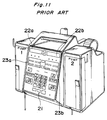
- Fluid infusion pumps conventionally available are in general provided with a keyboard 21 and display units 22a, 22b, 23a, 23b, as shown in Fig. 11, and so adapted to allow the settings of the maximum rate of fluid infusion, maximum volume to be infused, occlusion sensing level, air bubble detection size, and the like to be set according to the purposes of applications (e.g. for infants or adults) and the places where they are used (e.g. operating room, surgical intensive care units).
- applications e.g. for infants or adults
- the places where they are used e.g. operating room, surgical intensive care units.
- the fluid infusion pumps are electromechanical, positive-pressure peristaltic type intravenous infusion devices having a pump mechanism, for use with a specified administration set. Programming for the devices is carried out through the keyboard 21. To enhance the safety of patients, the pump is provided with various types of alarm functions such as air bubble detection, upstream occlusion detection, and downstream occlusion detection.
- Fig. 12 is a block diagram of this type of a fluid infusion pump.
- a power switch designated by numeral 101
- the power switch 101 When the power switch 101 is pressed once more, the power turns OFF.
- An alarm/alert display unit designated by 102, displays all the alarm and alert messages that the fluid infusion pump has detected.
- a programming display unit designated by 103, displays all the program data concerning the fluid infusion such as rate, volume to be infused, and total volume infused, inputted for or collected by the fluid infusion pump.
- a key panel designated by 104, has thereon numeric keys for inputting the rate and the volume to be infused, control keys for serving as an aid of input, a start key for starting the fluid infusion, a stop key for stopping the fluid infusion, and a call-up key for displaying the total volume infused and other data.
- An operation lamp, designated by 105, is a lamp that shows under which state it is currently among the alarm, fluid infusing operation, or alert state.
- a door opening detector designated by 106, is a circuit for detecting whether or not the door has come into the open position, and necessary also for stopping the fluid infusion pump mechanism when the door is opened while the pump is driven and then generating the alarm.
- An upstream occlusion sensor designated by 107, is used to detect the pressure-reduction state due to occurrence of any abnormality (e.g. clogged filter) in the administration set located between the administration bag and the fluid infusion pump and then generate an alarm so that the fluid infusion pump mechanism is stopped.
- a stepping motor designated by 108, drives a linear peristaltic type fluid infusion pump mechanism specially designed for a specified administration set. This fluid infusion pump mechanism serves to press and release the tube for fluid infusion.
- a motor driving circuit designated by 109, drives the stepping motor 108 in response to pulses outputted by a CPU 118.
- a motor-rotation detector designated by 110 detects through the amount of motor rotation that a unit flow of fluid has taken place as a result of fluid conveyance by the fluid infusion pump mechanism, and then inform the CPU 118 of it.
- a downstream occlusion sensor designated by 111 detects a pressure-rise state within a tube due to occurrence of any abnormality (e.g. occlusion) in the administration set located between the fluid infusion pump and the patient and generates an alarm to stop the fluid infusion pump mechanism.
- a battery-voltage detector designated by 112 detects any battery-voltage drop of a lead battery (not shown) used as a backup of the AC power supply and generates an alarm to stop the fluid infusion pump mechanism.
- An air bubble detector designated by 113, detects that air bubbles more than a prescribed amount has entered an administration tube, and generates an alarm while stopping the fluid infusion pump mechanism to thereby prevent the air bubbles from entering into the body.
- a buzzer driving circuit designated by 114, generates a buzzer sound for informing doctors and nurses of the fact that the fluid infusion pump has come into the alarm/alert state.
- a power supply circuit designated by 115, feeds power to all the circuits of the fluid infusion pump.
- An A/D converter designated by 116, converts the voltage resulting from voltage conversion of the current applied to the motor 108, the air bubble detector output level, the battery voltage level, and the like into digital values, inputting them into the CPU 118.
- a panel lock switch designated by 117, serves to render the panel key and the power key input-inhibited so that the fluid infusion pump will not be operated without permission by any person other than doctors or nurses.
- a CPU Central Processing Unit
- a RAM memory section
- a ROM program section
- 120 contains the program for operating the CPU 118.
- the maximum fluid infusion rate, the maximum volume to be infused, and the like are normally set by a biomedical engineer or serviceman in the hospital.
- the conventional peristaltic intravenous infusion pump is not subjected to a decision whether or not the settings such as the maximum fluid infusion rate and the maximum volume to be infused set by a biomedical engineer or serviceman in the hospital are appropriate for a selected application. This requires a further verification as to whether the settings are correctly made for a selected application. Moreover, if a label saying an incorrect purpose or place of usage different from those actually set should be attached on the fluid infusion pump unit because of misconfirmation or any other reason, it may matter critically.
- the key panel is used to change and input the settings, such as the maximum fluid infusion rate and the maximum volume to be infused, for an application name selected according to the purpose and place of usage, or to change and input the settings, such as the maximum fluid infusion rate and the maximum volume to be infused, for the fluid infusion pump unit, or yet to select an application name in accordance with the purpose and place of usage out of a plurality of application names.
- Most hospitals each have tens or hundreds of fluid infusion pumps. It is very troublesome, tedious work to change and input the settings through the key panel with every one fluid infusion pump unit. There is also a possibility that some missetting may occur in changing and inputting the settings unit by unit. Furthermore, since the settings such as the maximum fluid infusion rate and the maximum volume to be infused can be changed and inputted through the key panel, there is a danger that these settings may be changed by some person who is not authorized to do that.
- EP-A-0319268 discloses a medication infusion system including an interface which controls physically separate and discrete pumps having respective parameter settings. These parameter settings/values are set at the factory as default settings. An operator is simply limited to selecting a particular clinical device type, and while the clinician can visually check the device settings, he cannot change them. Changes can only be made with the use of specialized equipment by biomedical engineers or by the manufacturer.
- the pump itself does not include a display for displaying the currently programmed pump parameters and an input device for permitting an operator to select an application name and selectively modify infusion-related parameter values of the pump. Also, no means is disclosed for automatically assuring that the selectively modified pump parameter values are within a predetermined range.
- EP-A-0192786 discloses a processor-controlled angiographic injector device for injecting into a patient contrast media at a controlled rate and pressure during x-ray photography.
- This known device comprises a syringe containing liquid contrast media, drive means for forcing the media from the syringe, and a processor control system for calculating injection control signals and for controlling the delivery of the contrast media.
- a preprogrammed storage module is provided for storing routine injection parameters.
- the present invention has been developed with a view to substantially solving the above described disadvantages and has for its essential object to provide a peristaltic intravenous infusion pump which allows simple verification as to what purpose and what place the settings have been made for, without labeling the unit or verifying for actual use the settings such as the maximum fluid infusion rate and the maximum volume to be infused.
- Another object of the present invention is to provide a peristaltic intravenous infusion pump which eliminates the need of checking if the settings are made correctly for the selected application.
- a still further object of the present invention is to provide a peristaltic intravenous infusion pump capable of preventing a danger that the settings may be changed by any unauthorized person, with an arrangement that change and input of the settings as well as selection of application names can be effected from an external control unit such as a computer, thereby facilitating the operation and preventing occurrence of any missetting.
- a peristaltic intravenous infusion pump having the features of appended claim 1.
- the maximum fluid infusion rate, the maximum volume to be infused, and the like can be set according to application such as the purpose and place of usage, while an application name corresponding to the contents of the settings is selected by the selection means from among a plurality of application names stored in the storage means, and the selected application name is displayed onto the display means. Therefore, the application of the peristaltic intravenous infusion pump can be simply verified by viewing the application name displayed on the display means, saving the trouble of attaching a label saying the application name onto the pump or verifying the settings when the pump is put into use. Moreover, even when the contents of the settings are changed, all that is additionally required is to change the display of the application name in correspondence to the contents of the setting, saving the trouble of replacing the label or other tasks, which have conventionally been required.
- the decision means serves to decide whether or not a setting set by the setting means is appropriate for the application name selected by the selection means by comparing it to the corresponding setting stored in the setting storage means, thus facilitating correct setting for the selected application.
- the setting set by the setting means if it is inappropriate for the selected application name, it alarms the setter of it, thereby enabling him or her to notice a missetting or an inappropriate selection of application name before it matters. Therefore, there is no possibility that an incorrect label saying any purpose or place of usage different from those actually set according to the purpose and place of usage may be attached onto the body of the peristaltic intravenous infusion pump.
- the data processing means serves to transmit settings set by the setting means, settings and applications stored in the setting storage means to the external control unit via the communication means, or to change the settings set by the setting means or settings and applications stored in the setting storage means, in response to instructions from the external control unit via the communication means. Accordingly, since the settings and applications can be set or changed by the external control unit, there is no need of implementing such setting and changing with individual peristaltic intravenous infusion pumps unit by unit, saving time and labor of operation.
- a plurality of peristaltic intravenous infusion pumps are connected with one external control unit, it is possible to set and change the settings for each peristaltic intravenous infusion pump at the same time.
- the external control unit is adapted to record the settings directed to one of the peristaltic intravenous infusion pumps, it is possible to set the same settings with every peristaltic intravenous infusion pump even though the settings are set or changed for individual units of the peristaltic intravenous infusion pumps.
- the setting and change of the settings are associated with the body of the peristaltic intravenous infusion pump, there will be no possibility that they may be changed by any unauthorized person. It further becomes feasible to remotely control the peristaltic intravenous infusion pump, for example by installing the pump in a hospital room and the external control unit in the nurse station.
- peristaltic intravenous infusion pumps of the following embodiments of the present invention have components as shown in Fig. 12 as a basic construction as well as a panel similar to that of Fig. 11.
- the peristaltic intravenous infusion pump of this embodiment is so adapted that the settings of a maximum fluid infusion rate, a maximum volume to be infused, and others can be changed according to application such as the purpose and place of usage.
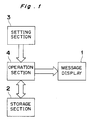
- This peristaltic intravenous infusion pump as shown in Fig.
- a message display 1 as display means capable of displaying various types of messages
- a storage section 2 as storage means having a rewritable memory in which a plurality of application names are stored
- a setting section 3 as both selection means for selecting one from among the plurality of application names stored in the storage section 2 and setting means for instructing any rewrite of the contents of the storage section 2
- an operation section 4 for accessing the storage section 2 for an application name selected by the setting section 3 and allowing the application name to be displayed on the message display 1 or for rewriting the storage contents of the storage section 2 in response to an instruction of the setting section 3.
- the display of these application names onto the message display 1 is effected by selecting an application name corresponding to the setting contents with the setting section 3 when a biomedical engineer or serviceman of the hospital sets the maximum fluid infusion rate and others.
- the application name selected will be displayed on the message display 1, for example when the power for the pump is turned ON or while the power is OFF or when a specific key is operated, as required. Accordingly, it is possible for the doctor or nurse who actually uses the peristaltic intravenous infusion pump to know what purpose the pump has been set for by viewing the application name displayed on the message display 1, thereby facilitating correct setting for the selected application when he or she uses the pump. Also, it is possible to prevent misuse of the pump, such as putting the pump set for adults into use for infants. Moreover, the storage contents of the storage section 2 can be rewritten with the setting section 3, allowing the pump to be applied to a variety of applications in a simple manner.
- the peristaltic intravenous infusion pump of this embodiment has a message display 23 as a display means capable of displaying various types of messages, and a storage section 24, as a setting storage means having a rewritable memory.
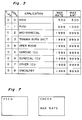
- the storage section 24 has a first storage area 25 (referred to as a pump-related set data storage area below) which stores therein set data that has been set with respect to the pump, and a second storage area 26 (referred to as an application-related set data storage area below) which stores therein a plurality of application names and set data for each application name.
- the peristaltic intravenous infusion pump also has a key-input section 22 as both a selection means for selecting one from among the plurality of application names stored in the storage section 24 and a setting means for instructing the rewrite of the contents of the storage section 24, and a CPU 21 as a decision means for accessing the storage section 24 for the application name selected by the key-input section 22 and displaying it onto the message display 23, or rewriting the contents of the storage section 24 in response to an instruction from the key-input section 22, or comparing the settings of the pump-related set data storage area 25 with those of the application-related set data storage area 26.
- FIG. 4 An example of set data of the pump-related set data storage area 25 and that of the application-related set data storage area 26 are shown in Fig. 4 and Fig. 3, respectively.
- Fig. 3 has only the settings of the maximum fluid infusion rate and the maximum volume to be infused with respect to each application, it is also possible to further set the occlusion sensing level, air bubble detection size, and the like.
- step A0 succeeded by step A1, message data corresponding to the code 0 is displayed onto the message display 23.
- step A2 it is decided at step A2 whether the application name is changed or not.
- step A3 an application name is inputted through the key-input section 22; message data (application name) corresponding to the code in Fig. 3 is rewritten and saved; and the rewritten application name is displayed onto the display.
- step A4 the maximum fluid infusion rate and the maximum volume to be infused corresponding to the application displayed on the display 23 are inputted in sequence through the key-input section 22, and the set data in Fig. 3 is rewritten and saved. Subsequently at step A5, it is decided whether or not the processing from step A1 to step A4 is completed for all the codes; if not, then at step A6, 1 is added to the code, the processing from step A1 to step A4 is repeated with respect to the resulting code.
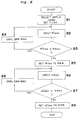
- step B1 message data (application name) is selected by selecting a code shown in Fig. 3 through the key-input section 22, a flag indicating the selection being set. Then at step B2, a maximum fluid infusion rate R'max to be set is inputted through the key-input section 22.
- a specific key e.g. PANEL-LOCK or STOP key
- step B3 it is decided whether or not the value R'max inputted at step B2 is greater than a maximum fluid infusion rate Rmax for the application to which the flag is set (selected).
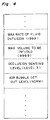
- the sequence goes to step B4, where such an error message as shown in Fig. 7 is displayed onto the message display 23.
- the input value R'max is decided to be appropriate for the application.
- the input value is saved into the pump-related set data storage area 25 (RAM).
- step B6 to B9 is effected in the same manner as in the processing from B2 to B5 with the maximum fluid infusion rate.
- A'max is a maximum volume to be infused inputted through the key input 22 be set and Amax is a maximum volume to be infused for an application selected.
- the display of any selected application name it is possible to display it onto the message display 23 as required, for example when the power for the pump is turned ON, or while the power is OFF, or when a specific key is operated. Accordingly, if a desired application name is being displayed, it is unnecessary to verify the settings when the pump is put into use, as in the first embodiment of the present invention, and moreover any misuse of the pump can be prevented beforehand.
- the peristaltic intravenous infusion pump of this embodiment has a message display 33 capable of displaying various types of messages, and a storage section 34 as a setting storage means having a rewritable memory.
- the storage section 34 has a first storage area (referred to as a pump-related set data storage area below) 35, which stores therein set data that has been set with respect to the pump, and a second storage area (referred to as an application-related set data storage area below) 36, which stores therein a plurality of application names and set data for each application name.
- the peristaltic intravenous infusion pump also has a communication circuit 37 and an interface (I/F) 38 as a communication means necessary for communication between the pump and an external computer 39, a key-input section 32 as a setting means which can put the peristaltic intravenous infusion pump into a communication mode with the external computer 39, and a CPU 31 as data processing means for rewriting the contents of the pump-related and application-related set data storage areas 35 and 36 in response to an instruction from the external computer 39, or comparing the data received from the external computer 39 with the settings of the storage areas 35 and 36, or transmitting data within the storage section 34 to the external computer 39.
- I/F interface
- the storage section 34 being identical with the storage section 24 of the second embodiment, set data as exemplified in Fig. 4 and Fig. 3 are stored in the storage areas 35 and 36.
- the pump is brought into the communication mode through the key-input section 32.
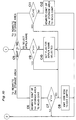
- the CPU 31 checks the power supply for the pump at step C1. If the power is OFF, the processing is terminated; otherwise, at the next step C2, it is checked whether or not any command has been received from the external computer 39. If no command has yet been received, step C1 and step C2 are repeatedly executed. If some command has been received, the CPU 31 goes to step C3, where it is decided whether the received command is a "reference" command for causing the CPU 31 to refer to the contents of the storage section 34 or a "set" command for causing the CPU 31 to rewrite the contents of the storage section 34.
- step C4 If the received command is the "reference" command, the CPU 31 goes to step C4, where it reads set data from the pump-related set data storage area 35 and the application-related set data storage area 36 within the storage section 34, and writes the read contents into the communication circuit 37, thereby transmitting it to the external computer 39.
- step C5 it is decided whether the "set" command is one that leads to the rewrite of the second storage area 36 or another that leads to the selection of an application name, or yet another that leads to the rewrite of the first storage area 35. In compliance with the decision result, the CPU 31 goes to step C6, C9, or C11 for each case.
- step C6 set data, as shown in Fig. 3, that is stored in the application-related set data storage area 36 is rewritten into data received from the external computer 39. Then at step C7, a comparison is made between the settings (represented by V here) such as the maximum fluid infusion rate and the maximum volume to be infused for an application being currently selected by the pump and the current settings (represented by V' here) such as the maximum fluid infusion rate and the maximum volume to be infused for the pump.
- V the settings
- V' the current settings
- step C8 the contents of the inconsistency or the like are transmitted as an error message to the external computer 39, returning to step C1. If there is no inconsistency, the CPU 31 returns to step C1.
- a comparison is made between the settings (represented by V1 here) such as the maximum fluid infusion rate and the maximum volume to be infused for an application that is about to be selected by the external computer 39 and the current settings (represented by V1' here) such as the maximum fluid infusion rate and the maximum volume to be infused for the pump.
- step C8 the contents of the inconsistency or the like are transmitted as an error message to the external computer 39, returning to step C1. If there is no inconsistency, the CPU 31 goes to step C10, where the application name selected by the external computer 39 is selected and set (a flag (shown in Fig. 3) corresponding to the selected application is set), returning to step C1.
- step C11 a comparison is made between the settings (represented by V'2 here) of the maximum fluid infusion rate and the maximum volume to be infused that the external computer 39 is about to set to the pump-related set data storage area 35 and the settings (represented by V2 here) of the maximum fluid infusion rate and the maximum volume to be infused for the application currently selected.
- step C8 the contents of the inconsistency or the like are transmitted as an error message to the external computer 39, returning to step C1. If there is no inconsistency, the CPU 31 goes to step C12, where set data as shown in Fig. 4 stored in the pump-related set data storage area 35 is rewritten into the data received from the external computer 39, returning to step C1.
- the external computer 39 allows the settings such as the maximum fluid infusion rate and the maximum volume to be infused to be changed or inputted therethrough, it is unnecessary to treat the peristaltic intravenous infusion pump to execute change or input of the settings. Also, connecting a plurality of peristaltic intravenous infusion pumps with the external computer 39 allows the settings for every pump to be changed or inputted at the same time; otherwise, even if the settings are changed or inputted for each one unit of the peristaltic intravenous infusion pumps, the same settings can be ensured with simplicity. Further, it is also made feasible to remotely control the pumps installed in respective hospital rooms by means of the external computer 39 installed in the nurse station. Moreover, inhibiting change and input of the settings from the key-input section 32 will serve to prevent the settings from being changed by any unauthorized person.
Landscapes
- Health & Medical Sciences (AREA)
- Vascular Medicine (AREA)
- Engineering & Computer Science (AREA)
- Anesthesiology (AREA)
- Biomedical Technology (AREA)
- Heart & Thoracic Surgery (AREA)
- Hematology (AREA)
- Life Sciences & Earth Sciences (AREA)
- Animal Behavior & Ethology (AREA)
- General Health & Medical Sciences (AREA)
- Public Health (AREA)
- Veterinary Medicine (AREA)
- Infusion, Injection, And Reservoir Apparatuses (AREA)
Claims (8)
- Peristaltische intravenöse Infusionspumpe mit- einer Anzeige (1, 23, 33);- einem Speicher (2, 24, 34) zum Einspeichern mehrerer Anwendungsnamen, die verschiedenen medizinischen Vorgängen entsprechen, und zugehöriger, voreingestellter infusionsbezogener Parameterwerte der Pumpe wie der maximalen Flüssigkeitsinfusionsrate und dem maximalen Infusionsvolumen;- einer Einrichtung zum Anzeigen des Namens der aktuell ausgewählten Anwendung auf der Anzeige sowie der ihr zugehörigen voreingestellten Paramterwerte, auf die anfängliche Aktivierung der Pumpe hin, so daß die Bedienperson unmittelbar visuell den Zweck, den Ort und die voreingestellten Parameterwerte der Pumpe klarstellen kann;- einer Eingabevorrichtung (22, 32), mit der die Bedienperson jeden der mehreren Anwendungsnamen auswählen kann und die zugehörigen, voreingestellten, infusionsbezogenen Parameterwerte wahlweise modifizieren kann;- einer Entscheidungseinrichtung (21) zum automatischen Sicherstellen, daß die wahlweise modifizierten Parameterwerte innerhalb eines vorgegebenen Bereichs liegen; und- einer Steuereinrichtung (118) zum Betreiben der Infusionspumpe entsprechend den infusionsbezogenen Parameterwerten, wie sie der aktuell ausgewählten Anwendung zugeordnet sind.
- Peristaltische intravenöse Infusionspumpe nach Anspruch 1, ferner mit:- einer Einstellspeichereinrichtung zum Einspeichern der modifizierten, durch die Eingabevorrichtung eingegebenen Parameterwerte für jeden der verschiedenen medizinischen Vorgänge, entsprechend den Anwendungsnamen; und- wobei die Entscheidungseinrichtung eine Einrichtung für folgendes aufweist: Auslesen der voreingestellten Parameterwerte aus dem Speicher, entsprechend der ausgewählten Anwendung, Vergleichen der voreingestellten Parameterwerte mit den modifizierten, persönlichen Parameterwerten und Entscheiden, ob die modifizierten Parameterwerte innerhalb des vorgegebenen Bereichs für den ausgewählten Anwendungsnamen liegen oder nicht.
- Peristaltische intravenöse Infusionspumpe nach Anspruch 2, ferner mit:- einer Kommunikationseinrichtung zum Austauschen von Daten einschließlich infusionsbezogener Pumpenparameterwerte und entsprechender Anwendungsnamen mit einer externen Steuereinheit; und- einer Datenverarbeitungseinrichtung, die auf eine von der externen Steuereinheit über die Kommunikationseinrichtung empfangene Anweisung hin die voreingestellten Parameterwerte und die Anwendungsnamen, wie im Speicher abgespeichert, über die Kommunikationseinrichtung an die externe Steuereinheit überträgt und die voreingestellten Parameterwerte und die Anwendungsnamen auf Grundlage von von der externen Steuereinheit empfangenen Daten modifiziert.
- Peristaltische intravenöse Infusionspumpe nach Anspruch 1, bei der die anfängliche Aktivierung der Pumpe das Anlegen von Spannung an die Pumpe umfaßt.
- Peristaltische intravenöse Infusionspumpe nach Anspruch 1, bei der die anfängliche Aktivierung der Pumpe die Betätigung eines Schalters oder Schlüssels an der Eingabevorrichtung durch die Bedienperson umfaßt.
- Peristaltische intravenöse Infusionspumpe nach Anspruch 1, bei der jedem im Speicher abgespeicherten Anwendungsnamen ein entsprechender Code zugeordnet ist und eine spezielle maximale Flüssigkeitsinfusionsrate und ein maximales Infusionsvolumen in Zuordnung zu diesem Anwendungsnamen vorhanden sind.
- Peristaltische intravenöse Infusionspumpe nach Anspruch 6, bei der die Bedienperson einen Anwendungsnamen dadurch auswählen kann, daß sie den zugehörigen Code über die Eingabevorrichtung auswählt.
- Peristaltische intravenöse Infusionspumpe nach Anspruch 2, ferner mit einer Einrichtung zum Erzeugen einer Fehlermeldung, wenn die Entscheidungseinrichtung entscheidet, daß die modifizierten Parameterwerte außerhalb des für den ausgewählten Anwendungsnamen bestimmten Bereichs liegen.
Applications Claiming Priority (4)
| Application Number | Priority Date | Filing Date | Title |
|---|---|---|---|
| JP49898/91 | 1991-03-14 | ||
| JP4989891 | 1991-03-14 | ||
| JP46776/92 | 1992-03-04 | ||
| JP4046776A JPH05168708A (ja) | 1991-03-14 | 1992-03-04 | 輸液注入ポンプ |
Publications (3)
| Publication Number | Publication Date |
|---|---|
| EP0503670A2 EP0503670A2 (de) | 1992-09-16 |
| EP0503670A3 EP0503670A3 (en) | 1993-02-03 |
| EP0503670B1 true EP0503670B1 (de) | 1996-05-22 |
Family
ID=26386897
Family Applications (1)
| Application Number | Title | Priority Date | Filing Date |
|---|---|---|---|
| EP92104412A Expired - Lifetime EP0503670B1 (de) | 1991-03-14 | 1992-03-13 | Peristaltische intravenöse Infusionspumpe mit Anzeige einer gewählten Anwendung |
Country Status (2)
| Country | Link |
|---|---|
| EP (1) | EP0503670B1 (de) |
| DE (1) | DE69210873T2 (de) |
Cited By (8)
| Publication number | Priority date | Publication date | Assignee | Title |
|---|---|---|---|---|
| US7347836B2 (en) | 1992-09-09 | 2008-03-25 | Smiths Medical, Inc. | Drug pump systems and methods |
| US7934912B2 (en) | 2007-09-27 | 2011-05-03 | Curlin Medical Inc | Peristaltic pump assembly with cassette and mounting pin arrangement |
| US8062008B2 (en) | 2007-09-27 | 2011-11-22 | Curlin Medical Inc. | Peristaltic pump and removable cassette therefor |
| US8083503B2 (en) | 2007-09-27 | 2011-12-27 | Curlin Medical Inc. | Peristaltic pump assembly and regulator therefor |
| US8858526B2 (en) | 2006-08-03 | 2014-10-14 | Smiths Medical Asd, Inc. | Interface for medical infusion pump |
| US8952794B2 (en) | 2006-08-03 | 2015-02-10 | Smiths Medical Asd, Inc. | Interface for medical infusion pump |
| US8954336B2 (en) | 2004-02-23 | 2015-02-10 | Smiths Medical Asd, Inc. | Server for medical device |
| US8965707B2 (en) | 2006-08-03 | 2015-02-24 | Smiths Medical Asd, Inc. | Interface for medical infusion pump |
Families Citing this family (12)
| Publication number | Priority date | Publication date | Assignee | Title |
|---|---|---|---|---|
| JPH06509265A (ja) * | 1992-05-26 | 1994-10-20 | バクスター、インターナショナル、インコーポレイテッド | Eepromを使用する注入ポンプ構成スキーム |
| WO1995002426A1 (en) * | 1993-07-13 | 1995-01-26 | Sims Deltec, Inc. | Medical pump and method of programming |
| US5685844A (en) * | 1995-01-06 | 1997-11-11 | Abbott Laboratories | Medicinal fluid pump having multiple stored protocols |
| US5782805A (en) * | 1996-04-10 | 1998-07-21 | Meinzer; Randolph | Medical infusion pump |
| US6012034A (en) * | 1997-08-18 | 2000-01-04 | Becton, Dickinson And Company | System and method for selecting an intravenous device |
| US8504179B2 (en) * | 2002-02-28 | 2013-08-06 | Smiths Medical Asd, Inc. | Programmable medical infusion pump |
| US8133197B2 (en) | 2008-05-02 | 2012-03-13 | Smiths Medical Asd, Inc. | Display for pump |
| CN105073159A (zh) | 2013-01-28 | 2015-11-18 | 史密斯医疗Asd公司 | 用药安全设备及方法 |
| EP3007744B1 (de) | 2013-06-14 | 2021-11-10 | Bayer Healthcare LLC | Tragbares flüssigkeitsabgabesystem |
| EP3092017B1 (de) | 2014-01-10 | 2024-07-17 | Bayer Healthcare LLC | Voreingestellte verbinder zur einmaligen verwendung |
| KR102709324B1 (ko) | 2015-01-09 | 2024-09-25 | 바이엘 헬쓰케어 엘엘씨 | 다회 사용 1회용 세트를 갖는 다중 유체 전달 시스템 및 그 특징부 |
| CN109328080B (zh) | 2016-06-15 | 2021-08-24 | 拜耳医药保健有限公司 | 多次使用可丢弃系统及其针筒 |
Citations (3)
| Publication number | Priority date | Publication date | Assignee | Title |
|---|---|---|---|---|
| US4624661A (en) * | 1982-11-16 | 1986-11-25 | Surgidev Corp. | Drug dispensing system |
| FR2603488A1 (fr) * | 1986-09-04 | 1988-03-11 | Cupissol Didier | Dispositif programmable et a fonctionnement autonome pour distribuer des substances liquides medicamenteuses dans le corps d'un patient |
| EP0319268A2 (de) * | 1987-12-04 | 1989-06-07 | IVAC MEDICAL SYSTEMS, Inc. | Anordnung eines Multimoden-Medikamenteninfusionssystems für klinische Zwecke |
Family Cites Families (3)
| Publication number | Priority date | Publication date | Assignee | Title |
|---|---|---|---|---|
| SE432054B (sv) * | 1982-09-10 | 1984-03-19 | Anders Tamsen | Programmerbart injektions-och infusionsaggregat |
| EP0192786B1 (de) * | 1985-02-18 | 1990-02-07 | Medrad Incorporated | Angiographischer Injektor mit einer Steuereinheit |
| DE3905350A1 (de) * | 1989-02-22 | 1990-09-06 | Braun Melsungen Ag | Medizintechnisches geraet mit redundant aufgebauter steuereinheit zur infusionstherapie oder blutbehandlung |
-
1992
- 1992-03-13 DE DE1992610873 patent/DE69210873T2/de not_active Expired - Lifetime
- 1992-03-13 EP EP92104412A patent/EP0503670B1/de not_active Expired - Lifetime
Patent Citations (3)
| Publication number | Priority date | Publication date | Assignee | Title |
|---|---|---|---|---|
| US4624661A (en) * | 1982-11-16 | 1986-11-25 | Surgidev Corp. | Drug dispensing system |
| FR2603488A1 (fr) * | 1986-09-04 | 1988-03-11 | Cupissol Didier | Dispositif programmable et a fonctionnement autonome pour distribuer des substances liquides medicamenteuses dans le corps d'un patient |
| EP0319268A2 (de) * | 1987-12-04 | 1989-06-07 | IVAC MEDICAL SYSTEMS, Inc. | Anordnung eines Multimoden-Medikamenteninfusionssystems für klinische Zwecke |
Cited By (8)
| Publication number | Priority date | Publication date | Assignee | Title |
|---|---|---|---|---|
| US7347836B2 (en) | 1992-09-09 | 2008-03-25 | Smiths Medical, Inc. | Drug pump systems and methods |
| US8954336B2 (en) | 2004-02-23 | 2015-02-10 | Smiths Medical Asd, Inc. | Server for medical device |
| US8858526B2 (en) | 2006-08-03 | 2014-10-14 | Smiths Medical Asd, Inc. | Interface for medical infusion pump |
| US8952794B2 (en) | 2006-08-03 | 2015-02-10 | Smiths Medical Asd, Inc. | Interface for medical infusion pump |
| US8965707B2 (en) | 2006-08-03 | 2015-02-24 | Smiths Medical Asd, Inc. | Interface for medical infusion pump |
| US7934912B2 (en) | 2007-09-27 | 2011-05-03 | Curlin Medical Inc | Peristaltic pump assembly with cassette and mounting pin arrangement |
| US8062008B2 (en) | 2007-09-27 | 2011-11-22 | Curlin Medical Inc. | Peristaltic pump and removable cassette therefor |
| US8083503B2 (en) | 2007-09-27 | 2011-12-27 | Curlin Medical Inc. | Peristaltic pump assembly and regulator therefor |
Also Published As
| Publication number | Publication date |
|---|---|
| EP0503670A2 (de) | 1992-09-16 |
| EP0503670A3 (en) | 1993-02-03 |
| DE69210873D1 (de) | 1996-06-27 |
| DE69210873T2 (de) | 1997-01-16 |
Similar Documents
| Publication | Publication Date | Title |
|---|---|---|
| EP0503670B1 (de) | Peristaltische intravenöse Infusionspumpe mit Anzeige einer gewählten Anwendung | |
| US7471994B2 (en) | Infusion pump with an electronically loadable drug library and label reader | |
| EP0837708B1 (de) | Medizinische infusionspumpe | |
| EP1855737B1 (de) | System und verfahren zur steuerung des zugriffs auf funktionen eines medizinischen instruments | |
| US7347836B2 (en) | Drug pump systems and methods | |
| JPH11501529A (ja) | 複数の記憶プロトコルを有する医療用流体ポンプ | |
| JPH05168708A (ja) | 輸液注入ポンプ | |
| AU744398B2 (en) | Medical infusion pump | |
| AU660826B2 (en) | Infusion pump configuration scheme using eeproms | |
| GB2342188A (en) | Infusion pump |
Legal Events
| Date | Code | Title | Description |
|---|---|---|---|
| PUAI | Public reference made under article 153(3) epc to a published international application that has entered the european phase |
Free format text: ORIGINAL CODE: 0009012 |
|
| AK | Designated contracting states |
Kind code of ref document: A2 Designated state(s): DE FR GB |
|
| PUAL | Search report despatched |
Free format text: ORIGINAL CODE: 0009013 |
|
| AK | Designated contracting states |
Kind code of ref document: A3 Designated state(s): DE FR GB |
|
| 17P | Request for examination filed |
Effective date: 19930318 |
|
| 17Q | First examination report despatched |
Effective date: 19940912 |
|
| GRAH | Despatch of communication of intention to grant a patent |
Free format text: ORIGINAL CODE: EPIDOS IGRA |
|
| GRAA | (expected) grant |
Free format text: ORIGINAL CODE: 0009210 |
|
| AK | Designated contracting states |
Kind code of ref document: B1 Designated state(s): DE FR GB |
|
| ET | Fr: translation filed | ||
| REF | Corresponds to: |
Ref document number: 69210873 Country of ref document: DE Date of ref document: 19960627 |
|
| PLBE | No opposition filed within time limit |
Free format text: ORIGINAL CODE: 0009261 |
|
| STAA | Information on the status of an ep patent application or granted ep patent |
Free format text: STATUS: NO OPPOSITION FILED WITHIN TIME LIMIT |
|
| 26N | No opposition filed | ||
| REG | Reference to a national code |
Ref country code: GB Ref legal event code: IF02 |
|
| PGFP | Annual fee paid to national office [announced via postgrant information from national office to epo] |
Ref country code: FR Payment date: 20110217 Year of fee payment: 20 |
|
| PGFP | Annual fee paid to national office [announced via postgrant information from national office to epo] |
Ref country code: GB Payment date: 20110309 Year of fee payment: 20 Ref country code: DE Payment date: 20110329 Year of fee payment: 20 |
|
| REG | Reference to a national code |
Ref country code: DE Ref legal event code: R071 Ref document number: 69210873 Country of ref document: DE |
|
| REG | Reference to a national code |
Ref country code: DE Ref legal event code: R071 Ref document number: 69210873 Country of ref document: DE |
|
| REG | Reference to a national code |
Ref country code: GB Ref legal event code: PE20 Expiry date: 20120312 |
|
| PG25 | Lapsed in a contracting state [announced via postgrant information from national office to epo] |
Ref country code: DE Free format text: LAPSE BECAUSE OF EXPIRATION OF PROTECTION Effective date: 20120314 |
|
| PG25 | Lapsed in a contracting state [announced via postgrant information from national office to epo] |
Ref country code: GB Free format text: LAPSE BECAUSE OF EXPIRATION OF PROTECTION Effective date: 20120312 |