EP0502301B1 - Composition and method of making high porosity, high strength compositions - Google Patents
Composition and method of making high porosity, high strength compositions Download PDFInfo
- Publication number
- EP0502301B1 EP0502301B1 EP92101127A EP92101127A EP0502301B1 EP 0502301 B1 EP0502301 B1 EP 0502301B1 EP 92101127 A EP92101127 A EP 92101127A EP 92101127 A EP92101127 A EP 92101127A EP 0502301 B1 EP0502301 B1 EP 0502301B1
- Authority
- EP
- European Patent Office
- Prior art keywords
- silica
- composition
- fluorine
- parts
- weight
- Prior art date
- Legal status (The legal status is an assumption and is not a legal conclusion. Google has not performed a legal analysis and makes no representation as to the accuracy of the status listed.)
- Expired - Lifetime
Links
- 239000000203 mixture Substances 0.000 title claims abstract description 60
- 238000004519 manufacturing process Methods 0.000 title description 2
- VYPSYNLAJGMNEJ-UHFFFAOYSA-N Silicium dioxide Chemical compound O=[Si]=O VYPSYNLAJGMNEJ-UHFFFAOYSA-N 0.000 claims abstract description 154
- 239000000377 silicon dioxide Substances 0.000 claims abstract description 74
- 239000002253 acid Substances 0.000 claims abstract description 41
- YCKRFDGAMUMZLT-UHFFFAOYSA-N Fluorine atom Chemical compound [F] YCKRFDGAMUMZLT-UHFFFAOYSA-N 0.000 claims abstract description 31
- 239000011737 fluorine Substances 0.000 claims abstract description 31
- 229910052731 fluorine Inorganic materials 0.000 claims abstract description 31
- 239000011148 porous material Substances 0.000 claims abstract description 26
- 238000000034 method Methods 0.000 claims abstract description 24
- 239000003054 catalyst Substances 0.000 claims abstract description 20
- KRHYYFGTRYWZRS-UHFFFAOYSA-N Fluorane Chemical compound F KRHYYFGTRYWZRS-UHFFFAOYSA-N 0.000 claims description 32
- 238000001354 calcination Methods 0.000 claims description 17
- 150000001875 compounds Chemical class 0.000 claims description 14
- -1 silica compound Chemical class 0.000 claims description 11
- XLYOFNOQVPJJNP-UHFFFAOYSA-N water Substances O XLYOFNOQVPJJNP-UHFFFAOYSA-N 0.000 claims description 10
- 238000002156 mixing Methods 0.000 claims description 9
- 239000008240 homogeneous mixture Substances 0.000 claims description 7
- QVGXLLKOCUKJST-UHFFFAOYSA-N atomic oxygen Chemical compound [O] QVGXLLKOCUKJST-UHFFFAOYSA-N 0.000 claims description 4
- 239000007789 gas Substances 0.000 claims description 4
- 239000001301 oxygen Substances 0.000 claims description 4
- 229910052760 oxygen Inorganic materials 0.000 claims description 4
- 238000000465 moulding Methods 0.000 claims description 3
- 238000005453 pelletization Methods 0.000 claims description 3
- 238000003825 pressing Methods 0.000 claims description 3
- 230000008569 process Effects 0.000 claims description 3
- 239000002245 particle Substances 0.000 claims description 2
- UFHFLCQGNIYNRP-UHFFFAOYSA-N Hydrogen Chemical compound [H][H] UFHFLCQGNIYNRP-UHFFFAOYSA-N 0.000 claims 2
- DWYMPOCYEZONEA-UHFFFAOYSA-N fluorophosphoric acid Chemical compound OP(O)(F)=O DWYMPOCYEZONEA-UHFFFAOYSA-N 0.000 claims 2
- 229960005051 fluostigmine Drugs 0.000 claims 2
- 239000001257 hydrogen Substances 0.000 claims 2
- 229910052739 hydrogen Inorganic materials 0.000 claims 2
- 239000000463 material Substances 0.000 abstract description 32
- 230000000704 physical effect Effects 0.000 abstract description 11
- 230000003197 catalytic effect Effects 0.000 abstract description 4
- 239000007864 aqueous solution Substances 0.000 description 14
- 239000000243 solution Substances 0.000 description 14
- QPJSUIGXIBEQAC-UHFFFAOYSA-N n-(2,4-dichloro-5-propan-2-yloxyphenyl)acetamide Chemical compound CC(C)OC1=CC(NC(C)=O)=C(Cl)C=C1Cl QPJSUIGXIBEQAC-UHFFFAOYSA-N 0.000 description 11
- 238000001125 extrusion Methods 0.000 description 10
- PNEYBMLMFCGWSK-UHFFFAOYSA-N aluminium oxide Inorganic materials [O-2].[O-2].[O-2].[Al+3].[Al+3] PNEYBMLMFCGWSK-UHFFFAOYSA-N 0.000 description 7
- 239000005909 Kieselgur Substances 0.000 description 6
- 238000005054 agglomeration Methods 0.000 description 6
- 230000002776 aggregation Effects 0.000 description 6
- 238000004458 analytical method Methods 0.000 description 5
- 239000011230 binding agent Substances 0.000 description 5
- 239000000126 substance Substances 0.000 description 5
- 230000000694 effects Effects 0.000 description 4
- 229910052751 metal Inorganic materials 0.000 description 4
- 239000002184 metal Substances 0.000 description 4
- XEEYBQQBJWHFJM-UHFFFAOYSA-N Iron Chemical compound [Fe] XEEYBQQBJWHFJM-UHFFFAOYSA-N 0.000 description 3
- 229910052593 corundum Inorganic materials 0.000 description 3
- 238000001035 drying Methods 0.000 description 3
- 230000006872 improvement Effects 0.000 description 3
- 235000012239 silicon dioxide Nutrition 0.000 description 3
- 238000007655 standard test method Methods 0.000 description 3
- 238000012360 testing method Methods 0.000 description 3
- 229910001845 yogo sapphire Inorganic materials 0.000 description 3
- 239000010457 zeolite Substances 0.000 description 3
- KKCBUQHMOMHUOY-UHFFFAOYSA-N Na2O Inorganic materials [O-2].[Na+].[Na+] KKCBUQHMOMHUOY-UHFFFAOYSA-N 0.000 description 2
- GWEVSGVZZGPLCZ-UHFFFAOYSA-N Titan oxide Chemical compound O=[Ti]=O GWEVSGVZZGPLCZ-UHFFFAOYSA-N 0.000 description 2
- 230000008901 benefit Effects 0.000 description 2
- 230000015572 biosynthetic process Effects 0.000 description 2
- 239000000460 chlorine Substances 0.000 description 2
- 239000004927 clay Substances 0.000 description 2
- 229910052681 coesite Inorganic materials 0.000 description 2
- 229910052906 cristobalite Inorganic materials 0.000 description 2
- 239000006185 dispersion Substances 0.000 description 2
- 239000000017 hydrogel Substances 0.000 description 2
- 239000012535 impurity Substances 0.000 description 2
- 229910052500 inorganic mineral Inorganic materials 0.000 description 2
- QSHDDOUJBYECFT-UHFFFAOYSA-N mercury Chemical compound [Hg] QSHDDOUJBYECFT-UHFFFAOYSA-N 0.000 description 2
- 229910052753 mercury Inorganic materials 0.000 description 2
- 229910044991 metal oxide Inorganic materials 0.000 description 2
- 150000004706 metal oxides Chemical class 0.000 description 2
- 238000002459 porosimetry Methods 0.000 description 2
- 229910052682 stishovite Inorganic materials 0.000 description 2
- 238000010998 test method Methods 0.000 description 2
- 229910052905 tridymite Inorganic materials 0.000 description 2
- QTZBTBLHYPSFMG-UHFFFAOYSA-N 5-chloro-3-methylpyridin-2-amine Chemical compound CC1=CC(Cl)=CN=C1N QTZBTBLHYPSFMG-UHFFFAOYSA-N 0.000 description 1
- OYPRJOBELJOOCE-UHFFFAOYSA-N Calcium Chemical compound [Ca] OYPRJOBELJOOCE-UHFFFAOYSA-N 0.000 description 1
- ZAMOUSCENKQFHK-UHFFFAOYSA-N Chlorine atom Chemical compound [Cl] ZAMOUSCENKQFHK-UHFFFAOYSA-N 0.000 description 1
- 229910003708 H2TiF6 Inorganic materials 0.000 description 1
- 229910004039 HBF4 Inorganic materials 0.000 description 1
- 229910004713 HPF6 Inorganic materials 0.000 description 1
- 229910004698 HPO2F2 Inorganic materials 0.000 description 1
- DGAQECJNVWCQMB-PUAWFVPOSA-M Ilexoside XXIX Chemical compound C[C@@H]1CC[C@@]2(CC[C@@]3(C(=CC[C@H]4[C@]3(CC[C@@H]5[C@@]4(CC[C@@H](C5(C)C)OS(=O)(=O)[O-])C)C)[C@@H]2[C@]1(C)O)C)C(=O)O[C@H]6[C@@H]([C@H]([C@@H]([C@H](O6)CO)O)O)O.[Na+] DGAQECJNVWCQMB-PUAWFVPOSA-M 0.000 description 1
- QAOWNCQODCNURD-UHFFFAOYSA-L Sulfate Chemical compound [O-]S([O-])(=O)=O QAOWNCQODCNURD-UHFFFAOYSA-L 0.000 description 1
- 229910021536 Zeolite Inorganic materials 0.000 description 1
- 238000010306 acid treatment Methods 0.000 description 1
- 150000007513 acids Chemical class 0.000 description 1
- 238000013459 approach Methods 0.000 description 1
- 239000011260 aqueous acid Substances 0.000 description 1
- 239000011575 calcium Substances 0.000 description 1
- 229910052791 calcium Inorganic materials 0.000 description 1
- 230000015556 catabolic process Effects 0.000 description 1
- 229910052801 chlorine Inorganic materials 0.000 description 1
- 239000000470 constituent Substances 0.000 description 1
- 238000006731 degradation reaction Methods 0.000 description 1
- 238000009792 diffusion process Methods 0.000 description 1
- KFULUWWEYQSBCP-UHFFFAOYSA-N difluorophosphinic acid;hydrate Chemical compound O.OP(F)(F)=O.OP(F)(F)=O KFULUWWEYQSBCP-UHFFFAOYSA-N 0.000 description 1
- HNPSIPDUKPIQMN-UHFFFAOYSA-N dioxosilane;oxo(oxoalumanyloxy)alumane Chemical compound O=[Si]=O.O=[Al]O[Al]=O HNPSIPDUKPIQMN-UHFFFAOYSA-N 0.000 description 1
- 238000009826 distribution Methods 0.000 description 1
- 238000005516 engineering process Methods 0.000 description 1
- 229910000040 hydrogen fluoride Inorganic materials 0.000 description 1
- 238000005342 ion exchange Methods 0.000 description 1
- 229910052742 iron Inorganic materials 0.000 description 1
- JEIPFZHSYJVQDO-UHFFFAOYSA-N iron(III) oxide Inorganic materials O=[Fe]O[Fe]=O JEIPFZHSYJVQDO-UHFFFAOYSA-N 0.000 description 1
- 230000001788 irregular Effects 0.000 description 1
- 238000004898 kneading Methods 0.000 description 1
- 150000002739 metals Chemical class 0.000 description 1
- 239000011707 mineral Substances 0.000 description 1
- 238000012986 modification Methods 0.000 description 1
- 230000004048 modification Effects 0.000 description 1
- 239000008188 pellet Substances 0.000 description 1
- 230000035699 permeability Effects 0.000 description 1
- 239000006187 pill Substances 0.000 description 1
- 238000002360 preparation method Methods 0.000 description 1
- 238000012545 processing Methods 0.000 description 1
- 239000011734 sodium Substances 0.000 description 1
- 229910052708 sodium Inorganic materials 0.000 description 1
- PNGLEYLFMHGIQO-UHFFFAOYSA-M sodium;3-(n-ethyl-3-methoxyanilino)-2-hydroxypropane-1-sulfonate;dihydrate Chemical compound O.O.[Na+].[O-]S(=O)(=O)CC(O)CN(CC)C1=CC=CC(OC)=C1 PNGLEYLFMHGIQO-UHFFFAOYSA-M 0.000 description 1
- 239000007921 spray Substances 0.000 description 1
- 239000007858 starting material Substances 0.000 description 1
Images
Classifications
-
- B—PERFORMING OPERATIONS; TRANSPORTING
- B01—PHYSICAL OR CHEMICAL PROCESSES OR APPARATUS IN GENERAL
- B01J—CHEMICAL OR PHYSICAL PROCESSES, e.g. CATALYSIS OR COLLOID CHEMISTRY; THEIR RELEVANT APPARATUS
- B01J37/00—Processes, in general, for preparing catalysts; Processes, in general, for activation of catalysts
- B01J37/22—Halogenating
- B01J37/26—Fluorinating
-
- B—PERFORMING OPERATIONS; TRANSPORTING
- B01—PHYSICAL OR CHEMICAL PROCESSES OR APPARATUS IN GENERAL
- B01J—CHEMICAL OR PHYSICAL PROCESSES, e.g. CATALYSIS OR COLLOID CHEMISTRY; THEIR RELEVANT APPARATUS
- B01J21/00—Catalysts comprising the elements, oxides, or hydroxides of magnesium, boron, aluminium, carbon, silicon, titanium, zirconium, or hafnium
- B01J21/06—Silicon, titanium, zirconium or hafnium; Oxides or hydroxides thereof
- B01J21/08—Silica
Definitions
- This invention relates to silica compositions having high porosity and high crush strength.
- Silica is often used as an inert support material for active metal catalysts because of its high porosity and high total surface area. It is desirable to have a support material that has a high total surface area and high porosity in order to improve catalytic activity by providing for easy permeability and diffusion of reacting compounds within the pores of the catalyst support material.
- US 3,004,929 provides a process for the preparation and extrusion of silica-alumina catalyst supports. Silica and alumina are precipitated as a hydrogel from solution and filtered, purified by ion-exchange, and washed. After formation the hydrogel is extruded in the presence of a fluorine-containing compound, the extrusion requires a certain percentage of water.
- silica as a catalyst support is the inability to provide a pure silica support mass, without the use of a binder, that has sufficient crush strength to withstand process operating conditions without excessive degradation.
- a catalyst support with a low crush strength often is highly susceptible to attrition by chipping and fracture of the support surfaces.
- an object of this invention to provide a catalyst support composition having both a high crush strength and high porosity.
- a composition having a crush strength between 0,27 to 4,99 kg (0.6 to 11 pounds) and a pore volume between 0.71 to 1.8 milliliters per gram comprising silica is provided.
- a method for prod-icing a strength enhanced composition having a high porosity comprises mixing silica and an aqueous flourine-containing acid solution to form a homogeneous mixture, agglomerating said homogeneous mixture to form an agglomerate, and calcining said agglomerate to produce a formed silica compound.
- silica composition having unique physical properties can be produced.
- the silica composition as described herein has specific physical properties that provide for a material suitable for the support of active metal catalysts. Because of the unique physical properties of the silica composition, catalytic activity is enhanced due to its high porosity, and catalyst life is increased due to the high crush strength of the silica material.
- the starting silica material used as a component of this invention can be any suitable form of silica including, but not limited to, naturally occurring silicas, such as diatomaceous earth, which is also referred to as kieselguhr or diatomite or zeolite, and synthetic silicas, such as zeolites, high silica zeolites, precipitated or spray dried silicas or clay, and plasma-treated silica or clay.
- naturally occurring silicas such as diatomaceous earth, which is also referred to as kieselguhr or diatomite or zeolite
- synthetic silicas such as zeolites, high silica zeolites, precipitated or spray dried silicas or clay, and plasma-treated silica or clay.
- silica materials that can be used as a part of the inventive composition.
- One such silica is diatomaceous earth, which also contains impurities. Decause of the nature of diatomaceous earth, the types and amounts of impurities are highly variable and depend upon the source of the particular diatomaceous earth. Typical chemical analyses of a diatomaceous earth from various sources are given in Table I below as taken from the Encyclopedia of Chemical Technology, 3rd Edition, volume 7, page 606.
- diatomaceous earth is a mixture of metal oxides having a silica (SiO2) content of from about 87 weight percent to about 94 weight percent, and alumina (Al2O3) content of from about 2 weight percent to about 4 weight percent and numerous other trace quantities of metal oxides.
- SiO2 silica
- Al2O3 alumina
- a fluorine-containing acid solution is used as a binder to assist in the forming of a silica agglomerate and to treat the surface of the silica compound to provide a composition having a high crush strength, a suitably large pore volume and porosity.
- Any suitable fluorine-containing inorganic or mineral acid can be used which provides the desirable physical properties and which serves as an effective binder in the formation of a silica agglomerate.
- Such fluorine-containing inorganic mineral acids can, for example, comprise fluotitanic acid (H2TiF6), fluoboric acid (HBF4), fluophosphoric acid (H2PO3F), difluorophosphoric acid (HPO2F2), hexafluorophosphoric acid (HPF6), fluosilicic acid (H2SiF6), and hydrofluoric acid (HF).
- the preferred acid for use in this invention is hydrofluoric acid.
- any effective amount of fluorine-containing acid can be used to treat the silica material in order to provide the desired binding effect and to provide the desired crush strength and porosity.
- the fluorine-containing acid is utilized in the form of an aqueous solution of a fluorine-containing acid compound. Any suitable concentration of the aqueous solution can be used, but preferably, the concentration of the fluorine-containing acid compound in the aqueous solution will range from 1 to 4 parts by weight of the fluorine-containing acid compound per from 40 to 70 Parts by weight of water to form the aqueous solution.
- the aqueous solution will have a concentration in the range of from 2 to 3 parts by weight of the fluorine-containing acid compound per from 45 to 60 parts by weight of water.
- concentration range of the aqueous solution will be from 2 to 3 parts by weight of a fluorine-containing acid compound per from 50 to 55 parts by weight of water.
- the ratio of silica to aqueous solution will be between 30 and 60 parts by weight of silica per from 40 to 75 parts by weight of aqueous solution. Preferably, however, the ratio shall be from 35 to 55 parts by weight silica per 45 to 65 parts by weight of the aqueous solution. Most preferably, the ratio of silica to aqueous solution shall be from 40 to 50 parts by weight silica per from 50 to 60 parts by weight of aqueous solution.
- the fluorine-containing acid solution can be mixed with the silica by any suitable method that will provide for the desired degree of mixing.
- these components can be mixed in a batch-wise fashion or a continuous fashion provided that the components are thoroughly and intimately mixed prior to further processing.
- Suitable types of batch mixers include, but are not limited to, change-can mixers, stationary-tank mixers, double-arm kneading mixers having any suitable type of agitator or blades such as sigma blades, dispersion blades, multi-wiping overlap blades, single curve blades, double-nabin blades and the like.
- Suitable types of continuous mixers can include, but are not limited to, single or double screw extruders, trough-and-screw mixers and pugmils.
- the materials are mixed until a homogenous mixture is formed.
- the mixing time should be sufficient to give a uniform mixture and, generally, will be less than 45 minutes.
- the mixing time will be in the range from 2 minutes to 15 minutes.
- the treating of the silica material with a fluorine-containing acid aids in the agglomeration of a formed silica agglomerate and improves the physical strength and porosity of the agglomerate.
- the agglomeration step is utilized to provide a formed silica agglomerate in any desirable form such as spheroids, pills or tablets, cylinders, irregular extrusions or merely loosely bound agglomerates or clusters.
- Any suitable method of agglomeration known in the art can be used. Examples of such methods include, but are not limited to, molding, tabletting, pressing, pelletizing, extruding, and tumbling. The preferred method, however, is by extrusion. Any of the various types of extrusion methods and extrusion equipment known in the art can be used. It is preferred to use either a single screw extruder or a double screw extruder that uses a screw or auger to convey or force the treated silica material through a die plate to produce the desirable shapes or extrusion profiles.
- the thus formed agglomerate can then undergo a calcination step wherein the agglomerate is calcined in the presence of an oxygen-containing gas at a temperature suitable for achieving the desired degree, of calcination, for example, generally in the range of from 371°C (700°F) to 760°C (1400°F).
- the calcination temperature should range from 454°C (850°F) to 677°C (1250°F) and, most preferably, the calcination temperature should range from 482°C (900°F) to 635°C (1175°F).
- the calcination step is conducted for a period of time suitable for achieving the desired degree of calcination; but, generally, the time shall range from 0.5 hour to 4 hours. Most preferably, the calcination time shall range from 1 hour to 3 hours to produce the calcined agglomerate material.
- An optional embodiment of this invention is to utilize an additional agglomeration step which follows the earlier described agglomeration step or first agglomeration step. It has unexpectedly been discovered that by re-extruding an already extruded silica material, which has been previously treated with a fluorine-containing aqueous acid solution, the crush strength and pore volume of the finally formed composition will significantly and materially be improved over those properties of the composition that exists after the first extrusion step but prior to the second extrusion step.
- the composition of matter of this invention can have any suitable crush strength and pore volume.
- the crush strength shall range from 0,04 to 5,44 kg (0.1 to 12 pounds), preferably it shall range from 0,45 to 4,99 kg (1 to 11 pounds), more preferably 0.27 to 3.22 kg (0.6 to 7.1 pounds).
- the value representing "crush strength” is determined by the American Society for Testing Materials (ASTM) Standard Test Method D 4179-88A entitled “Standard Test Method for Single Pellet Crush Strength to Form Catalyst Shapes.” This standard ASTM test D 4179-88A is incorporated herein and made a part hereto by reference.
- any suitable pore volume can be, obtained by utilizing the novel features of this invention. It is desirable to have a large pore volume in order to enhance the catalyst activity of any of the catalyst metals that are supported by the composition of matter of this invention.
- the pore volume of the composition should be at least 0.3 cc/gm. Preferably, the pore volume should range from 0.3 to 2.0 cc/gm; and, most preferably, the pore volume should range from 0.71 to 1.8 cc/gm.
- pore volume is determined by the method of mercury intrusion porosimetry as completely described by the ASTM method D 4284-88 entitled “Standard Test Method for Determining Pore Volume Distribution of Catalyst by Mercury Intrusion Porosimetry.” This standard ASTM test method D 4284-88 is incorporated herein and made a part hereto by reference.
- the acid treating method described herein provides the unexpected results of improving the porosity and calcined crush strength of typical. silica materials.
- the crush strength of the silica composition can be significantly and materially improved over that of a silica mass that has not undergone the acid treatment.
- the utilization of acid treating of the composition provides for an improved pore volume over that which exists without acid treating. Improvements in both of these physical properties are desirable for providing an improved metal catalyst support material.
- a support material having high crush strength provides for a long lived and durable catalyst that can be used under severe operating services.
- a support having a high pore volume provides for enhanced catalytic activity.
- This example illustrates the novel method of preparing the novel composition of matter and the benefits which are achievable From utilizing a fluorine-containing acid for treating a silica compound to produce a composition having a high crush strength and high porosity.
- a formed silica particle was prepared by using hydrogen fluoride acid as a binder.
- a 1/8-inch diameter silica extrudate was formed by utilizing an aqueous HF acid solution followed by drying and calcining at different temperatures in order to determine the effect of calcination temperature upon pore volume and crush strength. The final calcined extrudates showed a better crush strength than that of the original material without the utilization of an aqueous HF solution and the extrudate showed an equal or greater total porosity.
- a more regularly shaped extrudate was produced. This more uniformly shaped extrudate can provide a support material that is less susceptible to attrition when used in severe operating services.
- the extrudates were prepared by mixing the amorphous silica material with an aqueous HF acid solution in a small lab sigma mixer. The resulting mixture was extruded using a lab-size Bonnot single screw extruder. The extrudate was dried for 2 hours at 200°C (392°F) in a muffle furnace or drying oven. Following the drying step samples of the extrudate were dried at two separate temperatures of 482°C (900°F) and 635°C (1175°F), each for a period of 3 hours, in a muffle furnace.
- the physical properties of the calcined extrudate were subsequently determined with the crush strength being measured by using the standard ASTM D 4179-88A testing method and with the pore volume being measured by using the standard ASTM D 4284-88 test method.
- Table III compositions that were prepared using the method described above with compositions A through E showing the weight percent of silica, HF and water in the extruded mixture.
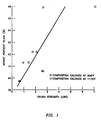
- Table IV are the measured physical properties of the calcined compositions.
- the extrudates were calcined at two separate temperatures: 482°C (900°F) and 635°C (1175°F).
- the data represented in Table IV for crush strength of the composition is further illustrated in FIG.
Landscapes
- Chemical & Material Sciences (AREA)
- Engineering & Computer Science (AREA)
- Materials Engineering (AREA)
- Organic Chemistry (AREA)
- Chemical Kinetics & Catalysis (AREA)
- Catalysts (AREA)
- Silicon Compounds (AREA)
- Manufacture Of Porous Articles, And Recovery And Treatment Of Waste Products (AREA)
- Saccharide Compounds (AREA)
- Filtering Materials (AREA)
- Dental Preparations (AREA)
Applications Claiming Priority (2)
| Application Number | Priority Date | Filing Date | Title |
|---|---|---|---|
| US646042 | 1991-01-28 | ||
| US07/646,042 US5108975A (en) | 1991-01-28 | 1991-01-28 | Composition and method of making high porosity, high strength compositions |
Publications (2)
| Publication Number | Publication Date |
|---|---|
| EP0502301A1 EP0502301A1 (en) | 1992-09-09 |
| EP0502301B1 true EP0502301B1 (en) | 1995-07-26 |
Family
ID=24591501
Family Applications (1)
| Application Number | Title | Priority Date | Filing Date |
|---|---|---|---|
| EP92101127A Expired - Lifetime EP0502301B1 (en) | 1991-01-28 | 1992-01-24 | Composition and method of making high porosity, high strength compositions |
Country Status (10)
| Country | Link |
|---|---|
| US (1) | US5108975A (ja) |
| EP (1) | EP0502301B1 (ja) |
| JP (1) | JPH04322746A (ja) |
| AT (1) | ATE125466T1 (ja) |
| BR (1) | BR9200157A (ja) |
| CA (1) | CA2056000A1 (ja) |
| DE (1) | DE69203626T2 (ja) |
| DK (1) | DK0502301T3 (ja) |
| ES (1) | ES2075481T3 (ja) |
| MX (1) | MX9200179A (ja) |
Families Citing this family (11)
| Publication number | Priority date | Publication date | Assignee | Title |
|---|---|---|---|---|
| WO1997039990A1 (en) * | 1996-04-24 | 1997-10-30 | Owens Corning | Glass compositions having high ki values and fibers therefrom |
| DE69717440T2 (de) | 1996-06-21 | 2003-10-02 | W.R. Grace & Co.-Conn., New York | Aggregatträger und darauf angebrachte olefinpolymerisationskatalysatoren |
| US6034014A (en) * | 1997-08-04 | 2000-03-07 | Owens Corning Fiberglas Technology, Inc. | Glass fiber composition |
| JP2002523568A (ja) | 1998-08-26 | 2002-07-30 | エクソンモービル・ケミカル・パテンツ・インク | 高度に活性な担持触媒組成物 |
| US6313061B1 (en) | 1998-12-22 | 2001-11-06 | W. R. Grace & Co.-Conn. | Method of making frangible spray dried agglomerated supports and olefin polymerization catalysts supported thereon |
| JP4938447B2 (ja) | 2003-06-23 | 2012-05-23 | シエル・インターナシヨネイル・リサーチ・マーチヤツピイ・ベー・ウイ | 潤滑基油の製造方法 |
| CN100358979C (zh) * | 2003-06-27 | 2008-01-02 | 国际壳牌研究有限公司 | 制备润滑基础油的方法 |
| EP1853682A1 (en) * | 2004-12-23 | 2007-11-14 | Shell Internationale Research Maatschappij B.V. | Process to prepare a lubricating base oil |
| JP5112078B2 (ja) * | 2005-01-06 | 2013-01-09 | リサーチ・トライアングル・インスティチュート | 酸化亜鉛ベースの吸着剤並びにその作成及び使用方法 |
| WO2020096069A1 (ja) * | 2018-11-06 | 2020-05-14 | 有限会社ソルチ | 焼結造粒粘土及びその製造方法 |
| US11731121B2 (en) | 2020-02-19 | 2023-08-22 | Viridis Chemicals Private Limited | Process for preparation of highly coordinated sulfated mixed metal oxide catalyst having high crushing strength |
Family Cites Families (15)
| Publication number | Priority date | Publication date | Assignee | Title |
|---|---|---|---|---|
| DE1074791B (de) * | 1960-02-04 | W. R. Grace & Co., New York, N. Y. (V. St. A.) | Siliziumdioxyd-Magnesiumoxyd-Crack-Katalysator sowie Verfahren zu seiner Herstellung | |
| US2657114A (en) * | 1949-06-21 | 1953-10-27 | Union Carbide & Carbon Corp | Chlorosilanes |
| US3004929A (en) * | 1958-11-19 | 1961-10-17 | Pure Oil Co | Method of preparing a catalyst support |
| US3271107A (en) * | 1963-07-31 | 1966-09-06 | Int Minerals & Chem Corp | Silica pigments from fluosilicic acid |
| FR1528785A (fr) * | 1967-04-26 | 1968-06-14 | Pechiney Saint Gobain | Corps poreux de silice |
| US3696053A (en) * | 1970-03-18 | 1972-10-03 | Pechiney Saint Gobain | Porous silica containing foreign ions and method for preparation for same |
| GB1453044A (en) * | 1973-06-14 | 1976-10-20 | British Petroleum Co | Production of acid hydrocarbon conversion catalysts |
| US3917721A (en) * | 1973-12-17 | 1975-11-04 | Nat Distillers Chem Corp | Olefin hydration using phosphoric acid on porous silica xerogel |
| US3969274A (en) * | 1974-03-14 | 1976-07-13 | National Distillers And Chemical Corporation | Fixed bed catalyst |
| US4135941A (en) * | 1977-04-25 | 1979-01-23 | Martin Marietta Corporation | Process for the production of portland type cement clinker |
| US4402924A (en) * | 1978-01-16 | 1983-09-06 | Exxon Research And Engineering Co. | Preparation of high surface area metal fluorides and metal oxyfluorides, especially aluminum fluoride extrudates |
| FR2505831A1 (fr) * | 1981-05-15 | 1982-11-19 | Rhone Poulenc Spec Chim | Procede de preparation de nitriles aromatiques ou aliphatiques |
| FR2505830A1 (fr) * | 1981-05-15 | 1982-11-19 | Rhone Poulenc Spec Chim | Procede de preparation de nitriles aromatiques ou aliphatiques |
| DE3803895C1 (ja) * | 1988-02-09 | 1989-04-13 | Degussa Ag, 6000 Frankfurt, De | |
| DE3912504A1 (de) * | 1989-04-17 | 1990-10-18 | Degussa | Presslinge auf basis von pyrogen hergestelltem siliciumdioxid, verfahren zu ihrer herstellung und ihre verwendung |
-
1991
- 1991-01-28 US US07/646,042 patent/US5108975A/en not_active Expired - Lifetime
- 1991-11-22 CA CA002056000A patent/CA2056000A1/en not_active Abandoned
-
1992
- 1992-01-16 MX MX9200179A patent/MX9200179A/es unknown
- 1992-01-17 BR BR929200157A patent/BR9200157A/pt unknown
- 1992-01-17 JP JP4006764A patent/JPH04322746A/ja active Pending
- 1992-01-24 AT AT92101127T patent/ATE125466T1/de not_active IP Right Cessation
- 1992-01-24 DE DE69203626T patent/DE69203626T2/de not_active Expired - Fee Related
- 1992-01-24 ES ES92101127T patent/ES2075481T3/es not_active Expired - Lifetime
- 1992-01-24 DK DK92101127.6T patent/DK0502301T3/da active
- 1992-01-24 EP EP92101127A patent/EP0502301B1/en not_active Expired - Lifetime
Also Published As
| Publication number | Publication date |
|---|---|
| MX9200179A (es) | 1992-09-01 |
| US5108975A (en) | 1992-04-28 |
| DE69203626T2 (de) | 1996-01-11 |
| CA2056000A1 (en) | 1992-07-29 |
| ES2075481T3 (es) | 1995-10-01 |
| EP0502301A1 (en) | 1992-09-09 |
| BR9200157A (pt) | 1992-10-06 |
| ATE125466T1 (de) | 1995-08-15 |
| DK0502301T3 (da) | 1995-09-11 |
| JPH04322746A (ja) | 1992-11-12 |
| DE69203626D1 (de) | 1995-08-31 |
Similar Documents
| Publication | Publication Date | Title |
|---|---|---|
| US3950507A (en) | Method for producing granulated porous corundum | |
| US5108975A (en) | Composition and method of making high porosity, high strength compositions | |
| US3094383A (en) | Method for making synthetic zeolitic material | |
| US4058483A (en) | Adsorbent material | |
| JPS6126509A (ja) | シリカに富む固体の押出成形法 | |
| JPS6291410A (ja) | クロマトグラフイ−分離用リン酸カルシウム系ヒドロキシアパタイト及びその製造方法 | |
| JPH02144145A (ja) | アルミノシリケート基触媒担体の製造方法 | |
| EP0452619B1 (de) | Titandioxidpresslinge, Verfahren zu ihrer Herstellung sowie ihre Verwendung | |
| US5002918A (en) | Molded articles based on pyrogenically produced mixed-oxide systems of silicon dioxide and aluminum oxide, a method for manufacturing them and their use | |
| KR101203258B1 (ko) | BaX형 제올라이트 성형체 및 그의 제조방법 | |
| US5132260A (en) | Zeolite granules with zeolitic binder | |
| US5015615A (en) | Molded articles based on pyrogenically prepared aluminum oxide and process for their production | |
| JPH0674136B2 (ja) | ゼオライト成形体およびその製造法 | |
| US4937394A (en) | Silica catalyst supports for hydration of ethylene to ethanol | |
| CA1326742C (en) | Silica extrudates | |
| US4239655A (en) | Process for the production of bonded zeolite bodies | |
| JPH0639287A (ja) | オレフィンをアルコールに水和化する為の触媒の製造方法 | |
| US4521528A (en) | Preparation of zirconium phosphate activated carbon adsorbent | |
| JP2782744B2 (ja) | バインダレスゼオライト成型体の製造方法 | |
| JPS6234685B2 (ja) | ||
| DE68923930T2 (de) | Peptisierte aktivierte Kohlenstoff-/Aluminiumoxid-Zusammenstellung. | |
| US4601992A (en) | Product and process for the production of granules of high mechanical strength and containing molecular sieve | |
| JPS6219363B2 (ja) | ||
| KR100392701B1 (ko) | 메조포러스 제올라이트 허니컴구조체 및 그 제조방법 | |
| JP2620127B2 (ja) | シリカーアルミナ押出物 |
Legal Events
| Date | Code | Title | Description |
|---|---|---|---|
| PUAI | Public reference made under article 153(3) epc to a published international application that has entered the european phase |
Free format text: ORIGINAL CODE: 0009012 |
|
| AK | Designated contracting states |
Kind code of ref document: A1 Designated state(s): AT BE DE DK ES FR GB IT LU NL |
|
| 17P | Request for examination filed |
Effective date: 19930108 |
|
| 17Q | First examination report despatched |
Effective date: 19931001 |
|
| GRAA | (expected) grant |
Free format text: ORIGINAL CODE: 0009210 |
|
| AK | Designated contracting states |
Kind code of ref document: B1 Designated state(s): AT BE DE DK ES FR GB IT LU NL |
|
| REF | Corresponds to: |
Ref document number: 125466 Country of ref document: AT Date of ref document: 19950815 Kind code of ref document: T |
|
| ITF | It: translation for a ep patent filed | ||
| REF | Corresponds to: |
Ref document number: 69203626 Country of ref document: DE Date of ref document: 19950831 |
|
| REG | Reference to a national code |
Ref country code: DK Ref legal event code: T3 |
|
| ET | Fr: translation filed | ||
| REG | Reference to a national code |
Ref country code: ES Ref legal event code: FG2A Ref document number: 2075481 Country of ref document: ES Kind code of ref document: T3 |
|
| PG25 | Lapsed in a contracting state [announced via postgrant information from national office to epo] |
Ref country code: GB Effective date: 19960124 Ref country code: DK Effective date: 19960124 Ref country code: AT Effective date: 19960124 |
|
| REG | Reference to a national code |
Ref country code: DK Ref legal event code: EBP |
|
| PG25 | Lapsed in a contracting state [announced via postgrant information from national office to epo] |
Ref country code: ES Free format text: LAPSE BECAUSE OF NON-PAYMENT OF DUE FEES Effective date: 19960125 |
|
| PG25 | Lapsed in a contracting state [announced via postgrant information from national office to epo] |
Ref country code: LU Free format text: LAPSE BECAUSE OF NON-PAYMENT OF DUE FEES Effective date: 19960131 Ref country code: BE Effective date: 19960131 |
|
| PLBE | No opposition filed within time limit |
Free format text: ORIGINAL CODE: 0009261 |
|
| STAA | Information on the status of an ep patent application or granted ep patent |
Free format text: STATUS: NO OPPOSITION FILED WITHIN TIME LIMIT |
|
| 26N | No opposition filed | ||
| BERE | Be: lapsed |
Owner name: PHILLIPS PETROLEUM CY Effective date: 19960131 |
|
| PG25 | Lapsed in a contracting state [announced via postgrant information from national office to epo] |
Ref country code: NL Effective date: 19960801 |
|
| GBPC | Gb: european patent ceased through non-payment of renewal fee |
Effective date: 19960124 |
|
| PG25 | Lapsed in a contracting state [announced via postgrant information from national office to epo] |
Ref country code: FR Effective date: 19960930 |
|
| NLV4 | Nl: lapsed or anulled due to non-payment of the annual fee |
Effective date: 19960801 |
|
| PG25 | Lapsed in a contracting state [announced via postgrant information from national office to epo] |
Ref country code: DE Effective date: 19961001 |
|
| REG | Reference to a national code |
Ref country code: FR Ref legal event code: ST |
|
| REG | Reference to a national code |
Ref country code: ES Ref legal event code: FD2A Effective date: 19990301 |
|
| PG25 | Lapsed in a contracting state [announced via postgrant information from national office to epo] |
Ref country code: IT Free format text: LAPSE BECAUSE OF NON-PAYMENT OF DUE FEES;WARNING: LAPSES OF ITALIAN PATENTS WITH EFFECTIVE DATE BEFORE 2007 MAY HAVE OCCURRED AT ANY TIME BEFORE 2007. THE CORRECT EFFECTIVE DATE MAY BE DIFFERENT FROM THE ONE RECORDED. Effective date: 20050124 |