EP0501829B1 - Digitaler Navigationssatellitenempfänger - Google Patents
Digitaler Navigationssatellitenempfänger Download PDFInfo
- Publication number
- EP0501829B1 EP0501829B1 EP92301741A EP92301741A EP0501829B1 EP 0501829 B1 EP0501829 B1 EP 0501829B1 EP 92301741 A EP92301741 A EP 92301741A EP 92301741 A EP92301741 A EP 92301741A EP 0501829 B1 EP0501829 B1 EP 0501829B1
- Authority
- EP
- European Patent Office
- Prior art keywords
- receiver
- code
- set forth
- search
- signal
- Prior art date
- Legal status (The legal status is an assumption and is not a legal conclusion. Google has not performed a legal analysis and makes no representation as to the accuracy of the status listed.)
- Expired - Lifetime
Links
Images





Classifications
-
- G—PHYSICS
- G01—MEASURING; TESTING
- G01S—RADIO DIRECTION-FINDING; RADIO NAVIGATION; DETERMINING DISTANCE OR VELOCITY BY USE OF RADIO WAVES; LOCATING OR PRESENCE-DETECTING BY USE OF THE REFLECTION OR RERADIATION OF RADIO WAVES; ANALOGOUS ARRANGEMENTS USING OTHER WAVES
- G01S19/00—Satellite radio beacon positioning systems; Determining position, velocity or attitude using signals transmitted by such systems
- G01S19/01—Satellite radio beacon positioning systems transmitting time-stamped messages, e.g. GPS [Global Positioning System], GLONASS [Global Orbiting Navigation Satellite System] or GALILEO
- G01S19/13—Receivers
- G01S19/32—Multimode operation in a single same satellite system, e.g. GPS L1/L2
-
- G—PHYSICS
- G01—MEASURING; TESTING
- G01S—RADIO DIRECTION-FINDING; RADIO NAVIGATION; DETERMINING DISTANCE OR VELOCITY BY USE OF RADIO WAVES; LOCATING OR PRESENCE-DETECTING BY USE OF THE REFLECTION OR RERADIATION OF RADIO WAVES; ANALOGOUS ARRANGEMENTS USING OTHER WAVES
- G01S19/00—Satellite radio beacon positioning systems; Determining position, velocity or attitude using signals transmitted by such systems
- G01S19/01—Satellite radio beacon positioning systems transmitting time-stamped messages, e.g. GPS [Global Positioning System], GLONASS [Global Orbiting Navigation Satellite System] or GALILEO
- G01S19/13—Receivers
- G01S19/21—Interference related issues ; Issues related to cross-correlation, spoofing or other methods of denial of service
-
- G—PHYSICS
- G01—MEASURING; TESTING
- G01S—RADIO DIRECTION-FINDING; RADIO NAVIGATION; DETERMINING DISTANCE OR VELOCITY BY USE OF RADIO WAVES; LOCATING OR PRESENCE-DETECTING BY USE OF THE REFLECTION OR RERADIATION OF RADIO WAVES; ANALOGOUS ARRANGEMENTS USING OTHER WAVES
- G01S19/00—Satellite radio beacon positioning systems; Determining position, velocity or attitude using signals transmitted by such systems
- G01S19/01—Satellite radio beacon positioning systems transmitting time-stamped messages, e.g. GPS [Global Positioning System], GLONASS [Global Orbiting Navigation Satellite System] or GALILEO
- G01S19/13—Receivers
- G01S19/24—Acquisition or tracking or demodulation of signals transmitted by the system
-
- G—PHYSICS
- G01—MEASURING; TESTING
- G01S—RADIO DIRECTION-FINDING; RADIO NAVIGATION; DETERMINING DISTANCE OR VELOCITY BY USE OF RADIO WAVES; LOCATING OR PRESENCE-DETECTING BY USE OF THE REFLECTION OR RERADIATION OF RADIO WAVES; ANALOGOUS ARRANGEMENTS USING OTHER WAVES
- G01S19/00—Satellite radio beacon positioning systems; Determining position, velocity or attitude using signals transmitted by such systems
- G01S19/01—Satellite radio beacon positioning systems transmitting time-stamped messages, e.g. GPS [Global Positioning System], GLONASS [Global Orbiting Navigation Satellite System] or GALILEO
- G01S19/13—Receivers
- G01S19/35—Constructional details or hardware or software details of the signal processing chain
- G01S19/37—Hardware or software details of the signal processing chain
Definitions
- This invention relates to navigation satellite receivers, and more particularly to a digital receiver having rapid signal acquisition.
- the Navstar Global Positioning System is used to determine exact geographic position (i.e., latitude, longitude and height above the earth) absolute velocity, as well as the exact time.
- the navigation device, receiver must calculate the position velocity and the time by determining distance and relative velocity to a series of satellites.
- the velocity of the receiver is calculated from the doppler frequency shift of signals transmitted from space while the exact position of the receiver is calculated from the time shift of data due to the distance the signals must travel from the satellite. This distance is called range and the doppler shift yields range rate.
- sequential tracking there is one receiver channel that sequences across multiple satellites, tracking each satellite for a predetermined period of time, and then tracking another satellite, etc. Sequential tracking requires the minimum hardware, but also has the lowest performance characteristics.
- US-4,468,793 discloses a global positioning system that utilises this concept.
- the GPS system comprises a receiver for receiving L1, L2 P-code or C/A code modulated frequency outputs.
- the receiver multiplexes the L1 and L2 signals, and code and carrier tracking loops.
- GB-A-2,155,268 discloses a receiver for a Navstar satellite navigation system.
- the receiver includes amplification and down conversion to i.f., frequencies to produce quadrature signals, Analogue-to-digital converters are provided to digitise separately the quadrature signals.
- the receiver also includes local digital code generating means, means for correlating the digitised quadrature signals separately with the same locally generated digital codes, and channel signal processing means to which the outputs of the correlation means are applied, the processing means being arranged to control the code and carrier tracking of the receiver.
- Correlation means responsive to control signals generated in the processing means are provided to effect phase rotation of the baseband signal phasor represented by the digitised quadrature signals to effect Doppler tracking in the receiver loop
- the correction means includes means for generating digital signals representing sincit and cos0t. where it is the required phase rotation angle, means for multiplying each of the quadrature signals by the sinwt and coswt signals separately and means for summing the multiplied signals according to a given algorithm.
- the present invention provides a receiver for acquiring and tracking a plurality of analog spread spectrum signals from a satellite, said analog spread spectrum signals having analog carrier signals with data and pseudo-random noise codes modulated thereon, which receiver comprising;
- the present invention also provides a receiver for acquiring and tracking each of a plurality of analog spread spectrum signals from a plurality of satellites, each analog spread spectrum signal having L1 and L2 carrier signals with data and pseudo-random noise codes modulated thereon, which receiver comprising;
- Each GPS satellite generates two spread spectrum signals centered around separate frequencies.
- the L1 channel is centered around 1575.42 megahertz, and has C/A-code, and P(Y)-code and data modulated on it.
- C/A-code has a 1.023 megahertz chipping rate with a bandwidth of about two megahertz
- P(Y)-code has a 10.23 megahertz chipping rate with a bandwidth of about 20 megahertz.
- the L2 channel is centered around 1227.6 megahertz and only has P(Y)-code and data modulated on it. Data provides information about the satellite's orbit and health and information about other satellites in the GPS constellation.
- a GPS receiver is designed having a method and system for converting the analog signal to the digital equivalent prior to processing the signal for acquisition purposes.
- a further technical advantage of our illustrated receiver is that the processing time is reduced thereby allowing for faster signal acquisition during the signal search mode.
- a still further technical advantage of our illustrated embodiment is that the part count of the GPS receiver is reduced and the system is designed using modular blocks which are interchangeable with many different types of receivers and for receivers used for different applications.
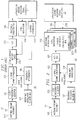
- FIGURE 1 shows prior art receiver 10 having antenna 12 which feeds into antenna preamp assembly 101. This is followed by L1/L2 frequency selector 102 and L-band down-conversion 103 which converts either the L1 signal or the L2 signal to a second IF frequency.
- the local oscillators for the down-conversion are provided by reference oscillator 107 and frequency synthesizer 108.
- the second IF (output from conversion 103) goes into analog circuit 104 for code and carrier wipe off. This is where the code transmitted by the satellite is compared and matched with the receiver's estimate of the code, and the carrier is compared with the receiver's estimate of the carrier.
- Carrier frequency changes as a function of doppler velocity between the satellite and the user, and is the way the GPS measures relative velocity.
- Code generation 109 and carrier synthesizer 110 feed the code and carrier to the code/carrier wipe off circuitry and operate under control of computer 11.
- AGC circuit 201 The output of L-band down conversion 103 is provided to analog to digital (A/D) AGC circuit 201 which is different from the A/D circuit in FIGURE 1.
- A/D circuit 201 employs a null zone Automatic Gain Control (AGC) technique which provides added immunity against jamming.
- A/D converter provides a four level output signal to signal processing circuits 202, 203 and 204. Note that circuits 202, 203 and 204 are replicas of the same chip and are detailed in concurrently filed copending patent application entitled "Method and System for a Dual Channel and Search Global Position System Signal Processor.”
- circuits 202, 203 and 204 are shown as signals 205 going to processor computer 21. They are similar to the outputs of FIGURE 1 going to processor 11 in that they represent the error between the receiver's estimate of code and carrier phase and the actual code and carrier phase being received.
- Signal 206 is the control from processor 21 back to circuits 202, 203, and 204, where the computer is directing the circuits to change their code and carrier estimates, as well as mode control of these chips.
- Modules 101, 102 and 103 contain circuitry common with that found in a good FM radio.
- circuit element 201 we have added null zone processing, which takes advantage of the spectral characteristics of the GPS signal and the spectral characteristics of the most common GPS jamming signals, which are CW signals.
- the null zone circuitry is desensitized to process CW energy, thereby yielding up to a 9dB improvement in jamming immunity against CW jammers.
- Circuit elements 202, 203 and 204 channel signal processing with no signal differentiation occurring prior to these circuit elements.
- Each element uniquely and completely generates carrier estimates, code estimates, base band predetection estimates and contains all the correlators for signal processing, and provides autonomous signal search capability for two satellites.
- Each circuit element also has the capability to simultaneously track both the C/A-code signal and the P(Y)-code signal within a single channel from a single satellite, effectively giving about a 4dB improvement in signal strength over tracking P(Y)-code only.
- FIGURE 3 shows a block diagram containing more detail of system 20 showing one implementation of the receiver. Note that modules 103 and 108 have been combined into a single block consisting of L-band hybrid circuit 302 and times 17 circuit 303. The exact arrangement of this circuit is dependent upon the arrangement of the various components, and this could be one circuit or multiple pieces separated and is driven by specific application requirements.
- reference oscillator 107 operates at an off beat frequency of 20.4608 megahertz or 2 x 10.2304 megahertz.
- Conventional GPS reference frequency is 10.2300 megahertz. It is the frequency offset (in this case 400 Hz) that allows us to implement digital oscillators inside channels 202, 203 and 204.
- Processor 21 is an implementation of the computer using the Intel chip set such that element 304 is an Intel 80386 and element 305 is an Intel 80387 floating point unit.
- the computer also includes static RAM 306, EPROM 308 where the program code is stored, and interface and glue logic 307.
- Glue logic provides address decode functions, interrupt control functions, direct memory access (DMA) functions, and miscellaneous housekeeping required for the computer.
- Element 31 provides the input output reference between the GPS core receiver and the rest of the world.
- Element 31 has an I/O function 309, bus drivers 310 for parallel I/O and serial drivers 311 for a serial I/O.
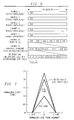
- FIGURES 4-4C show aspects of the null zone A to D converter (201, FIGURE 3).
- FIGURE 4A shows the functional implementation of the null zone technique with 4 bit outputs A, B, C and D.
- FIGURE 4B is a truth table for the outputs of FIGURE 4A
- FIGURE 4C shows the difference in spectral content between a gaussian wave form and a sinusoidal wave form.
- the sinusoidal wave form is what you see when a CW jammer is incoming along with the GPS signal.
- the advanced A/D conversion process shown in FIGURE 4A is a modified version of a scheme called null-zone detection and was adapted for use for two reasons:
- FIGURE 4A shows the different aspects of the A/D conversion process.
- Automatic gain control (AGC) circuit 401 maintains the raw incoming analog signal at a constant level.
- Three threshold detectors 403-405 quantize the incoming voltage into one of four values.
- the four values are assigned weights of -16, -4, +4, +16. This weighting approximates a linear detector.
- the automatic gain control (AGC) maintains the percentage of ⁇ 16 values as a constant.
- a separate detector 406 determines if the signal is, indeed, gaussian or if it has a strong CW component. The probability distribution function of these two cases is very different. If a strong CW component exists, then a waveform with equivalent power will spend a larger percentage of time near the high and low thresholds. The CW detector senses this condition, and the weights applied to the four values change to -16, -1, +1, +16. The ⁇ 1 values deemphasize signal between the high and low thresholds where less GPS signal can be extracted. The waveform straddling the high and low thresholds is rich in GPS signal and maintains full weighting.
- FIGURE 5 shows the performance gain using this detector approach.
- J/S CW jammer-to-signal ratio
- the receiver employs a fast multiplexing or switching technique between the L1 and L2 signals as shown.
- both L1 and L2 enter hybrid circuit 302, but only one signal comes out. That is because the channels are capable of quickly switching between L1 code state and carrier phase and L2 code state and carrier phase. This preserves a single signal path for L1 and L2 having the effect that there is no interchannel bias between L1 and L2 and no interchannel bias between any of the channels.
- This technique also allows us to build a full function receiver with only a single RF signal path and a single A/D converter, thus eliminating at least 50 percent of the expensive RF circuitry required for a GPS receiver.
- the RF switch is a conventional switch, but this technique is made possible because channels 202, 203 and 204 are capable of switching from a single code state and carrier phase to a different code state and carrier phase very quickly unlike conventional receiver architectures.
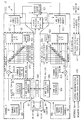
- FIGURE 8 is a block diagram of dual channel decoder 202, which is detailed in the above-identified copending patent application entitled "Method and System for a Multi Channel and Search Global Position System Signal Processor.” The details of operation of that system will not be repeated herein.
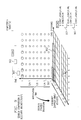
- FIGURE 9 represents pictorially the problem inherent with determining position from a series of satellites.
- the code changes are akin to two people talking next to each other. Whatever the speaker says, the hearer receives at the exact same time. However, if the speaker were to move away far enough, the speaker would output information, and that information would arrive at the receiving person sometime later. Thus, if the speaker were reciting the alphabet, A, B, C, D in order, the receiver might be listening to the letter "A" while the sender is speaking the letter "C”.
- the code being received By knowing the delay, i.e., the number of bits different in the transmitted information, one could figure out the distance, and thus the position of the receiver along a single straight line from the sender or satellite. This repetition from three other satellites yields precise position and time of the receiver.
- noise meter 819 is tied to the ninth correlator in each channel. It has a high sampling rate tied to the discrete faner transform (DFT) samples for search. It is programmable for C/A and P(Y)-code bandwidths and is capable of aiding search by setting the thresholds in the search processor for the Tong detectors. This is done without aiding or intervention or time line requirements from the computer.
- DFT discrete faner transform
- the pre-detection integration period determines the bandwidth over which noise power is measured and is normally set to roughly match the bandwidth of the code being received. Taking absolute values provides a discriminant for the variance of I and Q.
- Post-detection integration acts as an averaging process to improve the quality of the noise power estimate.
- the noise meter can measure the power of gaussian, CW or plus noise.
- the pre-detection integration period determines the noise power bandwidth. For normal operation, the bandwidth is set to match the bandwidth of the desired code (i.e., 10 MHz for P(Y)-code and 1 MHz for C/A-code). Pre-detection integration band width is equal to: 1 pre-detection integration period
- VAR iq 0.0783321 x N + 4 (M x N) 0.5 X DATA nm
- VAR iq the variance of the I and Q integration samples
- N the pre-detection integration period
- M the number of reference clocks in the post-detection integration period
- DATA nm is the noise meter data. Note, there is a four reference clock dead time between pre-detection integration samples.
- modulating P(Y)-code onto the incoming signal prior to pre-detection integration has a negligible effect on noise meter data.
- modulating P(Y)-code onto the incoming signal prior to pre-detection integration reduces the effect CW noise has on final post-detection values.
- the noise meter is also capable of measuring CW and/or pulse noise.
- the search processor 823 will go and read the samples and apply a Tong detect algorithm to them to determine if signal is present at a particular code state and carrier frequency.
- the approximate DFT algorithm differs from the standard eight-point DFT algorithm only by the vector set that is used.
- the approximate vector set is used to reduce the circuitry required for implementation.
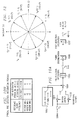
- FIGURE 12 shows the vector set, [V 0 , V 1 , V 2 , V 3 , V 4 , V 5 , V 6 , and V 7 ], used for this approximate DFT algorithm.
- This algorithm can also be expressed using the following matrix multiply equation: where Z n represents the complex value I n + jQ n .
- Z n represents the complex value I n + jQ n .
- the output level associated with each doppler bin is affected by doppler attenuation. Attenuation increases as signal offset from the internal generated carrier center frequency increases. The result is a non-linear distribution over the full range of the eight-point DFT output.
- the search processor module In addition to the seven frequency bins produced by the DFT module, the search processor module generates six frequency bins by interpolating between the seven bins generated by the DFT module. This provides a means of filling in the signal to noise ratio holes between frequency bins.
- Search processor 823 controls the DFT circuitry.
- a discrete fourier transform is performed on the I and Q data sample integration set. Frequency data from the DFT consists of seven I and Q pairs (representing seven doppler bins).
- the search processor interpolates between adjacent pairs of doppler bin data to obtain six additional doppler bins for a total of thirteen doppler bins for each of the correlators.
- a Tong detection algorithm is performed on this data to determine if a signal is present. If not, the search processor moves code to a new code state and continues the search there. The search continues until one of three conditions exist: a signal is found, the maximum search length (specified by the host processor) is reached, or an error condition occurs. Except for setup, the search processor operates independent of the resident computer.
- the seven frequency bins from the DFT are labelled B 0 , B 2 , B 4 , B 6 , B 8 , B 10 and B 12 from the most positive to the most negative doppler, respectively.
- the search processor interpolates between these frequency bins providing bins B 1 , B 3 , B 5 , B 7 , B 9 , and B 11 .
- These interpolated frequency bins indicate signal power found at a center frequency which is the arithmetic mean of the center frequencies of the even frequency bins from which it was interpolated.
- FIGURE 14 shows gain of each DFT bin relative to the magnitude of the sample integration data.
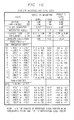
- FIGURE 15 shows C/No loss for each doppler bin as a function of doppler. The effect of doppler attenuation is factored into the values shown on this FIGURE. Doppler attenuation is loss which occurs because the final signal IF does not exactly match the carrier generator digital oscillator frequency.
- FIGURE 16 shows the effect each stage of signal correlation has on C/No and envelope magnitude and standard deviation. These factors are useful for determining C/No loss, determining if envelopes will overflow, and for setting search threshold (V t1 ).
- the maximum envelope magnitude can be calculated as follows:
- Noise variance will have a gain of:
- 2.87 is the ratio of the standard deviation of noise of the envelope to the standard deviation of noise at the input of the PCOAC. This factor is useful for calculating search threshold, V t1 .
- V t1 and V t2 thresholds are used in the Tong detection algorithm in determining whether or not signal is present as discussed previously.
- the host processor can either set V t1 and V t2 at a fixed value or specify V t1 and V t2 to be calculated by multiplying the output of the noise meter by a specified gain (G t ).
- G t the gain
- V t1 is used for even doppler bins and V t2 (V t1 multiplied by the square root of two) for odd doppler bins.
- the noise meter's post-detection integrations are continued until all DFT input samples are collected.
- the total integration period affects the magnitude of the final noise measurement.
- V t1 is always calculated at the completion of each DFT by multiplying noise measurement by a gain value (G+) specified by the host processor or it is provided by the host processor directly.
- the search processor calculates V t2 by multiplying V t1 by the square root of two.
- FIGURE 17 A diagram of the Tong detection algorithm is shown in FIGURE 17.
- the Tong detection algorithm is designed to decide when signal is present.
- the Tong detector keeps a Tong count for each of the 104 (13 doppler bins times 8 correlators) search bins for which it is trying to determine if signal is present. Initially, the Tong count (K) is set to one 1712.
- the search processor 1703 compares each envelope 1702 to its appropriate threshold (V t1 or V t2 ). If the envelope is greater than or equal to the threshold, the Tong count for that search bin is incremented 1704. If the envelope is less than the threshold, the Tong count is decremented 1705.
- search processor may ignore the envelopes from certain correlators or for certain frequency bins.
- the search processor provides the host processor the means with which to mask the unwanted correlators or frequency bins.
- a search that is in progress can be temporarily suspended. This might be done in the event that the host processor has determined the input signal to be no good, such as when a pulse jammer is detected.
- Search suspend is tied to DFT cycles. Tong detection is not performed on DFT data which was taken during search suspend. Once suspend is de-asserted, Tong detection resumes on data from the next DFT cycle.
- Each channel has a (hardware) suspend search input.
- the host processor enables and disables the suspend input for a channel by setting a suspend input enable bit.
- the host processor can directly suspend search.
- the search processor also incorporates a hit counter which can be used by the host processor to aid in determining the adequacy of a threshold setting. It can also play a role in designs for non-gaussian environments.
- the hit counter only provides information to the host processor; it does not affect the operation of the search processor.
- the hit counter counts the number of hits for a specified number of DFT samples. It is incremented each time an active Tong count is incremented. Once the hit count is complete, it is transferred to a latch to be read by the host processor. The hit counter is cleared after the transfer to keep count of hits for the next set of DFT samples. A large hit count could be indicative of a low threshold.
- FIGURE 18 summarizes the performance of four different receiver arcnitectures under various conditions of signal aiding and jamming levels.
- the metric used is time to first fix or the time from the point at which the receiver is turned-on until it is navigating to specified accuracy.
- P(Y) the unique receiver architecture which is P(Y) described herein produces a system that gives the best performance independent of jamming level and independent of aiding quality.
- the GPS Satellite System has in it an algorithm which converts the P(Y)-code to Y-code for special applications.
- This algorithm is not widely known. Therefore, only those receivers that have a special access to the algorithm can utilize Y-code.
- CV code In operation a special code called the CV code can be sent to the satellite, and the satellite using its special algorithm, will then convert the P(Y)-code signals to a Y-code signal.
- CV code stands for cryptovariable.
- prior receivers there has been one AOC circuit for each channel.
Landscapes
- Engineering & Computer Science (AREA)
- Radar, Positioning & Navigation (AREA)
- Remote Sensing (AREA)
- Computer Networks & Wireless Communication (AREA)
- Physics & Mathematics (AREA)
- General Physics & Mathematics (AREA)
- Position Fixing By Use Of Radio Waves (AREA)
Claims (27)
- Empfänger (20) zum Erfassen und Verfolgen mehrerer analoger Spreizspektrumsignale von einem Satelliten, wobei die analogen Spreizspektrumsignale analoge Trägersignale mit aufmodulierten Daten- und Pseudo-Zufallsrauschcodes aufweisen und der Empfänger (20) folgendes aufweist:dadurch gekennzeichnet, daß der Suchprozessor (832) geeignet ist, jede der mehreren Kanalverarbeitungsschaltungen (202, 203, 204) autonom und gleichzeitig zu steuern, wobei jede der Kanalverarbeitungsschaltungen (202, 203, 204) zum gleichzeitigen Erfassen und Verfolgen jedes der mehreren, im Zusammenhang mit dem Satelliten stehenden analogen Spreizspektrumsignale eingerichtet ist und jede der Kanalverarbeitungsschaltungen (202, 203, 204) weiterhin geeignet ist, jeden der Pseudo-Zufallsrauschcodes gleichzeitig mit den analogen Spreizspektrumsignalen zu verarbeiten.eine Abwärtsmischerschaltung (103) zum Abwärtsmischen der erfaßten analogen Spreizspektrumsignale zu analogen abwärtsgemischten Spreizspektrumsignalen;eine mit der Abwärtsmischerschaltung (103) gekoppelte lokale Taktgeneratorschaltung (107, 108) zum Erzeugen einer Abtasttaktfrequenz für die Erzeugung der analogen abwärtsgemischten Spreizspektrumsignale und zum Bereitstellen von Steuersignalen für den Empfänger (20);eine Abtastschaltung (201) zum Umsetzen der analogen abwärtsgemischten Spreizspektrumsignale in digitale Spreizspektrumsignale;mehrere Kanalverarbeitungsschaltungen (202, 203, 204) zum Demodulieren der digitalen Spreizspektrunsignale für den Erhalt von Informationen über den Ist-Code und die Ist-Trägerphase, wobei jede Kanalverarbeitungsschaltung (202, 203, 204) einen abgeschätzten Code und eine abgeschätzte Trägerphase erzeugt und diesen abgeschätzten Code und die abgeschätzte Trägerphase mit dem Ist-code und der Ist-Trägerphase vergleicht, und wobei jede Kanalverarbeitungsschaltung (202, 203, 204) Korrelatoren (813) zum Erzeugen von Vordetektierungs-Integrations-Daten gemäß dem Vergleich aufweist;einen mit jeder der Kanalverarbeitungsschaltungen (202, 203, 204) gekoppelten Suchprozessor (823);einen Universalprozessor (21) zur Gesamtsteuerung des Empfängers;
- Empfänger nach Anspruch 1, worin jede Kanalverarbeitungsschaltung (202, 203, 204) geeignet ist, einen abgeschätzten Code, eine abgeschätzte Trägerphase und Vordetektierungs-Integrations-Daten für analoge Spreizspektrumsignale zu erzeugen, die von mehr als einem Satelliten erfaßt wurden.
- Empfänger nach Anspruch 2, worin jede Kanalverarbeitungsschaltung (202, 203, 204) genug Korrelatoren (813) aufweist, um Vordetektierungs-Integrations-Daten gemäß dem Vergleich des abgeschätzten Codes und der abgeschätzten Trägerphase mit dem Ist-Code und der Ist-Trägerphase für mehr als einen Satelliten zu erzeugen.
- Empfänger nach einem der vorstehenden Ansprüche, worin eine einzelne Abtastschaltung (201) geeignet ist, sowohl die gleichphasigen (I) als auch die Quadratur-Komponenten eines empfangenen, abwärtsgemischten Spreizspektrumsignals zu digitalisieren.
- Empfänger nach einem der vorstehenden Ansprüche, worin die Abtastschaltung (201) ein mehrstufiges digitales Spreizspektrumsignal erzeugt.
- Empfänger nach einem der vorstehenden Ansprüche, worin jede Kanalverarbeitungsschaltung geeignet ist, gleichzeitige Stationär-Präzisionscode-Verfolgung (P)Y)-code) und Groberfassungscode-Verfolgung (C/A) durchzuführen.
- Empfänger nach einem der vorstehenden Ansprüche, worin der Empfänger ein Schnell-Multiplexier-Verfahren zwischen den Hochfrequenzbandsignalen (L1) und den Niederfrequenzbandsignalen (L2) verwendet.
- Empfänger nach Anspruch 7, worin der Empfänger geeignet ist, einen einzigen Signalpfad für L1- und L2-Bandsignale einzurichten, so daß eine Zwischenkanalvorspannung zwischen den L1-und L2-Bandsignalen und eine Zwischenkanalvorspannung zwischen Xanälen im wesentlichen eliminiert ist.
- Empfänger nach einem der vorstehenden Ansprüche, worin das analoge Trägersignal L1- und L2-Trägersignale aufweist, die mit den Daten- und den Pseudo-Zufallsrauschcodes moduliert sind.
- Empfänger nach einem der vorstehenden Ansprüche, worin der Suchprozessor einen Tong-Detektierungsalgorithmus zum Bestimmen einer Signalerfassung bei einem speziellen Codezustand für eine vorbestimmte Suchschwelle verwendet.
- Empfänger nach einem der vorstehenden Ansprüche, ferner mit einer Fouriertransformationsschaltung (824) zum Erzeugen von Frequenzabschnitten (B0, B2, B4, B6, B8, B10, B12) aus den Vordetektierungs-Integrations-Daten für die Ausweitung eines Doppler-Frequenzsuchbereichs für das analoge Trägersignal.
- Empfänger nach Anspruch 11, worin die Fouriertransformationsschaltung (824) eine Schaltung (824) zur diskreten Fouriertransformationsnäherung ist, die komplexe Zwei-Bit-Vektoren verwendet.
- Empfänger nach Anspruch 11 oder Anspruch 12, worin der Suchprozessor zum Erzeugen von Hüllkurven für jeden der Frequenzabschnitte eine Robertson-Näherung implementiert.
- Empfänger nach einem der Ansprüche 11 bis 13, worin der Suchprozessor Schaltkreise zum Interpolieren neuer Frequenzabschnitte aus den Frequenzabschnitten der Fouriertransformationsschaltung aufweist.
- Empfänger nach einem der Ansprüche 10 bis 13, ferner mit einem Rauschmesser (819) zum dynamischen Einstellen der Suchschwelle.
- Empfänger nach Anspruch 15, worin der Rauschmesser eine programmierbare Bandbreite hat.
- Empfänger nach Anspruch 15 oder Anspruch 16, worin der Suchprozessor einen Schwellenrechner aufweist, der die Suchschwelle gemäß einem Ausgangssignal des Rauschmessers einstellt.
- Empfänger nach einem der Ansprüche 15 bis 17, worin der Suchprozessor weiterhin einen zweiten Schwellenrechner aufweist, der den interpolierten Fouriertranstormationsfrequenzabschnitten zugeordnet ist, wobei der zweite Schwellenrechner eine zweite Schwelle erzeugt, die um √2 größer ist als die Suchschwelle des Schwellenrechners.
- Empfänger nach einem der Ansprüche 15 bis 18, worin der Rauschmesser Gaußsches, Dauerstrich- oder Impuls-Rauschen mißt.
- Empfänger nach einem der Ansprüche 15 bis 19, worin der Rauschmesser auf eine gewünschte Pseudo-Zufalls-Rauschbandbreite programmierbar ist.
- Empfänger nach einem der Ansprüche 10 bis 20, worin der Suchprozessor einen ersten Zähler zum Begrenzen einer Anzahl von Durchläufen durch den Tong-Detektierungsalgorithmus aufweist und eine Signalerfassung erzwingt, um nach einer bestimmten Anzahl von Durchläufen, die bei dem speziellen Codezustand durchgeführt wurden, bei einem neuen Codezustand fortzufahren.
- Empfänger nach einem der Ansprüche 10 bis 20, worin der Suchprozessor einen ersten Zähler zum Begrenzen einer Anzahl von Durchläufen durch die Tong-Detektierung aufweist und eine Signalerfassung erzwingt, um nach der Durchführung einer bestimmten Anzahl von Durchläufen anzuhalten.
- Empfänger nach einem der Ansprüche 20 bis 22, worin der Suchprozessor gleichzeitig mehrere Codezustände verarbeitet.
- Empfänger nach einem der vorstehenden Ansprüche, worin der Suchprozessor einen zweiten Zähler aufweist, um die Bestimmung der Angemessenheit einer vorbestimmten Suchschwelle durch Zählen der Anzahl von Signalabtastungen zu unterstützen, die für eine gegebene Suchdauer die vorbestimmte Suchschwelle überschreiten.
- Empfänger nach einem der vorstehenden Ansprüche, worin der Suchprozessor Schaltkreise zum Anhalten der Signalerfassung gemäß einer Zeitdauer mit bekannten, schlechten Signalzuständen aufweist.
- Empfänger nach einem der vorstehenden Ansprüche, worin die Suchprozessorschaltkreise zusammen mit den mehreren Kanalverarbeitungsschaltungen auf einer einzigen monolithischen Schaltung vorgesehen sind.
- Empfänger nach einem der vorstehenden Ansprüche, weiter aufweisend: mehrere Rover-Kanalverarbeitungsschaltungen zum Demodulieren der digitalen Spreizspektrumsignale für den Erhalt von Informationen über den Ist-Code und die Ist-Trägerphase, wobei jede Rover-Kanalverarbeitungsschaltung einen abgeschätzten Code und eine abgeschätzte Trägerphase erzeugt und den abgeschätzten Code und die abgeschätzte Trägerphase mit dem Ist-Code und der Ist-Trägerphase vergleicht, jede Rover-Kanalschaltung ein von mehreren Satelliten empfangenes L-Bandsignal durchstreift, während jede kontinuierliche Kanalverarbeitungsschaltung das andere L-Bandsignal eines bestimmten Satelliten kontinuierlich verfolgt, und den Universalprozessor zum Steuern der kontinuierlichen und Rover-Kanalverarbeitungsschaltungen während der Signalerfassung und Verfolgung.
Applications Claiming Priority (2)
| Application Number | Priority Date | Filing Date | Title |
|---|---|---|---|
| US07/662,585 US5347284A (en) | 1991-02-28 | 1991-02-28 | System and method for a digital navigation satellite receiver |
| US662585 | 1991-02-28 |
Publications (2)
| Publication Number | Publication Date |
|---|---|
| EP0501829A1 EP0501829A1 (de) | 1992-09-02 |
| EP0501829B1 true EP0501829B1 (de) | 1999-06-16 |
Family
ID=24658320
Family Applications (1)
| Application Number | Title | Priority Date | Filing Date |
|---|---|---|---|
| EP92301741A Expired - Lifetime EP0501829B1 (de) | 1991-02-28 | 1992-02-28 | Digitaler Navigationssatellitenempfänger |
Country Status (3)
| Country | Link |
|---|---|
| US (1) | US5347284A (de) |
| EP (1) | EP0501829B1 (de) |
| DE (1) | DE69229417T2 (de) |
Cited By (6)
| Publication number | Priority date | Publication date | Assignee | Title |
|---|---|---|---|---|
| RU2195685C1 (ru) * | 2001-11-29 | 2002-12-27 | Общество с ограниченной ответственностью "Ратеос" | Приемник аппаратуры потребителей сигналов глобальных спутниковых радионавигационных систем |
| US6574558B2 (en) | 1996-04-25 | 2003-06-03 | Sirf Technology, Inc. | GPS receiver with cross-track hold |
| WO2007003049A1 (en) * | 2005-07-05 | 2007-01-11 | Sige Semiconductor (Europe) Limited | Gps receiver with improved immunity to collocated transmissions and method therefor |
| WO2009063062A3 (en) * | 2007-11-15 | 2009-07-30 | Qualcomm Inc | Gnns receiver and signal tracking circuit and system |
| RU2435307C1 (ru) * | 2010-05-25 | 2011-11-27 | Государственное образовательное учреждение высшего профессионального образования Московский авиационный институт (государственный технический университет) (МАИ) | Устройство для обработки навигационных сигналов глонасс, gps и галилео |
| CN112363188A (zh) * | 2020-10-13 | 2021-02-12 | 无锡卡尔曼导航技术有限公司 | 一种多分集卫星导航接收机跟踪环路方法及装置 |
Families Citing this family (120)
| Publication number | Priority date | Publication date | Assignee | Title |
|---|---|---|---|---|
| US5796772A (en) | 1991-05-13 | 1998-08-18 | Omnipoint Corporation | Multi-band, multi-mode spread-spectrum communication system |
| US5815525A (en) | 1991-05-13 | 1998-09-29 | Omnipoint Corporation | Multi-band, multi-mode spread-spectrum communication system |
| US5694414A (en) | 1991-05-13 | 1997-12-02 | Omnipoint Corporation | Multi-band, multi-mode spread-spectrum communication system |
| US5790587A (en) | 1991-05-13 | 1998-08-04 | Omnipoint Corporation | Multi-band, multi-mode spread-spectrum communication system |
| US5887020A (en) | 1991-05-13 | 1999-03-23 | Omnipoint Corporation | Multi-band, multi-mode spread-spectrum communication system |
| US5420516A (en) * | 1991-09-20 | 1995-05-30 | Audio Precision, Inc. | Method and apparatus for fast response and distortion measurement |
| US5917444A (en) * | 1995-05-22 | 1999-06-29 | Trimble Navigation Ltd. | Reduction of time to first fix in an SATPS receiver |
| USRE37408E1 (en) * | 1993-05-21 | 2001-10-16 | Trimble Navigation Ltd. | Reduction of time to first fix in an SATPS receiver |
| EP0634666A3 (de) * | 1993-06-28 | 1997-08-20 | Victor Company Of Japan | Empfänger zum Empfangen und Demodulieren von spreizspektrummodulierten GPS-Signalen. |
| IL111469A0 (en) * | 1993-11-01 | 1994-12-29 | Omnipoint Corp | Despreading/demodulating direct sequence spread spectrum signals |
| JPH07235913A (ja) * | 1994-02-23 | 1995-09-05 | Sony Corp | スペクトラム拡散通信装置及び信号強度検出装置 |
| US5576715A (en) * | 1994-03-07 | 1996-11-19 | Leica, Inc. | Method and apparatus for digital processing in a global positioning system receiver |
| US5754585A (en) | 1994-09-09 | 1998-05-19 | Omnipoint Corporation | Method and apparatus for serial noncoherent correlation of a spread spectrum signal |
| US5627856A (en) | 1994-09-09 | 1997-05-06 | Omnipoint Corporation | Method and apparatus for receiving and despreading a continuous phase-modulated spread spectrum signal using self-synchronizing correlators |
| US5953370A (en) | 1994-09-09 | 1999-09-14 | Omnipoint Corporation | Apparatus for receiving and correlating a spread spectrum signal |
| US5680414A (en) | 1994-09-09 | 1997-10-21 | Omnipoint Corporation | Synchronization apparatus and method for spread spectrum receiver |
| US5856998A (en) | 1994-09-09 | 1999-01-05 | Omnipoint Corporation | Method and apparatus for correlating a continuous phase modulated spread spectrum signal |
| US5757847A (en) | 1994-09-09 | 1998-05-26 | Omnipoint Corporation | Method and apparatus for decoding a phase encoded signal |
| EP1333589B1 (de) * | 1994-09-09 | 2009-04-29 | XIRCOM Wireless, Inc. | Empfangen von CPM Spreizspektrumnachrichtenübertragungen |
| US5692007A (en) | 1994-09-09 | 1997-11-25 | Omnipoint Corporation | Method and apparatus for differential phase encoding and decoding in spread-spectrum communication systems with continuous-phase modulation |
| US5629956A (en) | 1994-09-09 | 1997-05-13 | Omnipoint Corporation | Method and apparatus for reception and noncoherent serial correlation of a continuous phase modulated signal |
| US5963586A (en) | 1994-09-09 | 1999-10-05 | Omnipoint Corporation | Method and apparatus for parallel noncoherent correlation of a spread spectrum signal |
| US5610940A (en) | 1994-09-09 | 1997-03-11 | Omnipoint Corporation | Method and apparatus for noncoherent reception and correlation of a continous phase modulated signal |
| US5881100A (en) | 1994-09-09 | 1999-03-09 | Omnipoint Corporation | Method and apparatus for coherent correlation of a spread spectrum signal |
| US5832028A (en) | 1994-09-09 | 1998-11-03 | Omnipoint Corporation | Method and apparatus for coherent serial correlation of a spread spectrum signal |
| US5648982A (en) | 1994-09-09 | 1997-07-15 | Omnipoint Corporation | Spread spectrum transmitter |
| US5659574A (en) | 1994-09-09 | 1997-08-19 | Omnipoint Corporation | Multi-bit correlation of continuous phase modulated signals |
| US5754584A (en) | 1994-09-09 | 1998-05-19 | Omnipoint Corporation | Non-coherent spread-spectrum continuous-phase modulation communication system |
| US5854813A (en) * | 1994-12-29 | 1998-12-29 | Motorola, Inc. | Multiple access up converter/modulator and method |
| US5602874A (en) * | 1994-12-29 | 1997-02-11 | Motorola, Inc. | Method and apparatus for reducing quantization noise |
| US5668836A (en) * | 1994-12-29 | 1997-09-16 | Motorola, Inc. | Split frequency band signal digitizer and method |
| US5754597A (en) * | 1994-12-29 | 1998-05-19 | Motorola, Inc. | Method and apparatus for routing a digitized RF signal to a plurality of paths |
| US5748683A (en) * | 1994-12-29 | 1998-05-05 | Motorola, Inc. | Multi-channel transceiver having an adaptive antenna array and method |
| DE19581533C2 (de) * | 1994-12-29 | 1999-02-25 | Motorola Inc | Verfahren zum Digitalisieren eines Breitbandfrequenzsignals und zugehöriger Breitbandfrequenzsignaldigitalisierer |
| US5579341A (en) * | 1994-12-29 | 1996-11-26 | Motorola, Inc. | Multi-channel digital transceiver and method |
| US5784403A (en) * | 1995-02-03 | 1998-07-21 | Omnipoint Corporation | Spread spectrum correlation using saw device |
| US5832022A (en) * | 1995-06-02 | 1998-11-03 | Omnipoint Corporation | Method and apparatus for controlling the modulation index of continuous phase modulated (CPM) signals |
| US6356607B1 (en) | 1995-06-05 | 2002-03-12 | Omnipoint Corporation | Preamble code structure and detection method and apparatus |
| US5745484A (en) * | 1995-06-05 | 1998-04-28 | Omnipoint Corporation | Efficient communication system using time division multiplexing and timing adjustment control |
| US5678169A (en) * | 1995-06-30 | 1997-10-14 | Trimble Navigation Limited | Receivers for down-conversion of L1 and L2 carrier frequency transmissions from orbiting global positioning system (GPS) satellites |
| US5710763A (en) * | 1995-07-31 | 1998-01-20 | Motorola, Inc. | Filtered fast Fourier transmultiplexer and method |
| US7092369B2 (en) | 1995-11-17 | 2006-08-15 | Symbol Technologies, Inc. | Communications network with wireless gateways for mobile terminal access |
| US6041280A (en) * | 1996-03-15 | 2000-03-21 | Sirf Technology, Inc. | GPS car navigation system |
| US6393046B1 (en) | 1996-04-25 | 2002-05-21 | Sirf Technology, Inc. | Spread spectrum receiver with multi-bit correlator |
| US5897605A (en) * | 1996-03-15 | 1999-04-27 | Sirf Technology, Inc. | Spread spectrum receiver with fast signal reacquisition |
| US6018704A (en) * | 1996-04-25 | 2000-01-25 | Sirf Tech Inc | GPS receiver |
| EP1209483A3 (de) * | 1996-04-25 | 2003-03-05 | Sirf Technology, Inc. | Spreizspektrumempfänger mit Tibitkorrelator |
| US6198765B1 (en) | 1996-04-25 | 2001-03-06 | Sirf Technologies, Inc. | Spread spectrum receiver with multi-path correction |
| US6917644B2 (en) * | 1996-04-25 | 2005-07-12 | Sirf Technology, Inc. | Spread spectrum receiver with multi-path correction |
| EP0895599B1 (de) * | 1996-04-25 | 2002-08-07 | Sirf Technology, Inc. | Spreizspektrumempfänger mit multibitkorrelation |
| US6047017A (en) * | 1996-04-25 | 2000-04-04 | Cahn; Charles R. | Spread spectrum receiver with multi-path cancellation |
| EP1271102B1 (de) * | 1996-04-25 | 2012-09-05 | SiRF Technology, Inc. | Spreizspektrumempfänger mit Multibitkorrelation |
| US5953636A (en) * | 1996-10-30 | 1999-09-14 | Lsi Logic Corporation | Single-chip DBS receiver |
| US6141373A (en) * | 1996-11-15 | 2000-10-31 | Omnipoint Corporation | Preamble code structure and detection method and apparatus |
| US5898728A (en) * | 1996-11-22 | 1999-04-27 | Trw Inc. | Distributed analog-digital frequency dehopping system |
| US6282228B1 (en) | 1997-03-20 | 2001-08-28 | Xircom, Inc. | Spread spectrum codes for use in communication |
| US6249542B1 (en) * | 1997-03-28 | 2001-06-19 | Sirf Technology, Inc. | Multipath processing for GPS receivers |
| US5983160A (en) * | 1997-04-21 | 1999-11-09 | Raytheon Company | Increase jamming immunity by optimizing processing gain for GPS/INS systems |
| US6776792B1 (en) | 1997-04-24 | 2004-08-17 | Advanced Cardiovascular Systems Inc. | Coated endovascular stent |
| US6005889A (en) * | 1997-07-17 | 1999-12-21 | Nokia | Pseudo-random noise detector for signals having a carrier frequency offset |
| GB9718131D0 (en) * | 1997-08-27 | 1997-10-29 | Sertway Limited | Communications apparatus |
| EP1674881A3 (de) * | 1997-11-19 | 2008-04-16 | IMEC vzw | Verfahren und Vorrichtung zum Empfang von GPS-/GLONASS-Signalen |
| US6366599B1 (en) | 1998-03-16 | 2002-04-02 | Trimble Navigation Limited | Fast acquisition of spread-spectrum signals by dynamically varying spacing of search bins |
| US6195328B1 (en) | 1998-04-15 | 2001-02-27 | The United States Of America As Represented By The Secretary Of The Air Force | Block adjustment of synchronizing signal for phase-coded signal tracking |
| AU2644799A (en) | 1998-11-11 | 2000-05-29 | Samsung Electronics Co., Ltd. | Digital correlator for a receptor of signals from satellite radio-navigation systems |
| KR20010034174A (ko) | 1998-11-11 | 2001-04-25 | 윤종용 | 위성 무선 항법시스템의 의사-잡음 신호 수신기 |
| US6175327B1 (en) | 1999-01-16 | 2001-01-16 | Sensors Systems, Inc. | GPS receivers with adaptive antenna systems for suppressing interference signals |
| US6137433A (en) * | 1999-03-18 | 2000-10-24 | The United States Of America As Represented By The Secretary Of Commerce | Scatterometer with adaptable spatial resolution |
| US6683923B1 (en) | 1999-04-16 | 2004-01-27 | Bd Systems, Inc. | Method and apparatus for detecting and tracking coded signals in a noisy background environment |
| US6411892B1 (en) * | 2000-07-13 | 2002-06-25 | Global Locate, Inc. | Method and apparatus for locating mobile receivers using a wide area reference network for propagating ephemeris |
| RU2173862C2 (ru) * | 1999-04-28 | 2001-09-20 | Государственное предприятие - "КБ Оризон-Навигация" | Способ и устройство обработки радиосигналов навигационных спутников gps и глонасс |
| CN1443345A (zh) * | 1999-06-17 | 2003-09-17 | 三星电子株式会社 | 用于个人安全系统的便携式全球定位系统接收机 |
| US6166690A (en) * | 1999-07-02 | 2000-12-26 | Sensor Systems, Inc. | Adaptive nulling methods for GPS reception in multiple-interference environments |
| GB9929329D0 (en) * | 1999-12-10 | 2000-02-02 | Nokia Mobile Phones Ltd | Data processing |
| US6282231B1 (en) | 1999-12-14 | 2001-08-28 | Sirf Technology, Inc. | Strong signal cancellation to enhance processing of weak spread spectrum signal |
| US7970412B2 (en) | 2000-05-18 | 2011-06-28 | Sirf Technology, Inc. | Aided location communication system |
| US7949362B2 (en) | 2000-05-18 | 2011-05-24 | Sirf Technology, Inc. | Satellite positioning aided communication system selection |
| US6462708B1 (en) | 2001-04-05 | 2002-10-08 | Sirf Technology, Inc. | GPS-based positioning system for mobile GPS terminals |
| US6427120B1 (en) * | 2000-08-14 | 2002-07-30 | Sirf Technology, Inc. | Information transfer in a multi-mode global positioning system used with wireless networks |
| US6389291B1 (en) * | 2000-08-14 | 2002-05-14 | Sirf Technology | Multi-mode global positioning system for use with wireless networks |
| US7929928B2 (en) | 2000-05-18 | 2011-04-19 | Sirf Technology Inc. | Frequency phase correction system |
| US7970411B2 (en) | 2000-05-18 | 2011-06-28 | Sirf Technology, Inc. | Aided location communication system |
| US8078189B2 (en) | 2000-08-14 | 2011-12-13 | Sirf Technology, Inc. | System and method for providing location based services over a network |
| JP2004502175A (ja) * | 2000-06-27 | 2004-01-22 | シーフ、テクノロジー、インコーポレーテッド | Gps信号を獲得するために組み合わされた並列および順次検出 |
| US6856794B1 (en) * | 2000-07-27 | 2005-02-15 | Sirf Technology, Inc. | Monolithic GPS RF front end integrated circuit |
| US7616705B1 (en) | 2000-07-27 | 2009-11-10 | Sirf Technology Holdings, Inc. | Monolithic GPS RF front end integrated circuit |
| US7236883B2 (en) | 2000-08-14 | 2007-06-26 | Sirf Technology, Inc. | Aiding in a satellite positioning system |
| US7680178B2 (en) | 2000-08-24 | 2010-03-16 | Sirf Technology, Inc. | Cross-correlation detection and elimination in a receiver |
| WO2002016960A1 (en) | 2000-08-24 | 2002-02-28 | Sirf Technology, Inc. | Apparatus for reducing auto-correlation or cross-correlation in weak cdma signals |
| US6931233B1 (en) | 2000-08-31 | 2005-08-16 | Sirf Technology, Inc. | GPS RF front end IC with programmable frequency synthesizer for use in wireless phones |
| US7668554B2 (en) | 2001-05-21 | 2010-02-23 | Sirf Technology, Inc. | Network system for aided GPS broadcast positioning |
| US6944422B2 (en) * | 2003-04-18 | 2005-09-13 | Motorola, Inc. | Method and device for detecting an interference condition |
| US8138972B2 (en) * | 2003-09-02 | 2012-03-20 | Csr Technology Inc. | Signal processing system for satellite positioning signals |
| WO2008024123A2 (en) | 2005-10-28 | 2008-02-28 | Sirf Technology, Inc. | Global positioning system receiver timeline management |
| EP1680686A1 (de) | 2003-09-02 | 2006-07-19 | Sirf Technology, Inc. | Signalverarbeitungssystem für satellitenpositionierungssignale |
| US7432853B2 (en) * | 2003-10-28 | 2008-10-07 | Trimble Navigation Limited | Ambiguity estimation of GNSS signals for three or more carriers |
| US7365680B2 (en) | 2004-02-10 | 2008-04-29 | Sirf Technology, Inc. | Location services system that reduces auto-correlation or cross-correlation in weak signals |
| US7333053B2 (en) * | 2004-04-29 | 2008-02-19 | Novariant Inc. | Signal path system and method for a ranging signal receiver |
| US7472152B1 (en) | 2004-08-02 | 2008-12-30 | The United States Of America As Represented By The Secretary Of The Air Force | Accommodating fourier transformation attenuation between transform term frequencies |
| US7551127B2 (en) * | 2005-02-10 | 2009-06-23 | Motorola, Inc. | Reconfigurable downconverter for a multi-band positioning receiver |
| US7630430B2 (en) | 2005-07-25 | 2009-12-08 | Mstar Semiconductor, Inc. | Method and apparatus for accelerating correlation processing of GPS signal |
| US7729457B2 (en) * | 2005-07-25 | 2010-06-01 | Mstar Semiconductor, Inc. | Method of weak signal acquisition and associated apparatus |
| TWI301546B (en) | 2006-06-16 | 2008-10-01 | Via Tech Inc | Global position system signal receiver and searching and acquiring method thereof |
| US8442020B1 (en) * | 2006-09-12 | 2013-05-14 | Rockwell Collins, Inc. | Phase compensation system and method to correct M-code dual sideband distortion |
| US7990315B2 (en) * | 2006-09-15 | 2011-08-02 | Mediatek Inc. | Shared memory device applied to functional stages configured in a receiver system for processing signals from different transmitter systems and method thereof |
| US8515494B2 (en) * | 2007-01-13 | 2013-08-20 | Panasonic Automotive Systems Company Of America, Division Of Panasonic Corporation Of North America | Highly configurable radio frequency (RF) module |
| US8249616B2 (en) * | 2007-08-23 | 2012-08-21 | Texas Instruments Incorporated | Satellite (GPS) assisted clock apparatus, circuits, systems and processes for cellular terminals on asynchronous networks |
| US7800536B2 (en) * | 2007-10-11 | 2010-09-21 | Mediatek, Inc. | Signal acquisition/tracking method and correlator for the same |
| EP2204914B1 (de) * | 2008-12-30 | 2012-08-29 | u-blox AG | Verfahren zur Verarbeitung eines aus einem Direktsequenz-Spreizspektrum-Signals abgeleitetem digitalen Signals |
| DE102010004617A1 (de) * | 2010-01-13 | 2011-07-14 | Astrium GmbH, 82024 | Verbesserung der Integritätskommunikation in einem Satellitennavigationssystem |
| US8798566B2 (en) * | 2011-03-30 | 2014-08-05 | Texas Instruments Incorporated | Rapid autonomous scan in FM or other receivers with parallel search strategy, and circuits, processes and systems |
| EP2748634B1 (de) | 2011-08-25 | 2018-11-21 | BAE SYSTEMS Information and Electronic Systems Integration Inc. | Zeigevektorerfassung mit einzelempfänger-gps |
| KR101564828B1 (ko) * | 2014-01-20 | 2015-10-30 | 한국과학기술원 | 도플러 주파수가 있는 미약한 대역확산 신호의 초고속 신호 획득 및 추적을 위한 신호 처리 방법 및 그 장치 |
| CN105577230B (zh) * | 2015-12-22 | 2018-01-16 | 北京理工大学 | 收敛函数改进的Tong检测判决方法 |
| RU2616970C1 (ru) * | 2016-01-27 | 2017-04-19 | Федеральное государственное казенное военное образовательное учреждение высшего образования "Военно-космическая академия имени А.Ф. Можайского" Министерства обороны Российской Федерации | Способ обработки сигнала системы ГЛОНАСС с частотным разделением |
| US10469126B1 (en) * | 2018-09-24 | 2019-11-05 | Huawei Technologies Co., Ltd. | Code synchronization for analog spread spectrum systems |
| CN109547129B (zh) * | 2018-11-27 | 2021-09-24 | 中国科学院光电研究院 | 一种步进加权Tong检测方法 |
| CN115499036B (zh) * | 2022-11-14 | 2023-02-24 | 北京航空航天大学合肥创新研究院(北京航空航天大学合肥研究生院) | 宽带扩频信号并行捕获方法及存储介质 |
| CN117310763B (zh) * | 2023-11-30 | 2024-02-23 | 中国人民解放军国防科技大学 | 伪码调相-线性调频的时分低轨导航信号同步方法与装置 |
| US20250277910A1 (en) * | 2024-03-01 | 2025-09-04 | Bae Systems Information And Electronic Systems Integration Inc. | Multi-stage multi-burst signal acquisition |
Family Cites Families (9)
| Publication number | Priority date | Publication date | Assignee | Title |
|---|---|---|---|---|
| US3609682A (en) * | 1969-07-16 | 1971-09-28 | Gen Electric | Augmented digital-error-correcting decoder |
| US4468793A (en) * | 1980-12-01 | 1984-08-28 | Texas Instruments Incorporated | Global position system (GPS) multiplexed receiver |
| US4578678A (en) * | 1983-11-14 | 1986-03-25 | The United States Of America As Represented By The United States National Aeronautics And Space Administration | High dynamic global positioning system receiver |
| GB2155268B (en) * | 1984-03-01 | 1987-08-26 | Standard Telephones Cables Ltd | Digital navstar receiver |
| US4701934A (en) * | 1985-09-03 | 1987-10-20 | Motorola, Inc. | Method of doppler searching in a digital GPS receiver |
| US4821294A (en) * | 1987-07-08 | 1989-04-11 | California Institute Of Technology | Digital signal processor and processing method for GPS receivers |
| US5223843A (en) * | 1988-01-05 | 1993-06-29 | Rockwell International Corporation | High performance global positioning system receiver means and method |
| US4998071A (en) * | 1988-10-25 | 1991-03-05 | Cascade Microtech, Inc. | Noise parameter test method and apparatus |
| US5101416A (en) * | 1990-11-28 | 1992-03-31 | Novatel Comunications Ltd. | Multi-channel digital receiver for global positioning system |
-
1991
- 1991-02-28 US US07/662,585 patent/US5347284A/en not_active Expired - Lifetime
-
1992
- 1992-02-28 DE DE69229417T patent/DE69229417T2/de not_active Expired - Fee Related
- 1992-02-28 EP EP92301741A patent/EP0501829B1/de not_active Expired - Lifetime
Cited By (9)
| Publication number | Priority date | Publication date | Assignee | Title |
|---|---|---|---|---|
| US6574558B2 (en) | 1996-04-25 | 2003-06-03 | Sirf Technology, Inc. | GPS receiver with cross-track hold |
| RU2195685C1 (ru) * | 2001-11-29 | 2002-12-27 | Общество с ограниченной ответственностью "Ратеос" | Приемник аппаратуры потребителей сигналов глобальных спутниковых радионавигационных систем |
| WO2007003049A1 (en) * | 2005-07-05 | 2007-01-11 | Sige Semiconductor (Europe) Limited | Gps receiver with improved immunity to collocated transmissions and method therefor |
| GB2441283A (en) * | 2005-07-05 | 2008-02-27 | Sige Semiconductor | GPS receiver with improved immunity to collocated transmissions and method therefor |
| GB2441283B (en) * | 2005-07-05 | 2009-06-24 | Sige Semiconductor | GPS receiver with improved immunity to collocated transmissions and method therefor |
| WO2009063062A3 (en) * | 2007-11-15 | 2009-07-30 | Qualcomm Inc | Gnns receiver and signal tracking circuit and system |
| RU2435307C1 (ru) * | 2010-05-25 | 2011-11-27 | Государственное образовательное учреждение высшего профессионального образования Московский авиационный институт (государственный технический университет) (МАИ) | Устройство для обработки навигационных сигналов глонасс, gps и галилео |
| CN112363188A (zh) * | 2020-10-13 | 2021-02-12 | 无锡卡尔曼导航技术有限公司 | 一种多分集卫星导航接收机跟踪环路方法及装置 |
| CN112363188B (zh) * | 2020-10-13 | 2021-06-11 | 无锡卡尔曼导航技术有限公司 | 一种多分集卫星导航接收机跟踪环路方法及装置 |
Also Published As
| Publication number | Publication date |
|---|---|
| US5347284A (en) | 1994-09-13 |
| EP0501829A1 (de) | 1992-09-02 |
| DE69229417D1 (de) | 1999-07-22 |
| DE69229417T2 (de) | 1999-12-30 |
Similar Documents
| Publication | Publication Date | Title |
|---|---|---|
| EP0501829B1 (de) | Digitaler Navigationssatellitenempfänger | |
| CA2265720C (en) | Receiver with improved multipath signal rejection | |
| JP4408572B2 (ja) | グローバル・ポジショニング・システム信号を復調する方法及びシステム | |
| US5117232A (en) | Global system positioning receiver | |
| EP1301803B1 (de) | Signaldetektor sowie verfahren mit kohärentem akkumulationssystem zur korrelation von unterschiedlichen und disjunkten segmenten von abtastwerten | |
| US6922546B1 (en) | GPS signal acquisition based on frequency-domain and time-domain processing | |
| US6959057B1 (en) | Method of enhancing signal tracking in global positioning system receivers | |
| US6252546B1 (en) | Method and apparatus for processing multipath reflection effects in timing systems | |
| US6643320B1 (en) | Receiver for DS-CDMA signals | |
| WO2021021212A1 (en) | Inter-frequency signal aiding for tracking satellite navigation signals | |
| JP2839211B2 (ja) | 広域測位システム受信機 | |
| FI109311B (fi) | Menetelmä informaatioelementin reunan määrittämiseksi, järjestelmä ja elektroniikkalaite | |
| EP1336860B1 (de) | GPS-Empfänger mit hoher Empfindlichkeit | |
| US7403558B2 (en) | Integrated circuit for code acquisition | |
| US7248624B2 (en) | Bit synchronization in a communications device | |
| Deshpande et al. | Analysis of the effects of GPS receiver acquisition parameters | |
| Weill | Theoretical and practical sensitivity limits for assisted GNSS receivers using legacy and future GNSS signals | |
| AU720886B2 (en) | Receiver with improved multipath signal rejection | |
| Backén et al. | Submitted to | |
| MacDoran et al. | Codeless GPS Applications to Multi-Path: CGAMP | |
| Ward et al. | Processor for multiple, continuous, spread spectrum signals | |
| HK1056399B (en) | High sensitivity gps receiver | |
| HK1010062B (en) | Global positioning system receiver |
Legal Events
| Date | Code | Title | Description |
|---|---|---|---|
| PUAI | Public reference made under article 153(3) epc to a published international application that has entered the european phase |
Free format text: ORIGINAL CODE: 0009012 |
|
| AK | Designated contracting states |
Kind code of ref document: A1 Designated state(s): DE FR GB IT NL |
|
| 17P | Request for examination filed |
Effective date: 19921102 |
|
| 17Q | First examination report despatched |
Effective date: 19940406 |
|
| GRAG | Despatch of communication of intention to grant |
Free format text: ORIGINAL CODE: EPIDOS AGRA |
|
| GRAG | Despatch of communication of intention to grant |
Free format text: ORIGINAL CODE: EPIDOS AGRA |
|
| GRAH | Despatch of communication of intention to grant a patent |
Free format text: ORIGINAL CODE: EPIDOS IGRA |
|
| GRAH | Despatch of communication of intention to grant a patent |
Free format text: ORIGINAL CODE: EPIDOS IGRA |
|
| GRAA | (expected) grant |
Free format text: ORIGINAL CODE: 0009210 |
|
| AK | Designated contracting states |
Kind code of ref document: B1 Designated state(s): DE FR GB IT NL |
|
| PG25 | Lapsed in a contracting state [announced via postgrant information from national office to epo] |
Ref country code: IT Free format text: LAPSE BECAUSE OF FAILURE TO SUBMIT A TRANSLATION OF THE DESCRIPTION OR TO PAY THE FEE WITHIN THE PRE;WARNING: LAPSES OF ITALIAN PATENTS WITH EFFECTIVE DATE BEFORE 2007 MAY HAVE OCCURRED AT ANY TIME BEFORE 2007. THE CORRECT EFFECTIVE DATE MAY BE DIFFERENT FROM THE ONE RECORDED.SCRIBED TIME-LIMIT Effective date: 19990616 |
|
| REF | Corresponds to: |
Ref document number: 69229417 Country of ref document: DE Date of ref document: 19990722 |
|
| ET | Fr: translation filed | ||
| PLBE | No opposition filed within time limit |
Free format text: ORIGINAL CODE: 0009261 |
|
| 26N | No opposition filed | ||
| REG | Reference to a national code |
Ref country code: GB Ref legal event code: IF02 |
|
| PGFP | Annual fee paid to national office [announced via postgrant information from national office to epo] |
Ref country code: NL Payment date: 20090210 Year of fee payment: 18 Ref country code: DE Payment date: 20090227 Year of fee payment: 18 |
|
| PGFP | Annual fee paid to national office [announced via postgrant information from national office to epo] |
Ref country code: GB Payment date: 20090106 Year of fee payment: 18 |
|
| REG | Reference to a national code |
Ref country code: NL Ref legal event code: V1 Effective date: 20100901 |
|
| GBPC | Gb: european patent ceased through non-payment of renewal fee |
Effective date: 20100228 |
|
| REG | Reference to a national code |
Ref country code: FR Ref legal event code: ST Effective date: 20101029 |
|
| PG25 | Lapsed in a contracting state [announced via postgrant information from national office to epo] |
Ref country code: FR Free format text: LAPSE BECAUSE OF NON-PAYMENT OF DUE FEES Effective date: 20100301 Ref country code: NL Free format text: LAPSE BECAUSE OF NON-PAYMENT OF DUE FEES Effective date: 20100901 |
|
| PG25 | Lapsed in a contracting state [announced via postgrant information from national office to epo] |
Ref country code: DE Free format text: LAPSE BECAUSE OF NON-PAYMENT OF DUE FEES Effective date: 20100901 |
|
| PG25 | Lapsed in a contracting state [announced via postgrant information from national office to epo] |
Ref country code: GB Free format text: LAPSE BECAUSE OF NON-PAYMENT OF DUE FEES Effective date: 20100228 |
|
| PGFP | Annual fee paid to national office [announced via postgrant information from national office to epo] |
Ref country code: FR Payment date: 20090206 Year of fee payment: 18 |