EP0490617B1 - Method for producing non-oriented electromagnetic steel strip having superior magnetic properties and appearance - Google Patents
Method for producing non-oriented electromagnetic steel strip having superior magnetic properties and appearance Download PDFInfo
- Publication number
- EP0490617B1 EP0490617B1 EP91311441A EP91311441A EP0490617B1 EP 0490617 B1 EP0490617 B1 EP 0490617B1 EP 91311441 A EP91311441 A EP 91311441A EP 91311441 A EP91311441 A EP 91311441A EP 0490617 B1 EP0490617 B1 EP 0490617B1
- Authority
- EP
- European Patent Office
- Prior art keywords
- annealing
- strip
- rolling
- cold
- hot
- Prior art date
- Legal status (The legal status is an assumption and is not a legal conclusion. Google has not performed a legal analysis and makes no representation as to the accuracy of the status listed.)
- Expired - Lifetime
Links
Images


Classifications
-
- C—CHEMISTRY; METALLURGY
- C21—METALLURGY OF IRON
- C21D—MODIFYING THE PHYSICAL STRUCTURE OF FERROUS METALS; GENERAL DEVICES FOR HEAT TREATMENT OF FERROUS OR NON-FERROUS METALS OR ALLOYS; MAKING METAL MALLEABLE, e.g. BY DECARBURISATION OR TEMPERING
- C21D8/00—Modifying the physical properties of ferrous metals or ferrous alloys by deformation combined with, or followed by, heat treatment
- C21D8/12—Modifying the physical properties of ferrous metals or ferrous alloys by deformation combined with, or followed by, heat treatment during manufacturing of articles with special electromagnetic properties
- C21D8/1216—Modifying the physical properties of ferrous metals or ferrous alloys by deformation combined with, or followed by, heat treatment during manufacturing of articles with special electromagnetic properties characterised by the working steps
- C21D8/1233—Cold rolling
-
- C—CHEMISTRY; METALLURGY
- C22—METALLURGY; FERROUS OR NON-FERROUS ALLOYS; TREATMENT OF ALLOYS OR NON-FERROUS METALS
- C22C—ALLOYS
- C22C38/00—Ferrous alloys, e.g. steel alloys
-
- C—CHEMISTRY; METALLURGY
- C21—METALLURGY OF IRON
- C21D—MODIFYING THE PHYSICAL STRUCTURE OF FERROUS METALS; GENERAL DEVICES FOR HEAT TREATMENT OF FERROUS OR NON-FERROUS METALS OR ALLOYS; MAKING METAL MALLEABLE, e.g. BY DECARBURISATION OR TEMPERING
- C21D8/00—Modifying the physical properties of ferrous metals or ferrous alloys by deformation combined with, or followed by, heat treatment
- C21D8/12—Modifying the physical properties of ferrous metals or ferrous alloys by deformation combined with, or followed by, heat treatment during manufacturing of articles with special electromagnetic properties
- C21D8/1244—Modifying the physical properties of ferrous metals or ferrous alloys by deformation combined with, or followed by, heat treatment during manufacturing of articles with special electromagnetic properties characterised by the heat treatment
- C21D8/1266—Modifying the physical properties of ferrous metals or ferrous alloys by deformation combined with, or followed by, heat treatment during manufacturing of articles with special electromagnetic properties characterised by the heat treatment between cold rolling steps
Definitions
- the present invention relates to a method of producing a non-oriented electromagnetic steel strip having superior magnetic properties. More particularly, the present invention is concerned with a method of producing non-oriented electromagnetic steel strip which has a high level of magnetic flux density and superior surface appearance.
- Non-oriented electromagnetic steel sheets are used as materials of cores of rotating machines such as motors, as well as cores of transformers and stabilizers. To improve efficiency of operation of these electrical cores while reducing their sizes it is necessary to raise the level of the magnetic flux density and to reduce the iron loss of the electromagnetic steel sheet used as the core material.
- the present inventors have proposed, in Japanese Patent Publication (Kokoku) No. 57-35628, a method for coarsening the crystalline structure of an electromagnetic steel strip which is to be cold-rolled, wherein an electromagnetic steel strip, which is to be cold-rolled, is hot-rolled such that the hot-rolling is finished at a temperature not lower than the Ar 3 transformation temperature of the steel which is determined on the basis of the chemical composition of the steel.
- the hot-rolled steel strip is annealed for at least 30 seconds up to 15 minutes at a temperature not higher than the A 3 transformation temperature.
- the inventors also proposed, in Japanese Patent Laid-Open (Kokai) No. 2-182831, a method in which hot-rolling of a steel strip is finished at a temperature not lower than the Ar 3 transformation temperature and the hot-rolled steel strip is held at a temperature not higher than the A 3 transformation temperature for 15 to 30 seconds, followed by cooling which is effected at a controlled cooling rate.
- Japanese Patent Laid-Open (Kokai) No. 58-136718 discloses a method in which a steel strip is hot-rolled down to a final temperature which is within the ⁇ -phase region and not more than 50°C higher than the Ar 3 transformation temperature, the strip being then taken-up at a temperature which is not higher than the A 3 transformation temperature but not lower than 700°C so as to coarsen the ferrite crystal grains to a size which is not greater than 100 ⁇ m, thereby improving magnetic properties of the steel strip.
- Japanese Patent Laid-Open (Kokai) No. 54-76422 discloses a method in which a hot-rolled steel strip is taken up at a temperature ranging between 750 and 1000°C, and is self-annealed by the heat possessed by the steel strip itself, whereby the steel strip is recrystallized to crystal grains sized between 50 and 70 ⁇ m so as to exhibit improved magnetic characteristics.
- Japanese Patent Publication (Kokoku) No. 45-22211 discloses a method in which a hot-rolled steel strip is cold-rolled at a rolling reduction of 0.5 to 15% and is then subjected to annealing which is conducted for a comparatively long time at a temperature not higher than the A 3 transformation temperature, so as to coarsen the crystalline structure of the steel strip thereby reducing iron loss.
- the annealing after cold rolling is conducted in accordance with a so-called box-annealing method at a temperature of 800 to 850°C for a comparatively long time of 30 minutes to 20 hours (10 hours in all the illustrated examples).
- box-annealing method at a temperature of 800 to 850°C for a comparatively long time of 30 minutes to 20 hours (10 hours in all the illustrated examples).
- Such a long term annealing is undesirable from the viewpoint of cost and tends to cause excessive coarsening to grain sizes of 180 ⁇ m or greater, leading to inferior appearance of the product.
- Japanese Patent Laid-Open (Kokai) No. 1-306523 discloses a method for producing a non-oriented electromagnetic steel sheet having a high level of magnetic flux density, wherein a hot-rolled steel strip is subjected to cold rolling at a small reduction conducted at a rolling reduction of 5 to 20%, followed by annealing for 0.5 to 10 minutes at a temperature ranging from 850 to 1000°C. Annealing is conducted in a continuous annealing furnace in this case but this method uneconomically requires huge equipment because the annealing has to be completed in a short time, e.g., 2 minutes or so as in the illustrated examples.
- Japanese Patent Laid-Open Nos. 1-139721 see the search report of the European Patent Office, and 1-191741 disclose methods of producing semi-processed electromagnetic steel sheets, wherein skin pass rolling is conducted at a rolling reduction of 3 to 15% as the final step.
- the skin pass rolling for semi-processed steel strip is intended to control the hardness of the rolled product.
- the skin pass rolling In order to assure required magnetic properties the skin pass rolling must be followed by a special annealing which must be conducted for a comparatively long time, e.g., 2 hours, at a temperature of, for example, 750°C. Therefore, short-time annealing which is basically conducted by the continuous annealing method, when applied to such semi-processed steel strip, could not stably provide superior magnetic properties.
- an object of the present invention is to provide a method of producing a non-oriented electromagnetic steel strip which excels in magnetic properties, particularly in magnetic flux density, while further providing a product of excellent appearance.
- Still another object is to provide a method for optimizing conditions of annealing the strip to coarsen to a carefully controlled degree the crystal grains of steel strip which has been hot-rolled after cold-rolling conducted with small rolling reduction.
- the present invention thus aims to provide a method of producing a non-oriented electromagnetic steel strip which is superior in magnetic properties and appearance.
- a method of producing a non-oriented electromagnetic steel strip having improved magnetic properties and appearance comprising the steps of:
- the slab from which the strip is made contains, by weight, up to 0.02 of C, up to 4.0 of Si plus Al or Si alone, up to 1.0% of Mn, up to 0.2 of P and the balance Fe.
- the steps of the method include hot-rolling the slab to form a hot-rolled strip, subjecting the hot-rolled strip to cold-rolling at a rolling reduction between 5 and 15 %, subjecting the cold-rolled strip to annealing controlled to produce a crystal grain size ranging from 100 to 200 ⁇ m, subjecting the annealed strip to cold rolling to reduce the strip thickness to a predetermined thickness, and subjecting the cold-rolled strip to final annealing.
- a slab was formed from a steel melt containing, by weight, 0.010% C, 0.15% Si, 0.25% Mn, 0.08% P, 0.045% Sb, 0.004% S, 0.0008% Al and the balance Fe.
- the slab was heated to 1250°C and was hot-rolled to form a hot-rolled steel strip 2.3 mm thick. Subsequently, a cold rolling at a small reduction was applied to the steel strip at a rolling reduction of 0 to 20%, followed by first annealing which was conducted in a continuous annealing furnace for 10 seconds at a temperature of 700 to 1000°C. The rate of heating in the continuous annealing step was 5°C/sec. The A 3 transformation temperature of this steel strip was 915°C.
- the steel strip was subjected to ordinary cold-rolling to make a cold-rolled steel strip 0.50 mm thick, followed by final annealing for 75 seconds in a wet atmosphere at 800°C for decarburization and recrystallization, whereby a final product was obtained.
- the comparative steel strip which did not show substantial improvement in magnetic flux density B 50 had crystal grain sizes of less than about 100 ⁇ m after first annealing and were outside the scope of this invention.
- the coarsening of the crystal grains effected by the first annealing step is caused by the fact that the step of cold rolling at a small reduction imparts to the hot-rolled steel strip a strain which in turn creates the extraordinary growth of the crystal grains which causes the coarsening phenomenon.
- a slab was formed from a steel melt containing, by weight, 0.010% C, 0.15% Si, 0.25% Mn, 0.08% P, 0.045% Sb, 0.004% S, 0.0008% Al and the balance Fe, the slab being then heated to 1250°C and then subjected to ordinary hot rolling to make a hot-rolled steel strip 2.3 mm thick. Then, a step of cold rolling at a small reduction was executed at a rolling reduction of 10%, followed by a short annealing step in a continuous annealing furnace for a (very short) time of 10 seconds at a temperature of 915°C. The rate of anneal heating was varied within the range from 1°C/sec and 5°C/sec.
- the structure of the steel strip after annealing was observed in order to examine the relationship between the proportion (area ratio) of coarse grains such as those greater than 200 ⁇ m and the heating rate, the results being shown in Fig. 2. It will be understood that the coarsening of the crystal grains tends to enhance the generation of wrinkling in the product surface. It will also be seen from Fig. 2 that, for the purpose of improving the nature and appearance of the surface of the product, it is preferred to apply a greater heating rate to decrease the proportion of the coarse crystal grains.
- a hot-rolled steel strip of the same composition as that described before was subjected to cold rolling at a rolling reduction of 10% and was subjected to first annealing in which the steel strip was held for 10 seconds at a temperature of 900°C.
- the crystal grain size of the steel strip at this stage was 120 ⁇ m.
- Cold rolling was effected on the steel strip so as to reduce the thickness of the strip down to 0.50 to 0.65 mm.
- the cold-rolled steel strip was then subjected to a second annealing conducted at a temperature between 600 and 750°C so that the crystal grain size was reduced to 10 to 30 ⁇ m, followed by cold rolling at a small reduction executed at a rolling reduction of 0 to 20%, down to a strip thickness of 0.50 mm.
- the steel strip was then subjected to final annealing which was conducted also for a decarburization purpose in a wet atmosphere of 800°C for 60 seconds. Final products were thus obtained and examined.
- Fig. 3 shows how the magnetic flux density B 50 of the strip is varied by a change in the crystal grain size after the second annealing and the rolling reduction in the cold rolling at a small reduction. It will be seen that the highest level of magnetic flux density B 50 was obtained when the cold-rolling and the annealing (which were executed sequentially after the first annealing) were respectively conducted such as to provide a rolling reduction of 1 to 15 % and to provide a crystal grain size of 20 ⁇ m or less after the secondary annealing. In general, products exhibiting higher levels of magnetic flux density showed good surface conditions without any wrinkling or roughening.
- a further improvement in the magnetic flux density is attained by controlling the crystal grain size obtained after the second annealing executed after the first annealing and by controlling also the amount of rolling reduction in the cold-rolling step executed subsequently to the second annealing. This results from improvement of the texture caused by crystal rotation and selective orientation of the crystal grains during the growth of such crystal grains.
- the rolling reduction in the step of cold rolling at a small reduction executed after hot-rolling is limited to 5 to 15 %.
- a rolling reduction value less than 5 % is not sufficient for providing a required level of strain when the first annealing, which is executed after cold rolling at a small reduction for the purpose of controlling the crystal grain size, is conducted in a short period of time at a comparatively high temperature or in a long period of time at a comparatively low temperature.
- the crystal grains are not sufficiently coarsened and cannot reach a size of 100 ⁇ m, so that no remarkable improvement in the magnetic flux density is attained.
- a rolling reduction value exceeding 15 % is not outstanding and provides essentially the same effect as that produced by ordinary cold-rolling. Cold-rolling at such a large rolling reduction cannot grow the crystal grains to grain sizes of 100 ⁇ m or greater.
- first annealing is executed under conditions of temperature and time to grow the crystal grains to a size of 100 to 200 ⁇ m.
- This specific range of crystal grain size is critical and has to be met for the following reasons.
- annealing should be executed in such a manner as not to cause the crystal grain size to exceed 200 ⁇ m.
- crystal grain size below 100 ⁇ m fails to provide appreciable improvement in the magnetic properties of the strip.
- the first annealing step therefore, should also be conducted so as not to cause the crystal grain size to develop to a size below 100 ⁇ m.
- the first annealing step which is conducted to obtain a crystal grain size of 100 to 200 ⁇ m, is executed at a heating rate of at least 3°C/sec.
- a heating rate less than 3°C/sec tends to allow a local growth of grains in the structure during the heating, failing to provide uniform and moderate growth of the crystal grains, resulting in coexistence of coarse and fine grains.
- the heating rate is preferably set at a level of at least about 5°C/sec.
- the steel strip is held at its elevated temperature for a period of 5 to 30 seconds.
- This is advantageous in the operating condition of a continuous annealing furnace and is advantageously used for reducing production cost and stabilizing the product quality. It is designed to anneal steel strip in a short period of 5 to 30 seconds at a comparatively high temperature of about 850°C to 915°C.
- the annealing temperature is below about 850°C the crystal grains cannot grow to an extent sufficient for improvement of magnetic flux density. More specifically, the annealing temperature is preferably set at a level between about 850°C and the A 3 transformation temperature.
- Wrinkling of the product surfaces also undesirably impairs the so-called "space factor" of the strip.
- the time at which the steel strip is held at the elevated temperature during the first annealing is selected to range from 5 to 30 seconds, so as to realize a crystal grain size of 100 to 200 ⁇ m after first annealing, thereby to attain an appreciable improvement of magnetic flux density without being accompanied by degradation of product appearance.
- the cold-rolling step after first annealing is conducted at a rolling reduction of at least 50%. This condition has to be met in order to generate strain necessary to obtain the desired crystal grain size in the subsequent second annealing step.
- the second annealing step should be performed under conditions that the crystal grain size is reduced to 20 ⁇ m or less after annealing. It is considered that a too large crystal grain size undesirably restricts crystal rotation during subsequent cold rolling at a small reduction and impedes suppression of growth of (111) oriented grains in subsequent annealing, the (111) oriented grain being preferably eliminated by development of grains of other orientations.
- the cold rolling at a small reduction performed after annealing for the purpose of grain size control has to be done at a rolling reduction of at least about 1 %, in order to attain an appreciable improvement in the texture.
- Cold-rolling at a rolling reduction exceeding 15% tends to promote recrystallization as is the case of ordinary cold-rolling, preventing improvement of the texture and failing to provide appreciable improvement of magnetic properties.
- the content of C is up to 0.02 % because a C content exceeding this level not only impairs magnetic properties but also impedes decarburization upon final annealing, causing an undesirable effect on the non-aging property of the product.
- Si plus Al or Si alone exhibits a high specific resistivity.
- the content should be determined according to the levels of the iron loss and magnetic flux densities to be attained, in such a manner as to simultaneously meet both these demands.
- Si plus Al content exceeds 4.0 % the cold-rolling characteristics are seriously impaired. Accordingly, this content should be up to 4.0 %.
- Sb and Sn are elements which enhance magnetic flux density through improvement of the texture and, hence,are preferably contained particularly when a specifically high magnetic flux density is required.
- the content of Sb and Si in total or the content of Sb or Si alone should be determined to be up to 0.10 % because a higher content deteriorates the magnetic properties of the strip.
- Mn is an element which is used as a deoxidizer or for the purpose of controlling hot embrittlement which is caused when S is present.
- the content of Mn should be limited to up to 1.0 % because addition of this element raises the cost of production.
- P may be added as an element which enhances hardness to improve the punching characteristics of the product steel.
- the content of this element should be up to 0.20 % because addition of this element in excess of this value undesirably makes the product fragile.
- Continuously cast slabs Nos. 1 to 9 having a chemical composition containing 0.006 % C, 0.35 % Si, 0.25 % Mn, 0.08 % P, 0.0009% Al and the balance Fe, were hot-rolled in a conventional manner to steel strip 2.3 mm thick.
- the A 3 transformation temperature of the hot-rolled strip was 955°C.
- Each hot-rolled steel strip was then subjected to cold rolling at a small reduction, followed by first annealing. Different rolling reductions and different annealing conditions were applied to individual hot-rolled strip, as shown in Table 1. Subsequently a single cold-rolling step was applied to roll the strip to a final thickness of 0.50 mm, followed by final decarburization/recrystallization annealing which was executed at 850°C for 75 seconds, whereby final products were obtained.
- Table 2 shows the magnetic properties of these products, with and without stress relief annealing conducted at 750°C for 2 hours, as measured in the form of an Epstein test piece. From Table 2 it will be seen that, when the requirement for the rolling reduction in the cold rolling at a small reduction of hot-rolled steel strip and the conditions for the first annealing are met, crystal grains are coarsened moderately through the first annealing step so that the texture is improved to provide a high level of magnetic flux density B 50 , as well as improved product appearance.
- Example 1 continuously cast slabs Nos. 10 to 15, having a chemical composition containing 0.007 % C, 1.0 % Si, 0.30 % Mn, 0.018 % P, 0.30 % Al and the balance Fe, were hot-rolled in a conventional manner to hot-rolled steel strip 2.0 mm thick.
- the A 3 transformation temperature of the hot-rolled strip was 1,050°C.
- Each hot-rolled steel strip was then subjected to cold rolling at a small reduction followed by first annealing. Different rolling reductions and different annealing conditions were applied to different hot-rolled strip, as shown in Table 3. Subsequently a single cold-rolling step was executed to roll the strip to a final thickness of 0.50 mm, followed by final decarburization/recrystallization annealing which was executed at 830°C for 75 seconds, whereby final products were obtained.
- Table 4 shows the magnetic properties of these products, with and without stress relief annealing conducted at 750°C for 2 hours, as measured in the form of Epstein test pieces. From Table 4, it will be seen that the product of this invention has superior magnetic density and surface appearance, when compared with those of the comparison examples.
- Time 10 Invention 12 5°C/sec 950°C 30 sec 200 11 7 5°C/sec 950°C 10 sec 160 12 Comparison examples 0 5°C/sec 950°C 30 sec 60 13 10 7°C/sec 1080°C 30 sec 50 14 20 7°C/sec 950°C 30 sec 80 15 7 5°C/sec 950°C 90 sec 410 Samples Nos.
- the A 3 transformation temperature of the hot-rolled strip was 950°C.
- Each hot-rolled steel strip was then subjected to a cold rolling at a small reduction, followed by first annealing. Different rolling reductions and different annealing conditions were applied to different hot-rolled strip, as shown in Table 5. Subsequently, a single cold-rolling step was executed to roll the strip to a final thickness of 0.50 mm, followed by final decarburization/recrystallization annealing which was executed at 810°C for 60 seconds, whereby final products were obtained. Table 6 shows the magnetic properties of these products, with and without stress relief annealing conducted at 750°C for 2 hours, as measured in the form of Epstein test pieces.
- the A 3 transformation temperature of the hot-rolled strip produced from slab Nos. 23 to 28 was 1045°C while the A 3 transformation temperature of the strip rolled from slabs Nos. 29 to 31 was 1055°C.
- Each hot-rolled steel strip was then subjected to cold rolling at a small reduction followed by first annealing. Different rolling reductions and different annealing conditions were applied to different hot-rolled strip, as shown in Table 7. Subsequently, a single cold-rolling step was executed to roll each strip to a final thickness of 0.50 mm, followed by final decarburization/recrystallization annealing which was executed at 830°C for 75 seconds, whereby final products were obtained.
- Table 8 shows the magnetic properties of these products, with and without stress relief annealing conducted at 750°C for 2 hours, as measured in the form of Epstein test pieces. From Table 8 it will be seen that the strip produced by the processes meeting the requirements of the present invention were superior both in the magnetic flux density and appearance.
- Continuously cast slabs Nos. 32 to 48 having a chemical composition containing 0.007 % C, 0.15 % Si, 0.25 % Mn, 0.03 % P, 0.0008 % Al and the balance Fe, were hot-rolled by ordinary hot-rolling so as to make hot-rolled steel strip 2.0 mm thick.
- the strip had A 3 transformation temperatures of 920°C.
- Each strip was treated under first annealing conditions shown in Table 9 so that structures having crystal grain sizes as shown in the same Table were obtained.
- Each first-annealed strip was then cold-rolled down to 0.50 to 0.60 mm and subjected to second annealing conducted at 600 to 800°C so as to obtain structures having crystal grain sizes as shown in Table 9.
- Each second-annealed strip was further subjected to cold-rolling conducted at rolling reductions as shown in Table 9 down to 0.50 mm thickness, and then subjected to final decarburization annealing conducted at 800°C for 75 seconds, whereby final products were obtained.
- Table 9 shows the properties of the products as measured by Epstein test pieces, as well as the conditions of the strip surfaces.
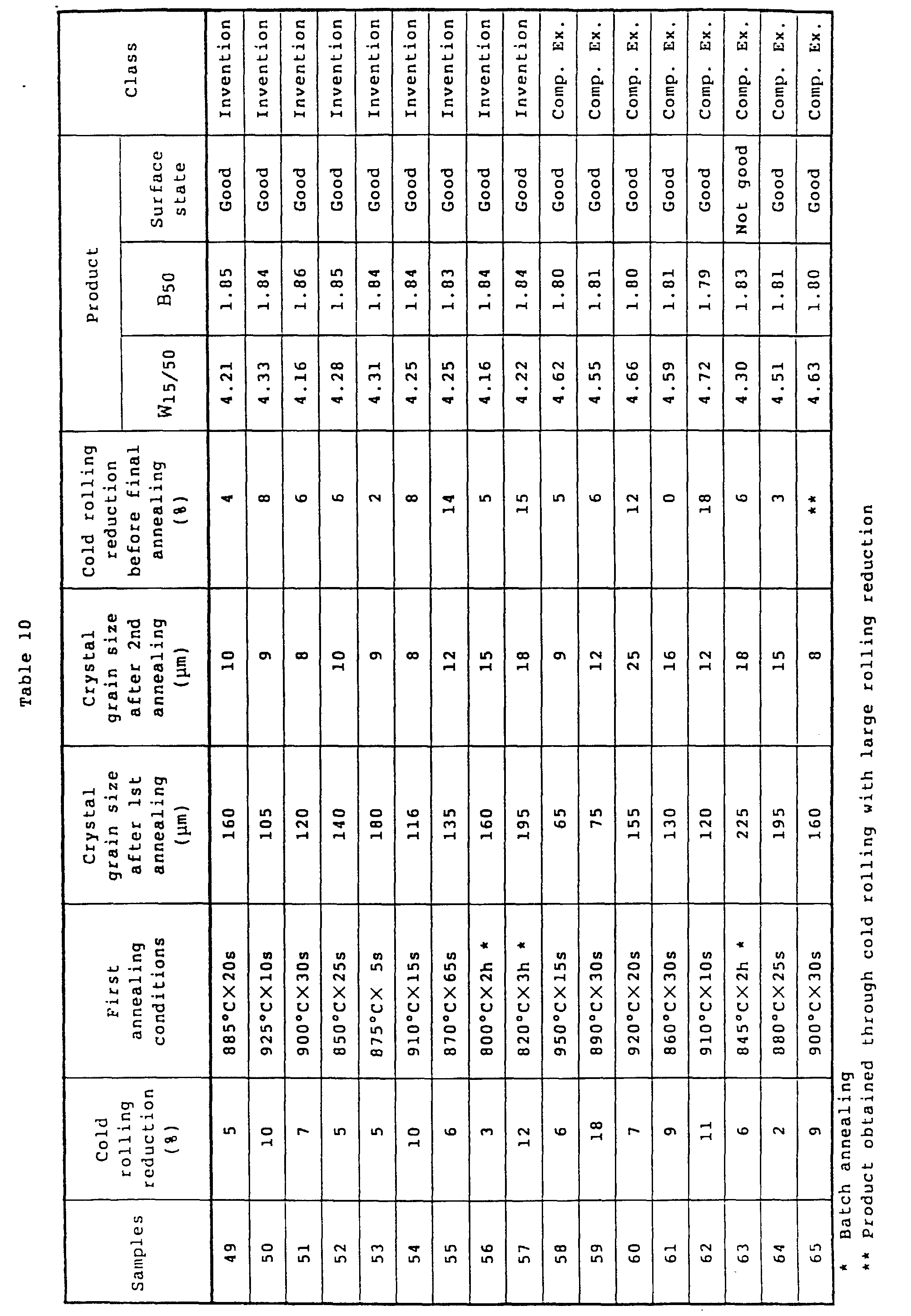
- Continuously cast slabs Nos. 49 to 65 having a chemical composition containing 0.006 % C, 0.18 % Si, 0.25 % Mn, 0.03 % P, 0.0011 % Al, 0.06 % Sb and the balance Fe, were hot-rolled by ordinary hot-rolling to hot-rolled steel strip 2.0 mm thick. Each strip had an A 3 transformation temperature of 925°C.
- Each strip was treated under first annealing conditions shown in Table 10 so that structures having crystal grain sizes as shown in the same Table were obtained.
- the first-annealed strip was then cold-rolled down to 0.50 to 0.60 mm and was subjected to second annealing conducted at 600 to 800°C so as to obtain structures having crystal grain sizes as shown in Table 10.
- Each second-annealed strip was further subjected to cold-rolling conducted at rolling reductions as shown in Table 10 down to 0.50 mm in thickness, and then subjected to final decarburization annealing conducted at 800°C for 75 seconds, whereby final products were obtained.
- Table 10 also shows the properties of the products as measured by Epstein test pieces, as well as the conditions of the product surfaces. Properties and surface qualities of products, which were produced by annealing the strip after second cold-rolling, are also shown by way of Comparison Examples. It will be seen that the products produced by the present invention were superior both in magnetic flux density and appearance, as compared with the Comparison Examples.
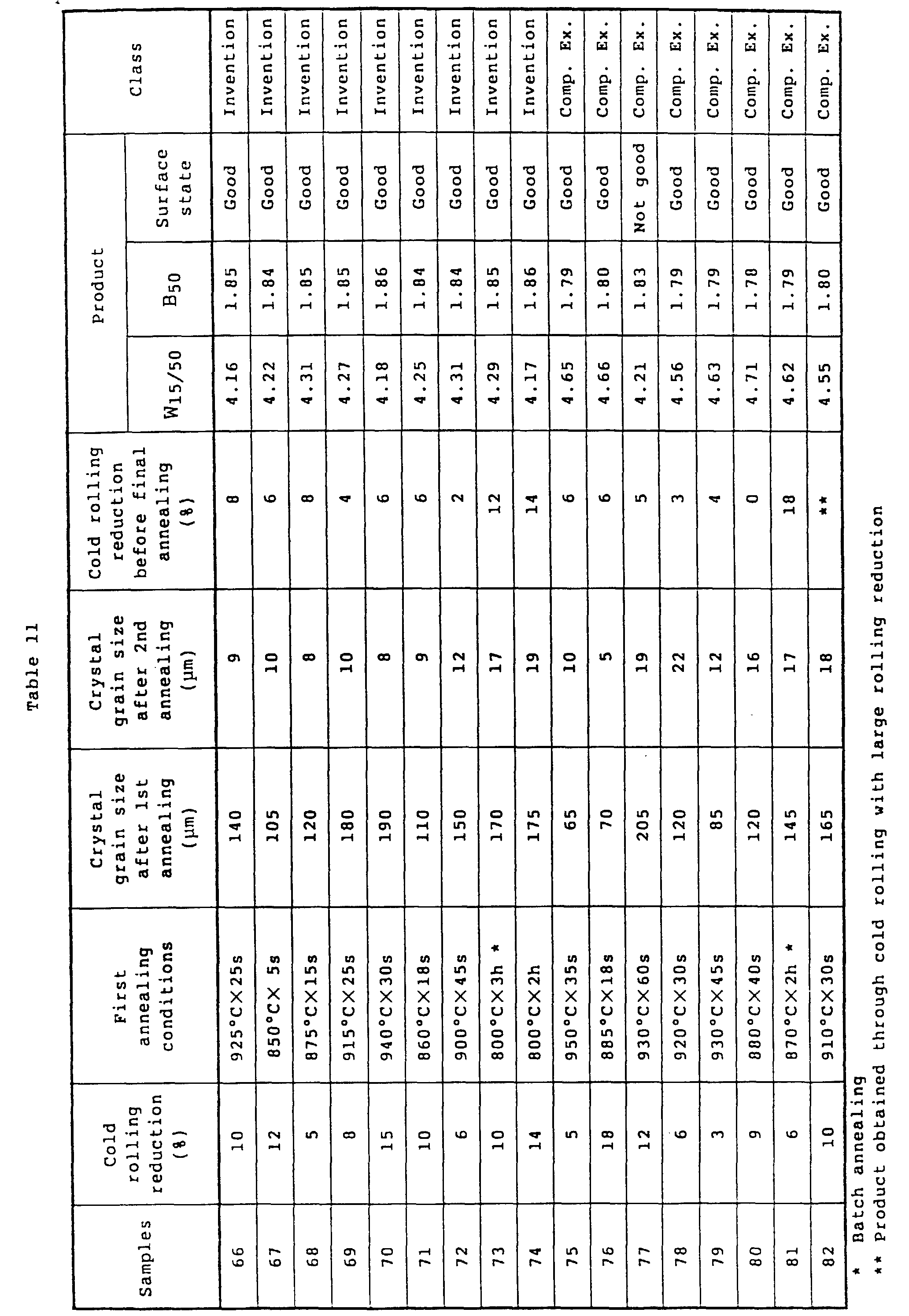
- Continuously cast slabs Nos. 66 to 82 having a chemical composition containing 0.008 % C, 0.35 % Si, 0.35 % Mn, 0.05 % P, 0.0012 % Al, 0.05 % Sb, 0.03 % Sn and the balance Fe.
- the slabs were hot-rolled by an ordinary hot-rolling process to hot-rolled steel strip 2.0 mm thick. Each strip had an A 3 transformation temperature of 940°C.
- Each strip was treated under first annealing conditions shown in Table 11 so that structures having crystal grain sizes as shown in the same Table were obtained.
- Each first-annealed strip was then cold-rolled down to 0.50 to 0.60 mm and subjected to second annealing conducted at 600 to 800°C so as to obtain structures having crystal grain sizes as shown in Table 11.
- Each second-annealed strip was further subjected to cold-rolling conducted at rolling reductions as shown in Table 11 down to 0.50 mm in thickness, and then subjected to final decarburization annealing conducted at 800°C for 75 seconds, whereby final products were obtained.
- Table 11 also shows the result of measurement of the properties of the products as measured by Epstein test pieces, as well as the conditions of the product surfaces. Properties and surface qualities of products, which were produced by annealing the strip after second cold-rolling, are also shown by way of Comparison Examples. It will be seen that the products produced by the present invention are superior both in magnetic flux density and appearance, as compared with the Comparison Examples.
- Continuously cast slabs Nos. 83 to 87 having a chemical composition containing 0.002 % C, 3.31 % Si, 0.16 % Mn, 0.02 % P, 0.64 % Al and the balance Fe
- slabs Nos. 88 to 92 having a chemical composition consisting of 0.003 % C, 3.25 % Si, 0.15 % Mn, 0.02 % P, 0.62 % Al, 0.05 % Sb and the balance Fe, and slabs Nos.
- Each strip was treated under first annealing conditions shown in Table 12 so that structures having crystal grain sizes as shown in the same Table were obtained.
- Each first-annealed strip was then cold-rolled down to 0.50 to 0.60 mm and subjected to a second annealing step conducted at 600 to 800°C so as to obtain structures having crystal grain sizes as shown in Table 12.
- Each second-annealed strip was further subjected to cold-rolling conducted at rolling reductions as shown in Table 12 down to 0.50 mm in thickness, and then subjected to final recrystallizing annealing conducted at 1000°C for 30 seconds, whereby final products were obtained.
- Table 12 also shows the result of measurement of the properties of the products as measured by Epstein test pieces, as well as the conditions of the product surfaces.
Landscapes
- Chemical & Material Sciences (AREA)
- Engineering & Computer Science (AREA)
- Physics & Mathematics (AREA)
- Mechanical Engineering (AREA)
- Metallurgy (AREA)
- Organic Chemistry (AREA)
- Materials Engineering (AREA)
- Electromagnetism (AREA)
- Manufacturing & Machinery (AREA)
- Thermal Sciences (AREA)
- Crystallography & Structural Chemistry (AREA)
- Manufacturing Of Steel Electrode Plates (AREA)
- Soft Magnetic Materials (AREA)
Description
- The present invention relates to a method of producing a non-oriented electromagnetic steel strip having superior magnetic properties. More particularly, the present invention is concerned with a method of producing non-oriented electromagnetic steel strip which has a high level of magnetic flux density and superior surface appearance.
- Non-oriented electromagnetic steel sheets are used as materials of cores of rotating machines such as motors, as well as cores of transformers and stabilizers. To improve efficiency of operation of these electrical cores while reducing their sizes it is necessary to raise the level of the magnetic flux density and to reduce the iron loss of the electromagnetic steel sheet used as the core material.
- It has been known that one way of improving magnetic properties of non-oriented electromagnetic steel sheets is to coarsen the crystal grains of the steel strip before cold rolling.
- The present inventors have proposed, in Japanese Patent Publication (Kokoku) No. 57-35628, a method for coarsening the crystalline structure of an electromagnetic steel strip which is to be cold-rolled, wherein an electromagnetic steel strip, which is to be cold-rolled, is hot-rolled such that the hot-rolling is finished at a temperature not lower than the Ar3 transformation temperature of the steel which is determined on the basis of the chemical composition of the steel. The hot-rolled steel strip is annealed for at least 30 seconds up to 15 minutes at a temperature not higher than the A3 transformation temperature.
- The inventors also proposed, in Japanese Patent Laid-Open (Kokai) No. 2-182831, a method in which hot-rolling of a steel strip is finished at a temperature not lower than the Ar3 transformation temperature and the hot-rolled steel strip is held at a temperature not higher than the A3 transformation temperature for 15 to 30 seconds, followed by cooling which is effected at a controlled cooling rate.
- In these methods, however, coarsening of the crystal grains cannot be attained satisfactorily particularly when the annealing time is near the shorter end (30 seconds) of the annealing period, resulting in large fluctuation of the magnetic characteristics. Conversely, when the annealing time approaches the longer limit (15 minutes) of the annealing period, the crystalline structure becomes too coarse so that the appearance of the product is impaired due to roughening or wrinkling of its surface.
- Japanese Patent Laid-Open (Kokai) No. 58-136718 discloses a method in which a steel strip is hot-rolled down to a final temperature which is within the γ-phase region and not more than 50°C higher than the Ar3 transformation temperature, the strip being then taken-up at a temperature which is not higher than the A3 transformation temperature but not lower than 700°C so as to coarsen the ferrite crystal grains to a size which is not greater than 100 µm, thereby improving magnetic properties of the steel strip.
- Japanese Patent Laid-Open (Kokai) No. 54-76422 discloses a method in which a hot-rolled steel strip is taken up at a temperature ranging between 750 and 1000°C, and is self-annealed by the heat possessed by the steel strip itself, whereby the steel strip is recrystallized to crystal grains sized between 50 and 70µm so as to exhibit improved magnetic characteristics.
- These known methods for improving magnetic properties by employing take-up temperatures not lower than 700°C conveniently eliminate the necessity for annealing but suffer from a disadvantage in that, since the take-up temperature is high, both side edge portions of the coiled steel strip are cooled at a greater rate than the breadthwise central portion of the coil and at a higher speed at the starting and terminating ends of the coil than at the mid portion of the coil, which not only produce nonuniform distribution of magnetic properties over the entire coiled steel strip but also impair the effect of pickling which is conducted for the purpose of descaling.
- Japanese Patent Publication (Kokoku) No. 45-22211, see the search report of the European Patent Office, discloses a method in which a hot-rolled steel strip is cold-rolled at a rolling reduction of 0.5 to 15% and is then subjected to annealing which is conducted for a comparatively long time at a temperature not higher than the A3 transformation temperature, so as to coarsen the crystalline structure of the steel strip thereby reducing iron loss. In this method, however, the annealing after cold rolling is conducted in accordance with a so-called box-annealing method at a temperature of 800 to 850°C for a comparatively long time of 30 minutes to 20 hours (10 hours in all the illustrated examples). Such a long term annealing is undesirable from the viewpoint of cost and tends to cause excessive coarsening to grain sizes of 180 µm or greater, leading to inferior appearance of the product.
- Japanese Patent Laid-Open (Kokai) No. 1-306523, see the search report of the European Patent Office, discloses a method for producing a non-oriented electromagnetic steel sheet having a high level of magnetic flux density, wherein a hot-rolled steel strip is subjected to cold rolling at a small reduction conducted at a rolling reduction of 5 to 20%, followed by annealing for 0.5 to 10 minutes at a temperature ranging from 850 to 1000°C. Annealing is conducted in a continuous annealing furnace in this case but this method uneconomically requires huge equipment because the annealing has to be completed in a short time, e.g., 2 minutes or so as in the illustrated examples.
- All these known methods are intended to improve magnetic properties by coarsening the crystalline structure of the steel strip before the strip is subjected to cold-rolling. Unfortunately, these known methods do not provide sufficient combined magnetic properties, product quality and economy of production.
- Japanese Patent Laid-Open Nos. 1-139721, see the search report of the European Patent Office, and 1-191741 disclose methods of producing semi-processed electromagnetic steel sheets, wherein skin pass rolling is conducted at a rolling reduction of 3 to 15% as the final step. The skin pass rolling for semi-processed steel strip, however, is intended to control the hardness of the rolled product. In order to assure required magnetic properties the skin pass rolling must be followed by a special annealing which must be conducted for a comparatively long time, e.g., 2 hours, at a temperature of, for example, 750°C. Therefore, short-time annealing which is basically conducted by the continuous annealing method, when applied to such semi-processed steel strip, could not stably provide superior magnetic properties.
- Accordingly, an object of the present invention is to provide a method of producing a non-oriented electromagnetic steel strip which excels in magnetic properties, particularly in magnetic flux density, while further providing a product of excellent appearance.
- Still another object is to provide a method for optimizing conditions of annealing the strip to coarsen to a carefully controlled degree the crystal grains of steel strip which has been hot-rolled after cold-rolling conducted with small rolling reduction.
- The present invention thus aims to provide a method of producing a non-oriented electromagnetic steel strip which is superior in magnetic properties and appearance.
- According to the present invention, there is provided a method of producing a non-oriented electromagnetic steel strip having improved magnetic properties and appearance, comprising the steps of:
- (a) hot-rolling a steel slab comprising, up to 0.02wt% of C, up to 4.0wt% of Si or Si and Al, up to 1.0wt% of Mn, up to 0.2wt% of P, the balance being Fe and incidental impurities, to form a hot-rolled strip;
- (b) subjecting the hot-rolled strip to cold rolling conducted at a rolling reduction of between 5 and 15%;
- (c) subjecting the cold-rolled strip to a first annealing step;
- (d) subjecting the resulting annealed strip to cold rolling to reduce the strip thickness to a predetermined thickness; and
- (e) subjecting the resulting cold-rolled strip to final annealing, characterised in that the strip is heated in the first annealing step (c) at a rate of at least 3°C/sec and is held at the annealing temperature for a period of 5 to 30 seconds so as to produce a crystal grain size ranging from 100 to 200µm.
-
- The slab from which the strip is made contains, by weight, up to 0.02 of C, up to 4.0 of Si plus Al or Si alone, up to 1.0% of Mn, up to 0.2 of P and the balance Fe.
- The steps of the method include hot-rolling the slab to form a hot-rolled strip, subjecting the hot-rolled strip to cold-rolling at a rolling reduction between 5 and 15 %, subjecting the cold-rolled strip to annealing controlled to produce a crystal grain size ranging from 100 to 200 µm, subjecting the annealed strip to cold rolling to reduce the strip thickness to a predetermined thickness, and subjecting the cold-rolled strip to final annealing.
- The above and other objects, features and advantages of the present invention will become clear from the following description of the preferred embodiments when read in conjunction with the accompanying drawings.
-
- Fig. 1 is a diagram showing the relationship at various temperature conditions between the magnetic flux density B50 of a steel strip and the cold rolling reduction percent before first annealing;
- Fig. 2 is a graph showing the relationship between the proportion of coarse crystal grains in the strip and the rate of heating after first annealing; and
- Fig. 3 is a graph showing the relationship among the magnetic flux density of a steel strip product, its crystal grain size before final annealing, and the percentage of applied rolling reduction.
-
- A description will now be given regarding specific forms of the method, showing specific procedures actually accomplished, as well as advantageous effects produced, with reference to results achieved by the present invention. This description is not intended to define or to limit the scope of the invention, which is defined in the appended claims.
- A slab was formed from a steel melt containing, by weight, 0.010% C, 0.15% Si, 0.25% Mn, 0.08% P, 0.045% Sb, 0.004% S, 0.0008% Al and the balance Fe. The slab was heated to 1250°C and was hot-rolled to form a hot-rolled steel strip 2.3 mm thick. Subsequently, a cold rolling at a small reduction was applied to the steel strip at a rolling reduction of 0 to 20%, followed by first annealing which was conducted in a continuous annealing furnace for 10 seconds at a temperature of 700 to 1000°C. The rate of heating in the continuous annealing step was 5°C/sec. The A3 transformation temperature of this steel strip was 915°C. Then, after pickling, the steel strip was subjected to ordinary cold-rolling to make a cold-rolled steel strip 0.50 mm thick, followed by final annealing for 75 seconds in a wet atmosphere at 800°C for decarburization and recrystallization, whereby a final product was obtained.
- The unusual relationship that we have discovered between (a) the percentage of rolling reduction in the step of cold rolling at a small reduction before first annealing and (b) the resulting level of magnetic flux density of the steel strip of this Example is shown in Fig. 1. From the Table in Fig. 1 and from the two uppermost curves, it will be seen that the highest level of magnetic flux density B50 is obtained when the cold rolling at a small reduction, conducted at a rolling reduction, is followed by first annealing at a temperature ranging from about 850°C to 915°C, which is the A3 transformation temperature of the steel strip. The sizes of the crystal grains of the steel strip after first annealing, obtained through cold-rolling and first annealing executed under the above-described conditions, ranged between 100 and 200 µm, and the product strip had a good appearance without substantial wrinkling.
- The comparative steel strip which did not show substantial improvement in magnetic flux density B50 had crystal grain sizes of less than about 100 µm after first annealing and were outside the scope of this invention.
- Thus, appreciable improvement of magnetic flux density can be attained when the hot-rolled steel strip is subjected to cold-rolling at a rolling reduction of 5 to 15% and subsequent first annealing at a (comparatively high) temperature ranging from about 850°C to 915°C, which is the A3 transformation temperature, for a very short time of about 10 seconds. This remarkable effect is considered to be attributable to a coarsening of the crystal grains which is caused by the first annealing step and which significantly improves the texture in the final product. The coarsening of the crystal grains effected by the first annealing step is caused by the fact that the step of cold rolling at a small reduction imparts to the hot-rolled steel strip a strain which in turn creates the extraordinary growth of the crystal grains which causes the coarsening phenomenon.
- Further work was also conducted in which a slab was formed from a steel melt containing, by weight, 0.010% C, 0.15% Si, 0.25% Mn, 0.08% P, 0.045% Sb, 0.004% S, 0.0008% Al and the balance Fe, the slab being then heated to 1250°C and then subjected to ordinary hot rolling to make a hot-rolled steel strip 2.3 mm thick. Then, a step of cold rolling at a small reduction was executed at a rolling reduction of 10%, followed by a short annealing step in a continuous annealing furnace for a (very short) time of 10 seconds at a temperature of 915°C. The rate of anneal heating was varied within the range from 1°C/sec and 5°C/sec. The structure of the steel strip after annealing was observed in order to examine the relationship between the proportion (area ratio) of coarse grains such as those greater than 200 µm and the heating rate, the results being shown in Fig. 2. It will be understood that the coarsening of the crystal grains tends to enhance the generation of wrinkling in the product surface. It will also be seen from Fig. 2 that, for the purpose of improving the nature and appearance of the surface of the product, it is preferred to apply a greater heating rate to decrease the proportion of the coarse crystal grains.
- We have also confirmed that a similar effect can be obtained even when the annealing heating temperature is about 850°C or lower, provided that the crystal grains are coarsened to sizes not smaller than about 100 µm by applying a longer annealing time.
- A specific example will now be given showing conditions of cold rolling conducted subsequently to first annealing and conditions of the annealing following cold rolling.
- A hot-rolled steel strip of the same composition as that described before was subjected to cold rolling at a rolling reduction of 10% and was subjected to first annealing in which the steel strip was held for 10 seconds at a temperature of 900°C. The crystal grain size of the steel strip at this stage was 120 µm. Cold rolling was effected on the steel strip so as to reduce the thickness of the strip down to 0.50 to 0.65 mm. The cold-rolled steel strip was then subjected to a second annealing conducted at a temperature between 600 and 750°C so that the crystal grain size was reduced to 10 to 30 µm, followed by cold rolling at a small reduction executed at a rolling reduction of 0 to 20%, down to a strip thickness of 0.50 mm. The steel strip was then subjected to final annealing which was conducted also for a decarburization purpose in a wet atmosphere of 800°C for 60 seconds. Final products were thus obtained and examined.
- Fig. 3 shows how the magnetic flux density B50 of the strip is varied by a change in the crystal grain size after the second annealing and the rolling reduction in the cold rolling at a small reduction. It will be seen that the highest level of magnetic flux density B50 was obtained when the cold-rolling and the annealing (which were executed sequentially after the first annealing) were respectively conducted such as to provide a rolling reduction of 1 to 15 % and to provide a crystal grain size of 20 µm or less after the secondary annealing. In general, products exhibiting higher levels of magnetic flux density showed good surface conditions without any wrinkling or roughening.
- As has been described, according to the present invention, a further improvement in the magnetic flux density is attained by controlling the crystal grain size obtained after the second annealing executed after the first annealing and by controlling also the amount of rolling reduction in the cold-rolling step executed subsequently to the second annealing. This results from improvement of the texture caused by crystal rotation and selective orientation of the crystal grains during the growth of such crystal grains.
- Conditions of the cold rolling executed after hot-rolling and annealing will be explained hereinafter in view of the test results described hereinbefore.
- According to the invention the rolling reduction in the step of cold rolling at a small reduction executed after hot-rolling is limited to 5 to 15 %. A rolling reduction value less than 5 % is not sufficient for providing a required level of strain when the first annealing, which is executed after cold rolling at a small reduction for the purpose of controlling the crystal grain size, is conducted in a short period of time at a comparatively high temperature or in a long period of time at a comparatively low temperature. In this case, therefore, the crystal grains are not sufficiently coarsened and cannot reach a size of 100 µm, so that no remarkable improvement in the magnetic flux density is attained. A rolling reduction value exceeding 15 % is not outstanding and provides essentially the same effect as that produced by ordinary cold-rolling. Cold-rolling at such a large rolling reduction cannot grow the crystal grains to grain sizes of 100 µm or greater.
- According to the invention after cold rolling at a rolling reduction of 5 to 15 %, first annealing is executed under conditions of temperature and time to grow the crystal grains to a size of 100 to 200 µm. This specific range of crystal grain size is critical and has to be met for the following reasons.
- The appearance of the product is seriously degraded when the crystal grain size exceeds 200 µm. Accordingly, annealing should be executed in such a manner as not to cause the crystal grain size to exceed 200 µm. On the other hand, crystal grain size below 100 µm fails to provide appreciable improvement in the magnetic properties of the strip. The first annealing step, therefore, should also be conducted so as not to cause the crystal grain size to develop to a size below 100 µm.
- According to the invention, the first annealing step, which is conducted to obtain a crystal grain size of 100 to 200 µm, is executed at a heating rate of at least 3°C/sec. This is because a heating rate less than 3°C/sec tends to allow a local growth of grains in the structure during the heating, failing to provide uniform and moderate growth of the crystal grains, resulting in coexistence of coarse and fine grains. In order to obviate such a shortcoming, the heating rate is preferably set at a level of at least about 5°C/sec.
- During the first annealing step, the steel strip is held at its elevated temperature for a period of 5 to 30 seconds. This is advantageous in the operating condition of a continuous annealing furnace and is advantageously used for reducing production cost and stabilizing the product quality. It is designed to anneal steel strip in a short period of 5 to 30 seconds at a comparatively high temperature of about 850°C to 915°C. When the annealing temperature is below about 850°C the crystal grains cannot grow to an extent sufficient for improvement of magnetic flux density. More specifically, the annealing temperature is preferably set at a level between about 850°C and the A3 transformation temperature. When annealing is executed at a temperature outside the above-specified range, crystal grains cannot grow to sizes of 100 µm or greater, so that the improvement in the magnetic flux density is not appreciable, when the above-mentioned annealing time is less than 5 seconds. Conversely, when the above-mentioned annealing time exceeds 30 seconds, the crystal grains tend to become coarsened excessively to sizes exceeding 200 µm, with product appearance deteriorated due to wrinkling, although the magnetic flux density may be improved appreciably.
- Wrinkling of the product surfaces also undesirably impairs the so-called "space factor" of the strip.
- According to the invention, the time at which the steel strip is held at the elevated temperature during the first annealing is selected to range from 5 to 30 seconds, so as to realize a crystal grain size of 100 to 200 µm after first annealing, thereby to attain an appreciable improvement of magnetic flux density without being accompanied by degradation of product appearance.
- A further description will now be given of specific selected conditions for cold-rolling after first annealing, and of the annealing following the cold-rolling.
- According to the invention, the cold-rolling step after first annealing is conducted at a rolling reduction of at least 50%. This condition has to be met in order to generate strain necessary to obtain the desired crystal grain size in the subsequent second annealing step. The second annealing step should be performed under conditions that the crystal grain size is reduced to 20 µm or less after annealing. It is considered that a too large crystal grain size undesirably restricts crystal rotation during subsequent cold rolling at a small reduction and impedes suppression of growth of (111) oriented grains in subsequent annealing, the (111) oriented grain being preferably eliminated by development of grains of other orientations.
- The cold rolling at a small reduction performed after annealing for the purpose of grain size control has to be done at a rolling reduction of at least about 1 %, in order to attain an appreciable improvement in the texture. Cold-rolling at a rolling reduction exceeding 15%, however, tends to promote recrystallization as is the case of ordinary cold-rolling, preventing improvement of the texture and failing to provide appreciable improvement of magnetic properties.
- A description will now be given regarding critical proportions of the respective elements or components of the strip.
- The content of C is up to 0.02 % because a C content exceeding this level not only impairs magnetic properties but also impedes decarburization upon final annealing, causing an undesirable effect on the non-aging property of the product.
- Si plus Al or Si alone exhibits a high specific resistivity. When the content of Si plus Al or Si alone increases, therefore, iron loss is decreased but the magnetic flux density is lowered. The content, therefore, should be determined according to the levels of the iron loss and magnetic flux densities to be attained, in such a manner as to simultaneously meet both these demands. When the Si plus Al content exceeds 4.0 % the cold-rolling characteristics are seriously impaired. Accordingly, this content should be up to 4.0 %.
- Sb and Sn are elements which enhance magnetic flux density through improvement of the texture and, hence,are preferably contained particularly when a specifically high magnetic flux density is required. The content of Sb and Si in total or the content of Sb or Si alone should be determined to be up to 0.10 % because a higher content deteriorates the magnetic properties of the strip.
- Mn is an element which is used as a deoxidizer or for the purpose of controlling hot embrittlement which is caused when S is present. The content of Mn, however, should be limited to up to 1.0 % because addition of this element raises the cost of production.
- P may be added as an element which enhances hardness to improve the punching characteristics of the product steel. The content of this element, however, should be up to 0.20 % because addition of this element in excess of this value undesirably makes the product fragile.
- The following specific Examples of the present invention are intended as illustrative and are not intended to limit the scope of the invention other than defined in the appended claims.
- Continuously cast slabs Nos. 1 to 9, having a chemical composition containing 0.006 % C, 0.35 % Si, 0.25 % Mn, 0.08 % P, 0.0009% Al and the balance Fe, were hot-rolled in a conventional manner to steel strip 2.3 mm thick. The A3 transformation temperature of the hot-rolled strip was 955°C.
- Each hot-rolled steel strip was then subjected to cold rolling at a small reduction, followed by first annealing. Different rolling reductions and different annealing conditions were applied to individual hot-rolled strip, as shown in Table 1. Subsequently a single cold-rolling step was applied to roll the strip to a final thickness of 0.50 mm, followed by final decarburization/recrystallization annealing which was executed at 850°C for 75 seconds, whereby final products were obtained.
- Table 2 shows the magnetic properties of these products, with and without stress relief annealing conducted at 750°C for 2 hours, as measured in the form of an Epstein test piece. From Table 2 it will be seen that, when the requirement for the rolling reduction in the cold rolling at a small reduction of hot-rolled steel strip and the conditions for the first annealing are met, crystal grains are coarsened moderately through the first annealing step so that the texture is improved to provide a high level of magnetic flux density B50, as well as improved product appearance.
Sample Nos. Class Cold rolling reduction (%) First annealing Crys. grain size after 1st annealing (µm) Heating rate Temp. Time 1 Invention 10 7°C/sec 900° C 10 sec 120 2 10 7°C/sec 870° C 30 sec 180 3 10 1°C/sec 840°C 70 sec 155 4 8 0.02°C/sec 800° C 3 hr 185 5 Comparison examples 0 7°C/sec 900° C 30 sec 50 6 3 7°C/sec 900° C 30 sec 70 7 10 7°C/sec 1000° C 30 sec 50 8 20 5°C/sec 900° C 30 sec 80 9 10 5°C/sec 900°C 80 sec 260 Samples Nos. Class After final annealing After stress relief annealing Appearance of product W15/50 (w/kg) B50 (T) W15/50 (w/kg) B50 (T) 1 Invention 4.62 1.79 3.92 1.78 Good 2 4.51 1.79 3.85 1.78 Good 3 4.82 1.78 4.08 1.77 Good 4 4.72 1.78 3.99 1.77 Good 5 Comparison examples 5.13 1.77 4.62 1.76 Good 6 4.96 1.77 4.51 1.76 Good 7 5.38 1.76 4.82 1.75 Good 8 5.10 1.77 4.58 1.75 Good 9 4.48 1.79 3.82 1.78 Not good Good: No wrinkling Not good: Wrinkling - As in Example 1, continuously cast slabs Nos. 10 to 15, having a chemical composition containing 0.007 % C, 1.0 % Si, 0.30 % Mn, 0.018 % P, 0.30 % Al and the balance Fe, were hot-rolled in a conventional manner to hot-rolled steel strip 2.0 mm thick. The A3 transformation temperature of the hot-rolled strip was 1,050°C.
- Each hot-rolled steel strip was then subjected to cold rolling at a small reduction followed by first annealing. Different rolling reductions and different annealing conditions were applied to different hot-rolled strip, as shown in Table 3. Subsequently a single cold-rolling step was executed to roll the strip to a final thickness of 0.50 mm, followed by final decarburization/recrystallization annealing which was executed at 830°C for 75 seconds, whereby final products were obtained.
- Table 4 shows the magnetic properties of these products, with and without stress relief annealing conducted at 750°C for 2 hours, as measured in the form of Epstein test pieces. From Table 4, it will be seen that the product of this invention has superior magnetic density and surface appearance, when compared with those of the comparison examples.
Samples Nos. Class Cold rolling reduction (%) First annealing Cry. grain size after 1st annealing (µm) Heating rate Temp. Time 10 Invention 12 5°C/sec 950° C 30 sec 200 11 7 5°C/sec 950° C 10 sec 160 12 Comparison examples 0 5°C/sec 950° C 30 sec 60 13 10 7°C/sec 1080° C 30 sec 50 14 20 7°C/sec 950° C 30 sec 80 15 7 5°C/sec 950°C 90 sec 410 Samples Nos. Class After final annealing After stress relief annealing Appearance of product W15/50 (w/kg) B50 (T) W15/50 (w/kg) B50 (T) 10 Invention 4.00 1.78 3.62 1.77 Good 11 4.13 1.78 3.70 1.77 Good 12 Comparison examples 4.61 1.76 4.29 1.75 Good 13 4.77 1.75 4.36 1.75 Good 14 4.58 1.76 4.19 1.75 Good 15 4.10 1.78 3.63 1.77 Not good - Continuously cast slabs Nos. 16 to 22, having a chemical composition containing 0.005 % C, 0.33 % Si, 0.25 % Mn, 0.07 % P, 0.0008% Al, 0.050 % Sb and the balance Fe, were hot-rolled in a conventional manner to hot-rolled steel strip 2.3 mm thick. The A3 transformation temperature of the hot-rolled strip was 950°C.
- Each hot-rolled steel strip was then subjected to a cold rolling at a small reduction, followed by first annealing. Different rolling reductions and different annealing conditions were applied to different hot-rolled strip, as shown in Table 5. Subsequently, a single cold-rolling step was executed to roll the strip to a final thickness of 0.50 mm, followed by final decarburization/recrystallization annealing which was executed at 810°C for 60 seconds, whereby final products were obtained. Table 6 shows the magnetic properties of these products, with and without stress relief annealing conducted at 750°C for 2 hours, as measured in the form of Epstein test pieces. From Table 6 it will be seen that, when the requirement for the rolling reduction in the cold rolling at a small reduction of hot-rolled strip and the conditions of the subsequent annealing in accordance with the invention are met, it is possible to obtain electromagnetic steel strip having a high level off magnetic flux density and superior appearance.
Samples Nos. Class Cold rolling reduction (%) First annealing Crys. grain size after 1st annealing (µm) Heating rate Temp. Time 16 Invention 10 7°C/sec 930° C 10 sec 120 17 10 7°C/sec 880° C 30 sec 180 18 Comparison examples 0 7°C/sec 930° C 30 sec 55 19 3 7°C/sec 930° C 30 sec 70 20 10 7°C/sec 1000° C 30 sec 50 21 10 7°C/sec 900°C 80 sec 250 22 10 2°C/sec 880° C 30 sec 240 Samples Nos. Class After final annealing After stress relief annealing Appearance of product W15/50 (w/kg) B50 (T) W15/50 (w/kg) B50 (T) 16 Invention 4.58 1.81 3.78 1.80 Good 17 4.40 1.81 3.70 1.81 Good 18 Comparison examples 5.00 1.78 4.57 1.77 Good 19 4.83 1.79 4.32 1.78 Good 20 5.30 1.77 4.78 1.76 Good 21 4.38 1.81 3.66 1.81 Not good 22 4.53 1.80 3.81 1.80 Not good - Continuously cast slab Nos. 23 to 28, having a chemical composition containing 0.008 % C, 1.1 % Si, 0.28 % Mn, 0.018 % P, 0.31 % Al, 0.055 % Sn and the balance Fe, and continuously cast slabs Nos. 29 to 31, containing 0.007 % C, 1.1 % Si, 0.30 % Mn, 0.019 % P, 0.30 % Al, 0.03 % Sb, 0.03 % Sn and the balance Fe, were hot-rolled in a conventional manner to hot-rolled steel strip 2.0 mm thick. The A3 transformation temperature of the hot-rolled strip produced from slab Nos. 23 to 28 was 1045°C while the A3 transformation temperature of the strip rolled from slabs Nos. 29 to 31 was 1055°C.
- Each hot-rolled steel strip was then subjected to cold rolling at a small reduction followed by first annealing. Different rolling reductions and different annealing conditions were applied to different hot-rolled strip, as shown in Table 7. Subsequently, a single cold-rolling step was executed to roll each strip to a final thickness of 0.50 mm, followed by final decarburization/recrystallization annealing which was executed at 830°C for 75 seconds, whereby final products were obtained. Table 8 shows the magnetic properties of these products, with and without stress relief annealing conducted at 750°C for 2 hours, as measured in the form of Epstein test pieces. From Table 8 it will be seen that the strip produced by the processes meeting the requirements of the present invention were superior both in the magnetic flux density and appearance.
Samples Nos. Class Cold rolling reduction (%) First annealing Cry. grain size after 1st annealing (µm) Heating rate Temp. Time 23 Invention 13 5°C/sec 950° C 30 sec 190 24 7 5°C/sec 950° C 10 sec 160 30 10 5°C/sec 950° C 30 sec 200 25 Comparison examples 0 5°C/sec 950° C 30 sec 55 26 10 5°C/sec 1080° C 30 sec 45 27 20 5°C/sec 950° C 30 sec 80 28 7 5°C/sec 950°C 100 sec 430 29 0 5°C/sec 950° C 30 sec 55 31 10 1°C/sec 950° C 30 sec 260 Samples Nos. Class After final annealing After stress relief annealing Appearance of product W15/50 (w/kg) B50 (T) W15/50 (w/kg) B50 (T) 23 Invention 3.90 1.80 3.51 1.79 Good 24 3.96 1.79 3.62 1.79 Good 30 3.89 1.80 3.48 1.79 Good 25 Comparison examples 4.50 1.77 4.20 1.76 Good 26 4.67 1.76 4.37 1.76 Good 27 4.49 1.77 4.10 1.76 good 28 3.89 1.80 3.49 1.79 Not good 29 4.53 1.77 4.23 1.76 Good 31 3.98 1.79 3.55 1.78 Not good - Continuously cast slabs Nos. 32 to 48, having a chemical composition containing 0.007 % C, 0.15 % Si, 0.25 % Mn, 0.03 % P, 0.0008 % Al and the balance Fe, were hot-rolled by ordinary hot-rolling so as to make hot-rolled steel strip 2.0 mm thick. The strip had A3 transformation temperatures of 920°C.
- Each strip was treated under first annealing conditions shown in Table 9 so that structures having crystal grain sizes as shown in the same Table were obtained. Each first-annealed strip was then cold-rolled down to 0.50 to 0.60 mm and subjected to second annealing conducted at 600 to 800°C so as to obtain structures having crystal grain sizes as shown in Table 9. Each second-annealed strip was further subjected to cold-rolling conducted at rolling reductions as shown in Table 9 down to 0.50 mm thickness, and then subjected to final decarburization annealing conducted at 800°C for 75 seconds, whereby final products were obtained. Table 9 shows the properties of the products as measured by Epstein test pieces, as well as the conditions of the strip surfaces. Properties and surface qualities of the products, which were produced by annealing the strip after the second cold-rolling, are also shown by way of Comparison Examples. It will be seen that the products produced by processes meeting the conditions of the present invention are superior both in magnetic flux density and appearance, as compared with the Comparison Examples.
- Continuously cast slabs Nos. 49 to 65, having a chemical composition containing 0.006 % C, 0.18 % Si, 0.25 % Mn, 0.03 % P, 0.0011 % Al, 0.06 % Sb and the balance Fe, were hot-rolled by ordinary hot-rolling to hot-rolled steel strip 2.0 mm thick. Each strip had an A3 transformation temperature of 925°C.
- Each strip was treated under first annealing conditions shown in Table 10 so that structures having crystal grain sizes as shown in the same Table were obtained. The first-annealed strip was then cold-rolled down to 0.50 to 0.60 mm and was subjected to second annealing conducted at 600 to 800°C so as to obtain structures having crystal grain sizes as shown in Table 10. Each second-annealed strip was further subjected to cold-rolling conducted at rolling reductions as shown in Table 10 down to 0.50 mm in thickness, and then subjected to final decarburization annealing conducted at 800°C for 75 seconds, whereby final products were obtained. Table 10 also shows the properties of the products as measured by Epstein test pieces, as well as the conditions of the product surfaces. Properties and surface qualities of products, which were produced by annealing the strip after second cold-rolling, are also shown by way of Comparison Examples. It will be seen that the products produced by the present invention were superior both in magnetic flux density and appearance, as compared with the Comparison Examples.

- Continuously cast slabs Nos. 66 to 82, having a chemical composition containing 0.008 % C, 0.35 % Si, 0.35 % Mn, 0.05 % P, 0.0012 % Al, 0.05 % Sb, 0.03 % Sn and the balance Fe. The slabs were hot-rolled by an ordinary hot-rolling process to hot-rolled steel strip 2.0 mm thick. Each strip had an A3 transformation temperature of 940°C.
- Each strip was treated under first annealing conditions shown in Table 11 so that structures having crystal grain sizes as shown in the same Table were obtained. Each frist-annealed strip was then cold-rolled down to 0.50 to 0.60 mm and subjected to second annealing conducted at 600 to 800°C so as to obtain structures having crystal grain sizes as shown in Table 11. Each second-annealed strip was further subjected to cold-rolling conducted at rolling reductions as shown in Table 11 down to 0.50 mm in thickness, and then subjected to final decarburization annealing conducted at 800°C for 75 seconds, whereby final products were obtained. Table 11 also shows the result of measurement of the properties of the products as measured by Epstein test pieces, as well as the conditions of the product surfaces. Properties and surface qualities of products, which were produced by annealing the strip after second cold-rolling, are also shown by way of Comparison Examples. It will be seen that the products produced by the present invention are superior both in magnetic flux density and appearance, as compared with the Comparison Examples.
- Continuously cast slabs Nos. 83 to 87, having a chemical composition containing 0.002 % C, 3.31 % Si, 0.16 % Mn, 0.02 % P, 0.64 % Al and the balance Fe, slabs Nos. 88 to 92, having a chemical composition consisting of 0.003 % C, 3.25 % Si, 0.15 % Mn, 0.02 % P, 0.62 % Al, 0.05 % Sb and the balance Fe, and slabs Nos. 93 to 97, having a composition consisting of 0.002 % C, 3.2 % Si, 0.17 % Mn, 0.02 % P, 0.58 % Al, 0.03 % Sb, 0.04 % Sn and the balance Fe, were treated by ordinary hot-rolling to hot-rolled steel strip 2.0 mm thick. Because of high Si content, transformation of the strip did not occur.
- Each strip was treated under first annealing conditions shown in Table 12 so that structures having crystal grain sizes as shown in the same Table were obtained. Each first-annealed strip was then cold-rolled down to 0.50 to 0.60 mm and subjected to a second annealing step conducted at 600 to 800°C so as to obtain structures having crystal grain sizes as shown in Table 12. Each second-annealed strip was further subjected to cold-rolling conducted at rolling reductions as shown in Table 12 down to 0.50 mm in thickness, and then subjected to final recrystallizing annealing conducted at 1000°C for 30 seconds, whereby final products were obtained. Table 12 also shows the result of measurement of the properties of the products as measured by Epstein test pieces, as well as the conditions of the product surfaces.

- As will be seen from the foregoing description, according to the present invention, it is possible to produce, stably and at a reduced cost, non-oriented electromagnetic steel strip having a high level of magnetic flux density, as well as superior appearance, by a process in which a hot-rolled steel strip is treated through sequential steps including moderate cold rolling at a small reduction and first annealing conducted for the purpose of controlling crystal grain size to a moderate size, followed by cold rolling and subsequent annealing.
Claims (5)
- A method of producing a non-oriented electromagnetic steel strip having improved magnetic properties and appearance, comprising the steps of:characterised in that the strip is heated in the first annealing step (c) at a rate of at least 3°C/sec and is held at the annealing temperature for a period of 5 to 30 seconds so as to produce a crystal grain size ranging from 100 to 200µm.(a) hot-rolling a steel slab comprising, up to 0.02wt% of C, up to 4.0wt% of Si or Si and Al, up to 1.0wt% of Mn, up to 0.2wt% of P, the balance being Fe and incidental impurities, to form a hot-rolled strip;(b) subjecting the hot-rolled strip to cold rolling conducted at a rolling reduction of between 5 and 15%;(c) subjecting the cold-rolled strip to a first annealing step;(d) subjecting the resulting annealed strip to cold rolling to reduce the strip thickness to a predetermined thickness; and(e) subjecting the resulting cold-rolled strip to final annealing,
- A method according to claim 1, wherein the slab further contains up to 0.10wt% Sb and/or Sn at the expense of iron.
- A method according to claim 1 or 2, wherein the cold-rolling step (d) subsequent to the first annealing step (c) is conducted at a rolling reduction of at least 50%, and wherein the method further includes after step (d) and before step (e) a second annealing step (d)(i) so that the crystal grain size of the strip is reduced to 20µm, and a cold-rolling step (d) (ii) to roll the strip to a predetermined strip thickness which is conducted at a rolling reduction of 1 to 15%.
- A method according to claim 1, 2 or 3, wherein the first annealing step (c) subsequent to the cold rolling (b) is conducted at a temperature of from 850°C to the A3 transformation temperature of the steel.
- A method according to any preceding claim wherein the holding time at the annealing temperature in the first annealing step (c) is 10 seconds.
Applications Claiming Priority (6)
| Application Number | Priority Date | Filing Date | Title |
|---|---|---|---|
| JP40104890 | 1990-12-10 | ||
| JP40104890 | 1990-12-10 | ||
| JP401048/90 | 1990-12-10 | ||
| JP27513891 | 1991-10-23 | ||
| JP275138/91 | 1991-10-23 | ||
| JP27513891 | 1991-10-23 |
Publications (3)
| Publication Number | Publication Date |
|---|---|
| EP0490617A2 EP0490617A2 (en) | 1992-06-17 |
| EP0490617A3 EP0490617A3 (en) | 1993-09-15 |
| EP0490617B1 true EP0490617B1 (en) | 1999-07-07 |
Family
ID=26551336
Family Applications (1)
| Application Number | Title | Priority Date | Filing Date |
|---|---|---|---|
| EP91311441A Expired - Lifetime EP0490617B1 (en) | 1990-12-10 | 1991-12-09 | Method for producing non-oriented electromagnetic steel strip having superior magnetic properties and appearance |
Country Status (8)
| Country | Link |
|---|---|
| US (1) | US5413640A (en) |
| EP (1) | EP0490617B1 (en) |
| KR (1) | KR940008933B1 (en) |
| CN (1) | CN1034516C (en) |
| AU (1) | AU629489B2 (en) |
| CA (1) | CA2057368C (en) |
| DE (1) | DE69131416T2 (en) |
| TW (1) | TW198734B (en) |
Families Citing this family (15)
| Publication number | Priority date | Publication date | Assignee | Title |
|---|---|---|---|---|
| CN1035271C (en) * | 1993-04-08 | 1997-06-25 | 上海矽钢片厂 | Anti-shock high strength silicon steel sheet |
| US5665178A (en) * | 1995-02-13 | 1997-09-09 | Kawasaki Steel Corporation | Method of manufacturing grain-oriented silicon steel sheet having excellent magnetic characteristics |
| FR2744135B1 (en) * | 1996-01-25 | 1998-02-27 | Usinor Sacilor | PROCESS FOR PRODUCING MAGNETIC STEEL SHEET WITH NON-ORIENTED GRAINS AND SHEET OBTAINED BY THE PROCESS |
| JP3316123B2 (en) * | 1996-02-15 | 2002-08-19 | 川崎製鉄株式会社 | Semi-process non-oriented electrical steel sheet having excellent magnetic properties and method for producing the same |
| EP1026267A4 (en) * | 1998-05-29 | 2004-12-15 | Neomax Co Ltd | PROCESS FOR PRODUCING HIGH SILICON STEEL, AND SILICON STEEL |
| US6143241A (en) * | 1999-02-09 | 2000-11-07 | Chrysalis Technologies, Incorporated | Method of manufacturing metallic products such as sheet by cold working and flash annealing |
| JP4258918B2 (en) * | 1999-11-01 | 2009-04-30 | Jfeスチール株式会社 | Method for producing non-oriented electrical steel sheet |
| CN100436605C (en) * | 2005-09-23 | 2008-11-26 | 东北大学 | A kind of manufacturing method of non-oriented silicon steel sheet |
| CN100513060C (en) * | 2006-05-12 | 2009-07-15 | 武汉分享科工贸有限公司 | Method for making orientation-free cold-rolled electric steel-board |
| CN102373366A (en) * | 2010-08-26 | 2012-03-14 | 宝山钢铁股份有限公司 | Method for improving coarse grains on surface of non-oriented silicon steel |
| TWI635188B (en) * | 2017-09-08 | 2018-09-11 | 中國鋼鐵股份有限公司 | Non-oriented electromagnetic steel sheet and method of forming the same |
| CN111349742A (en) * | 2020-03-17 | 2020-06-30 | 本钢板材股份有限公司 | A kind of production method of high-efficiency non-oriented silicon steel |
| CN112359265B (en) * | 2020-11-16 | 2021-10-26 | 湖南上临新材料科技有限公司 | Small-deformation pretreatment method of non-oriented silicon steel for motor |
| CN116673325B (en) * | 2023-06-07 | 2026-04-07 | 烟台先进材料与绿色制造山东省实验室 | Preparation methods, systems, electronic equipment, and dielectrics for non-oriented silicon steel ultrathin strips |
| CN119194294B (en) * | 2024-08-30 | 2025-10-28 | 马鞍山钢铁股份有限公司 | Raw material pure iron steel plate for low P, S high purity amorphous strip and production method thereof |
Citations (1)
| Publication number | Priority date | Publication date | Assignee | Title |
|---|---|---|---|---|
| JPH01139721A (en) * | 1987-11-27 | 1989-06-01 | Kawasaki Steel Corp | Manufacture of semiprocessing non-oriented magnetic steel sheet having low iron loss and high magnetic permeability |
Family Cites Families (8)
| Publication number | Priority date | Publication date | Assignee | Title |
|---|---|---|---|---|
| GB943448A (en) * | 1961-11-21 | 1963-12-04 | Jones & Laughlin Steel Corp | Improvements in or relating to the production of electrical steel |
| US3770517A (en) * | 1972-03-06 | 1973-11-06 | Allegheny Ludlum Ind Inc | Method of producing substantially non-oriented silicon steel strip by three-stage cold rolling |
| JPS5366816A (en) * | 1976-11-26 | 1978-06-14 | Kawasaki Steel Co | Method of making nondirectional silicon steel shee having high magnetic flux and low iron loss |
| SU742471A1 (en) * | 1977-08-22 | 1980-06-25 | Центральный Ордена Трудового Красного Знамени Научно-Исследовательский Институт Черной Металлургии Им. И.П.Бардина | Method of producing electroengineering steel web |
| JPS5468717A (en) * | 1977-11-11 | 1979-06-02 | Kawasaki Steel Co | Production of unidirectional silicon steel plate with excellent electromagnetic property |
| JPH01191741A (en) * | 1988-01-27 | 1989-08-01 | Sumitomo Metal Ind Ltd | Manufacture of semiprocessing non-oriented electrical steel sheet |
| US4898627A (en) * | 1988-03-25 | 1990-02-06 | Armco Advanced Materials Corporation | Ultra-rapid annealing of nonoriented electrical steel |
| JPH0832927B2 (en) * | 1988-06-04 | 1996-03-29 | 株式会社神戸製鋼所 | Manufacturing method of non-oriented electrical steel sheet with high magnetic flux density |
-
1991
- 1991-12-06 TW TW080109585A patent/TW198734B/zh active
- 1991-12-09 EP EP91311441A patent/EP0490617B1/en not_active Expired - Lifetime
- 1991-12-09 DE DE69131416T patent/DE69131416T2/en not_active Expired - Fee Related
- 1991-12-10 CN CN91107594A patent/CN1034516C/en not_active Expired - Lifetime
- 1991-12-10 AU AU88969/91A patent/AU629489B2/en not_active Ceased
- 1991-12-10 KR KR1019910022576A patent/KR940008933B1/en not_active Expired - Lifetime
- 1991-12-10 CA CA002057368A patent/CA2057368C/en not_active Expired - Fee Related
-
1993
- 1993-03-29 US US08/039,529 patent/US5413640A/en not_active Expired - Lifetime
Patent Citations (1)
| Publication number | Priority date | Publication date | Assignee | Title |
|---|---|---|---|---|
| JPH01139721A (en) * | 1987-11-27 | 1989-06-01 | Kawasaki Steel Corp | Manufacture of semiprocessing non-oriented magnetic steel sheet having low iron loss and high magnetic permeability |
Also Published As
| Publication number | Publication date |
|---|---|
| TW198734B (en) | 1993-01-21 |
| CN1034516C (en) | 1997-04-09 |
| KR940008933B1 (en) | 1994-09-28 |
| US5413640A (en) | 1995-05-09 |
| CN1063125A (en) | 1992-07-29 |
| DE69131416T2 (en) | 2000-01-13 |
| AU629489B2 (en) | 1992-10-01 |
| CA2057368A1 (en) | 1992-06-11 |
| EP0490617A2 (en) | 1992-06-17 |
| EP0490617A3 (en) | 1993-09-15 |
| DE69131416D1 (en) | 1999-08-12 |
| CA2057368C (en) | 1997-06-24 |
| AU8896991A (en) | 1992-06-11 |
| KR920012500A (en) | 1992-07-27 |
Similar Documents
| Publication | Publication Date | Title |
|---|---|---|
| US5413640A (en) | Method of producing non-oriented electromagnetic steel strip having superior magnetic properties and appearance | |
| JP2500033B2 (en) | Manufacturing method of non-oriented electrical steel sheet with excellent magnetic properties and good surface appearance | |
| JP2026500415A (en) | Non-oriented electrical steel sheet and its manufacturing method | |
| US5667598A (en) | Production method for grain oriented silicion steel sheet having excellent magnetic characteristics | |
| EP0475710B1 (en) | Method of manufacturing an oriented silicon steel sheet having improved magnetic characteristics | |
| JP3387980B2 (en) | Method for producing non-oriented silicon steel sheet with extremely excellent magnetic properties | |
| JPH10130729A (en) | Manufacturing method of grain-oriented electrical steel sheet with extremely low iron loss | |
| JPH07116508B2 (en) | Manufacturing method of non-oriented electrical steel sheet with excellent magnetic properties | |
| JPH09125148A (en) | High magnetic flux density Low iron loss Non-oriented electrical steel sheet manufacturing method | |
| JP3392579B2 (en) | Manufacturing method of grain-oriented electrical steel sheet with extremely low iron loss | |
| JP3290446B2 (en) | Method for producing non-oriented electrical steel sheet with excellent magnetic properties and good surface appearance | |
| US5013372A (en) | Semi-process non-oriented electromagnetic steel strip having low core loss and high magnetic permeability, and method of making | |
| US20240183011A1 (en) | Method for producing grain-oriented electrical steel sheet | |
| JP3348811B2 (en) | Manufacturing method of non-oriented electrical steel sheet with high magnetic flux density and low iron loss | |
| JP2746631B2 (en) | High magnetic flux density oriented silicon steel sheet with excellent iron loss characteristics and method for producing the same | |
| JPH03211258A (en) | Non-oriented silicon steel sheet having excellent magnetic properties and surface properties | |
| JP2717009B2 (en) | Manufacturing method of non-oriented electrical steel sheet with excellent magnetic properties | |
| JP3179986B2 (en) | Method for producing unidirectional silicon steel sheet with excellent magnetic properties | |
| JP2716987B2 (en) | Manufacturing method of non-oriented electrical steel sheet with excellent magnetic properties | |
| JPH03223424A (en) | Production of semiprocessed nonoriented silicon steel sheet excellent in magnetic property | |
| JPH06240358A (en) | Manufacturing method of non-oriented electrical steel sheet with high magnetic flux density and low iron loss | |
| JP3379058B2 (en) | Manufacturing method of non-oriented electrical steel sheet with high magnetic flux density and low iron loss | |
| JP3845887B2 (en) | Manufacturing method of hot rolled electrical steel sheet with excellent magnetic properties | |
| JP2000104119A (en) | Manufacturing method of non-oriented electrical steel sheet with high thickness accuracy | |
| JP3271655B2 (en) | Method for producing silicon steel sheet and silicon steel sheet |
Legal Events
| Date | Code | Title | Description |
|---|---|---|---|
| PUAI | Public reference made under article 153(3) epc to a published international application that has entered the european phase |
Free format text: ORIGINAL CODE: 0009012 |
|
| AK | Designated contracting states |
Kind code of ref document: A2 Designated state(s): DE FR GB SE |
|
| PUAL | Search report despatched |
Free format text: ORIGINAL CODE: 0009013 |
|
| AK | Designated contracting states |
Kind code of ref document: A3 Designated state(s): DE FR GB SE |
|
| 17P | Request for examination filed |
Effective date: 19940308 |
|
| 17Q | First examination report despatched |
Effective date: 19970212 |
|
| GRAG | Despatch of communication of intention to grant |
Free format text: ORIGINAL CODE: EPIDOS AGRA |
|
| GRAG | Despatch of communication of intention to grant |
Free format text: ORIGINAL CODE: EPIDOS AGRA |
|
| GRAH | Despatch of communication of intention to grant a patent |
Free format text: ORIGINAL CODE: EPIDOS IGRA |
|
| GRAH | Despatch of communication of intention to grant a patent |
Free format text: ORIGINAL CODE: EPIDOS IGRA |
|
| GRAA | (expected) grant |
Free format text: ORIGINAL CODE: 0009210 |
|
| AK | Designated contracting states |
Kind code of ref document: B1 Designated state(s): DE FR GB SE |
|
| REF | Corresponds to: |
Ref document number: 69131416 Country of ref document: DE Date of ref document: 19990812 |
|
| ET | Fr: translation filed | ||
| PGFP | Annual fee paid to national office [announced via postgrant information from national office to epo] |
Ref country code: SE Payment date: 19991216 Year of fee payment: 9 |
|
| PLBE | No opposition filed within time limit |
Free format text: ORIGINAL CODE: 0009261 |
|
| STAA | Information on the status of an ep patent application or granted ep patent |
Free format text: STATUS: NO OPPOSITION FILED WITHIN TIME LIMIT |
|
| 26N | No opposition filed | ||
| PG25 | Lapsed in a contracting state [announced via postgrant information from national office to epo] |
Ref country code: SE Free format text: LAPSE BECAUSE OF NON-PAYMENT OF DUE FEES Effective date: 20001210 |
|
| EUG | Se: european patent has lapsed |
Ref document number: 91311441.9 |
|
| REG | Reference to a national code |
Ref country code: GB Ref legal event code: IF02 |
|
| PGFP | Annual fee paid to national office [announced via postgrant information from national office to epo] |
Ref country code: DE Payment date: 20051201 Year of fee payment: 15 |
|
| PGFP | Annual fee paid to national office [announced via postgrant information from national office to epo] |
Ref country code: GB Payment date: 20051207 Year of fee payment: 15 |
|
| PGFP | Annual fee paid to national office [announced via postgrant information from national office to epo] |
Ref country code: FR Payment date: 20051208 Year of fee payment: 15 |
|
| PG25 | Lapsed in a contracting state [announced via postgrant information from national office to epo] |
Ref country code: DE Free format text: LAPSE BECAUSE OF NON-PAYMENT OF DUE FEES Effective date: 20070703 |
|
| GBPC | Gb: european patent ceased through non-payment of renewal fee |
Effective date: 20061209 |
|
| REG | Reference to a national code |
Ref country code: FR Ref legal event code: ST Effective date: 20070831 |
|
| PG25 | Lapsed in a contracting state [announced via postgrant information from national office to epo] |
Ref country code: GB Free format text: LAPSE BECAUSE OF NON-PAYMENT OF DUE FEES Effective date: 20061209 |
|
| PG25 | Lapsed in a contracting state [announced via postgrant information from national office to epo] |
Ref country code: FR Free format text: LAPSE BECAUSE OF NON-PAYMENT OF DUE FEES Effective date: 20070102 |