EP0489935B1 - MOSFET-Schalter für eine induktive Last - Google Patents
MOSFET-Schalter für eine induktive Last Download PDFInfo
- Publication number
- EP0489935B1 EP0489935B1 EP90121498A EP90121498A EP0489935B1 EP 0489935 B1 EP0489935 B1 EP 0489935B1 EP 90121498 A EP90121498 A EP 90121498A EP 90121498 A EP90121498 A EP 90121498A EP 0489935 B1 EP0489935 B1 EP 0489935B1
- Authority
- EP
- European Patent Office
- Prior art keywords
- voltage
- inductive load
- current
- source
- zener diode
- Prior art date
- Legal status (The legal status is an assumption and is not a legal conclusion. Google has not performed a legal analysis and makes no representation as to the accuracy of the status listed.)
- Expired - Lifetime
Links
- 230000001939 inductive effect Effects 0.000 title claims description 22
- 230000015556 catabolic process Effects 0.000 claims 3
- 230000000903 blocking effect Effects 0.000 description 2
- 239000000758 substrate Substances 0.000 description 2
- 230000001419 dependent effect Effects 0.000 description 1
- 238000011161 development Methods 0.000 description 1
- 230000018109 developmental process Effects 0.000 description 1
Images
Classifications
-
- H—ELECTRICITY
- H03—ELECTRONIC CIRCUITRY
- H03K—PULSE TECHNIQUE
- H03K17/00—Electronic switching or gating, i.e. not by contact-making and –breaking
- H03K17/08—Modifications for protecting switching circuit against overcurrent or overvoltage
- H03K17/082—Modifications for protecting switching circuit against overcurrent or overvoltage by feedback from the output to the control circuit
- H03K17/0822—Modifications for protecting switching circuit against overcurrent or overvoltage by feedback from the output to the control circuit in field-effect transistor switches
-
- H—ELECTRICITY
- H03—ELECTRONIC CIRCUITRY
- H03K—PULSE TECHNIQUE
- H03K17/00—Electronic switching or gating, i.e. not by contact-making and –breaking
- H03K17/06—Modifications for ensuring a fully conducting state
- H03K17/063—Modifications for ensuring a fully conducting state in field-effect transistor switches
-
- H—ELECTRICITY
- H03—ELECTRONIC CIRCUITRY
- H03K—PULSE TECHNIQUE
- H03K17/00—Electronic switching or gating, i.e. not by contact-making and –breaking
- H03K17/51—Electronic switching or gating, i.e. not by contact-making and –breaking characterised by the components used
- H03K17/56—Electronic switching or gating, i.e. not by contact-making and –breaking characterised by the components used by the use, as active elements, of semiconductor devices
- H03K17/687—Electronic switching or gating, i.e. not by contact-making and –breaking characterised by the components used by the use, as active elements, of semiconductor devices the devices being field-effect transistors
- H03K17/6877—Electronic switching or gating, i.e. not by contact-making and –breaking characterised by the components used by the use, as active elements, of semiconductor devices the devices being field-effect transistors the control circuit comprising active elements different from those used in the output circuit
Definitions
- the invention relates to a circuit arrangement with a power MOSFET and an inductive load, which is connected on the one hand to the source connection and on the other hand to a terminal which is at a fixed potential, and with a Zener diode and a controllable switch for switching off the inductive load.
- Switch existing series circuit which is connected between the gate connection and the terminal.
- the gate connection of the power MOSFET is at zero volts in the switched-off state. If the voltage at the inductive load reverses, the power MOSFET can switch on again before the zener diode reaches its zener voltage if its source potential has dropped below zero by the threshold voltage.
- the driving voltage at the inductive load is therefore limited in this case to a value that corresponds to the threshold voltage of the power MOSFET. The magnetic energy is therefore only slowly reduced in this case.
- the aim of the invention is to develop a circuit arrangement of the type described so that switching on of the power MOSFET is reliably prevented as long as the voltage applied to the zener diode in the blocking direction is below the zener voltage.
- This goal is achieved by a controllable resistance between the gate connection and the source connection, the resistance value of which, when the load is switched off, is controlled in such a way that it has a first high value when a current flows when the Zener diode breaks down and a second, lower value below this current.
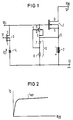
- FIGS. 1 and 2 show a circuit arrangement according to the invention and FIG. 2 shows the U / I characteristic of a controllable resistor.
- the circuit arrangement according to FIG. 1 contains a power MOSFET 1 to which an inductive load 2 is connected in series on the source side.
- the series connection is connected to an operating voltage V DD via two terminals 12, 13.
- the terminal 13 is at a fixed potential, for. B. to ground.
- a series circuit consisting of a MOSFET 3 and a Zener diode 4 is connected between the gate connection of the power MOSFET 1 and the terminal 13.
- the zener diode 4 is polarized such that it is stressed in the reverse direction by the driving voltage generated when the inductive load 2 is switched off.
- the gate connection of the power MOSFET is connected to a terminal 10, the gate connection of the MOSFET 3 to a terminal 11.
- An n-channel depletion MOSFET 5 is located between the gate connection and the source connection of the power MOSFET 1.
- the source connection of the depletion MOSFET 5 is connected to its substrate. Its gate connection is connected to the tap of a voltage divider 6, which is connected in parallel with the inductive load 2.
- the voltage divider 6 consists of a Zener diode 7 and a resistor 8. However, the Zener diode 7 can also be replaced by a resistor.
- a positive voltage is applied to the terminal 10, which is greater than the operating voltage V DD .
- You can e.g. B. can be supplied by a known pump circuit.
- the controllable switch 3 is controlled to be conductive by a voltage applied to the terminal 11.
- the gate-source capacitance of the power MOSFET 1 is thus discharged and the latter begins to block.
- a voltage with the drawn polarity builds up on the inductive load 2.
- the voltage at the source terminal of the power MOSFET 1 (node 9) thus becomes negative with respect to its gate voltage, since its gate is at zero volts via the terminal 10.
- the power MOSFET 1 could thus be switched on again.
- This is switched as a current source; its source is connected to the substrate. It is dimensioned such that its saturation current I sat (FIG 2) is greater than the reverse current which flows through the Zener diode 4 if it has not yet broken down. However, the saturation current is less than the current that would flow if the Zener diode 4 breaks down.
- the voltage present at the inductive load 2 after switching on the MOSFET 3 and blocking the power MOSFET 1 first drives a current through the Zener diode 4, the MOSFET 3 and the depletion FET 5, which is less than the saturation current of the depletion FET. Therefore, only a low drain-source voltage drops across it. The gate connection and the source connection of the power MOSFET 1 are thus practically at the same potential, so that it remains blocked. If the voltage across the inductive load 2 continues to rise, the Zener voltage U Z of the Zener diode 4 is reached and this breaks down. So that increases current driven by the zener diode 4, the MOSFET 3 and the depletion FET 5 until the saturation current of the depletion FET is reached.
- the drain-source voltage of the depletion FET increases and the power MOSFET 1 is turned on when its threshold voltage is reached.
- the current of the inductive load 2 can thus flow through the operating voltage source and the power MOSFET 1.
- the driving voltage is determined by the voltage U Z plus the drain-source voltage of the controllable switch 3 plus the drain-source voltage of the depletion FET 5. It can be set by selecting the Zener diode 4 accordingly.
- the depletion FET In order to reliably block the depletion FET when the load 2 is switched on, it must have a high forward resistance when the control voltage is applied to the terminal 10. This is achieved in that its gate connection is negatively biased with respect to its source connection via the voltage divider 6. The depletion FET 5 is thus blocked as long as the voltage at node 9 is more positive than at terminal 13.
- the MOSFET 3 can by another controllable switch, for. B. be replaced by a bipolar transistor.
- the depletion FET 5 can also be controlled by another controllable resistor. B. a bipolar transistor can be replaced.
Landscapes
- Electronic Switches (AREA)
Description
- Die Erfindung bezieht sich auf eine Schaltungsanordnung mit einem Leistungs-MOSFET und einer induktiven Last, die einerseits mit dem Sourceanschluß und andererseits mit einer auf festem Potential liegenden Klemme verbunden ist, und mit einer aus einer Zenerdiode und einem, zum Abschalten der induktiven Last steuerbaren, Schalter bestehenden Reihenschaltung, die zwischen Gateanschluß und die Klemme geschaltet ist.
- Eine solche Schaltungsanordnung ist beispielsweise in der europäischen Patentschrift 0 239 861 beschrieben worden. Geht man von einer stromdurchflossenen induktiven Last aus, so wird das Abschalten der induktiven Last durch Einschalten des steuerbaren Schalters eingeleitet. Dieser entlädt die Gate-Sourcekapazität des Leistungs-MOSFET, der damit zu sperren beginnt. Der Strom durch die induktive Last fließt zunächst weiter und baut an der Zenerdiode eine Spannung in Sperrichtung auf, die bis zur Zenerspannung ansteigen kann. Die an der induktiven Last anliegende treibende Spannung ist daher die Zenerspannung zuzüglich der am steuerbaren Schalter abfallenden Spannung zuzüglich der Gate-Sourcespannung am Leistungs-FET. Die treibende Spannung an der induktiven Last kann daher im wesentlichen durch die Wahl der Zenerspannung eingestellt werden. Bei einer hohen Zenerspannung wird dann die magnetische Energie schnell abgebaut.
- Wird der Leistungs-MOSFET durch einen elektronischen Schalter betrieben, so liegt der Gateanschluß des Leistungs-MOSFET im abgeschalteten Zustand auf Null Volt. Kehrt sich nun die Spannung an der induktiven Last um, so kann, bevor die Zenerdiode ihre Zenerspannung erreicht, der Leistungs-MOSFET bereits dann wieder einschalten, wenn sein Sourcepotential um die Einsatzspannung unter Null gefallen ist. Die treibende Spannung an der induktiven Last ist daher in diesem Fall auf einen Wert begrenzt, der der Einsatzspannung des Leistungs-MOSFET entspricht. Die magnetische Energie wird daher in diesem Fall nur langsam abgebaut.
- Ziel der Erfindung ist es, eine Schaltungsanordnung der beschriebenen Art so weiterzubilden, daß ein Einschalten des Leistungs-MOSFET sicher verhindert wird, solange die in Sperrichtung an der Zenerdiode anstehende Spannung unter der Zenerspannung liegt.
- Dieses Ziel wird erreicht durch einen steuerbaren Widerstand zwischen Gateanschluß und Sourceanschluß, dessen Widerstandswert, beim Abschalten der Last, derart gesteuert wird, daß er bei einem bei Durchbruch der Zenerdiode fließenden Strom einen ersten hohen Wert und unterhalb dieses Stroms einen zweiten, niedrigeren Wert hat.
- Weiterbildungen der Erfindung sind Gegenstand der abhängigen Ansprüche.
- Die Erfindung wird anhand eines Ausführungsbeispiels in Verbindung mit den FIG 1 und 2 näher erläutert. Es zeigen FIG 1 eine Schaltungsanordnung gemäß der Erfindung und FIG 2 die U/I-Kennlinie eines steuerbaren Widerstandes.
- Die Schaltungsanordnung nach FIG 1 enthält einen Leistungs-MOSFET 1, dem sourceseitig eine induktive Last 2 in Reihe geschaltet ist. Die Reihenschaltung liegt über zwei Klemmen 12, 13 an einer Betriebsspannung VDD. Die Klemme 13 liegt auf festem Potential, z. B. an Masse. Zwischen dem Gateanschluß des Leistungs-MOSFET 1 und der Klemme 13 ist eine aus einem MOSFET 3 und einer Zenerdiode 4 bestehende Reihenschaltung angeschlossen. Die Zenerdiode 4 ist derart gepolt, daß sie durch die beim Abschalten der induktiven Last 2 entstehende treibende Spannung in Sperrichtung beansprucht wird. Der Gateanschluß des Leistungs-MOSFET ist mit einer Klemme 10 verbunden, der Gateanschluß des MOSFET 3 mit einer Klemme 11.
- Zwischen Gateanschluß und Sourceanschluß des Leistungs-MOSFET 1 liegt ein n-Kanal-Depletion-MOSFET 5. Der Sourceanschluß des Depletion-MOSFET 5 ist mit seinem Substrat verbunden. Sein Gateanschluß ist mit dem Abgriff eines Spannungsteilers 6 verbunden, der der induktiven Last 2 parallel geschaltet ist. Der Spannungsteiler 6 besteht aus einer Zenerdiode 7 und einem Widerstand 8. Die Zenerdiode 7 kann jedoch auch durch einen Widerstand ersetzt werden.
- Zum Einschalten der induktiven Last 2 wird an die Klemme 10 eine positive Spannung gelegt, die größer ist als die Betriebsspannung VDD. Sie kann z. B. durch eine bekannte Pumpschaltung geliefert werden.
- Soll die induktive Last abgeschaltet werden, so wird der steuerbare Schalter 3 durch eine an die Klemme 11 gelegte Spannung leitend gesteuert. Damit wird die Gate-Sourcekapazität des Leistungs-MOSFET 1 entladen und dieser beginnt zu sperren. An der induktiven Last 2 baut sich eine Spannung mit der eingezeichneten Polarität auf. Die Spannung am Sourceanschluß des Leistungs-MOSFET 1 (Knoten 9) wird also negativ bezüglich seiner Gatespannung, da sein Gate über die Klemme 10 auf Null Volt liegt. Damit könnte der Leistungs-MOSFET 1 wieder eingeschaltet werden.
- Dies wird durch den Depletion-FET 5 verhindert. Dieser ist als Stromquelle geschaltet; sein Sourceanschluß ist mit dem Substrat verbunden. Er ist derart dimensioniert, daß sein Sättigungsstrom Isat (FIG 2) größer ist als der Sperrstrom, der durch die Zenerdiode 4 fließt, wenn diese noch nicht durchgebrochen ist. Der Sättigungsstrom ist jedoch kleiner als derjenige Strom, der bei Durchbruch der Zenerdiode 4 fließen würde.
- Die nach dem Einschalten des MOSFET 3 und dem Sperren des Leistungs-MOSFET 1 an der induktiven Last 2 anstehende Spannung treibt zunächst einen Strom durch die Zenerdiode 4, den MOSFET 3 und den Depletion-FET 5, der kleiner ist als der Sättigungsstrom des Depletion-FET. An ihm fällt daher nur eine geringe Drain-Sourcespannung ab. Der Gateanschluß und der Sourceanschluß des Leistungs-MOSFET 1 befindet sich damit praktisch auf gleichem Potential, so daß er gesperrt bleibt. Steigt die Spannung an der induktiven Last 2 weiter an, so wird die Zenerspannung UZ der Zenerdiode 4 erreicht und diese bricht durch. Damit steigt der durch die Zenerdiode 4, den MOSFET 3 und den Depletion-FET 5 getriebene Strom an, bis der Sättigungsstrom des Depletion-FET erreicht ist. Dabei nimmt die Drain-Sourcespannung des Depletion-FET zu und der Leistungs-MOSFET 1 wird leitend gesteuert, wenn seine Einsatzspannung erreicht wird. Damit kann der Strom der induktiven Last 2 durch die Betriebsspannungsquelle und den Leistungs-MOSFET 1 abfließen. Die treibende Spannung wird dabei durch die Spannung UZ zuzüglich der Drain-Sourcespannung des steuerbaren Schalters 3 zuzüglich der Drain-Sourcespannung des Depletion-FET 5 bestimmt. Sie kann durch entsprechende Auswahl der Zenerdiode 4 eingestellt werden.
- Um den Depletion-FET beim Einschalten der Last 2 sicher zu sperren, muß er bei an der Klemme 10 anliegender Steuerspannung einen hohen Durchlaßwiderstand haben. Dies wird dadurch erreicht, daß sein Gateanschluß gegenüber seinem Sourceanschluß über den Spannungsteiler 6 negativ vorgespannt wird. Damit ist der Depletion-FET 5 so lange gesperrt, wie die Spannung am Knoten 9 positiver als an der Klemme 13 ist.
- Der MOSFET 3 kann durch einen anderen steuerbaren Schalter, z. B. durch einen Bipolartransistor ersetzt werden. Der Depletion-FET 5 kann auch durch einen anderen steuerbaren Widerstand z. B. einen Bipolartransistor ersetzt werden.
Claims (4)
- Schaltungsanordnung mit einem Leistungs-MOSFET (1) und einer induktiven Last (2), die einerseits mit dem Sourceanschluß und andererseits mit einer auf festem Potential liegenden Klemme (13) verbunden ist, mit einer aus einer Zenerdiode (4) und einem, zum Abschalten der induktiven Last (2) steuerbaren, Schalter (3) bestehenden Reihenschaltung, die zwischen Gateanschluß und die Klemme (13) geschaltet ist,
gekennzeichnet durch einen steuerbaren Widerstand (5) zwischen Gateanschluß und Sourceanschluß, dessen Widerstandswert, beim Abschalten der Last (2), derart gesteuert wird, daß er bei einem bei Durchbruch der Zenerdiode (4) fließenden Strom einen ersten, hohen Wert und unterhalb dieses Stroms einen zweiten, niedrigeren Wert hat. - Schaltungsanordnung nach Anspruch 1,
dadurch gekennzeichnet, daß der steuerbare Widerstand eine Stromquelle ist, deren Strom kleiner als der beim Zenerdurchbruch fließende Strom ist. - Schaltungsanordnung nach Anspruch 2,
dadurch gekennzeichnet, daß die Stromquelle ein Depletion-FET (5) ist, dessen Sättigungsstrom kleiner als der beim Zenerdurchbruch fließende Strom ist. - Schaltungsanordnung nach Anspruch 3,
dadurch gekennzeichnet, daß der Gateanschluß des Depletion-FET (5) mit dem Abgriff eines Spannungsteilers (6) verbunden ist, der der induktiven Last (2) parallel geschaltet ist.
Priority Applications (4)
| Application Number | Priority Date | Filing Date | Title |
|---|---|---|---|
| EP90121498A EP0489935B1 (de) | 1990-11-09 | 1990-11-09 | MOSFET-Schalter für eine induktive Last |
| DE59009841T DE59009841D1 (de) | 1990-11-09 | 1990-11-09 | MOSFET-Schalter für eine induktive Last. |
| JP31362091A JP3258050B2 (ja) | 1990-11-09 | 1991-10-31 | 誘導性負荷用mosfetを備えた回路装置 |
| US07/788,594 US5160862A (en) | 1990-11-09 | 1991-11-06 | Mosfet switch circuit for preventing the switch being turned on during deactivation of an inductive load |
Applications Claiming Priority (1)
| Application Number | Priority Date | Filing Date | Title |
|---|---|---|---|
| EP90121498A EP0489935B1 (de) | 1990-11-09 | 1990-11-09 | MOSFET-Schalter für eine induktive Last |
Publications (2)
| Publication Number | Publication Date |
|---|---|
| EP0489935A1 EP0489935A1 (de) | 1992-06-17 |
| EP0489935B1 true EP0489935B1 (de) | 1995-11-02 |
Family
ID=8204701
Family Applications (1)
| Application Number | Title | Priority Date | Filing Date |
|---|---|---|---|
| EP90121498A Expired - Lifetime EP0489935B1 (de) | 1990-11-09 | 1990-11-09 | MOSFET-Schalter für eine induktive Last |
Country Status (4)
| Country | Link |
|---|---|
| US (1) | US5160862A (de) |
| EP (1) | EP0489935B1 (de) |
| JP (1) | JP3258050B2 (de) |
| DE (1) | DE59009841D1 (de) |
Families Citing this family (6)
| Publication number | Priority date | Publication date | Assignee | Title |
|---|---|---|---|---|
| US5430401A (en) * | 1992-08-27 | 1995-07-04 | Northern Telecom Ltd. | Electronic switches |
| JPH06252727A (ja) * | 1993-02-10 | 1994-09-09 | Siemens Ag | Mos半導体素子の制御回路 |
| DE4329981A1 (de) * | 1993-09-04 | 1995-03-09 | Bosch Gmbh Robert | Verfahren und Vorrichtung zur Ansteuerung eines elektromagnetischen Verbrauchers |
| DE19838109B4 (de) * | 1998-08-21 | 2005-10-27 | Infineon Technologies Ag | Ansteuerschaltung für induktive Lasten |
| US7834669B2 (en) * | 2007-12-21 | 2010-11-16 | Nec Electronics Corporation | Semiconductor output circuit for controlling power supply to a load |
| JP6515241B1 (ja) | 2018-03-02 | 2019-05-15 | 田中精密工業株式会社 | 接着剤塗布装置及び接着剤塗布方法 |
Family Cites Families (7)
| Publication number | Priority date | Publication date | Assignee | Title |
|---|---|---|---|---|
| JPS5855582B2 (ja) * | 1981-11-13 | 1983-12-10 | 株式会社東芝 | 透視性テ−プカセツト |
| US4691129A (en) * | 1986-03-19 | 1987-09-01 | Siemens Aktiengesellschaft | Drive circuit for a power MOSFET with source-side load |
| US4728826A (en) * | 1986-03-19 | 1988-03-01 | Siemens Aktiengesellschaft | MOSFET switch with inductive load |
| US4808839A (en) * | 1988-04-04 | 1989-02-28 | Motorola, Inc. | Power field effect transistor driver circuit for protection from overvoltages |
| IT1226557B (it) * | 1988-07-29 | 1991-01-24 | Sgs Thomson Microelectronics | Circuito di controllo della tensione di bloccaggio di un carico induttivo pilotato con un dispositivo di potenza in configurazione "high side driver" |
| EP0369048A1 (de) * | 1988-11-15 | 1990-05-23 | Siemens Aktiengesellschaft | Schaltungsanordnung zur Laststromregelung in einem Leistungs-MOSFET |
| US5017816A (en) * | 1989-11-08 | 1991-05-21 | National Semiconductor Corp. | Adaptive gate discharge circuit for power FETS |
-
1990
- 1990-11-09 DE DE59009841T patent/DE59009841D1/de not_active Expired - Lifetime
- 1990-11-09 EP EP90121498A patent/EP0489935B1/de not_active Expired - Lifetime
-
1991
- 1991-10-31 JP JP31362091A patent/JP3258050B2/ja not_active Expired - Lifetime
- 1991-11-06 US US07/788,594 patent/US5160862A/en not_active Expired - Fee Related
Also Published As
| Publication number | Publication date |
|---|---|
| JPH04268813A (ja) | 1992-09-24 |
| EP0489935A1 (de) | 1992-06-17 |
| DE59009841D1 (de) | 1995-12-07 |
| US5160862A (en) | 1992-11-03 |
| JP3258050B2 (ja) | 2002-02-18 |
Similar Documents
| Publication | Publication Date | Title |
|---|---|---|
| EP0572706B1 (de) | Ansteuerschaltung für einen Leistungs-FET mit sourceseitiger Last | |
| EP0043489B1 (de) | Schalter mit in Serie geschalteten MOS-FET | |
| EP1074081B1 (de) | Verpolschutzschaltung | |
| DE4432957C1 (de) | Schaltmittel | |
| DE69329791T2 (de) | Schaltkreis zur abschaltung einer induktiven last | |
| EP0244743B1 (de) | Zweidraht-Schalter | |
| EP0108283A2 (de) | Elektronischer Schalter | |
| EP0236967B1 (de) | Schaltungsanordnung zum Ansteuern eines mit sourceseitiger Last verbundenen Mosfet | |
| DE102014108576A1 (de) | Treiberschaltung mit Miller-Clamping-Funktionalität für Leistungshalbleiterschalter, Leistungshalbleiterschalter und Wechselrichterbrücke | |
| DE68924107T2 (de) | Steuerschaltung für die Begrenzungsspannung einer durch eine Leistungsvorrichtung in spannungsseitiger Treiberkonfiguration getriebenen induktiven Last. | |
| DE19631751C1 (de) | Ansteuerschaltung für einen Leistungs-FET mit sourceseitiger Last | |
| EP0489935B1 (de) | MOSFET-Schalter für eine induktive Last | |
| DE3100795C2 (de) | ||
| DE4429285C1 (de) | Ansteuerschaltung für ein feldeffektgesteuertes Leistungs-Halbleiterbauelement | |
| EP0405407A2 (de) | Schaltungsanordnung zum Ansteuern eines MOSFET mit sourceseitiger Last | |
| DE3128013C1 (de) | Ansteuerschaltung fuer wenigstens eine lichtemittierende Diode | |
| DE4035969A1 (de) | Schaltungsanordnung mit wenigstens einer einen leistungs-mosfet enthaltenden schaltvorrichtung | |
| DE2135858C3 (de) | Transistorschalteinrichtung zum Schalten eines induktiven Gleichstromkreises | |
| EP0365706A1 (de) | Leistungsendstufe mit einer Last | |
| EP0082422A1 (de) | Beschaltung für einen Leistungs-Feldeffekttransistor | |
| DE3536447C2 (de) | Kurzschluß- und überlastfeste Transistorausgangsstufe | |
| DE102004022800A1 (de) | MOSFET-Gate-Treiberschaltung | |
| EP0555648A2 (de) | Schaltungsanordnung zum Ansteuern von feldgesteuerten Leistungsschaltern | |
| EP0822661A2 (de) | Ansteuerschaltung für ein Feldeffekt gesteuertes Leistungs-Halbleiterbauelement | |
| EP0766394A2 (de) | Schaltungsanordnung zum Ansteuern eines Leistungs-Enhancement-MOSFET |
Legal Events
| Date | Code | Title | Description |
|---|---|---|---|
| PUAI | Public reference made under article 153(3) epc to a published international application that has entered the european phase |
Free format text: ORIGINAL CODE: 0009012 |
|
| 17P | Request for examination filed |
Effective date: 19901205 |
|
| AK | Designated contracting states |
Kind code of ref document: A1 Designated state(s): AT BE CH DE DK ES FR GB GR IT LI LU NL SE |
|
| RBV | Designated contracting states (corrected) |
Designated state(s): DE FR IT |
|
| 17Q | First examination report despatched |
Effective date: 19950405 |
|
| GRAA | (expected) grant |
Free format text: ORIGINAL CODE: 0009210 |
|
| AK | Designated contracting states |
Kind code of ref document: B1 Designated state(s): DE FR IT |
|
| REF | Corresponds to: |
Ref document number: 59009841 Country of ref document: DE Date of ref document: 19951207 |
|
| ITF | It: translation for a ep patent filed | ||
| ET | Fr: translation filed | ||
| PLBE | No opposition filed within time limit |
Free format text: ORIGINAL CODE: 0009261 |
|
| STAA | Information on the status of an ep patent application or granted ep patent |
Free format text: STATUS: NO OPPOSITION FILED WITHIN TIME LIMIT |
|
| 26N | No opposition filed | ||
| PGFP | Annual fee paid to national office [announced via postgrant information from national office to epo] |
Ref country code: IT Payment date: 20091126 Year of fee payment: 20 Ref country code: FR Payment date: 20091201 Year of fee payment: 20 |
|
| PGFP | Annual fee paid to national office [announced via postgrant information from national office to epo] |
Ref country code: DE Payment date: 20100119 Year of fee payment: 20 |
|
| PG25 | Lapsed in a contracting state [announced via postgrant information from national office to epo] |
Ref country code: DE Free format text: LAPSE BECAUSE OF EXPIRATION OF PROTECTION Effective date: 20101109 |