EP0481809B1 - Golfball sowie Verfahren zu seiner Herstellung - Google Patents
Golfball sowie Verfahren zu seiner Herstellung Download PDFInfo
- Publication number
- EP0481809B1 EP0481809B1 EP91309636A EP91309636A EP0481809B1 EP 0481809 B1 EP0481809 B1 EP 0481809B1 EP 91309636 A EP91309636 A EP 91309636A EP 91309636 A EP91309636 A EP 91309636A EP 0481809 B1 EP0481809 B1 EP 0481809B1
- Authority
- EP
- European Patent Office
- Prior art keywords
- peak
- cover
- golf ball
- weight
- annealing treatment
- Prior art date
- Legal status (The legal status is an assumption and is not a legal conclusion. Google has not performed a legal analysis and makes no representation as to the accuracy of the status listed.)
- Expired - Lifetime
Links
- 238000000034 method Methods 0.000 title claims description 13
- 229920005989 resin Polymers 0.000 claims description 134
- 239000011347 resin Substances 0.000 claims description 134
- 229920000554 ionomer Polymers 0.000 claims description 90
- 238000000137 annealing Methods 0.000 claims description 81
- 239000013078 crystal Substances 0.000 claims description 22
- 238000002844 melting Methods 0.000 claims description 20
- 230000008018 melting Effects 0.000 claims description 20
- 239000000463 material Substances 0.000 claims description 4
- 239000000203 mixture Substances 0.000 description 68
- 230000000052 comparative effect Effects 0.000 description 53
- TZCXTZWJZNENPQ-UHFFFAOYSA-L barium sulfate Chemical compound [Ba+2].[O-]S([O-])(=O)=O TZCXTZWJZNENPQ-UHFFFAOYSA-L 0.000 description 28
- 239000007787 solid Substances 0.000 description 23
- 238000002474 experimental method Methods 0.000 description 22
- 150000001732 carboxylic acid derivatives Chemical class 0.000 description 20
- 238000005259 measurement Methods 0.000 description 19
- 239000003963 antioxidant agent Substances 0.000 description 17
- 239000000314 lubricant Substances 0.000 description 17
- 229910052751 metal Inorganic materials 0.000 description 17
- 239000002184 metal Substances 0.000 description 17
- 238000000465 moulding Methods 0.000 description 17
- 229910021645 metal ion Inorganic materials 0.000 description 16
- 230000003078 antioxidant effect Effects 0.000 description 15
- GWEVSGVZZGPLCZ-UHFFFAOYSA-N Titan oxide Chemical compound O=[Ti]=O GWEVSGVZZGPLCZ-UHFFFAOYSA-N 0.000 description 14
- 238000006386 neutralization reaction Methods 0.000 description 14
- OGIDPMRJRNCKJF-UHFFFAOYSA-N titanium oxide Inorganic materials [Ti]=O OGIDPMRJRNCKJF-UHFFFAOYSA-N 0.000 description 14
- 150000003839 salts Chemical class 0.000 description 11
- 238000002425 crystallisation Methods 0.000 description 9
- 230000008025 crystallization Effects 0.000 description 9
- CERQOIWHTDAKMF-UHFFFAOYSA-N Methacrylic acid Chemical compound CC(=C)C(O)=O CERQOIWHTDAKMF-UHFFFAOYSA-N 0.000 description 8
- 239000004711 α-olefin Substances 0.000 description 8
- 125000003178 carboxy group Chemical group [H]OC(*)=O 0.000 description 7
- 230000006866 deterioration Effects 0.000 description 6
- -1 polyethylene Polymers 0.000 description 6
- 229910001415 sodium ion Inorganic materials 0.000 description 6
- 239000002253 acid Substances 0.000 description 5
- 238000009472 formulation Methods 0.000 description 5
- 239000011734 sodium Substances 0.000 description 5
- 239000005977 Ethylene Substances 0.000 description 4
- DGAQECJNVWCQMB-PUAWFVPOSA-M Ilexoside XXIX Chemical compound C[C@@H]1CC[C@@]2(CC[C@@]3(C(=CC[C@H]4[C@]3(CC[C@@H]5[C@@]4(CC[C@@H](C5(C)C)OS(=O)(=O)[O-])C)C)[C@@H]2[C@]1(C)O)C)C(=O)O[C@H]6[C@@H]([C@H]([C@@H]([C@H](O6)CO)O)O)O.[Na+] DGAQECJNVWCQMB-PUAWFVPOSA-M 0.000 description 4
- JLVVSXFLKOJNIY-UHFFFAOYSA-N Magnesium ion Chemical compound [Mg+2] JLVVSXFLKOJNIY-UHFFFAOYSA-N 0.000 description 4
- 238000002441 X-ray diffraction Methods 0.000 description 4
- 150000001735 carboxylic acids Chemical class 0.000 description 4
- 238000004132 cross linking Methods 0.000 description 4
- 229910001425 magnesium ion Inorganic materials 0.000 description 4
- 229910052708 sodium Inorganic materials 0.000 description 4
- FAIIFDPAEUKBEP-UHFFFAOYSA-N Nilvadipine Chemical compound COC(=O)C1=C(C#N)NC(C)=C(C(=O)OC(C)C)C1C1=CC=CC([N+]([O-])=O)=C1 FAIIFDPAEUKBEP-UHFFFAOYSA-N 0.000 description 3
- 239000004698 Polyethylene Substances 0.000 description 3
- HCHKCACWOHOZIP-UHFFFAOYSA-N Zinc Chemical compound [Zn] HCHKCACWOHOZIP-UHFFFAOYSA-N 0.000 description 3
- PTFCDOFLOPIGGS-UHFFFAOYSA-N Zinc dication Chemical compound [Zn+2] PTFCDOFLOPIGGS-UHFFFAOYSA-N 0.000 description 3
- 238000004458 analytical method Methods 0.000 description 3
- 230000015572 biosynthetic process Effects 0.000 description 3
- 150000001733 carboxylic acid esters Chemical class 0.000 description 3
- 238000000748 compression moulding Methods 0.000 description 3
- 239000010949 copper Substances 0.000 description 3
- 229920001971 elastomer Polymers 0.000 description 3
- 230000002708 enhancing effect Effects 0.000 description 3
- 229920001038 ethylene copolymer Polymers 0.000 description 3
- 229920001684 low density polyethylene Polymers 0.000 description 3
- 239000004702 low-density polyethylene Substances 0.000 description 3
- 239000011777 magnesium Substances 0.000 description 3
- 150000002739 metals Chemical class 0.000 description 3
- 229920000573 polyethylene Polymers 0.000 description 3
- 229920000642 polymer Polymers 0.000 description 3
- 239000005060 rubber Substances 0.000 description 3
- 239000011701 zinc Substances 0.000 description 3
- 229910052725 zinc Inorganic materials 0.000 description 3
- SMZOUWXMTYCWNB-UHFFFAOYSA-N 2-(2-methoxy-5-methylphenyl)ethanamine Chemical compound COC1=CC=C(C)C=C1CCN SMZOUWXMTYCWNB-UHFFFAOYSA-N 0.000 description 2
- NIXOWILDQLNWCW-UHFFFAOYSA-N 2-Propenoic acid Natural products OC(=O)C=C NIXOWILDQLNWCW-UHFFFAOYSA-N 0.000 description 2
- RYGMFSIKBFXOCR-UHFFFAOYSA-N Copper Chemical compound [Cu] RYGMFSIKBFXOCR-UHFFFAOYSA-N 0.000 description 2
- VGGSQFUCUMXWEO-UHFFFAOYSA-N Ethene Chemical compound C=C VGGSQFUCUMXWEO-UHFFFAOYSA-N 0.000 description 2
- 229920012753 Ethylene Ionomers Polymers 0.000 description 2
- VZCYOOQTPOCHFL-OWOJBTEDSA-N Fumaric acid Chemical compound OC(=O)\C=C\C(O)=O VZCYOOQTPOCHFL-OWOJBTEDSA-N 0.000 description 2
- WHXSMMKQMYFTQS-UHFFFAOYSA-N Lithium Chemical compound [Li] WHXSMMKQMYFTQS-UHFFFAOYSA-N 0.000 description 2
- FYYHWMGAXLPEAU-UHFFFAOYSA-N Magnesium Chemical compound [Mg] FYYHWMGAXLPEAU-UHFFFAOYSA-N 0.000 description 2
- ZLMJMSJWJFRBEC-UHFFFAOYSA-N Potassium Chemical compound [K] ZLMJMSJWJFRBEC-UHFFFAOYSA-N 0.000 description 2
- WYURNTSHIVDZCO-UHFFFAOYSA-N Tetrahydrofuran Chemical compound C1CCOC1 WYURNTSHIVDZCO-UHFFFAOYSA-N 0.000 description 2
- XLOMVQKBTHCTTD-UHFFFAOYSA-N Zinc monoxide Chemical compound [Zn]=O XLOMVQKBTHCTTD-UHFFFAOYSA-N 0.000 description 2
- 238000010276 construction Methods 0.000 description 2
- 238000001816 cooling Methods 0.000 description 2
- 229910052802 copper Inorganic materials 0.000 description 2
- 238000010438 heat treatment Methods 0.000 description 2
- 150000002500 ions Chemical class 0.000 description 2
- 238000004898 kneading Methods 0.000 description 2
- 229910052744 lithium Inorganic materials 0.000 description 2
- 229910052749 magnesium Inorganic materials 0.000 description 2
- 239000000155 melt Substances 0.000 description 2
- 229910052700 potassium Inorganic materials 0.000 description 2
- 239000011591 potassium Substances 0.000 description 2
- VZCYOOQTPOCHFL-UHFFFAOYSA-N trans-butenedioic acid Natural products OC(=O)C=CC(O)=O VZCYOOQTPOCHFL-UHFFFAOYSA-N 0.000 description 2
- 108010053481 Antifreeze Proteins Proteins 0.000 description 1
- 239000005062 Polybutadiene Substances 0.000 description 1
- KWYUFKZDYYNOTN-UHFFFAOYSA-M Potassium hydroxide Chemical compound [OH-].[K+] KWYUFKZDYYNOTN-UHFFFAOYSA-M 0.000 description 1
- OFOBLEOULBTSOW-UHFFFAOYSA-N Propanedioic acid Natural products OC(=O)CC(O)=O OFOBLEOULBTSOW-UHFFFAOYSA-N 0.000 description 1
- 229920003182 Surlyn® Polymers 0.000 description 1
- BGYHLZZASRKEJE-UHFFFAOYSA-N [3-[3-(3,5-ditert-butyl-4-hydroxyphenyl)propanoyloxy]-2,2-bis[3-(3,5-ditert-butyl-4-hydroxyphenyl)propanoyloxymethyl]propyl] 3-(3,5-ditert-butyl-4-hydroxyphenyl)propanoate Chemical compound CC(C)(C)C1=C(O)C(C(C)(C)C)=CC(CCC(=O)OCC(COC(=O)CCC=2C=C(C(O)=C(C=2)C(C)(C)C)C(C)(C)C)(COC(=O)CCC=2C=C(C(O)=C(C=2)C(C)(C)C)C(C)(C)C)COC(=O)CCC=2C=C(C(O)=C(C=2)C(C)(C)C)C(C)(C)C)=C1 BGYHLZZASRKEJE-UHFFFAOYSA-N 0.000 description 1
- 239000002250 absorbent Substances 0.000 description 1
- 230000002745 absorbent Effects 0.000 description 1
- 238000010521 absorption reaction Methods 0.000 description 1
- 239000000654 additive Substances 0.000 description 1
- 230000032683 aging Effects 0.000 description 1
- 239000002216 antistatic agent Substances 0.000 description 1
- 238000006243 chemical reaction Methods 0.000 description 1
- 238000005520 cutting process Methods 0.000 description 1
- 239000002270 dispersing agent Substances 0.000 description 1
- 230000000694 effects Effects 0.000 description 1
- 238000010304 firing Methods 0.000 description 1
- 239000001530 fumaric acid Substances 0.000 description 1
- 239000003999 initiator Substances 0.000 description 1
- 238000001746 injection moulding Methods 0.000 description 1
- 229920002521 macromolecule Polymers 0.000 description 1
- VZCYOOQTPOCHFL-UPHRSURJSA-N maleic acid Chemical compound OC(=O)\C=C/C(O)=O VZCYOOQTPOCHFL-UPHRSURJSA-N 0.000 description 1
- 239000011976 maleic acid Substances 0.000 description 1
- 238000004519 manufacturing process Methods 0.000 description 1
- 230000003472 neutralizing effect Effects 0.000 description 1
- 239000012299 nitrogen atmosphere Substances 0.000 description 1
- 238000007591 painting process Methods 0.000 description 1
- 230000000704 physical effect Effects 0.000 description 1
- 239000000049 pigment Substances 0.000 description 1
- 230000010287 polarization Effects 0.000 description 1
- 229920002857 polybutadiene Polymers 0.000 description 1
- 239000003381 stabilizer Substances 0.000 description 1
- 238000003860 storage Methods 0.000 description 1
- 239000000126 substance Substances 0.000 description 1
- 229920003051 synthetic elastomer Polymers 0.000 description 1
- 239000005061 synthetic rubber Substances 0.000 description 1
- JBQYATWDVHIOAR-UHFFFAOYSA-N tellanylidenegermanium Chemical compound [Te]=[Ge] JBQYATWDVHIOAR-UHFFFAOYSA-N 0.000 description 1
- YLQBMQCUIZJEEH-UHFFFAOYSA-N tetrahydrofuran Natural products C=1C=COC=1 YLQBMQCUIZJEEH-UHFFFAOYSA-N 0.000 description 1
- 238000004073 vulcanization Methods 0.000 description 1
- 239000011787 zinc oxide Substances 0.000 description 1
- XOOUIPVCVHRTMJ-UHFFFAOYSA-L zinc stearate Chemical group [Zn+2].CCCCCCCCCCCCCCCCCC([O-])=O.CCCCCCCCCCCCCCCCCC([O-])=O XOOUIPVCVHRTMJ-UHFFFAOYSA-L 0.000 description 1
- XKMZOFXGLBYJLS-UHFFFAOYSA-L zinc;prop-2-enoate Chemical compound [Zn+2].[O-]C(=O)C=C.[O-]C(=O)C=C XKMZOFXGLBYJLS-UHFFFAOYSA-L 0.000 description 1
Images





Classifications
-
- A—HUMAN NECESSITIES
- A63—SPORTS; GAMES; AMUSEMENTS
- A63B—APPARATUS FOR PHYSICAL TRAINING, GYMNASTICS, SWIMMING, CLIMBING, OR FENCING; BALL GAMES; TRAINING EQUIPMENT
- A63B37/00—Solid balls; Rigid hollow balls; Marbles
- A63B37/0003—Golf balls
-
- A—HUMAN NECESSITIES
- A63—SPORTS; GAMES; AMUSEMENTS
- A63B—APPARATUS FOR PHYSICAL TRAINING, GYMNASTICS, SWIMMING, CLIMBING, OR FENCING; BALL GAMES; TRAINING EQUIPMENT
- A63B37/00—Solid balls; Rigid hollow balls; Marbles
- A63B37/0003—Golf balls
- A63B37/0023—Covers
-
- A—HUMAN NECESSITIES
- A63—SPORTS; GAMES; AMUSEMENTS
- A63B—APPARATUS FOR PHYSICAL TRAINING, GYMNASTICS, SWIMMING, CLIMBING, OR FENCING; BALL GAMES; TRAINING EQUIPMENT
- A63B37/00—Solid balls; Rigid hollow balls; Marbles
- A63B37/0003—Golf balls
- A63B37/0023—Covers
- A63B37/0029—Physical properties
- A63B37/0033—Thickness
-
- A—HUMAN NECESSITIES
- A63—SPORTS; GAMES; AMUSEMENTS
- A63B—APPARATUS FOR PHYSICAL TRAINING, GYMNASTICS, SWIMMING, CLIMBING, OR FENCING; BALL GAMES; TRAINING EQUIPMENT
- A63B37/00—Solid balls; Rigid hollow balls; Marbles
- A63B37/0003—Golf balls
- A63B37/007—Characteristics of the ball as a whole
- A63B37/0072—Characteristics of the ball as a whole with a specified number of layers
- A63B37/0074—Two piece balls, i.e. cover and core
-
- A—HUMAN NECESSITIES
- A63—SPORTS; GAMES; AMUSEMENTS
- A63B—APPARATUS FOR PHYSICAL TRAINING, GYMNASTICS, SWIMMING, CLIMBING, OR FENCING; BALL GAMES; TRAINING EQUIPMENT
- A63B37/00—Solid balls; Rigid hollow balls; Marbles
- A63B37/0003—Golf balls
- A63B37/007—Characteristics of the ball as a whole
- A63B37/0077—Physical properties
- A63B37/0078—Coefficient of restitution
-
- A—HUMAN NECESSITIES
- A63—SPORTS; GAMES; AMUSEMENTS
- A63B—APPARATUS FOR PHYSICAL TRAINING, GYMNASTICS, SWIMMING, CLIMBING, OR FENCING; BALL GAMES; TRAINING EQUIPMENT
- A63B37/00—Solid balls; Rigid hollow balls; Marbles
- A63B37/0003—Golf balls
- A63B37/007—Characteristics of the ball as a whole
- A63B37/0077—Physical properties
- A63B37/008—Diameter
-
- A—HUMAN NECESSITIES
- A63—SPORTS; GAMES; AMUSEMENTS
- A63B—APPARATUS FOR PHYSICAL TRAINING, GYMNASTICS, SWIMMING, CLIMBING, OR FENCING; BALL GAMES; TRAINING EQUIPMENT
- A63B37/00—Solid balls; Rigid hollow balls; Marbles
- A63B37/0003—Golf balls
- A63B37/007—Characteristics of the ball as a whole
- A63B37/0077—Physical properties
- A63B37/0094—Rebound resilience
-
- C—CHEMISTRY; METALLURGY
- C08—ORGANIC MACROMOLECULAR COMPOUNDS; THEIR PREPARATION OR CHEMICAL WORKING-UP; COMPOSITIONS BASED THEREON
- C08L—COMPOSITIONS OF MACROMOLECULAR COMPOUNDS
- C08L23/00—Compositions of homopolymers or copolymers of unsaturated aliphatic hydrocarbons having only one carbon-to-carbon double bond; Compositions of derivatives of such polymers
- C08L23/02—Compositions of homopolymers or copolymers of unsaturated aliphatic hydrocarbons having only one carbon-to-carbon double bond; Compositions of derivatives of such polymers not modified by chemical after-treatment
- C08L23/04—Homopolymers or copolymers of ethene
- C08L23/08—Copolymers of ethene
- C08L23/0846—Copolymers of ethene with unsaturated hydrocarbons containing atoms other than carbon or hydrogen
- C08L23/0869—Copolymers of ethene with unsaturated hydrocarbons containing atoms other than carbon or hydrogen with unsaturated acids, e.g. [meth]acrylic acid; with unsaturated esters, e.g. [meth]acrylic acid esters
- C08L23/0876—Salts thereof, i.e. ionomers
-
- C—CHEMISTRY; METALLURGY
- C08—ORGANIC MACROMOLECULAR COMPOUNDS; THEIR PREPARATION OR CHEMICAL WORKING-UP; COMPOSITIONS BASED THEREON
- C08L—COMPOSITIONS OF MACROMOLECULAR COMPOUNDS
- C08L2205/00—Polymer mixtures characterised by other features
- C08L2205/02—Polymer mixtures characterised by other features containing two or more polymers of the same C08L -group
-
- Y—GENERAL TAGGING OF NEW TECHNOLOGICAL DEVELOPMENTS; GENERAL TAGGING OF CROSS-SECTIONAL TECHNOLOGIES SPANNING OVER SEVERAL SECTIONS OF THE IPC; TECHNICAL SUBJECTS COVERED BY FORMER USPC CROSS-REFERENCE ART COLLECTIONS [XRACs] AND DIGESTS
- Y10—TECHNICAL SUBJECTS COVERED BY FORMER USPC
- Y10S—TECHNICAL SUBJECTS COVERED BY FORMER USPC CROSS-REFERENCE ART COLLECTIONS [XRACs] AND DIGESTS
- Y10S524/00—Synthetic resins or natural rubbers -- part of the class 520 series
- Y10S524/908—Composition having specified shape, e.g. rod, stick, or ball, and other than sheet, film, or fiber
Definitions
- the present invention relates to a golf ball having a high impact resilience and a process for producing the same.
- an ionomer resin has been widely used as a resin for the cover (e.g. Japanese Patent Laid Open Publication Nos. 149277/1990, 182279/1990, 88087/1990, 107275/1990, 308577/1989, 223103/1989, 207343/1989, 70086/1989, 229077/1988, 311973/1988, 281145/1986, 82768/1986, 212406/1985, 14879/1985, 199766/1982 etc.).
- Japanese Patent Laid Open Publication Nos. 149277/1990, 182279/1990, 88087/1990, 107275/1990, 308577/1989, 223103/1989, 207343/1989, 70086/1989, 229077/1988, 311973/1988, 281145/1986, 82768/1986, 212406/1985, 14879/1985, 199766/1982 etc. e.g. Japanese Patent Laid Open Publication Nos. 149277/1990, 182279/1990,
- the ionomer resin is that obtained by subjecting an ionic ethylene copolymer composed of three components of an ⁇ -olefin, ⁇ , ⁇ -ethylene unsaturated carboxylic acid, and ⁇ , ⁇ -ethylene unsaturated carboxylic acid metal salt, or four components of ⁇ -olefin, ⁇ , ⁇ -ethylenic unsaturated carboxylic acid, ⁇ , ⁇ -ethylenic unsaturated carboxylic acid metal salt, and ⁇ , ⁇ -ethylenic unsaturated carboxylic acid ester to partial metal crosslinking. Because of its high impact resilience as well as excellent impact resistance and cut resistance, the ionomer resin has been widely used as the resin for the cover of golf balls having a multilayer construction, as described above, and now predominates over others.
- ionomer resins have been reported and they may be normally produced in such a manner that, using ethylene as the ⁇ -olefin and using monobasic unsaturated carboxylic acids (e.g. acrylic acid, methacrylic acid, etc.) or dibasic unsaturated carboxylic acids (e.g. maleic acid, fumaric acid, etc.) as the ⁇ , ⁇ -ethylenic unsaturated carboxylic acids, these carboxylic acids are partially neutralized with monovalent metal ions (e.g. sodium (Na), lithium (Li,), potassium (K), etc.] or divalent metal ions [e.g. zinc (Zn), magnesium (Mg), copper (Cu), etc.].
- monovalent metal ions e.g. sodium (Na), lithium (Li,), potassium (K), etc.
- divalent metal ions e.g. zinc (Zn), magnesium (Mg), copper (Cu), etc.
- this type of resin is commercially available under trade name of SURLYN from
- the ionomer resin has a high impact resilience as well as an excellent impact resistance and cut resistance and now dominates in the resin for golf ball covers, and golf balls in which the ionomer resin is used for the cover have excellent properties such as high impact resilience, etc.
- One object of the present invention is to provide a golf ball having a high impact resilience and an excellent flying performance by further enhancing the impact resilience of the ionomer resin.
- Another object of the present invention is to provide a process for producing the above golf ball.
- the present invention has achieved the above objects by further enhancing the impact resilience of the ionomer resins in such a manner that the crystalline form of the ionomer resins is modified by annealing the ionomer resins of the cover which has been placed onto a core, so that the ionomer resin has a first peak at 85 to 95°C and a second peak at 70 to 80°C in its crystal melting behaviour attended with the measurement by a differential scanning calorimeter.
- the ionomer resin is obtained by subjecting an ionic ethylene copolymer composed of three components of an ⁇ -olefin, ⁇ , ⁇ -ethylenic unsaturated carboxylic acid, and ⁇ , ⁇ -ethylenic unsaturated carboxylic acid metal salt, or four components of an ⁇ -olefin, ⁇ , ⁇ -ethylenic unsaturated carboxylic acid, ⁇ , ⁇ -ethylenic unsaturated carboxylic acid metal salt, and ⁇ , ⁇ -ethylenic unsaturated carboxylic acid ester to partial metal crosslinking.
- the ionomer resin has been described as having a side chain of polyethylene and as having some of the carboxylic groups crosslinked by metal ions between the molecular chain of polyethylene, and that these two structural features produce the various excellent properties of the ionomer resin. It has furthermore been described that crosslinkage by the metal ions, unlike crosslinking by general chemical bonding is characterized in that the bond strength is weakened when heated and strengthened when cooled.
- the ionomer resin has a moderate degree of crystallization depending upon its polyethylene component and some reports have recently been made on formation of ionic crystal of the ionmer resin of Mitsui Du Pont Polychemicals Co. [(1) Journal of Applied polymer Science, Vol. 33, 1307-1314, 1987, Thermal Properties of Ethylene Ionomer, Y. TSUJITA; (2) Journal of Applied Polymer Science, Vol. 33, 2393-2402, 1987, The Crystallization and Formation of Cluster of Ethylene Ionomer during Physical Aging, MAMORU KOHZAKI; (3) Macromolecules, 1989, 22, 226-233, Kenji TADANO.
- the inventors have intensively studied the influence of the crystalline form of the ionomer resin on the impact resilience, as well as on the flying performance, of the golf ball wherein the ionomer resin is used for the cover.
- the impact resilience of the ionomer resin can be enhanced by modifying the crystalline form of the ionomer resin in such a manner that a specific annealing treatment is conducted on the ionomer resin of the cover which has been placed on the core so that the ionomer resin has a first peak at a temperature of 85 to 95°C and a second peak at a temperature of 70 to 80°C in its crystal melting behaviour attended with the measurement by a differential scanning calorimeter.
- the present invention provides a golf ball comprising a core and a cover for covering the core, the cover containing an ionomer resin as the main material thereof, said ionomer resin having a first peak at 85 to 95°C and a seocnd peak at 70 to 80°C in its crystal melting behaviour as measured by a differential scanning calorimeter.
- the present invention also provides a process for producing the above golf ball, wherein an ionomer resin for a cover which has been placed on a core is subjected to an annealing treatment so that the ionomer resin has a first peak at 85 to 95°C and a second peak at 70 to 80°C in its crystal melting behaviour as measured by a differential scanning calorimeter.
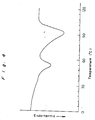
- Fig. 1 is a chart illustrating the differential scanning calorimeter measurement on the cover resin of the golf ball subjected to different types of hysteresis in Experiment Example 1.
- Figs. 2 to 5 are charts illustrating the differential scanning calorimeter measurement on various commerically available golf balls.
- Fig. 6 is a graph illustrating a relation between the resilience coefficient and the annealing treatment temperature of the golf balls in Examples 1 and 2 and Comparative Examples 1 to 3.
- Fig. 7 is a graph illustrating a relation between the annealing treatment temperature of the golf balls in Example 1 and 2 and Comparative Examples 1 to 3 and the second peak temperature of the cover resin in the differential scanning calorimeter measurement.
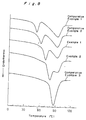
- Fig. 8 is a chart illustrating the differential scanning calorimeter measurement on the golf balls in Examples 1 and 2 and Comparative Examples 1 to 3.
- Figs. 9a to 9c are charts illustrating X-ray diffraction pattern of those obtained by press-molding the cover composition of the formulation shown in Table 1 into sheets of 2 mm in thickness, storing the sheets for a certain period of time and subjecting them to annealing treatment at 23°C, 48°C and 70°C for four days.
- the ionomer resin constituting the cover is required to have a first peak at 85 to 95°C and a second peak at 70 to 80°C in its crystal melting behaviour as measured by a differential scanning calorimeter.
- the measurement by a differential scanning calorimeter is conducted in the following manner.
- the differential scanning calorimeter used may be, for example, the DSC SSC-500 manufactured by Sieko Electric Industry K.K. or the DSC-50 manufactured by Shimazu Corporation, etc.
- the measurement is conducted as follows.
- a golf ball which has been subjected to annealing treatment is stored at constant room temperature for not less than 24 hours to cool.
- a sample of 5 mg in conversion to the cover resin (the resin used for the cover) is obtained from the cover of the above golf ball and cooled from room temperature to -30°C under nitrogen atmosphere. Then, the sample is heated from -30°C up to 150°C at a heating rate of 10°C/min. to record the endothermic peaks attended with crystal melting.
- the differential scanning calorimeter measurement is conducted according to JIS K 7121 and JIS K 7122.
- the first peak appearing at 85 to 95°C is inherent in the ionomer resin used for the cover of the golf ball and, therefore, it is referred to as the "first peak".
- the second peak at 70 to 80°C does not appear until the ionomer resin for the cover, which has been placed on the core, is subjected to the annealing treatment under specific conditions.
- the ionomer is obtained by subjecting an ionic ethylene copolymer composed of three components of an ⁇ -olefin, ⁇ , ⁇ -ethylenic unsaturated carboxylic acid, and ⁇ , ⁇ -ethylenic unsaturated carboxylic acid metal salt, or four components of an ⁇ -olefin, ⁇ , ⁇ -ethylenic unsaturated carboxylic acid, ⁇ , ⁇ -ethylenic unsaturated carboxylic acid metal salt, and ⁇ , ⁇ -ethylenic unsaturated carboxylic acid ester to partial metal crosslinking.
- those using ethylene as the ⁇ -olefin and using acrylic acid or methacrylic acid as the ⁇ , ⁇ -ethylenic unsaturated carboxylic acid are particularly preferred.
- the acid content is preferably 10 to 20% by weight, more preferably 13 to 20% by weight. That is, when it is less than 10%, it is difficult to obtain excellent characteristics by neutralization of metal ions because the amount of carboxylic acid is too small, which results in insufficient rigidity as well as poor enhancement of the impact resilience by annealing treatment. Furthermore, when the acid content is more than 20% by weight, it becomes difficult to form a resin with a high degrees of neturalization by metal ions and the rigidity becomes too large, which results in deterioration of the shot feel.
- the ionomer resin used in the present invention uses monovalent metal ions (e.g. sodium, potassium, lithium, etc.) or divalent metal ions (e.g. zinc, copper, magnesium, etc.) as the metal ions for partially neutralizing the ⁇ , ⁇ -ethylenic unsaturated carboxylic acid.
- the degree of neutralization by metal ions 30 to 70% of the carboxyl groups of the carboxylic acid is preferably neutralized.
- the degree of neutralization by metal ions is less than 30 mole %, the desired rigidity can not be obtained, which results in a deterioration of the impact resilience.
- the degree of neutralization is more than 70% by weight, the rigidity becomes too high which results in a deterioration of the shot feel and, at the same time, the melt viscosity becomes high, which results in moulding difficulties.
- the resulting ionomer resin differs in its properties depending on the type of metal ions used for neutralization, it is preferred to use the ionomer resin in the form of that neutralized by monovalent ions and that neutralized by divalent metal ions, or in the form wherein the free carboxylic acid of an ionomer resin neutralized by monovalent ions is further neutralized by divalent metal ions and the result is ion-blended in the same molecules.
- Examples of the above ionomer resin include HI-MILAN 1605, HI-MILAN 1707, HI-MILAN 1706 which are commercially available from Mitsui Du Pont Polychemicals Co.; SURLIN 8940, SURLIN 8920, SURLIN 9910 which are commercially available from Du Pont de Nemours & Co.; and ESCOR EX-900, ESCOR EX-562, ESCOR EX-926 which are commerically available from EXXON Co.
- the above acid content means the content of ⁇ , ⁇ -ethylenic unsaturated carboxylic acid in the ionomer resin, indepenent of whether neutralization by metal ions has been made or not.
- the metal analysis is conducted, for example, by using a polarization Zeeman atomic absorption spectrometer, type 180-80 manufactured by Hitachi Seisakusho K.K. for monovalent metals such as sodium, etc.
- the metal analysis is conducted, for example, by using a sequential type ICI emission spectrometer, type SPS1100 manufactured by Seiko Electric Industry K.K.
- the ionomer resin as described is used as the main material for the golf ball cover.
- Appropriate additives such as pigments, lubricants, dispersants, antioxidants, ultraviolet ray absorbents, ultraviolet ray stabilizers, antistatic agents and the like are optionally added to the ionomer resin and then mixed to prepare a cover composition.
- the cover composition thus prepared is used for covering the core and, as the core, there can be used both solid cores and rubber thread wound cores.
- Various methods may be used for covering the core with the cover composition.
- a method comprising directly covering the core by injection moulding can normally be employed.
- a method comprising forming the cover composition into hemispheric shell-like shapes, so called "half shells" in advance, covering the two pieces of the resulting half shells on the rubber thread wound core to form a sphere, followed by hot compression molding to cover the core can normally be used.
- the thickness of the cover is normally 1.0 to 3.0 mm.
- the annealing treatment for enhancing the impact resilience by modifying the crystalline from of the ionomer resin is conducted on the ionomer resin for the cover which has been placed on the core. This is due to the fact, as is clear from Experiment Example 1 hereinafter, that even if the ionomer resin having a second peak at 70 to 80°C is obtained by subjecting it to an annealing treatment, the second peak disappears and the improvement in the impact resilience disappeared if it is exposed to a temperature higher than the crystal melting temperature thereafter.
- the temperature for the annealing treatment varies depending upon the type of the ionomer resin and a temperature in the range of from 45 to 63°C is preferred.
- the temperature for the annealing treatment is less than 45°C, the temperature of the second peak is lowered, which results in a poor improvement of the impact resilience.
- the temperature exceeds 63°C the second peak overlaps with the first peak if the annealing treatment is conducted for 72 hours (although depending upon the treatment time), which results in a deterioration in the impact resilience.
- the time of the annealing treatment is normally 3 to 240 hours. When the time is too short, the crystalline form can not be sufficiently modified, which results in no improvement in the impact resilience. On the contrary, when the time is too long, the production efficiency is inferior and heat deterioration of core is caused, which is not preferred.
- the ionomer resin has a first peak at 85 to 95°C and a second peak at 70 to 80°C in its crystal melting behaviour shown in the measurement by differential scanning calorimeter means that the first melting behaviour, or the intrinsic melting point of the ionomer resin at 85 to 95°C is recorded in the differential scanning calorimeter measurement and, further, the second crystal melting behaviour at 70 to 80°C resulting from annealing treatment is recorded.
- the reason that the ionomer resin should have the second peak at 70 to 80°C is as follows. That is, when the temperature of the second peak is below 70°C, the impact resilience is not improved because of insufficient progress of crystallization. When the temperature of the second peak is higher than 80°C, the second peak overlaps with the first peak although crystallization progresses which results in deterioration of the impact resilience.
- the annealing treatment exhibits its effect by applying to the ionomer resin for the cover.
- the annealing treatment is conducted on the ionomer resin for the cover which has been placed on the core, it is impossible to selectively subject only the ionomer resin to annealing treatment. In practice, the annealing treatment is applied to the whole cover.
- the golf ball of the present invention has a high impact resilience as well as an excellent flying performance. Furthermore, the golf ball has also a good shot feel.
- Experiment Example 1 relates to a two-piece solid golf ball, and its solid core and cover were prepared as follows.
- a solid core was made by adding 35 parts by weight of zinc acrylate, 10 parts by weight of zinc oxide and 1 part by weight of a vulcanization initiator (dicumyloxide, PERCUMYL manufactured by Nihon Yushi K.K.) to 100 parts by weight of cys-1,4-polybutadiene (JSR BR-01 manufactured by Japan Synthetic Rubber K.K.), kneading the mixture with an internal mixer, cutting the mixture into a specified size and filling it into a die for molding the core, followed by hot compression molding at 160°C for 20 minutes.
- the diameter of the solid core thus prepared was 38.5 mm.
- the cover composition was prepared by using HI-MILAN 1707 and HI-MILAN 1706 manufactured by Mitsui Du Pont Polychemicals Co. as the ionomer resin, kneading the mixture of the formulation as shown in Table 1 with an extruder.
- HI-MILAN 1707 contains 15 % by weight of methacrylic acid and it is of the type neutralized by sodium ions. The degree of neutralization by sodium ions is about 60 mole %.
- HI-MILAN 1706 contains 15 % by weight of methacrylic acid and it is of the type neutralized by zinc ions. The degree of neutralization by zinc is about 60 mole %.
- the antioxidant in Table 1 is Irganox 1010 (trade name) manufactured by Ciba-Geigay Co. and the lubricant is zinc stearate, both of which are also used in the cover formulation hereinafter as antioxidants and lubricants, respectively.
- the cover composition as described above was injection-molded to directly cover the core and was optionally subjected to annealing treatment. Then, it was optionally finished through a painting process to obtain a two-piece solid golf ball having a diameter of 42.8 mm.
- the second peak appears depending upon the elapsed time after cover molding and the temperature range of the peak varies depending upon the thermal hysteresis after cover molding.
- the golf ball was stored at room temperature (23°C) for 3 months and the cover of the golf ball which was not subjected to annealing treatment was once heated and molten up to 150°C by the differential scanning calorimeter. After natural cooling, it was measured again by the differential scanning calorimeter and the resulting chart is shown by a curve D in Fig. 1.
- the cover which has been subjected to annealing treatment at 50°C for 7 days was once heated up to 150°C by the differential scanning calorimeter. After natural cooling, it was measured again by the differential scanning calorimeter and the resulting chart is shown by a curve E in Fig. 1.
- both curves D and E show nearly the same crystal melting behavior as the curve A which shows the crystal melting behavior of the ionomer resin immediately after cover molding, and no second peak is observed.
- the crystal growth by annealing treatment after cover molding disappears if the cover is exposed to the temperature higher than the crystal melting temperature thereafter.
- the crystal does grow or does not grow, or the crystal which has once grown melts according to the thermal hysterisis after cover molding.
- the cover composition of the formulation as shown in Table 1 hereinabove, the cover composition was injection-molded to cover the same solid core as that in Experiment Example 1. After it was subjected to annealing treatment as described in Table 3, the coefficient of restitution of the golf ball after annealing treatment was measured. The results are shown in Table 3. Further, a relation between the temperature of annealing treatment and the coefficient of restitution is shown in Fig. 6. In this case, the coefficient of restitution is a measure of the impact resilience of the golf ball, and the method for measuring the coefficient of restitution is as follows.
- the cover composition of the formulation as shown in Table 1 was press-molded into a sheet of 2 mm in thickness. After molding, the sheet was stored at 23°C for 7 days and subjected to annealing treatment at 23°C, 48°C and 70°C, respectively for 4 days. Then, the flexural modulus and X-ray diffraction were measured. The results of the flexural modulus are shown in Table 4. Further, X-ray diffraction chart is shown in Fig. 9. In this case, the conditions under which the press molding was done was that the sample was subjected to hot compression molding at 180°C for 5 minutes and cooled for 30 minutes. Further, the flexural modulus was measured by using a stiffness tester manufactured by Toyo Seiki K.K.
- the flexural modulus increases with increasing temperature of annealing treatment.
- the degree of crystallization increases with increasing temperature of annealing treatment, whereas the coefficient of restitution does not increase with increasing the flexural modulus and the degree of crystallization, as is clear from the results of Fig. 6.
- FIG. 7 A relation between the second peak temperature and the temperature of annealing treatment in the differential scanning calorimeter measurement of golf balls is shown in Fig. 7. Further, the chart of the measurement by the differential scanning calorimeter is shown in Fig. 8.
- the second peak also appears in the case of Comparative Example 1 wherein the annealing treatment was conducted at 23°C and Example 2 wherein the annealing treatment was conducted at 35°C.
- the temperature of the second peak is low and sufficient enhancement of the coefficient of restitution can not be obtained as is shown in Table 3 and Fig. 6.
- the second peak overlapped with the first peak and the degree of crystallization becomes high, but the impact resilience of the golf ball is the lowest.
- golf balls of Examples 1 and 2 showed high ball initial velocity and long total flying distance in comparison with those of Comparative Examples 1 to 3. Further, golf balls of Examples 1 and 2 showed good hit feeling.
- HI-MILAN 1707 As the ionomer resin, HI-MILAN 1707 was used. To 100 parts by weight of the ionomer resin (HI-MILAN 1707) were added 1 part by weight of titanium oxide, 3 parts by weight of precipitated barium sulfate, 0.01.parts by weight of an antioxidant and 0.001 parts by weight of a lubricant and the mixture was kneaded to prepare a cover composition.
- the resulting cover composition was injection-molded to cover the same solid core as that of Experiment Example 1 to prepare a golf ball having a diameter of 42.8 mm. After the golf ball was stored at room temperature for 24 hours, it was subjected to annealing treatment at 30°C, 50°C and 70°C, respectively, for 72 hours.
- the golf ball after annealing treatment was stored at room temperature for 24 hours to cool, and the coefficient of restitution was measured. Then, the cover resin (the resin used for the cover) was measured by the differential scanning calorimeter to determine the first peak temperature and the second peak temperature. The results are shown in Table 6.
- Example 3 As shown in Table 6, a golf ball of Example 3 having the second peak at 75°C within the temperature range of 70 to 80°C showed high coefficient of restitution and high impact resilience in comparison with that of Comparative Example 4 having the second peak at 58°C and that of Comparative Example 5 of which second peak overlaps with the first peak and lies in the temperature range higer than 80°C.
- HI-MILAN 1706 As the ionomer resin, HI-MILAN 1706 was used. To 100 parts by weight of the ionomer resin (HI-MILAN 1706) were added 1 part by weight of titanium oxide, 3 parts by weight of precipitated barium sulfate, 0.01 parts by weight of an antioxidant and 0.001 parts by weight of a lubricant and the mixture was kneaded to prepare a cover composition.
- the resulting cover composition was injection-molded to cover the same solid core as that of Experiment Example 1 to prepare a golf ball having a diameter of 42.8 mm. After the golf ball was stored at room temperature for 24 hours, it was subjected to annealing treatment at 30°C, 50°C and 70°C, respectively, for 72 hours.
- the golf ball after annealing treatment was stored at room temperature for 24 hours to cool, and the coefficient of restitution was measured. Then, the cover resin was measured by the differential scanning calorimeter to determine the first peak temperature and the second peak temperature. The result are shown in Table 7.
- a golf ball of Example 4 having the second peak at 73°C within the temperature range of 70 to 80°C showed high coefficient of restitution and high impact resilience in comparison with that of Comparative Example 6 having the second peak at 59°C and that of Comparative Example 7 of which second peak overlaps with the first peak and lies in the temperature range higer than 80°C.
- HI-MILAN resin A As the ionomer resin, HI-MILAN resin A was used. To 100 parts by weight of the ionomer resin (HI-MILAN resin A) were added 1 part by weight of titanium oxide, 3 parts by weight of precipitated barium sulfate, 0.01 parts by weight of an antioxidant and 0.001 parts by weight of a lubricant and the mixture was kneaded to prepare a cover composition. HI-MILAN resin A contains 15 % by weight of methacrylic acid and is of the type neutralized by magnesium ions. The degree of neutralization by magnesium ions is about 45 mole %.
- the resulting cover composition was injection-molded to cover the same solid core as that of Experiment Example 1 to prepare a golf ball having a diameter of 42.8 mm. After the golf ball was stored at room temperature for 24 hours, it was subjected to annealing treatment at 30°C, 50°C and 70°C, respectively, for 72 hours.
- the golf ball after annealing treatment was stored at room temperature for 24 hours to cool, and the coefficient of restitution was measured. Then, the cover resin was measured by the differential scanning calorimeter to determine the first peak temperature and the second peak temperature. The results are shown in Table 8.
- a golf ball of Example 5 having the second peak at 74°C within the temperature range of 70 to 80°C showed high coefficient of restitution and high impact resilience in comparison with that of Comparative Example 8 having the second peak at 59°C and that of Comparative Example 9 of which second peak overlaps with the first peak and lies in the temperature range higer than 80°C.
- HI-MILAN resin B As the ionomer resin, HI-MILAN resin B was used. To 100 parts by weight of the ionomer resin HI-MILAN resin B) were added 1 part by weight of titanium oxide, 3 parts by weight of precipitated barium sulfate, 0.01 parts by weight of an antioxidant and 0.001 parts by weight of a lubricant and the mixture was kneaded to prepare a cover composition. HI-MILAN resin B contains 15 % by weight of methacrylic acid and is of the type neutralized by sodium ions and magnesium ions. The degree of neutralization by sodium ions and magnesium ions is about 45 mole %.
- the resulting cover composition was injection-molded to cover the same solid core as that of Experiment Example 1 to prepare a golf ball having a diameter of 42.8 mm. After the golf ball was stored at room temperature for 24 hours, it was subjected to annealing treatment at 30°C, 50°C and 70°C, respectively, for 72 hours.
- the golf ball after annealing treatment was stored at room temperature for 24 hours to cool, and the coefficient of restitution was measured. Then, the cover resin was measured by the differential scanning calorimeter to determine the first peak temperature and the second peak temperature. The results are shown in Table 9.
- a golf ball of Example 3 having the second peak at 74°C within the temperature range of 70 to 80°C showed high resilience coefficient and high impact resilience in comparison with that of Comparative Example 10 having the second peak at 58°C and that of Comparative Example 11 of which second peak overlaps with the first peak and lies in the temperature range higer than 80°C.
- HI-MILAN 1707 and HI-MILAN 1706 were used as the ionomer resin.
- To 100 parts by weight of the ionomer resin mix (50 parts by weight of HI-MILAN 1707 and 50 parts by weight of HI-MILAN 1706) were added 1 part by weight of titanium oxide, 3 parts by weight of precipitated barium sulfate, 0.01 parts by weight of an antioxidant and 0.001 parts by weight of a lubricant and the mixture was kneaded to prepare a cover composition.
- the resulting cover composition was injection-molded to cover the same solid core as that of Experiment Example 1 to prepare a golf ball having a diameter of 42,8 mm. After the golf ball was stored at room temperature for 24 hours, it was subjected to annealing treatment at 30°C, 50°C and 70°C, respectively, for 72 hours.
- the golf ball after annealing treatment was stored at room temperature for 24 hours to cool, and the coefficient of restitution was measured. Then, the cover resin was measured by the differential scanning calorimeter to determine the first peak temperature and the second peak temperature. The results are shown in Table 10.
- Example 7 As shown in Table 10, a golf ball of Example 7 having the second peak at 74°C within the temperature range of 70 to 80°C showed high coefficient of restitution and high impact resilience in comparison with that of Comparative Example 12 having the second peak at 59°C and that of Comparative Example 13 of which second peak overlaps with the first peak and lies in the temperature range higer than 80°C.
- HI-MILAN 1707 and HI-MILAN resin A were used as the ionomer resin.
- To 100 parts by weight of the ionomer resin mix (50 parts by weight of HI-MILAN 1707 and 50 parts by weight of HI-MILAN resin A) were added 1 part by weight of titanium oxide, 3 parts by weight of precipitated barium sulfate, 0.01 parts by weight of an antioxidant and 0.001 parts by weight of a lubricant and the mixture was kneaded to prepare a cover composition.
- the resulting cover composition was injection-molded to cover the same solid core as that of Experiment Example 1 to prepare a golf ball having a diameter of 42.8 mm. After the golf ball was stored at room temperature for 24 hours, it was subjected to annealing treatment at 30°C, 50°C and 70°C, respectively, for 72 hours.
- the golf ball after annealing treatment was stored at room temperature for 24 hours to cool, and the coefficient of restitution was measured. Then, the cover resin was measured by the differential scanning calorimeter to determine the first peak temperature and the second peak temperature. The results are shown in Table 11.
- a golf ball of Example 8 having the second peak at 73°C within the temperature range of 70 to 80°C showed high coefficient of restitution and high impact resilience in comparison with that of Comparative Example 14 having the second peak at 59°C and that of Comparative Example 15 of which second peak overlaps with the first peak and lies in the temperature range higer than 80°C.
- HI-MILAN 1707 and HI-MILAN resin B were used as the ionomer resin.
- To 100 parts by weight of the ionomer resin mix (50 parts by weight of HI-MILAN 1707 and 50 parts by weight of HI-MILAN resin B) were added 1 part by weight of titanium oxide, 3 parts by weight of precipitated barium sulfate, 0.01 parts by weight of an antioxidant and 0.001 parts by weight of a lubricant and the mixture was kneaded to prepare a cover composition.
- the resulting cover composition was injection-molded to cover the same solid core as that of Experiment Example 1 to prepare a golf ball having a diameter of 42.8 mm. After the golf ball was stored at room temperature for 24 hours, it was subjected to annealing treatment at 30°C, 50°C and 70°C, respectively, for 72 hours.
- the golf ball after annealing treatment was stored at room temperature for 24 hours to cool, and the coefficient of restitution was measured. Then, the cover resin was measured by the differential scanning calorimeter to determine the first peak temperature and the second peak temperature. The results are shown in Table 12.
- a golf ball of Example 9 having the second peak at 74°C within the temperature range of 70 to 80°C showed high coefficient of restitution and high impact resilience in comparison with that of Comparative Example 16 having the second peak at 60°C and that of Comparative Example 17 of which second peak overlaps with the first peak and lies in the temperature range higer than 80°C.
- HI-MILAN 1706 and HI-MILAN resin A were used as the ionomer resin.
- To 100 parts by weight of the ionomer resin mix (50 parts by weight of HI-MILAN 1707 and 50 parts by weight of HI-MILAN resin A) were added 1 part by weight of titanium oxide, 3 parts by weight of precipitated barium sulfate, 0.01 parts by weight of an antioxidant and 0.001 parts by weight of a lubricant and the mixture was kneaded to prepare a cover composition.
- the resulting cover composition was injection-molded to cover the same solid core as that of Experiment Example 1 to prepare a golf ball having a diameter of 42.8 mm. After the golf ball was stored at room temperature for 24 hours, it was subjected to annealing treatment at 30°C, 50°C and 70°C, respectively, for 72 hours.
- the golf ball after annealing treatment was stored at room temperature for 24 hours to cool, and the coefficient of restitution was measured. Then, the cover resin was measured by the differential scanning calorimeter to determine the first peak temperature and the second peak temperature. The results are shown in Table 13.
- a golf ball of Example 10 having the second peak at 74°C within the temperature range of 70 to 80°C showed high coefficient of restitution and high impact resilience in comparison with that of Comparative Example 18 having the second peak at 58°C and that of Comparative Example 19 of which second peak overlaps with the first peak and lies in the temperature range higer than 80°C.
- HI-MILAN 1706 and HI-MILAN resin B were used as the ionomer resin.
- To 100 parts by weight of the ionomer resin mix (50 part by weight of HI-MILAN 1707 and 50 parts by weight of HI-MILAN resin B) were added 1 part by weight of titanium oxide, 3 parts by weight of precipitated barium sulfate, 0.01 parts by weight of an antioxidant and 0.001 parts by weight of a lubricant and the mixture was kneaded to prepare a cover composition.
- the resulting cover composition was injection-molded to cover the same solid core as that of Experiment Example 1 to prepare a golf ball having a diameter of 42.8 mm. After the golf ball was stored at room temperature for 24 hours, it was subjected to annealing treatment at 30°C, 50°C and 70°C, respectively, for 72 hours.
- the golf ball after annealing treatment was stored at room temperature for 24 hours to cool, and the coefficient of restitution was measured. Then, the cover resin was measured by the differential scanning calorimeter to determine the first peak temperature and the second peak temperature. The results are shown in Table 14.
- a golf ball of Example 11 having the second peak at 74°C within the temperature range of 70 to 80°C showed high coefficient of restitution and high impact resilience in comparison with that of Comparative Example 20 having the second peak at 60°C and that of Comparative Example 21 of which second peak overlaps with the first peak and lies in the temperature range higer than 80°C.
- HI-MILAN resin A and HI-MILAN resin B were used as the ionomer resin.
- To 100 parts by weight of the ionomer resin mix (50 parts by weight of HI-MILAN resin A and 50 parts by weight of HI-MILAN resin B) were added 1 part by weight of titanium oxide, 3 parts by weight of precipitated barium sulfate, 0.01 parts by weight of an antioxidant and 0.001 parts by weight of a lubricant and the mixture was kneaded to prepare a cover composition.
- the resulting cover composition was injection-molded to cover the same solid core as that of Experiment Example 1 to prepare a golf ball having a diameter of 42.8 mm. After the golf ball was stored at room temperature for 24 hours, it was subjected to annealing treatment at 30°C, 50°C and 70°C, respectively, for 72 hours.
- the golf ball after annealing treatment was stored at room temperature for 24 hours to cool, and the coefficient of restitution was measured. Then, the cover resin was measured by the differential scanning calorimeter to determine the first peak temperature and the second peak temperature. The results are shown in Table 15.
- a golf ball of Example 12 having the second peak at 74°C within the temperature range of 70 to 80°C showed high coefficient of restitution and high impact resilience in comparison with that of Comparative Example 22 having the second peak at 60°C and that of Comparative Example 23 of which second peak overlaps with the first peak and lies in the temperature range higer than 80°C.
- HI-MILAN 1555 As the ionomer resin, HI-MILAN 1555 was used. To 100 parts by weight of the ionomer resin (HI MILAN 1555) were added 1 part by weight of titanium oxide, 3 parts by weight of precipitated barium sulfate, 0.01 parts by weight of an antioxidant and 0.001 parts by weight of a lubricant and the mixture was kneaded to prepare a cover composition. HI-MILAN 1555 contains 11 % by weight of methacrylic acid and is of type neutralized by sodium ions. the degree of neutralization by sodium ions is about 35 mole %.
- the resulting cover composition was injection-molded to cover the same solid core as that of Experiment Example 1 to prepare a golf ball having a diameter of 42.8 mm. After the golf ball was stored at room temperature for 24 hours, it was subjected to annealing treatment at 30°C, 50°C and 70°C, respectively, for 72 hours.
- the golf ball after annealing treatment was stored at room temperature for 24 hours to cool, and the coefficient of restitution was measured. Then, the cover resin was measured by the differential scanning calorimeter to determine the first peak temperature and the second peak temperature. The results are shown in Table 16.
- a golf ball of Example 13 having the second peak at 75°C within the temperature range of 70 to 80°C showed high coefficient of restitution and high impact resilience in comparison with that of Comparative Example 24 having the second peak at 59°C and that of Comparative Example 25 of which second peak overlaps with the first peak and lies in the temperature range higer than 80°C.
- HI-MILAN 1557 As the ionomer resin, HI-MILAN 1557 was used. To 100 parts by weight of the ionomer resin (HI-MILAN 1557) were added 1 part by weight of titanium oxide, 3 parts by weight of precipitated barium sulfate, 0.01 parts by weight of an antioxidant and 0.001 parts by weight of a lubricant and the mixture was kneaded to prepare a cover composition. HI-MILAN 1557 contains 11 % by weight of methacrylic acid and is of the type neutralized by zinc ions. The degree of neutralization by zinc ions is not less than about 55 mole %.
- the resulting cover composition was injection-molded to cover the same solid core as that of Experiment Example 1 to prepare a golf ball having a diameter of 42.8 mm. After the golf ball was stored at room temperature for 24 hours, it was subjected to annealing treatment at 30°C, 50°C and 70°C, respectively, for 72 hours.
- the golf ball after annealing treatment was stored at room temperature for 24 hours to cool, and the coefficient of restitution was measured. Then, the cover resin was measured by the differential scanning calorimeter to determine the first peak temperature and the second peak temperature. The results are shown in Table 17.
- a golf ball of Example 14 having the second peak at 74°C within the temperature range of 70 to 80°C showed high coefficient of restitution and high impact resilience in comparison with that of Comparative Example 26 having the second peak at 59°C and that of Comparative Example 27 of which second peak overlaps with the first peak and lies in the temperature range higer than 80°C.
- HI-MILAN 1555 and HI-MILAN 1557 were used as the ionomer resin.
- To 100 parts by weight of the ionomer resin mix (50 parts by weight of HI-MILAN 1555 and 50 % by weight of HI-MILAN 1557) were added 1 part by weight of titanium oxide, 3 parts by weight of precipitated barium sulfate, 0.01 parts by weight of an antioxidant and 0.001 parts by weight of a lubricant and the mixture was kneaded to prepare a cover composition.
- the resulting cover composition was injection-molded to cover the same solid core as that of Experiment Example 1 to prepare a golf ball having a diameter of 42.8 mm. After the golf ball was stored at room temperature for 24 hours, it was subjected to annealing treatment at 30°C, 50°C and 70°C, respectively, for 72 hours.
- the golf ball after annealing treatment was stored at room temperature for 24 hours to cool, and the coefficient of restitution was measured. Then, the cover resin was measured by the differential scanning calorimeter to determine the first peak temperature and the second peak temperature. The results are shown in Table 18.
- Example 15 having the second peak at 74°C within the temperature range of 70 to 80°C showed high coefficient of restitution and high impact resilience in comparison with that of Comparative Example 28 having the second peak at 60°C and that of Comparative Example 29 of which second peak overlaps with the first peak and lies in the temperature range higer than 80°C.
- low density polyethylene (Ultzex 3550R manufactured by Mitsui Petrochemical K.K.) was used. To 100 parts by weight of the low density polyethylene were added 1 part by weight of titanium oxide, 3 parts by weight of precipitated barium sulfate, 0.01 parts by weight of an antioxidant and 0.001 parts by weight of a lubricant and the mixture was kneaded to prepare a cover composition.
- the resulting cover composition was injection-molded to cover the same solid core as that of Experiment Example 1 to prepare a golf ball having a diameter of 42.8 mm. After the golf ball was stored at room temperature for 24 hours, it was subjected to annealing treatment at 30°C, 50°C and 70°C, respectively, for 72 hours.
- the golf ball after annealing treatment was stored at room temperature for 24 hours to cool, and the coefficient of restitution was measured. Then, the cover resin was measured by the differential scanning calorimeter to determine the first peak temperature and the second peak temperature. The results are shown in Table 19.
- Comparative Examples 30 to 32 relate to a golf ball wherein low density polyethylene containing neither unsaturated carboxylic acid nor its metal salt was used as the cover resin. As shown in Table 19, no second peak was observed and, further, there was almost no difference in coefficient of restitution due to difference in annealing temperature and, therefore, no enhancement of the coefficient of restitution was observed. Further, it is considered to be caused by thermal hardening of the core that the coefficient of restitution slightly increases with increasing the temperature of annealing treatment.
- Examples 3 to 15 and Comparative Examples 4 to 29 described above various ionomer resins were selected to examine the differences in impact resilience due to differences in the temperature of annealing treatment. As shown in Tables 6 to 18, any ionomer resin has high coefficient of restitution when it was subjected to annealing treatment at 50°C in comparison with the case when it was subjected to annealing treatment at 30°C or 70°C, which results in golf balls having high impact resilience.
Landscapes
- Health & Medical Sciences (AREA)
- General Health & Medical Sciences (AREA)
- Physical Education & Sports Medicine (AREA)
- Chemical & Material Sciences (AREA)
- Chemical Kinetics & Catalysis (AREA)
- Medicinal Chemistry (AREA)
- Polymers & Plastics (AREA)
- Organic Chemistry (AREA)
- Compositions Of Macromolecular Compounds (AREA)
- Addition Polymer Or Copolymer, Post-Treatments, Or Chemical Modifications (AREA)
Claims (4)
- Golfball, umfassend einen Kern und einen Mantel zum Ummanteln des Kerns, wobei der Mantel ein ionomeres Harz als Hauptmaterial enthält und das ionomere Harz beim Messen mit einem Differentialscanning-Kalorimeter einen ersten Peak bei 85 bis 95°C und einen zweiten Peak bei 70 bis 80°C in seinem Kristallschmelzverhalten zeigt.
- Verfahren zur Herstellung eines Golfballs nach Anspruch 1, in dem ein ionomeres Harz für einen Mantel, der auf einen Golfballkern aufgebracht wurde, getempert wird, daß das ionomere Harz beim messen mit einem Differentialscanning-Kalorimeter einen ersten Peak bei 85 bis 95°C und einen zweiten Peak bei 70 bis 80°C in seinem Kristallschmelzverhalten zeigt.
- Verfahren nach Anspruch 2, in dem das Tempern bei einer Temperatur im Bereich von 45 bis 63°C ausgeführt wird.
- Verfahren nach Anspruch 2 oder 3, in dem das Tempern innerhalb von 3 bis 240 Stunden ausgeführt wird.
Applications Claiming Priority (2)
| Application Number | Priority Date | Filing Date | Title |
|---|---|---|---|
| JP280215/90 | 1990-10-18 | ||
| JP2280215A JP2665991B2 (ja) | 1990-10-18 | 1990-10-18 | ゴルフボールおよびその製造方法 |
Publications (2)
| Publication Number | Publication Date |
|---|---|
| EP0481809A1 EP0481809A1 (de) | 1992-04-22 |
| EP0481809B1 true EP0481809B1 (de) | 1994-04-06 |
Family
ID=17621917
Family Applications (1)
| Application Number | Title | Priority Date | Filing Date |
|---|---|---|---|
| EP91309636A Expired - Lifetime EP0481809B1 (de) | 1990-10-18 | 1991-10-18 | Golfball sowie Verfahren zu seiner Herstellung |
Country Status (6)
| Country | Link |
|---|---|
| US (1) | US5274041A (de) |
| EP (1) | EP0481809B1 (de) |
| JP (1) | JP2665991B2 (de) |
| AU (1) | AU648830B2 (de) |
| CA (1) | CA2053617A1 (de) |
| DE (1) | DE69101617T2 (de) |
Families Citing this family (75)
| Publication number | Priority date | Publication date | Assignee | Title |
|---|---|---|---|---|
| US5368304A (en) | 1993-04-28 | 1994-11-29 | Lisco, Inc. | Low spin golf ball |
| US5688869A (en) * | 1991-10-15 | 1997-11-18 | Lisco, Inc. | Golf ball cover compositions |
| US20010020068A1 (en) * | 1992-06-19 | 2001-09-06 | Spalding Sports Worldwide, Inc. | Golf ball cover compositions |
| US6451923B1 (en) | 1992-06-19 | 2002-09-17 | Spalding Sports Worldwide, Inc. | Low spin golf ball |
| US6207759B1 (en) | 1993-04-08 | 2001-03-27 | E. I. Du Pont De Nemours And Company | Composition for a cover of a golf ball |
| US5803831A (en) * | 1993-06-01 | 1998-09-08 | Lisco Inc. | Golf ball and method of making same |
| US7494427B2 (en) | 2001-11-05 | 2009-02-24 | Callaway Golf Company | Multi-layer golf ball |
| US6695718B2 (en) | 1993-06-01 | 2004-02-24 | The Top-Flite Golf Company | Golf ball with sulfur cured inner core component |
| US6638185B2 (en) | 1993-06-01 | 2003-10-28 | The Top-Flite Golf Company | Multi-layer golf ball |
| US6210293B1 (en) | 1993-06-01 | 2001-04-03 | Spalding Sports Worldwide, Inc. | Multi-layer golf ball |
| US6394913B1 (en) | 1993-06-01 | 2002-05-28 | Spalding Sports Worldwide, Inc. | Multi-layer golf ball |
| US6824476B2 (en) | 1993-06-01 | 2004-11-30 | Callaway Golf Company | Multi-layer golf ball |
| US6325731B1 (en) | 1993-06-01 | 2001-12-04 | Spalding Sports Wordwide, Inc. | Multi-layer golf ball |
| US6083119A (en) * | 1993-06-01 | 2000-07-04 | Spalding Sports Worldwide, Inc. | Multi-layer golf ball |
| US6663508B1 (en) | 1993-06-01 | 2003-12-16 | Callaway Golf Company | Multi-layer golf ball with reaction injection molded polyurethane component |
| US6287217B1 (en) | 1993-06-01 | 2001-09-11 | Spalding Sports Worldwide, Inc. | Multi-layer golf ball |
| US6548618B2 (en) | 1993-06-01 | 2003-04-15 | Spalding Sports Worldwide, Inc. | Golf ball having dual core and thin polyurethane cover formed by RIM |
| US6648777B2 (en) | 1993-06-01 | 2003-11-18 | Callaway Golf Company | Multi-layer golf ball |
| US6290614B1 (en) | 1998-03-18 | 2001-09-18 | Spalding Sports Worldwide, Inc. | Golf ball which includes fast-chemical-reaction-produced component and method of making same |
| US6213894B1 (en) | 1993-06-01 | 2001-04-10 | Spalding Sports Worldwide, Inc. | Multi-layer golf ball |
| US6506130B2 (en) | 1993-06-01 | 2003-01-14 | Spalding Sports Worldwide, Inc. | Multi layer golf ball |
| JP2910516B2 (ja) | 1993-07-08 | 1999-06-23 | ブリヂストンスポーツ株式会社 | スリーピースソリッドゴルフボール |
| CA2194934C (en) | 1996-01-25 | 2006-01-10 | Michael J. Sullivan | Golf ball with ionomeric cover and method of making same |
| US20010019969A1 (en) * | 1997-03-28 | 2001-09-06 | Spalding Sports Worldwide, Inc. | Perimeter weighted multi-layer golf ball |
| US6565457B1 (en) | 1997-07-14 | 2003-05-20 | Spalding Sports Worldwide, Inc. | Golf ball containing high density fillers in the core and cover |
| US7160210B2 (en) | 1998-03-18 | 2007-01-09 | Callaway Golf Company | Golf ball which includes fast-chemical-reaction-produced component and method of making same |
| US7244196B2 (en) | 1998-03-18 | 2007-07-17 | Callaway Golf Company | Golf ball which includes fast-chemical-reaction-produced component and method of making same |
| US6716954B2 (en) | 1998-03-18 | 2004-04-06 | Callaway Golf Company | Golf ball formed from a polyisocyanate copolymer and method of making same |
| JP2000279554A (ja) | 1999-03-30 | 2000-10-10 | Bridgestone Sports Co Ltd | ゴルフボール |
| US7148266B2 (en) * | 1999-12-23 | 2006-12-12 | Callaway Golf Company | Game balls with cover containing post crosslinkable thermoplastic polyurethane and method of making same |
| US6369125B1 (en) | 1999-12-23 | 2002-04-09 | Spalding Sports Worldwide, Inc. | Game balls with cover containing post crosslinkable thermoplastic polyurethane and method of making same |
| US6488597B2 (en) * | 2000-03-15 | 2002-12-03 | Sumitomo Rubber Industries, Ltd. | Golf ball |
| US7427193B2 (en) | 2001-12-04 | 2008-09-23 | Callaway Golf Company | Method and apparatus for forming a golf ball |
| US6855077B2 (en) | 2001-12-04 | 2005-02-15 | Callaway Golf Company | Process and apparatus for producing a golf ball with deep dimples |
| US8076000B2 (en) | 2003-05-27 | 2011-12-13 | Exxonmobil Chemical Patents Inc. | Tie-layer materials for use with ionomer-based films and sheets as skins on other materials |
| US7156755B2 (en) | 2005-01-26 | 2007-01-02 | Callaway Golf Company | Golf ball with thermoplastic material |
| US7175543B2 (en) * | 2005-01-26 | 2007-02-13 | Callaway Golf Company | Golf ball and thermoplastic material |
| US8177665B2 (en) | 2005-02-01 | 2012-05-15 | Taylor Made Golf Company, Inc. | Multi-layer golf ball |
| US7612134B2 (en) | 2005-02-23 | 2009-11-03 | Callaway Golf Company | Golf ball and thermoplastic material |
| US7312267B2 (en) | 2005-02-23 | 2007-12-25 | Callaway Golf Company | Golf ball and thermoplastic material |
| US7264560B2 (en) | 2005-03-10 | 2007-09-04 | Callaway Golf Company | Golf ball |
| US20070035063A1 (en) * | 2005-08-10 | 2007-02-15 | Lavallee Gerald A | Two-stage reaction injection molded golf ball |
| US20070069424A1 (en) * | 2005-08-30 | 2007-03-29 | Veilleux Thomas A | Reaction injection molding assembly for manufacturing a golf ball component |
| US7524251B2 (en) | 2005-08-30 | 2009-04-28 | Callaway Golf Company | Golf products produced by a stoichiometrically imbalanced RIM system |
| US7306529B2 (en) | 2005-10-07 | 2007-12-11 | Callaway Golf Company | Multi-layer golf ball |
| US20070135235A1 (en) * | 2005-10-13 | 2007-06-14 | Kennedy Thomas J Iii | Fast-Chemical-Reaction-Produced Golf Product Comprising a Caprolactam Polyol |
| US7612135B2 (en) | 2006-02-17 | 2009-11-03 | Callaway Golf Company | Golf ball and thermoplastic material |
| US7988898B2 (en) * | 2006-10-20 | 2011-08-02 | QUBICAAMF Worldwide LLC. | Method of manufacturing a bowling pin |
| US7946934B2 (en) | 2007-11-14 | 2011-05-24 | Acushnet Company | Dual core golf ball having negative-hardness-gradient thermoplastic inner core and shallow positive-hardness-gradient thermoset outer core layer |
| US7815526B2 (en) | 2007-11-14 | 2010-10-19 | Acushnet Company | Dual core golf ball having negative-hardness-gradient thermoplastic inner core and steep positive-hardness-gradient thermoset outer core layer |
| US8740725B2 (en) | 2007-11-14 | 2014-06-03 | Acushnet Company | Dual core golf ball having positive-hardness-gradient thermoplastic inner core and shallow negative-hardness-gradient outer core layer |
| US7762910B2 (en) * | 2007-11-14 | 2010-07-27 | Acushnet Company | Dual core golf ball having negative-hardness-gradient thermoplastic inner core and steep negative-hardness-gradient outer core layer |
| US8753231B2 (en) | 2007-11-14 | 2014-06-17 | Acushnet Company | Golf ball having a thermoplastic positive hardness gradient inner core layer and a thermoset shallow positive hardness gradient outer core layer |
| US9433828B2 (en) | 2007-11-14 | 2016-09-06 | Acushnet Company | Dual core golf ball having negative-hardness-gradient thermoplastic inner core and steep positive-hardness-gradient thermoset outer core layer |
| US9675846B2 (en) | 2007-11-14 | 2017-06-13 | Acushnet Company | Dual core golf ball having positive-hardness-gradient thermoplastic inner core and positive-hardness-gradient thermoset outer core layer |
| US9999809B2 (en) | 2007-11-14 | 2018-06-19 | Acushnet Company | Dual core having thermoplastic inner core, thermoset outer core layer, and positive hardness gradient |
| US9433829B2 (en) | 2007-11-14 | 2016-09-06 | Acushnet Company | Dual core golf ball having positive-hardness-gradient thermoplastic inner core and positive-hardness-gradient thermoset outer core layer |
| US9072944B2 (en) | 2007-11-14 | 2015-07-07 | Acushnet Copany | Dual core golf ball having a shallow “positive hardness gradient” thermoplastic inner core and a steep “positive hardness gradient” thermoset outer core layer |
| US9873026B2 (en) | 2007-11-14 | 2018-01-23 | Acushnet Company | Thermoplastic dual core having positive hardness gradient inner and outer core layers |
| US8764585B2 (en) | 2007-11-14 | 2014-07-01 | Acushnet Company | Dual core golf ball having a shallow “positive hardness gradient” thermoplastic inner core and a steep “positive hardness gradient” thermoset outer core layer |
| US7942761B2 (en) * | 2007-11-14 | 2011-05-17 | Acushnet Company | Dual core golf ball having negative-hardness-gradient thermoplastic inner core and shallow negative-hardness-gradient outer core layer |
| US9566475B2 (en) | 2007-11-14 | 2017-02-14 | Acushnet Company | Golf ball having a thermoplastic positive hardness gradient inner core layer and a thermostat shallow positive hardness gradient outer core layer |
| US9789367B2 (en) | 2007-11-14 | 2017-10-17 | Acushnet Company | Thermoplastic dual core having a negative gradient inner core and a positive gradient outer core |
| US9352194B2 (en) | 2007-11-14 | 2016-05-31 | Acushnet Company | Dual core golf ball having a shallow “positive hardness gradient” thermoplastic inner core and a steep “positive hardness gradient” thermoset outer core layer |
| US9149689B2 (en) | 2007-11-14 | 2015-10-06 | Acushnet Company | Dual core golf ball having positive-hardness-gradient thermoplastic inner core and positive-hardness-gradient thermoset outer core layer |
| US9717957B2 (en) | 2013-08-05 | 2017-08-01 | Acushnet Company | Multi-layer core golf ball |
| US9643060B2 (en) | 2008-01-10 | 2017-05-09 | Acushnet Company | Multi-layer core golf ball |
| US9649538B2 (en) | 2013-08-05 | 2017-05-16 | Acushnet Company | Multi-layer core golf ball |
| US8106125B2 (en) * | 2008-08-27 | 2012-01-31 | Bridgestone Sports Co., Ltd. | Golf ball material, golf ball and method for preparing golf ball material |
| US8602914B2 (en) * | 2010-01-20 | 2013-12-10 | Nike, Inc. | Methods and systems for customizing a golf ball |
| US9649539B2 (en) | 2012-04-20 | 2017-05-16 | Acushnet Company | Multi-layer core golf ball |
| US9592425B2 (en) | 2012-04-20 | 2017-03-14 | Acushnet Company | Multi-layer core golf ball |
| EP2746351B1 (de) * | 2012-12-20 | 2016-07-27 | Tarkett GDL S.A. | PVC-freie Oberflächenabdeckung |
| US9643061B2 (en) | 2013-08-05 | 2017-05-09 | Acushnet Company | Multi-layer core golf ball |
| US9737764B2 (en) | 2013-08-05 | 2017-08-22 | Acushnet Company | Multi-layer core golf ball |
Family Cites Families (12)
| Publication number | Priority date | Publication date | Assignee | Title |
|---|---|---|---|---|
| GB1210698A (en) * | 1968-03-01 | 1970-10-28 | Dunlop Co Ltd | Curing of golf ball covers |
| US4264075A (en) * | 1975-08-07 | 1981-04-28 | Princeton Chemical Research, Inc. | Two piece molded golf ball |
| US4323247A (en) * | 1981-01-19 | 1982-04-06 | Acushnet Company | Golf ball cover |
| JPS6014879A (ja) * | 1983-07-06 | 1985-01-25 | 住友ゴム工業株式会社 | ゴルフボ−ルのカバ−用組成物 |
| US4999404A (en) * | 1985-10-03 | 1991-03-12 | Sumitomo Rubber Industries, Ltd. | Monomer resin |
| GB2206889B (en) * | 1987-06-11 | 1991-03-20 | Asics Corp | Rubber composition and golf ball comprising it |
| JP2583242B2 (ja) * | 1987-09-10 | 1997-02-19 | 住友ゴム工業株式会社 | ゴルフボール |
| US4884814A (en) * | 1988-01-15 | 1989-12-05 | Spalding & Evenflo Companies, Inc. | Golf ball |
| JP2635354B2 (ja) * | 1988-03-02 | 1997-07-30 | 住友ゴム工業株式会社 | 変性アイオノマー樹脂の製法 |
| JPH02107275A (ja) * | 1988-10-17 | 1990-04-19 | Sumitomo Rubber Ind Ltd | ゴルフボール |
| US4929407A (en) * | 1988-12-06 | 1990-05-29 | Acushnet Company | Process of making a golf ball cover |
| US4911451A (en) * | 1989-03-29 | 1990-03-27 | Sullivan Michael J | Golf ball cover of neutralized poly(ethylene-acrylic acid) copolymer |
-
1990
- 1990-10-18 JP JP2280215A patent/JP2665991B2/ja not_active Expired - Lifetime
-
1991
- 1991-10-17 US US07/778,244 patent/US5274041A/en not_active Expired - Lifetime
- 1991-10-17 CA CA002053617A patent/CA2053617A1/en not_active Abandoned
- 1991-10-17 AU AU85928/91A patent/AU648830B2/en not_active Ceased
- 1991-10-18 EP EP91309636A patent/EP0481809B1/de not_active Expired - Lifetime
- 1991-10-18 DE DE69101617T patent/DE69101617T2/de not_active Expired - Fee Related
Also Published As
| Publication number | Publication date |
|---|---|
| JP2665991B2 (ja) | 1997-10-22 |
| CA2053617A1 (en) | 1992-04-19 |
| EP0481809A1 (de) | 1992-04-22 |
| JPH04156865A (ja) | 1992-05-29 |
| DE69101617T2 (de) | 1994-08-25 |
| US5274041A (en) | 1993-12-28 |
| DE69101617D1 (de) | 1994-05-11 |
| AU8592891A (en) | 1992-04-30 |
| AU648830B2 (en) | 1994-05-05 |
Similar Documents
| Publication | Publication Date | Title |
|---|---|---|
| EP0481809B1 (de) | Golfball sowie Verfahren zu seiner Herstellung | |
| US4526375A (en) | Golf ball | |
| US5873796A (en) | Multi-layer golf ball comprising a cover of ionomer blends | |
| US5697856A (en) | Solid golf ball and process for producing the same | |
| CA1308212C (en) | Composition for making durable golf balls | |
| US5328959A (en) | Golf ball cover compositions | |
| US5324783A (en) | Golf ball cover compositions | |
| US5721304A (en) | Golf ball composition | |
| US3940146A (en) | Golf ball cover | |
| AU613454B2 (en) | Process for production of modified resin | |
| EP0532269B1 (de) | Golfball | |
| EP0625363A1 (de) | Golfball | |
| GB2267908A (en) | High acid ionomers and golf ball cover compositions comprising same | |
| AU681696B2 (en) | Two-piece golf ball | |
| US6319153B1 (en) | Multi-layer golf ball | |
| WO1999042184A1 (en) | Golf ball composition | |
| CA2424486A1 (en) | Multi-layer golf ball and method of making same | |
| US6736736B2 (en) | Golf ball having improved heat resistance | |
| CA2360369C (en) | Improved low modulus covered golf balls | |
| EP0638337B1 (de) | Golfball | |
| JPH0124820B2 (de) | ||
| US5824747A (en) | Golf ball | |
| US5962590A (en) | Golf ball | |
| AU702351B2 (en) | Golf ball | |
| AU721327B2 (en) | Golf ball |
Legal Events
| Date | Code | Title | Description |
|---|---|---|---|
| PUAI | Public reference made under article 153(3) epc to a published international application that has entered the european phase |
Free format text: ORIGINAL CODE: 0009012 |
|
| AK | Designated contracting states |
Kind code of ref document: A1 Designated state(s): DE FR GB |
|
| 17P | Request for examination filed |
Effective date: 19920609 |
|
| 17Q | First examination report despatched |
Effective date: 19930719 |
|
| GRAA | (expected) grant |
Free format text: ORIGINAL CODE: 0009210 |
|
| AK | Designated contracting states |
Kind code of ref document: B1 Designated state(s): DE FR GB |
|
| REF | Corresponds to: |
Ref document number: 69101617 Country of ref document: DE Date of ref document: 19940511 |
|
| ET | Fr: translation filed | ||
| PLBE | No opposition filed within time limit |
Free format text: ORIGINAL CODE: 0009261 |
|
| STAA | Information on the status of an ep patent application or granted ep patent |
Free format text: STATUS: NO OPPOSITION FILED WITHIN TIME LIMIT |
|
| 26N | No opposition filed | ||
| REG | Reference to a national code |
Ref country code: GB Ref legal event code: IF02 |
|
| REG | Reference to a national code |
Ref country code: GB Ref legal event code: 732E |
|
| REG | Reference to a national code |
Ref country code: FR Ref legal event code: TP |
|
| PGFP | Annual fee paid to national office [announced via postgrant information from national office to epo] |
Ref country code: DE Payment date: 20081016 Year of fee payment: 18 |
|
| PGFP | Annual fee paid to national office [announced via postgrant information from national office to epo] |
Ref country code: FR Payment date: 20081014 Year of fee payment: 18 |
|
| PGFP | Annual fee paid to national office [announced via postgrant information from national office to epo] |
Ref country code: GB Payment date: 20081015 Year of fee payment: 18 |
|
| REG | Reference to a national code |
Ref country code: FR Ref legal event code: ST Effective date: 20100630 |
|
| PG25 | Lapsed in a contracting state [announced via postgrant information from national office to epo] |
Ref country code: FR Free format text: LAPSE BECAUSE OF NON-PAYMENT OF DUE FEES Effective date: 20091102 Ref country code: DE Free format text: LAPSE BECAUSE OF NON-PAYMENT OF DUE FEES Effective date: 20100501 |
|
| PG25 | Lapsed in a contracting state [announced via postgrant information from national office to epo] |
Ref country code: GB Free format text: LAPSE BECAUSE OF NON-PAYMENT OF DUE FEES Effective date: 20091018 |