EP0465461B1 - Gegossene detergentiensysteme - Google Patents
Gegossene detergentiensysteme Download PDFInfo
- Publication number
- EP0465461B1 EP0465461B1 EP19890909286 EP89909286A EP0465461B1 EP 0465461 B1 EP0465461 B1 EP 0465461B1 EP 19890909286 EP19890909286 EP 19890909286 EP 89909286 A EP89909286 A EP 89909286A EP 0465461 B1 EP0465461 B1 EP 0465461B1
- Authority
- EP
- European Patent Office
- Prior art keywords
- detergent
- detersive
- detersive system
- source
- sequestering agent
- Prior art date
- Legal status (The legal status is an assumption and is not a legal conclusion. Google has not performed a legal analysis and makes no representation as to the accuracy of the status listed.)
- Expired - Lifetime
Links
Images

Classifications
-
- C—CHEMISTRY; METALLURGY
- C11—ANIMAL OR VEGETABLE OILS, FATS, FATTY SUBSTANCES OR WAXES; FATTY ACIDS THEREFROM; DETERGENTS; CANDLES
- C11D—DETERGENT COMPOSITIONS; USE OF SINGLE SUBSTANCES AS DETERGENTS; SOAP OR SOAP-MAKING; RESIN SOAPS; RECOVERY OF GLYCEROL
- C11D17/00—Detergent materials or soaps characterised by their shape or physical properties
- C11D17/0047—Detergents in the form of bars or tablets
- C11D17/0052—Cast detergent compositions
-
- C—CHEMISTRY; METALLURGY
- C11—ANIMAL OR VEGETABLE OILS, FATS, FATTY SUBSTANCES OR WAXES; FATTY ACIDS THEREFROM; DETERGENTS; CANDLES
- C11D—DETERGENT COMPOSITIONS; USE OF SINGLE SUBSTANCES AS DETERGENTS; SOAP OR SOAP-MAKING; RESIN SOAPS; RECOVERY OF GLYCEROL
- C11D17/00—Detergent materials or soaps characterised by their shape or physical properties
- C11D17/0039—Coated compositions or coated components in the compositions, (micro)capsules
Definitions
- the invention relates to a detersive system containing soil removing detergents, an encapsulated halogen source and an organic component such as a polyalkylene oxide polymer, and to the use of the system in cleaning.
- the detersive systems of the invention can contain an active encapsulated halogen source and organic component, preferably an alkylene oxide polymer, which are co-stable at relatively high concentration during manufacture, storage, distribution, sale and use.
- Such detersive systems can be used in a variety of environments including general purpose cleaning, laundry, warewashing, etc., while producing an effective concentration of active chlorine for stain removal and sanitizing purposes in the presence of organic materials such as defoamers, soil removing nonionic surfactants and other polyalkylene oxide polymers.
- Detersive systems have been used for many years in cleaning environments such as laundry, warewashing, hard surface cleaning and other general cleaning applications.
- detersive systems are concentrates comprising mixtures of cleaning ingredients that, just prior to use, are mixed with water to form a cleaning medium or final use composition.
- detersive systems contain organic materials that function in a variety of modes. Such organics can act as defoaming agents, dispersing agents, soil removing surfactants, thickening agents, casting aids, anti-redeposition aids, viscosity modifiers, brightening agents, etc.
- organic materials can act as defoaming agents, dispersing agents, soil removing surfactants, thickening agents, casting aids, anti-redeposition aids, viscosity modifiers, brightening agents, etc.
- One important class of organic materials is polyalkylene oxide polymers. The polyalkylene oxide polymers derive their properties from the presence of large polymeric units derived from ethylene oxide, propylene oxide, heteric polymers thereof or block copolymers thereof.
- oxidizing available halogen such as chlorine or bromine
- halogen compounds can clean and remove certain residues, and can remove stains by oxidizing and destroying color generating functional groups in organic molecules.
- active chlorine can kill microorganisms and provide an antimicrobial or sanitizing action.
- detersive systems manufacturers have been reluctant to produce detersive systems in which organic materials such as polyalkylene oxide polymers and active chlorine yielding substances come into direct contact. Such contact can have undesirable safety and performance consequences.
- European Patent Application No. 307,587 discloses a cast detergent composition
- a cast detergent composition comprising an alkali metal silicate, alkali metal condensed phosphate, encapsulated bleaching source and optional ingredients such as a surfactant, a defoamer, such as a copolymer of ethylene oxide and propylene oxide, etc.
- the encapsulated bleaching source is coated with a first inner coating of a separating water soluble compound and a second outer coating of a cellulose ether.
- U.S. Patent No. 3,637,509 discloses dishwashing detergent compositions containing a combination of an alkali metal tripolyphosphate and an organic chlorinating agent, in which the combination is coated with tetrapotassium pyrophosphate. The coated composition is then combined with other detergent ingredients.
- the common functional groups reactive with active chlorine compounds include olefinic bonds commonly found in unsaturated fatty acids which are a common composition of alkali metal soaps, hydroxyl groups typically found in organic builders, amine groups, ether groups common in polyalkylene oxide polymers and aromatic rings typically found in alkyl benzene sulfonates, alkyl phenol ethoxylates, etc.
- the prior art commonly kept the concentration of organics less than 5 wt-% to reduce the harmful effects of the organic/chlorine interaction.
- a cast, solid detersive system containing an effective amount of a source of alkalinity, an effective hardness sequestering agent, at least 5 wt-% of an encapsulated source of halogen and at least 20 wt-% of an organic such as polyalkylene oxide polymer is an effective detersive system that can be used in general purpose cleaning, laundry, warewashing, hard surface cleaning and sanitizing, and a variety of other end uses.
- Such materials when cast in a solid form result in substantial stability of an effective concentration of both halogen and organic materials during manufacture, storage, distribution and use.
- the products can maintain a substantial concentration of active halogen and an effective concentration of organics until the product is entirely consumed.
- the detersive systems of the invention can comprise an effective amount of a source of alkalinity, an effective amount of a hardness sequestering agent, at least 5 wt-%, up to 60 wt-%, of an encapsulated source of halogen compound, and at least 20 wt-%, up to 50 wt-%, of an organic composition such as a polyalkylene oxide polymer.
- the detersive systems of this invention are typically in the form of a cast, solid material wherein the material is in the form of a large, solid mass having a minimum weight of 50 grams held within a disposable container.
- the detersive system or concentrate can he dispensed from the container or can he removed from its container and placed into a dispenser for dilution and use at the use site.
- the detersive systems of the invention can contain a source of alkalinity.
- Sources of alkalinity identified as being useful in combination with the other components of the detersive systems of the invention include but are not limited to the following: alkali metal hydroxide, alkali metal phosphate, alkali metal carbonate, alkali metal bicarbonate, alkali metal sequicarbonate, alkali metal borate, alkali metal silicate, and mixtures thereof.
- Alkali metal hydroxides are typically used where the detersive system requires strong cleaning action and highest pH.
- Silicates M2O:SiO2 compounds having a ratio from 2:1 to 1:3.6 wherein M is an alkali metal ion) are typically a reaction product between an alkali metal hydroxide and silica.
- silicates are primarily used as a source of alkalinity where moderate strength and pH are required.
- Carbonate and borate sources of alkalinity are typically used in compositions having an alkaline pH but do not require the strength of alkalinity of silicates or hydroxides.
- the detersive systems of the invention typically contain a hardness sequestering agent to reduce the harmful effects of divalent and trivalent metal ions on the components of the detersive systems.
- the detersive systems of the invention can contain both organic and inorganic hardness sequestering agents. Such sequestering agents are typically in the form of polyanionic materials.
- Inorganic hardness sequestering agents include alkali metal condensed phosphates in the form of pyrophosphate, tripolyphosphate, hexametaphosphate, etc.
- Organic hardness sequestering agents included polymeric and copolymeric compositions having pendent carboxylic acid functionality derived from carboxylic acid containing monomers such as acrylic acid, methacrylic acid, maleic acid, itaconic acid, fumaric acid and mixtures thereof, etc.; alkali metal salts or organic substituted phosphonic acid and polyphosphonic acids, alkali metal salts of gluconic acid, alkali metal salts of ethylene diamine tetraacetic acid, alkali metal salts of nitrilotriacetic acid, and mixtures thereof.
- organic functional materials can be used in the detersive systems of the invention.
- Such functional materials include absorbents, adsorbents, antimicrobials, antioxidants, anti-soil agents, perfumes, dyes, binders, chelating agents, corrosion inhibitors, coupling agents, defoamers, dispersants, solubilizers, stabilizers, thickeners, and UV absorbers.
- absorbents and adsorbents are microcrystalline cellulose, zinc ricinoleate, free-flowing malto dextrin, powdered acrylate copolymers, and others.
- Anti-soil or anti-soil redeposition agents that can bed used include fatty acid amides, fluorocarbon surfactants, complex phosphate esters, styrene maleic anhydride copolymers, and cellulosic derivatives such as hydroxyethyl cellulose, hydroxypropyl cellulose, and others.
- Powder binders that can be used to aid in the formation of solid materials include microcrystalline cellulose, long chain lactate esters, long chain oleate esters, polyacrylamides, microcrystalline waxes, polyvinyl alcohol resins, polyethylene, polyvinyl pyrrolidone, and others.
- Defoamers that can be used in the detersive systems of the invention include high molecular weight C10 ⁇ 40 linear primary alcohols, polyalkylene glycols, well known silicone defoamers, certain acrylate copolymers, and others.
- organic surfactants One important class of functional organic materials in the manufacture of detersive systems of the invention comprises organic surfactants.
- a wide variety of surfactants can be used in the detersive systems of the invention including anionic surfactants, zwitterionic surfactants (containing both anionic and cationid groups), cationic surfactants and nonionic surfactants.
- Anionic surfactants include alkyl carboxylate (sodium and potassium soaps), alkyl sulfate, alkyl ether sulfate, alkyl benzene sulfonate, alkyl sulfonate, sulfonated fatty acid ester, sulfosuccinate surfactant.
- Nonionic surfactants typically in the form of compositions having polyalkylene oxide polymers as a portion of the surfactant molecule can be useful in the detersive systems of the invention.
- Nonionic surfactants which are advantageously employed in the composition of this invention include, but are not limited to, the following polyoxyalkylene nonionic detergents: C8-C22 normal fatty alcohol-ethylene oxide or propylene oxide condensates, i.e., condensation products of one mole of a fatty alcohol Containing 8 to 22 carbon atoms with from 2 to 20 moles of ethylene oxide or propylene oxide; polyoxypropylene-polyoxyethylene condensates having the formula HO(C2H4O) x (C3H6O) y -H wherein (C2H4O) x equals at least 15% and (C3H6O) y equals 20-90% of the total weight of the compound; alkyl polyoxypropylenepolyoxyethylene condensates having the formula RO-(C3H6O) x (C2H4O) y H where R is a C1-C15 alkyl group and x and y each represent an integer of from 2 to
- Nonsurfactant polyalkylene oxide polymers are used in the manufacture of the detersive systems of the invention as a binder or as a casting agent in which the materials of the invention are blended with the casting agent at elevated temperatures and the cooling of the blended material solidifies the casting agent resulting in a stable cast solid.
- Such polyalkylene oxide polymers comprise homopolymers of ethylene oxide (EO), homopolymers of propylene oxide (PO), heteric EO/PO copolymers or block EO/PO copolymers, for example, those of molecular weight from 1,000 to 10,000, especially 6,000 to 8,000. These materials are not to be considered as surfactant materials in the context of the present invention.
- the detersive systems of the invention can contain anti-foaming agents, typically in an amount of from 0.001% to 2%, preferably 0.05 to 1%.
- foam suppressing or foam regulating agents include silicone compounds, phosphate esters, microcrystalline slack waxes, etc.
- preferred foam suppressing agents are silicone materials which are siloxanes having the formula wherein X is from 20 to 2,000 and R and R' are each independently selected from the group consisting of C1 ⁇ 20 alkyl or alkyl substituted aryl groups. Preferred groups include methyl, ethyl, propyl, butyl, and phenyl.
- Polydimethyl siloxanes having a molecular weight in the range of 200 to 200,000 and higher are useful suds controlling agents.
- Other suds suppressing agents include alkyl phosphate esters such as monostearyl phosphate and microcrystalline waxes having a melting point from 65°C. to 100°C. and having a molecular weight from 400 to 1,000.
- the detersive systems of the invention can contain neutral organic and inorganic fillers such as sodium sulfate and sodium chloride.
- Organic fillers that can be used in the invention include starch, sugars, alkylene glycols having from 1 to 10 carbon atoms, etc. Additionally the compositions can contain proteolytic and amylolytic enzymes, tarnish inhibitors such as benzotriazol, antibacterial agents, anti-soil redeposition agents, soil suspending agents, dyes, perfumes, and silicate, glass and aluminum tarnish suppressing agents.
- the components of the detersive systems are typically cast in a disposable container which also acts as a mold.
- the detersive system can be dispensed from the container or can be removed from the container prior to insertion in the dispenser.
- the detersive system components can be cast in a reusable mold wherein the cast material is removed from the mold and placed into a separate disposable container for Shipment and use.
- the detersive system can be cast in virtually any order of addition of materials to a mixing unit. Once uniform the material for casting is then placed in an appropriate mold.
- a preferred mode of casting the material is to place the low molecular weight and water soluble materials into a mixing chamber in conjunction with any water used in the manufacture of the materials. Next the higher molecular weight or insoluble materials are slowly added to the contents of the mixing unit until a uniform suspension is obtained. Lastly the active halogen source can be added to the mixture. The mixture is carefully agitated at a slow rate such that the integrity of the encapsulate is not compromised.
- the encapsulated sources of halogen of this invention comprise a core of an active halogen compound and at least one coating layer.
- the encapsulated sources of halogen have a core and two or more coating layers. If one layer is used it preferably comprises an inorganic coating of a composition compatible with the halogen source, however certain coatings of a synthetic detergent an be used. If two layers are used the first layer comprises a typically inert or inorganic coating agent and the second layer comprises an organic layer or a synthetic detergent layer.
- halogen releasing substances suitable as a core material include halogen components capable of liberating active halogen species such as a free elemental halogen or -OX- wherein X is Cl or Br, under conditions normally used in detergent-bleaching cleaning processes.
- halogen releasing compound releases chlorine or bromine species.
- the most preferred halogen releasing compound releases chlorine.
- Chlorine releasing compounds include potassium dichloroisocyanurate, sodium dichloroisocyanurate, chlorinated trisodium phosphate, calcium hypochlorite, lithium hypochlorite, monochloroamine, dichloroamine, pentaisocyanurate, 1,3-dichloro-5,5-dimethyl hydantoin, paratoluene sulfondichloro-amide, trichloromelamine, N-chloromelamine, N-chlorosuccinimide, N,N'-dichloroazodi-carbonamide, N-chloro-acetyl-urea, N-N-dichlorobiuret, chlorinated dicyandiamide, trichlorocyanuric acid, and dichloroglycoluril.
- Sodium dichloroisocyanurate, potassium dichloroisocyanurate and the dihydrates thereof are the most preferred oxidizing chlorine source suitable as a core substance. These materials are commercially available and may be obtained from sources such as Monsanto or Olin Corp.
- the coating on the active halogen source can be a single or multiple layer coating.
- Single layer coatings can comprise virtually any inert organic or inorganic coating material stable with a halogen source that is solid at room temperature.
- the first layer is an inorganic layer where the second layer comprises an organic layer that can be drawn from a variety or sources.
- the first coating may be employed as the first coating so long as it is substantially halogen inert and is a solid at normal storage temperature typically between 30° and 100° F. (-1° to 38° C.).
- the coating materials is preferably inert with respect to the core material. If the inner coating material is potentially reactive with the core material, the core meterial may be initially coated with an inert material to prevent or retard any reaction between the core and this first coat, the initial cost acting as a chemical barrier between the core and the first and other layers.
- Useful inorganics in the coating material include alkalies such as sodium carbonate, sodium bicarbonate, sodium sequicarbonate, sodium borate, potassium bicarbonate, potassium sequicarbonate, potassium borate, phosphates such as diammonium phosphates, monocalcium phosphate, tricalcium phosphate, calcium pyrophosphate, iron pyrophosphate, magnesium phosphate, monopotassium orthophosphate, potassium pyrophosphate, disodium orthophosphate, trisodium orthophosphate, tetrasodium pyrophosphate, sodium tripolyphosphate, sodium phosphate glass; neutral salts such as zeolites, sodium sulfate, sodium chloride, and talc; silicates and silicate hydrates such as sodium metasilicate, sodium sequisilicate, dry sodium/potassium silicate water glasses, sodium orthosilicate and mixtures thereof.
- alkalies such as sodium carbonate, sodium bicarbonate, sodium sequicarbonate, sodium borate, potassium bicarbon
- a useful initial inorganic coating compound for a halogen bleach core material to be used in a detergent composition would be an admixture of sodium sulfate and sodium tripolyphosphate.
- Sodium sulfate and sodium tripolyphosphate are relatively inert with respect to halogen bleaches and are components commonly blended into detergent compositions.
- any substance may be employed as the outer coating material so long as it is solid at normal storage temperatures (typically between -1.1°C (30°F) and 37.8°C (100°F)).
- a nonexhaustive list of compounds which may be used as the second coat includes alkalies such as sodium carbonate, sodium bicarbonate, sodium sequicarbonate, sodium borate, potassium bicarbonate, potassium sequicarbonate, potassium borate, sodium sulfate hydrate, phosphates such as diammonium phosphates, monocalcium phosphate, tricalcium phosphate, calcium pyrophosphate, iron pyrophosphate magnesium phosphate, monopotassium orthophosphate, potassium pyrophosphate, disodium orthophosphate, trisodium orthophosphate, tetrasodium pyrophosphate, sodium tripolyphosphate, sodium phosphate glass; neutral salts such as zeolites, sodium sulfate, sodium chloride, and talc; silicates and silicate hydrates such as sodium meta
- the synthetic detergent compound used in the coating must remain sufficiently solid at temperatures likely to be encountered during storage of the product, for example, temperatures of 15 to 50° C., and also remain stable at temperatures likely to be encountered during processing of the product into end use mixtures, for example, temperatures of 15 to 95° C.
- Synthetic detergents that can be used include anionic, cationic, nonionic and amphoteric detergent compositions.
- anionic detergents useful in the detergent-bleach compositions of the invention are the higher alkyl mononuclear aromatic alkali-metal sulfates and sulfonates, and linear alkyl sulfates and sulfonates such as alkylbenzene sulfonates having 9 to 13 carbon atoms in the alkyl group wherein the alkyl group is derived from polypropylene as described by Lewis in U.S. Pat. No. 2,477,382, or wherein the alkyl group is a hexene dimer or trimer as in McEwan, U.S. Pat. No. 3,370,100, or wherein the alkyl group is derived from alpha-olefins, as in Swenson, U.S. Pat. No. 3,214,462. Also there may be employed primary and secondary alkyl sulfates.
- the soaps are included within the definition of anionic detergents as used herein.
- Examples of operable soaps soluble with the present invention are the sodium and potassium salts of acyclic monocarboxylic acids having chain lengths of 8 to 22 carbon atoms.
- a particularly suitable synthetic detergent for use as a coating in the present invention is preoxidized sodium octyl sulfonate.
- the sodium octyl sulfonate may contain 1,2 alkane bisulfonate as a by-product of manufacture which does not affect the performance of sodium octyl sulfonate as a coating in the invention.
- the organic compound coating is applied as a solution in a suitable solvent, water being preferred because of its compatibility with chlorine releasing agents, non-flammability, and non-toxicity.
- compositions of the present invention may be formulated with a detergent builder as a detergency aid, for example, those mentioned hereinafter, to provide a commercially valuable detergent-bleach composition.
- Inorganic fillers suitable for coating agents include alkalies such as sodium bicarbonate, sodium sequicarbonate, sodium borate, potassium bicarbonate, potassium sequi-carbonate, potassium borate; phosphates such as diammonium phosphate, monocalcium phosphate monohydrate, tricalcium phosphate, calcium pyrophosphate, iron pyrophosphate, magnesium phosphate, monopotassium orthophosphate, potassium pyrophosphate, dry, disodium orthophosphate, dihydrate, trisodium orthophosphate, decahydrate, tetrasodium pyrophosphate, sodium tripolyphosphate, sodium phosphate glass; neutral soluble salts such as sodium sulfate and sodium chloride; silicates; organic sequestering agents; and anti-redeposition agents.
- alkalies such as sodium bicarbonate, sodium sequicarbonate, sodium borate, potassium bicarbonate, potassium sequi-carbonate, potassium borate
- phosphates such as diammonium phosphate, monocalcium
- the protective encapsulate materials or coatings of the invention are conveniently applied using fluidized bed encapsulating equipment.
- Such equipment comprises a coating chamber or cylindrical tower wherein the coating or encapsulation of the particles is accomplished.
- An unexpanded bed of the particles to be coated is introduced into the equipment.
- a nozzle constituting a spraying means is disposed within the equipment and adapted to be adjusted vertically so that the liquid coating material discharged in a downwardly diverging three-dimensional spray pattern would just cover the upper surface area of the bed.
- the coating solution is contained in a vessel and is fed to the nozzle.
- Fluidizing gas typically air
- the fluidized gas is heated or cooled if required, in order to maintain the fluidizing gas within a desired temperature range.
- a known weight of particles of a halogen source to be coated is placed in the equipment. Air is caused to flow into the fluidized bed thereby expanding the layer of particles, and maintaining the particles in continuous motion within the volume defined by the expanded bed, thus forming a fluidized bed. A solution of a coating substance is sprayed through the nozzle on the fluidized bed of particles until all particles in the bed are completely coated. Particles coated by the above-described procedure are completely encapsulated with a continuous coating, and are free-flowing and non-agglomerated.
- each particle be fully covered to prevent the oxidizing halogen source from reacting in the detersive system environment.
- the double coating may be conducted in a single fluidized bed either by applying the first coat, emptying the solution tank, filling the solution tank with the second coating solution and then applying the second coat; or with a dual coating solution inlet to the nozzle, the fluidized particles in the bed first being coated with the coating agent contained in a solution tank, this first coating being allowed to dry and then a second coating of the synthetic detergent contained in a second solution tank being applied, both coatings being conducted in accordance with the previous discussion on the operation of the fluidized bed.
- a third method of applying a double coating in a fluidized bed is to coat the core particles with the coating agent in a first fluidized bed apparatus.
- the coated material is then allowed to dry and placed in a second fluidized bed apparatus, wherein the encapsulated product produced in the first fluidized bed is coated with a second coating solution of a synthetic detergent.
- the fluidized bed operation is conducted in accordance with the prior discussion of the operation of the fluidized bed.
- the temperature in the bed can be increased so as to drive off any solvent remaining in the encapsulate.
- the temperature must remain below the melting temperature of the encapsulant and below the degradation temperature of the encapsulated core and coatings.
- the encapsulated halogen bleach sources of the present invention comprise 20 to 90 wt-% halogen bleach source core and 10 to 80 wt-% coating when a single coating is utilized, and 20 to 90 wt-% halogen bleach source core, 0.5 to 50 wt-% inorganic coating agent first coat, and 5 to 70 wt-% synthetic coating when a double coating is utilized.
- the single coated halogen bleach source comprises 30 to 80 wt-% halogen bleach source core and 20 to 70 wt-% synthetic coating and most particularly 40 to 55 wt-% halogen bleach source core and 45 to 60 wt-% synthetic coating.
- a more preferred embodiment of the double coated halogen bleach source comprises 30 to 80 wt-% halogen bleach source core, 5 to 50 wt-% inorganic coating agent first coating, and 5 to 50 wt-% synthetic coating.
- the encapsulate comprises 30 to 60 wt-% chlorine bleach source core, 5 to 45 wt-% inorganic coating agent first coating, and 10 to 35 wt-% detergent second coating.
- the cast solid detersive systems of the invention can be dispensed from a manual or automatic dispenser in which a stream of water is contacted with a surface of the cast material providing a concentrate that is directed to a use location.
- the cast material can be contained in a disposable container and inserted into the dispenser in that form. Alternatively the cast material can be manually removed from a disposable container directly into a dispenser wherein the stream of water is contacted with at least one surface of the material.
- Typical dispensers are mechanical apparatus containing a nozzle for directing a stream of water onto the solid cast material.
- the dispenser typically comprises a housing containing the internal working parts.
- the housing typically includes a storage portion wherein the mass of the solid block detersive system can be supported.
- the dispenser contains typically a support means upon which the cast material is placed. The support is typically horizontally mounted within the dispenser and maintains the block material in position adjacent to the spray.
- the preferred support comprises a screen mounted to the inner walls of the housing at a position fixed above the spray such that the spray contacts the majority of the solid cast detersive system.
- the spray-forming nozzle is connected to a pressurized source of water by means of a supply line.
- the spray is controlled by a device that can demand the addition of the concentrate made by spraying water on the cast material.
- water flow is directed through the supply line and nozzle onto substantially the entire lower surface of the cast material at pressures typically greater than 6.9 x 10⁴ Pa (10 psi). Heated water can be used depending on the formulation. The use of heated water, all else being equal, increases the rate of dispensing.
- the detersive system passes in solution form through the support screen and is directed by underlying collector portion of the housing to an outlet port and through a conduit to a utilization point.
- the utilization point can be a warewashing machine, a station for charging containers such as buckets or other apparatus with a concentrate for dissolution with additional quantities of water, or other use positions.
- the dispensing apparatus can be manually operated such that a measured amount of concentrate can be produced by manually triggering the spray onto the cast material.
- the stability of the chlorine source in the presence of the organic compositions relates to the quantity of free water in the cast material.
- the detersive systems during manufacture may require some water for processing.
- Preferably all water present in the detersive system is in the form of bound water or water of hydration or complexed water which is sequestered and removed from reactivity with the components.
- Free water is water available for reaction with the encapsulated chlorine material and can provide a medium of reaction between released chlorine and any organics present in the cast material.
- maintaining the concentration of free water below 10 wt-% can aid in preserving the availability of chlorine in the cast material over a substantial period of time, preferably maintaining the concentration of free water at less than 5 wt-% or most preferably less than 2 wt-% can be very effective in maintaining the stability of the material.
- the encapsulated sodium dichloroisocyanurate used in Example I was prepared as follows. Into a cylindrical fluidized bed encapsulating machine was placed 61.25 parts of sodium dichloroisocyanurate. The particles were fluidized and suspended in air by an upwardly moving stream of air at a temperature of about 90°C. Onto the heated suspended particulate was sprayed a solution comprising in 68.97 parts of soft deionized water, 16.5 parts of sodium sulfate and 5.5 parts of sodium tripolyphosphate. The addition of this solution creates a first inorganic layer of mixed sodium sulfate and sodium tripolyphosphate.
- a solution comprising 49.62 parts of a sodium linear alkyl sulfonate in 49.62 parts of soft water is than sprayed on the fluidized particle.
- This second step created an organic encapsulate layer on the exterior of the particle. Substantially all free water (about 151.5 parts were removed) was removed during encapsulation.
- Example II Using the procedure of Example II the following encapsulate was prepared.
- Example II Using the procedure of Example II an encapsulated chlorine source was prepared using the following ingredients.
- An encapsulated chlorine source was prepared using the procedure of Example II using the following ingredients.
- Example IV was repeated with the encapsulate of Example II.
- the prepared material had a chlorine stability of 57.5% chlorine retained at 37.8°C (100°F) for two weeks of storage.
- the material manufactured above had a chlorine stability of 106.06% chlorine retained at 37.8°C (100°F.) for two weeks of storage.
- Table 1 Dispensing Characteristics of Product of Example VII Temperature Grams Dispensed (Average of 5 Tests) At 2.1 x 10⁵Pa (30 psi) At 3.4 x 10⁵Pa (50 psi) 48.9°C (120°F.) 34.338 53.735 54.4°C (130°F.) 38.72 59.2 60.0°C (140°F.) 50.68 66.184 65.6°C (150°F.) 55.44 81.7
- Example VII is easily dispensed using warm water at commonly available temperatures at commonly available pressures at most end use sites.
- the product can easily be dispensed-for any typical end use by controlling either pressure, temperature or dispensing time.
- the product was dispensed by placing the material in a dispenser using a 30-second cycle at either 2.1 x 10⁵ Pa or 3.4 x 10⁵ Pa (30 or 50 psi) and at temperatures ranging from 48.9°C-65.6°C (120-150°F.).
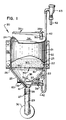
- FIGURE 1 A useful dispenser is shown in FIGURE 1.
- a dispenser having a container or housing 20.
- the housing has a generally cylindrical upper storage portion 21 having a cylindrical inner wall 22.
- the wall 22 defines an internal cavity 23.
- the upper terminous of the storage portion 21 defines an access port 24 into cavity 23 of storage portion 21.
- Inner wall 22 of housing 20 converges in the downward direction, defining a lower funnel-shaped collector portion 25 of housing 20.
- Inner wall 22 of housing 20 is configured to form an annular flange at 26 circumferentially extending around inner wall 22 of housing 20 at the juncture of upper storage portion 21 and lower collector portion 25.
- the lower terminous of collector portion 25 defines an outlet port 27 from internal cavity 23 for passage therethrough of solution collected by collector portion 25.
- Outlet pore 27 has a hose clamp extension 28 having a plurality of annular ribs configured for engaging the inner walls of a connecting hose or conduit 29.
- the outlet port 27 may be directly connected with the wash chemical solution utilization point by conduit 29 and feed thereto by gravity as it is created or feed thereto by a wash chemical solution pump 30 placed in conduit 29.
- Housing 20 may be constructed of any suitable material which is capable of withstanding exposure to cleaning solutions, and is preferably configured of stainless steel or molded plastic material.
- the housing 20 can be constructed of a transparent or translucent material to allow the operator to see at a glance the amount of wash chemical in storage portion 21 and if dispenser 20 needs to be refilled. If housing 20 is not made of a transparent or translucent material, preferably a portion of storage portion 21 is made transparent or translucent to aid in determining when dispenser 20 should be refilled.
- a pair of mounting plates 32 are connected to and extend rearwardly from the outer surface of housing 20 for securely mounting housing 20 to a vertical side wall.
- a door 34 is sized to extend entirely across and to sealingly close access port 24. Door 34 is pivotally mounted at 35 for pivotal motion between a closed and opened position.
- the lower collector portion 25 of housing 20 has an outwardly projecting coupling portion 36 extending from collector portion 25 adjacent outlet port 27 of collector portion 25.
- a tube fitting insert 37 is secured within coupling projection 36 and projects through inner wall 22 of collector portion 25 of housing 20.
- a spray-forming nozzle 38 is threaded into the end of tube insert 37 and is axially aligned within inner cavity 23 of housing 20 in a direction so as to direct an upwardly projected spray pattern therefrom.
- Tube fitting insert 37 is provided with an O-ring seal 39.
- a horizontal support screen 40 is mounted in resting engagement upon annular flanged portion 26 of housing 20.
- Support screen 40 has 6.45 cm2 ( 1 inch square) openings in order to support a solid block of detersive system 80 without significantly interfering with the impingement of water sprayed from nozzle 38 onto the lower surface of water sprayed from nozzle 38 onto the lower surface 81 of the detersive system 80 (i.e., the surface in contact with support screen 40).
- a 1/4 to 1/20 inch (0.63 to 0.13 cm) lower screen 41 is placed in collector portion 25 of housing 20 between spray nozzle 38 and outlet port 27 to catch any undissolved chunks of wash chemical 80 small enough to pass through support screen 40. This prevents small chunks of chemical 80 collecting in outlet port 27 or conduit 29 and blocking the flow of concentrated wash chemical solution out of dispenser 20.
- a water supply inlet pipe 42 is connected to tube insert 37 and is in communication therewith for providing a source of water flow to spray-forming nozzle 38.
- Water supply line 42 passes through one of the mounting plate members 32 and receives structural support therefrom.
- a siphon breaker 43 interrupts water supply line 42.
- a safety switch 50 is mounted to door 34 for movement therewith and senses the operative position of door 34 relative to access port 24 of housing 20.
- safety switch 50 comprises a mercury actuated switch.
- FIGURES 2 and 3 represent an embodiment of the product format for the cast detersive systems of the invention.
- the solid Cast detersive system of the invention is packaged in a closable container 200 which corprises a lid 210 and a lower container section 211.
- the lid 210 can be made of a variety of materials including paper, film, foil, etc.
- the lower container can also be mace of a variety of materials, however thermoplastic deformable material is preferred.
- the lid 210 is adhered to the container 211 through a releasable layer 212 disposed between the lid and the container.
- FIGURE 3 shows a side view of the cast detersive system within its container.
- lid 210 is peeled from the top of the lower portion revealing the upper surface of the cast material 80.
- the container as a whole without the lid can be inserted into the dispenser.
- the container body 211 if made of a deformable material can be flexed for the purpose of removing the cast material 80 in a solid block which can then directly be inserted into the dispenser for contact with a water stream.
Landscapes
- Chemical & Material Sciences (AREA)
- Life Sciences & Earth Sciences (AREA)
- Engineering & Computer Science (AREA)
- Chemical Kinetics & Catalysis (AREA)
- Oil, Petroleum & Natural Gas (AREA)
- Wood Science & Technology (AREA)
- Organic Chemistry (AREA)
- Detergent Compositions (AREA)
- Organic Low-Molecular-Weight Compounds And Preparation Thereof (AREA)
- Confectionery (AREA)
Claims (44)
- Festes, gegossenes, aktives Halogen enthaltendes, lagerstabiles Detergentiensystem, das folgende Bestandteile umfaßt:(a) eine wirkungsvolle, reinigende Menge einer Alkalitätsquelle;(b) eine wirkungsvolle Menge eines Härtemaskierungsmittels;(c) 5 bis 60 Gew.-% einer eingekapselten Quelle aktiven Halogens; und(d) 20 bis 50 Gew.-% eines Polyalkylenoxidpolymers.
- Detergentiensystem nach Anspruch 1, worin es sich bei dem Halogen um Chlor handelt.
- Detergentiensystem nach Anspruch 2, worin der Gehalt an eingekapselter Quelle aktiven Chlors 15 bis 60 Gew.-% beträgt.
- Detergentiensystem nach Anspruch 2, worin der Gehalt an eingekapselter Quelle aktiven Chlors 15 bis 50 Gew.-% beträgt.
- Detergentiensystem nach Anspruch 2, worin der Gehalt der Quelle eingekapselten aktiven Chlors 20 bis 35 Gew.-% beträgt.
- Detergentiensystem nach Anspruch 2, worin das eingekapselte Material 1 bis 80 Gew.-% einer Quelle aktiven Chlors und 99 bis 20 Gew.-% einer Einkapselungsschicht umfaßt.
- Detergentiensystem nach Anspruch 6, worin die eingekapselte Schicht ein synthetisches anionisches oberflächenaktives Mittel umfaßt.
- Detergentiensystem nach Anspruch 6, worin die Einkapselungsschicht 10 bis 90 Gew.-% einer ersten anorganischen Schicht und 90 bis 10 Gew.-% einer zweiten Schicht unfaßt.
- Detergentiensystem nach Anspruch 8, worin die organische Einkapselungsschicht eine Celluloseschicht, ein synthetisches, anionisches oberflächenaktives Mittel oder Mischungen daraus umfaßt.
- Detergentiensystem nach Anspruch 9, worin die Celluloseschicht Methylcellulose, eine Hydroxylalkylcellulose oder Mischungen daraus umfaßt.
- Detergentiensystem nach Anspruch 2, worin die Quelle aktiven Chlors aus der Gruppe ausgewählt ist, die aus Trichlorisocyanursäure, Kaliumdichlorisocyanurat, Natriumdichlorisocyanurat, Natriumdichlorisocyanuratdihydrat und Mischungen daraus besteht.
- Detergentiensystem nach Anspruch 1, worin die Polyalkylenoxidpolymerzusammensetzung ein Polyethylenoxidpolymer, ein Polypropylenoxidpolymer oder ein Ethylenoxid/Propylenoxid-Blockcopolymer umfaßt.
- Detergentiensystem nach Anspruch 12, worin das Alkylenoxidpolymer ein nichtionisches oberflächenaktives Mittel umfaßt.
- Detergentiensystem nach Anspruch 13, worin das nichtionische oberflächenaktive Mittel ein Blockcopolymer umfaßt, das mindestens einen Ethylenoxidblock und mindestens einen Propylenoxidblock enthält.
- Detergentiensystem nach Anspruch 14, worin das nichtionische oberflächenaktive Mittel ein Alkylphenolalkoxylat umfaßt, bei dem die Alkylgruppe ein C₁₋₁₂-Alkyl ist und das Alkoxylat 2 bis 24 Mole Ethylenoxid umfaßt.
- Detergentiensystem nach Anspruch 1, worin das Härtemaskierungsmittel ein organisches Härtemaskierungsmittel oder ein anorganisches Härtemaskierungsmittel umfaßt.
- Detergentiensystem nach Anspruch 16, worin das organische Härtemaskierungsmittel eine Polyacrylsäure, ein organisches Phosphonat oder Mischungen daraus umfaßt.
- Detergentiensystem nach Anspruch 16, worin das anorganische Härtemaskierungsmittel ein kondensiertes Phosphathärtemaskierungsmittel umfaßt.
- Detergentiensystem nach Anspruch 18, worin das kondensierte Phosphat ein Alkalimetalltripolyphosphat-Maskierungsmittel umfaßt.
- Detergentiensystem nach Anspruch 1, worin die Alkalitätsquelle ein Alkalimetallhydroxid oder ein Alkalimetallsilikat mit einem M₂O:SiO₂-Verhältnis von ca. 2:1 bis 1:3,6 umfaßt, worin M ein Alkalimetall ist.
- Detergentiensystem nach Anspruch 1, worin die Alkalitätsquelle ein Alkalimetallcarbonat, ein Alkalimetallbicarbonat, ein Alkalimetallborat und Mischungen daraus umfaßt.
- Detergentiensystem nach Anspruch 1, das zusätzlich ein anionisches oberflächenaktives Mittel umfaßt.
- Detergentiensystem nach Anspruch 22, worin das anionische oberflächenaktive Mittel ein Alkylsulfonat, ein Alkylsulfat, ein Alkylbenzolsulfonat, ein Alkylbenzolsulfat oder Mischungen daraus umfaßt.
- Festes, gegossenes, stabiles, chlorhaltiges Wäschedetergens, das folgende Bestandteile umfaßt:(a) 0,1 bis 50 Gew.-% eines schmutzentfernenden nichtionischen oberflächenaktiven Mittels;(b) 0,1 bis 95 Gew.-% einer Alkalitätsquelle;(c) eine wirkungsvolle Menge eines Härtemaskierungsmittels;(d) 5 bis 60 Gew.-% einer eingekapselten chlorierten Isocyanuratverbindung; und(e) 20 bis 50 Gew.-% eines Polyalkylenglykolgießmittels.
- Detergens nach Anspruch 24, worin der Gehalt an eingekapselter Quelle aktiven Chlors 15 bis 30 Gew.-% beträgt.
- Detergens nach Anspruch 24, worin der Gehalt der Quelle eingekapselten aktiven Chlors 20 bis 25 Gew.-% beträgt.
- Detergens nach Anspruch 24, worin das eingekapselte Material 1 bis 80 Gew.-% einer Quelle aktiven Chlors und 99 bis 20 Gew.-% einer Einkapselungsschicht umfaßt.
- Detergens nach Anspruch 27, worin die Einkapselungsschicht ein synthetisches, anionisches oberflächenaktives Mittel umfaßt.
- Detergens nach Anspruch 27, worin die Einkapselungsschicht 10 bis 90 Gew.-% einer ersten anorganischen Schicht und 90 bis 10 Gew.-% einer zweiten Schicht umfaßt.
- Detergens nach Anspruch 29, worin die organische Einkapselungsschicht eine Celluloseschicht, ein synthetisches anionisches oberflächenaktives Mittel oder Mischungen daraus umfaßt.
- Detergens nach Anspruch 30, worin die Celluloseschicht Methylcellulose, eine Hydroxyalkylcellulose oder Mischungen daraus umfaßt.
- Wäschedetergens nach Anspruch 24, worin das Detergens zusätzlich eine wirkungsvolle Menge eines Mittels zur Verhinderung einer Wiederablagerung von Schmutz umfaßt.
- Detergens nach Anspruch 32, worin das Mittel zur Verhinderung einer Schmutzwiederablagerung eine Carboxymethylcellulosezusammensetzung umfaßt.
- Detergens nach Anspruch 24, worin das Detergens zusätzlich einen Farbstoff, einen Duftstoff, ein Mittel zur Verhinderung der Schmutzwiederablagerung, einen Weißmacher oder Mischungen daraus umfaßt.
- Detergens nach Anspruch 24, worin die chlorierte Isocyanuratverbindung aus der Gruppe ausgewählt ist, die aus Trichlorisocyanursäure, Kaliumdichlorisocyanurat, Natriumdichlorisocyanurat, Natriumdichlorisocyanuratdihydrat und Mischungen daraus besteht.
- Detergens nach Anspruch 35, worin das nichtionische oberflächenaktive Mittel ein Blockcopolymer umfaßt, das mindestens einen Ethylenoxidblock und mindestens einen Propylenoxidblock umfaßt.
- Detergens nach Anspruch 36, worin das nichtionische oberflächenaktive Mittel ein Alkylphenolalkoxylat umfaßt, worin die Alkylgruppe ein C₁₋₁₂-Alkyl ist und das Alkoxylat 2 bis 24 Mole Ethylenoxid umfaßt.
- Detergens nach Anspruch 24, worin das Härtemaskierungsmittel ein organisches Härtemaskierungsmittel oder ein anorganisches Härtemaskierungsmittel umfaßt.
- Detergens nach Anspruch 38, worin das organische Härtemaskierungsmittel eine Polyacrylsäure, ein organisches Phosphonat oder Mischungen daraus umfaßt.
- Detergens nach Anspruch 38, worin das anorganische Härtemaskierungsmittel ein kondensiertes Phosphat-Härtemaskierungsmittel umfaßt.
- Detergens nach Anspruch 40, worin das kondensierte Phosphat ein Alkalimetalltripolyphosphat-Maskierungsmittel umfaßt.
- Detergens nach Anspruch 24, worin die Alkalitätsquelle ein Alkalimetallhydroxid oder ein Alkalimetallsilikat mit einem M₂O:SiO₂-Verhältnis von ca. 2:1 bis 1:3,6 umfaßt, worin M ein Alkalimetall ist.
- Detergens nach Anspruch 24, das zusätzlich ein anionisches oberflächenaktives Mittel umfaßt.
- Detergens nach Anspruch 24, das zusätzlich einen quaternären Gewebeweichmacher umfaßt.
Priority Applications (1)
| Application Number | Priority Date | Filing Date | Title |
|---|---|---|---|
| AT89909286T ATE97158T1 (de) | 1989-03-31 | 1989-08-01 | Gegossene detergentiensysteme. |
Applications Claiming Priority (2)
| Application Number | Priority Date | Filing Date | Title |
|---|---|---|---|
| US331695 | 1981-12-17 | ||
| US33169589A | 1989-03-31 | 1989-03-31 |
Publications (2)
| Publication Number | Publication Date |
|---|---|
| EP0465461A1 EP0465461A1 (de) | 1992-01-15 |
| EP0465461B1 true EP0465461B1 (de) | 1993-11-10 |
Family
ID=23294981
Family Applications (1)
| Application Number | Title | Priority Date | Filing Date |
|---|---|---|---|
| EP19890909286 Expired - Lifetime EP0465461B1 (de) | 1989-03-31 | 1989-08-01 | Gegossene detergentiensysteme |
Country Status (8)
| Country | Link |
|---|---|
| EP (1) | EP0465461B1 (de) |
| JP (1) | JP2557991B2 (de) |
| AU (2) | AU4051289A (de) |
| CA (1) | CA1329102C (de) |
| DE (1) | DE68910701T2 (de) |
| MX (1) | MX170438B (de) |
| NZ (1) | NZ230421A (de) |
| WO (1) | WO1990012081A1 (de) |
Families Citing this family (9)
| Publication number | Priority date | Publication date | Assignee | Title |
|---|---|---|---|---|
| US5397506A (en) * | 1993-08-20 | 1995-03-14 | Ecolab Inc. | Solid cleaner |
| US5474698A (en) * | 1993-12-30 | 1995-12-12 | Ecolab Inc. | Urea-based solid alkaline cleaning composition |
| CA2188256A1 (en) * | 1994-06-14 | 1995-12-21 | Steven E. Lentsch | Improved performance cast detergent |
| JP6468734B2 (ja) * | 2013-12-27 | 2019-02-13 | 株式会社ニイタカ | カートリッジ洗浄剤 |
| JP5801941B1 (ja) * | 2014-11-21 | 2015-10-28 | 株式会社ニイタカ | 洗浄剤組成物、食器洗浄方法、液体洗浄剤組成物用キット及びカートリッジ洗浄剤 |
| JP6462028B2 (ja) * | 2016-03-31 | 2019-01-30 | 株式会社Adeka | 溶融固形型洗浄剤組成物 |
| US11078450B2 (en) * | 2016-04-22 | 2021-08-03 | Shikoku Chemicals Corporation | Material containing solid bleaching agent, and detergent composition |
| JP7252601B2 (ja) * | 2019-02-08 | 2023-04-05 | 株式会社ニイタカ | 固形洗浄剤組成物、カートリッジ洗浄剤、洗浄方法、及び、微生物の除菌方法又は菌叢凝塊の除去方法 |
| JP7420873B1 (ja) * | 2022-07-04 | 2024-01-23 | ユシロ化学工業株式会社 | 洗濯槽用洗剤、及び洗濯槽の洗浄方法 |
Family Cites Families (6)
| Publication number | Priority date | Publication date | Assignee | Title |
|---|---|---|---|---|
| US3637509A (en) * | 1970-02-10 | 1972-01-25 | Grace W R & Co | Chlorinated machine dishwashing composition and process |
| US4078099A (en) * | 1976-08-25 | 1978-03-07 | Lever Brothers Company | Encapsulated bleaches and methods for their preparation |
| DE2963759D1 (en) * | 1978-02-07 | 1982-11-11 | Economics Lab | Cast detergent-containing article and method of making and using |
| DE3634812A1 (de) * | 1986-10-13 | 1988-04-14 | Henkel Kgaa | Verfahren zur herstellung schmelzblockfoermiger, alkalihydroxid- und gegebenenfalls auch aktivchlorhaltiger mittel fuer das maschinelle reinigen von geschirr |
| US4830773A (en) * | 1987-07-10 | 1989-05-16 | Ecolab Inc. | Encapsulated bleaches |
| AU605573B2 (en) * | 1987-08-12 | 1991-01-17 | Ecolab Inc. | Solid cast warewashing composition |
-
1989
- 1989-08-01 EP EP19890909286 patent/EP0465461B1/de not_active Expired - Lifetime
- 1989-08-01 AU AU40512/89A patent/AU4051289A/en not_active Abandoned
- 1989-08-01 WO PCT/US1989/003313 patent/WO1990012081A1/en not_active Ceased
- 1989-08-01 JP JP1508658A patent/JP2557991B2/ja not_active Expired - Lifetime
- 1989-08-01 DE DE68910701T patent/DE68910701T2/de not_active Expired - Fee Related
- 1989-08-09 CA CA 607911 patent/CA1329102C/en not_active Expired - Lifetime
- 1989-08-21 MX MX1726589A patent/MX170438B/es unknown
- 1989-08-24 NZ NZ23042189A patent/NZ230421A/xx unknown
-
1994
- 1994-02-07 AU AU54966/94A patent/AU657239B2/en not_active Ceased
Also Published As
| Publication number | Publication date |
|---|---|
| DE68910701D1 (de) | 1993-12-16 |
| EP0465461A1 (de) | 1992-01-15 |
| JP2557991B2 (ja) | 1996-11-27 |
| WO1990012081A1 (en) | 1990-10-18 |
| AU5496694A (en) | 1994-04-14 |
| MX170438B (es) | 1993-08-23 |
| AU4051289A (en) | 1990-11-05 |
| CA1329102C (en) | 1994-05-03 |
| JPH04504271A (ja) | 1992-07-30 |
| AU657239B2 (en) | 1995-03-02 |
| NZ230421A (en) | 1991-09-25 |
| DE68910701T2 (de) | 1994-06-01 |
Similar Documents
| Publication | Publication Date | Title |
|---|---|---|
| US5078301A (en) | Article comprising a water soluble bag containing a multiple use amount of a pelletized functional material and methods of its use | |
| US5358653A (en) | Chlorinated solid rinse aid | |
| US4931203A (en) | Method for making an automatic dishwashing detergent powder by spraying drying and post-adding nonionic detergent | |
| US5384364A (en) | Stabilized detersive-system containing water soluble film article | |
| EP0203239B1 (de) | Eingekapselte Halogen-Bleichmittel | |
| US5670473A (en) | Solid cleaning compositions based on hydrated salts | |
| US5316688A (en) | Water soluble or dispersible film covered alkaline composition | |
| USRE32818E (en) | Cast detergent-containing article and method of using | |
| US4569781A (en) | Cast detergent-containing article and method of using | |
| US5213705A (en) | Encapsulated halogen bleaches and methods of preparation and use | |
| EP0314890B9 (de) | Verfahren zur Abgabe eines granulierten funktionellen Stoffes aus einem wasserlöslichen Behälter | |
| EP0686189A1 (de) | Geformter festkörper enthaltend oxidationsbleichmittel mit eingekapselter bleichmittelquelle | |
| EP0465461B1 (de) | Gegossene detergentiensysteme | |
| EP0002293A1 (de) | Reinigungsmittel in Tablettenform mit einer Umhüllung aus hydratisiertem Salz und Verfahren zur Herstellung der Tablette | |
| US6365568B1 (en) | Process for manufacturing solid cast silicate-based detergent compositions and resultant product | |
| US6162777A (en) | Automatic dishwashing tablets | |
| NZ228002A (en) | Automatic dishwashing detergent powder containing alkali silicate | |
| CA1316788C (en) | Automatic dishwashing detergent powder |
Legal Events
| Date | Code | Title | Description |
|---|---|---|---|
| PUAI | Public reference made under article 153(3) epc to a published international application that has entered the european phase |
Free format text: ORIGINAL CODE: 0009012 |
|
| 17P | Request for examination filed |
Effective date: 19910917 |
|
| AK | Designated contracting states |
Kind code of ref document: A1 Designated state(s): AT BE CH DE FR GB IT LI NL SE |
|
| D17Q | First examination report despatched (deleted) | ||
| GRAA | (expected) grant |
Free format text: ORIGINAL CODE: 0009210 |
|
| AK | Designated contracting states |
Kind code of ref document: B1 Designated state(s): AT BE CH DE FR GB IT LI NL SE |
|
| PG25 | Lapsed in a contracting state [announced via postgrant information from national office to epo] |
Ref country code: AT Effective date: 19931110 |
|
| REF | Corresponds to: |
Ref document number: 97158 Country of ref document: AT Date of ref document: 19931115 Kind code of ref document: T |
|
| ITF | It: translation for a ep patent filed | ||
| REF | Corresponds to: |
Ref document number: 68910701 Country of ref document: DE Date of ref document: 19931216 |
|
| ET | Fr: translation filed | ||
| PLBE | No opposition filed within time limit |
Free format text: ORIGINAL CODE: 0009261 |
|
| STAA | Information on the status of an ep patent application or granted ep patent |
Free format text: STATUS: NO OPPOSITION FILED WITHIN TIME LIMIT |
|
| 26N | No opposition filed | ||
| EAL | Se: european patent in force in sweden |
Ref document number: 89909286.0 |
|
| PGFP | Annual fee paid to national office [announced via postgrant information from national office to epo] |
Ref country code: SE Payment date: 19950713 Year of fee payment: 7 Ref country code: CH Payment date: 19950713 Year of fee payment: 7 |
|
| PGFP | Annual fee paid to national office [announced via postgrant information from national office to epo] |
Ref country code: FR Payment date: 19950717 Year of fee payment: 7 |
|
| PGFP | Annual fee paid to national office [announced via postgrant information from national office to epo] |
Ref country code: NL Payment date: 19950719 Year of fee payment: 7 |
|
| PGFP | Annual fee paid to national office [announced via postgrant information from national office to epo] |
Ref country code: DE Payment date: 19950725 Year of fee payment: 7 |
|
| PGFP | Annual fee paid to national office [announced via postgrant information from national office to epo] |
Ref country code: GB Payment date: 19950727 Year of fee payment: 7 |
|
| PGFP | Annual fee paid to national office [announced via postgrant information from national office to epo] |
Ref country code: BE Payment date: 19950731 Year of fee payment: 7 |
|
| PG25 | Lapsed in a contracting state [announced via postgrant information from national office to epo] |
Ref country code: GB Effective date: 19960801 |
|
| PG25 | Lapsed in a contracting state [announced via postgrant information from national office to epo] |
Ref country code: SE Effective date: 19960802 |
|
| PG25 | Lapsed in a contracting state [announced via postgrant information from national office to epo] |
Ref country code: LI Effective date: 19960831 Ref country code: CH Effective date: 19960831 Ref country code: BE Effective date: 19960831 |
|
| BERE | Be: lapsed |
Owner name: ECOLAB INC. Effective date: 19960831 |
|
| PG25 | Lapsed in a contracting state [announced via postgrant information from national office to epo] |
Ref country code: NL Effective date: 19970301 |
|
| GBPC | Gb: european patent ceased through non-payment of renewal fee |
Effective date: 19960801 |
|
| REG | Reference to a national code |
Ref country code: CH Ref legal event code: PL |
|
| PG25 | Lapsed in a contracting state [announced via postgrant information from national office to epo] |
Ref country code: FR Effective date: 19970430 |
|
| NLV4 | Nl: lapsed or anulled due to non-payment of the annual fee |
Effective date: 19970301 |
|
| PG25 | Lapsed in a contracting state [announced via postgrant information from national office to epo] |
Ref country code: DE Effective date: 19970501 |
|
| EUG | Se: european patent has lapsed |
Ref document number: 89909286.0 |
|
| REG | Reference to a national code |
Ref country code: FR Ref legal event code: ST |
|
| PG25 | Lapsed in a contracting state [announced via postgrant information from national office to epo] |
Ref country code: IT Free format text: LAPSE BECAUSE OF NON-PAYMENT OF DUE FEES;WARNING: LAPSES OF ITALIAN PATENTS WITH EFFECTIVE DATE BEFORE 2007 MAY HAVE OCCURRED AT ANY TIME BEFORE 2007. THE CORRECT EFFECTIVE DATE MAY BE DIFFERENT FROM THE ONE RECORDED. Effective date: 20050801 |