EP0458528B1 - Datenspeicherungsvorrichtung mit Dampfdrucksteuersystem - Google Patents
Datenspeicherungsvorrichtung mit Dampfdrucksteuersystem Download PDFInfo
- Publication number
- EP0458528B1 EP0458528B1 EP91304421A EP91304421A EP0458528B1 EP 0458528 B1 EP0458528 B1 EP 0458528B1 EP 91304421 A EP91304421 A EP 91304421A EP 91304421 A EP91304421 A EP 91304421A EP 0458528 B1 EP0458528 B1 EP 0458528B1
- Authority
- EP
- European Patent Office
- Prior art keywords
- vapour
- enclosure
- drain
- atmosphere
- lubricant
- Prior art date
- Legal status (The legal status is an assumption and is not a legal conclusion. Google has not performed a legal analysis and makes no representation as to the accuracy of the status listed.)
- Expired - Lifetime
Links
- 238000013500 data storage Methods 0.000 title claims description 10
- 239000000314 lubricant Substances 0.000 claims description 81
- OKTJSMMVPCPJKN-UHFFFAOYSA-N Carbon Chemical compound [C] OKTJSMMVPCPJKN-UHFFFAOYSA-N 0.000 claims description 16
- 239000000463 material Substances 0.000 claims description 13
- 238000001179 sorption measurement Methods 0.000 claims description 7
- 238000010521 absorption reaction Methods 0.000 claims description 3
- VYPSYNLAJGMNEJ-UHFFFAOYSA-N Silicium dioxide Chemical compound O=[Si]=O VYPSYNLAJGMNEJ-UHFFFAOYSA-N 0.000 claims description 2
- PNEYBMLMFCGWSK-UHFFFAOYSA-N aluminium oxide Inorganic materials [O-2].[O-2].[O-2].[Al+3].[Al+3] PNEYBMLMFCGWSK-UHFFFAOYSA-N 0.000 claims description 2
- HNPSIPDUKPIQMN-UHFFFAOYSA-N dioxosilane;oxo(oxoalumanyloxy)alumane Chemical compound O=[Si]=O.O=[Al]O[Al]=O HNPSIPDUKPIQMN-UHFFFAOYSA-N 0.000 claims description 2
- 230000002427 irreversible effect Effects 0.000 claims description 2
- 239000000741 silica gel Substances 0.000 claims description 2
- 229910002027 silica gel Inorganic materials 0.000 claims description 2
- 238000003860 storage Methods 0.000 claims description 2
- 229910021536 Zeolite Inorganic materials 0.000 claims 1
- 238000006243 chemical reaction Methods 0.000 claims 1
- 239000010457 zeolite Substances 0.000 claims 1
- 238000011109 contamination Methods 0.000 description 26
- 239000000356 contaminant Substances 0.000 description 22
- 239000000126 substance Substances 0.000 description 17
- 229920006395 saturated elastomer Polymers 0.000 description 15
- 239000010408 film Substances 0.000 description 14
- 238000005461 lubrication Methods 0.000 description 13
- 230000015654 memory Effects 0.000 description 10
- 239000003990 capacitor Substances 0.000 description 8
- 150000001875 compounds Chemical class 0.000 description 6
- 230000006870 function Effects 0.000 description 6
- 238000000034 method Methods 0.000 description 6
- 239000000203 mixture Substances 0.000 description 6
- 239000006096 absorbing agent Substances 0.000 description 5
- 238000009792 diffusion process Methods 0.000 description 5
- 239000010410 layer Substances 0.000 description 5
- 238000010943 off-gassing Methods 0.000 description 5
- 229920002799 BoPET Polymers 0.000 description 4
- 238000013098 chemical test method Methods 0.000 description 4
- 238000013461 design Methods 0.000 description 4
- 230000008569 process Effects 0.000 description 4
- 230000000717 retained effect Effects 0.000 description 4
- 239000010409 thin film Substances 0.000 description 4
- 238000013459 approach Methods 0.000 description 3
- 230000001419 dependent effect Effects 0.000 description 3
- 238000004519 manufacturing process Methods 0.000 description 3
- 239000002052 molecular layer Substances 0.000 description 3
- 239000000853 adhesive Substances 0.000 description 2
- 230000001070 adhesive effect Effects 0.000 description 2
- 229910052799 carbon Inorganic materials 0.000 description 2
- 238000000576 coating method Methods 0.000 description 2
- 239000002131 composite material Substances 0.000 description 2
- 230000001186 cumulative effect Effects 0.000 description 2
- 238000001914 filtration Methods 0.000 description 2
- 230000000670 limiting effect Effects 0.000 description 2
- 238000012423 maintenance Methods 0.000 description 2
- 230000007246 mechanism Effects 0.000 description 2
- 230000003287 optical effect Effects 0.000 description 2
- 230000036961 partial effect Effects 0.000 description 2
- 239000004033 plastic Substances 0.000 description 2
- 229920003023 plastic Polymers 0.000 description 2
- 230000003134 recirculating effect Effects 0.000 description 2
- 230000002829 reductive effect Effects 0.000 description 2
- 230000002441 reversible effect Effects 0.000 description 2
- 230000005641 tunneling Effects 0.000 description 2
- 239000005041 Mylar™ Substances 0.000 description 1
- 238000002872 Statistical quality control Methods 0.000 description 1
- 238000009825 accumulation Methods 0.000 description 1
- 239000011248 coating agent Substances 0.000 description 1
- 239000004020 conductor Substances 0.000 description 1
- 230000001276 controlling effect Effects 0.000 description 1
- 230000008021 deposition Effects 0.000 description 1
- 238000010586 diagram Methods 0.000 description 1
- 230000003292 diminished effect Effects 0.000 description 1
- 230000000694 effects Effects 0.000 description 1
- 230000008030 elimination Effects 0.000 description 1
- 238000003379 elimination reaction Methods 0.000 description 1
- 238000000605 extraction Methods 0.000 description 1
- 230000010354 integration Effects 0.000 description 1
- 239000010687 lubricating oil Substances 0.000 description 1
- 238000012986 modification Methods 0.000 description 1
- 230000004048 modification Effects 0.000 description 1
- 238000012544 monitoring process Methods 0.000 description 1
- 239000002245 particle Substances 0.000 description 1
- 239000011236 particulate material Substances 0.000 description 1
- 239000004014 plasticizer Substances 0.000 description 1
- 239000004417 polycarbonate Substances 0.000 description 1
- 229920000515 polycarbonate Polymers 0.000 description 1
- 230000002062 proliferating effect Effects 0.000 description 1
- 230000001105 regulatory effect Effects 0.000 description 1
- 238000005070 sampling Methods 0.000 description 1
- 230000002000 scavenging effect Effects 0.000 description 1
- 229920002545 silicone oil Polymers 0.000 description 1
- 239000002356 single layer Substances 0.000 description 1
- 239000002904 solvent Substances 0.000 description 1
- 238000009987 spinning Methods 0.000 description 1
- 238000003892 spreading Methods 0.000 description 1
- 230000007480 spreading Effects 0.000 description 1
- 239000000725 suspension Substances 0.000 description 1
- 238000012546 transfer Methods 0.000 description 1
- 230000001052 transient effect Effects 0.000 description 1
- XLYOFNOQVPJJNP-UHFFFAOYSA-N water Substances O XLYOFNOQVPJJNP-UHFFFAOYSA-N 0.000 description 1
- 238000003466 welding Methods 0.000 description 1
Images


Classifications
-
- G—PHYSICS
- G11—INFORMATION STORAGE
- G11B—INFORMATION STORAGE BASED ON RELATIVE MOVEMENT BETWEEN RECORD CARRIER AND TRANSDUCER
- G11B33/00—Constructional parts, details or accessories not provided for in the other groups of this subclass
- G11B33/14—Reducing influence of physical parameters, e.g. temperature change, moisture, dust
- G11B33/1446—Reducing contamination, e.g. by dust, debris
- G11B33/1453—Reducing contamination, e.g. by dust, debris by moisture
-
- G—PHYSICS
- G11—INFORMATION STORAGE
- G11B—INFORMATION STORAGE BASED ON RELATIVE MOVEMENT BETWEEN RECORD CARRIER AND TRANSDUCER
- G11B25/00—Apparatus characterised by the shape of record carrier employed but not specific to the method of recording or reproducing, e.g. dictating apparatus; Combinations of such apparatus
- G11B25/04—Apparatus characterised by the shape of record carrier employed but not specific to the method of recording or reproducing, e.g. dictating apparatus; Combinations of such apparatus using flat record carriers, e.g. disc, card
- G11B25/043—Apparatus characterised by the shape of record carrier employed but not specific to the method of recording or reproducing, e.g. dictating apparatus; Combinations of such apparatus using flat record carriers, e.g. disc, card using rotating discs
-
- G—PHYSICS
- G11—INFORMATION STORAGE
- G11B—INFORMATION STORAGE BASED ON RELATIVE MOVEMENT BETWEEN RECORD CARRIER AND TRANSDUCER
- G11B33/00—Constructional parts, details or accessories not provided for in the other groups of this subclass
- G11B33/14—Reducing influence of physical parameters, e.g. temperature change, moisture, dust
- G11B33/1446—Reducing contamination, e.g. by dust, debris
Definitions
- This invention relates to data storage devices with vapour pressure control systems that regulate the vapour phase composition within an enclosure of said data storage device.
- a critical feature of rigid disk magnetic storage devices is the vulnerability to failure by the slider wearing into the magnetic layer on the disk surface. Magnetic performance improvements have been achieved by using thinner magnetic coatings (less than 100 nanometers thick), and lower flying heights (less than 250 nanometers). Both of these factors mean that the tribology of the system must be excellent if a useful life is to be achieved. A thin film of lubricant molecules is required as part of the tribological system to keep the coefficient of friction low when the slider lands or the disk, or intermittently hits it while flying.
- the magnetic medium was a magnetic ink that had significant thickness and porosity.
- a relatively large amount of lubricant could be accommodated by such a disk, so it was not as sensitive to monolayer quantities of adsorbed contaminants as present disks are.
- Present disks have an overcoat that is only 20 to 50 nanometers thick, and has very little porosity for storing lubricant.
- the disk lubricant is typically only one to several monomolecular layers thick. For a given disk design the lubricant thickness must be held to very close tolerances. If the lubricant gets too thin, the coefficient of friction goes up and wear-out occurs sooner. If the lubricant is too thick, the slider will become stuck to the disk in a process called stiction which can be strong enough to prevent the motor from starting up.
- a lubricant film may be chemically bonded to the disk surface, and a mobile lubricant film may or may not be added on top of it.
- a mobile film may be used alone through a one-time application of lubricant at time of manufacture.
- an equilibrium film thickness is maintained on the disk surface by replenishment through the vapour phase from a reservoir of lubricant within the device enclosure.
- the invention disclosed herein is designed to control this problem of lubricant film contamination from the vapour phase.
- the key variable to be controlled for each molecular species present in the atmosphere of the enclosure is its relative vapour density.
- the relative vapour density of any given compound at a given temperature is defined as the ratio of the mass of the compound present per unit volume of air to the mass of the compound that is present in a unit volume of air that is saturated with the compound at that temperature. This is analogous to the special case of water for which this variable is called relative humidity. It is important because the extent to which a molecular species infiltrates the lubricant film is a function of its relative vapour density at the disk surface.
- disk enclosures today are made to be substantially sealed, so the rate at which molecules evaporate from the components such as greases and plastics is greater than the rate at which they leak out of the enclosure. Therefore many of these compounds can be expected to have high relative vapour densities at the disks. In other words, the air is nearly saturated with them.
- the relative vapour density of the lubricant in the atmosphere is controlled by the temperature difference between the lubricant reservoir and the disk surfaces.
- the relative vapour density is deliberately maintained at 0.5 to 0.8 at the disks by the fact that the reservoir is positioned at a location that is 1 to 5 degrees Celsius cooler than the disks during operation. If the temperature difference is allowed to become too small, then the relative vapour density of the lubricant at the disks will get too close to one and the lubricant film will get too thick. If the reservoir gets too cold relative to the disks, then the lube film will get too thin.
- the spinning of the disks moves the air through the reservoir structure.
- a second embodiment of US patent 4,789,913 on which the preamble of claim 1 is based uses granular carbon particles as the lubricant source. These have a surface area that is many times greater than the surface area of the disk, thereby effectively regulating lubricant vapour pressure within the device enclosure.
- a typical file contains many parts that inadvertently act as reservoirs. Plasticizers from plastic parts, volatile components from greases, and contaminants such as fingerprints, are major sources. Many of these are in locations that are as warm as the disks, so depending on the rate at which they outgas, and the efficiency with which the airflow carries the molecules to the disks, a high relative vapour density may be established at the disks. This will lead to increased contamination of the lubricant film.
- SXM Scanning Tunneling Microscope
- the invention provides a data storage device including a substantially sealed enclosure, the atmosphere inside said enclosure containing one or more vapour components, said device including a system for controlling the vapour pressure of said vapour components comprising reservoir means for supplying a particular vapour component into said atmosphere; and characterised by vapour drain means for controlled irreversible withdrawal of vapour components from said atmosphere, said vapour drain means being adapted so as not to fully deplete said reservoir within a predetermined time period (typically the expected useful operational life of the device).
- the present invention is advantageous for any data storage device in which a head moves close to a smooth surface, and which is sensitive to vapours in its atmosphere.
- This includes magnetic disk memories, optical memories with near-field optics, memories or microscopes based on STM or AFM or related techniques.
- the rotary disk geometry can be generalized to include a rectangular X-Y geometry, or a tape geometry.
- the benefits of the present invention are exemplified in magnetic disk files, especially those with thin film disks, which are sensitive to molecules in the vapour phase that adsorb onto the disk and slider surfaces.
- the vapour drain provides a controlled vapour loss process, such as an activated carbon adsorber or a leak to the outside.
- the loss rate is controlled by the design of the convection, diffusion or vapour transport aerodynamics. For the case of a controlled leak, the size of the leak opening is also relevant.
- the cumulative loss is controlled by limiting the amount of adsorber or the duration of the leak.
- the vapour drain can be designed to accomplish the following functions: trap outgassed contamination, reduce or control lube relative vapour density in an operating file, reduce or control lube vapour partial pressure in a dormant file and sample the vapour for chemical extraction and analysis.
- Thin film magnetic disk files are sensitive to interior vapours. These can cause thin deposits and 'stiction' failure when the file tries to start, the head and disk stick together so that the motor cannot turn.
- stiction failure caused by outgassed organic contamination emitted by file components.
- stiction failure caused by excessive relative vapour density of lubricant in a file with a vapour lubricant reservoir.
- Vapor drain is a deliberate controlled loss mechanism to remove some vapour components from the file atmosphere. This removal may use adsorption, absorption, outward leakage or other processes.
- a file typically has components which steadily emit contamination vapours (or possibly these are brought in with outside air).
- a vapour drain will steadily remove these contamination vapours.
- Non-equilibrium dynamics will determine the density of contamination vapour in the file atmosphere, and in some cases it will reach a steady state. This steady-state atmosphere is very low in undesired contaminant molecules, thereby greatly suppressing the population of contaminant molecules adsorbed onto the disk surfaces.
- a suitable vapour drain will greatly reduce the contamination vapour density, often by more than a factor of 10, depending on the contamination source and its ability to treat the atmosphere.
- the drain rate is typically controlled by convection aerodynamics. Thus typically vapour loss counterbalances vapour gain, causing a steady state with reduced vapour density. Cumulative drain amount is typically controlled by the adsorber mass or leak duration.
- a vapour drain can trap outgassed contamination, control relative density of lubricant vapour, or sample vapour for chemical analysis. The vapour drain irreversibly removes vapour from the atmosphere inside the enclosure, although it can be released later to provide a sample for analysis.
- Some files replenish the organic lubricant used to coat the disks by vapour transport from a lubricant reservoir.
- the lubricant reservoir supplies molecules of lubricant into the atmosphere.
- a vapour drain will steadily remove the lubricant molecules from the air as well as contamination.
- Non-equilibrium dynamics will determine the density of lubricant vapour in the file atmosphere, and if the disk drive runs long enough under constant conditions it will reach a steady state, which is often largely independent of temperature.
- a suitable vapour drain will make this lubricant relative vapour density significantly smaller than the relative vapour density in air saturated with the lubricant. For example, this can readily produce 50% of saturation density.
- the total loss of lubricant to the drain is arranged so that no more than a predetermined proportion of the lubricant within the reservoir is exhausted over the operational life of the disk file.
- vapour drain can greatly reduce the concentration of outgassed vapours, and simultaneously only moderately reduce the concentration of lubricant vapours.
- vapour drain should also accommodate the requirement for a variable rate of entrapment or diffusion over the life of the disk drive. This is independent of the lubrication system, which may use vapour replenishment or use a bonded lubricant.
- vapour drain adsorber accumulates a chemical sample of the vapours in the atmosphere of the head-disk enclosure. Subsequently this sample can be chemically analyzed. As will be shown, this can be accomplished without exposing the head-disk enclosure to the introduction of unfiltered air.
- a filter is used as the vapour drain then this will normally comprise some particulate material such as activated carbon.
- the filter is placed such that the atmosphere in the disk file flows either through it or past it, whichever is appropriate for the filter in question. Typically the rotation of the disks would be responsible for the atmospheric flow, although other means might be used.
- the vapour drain permits steady state control of the composition of the atmosphere within a substantially sealed enclosure.
- any fabricated enclosure there will be sources of vapour phase molecules: molecules evapourating from a deliberately installed reservoir, molecules outgassed from components, and molecules diffusing in from the outside world.
- the purpose of the vapour drain is to minimize the second two classes of molecules in the composition of the enclosure atmosphere because they are generally considered to be contaminants.
- An example application is a rigid disk magnetic data storage device which requires a monomolecular layer of lubricant on the disk and slider surfaces.
- the steady state molecular surface density and composition is determined by the vapour composition of the enclosure atmosphere. If outgassing is not controlled, the atmosphere will become saturated with a multitude of species of contaminants which will corrupt the desired lubricant layer.
- the vapour drain suppresses the contaminant population by capturing these molecules from the atmosphere.
- the desired lubricant may be a very low vapour pressure material with a long residence time on the disk surface so that it goes into the vapour drain at an infinitesimal rate.
- Another approach is to have a relatively high vapour pressure lubricant supplied from a reservoir via the vapour phase. These molecules will enter the vapour drain at a high rate, so the reservoir must be able to supply molecules to the air at a much higher rate than the contaminant sources can. For either system the vapour drain will result in less contamination on the surfaces of concern within the enclosure.
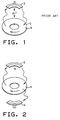
- Fig. 1 is a schematic diagram showing a prior art equilibrium type vapour transport lubrication system.
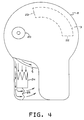
- Fig.2 is a schematic illustration of the steady state vapour transport lubrication system of the present invention.
- Fig. 3 is a view of a typical magnetic hard disk file with the cover removed.
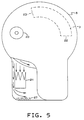
- Fig.4 is a plan view with the cover partly broken away of a disk drive such as shown in Fig.3 which includes a steady state vapour transport system using a flow through vapour drain.
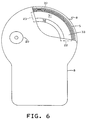
- Fig. 5 is a plan view similar to Fig. 4 illustrating a steady state vapour transport system using a flow by vapour drain.
- Fig. 6 is a plan view of a device similar to those of Figs. 4 and 5 using a combined reservoir and vapour drain.
- Fig. 7 illustrates the combined reservoir and vapour drain of Fig 6.
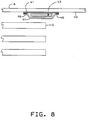
- Fig. 8 illustrates a flow by vapour drain in that can be attached to a disk drive cover to scavenge vapours from a head-disk enclosure.
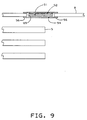
- Fig. 9 illustrates a flow-by vapour drain mounted in an opening in a disk cover mounting and retained between mylar tape and a particulate filter media enabling removal of the vapour entrapping media without exposing the enclosure to unfiltered air.
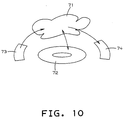
- Fig. 10 schematically illustrates vapour transport in a file with a vapour drain.
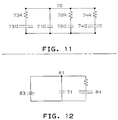
- Fig. 11 is an electrical analog to describe the dynamics of vapour transport in a file with a vapour drain.
- Fig. 12 is an electrical analog to describe another variation of the vapour drain concept.
- a reservoir 3 has a saturated atmosphere emerging from the outlet that releases molecules at the surface 4 of disk 5 to maintain a mono molecular layer of lubricant at the disk surface.
- these components are confined within an enclosure such that the saturated air from the reservoir is less than saturated at the temperature of the disks.
- Lubricant molecules also migrate from the disk surface 4 to the reservoir 3 as an air flow is induced by rotation on the disk 5.
- the maintenance of the correct film thickness of the lubricant is dependent on the existence of a "delta T", or a lower temperature, at the reservoir than at the rotating disks 5. Since there is no vehicle for the removal of contaminant vapours from the enclosure, the outgassing and other contaminants migrate to the reservoir and the disk surface and gradually accumulate in the reservoir until contaminants begin to reach the atmosphere coming from the reservoir outlet as well as from the sources of contamination.
- the reservoir delivers atmosphere that is effectively saturated with lubricant and is admixed with atmosphere passed through a chemical filter that captures substantially all vapours to provide a composite atmosphere with a lube relative vapour pressure that is stabilized at a relative pressure to maintain a partial molecular layer on the disk surface.
- Fig. 2 schematically illustrates the steady state vapour transport lubrication system wherein there is not only a reservoir 3 and disk surface 4, but also a vapour drain 6. Once again air passing through reservoir 3 emerges saturated with lube from within the reservoir.
- the vapour drain is a chemical filter that traps vapours and has an air flow which emerges with an organic vapour pressure that is substantially zero.
- the composite atmosphere supplied from the reservoir 3 and the vapour drain 6 is less than saturated and the system is not therefore dependent upon maintenance of a reduced temperature at the reservoir.
- the vapour drain essentially permanently entraps vapours in the air passing therethrough. Contaminant vapours as well as lubricant vapours are trapped. This gradually depletes the lubricant, but it also maintains the atmosphere and the disk surface almost contaminant free. It is also important that the lubricant supply in the reservoir not be depleted during the life of the disk drive.
- the reservoir capacity and the capability of the vapour drain to capture vapours are selected to achieve this result.
- Fig. 10 is a schematic concerning vapours inside a disk file. This shows a density of vapour in the file atmosphere 71, a disk 72, a file component 73 and a vapour drain 74. Into the atmosphere 71, the component 73 supplies vapour density. The surface of the disk 72 develops a coating whose thickness depends on the relative vapour density in the file atmosphere 71 at the disk surface. From the atmosphere 71, a significant part of the vapour density is steadily removed by the vapour drain 74.
- the density of vapour is determined by competition between vapour gained from component 73 versus vapour removal by the vapour drain 74.
- the vapour drain 74 reduces the density of vapours in the file atmosphere 71.
- the general structure and mechanism of Fig. 10 can be applied to control contamination vapours or to control lubricant vapours.
- a typical seal band 73A outgasses silicone oil vapour.
- the vapour drain 74 reduces the density of contamination vapour in the file atmosphere 71.
- the file uses vapour replenishment of the lubrication.
- the component 73B is a lubricant reservoir which emits a lubricant vapour.
- the vapour drain 74 reduces the density of the lubricant vapour in the file atmosphere 71.
- the density of vapour reaches a steady state. This is a dynamic balance between the rate that the component 73 supplies vapour density, and the rate that the vapour drain 74 removes vapour density.
- the relative vapour density is determined mainly by the aerodynamics, convection and diffusion. Also the relative vapour density is largely independent of chemical equilibrium parameters such as file temperature.
- vapour dynamics may be understood by an electronic analogy Fig. 11.
- vapour is represented by electric charge
- vapour density is represented by voltage.
- the large capacitor 73C and resistor 73R represent the vapour source component 73 and its ability to add vapour to the air.
- the large capacitor 74C and resistor 74R represent the vapour drain 74 and its ability to remove vapour from the air.
- the wire 70 represents air motion inside the file spreading the vapour density throughout the file.
- the small capacitor 72C and resistor 72R represent the deposition of vapour on the disk 72.
- the small capacitor 71C represents the ability of the file atmosphere to hold vapour.
- the steady state is particularly simple. In some cases, the time constants are hours for the disk 72RC, many years for the component vapour source 73RC, many years for the vapour drain 74RC.
- the file operates for an intermediate duration, then a steady state will occur.
- the voltage in the file atmosphere 70 will be determined by a voltage divider formed by the ratio between source resistor 73R and the drain resistor 74R.
- the relative vapour density is determined by the ratio between vapour source and drain rates. This depends on aerodynamics, convection and diffusion, and is largely independent of temperature and other thermo-chemical parameters.
- vapour drain 74 can be applied to lubricant vapour supplied by a lubricant reservoir 73B, and removed by a vapour drain 74.
- the goal is to achieve 50% to 80% relative density of lubricant vapour (compared to the saturation density at the disk temperature). Therefore the vapour drain 74 should match the lubricant reservoir 73B.
- This provides a controlled relative vapour density which is largely independent of temperature gradient or overall temperature. This contrasts with US patent 4,789,913, that teaches a vapour replenishment system that depends on a temperature gradient to control the relative vapour density of lubricant.
- Some files have both significant outgassed contamination and vapour lubrication. It is desirable to greatly reduce the outgassed contamination, and to simultaneously achieve .50% to 80% relative density of lubrication vapour. To achieve this requires some parameterization.
- a vapour source parameterize its rate as the equivalent volume per unit time of saturated vapour added to a file atmosphere with initially zero vapour density.
- a vapour drain parameterize its rate as the equivalent volume per time of saturated vapour drained from a file atmosphere with initially saturated vapour density. In some cases, these rates equal the rate that air flows through the vapour source or vapour drain. (Implicitly, these parameterizations might depend on the vapour material. In many cases, these equivalent rates are dominated by convection aerodynamics. For various vapour materials, this depends on the vapour diffusivity, hence on the molecular weight of the vapour. Thus if outgassed contamination and lubricant have similar molecular weights, then the equivalent rate is independent of the vapour material.)
- the file can be designed as follows. First design file materials and components which achieve the following: the outgas gain rate is much smaller than the lubricant supply rate from the reservoir. Second, add a vapour drain whose equivalent drain rate for outgassed vapour (measured in a file atmosphere saturated with outgassed contamination) approximates the equivalent gain rate for the lubricant reservoir (measured in a file atmosphere with zero lubricant vapour). At steady state, this vapour drain will moderately reduce the relative density of lubricant vapour, and simultaneously will reduce the outgas relative vapour density by a much larger factor.
- the vapour source becomes depleted.
- This can be expressed as a medium-sized capacitor 73C, so the time constant 73RC is a few months.
- a vapour drain with a medium-sized adsorber 74C and a time constant 74RC of a few months will remove vapour more intensely at first, then less intensely after a few months.
- the schematic Fig. 11 implicitly summarizes many additional transient effects. More complex effects can be expressed by using batteries or electrolytic capacitors instead of linear capacitors.
- the vapour drain chemical filter element requires high surface area adsorption.
- Activated carbon is a high capacity non-specific adsorber with a capacity that can be fairly accurately predicted from certain parameters of the carbon and the molar volume of the condensed vapour. As such it is usually the material of choice; however, silica gel, activated alumina and certain synthetic zeolites car be similarly used.
- vapour drain Another function for a vapour drain is to accumulate a sample of vapours for subsequent chemical testing. This favors a reversible absorber. First operate the file for some time with a reversible absorber. Later remove the absorber. In a laboratory, this can be heated to recover the sample for chemical testing. An alternative is to use a solvent to extract the sample. Below we describe structures to facilitate this chemical testing function.
- This chemical testing function can be used in various ways. It can be implemented in developmental prototype files to accelerate chemical integration. It can be implemented in a few production files for statistical quality control. It can be implemented in many production files, to allow monitoring chemical quality in the field throughout file life.
- vapour drain Another modification is to design the vapour drain to have a greater initial capacity followed by a diminished adsorption capability.
- the outgassing contamination and other contaminant sources are more prolific, whereas following the initial period of operation the generation of contaminants stabilizes at significantly lower levels.
- This bilevel capability can be achieved by limiting the filtering capacity of the filter such that the initial capacity is significant while the later more restricted capacity supplies a longer term lower filtering capability that generally parallels the rate of contaminant generation.
- Fig.3 shows a typical magnetic hard disk data storage device with the cover 8 removed.
- a series of disks 5 are clamped together in axially spaced relation for rotation in unison about a common axis and are mounted on a base plate 10.
- An actuator 12 carries a series of arms 13 that have secured thereto suspensions 14 that respectively carry transducers 15.
- Transducers 15 respectively confront disk surfaces 4 to write data to the disk or read data from the disk.
- the actuator arms 13 move in unison about a common axis to cause the transducers 15 to translate from one concentric recording track to another concentric track on the disk surface.
- the flat cable 16 contains the conductors that carry signals from the transducers 15 to the circuitry exterior of the head disk enclosure.
- the HDA is a substantially sealed enclosure surrounding the transducer heads and rotating data storage disks.
- a breather filter 20 is provided and positioned to access the enclosed atmosphere at a location of low pressure. This filter 20 is provided to compensate for atmospheric and thermally induced temperature changes. By being located at a low pressure location it is assured that any leakage location is at a higher pressure such that leakage is out of the enclosure and that makeup air is filtered. Thus, no unfiltered air enters the enclosure.
- the breather filter is commonly provided with an extended length diffusion passage to prevent or limit the introduction of vapour contamination.
- Fig. 4 shows a file, with the cover partially broken away, which includes a steady state lubricant vapour transport system.
- a reservoir 3 is secured to the inner surface of the cover 8, has an air entrance 22 and an exit opening 23 to permit an air flow induced by rotation of disk 5 to pass therethrough.
- Another flow of air induced by disk rotation is partitioned with one portion directed through the recirculating particulate filter 24 and another portion directed through the vapour drain 25.
- FIG. 5 Another embodiment of a steady state system is shown in Fig. 5. This is similar to the system of Fig. 4 with the exception that the vapour drain is a flow by chemical filter for entrapping vapour by adsorption or absorption as the air flow within the enclosure is directed past the filter surface.
- the vapour drain is a flow by chemical filter for entrapping vapour by adsorption or absorption as the air flow within the enclosure is directed past the filter surface.
- Fig. 6 illustrates a further embodiment showing a disk drive with the cover 8 partially broken away wherein the lubricant reservoir and the vapour drain are formed as parallel arcuate paths in a single assembly.
- the reservoir-vapour drain assembly upper surface 33 is adhered to the cover inner surface in a position that is in the air flow induced by disk rotation.
- the reservoir-vapour drain assembly includes one arcuate channel 31 that houses the lubricant source or reservoir and the other, adjoining arcuate channel 32 provides the vapour drain.
- the rotating disk 5 induces an air flow from the entry openings 22 to the outlet openings 23. Since both reservoir 31 and vapour drain 32 are in a common air flow path, the balance between lubricant vapour bearing air and vapour depleted filtered air is easier to achieve in addition to the recognized economy achieved by fabricating both functional elements as a single device.
- vapour drain Since the essence of the vapour drain is vapour control, the concept is also applicable to drives that do not use vapour transport lubrication systems. Disk surfaces having a nonselective affinity for organic vapours are subject to the accumulation of such contaminants which emanate from such sources as material outgassing and bearing lubricants. In particular, drives including disks with bonded lubricants are benefited by the vapour scavenging capabilities of a vapour drain. This contamination control function is useful regardless of the lubrication system, which might be a bonded lubricant, a single application liquid lubricant, vapour replenished lubricant, or other lubrication systems.
- Fig. 8 illustrates an embodiment wherein a vapour drain is used in the form of a flow-by chemical absorber or adsorber which is bonded to the cover 8 and positioned in the path of air circulation induced by rotation of the disks 5.
- the mylar or polycarbonate backing layer 41 is bonded to the cover 8 inner surface 42.
- An activated carbon chemical filter 43 is retained by a HEPA particulate media which is bonded to the backing along its margins 46 either by an adhesive or ultra sonic welding.
- FIG. 9 Another embodiment of a vapour drain used for contaminant entrapment is shown in Fig. 9.
- the vapour drain is placed in an opening 49 in the cover 8.
- the exterior is sealed by mylar tape 52 which is bonded to the exterior surface of cover 8 along the marginal edge surfaces of the opening 49.
- the activated carbon vapour drain element 51 is in the cover opening and retained by a HEPA particulate media 54 which is continuously bonded by adhesive about its margins 56 to the inner surface 42 of cover 8.
- the vapor drain is fabricated as an assembly which is subsequently attached to the drive cover. If the mylar tape at the outer side of the vapour drain is removed, the activated carbon element 51 can be removed and even replaced without exposing the head-disk assembly within the enclosure to unfiltered air.
- This embodiment can be utilized either as a vapour drain for removing contaminants from the enclosure or as a sampling device which permits the filter to be removed so that entrapped contaminants can subsequently be analyzed.
- the vapour drain has been shown in this description as a recirculating type chemical absorber or adsorber for entrapping chemical vapours. This is the preferred embodiment.
- the same result could be obtained by using a controlled leak that permits a predetermined rate of loss of vapour to the atmosphere outside the enclosure. In this application it would be likewise necessary to limit vapour depletion to a rate that would not cause the vapour from the lubricant reservoir to be exhausted during the useful life of the device.
- lubricant vapour and contaminant vapours would be allowed to escape from the enclosure and be replaced by lubricant vapours from the reservoir.
- vapour drain has been described in terms of a magnetic disk memory. Nevertheless it is more widely applicable.
- a vapour drain can control vapours in an optical memories using "near field optics", which have heads that operate very close to a moving disk.
- a vapour drain can control vapours inside a Scanning Tunneling Microscope (STM), an Atomic Force Microscope (AFM), and other devices that have a head moving ultra-close to an ultra-smooth surface.
- STM Scanning Tunneling Microscope
- AFM Atomic Force Microscope
- a vapour drain is applicable to a memory device based on the STM microscope or any of these other devices.
Landscapes
- Magnetic Record Carriers (AREA)
- Manufacturing Of Magnetic Record Carriers (AREA)
- Supporting Of Heads In Record-Carrier Devices (AREA)
Claims (14)
- Eine Datenspeicherungsvorrichtung mit einem im wesentlichen dicht geschlossenen Gehäuse, wobei die Atmosphäre innerhalb des Gehäuses eine oder mehrere Dampfkomponenten enthält und wobei die Vorrichtung ein System zum Steuern des Dampfdrucks der Dampfkomponenten aufweist, das eine Behältervorrichtung (3) für die Bereitstellung einer bestimmten Dampfkomponente in der Atmosphäre umfaßt; und gekennzeichnet durch eine Dampfablaßvorrichtung (25) für das gesteuerte, irreversible Abziehen von Dampfkomponenten aus der Atmosphäre, wobei die Dampfablaßvorrichtung so angepaßt ist, daß sie den Behälter innerhalb eines zuvor festgelegten Zeitraums nicht vollständig entleert.
- Die Vorrichtung nach Anspruch 1, wobei die Dampfablaßvorrichtung einen Filter aufweist, der durch Adsorption, Absorption oder chemische Reaktion Dampfkomponenten aus der Atmosphäre abscheidet.
- Die Vorrichtung nach Anspruch 2, wobei das aktive Element des Filters mindestens ein Material aus der Liste Aktivkohle, Kieselgel, aktiviertes Aluminiumoxid, synthetisches Zeolith oder ein anderes Material umfaßt, das ein großes Verhältnis von Oberfläche zu Volumen aufweist und die Fähigkeit hat, bestimmte Dampfkomponenten zu absorbieren.
- Die Vorrichtung nach Anspruch 2 oder 3, wobei der Filter aus dem Gehäuse herausgenommen werden kann und wobei die Vorrichtung desweiteren eine Einrichtung (54) umfaßt, die verhindert, daß ungefilterte Luft in das Gehäuse eindringt, wenn der Filter entfernt wird.
- Die Vorrichtung nach einem der Ansprüche 2 bis 4, wobei die Fähigkeiten des Filters und der Behältervorrichtung so gestaltet sind, daß die Gesamtmenge an Dampf, die die Behältervorrichtung an die Atmosphäre abgeben kann, größer ist als die Gesamtmenge an Dampf, die der Filter abscheiden kann.
- Die Vorrichtung nach Anspruch 5, wobei die Behältervorrichtung und die Dampfablaßvorrichtung aerodynamisch ähnliche Strukturen sind, um ein kontrolliertes Verhältnis des atmosphärischen Stroms durch die beiden Strukturen oder entlang der beiden Strukturen zu wahren.
- Die Vorrichtung nach Anspruch 6, wobei die Behältervorrichtung und die Dampfablaßvorrichtung unabhängige Durchgänge (31, 32) aufweisen, die parallel angeordnet sind und an einer Wand im Gehäuse befestigt sind.
- Die Vorrichtung nach Anspruch 7, wobei die Durchgänge gebogen und koplanar sind.
- Die Vorrichtung nach einem der vorangehenden Ansprüche, wobei die Behältervorrichtung und die Dampfablaßvorrichtung in eine einzige Einheit integriert sind.
- Die Vorrichtung nach Anspruch 1, wobei die Dampfablaßvorrichtung eine Auslaßvorrichtung umfaßt, die ein kontrolliertes Entweichen der Atmosphäre aus dem Gehäuse zuläßt, wobei die Auslaßvorrichtung eine Öffnung in der Wand des Gehäuses und einen Einlaßfilter umfaßt, der einen entsprechenden Strom der Atmosphäre in das Gehäuse hinein zuläßt.
- Die Vorrichtung nach Anspruch 10, wobei die Auslaßvorrichtung desweiteren einen Durchgang von beträchtlicher Länge auf der einen oder der anderen Seite der Öffnung in der Gehäusewand hat.
- Die Vorrichtung nach einem der vorangehenden Ansprüche, wobei das Gehäuse mindestens eine Magnetspeicherplatte enthält, die mit einer Schmiermittelschicht beschichtet ist, und wobei der betreffende Dampf, der von der Behältervorrichtung bereitgestellt wird, Schmiermitteldampf ist, um durch Dampftransport die Schmiermittelschicht auf dieser mindestens einen Platte zu wahren.
- Die Vorrichtung nach Anspruch 12, wobei die Rotation der Platten dazu führt, daß die Atmosphäre innerhalb des Gehäuses durch die Dampfablaßvorrichtung strömt oder an dieser entlangströmt.
- Die Vorrichtung nach einem der vorangehenden Ansprüche, wobei die Rate der Dampfentfernung durch den Dampfablaß durch Konvektionsströmung begrenzt ist.
Applications Claiming Priority (2)
| Application Number | Priority Date | Filing Date | Title |
|---|---|---|---|
| US53526990A | 1990-05-24 | 1990-05-24 | |
| US535269 | 1990-05-24 |
Publications (2)
| Publication Number | Publication Date |
|---|---|
| EP0458528A1 EP0458528A1 (de) | 1991-11-27 |
| EP0458528B1 true EP0458528B1 (de) | 1995-12-27 |
Family
ID=24133514
Family Applications (1)
| Application Number | Title | Priority Date | Filing Date |
|---|---|---|---|
| EP91304421A Expired - Lifetime EP0458528B1 (de) | 1990-05-24 | 1991-05-16 | Datenspeicherungsvorrichtung mit Dampfdrucksteuersystem |
Country Status (3)
| Country | Link |
|---|---|
| EP (1) | EP0458528B1 (de) |
| JP (1) | JP2803688B2 (de) |
| DE (1) | DE69115755T2 (de) |
Cited By (1)
| Publication number | Priority date | Publication date | Assignee | Title |
|---|---|---|---|---|
| US6491741B2 (en) | 1998-10-08 | 2002-12-10 | Donaldson Company, Inc. | Filter assembly with shaped adsorbent article; and devices and methods of use |
Families Citing this family (7)
| Publication number | Priority date | Publication date | Assignee | Title |
|---|---|---|---|---|
| US5307222A (en) * | 1992-11-13 | 1994-04-26 | Maxtor Corporation | Air filter and circulation system for a hard disk drive |
| US5346518A (en) * | 1993-03-23 | 1994-09-13 | International Business Machines Corporation | Vapor drain system |
| US6088190A (en) * | 1994-11-08 | 2000-07-11 | Seagate Technology, Inc. | Disk drive including multi-stage environmental diffusion buffer |
| US5876487A (en) * | 1997-03-17 | 1999-03-02 | Donaldson Company, Inc. | Adsorbent construction; and, method |
| US6143058A (en) * | 1997-03-17 | 2000-11-07 | Donaldson Company, Inc. | Adsorbent construction and method |
| US6146446A (en) * | 1998-10-08 | 2000-11-14 | Donaldson Company, Inc. | Filter assembly with shaped adsorbent article; and devices and methods of use |
| DE10085329T1 (de) * | 1999-12-09 | 2002-11-07 | Matsushita Electric Industrial Co Ltd | Magnetische Aufzeichnungs- und Wiedergabevorrichtung |
Family Cites Families (7)
| Publication number | Priority date | Publication date | Assignee | Title |
|---|---|---|---|---|
| JPS55157170A (en) * | 1979-05-21 | 1980-12-06 | Nippon Telegr & Teleph Corp <Ntt> | Magnetic storage device |
| JPS592273A (ja) * | 1982-06-25 | 1984-01-07 | Fujitsu Ltd | 磁気デイスク装置 |
| US4626941A (en) * | 1983-05-26 | 1986-12-02 | Fujitsu Limited | Method and apparatus for suppressing the evaporation of lubricant film coated on magnetic disks of a disk storage |
| JPS59221873A (ja) * | 1983-05-30 | 1984-12-13 | Fujitsu Ltd | 磁気デイスク表面の潤滑膜安定化法 |
| JPS62279586A (ja) * | 1986-05-28 | 1987-12-04 | Alps Electric Co Ltd | 磁気デイスク駆動装置 |
| US4789913A (en) * | 1987-08-03 | 1988-12-06 | International Business Machines Corporation | Method and apparatus for lubricating a magnetic disk continuously in a recording file |
| JPH01199389A (ja) * | 1987-10-01 | 1989-08-10 | Mitsubishi Electric Corp | 磁気ディスク装置および結露防止容器 |
-
1991
- 1991-04-24 JP JP3093881A patent/JP2803688B2/ja not_active Expired - Lifetime
- 1991-05-16 DE DE1991615755 patent/DE69115755T2/de not_active Expired - Fee Related
- 1991-05-16 EP EP91304421A patent/EP0458528B1/de not_active Expired - Lifetime
Non-Patent Citations (1)
| Title |
|---|
| & JP-A- 59 218633 (FUJITSU KK) 08 December 1984, * |
Cited By (1)
| Publication number | Priority date | Publication date | Assignee | Title |
|---|---|---|---|---|
| US6491741B2 (en) | 1998-10-08 | 2002-12-10 | Donaldson Company, Inc. | Filter assembly with shaped adsorbent article; and devices and methods of use |
Also Published As
| Publication number | Publication date |
|---|---|
| JPH05342841A (ja) | 1993-12-24 |
| EP0458528A1 (de) | 1991-11-27 |
| JP2803688B2 (ja) | 1998-09-24 |
| DE69115755D1 (de) | 1996-02-08 |
| DE69115755T2 (de) | 1996-07-11 |
Similar Documents
| Publication | Publication Date | Title |
|---|---|---|
| US5229899A (en) | Apparatus and method for controlling vapor phase within an enclosure | |
| US5030260A (en) | Disk drive breather filter | |
| US9302795B1 (en) | Humidity control for enclosure | |
| US5447695A (en) | Chemical breather filter assembly | |
| EP0458528B1 (de) | Datenspeicherungsvorrichtung mit Dampfdrucksteuersystem | |
| US7388731B1 (en) | Hard disk drive recirculation air filter | |
| US7306659B2 (en) | Adsorbent breather filter | |
| US5734521A (en) | Moisture-absorbent element for disk drives | |
| US8867164B2 (en) | Magnetic storage device with humidity control device incorporating a differentially permeable membrane | |
| US6940687B2 (en) | Rigid housing member for a data storage device with integrated contaminant adsorbent filter | |
| EP0302606A2 (de) | Verfahren und Gerät zum kontinuierlichen Schmieren einer Magnetplatte in einem Aufnahmespeicher | |
| US8885289B2 (en) | Magnetic storage device with multi-functional component for controlling chemical and water vapor therein | |
| EP1222661A1 (de) | Starre multifunktionale filtervorrichtung | |
| US9613658B2 (en) | Contamination reduction head for media | |
| US10115436B1 (en) | Filter media and filter products for electronic enclosures | |
| CN102403016A (zh) | 硬盘驱动器、干燥剂 | |
| US8908319B1 (en) | Disk drive with slow acting desiccant | |
| US20050063093A1 (en) | Breather filter cartridge for data storage devices | |
| US20130044393A1 (en) | Magnetic storage device with dynamic humidity control system to mitigate water vapor transients | |
| US9202504B2 (en) | Producing a magnetic disk device | |
| US7815715B2 (en) | Mounting configuration for a filtration canister | |
| US6356407B1 (en) | System and process for reducing contamination in internal disc drive environment | |
| Fowler et al. | Protecting the head/disk interface from the chemical environment with disk drive filtration | |
| EP1911030A2 (de) | Verbesserte filterkonstruktion zum entfernen von verunreinigungen aus einem gehäuse | |
| US20060132975A1 (en) | Humidity control in a removable data cartridge |
Legal Events
| Date | Code | Title | Description |
|---|---|---|---|
| PUAI | Public reference made under article 153(3) epc to a published international application that has entered the european phase |
Free format text: ORIGINAL CODE: 0009012 |
|
| AK | Designated contracting states |
Kind code of ref document: A1 Designated state(s): DE FR GB |
|
| 17P | Request for examination filed |
Effective date: 19911219 |
|
| 17Q | First examination report despatched |
Effective date: 19940803 |
|
| GRAA | (expected) grant |
Free format text: ORIGINAL CODE: 0009210 |
|
| AK | Designated contracting states |
Kind code of ref document: B1 Designated state(s): DE FR GB |
|
| REF | Corresponds to: |
Ref document number: 69115755 Country of ref document: DE Date of ref document: 19960208 |
|
| ET | Fr: translation filed | ||
| PG25 | Lapsed in a contracting state [announced via postgrant information from national office to epo] |
Ref country code: GB Effective date: 19960516 |
|
| PLBE | No opposition filed within time limit |
Free format text: ORIGINAL CODE: 0009261 |
|
| STAA | Information on the status of an ep patent application or granted ep patent |
Free format text: STATUS: NO OPPOSITION FILED WITHIN TIME LIMIT |
|
| 26N | No opposition filed | ||
| GBPC | Gb: european patent ceased through non-payment of renewal fee |
Effective date: 19960516 |
|
| PG25 | Lapsed in a contracting state [announced via postgrant information from national office to epo] |
Ref country code: FR Effective date: 19970131 |
|
| PG25 | Lapsed in a contracting state [announced via postgrant information from national office to epo] |
Ref country code: DE Effective date: 19970201 |
|
| REG | Reference to a national code |
Ref country code: FR Ref legal event code: ST |