EP0455742B1 - Texturierte weichkapseln und verfahren und vorrichtung zur herstellung - Google Patents
Texturierte weichkapseln und verfahren und vorrichtung zur herstellung Download PDFInfo
- Publication number
- EP0455742B1 EP0455742B1 EP90903554A EP90903554A EP0455742B1 EP 0455742 B1 EP0455742 B1 EP 0455742B1 EP 90903554 A EP90903554 A EP 90903554A EP 90903554 A EP90903554 A EP 90903554A EP 0455742 B1 EP0455742 B1 EP 0455742B1
- Authority
- EP
- European Patent Office
- Prior art keywords
- drum
- gelatin
- ribbons
- textured
- ribbon
- Prior art date
- Legal status (The legal status is an assumption and is not a legal conclusion. Google has not performed a legal analysis and makes no representation as to the accuracy of the status listed.)
- Expired - Lifetime
Links
- 238000000034 method Methods 0.000 title claims abstract description 39
- 238000004519 manufacturing process Methods 0.000 title abstract description 13
- 108010010803 Gelatin Proteins 0.000 claims abstract description 51
- 239000008273 gelatin Substances 0.000 claims abstract description 51
- 229920000159 gelatin Polymers 0.000 claims abstract description 51
- 235000019322 gelatine Nutrition 0.000 claims abstract description 51
- 235000011852 gelatine desserts Nutrition 0.000 claims abstract description 51
- 230000009969 flowable effect Effects 0.000 claims abstract description 11
- 239000002775 capsule Substances 0.000 claims description 23
- 239000000463 material Substances 0.000 claims description 7
- 238000005266 casting Methods 0.000 description 8
- 238000001816 cooling Methods 0.000 description 7
- 239000007903 gelatin capsule Substances 0.000 description 6
- 230000015572 biosynthetic process Effects 0.000 description 5
- 230000002093 peripheral effect Effects 0.000 description 5
- 238000009472 formulation Methods 0.000 description 4
- 239000000203 mixture Substances 0.000 description 4
- 239000003086 colorant Substances 0.000 description 3
- 230000001419 dependent effect Effects 0.000 description 3
- 229940088594 vitamin Drugs 0.000 description 3
- 239000011782 vitamin Substances 0.000 description 3
- 229930003231 vitamin Natural products 0.000 description 3
- 235000013343 vitamin Nutrition 0.000 description 3
- 239000003814 drug Substances 0.000 description 2
- 239000007788 liquid Substances 0.000 description 2
- 239000003921 oil Substances 0.000 description 2
- 239000006186 oral dosage form Substances 0.000 description 2
- 239000004014 plasticizer Substances 0.000 description 2
- 239000000126 substance Substances 0.000 description 2
- XLYOFNOQVPJJNP-UHFFFAOYSA-N water Substances O XLYOFNOQVPJJNP-UHFFFAOYSA-N 0.000 description 2
- 238000010420 art technique Methods 0.000 description 1
- 230000000295 complement effect Effects 0.000 description 1
- 238000007906 compression Methods 0.000 description 1
- 230000006835 compression Effects 0.000 description 1
- 238000010276 construction Methods 0.000 description 1
- 238000007796 conventional method Methods 0.000 description 1
- 239000002537 cosmetic Substances 0.000 description 1
- 229940079593 drug Drugs 0.000 description 1
- 239000012530 fluid Substances 0.000 description 1
- 239000000499 gel Substances 0.000 description 1
- 238000002347 injection Methods 0.000 description 1
- 239000007924 injection Substances 0.000 description 1
- 239000000314 lubricant Substances 0.000 description 1
- 239000002480 mineral oil Substances 0.000 description 1
- 235000010446 mineral oil Nutrition 0.000 description 1
- 239000003605 opacifier Substances 0.000 description 1
- 239000002304 perfume Substances 0.000 description 1
- 239000000049 pigment Substances 0.000 description 1
- 239000002985 plastic film Substances 0.000 description 1
- 229920006255 plastic film Polymers 0.000 description 1
- 229920000098 polyolefin Polymers 0.000 description 1
- 238000002360 preparation method Methods 0.000 description 1
- 239000002453 shampoo Substances 0.000 description 1
- 239000002884 skin cream Substances 0.000 description 1
- 239000000344 soap Substances 0.000 description 1
- 125000006850 spacer group Chemical group 0.000 description 1
- 239000000829 suppository Substances 0.000 description 1
- 230000000699 topical effect Effects 0.000 description 1
- 150000003722 vitamin derivatives Chemical class 0.000 description 1
Images

Classifications
-
- B—PERFORMING OPERATIONS; TRANSPORTING
- B29—WORKING OF PLASTICS; WORKING OF SUBSTANCES IN A PLASTIC STATE IN GENERAL
- B29C—SHAPING OR JOINING OF PLASTICS; SHAPING OF MATERIAL IN A PLASTIC STATE, NOT OTHERWISE PROVIDED FOR; AFTER-TREATMENT OF THE SHAPED PRODUCTS, e.g. REPAIRING
- B29C43/00—Compression moulding, i.e. applying external pressure to flow the moulding material; Apparatus therefor
- B29C43/22—Compression moulding, i.e. applying external pressure to flow the moulding material; Apparatus therefor of articles of indefinite length
- B29C43/222—Compression moulding, i.e. applying external pressure to flow the moulding material; Apparatus therefor of articles of indefinite length characterised by the shape of the surface
-
- A—HUMAN NECESSITIES
- A61—MEDICAL OR VETERINARY SCIENCE; HYGIENE
- A61J—CONTAINERS SPECIALLY ADAPTED FOR MEDICAL OR PHARMACEUTICAL PURPOSES; DEVICES OR METHODS SPECIALLY ADAPTED FOR BRINGING PHARMACEUTICAL PRODUCTS INTO PARTICULAR PHYSICAL OR ADMINISTERING FORMS; DEVICES FOR ADMINISTERING FOOD OR MEDICINES ORALLY; BABY COMFORTERS; DEVICES FOR RECEIVING SPITTLE
- A61J3/00—Devices or methods specially adapted for bringing pharmaceutical products into particular physical or administering forms
- A61J3/07—Devices or methods specially adapted for bringing pharmaceutical products into particular physical or administering forms into the form of capsules or similar small containers for oral use
-
- Y—GENERAL TAGGING OF NEW TECHNOLOGICAL DEVELOPMENTS; GENERAL TAGGING OF CROSS-SECTIONAL TECHNOLOGIES SPANNING OVER SEVERAL SECTIONS OF THE IPC; TECHNICAL SUBJECTS COVERED BY FORMER USPC CROSS-REFERENCE ART COLLECTIONS [XRACs] AND DIGESTS
- Y10—TECHNICAL SUBJECTS COVERED BY FORMER USPC
- Y10T—TECHNICAL SUBJECTS COVERED BY FORMER US CLASSIFICATION
- Y10T428/00—Stock material or miscellaneous articles
- Y10T428/13—Hollow or container type article [e.g., tube, vase, etc.]
- Y10T428/1324—Flexible food casing [e.g., sausage type, etc.]
-
- Y—GENERAL TAGGING OF NEW TECHNOLOGICAL DEVELOPMENTS; GENERAL TAGGING OF CROSS-SECTIONAL TECHNOLOGIES SPANNING OVER SEVERAL SECTIONS OF THE IPC; TECHNICAL SUBJECTS COVERED BY FORMER USPC CROSS-REFERENCE ART COLLECTIONS [XRACs] AND DIGESTS
- Y10—TECHNICAL SUBJECTS COVERED BY FORMER USPC
- Y10T—TECHNICAL SUBJECTS COVERED BY FORMER US CLASSIFICATION
- Y10T428/00—Stock material or miscellaneous articles
- Y10T428/13—Hollow or container type article [e.g., tube, vase, etc.]
- Y10T428/1334—Nonself-supporting tubular film or bag [e.g., pouch, envelope, packet, etc.]
-
- Y—GENERAL TAGGING OF NEW TECHNOLOGICAL DEVELOPMENTS; GENERAL TAGGING OF CROSS-SECTIONAL TECHNOLOGIES SPANNING OVER SEVERAL SECTIONS OF THE IPC; TECHNICAL SUBJECTS COVERED BY FORMER USPC CROSS-REFERENCE ART COLLECTIONS [XRACs] AND DIGESTS
- Y10—TECHNICAL SUBJECTS COVERED BY FORMER USPC
- Y10T—TECHNICAL SUBJECTS COVERED BY FORMER US CLASSIFICATION
- Y10T428/00—Stock material or miscellaneous articles
- Y10T428/23—Sheet including cover or casing
- Y10T428/239—Complete cover or casing
-
- Y—GENERAL TAGGING OF NEW TECHNOLOGICAL DEVELOPMENTS; GENERAL TAGGING OF CROSS-SECTIONAL TECHNOLOGIES SPANNING OVER SEVERAL SECTIONS OF THE IPC; TECHNICAL SUBJECTS COVERED BY FORMER USPC CROSS-REFERENCE ART COLLECTIONS [XRACs] AND DIGESTS
- Y10—TECHNICAL SUBJECTS COVERED BY FORMER USPC
- Y10T—TECHNICAL SUBJECTS COVERED BY FORMER US CLASSIFICATION
- Y10T428/00—Stock material or miscellaneous articles
- Y10T428/24—Structurally defined web or sheet [e.g., overall dimension, etc.]
- Y10T428/24355—Continuous and nonuniform or irregular surface on layer or component [e.g., roofing, etc.]
Definitions
- This invention relates to textured softgels (or soft gelatin capsules) and to a process and apparatus for the manufacture thereof.
- Soft gelatin capsules now more commonly known as softgels, have been well known and widely used for many years.
- Softgels generally comprise an outer shell primarily made of gelatin, a plasticizer, and water, and a fill contained within the shell.
- the fill may be selected from any of a wide variety of substances that are compatible with the gelatin shell.
- Softgels are widely used in the pharmaceutical industry as an oral dosage form containing many different types of pharmaceutical and vitamin products. In addition to use as an oral dosage form for drugs and vitamins, soft gelatin capsules or softgels are also designed for use as suppositories for rectal or vaginal use. Other uses are for topical and ophthalmic preparations and the like.
- softgels are available in a great variety of sizes and shapes, including round shapes, oval shapes, oblong shapes, tube shapes and other special types of shapes such as stars.
- the finished capsules or softgels can be made in a variety of colors.
- opacifiers may be added to the shell.
- softgels can be made in a wide variety of shapes, sizes and colors, because of the wide range of use of softgels, there is a definite need to provide other means of identification.
- the printing material may be any suitable dye or pigment.
- this has the disadvantage of requiring the use of an additional machine that will align the softgels and hold them in a desired oriented position for the application of the dye or ink.
- additional equipment and procedural steps adds to the overall cost of manufacture of the softgels and, therefore, this system is considered disadvantageous.
- each softgel can be done over only a limited portion of the exterior surface of the softgel and may not be readily read or even seen by the consumer.
- Specific examples of known processes and machines used for applying some type of identification on the softgels are those shown, for example, in Power (Posner) Patent No. 2,449,139; Scherer Patent No. 2,623,494; Scherer Patent No. 2,688,775; Scherer Patent No. 2,703,047; Taylor Patent No. 3,124,840; Hansen Patent No. 3,203,347; and Vincent Patent No. 3,333,031.
- the Posner Patent shows gelatin as one possible type of system that can be used in connection with an apparatus for manufacturing and filling capsules.
- a tube of gelatin is formed and then a textured brand is applied to a portion of the outer surface of the tube.
- the capsule is then filled and sealed.
- This apparatus is used in quite a different system from the rotary die process which is probably the most common type of machine used for manufacturing softgels today.
- the rotary die process is described in some detail in Stanley's Chapter 13 of Lachman, Lieberman, and Kanig, The Theory and Practice of Industrial Chemistry (Copyright Lea & Febiger, 1970).
- the Scherer Patent No. 2,623,494 relates to a banding machine for softgels.
- the identifying band is applied to each individual capsule after the capsule is formed.
- the Scherer Patent No. 2,688,775 shows a method for applying a brand to the exterior surface of a gelatin capsule.
- the Scherer Patent No. 2,703,047 discloses a similar system of branding the filled capsules.
- a printing element is provided in order to print on the gelatin strip prior to the formation of the capsule.
- the Hansen Patent No. 3,203,347 shows a marking fluid that is printed on the gelatin ribbon used to make the softgels.
- the Vincent Patent No. 3,333,031 shows dying of the gelatin strip before capsule formation.
- Metz Patent No. 3,374,303 is concerned with a method for manufacturing imprinted plastic film in which the polyolefin film is embossed by an impression roller while it is cooling.
- this invention is not related to softgel manufacture.
- a process for imparting a texture to the surface of softgels produced by the rotary die method comprising the steps of forming a flowable gelatin mass, providing a rotary drum having an outer surface, controllably directing said flowable gelatin mass to said outer surface of said drum, forming a gelatin ribbon of substantially uniform thickness on said outer surface of said drum, providing a second gelatin ribbon, said ribbons being initially in a relatively softer and mouldable state immediately following said directing step, forming a plurality of filled softgels from said ribbons by use of said rotary die method, characterised in that:
- At least one of said ribbons is passed while in said relatively softer and mouldable state between said rotary drum outer surface and a roller, the roller having a textured surface, said roller being positioned closely adjacent to said outer surface of said drum, while applying sufficient pressure to said roller towards said drum to cause said textured surface to impart a matching texture on the outer surface of said ribbon, said matching texture defining the outer surface of at least a portion of each softgel.
- the rotary die process machine is schematically illustrated in Figure 1.
- the principal parts thereof include a gelatin metering device or spreader box, generally 12, and a gelatin ribbon casting and cooling rotary drum 14 upon which the first gelatin ribbon 16 is formed.
- a gelatin metering device or spreader box generally 12
- a gelatin ribbon casting and cooling rotary drum 14 upon which the first gelatin ribbon 16 is formed.
- only one spreader box 12 and one rotary drum 14 are illustrated in Figure 1. Since the rotary die process uses two gelatin ribbons, the second being designated as 18, it is to be understood that a similarly situated spreader box (not shown in Figure 1) and rotary drum (not shown in Figure 1) are utilized in connection with the formation of the second gelatin ribbon 18.
- the rotary die process machine 10 further includes a tank 20, generally containing a liquid fill material which is any of a wide variety of substances both of an edible nature, such as vitamins and pharmaceuticals, or of an inedible nature, including oils, bath soaps, and the like.
- the fill material 22 contained in the tank 20 flows to a fill pump 23 which meters the volume of the fill material which passes through a line 24 to an injection wedge 26.
- the narrowed lower end of the wedge 26 is constructed and shaped to be located between a pair of rotary dies, generally 28, which contain matching die pockets 31.
- the rotary dies 28 rotate in the direction designated by the arrows 29 shown in Figure 1.
- the fill material 22 passes through the filling wedge 26 into the space formed in the gelatin by the die pockets 31 formed by and between the rotary dies 28 where the softgels 30 are filled, shaped, hermetically sealed and cut from the gel ribbons 16 and 18 using conventional techniques.
- the filled capsules or softgels 30 which are formed are dropped into collecting chutes 33 where they fall down onto a conveyor 32.
- the gelatin net 34 which remains after the capsules 30 are cut is then passed on for collecting and reuse in a known manner.
- the rotary die machine 10 is generally a conventional type of machine used for making gelatin capsules or softgels. Although there is nothing considered unique in the machine, as described above, it is, nevertheless, considered advantageous to have a full understanding of the rotary die process in order to have a full understanding of the overall process for manufacturing the capsules 30 which have the textured appearance as depicted in Figures 6 and 7.
- Figure 1 there is no illustration of the texturing apparatus, generally 36, which is used for applying the textured outer periphery to the outer surface of the gelatin ribbons 16 and 18 which have been formed on the rotary casting and cooling drums 14.
- the texturing apparatus 36 which is the general subject of the present invention, is best illustrated in Figures 2-5 herein. As stated previously, the disclosure of the rotary die process in Chapter 13 by Stanley, identified above, is incorporated herein by reference.
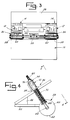
- a machine frame 38 is generally illustrated in Figure 2, and the cooling and casting rotary drum 14 is rotatably mounted about its transverse axis 40.
- the texturing apparatus 36 is mounted closely adjacent and below the spreader box 12. Cylindrical outer surface 52 of the texturing apparatus 36 is placed sufficiently close to the spreader box 12 so that the gelatin ribbon 16 or 18 is formed on the outer peripheral surface 42 of the drum 14.
- the texturing apparatus 36 is positioned so that the ribbon 16 is in a suitable softened and moldable condition to have a suitable texture applied to its exterior surface, that is, the ribbon 16 should be sufficiently softened and moldable so as to accept the desired textured surface being applied thereto by the texturing apparatus 36.
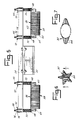
- the outer surface of the capsule 30 has a texture of raised ribs 44 provided thereon. It is to be understood, however, that the texture for the capsules can vary over a wide range.
- a texturing location is generally illustrated in the shaded area 46 as seen best in Figure 2.
- This area represents a segment of up to approximately 45 degrees along the outer periphery of the drum 14 and extends from the lower, open end of the spreader box 12. If the texturing apparatus 36 is positioned beyond the texturing area 46, where the gelatin is applied to the outer periphery 42, it is unlikely that the ribbon 16 or 18 will accept a texture because the ribbon will have sufficiently hardened on the casting and cooling rotary drum 14, which rotates in the direction indicated by the arrow 48 in Figure 2.
- a base plate 50 is mounted on the frame 38 of the rotary die process machine 10.
- a cross support 54 as best seen in Figures 4 and 5, is mounted on the base plate 50 at a preselected angle.
- An upright angled rib 56 angularly mounts the cross support 54 to the base plate 50.
- the cross support 54 is elongated and at its opposite ends, has a texturing roller assembly 58 operatively mounted at either end thereof for the texturing of each ribbon 16 and 18.
- the roller assembly generally 58, includes an elongated roller 60 having a textured outer periphery 62.
- the roller 60 is approximately the same width as the drum 14 and is rotatable about the transverse axis 64 which is parallel to the axis 40 of the rotary casting and cooling drums 14.
- Each roller 60 is biased or spring mounted towards the drum 14.
- each roller assembly 60 has the outer ends thereof interconnected to a threaded rod 66.
- Each threaded rod 66 is substantially transverse or perpendicular to the axis 64.
- a retaining washer 68 is mounted on the lower end of each of the threaded rods 66.
- a compression spring 70 is positioned between the retaining washer 68 and the cross support 54 in such a way that the springs 70 are biased to apply pressure in a radial direction, forcing the roller 60 and its peripheral textured surface 62 towards or against the outer peripheral surface 42 of the casting drum 14.
- the pressure applied by the spring 70 is adjustable by the adjusting assembly, generally 72, located at the upper end of each of the threaded rods 66.
- a spacer 74 is mounted between the cross support 54 and the upper retaining washer 74.
- An adjustment nut 76 is threadably mounted at the upper end of the threaded rod so that by adjusting the nut 76 along the length of the threaded rod 66, the desired amount of pressure can be applied by the spring 70 so the outer textured surface 62 of the roller 60 bears towards the outer surface 42 of the rotary drum 14 with the ribbon 16 or 18 therebetween.
- the spreader box 12 is filled with a molten, flowable gelatin of a conventional formulation well known to those skilled in the art.
- the shell formulation generally comprising water, gelatin and a plasticizer passes through the spreader box and is applied initially in liquid form against the outer periphery of the rotating cooling and casting drum 14.
- the gelatin sheet or ribbon of suitable thickness is desirably placed against the outer surface of the drum 14 and upon counterclockwise direction of the drum 14, as viewed in Figure 2, in the direction of the arrow 48, the texturing apparatus immediately comes into contact with the outer periphery of the gelatin ribbon 16 while it is still in a flowable, or moldable condition.
- the outer periphery of the roller 60 has a lubricant, such as mineral oil, applied, by suitable means, such as a brush (not shown), to its outer surface, in order to assure that there is no sticking of the gelatin ribbon to the texturing roller 60 once the texture has been applied thereto.
- suitable means such as a brush (not shown)
- the operator adjusts the pressure of roller 60 as the ribbon passes between the outer textured surface 62 of the roller assembly 58 and the outer peripheral surface 42 of the casting drum 14.
- the capsules 30 thus formed are as illustrated in Figure 6.
- the capsule 30 has the shape of a star and the texture on the outer surface thereof has raised ribs which are complementary to the peripheral grooves that are located on the outer periphery of the textured surface 62 of the roller 60.
- the textured surface can define the inner surface of the shell capsule as opposed to the outer surface thereof. It is thus believed that all objects previously set forth have been accomplished.
Landscapes
- Health & Medical Sciences (AREA)
- Chemical & Material Sciences (AREA)
- Medicinal Chemistry (AREA)
- Pharmacology & Pharmacy (AREA)
- Life Sciences & Earth Sciences (AREA)
- Animal Behavior & Ethology (AREA)
- General Health & Medical Sciences (AREA)
- Public Health (AREA)
- Veterinary Medicine (AREA)
- Mechanical Engineering (AREA)
- Engineering & Computer Science (AREA)
- Medicinal Preparation (AREA)
- Jellies, Jams, And Syrups (AREA)
- Medical Preparation Storing Or Oral Administration Devices (AREA)
- Meat, Egg Or Seafood Products (AREA)
- Casting Or Compression Moulding Of Plastics Or The Like (AREA)
- Moulding By Coating Moulds (AREA)
- Lubricants (AREA)
- Fats And Perfumes (AREA)
- Moulds For Moulding Plastics Or The Like (AREA)
- Confectionery (AREA)
Claims (8)
- Verfahren zum Aufbringen einer Textur auf die Oberfläche von durch das Drehformverfahren erzeugten Weichkapseln, wobei das Verfahren die Schritte aufweist:
Bilden einer fließfähigen Gelatinemasse, Vorsehen einer Drehtrommel (14) mit einer Außenoberfläche (42), steuerbares Richten der fließfähigen Gelatinemasse zu der Außenoberfläche (42) der Trommel (14), Bilden eines Gelatinebands (16) im wesentlichen gleichmäßiger Dicke auf der Außenoberfläche (42) der Trommel (14), Vorsehen eines zweiten Gelatinebands (18), wobei sich die Bänder (16, 18) unmittelbar nach dem Schritt des Richtens anfangs in einem relativ weicheren und formbaren Zustand befinden, Formen einer Mehrzahl gefüllter Weichkapseln (30) aus den Bändern (16, 18) unter Verwendung des Drehformverfahrens,
dadurch gekennzeichnet, daß:
wenigstens eines der Bänder (16, 18) in dem relativ weicheren und formbaren Zustand zwischen der Außenoberfläche (42) der Drehtrommel und einer Rolle (60) hindurchtritt, wobei die Rolle eine texturierte Oberfläche (62) aufweist, wobei die Rolle (60) der Außenoberfläche (42) der Trommel (14) eng benachbart angeordnet ist, während ein ausreichender Druck auf die Rolle (60) zu der Trommel hin anliegt, um zu bewirken, daß die texturierte Oberfläche (62) eine passende Textur auf die Außenoberfläche des Bands aufbringt, wobei die passende Textur die Außenoberfläche wenigstens eines Abschnitts jeder Weichkapsel (30) festlegt. - Verfahren nach Anspruch 1, in dem beide Bänder (16, 18) zwischen der Außenoberfläche (42) der Drehtrommel und den Rollen (60) hindurchtreten, um die passende Textur auf die Außenoberfläche beider Bänder (16, 18) aufzubringen.
- Vorrichtung zum Aufbringen einer Textur auf die Oberfläche von Weichkapseln unter Verwendung einer Drehformmaschine, welche Vorrichtung in Kombination umfaßt:
ein Mittel, das eine fließfähige Gelatinemasse enthält, eine Drehtrommel (14) mit einer Außenoberfläche (42), ein Mittel zum steuerbaren Richten einer solchen fließfähigen Gelatinemasse auf die Außenoberfläche (42) der Trommel (14), wobei das Mittel zum Richten und die Trommel (14) zur Bildung eines Gelatinebands (16) im wesentlichen gleichmäßiger Dicke auf der Außenoberfläche (42) betriebsmäßig in Beziehung stehen, ein Mittel zum Bilden eines zweiten Gelatinebands (18), wobei sich die Bänder (16, 18) unmittelbar nach dem Schritt des Richtens anfangs in einem relativ weicheren und formbaren Zustand befinden, ein Mittel zum Formen einer Mehrzahl gefüllter Weichkapseln (30) aus den Gelatinebändern (16, 18), dadurch gekennzeichnet, daß die Vorrichtung aufweist: wenigstens eine Drehrolle (60), welche eine der Außenoberfläche (42) der Trommel (14) eng benachbarte texturierte Oberfläche (62) aufweist, ein Mittel zum Anlegen eines ausreichenden Drucks auf die Rolle (60) zu der Trommel (14) hin, während wenigstens eines der Bänder (16, 18) zwischen der texturierten Oberfläche (62) und der Außenoberfläche (42) der Trommel (14) hindurchtritt, um eine passende Textur auf der Außenoberfläche des Bands zu bilden, wobei die passende Textur die Außenoberfläche wenigstens eines Abschnitts der Weichkapseln festlegt. - Vorrichtung nach Anspruch 3, die zwei Rollen (60) und ein Mittel zum Anlegen eines ausreichenden Drucks auf die Rollen zu der Trommel (14) hin aufweist, während beide Bänder (16, 18) zwischen den texturierten Oberflächen (62) und der Außenoberfläche (42) der Trommel (14) hindurchtreten, um die passende Textur auf der Außenoberfläche beider Bänder (16, 18) zu formen.
- Texturierte Weichkapsel (30), erhältlich durch das Verfahren der Ansprüche 1 oder 2, umfassend eine äußere Gelatineschale, die ein Füllmaterial (22) enthält, wobei die äußere Schale Wände aufweist, die über ihre gesamte Oberfläche eine Textur aufweisen.
- Kapsel, erhältlich durch das Verfahren nach Anspruch 1 oder 2, umfassend:
eine weiche Gelatineschale, die aus ersten und zweiten Gelatinebändern (16, 18) in einer Drehform geformt ist, wobei wenigstens eines der Bänder vor dem Eintritt in die Drehform mit einer vorbestimmten texturierten Außenoberfläche versehen ist; und ein Füllmaterial (22), das in der weichen Gelatineschale enthalten ist. - Kapsel nach Anspruch 6, in der die vorbestimmte texturierte Außenoberfläche durch Eingriff wenigstens eines der Bänder (16, 18) mit einer texturierten Rolle (60) geformt ist.
- Kapsel nach Anspruch 6 oder 7, in der die ersten und zweiten Gelatinebänder (16, 18) die vorbestimmte texturierte Außenoberfläche haben.
Applications Claiming Priority (3)
| Application Number | Priority Date | Filing Date | Title |
|---|---|---|---|
| US30242489A | 1989-01-26 | 1989-01-26 | |
| US302424 | 1989-01-26 | ||
| PCT/US1990/000386 WO1990008527A1 (en) | 1989-01-26 | 1990-01-23 | Textured softgels and method and apparatus for the manufacture thereof |
Publications (2)
| Publication Number | Publication Date |
|---|---|
| EP0455742A1 EP0455742A1 (de) | 1991-11-13 |
| EP0455742B1 true EP0455742B1 (de) | 1995-03-29 |
Family
ID=23167678
Family Applications (1)
| Application Number | Title | Priority Date | Filing Date |
|---|---|---|---|
| EP90903554A Expired - Lifetime EP0455742B1 (de) | 1989-01-26 | 1990-01-23 | Texturierte weichkapseln und verfahren und vorrichtung zur herstellung |
Country Status (11)
| Country | Link |
|---|---|
| US (1) | US5422160A (de) |
| EP (1) | EP0455742B1 (de) |
| JP (1) | JPH04506612A (de) |
| KR (1) | KR910700037A (de) |
| AT (1) | ATE120362T1 (de) |
| AU (2) | AU642136B2 (de) |
| CA (1) | CA2008535C (de) |
| DE (1) | DE69018255T2 (de) |
| DK (1) | DK0455742T3 (de) |
| ES (1) | ES2070315T3 (de) |
| WO (1) | WO1990008527A1 (de) |
Families Citing this family (21)
| Publication number | Priority date | Publication date | Assignee | Title |
|---|---|---|---|---|
| NZ244796A (en) * | 1992-08-18 | 1995-05-26 | Scherer Corp R P | Capsule shell of soft gelatin contains a medicament and has a removable tab |
| US5558894A (en) * | 1995-04-05 | 1996-09-24 | Recot, Inc. | Process for forming a puffed food product |
| US5827535A (en) * | 1996-06-21 | 1998-10-27 | Banner Pharmacaps, Inc. | Graphically impressed softgel and method for making same |
| NL1009107C2 (nl) * | 1997-11-12 | 1999-06-15 | Banner Pharmacaps Inc | Gelatine-uitspreidende doos met meervoudige, aanpasbare poortklep en meerlagig zacht gel. |
| US20050037065A1 (en) * | 1999-05-27 | 2005-02-17 | Drugtech Corporation | Nutritional formulations |
| WO2001026602A1 (en) * | 1999-10-13 | 2001-04-19 | Novo Nordisk A/S | Method for producing an elongated drug formulation |
| NZ529605A (en) * | 2001-06-11 | 2005-05-27 | Warner Lambert Co | Breath protection microcapsules |
| US7247010B2 (en) * | 2003-10-01 | 2007-07-24 | Technophar Equipment & Service Limited | Servo control for capsule making machine |
| EP1706700A2 (de) | 2003-11-12 | 2006-10-04 | National Paintball Supply, Inc. | Geschoss, geschosskern und herstellungsverfahren |
| US20050152969A1 (en) * | 2004-01-08 | 2005-07-14 | Chiprich Timothy B. | Colored liquid-filled soft capsules and method of manufacture thereof |
| US20060088590A1 (en) * | 2004-10-22 | 2006-04-27 | Banner Pharmacaps, Inc. | Non-blooming gelatin and non-gelatin formulations |
| US20070281008A1 (en) * | 2006-06-05 | 2007-12-06 | Lin Shun Y | Personal lubricant compositions and kits for providing personal lubrication |
| US20080038334A1 (en) * | 2006-08-08 | 2008-02-14 | John Zazula | Method for producing and a system for cooling a hot-filled softgel capsule |
| US20090004231A1 (en) | 2007-06-30 | 2009-01-01 | Popp Shane M | Pharmaceutical dosage forms fabricated with nanomaterials for quality monitoring |
| CA2697782C (en) * | 2007-07-30 | 2015-12-22 | Procaps S.A. | Method and apparatus for printing on soft gelatin capsules during forming |
| WO2009100306A1 (en) * | 2008-02-08 | 2009-08-13 | Method Products, Inc. | Consumer product packets with enhanced performance |
| GB2521855B (en) * | 2014-01-06 | 2016-04-27 | Kraft Foods R & D Inc | Preparation of sealed confectionery capsules comprising a liquid filling |
| CN105007904A (zh) * | 2014-02-07 | 2015-10-28 | 科学实验室药物公司 | 全天然无毒舌下药物递送系统 |
| US20150335586A1 (en) | 2014-05-20 | 2015-11-26 | R.P. Scherer Technologies, Llc | Capsule dispensing container |
| CN104116639B (zh) * | 2014-07-07 | 2017-09-08 | 浙江越溪胶丸有限公司 | 一种软胶囊机 |
| CN107498898B (zh) * | 2017-09-06 | 2019-07-09 | 河北豪东生物科技有限公司 | 一种明胶生产设备 |
Family Cites Families (28)
| Publication number | Priority date | Publication date | Assignee | Title |
|---|---|---|---|---|
| US3124840A (en) * | 1964-03-17 | taylor etal | ||
| US2152101A (en) * | 1935-10-28 | 1939-03-28 | Robert P Scherer | Method and apparatus for making capsules by submerged filling action |
| US2205837A (en) * | 1937-03-12 | 1940-06-25 | Abbott Lab | Capsule making machine |
| US2219537A (en) * | 1938-09-19 | 1940-10-29 | Parva Products Co | Buckle |
| US2345674A (en) * | 1938-12-30 | 1944-04-04 | Arthur Colton Company | Method of forming gelatin sheets |
| GB591442A (en) * | 1944-07-08 | 1947-08-18 | Kurt Posner | Improvements in or relating to the manufacture of capsules containing a liquid |
| US2555369A (en) * | 1948-09-18 | 1951-06-05 | Campbell Mfg Company Ltd | Machine for forming sealed plastic containers from deformable material in sheet form |
| US2623494A (en) * | 1950-03-25 | 1952-12-30 | Scherer Corp R P | Capsule banding machine |
| US2688775A (en) * | 1952-05-03 | 1954-09-14 | Scherer Corp R P | Method of branding gelatin capsules |
| US2703047A (en) * | 1952-07-12 | 1955-03-01 | Scherer Corp R P | Machine for branding capsules |
| GB758642A (en) * | 1953-03-17 | 1956-10-10 | Edwin George Fisher | Improvements relating to capsule machines |
| US2775447A (en) * | 1953-04-27 | 1956-12-25 | American Cyanamid Co | Capsule forming gelatin strip handling |
| US2927345A (en) * | 1955-06-13 | 1960-03-08 | American Cyanamid Co | Apparatus for casting gelatin upon a cooled drum including drum warp compensating means |
| US2928128A (en) * | 1956-03-26 | 1960-03-15 | Scherer Corp R P | Process of improving adhesivity of gelatin used in preparing capsules by continouslyagitating the gelatin until casting |
| US3203347A (en) * | 1963-06-14 | 1965-08-31 | American Cyanamid Co | Rotary pigment printer for gelatin strip for capsules |
| US3333031A (en) * | 1963-06-14 | 1967-07-25 | American Cyanamid Co | Surface dyeing and pigment marking of gelatin capsules |
| US3436453A (en) * | 1963-06-14 | 1969-04-01 | American Cyanamid Co | Surface dyed edible gelatin capsule with pigment marking |
| US3374303A (en) * | 1964-02-14 | 1968-03-19 | Crown Zellerbach Corp | Method for manufacturing imprinted plastic film |
| US4028024A (en) * | 1974-10-31 | 1977-06-07 | Moreland Stephen T | Manufacture of filled capsules or the like |
| US4215104A (en) * | 1979-03-26 | 1980-07-29 | Mead Johnson & Company | Multi-fractionable tablet structure |
| US4428927A (en) * | 1981-05-11 | 1984-01-31 | R. P. Scherer Corporation | Masticatory soft elastic gelatin capsules and method for the manufacture thereof |
| US4532126A (en) * | 1982-05-07 | 1985-07-30 | R. P. Scherer Corporation | Masticatory soft elastic gelatin capsules and method for the manufacture thereof |
| US4719112A (en) * | 1982-10-29 | 1988-01-12 | Warner-Lambert Company | Foam capsules |
| DK149193C (da) * | 1984-02-27 | 1986-07-28 | Poul Carl Goedecke | Sammentrykkelig beholder til midler af pasta- eller cremeagtig konsistens og hoejviskose vaesker |
| US4609403A (en) * | 1984-03-12 | 1986-09-02 | Warner-Lambert Company | Foam soft gelatin capsules and their method of manufacture |
| JPS6215056A (ja) * | 1985-07-12 | 1987-01-23 | Mitsubishi Heavy Ind Ltd | 工作機械用数値制御装置 |
| DE8536337U1 (de) * | 1985-12-23 | 1986-02-13 | R.P. Scherer GmbH, 6930 Eberbach | Füllkeil für eine Maschine zum Herstellen von Gelatinekapseln |
| US4735805A (en) * | 1987-03-11 | 1988-04-05 | The Upjohn Company | Bisectable drug tablet |
-
1990
- 1990-01-23 AT AT90903554T patent/ATE120362T1/de not_active IP Right Cessation
- 1990-01-23 KR KR1019900702145A patent/KR910700037A/ko not_active Ceased
- 1990-01-23 AU AU51045/90A patent/AU642136B2/en not_active Ceased
- 1990-01-23 WO PCT/US1990/000386 patent/WO1990008527A1/en not_active Ceased
- 1990-01-23 DK DK90903554.5T patent/DK0455742T3/da active
- 1990-01-23 EP EP90903554A patent/EP0455742B1/de not_active Expired - Lifetime
- 1990-01-23 DE DE69018255T patent/DE69018255T2/de not_active Expired - Fee Related
- 1990-01-23 JP JP2503695A patent/JPH04506612A/ja active Pending
- 1990-01-23 ES ES90903554T patent/ES2070315T3/es not_active Expired - Lifetime
- 1990-01-25 CA CA002008535A patent/CA2008535C/en not_active Expired - Fee Related
-
1993
- 1993-08-25 AU AU44907/93A patent/AU649185B2/en not_active Ceased
- 1993-09-15 US US08/121,950 patent/US5422160A/en not_active Expired - Fee Related
Also Published As
| Publication number | Publication date |
|---|---|
| EP0455742A1 (de) | 1991-11-13 |
| DE69018255D1 (de) | 1995-05-04 |
| JPH04506612A (ja) | 1992-11-19 |
| CA2008535C (en) | 1999-01-05 |
| DE69018255T2 (de) | 1995-07-27 |
| KR910700037A (ko) | 1991-03-13 |
| AU642136B2 (en) | 1993-10-14 |
| AU4490793A (en) | 1993-11-11 |
| CA2008535A1 (en) | 1990-07-26 |
| ES2070315T3 (es) | 1995-06-01 |
| WO1990008527A1 (en) | 1990-08-09 |
| US5422160A (en) | 1995-06-06 |
| ATE120362T1 (de) | 1995-04-15 |
| AU5104590A (en) | 1990-08-24 |
| DK0455742T3 (da) | 1995-05-01 |
| AU649185B2 (en) | 1994-05-12 |
Similar Documents
| Publication | Publication Date | Title |
|---|---|---|
| EP0455742B1 (de) | Texturierte weichkapseln und verfahren und vorrichtung zur herstellung | |
| US5246635A (en) | Method and apparatus for the manufacture of textured softgels | |
| US5672300A (en) | Method for striping or marbleizing capsules | |
| US2546059A (en) | Method and apparatus for preparing and using sheet material for packaging purposes | |
| DE69710710T3 (de) | Verbesserung an einkapselung | |
| DE3043134C2 (de) | Packung für fließfähige Füllgüter | |
| US2703047A (en) | Machine for branding capsules | |
| RU2155151C2 (ru) | Способ маркировки изделия и изделие, маркированное с использованием этого способа | |
| DE4216193A1 (de) | Verfahren zur herstellung kontinuierlicher verpackungen in unterteilter form | |
| JP3508056B2 (ja) | ゼラチンカプセルの製造方法並びにその製造装置 | |
| CN2166088Y (zh) | 多功能糖果成型包装机 | |
| AU2019292334B2 (en) | Lubrication unit and method of lubricating encapsulated soft gelatin capsule | |
| US20060141026A1 (en) | Imprinted paintball and apparatus and method for manufacturing same | |
| CN217197541U (zh) | 一种药物包装袋的批号印制机构 | |
| US2147383A (en) | Package fabrication | |
| US3026792A (en) | Apparatus for branding uniformlyshaped articles | |
| JPS6112242A (ja) | 製麺機における麺類の刻印方法 | |
| JPH0564875A (ja) | 軟カプセルへの印刷方法及びその装置 | |
| JPS6045108A (ja) | 可食性ラベル包装体の製造方法 | |
| US2103385A (en) | Package fabrication | |
| GB2141993A (en) | Apparatus for forming capsules | |
| JPS63254663A (ja) | 筒型電池 | |
| JPS63254665A (ja) | 筒型電池の刻印装置 | |
| DE7007068U (de) | Schrumpffolienpackung. |
Legal Events
| Date | Code | Title | Description |
|---|---|---|---|
| PUAI | Public reference made under article 153(3) epc to a published international application that has entered the european phase |
Free format text: ORIGINAL CODE: 0009012 |
|
| 17P | Request for examination filed |
Effective date: 19910731 |
|
| AK | Designated contracting states |
Kind code of ref document: A1 Designated state(s): AT BE CH DE DK ES FR GB IT LI LU NL SE |
|
| RIN1 | Information on inventor provided before grant (corrected) |
Inventor name: RATKO, MICHAEL, R.P. SCHERER CORPORATION Inventor name: BEZAIRE, OVILA Inventor name: TEDDER, DANIEL, A. Inventor name: MORISETTE, ROBERT Inventor name: MENDELIN, EDWARD, A. |
|
| 17Q | First examination report despatched |
Effective date: 19921222 |
|
| GRAA | (expected) grant |
Free format text: ORIGINAL CODE: 0009210 |
|
| ITF | It: translation for a ep patent filed | ||
| AK | Designated contracting states |
Kind code of ref document: B1 Designated state(s): AT BE CH DE DK ES FR GB IT LI LU NL SE |
|
| PG25 | Lapsed in a contracting state [announced via postgrant information from national office to epo] |
Ref country code: AT Effective date: 19950329 Ref country code: BE Effective date: 19950329 |
|
| REF | Corresponds to: |
Ref document number: 120362 Country of ref document: AT Date of ref document: 19950415 Kind code of ref document: T |
|
| REG | Reference to a national code |
Ref country code: DK Ref legal event code: T3 |
|
| REF | Corresponds to: |
Ref document number: 69018255 Country of ref document: DE Date of ref document: 19950504 |
|
| ET | Fr: translation filed | ||
| REG | Reference to a national code |
Ref country code: ES Ref legal event code: FG2A Ref document number: 2070315 Country of ref document: ES Kind code of ref document: T3 |
|
| PG25 | Lapsed in a contracting state [announced via postgrant information from national office to epo] |
Ref country code: DK Effective date: 19960123 |
|
| REG | Reference to a national code |
Ref country code: DK Ref legal event code: EBP |
|
| PG25 | Lapsed in a contracting state [announced via postgrant information from national office to epo] |
Ref country code: SE Effective date: 19960124 |
|
| PG25 | Lapsed in a contracting state [announced via postgrant information from national office to epo] |
Ref country code: LU Free format text: LAPSE BECAUSE OF NON-PAYMENT OF DUE FEES Effective date: 19960131 |
|
| PLBE | No opposition filed within time limit |
Free format text: ORIGINAL CODE: 0009261 |
|
| STAA | Information on the status of an ep patent application or granted ep patent |
Free format text: STATUS: NO OPPOSITION FILED WITHIN TIME LIMIT |
|
| 26N | No opposition filed | ||
| EUG | Se: european patent has lapsed |
Ref document number: 90903554.5 |
|
| REG | Reference to a national code |
Ref country code: GB Ref legal event code: IF02 |
|
| PGFP | Annual fee paid to national office [announced via postgrant information from national office to epo] |
Ref country code: NL Payment date: 20041229 Year of fee payment: 16 |
|
| PGFP | Annual fee paid to national office [announced via postgrant information from national office to epo] |
Ref country code: ES Payment date: 20050208 Year of fee payment: 16 |
|
| PGFP | Annual fee paid to national office [announced via postgrant information from national office to epo] |
Ref country code: DE Payment date: 20050228 Year of fee payment: 16 |
|
| PG25 | Lapsed in a contracting state [announced via postgrant information from national office to epo] |
Ref country code: ES Free format text: LAPSE BECAUSE OF NON-PAYMENT OF DUE FEES Effective date: 20060124 |
|
| PGFP | Annual fee paid to national office [announced via postgrant information from national office to epo] |
Ref country code: IT Payment date: 20060131 Year of fee payment: 17 |
|
| PG25 | Lapsed in a contracting state [announced via postgrant information from national office to epo] |
Ref country code: DE Free format text: LAPSE BECAUSE OF NON-PAYMENT OF DUE FEES Effective date: 20060801 Ref country code: NL Free format text: LAPSE BECAUSE OF NON-PAYMENT OF DUE FEES Effective date: 20060801 |
|
| NLV4 | Nl: lapsed or anulled due to non-payment of the annual fee |
Effective date: 20060801 |
|
| REG | Reference to a national code |
Ref country code: ES Ref legal event code: FD2A Effective date: 20060124 |
|
| PGFP | Annual fee paid to national office [announced via postgrant information from national office to epo] |
Ref country code: CH Payment date: 20080130 Year of fee payment: 19 |
|
| PGFP | Annual fee paid to national office [announced via postgrant information from national office to epo] |
Ref country code: GB Payment date: 20080129 Year of fee payment: 19 |
|
| REG | Reference to a national code |
Ref country code: CH Ref legal event code: PFA Owner name: R. P. SCHERER CORPORATION Free format text: R. P. SCHERER CORPORATION#2075 W. BIG BEAVER ROAD P.O. BOX 160#TROY/MI (US) -TRANSFER TO- R. P. SCHERER CORPORATION#2075 W. BIG BEAVER ROAD P.O. BOX 160#TROY/MI (US) |
|
| PGFP | Annual fee paid to national office [announced via postgrant information from national office to epo] |
Ref country code: FR Payment date: 20080117 Year of fee payment: 19 |
|
| REG | Reference to a national code |
Ref country code: CH Ref legal event code: PL |
|
| GBPC | Gb: european patent ceased through non-payment of renewal fee |
Effective date: 20090123 |
|
| PG25 | Lapsed in a contracting state [announced via postgrant information from national office to epo] |
Ref country code: IT Free format text: LAPSE BECAUSE OF NON-PAYMENT OF DUE FEES Effective date: 20070123 |
|
| PG25 | Lapsed in a contracting state [announced via postgrant information from national office to epo] |
Ref country code: CH Free format text: LAPSE BECAUSE OF NON-PAYMENT OF DUE FEES Effective date: 20090131 Ref country code: LI Free format text: LAPSE BECAUSE OF NON-PAYMENT OF DUE FEES Effective date: 20090131 |
|
| REG | Reference to a national code |
Ref country code: FR Ref legal event code: ST Effective date: 20091030 |
|
| PG25 | Lapsed in a contracting state [announced via postgrant information from national office to epo] |
Ref country code: GB Free format text: LAPSE BECAUSE OF NON-PAYMENT OF DUE FEES Effective date: 20090123 |
|
| PG25 | Lapsed in a contracting state [announced via postgrant information from national office to epo] |
Ref country code: FR Free format text: LAPSE BECAUSE OF NON-PAYMENT OF DUE FEES Effective date: 20090202 |