EP0452935B1 - Chirale 2-(Phosphonomethoxy)propyl-Guanine als antivirale Agentien - Google Patents
Chirale 2-(Phosphonomethoxy)propyl-Guanine als antivirale Agentien Download PDFInfo
- Publication number
- EP0452935B1 EP0452935B1 EP91106239A EP91106239A EP0452935B1 EP 0452935 B1 EP0452935 B1 EP 0452935B1 EP 91106239 A EP91106239 A EP 91106239A EP 91106239 A EP91106239 A EP 91106239A EP 0452935 B1 EP0452935 B1 EP 0452935B1
- Authority
- EP
- European Patent Office
- Prior art keywords
- formula
- compound
- propyl
- phosphonomethoxy
- nmr
- Prior art date
- Legal status (The legal status is an assumption and is not a legal conclusion. Google has not performed a legal analysis and makes no representation as to the accuracy of the status listed.)
- Expired - Lifetime
Links
Images


Classifications
-
- C—CHEMISTRY; METALLURGY
- C07—ORGANIC CHEMISTRY
- C07F—ACYCLIC, CARBOCYCLIC OR HETEROCYCLIC COMPOUNDS CONTAINING ELEMENTS OTHER THAN CARBON, HYDROGEN, HALOGEN, OXYGEN, NITROGEN, SULFUR, SELENIUM OR TELLURIUM
- C07F9/00—Compounds containing elements of Groups 5 or 15 of the Periodic Table
- C07F9/02—Phosphorus compounds
- C07F9/547—Heterocyclic compounds, e.g. containing phosphorus as a ring hetero atom
- C07F9/6524—Heterocyclic compounds, e.g. containing phosphorus as a ring hetero atom having four or more nitrogen atoms as the only ring hetero atoms
-
- C—CHEMISTRY; METALLURGY
- C07—ORGANIC CHEMISTRY
- C07F—ACYCLIC, CARBOCYCLIC OR HETEROCYCLIC COMPOUNDS CONTAINING ELEMENTS OTHER THAN CARBON, HYDROGEN, HALOGEN, OXYGEN, NITROGEN, SULFUR, SELENIUM OR TELLURIUM
- C07F9/00—Compounds containing elements of Groups 5 or 15 of the Periodic Table
- C07F9/02—Phosphorus compounds
- C07F9/547—Heterocyclic compounds, e.g. containing phosphorus as a ring hetero atom
- C07F9/6561—Heterocyclic compounds, e.g. containing phosphorus as a ring hetero atom containing systems of two or more relevant hetero rings condensed among themselves or condensed with a common carbocyclic ring or ring system, with or without other non-condensed hetero rings
- C07F9/65616—Heterocyclic compounds, e.g. containing phosphorus as a ring hetero atom containing systems of two or more relevant hetero rings condensed among themselves or condensed with a common carbocyclic ring or ring system, with or without other non-condensed hetero rings containing the ring system having three or more than three double bonds between ring members or between ring members and non-ring members, e.g. purine or analogs
-
- A—HUMAN NECESSITIES
- A61—MEDICAL OR VETERINARY SCIENCE; HYGIENE
- A61P—SPECIFIC THERAPEUTIC ACTIVITY OF CHEMICAL COMPOUNDS OR MEDICINAL PREPARATIONS
- A61P31/00—Antiinfectives, i.e. antibiotics, antiseptics, chemotherapeutics
- A61P31/12—Antivirals
Definitions
- the present invention relates to certain chiral nucleotide analogs and their compositions and use in the treatment of viral infections.
- the present invention relates to certain chiral acyclic 2-(phosphonomethoxy)propyl guanines and their use in the treatment of human immunodeficiency virus (HIV) diseases.
- HIV human immunodeficiency virus
- nucleoside analogs are structural analogs of the naturally occurring nucleosides. Structural modification in either the purine or pyrimidine base nucleus and/or the saccharide component results in a synthetically modified nucleoside derivative which, when incorporated into a viral nucleic acid forming process, acts to disrupt further synthesis of viral nucleic acid.
- Effectiveness of these antiviral agents depends on selective conversion by viral enzymes, but not by host enzymes, to the corresponding nucleotide analog which is then converted to the triphosphate and incorporated into viral nucleic acid.
- a problem with this antiviral strategy has been the emergence of certain viral strains whose enzymes poorly promote phosphorylation of the nucleoside analogs. To circumvent this problem, intact nucleotide analogs appear to be potentially quite useful as antivirals for incorporation into viral nucleic acid.
- the structural formula for these compounds is shown below as Formula 1.
- B is a purine or pyrimidine base: R1 and R2 together complete a ⁇ -pentofuranose sugar or R1 is H and R2 is H or hydroxymethyl; R3 is H or OH; X is H, OH, or together with Y is carbonyl oxygen, and Y can also be H; Z1 and Z2 are H or alkyl.
- R2 and R3 may be hydrogen and R4 is independently a hydrogen atom or a -CH2P(O)(OH)2 group.
- European Patent Application EP-269,947 As Example 32 and Example 35 in Table 1 and in Claim 8 the racemic compound of the present invention. The racemic compound of the present invention was never made and was suggested as only one of many possible combinations.
- the present applicants have separately prepared the (R)- and (S)-isomers of 9-[2-(phosphonomethoxy)propyl]-guanine (2'-methyl-PMEG) and have discovered, surprisingly, that both are active against human immunodeficiency virus (HIV).
- HIV human immunodeficiency virus
- both the (R)- and (S)-isomers of HPMPG are inactive against HIV.
- the (R)-isomer of 2'-methyl-PMEG provides complete protection of both MT4 and CEM-SS cells against HIV over a concentration range of from about 5 to 100 »M with no observable cytotoxicity at concentrations less than 100 »M.
- PMEG is approximately 30 fold more cytotoxic than (R)-2'-methyl-PMEG.
- the present invention relates to the (R)-9-[2-(phosphonomethoxy)propyl]guanine, its which are also designated herein as 2'-methyl-PMEG and its selective preparation.
- This compound differs from the natural nucleotides by having structural variations in its sugar analog component and in the nature of the oxygen-carbon-phosphorous bonds.
- the compound of this invention are represented by structural Formula I.
- Formula II represents the (S) isomer.
- the present invention also relates to the treatment of viral infections in mammals, including humans, and, in particular, those caused by human immunodeficiency virus (HIV) with a therapeutically-effective amount of a compound of Formula I, and pharmaceutically acceptable salts thereof.
- This invention further relates to the formulation of this compound into pharmaceutical compositions and the use of these compositions to treat viral infections.
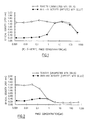
- FIG. 1 illustrates the relative effects between cellular toxicity of uninfected and anti-HIV activity of infected MT4 cells by increasing concentrations of (R)-2'-methyl-PMEG (Compound I).
- FIG. 2 illustrates the relative effects between cellular toxicity of uninfected and anti-HIV activity of infected MT4 cells by increasing concentrations of PMEG.
- FIG. 3 illustrates the relative effects between cellular toxicity of uninfected and anti-HIV activity of infected CEM-SS cells by increasing concentrations of (R)-2'-methyl-PMEG (Compound I).
- FIG. 4 illustrates the relative effects between cellular toxicity of uninfected and anti-HIV activity of infected CEM-SS cells by increasing concentrations of PMEG.
- FIG. 5 illustrates the relative effects between cellular toxicity of uninfected and anti-HIV activity of infected CEM-SS cells by increasing concentrations of (S)-2'-methyl-PMEG (Compound II).
- FIG. 6 illustrates the relative effects between cellular toxicity of uninfected and anti-HIV activity of infected CEM-SS cells by increasing concentrations of (R)-HPMPG.
- FIG. 7 illustrates the relative effects between cellular toxicity of uninfected and anti-HIV activity of infected CEM-SS cells by increasing concentrations of (S)-HPMPG.
- the present invention relates to the stereospecific synthesis of the (R) chiral isomer of compounds of Formulas I and II, respectively, and to pharmaceutically acceptable salts thereof.
- the compounds of the present invention also exhibit antiviral activity without observable cytotoxicity and, thus, can advantageously be used in the treatment of viral infections.
- these compounds are effective against human immunodeficiency virus (HIV).
- HIV human immunodeficiency virus
- the chiral (R)-isomer of Formula I surprisingly, exhibits complete cell protection against HIV over a broad concentration range with no observable cytotoxicity.
- the present invention also pertains to the pharmaceutically acceptable non-toxic salts of the compounds of Formula I.
- physiologically acceptable salts may include those derived by combination of appropriate cations such as alkali and alkaline earth metal ions or ammonium and quaternary amino ions with the acid anion moiety of the phosphonic acid group.
- salts may be formed from acid addition of certain organic and inorganic acids with basic centers of the purine, specifically guanine, base.
- the compounds of the present invention can exist in various tautomeric forms, in their unionized as well as zwitterionic form and/or in the form of solvates.
- the compounds of Formulas I and II can be prepared by a sterospecific synthesis following the general procedures illustrated in Reaction Schemes 1 and 2, respectively.
- the procedures for the preparation of compounds of Formulas I and II are similar, except for the use of opposite enantiomeric (chiral) starting materials of Formulas IIIa and IIIb.
- the preparation of the chiral (R)-isomer of Formula I is illustrated in Reaction Scheme 1 starting with the completely protected phosphonate ester of Formula IIIa which is prepared from chiral (S)-2,3- 0 -isopropylidene glycerol following the procedure described by J. J. Bronson, et al. , in J. Med. Chem.
- the mesylate is converted to the iodo compound of Formula IVa with sodium iodide in an inert organic solvent such as acetonitrile, acetone, and the like at the reflux temperature of the solvent.
- the desired methyl substituent of the compound of Formula Va having the desired stereochemical configuration is advantageously produced from the iodo compound of Formula IVa by catalytic hydrogenation using, for example, palladium on carbon.
- the benzyl protecting group of the compound of Formula Va is then selectively removed by catalytic hydrogenolysis using palladium hydroxide on carbon in an organic medium containing cyclohexene.
- the resulting primary alcohol of Formula VIa is then converted to an organic leaving group such as halide, tosylate, mesylate, and triflate in the presence of an organic base.
- the reaction is carried out with methylsulfonyl chloride and triethylamine to give the mesylate of Formula VIIa.
- the alkylation of 2-amino-6-chloropurine is carried out in a coupling reaction with the mesylate of Formula VIIa in an inert organic solvent such as acetonitrile, dimethylformamide, and the like in the presence of an excess of inorganic bases such as cesium carbonate or sodium hydride.
- the completely protected phosphonate ester of Formula VIIIa is first treated with bromotrimethylsilane and then the intermediate is hydrolyzed in an acidic medium, for example, 2N hydrochloric acid, to produce the optically active (R)-isomer of Formula I.
- optically active (S)-isomer of Formula II is prepared from the phosphonate ester of Formula IIIb as shown in Reaction Scheme 2 following the same general procedures and reaction sequences as illustrated in Reaction Scheme 1 for the preparation of the (R)-isomer of Formula I.
- the chiral intermediate of Formula VIa may be prepared starting with (S)-1,2-propanediol of Formula IX, as illustrated in Reaction Scheme 3.
- the primary alcohol of the compound of Formula IX can selectively be protected with p-anisylchlorodiphenylmethane (MMt-Cl) in the presence of dimethylaminopyridine and triethylamine to produce the compound of Formula X.
- the secondary alcohol of Formula X is then alkylated with diisopropyl tosyloxymethanephosphonate to give the intermediate of Formula XI which is then hydrolyzed with acid to produce the chiral intermediate of Formula VIa.
- the intermediate of Formula IIIa is treated with 6- O -benzylguanine in the presence of an inorganic base such as cesium carbonate in an inert organic solvent to produce the coupled alkylated product of Formula XIIa.
- an inorganic base such as cesium carbonate
- Subsequent removal of the benzyl protecting groups was carried out by catalytic hydrogenolysis using palladium hydroxide on carbon in the presence of cyclohexene to produce the intermediate of Formula XIIIa.
- the phosphonate ester of Formula XIIIa is treated with trimethylsilylbromide to produce the optically active (R)-HPMPG of Formula XIV.
- the compound of Formula XV [(S)-HPMPG] may be prepared from the compound of Formula IIIb, as illustrated in Reaction Scheme 5.
- the starting material of Formula IIIb is coupled with 6-0-benzylguanine to give the intermediate of Formula XIIb and then removal of the benzyl groups followed by hydrolysis of the phosphonate ester of Formula XIIIb, similar to the procedures used in Reaction Scheme 4, to produce the optically active (S)-HPMPG of Formula XV.
- Pharmaceutically acceptable salts of a Formula I or II compound of this invention are prepared by methods known in the art.
- the salts include ammonium salts and salts of physiologically acceptable metals, particularly Li+, K+, Na+, Ca++, and Mg++, and comprise a further aspect of the invention.
- Metal salts can be prepared by reacting the ,metal hydroxide with a Formula I or II compound of this invention. Examples of metal salts which can be prepared in this way are salts containing Li+, Na+, and K+. A less soluble metal salt can be precipitated from the solution of a more soluble salt by addition of the suitable metal compound.
- Acid salts may be prepared by reacting a Formula I or II compound of the invention with an inorganic or organic acid, e.g., HCl, HBr, H2SO4, organic sulfonic acids, and the like.
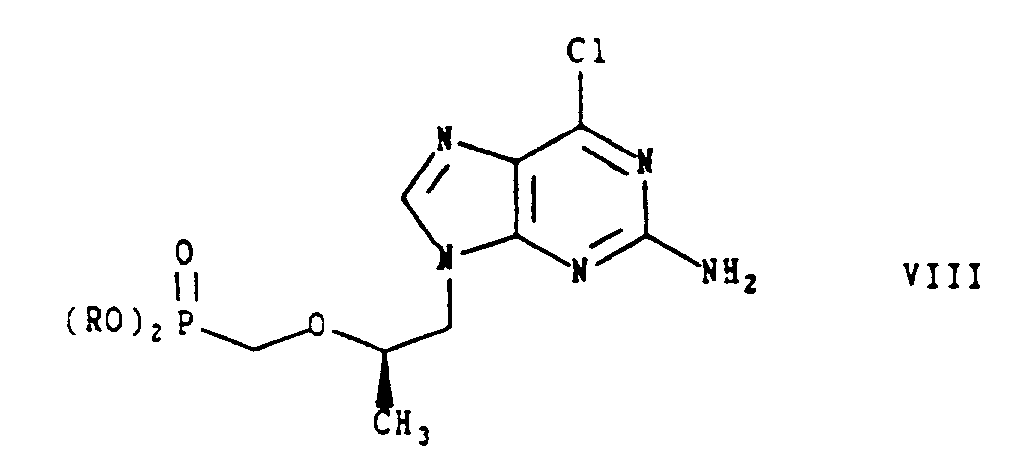
- the present invention includes a process for preparing (R)-9-[2-(phosphonomethoxy)propyl]guanine or a pharmaceutically acceptable salt or solvate thereof which comprises hydrolysing a compound of formula VIII in which R is a phosphonate protecting group; and, if desired, salifying the product obtained.
- the compounds of the instant invention and a representative number of known compounds are presented in Tables I and II and FIGS. 1-7, along with their relative cytotoxicities.
- the compounds were evaluated for antiviral activity in vitro by the standard plaque reduction assay.
- vero cells African Green Monkey Kidney cells
- herpes simplex virus Type 1 HSV-1
- HSV-2 herpes simplex virus Type 2
- MRC-5 cells human embryonic lung (diploid) cells
- HCMV human cytomegalovirus
- LAV BRU strain obtained from Luc Montagnier, Institut Pasteur, Paris, France
- CEM-SS cells P. L. Nara et al. , in AIDS Res. Human. Retroviruses , 1987, 3 , 283-302
- MT-4 cells S. Harada, et al. , in Science , 1985, 229 , 563-566
- O. S. Weislow et al. in J. Natl. Cancer Instit. , 1989, 81 , 577-586.
- CEM-SS cells were obtained from Owen Weislow at the National Cancer Institute, and MT-4 cells were obtained from Doug Richman at the University of California at San Diego. Cells were exposed to HIV and cultured in microtiter plates in the presence of test compounds at concentrations of 0.0013, 0.0064, 0.032, 0.16, 0.8, 4, 20, 100, and 500 »M. On day 7 post-infection, the antiviral effect was measured using the XTT assay in which an optical density (OD) reading is obtained at each drug concentration. The optical density reading is proportional to the number of viable cells. Plots of drug concentration versus optical density readings are shown in FIGS. 1-7.
- Assays run in infected cells show the antiviral effect of the test compounds, where an increase in the number of viable cells (higher OD reading) reflects the protective, antiviral activity of the compound. Assays run in uninfected cells provide a measure of cellular toxicity.
- the antiviral effect is also expressed (see Table 2) as the concentration of compound which increases the number of viable cells in infected cultures to 50%, that of the untreated, uninfected control cultures (ED50).
- the cellular toxicity is expressed as the concentration of compound which reduces the number of viable cells to 50%, that of the untreated control (TD50).
- the selectivity index (SI) is the ratio of TD50 to ED50.
- FIGS. 1-7 The anti-HIV activity and cellular toxicity of the test compounds are plotted in FIGS. 1-7 as a function of optical density verus increasing log concentrations of the test compounds (XTT assay).
- FIGS. 1-7 visually show the results of the relative anti-HIV activity of the test compounds on infected cells ( ⁇ - ⁇ ) against the cellular toxicity of the same test compound on uninfected cells ( ⁇ - ⁇ ).
- the anti-HIV activity of the (R)-isomer (R)-2'-methyl-PMEG of the instant invention is shown in FIG. 1 (MT4 cells) and FIG. 3 (CEM-SS cells) while the (S)-isomer (S)-2'-methyl-PMEG is shown in FIG. 5 (CEM-SS cells).
- the anti-HIV activity of the comparison compound PMEG is shown in FIG. 2 (MT4 cells) and FIG. 4 (CEM-SS cells) while the results of the anti-HIV assay of the (R)-and (S)-HPMPG are shown in FIGS. 6 and 7 (CEM-SS cells), respectively.
- FIGS. 1 and 3 show that, over a concentration range of 5 to 100 »M, (R)-2'-methyl-PMEG provides complete protection from the human immunodeficiency virus in both MT4 and CEM-SS cell lines with no observed cellular toxicity at concentrations less than 100 »M.
- Fig. 5 shows that (S)-2'-methyl-PMEG provides complete protection from HIV in CEM-SS cells at 100 »M with no observed cellular toxicity at concentrations less than 100 »M.
- PMEG is highly toxic to MT4 cells at concentrations above 0.1 »M, and no anti-HIV effect can be measured due to the cellular toxicity of PMEG.
- selectivity index an in vitro "therapeutic index”
- SI selectivity index
- Table 2 The data in Table 2 clearly shows that (R)-2'-methyl-PMEG is both a potent and selective anti-HIV agent as compared to the other compounds having a selectivity index greater than 500.
- the invention accordingly, provides compounds of Formulas I and II and their pharmaceutically acceptable salts and solvates thereof and, preferably, the compound of Formula I which is substantially free of the (S)-isomer and its pharmaceutically acceptable salts and solvates thereof for use in the therapy or prophylaxis of viral infections, especially human immunodeficiency virus, in a human subject.
- the compounds of this invention including the pharmaceutically acceptable salts and solvates thereof, have desirable antiviral activity. They exhibit activity against DNA viruses and retroviruses. In particular, the compound of Formula I exerts a significant anti-HIV effect with no observed cytotoxicity.
- the compounds of this invention may be formulated into pharmaceutical preparations in any convenient way, and the invention, therefore, also includes, within its scope, pharmaceutical compositions comprising a compound of Formula I or a pharmaceutically acceptable salt or solvate thereof adapted for use in human medicine.
- Such compositions may be presented for use in conventional manner in admixture with one or more pharmaceutically acceptable carriers or excipients.
- the reference Remington's Pharmaceutical Sciences , 15th Edition , by E. W. Martin discloses typical carriers and methods of preparation.
- the compounds may be administered topically or systemically.
- systemic administration is intended oral, rectal, and parenteral (i.e., intramuscular, intravenous, subcutaneous, and nasal) routes.
- parenteral i.e., intramuscular, intravenous, subcutaneous, and nasal
- compositions comprised of an effective antiviral amount of a compound of Formula I or a pharmaceutically acceptable salt thereof and a pharmaceutically acceptable carrier, as stated hereinabove.
- Pharmaceutical compositions for effecting such treatment will contain a major or minor amount, e.g., from 95% to 0.5% of at least one compound of the present invention in combination with a pharmaceutical carrier, the carrier comprising one or more solid, semi-solid, or liquid diluents, fillers, and formulation adjuvants which are non-toxic, inert, and pharmaceutically acceptable.
- compositions are preferable in dosage unit form; i.e., physically discreet units containing a predetermined amount of the drug corresponding to a fraction or multiple of the dose which is calculated to produce the desired therapeutic response.
- Other therapeutic agents can also be present.
- Pharmaceutical compositions providing from about 0.1 to 500 mg of the active ingredient per unit dose are preferred and are conventionally prepared as tablets, lozenges, capsules, powders, aqueous or oily suspensions, syrups, elixirs, and aqueous solutions.
- Preferred oral compositions are in the form of tablets or capsules and may contain conventional excipients such as binding agents (e.g., syrup, acacia, gelatin, sorbitol, tragacanth, or polyvinylpyrrolidone), fillers (e.g., lactose, sugar, maize-starch, calcium phosphate, sorbitol, or glycine), lubricants (e.g., magnesium stearate, talc, polyethylene glycol, or silica), disintegrants (e.g., starch), and wetting agents (e.g., sodium lauryl sulfate).
- binding agents e.g., syrup, acacia, gelatin, sorbitol, tragacanth, or polyvinylpyrrolidone
- fillers e.g., lactose, sugar, maize-starch, calcium phosphate, sorbitol, or glycine
- lubricants e
- compositions such as an aqueous solution for intravenous injection or an oily suspension for intramuscular injection.
- parenteral compositions having the desired clarity, stability, and adaptability for parenteral use are obtained by dissolving from 0.1% to 10% by weight of the active compound in water or a vehicle consisting of a polyhydric aliphatic alcohol, such as glycerine, propylene glycol, and polyethylene glycol or mixtures thereof.
- the polyethylene glycols consist of a mixture of non-volatile, usually liquid, polyethylene glycols which are soluble in both water and organic liquids and have molecular weights from about 200 to 1500.
- Another aspect of the instant invention concerns a method for treating HIV infections in mammals, including humans, in need of such treatment which comprises systemic or topical administration to such mammal of an effective dose of a Formula I compound or a pharmaceutically acceptable salt or solvate thereof.
- a further aspect of the instant invention concerns a method for treating human cells infected with HIV infections which comprises systemic or topical administration to such cells of an effective dose of a Formula I compound or a pharmaceutically acceptable salt or solvate thereof.
- an effective dose could be expected to be from about 0.001 to about 30 mg/kg body weight.
- a daily oral dose will comprise from about 0.1 to about 750 mg, preferably 10-500 mg of a Formula I compound administered from 1 to 3 times a day. In some instances, a sufficient therapeutic effect can be obtained at lower doses while larger doses will be required in others.
- a compound of Formula I may be administered on a weekly schedule, such as once or twice per week; the dosage to be used in such a regimen may be adjusted with due consideration of factors listed above and to maintain serum drug level at an anti-HIV effective level.
- IR Infrared
- IR Infrared
- IR Infrared
- spectra were determined on a Perkin-Elmer 1800 FT-IR spectrometer from 4000 cm ⁇ 1 to 400 cm ⁇ 1, calibrated to 1601 cm ⁇ 1 absorption of a polystyrene film, and are reported in reciprocal centimeters (cm ⁇ 1).
- Optical rotations [ ⁇ ] 20 D were determined on a Perkin-Elmer 41 polarimeter in the solvents indicated.
- Ultraviolet spectra were determined on a Hewlett Packard 8452 diode array spectrophotometer in the solvent and concentration indicated.
- Mass spectra were recorded on a Kratos MS-50 or a Finnegan 4500 instrument utilizing the fast atom bombardment (FAB) or direct chemical ionization (DCI) technique. The mass data are expressed in the format: protonated parent ion (MH+).
- Analytical thin-layer chromatography was carried out on precoated silica gel plates (60F-254) and visualized using UV light, iodine vapors, and/or staining with one of the following reagents: (a) methanolic phosphomolybdic acid (2%) and heating; (b) reagent (a) followed by 2% cobalt sulphate in 5M H2SO4 and heating.
- Column chromatography also referred to as flash column chromatography, was performed in a glass column using finely divided silica gel (32-63 »m on silica gel-H) and pressures somewhat above atmospheric pressure with the indicated solvents.
- Reversed phase analytical thin-layer chromatography was carried out on Analtech precoated reversed phase F (250 »m) plates and visualized using UV light or iodine vapors. Reversed phase column chromatography was performed in a glass column using Baker Octadecyl (C18), 40 »m.
- Celite is a registered trademark of the Johns-Manville Products Corporation for diatomaceous earth.
- hexanes is a mixture of isomeric C6 hydrocarbons as specified by the American Chemical Society, and the term "inert" atmosphere is an argon or nitrogen atmosphere unless otherwise indicated.
- Methanesulfonyl chloride (3.27 g, 28.5 mmol) was added in 1 portion to an ice-cold solution of ( S )-2- O -[(diisopropylphosphono)methyl]-1,2-propanediol (used crude from Example 10, 23.8 mmol) in methylene chloride (100 mL).
- Triethylamine (3.61 g, 35.7 mmol) was added dropwise via syringe over 5 minutes. The resulting pale-yellow slurry was allowed to warm to room temperature and stirred further for 14 hours.
- the title compound can be prepared from ( R )-lactic acid using a procedure similar to that of C. Melchiorre ( Chem. Ind. , 1976, 218). [ ⁇ ] 20 D : -17.3° (neat).
- the resulting reaction mixture was cooled to 0°C, and a solution of tosyloxymethyl diisopropylphosphonate (280 g, 0.80 mol) in 300 mL of anhydrous tetrahydrofuran was added via a cannula. The mixture was stirred in ice-bath and slowly warmed to room temperature overnight (18 hours). The resulting brown slurry was filtered through a pad of Celite and washed with methylene chloride.
Landscapes
- Chemical & Material Sciences (AREA)
- Organic Chemistry (AREA)
- Health & Medical Sciences (AREA)
- Life Sciences & Earth Sciences (AREA)
- General Health & Medical Sciences (AREA)
- Molecular Biology (AREA)
- Biochemistry (AREA)
- Chemical Kinetics & Catalysis (AREA)
- Public Health (AREA)
- General Chemical & Material Sciences (AREA)
- Nuclear Medicine, Radiotherapy & Molecular Imaging (AREA)
- Virology (AREA)
- Animal Behavior & Ethology (AREA)
- Pharmacology & Pharmacy (AREA)
- Medicinal Chemistry (AREA)
- Veterinary Medicine (AREA)
- Oncology (AREA)
- Communicable Diseases (AREA)
- Pharmaceuticals Containing Other Organic And Inorganic Compounds (AREA)
- Medicines That Contain Protein Lipid Enzymes And Other Medicines (AREA)
- Saccharide Compounds (AREA)
Claims (4)
- Chirale Verbindung, die im wesentlichen frei an (S)-Isomer ist und bei der es sich um (R)-9-[2-(Phosphonomethoxy)propyl]guanin oder ein pharmazeutisch akzeptables Salz oder Solvat davon handelt.
- Pharmazeutische Formulierung, die als Wirkstoff eine therapeutisch anti-HIV-wirksame Menge an (R)-9-[2-(Phosphonomethoxy)propyl]guanin oder einem pharmazeutisch akzeptablen Salz oder Solvat davon nach Anspruch 1 in Kombination mit einem oder mehreren pharmazeutisch akzeptablen Trägern, Exzipienten oder Verdünnungsmitteln enthält.
- (R)-9-[2-Phosphonomethoxy)propyl]guanin, wie in Anspruch 1 oder 2 definiert, zur Anwendung bei der Behandlung oder Prävention einer Human-Immundefizienz-Virus-(HIV)-Infektion.
- Verfahren zur Herstellung von (R)-9-[2-Phosphonomethoxy)propyl]guanin oder eines pharmazeutisch akzeptablen Salzes oder Solvates davon, wobei man eine Verbindung der Formel VIII
Applications Claiming Priority (4)
| Application Number | Priority Date | Filing Date | Title |
|---|---|---|---|
| US51330790A | 1990-04-20 | 1990-04-20 | |
| US51169090A | 1990-04-20 | 1990-04-20 | |
| US513307 | 1990-04-20 | ||
| US511690 | 1990-04-20 |
Publications (2)
| Publication Number | Publication Date |
|---|---|
| EP0452935A1 EP0452935A1 (de) | 1991-10-23 |
| EP0452935B1 true EP0452935B1 (de) | 1995-06-21 |
Family
ID=27057310
Family Applications (1)
| Application Number | Title | Priority Date | Filing Date |
|---|---|---|---|
| EP91106239A Expired - Lifetime EP0452935B1 (de) | 1990-04-20 | 1991-04-18 | Chirale 2-(Phosphonomethoxy)propyl-Guanine als antivirale Agentien |
Country Status (10)
| Country | Link |
|---|---|
| EP (1) | EP0452935B1 (de) |
| JP (1) | JP3172801B2 (de) |
| KR (1) | KR100188554B1 (de) |
| AT (1) | ATE124050T1 (de) |
| AU (1) | AU643987B2 (de) |
| CA (1) | CA2040854C (de) |
| DE (1) | DE69110528T2 (de) |
| FI (1) | FI911875L (de) |
| IE (1) | IE68415B1 (de) |
| PT (1) | PT97407B (de) |
Cited By (1)
| Publication number | Priority date | Publication date | Assignee | Title |
|---|---|---|---|---|
| US9593137B2 (en) | 2011-12-22 | 2017-03-14 | Geron Corporation | Guanine analogs as telomerase substrates and telomere length affectors |
Families Citing this family (9)
| Publication number | Priority date | Publication date | Assignee | Title |
|---|---|---|---|---|
| US5356886A (en) * | 1990-07-19 | 1994-10-18 | Beecham Group P.L.C. | Antiviral phosphono-alken derivatives of purines |
| AU2641192A (en) * | 1991-09-24 | 1993-04-27 | Wellcome Foundation Limited, The | Therapeutic nucleosides |
| US6057305A (en) * | 1992-08-05 | 2000-05-02 | Institute Of Organic Chemistry And Biochemistry Of The Academy Of Sciences Of The Czech Republic | Antiretroviral enantiomeric nucleotide analogs |
| GB9226879D0 (en) * | 1992-12-23 | 1993-02-17 | Iaf Biochem Int | Anti-viral compounds |
| US6444656B1 (en) | 1992-12-23 | 2002-09-03 | Biochem Pharma, Inc. | Antiviral phosphonate nucleotides |
| US6005107A (en) * | 1992-12-23 | 1999-12-21 | Biochem Pharma, Inc. | Antiviral compounds |
| US5877166A (en) * | 1996-04-29 | 1999-03-02 | Sri International | Enantiomerically pure 2-aminopurine phosphonate nucleotide analogs as antiviral agents |
| CZ304734B6 (cs) * | 2000-07-21 | 2014-09-10 | Gilead Sciences, Inc. | Způsob přípravy 9-[2-(fosfonomethoxy)propyl]adeninu a 9-[2-(fosfonomethoxy)ethyl]adeninu |
| KR200488845Y1 (ko) * | 2019-03-12 | 2019-07-31 | 임병철 | 엔진 구동 교육 장치 |
Family Cites Families (2)
| Publication number | Priority date | Publication date | Assignee | Title |
|---|---|---|---|---|
| CS264222B1 (en) * | 1986-07-18 | 1989-06-13 | Holy Antonin | N-phosphonylmethoxyalkylderivatives of bases of pytimidine and purine and method of use them |
| IL84477A (en) * | 1986-11-18 | 1995-12-08 | Bristol Myers Squibb Co | History of Phosphonomethoxyalkylene Purinopyrimidine and Pharmaceutical Preparations Containing Them |
-
1991
- 1991-04-18 EP EP91106239A patent/EP0452935B1/de not_active Expired - Lifetime
- 1991-04-18 FI FI911875A patent/FI911875L/fi not_active Application Discontinuation
- 1991-04-18 AT AT91106239T patent/ATE124050T1/de not_active IP Right Cessation
- 1991-04-18 PT PT97407A patent/PT97407B/pt not_active IP Right Cessation
- 1991-04-18 DE DE69110528T patent/DE69110528T2/de not_active Expired - Lifetime
- 1991-04-19 AU AU75171/91A patent/AU643987B2/en not_active Expired
- 1991-04-19 KR KR1019910006290A patent/KR100188554B1/ko not_active Expired - Lifetime
- 1991-04-19 JP JP17907591A patent/JP3172801B2/ja not_active Expired - Lifetime
- 1991-04-19 CA CA002040854A patent/CA2040854C/en not_active Expired - Lifetime
- 1991-04-19 IE IE132191A patent/IE68415B1/en not_active IP Right Cessation
Cited By (2)
| Publication number | Priority date | Publication date | Assignee | Title |
|---|---|---|---|---|
| US9593137B2 (en) | 2011-12-22 | 2017-03-14 | Geron Corporation | Guanine analogs as telomerase substrates and telomere length affectors |
| US10035814B2 (en) | 2011-12-22 | 2018-07-31 | Geron Corporation | Guanine analogs as telomerase substrates and telomere length affectors |
Also Published As
| Publication number | Publication date |
|---|---|
| DE69110528D1 (de) | 1995-07-27 |
| KR910018393A (ko) | 1991-11-30 |
| FI911875A7 (fi) | 1991-10-21 |
| JP3172801B2 (ja) | 2001-06-04 |
| JPH0539297A (ja) | 1993-02-19 |
| AU643987B2 (en) | 1993-12-02 |
| CA2040854C (en) | 2000-11-21 |
| FI911875A0 (fi) | 1991-04-18 |
| KR100188554B1 (ko) | 1999-06-01 |
| AU7517191A (en) | 1991-10-24 |
| DE69110528T2 (de) | 1996-03-14 |
| ATE124050T1 (de) | 1995-07-15 |
| IE68415B1 (en) | 1996-06-12 |
| PT97407A (pt) | 1992-01-31 |
| EP0452935A1 (de) | 1991-10-23 |
| FI911875L (fi) | 1991-10-21 |
| PT97407B (pt) | 1998-08-31 |
| IE911321A1 (en) | 1991-10-23 |
| CA2040854A1 (en) | 1991-10-21 |
Similar Documents
| Publication | Publication Date | Title |
|---|---|---|
| US5302585A (en) | Use of chiral 2-(phosphonomethoxy)propyl guanines as antiviral agents | |
| KR950009195B1 (ko) | 항 비루스성 포스포노메톡시알킬렌 푸린 및 피리미딘 유도체 | |
| US5792756A (en) | Prodrugs of phosphonates | |
| CA2297294C (en) | Phosphonomethoxymethylpurine/pyrimidine derivatives | |
| US5386030A (en) | Antiviral (phosphonomethoxy)methoxy purine/pyrimidine derivatives | |
| US5688778A (en) | Nucleoside analogs | |
| AU661347B2 (en) | Antiviral acyclic phosphonomethoxyalkyl substituted, alkenyl and alkynyl purine and pyrimidine derivatives | |
| FI113539B (fi) | Menetelmä terapeuttisesti käyttökelpoisten puriinien ja pyrimidiinien tyydyttymättömien fosfonaattijohdannaisten valmistamiseksi | |
| EP0452935B1 (de) | Chirale 2-(Phosphonomethoxy)propyl-Guanine als antivirale Agentien | |
| IE912503A1 (en) | Pharmaceuticals | |
| AU617724B2 (en) | 9-(2-(Phosphonomethoxy)Ethoxy) Purine derivatives, intermediates and use as pharmaceuticals | |
| EP0399743A1 (de) | Phosphonomethylthio-alkoxypurin Derivate, Zwischenprodukte für deren Herstellung und pharmazeutische Zusammensetzungen, die sie enthalten | |
| US5166198A (en) | Antiviral phosphonylalkoxy purines |
Legal Events
| Date | Code | Title | Description |
|---|---|---|---|
| PUAI | Public reference made under article 153(3) epc to a published international application that has entered the european phase |
Free format text: ORIGINAL CODE: 0009012 |
|
| AK | Designated contracting states |
Kind code of ref document: A1 Designated state(s): AT BE CH DE DK ES FR GB GR IT LI LU NL SE |
|
| 17P | Request for examination filed |
Effective date: 19920402 |
|
| RAP1 | Party data changed (applicant data changed or rights of an application transferred) |
Owner name: REGA STICHTING VZW. Owner name: INSTITUTE OF ORGANIC CHEMISTRY ACADEMY OF SCIENCES |
|
| 17Q | First examination report despatched |
Effective date: 19940921 |
|
| RAP1 | Party data changed (applicant data changed or rights of an application transferred) |
Owner name: INSTITUTE OF ORGANIC CHEMISTRY AND BIOCHEMISTRY OF Owner name: REGA STICHTING VZW. |
|
| GRAA | (expected) grant |
Free format text: ORIGINAL CODE: 0009210 |
|
| RBV | Designated contracting states (corrected) |
Designated state(s): AT BE CH DE DK FR GB IT LI LU NL SE |
|
| AK | Designated contracting states |
Kind code of ref document: B1 Designated state(s): AT BE CH DE DK FR GB IT LI LU NL SE |
|
| PG25 | Lapsed in a contracting state [announced via postgrant information from national office to epo] |
Ref country code: IT Free format text: LAPSE BECAUSE OF FAILURE TO SUBMIT A TRANSLATION OF THE DESCRIPTION OR TO PAY THE FEE WITHIN THE PRESCRIBED TIME-LIMIT;WARNING: LAPSES OF ITALIAN PATENTS WITH EFFECTIVE DATE BEFORE 2007 MAY HAVE OCCURRED AT ANY TIME BEFORE 2007. THE CORRECT EFFECTIVE DATE MAY BE DIFFERENT FROM THE ONE RECORDED. Effective date: 19950621 Ref country code: NL Free format text: LAPSE BECAUSE OF FAILURE TO SUBMIT A TRANSLATION OF THE DESCRIPTION OR TO PAY THE FEE WITHIN THE PRESCRIBED TIME-LIMIT Effective date: 19950621 Ref country code: AT Effective date: 19950621 Ref country code: CH Effective date: 19950621 Ref country code: BE Effective date: 19950621 Ref country code: DK Effective date: 19950621 Ref country code: LI Effective date: 19950621 |
|
| REF | Corresponds to: |
Ref document number: 124050 Country of ref document: AT Date of ref document: 19950715 Kind code of ref document: T |
|
| REF | Corresponds to: |
Ref document number: 69110528 Country of ref document: DE Date of ref document: 19950727 |
|
| REG | Reference to a national code |
Ref country code: CH Ref legal event code: PLI Owner name: GILEAD SCIENCES, INC. |
|
| 111L | Licence recorded |
Free format text: 0100 GILEAD SCIENCES, INC. |
|
| PG25 | Lapsed in a contracting state [announced via postgrant information from national office to epo] |
Ref country code: SE Effective date: 19950921 |
|
| REG | Reference to a national code |
Ref country code: CH Ref legal event code: PL |
|
| ET | Fr: translation filed | ||
| NLV1 | Nl: lapsed or annulled due to failure to fulfill the requirements of art. 29p and 29m of the patents act | ||
| PLBE | No opposition filed within time limit |
Free format text: ORIGINAL CODE: 0009261 |
|
| STAA | Information on the status of an ep patent application or granted ep patent |
Free format text: STATUS: NO OPPOSITION FILED WITHIN TIME LIMIT |
|
| PG25 | Lapsed in a contracting state [announced via postgrant information from national office to epo] |
Ref country code: LU Free format text: LAPSE BECAUSE OF NON-PAYMENT OF DUE FEES Effective date: 19960430 |
|
| 26N | No opposition filed | ||
| REG | Reference to a national code |
Ref country code: GB Ref legal event code: IF02 |
|
| PGFP | Annual fee paid to national office [announced via postgrant information from national office to epo] |
Ref country code: FR Payment date: 20100506 Year of fee payment: 20 |
|
| PGFP | Annual fee paid to national office [announced via postgrant information from national office to epo] |
Ref country code: DE Payment date: 20100428 Year of fee payment: 20 |
|
| PGFP | Annual fee paid to national office [announced via postgrant information from national office to epo] |
Ref country code: GB Payment date: 20100426 Year of fee payment: 20 |
|
| REG | Reference to a national code |
Ref country code: DE Ref legal event code: R071 Ref document number: 69110528 Country of ref document: DE |
|
| REG | Reference to a national code |
Ref country code: GB Ref legal event code: PE20 Expiry date: 20110417 |
|
| PG25 | Lapsed in a contracting state [announced via postgrant information from national office to epo] |
Ref country code: GB Free format text: LAPSE BECAUSE OF EXPIRATION OF PROTECTION Effective date: 20110417 |
|
| PG25 | Lapsed in a contracting state [announced via postgrant information from national office to epo] |
Ref country code: DE Free format text: LAPSE BECAUSE OF EXPIRATION OF PROTECTION Effective date: 20110418 |