EP0452595B1 - Flüssigkristallkatheter und Herstellungsverfahren dafür - Google Patents
Flüssigkristallkatheter und Herstellungsverfahren dafür Download PDFInfo
- Publication number
- EP0452595B1 EP0452595B1 EP90314428A EP90314428A EP0452595B1 EP 0452595 B1 EP0452595 B1 EP 0452595B1 EP 90314428 A EP90314428 A EP 90314428A EP 90314428 A EP90314428 A EP 90314428A EP 0452595 B1 EP0452595 B1 EP 0452595B1
- Authority
- EP
- European Patent Office
- Prior art keywords
- tubing
- liquid crystalline
- melt
- point
- crystalline polymer
- Prior art date
- Legal status (The legal status is an assumption and is not a legal conclusion. Google has not performed a legal analysis and makes no representation as to the accuracy of the status listed.)
- Expired - Lifetime
Links
- 238000000034 method Methods 0.000 title claims abstract description 21
- 239000007788 liquid Substances 0.000 title claims description 23
- 229920000106 Liquid crystal polymer Polymers 0.000 claims abstract description 39
- -1 polyxylylene Polymers 0.000 claims abstract description 22
- 229920000728 polyester Polymers 0.000 claims abstract description 9
- 229920001296 polysiloxane Polymers 0.000 claims abstract description 5
- 239000004952 Polyamide Substances 0.000 claims abstract description 4
- 229920002627 poly(phosphazenes) Polymers 0.000 claims abstract description 4
- 229920002492 poly(sulfone) Polymers 0.000 claims abstract description 4
- 229920002647 polyamide Polymers 0.000 claims abstract description 4
- 229920000570 polyether Polymers 0.000 claims abstract description 4
- 239000004721 Polyphenylene oxide Substances 0.000 claims abstract description 3
- 229920000642 polymer Polymers 0.000 claims description 27
- 239000000155 melt Substances 0.000 claims description 26
- LYCAIKOWRPUZTN-UHFFFAOYSA-N Ethylene glycol Chemical compound OCCO LYCAIKOWRPUZTN-UHFFFAOYSA-N 0.000 claims description 7
- 125000003118 aryl group Chemical group 0.000 claims description 6
- 125000000217 alkyl group Chemical group 0.000 claims description 5
- 238000001816 cooling Methods 0.000 claims description 5
- 239000004033 plastic Substances 0.000 claims description 5
- 229920003023 plastic Polymers 0.000 claims description 5
- 125000005740 oxycarbonyl group Chemical group [*:1]OC([*:2])=O 0.000 claims description 4
- 229920001577 copolymer Polymers 0.000 claims description 3
- 238000010438 heat treatment Methods 0.000 claims description 3
- 229920001169 thermoplastic Polymers 0.000 claims description 3
- NINIDFKCEFEMDL-UHFFFAOYSA-N Sulfur Chemical group [S] NINIDFKCEFEMDL-UHFFFAOYSA-N 0.000 claims description 2
- 125000003545 alkoxy group Chemical group 0.000 claims description 2
- 125000004453 alkoxycarbonyl group Chemical group 0.000 claims description 2
- 125000004448 alkyl carbonyl group Chemical group 0.000 claims description 2
- 125000005196 alkyl carbonyloxy group Chemical group 0.000 claims description 2
- QVGXLLKOCUKJST-UHFFFAOYSA-N atomic oxygen Chemical compound [O] QVGXLLKOCUKJST-UHFFFAOYSA-N 0.000 claims description 2
- 125000004432 carbon atom Chemical group C* 0.000 claims description 2
- 125000002915 carbonyl group Chemical group [*:2]C([*:1])=O 0.000 claims description 2
- 125000003178 carboxy group Chemical group [H]OC(*)=O 0.000 claims description 2
- 125000000623 heterocyclic group Chemical group 0.000 claims description 2
- 229910052760 oxygen Inorganic materials 0.000 claims description 2
- 239000001301 oxygen Substances 0.000 claims description 2
- 150000003457 sulfones Chemical class 0.000 claims description 2
- 239000004416 thermosoftening plastic Substances 0.000 claims description 2
- OFOBLEOULBTSOW-UHFFFAOYSA-N Malonic acid Chemical compound OC(=O)CC(O)=O OFOBLEOULBTSOW-UHFFFAOYSA-N 0.000 claims 2
- WGCNASOHLSPBMP-UHFFFAOYSA-N hydroxyacetaldehyde Natural products OCC=O WGCNASOHLSPBMP-UHFFFAOYSA-N 0.000 claims 2
- 239000007795 chemical reaction product Substances 0.000 claims 1
- 230000007423 decrease Effects 0.000 claims 1
- 125000004356 hydroxy functional group Chemical group O* 0.000 claims 1
- 238000000465 moulding Methods 0.000 description 9
- 238000003780 insertion Methods 0.000 description 7
- 230000037431 insertion Effects 0.000 description 7
- 239000000243 solution Substances 0.000 description 6
- 239000000126 substance Substances 0.000 description 5
- ZUOUZKKEUPVFJK-UHFFFAOYSA-N diphenyl Chemical group C1=CC=CC=C1C1=CC=CC=C1 ZUOUZKKEUPVFJK-UHFFFAOYSA-N 0.000 description 4
- QIGBRXMKCJKVMJ-UHFFFAOYSA-N Hydroquinone Chemical compound OC1=CC=C(O)C=C1 QIGBRXMKCJKVMJ-UHFFFAOYSA-N 0.000 description 3
- 230000008901 benefit Effects 0.000 description 3
- 238000001125 extrusion Methods 0.000 description 3
- 239000012530 fluid Substances 0.000 description 3
- 230000035515 penetration Effects 0.000 description 3
- 229910001220 stainless steel Inorganic materials 0.000 description 3
- 239000010935 stainless steel Substances 0.000 description 3
- 239000004743 Polypropylene Substances 0.000 description 2
- 239000004793 Polystyrene Substances 0.000 description 2
- KKEYFWRCBNTPAC-UHFFFAOYSA-N Terephthalic acid Chemical compound OC(=O)C1=CC=C(C(O)=O)C=C1 KKEYFWRCBNTPAC-UHFFFAOYSA-N 0.000 description 2
- 230000015572 biosynthetic process Effects 0.000 description 2
- 235000010290 biphenyl Nutrition 0.000 description 2
- 239000004305 biphenyl Substances 0.000 description 2
- 239000003795 chemical substances by application Substances 0.000 description 2
- 239000003814 drug Substances 0.000 description 2
- 230000000694 effects Effects 0.000 description 2
- 238000011049 filling Methods 0.000 description 2
- 238000001746 injection moulding Methods 0.000 description 2
- QQVIHTHCMHWDBS-UHFFFAOYSA-N isophthalic acid Chemical compound OC(=O)C1=CC=CC(C(O)=O)=C1 QQVIHTHCMHWDBS-UHFFFAOYSA-N 0.000 description 2
- 239000004973 liquid crystal related substance Substances 0.000 description 2
- 239000000314 lubricant Substances 0.000 description 2
- 238000002595 magnetic resonance imaging Methods 0.000 description 2
- 238000004519 manufacturing process Methods 0.000 description 2
- 239000000463 material Substances 0.000 description 2
- 238000002844 melting Methods 0.000 description 2
- 230000008018 melting Effects 0.000 description 2
- 239000000203 mixture Substances 0.000 description 2
- 230000008520 organization Effects 0.000 description 2
- BVJSUAQZOZWCKN-UHFFFAOYSA-N p-hydroxybenzyl alcohol Chemical compound OCC1=CC=C(O)C=C1 BVJSUAQZOZWCKN-UHFFFAOYSA-N 0.000 description 2
- 230000000704 physical effect Effects 0.000 description 2
- 229920000139 polyethylene terephthalate Polymers 0.000 description 2
- 239000005020 polyethylene terephthalate Substances 0.000 description 2
- 229920001155 polypropylene Polymers 0.000 description 2
- 229920002223 polystyrene Polymers 0.000 description 2
- 229920002635 polyurethane Polymers 0.000 description 2
- 239000004814 polyurethane Substances 0.000 description 2
- 230000008569 process Effects 0.000 description 2
- 239000007787 solid Substances 0.000 description 2
- 238000003786 synthesis reaction Methods 0.000 description 2
- 230000007704 transition Effects 0.000 description 2
- CJMKSYKFEDJPMM-UHFFFAOYSA-N 2-hydroxy-6-phenylbenzoic acid Chemical compound OC(=O)C1=C(O)C=CC=C1C1=CC=CC=C1 CJMKSYKFEDJPMM-UHFFFAOYSA-N 0.000 description 1
- UPHOPMSGKZNELG-UHFFFAOYSA-N 2-hydroxynaphthalene-1-carboxylic acid Chemical compound C1=CC=C2C(C(=O)O)=C(O)C=CC2=C1 UPHOPMSGKZNELG-UHFFFAOYSA-N 0.000 description 1
- HSSYVKMJJLDTKZ-UHFFFAOYSA-N 3-phenylphthalic acid Chemical compound OC(=O)C1=CC=CC(C=2C=CC=CC=2)=C1C(O)=O HSSYVKMJJLDTKZ-UHFFFAOYSA-N 0.000 description 1
- FJKROLUGYXJWQN-UHFFFAOYSA-N 4-hydroxybenzoic acid Chemical compound OC(=O)C1=CC=C(O)C=C1 FJKROLUGYXJWQN-UHFFFAOYSA-N 0.000 description 1
- 229920013683 Celanese Polymers 0.000 description 1
- 239000004698 Polyethylene Substances 0.000 description 1
- KDYFGRWQOYBRFD-UHFFFAOYSA-N Succinic acid Natural products OC(=O)CCC(O)=O KDYFGRWQOYBRFD-UHFFFAOYSA-N 0.000 description 1
- 239000002253 acid Substances 0.000 description 1
- 150000007513 acids Chemical class 0.000 description 1
- 238000004026 adhesive bonding Methods 0.000 description 1
- 210000001367 artery Anatomy 0.000 description 1
- 238000005452 bending Methods 0.000 description 1
- 238000001574 biopsy Methods 0.000 description 1
- VCCBEIPGXKNHFW-UHFFFAOYSA-N biphenyl-4,4'-diol Chemical group C1=CC(O)=CC=C1C1=CC=C(O)C=C1 VCCBEIPGXKNHFW-UHFFFAOYSA-N 0.000 description 1
- 229910000416 bismuth oxide Inorganic materials 0.000 description 1
- 239000008280 blood Substances 0.000 description 1
- 210000004369 blood Anatomy 0.000 description 1
- KDYFGRWQOYBRFD-NUQCWPJISA-N butanedioic acid Chemical compound O[14C](=O)CC[14C](O)=O KDYFGRWQOYBRFD-NUQCWPJISA-N 0.000 description 1
- 238000004891 communication Methods 0.000 description 1
- 238000007796 conventional method Methods 0.000 description 1
- 238000000354 decomposition reaction Methods 0.000 description 1
- 238000012631 diagnostic technique Methods 0.000 description 1
- TYIXMATWDRGMPF-UHFFFAOYSA-N dibismuth;oxygen(2-) Chemical compound [O-2].[O-2].[O-2].[Bi+3].[Bi+3] TYIXMATWDRGMPF-UHFFFAOYSA-N 0.000 description 1
- IMHDGJOMLMDPJN-UHFFFAOYSA-N dihydroxybiphenyl Natural products OC1=CC=CC=C1C1=CC=CC=C1O IMHDGJOMLMDPJN-UHFFFAOYSA-N 0.000 description 1
- 230000032050 esterification Effects 0.000 description 1
- 238000005886 esterification reaction Methods 0.000 description 1
- 238000009472 formulation Methods 0.000 description 1
- 239000003292 glue Substances 0.000 description 1
- 150000002334 glycols Chemical class 0.000 description 1
- 238000000227 grinding Methods 0.000 description 1
- 229910052736 halogen Inorganic materials 0.000 description 1
- 150000002367 halogens Chemical class 0.000 description 1
- 229920001519 homopolymer Polymers 0.000 description 1
- 125000002887 hydroxy group Chemical group [H]O* 0.000 description 1
- 238000002347 injection Methods 0.000 description 1
- 239000007924 injection Substances 0.000 description 1
- 125000001624 naphthyl group Chemical group 0.000 description 1
- 125000004957 naphthylene group Chemical group 0.000 description 1
- 150000002894 organic compounds Chemical class 0.000 description 1
- 230000037361 pathway Effects 0.000 description 1
- 125000001997 phenyl group Chemical group [H]C1=C([H])C([H])=C(*)C([H])=C1[H] 0.000 description 1
- 229920000058 polyacrylate Polymers 0.000 description 1
- 239000004417 polycarbonate Substances 0.000 description 1
- 229920000515 polycarbonate Polymers 0.000 description 1
- 229920000573 polyethylene Polymers 0.000 description 1
- 229920001343 polytetrafluoroethylene Polymers 0.000 description 1
- 239000004810 polytetrafluoroethylene Substances 0.000 description 1
- 125000004076 pyridyl group Chemical group 0.000 description 1
- 125000002943 quinolinyl group Chemical group N1=C(C=CC2=CC=CC=C12)* 0.000 description 1
- 125000005493 quinolyl group Chemical group 0.000 description 1
- 230000009467 reduction Effects 0.000 description 1
- 238000011160 research Methods 0.000 description 1
- 239000002904 solvent Substances 0.000 description 1
- 125000001424 substituent group Chemical group 0.000 description 1
- 229910052717 sulfur Inorganic materials 0.000 description 1
- 239000011593 sulfur Substances 0.000 description 1
- 229920001059 synthetic polymer Polymers 0.000 description 1
- 238000005809 transesterification reaction Methods 0.000 description 1
- 238000012546 transfer Methods 0.000 description 1
- 210000003462 vein Anatomy 0.000 description 1
- 238000012800 visualization Methods 0.000 description 1
Images

Classifications
-
- A—HUMAN NECESSITIES
- A61—MEDICAL OR VETERINARY SCIENCE; HYGIENE
- A61L—METHODS OR APPARATUS FOR STERILISING MATERIALS OR OBJECTS IN GENERAL; DISINFECTION, STERILISATION OR DEODORISATION OF AIR; CHEMICAL ASPECTS OF BANDAGES, DRESSINGS, ABSORBENT PADS OR SURGICAL ARTICLES; MATERIALS FOR BANDAGES, DRESSINGS, ABSORBENT PADS OR SURGICAL ARTICLES
- A61L29/00—Materials for catheters, medical tubing, cannulae, or endoscopes or for coating catheters
- A61L29/04—Macromolecular materials
-
- A—HUMAN NECESSITIES
- A61—MEDICAL OR VETERINARY SCIENCE; HYGIENE
- A61L—METHODS OR APPARATUS FOR STERILISING MATERIALS OR OBJECTS IN GENERAL; DISINFECTION, STERILISATION OR DEODORISATION OF AIR; CHEMICAL ASPECTS OF BANDAGES, DRESSINGS, ABSORBENT PADS OR SURGICAL ARTICLES; MATERIALS FOR BANDAGES, DRESSINGS, ABSORBENT PADS OR SURGICAL ARTICLES
- A61L29/00—Materials for catheters, medical tubing, cannulae, or endoscopes or for coating catheters
- A61L29/14—Materials characterised by their function or physical properties, e.g. lubricating compositions
-
- A—HUMAN NECESSITIES
- A61—MEDICAL OR VETERINARY SCIENCE; HYGIENE
- A61M—DEVICES FOR INTRODUCING MEDIA INTO, OR ONTO, THE BODY; DEVICES FOR TRANSDUCING BODY MEDIA OR FOR TAKING MEDIA FROM THE BODY; DEVICES FOR PRODUCING OR ENDING SLEEP OR STUPOR
- A61M25/00—Catheters; Hollow probes
- A61M25/0009—Making of catheters or other medical or surgical tubes
-
- C—CHEMISTRY; METALLURGY
- C08—ORGANIC MACROMOLECULAR COMPOUNDS; THEIR PREPARATION OR CHEMICAL WORKING-UP; COMPOSITIONS BASED THEREON
- C08G—MACROMOLECULAR COMPOUNDS OBTAINED OTHERWISE THAN BY REACTIONS ONLY INVOLVING UNSATURATED CARBON-TO-CARBON BONDS
- C08G63/00—Macromolecular compounds obtained by reactions forming a carboxylic ester link in the main chain of the macromolecule
- C08G63/02—Polyesters derived from hydroxycarboxylic acids or from polycarboxylic acids and polyhydroxy compounds
- C08G63/60—Polyesters derived from hydroxycarboxylic acids or from polycarboxylic acids and polyhydroxy compounds derived from the reaction of a mixture of hydroxy carboxylic acids, polycarboxylic acids and polyhydroxy compounds
-
- C—CHEMISTRY; METALLURGY
- C08—ORGANIC MACROMOLECULAR COMPOUNDS; THEIR PREPARATION OR CHEMICAL WORKING-UP; COMPOSITIONS BASED THEREON
- C08G—MACROMOLECULAR COMPOUNDS OBTAINED OTHERWISE THAN BY REACTIONS ONLY INVOLVING UNSATURATED CARBON-TO-CARBON BONDS
- C08G63/00—Macromolecular compounds obtained by reactions forming a carboxylic ester link in the main chain of the macromolecule
- C08G63/02—Polyesters derived from hydroxycarboxylic acids or from polycarboxylic acids and polyhydroxy compounds
- C08G63/60—Polyesters derived from hydroxycarboxylic acids or from polycarboxylic acids and polyhydroxy compounds derived from the reaction of a mixture of hydroxy carboxylic acids, polycarboxylic acids and polyhydroxy compounds
- C08G63/605—Polyesters derived from hydroxycarboxylic acids or from polycarboxylic acids and polyhydroxy compounds derived from the reaction of a mixture of hydroxy carboxylic acids, polycarboxylic acids and polyhydroxy compounds the hydroxy and carboxylic groups being bound to aromatic rings
-
- C—CHEMISTRY; METALLURGY
- C08—ORGANIC MACROMOLECULAR COMPOUNDS; THEIR PREPARATION OR CHEMICAL WORKING-UP; COMPOSITIONS BASED THEREON
- C08L—COMPOSITIONS OF MACROMOLECULAR COMPOUNDS
- C08L25/00—Compositions of, homopolymers or copolymers of compounds having one or more unsaturated aliphatic radicals, each having only one carbon-to-carbon double bond, and at least one being terminated by an aromatic carbocyclic ring; Compositions of derivatives of such polymers
- C08L25/02—Homopolymers or copolymers of hydrocarbons
-
- C—CHEMISTRY; METALLURGY
- C08—ORGANIC MACROMOLECULAR COMPOUNDS; THEIR PREPARATION OR CHEMICAL WORKING-UP; COMPOSITIONS BASED THEREON
- C08L—COMPOSITIONS OF MACROMOLECULAR COMPOUNDS
- C08L67/00—Compositions of polyesters obtained by reactions forming a carboxylic ester link in the main chain; Compositions of derivatives of such polymers
-
- C—CHEMISTRY; METALLURGY
- C08—ORGANIC MACROMOLECULAR COMPOUNDS; THEIR PREPARATION OR CHEMICAL WORKING-UP; COMPOSITIONS BASED THEREON
- C08L—COMPOSITIONS OF MACROMOLECULAR COMPOUNDS
- C08L71/00—Compositions of polyethers obtained by reactions forming an ether link in the main chain; Compositions of derivatives of such polymers
-
- C—CHEMISTRY; METALLURGY
- C08—ORGANIC MACROMOLECULAR COMPOUNDS; THEIR PREPARATION OR CHEMICAL WORKING-UP; COMPOSITIONS BASED THEREON
- C08L—COMPOSITIONS OF MACROMOLECULAR COMPOUNDS
- C08L77/00—Compositions of polyamides obtained by reactions forming a carboxylic amide link in the main chain; Compositions of derivatives of such polymers
-
- C—CHEMISTRY; METALLURGY
- C08—ORGANIC MACROMOLECULAR COMPOUNDS; THEIR PREPARATION OR CHEMICAL WORKING-UP; COMPOSITIONS BASED THEREON
- C08L—COMPOSITIONS OF MACROMOLECULAR COMPOUNDS
- C08L83/00—Compositions of macromolecular compounds obtained by reactions forming in the main chain of the macromolecule a linkage containing silicon with or without sulfur, nitrogen, oxygen or carbon only; Compositions of derivatives of such polymers
- C08L83/04—Polysiloxanes
-
- C—CHEMISTRY; METALLURGY
- C08—ORGANIC MACROMOLECULAR COMPOUNDS; THEIR PREPARATION OR CHEMICAL WORKING-UP; COMPOSITIONS BASED THEREON
- C08L—COMPOSITIONS OF MACROMOLECULAR COMPOUNDS
- C08L85/00—Compositions of macromolecular compounds obtained by reactions forming a linkage in the main chain of the macromolecule containing atoms other than silicon, sulfur, nitrogen, oxygen and carbon; Compositions of derivatives of such polymers
- C08L85/02—Compositions of macromolecular compounds obtained by reactions forming a linkage in the main chain of the macromolecule containing atoms other than silicon, sulfur, nitrogen, oxygen and carbon; Compositions of derivatives of such polymers containing phosphorus
-
- B—PERFORMING OPERATIONS; TRANSPORTING
- B29—WORKING OF PLASTICS; WORKING OF SUBSTANCES IN A PLASTIC STATE IN GENERAL
- B29C—SHAPING OR JOINING OF PLASTICS; SHAPING OF MATERIAL IN A PLASTIC STATE, NOT OTHERWISE PROVIDED FOR; AFTER-TREATMENT OF THE SHAPED PRODUCTS, e.g. REPAIRING
- B29C45/00—Injection moulding, i.e. forcing the required volume of moulding material through a nozzle into a closed mould; Apparatus therefor
- B29C2045/0098—Injection moulding, i.e. forcing the required volume of moulding material through a nozzle into a closed mould; Apparatus therefor shearing of the moulding material, e.g. for obtaining molecular orientation or reducing the viscosity
Definitions
- This invention relates to a plastic medical article and more particularly relates to a catheter of improved mechanical properties.
- liquid crystals Substances which exhibit physical properties characteristic of a transition state between conventional liquids and solid are generally termed liquid crystals.
- the transition state is believed to be a result of an ordering of the molecules in melts and solutions of various organic compounds that occurs within certain ranges of temperature. The ordering is sufficient to impart some solid-like properties to the substances, but the forces of attraction usually are not strong enough to prevent flow.
- liquid crystallinity or the synonymous term mesomorphism.
- Some polymers are also known to exhibit liquid crystalline properties. These products have been disclosed for various applications, most particularly for molded parts which require high impact strength and for temperature sensing, recording and display devices. Representative of such disclosures are U.S. Patent No. 4,814,211 and U.S. Patent No. 4, 481,014 which discloses shear-thinning of crystalline polymer.
- Catheterization procedures conventionally include puncture of a patient's skin and insertion of a catheter into a body cavity, such as the blood stream, using some type of catheter insertion device.
- the puncturing tip be as sharp as possible.
- the catheter, and perforce any insertioon equipment be of the smallest possible cross-sectional area during insertion and use.
- the catheter lumen must be large enough to achieve the required rate of administration of a medicament solution through the catheter.
- catheters are of great length and are extended along rather tortuous and extended paths within the body to reach desired locations. Accordingly, the ideal catheter would be stiff enough for insertion and manipulation inside a vein or artery without kinking, but at the same time be sufficiently soft and nonbrittle to avoid breaking off.
- Catheters of the prior art e.g. as disclosed in U.S. Patent No. 4,381,006, have generally been made of polymeric materials such as polystyrene, polycarbonate, polyurethane and polyacrylate. These materials, while providing advantages for certain catheter applications, nevertheless have mechanical properties which limit their use for other applications. Accordingly, there is a need for a catheter having a balance of strength, stiffness and nonbrittleness suitable for insertion into a patient and maneuverability after insertion. The present invention addresses this need.
- a tubing comprising a body portion (10) and a hollow needle portion (16) associated therewith, said needle portion having a point (14); said body portion needle portions being fabricated of liquid crystalline polymer, characterised in that said needle portion is fabricated of a polyether, polyphosphazine, polyxylylene, polysulfone, polyamide, polysiloxane or polyester crystalline polymer which has been shear-thinned to a viscosity which allows it to flow into and fill a long, thin mould, including a point.
- the invention also provides a method for preparing a liquid crystalline polymeric tubing having a point comprising:
- thermotropic liquid crystalline polymer which undergoes molecular orientation on shear thinning and retains the orientation on cooling may be extruded into the tubing of the invention.
- shear thinning describes the well-known propensity of most polymer melt to undergo reduction in viscosity when subjected to conditions of high shear.
- Preferred liquid crystalline polymers shear-thin to a viscosity of 500 poise or less and thereby flow into and fill completely the point of a hollow needle mold.
- Most preferred are liquid crystalline polyesters.
- the invention includes a method to prepare tubing by extruding shear thinned liquid crystalline polymers and a method to prepare hollow needles and catheters having a point by passing a melt of liquid crystalline polymer through an orifice to effect shear thinning and directing the shear thinned melt into a hollow tubing mold which has a point.
- Molecularly oriented liquid crystalline polymers have high impact strength, high flex or bend modulus and low elongation. These properties make them admirably suited for fabrication into plastic articles having a point for skin penetration without danger of bending or breaking. Further, the pointed articles can be made in a single molding operation because melts of the polymers shear thin to a viscosity low enough to flow into and completely fill a mold including a point.
- a particularly useful article is a tubing having a molded point which may serve as a catheter without the need for a separate catheter inserter.
- the catheter tubing of the invention may be of very thin wall so that a lumen large enough to provide adequate fluid flow can be obtained in a catheter of narrow outside diameter for patient comfort. Because the wall is thin, the high flex modulus is overcome sufficiently to allow the catheter to be threaded through tortuous pathways without breaking, kinking or needing a guide wire.
- Liquid crystalline polymers have some radiopaquing properties for visualization after insertion, but also are compatible with conventional radiopaque agents, such as bismuth oxide, for formulations of higher radiopaque visibility.
- a catheter which is at least partially fabricated of a liquid crystalline polymer comprises a tubing open at both ends.
- the catheter may include a point for penetration of a patient's skin.
- the tubing may be entirely of a liquid crystalline polymer molded to include a point so that a separate catheter inserter is not needed.
- a liquid crystalline polymeric tubing may be used with a separate needle portion which includes the point.
- the needle may be a conventional stainless steel needle or may be of the same or a different liquid crystalline polymer.
- a liquid crystalline polymeric needle may be used with a tubing of a non-liquid crystalline polymer.
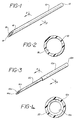
- One embodiment of the invention illustrated in Figs. 1 and 2, includes a tubing 10 having a first open end 12 for connection to, for example, a medicament reservoir (not shown).
- Tubing 10 tapers to a point 14, preferably beveled, and also has a second open end 16.
- Tubing 10 defines a lumen 18 as illustrated in Fig. 2.
- FIGs. 3 and 4 illustrate a catheter of polymeric tubing 10a having open end 12a.
- Tubing 10a is affixed to a needle 20 having open end 16a and point 14a, preferably beveled.
- Tubing 10a and needle 20 define a lumen 18a.
- the liquid crystalline polymeric tubing may be connected to a hub.
- the hub and tubing may be separate components conventionally attached, as by glue, wherein the hub may be of the same or different liquid crystalline polymer or the hub may be of a non-liquid crystalline polymer.
- the hub and tubing are integrally molded of liquid crystalline polymer.
- Fig. 5 and 6 show liquid crystalline tubing 10b integrally molded with hub 30.
- Hub 30 has a passageway 32 therethrough which provides fluid communication between tubing 10b and a needle 20b.
- hub 30 is shown to be conical, it may be of any shape convenient for conventional attachment to needle 20b and may include other integrally molded parts, such as tabs, lugs or threads (not shown) which may be useful for attachment to the needle.
- the hub may also include an optional port 36 and associated projection 38 for attaching a second tubing (not shown).
- gluing may be used for attaching separate needle and tubing components.
- the needle is inserted inside of the tubing by an interference fit.
- thermoplastic polymer of elongated molecular shape which can exist in a liquid crystalline phase is contemplated to fall within the scope of this invention.
- polymer classes which can form liquid crystals are polyethers, polyphosphazines polyxylylenes, polysulfones, polyamides, polysiloxanes and polyesters.
- Preferred liquid crystalline polymers for molding into the catheter of the invention are polyesters having a plurality of aromatic rings which contribute to ordering or alignment of the elongated molecules. The aromatic rings may be connected directly together, as in biphenyl moieties, or they may be separated by a connecting unit, as exemplified by generic structures I and II.
- Ar1 and Ar3 may be an aromatic, heterocyclic or substituted aromatic ring such as phenyl, pyridyl, naphthyl, biphenyl or quinolyl wherein the substituent may be a halogen or lower alkyl group.
- a and B may be alkyl, alkyloxy, alkyldioxy, oxygen, sulfur, sulfone, carbonyl, oxycarbonyl, alkylcarbonyl, alkyloxycarbonyl, alkylcarbonyloxy and oxyalkylcarbonyl wherein at least one of A and B is an oxycarbonyl group, the term alkyl being about 1 to 5 carbon atoms, X and Y may be hydroxyl or carboxyl and groups X,Y,A and B may be in a meta or para relationship or, if Ar is a naphthylene or quinoline ring, the bonds to A and B may be in a 2,6; 2,7; 3,6; 3,7; or 4,8 relationship.
- liquid crystalline polymers suitable for the present invention are commercially available, such as VectraTM (Hoechst-Celanese, Chatham, New Jersey, XydarTM and TorlonTM (Amoco Performance Products, Ridgefield, Connecticut, and LCPTM (RTP Co., Winona, Minnesota).
- Representative structures of preferred liquid crystalline polymers are p-oxybenzoate-6-oxy-2-naphthoate copolymer p-oxybenzoate-biphenol terephthalate copolymer p-oxybenzoate-polyethylene terephthalate copolymer Synthesis of the preferred crystalline polyesters used in the invention may be carried out by well-known esterification and transesterification procedures.
- hydroxyaromatic acids such as hydroxy benzoic acid, hydroxynaphthoic acid and hydroxybiphenyl carboxylic acid may be polymerised or copolymerized.
- Aromatic dicarboxylic acids such as terephthalic acid, isophthalic acid, naphthylene dicarboxylic acid and biphenyl dicarboxylic acid may be polymerized with aromatic glycols, such as dihydroxybenzene, dihydroxynaphthylene and dihydroxybiphenyl, araliphatic glycols, such as p-hydroxy benzyl alcohol, or with aliphatic glycols, such as ethylene glycol.
- Aliphatic dicarboxylic acids such as succinic acid
- aromatic glycols such as hydroquinone. Representative procedures are given by Calundann, et al., "Anisotropic Polymers, Their Synthesis, and Properties," Proceedings of the Robert A. Welch Conference on Chemical Research, XXVI, Synthetic Polymers, (1982) and by Chung et al., Polymer Engineering and Science 26, 901 (1986).
- melts of polymeric liquid crystallines are known to have a degree of molecular organization whereas melts of ordinary polymers exist in an almost completely random state. Organization of the molecules of both ordinary polymers and liquid crystalline polymers is greatly enhanced by shear thinning. As is known in the art, shear thinning is due to orientation of the elongated polymer molecules into an arrangement in which the molecules are aligned substantially completely in the direction of melt flow through an orifice. While most polymers undergo more or less shear thinning, conventional polymers such as polypropylene or polyethylene do not retain their orientation on cooling, but rather undergo molecular randomization and thereby lose the mechanical properties gained when their melts are shear thinned.
- a shear thinned liquid crystalline polymer melt having filled a mold, retains its molecular orientation on cooling, and it is the oriented molecules in the cooled polymer which gives the molded product the unique combination of properties characteristic of liquid crystalline polymers.
- the catheter tubing of the invention may have a gauge size of from 8 to 26.
- Preferred tubing is of 14 to 20 gauge.
- the invention includes a hollow plastic article having a point sufficiently sharp to penetrate a patient's skin without substantial discomfort.
- Preferred hollow articles are catheters and needles which may have a point of any desired shape.
- the most preferred hollow article is a catheter which has a beveled point for maximum patient comfort, it is evident that a hollow plastic needle may also find application in a variety of other areas, such as liquid transfer for example with a hypodermic needle attached to a syringe.
- a particularly attractive application of liquid crystalline needles is in magnetic resonance imaging (MRI), a non-invasive diagnostic technique which uses apparatus which includes a very high field magnet. Oftentimes needles which must be nonmetallic are used to biopsy areas highlighted by the MRI.
- MRI magnetic resonance imaging
- suitable polymers are, for example, polypropylene, polytetrafluoroethylene, polyurethane, polyethylene terephthalate and the like.
- liquid crystalline polymers after extruding into tubing or molding into hollow needles have high impact strength.
- the tensile at break of the molded or extruded liquid crystalline polymer may be about 68,9 to 483 MPa (10,000 to 70,000 psi), preferably about 172 to 241 MPa (25,000 to 35,000 psi).
- Elongation at break may be about 1 to 50, preferably about 2 to 10%.
- the flex modulus may be about 6,9 to 138 (1,000,000 to 20,000,000), preferably about 20,7 to 48,3 GPa (3,000,000 to 7,000,000 psi).
- liquid crystalline polymer melt is suitable for molding into the inventive devices having a sharp point if it has a viscosity of no more than about 500 poise.
- Preferred liquid crystalline polymers have a shear-thinned viscosity of about 75 to 150 poise.
- Such products have a very low coefficient of friction, generally in the range of 0.1 to 0.25. This property enables the article of the invention to release from the mold without any mold releasing agents.
- the catheter tubing of the invention may be fabricated from a thermoplastic liquid crystalline polymer by conventional means.
- a mandrel may be alternately dipped into a melt or solvent solution of the polymer and dried, the process being repeated until the tubing is of the desired thickness.
- a preferred method for forming a tubing is by conventional melt and solution extrusion processes well-known to one skilled in the art wherein shear thinning takes place when the melt or solution passes through the extrusion die.
- a liquid crystalline homopolymer may be extruded, or a solution or melt of a mixture of liquid crystalline polymers may be extruded.
- two or more polymers may be coextruded using conventional equipment giving a tubing having a base layer and one or more laminated layers. Such a tubing may present different surfaces to the body environment and any liquid passing through the tubing.
- a method to prepare hollow liquid crystalline polymeric needles includes melting a thermotropic liquid crystalline polymer and introducing the melt into an injection mold of the desired shape in a conventional molding operation. Molding may be performed at any temperature between the melting and decomposition temperatures of the polymer at which the viscosity of the melt is sufficiently low to enable the melt to completely fill the mold.
- the polymer may be melted to its anisotropic melt range and processed while within this range.
- the polymer melt may be forced under pressure through an orifice and thence directly into the mold. Passage of the melt through the orifice effects shear thinning and reduces the viscosity of the melt to facilitate completely filling of the mold.
- the degree of shear thinning of a polymer is a function of the nature of the polymer, the temperature, the pressure applied (and thus the rate of passage through the orifice) and the size of the orifice. These variables are well-known in the injection molding art, and a suitable combination of thinning and molding conditions may easily be determined by those skilled in the art. Thus, without wishing to be limited thereby, suitable molding parameter ranges are a pressure of 3,45 to 10,3 MPa (500 to 1,500 psi), a shear rate of 10 to 150 sec ⁇ 1 , and an orifice size of 0.5 to 2.0 mm. After shear thinning, the polymer melt flows into and completely fills the mold, including the tip.
- the molded point of the article is generally sharp enough to puncture a patient's skin without substantial discomfort.
- the molded point may be machined by any conventional procedure such as grinding or sanding, or may be thermoformed in a heated tipping die to further sharpen the point.
- the finished article may then be sterilized by any convenient procedure, such as heat, irradiation, or chemical methods taking advantage of the known stability of liquid crystalline polymers to these techniques.
- the low friction surface of the point of the article of the invention in many cases allows skin puncture without any lubricant.
- conventional stainless steel needles have a coefficient of friction of about 0.57, and often are lubricated prior to puncture of a patient's skin, as, for example, with a polysiloxane lubricant.
- Polyester liquid crystalline polymer (Vectra®) was melted and forced at a temperature of 290°C under a pressure of 6,2 MPa (900 psi) through a die having a circular orifice of 1.6 mm diameter.
- the die was mounted on a conventional injection molding apparatus so that the polymer, after passing through the orifice, flowed directly into a tubing mold shaped to include a beveled point. After filling, the mold was cooled and the tubing was removed. It was found that the tubing had a point which was comparable in penetration force to a stainless steel lancet (Becton, Dickinson and Company).
Landscapes
- Chemical & Material Sciences (AREA)
- Health & Medical Sciences (AREA)
- Chemical Kinetics & Catalysis (AREA)
- Medicinal Chemistry (AREA)
- Polymers & Plastics (AREA)
- Organic Chemistry (AREA)
- Life Sciences & Earth Sciences (AREA)
- Public Health (AREA)
- Animal Behavior & Ethology (AREA)
- General Health & Medical Sciences (AREA)
- Veterinary Medicine (AREA)
- Epidemiology (AREA)
- Engineering & Computer Science (AREA)
- Pulmonology (AREA)
- Biophysics (AREA)
- Anesthesiology (AREA)
- Biomedical Technology (AREA)
- Heart & Thoracic Surgery (AREA)
- Hematology (AREA)
- Materials For Medical Uses (AREA)
- Media Introduction/Drainage Providing Device (AREA)
Claims (9)
- Schlauch, der einen Tubusabschnitt (10) und einen damit verbundenen Hohlnadelabschnitt (16) aufweist, wobei der Nadelabschnitt eine Spitze (14) hat; wobei die Nadelabschnitte des Tubusabschnitts aus einem flüssigkristallinen Polymer hergestellt werden, dadurch gekennzeichnet, daß der Nadelabschnitt aus einem kristallinen Polyether-, Polyphosphazin-, Polyxylylen-, Polysulfon-, Polyamid-, Polysiloxan- oder Polyesterpolymer hergestellt wird, das durch Scherverflüssigung auf eine Viskosität gebracht wurde, die es dem Polymer ermöglicht, in eine lange, dünne Form, die eine Spitze einschließt, zu fließen und diese zu füllen.
- Schlauch nach Anspruch 1, bei dem der Nadelabschnitt (16) aus einem flüssig-kristallinen Polyester gebildet wird, der ein Polymer oder Copolymer einer aromatischen Hydroxycarbonsäure und des polymeren Reaktionsprodukts einer Dicarbonsäure und eines Glykols ist, wobei zumindest eines der Dicarbonsäure und des Glykols eine aromatische Gruppe einschließt.
- Schlauch nach Anspruch 1, bei dem das thermoplastische flüssigkristalline Polymer folgende Struktur hat:
X ⁅Ar₁ - A - Ar₂ - B - Ar₃⁆ Y (I)
oder
X ⁅Ar₁ - A - Ar₂⁆ Y (II)
worin Ar₁, Ar₂ und Ar₃ jeweils unabhängig voneinander ein aromatischer oder ein heterocyclischer Ring sind; A und B jeweils unabhängig voneinander ein Sauerstoff- oder Schwefelatom oder eine Alkyloxy-, Alkyldioxy-, Sulfon-, Carbonyl-, Oxycarbonyl-, Alkylcarbonyl-, Alkyloxycarbonyl-, Alkylcarbonyloxy- oder Oxyalkylcarbonylgruppe sind (wobei wenigstens eines von A und B eine Oxycarbonylgruppe ist und wobei sich der Begriff Alkyl auf eine Alkylgruppe bezieht, die 1 bis 5 Kohlenstoffatome enthält) und X und Y jeweils eine Hydroxy- oder Carboxylgruppe sind. - Vorrichtung nach Anspruch 2 oder Anspruch 3, bei welcher der Tubusabschnitt (10) einen Schlauch und einen Ansatzabschnitt aufweist.
- Vorrichtung nach irgendeinem der Ansprüche 2 bis 4, bei welcher der Tubusabschnitt (10) ein Plastikschlauch ist, der am proximalen Ende eines flüssig-kristallinen Polymer-Nadelabschnitts (16) befestigt ist, während das distale Ende des Nadelabschnitts die Spitze (14) aufweist.
- Vorrichtung nach einem der Ansprüche 2 bis 4, bei welcher der Tubusabschnitt (10) ein Schlauch aus einem ersten flüssig-kristallinen Polymer ist, der am proximalen Ende eines flüssig-kristallinen Nadelabschnitts (16) befestigt wird, während das distale Ende des Nadelabschnitts die Spitze (18) aufweist.
- Verfahren zur Herstellung eines flüssig-kristallinen Polymerschlauchs, der eine Spitze hat, das folgende Schritte aufweist:a) Erhitzen eines thermotropen flüssig-kristallinen Polymers, um eine Schmelze zu schaffen;b) Leiten der Schmelze in eine Schlauchform, die eine Spitze einschließt, wobei die Schmelze die Form vollständig füllt;c) Abkühlen der Schmelze in der Form, wodurch sich die Schmelze zu einem Schlauch verfestigt, der die Form der Schlauchform hat; undd) Entfernen des Schlauches aus der Schlauchform.
- Verfahren nach Anspruch 7, das zwischen den Schritten (a) und (b) den Schritt einschließt, die Schmelze unter Druck durch eine Öffnung zu pressen, wodurch sich die Viskosität der Schmelze verringert.
- Verfahren zur Herstellung eines flüssig-kristallinen Polymerschlauchs nach Anspruch 7, welches das Erhitzen eines thermotropen flüssig-kristallinen Polymers zur Bildung einer Schmelze und das Extrudieren der Schmelze durch eine Schlauch-Hohlform umfaßt.
Applications Claiming Priority (2)
| Application Number | Priority Date | Filing Date | Title |
|---|---|---|---|
| US495072 | 1990-03-19 | ||
| US07/495,072 US5078700A (en) | 1990-03-19 | 1990-03-19 | Liquid crystalline catheter |
Publications (2)
| Publication Number | Publication Date |
|---|---|
| EP0452595A1 EP0452595A1 (de) | 1991-10-23 |
| EP0452595B1 true EP0452595B1 (de) | 1995-08-23 |
Family
ID=23967160
Family Applications (1)
| Application Number | Title | Priority Date | Filing Date |
|---|---|---|---|
| EP90314428A Expired - Lifetime EP0452595B1 (de) | 1990-03-19 | 1990-12-28 | Flüssigkristallkatheter und Herstellungsverfahren dafür |
Country Status (10)
| Country | Link |
|---|---|
| US (1) | US5078700A (de) |
| EP (1) | EP0452595B1 (de) |
| JP (1) | JPH04221570A (de) |
| AT (1) | ATE126713T1 (de) |
| AU (1) | AU632389B2 (de) |
| CA (1) | CA2031696A1 (de) |
| DE (1) | DE69021866D1 (de) |
| ES (1) | ES2078953T3 (de) |
| IE (1) | IE904407A1 (de) |
| NZ (1) | NZ236403A (de) |
Cited By (5)
| Publication number | Priority date | Publication date | Assignee | Title |
|---|---|---|---|---|
| US6475209B1 (en) | 1997-10-15 | 2002-11-05 | Scimed Life Systems, Inc. | Catheter with spiral cut transition member |
| US6517515B1 (en) | 1998-03-04 | 2003-02-11 | Scimed Life Systems, Inc. | Catheter having variable size guide wire lumen |
| US6623504B2 (en) | 2000-12-08 | 2003-09-23 | Scimed Life Systems, Inc. | Balloon catheter with radiopaque distal tip |
| WO2008036043A1 (en) * | 2006-09-18 | 2008-03-27 | Agency For Science, Technology And Research | Needle structures and methods for fabricating needle structures |
| AU2008247455B2 (en) * | 2007-05-02 | 2013-12-05 | Medtronic, Inc. | Dihydroxybenzoate polymers and uses thereof |
Families Citing this family (34)
| Publication number | Priority date | Publication date | Assignee | Title |
|---|---|---|---|---|
| AU648387B2 (en) * | 1991-03-04 | 1994-04-21 | Medex, Inc. | Use of surfactants to improve intravenous catheter flashback |
| US5188605A (en) * | 1991-05-08 | 1993-02-23 | Cordis Corporation | Separable insertion tool |
| US5256149A (en) * | 1992-02-14 | 1993-10-26 | Ethicon, Inc. | Trocar having transparent cannula and method of using |
| WO1993017074A1 (en) * | 1992-02-24 | 1993-09-02 | Baxter International Inc. | Polymer blends for torque transmitting catheters |
| US5387197A (en) * | 1993-02-25 | 1995-02-07 | Ethicon, Inc. | Trocar safety shield locking mechanism |
| US5397512A (en) * | 1993-09-10 | 1995-03-14 | Critikon, Inc. | Process for sealing catheter tip to insertion needle |
| US5484422A (en) * | 1993-09-10 | 1996-01-16 | Critikon, Inc. | Catheter needle having surface indication thereon and process for forming such catheter |
| US5425903A (en) * | 1993-09-10 | 1995-06-20 | Critikon, Inc. | Laser beveling process for catheters |
| CA2133159A1 (en) * | 1993-09-30 | 1995-03-31 | Eric J. Butterfield | Surgical instrument having improved manipulating means |
| US5554121B1 (en) * | 1994-07-25 | 1998-07-14 | Advanced Cardiovascular System | Intraluminal catheter with high strength proximal shaft |
| US6096012A (en) * | 1996-08-27 | 2000-08-01 | Johnson & Johnson Medical, Inc. | Coated one-piece composite plastic catheter and cannula |
| NL1006254C2 (nl) * | 1997-06-06 | 1998-12-08 | Cordis Europ | Met MRI-verenigbare geleidingsdraad. |
| US8079982B1 (en) | 1998-06-04 | 2011-12-20 | Biosense Webster, Inc. | Injection catheter with needle electrode |
| US6905476B2 (en) * | 1998-06-04 | 2005-06-14 | Biosense Webster, Inc. | Catheter with injection needle |
| US6540725B1 (en) * | 1998-06-04 | 2003-04-01 | Biosense Webster, Inc. | Injection catheter with controllably extendable injection needle |
| US7416547B2 (en) | 1999-03-29 | 2008-08-26 | Biosense Webster Inc. | Injection catheter |
| US6368316B1 (en) | 1998-06-11 | 2002-04-09 | Target Therapeutics, Inc. | Catheter with composite stiffener |
| US6936053B1 (en) * | 1998-07-02 | 2005-08-30 | Jeffrey N. Weiss | Ocular implant needle |
| EP1191964B1 (de) * | 1999-05-28 | 2005-05-25 | Novo Nordisk A/S | Verfahren und system für die herstellung einer plastiknadel |
| US6443925B1 (en) | 1999-09-13 | 2002-09-03 | Advanced Cardiovascular Systems, Inc. | Balloon catheter shaft formed of liquid crystal polymeric material blend |
| US6325780B1 (en) | 1999-09-13 | 2001-12-04 | Advanced Cardiovascular Systems, Inc. | Inflatable member formed of liquid crystal polymeric material blend |
| US6942648B2 (en) | 1999-12-09 | 2005-09-13 | Advanced Cardiovascular Systems, Inc. | Catheter with a transparent shaft |
| JP2002336355A (ja) * | 2001-05-11 | 2002-11-26 | Mitsubishi Pencil Co Ltd | 注射器針 |
| US20030208142A1 (en) * | 2001-06-12 | 2003-11-06 | Boudewijn Alexander C | Vascular guidewire for magnetic resonance and /or fluoroscopy |
| US6749792B2 (en) * | 2001-07-09 | 2004-06-15 | Lifescan, Inc. | Micro-needles and methods of manufacture and use thereof |
| US7201763B2 (en) | 2001-10-24 | 2007-04-10 | Boston Scientific Scimed, Inc. | Distal balloon waist material relief and method of manufacture |
| US7744574B2 (en) | 2004-12-16 | 2010-06-29 | Boston Scientific Scimed, Inc. | Catheter tip to reduce wire lock |
| US20070066934A1 (en) * | 2005-09-19 | 2007-03-22 | Transport Pharmaceuticals, Inc. | Electrokinetic delivery system and methods therefor |
| US20070185432A1 (en) * | 2005-09-19 | 2007-08-09 | Transport Pharmaceuticals, Inc. | Electrokinetic system and method for delivering methotrexate |
| EP2238998A1 (de) | 2009-04-02 | 2010-10-13 | F. Hoffmann-La Roche AG | Kanüle zum Durchstechen eines Septums einer Kartusche und Ventil für die Kanüle |
| BR112022022039A2 (pt) | 2020-04-28 | 2022-12-13 | Ticona Llc | Conjunto de microagulhas |
| US12171361B2 (en) | 2020-12-30 | 2024-12-24 | Sharkninja Operating Llc | Hybrid receptacle beverage brewing system |
| USD1048792S1 (en) | 2023-04-12 | 2024-10-29 | Sharkninja Operating Llc | Coffee machine |
| USD1048793S1 (en) | 2023-05-02 | 2024-10-29 | Sharkninja Operating Llc | Coffee machine |
Family Cites Families (12)
| Publication number | Priority date | Publication date | Assignee | Title |
|---|---|---|---|---|
| DE2434618A1 (de) * | 1973-07-30 | 1975-02-13 | Yolan Ronai Guttman | Infiltrationssichere nadel fuer intravenoese anwendung |
| US4381008A (en) * | 1978-09-08 | 1983-04-26 | Johnson & Johnson | Methods of improving surface characteristics of extruded thermoplastic tubing and products produced thereby |
| US4381380A (en) * | 1980-11-03 | 1983-04-26 | Leveen Harry H | Thermoplastic polyurethane article treated with iodine for antibacterial use |
| DE3311767A1 (de) * | 1983-03-31 | 1984-10-04 | Biotest-Serum-Institut Gmbh, 6000 Frankfurt | Kanuelensystem zur venenpunktion |
| US4790817A (en) * | 1985-03-28 | 1988-12-13 | Luther Medical Products, Inc. | Assembly of stylet and catheter, and needle and catheter |
| DE3517270A1 (de) * | 1985-05-14 | 1986-11-20 | Bayer Ag, 5090 Leverkusen | Thermotrope aromatische polyester mit hoher waermeformbestaendigkeit, verfahren zu ihrer herstellung und ihre verwendung zur herstellung von formkoerpern, filamenten, fasern und folien |
| DE3517948A1 (de) * | 1985-05-18 | 1986-11-20 | Bayer Ag, 5090 Leverkusen | Thermotrope aromatische polyester mit hervorragenden mechanischen eigenschaften und guter verarbeitbarkeit, verfahren zu ihrer herstellung und ihre verwendung zur herstellung von formkoerpern, filamenten, fasern und folien |
| US4722344A (en) * | 1986-05-23 | 1988-02-02 | Critikon, Inc. | Radiopaque polyurethanes and catheters formed therefrom |
| US4814211A (en) * | 1987-04-10 | 1989-03-21 | Hoechst Celanese Corporation | Liquid crystalline composites |
| DE3721256A1 (de) * | 1987-06-27 | 1989-01-12 | Akzo Gmbh | In der schmelze verarbeitbare thermotrope voll-aromatische polyester |
| US4950257A (en) * | 1988-09-15 | 1990-08-21 | Mallinckrodt, Inc. | Catheter introducer with flexible tip |
| JPH02189156A (ja) * | 1989-01-17 | 1990-07-25 | Mitsubishi Cable Ind Ltd | カテーテル |
-
1990
- 1990-03-19 US US07/495,072 patent/US5078700A/en not_active Expired - Lifetime
- 1990-12-06 IE IE440790A patent/IE904407A1/en unknown
- 1990-12-07 CA CA002031696A patent/CA2031696A1/en not_active Abandoned
- 1990-12-10 NZ NZ236403A patent/NZ236403A/en unknown
- 1990-12-11 AU AU67949/90A patent/AU632389B2/en not_active Ceased
- 1990-12-28 AT AT90314428T patent/ATE126713T1/de not_active IP Right Cessation
- 1990-12-28 EP EP90314428A patent/EP0452595B1/de not_active Expired - Lifetime
- 1990-12-28 DE DE69021866T patent/DE69021866D1/de not_active Expired - Lifetime
- 1990-12-28 ES ES90314428T patent/ES2078953T3/es not_active Expired - Lifetime
-
1991
- 1991-02-06 JP JP3015295A patent/JPH04221570A/ja active Pending
Cited By (7)
| Publication number | Priority date | Publication date | Assignee | Title |
|---|---|---|---|---|
| US6475209B1 (en) | 1997-10-15 | 2002-11-05 | Scimed Life Systems, Inc. | Catheter with spiral cut transition member |
| US8206372B2 (en) | 1997-10-15 | 2012-06-26 | Boston Scientific Scimed, Inc. | Catheter with spiral cut transition member |
| US6517515B1 (en) | 1998-03-04 | 2003-02-11 | Scimed Life Systems, Inc. | Catheter having variable size guide wire lumen |
| US6623504B2 (en) | 2000-12-08 | 2003-09-23 | Scimed Life Systems, Inc. | Balloon catheter with radiopaque distal tip |
| WO2008036043A1 (en) * | 2006-09-18 | 2008-03-27 | Agency For Science, Technology And Research | Needle structures and methods for fabricating needle structures |
| AU2008247455B2 (en) * | 2007-05-02 | 2013-12-05 | Medtronic, Inc. | Dihydroxybenzoate polymers and uses thereof |
| US9491966B2 (en) | 2007-05-02 | 2016-11-15 | Tyrx, Inc. | Dihydroxybenzoate polymers and uses thereof |
Also Published As
| Publication number | Publication date |
|---|---|
| ES2078953T3 (es) | 1996-01-01 |
| NZ236403A (en) | 1993-12-23 |
| IE904407A1 (en) | 1991-09-25 |
| US5078700A (en) | 1992-01-07 |
| AU6794990A (en) | 1991-09-19 |
| AU632389B2 (en) | 1992-12-24 |
| DE69021866D1 (de) | 1995-09-28 |
| EP0452595A1 (de) | 1991-10-23 |
| ATE126713T1 (de) | 1995-09-15 |
| CA2031696A1 (en) | 1991-09-20 |
| JPH04221570A (ja) | 1992-08-12 |
Similar Documents
| Publication | Publication Date | Title |
|---|---|---|
| EP0452595B1 (de) | Flüssigkristallkatheter und Herstellungsverfahren dafür | |
| US5151231A (en) | Method for making liquid crystalline tube having a point | |
| US5456875A (en) | Method for preparing plastic lancet | |
| EP0362497B1 (de) | Verfahren zur Herstellung eines einstückigen Angiographie Katheters | |
| EP1420845B2 (de) | Katheter und methode zum herstellen eines katheters | |
| EP0826387B1 (de) | Beschichtete, einstückige Katheter- und Kanülenstruktur | |
| US4596563A (en) | Thin-walled multi-layered catheter having a fuseless tip | |
| EP0826388B1 (de) | Billiges Verfahren zum Zusammenbauen eines extrudierten Kanülenhalters für eine Vorrichtung zum Legen eines Katheters | |
| EP0537069B1 (de) | Ballon für Blutgefässdilatationskatheter | |
| EP0807446A2 (de) | Einstückiger Katheter mit weicher Spitze und Verfahren zu seiner Herstellung | |
| EP0669142A2 (de) | Katheter mit koextrudierter Kupplung | |
| US5810785A (en) | Blown-in-place blood gasket for a safety catheter | |
| CA2589130A1 (en) | Introducer apparatus | |
| JP2001087389A (ja) | カテーテルの製造方法およびカテーテル | |
| EP2032344B1 (de) | Medizinische vorrichtungen sowie entsprechende systeme und verfahren | |
| EP0580846A4 (en) | Composite material having a lubricous surface for catheter use | |
| WO1995014501A1 (en) | Radiopaque balloon catheters | |
| US20080228145A1 (en) | Guidewire introducer and shaping tool | |
| EP0451184B1 (de) | Medizinische nadel für einmalige verwendung | |
| JP2012010846A (ja) | 医療用チューブ | |
| WO2025160818A1 (en) | Medical device including cyclic olefin copolymer | |
| CA2213064C (en) | Blown-in-place blood gasket for a safety catheter | |
| JPH0691005A (ja) | カテーテル | |
| HK1003871B (en) | Low-cost method of assembling an extruded cannula holder for a catheter insertion device | |
| JP2002282276A (ja) | 医療用器具収納具 |
Legal Events
| Date | Code | Title | Description |
|---|---|---|---|
| PUAI | Public reference made under article 153(3) epc to a published international application that has entered the european phase |
Free format text: ORIGINAL CODE: 0009012 |
|
| 17P | Request for examination filed |
Effective date: 19910102 |
|
| AK | Designated contracting states |
Kind code of ref document: A1 Designated state(s): AT BE CH DE DK ES FR GB GR IT LI LU NL SE |
|
| 17Q | First examination report despatched |
Effective date: 19940713 |
|
| GRAA | (expected) grant |
Free format text: ORIGINAL CODE: 0009210 |
|
| AK | Designated contracting states |
Kind code of ref document: B1 Designated state(s): AT BE CH DE DK ES FR GB GR IT LI LU NL SE |
|
| PG25 | Lapsed in a contracting state [announced via postgrant information from national office to epo] |
Ref country code: IT Free format text: LAPSE BECAUSE OF FAILURE TO SUBMIT A TRANSLATION OF THE DESCRIPTION OR TO PAY THE FEE WITHIN THE PRE;WARNING: LAPSES OF ITALIAN PATENTS WITH EFFECTIVE DATE BEFORE 2007 MAY HAVE OCCURRED AT ANY TIME BEFORE 2007. THE CORRECT EFFECTIVE DATE MAY BE DIFFERENT FROM THE ONE RECORDED.SCRIBED TIME-LIMIT Effective date: 19950823 Ref country code: AT Effective date: 19950823 Ref country code: NL Free format text: LAPSE BECAUSE OF NON-PAYMENT OF DUE FEES Effective date: 19950823 Ref country code: GR Free format text: LAPSE BECAUSE OF FAILURE TO SUBMIT A TRANSLATION OF THE DESCRIPTION OR TO PAY THE FEE WITHIN THE PRESCRIBED TIME-LIMIT Effective date: 19950823 Ref country code: FR Free format text: THE PATENT HAS BEEN ANNULLED BY A DECISION OF A NATIONAL AUTHORITY Effective date: 19950823 Ref country code: DK Effective date: 19950823 Ref country code: BE Effective date: 19950823 |
|
| REF | Corresponds to: |
Ref document number: 126713 Country of ref document: AT Date of ref document: 19950915 Kind code of ref document: T |
|
| REF | Corresponds to: |
Ref document number: 69021866 Country of ref document: DE Date of ref document: 19950928 |
|
| REG | Reference to a national code |
Ref country code: CH Ref legal event code: PL |
|
| PG25 | Lapsed in a contracting state [announced via postgrant information from national office to epo] |
Ref country code: SE Effective date: 19951123 |
|
| PG25 | Lapsed in a contracting state [announced via postgrant information from national office to epo] |
Ref country code: DE Effective date: 19951124 |
|
| PGFP | Annual fee paid to national office [announced via postgrant information from national office to epo] |
Ref country code: ES Payment date: 19951219 Year of fee payment: 6 Ref country code: GB Payment date: 19951219 Year of fee payment: 6 |
|
| PG25 | Lapsed in a contracting state [announced via postgrant information from national office to epo] |
Ref country code: LU Free format text: LAPSE BECAUSE OF NON-PAYMENT OF DUE FEES Effective date: 19951231 |
|
| PGFP | Annual fee paid to national office [announced via postgrant information from national office to epo] |
Ref country code: CH Payment date: 19951231 Year of fee payment: 6 |
|
| REG | Reference to a national code |
Ref country code: ES Ref legal event code: FG2A Ref document number: 2078953 Country of ref document: ES Kind code of ref document: T3 |
|
| EN | Fr: translation not filed | ||
| NLV1 | Nl: lapsed or annulled due to failure to fulfill the requirements of art. 29p and 29m of the patents act | ||
| PLBE | No opposition filed within time limit |
Free format text: ORIGINAL CODE: 0009261 |
|
| STAA | Information on the status of an ep patent application or granted ep patent |
Free format text: STATUS: NO OPPOSITION FILED WITHIN TIME LIMIT |
|
| 26N | No opposition filed | ||
| PG25 | Lapsed in a contracting state [announced via postgrant information from national office to epo] |
Ref country code: GB Effective date: 19961228 |
|
| PG25 | Lapsed in a contracting state [announced via postgrant information from national office to epo] |
Ref country code: LI Free format text: LAPSE BECAUSE OF FAILURE TO SUBMIT A TRANSLATION OF THE DESCRIPTION OR TO PAY THE FEE WITHIN THE PRESCRIBED TIME-LIMIT Effective date: 19961231 Ref country code: CH Free format text: LAPSE BECAUSE OF FAILURE TO SUBMIT A TRANSLATION OF THE DESCRIPTION OR TO PAY THE FEE WITHIN THE PRESCRIBED TIME-LIMIT Effective date: 19961231 |
|
| GBPC | Gb: european patent ceased through non-payment of renewal fee |
Effective date: 19961228 |
|
| PG25 | Lapsed in a contracting state [announced via postgrant information from national office to epo] |
Ref country code: ES Free format text: LAPSE BECAUSE OF NON-PAYMENT OF DUE FEES Effective date: 19971229 |
|
| REG | Reference to a national code |
Ref country code: ES Ref legal event code: FD2A Effective date: 19980113 |