EP0449512A1 - Schneidevorrichtung - Google Patents
Schneidevorrichtung Download PDFInfo
- Publication number
- EP0449512A1 EP0449512A1 EP91302482A EP91302482A EP0449512A1 EP 0449512 A1 EP0449512 A1 EP 0449512A1 EP 91302482 A EP91302482 A EP 91302482A EP 91302482 A EP91302482 A EP 91302482A EP 0449512 A1 EP0449512 A1 EP 0449512A1
- Authority
- EP
- European Patent Office
- Prior art keywords
- image data
- product
- accordance
- different
- camera
- Prior art date
- Legal status (The legal status is an assumption and is not a legal conclusion. Google has not performed a legal analysis and makes no representation as to the accuracy of the status listed.)
- Withdrawn
Links
Images




Classifications
-
- A—HUMAN NECESSITIES
- A22—BUTCHERING; MEAT TREATMENT; PROCESSING POULTRY OR FISH
- A22C—PROCESSING MEAT, POULTRY, OR FISH
- A22C17/00—Other devices for processing meat or bones
- A22C17/0006—Cutting or shaping meat
- A22C17/0033—Cutting slices out of a piece of meat
-
- A—HUMAN NECESSITIES
- A22—BUTCHERING; MEAT TREATMENT; PROCESSING POULTRY OR FISH
- A22C—PROCESSING MEAT, POULTRY, OR FISH
- A22C17/00—Other devices for processing meat or bones
- A22C17/0073—Other devices for processing meat or bones using visual recognition, X-rays, ultrasounds, or other contactless means to determine quality or size of portioned meat
-
- B—PERFORMING OPERATIONS; TRANSPORTING
- B26—HAND CUTTING TOOLS; CUTTING; SEVERING
- B26D—CUTTING; DETAILS COMMON TO MACHINES FOR PERFORATING, PUNCHING, CUTTING-OUT, STAMPING-OUT OR SEVERING
- B26D7/00—Details of apparatus for cutting, cutting-out, stamping-out, punching, perforating, or severing by means other than cutting
- B26D7/27—Means for performing other operations combined with cutting
- B26D7/30—Means for performing other operations combined with cutting for weighing cut product
-
- G—PHYSICS
- G01—MEASURING; TESTING
- G01N—INVESTIGATING OR ANALYSING MATERIALS BY DETERMINING THEIR CHEMICAL OR PHYSICAL PROPERTIES
- G01N33/00—Investigating or analysing materials by specific methods not covered by groups G01N1/00 - G01N31/00
- G01N33/02—Food
- G01N33/12—Meat; Fish
-
- Y—GENERAL TAGGING OF NEW TECHNOLOGICAL DEVELOPMENTS; GENERAL TAGGING OF CROSS-SECTIONAL TECHNOLOGIES SPANNING OVER SEVERAL SECTIONS OF THE IPC; TECHNICAL SUBJECTS COVERED BY FORMER USPC CROSS-REFERENCE ART COLLECTIONS [XRACs] AND DIGESTS
- Y10—TECHNICAL SUBJECTS COVERED BY FORMER USPC
- Y10S—TECHNICAL SUBJECTS COVERED BY FORMER USPC CROSS-REFERENCE ART COLLECTIONS [XRACs] AND DIGESTS
- Y10S83/00—Cutting
- Y10S83/929—Particular nature of work or product
- Y10S83/932—Edible
-
- Y—GENERAL TAGGING OF NEW TECHNOLOGICAL DEVELOPMENTS; GENERAL TAGGING OF CROSS-SECTIONAL TECHNOLOGIES SPANNING OVER SEVERAL SECTIONS OF THE IPC; TECHNICAL SUBJECTS COVERED BY FORMER USPC CROSS-REFERENCE ART COLLECTIONS [XRACs] AND DIGESTS
- Y10—TECHNICAL SUBJECTS COVERED BY FORMER USPC
- Y10T—TECHNICAL SUBJECTS COVERED BY FORMER US CLASSIFICATION
- Y10T83/00—Cutting
- Y10T83/141—With means to monitor and control operation [e.g., self-regulating means]
- Y10T83/148—Including means to correct the sensed operation
- Y10T83/155—Optimizing product from unique workpiece
-
- Y—GENERAL TAGGING OF NEW TECHNOLOGICAL DEVELOPMENTS; GENERAL TAGGING OF CROSS-SECTIONAL TECHNOLOGIES SPANNING OVER SEVERAL SECTIONS OF THE IPC; TECHNICAL SUBJECTS COVERED BY FORMER USPC CROSS-REFERENCE ART COLLECTIONS [XRACs] AND DIGESTS
- Y10—TECHNICAL SUBJECTS COVERED BY FORMER USPC
- Y10T—TECHNICAL SUBJECTS COVERED BY FORMER US CLASSIFICATION
- Y10T83/00—Cutting
- Y10T83/162—With control means responsive to replaceable or selectable information program
- Y10T83/173—Arithmetically determined program
- Y10T83/175—With condition sensor
- Y10T83/178—Responsive to work
-
- Y—GENERAL TAGGING OF NEW TECHNOLOGICAL DEVELOPMENTS; GENERAL TAGGING OF CROSS-SECTIONAL TECHNOLOGIES SPANNING OVER SEVERAL SECTIONS OF THE IPC; TECHNICAL SUBJECTS COVERED BY FORMER USPC CROSS-REFERENCE ART COLLECTIONS [XRACs] AND DIGESTS
- Y10—TECHNICAL SUBJECTS COVERED BY FORMER USPC
- Y10T—TECHNICAL SUBJECTS COVERED BY FORMER US CLASSIFICATION
- Y10T83/00—Cutting
- Y10T83/525—Operation controlled by detector means responsive to work
- Y10T83/533—With photo-electric work-sensing means
Definitions
- the present invention relates to a slicing machine and a method of control for the machine.
- Such machines are principally, but not exclusively used for slicing food products, particularly slicing cheese, meat and pressed or moulded meat products.
- such a slicing machine typically includes a rotating blade and means to feed the product forward towards the blade so that successive slices are cut from one face of the product.
- the distance through which the product is advanced between successive cuts of the blade determines the thickness of the slices.
- the product is of uniform shape and density then it may be sufficient to use a single predetermined slice thickness to give a slice or group of slices of the required weight.
- variations in the shape and density of the product mean that the weight of a slice of a given thickness varies. A previous approach to dealing with this variation is described and claimed in the applicants' granted European Patent EP-B-0,127,463.
- a slicing machine comprising viewing with a camera, a cut face of a product being sliced; processing image data from the camera to determine a parameter characteristic of the cut face, the step of processing the image data including classifying the image data by comparing the image data with an intensity threshold, and automatically varying the intensity threshold in accordance with the determined populations of data in the different classes; and generating a control signal to control the operation of the slicing machine in accordance with the determined parameter.
- the present invention provides a method of control which is not only responsive to overall characteristics of the face of the product, such as its area, but is also able to recognise different classes of data within the face.
- the different regions are classified according to the intensities of the corresponding pixels in the image data. For example, in bacon, pixels corresponding to areas of fat are seen to have higher intensities than areas of lean which are darker.
- the analysis of the image data is complicated however by the fact that both the absolute and relative intensities of the different regions of the cut face vary with such factors as the condition of the product, the nature of the source of illumination and the different distances of regions of the face from the source of illumination and the camera.
- the present invention is able to overcome all these difficulties by automatically re-evaluating the thresholds used in classifying the image data, as described in further detail below.
- Different respective thresholds may be provided for different regions of the image data and the different thresholds independently re-calibrated in accordance with the populations of data in the respective regions.
- the threshold for one region may be updated for one set of image data, the threshold for the adjacent region updated for the next set of image data and so on. In the regions which are not updated the data is classified using the last determined threshold for the region in question.
- a slicing machine for cutting slices from a product including a camera arranged to view a cut face of the product being sliced; image processing means for processing image data from the camera to determine a parameter characteristic of the cut face, the image processing means including means to classify the image data by comparing it with an intensity threshold, and means to vary the intensity threshold automatically in accordance with the determined populations of data in the different classes; and control signal generating means arranged to generate a control signal to control the operation of the slicing machine in accordance with the determined parameter.
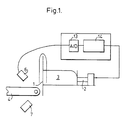
- a slicing machine includes a slicing blade 1 and a feed mechanism 2 arranged to advance a product 3 towards the blade 1. Slices cut from the end-face 5 of the product 3 fall onto a conveyor 4. A source of illumination 7 is provided to one side of the end-face 5 of the product 3. The output from a camera 6 is taken to image processing hardware which operates as described in further detail below to generate an appropriate control parameter for the slicer.
- the camera 6 is set so that the lower edge of the field of view coincides with the bed shear-edge 8, so that when the product is held against a vertical shear-edge guide 9 the view of the camera encompasses the product on two sides at right-angles to each other.
- the product is illuminated from below, so that the area within the frame but beyond the product periphery appears much darker than the product face, irrespective of the strength of the illumination source.
- the camera scan is initiated from a pulse from the slicer blade at the point where the field of view is clear of the blade.
- the camera 6 may be of any known type with or without distinguishing colour facilities, but will preferably use an asynchronous CCD to ensure rapid capture of the frame.
- the output from the camera 6 is converted into an array of pixels for processing by the image processing hardware 14.
- the image processing technique may subdivide the image field into any number of comprising areas and determine the optimum boundary thresholds for each so that disturbing effects which occur over the image field, for example asymmetric shading, skew between the axes of illumination and vision, the effects of the temperature gradients over the face of the product, may be compensated.
- the techniques also permit slice or portion quality segregation based upon the assessment of workface area or shape, or component proportion or its disposition.
- the system of the present invention has greatly improved the correlation between the visually apparent density and the actual density of the product and, together with fast processing, has enabled visual observation to be used to control slice and/or portion weight at high speed with more consistency than was hitherto possible.
- the scanning technigue employed divides the image field into say, 500 by 500 picture elements or pixels each recording a grey level value in the range of, say, 0 to 250.
- a range of pixel grey levels will be observed which, if the bacon contains both fat and lean, will be represented by higher and lower value populations of grey levels.
- the grey level values will all change in common proportion with any variation in illumination, the ratio between the maximum and minimum grey levels of the two component populations should be substantially constant.
- the sample may contain extraneous high or low grey level values which may be excluded from any further analysis by excluding preset numbers or fractions of the total pixels in the sample at one or both ends of the grey level value spectrum.
- the threshold grey level distinguishing between fat and lean may be computed for the area of bacon represented by the sample.
- This intermediate fat/lean grey level threshold value being evaluated in part as some preset fraction within the numeric interval between the modified maximum/minimum grey levels may, together with other grey level threshold values within the image field, be conveniently stored in tabular form in a computer memory. Further, a lean/background threshold value may also be evaluated in part as some preset ratio of the lean grey level.
- the threshold values may be re-evaluated from time to time. Under normal conditions the threshold values vary only gradually with time and between adjacent areas of the image field and so temporal and spatial digital filtering may be used to smooth the stored values or to identify the onset of abnormal conditions, for example, the major contamination of an optical aperture.
- the advancing face of the product is scanned when the blade and the last severed slice have just cleared and the camera has a free view of the workface.
- the captured image is transferred to a frame store in computer memory for analysis.
- the total areas of lean and fat so measured may be used not only for the control of slice and/or portion weight but also for the purpose of slice quality classification. Where the ratio of fat to lean of an individual slice or the average ratio of a portion of slices exceeds some preset limit or limits the slice or portion may be diverted to one or more separately classified lines.
- the fat to lean ratio for only a specified zone or zones within the slice is required.
- a shingle pack may display more fat than lean than is desirable in the market.
- the calculation of fat to lean ratio may then be confined to a predefined group of pixels in the frame store corresponding to a selected zone of the workface.
- the camera views the advancing face of the product about to be sliced and the image frame is adjusted to just exclude the bottom and the side shear-edges.
- the face of the product is illuminated asymmetrically from below, so that the area of the advancing product face is fully illuminated and the area above the product boundary receives no direct illumination and generally appears almost black, as viewed by the camera.
- each pixel may be classified, for instance as lean or fat, are automatically adjusted.
- both the camera and the light source are asymmetrically disposed with respect to the advancing face of the product, there will also be differences in the apparent illumination across the whole product surface and these may be further affected by any uneven scrap-dust film on the optical equipment, that is the light emitter window or the camera aperture.
- the visual parameters are regularly reviewed and refreshed in rotation for all component areas of the virtual image of the advancing product face by sampling each component area at intervals during the continuous slicing process and interpreting each sample in turn to maintain a valid relationship between the visual thresholds of the product components to enable appropriate density classifications, in spite of apparent changes in illumination across the face of the product, however they may occur.
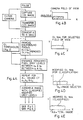
- sample S(n) is taken in rotation to be representative of meat within area A(n) to compute the Grey Level Thresholds numerically for lean and fat respectively, within zone S(n).
- Grey Level Thresholds are then used to analyse consecutive images of the product face just before a slice is cut and to control the product advance with the object of producing a constant weight slice or portion of slices.
- the sample Grey Levels are in a virtual tabular format corresponding to pixel location and the format is then shown modified for illustration purposes to show pixel numbers for each Grey Level as represented by a histogram with elongated tails at each end, indicating scatter.
- This scatter is untypical of the bulk of the sample and generally due to minor anomalies (ice crystals, droplets, small voids, etc.) and should, therefore, be removed.
- the data is treated to establish lower and upper limits a(n), b(n) for the Grey Levels (GL) which exclude the scatter in the tails of the distribution.
- test for validation consists of comparing this ratio with preset maximum and minimum values, which may be operator adjusted to suit the product.
- the shape of the histogram in Figure 3 shows a transition between concentrations of pixels which usually connect across a relatively narrow throat. For all practical purposes, this throat corresponds to neither lean nor fat and the Grey Level value at this point is used to distinguish between lean and fat at c(n) based on a(n) and b(n).
- the image data is periodically sampled, to update the Grey Level thresholds, which may be re-called and used as follows.
- the digital Grey Level grid is split into Zones which include areas A(1),A(2) - A(n), etc. and each zone is treated separately, preferably in parallel to save time, alternatively sequentially if time allows.
- Zone n for which the latest values of the product threshold Grey Levels are known (See Figure 3 tabulation of a(n), b(n) and c(n)) all pixels outside a(n) and b(n) are removed, thus retaining only those pixels which represent product.
- this fully enhanced pattern is usefully displayed on demand for direct comparison with the camera view, using a VDU, with or without super-imposed numerical data.
- the categorised pixels representing lean and fat are integrated separately and their ratio which represents lean/fat is compared to upper and lower set-points.
- the categorised pixels are also totalised and the total number of pixels is also compared to preset upper and lower limits, representative of the largest and smallest permissible slice area.
- the slice or the portion, complete or partial is diverted.
- the pixel sub-totals representing lean and fat are multiplied by their respective density factors to derive the linear density, that is the weight per unit thickness, appropriate to the slice which is about to be sliced.
- a standard control loop adjusts the slicer feed to produce a slice of substantially constant weight as described in the above cited patent.
- the control loop using the camera is found to achieve a consistent 85/95% on-weight performance, compared to a 30 to 60% performance for conventional control systems using a check-weigher rather than a camera.
- the distribution of fat and lean in a natural product, such as bacon, can result in portions, particularly shingled portions, which give the appearance of consisting of a large amount of fat and very little lean, because the exposed edges of consecutive slices are substantially fat although the bulk, which is hidden, is mainly lean.
- the enhanced digital image from Figure 4 is effectively masked to leave the appropriate edge area of the slice for computational purposes which, using the thresholds from Figure 3, computes the lean/fat ratio for the edge area, as explained in Figure 6 and compares it to a preset limit.
- the slice or the portion is diverted.
- slices may be rejected because, for example, the total ratio of fat to lean is unacceptably high.
- the final acceptability or otherwise of a slice also depends on a number of complex and interrelated characteristics such as the shape of the slice, the distribution of fat within the slice the size of the largest areas of fat within the slice etc.
- the neural network itself may be of conventional design and may be implemented in software in an appropriate microprocessor, or alternatively may use dedicated parallel-processing hardware.
- the network comprises an array of interconnected cells which are trained to fire in response to appropriate input stimuli. Neural network technology is discussed, and various commercial suppliers of both software and hardware-implemented systems identified in the review article "Neural Networks" published at pages 214-245 of Byte, vol. 14, number 8 August 1989, published by McGraw-Hill Inc.
- the system is first used in a training phase in which slices are cut individually from the product. Each slice is viewed by an assessor, preferably using the contrast-enhanced image from the VDU. The assessor inputs a signal to the system to indicate whether each slice is acceptable. After an appropriate number of slices has been viewed the network is then able to discriminate subsequent slices on the basis of the internal criteria developed during the training phase.
Landscapes
- Life Sciences & Earth Sciences (AREA)
- Engineering & Computer Science (AREA)
- Food Science & Technology (AREA)
- Wood Science & Technology (AREA)
- Zoology (AREA)
- Health & Medical Sciences (AREA)
- Chemical & Material Sciences (AREA)
- Physics & Mathematics (AREA)
- Medicinal Chemistry (AREA)
- Analytical Chemistry (AREA)
- Biochemistry (AREA)
- General Health & Medical Sciences (AREA)
- General Physics & Mathematics (AREA)
- Immunology (AREA)
- Pathology (AREA)
- Forests & Forestry (AREA)
- Mechanical Engineering (AREA)
- Image Processing (AREA)
- Image Analysis (AREA)
Applications Claiming Priority (2)
| Application Number | Priority Date | Filing Date | Title |
|---|---|---|---|
| GB9006804 | 1990-03-27 | ||
| GB909006804A GB9006804D0 (en) | 1990-03-27 | 1990-03-27 | Slicing machine |
Publications (1)
| Publication Number | Publication Date |
|---|---|
| EP0449512A1 true EP0449512A1 (de) | 1991-10-02 |
Family
ID=10673321
Family Applications (1)
| Application Number | Title | Priority Date | Filing Date |
|---|---|---|---|
| EP91302482A Withdrawn EP0449512A1 (de) | 1990-03-27 | 1991-03-21 | Schneidevorrichtung |
Country Status (5)
| Country | Link |
|---|---|
| US (1) | US5267168A (de) |
| EP (1) | EP0449512A1 (de) |
| JP (1) | JPH05277990A (de) |
| CA (1) | CA2039045A1 (de) |
| GB (1) | GB9006804D0 (de) |
Cited By (12)
| Publication number | Priority date | Publication date | Assignee | Title |
|---|---|---|---|---|
| DE19915861A1 (de) * | 1999-04-08 | 2000-10-12 | Biforce Anstalt Vaduz | Verfahren zum Aufschneiden von Lebensmittelprodukten |
| GB2427541A (en) * | 2005-06-24 | 2007-01-03 | Aew Delford Group Ltd | Vision system for food cutting and portioning apparatus |
| GB2428182A (en) * | 2005-06-24 | 2007-01-24 | Aew Delford Systems | Vision system for food cutting and portioning apparatus |
| EP1820614A1 (de) | 2006-02-17 | 2007-08-22 | Weber Maschinenbau GmbH & Co. KG | Aufschneiden von Lebensmittelprodukten |
| EP1312890A4 (de) * | 2000-08-21 | 2008-01-23 | Morinaga Milk Industry Co Ltd | Methode zur detektierung und identifikation der dicke von blattförmiger nahrung, verfahren und vorrichtung zur fabrikation von blattförmiger nahrung |
| EP1534478A4 (de) * | 2002-06-25 | 2008-03-26 | Formax Inc | Optisches klassifizierungssystem f r schneidvorrichtung |
| EP2251158A1 (de) * | 2009-05-15 | 2010-11-17 | AEW Delford Systems Limited | Vorrichtung und Verfahren zum Schneiden von Lebensmittelprodukten in Portionen |
| WO2013012346A1 (en) * | 2011-07-18 | 2013-01-24 | Titan Slicer Limited | Food slicing and weighing system |
| EP3187316A1 (de) * | 2015-12-31 | 2017-07-05 | Bizerba SE & Co. KG | Schneidemaschine mit wiegevorrichtung |
| EP3835017A1 (de) * | 2019-12-13 | 2021-06-16 | Inndeo Proyectos Industriales, S.L. | Scheibenklassifizierungssystem und -verfahren für eine aufschnittmaschine |
| US12311567B2 (en) | 2021-10-25 | 2025-05-27 | Provisur Technologies, Inc. | Releasable side strapping assembly for a food product slicing apparatus |
| WO2025168287A1 (de) * | 2024-02-09 | 2025-08-14 | Harburg-Freudenberger Maschinenbau Gmbh | Verfahren und vorrichtung zur kautschukdosierung |
Families Citing this family (38)
| Publication number | Priority date | Publication date | Assignee | Title |
|---|---|---|---|---|
| CA2133953A1 (en) * | 1992-04-23 | 1993-11-11 | Joseph Carey | Meat slicing machine and method of use thereof |
| GB9414803D0 (en) * | 1994-07-22 | 1994-09-14 | Lamberton & Co Ltd | Inspection system |
| DE69514972T2 (de) * | 1994-09-19 | 2000-07-20 | Totani Giken Kogyo Co. Ltd., Kyoto | Maschine zum Herstellen von Beuteln |
| US5974925A (en) * | 1994-10-11 | 1999-11-02 | Formax, Inc. | Continuous feed for food loaf slicing machine |
| US5926558A (en) * | 1996-01-05 | 1999-07-20 | Asko, Inc. | Method and apparatus for monitoring and inspecting rotary knives |
| US5937080A (en) * | 1997-01-24 | 1999-08-10 | Design Systems, Inc. | Computer controlled method and apparatus for meat slabbing |
| DE19852170C1 (de) * | 1998-11-12 | 2000-02-24 | Mohr Adolf Maschf | Vorrichtung zum Schneiden von gestapeltem, blattförmigem Gut |
| GB9827855D0 (en) * | 1998-12-17 | 1999-02-10 | Wright Pugson Limited | Methods and apparatus for cutting cheese |
| DE19914707A1 (de) * | 1999-03-31 | 2000-10-05 | Biforce Anstalt Vaduz | Verfahren und Vorrichtung zum Aufschneiden von Lebensmittelprodukten |
| US20050170056A1 (en) * | 1999-04-08 | 2005-08-04 | Weber Maschinenbau Gmbh & Co. Kg | Method for the slicing of food products |
| DE00928257T1 (de) * | 1999-04-20 | 2005-12-15 | Formax, Inc., Mokena | Gerät zur automatischen abtastung eines produktes sowie aufschnittschneidemaschine mit einem solchen gerät |
| US6320141B1 (en) | 1999-10-12 | 2001-11-20 | Formax, Inc. | Yield monitoring system for a slicing apparatus |
| GB2364894B8 (en) * | 2000-07-19 | 2010-07-07 | Fmc Corp | Three axis portioning method |
| WO2002060656A1 (en) * | 2001-01-30 | 2002-08-08 | Aew Engineering Company Ltd | Method and apparatus for setting the size of a image processor window in a slicing machine |
| GB2371738B (en) * | 2001-01-30 | 2003-01-15 | Aew Eng Co Ltd | Improvements in slicing machines |
| DE10131701A1 (de) * | 2001-06-29 | 2003-01-16 | Biforce Anstalt Vaduz | Aufschneideverfahren und -vorrichtung |
| DE10147617B4 (de) * | 2001-09-27 | 2016-05-25 | Weber Maschinenbau Gmbh & Co. Kg | Aufschneidevorrichtung |
| US7055419B2 (en) * | 2003-01-10 | 2006-06-06 | Formax, Inc. | System and method for optimizing slices from slicing apparatus |
| US7373217B2 (en) * | 2003-04-08 | 2008-05-13 | Hormel Foods, Llc | Apparatus for slicing a food product and method therefore |
| US20060288832A1 (en) * | 2003-04-09 | 2006-12-28 | Glenn Sandberg | System and apparatus for optimizing slices from slicing apparatus |
| CA2555608C (en) * | 2004-02-20 | 2013-01-08 | Scanvaegt International A/S | Method and apparatus for portion cutting of food products or similar items |
| US7949414B2 (en) * | 2004-12-30 | 2011-05-24 | John Bean Technologies Corporation | Processing of work piece based on desired end physical criteria |
| AU2005248942A1 (en) * | 2004-12-30 | 2006-07-20 | John Bean Technologies Corporation | Conveying conformable products |
| US20080229589A1 (en) * | 2007-03-23 | 2008-09-25 | Danny Bone | Power tool having improved visibility of the cutting area |
| WO2008143861A1 (en) * | 2007-05-15 | 2008-11-27 | Hudson Sharp Machine Co. | Method of making and inspecting bags |
| JP5099837B2 (ja) * | 2008-01-31 | 2012-12-19 | 吉泉産業株式会社 | 材料のスライス方法及びスライス装置 |
| DE102008040071A1 (de) * | 2008-07-02 | 2010-01-07 | Robert Bosch Gmbh | Werkzeugmaschine, insbesondere handgehaltene Werkzeugmaschine |
| US8931240B2 (en) * | 2008-10-27 | 2015-01-13 | Formax, Inc. | Shuttle system and method for moving food products into packaging |
| DE102010012709A1 (de) * | 2010-03-25 | 2011-09-29 | Weber Maschinenbau Gmbh Breidenbach | Vorrichtung und Verfahren zum Aufschneiden von Lebensmittelprodukten |
| TWI508153B (zh) * | 2010-04-30 | 2015-11-11 | 三星鑽石工業股份有限公司 | Disconnection device and disconnection method of brittle material substrate |
| CN110035874A (zh) * | 2016-12-01 | 2019-07-19 | 3M创新有限公司 | 转换工位中的膜对准 |
| US10836065B2 (en) | 2017-01-04 | 2020-11-17 | Provisur Technologies, Inc. | Exposed load cell in a food processing machine |
| EP3952657A4 (de) | 2019-04-08 | 2023-04-19 | Provisur Technologies, Inc. | Vorrichtung und verfahren zum schneiden von fleischprodukten in fleischblöcke |
| DE102019110313B3 (de) | 2019-04-18 | 2020-07-02 | Provisur Technologies GmbH | Nahrungsmittelverarbeitungseinrichtung und entsprechendes Nahrungsmittelverarbeitungsverfahren |
| JP7236938B2 (ja) * | 2019-05-31 | 2023-03-10 | 株式会社 ゼンショーホールディングス | 切断補助装置 |
| JP7237230B2 (ja) * | 2019-05-31 | 2023-03-10 | 株式会社 ゼンショーホールディングス | 切断補助装置 |
| CN113207935B (zh) * | 2021-03-03 | 2022-11-25 | 芜湖燕大润伟机械科技有限公司 | 基于类型解析的自适应机械加工系统及方法 |
| CN117400317B (zh) * | 2023-12-14 | 2024-03-12 | 洪雅县瓦屋山药业有限公司 | 一种中药材加工用可调节切片装置 |
Citations (5)
| Publication number | Priority date | Publication date | Assignee | Title |
|---|---|---|---|---|
| GB2000286A (en) * | 1977-06-25 | 1979-01-04 | Pfister Waagen Gmbh | Method and device for determining quality features of a foodstuffs test object |
| FR2496269A1 (fr) * | 1980-12-17 | 1982-06-18 | Pfister Gmbh | Procede pour evaluer sans contact les caracteristiques qualitatives d'un objet appartenant a la categorie des produits de boucherie |
| GB2187281A (en) * | 1986-02-26 | 1987-09-03 | Analytical Instr Ltd | Colour analyser |
| DE3714199A1 (de) * | 1987-04-29 | 1987-11-12 | Linke Karl Heinz | Verfahren zum gewichtsgenauen schneiden von produkten fester konsistenz |
| FR2632098A1 (fr) * | 1988-05-24 | 1989-12-01 | Cerisy Sa | Procede et dispositif de tranchage et de conditionnement a masse constante d'un produit consistant non homogene |
Family Cites Families (3)
| Publication number | Priority date | Publication date | Assignee | Title |
|---|---|---|---|---|
| US4136504A (en) * | 1976-09-10 | 1979-01-30 | Ihor Wyslotsky | Slicing method |
| DE3808790A1 (de) * | 1988-03-16 | 1989-09-28 | Guenther Weber | Verfahren zur gewinnung gewichtskonstanter portionen oder scheiben aus aufgeschnittenen lebensmittelprodukten |
| US4875254A (en) * | 1988-03-22 | 1989-10-24 | Design Systems, Inc. | Method and apparatus for automatically cutting food products to predetermined weight or shape |
-
1990
- 1990-03-27 GB GB909006804A patent/GB9006804D0/en active Pending
-
1991
- 1991-03-21 EP EP91302482A patent/EP0449512A1/de not_active Withdrawn
- 1991-03-26 CA CA002039045A patent/CA2039045A1/en not_active Abandoned
- 1991-03-27 JP JP3087556A patent/JPH05277990A/ja active Pending
- 1991-03-27 US US07/676,012 patent/US5267168A/en not_active Expired - Lifetime
Patent Citations (5)
| Publication number | Priority date | Publication date | Assignee | Title |
|---|---|---|---|---|
| GB2000286A (en) * | 1977-06-25 | 1979-01-04 | Pfister Waagen Gmbh | Method and device for determining quality features of a foodstuffs test object |
| FR2496269A1 (fr) * | 1980-12-17 | 1982-06-18 | Pfister Gmbh | Procede pour evaluer sans contact les caracteristiques qualitatives d'un objet appartenant a la categorie des produits de boucherie |
| GB2187281A (en) * | 1986-02-26 | 1987-09-03 | Analytical Instr Ltd | Colour analyser |
| DE3714199A1 (de) * | 1987-04-29 | 1987-11-12 | Linke Karl Heinz | Verfahren zum gewichtsgenauen schneiden von produkten fester konsistenz |
| FR2632098A1 (fr) * | 1988-05-24 | 1989-12-01 | Cerisy Sa | Procede et dispositif de tranchage et de conditionnement a masse constante d'un produit consistant non homogene |
Cited By (19)
| Publication number | Priority date | Publication date | Assignee | Title |
|---|---|---|---|---|
| WO2000061338A1 (de) * | 1999-04-08 | 2000-10-19 | Biforce Anstalt | Verfahren zum aufschneiden von lebensmittelprodukten |
| AU760726B2 (en) * | 1999-04-08 | 2003-05-22 | Weber Maschinenbau Gmbh & Co Kg | Method for slicing foodstuff products |
| DE19915861A1 (de) * | 1999-04-08 | 2000-10-12 | Biforce Anstalt Vaduz | Verfahren zum Aufschneiden von Lebensmittelprodukten |
| EP1312890A4 (de) * | 2000-08-21 | 2008-01-23 | Morinaga Milk Industry Co Ltd | Methode zur detektierung und identifikation der dicke von blattförmiger nahrung, verfahren und vorrichtung zur fabrikation von blattförmiger nahrung |
| EP1534478B1 (de) | 2002-06-25 | 2017-03-01 | Formax, Inc. | Optisches Klassifizierungssystem und entsprechendes Verfahren für Schneidevorrichtung |
| EP1534478A4 (de) * | 2002-06-25 | 2008-03-26 | Formax Inc | Optisches klassifizierungssystem f r schneidvorrichtung |
| GB2427541A (en) * | 2005-06-24 | 2007-01-03 | Aew Delford Group Ltd | Vision system for food cutting and portioning apparatus |
| GB2428182A (en) * | 2005-06-24 | 2007-01-24 | Aew Delford Systems | Vision system for food cutting and portioning apparatus |
| EP1820614A1 (de) | 2006-02-17 | 2007-08-22 | Weber Maschinenbau GmbH & Co. KG | Aufschneiden von Lebensmittelprodukten |
| EP2251158A1 (de) * | 2009-05-15 | 2010-11-17 | AEW Delford Systems Limited | Vorrichtung und Verfahren zum Schneiden von Lebensmittelprodukten in Portionen |
| US10350779B2 (en) | 2009-05-15 | 2019-07-16 | Thurne-Middleby Ltd. | Method for cutting food products into portions |
| US8869664B2 (en) | 2011-07-18 | 2014-10-28 | Titan Slicer Limited | Food slicing and weighing system |
| WO2013012346A1 (en) * | 2011-07-18 | 2013-01-24 | Titan Slicer Limited | Food slicing and weighing system |
| EP3187316A1 (de) * | 2015-12-31 | 2017-07-05 | Bizerba SE & Co. KG | Schneidemaschine mit wiegevorrichtung |
| EP3835017A1 (de) * | 2019-12-13 | 2021-06-16 | Inndeo Proyectos Industriales, S.L. | Scheibenklassifizierungssystem und -verfahren für eine aufschnittmaschine |
| US12311567B2 (en) | 2021-10-25 | 2025-05-27 | Provisur Technologies, Inc. | Releasable side strapping assembly for a food product slicing apparatus |
| US12427687B2 (en) | 2021-10-25 | 2025-09-30 | Provisur Technologies, Inc. | Profile scanner and feed assembly for a high-speed food slicing apparatus |
| US12441021B2 (en) | 2021-10-25 | 2025-10-14 | Provisur Technologies, Inc. | Blade assembly and counterweight mechanism for a high-speed food slicing apparatus, and methods associated with the same |
| WO2025168287A1 (de) * | 2024-02-09 | 2025-08-14 | Harburg-Freudenberger Maschinenbau Gmbh | Verfahren und vorrichtung zur kautschukdosierung |
Also Published As
| Publication number | Publication date |
|---|---|
| CA2039045A1 (en) | 1991-09-28 |
| US5267168A (en) | 1993-11-30 |
| JPH05277990A (ja) | 1993-10-26 |
| GB9006804D0 (en) | 1990-05-23 |
Similar Documents
| Publication | Publication Date | Title |
|---|---|---|
| US5267168A (en) | Apparatus for and method of controlling slicing machine | |
| EP2029330B1 (de) | Aufschneidemaschine mit GESTROBTE BELEUCHTUNG VERWENDENDEM OPTISCHEM SYSTEM sowie Verfahren zum Tasten einer Strirnseite eines Produktes | |
| US5324228A (en) | Method and apparatus for detecting and trimming fat from meat products | |
| EP1534478B2 (de) | Optisches Klassifizierungsverfahren für Schneidevorrichtung | |
| US5136906A (en) | Slicing machine | |
| AU2005248976B2 (en) | Determining the position and angular orientation of food products | |
| US5054345A (en) | Method of obtaining constant weight portions or slices of sliced food products | |
| CA2877448C (en) | Method and device for monitoring a meat processing machine | |
| EP0574831A1 (de) | Verfahren und Vorrichtung zur Prüfung von Produkten | |
| Rehkugler et al. | Image processing algorithm for apple defect detection | |
| US20090137195A1 (en) | Determining the position and angular orientation of food products | |
| US8116554B2 (en) | Two colour vision system | |
| EP1915240B1 (de) | Zweifarben-bilderkennungssystem | |
| US5537670A (en) | Product appearance inspection methods and apparatus employing low variance filter | |
| US11937612B2 (en) | Imaging based portion cutting | |
| US20240037771A1 (en) | A method and a system for determining a weight estimate of a food item | |
| US20050170056A1 (en) | Method for the slicing of food products | |
| Beatty | 2D contour shape analysis for automated herring roe quality grading by computer vision |
Legal Events
| Date | Code | Title | Description |
|---|---|---|---|
| PUAI | Public reference made under article 153(3) epc to a published international application that has entered the european phase |
Free format text: ORIGINAL CODE: 0009012 |
|
| AK | Designated contracting states |
Kind code of ref document: A1 Designated state(s): DE ES FR GB IT SE |
|
| 17P | Request for examination filed |
Effective date: 19920528 |
|
| 17Q | First examination report despatched |
Effective date: 19930413 |
|
| STAA | Information on the status of an ep patent application or granted ep patent |
Free format text: STATUS: THE APPLICATION IS DEEMED TO BE WITHDRAWN |
|
| 18D | Application deemed to be withdrawn |
Effective date: 19930824 |