EP0446740A2 - Verwendung von Benzophenon-Derivaten als Lichtschutzmittel für aromatische Polycarbonate und aromatische Polyestercarbonate - Google Patents
Verwendung von Benzophenon-Derivaten als Lichtschutzmittel für aromatische Polycarbonate und aromatische Polyestercarbonate Download PDFInfo
- Publication number
- EP0446740A2 EP0446740A2 EP91103173A EP91103173A EP0446740A2 EP 0446740 A2 EP0446740 A2 EP 0446740A2 EP 91103173 A EP91103173 A EP 91103173A EP 91103173 A EP91103173 A EP 91103173A EP 0446740 A2 EP0446740 A2 EP 0446740A2
- Authority
- EP
- European Patent Office
- Prior art keywords
- oder
- alkyl
- bis
- cyano
- phenoxy
- Prior art date
- Legal status (The legal status is an assumption and is not a legal conclusion. Google has not performed a legal analysis and makes no representation as to the accuracy of the status listed.)
- Withdrawn
Links
Classifications
-
- C—CHEMISTRY; METALLURGY
- C07—ORGANIC CHEMISTRY
- C07C—ACYCLIC OR CARBOCYCLIC COMPOUNDS
- C07C69/00—Esters of carboxylic acids; Esters of carbonic or haloformic acids
- C07C69/66—Esters of carboxylic acids having esterified carboxylic groups bound to acyclic carbon atoms and having any of the groups OH, O—metal, —CHO, keto, ether, acyloxy, groups, groups, or in the acid moiety
- C07C69/67—Esters of carboxylic acids having esterified carboxylic groups bound to acyclic carbon atoms and having any of the groups OH, O—metal, —CHO, keto, ether, acyloxy, groups, groups, or in the acid moiety of saturated acids
- C07C69/708—Ethers
- C07C69/712—Ethers the hydroxy group of the ester being etherified with a hydroxy compound having the hydroxy group bound to a carbon atom of a six-membered aromatic ring
-
- C—CHEMISTRY; METALLURGY
- C08—ORGANIC MACROMOLECULAR COMPOUNDS; THEIR PREPARATION OR CHEMICAL WORKING-UP; COMPOSITIONS BASED THEREON
- C08K—Use of inorganic or non-macromolecular organic substances as compounding ingredients
- C08K5/00—Use of organic ingredients
- C08K5/04—Oxygen-containing compounds
- C08K5/13—Phenols; Phenolates
- C08K5/134—Phenols containing ester groups
Definitions
- the invention relates to aromatic polycarbonates and aromatic polyester carbonates stabilized against the action of light.
- the invention therefore further relates to these new compounds and to a process for their preparation.
- benzophenone derivatives I are known from US Pat. No. 3,676,471 (1). These substances are recommended as light stabilizers for polymeric compositions such as polyolefins, polyvinyl chloride and its copolymers with other unsaturated compounds, polystyrene and its copolymers with butadiene, acrylonitrile or methacrylic acid esters, polyesters, polyamides and lacquers made from synthetic resins.
- the object of the present invention was therefore to provide means which do not have the disadvantages described.
- alkyl and alkoxy radicals R 1 which may be mentioned are: methyl, ethyl, n-propyl, isopropyl, n-butyl, tert-butyl, methoxy, ethoxy, n-propyloxy, iso-propyloxy, n-butyloxy and tert.- Butyloxy.
- the radicals R1 can be in the o-, m- or p-position.
- radicals R 1 are primarily hydrogen, methyl, methoxy, phenoxy and chlorine, in particular hydrogen is preferred.
- the number n of methylene groups is preferably 2.
- the value for p is preferably 2 or 3, in particular 2.
- the compounds Ia represent a subgroup of the compounds I.
- the benzophenone derivatives Ia are advantageously by esterification of an alcohol of the general formula II with a carboxylic acid of the general formula III produced in a manner known per se.
- the procedure is usually in an organic solvent such as benzene, toluene or xylene, at temperatures from 60 to 150 ° C and in the presence of an acidic catalyst, for example sulfuric acid, p-toluenesulfonic acid or an acidic ion exchange resin.
- an acidic catalyst for example sulfuric acid, p-toluenesulfonic acid or an acidic ion exchange resin.
- the water formed during the reaction is advantageously removed by distillation during the reaction.
- the benzophenone derivatives I serve as light stabilizers, especially for aromatic polycarbonates, but also for aromatic polyester carbonates.
- Aromatic polycarbonates are to be understood as homopolycarbonates, copolycarbonates and terpolycarbonates and mixtures thereof.
- Preferred polycarbonates are those with a weight average molecular weight of 10,000 to 200,000, in particular 20,000 to 80,000, and a flow rate by extrusion plastometer of 1 to 24 g / 10 min at 300 ° C. according to the Annual Book of ASTM Standards D. 1238-86.
- polycarbonates are obtained by known processes, for example from phosgene and dihydroxy compounds by polycondensation.
- dihydroxy compounds e.g. considered:
- Hydroquinone resorcinol, bis (hydroxyphenyl) alkanes, bis (hydroxyphenyl) cycloalkanes, bis (hydroxyphenyl) ether, bis (hydroxyphenyl) ketones, bis (hydroxyphenyl) sulfoxides, bis (hydroxyphenyl) sulfones or 2,2-bis (hydroxyphenyl) diisopropylbenzenes.
- Aromatic polyester carbonates which should be mentioned are in particular those obtained from diphenols (for example bisphenol A), iso- and / or terephthalic acid, phosgene or another carbonic acid derivative, chain terminators and, if appropriate, crosslinking agents. They usually have relative viscosities, i.e. a ratio of the viscosity of the solution to the viscosity of the pure solvent, from 1.2 to 2.0, measured in 0.5 wt .-% solution in dichloromethane at 25 ° C.
- the benzophenone derivatives I to be used according to the invention can be used in amounts of 0.05 to 10% by weight, preferably 0.5 to 3% by weight, based on the amount of the polymer.
- the incorporation into the polymer usually takes place in the melt, for example in extruders.
- the stabilizing effect against the action of light and also against thermal stress can be increased significantly.
- These agents or mixtures thereof are advantageously used in an amount of 0.1 to 5% by weight, preferably 0.5 to 3% by weight, based on the amount of the polymer, together with the compounds I.
- phosphorus-containing antioxidants are, for example Tris (nonylphenyl) phosphite, Distearylpentaerythritol diphosphite, Tris (2,4-di-tert-butylphenyl) phosphite, Tris (2-tert-butyl-4-methylphenyl) phosphite, Bis (2,4-di-tert-butylphenyl) pentaerythritol diphosphite and Tetrakis (2,4-di-tert-butylphenyl) -4,4'-biphenylene diphosphite to call.
- Tris (nonylphenyl) phosphite Distearylpentaerythritol diphosphite
- Tris (2,4-di-tert-butylphenyl) phosphite Tris (2-tert-butyl-4-methylphenyl) pho
- sulfur-containing antioxidants are Dilauryl thiodipropionate, Dimyristyl thiodipropionate, Distearyl thiodipropionate, Pentaerythritol tetrakis ( ⁇ -laurylthiopropionate) and Pentaerythritol tetrakis ( ⁇ -hexylthiopropionate) to call.
- sterically hindered phenolic antioxidants come, for example 2,6-di-tert-butyl-4-methylphenol, n-octadecyl- ⁇ - (3,5-di-tert-butyl-4-hydroxyphenyl) propionate, 1,1,3-tris (2-methyl-4-hydroxy-5-tert-butylphenyl) butane, 1,3,5-trimethyl-2,4,6-tris (3,5-di-tert-butyl-4-hydroxybenzyl) benzene, 1,3,5-tris (3,5-di-tert-butyl-4-hydroxybenzyl) isocyanurate, 1,3,5-tris [(3,5-di-tert-butyl-4-hydroxyphenyl) propionyloxy-ethyl] isocyanurate, 1,3,5-tris (2,6-dimethyl-3-hydroxy-4-tert-butylbenzyl) isocyanurate, Pentaerythrito
- Examples of sterically hindered amines are: Bis (2,2,6,6-tetramethylpiperidyl) sebacate, Bis (1,2,2,6,6-pentamethylpiperidyl) sebacate, the condensation product of 1-hydroxyethyl-2,2,6,6-tetramethyl-4-hydroxypiperidine and succinic acid, the condensation product of N, N '- (2,2,6,6-tetramethylpiperidyl) hexamethylenediamine and 4-tert-octylamino-2,6-dichloro-1,3,5-s-triazine, Tris (2,2,6,6-tetramethylpiperidyl) nitrilotriacetate, Tetrakis (2,2,6,6-tetramethyl-4-piperidyl) -1,2,3,4-butane-tetracarboxylic acid, 1,1 '- (1,2-ethanediyl) -bis (3,3,5, 5-tetramethylpiperazinone) and the
- the compounds I to be used according to the invention have a significantly lower intrinsic color and thus no longer cause discoloration, in particular in the case of transparent polycarbonate or polyester carbonate parts.
- the compounds I to be used according to the invention show a significantly improved stabilization effect against the action of light, i.e. the aging of the polymeric material is much slower in its presence.
- test specimens produced were tested for light and weather fastness in a Xenotest® 200 rapid weathering device from Hanau.
- the aging was determined by measuring the yellowness index (YI) according to the Annual Book of ASTM Standards D 1925-70 (Reapproved 1977) after defined time intervals.
- the maximum exposure time was 2000 h in all experiments. The results are summarized in Table 2.
Landscapes
- Chemical & Material Sciences (AREA)
- Organic Chemistry (AREA)
- Health & Medical Sciences (AREA)
- Chemical Kinetics & Catalysis (AREA)
- Medicinal Chemistry (AREA)
- Polymers & Plastics (AREA)
- Organic Low-Molecular-Weight Compounds And Preparation Thereof (AREA)
- Polyesters Or Polycarbonates (AREA)
- Furan Compounds (AREA)
- Pyridine Compounds (AREA)
- Compositions Of Macromolecular Compounds (AREA)
- Heterocyclic Compounds Containing Sulfur Atoms (AREA)
Abstract
Verwendung von Benzophenon-Derivaten I

bei denen die Variablen die folgende Bedeutung haben:
bei denen die Variablen die folgende Bedeutung haben:
- R¹
- Wasserstoff, C₁-C₄-Alkyl, C₁-C₄-Alkoxy, Phenoxy, Fluor, Chlor, Brom, Cyano oder Trifluormethyl,
- n
- 2 bis 4,
- p
- 1 bis 4 und
- R²
-
- (a) für den Fall p = 1
C₁-C₁₂-Alkyl, das durch eine oder mehrere Hydroxyl- oder C₁-C₄-Alkoxygruppen substituiert sein kann,
Cycloalkyl mit 3 bis 6 C-Atomen im Ring,
ein Rest der allgemeinen Formel
ein fünf- oder sechsgliedriger ungesättigter heterocyclischer Ring, der durch C₁-C₄-Alkylgruppen, Fluor, Chlor, Brom oder Cyano substituiert sein kann, oder
- (b) für den Fall p = 2 bis 4
eine Einfachbindung oder die Ergänzung zu einer p-wertigen aliphatischen, cycloaliphatischen, aromatischen oder heterocyclischen Carbonsäure
- (a) für den Fall p = 1
als Lichtschutzmittel für aromatische Polycarbonate und aromatische Polyestercarbonate.
Description
- Die vorliegende Erfindung betrifft die Verwendung von Benzophenon-Derivaten der allgemeinen Formel I

in der die Variablen die folgende Bedeutung haben: - R1
- Wasserstoff, C₁-C₄-Alkyl, C₁-C₄-Alkoxy, Phenoxy, Fluor, Chlor, Brom, Cyano oder Trifluormethyl,
- n
- 2 bis 4,
- p
- 1 bis 4 und
- R²
-
- (a) für den Fall p = 1
C₁-C₁₂-Alkyl, das durch eine oder mehrere Hydroxyl- oder C₁-C₄-Alkoxygruppen substituiert sein kann,
Cycloalkyl mit 3 bis 6 C-Atomen im Ring,
ein Rest der allgemeinen Formel
ein fünf- oder sechsgliedriger ungesättigter heterocyclischer Ring, der durch C₁-C₄-Alkylgruppen, Fluor, Chlor, Brom oder Cyano substituiert sein kann, oder
- (b) für den Fall p = 2 bis 4
eine Einfachbindung oder die Ergänzung zu einer p-wertigen aliphatischen, cycloaliphatischen, aromatischen oder heterocyclischen Carbonsäure
- (a) für den Fall p = 1
- Außerdem betrifft die Erfindung gegen die Einwirkung von Licht stabilisierte aromatische Polycarbonate und aromatische Polyestercarbonate.
- Die Verbindungen I sind zum Teil neue Stoffe. Deshalb betrifft die Erfindung weiterhin diese neuen Verbindungen sowie ein Verfahren zu ihrer Herstellung.
- Aus der US-A 3 676 471 (1) sind verschiedene Benzophenon-Derivate I bekannt. Diese Substanzen werden als Lichtschutzmittel für polymere Zusammensetzungen wie Polyolefine, Polyvinylchlorid und seine Copolymerisate mit anderen ungesättigten Verbindungen, Polystyrol und seine Copolymerisate mit Butadien, Acrylnitril oder Methacrylsäureestern, Polyester, Polyamide sowie Lacke aus synthetischen Harzen empfohlen.
- Die EP-A 254 987 (2) und 309 909 (3) betreffen jeweils ein Verfahren zum Färben von textilem Polyestermaterial mit Dispersionsfarbstoffen, bei dem im Falle von (2) ein Teil der unter (a) für p = 1 bezeichneten Benzophenon-Derivate I und im Falle von (3) die unter (b) für p = 2 bis 4 bezeichneten Benzophenon-Derivate I Anwendung finden.
- Die in der Literatur für Polycarbonate und Polyestercarbonate bereits beschriebenen Lichtschutzmittel, beispielsweise Benztriazol-Derivate, wie sie aus der EP-B 006 564 (4) bekannt sind, weisen eine Reihe von Nachteilen auf. Mit ihnen wird kein zufriedenstellender Schutz gegen die Zerstörung durch Lichteinwirkung unter atmosphärischen Bedingungen erzielt, so daß diese Kunststoffe zu rasch altern. Insbesondere wird durch den Zusatz dieser Mittel häufig bei Polycarbonatartikeln wie transparenten Platten und Profilen eine Verfärbung hervorgerufen, diese Artikel erscheinen dann in der Durchsicht gelb statt farblos.
- Aufgabe der vorliegenden Erfindung war es deshalb, Mittel bereitzustellen, die die beschriebenen Nachteile nicht aufweisen.
- Demgemäß wurden die eingangs definierten Benzophenon-Derivate I gefunden. Als Alkyl- und Alkoxyreste R¹ seien beispielsweise genannt: Methyl, Ethyl, n-Propyl, iso-Propyl, n-Butyl, tert.-Butyl, Methoxy, Ethoxy, n-Propyloxy, iso-Propyloxy, n-Butyloxy und tert.-Butyloxy. Die Reste R¹ können in o-, m- oder p-Stellung stehen.
- Weiterhin stehen die Reste R¹ in erster Linie für Wasserstoff, Methyl, Methoxy, Phenoxy und Chlor, insbesondere wird Wasserstoff bevorzugt.
- Die Anzahl n der Methylengruppen beträgt vorzugsweise 2.
- Als Reste R² für den Fall (a) mit p = 1 seien beispielhaft genannt:
- Methyl, Ethyl, n-Propyl, iso-Propyl, n-Butyl, iso-Butyl, sek.-Butyl, tert.-Butyl, n-Pentyl, 3-Methylbutyl, 1-Ethylpropyl, 1,1-Dimethylpropyl, 2,2-Dimethylpropyl, n-Hexyl, n-Heptyl, 1-Ethylpentyl, n-Octyl, 2, 4, 4-Trimethylpentyl, 2-Ethylhexyl, n-Nonyl, n-Decyl, n-Undecyl, n-Dodecyl, Hydroxymethyl, 2-Hydroxyethyl, 2-Hydroxypropyl, 2-Hydroxy-2-methylpropyl, 3-Hydroxy-2-methylpropyl, 2-Hydroxybutyl, Methoxymethyl und 2-Methoxyethyl; bevorzugt werden C₁-C₄-Alkylreste
- Cyclopropyl, Cyclobutyl, Cyclopentyl sowie vorzugsweise Cyclohexyl
- Phenyl, 2-, 3- und 4-Methylphenyl, 2-, 3- und 4-Ethylphenyl, 2-, 3-und 4- n- oder iso-Propylphenyl, 2-, 3- und 4- n- oder tert.-Butylphenyl, 2,3-Dimethylphenyl, 2,4-Dimethylphenyl, 2,5-Dimethylphenyl, 2,6-Dimethylphenyl, 3,4-Dimethylphenyl, 3,5-Dimethylphenyl, 2, 4, 6-Trimethylphenyl, 2,4-Dimethyl-6-tert.-butylphenyl, 2-, 3- und 4-Chlorphenyl, 2-, 3- und 4-Bromphenyl, 2,4-Dichlorphenyl, 2,5-Dichlorphenyl, 2,6-Dichlorphenyl, 3,5-Dichlorphenyl, 2-, 3- und 4-Methoxyphenyl, 2,3-Dimethoxyphenyl, 2,4-Dimethoxyphenyl, 2,6-Dimethoxyphenyl, 3,4-Dimethoxyphenyl, 3,5-Dimethoxyphenyl, 2-Ethoxyphenyl, 4-Ethoxyphenyl, 2,3,4-Trimethoxyphenyl, 3,4,5-Trimethoxyphenyl, 4-Biphenyl, 4-Phenoxyphenyl, Benzyl, 2-, 3-und 4-Methylbenzyl, 4-Ethylbenzyl, 4-Isopropylbenzyl, 4-tert.-Butylbenzyl, 2-, 3- und 4-Chlorbenzyl, 2-, 3- und 4-Brombenzyl, 2-, 3- und 4-Methoxybenzyl, 2-, 3- und 4-Ethoxybenzyl, 3,4-Dimethoxybenzyl, 3,5-Dimethoxybenzyl, 3,4,5-Trimethoxybenzyl, 2-Phenylethyl, 3-Phenylpropyl, 4-Phenylbutyl, Phenoxymethyl, 2-, 3- und 4-Methylphenoxymethyl, 2-, 3- und 4-Ethylphenoxymethyl, 4-Isopropylphenoxymethyl, 4-n-Butylphenoxymethyl, 4-tert.-Butylphenoxymethyl, 2,3-Dimethylphenoxymethyl, 2,4-Dimethylphenoxymethyl, 2,5-Dimethylphenoxymethyl, 3,5-Dimethylphenyoxymethyl, 3,4-Dimethylphenoxymethyl, 2-Methyl-4-tert.-butylphenoxymethyl, 3,4,5-Trimethoxyphenoxymethyl, 2,4,6-Trimethylphenoxymethyl, 2,6-Dimethyl-4-tert.-butyl-phenoxymethyl, 2-, 3- und 4-Chlorphenoxymethyl, 2-, 3- und 4-Bromphenoxymethyl, 2-, 3- und 4-Methoxyphenoxymethyl, 4-Ethoxyphenoxymethyl, 2-Methyl-4-chlorphenoxylmethyl, 2-Phenoxyethyl und 4-Phenoxybutyl; bevorzugt werden Phenyl, Methylphenyl-Reste (Tolyl-Reste), Dimethylphenyl-Reste (Xylyl-Reste), tert.-Butylphenyl-Reste, Methoxyphenyl-Reste, Dimethoxyphenyl-Reste, Benzyl, 2-Phenylethyl, Phenoxymethyl und 2-Phenoxyethyl
- Reste der allgemeinen Formel

- als heterocyclische Ringe Furyl-2, Furyl-3, 2,5-Dimethylfuryl-3, Thienyl-2, Thienyl-3, Pyridyl-2, Pyridyl-3, Pyridyl-4 und 2-Chlorpyridyl-3.
- Für den Fall (b) mit p = 2 bis 4 seien als p-wertige Carbonsäuren, aus denen durch Weglassen der Carboxylgruppen die Ergänzungen R² abgeleitet werden, beispielhaft genannt:
- Oxalsäure, Malonsäure, Bernsteinsäure, Glutarsäure, 3,3-Dimethylglutarsäure, Adipinsäure, Pimelinsäure, Korksäure, Azelainsäure, Sebacinsäure, Maleinsäure, Fumarsäure, Glutaconsäure, Itaconsäure, Citronensäure, Tricarballylsäure, Butan-1,2,3,4-tetracarbonsäure, Ethylendiamintetraessigsäure, Phthalsäure, Isophthalsäure, Terephthalsäure, Hexahydrophthalsäure, Hexahydroisophthalsäure, Hexahydroterephthalsäure, 3- und 4-Chlorphthalsäure, Tetrachlorphthalsäure, m-Phenylendiessigsäure, p-Phenylendiessigsäure, m-Phenylendioxiessigsäure, p-Phenylendioxiessigsäure, Diphenylether-4,4'-dicarbonsäure, Diphensäure, Diphenyl-4,4'-dicarbonsäure, Diphenylsulfon-4,4'-dicarbonsäure, Benzophenon-4,4'-dicarbonsäure, Naphthalin-2,6-dicarbonsäure, Trimellitsäure, Trimesinsäure, Pyromellitsäure, Hemimellitsäure, Thiophen-2,5-dicarbonsäure, Pyridin-2,6-, Pyridin-2,5- und Pyridin-3,5-dicarbonsäure.
- Die Ergänzung R² steht für eine Einfachbindung, wenn man ihn von Oxalsäure ableitet (p = 2).
- Für den Fall (b) beträgt der Wert für p vorzugsweise 2 oder 3, insbesondere 2.
- Die Erfindung betrifft weiterhin neue Benzophenon-Derivate der allgemeinen Formel Ia

in der die Variablen die folgende Bedeutung haben: - R⁶,R⁷
- Wasserstoff, C₁-C₄-Alkyl, C₁-C₄-Alkoxy, Phenoxy, Fluor, Chlor, Brom, Cyano oder Trifluormethyl und
- n
- 2 bis 4.
- Die Verbindungen Ia stellen eine Untergruppe der Verbindungen I dar.
- Die Benzophenon-Derivate Ia werden zweckmäßigerweise durch Veresterung eines Alkohols der allgemeinen Formel II
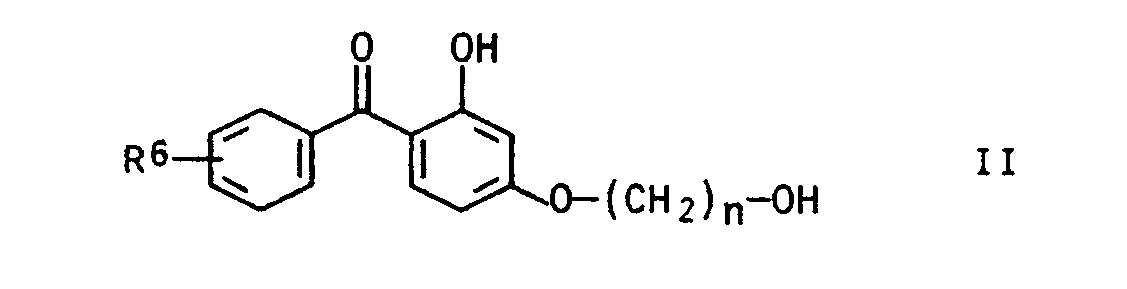
mit einer Carbonsäure der allgemeinen Formel III
in an sich bekannter Weise hergestellt. - Man arbeitet hierbei in der Regel in einem organischen Lösungsmittel wie Benzol, Toluol oder Xylol, bei Temperaturen von 60 bis 150°C und in Gegenwart eines sauren Katalysators, beispielsweise Schwefelsäure, p-Toluolsulfonsäure oder eines sauren Ionenaustauscherharzes. Das sich bei der Umsetzung bildende Wasser wird vorteilhaft während der Reaktion kontinuierlich destillativ entfernt.
- Die Benzophenon-Derivate I dienen als Lichtschutzmittel vor allem für aromatische Polycarbonate, daneben aber auch für aromatische Polyestercarbonate.
- Unter aromatischen Polycarbonaten sind Homopolycarbonate, Copolycarbonate und Terpolycarbonate sowie Mischungen hieraus zu verstehen. Bevorzugte Polycarbonate sind solche mit einem als Gewichtsmittel bestimmten Molekulargewicht von 10 000 bis 200 000, insbesondere 20 000 bis 80 000, und einer Flow Rate by Extrusion Plastometer von 1 bis 24 g/10 min bei 300°C gemäß Annual Book of ASTM Standards D 1238-86.
- Diese Polycarbonate werden nach bekannten Verfahren, beispielsweise aus Phosgen und Dihydroxyverbindungen durch Polykondensation, erhalten. Als Dihydroxyverbindungen kommen z.B. in Betracht:
- Hydrochinon, Resorcin, Bis(hydroxyphenyl)alkane, Bis(hydroxyphenyl)cycloalkane, Bis(hydroxyphenyl)ether, Bis(hydroxyphenyl)ketone, Bis(hydroxyphenyl)sulfoxide, Bis(hydroxyphenyl)sulfone oder 2,2-Bis(hydroxyphenyl)diisopropylbenzole. Im einzelnen seien genannt: 2,4-Bis(4-hydroxyphenyl)-2-methylbutan, 1,1-Bis(4-hydroxyphenyl)cyclohexan, Bis(4-hydroxyphenyl)-p-diisopropylbenzol, 2,2-Bis(3-chlor-4-hydroxyphenyl)propan, 4,4'-Dihydroxybenzophenon, 4,4'-Dihydroxydiphenylsulfon und insbesondere 2,2-Bis(4-hydroxyphenyl)propan (Bisphenol A).
- Als aromatische Polyestercarbonate sind vor allem solche zu nennen, die aus Diphenolen (beispielsweise Bisphenol A), Iso- und/oder Terephthalsäure, Phosgen oder einem anderen Kohlensäurederivat, Kettenabbrechern und gegebenenfalls Vernetzungsmitteln erhalten werden. Sie haben in der Regel relative Viskositäten, d.h. ein Verhältnis der Viskosität der Lösung zur Viskosität des reinen Lösungsmittels, von 1,2 bis 2,0, gemessen in 0,5 gew.-%iger Lösung in Dichlormethan bei 25°C.
- Die erfindungsgemäß zu verwendenden Benzophenon-Derivate I können in Mengen von 0,05 bis 10 Gew.-%, vorzugsweise 0,5 bis 3 Gew.-%, bezogen auf die Menge des Polymeren, eingesetzt werden. Die Einarbeitung in das Polymere erfolgt in der Regel in der Schmelze, beispielsweise in Extrudern.
- Außer den Verbindungen I können die organischen Materialien noch weitere Hilfs- und Füllstoffe in den hierfür üblichen Mengen enthalten, beispielsweise:
- weitere Lichtschutzmittel wie 2-(2'-Hydroxyphenyl)benztriazole, 2,4-Bis(2'-hydroxyphenyl)-6-alkyl-s-triazine, 2-Hydroxybenzophenone und 1,3-Bis(2'-hydroxybenzoyl)benzole
- Antioxidantien auf der Basis von Phosphor- und Schwefelverbindungen und von sterisch gehinderten Phenolen und Aminen
- Füllstoffe wie Ruß, Kaolin, Talk und Glasfasern
- Pigmente wie Titandioxid
- Sonstige Zusatzstoffe wie Weichmacher, Gleitmittel, Emulgatoren, optische Aufheller, Flammschutzmittel und Antistatica.
- Bei Verwendung der genannten Antioxidantien kann die stabilisierende Wirkung gegen die Einwirkung von Licht und auch gegen thermische Belastung noch deutlich gesteigert werden. Diese Mittel oder Gemische davon werden zweckmäßigerweise in einer Menge von 0,1 bis 5 Gew.%, vorzugsweise 0,5 bis 3 Gew.%, bezogen auf die Menge des Polymeren, zusammen mit den Verbindungen I eingesetzt.
- Als phosphorhaltige Antioxidantien sind z.B.
Tris(nonylphenyl)phosphit,
Distearylpentaerythritdiphosphit,
Tris(2,4-di-tert.-butylphenyl)phosphit,
Tris(2-tert.-butyl-4-methylphenyl)phosphit,
Bis(2,4-di-tert.-butylphenyl)pentaerythritdiphosphit und
Tetrakis(2,4-di-tert.-butylphenyl)-4,4'-biphenylendiphosphit
zu nennen. - Als schwefelhaltige Antioxidationsmittel sind z.B.
Dilaurylthiodipropionat,
Dimyristylthiodipropionat,
Distearylthiodipropionat,
Pentaerythrittetrakis(β-laurylthiopropionat) und
Pentaerythrittetrakis(β-hexylthiopropionat)
zu nennen. - Als sterisch gehinderte phenolische Antioxidationsmittel kommen z.B.
2,6-Di-tert.-butyl-4-methylphenol,
n-Octadecyl-β-(3,5-di-tert.-butyl-4-hydroxyphenyl)propionat,
1,1,3-Tris(2-methyl-4-hydroxy-5-tert.-butylphenyl)butan,
1,3,5-Trimethyl-2,4,6-tris(3,5-di-tert.-butyl-4-hydroxybenzyl)benzol,
1,3,5-Tris(3,5-di-tert.-butyl-4-hydroxybenzyl)isocyanurat,
1,3,5-Tris[(3,5-di-tert.-butyl-4-hydroxyphenyl)propionyloxy-ethyl]isocyanurat,
1,3,5-Tris(2,6-di-methyl-3-hydroxy-4-tert.-butylbenzyl)isocyanurat,
Pentaerythrit-tetrakis[β-(3,5-di-tert.-butyl-4-hydroxyphenyl)propionat]
Sowie Tocopherol
in Betracht. - Als sterisch gehinderte Amine kommen z.B.
Bis(2,2,6,6-tetramethylpiperidyl)sebacat,
Bis(1,2,2,6,6-pentamethylpiperidyl)sebacat,
das Kondensationsprodukt von 1-Hydroxyethyl-2,2,6,6-tetramethyl-4-hydroxypiperidin und Bernsteinsäure,
das Kondensationsprodukt von N,N'-(2,2,6,6-Tetramethylpiperidyl)hexamethylendiamin und 4-tert.-Octylamino-2,6-dichlor-1,3,5-s-triazin,
Tris(2,2,6,6-tetramethylpiperidyl)nitrilotriacetat,
Tetrakis(2,2,6,6-tetramethyl-4-piperidyl)-1,2,3,4-butan-tetracarbonsäure, 1,1'-(1,2-Ethandiyl)-bis(3,3,5,5-tetramethylpiperazinon) und
die Kondensationsprodukte von 4-Amino-2,2,6,6-tetramethylpiperidinen und Tetramethylol-acetylendiharnstoffen
in Betracht. - Als Vorteile gegenüber den aus dem Stand der Technik bekannten Lichtschutzmitteln seien hervorgehoben, daß die erfindungsgemäß zu verwendenden Verbindungen I eine deutlich geringere Eigenfarbe aufweisen und damit insbesondere bei transparenten Polycarbonat- oder Polyestercarbonatteilen keine Verfärbung mehr hervorrufen. Darüber hinaus zeigen die erfindungsgemäß zu verwendenden Verbindungen I einen deutlich verbesserten Stabilisationseffekt gegenüber der Einwirkung von Licht, d.h. die Alterung des polymeren Materials verläuft in ihrer Gegenwart wesentlich langsamer.
- 1,0 mol eines Alkohols II

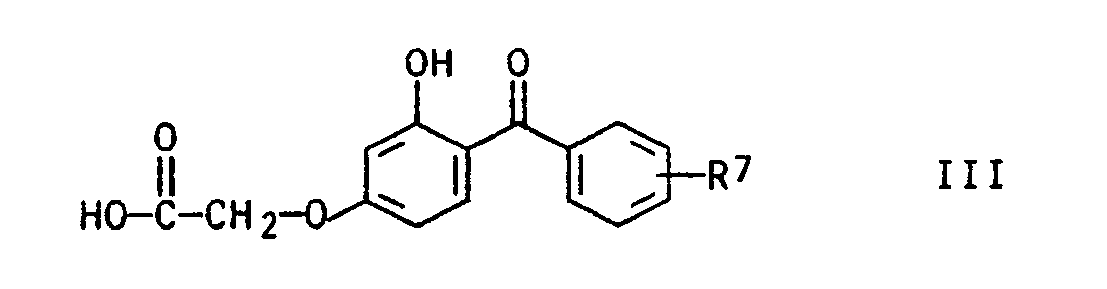
wurden zusammen mit 50 g p-Toluolsulfonsäure-monohydrat in 2,5 l Toluol 6 Stunden unter Rückfluß erhitzt. Dabei wurde Wasser kontinuierlich am Wasserabscheider destillativ entfernt. Nach Abkühlung auf Raumtemperatur wurde der entstandene Niederschlag abfiltriert, mit n-Hexan gewaschen und bei 60°C und 50 bis 100 mbar getrocknet. Zur weiteren Reinigung wurde aus Toluol oder aus einem Alkanol, in einigen Fällen unter Zusatz von Bleicherde, umkristallisiert. - Tabelle 1 zeigt die Einzelheiten und die Ergebnisse dieser Versuche.

- Zur Herstellung von Belichtungsproben wurden 2,5 g einer der in Tabelle 2 genannten Verbindungen in 1000 g eines handelsüblichen aromatischen Polycarbonats (Makrolon® Pc 2800 der Firma Bayer) durch einmaliges Extrudieren bei 280°C eingearbeitet und das anfallende Granulat wurde mit Hilfe einer Spritzgußmaschine bei 300°C zu 2 mm dicken Prüfkörpern verarbeitet.
- Die hergestellten Prüfkörper wurden in einem Xenotest® 200-Schnellbewitterungsgerät der Firma Hanau auf ihre Licht- und Wetterechtheit getestet. Die Alterung wurde durch Messung des Yellowness-Indexes (YI) gemäß Annual Book of ASTM Standards D 1925-70 (Reapproved 1977) nach definierten Zeitintervallen bestimmt. Die maximale Belichtungsdauer betrug bei allen Versuchen 2000 h. Die Ergebnisse sind in Tabelle 2 zusammengestellt.

als Lichtschutzmittel für aromatische Polycarbonate und aromatische Polyestercarbonate.
Claims (6)
- Verwendung von Benzophenon-Derivaten der allgemeinen Formel I
 R¹ Wasserstoff, C₁-C₄-Alkyl, C₁-C₄-Alkoxy, Phenoxy, Fluor, Chlor, Brom, Cyano oder Trifluormethyl,n 2 bis 4,p 1 bis 4 undR²als Lichtschutzmittel für aromatische Polycarbonate und aromatische Polyestercarbonate.(a) für den Fall p = 1
C₁-C₁₂-Alkyl, das durch eine oder mehrere Hydroxyl- oder C₁-C₄-Alkoxygruppen substituiert sein kann,
Cycloalkyl mit 3 bis 6 C-Atomen im Ring,
ein Rest der allgemeinen Formel
ein fünf- oder sechsgliedriger ungesättigter heterocyclischer Ring, der durch C₁-C₄-Alkylgruppen, Fluor, Chlor, Brom oder Cyano substituiert sein kann, oder
(b) für den Fall p = 2 bis 4
eine Einfachbindung oder die Ergänzung zu einer p-wertigen aliphatischen, cycloaliphatischen, aromatischen oder heterocyclischen Carbonsäure - Verwendung von Benzophenon-Derivatem I nach Anspruch 1, bei denen die Variablen die folgende Bedeutung haben:R¹ Wasserstoff, Methyl, Methoxy, Phenoxy oder Chlor,n 2,p 1 undR² C₁-C₄-Alkyl, Cyclohexyl, Phenyl, Tolyl, Xylyl, tert.-Butylphenyl, Methoxyphenyl, Dimethoxyphenyl, Benzyl, 2-Phenylethyl, Phenoxymethyl, 2-Phenoxyethyl oder die Gruppe

- Verwendung von Benzophenon-Derivaten I nach Anspruch 1, bei denen die Variablen die folgende Bedeutung haben:R¹ Wasserstoff, Methyl, Methoxy, Phenoxy oder Chlor,n 2,p 2 bis 4 undR² eine Einfachbindung oder die Ergänzung zu einer p-wertigen aliphatischen, cycloaliphatischen aromatischen oder heterocyclischen Carbonsäure.
- Benzophenon-Derivate der allgemeinen Formel Ia
 R⁶, R⁷ Wasserstoff, C₁-C₄-Alkyl, C₁-C₄-Alkoxy, Phenoxy, Fluor, Chlor, Brom, Cyano oder Trifluormethyl undn 2 bis 4.
 - Verfahren zur Herstellung der Benzophenon-Derivate Ia gemäß Anspruch 4, dadurch gekennzeichnet, daß man einen Alkohol der allgemeinen Formel II


- Gegen die Einwirkung von Licht stabilisierte aromatische Polycarbonate und aromatische Polyestercarbonate, enthaltend 0,05 bis 10 Gew.-%, bezogen auf die Menge des Polymeren, eines Benzophenon-Derivates I gemäß Anpruch 1 oder 2.
Applications Claiming Priority (2)
| Application Number | Priority Date | Filing Date | Title |
|---|---|---|---|
| DE19904007765 DE4007765A1 (de) | 1990-03-12 | 1990-03-12 | Verwendung von benzophenon-derivaten als lichtschutzmittel fuer aromatische polycarbonate und aromatische polyestercarbonate |
| DE4007765 | 1990-03-12 |
Publications (2)
| Publication Number | Publication Date |
|---|---|
| EP0446740A2 true EP0446740A2 (de) | 1991-09-18 |
| EP0446740A3 EP0446740A3 (en) | 1992-04-15 |
Family
ID=6401971
Family Applications (1)
| Application Number | Title | Priority Date | Filing Date |
|---|---|---|---|
| EP19910103173 Withdrawn EP0446740A3 (en) | 1990-03-12 | 1991-03-02 | Utilization of benzophenone-derivatives as antiluminous agents for aromatic polycarbonates and polyestercarbonates |
Country Status (3)
| Country | Link |
|---|---|
| EP (1) | EP0446740A3 (de) |
| JP (1) | JPH06206848A (de) |
| DE (1) | DE4007765A1 (de) |
Cited By (2)
| Publication number | Priority date | Publication date | Assignee | Title |
|---|---|---|---|---|
| EP0675108A1 (de) * | 1994-03-31 | 1995-10-04 | Ciba-Geigy Ag | Durch Thioether substituierte Hydroxybenzophenone und stabilisierte Zusammensetzungen |
| WO2002046136A3 (en) * | 2000-11-03 | 2003-01-16 | Cytec Tech Corp | Bis(alkyleneoxybenzophenone) ultraviolet light absorbers |
Family Cites Families (4)
| Publication number | Priority date | Publication date | Assignee | Title |
|---|---|---|---|---|
| US3676471A (en) * | 1967-12-21 | 1972-07-11 | Advance Prod Gmbh | 4-(betahydroxyethoxy-2-hydroxy-benzophenones) and esters thereof |
| US4503180A (en) * | 1981-02-13 | 1985-03-05 | General Electric Company | UV-Stabilized resins |
| DE3625355A1 (de) * | 1986-07-26 | 1988-02-04 | Basf Ag | Benzophenonether-ester und ein verfahren zur verbesserung der lichtechtheit von polyesterfaerbungen unter verwendung von benzophenonether-estern |
| DE3732980A1 (de) * | 1987-09-30 | 1989-04-13 | Basf Ag | Verfahren zur verbesserung der lichtechtheit von polyesterfaerbungen unter verwendung von benzophenonether-estern und neue benzophenonether-ester |
-
1990
- 1990-03-12 DE DE19904007765 patent/DE4007765A1/de not_active Withdrawn
-
1991
- 1991-03-02 EP EP19910103173 patent/EP0446740A3/de not_active Withdrawn
- 1991-03-08 JP JP4337691A patent/JPH06206848A/ja not_active Withdrawn
Cited By (5)
| Publication number | Priority date | Publication date | Assignee | Title |
|---|---|---|---|---|
| EP0675108A1 (de) * | 1994-03-31 | 1995-10-04 | Ciba-Geigy Ag | Durch Thioether substituierte Hydroxybenzophenone und stabilisierte Zusammensetzungen |
| US6576797B1 (en) | 1994-03-31 | 2003-06-10 | Ciba Specialty Chemicals Corporation | Thioether substituted hydroxybenzophenones and stabilized compositions |
| US6586519B1 (en) | 1994-03-31 | 2003-07-01 | Ciba Specialty Chemicals Corporation | Thioether substituted hydroxybenzophenones and stabilized compositions |
| WO2002046136A3 (en) * | 2000-11-03 | 2003-01-16 | Cytec Tech Corp | Bis(alkyleneoxybenzophenone) ultraviolet light absorbers |
| US6537670B1 (en) | 2000-11-03 | 2003-03-25 | Cytec Technology Corp. | Bis(alkyleneoxybenzophenone) ultraviolet light absorbers |
Also Published As
| Publication number | Publication date |
|---|---|
| DE4007765A1 (de) | 1991-09-19 |
| EP0446740A3 (en) | 1992-04-15 |
| JPH06206848A (ja) | 1994-07-26 |
Similar Documents
| Publication | Publication Date | Title |
|---|---|---|
| EP0057160B1 (de) | 2-(2-Hydroxyphenyl)-benztriazole, ihre Verwendung als UV-Absorber und ihre Herstellung | |
| EP0415887B1 (de) | 3-Phenylbenzofuran-2-one | |
| CH645908A5 (de) | Verfahren zum stabilisieren von polymeren organischen materialien. | |
| EP0117229A1 (de) | Neue, als Stabilisatoren für synthetische Polymere verwendbare Piperidinyl-triazinverbindungen | |
| DE19616185A1 (de) | Stabilisatorkombination für synthetische organische Polymere | |
| DE3811117A1 (de) | Lichtschutzmittelgemisch | |
| DE3919691A1 (de) | Polymere polyalkyl-1-oxa-diazaspirodecane | |
| EP0905181A1 (de) | Stabilisatorgemisch für organische Materialien | |
| EP0142467A1 (de) | Piperidylreste enthaltende polymere Verbindungen und ihre Verwendung als Stabilisatoren für synthetische Polymere | |
| DE69602902T2 (de) | S-Triazin-Lichtstabilisatorhybride, substituiert mit Benzotriazol- oder Benzophenon-Einheiten und damit stabilisierte Zusammensetzungen | |
| DE2709419A1 (de) | Farbstabilisierte halogenbisphenolaethylen-polycarbonate | |
| EP0214102A2 (de) | 5-Aralkylsubstituierte 2H-Benztriazole und stabilisierte Zusammensetzungen | |
| EP0344114B1 (de) | Ungesättigte Derivate von 2,2,6,6-Tetramethylpiperidin | |
| EP0634449A2 (de) | Polyether mit gehinderten Amin-Seitenketten als Stabilisatoren | |
| DE4007765A1 (de) | Verwendung von benzophenon-derivaten als lichtschutzmittel fuer aromatische polycarbonate und aromatische polyestercarbonate | |
| EP0707035B1 (de) | HALS-Phosphorinane als Stabilisatoren | |
| EP0271649B1 (de) | Ester von 3-tert.-Butyl- bzw. 3-tert.-Butyl-5-alkyl-4-hydroxylphenyl-(alkan)-carbonsäuren mit Oxethylaten von Bis-(4- bzw. 2-hydroxyphenyl)-alkanen, -oxiden, -sulfiden und -sulfonen, von Tris-(4-hydroxyphenyl)-alkanen und von 1,3,5-Tris-(4-hydroxyphenyl-isopropyliden)-arylen, Verfahren zu ihrer Herstellung und ihre Verwendung als Stabilisatoren | |
| DE19924984A1 (de) | Durch Dioxopiperazinylderivate stabilisierte Zusammensetzungen | |
| EP0422438A2 (de) | Polycarbonate aus Dihydroxydiphenylcycloalkanen mit Additiven | |
| EP0109932B1 (de) | Verfahren zur Herstellung von oligomeren Polyesteramiden mit Seitengruppen enthaltend einen sterisch gehinderten Aminrest | |
| EP0230401B1 (de) | Aminoxypyrrolidin-2,5-dione | |
| EP0634450A2 (de) | Polyether mit abspaltbaren gehinderten Aminen als Stabilisatoren | |
| EP0233153A2 (de) | Stabilisierung von Polyphenylenethern mit makrocyclischen Polyalkylpiperidinverbindungen | |
| EP0128861B1 (de) | Polyaminamide enthaltend Polyalkylpiperidinylreste | |
| DE3805786C2 (de) | Piperidin-Verbindungen |
Legal Events
| Date | Code | Title | Description |
|---|---|---|---|
| PUAI | Public reference made under article 153(3) epc to a published international application that has entered the european phase |
Free format text: ORIGINAL CODE: 0009012 |
|
| AK | Designated contracting states |
Kind code of ref document: A2 Designated state(s): BE CH DE FR GB IT LI NL |
|
| PUAL | Search report despatched |
Free format text: ORIGINAL CODE: 0009013 |
|
| AK | Designated contracting states |
Kind code of ref document: A3 Designated state(s): BE CH DE FR GB IT LI NL |
|
| STAA | Information on the status of an ep patent application or granted ep patent |
Free format text: STATUS: THE APPLICATION HAS BEEN WITHDRAWN |
|
| 18W | Application withdrawn |
Withdrawal date: 19920515 |