EP0442940B1 - Maritimes Wägesystem für eine Förderstrecke - Google Patents
Maritimes Wägesystem für eine Förderstrecke Download PDFInfo
- Publication number
- EP0442940B1 EP0442940B1 EP89912838A EP89912838A EP0442940B1 EP 0442940 B1 EP0442940 B1 EP 0442940B1 EP 89912838 A EP89912838 A EP 89912838A EP 89912838 A EP89912838 A EP 89912838A EP 0442940 B1 EP0442940 B1 EP 0442940B1
- Authority
- EP
- European Patent Office
- Prior art keywords
- weighing
- noise
- unit
- units
- results
- Prior art date
- Legal status (The legal status is an assumption and is not a legal conclusion. Google has not performed a legal analysis and makes no representation as to the accuracy of the status listed.)
- Expired - Lifetime
Links
Images
Classifications
-
- G—PHYSICS
- G01—MEASURING; TESTING
- G01G—WEIGHING
- G01G23/00—Auxiliary devices for weighing apparatus
- G01G23/01—Testing or calibrating of weighing apparatus
-
- G—PHYSICS
- G01—MEASURING; TESTING
- G01G—WEIGHING
- G01G11/00—Apparatus for weighing a continuous stream of material during flow; Conveyor belt weighers
- G01G11/04—Apparatus for weighing a continuous stream of material during flow; Conveyor belt weighers having electrical weight-sensitive devices
Definitions
- the present invention relates to a maritime weighing system it is given with claim 1. From US-A-4258811 a maritime scale with a weighing unit and an accelerometer is known.
- the said supplementary weighing unit will constitute or appear as an accelerometer, which will detect the vertical movements of the ship in such a manner that these movements, which as well known may be quite violent and disabling for the use of conventional weighing units with weighing cells, will in principle be without any influence on the weighing result, because the weighing results will continually be corrected for the disturbing influence from the movements of the ship in the sea.
- Admittedly weighings at sea may thus take place with a certain accuracy, which, however, is not particularly high. Guiding coarse weighings may be effected, but not such accurate small portion weighings, which will be required for achieving the highly desirable result that a maritime processing equipment can be usable for producing fish products for retail sale. So far it has been common practice to distinguish sharply between maritime catching and coarse treating equipment at one side and shore based treating and portion packing equipment at the other side, and no doubt this distinguishing - whether consciously or unconsciously - is due to the fact that at sea it has not been possible to carry out such weighings, which are sufficiently accurate for an economical preparation and marketing of products to the retailing trade.
- the invention departs from the circumstance that industrially it will be possible to achieve an important simplification and improvement in the working up of fish products for retail sale, if the working up and the associated accurate weighing out of the products can take place on the catch ships quickly after the hauling in of the catch. It is an important associated condition, however, that the products for the retail sale can be weighed out with a high accuracy, such that the required minimum weights per product portion will not give rise to any accumulated overweight of a substantial magnitude.
- this relief of the weighing cells may be effected by means of an actuator located in connection with the weighing unit and being operable to actuate means for bringing away the loading means of the weighing cells from the weighing cells themselves, whereby it is also important that the cells themselves are designed in such a manner that their own movable and loadable portion be as light as possible, such that neither this portion will affect the weighing cell noticeably by the occurring movements in the sea.
- an actuator located in connection with the weighing unit and being operable to actuate means for bringing away the loading means of the weighing cells from the weighing cells themselves, whereby it is also important that the cells themselves are designed in such a manner that their own movable and loadable portion be as light as possible, such that neither this portion will affect the weighing cell noticeably by the occurring movements in the sea.
- an actuator located in connection with the weighing unit and being operable to actuate means for bringing away the loading means of the weighing cells from the weighing cells themselves, whereby it is also important that the cells themselves are designed in
- the adjustment may well be effected fully automatically with relatively short time intervals, as the control equipment may be programmed to locate moments or periods of time, in which there is sufficient time to effect the adjustment, and to actuate suitable means for lifting off the tare load or preload of the weighing cells and to thereafter actuate an adjusting circuit for changing the supply voltage of the respective weighing cells until both cell systems produce the indication "absolute zero".
- the control equipment may be programmed to locate moments or periods of time, in which there is sufficient time to effect the adjustment, and to actuate suitable means for lifting off the tare load or preload of the weighing cells and to thereafter actuate an adjusting circuit for changing the supply voltage of the respective weighing cells until both cell systems produce the indication "absolute zero".
- a compensation technique which has the additional advantage of being able to compensate for external noise.
- a so-called adaptive filtering by which rapid analyses of the actual transfer function of the weighing cell are carried out, that is detections of the amplitude of the signal for narrow frequency intervals throughout the entire relevant frequency range, also called a Fourier-analysis. Based on this analysis an inverted transfer function is created and added to the actual transfer function of the weighing cell, whereby the resulting signal will ideally be without oscillations other than the raising of the signal to the correct measuring value. This raising takes place rapidly, such that the belt weigher can operate with a high capacity.
- the said adaptive filtering or compensation is carried out not only for the weighing unit, but also for the accelerometer, as by a subtraction of the signals from the two systems the oscillations due to the said minor shakings will then be out-compensated.
- the minor shakings may have different effects on the weighing unit and the accelerometer, respectively, and for this reason, according to the invention, it is advantageous to make use of a separate shaking sensor, which is mounted immediately adjacent the weighing system and is connected to this system in such a manner that the sensor signals will compensate for the corresponding signal variations in the weighing system.
- the separate shaking detector may be avoided, if or when the accelerometer is suitably sensitive for detecting the local shakings with high accuracy.
- a weighing effected in the same moment of time may be erroneous, but normally this will apply only to one of the three weighings, and in the signal processing unit it may then be determined that just that weighing must be incorrect, when the two other weighings result in other, but mutually identical values. It will not happen frequently that impacts occur so rapidly after each other that two of the three weighings will be influenced.
- the vessel pitches about an axis parallel with the weighing belt this neither will affect the weighing result, but if pitching takes place about an axis cross-wise of the belt, then the direction of the movement of the belt will tilt in the vertical plane, viz. by a movement composed by a parallel displacement and a pivoting.
- sensor means can be used for a continuous detection of the tilting of the vessel in the direction relevant for the individual belt, yet in such a manner that it is possible to derive an expression for the angular velocity of occurring changes of the tilting, whether such expressions are delivered as measuring results from the sensor means or should be calculated in the signal processor of the weighing equipment; additionally, the latter should be supplied with information of the current belt velocity, whereafter the discussed "tilt changing errors" can easily be calculated and utilized for current correction of the weighing results.
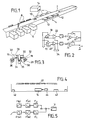
- a weighing and sorting system comprising a conveyor belt 2 which, in the direction indicated by an arrow, passes over a weighing area 4 and further along a stretch, at which a row of collector containers 6 is placed vis-a-vis a corresponding row of diverters 8, which may be actuated to be swung inwardly over the belt 2 and thereby effect a diversion of a conveyed article 10 to a selected container 6 all according to the result of the weighing of the article. So far described the system is fully conventional.
- weighing unit 4 In the weighing area 4 there is mounted underneath the belt 2 three weighing units 12 relatively close to each other in the length direction of the belt, and these units are connected with a common weighing data processor 14, which will record the weighing results for each advanced article 10.
- a maritime system - but also certain other systems - may as a whole or at least in the weighing area 4 be subjected to impactlike influences, which, despite the additional use of accelerometers in the weighing units, may give rise to totally unacceptable weighing results.
- the data processor 14 can easily sort out the correct result via the two other weighings. It can be an alternative to use only two weighing units in association with a separate sensor for the detection of occurring impact situations, whereby the sensor may condition that only such weighing signals can be accepted which occur outside these situations. There may be used more than three or two weighing units, respectively, and it is a possibility that one or more of the associated accelerometers can be exploited for the detection of the impact situations.
- the diagram shown in Fig. 2 is largely self-explanatory.
- the weighing cell of the weighing unit is designated 16 and the weighing cell of the accelerometer 18, while the associated primary amplifiers are designated 20 and 22, respectively.
- By 24 is designated a control unit, which is connected with these amplifiers and is explained below.
- Fig. 3 is schematically indicated the mechanical part of each of the applied weighing units, comprising a chassis 26, on which is mounted a pair of weighing cells 16 and 18 for a weighing plate 28 and a stationary accelerometer load 30, respectively.
- the weighing cells are designed in such a manner that their active sensors 32 are located very close to the respective loaded end portions 34 of the cells, such that these end portions are of as small dimensions and weight as possible, which in practice means an indeed very small weight of the end portions.
- an actuator 36 for raising a carrier portion 38, which has upwardly projecting parts for a concurrent lifting off of the weighing plate 28 and the load 30 from the respective weighing cells 16 and 18.
- the weighing cells should produce a weighing result of absolute zero, and it is possible to check this result whether or not the chassis 26 is subjected to movements, as e.g. vertical accelerations or decelerations will only negligibly affect the sensors 32 due to the very small gravity or mass of the end portions 34 of the weighing cells.
- movements as e.g. vertical accelerations or decelerations will only negligibly affect the sensors 32 due to the very small gravity or mass of the end portions 34 of the weighing cells.
- the associated check of "absolute zero" being both easier and more representative than a check weighing of a weight master concurrently with the presence of the load 30 on the weighing cell 18 of the accelerometer.
- the control unit 2 shown in Fig. 2 is adapted to carry out the relevant zero adjustments automatically, as by the actuation of the raising device 36, Fig. 3, it is caused to measure the output signal from the associated electrical part of the relevant weighing unit and to thereby adjust the primary amplifiers 20,22 until the output results become "zero". Thereafter the produced weighing result signals will be correct until the next adjustment, which can be effected e.g. at the beginning of each working day and/or several times during each working period, particularly if during this period so marked temperature changes occur that already these will give rise to considerable changes of the reaction of the mechanical or/and the electrical system of the weighing unit.
- the single weighing units 12 may be connected or provided with separate conveyor belt units 40, and it is also shown that the system may comprise sensors 42 for detecting mechanical noise in the area, of course preferably as close as possible to the weighing system.
- One or more of the sensors may be adapted to detect the tiltings of the vessel in the length direction of the belt 2, which will normally be the length direction of the vessel, such that hereby it becomes possible to effect a weight-pertaining compensation for such positive or negative contributions to the weighing results which occur as a consequence of the weighed objects moving over the weighing units in a non-horizontal direction, respectively with a change of direction by an occurring lengthwise tilting of the belt 2 as explained above.
- An occurring mechanical noise e.g. from a vessel engine or from working appliances, will reveal itself in the output signals from the weighing cells 16 and 18 and will to some degree be compensated for by the concurrent influence on the object weighing systems and the associated accelerometers.
- Such noise may nevertheless give rise to weighing errors, and as already mentioned it is important that in accordance with the invention it is possible to use even rather advanced filters for compensating or cleaning of the weighing signals such that these can be trusted to really express the weight of the weighed objects.
- filters which are adapted to and are actuated in different characteristic situations, e.g. all according to the vessel engine being operating or not, respectively whether it works at high or low speed.
- filters may be material, electronic filters, or their function may be achieved by a data processing of the primary weighing signals, as the associated data processing equipment may be programmed with various relevant correction programs. These programs may then be selected all according to occuring types of noise, and it is here a possibility that such a selection can be effected automatically based on the sensor equipment 42 detecting the type of the noise. It would then be possible even that by such sensing an automatic adaptation of the correction program be effected, such that the goodness of the weighing signal is steadily maximised, based on current frequency analyses of the signals from the weighing cells.
- the invention will also comprise the disclosed methods for improving the accuracy of the weighing in accelerometer reference based weighing systems, and that the invention or the single aspects thereof may also to a wide extent be applied to stationary weighing systems, in which mechanical or electrical noise appears. Some of the aspects of the invention can be advantageous even without the use of the accelerometer.
Landscapes
- Physics & Mathematics (AREA)
- General Physics & Mathematics (AREA)
- Indication And Recording Devices For Special Purposes And Tariff Metering Devices (AREA)
- Vibration Prevention Devices (AREA)
- Weight Measurement For Supplying Or Discharging Of Specified Amounts Of Material (AREA)
- Measurement Of Force In General (AREA)
- Navigation (AREA)
Claims (5)
- Ein Wägegeräuschen ausgesetztes maritimes Wägesystem der Art, die mindestens eine Wägeeinheit (12) mit einer zugehörigen ersten Wägezelle (16) und einer unmittelbar danebenliegenden zweiten Wägezelle (18) mit einem bekannten Gewicht (30) umfaßt, wobei die jeweiligen Wägezellen (16,18) durch eine Ausleseinheit (14) verbunden sind, in der die Wägeergebnisse hinsichtlich solcher Fehler korrigiert werden, die auf Makrobewegungen des gesamten Wägesystems in Richtung der Schwerkraft zurückzuführen sind, dadurch gekennzeichnet, daß das System zusätzlich mit Mitteln (42) zur Korrektur des Wägesignals hinsichtlich des Einflusses mechanischer Geräusche und/oder des Kippens oder einer Änderung der Neigung einer Transportbahn (2) für Gegenstände, die über die Wägeeinheit (12) bewegt werden, und bevorzugt auch mit Mitteln zur regelmäßigen Kalibrierung des Systems unter gewichtsunabhängigen Bedingungen versehen ist.
- Ein Wägesystem nach Anspruch 1, dadurch gekennzeichnet, daß die jeweiligen Wägezellen (16,18) mit einem Gewichtsträgerteil (32) von recht kleinen Abmessungen und Masse ausgebildet sind, daß das System mit manuell oder automatisch betriebenen Stell- bzw. Betätigungsmitteln (36,38) versehen ist, um ein Ladungsträgermittel (28) für die zu wiegenden Gegenstände bzw. das Beschleunigungsmessergewicht (30), wie sie auf den Gewichtsträgerteilen ruhen, von den Gewichtsträgerteilen (32) abzuheben, und daß das System außerdem mit manuell oder automatisch betätigbaren Justierungsmitteln (20,22) zum Justieren des resultierenden Wägesignals auf den Wert "absolut Null", wenn das Abheben veranlaßt ist, versehen ist.
- Ein Wägesystem nach Anspruch 1, dadurch gekennzeichnet, daß benachbart zur Wägeeinheit (12) eine oder mehrere entsprechende Wägeeinheiten (12) unterhalb des Transportweges (2) angeordnet sind, wobei diese Einheiten mit einer gemeinsamen Registriereinheit (14) verbunden sind, das ein Wägeergebnis aufnehmen kann, das für mehrere Wägeeinheiten (12) ähnlich ist oder während eines Zeitintervalls aufgenommen wurde, in dem ein Geräuschdetektor einen niedrigen Geräuschpegel ermittelt hat, während die Registriereinheit (14) solche Wägeergebnisse zurückweist, die von den durch mehrere der anderen Wägeeinheiten (12) gemessenen Ergebnissen abweichen oder die erzeugt werden, während der Geräuschdetektor einen hohen durch Schlaggeräusche verursachten Geräuschpegel ermittelt.
- Ein Wägesystem nach Anspruch 1, dadurch gekennzeichnet, daß die Geräuschtrennung durch eine stromangepaßte Kompensation und/oder unter Verwendung von Filtern zur selektiven Unterdrückung verschiedener charakteristischer Geräuscharten bewirkt wird, nämlich durch manuelle oder Lärmdetektion-gesteuerte Auswahl oder Regulierung geeigneter Filtermittel.
- Ein Wägesystem nach Anspruch 1, dadurch gekennzeichnet, daß es Detektormittel zur Ermittlung eines in Längsrichtung auftretenden Kippens oder einer Neigungsänderung einer sich bewegenden Transportbahn der infolge ihres Durchlaufes über das Wägesystem zu wiegenden Gegenstände umfaßt, wobei der Detektor an eine Registriereinheit für Wägesignale durch Mittel zur Korrektur solcher Fehler angeschlossen ist, die durch Kippen oder Änderungen in der Neigung der sich bewegenden Bahn bei der tatsächlichen Vorschubgeschwindigkeit der Wiegeobjekte verursacht werden.
Applications Claiming Priority (3)
| Application Number | Priority Date | Filing Date | Title |
|---|---|---|---|
| DK629188A DK161484C (da) | 1988-11-11 | 1988-11-11 | Fremgangsmaade og apparat til udfoerelse af dynamisk vejning f.eks. paa et skib |
| DK6291/88 | 1988-11-11 | ||
| PCT/DK1989/000268 WO1990005285A1 (en) | 1988-11-11 | 1989-11-13 | A weighing system, particularly a maritime weighing system |
Publications (2)
| Publication Number | Publication Date |
|---|---|
| EP0442940A1 EP0442940A1 (de) | 1991-08-28 |
| EP0442940B1 true EP0442940B1 (de) | 1995-02-22 |
Family
ID=8148526
Family Applications (1)
| Application Number | Title | Priority Date | Filing Date |
|---|---|---|---|
| EP89912838A Expired - Lifetime EP0442940B1 (de) | 1988-11-11 | 1989-11-13 | Maritimes Wägesystem für eine Förderstrecke |
Country Status (6)
| Country | Link |
|---|---|
| US (1) | US5178227A (de) |
| EP (1) | EP0442940B1 (de) |
| AU (1) | AU4526689A (de) |
| DE (1) | DE68921348T2 (de) |
| DK (1) | DK161484C (de) |
| WO (1) | WO1990005285A1 (de) |
Cited By (2)
| Publication number | Priority date | Publication date | Assignee | Title |
|---|---|---|---|---|
| DE102005007866A1 (de) * | 2005-02-21 | 2006-08-24 | Mettler-Toledo Garvens Gmbh | Verfahren und Vorrichtung zum Wiegen von Produkten |
| US9417118B2 (en) | 2008-12-23 | 2016-08-16 | Wipotec Wiege- Und Positioniersysteme Gmbh | Device for vibration compensation of the weight signal of a weighing sensor |
Families Citing this family (21)
| Publication number | Priority date | Publication date | Assignee | Title |
|---|---|---|---|---|
| JPH05118897A (ja) * | 1991-05-16 | 1993-05-14 | Ishida Scales Mfg Co Ltd | 計量コンベア装置 |
| US5561274A (en) * | 1992-09-15 | 1996-10-01 | Intel Corporation | Apparatus for weighing objects |
| US5547034A (en) * | 1994-01-10 | 1996-08-20 | Accu-Sort Systems, Inc. | Conveyor friction scale |
| EP1056991A1 (de) * | 1998-01-20 | 2000-12-06 | Marel HF. | Verfahren und vorrichtung zum wiegen |
| IS1758B2 (is) * | 1998-03-05 | 2002-09-20 | Pols Hf. | Aðferð til nákvæms og sjálfvirks þyngdarsamvals úr raðflæði stykkja |
| US6580038B1 (en) * | 2000-01-19 | 2003-06-17 | Gainco Inc. | Static weighing system |
| JP2003214936A (ja) * | 2002-01-21 | 2003-07-30 | Ishida Co Ltd | 組合せ計量装置 |
| US6765155B1 (en) | 2002-03-04 | 2004-07-20 | Alvin D Gray | Fish measuring and weighting device |
| US6727438B1 (en) | 2002-05-15 | 2004-04-27 | Steve Stokes | Method for determining oil and grease content using a reference weight signal for live cancellation of disturbances in the weighting signal |
| US20040035223A1 (en) * | 2002-06-06 | 2004-02-26 | Darnell Fred A. | Fish culling system |
| US6839697B2 (en) * | 2002-06-28 | 2005-01-04 | Pitney Bowes Inc. | System and method for weighing items such as mailpieces in the presence of external vibration |
| CA2597071C (en) | 2005-02-08 | 2013-07-30 | Cargill, Incorporated | Meat sortation |
| EP2019297A1 (de) * | 2006-05-18 | 2009-01-28 | Ishida Co., Ltd. | Wägemaschine |
| DE102006059261B4 (de) * | 2006-12-15 | 2010-09-09 | Sartorius Ag | Elektronische Waage mit einem Neigungsmesser und zugehöriges Verfahren zur Signalauswertung |
| DE102010019742A1 (de) | 2010-05-07 | 2011-11-10 | Bizerba Gmbh & Co. Kg | Wäge- und Sortiervorrichtung |
| NL2008607C2 (en) | 2012-04-05 | 2013-10-09 | Quintech Engineering Innovations B V | Method and system for depositing and checking of baggage into airline flights. |
| FI124888B (fi) * | 2013-06-04 | 2015-03-13 | Ponsse Oyj | Menetelmä ja järjestely punnitusjärjestelmässä sekä vastaava ohjelmistotuote ja materiaalinkäsittelykone |
| JP2018151366A (ja) * | 2017-03-13 | 2018-09-27 | 株式会社横崎製作所 | 選別皿計量装置 |
| NL1042956B1 (nl) * | 2018-08-17 | 2020-02-24 | Penko Eng B V | Weegsysteem voor het gebruik op bewegende voertuigen. |
| NL1043561B1 (nl) * | 2020-02-06 | 2021-09-13 | Penko Eng B V | Weegsysteem voor het gebruik op bewegende voertuigen. |
| JP7462295B2 (ja) * | 2020-03-19 | 2024-04-05 | 株式会社イシダ | 計量装置 |
Citations (1)
| Publication number | Priority date | Publication date | Assignee | Title |
|---|---|---|---|---|
| US4258811A (en) * | 1975-09-16 | 1981-03-31 | Ab Bofors | Electric mass and force measuring apparatus |
Family Cites Families (11)
| Publication number | Priority date | Publication date | Assignee | Title |
|---|---|---|---|---|
| US3322222A (en) * | 1964-11-12 | 1967-05-30 | Baur Fritz | Compensated electromagnetic balance |
| US3656337A (en) * | 1971-01-19 | 1972-04-18 | Ralph R Mcdonald | Scale calibration checking device |
| CH621409A5 (de) * | 1978-02-24 | 1981-01-30 | Mettler Instrumente Ag | |
| US4396080A (en) * | 1981-08-17 | 1983-08-02 | Pneumatic Scale Corporation | Weighing system |
| US4480705A (en) * | 1982-08-05 | 1984-11-06 | Rexnord Inc. | Platform calibration factor for conveyor inclination angle |
| DE3234372A1 (de) * | 1982-09-16 | 1984-03-22 | Sartorius GmbH, 3400 Göttingen | Elektrische waage |
| ZA8305130D (en) * | 1982-09-23 | 1984-03-28 | Tobacco Res & Dev | Weighbelt apparatus |
| AU565314B2 (en) * | 1983-12-28 | 1987-09-10 | K.S. Ishida K.K. | Weight sensor |
| JPH0621814B2 (ja) * | 1986-05-29 | 1994-03-23 | 大和製衡株式会社 | 計重装置の計重信号の濾波方法及び装置 |
| DE3867843D1 (de) * | 1987-09-30 | 1992-02-27 | Wirth Gallo Messtechnik | Verfahren fuer die eichung und den betrieb einer waage. |
| US4754822A (en) * | 1987-10-22 | 1988-07-05 | W. F. Altenpohl, Inc. | Repetitive weighing system for moving conveyor loads |
-
1988
- 1988-11-11 DK DK629188A patent/DK161484C/da active
-
1989
- 1989-11-13 DE DE68921348T patent/DE68921348T2/de not_active Expired - Fee Related
- 1989-11-13 EP EP89912838A patent/EP0442940B1/de not_active Expired - Lifetime
- 1989-11-13 AU AU45266/89A patent/AU4526689A/en not_active Abandoned
- 1989-11-13 WO PCT/DK1989/000268 patent/WO1990005285A1/en not_active Ceased
- 1989-11-13 US US07/681,523 patent/US5178227A/en not_active Expired - Fee Related
Patent Citations (1)
| Publication number | Priority date | Publication date | Assignee | Title |
|---|---|---|---|---|
| US4258811A (en) * | 1975-09-16 | 1981-03-31 | Ab Bofors | Electric mass and force measuring apparatus |
Cited By (2)
| Publication number | Priority date | Publication date | Assignee | Title |
|---|---|---|---|---|
| DE102005007866A1 (de) * | 2005-02-21 | 2006-08-24 | Mettler-Toledo Garvens Gmbh | Verfahren und Vorrichtung zum Wiegen von Produkten |
| US9417118B2 (en) | 2008-12-23 | 2016-08-16 | Wipotec Wiege- Und Positioniersysteme Gmbh | Device for vibration compensation of the weight signal of a weighing sensor |
Also Published As
| Publication number | Publication date |
|---|---|
| DK161484C (da) | 1991-12-16 |
| WO1990005285A1 (en) | 1990-05-17 |
| AU4526689A (en) | 1990-05-28 |
| DE68921348T2 (de) | 1995-09-21 |
| DK161484B (da) | 1991-07-08 |
| US5178227A (en) | 1993-01-12 |
| DK629188D0 (da) | 1988-11-11 |
| DK629188A (da) | 1990-05-12 |
| EP0442940A1 (de) | 1991-08-28 |
| DE68921348D1 (de) | 1995-03-30 |
Similar Documents
| Publication | Publication Date | Title |
|---|---|---|
| US5178227A (en) | Weighing system, particularly a maritime weighing system | |
| JP5757820B2 (ja) | 重量選別システム | |
| US7214954B2 (en) | Method for operating optical sensors | |
| US4231439A (en) | Automatic check weigher | |
| US3800893A (en) | Weighing apparatus and method | |
| US5670751A (en) | Bulk material weighing container with pressure feedback | |
| US5338901A (en) | Conveyor belt weigher incorporating two end located parallel-beam load cells | |
| CA2078512C (en) | Scale for fast determination of weights | |
| US4407380A (en) | Weighing device for fluent material | |
| US5878379A (en) | Coarse volume measurement with interlock | |
| CN100595530C (zh) | 称重装置,特别是多轨迹称重装置 | |
| US3604525A (en) | Automatic top-loading weigh apparatus with electronic measuring and recording circuit | |
| US4153122A (en) | Weighing apparatus | |
| US5936206A (en) | Weighing machines with means for correcting effects of floor vibrations on weight signals therefrom | |
| US5440076A (en) | Weight-checking apparatus | |
| WO2012071787A1 (zh) | 变倾角机架传送带秤及称重方法 | |
| US4480705A (en) | Platform calibration factor for conveyor inclination angle | |
| EP0432979A2 (de) | Waage zum Betrieb unter oszillierenden Bedingungen | |
| US4750574A (en) | Accurate weight determination at sea | |
| JP3834141B2 (ja) | 物品の振動式搬送装置 | |
| US11274960B2 (en) | Calibration and support platform for calibration weights on a conveyor and metering device | |
| JPS5951357B2 (ja) | 自動選別装置 | |
| US6949710B2 (en) | Mail weighing system and scale apparatus | |
| SU1451554A1 (ru) | Конвейерные весы | |
| GB2283573A (en) | Temperature-compensated weighing conveyor |
Legal Events
| Date | Code | Title | Description |
|---|---|---|---|
| PUAI | Public reference made under article 153(3) epc to a published international application that has entered the european phase |
Free format text: ORIGINAL CODE: 0009012 |
|
| 17P | Request for examination filed |
Effective date: 19910508 |
|
| AK | Designated contracting states |
Kind code of ref document: A1 Designated state(s): DE FR GB NL |
|
| 17Q | First examination report despatched |
Effective date: 19930903 |
|
| GRAA | (expected) grant |
Free format text: ORIGINAL CODE: 0009210 |
|
| AK | Designated contracting states |
Kind code of ref document: B1 Designated state(s): DE FR GB NL |
|
| REF | Corresponds to: |
Ref document number: 68921348 Country of ref document: DE Date of ref document: 19950330 |
|
| ET | Fr: translation filed | ||
| PGFP | Annual fee paid to national office [announced via postgrant information from national office to epo] |
Ref country code: GB Payment date: 19951117 Year of fee payment: 7 |
|
| PGFP | Annual fee paid to national office [announced via postgrant information from national office to epo] |
Ref country code: FR Payment date: 19951127 Year of fee payment: 7 |
|
| PGFP | Annual fee paid to national office [announced via postgrant information from national office to epo] |
Ref country code: NL Payment date: 19951130 Year of fee payment: 7 |
|
| PLBE | No opposition filed within time limit |
Free format text: ORIGINAL CODE: 0009261 |
|
| STAA | Information on the status of an ep patent application or granted ep patent |
Free format text: STATUS: NO OPPOSITION FILED WITHIN TIME LIMIT |
|
| PGFP | Annual fee paid to national office [announced via postgrant information from national office to epo] |
Ref country code: DE Payment date: 19960130 Year of fee payment: 7 |
|
| 26N | No opposition filed | ||
| PG25 | Lapsed in a contracting state [announced via postgrant information from national office to epo] |
Ref country code: GB Effective date: 19961113 |
|
| PG25 | Lapsed in a contracting state [announced via postgrant information from national office to epo] |
Ref country code: NL Effective date: 19970601 |
|
| GBPC | Gb: european patent ceased through non-payment of renewal fee |
Effective date: 19961113 |
|
| PG25 | Lapsed in a contracting state [announced via postgrant information from national office to epo] |
Ref country code: FR Effective date: 19970731 |
|
| NLV4 | Nl: lapsed or anulled due to non-payment of the annual fee |
Effective date: 19970601 |
|
| PG25 | Lapsed in a contracting state [announced via postgrant information from national office to epo] |
Ref country code: DE Effective date: 19970801 |
|
| REG | Reference to a national code |
Ref country code: FR Ref legal event code: ST |