EP0441968B1 - Analog-dekodierungsgerät für viterbi - Google Patents
Analog-dekodierungsgerät für viterbi Download PDFInfo
- Publication number
- EP0441968B1 EP0441968B1 EP90912466A EP90912466A EP0441968B1 EP 0441968 B1 EP0441968 B1 EP 0441968B1 EP 90912466 A EP90912466 A EP 90912466A EP 90912466 A EP90912466 A EP 90912466A EP 0441968 B1 EP0441968 B1 EP 0441968B1
- Authority
- EP
- European Patent Office
- Prior art keywords
- path
- circuit
- current
- analog
- signals
- Prior art date
- Legal status (The legal status is an assumption and is not a legal conclusion. Google has not performed a legal analysis and makes no representation as to the accuracy of the status listed.)
- Expired - Lifetime
Links
Images











Classifications
-
- H—ELECTRICITY
- H03—ELECTRONIC CIRCUITRY
- H03M—CODING; DECODING; CODE CONVERSION IN GENERAL
- H03M13/00—Coding, decoding or code conversion, for error detection or error correction; Coding theory basic assumptions; Coding bounds; Error probability evaluation methods; Channel models; Simulation or testing of codes
- H03M13/65—Purpose and implementation aspects
- H03M13/6597—Implementations using analogue techniques for coding or decoding, e.g. analogue Viterbi decoder
-
- H—ELECTRICITY
- H03—ELECTRONIC CIRCUITRY
- H03M—CODING; DECODING; CODE CONVERSION IN GENERAL
- H03M13/00—Coding, decoding or code conversion, for error detection or error correction; Coding theory basic assumptions; Coding bounds; Error probability evaluation methods; Channel models; Simulation or testing of codes
- H03M13/37—Decoding methods or techniques, not specific to the particular type of coding provided for in groups H03M13/03 - H03M13/35
- H03M13/39—Sequence estimation, i.e. using statistical methods for the reconstruction of the original codes
- H03M13/41—Sequence estimation, i.e. using statistical methods for the reconstruction of the original codes using the Viterbi algorithm or Viterbi processors
Definitions
- the present invention relates to a Viterbi decoder for performing maximum likelihood decoding of convolutional codes using a Viterbi algorithm. More particularly, the present invention relates to an analog Viterbi decoder wherein at least a part of the aforementioned decoding process is carried out in an analog signal process, as in US-A-4 087 787.
- a Viterbi decoder efficiently searches a plurality of known code sequences using a Viterbi algorithm to find a path of a code sequence which is at the shortest code distance from a received code sequence from among the plurality of known code sequences, to output a decoded signal corresponding to the found path.
- the Viterbi decoders are, for example, used for error correction in satellite communication systems, since the decoder has great error correction capability.
- the Viterbi decoders have been realized only by digital signal processing, as described, for example, in U. S. P. Nos. 4,614,933 and 4,763,328.
- Increasing the constraint length K of a convolutional code improves the error correction capability of the Viterbi decoder.
- increasing the constraint length exponentially increases the physical size of the decoder.
- a large scale integrated circuit is usually employed to realize a Viterbi decoder having a such a large scale construction.
- a decoder using a TTL circuit construction is not easily realized because the circuit scale is not so easily reduced and power consumption is very large in the TTL circuit.
- the power consumption of a circuit having a CMOS circuit construction is not so large, and therefore, the decoder can be realized by a several-chip construction using CMOS circuits.
- the CMOS circuit construction can not be applied when a high speed operation of more than 20 to 30 Mbps is required, since a maximum operation speed of the CMOS circuit is around that level.
- an ECL circuit construction may be applied.
- the decoder constructed by the ECL circuit cannot be miniaturized because the power consumption of the ECL circuit is greater than that of the TTL circuit.
- a high speed Viterbi decoder having greater error correction capability has not been realized in small size by only digital signal processing.
- Soft decision decoding is usually employed in the Viterbi decoder rather than hard decision decoding.
- the soft decision decoding a demodulated base band signal is quantized into a digital value in a plurality of quantization levels and the code distance is estimated in the form of the digital values.
- coding gain of the Viterbi decoder is improved if the number of quantization levels is increased.
- the number of quantization levels is, however, actually limited, because the complexity of the circuit is increased as the number of quantization levels is increased.
- It is another object of the present invention is to provide a Viterbi decoder which has improved coding gain in soft decision decoding
- an analog Viterbi decoder comprising branch metric calculation means for successively calculating branch metrics from received symbols to output the branch metrics, ACS means for successively calculating pairs of path metrics by adding preselected pairs of branch metrics and preselected pairs of the last path metrics, respectively, for comparing the pairs of calculated path metrics with each other to select paths having smaller path metric values, and for outputting path selection signals to be used in the selections, and path memory means for successively storing candidates for decoded symbol according to the path selection signals and for successively refining the candidates according to the path selection signals to obtain decoded signal, characterised in that the branch metric calculation means output the branch metrics in analog signal form, and the ACS means perform said addition, comparison, and selection operations in analog signal processes.
- an analog Viterbi decoder comprising branch metric calculation means for successively calculating branch metrics from received symbols to output the branch metrics, ACS means for successively calculating pairs of path metrics by adding preselected pairs of branch metrics and preselected pairs of the last path metrics, respectively, for comparing the pairs of calculated path metrics with each other to select paths having smaller path metric values, and for outputting path selection signals to be used in said selections, and path memory means for successively storing candidates for a decoded signal according to said path selection signals and for successively refining the candidates according to said path selection signals to obtain a decode signal, characterised in that: said path memory means comprises:
- Figure 1 shows a schematic construction of a conventional Viterbi decoder.
- a branch metric calculation circuit 51 has, for example, a construction shown in Figure 2.
- the received signal is a quadratic amplitude modulated (QAM) signal and where its demodulated signal is decided in a soft decision of 8 levels
- QAM quadratic amplitude modulated
- the adders 54 to 57 output four branch metrics BM1 to BM4 represented by 4 bits by calculating (I + Q), (I + Q ⁇ ), ( I ⁇ + Q), and ( I ⁇ + Q ⁇ ), respectively.
- An ACS circuit 52 (Fig. 1) comprises Adders, Comparators, and Selectors.
- the ACS circuit 52 has 2 K-1 ACS circuit blocks.
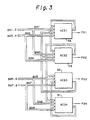
- the ACS circuit 52 is constructed from four ACS circuit blocks (ACS1 to ACS3) 58 to 61, as shown in Figure 3.
- Each ACS circuit block 58 to 61 calculates two path metrics by adding two branch metrics to two last path metrics, respectively, determined by a generator polynomial of the convolutional code, compares the two path metric values with each other, selects a path metric having a smaller value as a retained path metric, and outputs a path select signal PS1 to PS4 having been used for that selection.
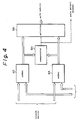
- Each ACS circuit block 58 to 61 has, for example, a construction shown in Figure 4.
- branch metrics BM1 and BM3 are added to the last path metrics PS1' and PS3' from the ACS circuit blocks 58 and 60 in adders 62 and 63, respectively, the path metrics BM1 + PS1' from the adder 62 and BM3 + PS3' from adder 63 are compared with each other in a comparator 64, a path metric having smaller value is selected as a new path metric in a selector 65, and a path select signal having been used for that selection is output to be supplied to a path memory circuit 53 (Fig. 1).
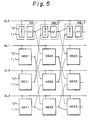
- the path memory circuit 53 has, for example, a construction shown in Figure 5, wherein MS11 to MS43 denote path memory cells, SEL denotes a selector, and FF denotes a flip-flop.
- the path memory circuit 53 comprises 2 K-1 ⁇ L path memories wherein L is a truncation length of a convolutional code and K is the constraint length of the convolutional code. Generally, the value (4 to 5) ⁇ K is used for the truncation length L.
- the path select signals SL0 to SL3 are supplied to selectors SEL in the corresponding path memory cells.
- One of two outputs of two path memory cells of the preceding stage is selected by the path select signal to be stored in the flip-flop FF. Namely, the contents of the path memory cells at selected sides as retained paths are transferred according to the path select signals SL0 to SL3 in each decoding cycle, and a decoded output is obtained by majority decision of the outputs of the final stage.
- the ACS circuit 52 requires 2 K-1 ACS circuit blocks and the path memory circuit requires 2 K-1 ⁇ L path memory cells.
- Figure 6 shows a schematic construction of the first embodiment of the present invention.
- a branch metric calculation circuit 1 and an ACS circuit 2 almost all of operation is carried out in analog signal processing circuits.
- the analog signal processing can be also applied to a path memory circuit 3.
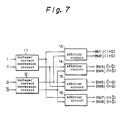
- the addition circuit 13 outputs current signals BM1 j and BM2 j which correspond to I + Q
- the addition circuits 14 outputs current signals BM3 j and BM4 j which correspond to I ⁇ + Q ⁇
- the addition circuit 15 outputs current signals BM5 j and BM6 j which correspond to I ⁇ + Q
- the addition circuit 16 outputs current signals BM7 j and BM8 j which correspond to I + Q ⁇ .
- Figure 8 is a circuit diagram of main part of the branch metric calculation circuit.
- Q1 to Q13 are transistors
- R1 to R24 are resistors
- D1 is a diode.
- the voltage/current transfer circuit 11 is realized by the transistors Q1 to Q4 and the resistors R1 to R7
- the voltage/current transfer circuit 12 is realized by the transistors Q8 to Q11 and the resistors R14 to R20
- the addition circuits 13 and 14 are realized by the transistors Q5 and Q6
- the addition circuits 15 and 16 are realized by the transistors Q12 and Q13.
- the transistors Q3 and Q4 and the resistor R3 constitutes a current mirror circuit providing a constant current the value of which is approximately determined by source voltage V 1 , and a value of R3.
- a pair of transistors Q1 and Q2 and the constant current circuit constitute a part of a differential amplifier. Since a load resistor of the the differential amplifier is located outside of the circuit, the output signal in response to the difference between input voltages is output in the form of current i 1 and i 2 .
- the I phase signal I and an inverted I phase signal I ⁇ are input to the differential amplifier (voltage/current converter). Therefore, the current i 1 varies proportionally to I and the current i 2 varies proportionally to I ⁇ .
- R1 and R2 are provided in order to stabilize an amplification degree, i.e., a voltage/current conversion ratio, by providing the differential amplifier with negative feedback.
- the values of R1 and R2 are preferably selected, so that i 1 becomes equal to i 0 and i 2 becomes zero when the I phase input voltage is at a nominal "1" level, and i 2 becomes equal to i 0 and i 1 becomes zero when the I ⁇ is at a nominal "1" level.
- R4, R5 and R6, R7 are provided in order to equally distribute i 1 and i 2 , respectively, without interfering with each other.
- the circuit constituted by Q8 to Q11 and R14 to R20 operates in the same manner as the aforementioned circuit constituted by Q1 to Q4 and R1 to R7.
- the latter is that for the I phase signal and the former is that for the Q phase signal.
- a constant electrical potential is applied to a base terminal of the transistor Q5, so that the transistor operates as a grounded base type amplifier. Since a current proportional to I is supplied to an emitter terminal of Q5 through R4, and a current proportional to Q is supplied through R17, Q5 operates as an adder which outputs a current signal corresponding to I + Q, i.e., branch metric BM1 j of BM2 j .
- R8 and R9 are resistors for distributing BM1 j and BM2 j without interfering with each other.
- the j's represent addresses of the ACS circuits in the following stage to be connected, and they are determined by a generator polynomial of the convolutional code.
- a circuit constituted by Q6 and two resistors R10 and R11, a circuit constituted by Q12 and two resistors R21 and R22, and a circuit constituted by Q13 and two resistors R23 and R24 operate in the same manner as the circuit constituted by Q5 and two resistors R8 and R9, and output current signals corresponding to I ⁇ + Q ⁇ , I ⁇ + Q, and I + Q ⁇ , respectively.
- D1 is provided to compensate for temperature characteristics of Q7 for the purpose of reducing the effect of temperature drift of Q7, because voltages between the collector and emitter terminals of Q5, Q6, Q12 and Q13 cannot be sufficiently high to eliminate the effect due to voltage drop by serially inserted resistors.
- differential amplifiers Q1, Q2, and Q8, Q9 are provided with sufficient negative feedback by their emitter resistors R1, R2 and R14, R15, respectively, the effect of dispersion of characteristic values of Q1, Q2 and Q8, Q9 can be sufficiently eliminated.
- Figure 9 is a circuit diagram showing an improved circuit of the branch metric calculation circuit shown in Fig. 8.
- Q4, R3 and Q11, R16 of Fig. 8 are replaced by one side of a common current mirror circuit (not shown, described later), whose constant voltage output Vcm is applied to base terminals of Q3 and Q10.
- This construction ensures equal current values in the constant current sources for a pair of the differential amplifiers, so that accuracy of the current metric is further improved.
- Q1 and R4, R5 are replaced by two transistors Q104 and Q105.
- Q5, R8, R9 are replaced by Q112, Q113; Q2, R6, R7 are replaced by Q106, Q107; Q6, R10, R11 are replaced by Q114, Q115; Q8, R17, R18 are replaced by Q108, Q109; Q12, R21, R22 are replaced by Q116, Q117; Q9, R19, R20 are replaced by Q110, Q111; and Q13, R23, R24 are replaced by Q118, Q119.
- These replacements reduce the number of elements and eliminate voltage drop caused by the resistors, so that the potential differences between the collector and emitter of the transistors Q112 to Q119 become enough in value to eliminate the diode D1(Fig. 8) to compensate temperature dependency.
- Figure 10 shows a further improved circuit of the circuit shown in Fig. 9.
- seesaw differential amplifiers are employed as the differential amplifiers for voltage/current conversion.
- two transistors for example, Q100 and Q101
- a pair of transistors for example, Q104 and Q105
- a single resistor for example, R100
- currents always flow through the emitter resistors (R1, R2 in Fig. 9) and the mean value of the currents is constant so that certain voltage drops always occur due to the mean voltage of the resistors.
- this type of differential amplifier current flows through the resistor in response to the difference between input voltages, and when the input voltages are equal to each other, the current does not flow.
- this type of differential amplifier has an advantage of high efficiency in utilization of voltage because there is no fixed voltage drop at the emitter resistor. Additionally, this type of differential amplifier is more advantageous in integration, because the number of resistors is smaller though the total number of elements is the same.
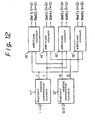
- Figure 12 is a block diagram showing a second example of the construction of the branch metric calculation circuit (Fig. 6), in the case where the demodulated signals I and Q are input in the form of a plurality of bits of digital signals.
- This example is adapted to the case wherein a punctured coding is employed together with the convolutional coding.
- the punctured coding is a coding method that elevates the information rate by transmitting eliminated and compressed code at the transmitter side and by inserting dummy bits in the eliminated position and decoding at the receiver side. Insertion of the dummy bits is carried out by a digital signal process because it is more advantageous than an analog signal process. Accordingly, digital signals are input to the Viterbi decoder in a next stage.
- Digital/analog conversion circuit 11' and 12' convert the input multi-bit I phase and Q phase signals to current signals and output them.
- the following addition circuits 13' to 16' have a similar construction to the addition circuits 13 to 16 of Fig. 7.
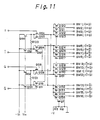
- Figure 13 is a detailed circuit diagram of the branch metric calculation circuit of Fig. 12.
- An I phase signal and Q phase signal are input as 3 bit ECL level signals i 001 , i 010 , i 100 , and Q 010 , Q 010 , Q 100 , respectively.
- Q136 to Q141 constitute emitter follower circuits for impedance conversion of the input signals.
- Q156, Q157 and Q158, Q159 constitute an emitter coupled circuit, wherein the output signal of Q136, namely, i 001 is input to base terminals of Q156, Q157, and wherein a voltage corresponding to a threshold value of the ECL determined by a voltage-V 1 and resistors R102, R103 is applied through an emitter follower circuit of Q180 to base terminals of Q158, Q159. Accordingly, when the input i 001 is higher than the threshold value, namely, logic "1", current from a constant current source Q142 flows through Q156, Q157, and when the input is logic "0", the current flows through Q158, Q159.
- Q160 to Q163 and Q164 to Q167 also constitute emitter coupled circuits, but values of currents when conducting become twice and four times, respectively, because two and four transistors as constant current sources are connected in Parallel.
- the numbers correspond to weights of the input signals i 001 , i 010 , i 100 .
- Outputs of Q156, Q160, Q164 and Q157, Q161, Q165 are connected to each other in that order by wires, and both become current signals corresponding to an I phase signal.
- outputs of Q158, Q162, Q166 and Q159, Q163, Q167 become current signals corresponding to I ⁇ .
- a circuit constituted by Q139 to Q141, Q149 to Q155, and Q168 to Q179 outputs two current signals corresponding to Q and two current signals corresponding to Q ⁇ .
- Q112 to Q119 operate as grounded base type current addition circuits as described in Fig. 9, and output branch metrics BM1 j to BM8 j in the form of current signals.
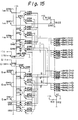
- Figure 14 shows a circuit similar to those in Fig. 13. However, a circuit is added to eliminate the effect of the dummy bit on the path metric calculation by making the current outputs of I and I ⁇ or Q and Q ⁇ zero while the dummy bit is input, in the case where the preceding stage is a dummy bit inserting circuit, to decode the punctured codes.
- Q183 and Q184 constitute a part of a current mirror circuit to apply constant voltages to base terminals of constant current sources Q142 to Q148.
- a constant current to be supplied to the circuit is supplied from a terminal iIc through a transistor Q181. Therefore, if the level of a signal input to a terminal iINH connected to a base terminal of Q181 is low, then Q181 does not conduct, the current supplied to the current mirror circuit becomes zero, and the current outputs I and I ⁇ are forced to be zero.
- the constant current supplied to the terminal iIc is varied in response to a variation in power source +V 2 in order to cancel the effect of variation of +V 2 which is used in an ACS circuit at the next stage.
- the circuit constituted by Q182, Q185, and Q186 operates similarly so that the current outputs Q and Q ⁇ are forced to be zero while a signal input to a terminal QINH is at a low level.
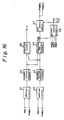
- FIG 16 is a block diagram showing a detailed construction of one ACS circuit unit of the ACS circuit 2 shown In Fig. 6.
- the ACS circuit 2 comprises 2 K-1 ACS circuit units having this construction.
- a signal BMi1 is an output signal of the aforementioned branch metric calculation circuit (i denotes the address of a connected branch metric calculation circuit, and is determined by the generator polynomial of the convolutional code).
- a signal PMMi1 is a last value of the path metric which is output from a path metric memory 27 (described later) comprised in this ACS circuit unit or another ACS circuit unit.
- Current signals corresponding to the BMi1 and PMMi1 are input to an addition circuit 21 which adds up the signals and outputs them as a current signal.
- an addition circuit 22 adds up BMi2 and PMMi2 and outputs them.
- Current/voltage conversion circuits 23 and 24 convert the current signals output from the addition circuits 21 and 22 into voltage signals and output them.
- a comparison circuit 26 compares the voltage signals output from the current/voltage conversion circuits 23 and 24, and outputs a digital signal indicating which path metric value is smaller than the other.
- a comparison and selection circuit 25 also compares the output signals of the current/voltage conversion circuits 23 and 24, and outputs a voltage signal PM1 which corresponds to the smaller path metric value.
- a path metric memory 27 holds the output PM1 from the comparison and selection circuit 25 during one cycle period, and normalizes by subtracting Vno from the PM1 to be output as PMM1 j and PMM2 j .
- j's denote addresses of the addition circuits 21 or 22, etc., to be connected, and are determined by the generator polynomial.
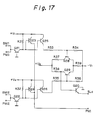
- Figure 17 is a circuit diagram showing an example of a detailed circuit construction of the addition circuits 21 and 22, the current/voltage conversion circuit 23 and 24, the comparison circuit 26, and the comparison and selection circuit 25 shown in Fig. 16.
- the addition circuit 21 is realized by a transistor Q21
- the addition circuit 22 is realized by a transistor Q22
- the current/voltage conversion circuit 23 is realized by a resistor R31
- the current/voltage conversion circuit 24 is realized by a resistor R32
- the comparison circuit 26 is realized by transistors Q28 and Q29 and resistors R33 to R39
- the comparison and selection circuit is realized by the transistors Q23 and Q24.
- the transistors Q21 and Q22 constitute grounded base type current addition circuits. Added currents are converted into voltages by the resistors R31 and R32.
- R31 and R32 become higher as the path metric value becomes smaller.
- Q25 and Q26 operate as emitter followers to separate output from input, and their output signals correspond to the path metric valued.
- R33, R34 and R35, R36 are voltage dividers to convert a signal level.
- Q28, Q29, and R37 to R39 constitute a differential amplifier having a sufficient gain, which operates as a comparator.
- an output signal SLO is at a high level
- Q20 is an emitter follower to separate output from input.
- An electrical potential at the emitter terminals of Q23 and Q24 is controlled by the transistor having a higher base potential because the emitter terminals thereof are connected together. Thus, the electrical potential becomes PM1.
- the two adders are realized by the two transistors as is in the branch metric calculation circuits.
- the current metrics added up in the adder Q21 and Q22 are converted into a voltage metric by the resistors R31 and R32.
- the resistors R31 and R32 As mentioned above, though accuracy and temperature dependency of values of resistance vary greatly, relative values thereof are good. Therefore, the converted voltage metrics are hardly affected by dispersion of the resistance or the temperature dependency. The reason is as follows. If the resistances are increased by 10%, all current signals determined by the resistances are decreased by 10%. Nevertheless, since the resistances R31 and R32 to convert the currents into voltages are also increased by 10%, the voltage drops across the resistances are not altered.
- the comparison circuits and comparison and selection circuits are realized by much simpler circuits than digital circuits. While an 8-bit comparator requires 56BC in the digital circuits, the present circuits are almost entirely realized by only two transistors.
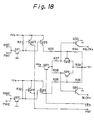
- a circuit shown in Figure 18 is a first modification of the circuit shown in Fig. 17.
- Fig. 18 shows a circuit wherein a clock CK3 is introduced in order to simplify the path memory circuit in the following stage, and a signal SLCKO in the form of the path select signal SLO masked during the latter half of the clock and an inverted signal SLCKO thereof are output.
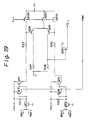
- a circuit shown in Figure 19 is a second modification of the circuit shown in Fig. 17.
- R34, R39 and R36 of Fig. 17 are replaced by transistors Q200, Q201 and Q202 which operate as constant current sources.
- the constant voltage Vcm of the current mirror circuit described with reference to Fig. 9 is applied to base terminals of Q200, Q201 and Q202. Accordingly, levels of output voltages of Q25 and Q26 are shifted by i 0 ⁇ R33 and i 0 x R35, respectively, to be applied to base terminals of the differential transistors Q28 and Q29.
- a path memory circuit constructed by ECL components can be connected thereto.
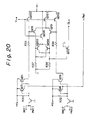
- a circuit shown in Figure 20 is a modification of the circuit shown in Fig. 19, wherein a circuit constituted by Q203 to Q205 is added. Since voltage amplification of a real differential amplifier can not be infinite because of the existence of an emitter resistance of the transistor itself, there is a case where the level of an output signal cannot reach full digital signal levels when the level difference of the input signals is small.
- the positive feedback circuit constituted by Q203 to Q205 serves to make the levels of output signals full digital signal levels. For example, when the electrical potential of the base terminal of the Q29 is slightly higher than that of Q28, the amount of current flowing through R38 become higher than the amount of current flowing through R37, so that the electrical potential of the base terminal of Q203 becomes higher than that of Q204. To this end, still more current flows through R38, and the output voltage is lowered even more.
- the circuit is a so-called latch circuit wherein the aforementioned positive feedback makes Q204 and Q203 completely turned-off and turned-on, respectively.
- Figure 21 shows a more improved circuit of Fig. 20.
- current flowing through Q205 is turned-off by lowering the level of a latch enable signal (LE) at predetermined periods of calculation intervals, to nullify a hysterisis characteristic, so that an exact decision is made in the case where the difference between input signals is small.
- LE latch enable signal
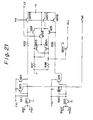
- Figure 22 is a diagram showing a first example of a detailed circuit construction of the path metric memory 27 and the normalization circuit 28 shown in Fig. 16.
- the upper portion of Fig. 22 corresponds to the path metric memory 27 and the lower portion corresponds to the normalization circuit 28.
- the collector voltage of Q32 is held at a constant value during the latter half period of the clock CK1, to perform a sample/hold operation. (In the case where the clock rate is low, the capacitance of the C1 must be a large value).
- Q34 When Q40 is turned-on and Q31 is cut-off, Q34 is turned-on because Q41 is turned-off. To this end, the collector voltage of Q32 is transferred through Q33 and Q34 to the next sample/hold circuit constituted by Q35, C2, and R46.
- normalization of the path metric is performed by subtracting a voltage Vno corresponding to a normalization metric from the normalization circuit in the lower half of Fig. 22.
- the source voltage for the collector of Q35 becomes ground potential when the normalization voltage Vno is maximum, becomes +V 2 when Vno is minimum, and is shifted between these values in response to the value of the normalization voltage Vno.
- the collector voltage of Q35 is shifted by the shifted quantity of the source voltage toward a direction where the path metric (v) is decreased, and thus the normalization is performed.
- the normalized path metric (v) is converted into a current path metric (i) again by a differential amplifier constituted by Q36 to Q39, and is supplied to its own ACS or another ACS as the past path metrics PMM1j and PMM2j.
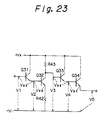
- a direct-coupled amplifier constituted by four transistors Q31 to Q34 shown in Figure 23 corresponds to the transistors Q31 to Q34 of the path metric memory circuit shown in Fig. 22.
- V BE 's are nullified.
- V 5 Vcc - V 1
- a circuit shown in the lower half of Fig. 22 is a normalization circuit.
- Two sample/hold circuits (Q47 to Q54, C3, C4, and R55 to R62) store and reserve a normalization metric (v) as an analog quantity, in the same arrangement as the path metric memory.
- the normalization metric (v) is temporarily converted into current metric (i) in a differential amplifier (Q55 to Q58, R63 to R68) for level conversion, and is again converted into a normalization metric (v) in the form of a voltage signal.
- An emitter follower (Q59) at the output end is necessary for preventing interference with currents from collectors of Q35 of ACS's.
- the comparison and selection circuit to select the smallest value from among voltage path metrics (v) from four (eight) ACS's can be realized by four (eight) transistors.
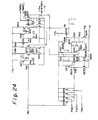
- Figure 24 is a diagram showing a second example of a detailed construction of the path metric memory 27 and normalization circuit 28 of Fig. 16. As is in Fig. 22, the upper half portion shows the path metric memory, and the lower half portion shows the normalization circuit.
- the emitter grounded amplifier constituted by Q32, R43 and R42 of Fig. 22 is replaced by a seesaw differential amplifier (explained with reference to Fig. 10) constituted by Q210 to Q213 and R110 to R112, and a normalization voltage Vno is supplied to one input of the amplifier, to perform normalization.
- a normalization voltage Vno is supplied to one input of the amplifier, to perform normalization.
- the normalization is carried out in the first sample/hold circuit of the path metric memory circuit in real time, the normalization voltage does not need to be stored, and no sample/hold circuit needs to be provided in the normalization circuit (lower half portion). This is one of the merits obtained from using an analog circuit.
- the differential amplifier constituted by Q36 to Q39 and R48 to R50 of Fig. 22 is also replaced by a seesaw differential amplifier. In this circuit, twice the number of transistors are used to obtain two current outputs.
- a voltage which is a division of +V 2 by resistors R121 and R122 is supplied through two stages of emitter followers of Q231 and Q232 and a level shifter of R120 to one input (base terminal of Q216 and Q217).
- the two stages of emitter followers are provided to match the number of stages of emitter followers (Q33 and Q34) in another input side, to cancel the temperature dependency of V BE .
- a voltage output from Q43 to Q46 corresponding to the normalization metric is supplied through a level shifter of R115 and an emitter follower of Q47 to one input of a seesaw differential amplifier constituted by Q223 to Q226 and R116 to R118.
- the aforementioned bias voltage is also supplied to another input.
- a non-inverted output of the differential amplifier is supplied through emitter followers of Q229 and Q230 and a resistor R119 as a level shifter to each of the path metric memories as a normalization voltage Vno.
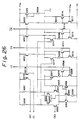
- Figure 26 shows an example of a circuit for generating the current source iIc and QIc to use in the circuits shown in Fig. 14 and Fig. 15, the latch enable signal LE to use in the circuit shown in Fig. 21, CK and CK ⁇ to use in the circuits shown in Fig. 24 and Fig. 25, and the constant voltage Vcm for the current mirror circuits used in the various circuits.
- a circuit for generating the Vcm is constituted by Q323 and R208 which operate as a constant voltage source by being connected to +V 2 , Q322 wherein the constant voltage is supplied to its base terminal to operate as a constant current source, and Q316 and Q317 which constitute a part of a current mirror circuit to let currents flow in various circuits at the same level as a current flowing through R207. Therefore, the constant currents flowing in various circuits vary in response to a variation of +V 2 .
- the voltage +V 2 is a reference voltage for converting a current signal to a voltage signal, for example, in R31 of Fig. 17. Therefore, even when the +V 2 varies, the constant voltage Vcm and the current signals in various circuits also vary in response to the variation, and the current metrics also vary, so that variations of values and linearity of converted voltage signal can be held to a low level.
- the circuits for generating LE, CK, and CK ⁇ have a similar construction except that Q307, Q310, and Q313 are interposed for switching, and commonly include the constant voltage circuit constituted by Q323 and R208. Accordingly, while the Q307, Q310, or Q313 conducts, LE, CK, or CK ⁇ is supplied as a voltage varying in response to the variation of +V 2 .
- the circuits which are supplied with iIc or QIc (Fig. 14 and Fig. 15) also have a similar construction.
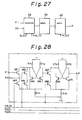
- Figure 27 is a block diagram of a single path memory cell in a path memory circuit which is adapted to be connected to the ACS circuits shown in Fig. 18 as the following stage.
- the path memory circuit comprises 4(K+1) ⁇ 2 K-1 path memory cells having the above construction.
- the path memory cell is constituted by a selector 38 that selects the output signal P1 or P2 from the path memory cell of the preceding stage in response to path select signals SLCK and *SLCK from the ACS circuits, and latch circuits 39 and 40.
- a signal having logic "1” or "0" is input to the path memory cell of the first stage as signal P1 or P2, and a connection between one stage and the following stage is determined by the generator polynomial.
- Fig. 28 is a circuit diagram of the path memory cell of Fig. 27, and wherein the selector 38 is constituted by transistors Q61 to Q64, the latch circuit 39 is constituted by resistors R71 to R73 and transistors Q65 and Q66, and the latch circuit 40 is constituted by resistors R74 to R76 and transistors Q67 to Q70.
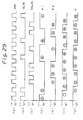
- Fig. 29 is a diagram illustrating the operation of the above-mentioned path memory cell, wherein (a) shows clock signals CK2, (b) and (c) show path select signals SLCK and *SLCK, (d) and (e) show output signals P1 and P2 from the path memory cell of the preceding stage, (f) shows output signals of the latch circuit 39, and (g) shows output signals P of the latch circuit 40.
- the path select signals SLCK and *SLCK correspond to the signals in which the clock signals CK2 are masked.
- the signal P1 of the preceding stage is selected when the path select signal SLCK is "1"
- the signal P2 of the preceding stage is selected when the path select signal *SLCK is "1".
- the portions denoted by 1 to in the signals P1 and P2 of the diagrams (d) and (e) are selected and latched by the latch circuit 39 (transistors Q65, Q66), and the output signal becomes as shown in the diagram (f).
- the output signals P become as shown in the diagram (g) and are added to the path memory cell of the next stage.
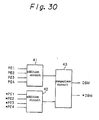
- Figure 30 is a circuit diagram of a majority circuit for obtaining decoded output by using the output signal from the final stage of the path memory circuit.
- Output signals PE1 to PE4 of the memory cells of the final stage and inverted output signals *PE1 to *PE4 are added to the adder circuits 41 and 42, and the added output signals are compared by a comparator circuit 43, and majority output signals DBM, *DBM are output as decoded output signals.
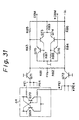
- Fig. 31 is a circuit diagram showing major portions in the majority circuit of Fig. 30, and wherein reference numeral 44 denotes a path memory cell in the final stage that includes transistors Q69 and Q70.
- the adder circuit 41 is constituted by a transistor Q71
- the adder circuit 42 is constituted by a transistor Q72
- the comparator circuit 43 is constituted by transistors Q73 to Q76.
- the levels are converted by resistors R83 to R86, and are compared in a differential amplifier consisting of transistors Q73 and Q74.
- the majority of the input signals are of an even number, and there may be a case where the signals "1" and "0" are input in the same number. In such a case, the S/N in the received signals will have been greatly deteriorated. Therefore, the decoded result is not affected irrespective of whether the determination is rendered to be “1” or "0". It is, however, also possible to make the resistance R81 and R82 different from each other, so that the determination is either "1" or "0" in such a case.
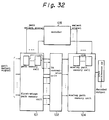
- Figure 32 is a schematic block diagram showing another embodiment of the path memory circuits, This path memory circuits can be connected to the ACS circuit shown in either Fig. 17, Fig. 19, Fig. 20, or Fig. 21.
- This path memory circuit is arranged so that a plurality of stages of the path memory cells can be realized by a single analog circuit.
- the circuit comprises a first-stage path memory unit 101 having n stages of path memory cells that receive path select signals; a DA conversion unit 102 that converts output signals of n stages of the first-stage path memory unit 101 into 2 n values; an analog path memory unit 104 having a plurality of stages of analog path memory cells 103 to successively store output signals of 2 n values of the DA converter unit 102; and an encoder 105 that supplies to the analog path memory unit 104 select signals corresponding to the path select signals for every n times of the path select signals, and a decoded output is obtained from an AD conversion unit.
- reference numeral 111 denotes a first-stage path memory unit
- 112 denotes a DA conversion unit
- 114 denotes an analog path memory unit
- 115 denotes an encoder
- 116 denotes path memory cells
- 117 denotes DA converters (D/A)
- 118 denotes analog path memory cells (APM)
- 119 denotes an output select circuit
- 120 denotes an AD converter (A/D)
- reference numeral 121 denotes a parallel/serial converter (P/S).
- Path select signals SLO to SL4 from an ACS circuit are applied to the first-stage path memory unit 111 and to the encoder 115.
- the analog path memory unit 114 is constituted by analog path memory cells 118 of a plurality of stages, where each analog path memory cell 118 corresponds to three stages of path memory cells and is capable of storing an octal signal. In response to a select signal from the encoder 115, the analog path memory unit 114 selects the output signal from the preceding stage and stores it. Therefore, the analog path memory unit 114 according to this embodiment has a number of stages which is one-third that of the prior art, making it possible to reduce the scale of the circuit.
- the output signals of the final stages of the analog path memory unit 114 are applied to the output select circuit 119 where a maximum value is selected out of the output signals and is converted into a digital signal through the AD converter 120.
- the digital signals output in parallel in three bits are converted by the parallel/serial converter 121 into serial signals which are used as decoded output signals.
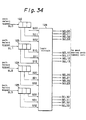
- the encoder 115 has a constitution shown, for example, in Fig. 34 wherein reference numerals 122 to 125 denote three-bit shift registers, and 126 denotes a logic circuit.
- the path select signals SLO, to SL3 are applied to the shift registers 112 to 125 and are shifted, and the path select signals SLO to SL3 of three times are converted into path select signals S00 to S02, ---, S30 to S32 of parallel outputs of three bits and are simultaneously applied to the logic circuit 126.
- the logic circuit 126 is constituted by a gate circuit or a read-only memory, and outputs select signals SEL00 to SEL03, ---, SEL30 to SEL33 that correspond to the path select signals S00 to S02 ---, S30 to S32, and sends them to the analog path memory unit 114.
- Fig. 35 is a diagram for explaining the logic of the logic circuit 126 wherein, for example, the select signal SEL01 is obtained by a logical sum of a logical product of inverted signals of path select signals S20, S02 and path select signal S01, and a logical product of an inverted signal of path select signal S30, and path select signals S21 and S02.
- Figs. 36(a) to 36(c) are explanatory diagrams related to the aforementioned select signal SEL01. It is now presumed that the path memory cell selects the upper side of input from the preceding stage when the path select signal is "0" and selects the lower side of input from the preceding stage when the path select signal is "1". Then, when the path select signal S20 corresponding to the path select signal SL2 at time to is "0", the path memory cell c among a series of path memory cells A, B, C and D selects and stores the signal output from the path memory cell B in the preceding stage. That is, shifting takes place as indicated by arrows in Fig. 36(a).
- the path memory cell A selects and stores the signal output from the path memory cell C in the preceding stage. That is, shifting takes place as indicated by arrows in Fig. 36(b).
- the path memory cell A selects and stores the signal output from the path memory cell A in the preceding stage. That is, shifting takes place as indicated by arrows in Fig. 36(c).
- the symbol “+” denotes the logical sum and " ⁇ ” denotes the logical product.
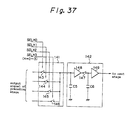
- Fig. 37 is a diagram which illustrates the analog path memory cell according to the embodiment of the present invention that is constituted by a selector unit 141 and an analog memory unit 142.
- the analog memory unit 142 is constituted by capacitors C5 and C6, buffer amplifiers 148 and 149, and a switch 147 which consists of a transistor or the like and which is turned on or off by a clock signal that is not shown.
- the number of inputs m to the analog path memory cell 118 is either 2 K-1 or 2 n whichever is smaller.
- i (1) [i/2] + 2 K-2 ⁇ Sit
- [x] such as [i/2] is a maximum integer that is not greater than x.
- a path select signal Si (1) (t-1) input to the node i (1) is read at a moment t-1.
- the logic of the encoder 115 is constituted by the gate circuit or by the read-only memory that reads the select signals SELij with the path select signals corresponding to a plurality of stages as addresses.
- the present invention is in no way limited thereto only but can be adapted to various cases depending on any coding factor R, constraint length K and resolution of the analog path memory cells.
- the analog path memory cell may employ any constitution provided it is capable of storing the data of 2 n levels.
- branch metric calculation circuit 1 and/or the ACS circuit 2 described with reference to Fig. 7 to Fig. 26 may not only be combined with the path memory circuit 3 described with reference to Fig. 32 to Fig. 37, but may also be combined with a conventional digital circuit, for example, a path memory circuit constructed by ECL circuits.
- a branch metric calculation circuit and ACS circuit constructed by digital circuits may be combined with the path memory circuit based on the analog signal process as described with reference to Fig. 32 to Fig. 37.
Landscapes
- Physics & Mathematics (AREA)
- Probability & Statistics with Applications (AREA)
- Engineering & Computer Science (AREA)
- Theoretical Computer Science (AREA)
- Error Detection And Correction (AREA)
Claims (20)
- Analoger Viterbi-Dekodierer, enthaltend:eine Zweigmetrik-Berechnungsvorrichtung (1) zum sukzessiven Berechnen von Zweigmetriken aus empfangenen Symbolen zum Ausgeben der Zweigmetriken,eine ACS-Vorrichtung (2) zum sukzessiven Berechnen von Paaren von Pfadmetriken jeweils durch Addieren vorausgewählter Paare von Zweigmetriken und vorausgewählter Paare von vorhergehenden Pfadmetriken zum Vergleichen der Paare berechneter Pfadmetriken miteinander für die Auswahl von Pfaden mit geringeren Pfadmetrikwerten und zum Ausgeben von Pfadauswahlsignalen, die bei den Auswahlvorgängen eingesetzt werden, undeine Pfadspeichervorrichtung (3) zum sukzessiven Speichern von Kandidaten für ein dekodiertes signal gemäß den Pfadauswahlsignalen und zum sukzessiven Verfeinern der Kandidaten gemäß den Pfadauswahlsignalen zum Erhalten eines dekodierten Signals,dadurch gekennzeichnet, daßdie Pfadmetrik-Berechnungsvorrichtung (1) die Zweigmetriken in analoger Signalform ausgibt; unddie ACS-Vorrichtung (2) die Additions-, die Vergleichs- und die Auswahlbetriebsschritte mit analogen Signalverarbeitungsprozessen durchführt.
- Analoger Viterbi-Dekodierer nach Anspruch 1, dadurch gekennzeichnet, daß die Pfadmetrik-Berechnungsvorichtung (1) enthält:eine Stromumsetzschaltung (4) zum Umsetzen von Werten der empfangenen Symbole in Stromsignale, undeine erste Addierschaltung (5) zum Berechnen von Stromzweigmetriken aus den Stromsignalen.
- Analoger Viterbi-Kodierer nach Anspruch 2, dadurch gekennzeichnet, daßdie empfangenen Symbole in den Dekodierer in Spannungssignalform eingegeben werden, unddie Stromumsetzschaltung (4) mehrere Spannungs/Strom-Umsetzschaltungen (11, 12) zum Umsetzen der empfangenen Symbole in Stromsignale enthält.
- Analoger Viterbi-Dekodierer nach Anspruch 3, dadurch gekennzeichnet, daß die Spannung/Strom-Umsetzschaltungen (11, 12) mehrere Differentialverstärkerschaltungen enthalten, bei denen nichtinvertierte und invertierte Spannungssignale eingegeben werden und von denen nichtinvertierte und invertierte Stromsignale ausgegeben werden.
- Analoger Viterbi-Dekodierer nach Anspruch 4, dadurch gekennzeichnet, daß die Differentialverstärkerschaltung ein Phasenumkehr-Differentialverstärker ist, der ein Paar von Konstantstromquellen enthält, die jeweils mit den Emitteranschlüssen eines Paares von Transistoren verbunden sind, und einen Rückkopplungswiderstand, der zwischen den Emitteranschlüssen und dem Paar der Transistoren angeschlossen ist.
- Analoger Viterbi-Dekodierer nach Anspruch 2, dadurch gekennzeichnet, daßdie empfangenen Symbole in dem Dekodierer in digitaler Signalform bestehend aus mehreren Bits eingegeben werden, unddie Stromumsetzschaltung (4) mehrere Digital/Analog-Umsetzschaltungen (11', 12') zum Umsetzen der empfangenen Symbole in Stromsignale enthält.
- Analoger Viterbi-Dekodierer nach Anspruch 6, dadurch gekennzeichnet, daß die Digital/Analog-Umsetzschaltungen (11', 12') 2n (n = 0, 1, 2, ...) parallel verbundene Konstantstromquellen enthalten und ein Ausgangsstrom jeder der 2n parallel verbundenen Konstantstromquellen gemäß dem digitalen Eingangssignal gesteuert wird, wodurch nichtinvertierte und invertierte Stromsignale ausgebbar sind.
- Analoger Viterbi-Dekodierer nach Anspruch 7, dadurch gekennzeichnet, daß die 2n parallel verbundenen Konstantstromquellen durch externe Steuersignale gesteuert sind.
- Analoger Viterbi-Dekodierer nach Anspruch 2, dadurch gekennzeichnet, daß die erste Addierschaltung (5) mehrere Stromaddierschaltungen enthält, die aus Transistorschaltungen vom Typ mit gemeinsamer Basis aufgebaut sind.
- Analoger Viterbi-Dekodierer nach Anspruch 2, dadurch gekennzeichnet, daß die ACS-Vorrichtung (2) enthält:einen Pfadmetrikspeicher (6) zum Speichern der Pfadmetrik in Spannungssignalform und zum Ausgeben von Strompfadmetriken,eine zweite Addierschaltung (7) zum Addieren jeweils vorausgebildeter Paare der Stromzweigmetriken und vorausgebildeter Paare der Strompfadmetriken zum Ausgeben von Paaren neuer Strompfadmetriken,eine Strom/Spannungs-Umsetzschaltung (8) zum Umsetzen der in der zweiten Addierschaltung (7) berechneten Strompfadmetriken in Spannungspfadmetriken,eine Vergleichs- und Auswahlschaltung (9) zum Vergleichen von Paaren der Spannungspfadmetriken untereinander und zum Auswählen von Pfadmetriken mit geringen Pfadmetrikwerten, die in dem Pfadmetrikspeicher (6) gespeichert sind, und zum Ausgeben des Pfadauswahlsignals.
- Analoger viterbi-Dekodierer nach Anspruch 10, dadurch gekennzeichnet, daß die zweite Addierschaltung (7) mehrere Stromaddierschaltungen enthält, die durch Transistorschaltungen vom Typ mit gemeinsamer Basis gebildet sind.
- Analoger Viterbi-Dekodierer nach Anspruch 10, dadurch gekennzeichnet, daß die Vergleichs- und Auswahlschaltung (9) enthält:Paare von Emitterfolgerschaltungen, an die Paare der Spannungspfadmetriken eingegeben werden und deren Emitteranschlüsse miteinander so verbunden sind, daß Pfadmetriken mit niedrigeren Werten für die Ausgabe ausgewählt werden, undDifferentialverstärkerschaltungen, an die Paare der Spannungspfadmetriken derart eingegeben werden, daß die Pfadauswahlsignale ausgegeben werden.
- Analoger Viterbi-Dekodierer nach Anspruch 10, dadurch gekennzeichnet, daß der Pfadmetrikspeicher (6) zwei Stufen von Abtast-Halte-Schaltungen enthält.
- Analoger Viterbi-Dekodierer nach Anspruch 13, dadurch gekennzeichnet, daß der Pfadmetrikspeicher (6) einen Phasenumkehr-Differentialverstärker für die Pegelverschiebung und Spannung/Strom-Umsetzung enthält.
- Analoger Viterbi-Dekodierer nach Anspruch 10, dadurch gekennzeichnet, daß die ACS-Vorrichtung (2) ferner enthält:
eine Normierungsschaltung (28) zum Ausgeben einer Normierungsspannung für die Normierung aller Pfadmetriken, die in dem Pfadmetrikspeicher (6) gespeichert sind, durch Vergleich sämtlicher Pfadmetriken untereinander und durch Auswahl der geringsten Pfadmetriken. - Analoger Viterbi-Dekodierer nach Anspruch 15, dadurch gekennzeichnet, daß die Normierungsschaltung (28) zwei Stufen von Abtast-Halte-Schaltungen enthält und die Normierungsspannung dem Ausgang der zweiten Stufe der Abtast/Halte-Schaltungen in dem Pfadmetrikspeicher (6) zugeführt wird.
- Analoger Viterbi-Dekodierer nach Anspruch 15, dadurch gekennzeichnet, daß die Normierungsspannung einem Eingangsanschluß der ersten Stufe der Abtast/Halte-Schaltung in dem Pfadmetrikspeicher (6) zugeführt wird.
- Analoger Viterbi-Dekodierer nach Anspruch 2, dadurch gekennzeichnet, daß mehrere Konstantstromquellen zu einer gemeinsamen Stromspiegelschaltung gehören.
- Analoger Viterbi-Dekodierer nach Anspruch 18, dadurch gekennzeichnet, daß ein Ausgangsstrom der Stromspiegelschaltung in Abhängigkeit von einer Spannungsveränderung einer Stromversorgung variiert.
- Analoger Viterbi-Dekodierer, enthaltend:eine Zweigmetrik-Berechnungsvorrichtung (1) zum sukzessiven Berechnen von Zweigmetriken aus empfangenen Symbolen zum Ausgeben der Zweigmetriken,eine ACS-Vorrichtung (2) zum sukzessiven Berechnen von Paaren von Pfadmetriken jeweils durch Addieren vorausgewählter Paare von Zweigmetriken und vorausgewählter Paare von vorhergehenden Pfadmetriken zum Vergleichen der Paare berechneter Pfadmetriken miteinander für die Auswahl von Pfaden mit geringeren Pfadmetrikwerten und zum Ausgeben von Pfadauswahlsignalen, die bei den Auswahlvorgängen eingesetzt werden, undeine Pfadspeichervorrichtung (3) zum sukzessiven Speichern von Kandidaten für ein dekodiertes Signal gemäß den Pfadauswahlsignalen und zum sukzessiven Verfeinern der Kandidaten gemäß den Pfadauswahlsignalen zum Erhalten eines dekodierten Signals,dadurch gekennzeichnet, daßdie Pfadspeichervorrichtung (3) enthält:einen Pfadspeicherteil einer ersten Stufe (101) mit Endstufen von Pfadspeicherzellen zum Empfangen der Pfadauswahlsignale;einen DA-Umsetzteil (102) zum Umsetzen von Ausgangssignalen mit n Bits der n Stufen der Pfadspeicherzellen in analoge Signale;einen analogen Pfadspeicherteil (104) mit mehreren Stufen analoger Pfadspeicherzellen (103) zum sequentiellen Speichern der analogen Signale; undeinen Kodierer (105) zum Zuführen von Auswahlsignalen entsprechend den Pfadauswahlsignalen zu dem analogen Pfadspeicherteil (104) jedesmal wenn n Pfadauswahlsignale eingegeben sind.
Applications Claiming Priority (5)
| Application Number | Priority Date | Filing Date | Title |
|---|---|---|---|
| JP21861389A JPH0383422A (ja) | 1989-08-28 | 1989-08-28 | ビタビ復号器のパスメモリ回路 |
| JP218613/89 | 1989-08-28 | ||
| JP22939289A JPH0393318A (ja) | 1989-09-06 | 1989-09-06 | ビタビ復号器 |
| JP229392/89 | 1989-09-06 | ||
| PCT/JP1990/001089 WO1991003881A1 (en) | 1989-08-28 | 1990-08-28 | Analog viterbi decoder |
Publications (3)
| Publication Number | Publication Date |
|---|---|
| EP0441968A1 EP0441968A1 (de) | 1991-08-21 |
| EP0441968A4 EP0441968A4 (en) | 1993-03-17 |
| EP0441968B1 true EP0441968B1 (de) | 1996-12-04 |
Family
ID=26522663
Family Applications (1)
| Application Number | Title | Priority Date | Filing Date |
|---|---|---|---|
| EP90912466A Expired - Lifetime EP0441968B1 (de) | 1989-08-28 | 1990-08-28 | Analog-dekodierungsgerät für viterbi |
Country Status (4)
| Country | Link |
|---|---|
| EP (1) | EP0441968B1 (de) |
| CA (1) | CA2039694A1 (de) |
| DE (1) | DE69029318T2 (de) |
| WO (1) | WO1991003881A1 (de) |
Families Citing this family (3)
| Publication number | Priority date | Publication date | Assignee | Title |
|---|---|---|---|---|
| US5295142A (en) * | 1989-07-18 | 1994-03-15 | Sony Corporation | Viterbi decoder |
| US5881075A (en) * | 1996-03-18 | 1999-03-09 | Samsung Electronics Co., Ltd. | Viterbi decoder |
| GB0018841D0 (en) * | 2000-08-02 | 2000-09-20 | Koninkl Philips Electronics Nv | Data decoding |
Family Cites Families (2)
| Publication number | Priority date | Publication date | Assignee | Title |
|---|---|---|---|---|
| US4087787A (en) * | 1977-04-19 | 1978-05-02 | Bell Telephone Laboratories, Incorporated | Decoder for implementing an approximation of the Viterbi algorithm using analog processing techniques |
| JPS63275227A (ja) * | 1987-05-07 | 1988-11-11 | Fujitsu Ltd | ビタビ復号器用パスメモリ回路 |
-
1990
- 1990-08-28 CA CA002039694A patent/CA2039694A1/en not_active Abandoned
- 1990-08-28 DE DE69029318T patent/DE69029318T2/de not_active Expired - Fee Related
- 1990-08-28 EP EP90912466A patent/EP0441968B1/de not_active Expired - Lifetime
- 1990-08-28 WO PCT/JP1990/001089 patent/WO1991003881A1/ja not_active Ceased
Also Published As
| Publication number | Publication date |
|---|---|
| EP0441968A4 (en) | 1993-03-17 |
| EP0441968A1 (de) | 1991-08-21 |
| DE69029318T2 (de) | 1997-04-24 |
| CA2039694A1 (en) | 1991-03-01 |
| DE69029318D1 (de) | 1997-01-16 |
| WO1991003881A1 (en) | 1991-03-21 |
Similar Documents
| Publication | Publication Date | Title |
|---|---|---|
| US5448583A (en) | Apparatus and method using analog viterbi decoding techniques | |
| US4606027A (en) | Error correction apparatus using a Viterbi decoder | |
| CA2352206C (en) | Component decoder and method thereof in mobile communication system | |
| US4087787A (en) | Decoder for implementing an approximation of the Viterbi algorithm using analog processing techniques | |
| US5509021A (en) | Viterbi decoder for decoding error-correcting encoded information symbol string | |
| KR940010435B1 (ko) | 비터비 복호기의 경로기억장치 | |
| JP2717032B2 (ja) | ビタビ復号器 | |
| CN107210754B (zh) | 多模式维特比解码器 | |
| GB2311447A (en) | Viterbi decoder | |
| JP4382040B2 (ja) | D/a変換回路 | |
| EP0441968B1 (de) | Analog-dekodierungsgerät für viterbi | |
| JP3238573B2 (ja) | エンコーダー | |
| US6697442B1 (en) | Viterbi decoding apparatus capable of shortening a decoding process time duration | |
| JP2991216B2 (ja) | アナログビタビ復号器 | |
| US7225393B2 (en) | Viterbi decoder and Viterbi decoding method | |
| KR100259031B1 (ko) | 아날로그/디지탈 변환 장치 | |
| JPWO1991003881A1 (ja) | アナログビタビ復号器 | |
| JPH0393318A (ja) | ビタビ復号器 | |
| JP3474492B2 (ja) | D/a変換回路 | |
| JP2798647B2 (ja) | 最尤復号器 | |
| JP2798648B2 (ja) | 最尤復号器 | |
| JPS63129714A (ja) | ビタビ復号器 | |
| JPH06204896A (ja) | ビタビ復号器 | |
| KR100237489B1 (ko) | 트렐리스 디코더의 브랜치 메트릭 계산 장치 | |
| JPH0420530B2 (de) |
Legal Events
| Date | Code | Title | Description |
|---|---|---|---|
| PUAI | Public reference made under article 153(3) epc to a published international application that has entered the european phase |
Free format text: ORIGINAL CODE: 0009012 |
|
| 17P | Request for examination filed |
Effective date: 19910425 |
|
| AK | Designated contracting states |
Kind code of ref document: A1 Designated state(s): DE FR GB IT |
|
| RIN1 | Information on inventor provided before grant (corrected) |
Inventor name: NAKAMURA, TADASHI, C/O FUJITSU LIMITED Inventor name: YAMASHITA, ATSUSHI, C/O FUJITSU LIMITED Inventor name: MIYAMOTO, BUN-ICHI, C/O FUJITSU LIMITED |
|
| A4 | Supplementary search report drawn up and despatched |
Effective date: 19930122 |
|
| AK | Designated contracting states |
Kind code of ref document: A4 Designated state(s): DE FR GB IT |
|
| 17Q | First examination report despatched |
Effective date: 19950213 |
|
| GRAH | Despatch of communication of intention to grant a patent |
Free format text: ORIGINAL CODE: EPIDOS IGRA |
|
| ITF | It: translation for a ep patent filed | ||
| GRAH | Despatch of communication of intention to grant a patent |
Free format text: ORIGINAL CODE: EPIDOS IGRA |
|
| GRAA | (expected) grant |
Free format text: ORIGINAL CODE: 0009210 |
|
| AK | Designated contracting states |
Kind code of ref document: B1 Designated state(s): DE FR GB IT |
|
| REF | Corresponds to: |
Ref document number: 69029318 Country of ref document: DE Date of ref document: 19970116 |
|
| ET | Fr: translation filed | ||
| PLBE | No opposition filed within time limit |
Free format text: ORIGINAL CODE: 0009261 |
|
| STAA | Information on the status of an ep patent application or granted ep patent |
Free format text: STATUS: NO OPPOSITION FILED WITHIN TIME LIMIT |
|
| 26N | No opposition filed | ||
| PGFP | Annual fee paid to national office [announced via postgrant information from national office to epo] |
Ref country code: FR Payment date: 19990810 Year of fee payment: 10 |
|
| PGFP | Annual fee paid to national office [announced via postgrant information from national office to epo] |
Ref country code: GB Payment date: 19990825 Year of fee payment: 10 |
|
| PGFP | Annual fee paid to national office [announced via postgrant information from national office to epo] |
Ref country code: DE Payment date: 19990827 Year of fee payment: 10 |
|
| PG25 | Lapsed in a contracting state [announced via postgrant information from national office to epo] |
Ref country code: GB Free format text: LAPSE BECAUSE OF NON-PAYMENT OF DUE FEES Effective date: 20000828 |
|
| GBPC | Gb: european patent ceased through non-payment of renewal fee |
Effective date: 20000828 |
|
| PG25 | Lapsed in a contracting state [announced via postgrant information from national office to epo] |
Ref country code: FR Free format text: LAPSE BECAUSE OF NON-PAYMENT OF DUE FEES Effective date: 20010430 |
|
| PG25 | Lapsed in a contracting state [announced via postgrant information from national office to epo] |
Ref country code: DE Free format text: LAPSE BECAUSE OF NON-PAYMENT OF DUE FEES Effective date: 20010501 |
|
| REG | Reference to a national code |
Ref country code: FR Ref legal event code: ST |
|
| PG25 | Lapsed in a contracting state [announced via postgrant information from national office to epo] |
Ref country code: IT Free format text: LAPSE BECAUSE OF NON-PAYMENT OF DUE FEES;WARNING: LAPSES OF ITALIAN PATENTS WITH EFFECTIVE DATE BEFORE 2007 MAY HAVE OCCURRED AT ANY TIME BEFORE 2007. THE CORRECT EFFECTIVE DATE MAY BE DIFFERENT FROM THE ONE RECORDED. Effective date: 20050828 |