EP0437916A2 - Verfahren zur Herstellung eines luftdurchlässigen Klebebands - Google Patents
Verfahren zur Herstellung eines luftdurchlässigen Klebebands Download PDFInfo
- Publication number
- EP0437916A2 EP0437916A2 EP90308901A EP90308901A EP0437916A2 EP 0437916 A2 EP0437916 A2 EP 0437916A2 EP 90308901 A EP90308901 A EP 90308901A EP 90308901 A EP90308901 A EP 90308901A EP 0437916 A2 EP0437916 A2 EP 0437916A2
- Authority
- EP
- European Patent Office
- Prior art keywords
- layer
- adhesive
- solution
- air
- water drops
- Prior art date
- Legal status (The legal status is an assumption and is not a legal conclusion. Google has not performed a legal analysis and makes no representation as to the accuracy of the status listed.)
- Granted
Links
Images

Classifications
-
- A—HUMAN NECESSITIES
- A61—MEDICAL OR VETERINARY SCIENCE; HYGIENE
- A61L—METHODS OR APPARATUS FOR STERILISING MATERIALS OR OBJECTS IN GENERAL; DISINFECTION, STERILISATION OR DEODORISATION OF AIR; CHEMICAL ASPECTS OF BANDAGES, DRESSINGS, ABSORBENT PADS OR SURGICAL ARTICLES; MATERIALS FOR BANDAGES, DRESSINGS, ABSORBENT PADS OR SURGICAL ARTICLES
- A61L15/00—Chemical aspects of, or use of materials for, bandages, dressings or absorbent pads
- A61L15/16—Bandages, dressings or absorbent pads for physiological fluids such as urine or blood, e.g. sanitary towels, tampons
- A61L15/42—Use of materials characterised by their function or physical properties
- A61L15/425—Porous materials, e.g. foams or sponges
-
- A—HUMAN NECESSITIES
- A61—MEDICAL OR VETERINARY SCIENCE; HYGIENE
- A61F—FILTERS IMPLANTABLE INTO BLOOD VESSELS; PROSTHESES; DEVICES PROVIDING PATENCY TO, OR PREVENTING COLLAPSING OF, TUBULAR STRUCTURES OF THE BODY, e.g. STENTS; ORTHOPAEDIC, NURSING OR CONTRACEPTIVE DEVICES; FOMENTATION; TREATMENT OR PROTECTION OF EYES OR EARS; BANDAGES, DRESSINGS OR ABSORBENT PADS; FIRST-AID KITS
- A61F13/00—Bandages or dressings; Absorbent pads
- A61F13/02—Adhesive bandages or dressings
- A61F13/0276—Apparatus or processes for manufacturing adhesive dressings or bandages
- A61F13/0283—Apparatus or processes for manufacturing adhesive dressings or bandages for making adhesive or cohesive tape or fabrics therefor, e.g. coating or mechanical treatments
-
- A—HUMAN NECESSITIES
- A61—MEDICAL OR VETERINARY SCIENCE; HYGIENE
- A61L—METHODS OR APPARATUS FOR STERILISING MATERIALS OR OBJECTS IN GENERAL; DISINFECTION, STERILISATION OR DEODORISATION OF AIR; CHEMICAL ASPECTS OF BANDAGES, DRESSINGS, ABSORBENT PADS OR SURGICAL ARTICLES; MATERIALS FOR BANDAGES, DRESSINGS, ABSORBENT PADS OR SURGICAL ARTICLES
- A61L15/00—Chemical aspects of, or use of materials for, bandages, dressings or absorbent pads
- A61L15/16—Bandages, dressings or absorbent pads for physiological fluids such as urine or blood, e.g. sanitary towels, tampons
- A61L15/42—Use of materials characterised by their function or physical properties
- A61L15/58—Adhesives
-
- C—CHEMISTRY; METALLURGY
- C09—DYES; PAINTS; POLISHES; NATURAL RESINS; ADHESIVES; COMPOSITIONS NOT OTHERWISE PROVIDED FOR; APPLICATIONS OF MATERIALS NOT OTHERWISE PROVIDED FOR
- C09J—ADHESIVES; NON-MECHANICAL ASPECTS OF ADHESIVE PROCESSES IN GENERAL; ADHESIVE PROCESSES NOT PROVIDED FOR ELSEWHERE; USE OF MATERIALS AS ADHESIVES
- C09J7/00—Adhesives in the form of films or foils
- C09J7/30—Adhesives in the form of films or foils characterised by the adhesive composition
- C09J7/38—Pressure-sensitive adhesives [PSA]
-
- A—HUMAN NECESSITIES
- A61—MEDICAL OR VETERINARY SCIENCE; HYGIENE
- A61F—FILTERS IMPLANTABLE INTO BLOOD VESSELS; PROSTHESES; DEVICES PROVIDING PATENCY TO, OR PREVENTING COLLAPSING OF, TUBULAR STRUCTURES OF THE BODY, e.g. STENTS; ORTHOPAEDIC, NURSING OR CONTRACEPTIVE DEVICES; FOMENTATION; TREATMENT OR PROTECTION OF EYES OR EARS; BANDAGES, DRESSINGS OR ABSORBENT PADS; FIRST-AID KITS
- A61F13/00—Bandages or dressings; Absorbent pads
- A61F2013/00361—Plasters
- A61F2013/00727—Plasters means for wound humidity control
- A61F2013/00761—Plasters means for wound humidity control with permeable adhesive layers
- A61F2013/00778—Plasters means for wound humidity control with permeable adhesive layers porous layers
Definitions
- the present invention relates to a method for the production of an air-permeable adhesive tape for medical and other applications.
- This type of adhesive tape also includes preparations in sheet form.
- Adhesive plaster and other types of adhesive products employed in the medical field are directly applied to the surface of the body.
- the long continued application of such adhesive products to the human body prevents the dissipation of moisture from the surface of the skin, and may thereby cause skin inflammation. Therefore, adhesive products which air-permeable to air are desirable, and accordingly the following techniques have previously been proposed for the purpose of manufacturing air-permeable adhesive materials.
- a gas or liquid incompatible with an adhesive material being used is dispersed in the form of minute bubbles or drops within a solution containing the adhesive material.
- the adhesive solution so obtained (hereinafter, "adhesive solution” is referred to as a solution containing an adhesive material) is then coated onto release paper, forming a layer of the adhesive solution.
- this layer of adhesive solution is heated, thereby forming an adhesive layer and also bursting the gas bubbles or liquid drops so as to form communicating pores.
- a solution of an adhesive material in an organic solvent which can be extracted with an aqueous extractant is coated onto a porous backing, forming a layer of adhesive solution.
- This backing with the layer of adhesive solution is then immersed in the extractant, thereby extracting the organic solvent into the said extractant, and at the same time coagulating of the organic solvent by the extractant results in the formation of numerous communicating pores in the adhesive layer.
- An adhesive solution is prepared by uniformly dispersing water or a mixture of water and a water-absorptive macromolecular substance in an adhesive solution containing a pressure sensitive adhesive material and an organic solvent. This adhesive solution is coated onto the surface of a sheet with adequate surface releasing properties, thus forming a layer of adhesive solution, which is then dried, and an air-permeable backing is then layered on this adhesive layer.
- the organic solvent is first evaporated to form an adhesive layer, and then the water is evaporated, thus forming pores where water was present.
- an adhesive solution containing a uniformly dispersed gas or liquid incompatible with the adhesive material is used.
- a porous air-permeable tape with uniformly dispersed communicating pores cannot be obtained unless the uniform state of dispersion of the gas bubbles or liquid drops within the adhesive solution is adequately maintained.
- the method for producing an air-permeable adhesive tape of this invention comprises the steps of: forming a layer of a solution on a substrate, said solution containing an adhesive material in an organic solvent; applying water drops on said layer of said solution while said organic solvent remains in said layer, thereby allowing water drops to sink into said layer, the diameter of said water drops being in the range of 10 to 1000 ⁇ m, and the total amount of said water drops applied onto the surface of said layer being 5 to 200 g/m2; evaporating said organic solvent contained in said layer of the solution, thereby forming an adhesive layer that contains said water drops; and evaporating said water from said adhesive layer, thereby forming communicating pores extending from the external surface to the inner surface of said adhesive layer.
- the substrate is an air-permeable sheet.
- the substrate is a sheet with releasing properties
- the said method further comprises the steps of, layering an air-permeable sheet on the surface of said adhesive layer with communicating pores, thereby transferring said adhesive layer onto said air-permeable sheet.
- the adhesive material is a rubber-base or synthetic resin-base adhesive material.
- the synthetic resin-base adhesive material comprises an acrylic adhesive which is a copolymer obtained from a macromer.
- the macromer is a monomer of number average molecular weight 1,000 to 20,000 containing at least one vinyl group, and the said monomer is at least one selected from the group consisting of polystyrene, polymethyl methacrylate, and polystyrene-acrylonitrile monomers.
- the interfacial tension between said organic solvent and water is 20 dyn/cm2 or more at 20°C.
- the water applied on the layer of the solution contains a crosslinking agent capable of crosslinking the adhesive material.
- Figures 1A to 1C are process diagrams illustrating the method of the production of an air-permeable adhesive tape of the present invention.
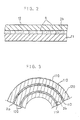
- Figure 2 is a cross-sectional view showing an example of the air-permeable adhesive tape obtained by the method of the present invention.
- Figure 3 is a cross-sectional view showing another example of the air-permeable adhesive tape obtained by the method of the present invention.
- an adhesive solution is coated on a substrate 1, thereby forming a layer of adhesive solution 2a.
- the substrate is an air-permeable sheet or a sheet with releasing properties.
- any of various well-known methods may be employed for the coating of the said adhesive solution onto the substrate, for example, a roller coater, a knife coater, an extrusion lip, etc. can be used.
- the aforesaid adhesive solution is prepared with an appropriate viscosity.
- the viscosity of the adhesive solution should desirably be in the range of about several thousands up to about 10,000 cps.
- the amount of the adhesive solution to be coated on the surface of the substrate will vary according to factors such as the type of adhesive material and organic solvent to be used, but ordinarily should be in the range of 20-250 g/m2, and more preferably, of the order of 150 g/m2.
- the thickness of the adhesive layer 2b (in dried state; see Figure 1C) should desirably be 5-100 ⁇ m, and preferably, 10-80 ⁇ m, in the dry state.
- the water drops can be applied sprayed with any conventional spraying device such as a spray gun, etc.
- the diameters of the water drops should be in the range of 10-1000 ⁇ m. Preferably, the diameter is larger than the width of the layer of the adhesive solution. If the diameters of the water drops are less than 10 ⁇ m, then, after drying the layer of the solution, the formation of communicating pores in the resulting adhesive layer is difficult. Moreover, even assuming that communicating pores are formed in the adhesive layer, the diameters of these communicating pores are unduly small, consequently, when the adhesive layer possessing the said pores comes into contact with another sheet or with the surface of the skin, the pores may be obstructed. On the other hand, if the diameters of the water drops exceed 1000 ⁇ m, then the said water drops are not imbedded within the layer of adhesive solution, and therefore the desired communicating pores cannot be formed.
- the amount of water applied onto the layer of adhesive solution 2a should be in the range of 5-200 g/m2. If the applied amount is less then 5 g/m2, then the number of communicating pores formed will be inadequate. Whereas if the amount exceeds 200 g/m2, then the drying of the applied water drops requires considerable time. Moreover, the drying process requires a greater amount of energy, which raises production costs. Furthermore, water that had been applied on the layer spreads over the surface of the layer, thus the desired communicating pores cannot be formed.
- the layer of adhesive solution 2a is dried, thereby forming an adhesive layer 2.
- the organic solvent and water contained in the layer of the adhesive solution 2a are evaporated.
- the evaporation of water is somewhat slower than the evaporation of the organic solvent. Therefore, the layer of adhesive solution 2a is dried in a state such that residual water drops 3 are present, and finally communicating pores 4 are formed in the adhesive layer 2b at the sites of the residual water drops 3.
- the thin layer 20 existing between the water drop 3 and the substrate 1 becomes contracted as the evaporation of the organic solvent proceeds, resulting in a cracking of the thin layer, thus, a communicating pore is formed.
- drying temperature will vary according to factors such as the type of organic solvent used, the amount of adhesive solution in the layer, and the amount of water applied on the layer, but in general, a temperature in the range of 70-120°C is desirable. Ordinarily, drying is performed by maintaining the layer at a temperature of approximately 110°C for several minutes.
- the adhesive solution used in the present invention is prepared by dissolving an adhesive material in an organic solvent.
- the said adhesive material can be either a rubber base adhesive material or a synthetic resin base adhesive material.
- a rubber base composition which contains a rubber such as natural or synthetic rubber, a tackifier such as a rosin, terpene, or petroleum resin a softening agent such as an oil, and an organic solvent.
- Applicable synthetic resin base adhesive materials include, for example, acrylic type polymers containing carboxylic acids which are obtained from vinyl type monomers containing carboxyl groups such as acrylic acid, methacrylic acid, etc.; acrylic type polymers containing hydroxyl groups which are obtained from vinyl type monomers containing hydroxyl groups such as 2-hydroxyethyl methacrylate, etc.; polyvinyl ether type polymers; and polyisobutyl type polymers. Acrylic adhesive materials are particularly suitable for the present purpose.
- a suitable acrylic adhesive material is, for example, obtained from the copolymerization of an alkyl acrylate such as butyl acrylate, 2-ethylhexyl acrylate, or isononyl acrylate; a polar monomer such as acrylic acid, acrylamide, or N-vinyl-2-pyrrolidone, and other monomer such as an acrylate other than the acrylate mentioned above, mehacrylate, styrene, vinyl acetate, etc.
- an alkyl acrylate such as butyl acrylate, 2-ethylhexyl acrylate, or isononyl acrylate
- a polar monomer such as acrylic acid, acrylamide, or N-vinyl-2-pyrrolidone
- other monomer such as an acrylate other than the acrylate mentioned above, mehacrylate, styrene, vinyl acetate, etc.
- the organic solvents applicable for use in the present invention include, for example, ethyl acetate, toluene, cyclohexane, n-hexane, and alkanes with 5 to 7 carbon atoms.
- Organic solvent such that the interfacial tension between the said solvent and water at 20°C is at least 20 dyn/cm are particularly desirable for the present purpose.
- Organic solvents satisfying this condition include, for example, toluene, cyclohexane, n-hexane, n-heptane, benzene, iodobenzene, hexadecane, nonylbenzene, nonane, carbon disulfide, dodecane, carbon tetrachloride, o-, m- or p-xylene, octane and ethylbenzene.
- the organic solvent used need not necessarily be one of the above-mentioned substances, but can also be any suitable mixture of two or more organic solvents.
- a mixed solvent consisting of ethyl acetate, having a interfacial tension with water of 6.8 dyn/cm, and cyclohexane, having an interfacial tension with water of 50.59 dyn/cm, can be used.
- the mixing ratio of ethyl acetate and cyclohexane should be such that the interfacial tension between the mixture and water be at least 20 dyn/cm.
- the reason for requiring the interfacial tension between the organic solvent and water be at least 20 dyn/cm is as follows. If this condition is satisfied, then the water drops applied onto the surface of the layer of adhesive solution more readily assume a spherical form upon entering the said layer in the direction of thickness, thus, each water drop extends from the external surface to the region very close to the inner surface of the said layer. If the interfacial tension between water and the organic solvent is less than 20 dyn/cm, then the said organic solvent will display an excessive affinity with water, and consequently the water drops will tend to spread along the directions parallel to the surface of the adhesive layer. Thus, the formation of the desirable communicating structures will be difficult in the resulting adhesive tape.
- the communicating pores in the adhesive layer can be formed more efficiently if an acrylic adhesive obtained by copolymerization of macromers is employed as the aforesaid adhesive material.
- an acrylic adhesive obtained by copolymerization of macromers is employed as the aforesaid adhesive material. The reasons for this are as follows.
- the form of the adhesive layer is maintained by crosslinking the adhesive material during the drying process.
- the crosslinking of the adhesive material during the drying process is generally not complete, therefore if the drying temperature is high, the adhesive layer will melt and flow. As a result, the flow of the adhesive layer may obstruct the communicating pores.
- the macromers applicable for use in the present invention should possess at least one vinyl group and have a molecular weight in the range of 1,000 to 20,000.
- the macromers having these properties include polystyrene macromers, polymethyl methacrylate macromers, and polystyrene-acrylonitrile macromers.
- Macromers containing methacryloyl groups at a terminal of the molecule are particularly suitable for the present purpose.
- the macromer includes the products manufactured by the TOA GOSEI CHEMICAL INDUSTRY CO., LTD., and sold under the Trade names AS-6 (i.e., a polystyrene macromer), AA-6 (i.e., a polymethyl methacrylate macromer), AN-6 (i.e., a polystyrene-acrylonitrile macromer), etc.
- any of the various solvents mentioned, above can be used as an organic solvent for the purpose of dissolving the acrylic type adhesive obtained by the copolymerization of the aforesaid macromer.
- a crosslinking agent capable of crosslinking adhesive materials can be added to the water applied onto the adhesive layer.
- the portions of the layer of adhesive solution contiguous with the water drops undergo crosslinking, which facilitates the subsequent maintenance of the structural form of the water drops. Therefore, the shapes of the communicating pores formed in the resulting adhesive layer can be stably maintained, which can prevent the obstruction of the said communicating pores by deformation or flow of the adhesive layer.
- crosslinking agents applicable for the aforesaid purpose include the following compounds.
- crosslinking agents for crosslinking an acrylic adhesive in which vinylcarboxylic acids such as acrylic acid and methacrylic acid are contained as monomer components include dimethylolphenolformaldehyde resin, trimethylolmelamine, and diamines or polyamines.
- the following compounds (1) to (12) can be used as the diamine or polyamine.
- isocyanate compounds can also be used as the crosslinking agent for acrylic adhesives.
- epoxy compounds can also be used as the crosslinking agent for acrylic adhesives together with a catalyst such as tertiary amine and quaternary ammonium salt.
- a catalyst such as tertiary amine and quaternary ammonium salt.
- metal oxides and metal peroxides such as zinc oxide and zinc peroxide can also be used.
- Dicyclopentadienyl metal dihalide represented by the formula MeCp2Cl2 can also be used as the crosslinking agent for acrylic adhesives, wherein Me is a metal selected from the group consisting of Ti, Zr and Hf; and Cp is cyclopentadiene.
- Organic metal compounds such as chromium trifluoroacetate can also be used as the crosslinking agent.
- the following compounds are useful as crosslinking agents: amino resin; halogen compounds represented by the formula RCl2PO, wherein R is selected from the group consisting of C6H5-, Cl-CH2-, C6H5O-, C2H5-, and the like; urea; the above-mentioned isocyanate compounds; anhydrides such as tetrahydrofurantetracarboxylic anhydride, pyromellitic dianhydride, and benzophenonetetracarboxylic anhydride; dialdehydes such as glyoxal and terephthalaldehyde; the above-mentioned epoxy compounds; boric acid; phosphites; and alkoxides of Ti, Zr, and Al.
- RCl2PO halogen compounds represented by the formula RCl2PO, wherein R is selected from the group consisting of C6H5-, Cl-CH2-, C6H5O-, C2H5-, and the like
- the substrate used in the present invention is an air-permeable sheet or a sheet with releasing properties.
- Materials appropriate for use as the aforesaid air-permeable sheet include, for example, woven fabric, unwoven fabric, paper, foam sheets with open cells, or non-permeable materials (e.g., synthetic resin sheets) with numerous minute perforations. If the sheet used is composed of a material with a relatively large mesh, such as woven fabric, so that the adhesive solution is prone to leak through the sheet, then a filler such as rubber latex may be coated onto the porous sheet to prevent leakage.
- any material which possesses adequate releasing properties to the adhesive layer can be used.
- Representative types of the release sheets appropriate for the present purpose are silicone-treated releasing papers or releasing films.
- Other types of the release sheets include, for example, steel belts or rotating drums composed of metals such as stainless steel.
- an air-permeable adhesive tape is obtained by the formation of a porous adhesive layer on the said substrate according to the method of the present invention.
- a sheet with releasing properties is used as the substrate, then, after the adhesive layer has been formed on the surface of the substrate, an air-permeable sheet is layered on the surface of the adhesive layer, thereby, the adhesive layer is transferred to the air-permeable sheet, resulting in an air-permeable adhesive tape.
- This type of adhesive tape shown in Figure 2 is composed of a release sheet 11, an adhesive layer 2b, and an air-permeable sheet 12. When the tape is to be used, the release sheet 11 is peeled away from the surface of the adhesive layer 2b.
- an air-permeable sheet 120 having a releasing layer 110 on one side is used as a substrate, then an air-permeable adhesive layer 2b can be formed on a side other than the side of the releasing surface, and the resulting adhesive tape can be wound into a roll, as shown in Figure 3.
- the form of the air-permeable tape is not limited to those mentioned above.
- Unwoven polyester fabric manufactured by the Dupont Corporation was used as the substrate (i.e., air-permeable sheet) in the examples and comparative examples described below.
- An adhesive solution was prepared by dissolving, in 700 parts by weight of n-hexane, an adhesive composition consisting of 100 parts by weight of natural rubber (SMR5L, produced in Malaysia), 50 parts by weight of zinc oxide, 75 parts by weight of hydrogenated rosin glycerin ester (Fioral 85; manufactured by the HERCULES INCORPORATED), 5 parts by weight lanolin, and 2 parts by weight of phenyl- ⁇ -naphthylamine (i.e., an antioxidant).
- this adhesive solution was coated onto release paper in the proportion of 200 g/m2, and while the adhesive solution was still undried, water drops with diameters 300-500 ⁇ m were sprayed onto the surface of the adhesive solution in the proportion of 150 g/m2, of the adhesive solution in the proportion of 150 g/m2, after which the specimen was dried.
- an air-permeable sheet was layered on the adhesive layer so obtained in order to transfer the said adhesive layer to the air-permeable sheet, thereby obtaining an air-permeable adhesive tape.
- the adhesive solution obtained in the process of Example 1 was coated onto release paper in the proportion of 200 g/m2, then, while layer of the adhesive solution was still undried, water drops with diameters of 300-500 ⁇ m were sprayed onto the surface of the layer of the adhesive solution in the proportion of 3 g/m2, after which the specimen was dried.
- Example 1 An air-permeable sheet used in Example 1 was layered on the adhesive layer in order to transfer the said adhesive layer to the air-permeable sheet, thereby obtaining an air-permeable adhesive tape.
- An adhesive solution was obtained by dissolving, in 750 parts by weight of toluene, an adhesive composition comprising 100 parts by weight of synthetic rubber (Quintack, manufactured by NIPPON ZEON CO., LTD.), 100 parts by weight of hydrogenated rosin ester (Estergum H, manufactured by ARAKAWA CHEMICAL INDUSTRIES, LTD.), 20 parts by weight of process oil, 5 parts by weight of mercaptobenzimidazole as an antioxidant.
- synthetic rubber Quintack, manufactured by NIPPON ZEON CO., LTD.
- hydrogenated rosin ester Estergum H, manufactured by ARAKAWA CHEMICAL INDUSTRIES, LTD.
- process oil 5 parts by weight of mercaptobenzimidazole as an antioxidant.
- this adhesive solution was coated onto an air-permeable sheet used in Example 1 in the proportion of 200 g/m2, and while the layer of said adhesive solution was still undried, water drops with diameters of 500-800 ⁇ m were sprayed onto the surface of the layer in the proportion of 25 g/m2, after which the specimen was dried, thereby obtaining an air-permeable adhesive tape.
- the adhesive solution obtained in the process of Example 2 was coated onto an air-permeable sheet in the proportion of 200 g/m2 in the same manner as in Example 2. Then, while layer of the adhesive solution was still undried, water drops with diameters of 500-800 ⁇ m were sprayed onto the surface of the layer of the adhesive solution in the proportion of 150 g/m2, after which the specimen was dried, thereby obtaining the desired adhesive tape.
- the adhesive solution obtained in the process of Example 2 was coated onto an air-permeable sheet in the proportion of 200 g/m2 in the same manner as in Example 2. Then, while layer of the adhesive solution was still undried, water drops with diameters of 500-800 ⁇ m were sprayed onto the surface of the layer of the adhesive solution in the proportion of 250 g/m2, after which the specimen was dried. Residual water was observed on the surface of the adhesive layer even after the evaporation of the toluene. Finally, an air-permeable adhesive tape was obtained by evaporating the residual water.
- An adhesive solution was obtained by polymerization, in ethyl acetate, of components consisting of 80 parts by weight of 2-ethylhexyl acrylate, 8 parts by weight of ethyl acrylate, 7 parts by weight of N-vinyl-2-pyrrolidone, 4.8 parts by weight of acrylic acid, and 0.2 parts by weight of 2-hydroxyethyl acrylate, and the solid content of the solution was adjusted to be 30% by weight by the addition of ethyl acetate.
- this adhesive solution was coated onto release paper in the proportion of 150 g/m2, and while the layer of said adhesive solution was still undried, water drops with diameters of 100-200 ⁇ m were sprayed onto the surface of the layer in the proportion of 75 g/m2, after which the specimen was dried.
- an air-permeable sheet was layered on the adhesive layer so obtained in order to transfer the said adhesive layer to the air-permeable sheet, thereby obtaining an air-permeable adhesive tape.
- the adhesive solution obtained in the process of Example 3 was coated onto release paper in the proportion of 150 g/m2, then, while layer of the adhesive solution was still undried, water drops with diameters 3-8 ⁇ m were sprayed onto the surface of the layer of the adhesive solution in the proportion of 75 g/m2, after which the specimen was dried.
- Example 1 An air-permeable sheet used in Example 1 was layered on the adhesive layer in order to transfer the said adhesive layer to the air-permeable sheet, thereby obtaining an air-permeable adhesive tape.
- An adhesive solution was obtained by polymerization, in toluene(interfacial tension between toluene and water is 36.25 dyn/cm at 20°C), of components consisting of 80 parts by weight of 2-ethylhexyl acrylate, 8 parts by weight of ethyl acrylate, 7 parts by weight of N-vinyl-2-pyrrolidone, 4.8 parts by weight of acrylic acid, and 0.2 parts by weight of 2-hydroxyethyl acrylate, and the solid content of the solution was adjusted to be 40% by weight by the addition of toluene.
- the viscosity of the adhesive solution was 6000 cps.
- this adhesive solution was coated onto release paper in the proportion of 150 g/m2, and while the layer of said adhesive solution was still undried, water drops with diameters of 100-200 ⁇ m were sprayed onto the surface of the layer in the proportion of 75 g/m2, after which the specimen was dried, thus forming an adhesive layer on the release paper.
- an air-permeable sheet was layered on the adhesive layer so obtained in order to transfer the said adhesive layer to the air-permeable sheet.
- the permeability of the adhesive tape so obtained was measured and found to be 0.8 sec.
- An adhesive solution was obtained by polymerization, in cyclohexane (interfacial tension between cyclohexane and water is 50.59 dyn/cm at 20°C), of components consisting of 80 parts by weight of 2-ethylhexyl acrylate, 8 parts by weight of ethyl acrylate, 7 parts by weight of N-vinyl-2-pyrrolidone, 4.8 parts by weight of acrylic acid, and 0.2 parts by weight of 2-hydroxyethyl acrylate, and the solid content of the solution was adjusted to be 40% by weight by the addition of ethyl acetate.
- the weight ratio of cyclohexane and ethyl acetate contained in the adhesive solution was 75 : 25.
- the viscosity of the adhesive solution was 8000 cps.
- a layer of adhesive solution was formed by coating the aforesaid adhesive solution onto release paper in the proportion of 150 g/m2, and while the layer of adhesive solution was still undried, water drops with diameters of 100-200 ⁇ m were sprayed onto the surface of the layer of the adhesive solution in the proportion of 75 g/m2, after which the specimen was dried, thus forming an adhesive layer on the release paper.
- an air-permeable sheet was layered on the adhesive layer in order to transfer the adhesive layer to the air-permeable sheet.
- the permeability of the adhesive tape so obtained was measured and found to be 1.0 sec.
- a resin solution was obtained by polymerization, in cyclohexane, of components consisting of 90 parts by weight of 2-ethylhexyl acrylate, 4 parts by weight of acrylic acid, 1 part by weight of 2-hydroxyethyl methacrylate, and 5 parts by weight of methyl methacrylate, and the solid content of the solution was adjusted to be 40% by weight by the addition of cyclohexane.
- the viscosity of the resin solution was 8000 cps.
- 1 part by weight of COLONATE L an isocyanate crosslinking agent manufactured by Nippon polyurethane industry Co., Ltd.
- a layer of adhesive solution was formed by coating the aforesaid adhesive solution onto a release paper in the proportion of 100 g/m2, and while the layer of adhesive solution was still undried, water drops containing 2% by weight of N,N'-hexamethylene-1,6-bis(aziridinecarboxamide) (diameters of the water drops were 100-200 ⁇ m) were sprayed onto the surface of the layer of the adhesive solution in the proportion of 75 g/m2, after which the specimen was dried, thus forming an adhesive layer on the release paper.
- an air-permeable sheet was layered on the adhesive layer in order to transfer the adhesive layer to the air-permeable sheet.
- the permeability of the adhesive tape so obtained was measured and found to be 1.0 sec.
- the permeability of the tape measured after keeping it at 60°C for 1 week was also 1.0 sec.
- An air-permeable adhesive tape was obtained in the same manner as Example 7, except that pure water drops were applied in the proportion of 100 g/m2 instead of the water drops containing N,N'-hexamethylene-1,6-bis(aziridinecarboxamide).
- the permeability of the adhesive tape so obtained was measured and found to be 1.0 sec.
- the permeability of the tape measured after keeping it at 60°C for 1 week was 10 sec.
- An adhesive solution was obtained by polymerization, in cyclohexane, of components consisting of 88 parts by weight of 2-ethylhexyl acrylate, 1 part by weight of acrylic acid, 1 part by weight of 2-hydroxyethyl methacrylate, and 10 parts by weight of styrene macromer AS-6(manufactured by TOA GOSEI CHEMICAL INDUSTRY CO.,LTD.; the macromer has a methacryloyl group at a terminal of the molecule and a number average molecular weight thereof is 6000), and the solid content of the solution was adjusted to be 40% by weight by the addition of cyclohexane.
- the viscosity of the adhesive solution was 7000 cps.
- a layer of adhesive solution was formed by coating the aforesaid adhesive solution onto release paper in the proportion of 100 g/m2, and while the layer of adhesive solution was still undried, water drops with diameters of 100-200 ⁇ m were sprayed onto the surface of the layer of the adhesive solution in the proportion of 100 g/m2.
- the specimen was dried at 110°C for 5 minutes, thus, an adhesive layer was formed on the release paper.
- an air-permeable sheet was layered on the adhesive layer in order to transfer the adhesive layer to the air-permeable sheet.
- the permeability of the adhesive tape so obtained was measured and found to be 1.0 sec.
- An adhesive solution was obtained by polymerization, in toluene, of components consisting of 88 parts by weight of 2-ethylhexyl acrylate, 3 parts by weight of acrylic acid, 0.5 parts by weight of 2-hydroxyethyl methacrylate, 1.5 parts by weight of vinylpyrrolidone and 7 parts by weight of macromer AA-6(manufactured by TOA GOSEI CHEMICAL INDUSTRY CO., LTD.; the macromer is a polymethyl methacrylate having a number average molecular weight of 6000 and has a methacryloyl group at a terminal of the molecule), and the solid content of the solution was adjusted to be 40% by weight by the addition of toluene.
- the viscosity of the adhesive solution was 6000 cps.
- a layer of adhesive solution was formed by coating the aforesaid adhesive solution onto release paper in the proportion of 100 g/m2, and while the layer of adhesive solution was still undried, water drops with diameters of 100-200 ⁇ m were sprayed onto the surface of the layer of the adhesive solution in the proportion of 100 g/m2.
- the specimen was dried at 110°C for 5 minutes, thus, an adhesive layer was formed on the release paper.
- an air-permeable sheet was layered on the adhesive layer in order to transfer the adhesive layer to the air-permeable sheet.
- the permeability of the adhesive tape so obtained was measured and found to be 1.2 sec.
- An adhesive solution was obtained by polymerization, in cyclohexane, of components consisting of 85 parts by weight of 2-ethylhexyl acrylate, 3 parts by weight of acrylic acid, 0.5 parts by weight of 2-hydroxyethyl methacrylate, 4.5 parts by weight of vinylpyrrolidone and 7 parts by weight of macromer AN-6(manufactured by TOA GOSEI CHEMICAL INDUSTRY CO., LTD.; the macromer is a copolymer of styrene and acrylonitrile having a number average molecular weight of 6000 and has a methacryloyl group at a terminal of the molecule), and the solid content of the solution was adjusted to be 30% by weight by the addition of cyclohexane.
- the viscosity of the adhesive solution was 6000 cps.
- a layer of adhesive solution was formed by coating the aforesaid adhesive solution onto release paper in the proportion of 150 g/m2, and while the layer of adhesive solution was still undried, water drops with diameters of 100-200 ⁇ m were sprayed onto the surface of the layer of the adhesive solution in the proportion of 150 g/m2.
- the specimen was dried at 110°C for 5 minutes, thus, an adhesive layer was formed on the release paper.
- an air-permeable sheet was layered on the adhesive layer in order to transfer the adhesive layer to the air-permeable sheet.
- the permeability of the adhesive tape so obtained was measured and found to be 0.5 sec.
Landscapes
- Health & Medical Sciences (AREA)
- Engineering & Computer Science (AREA)
- Chemical & Material Sciences (AREA)
- General Health & Medical Sciences (AREA)
- Veterinary Medicine (AREA)
- Public Health (AREA)
- Life Sciences & Earth Sciences (AREA)
- Animal Behavior & Ethology (AREA)
- Epidemiology (AREA)
- Hematology (AREA)
- Materials Engineering (AREA)
- Vascular Medicine (AREA)
- Heart & Thoracic Surgery (AREA)
- Biomedical Technology (AREA)
- Dispersion Chemistry (AREA)
- Manufacturing & Machinery (AREA)
- Organic Chemistry (AREA)
- Adhesive Tapes (AREA)
- Adhesives Or Adhesive Processes (AREA)
- Materials For Medical Uses (AREA)
Applications Claiming Priority (6)
| Application Number | Priority Date | Filing Date | Title |
|---|---|---|---|
| JP2007757A JPH0791411B2 (ja) | 1990-01-16 | 1990-01-16 | 通気性高分子フイルムの製造方法及び通気性粘着テープもしくはシートの製造方法 |
| JP7757/90 | 1990-01-16 | ||
| JP2007759A JPH07110930B2 (ja) | 1990-01-16 | 1990-01-16 | 通気性粘着テープもしくはシートの製造方法 |
| JP7759/90 | 1990-01-16 | ||
| JP113046/90 | 1990-04-27 | ||
| JP2113046A JPH049160A (ja) | 1990-04-27 | 1990-04-27 | 通気性粘着テープもしくはシートの製造方法 |
Publications (3)
| Publication Number | Publication Date |
|---|---|
| EP0437916A2 true EP0437916A2 (de) | 1991-07-24 |
| EP0437916A3 EP0437916A3 (en) | 1991-12-18 |
| EP0437916B1 EP0437916B1 (de) | 1993-12-22 |
Family
ID=27277741
Family Applications (1)
| Application Number | Title | Priority Date | Filing Date |
|---|---|---|---|
| EP90308901A Expired - Lifetime EP0437916B1 (de) | 1990-01-16 | 1990-08-13 | Verfahren zur Herstellung eines luftdurchlässigen Klebebands |
Country Status (4)
| Country | Link |
|---|---|
| US (1) | US5049417A (de) |
| EP (1) | EP0437916B1 (de) |
| CA (1) | CA2023097C (de) |
| DE (1) | DE69005434T2 (de) |
Cited By (5)
| Publication number | Priority date | Publication date | Assignee | Title |
|---|---|---|---|---|
| DE19738856A1 (de) * | 1997-09-05 | 1999-03-11 | Lohmann Therapie Syst Lts | Treibmittelfreies Verfahren zur Herstellung flächenförmiger Polymerschäume |
| US6514615B1 (en) | 1999-06-29 | 2003-02-04 | Stockhausen Gmbh & Co. Kg | Superabsorbent polymers having delayed water absorption characteristics |
| WO2003062342A1 (fr) | 2002-01-25 | 2003-07-31 | Hisamitsu Pharmaceutical Co., Inc. | Adhesif autocollant et piece utilisant cet adhesif |
| WO2008148797A1 (en) * | 2007-06-04 | 2008-12-11 | Coloplast A/S | A method for manufacturing a net patterned adhesive layer |
| WO2008148786A1 (en) * | 2007-06-04 | 2008-12-11 | Coloplast A/S | A method for manufacturing a patterned adhesive layer |
Families Citing this family (14)
| Publication number | Priority date | Publication date | Assignee | Title |
|---|---|---|---|---|
| AU6491494A (en) * | 1993-04-07 | 1994-10-24 | Rexham Industries Corp. | Method of coating microporous membranes and resulting products |
| AU2680497A (en) * | 1996-03-27 | 1997-10-17 | Airedale Sports & Technology, Inc. | Table tennis rubber solvent and adhesive systems |
| US6187432B1 (en) | 1997-03-11 | 2001-02-13 | Avery Dennison Corporation | Composite pressure sensitive adhesive |
| CN1078481C (zh) * | 1997-12-03 | 2002-01-30 | 陶智潞 | 直接涂布法生产医用透气性胶带的生产工艺 |
| DE19826103A1 (de) * | 1998-06-12 | 1999-12-16 | Beiersdorf Ag | Verwendung von Monothiolen als Stabilisatoren in geschmolzenen Haftklebemassen auf der Basis von Naturkautschuk oder Synthesekautschuken |
| USRE45936E1 (en) * | 2002-01-25 | 2016-03-22 | Hisamitsu Pharmaceutical Co., Inc. | Pressure-sensitive adhesive and patch employing the same |
| DE10318993A1 (de) * | 2003-04-25 | 2004-11-11 | Tesa Ag | Verfahren zur Vernetzung von Acrylatschmelzhaftklebemassen |
| JP4724368B2 (ja) * | 2004-01-07 | 2011-07-13 | コスメディ製薬株式会社 | 粘着剤組成物および貼付剤 |
| DE102004027557A1 (de) * | 2004-06-04 | 2005-12-22 | Tesa Ag | Verwendung eines einseitig selbstklebend ausgerüsteten Klebebands als Entlüftungsband mit einer Luftdurchlässigkeit von größer 30 cm3/(cm2*s) |
| US20090130188A9 (en) * | 2005-09-29 | 2009-05-21 | National Starch And Chemical Investment Holding Company | Acrylic pressure sensitive adhesives |
| US20110067799A1 (en) * | 2008-04-30 | 2011-03-24 | Tesa Se | Adhesive tape |
| DE102009055019A1 (de) * | 2009-12-18 | 2011-06-22 | tesa SE, 20253 | Selbstklebende Schutzfolie zum temporären Schutz von Fahrzeuglacken |
| US12305095B2 (en) | 2018-12-14 | 2025-05-20 | 3M Innovative Properties Company | Adhesive articles and methods |
| EP4153381A1 (de) | 2020-05-19 | 2023-03-29 | 3M Innovative Properties Company | Poröser beschichteter schleifartikel und verfahren zur herstellung davon |
Family Cites Families (1)
| Publication number | Priority date | Publication date | Assignee | Title |
|---|---|---|---|---|
| JPS61284252A (ja) * | 1985-06-12 | 1986-12-15 | 三協化学工業株式会社 | 透気性接着テ−プの製造法 |
-
1990
- 1990-08-10 CA CA002023097A patent/CA2023097C/en not_active Expired - Fee Related
- 1990-08-13 DE DE90308901T patent/DE69005434T2/de not_active Expired - Fee Related
- 1990-08-13 EP EP90308901A patent/EP0437916B1/de not_active Expired - Lifetime
- 1990-08-13 US US07/565,789 patent/US5049417A/en not_active Expired - Fee Related
Cited By (8)
| Publication number | Priority date | Publication date | Assignee | Title |
|---|---|---|---|---|
| DE19738856A1 (de) * | 1997-09-05 | 1999-03-11 | Lohmann Therapie Syst Lts | Treibmittelfreies Verfahren zur Herstellung flächenförmiger Polymerschäume |
| DE19738856C2 (de) * | 1997-09-05 | 2001-06-13 | Lohmann Therapie Syst Lts | Treibmittelfreies Verfahren zur Herstellung flächenförmiger Polymerschäume |
| US6514615B1 (en) | 1999-06-29 | 2003-02-04 | Stockhausen Gmbh & Co. Kg | Superabsorbent polymers having delayed water absorption characteristics |
| WO2003062342A1 (fr) | 2002-01-25 | 2003-07-31 | Hisamitsu Pharmaceutical Co., Inc. | Adhesif autocollant et piece utilisant cet adhesif |
| EP1477541A4 (de) * | 2002-01-25 | 2011-02-23 | Hisamitsu Pharmaceutical Co | Haftkleber und damit ausgerüstetes pflaster |
| WO2008148797A1 (en) * | 2007-06-04 | 2008-12-11 | Coloplast A/S | A method for manufacturing a net patterned adhesive layer |
| WO2008148786A1 (en) * | 2007-06-04 | 2008-12-11 | Coloplast A/S | A method for manufacturing a patterned adhesive layer |
| US8329976B2 (en) | 2007-06-04 | 2012-12-11 | Coloplast A/S | Method for manufacturing a net patterned adhesive layer |
Also Published As
| Publication number | Publication date |
|---|---|
| DE69005434T2 (de) | 1994-05-05 |
| EP0437916B1 (de) | 1993-12-22 |
| CA2023097C (en) | 1999-07-06 |
| EP0437916A3 (en) | 1991-12-18 |
| DE69005434D1 (de) | 1994-02-03 |
| US5049417A (en) | 1991-09-17 |
| CA2023097A1 (en) | 1991-07-17 |
Similar Documents
| Publication | Publication Date | Title |
|---|---|---|
| EP0437916B1 (de) | Verfahren zur Herstellung eines luftdurchlässigen Klebebands | |
| CA1083434A (en) | Adhesive material | |
| US5641506A (en) | Medical patch material and a process for its production | |
| US5198064A (en) | Process for preparing a permeable adhesive tape | |
| US4735837A (en) | Removable adhesive sheet | |
| EP0596418B1 (de) | Rückstandsfrei wiederablösbares, flexibles Flächengebilde, Verfahren zu dessen Herstellung und dessen Verwendung | |
| EP0315072A2 (de) | Schicht von Haftklebstoff | |
| US4696854A (en) | Bilayer substrate | |
| EP0693097A1 (de) | Dekorfilm mit druckempfindlichem kleber zum einfachen beschichten | |
| US20040058116A1 (en) | Tacky dust cleaner | |
| US5607763A (en) | Decorative film with PSA for easy application | |
| US5614050A (en) | Method and article for producing flexible, flat substrates with porous adhesive coatings | |
| JP2007254515A (ja) | 皮膚貼付用粘着シート | |
| US5993927A (en) | Permeable adhesive tape and a process for preparing the same | |
| JPS6341585B2 (de) | ||
| JPH0711211A (ja) | 感圧性粘着剤組成物 | |
| GB2250513A (en) | Film- or sheet-form adhesive material | |
| WO2001044397A1 (de) | Transferklebeband | |
| JP2647189B2 (ja) | 粘着テープもしくはシート | |
| JPH0229705B2 (de) | ||
| JPH03212473A (ja) | 通気性粘着テープもしくはシートの製造方法 | |
| JPH04175390A (ja) | 通気性粘着テープもしくはシートの製造方法 | |
| JPH0551036B2 (de) | ||
| JP2901557B2 (ja) | 透気性接着テープ及びその製造方法 | |
| JPH0722593B2 (ja) | 通気性粘着テープもしくはシートの製造方法 |
Legal Events
| Date | Code | Title | Description |
|---|---|---|---|
| PUAI | Public reference made under article 153(3) epc to a published international application that has entered the european phase |
Free format text: ORIGINAL CODE: 0009012 |
|
| AK | Designated contracting states |
Kind code of ref document: A2 Designated state(s): DE FR GB IT |
|
| PUAL | Search report despatched |
Free format text: ORIGINAL CODE: 0009013 |
|
| AK | Designated contracting states |
Kind code of ref document: A3 Designated state(s): DE FR GB IT |
|
| 17P | Request for examination filed |
Effective date: 19920401 |
|
| 17Q | First examination report despatched |
Effective date: 19930426 |
|
| GRAA | (expected) grant |
Free format text: ORIGINAL CODE: 0009210 |
|
| AK | Designated contracting states |
Kind code of ref document: B1 Designated state(s): DE FR GB IT |
|
| ITF | It: translation for a ep patent filed | ||
| REF | Corresponds to: |
Ref document number: 69005434 Country of ref document: DE Date of ref document: 19940203 |
|
| ET | Fr: translation filed | ||
| PLBE | No opposition filed within time limit |
Free format text: ORIGINAL CODE: 0009261 |
|
| STAA | Information on the status of an ep patent application or granted ep patent |
Free format text: STATUS: NO OPPOSITION FILED WITHIN TIME LIMIT |
|
| 26N | No opposition filed | ||
| REG | Reference to a national code |
Ref country code: GB Ref legal event code: IF02 |
|
| PGFP | Annual fee paid to national office [announced via postgrant information from national office to epo] |
Ref country code: GB Payment date: 20020807 Year of fee payment: 13 |
|
| PGFP | Annual fee paid to national office [announced via postgrant information from national office to epo] |
Ref country code: FR Payment date: 20020808 Year of fee payment: 13 |
|
| PGFP | Annual fee paid to national office [announced via postgrant information from national office to epo] |
Ref country code: DE Payment date: 20020821 Year of fee payment: 13 |
|
| PG25 | Lapsed in a contracting state [announced via postgrant information from national office to epo] |
Ref country code: GB Free format text: LAPSE BECAUSE OF NON-PAYMENT OF DUE FEES Effective date: 20030813 |
|
| PG25 | Lapsed in a contracting state [announced via postgrant information from national office to epo] |
Ref country code: DE Free format text: LAPSE BECAUSE OF NON-PAYMENT OF DUE FEES Effective date: 20040302 |
|
| GBPC | Gb: european patent ceased through non-payment of renewal fee |
Effective date: 20030813 |
|
| PG25 | Lapsed in a contracting state [announced via postgrant information from national office to epo] |
Ref country code: FR Free format text: LAPSE BECAUSE OF NON-PAYMENT OF DUE FEES Effective date: 20040430 |
|
| REG | Reference to a national code |
Ref country code: FR Ref legal event code: ST |
|
| PG25 | Lapsed in a contracting state [announced via postgrant information from national office to epo] |
Ref country code: IT Free format text: LAPSE BECAUSE OF NON-PAYMENT OF DUE FEES;WARNING: LAPSES OF ITALIAN PATENTS WITH EFFECTIVE DATE BEFORE 2007 MAY HAVE OCCURRED AT ANY TIME BEFORE 2007. THE CORRECT EFFECTIVE DATE MAY BE DIFFERENT FROM THE ONE RECORDED. Effective date: 20050813 |