EP0437177B1 - Verfahren zur Herstellung von Phenylsulfonamiden - Google Patents
Verfahren zur Herstellung von Phenylsulfonamiden Download PDFInfo
- Publication number
- EP0437177B1 EP0437177B1 EP90810932A EP90810932A EP0437177B1 EP 0437177 B1 EP0437177 B1 EP 0437177B1 EP 90810932 A EP90810932 A EP 90810932A EP 90810932 A EP90810932 A EP 90810932A EP 0437177 B1 EP0437177 B1 EP 0437177B1
- Authority
- EP
- European Patent Office
- Prior art keywords
- formula
- compound
- process according
- hydrogen
- tert
- Prior art date
- Legal status (The legal status is an assumption and is not a legal conclusion. Google has not performed a legal analysis and makes no representation as to the accuracy of the status listed.)
- Expired - Lifetime
Links
- 0 C*c(cccc1)c1S(N)(=O)=O Chemical compound C*c(cccc1)c1S(N)(=O)=O 0.000 description 3
- ZXKBVCUVSLFOSC-UHFFFAOYSA-N C1C2C1COC2 Chemical compound C1C2C1COC2 ZXKBVCUVSLFOSC-UHFFFAOYSA-N 0.000 description 1
Classifications
-
- C—CHEMISTRY; METALLURGY
- C07—ORGANIC CHEMISTRY
- C07C—ACYCLIC OR CARBOCYCLIC COMPOUNDS
- C07C323/00—Thiols, sulfides, hydropolysulfides or polysulfides substituted by halogen, oxygen or nitrogen atoms, or by sulfur atoms not being part of thio groups
- C07C323/64—Thiols, sulfides, hydropolysulfides or polysulfides substituted by halogen, oxygen or nitrogen atoms, or by sulfur atoms not being part of thio groups containing thio groups and sulfur atoms, not being part of thio groups, bound to the same carbon skeleton
- C07C323/67—Thiols, sulfides, hydropolysulfides or polysulfides substituted by halogen, oxygen or nitrogen atoms, or by sulfur atoms not being part of thio groups containing thio groups and sulfur atoms, not being part of thio groups, bound to the same carbon skeleton containing sulfur atoms of sulfonamide groups, bound to the carbon skeleton
Definitions
- the present invention relates to a process for the preparation of 2- (2-haloethylthio) phenylsulfonamides of the formula I. wherein R1 is hydrogen, C1-C5 alkyl or C2-C5 alkenyl; and Z means hydrogen, fluorine or chlorine.
- the 2- (2-haloethylthio) -phenylsulfonamides of the formula I are valuable intermediates for the preparation of herbicidally active N-phenylsulfonyl-N'-pyrimidinyl- and -triazinylureas as disclosed, for example, in European Patent Application No. 44808.
- Such phenylsulfonylureas derived from the 2- (2-haloethylthio) phenylsulfonamides of the formula I are notable for favorable degradation behavior. There is therefore a need for an advantageous production process for the 2- (2-haloethylthio) phenylsulfonamides of the formula I.
- the phenylsulfonamide of the formula VI and the salts of the formula III are new and also form an object of the present invention.
- alkyl groups appearing in the definitions of the substituents can be straight-chain or branched and represent, for example, methyl, ethyl, n-propyl, isopropyl, n-butyl, sec-butyl, isobutyl, tert-butyl, n-pentyl or the isomeric pentyl, n-hexyl or the isomeric hexyl.
- the alkyl groups preferably have 1 to 4 carbon atoms.
- tertiary alkyl groups with 4 to 8 carbon atoms that occur in the definitions of the substituent Y are, for example, tert-butyl, 3-methyl-pent-3-yl, 2-methyl-but-2-yl, 3-ethyl-pent-3 -yl or 4-methyl-hept-4-yl, Y is particularly preferably tert-butyl.
- the C2-C5 alkenyl radicals present in the substituent R1 can be straight-chain or branched. Alkenyl radicals with a chain length of two to three carbon atoms are preferred. Examples of C2-C5 alkenyl radicals are: vinyl, allyl, methallyl, 1-methylvinyl, 2-methylvinyl, but-2-en-1-yl or pent-3-en-1-yl. Vinyl and allyl are preferred.
- Solvents suitable for the reaction in process step Aa) are open-chain, branched, unbranched or cyclic alkanes and aromatics. Preferred solvents are toluene, xylene, mesitylene and alkanes with 6 to 8 carbon atoms such as n-hexane, cyclohexane or n-octane. If compounds of formula IX in which B represents OH or OR5 are used for process step Aa), primary, secondary or tertiary alcohols having 1 to 5 carbon atoms, such as, for example, methanol, ethanol, isopropanol or butanol, can also be used as solvents . Preferred alcohols are methanol and ethanol.
- Preferred strong bases of formula IX are the hydroxides and alcoholates. Sodium hydroxide, potassium hydroxide, sodium methylate, sodium ethylate and potassium methylate are particularly preferred.
- Y represents a silyl group of the formula VII
- the reaction is conveniently carried out under aprotic conditions.
- Preferred bases of the formula IX are the amides and the hydrides; particularly preferred bases are sodium amide, sodium hydride and potassium hydride.
- Solvents suitable for process steps Ab) to Ad) are, for example, compounds or mixtures from the group of open-chain and cyclic ethers such as dioxane, tetrahydrofuran, diethyl ether, diisopropyl ether, dimethoxymethane and 1,2-dimethoxyethane, aromatic hydrocarbons such as benzene, toluene or xylene, and open chain alkanes such as n-pentane or n-hexane.
- a preferred solvent is tetrahydrofuran.
- reaction of the 2-halofluoroethane of the formula V according to process step Ad) can take place either at normal pressure or at elevated pressure.
- a pressure range from 1 to 10 bar has proven to be well suited, a range from 1 to 3 bar being particularly preferred.
- Suitable solvents for the removal of group Y according to process step B) are, for example, cyclic and open-chain ethers such as those mentioned for process steps Ab) to Ad) and aliphatic ketones such as acetone, methyl ethyl ketone, diethyl ketone, Methyl isopropyl ketone or methyl isobutyl ketone.
- Solvents which are particularly suitable for this process step are dioxane and methyl isobutyl ketone.
- the Y group is split off in the presence of an acid.
- the reaction with trifluoroacetic acid or hydrochloric acid is particularly advantageous, hydrochloric acid being very particularly preferred.
- the method according to the invention is characterized by numerous advantageous properties.
- the reaction is straightforward.
- the only two-step reaction is economically particularly advantageous and requires little equipment.
- the process has a high yield and good product quality.
- reaction mixture is then diluted with 100 ml of toluene and concentrated on a mixture of 100 ml of ice and 30 ml Given hydrochloric acid.
- the organic phase is then separated off and concentrated in vacuo to constant weight. 43.5 g of 2- (2-fluoroethylthio) -N-tert-butyl-phenylsulfonamide (VIa, 83% of theory) are obtained in the form of a brown oil with a purity of 83%.
Landscapes
- Chemical & Material Sciences (AREA)
- Organic Chemistry (AREA)
- Organic Low-Molecular-Weight Compounds And Preparation Thereof (AREA)
Description
- Die vorliegende Erfindung betrifft ein Verfahren zur Herstellung von 2-(2-Halogenethylthio)-phenylsulfonamiden der Formel I
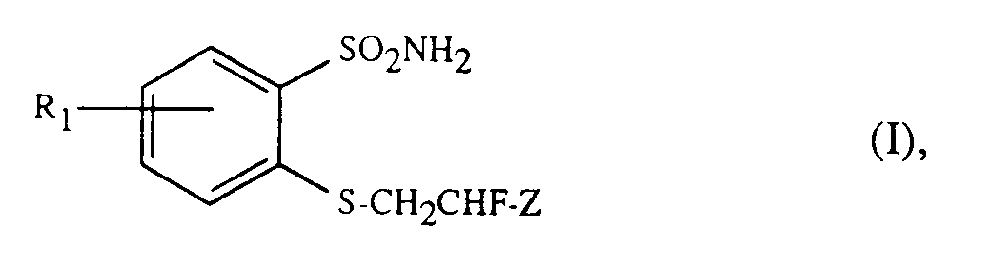
worin
R₁ Wasserstoff, C₁-C₅-Alkyl oder C₂-C₅-Alkenyl; und
Z Wasserstoff, Fluor oder Chlor bedeutet. - Die 2-(2-Halogenethylthio)-phenylsulfonamide der Formel I sind wertvolle Zwischenprodukte zur Herstellung von herbizid wirksamen N-Phenylsulfonyl-N′-pyrimidinyl- und -triazinylharnstoffen wie sie beispielsweise in der europäischen Patentanmeldung Nr. 44808 offenbart sind.
- Solche von den 2-(2-Halogenethylthio)-phenylsulfonamiden der Formel I abgeleiteten Phenylsulfonylharnstoffe zeichnen sich durch ein günstiges Abbauverhalten aus. Es besteht somit ein Bedarf nach einem vorteilhaften Herstellungsverfahren für die 2-(2-Halogenethylthio)-phenylsulfonamide der Formel I.
- Aus EP-A-0074282 ist bekannt, 2-alkylthiosubstituierte Phenylsulfonamide in der Weise herzustellen, indem man
- 1) N-tert.-Butylphenylsulfonamid mit 2 Äquivalenten n-Butyllithium in das Dilithiumsalz der Formel VIII

- 2) Schwefel und
- 3) einem Alkylhalogenid umsetzt und anschliessend
- 4) die Schutzgruppe abspaltet.
- Dieses Verfahren besitzt jedoch den schwerwiegenden Nachteil, dass für die Umsetzung pro eingesetztes Äquivalent des Phenylsulfonamids 2 Äquivalente des kostspieligen n-Butyllithiums benötigt werden.
- Es ist daher das Ziel der vorliegenden Erfindung, ein Verfahren bereitzustellen, welches die Herstellung von 2-(2-Halogenethylthio)-phenylsulfonamiden ausgehend von leicht zugänglichen Ausgangsstoffen auf besonders kostengünstige und einfache Weise in guten Ausbeuten ermöglicht.
- Es wurde nun gefunden, dass man die 2-(2-Halogenethylthio)-phenylsulfonamide der Formel I in vorteilhafter Weise herstellen kann, wenn man
- A) ein Phenylsulfonamid der Formel II

R₁ die unter Formel I angegebene Bedeutung hat und
Y für eine tertiäre Alkylgruppe mit 4 bis 8 Kohlenstoffatomen, Benzyl, Diphenylmethyl, Triphenylmethyl oder eine Silylgruppe der Formel VII
-Si(R₂R₃R₄) (VII),
worin R₂, R₃ und R₄ unabhängig voneinander C₁-C₆-Alkyl oder Phenyl bedeuten, steht, nacheinander ohne Isolierung von Zwischenprodukten mit- a) einer starken Base der Formel IX
MeB (IX),
worin Me für Natrium oder Kalium, B für Wasserstoff, OH, NH₂ oder OR₅ und R₅ für C₁-C₅-Alkyl steht, in die Verbindung der Formel III
überführt, diese mit - b) einem Äquivalent n-Butyllithium und
- c) Schwefel
in die Verbindung der Formel IV
überführt, diese mit - d) einem 2-Halogenfluorethan der Formel V
X-CH₂CHF-Z (V)
worin X für Chlor oder Brom steht und Z die unter Formel I angegebene Bedeutung hat, zu einem Phenylsulfonamid der Formel VI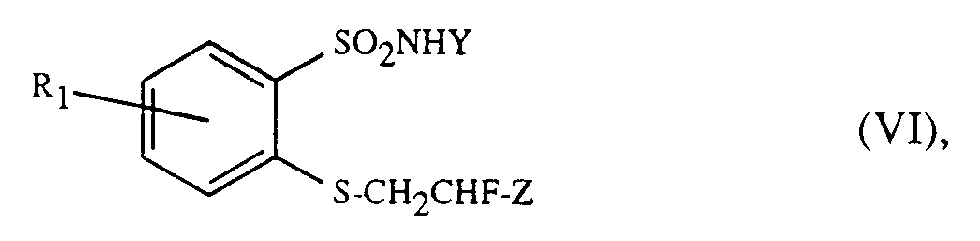
- a) einer starken Base der Formel IX
- B) anschliessend die Gruppe Y abspaltet.
- Ausgangs- und Endprodukte des erfindungsgemässen Verfahrens sind bekannt. Verbindungen der Formel V und IX sind ebenfalls bekannt und im Handel erhältlich.
- Das Phenylsulfonamid der Formel VI sowie die Salze der Formel III sind neu und bilden ebenfalls einen Gegenstand der vorliegenden Erfindung.
- Die in den Definitionen der Substituenten vorkommenden Alkylgruppen können geradkettig oder verzweigt sein und stehen beispielsweise für Methyl, Ethyl, n-Propyl, iso-Propyl, n-Butyl, sek.-Butyl, iso-Butyl, tert.-Butyl, n-Pentyl oder die isomeren Pentyl, n-Hexyl oder die isomeren Hexyl. Vorzugsweise besitzen die Alkylgruppen 1 bis 4 Kohlenstoffatome.
- Die in den Definitionen des Substituenten Y vorkommenden tertiären Alkylgruppen mit 4 bis 8 Kohlenstoffatomen stehen beispielsweise für tert.-Butyl, 3-Methyl-pent-3-yl, 2-Methyl-but-2-yl, 3-Ethyl-pent-3-yl oder 4-Methyl-hept-4-yl, besonders bevorzugt steht Y für tert.-Butyl.
- Die im Substituenten R₁ vorkommenden C₂-C₅-Alkenylreste können geradkettig oder verzweigt sein. Bevorzugt sind Alkenylreste mit einer Kettenlänge von zwei bis drei Kohlenstoffatomen. Beispiele für C₂-C₅-Alkenylreste sind: Vinyl, Allyl, Methallyl, 1-Methylvinyl, 2-Methylvinyl, But-2-en-1-yl oder Pent-3-en-1-yl. Bevorzugt ist Vinyl und Allyl.
- Für die Umsetzung gemäss Verfahrensschritt Aa) geeignete Lösungsmittel sind offenkettige, verzweigte, unverzweigte oder zyklische Alkane sowie Aromate. Bevorzugte Lösungsmittel sind Toluol, Xylol, Mesitylen sowie Alkane mit 6 bis 8 Kohlenstoffatomen wie n-Hexan, Cyclohexan oder n-Oktan. Werden für den Verfahrensschritt Aa) Verbindungen der Formel IX verwendet, in denen B für OH oder OR₅ steht, können als Lösungsmittel auch primäre, sekundäre oder tertiäre Alkohole mit 1 bis 5 Kohlenstoffatomen eingesetzt werden, wie beispielsweise Methanol, Ethanol, Iso-Propanol oder Butanol. Bevorzugte Alkohole sind dabei Methanol und Ethanol.
- Bevorzugte starke Basen der Formel IX sind die Hydroxide und Alkoholate. Besonders bevorzugt ist Natriumhydroxid, Kaliumhydroxid, Natriummethylat, Natriumethylat sowie Kaliummethylat.
- Wenn Y für eine Silylgruppe der Formel VII steht, erfolgt die Umsetzung zweckmässigerweise unter aprotischen Bedingungen. Bevorzugte Basen der Formel IX sind hier die Amide und die Hydride; besonders bevorzugte Basen sind Natriumamid, Natriumhydrid und Kaliumhydrid.
- Für die Verfahrensschritte Ab) bis Ad) geeignete Lösungsmittel sind beispielsweise Verbindungen oder Gemische aus der Gruppe der offenkettigen und zyklischen Ether wie Dioxan, Tetrahydrofuran, Diethylether, Diisopropylether, Dimethoxymethan und 1,2-Dimethoxyethan, aromatische Kohlenwasserstoffe wie Benzol, Toluol oder Xylol, sowie offenkettige Alkane wie n-Pentan oder n-Hexan. Ein bevorzugtes Lösungsmittel ist Tetrahydrofuran.
- Die Umsetzung des 2-Halogenfluorethans der Formel V gemäss Verfahrensschritt Ad) kann sowohl bei Normaldruck als auch bei erhöhtem Druck erfolgen. Als gut geeignet hat sich ein Druckbereich von 1 bis 10 bar erwiesen, wobei ein Bereich von 1 bis 3 bar besonders bevorzugt ist.
- Für die Abspaltung der Gruppe Y gemäss Verfahrensschritt B) geeignete Lösungsmittel sind beispielsweise cyclische und offenkettige Ether wie die für die Verfahrensschritte Ab) bis Ad) genannten sowie aliphatische Ketone wie Aceton, Methylethylketon, Diethylketon, Methylisopropylketon oder Methylisobutylketon.
Für diesen Verfahrensschritt besonders gut geeignete Lösungsmittel sind Dioxan sowie Methylisobutylketon. - Die Abspaltung der Gruppe Y erfolgt in Gegenwart einer Säure. Besonders vorteilhaft verläuft die Reaktion mit Trifluoressigsäure oder Salzsäure, wobei Salzsäure ganz besonders bevorzugt ist.
- Das erfindungsgemässe Verfahren kann in einem weiten Temperaturbereich durchgeführt werden. Mit Vorteil setzt man beim Verfahrensschritt A) das Phenylsulfonamid der Formel II nacheinander ohne Isolierung von Zwischenprodukten mit
- a) einer starken Base der Formel IX bei einer Temperatur von +20 bis +250°C, vorzugsweise von +60 bis +150°C zur Verbindung der Formel III um, welche
- b) mit n-Butyllithium bei einer Temperatur von -80 bis +50°C, vorzugsweise-20 bis +30°C; und
- c) mit Schwefel bei einer Temperatur von -50 bis +50°C, vorzugsweise-10 bis +30°C, in die Verbindung der Formel IV überführt wird, die anschliessend unmittelbar
- d) mit einem 2-Halogenfluorethan der Formel V bei einer Temperatur von 0 bis +80°C, vorzugsweise +20 bis +60°C und einen Druck von 1 bis 3 bar, zur Verbindung der Formel VI umgesetzt wird.
- Für das hydrolytische Abspalten der Gruppe Y gemäss Verfahrensschritt B) hat sich ein Temperaturbereich von -20°C bis +60°C, vorzugsweise -20 bis +30°C, als geeignet erwiesen.
- Besonders vorteilhaft lassen sich diejenigen Verbindungen der Formel I herstellen, in denen R₁ für Wasserstoff steht wobei Z vorzugsweise Wasserstoff bedeutet.
- In einer besonders bevorzugten Variante des erfindungsgemässen Verfahrens wird das 2-(2-Halogenethylthio)-phenylsulfonamid der Formel I hergestellt, indem man
- A) N-tert.-Butyl-phenylsulfonamid nacheinander ohne Isolierung von Zwischenprodukten mit
- a) Natriummethylat oder Kaliumhydroxid bei einer Temperatur von +60 bis +150°C in die Verbindung der Formel IIIa

- b) mit einem Äquivalent n-Butyllithium bei einer Temperatur von -20 bis +30°C und
- c) Schwefel bei einer Temperatur von -20 bis +30°C
in die Verbindung der Formel IVa
- d) einem 2-Halogenfluorethan der Formel V bei einer Temperatur von +20 bis +60°C und einem Druck von 1 bis 3 bar zu einem 2-(2-Halogenethylthio)-N-tert.-butyl-phenylsulfonamid der Formel VIa

- a) Natriummethylat oder Kaliumhydroxid bei einer Temperatur von +60 bis +150°C in die Verbindung der Formel IIIa
- B) anschliessend die tert.-Butylgruppe bei einer Temperatur von -20 bis +30°C in Gegenwart von Salzsäure abspaltet. In dieser bevorzugten Variante des erfindungsgemässen Verfahrens stehen Z und R₁ vorzugsweise für Wasserstoff.
- Das erfindungsgemässe Verfahren zeichnet sich durch zahlreiche vorteilhafte Eigenschaften aus. Die Reaktionsführung ist unkompliziert. Die nur zweistufige Reaktion ist ökonomisch besonders vorteilhaft und erfordert nur geringen apparativen Aufwand. Ausserdem weist das Verfahren eine hohe Ausbeute und gute Produktqualität auf.
- Anstelle von 2 Äquivalenten des kostspieligen n-Butyllithiums pro eingesetztes Äquivalent Phenylsulfonamid wird für das erfindungsgemässe Verfahren nur ein Äquivalent n-Butyllithium sowie wesentlich kostengünstigere Natrium- oder Kaliumbasen benötigt.
- Das erfindungsgemässe Verfahren wird durch die folgenden Beispiele näher erläutert.
-

- Zu einer Suspension von 9,4 g (0,15 Mol) pulverförmigem Kaliumhydroxid (90%ig) in 230 ml Toluol lässt man am Wasserabscheider unter Rückfluss bei einem Druck von 0,4 bar 32 g (0,15 Mol) N-(tert.-Butyl)-phenylsulfonamid in 120 ml Toluol zutropfen. Anschliessend wird das entstandene Wasser azeotrop abdestilliert und das Toluol unter reduziertem Druck entfernt. Aus dem erhaltenen Rückstand kann gewünschtenfalls das Kaliumsalz der Formel III zur Charakterisierung isoliert werden. Es wurden folgende spektroskopische Daten erhalten:

- Der Rückstand wird in einer Stickstoffatmosphäre mit 120 ml Tetrahydrofuran aufgeschlämmt und anschliessend auf -15°C gekühlt. Zu dieser Suspension lässt man innerhalb von 30 Minuten 100 ml (0,16 Mol) einer 1,6 molaren n-Butyllithiumlösung in n-Hexan zutropfen. Nach 4-stündigem Rühren bei Raumtemperatur und erneutem Abkühlen auf 0°C gibt man 5,6 g (0,17 Mol) Schwefel hinzu und rührt die Reaktionsmischung anchliessend für weitere 3 Stunden bei Raumtemperatur. Zum erhaltenen Reaktionsgemisch werden 21,6 g (0,17 Mol) 1-Brom-2-fluorethan zugegeben und die Mischung anschliessend 18 Stunden lang bei Raumtemperatur gerührt. Anschliessend wird die Reaktionsmischung mit 100 ml Toluol verdünnt und auf ein Gemisch aus 100 ml Eis und 30 ml konzentrierter Salzsäure gegeben. Die organische Phase wird anschliessend abgetrennt und am Vakuum bis zur Gewichtskonstanz eingeengt. Man erhält 43,5 g 2-(2-Fluorethylthio)-N-tert.-butyl-phenylsulfonamid (VIa, 83%ig d. Th.) in Form eines braunen Öls mit einer Reinheit von 83%.
-

- Zu einer Lösung aus 3,88 g gemäss Beispiel H1 erhaltenen 2-(2-Fluorethylthio)-N-tert.-butyl-phenylsulfonamids in 25 ml Trichlormethan gibt man bei einer Temperatur von 0°C 25 ml Trifluoressigsäure hinzu. Nach 18-stündigem Rühren bei einer Temperatur von +25°C wird das erhaltene braune Reaktionsgemisch lyophilisiert. Nach chromatographischer Reinigung des öligen Rückstandes mit 1) Essigsäureethylester/Petrolether (1:1) über Kieselgel und 2) Dichlormethan/Aceton (9:1) über Kieselgel werden die erhaltenen Fraktionen eingedampft. Man erhält 1,5 g (60,5% der Theorie) kristallines 2-(2-Fluorethylthio)-phenylsulfonamid.
-

- Zu einer Lösung von 18,2 g gemäss Beispiel H1 erhaltenen 2-(2-Fluorethylthio)-N-tert.-butyl-phenylsulfonamids (80%ig, 0,05 Mol) in 70 ml Methyl-isobutylketon gibt man bei einer Temperatur von +20 bis +25°C unter Kühlung 70 ml konzentrierte Salzsäure tropfenweise hinzu. Nach Halten des Reaktionsgemisches über 40 Stunden bei Raumtemperatur wird mit 30%iger Natronlauge neutralisiert und anschliessend die wässrige Phase abgetrennt. Nach dem Entfernen des Lösungsmittels unter reduziertem Druck erhält man aus der organischen Phase 15,8 g eines kristallinen Rückstandes, der das 2-(2-Fluorethylthio)-phenylsulfonamid der Formel I mit einem Gehalt von 70% und in einer Ausbeute von 94% d. Th. enthält. Nach Umkristallisation aus Isopropanol erhält man 10,1 g (79% d. Th.) 2-(2-Fluorethylthio)-phenylsulfonamid der Formel I mit einem Gehalt von 92%.
Claims (17)
- Verfahren zur Herstellung von 2-(2-Halogenethylthio)-phenylsulfonamiden der Formel I

R₁ Wasserstoff, C₁-C₅-Alkyl oder C₂-C₅-Alkenyl; und
Z Wasserstoff, Fluor oder Chlor bedeutet;
dadurch gekennzeichnet, dass manA) ein Phenylsulfonamid der Formel II
R₁ die unter Formel I angegebene Bedeutung hat und
Y für eine tertiäre Alkylgruppe mit 4 bis 8 Kohlenstoffatomen, Benzyl, Diphenylmethyl, Triphenylmethyl oder eine Silylgruppe der Formel VII
-Si(R₂R₃R₄) (VII),
worin R₂, R₃ und R₄ unabhängig voneinander C₁-C₆-Alkyl oder Phenyl bedeuten, steht, nacheinander ohne Isolierung von Zwischenprodukten mita) einer starken Base der Formel IX
MeB (IX),
worin Me für Natrium oder Kalium, B für Wasserstoff, OH, NH₂ oder OR₅ und R₅ für C₁-C₅-Alkyl steht, in die Verbindung der Formel III
überführt, diese mitb) einem Äquivalent n-Butyllithium undc) Schwefel
in die Verbindung der Formel IV
überführt, diese mitd) einem 2-Halogenfluorethan der Formel V
X-CH₂CHF-Z (V)
worin X für Chlor oder Brom steht und Z die unter Formel I angegebene Bedeutung hat,
zu einem Phenylsulfonamid der Formel VI B) anschliessend die Gruppe Y abspaltet.
 - Verfahren nach Anspruch 1, dadurch gekennzeichnet, dass R₁ für Wasserstoff steht.
- Verfahren nach Anspruch 1, dadurch gekennzeichnet, dass Z für Wasserstoff steht.
- Verfahren nach Anspruch 1, dadurch gekennzeichnet, dass B für OH oder OR₅ steht.
- Verfahren nach Anspruch 1, dadurch gekennzeichnet, dass man als starke Base der Formel IX Kaliumhydroxid oder Natriummethylat verwendet.
- Verfahren nach Anspruch 1, dadurch gekennzeichnet, dass X für Brom steht.
- Verfahren nach Anspruch 1, dadurch gekennzeichnet, dass Y für tert.-Butyl steht.
- Verfahren nach Anspruch 1, dadurch gekennzeichnet, dass man für die Abspaltung der Gruppe Y Salzsäure verwendet.
- Verfahren nach Anspruch 1, dadurch gekennzeichnet, dass manA) N-tert.-Butyl-phenylsulfonamid nacheinander ohne Isolierung von Zwischenprodukten mita) Natriummethylat oder Kaliumhydroxid bei einer Temperatur von +60 bis +150°C in die Verbindung der Formel IIIa
 b) mit einem Äquivalent n-Butyllithium bei einer Temperatur von -20 bis +30°C undc) Schwefel bei einer Temperatur von -20 bis +30°C
in die Verbindung der Formel IVa d) einem 2-Halogenfluorethan der Formel V bei einer Temperatur von +20 bis +60°C und einem Druck von 1 bis 3 bar
zu einem 2-(2-Halogenethylthio)-N-tert.-butyl-phenylsulfonamid der Formel VIa
umsetzt, undB) anschliessend die tert.-Butylgruppe bei einer Temperatur von -20 bis +30°C in Gegenwart von Salzsäure abspaltet. - Verfahren nach Anspruch 9, dadurch gekennzeichnet, dass R₁ für Wasserstoff steht.
- Verfahren nach Anspruch 9, dadurch gekennzeichnet, dass Z für Wasserstoff steht.
- Verbindungen der Formel VI

Y für eine tertiäre Alkylgruppe mit 4 bis 8 Kohlenstoffatomen, Benzyl, Diphenylmethyl, Triphenylmethyl oder eine Silylgruppe der Formel VII
-Si(R₂R₃R₄) (VII),
worin R₂, R₃ und R₄ unabhängig voneinander C₁-C₆-Alkyl oder Phenyl bedeuten, steht. - Verbindungen der Formel VI gemäss Anspruch 12, dadurch gekennzeichnet, dass R₁ für Wasserstoff steht.
- Verbindungen der Formel VI gemäss Anspruch 12, dadurch gekennzeichnet, dass Z für Wasserstoff steht.
- Verbindungen der Formel VIa

- Verbindungen der Formel VIa gemäss Anspruch 15, dadurch gekennzeichnet, dass R₁ für Wasserstoff steht.
- Verbindungen der Formel VIa gemäss Anspruch 15, dadurch gekennzeichnet, dass Z für Wasserstoff steht.
Applications Claiming Priority (2)
| Application Number | Priority Date | Filing Date | Title |
|---|---|---|---|
| CH4413/89 | 1989-12-08 | ||
| CH441389 | 1989-12-08 |
Publications (2)
| Publication Number | Publication Date |
|---|---|
| EP0437177A1 EP0437177A1 (de) | 1991-07-17 |
| EP0437177B1 true EP0437177B1 (de) | 1994-07-20 |
Family
ID=4275677
Family Applications (1)
| Application Number | Title | Priority Date | Filing Date |
|---|---|---|---|
| EP90810932A Expired - Lifetime EP0437177B1 (de) | 1989-12-08 | 1990-11-29 | Verfahren zur Herstellung von Phenylsulfonamiden |
Country Status (7)
| Country | Link |
|---|---|
| US (1) | US5087749A (de) |
| EP (1) | EP0437177B1 (de) |
| JP (1) | JPH0499761A (de) |
| AT (1) | ATE108769T1 (de) |
| DE (1) | DE59006512D1 (de) |
| IE (1) | IE904427A1 (de) |
| IL (1) | IL96574A0 (de) |
Family Cites Families (6)
| Publication number | Priority date | Publication date | Assignee | Title |
|---|---|---|---|---|
| DE1493664A1 (de) * | 1964-07-16 | 1969-06-04 | Hoechst Ag | Verfahren zur Spaltung von aromatischen Sulfonsaeureamiden |
| DE2002065A1 (de) * | 1970-01-17 | 1971-07-22 | Bayer Ag | Verfahren zur-Herstellung von Sulfimiden |
| US4141916A (en) * | 1978-02-13 | 1979-02-27 | The Dow Chemical Company | 3,4,5-Trichloro-N,N-Di(loweralkyl)-2-((chloromethyl)thio)benzenesulfonamides |
| CA1330438C (en) * | 1980-07-17 | 1994-06-28 | Willy Meyer | N-phenylsulfonyl-n'-pyrimidinyl-and-triazinylureas |
| US4528024A (en) * | 1981-09-09 | 1985-07-09 | E. I. Du Pont De Nemours And Company | Herbicidal alkyl sulfones |
| DD251342A1 (de) * | 1986-07-28 | 1987-11-11 | Paedagogische Hochschule Lisel | Verfahren zur herstellung von an der methylgruppe trisubstituierten n-methyl-arensulfonamiden |
-
1990
- 1990-11-29 DE DE59006512T patent/DE59006512D1/de not_active Expired - Fee Related
- 1990-11-29 AT AT90810932T patent/ATE108769T1/de not_active IP Right Cessation
- 1990-11-29 EP EP90810932A patent/EP0437177B1/de not_active Expired - Lifetime
- 1990-12-03 US US07/621,406 patent/US5087749A/en not_active Expired - Fee Related
- 1990-12-06 IL IL96574A patent/IL96574A0/xx unknown
- 1990-12-07 JP JP2407368A patent/JPH0499761A/ja active Pending
- 1990-12-07 IE IE442790A patent/IE904427A1/en unknown
Also Published As
| Publication number | Publication date |
|---|---|
| US5087749A (en) | 1992-02-11 |
| IL96574A0 (en) | 1991-09-16 |
| EP0437177A1 (de) | 1991-07-17 |
| ATE108769T1 (de) | 1994-08-15 |
| IE904427A1 (en) | 1991-06-19 |
| JPH0499761A (ja) | 1992-03-31 |
| DE59006512D1 (de) | 1994-08-25 |
Similar Documents
| Publication | Publication Date | Title |
|---|---|---|
| DE69224691T2 (de) | Verfahren zur Herstellung von Chlorsulfat und Sulfamatderivate von 2,3:4,5-bis-0-(1-Methylethylidene)-Beta-D-Fructopyranose und (1-Methylcyclohexyl)Methanol | |
| EP0143384A2 (de) | Verfahren zur Herstellung von Beta-Hydroxyethyl-(1,2,4-triazol)-Derivaten | |
| EP0454624B1 (de) | Verfahren zur Herstellung von 1,3-Diketonen | |
| EP0270982B1 (de) | Derivate bicyclischer Aminocarbonsäuren, Verfahren und Zwischenprodukte zu deren Herstellung sowie deren Verwendung | |
| DE69632919T2 (de) | Verfahren zur herstellung von 2-chlor-5-chloromethyl-thiazol | |
| EP0341693B1 (de) | Verfahren zur Herstellung von O-substituierten Hydroxylaminen | |
| EP0285681A1 (de) | Verfahren zur Herstellung von Nitroethenderivaten | |
| DE69427827T2 (de) | Verfahren zur Herstellung von Sulfonylharnstoffderivaten und Zwischenprodukte für dieses Verfahren | |
| EP0437177A1 (de) | Verfahren zur Herstellung von Phenylsulfonamiden | |
| DE2533919C3 (de) | Verfahren zur Herstellung von CyclohexandioneM 1.3) | |
| DE3112265C2 (de) | ||
| DE2446256C3 (de) | Verfahren zur Herstellung von Hexahydrothieno [3,4- d] -imidazol-2,4-dionen | |
| CH642968A5 (de) | Cephalosporin-analoge und verfahren zu deren herstellung. | |
| DE69013726T2 (de) | Verbessertes Verfahren für die Herstellung von o-Carboxypyridyl- und o-Carboxychinolylimidazolinonen. | |
| EP0454623A1 (de) | Verfahren zur Herstellung von linearen 1,3-Diketonen | |
| DE19712411A1 (de) | Verfahren zur Herstellung von 1,3-disubstituierten 2-Nitroguanidinen | |
| DE2628469C3 (de) | Verfahren zur Herstellung von γ -Aminoalkoholen | |
| EP0069905B1 (de) | Verfahren zur Herstellung von Hydrazidinen | |
| EP0224612A1 (de) | Verfahren zur Herstellung von N-Cyano-N'-methyl-N"[2-[[(5-methyl-1H-imidazol-4-yl)methyl]thio]ethyl]guanidin | |
| DE2919891A1 (de) | Substituierte 4-amino-2-aza-1,3- butadiene, verfahren zu ihrer herstellung und ihre verwendung zur herstellung von heterocyclischen verbindungen | |
| EP0279366B1 (de) | Verfahren zur Herstellung von Pyrimidinen | |
| EP0564841A1 (de) | Verfahren zur Herstellung von Pyrrolderivaten | |
| EP0007516B1 (de) | 7-Alpha-Methyl-Östrogene, Verfahren zu deren Herstellung und deren Verwendung zur Weiterverarbeitung | |
| EP0177448A2 (de) | Verfahren zur Herstellung von 1,2-Benzoxathiin-Derivaten | |
| DE3210092A1 (de) | Verfahren zur umwandlung eines optisch aktiven oder razemischen alkohols |
Legal Events
| Date | Code | Title | Description |
|---|---|---|---|
| PUAI | Public reference made under article 153(3) epc to a published international application that has entered the european phase |
Free format text: ORIGINAL CODE: 0009012 |
|
| 17P | Request for examination filed |
Effective date: 19901201 |
|
| AK | Designated contracting states |
Kind code of ref document: A1 Designated state(s): AT BE CH DE DK ES FR GB GR IT LI LU NL SE |
|
| 17Q | First examination report despatched |
Effective date: 19930607 |
|
| GRAA | (expected) grant |
Free format text: ORIGINAL CODE: 0009210 |
|
| AK | Designated contracting states |
Kind code of ref document: B1 Designated state(s): AT BE CH DE DK ES FR GB GR IT LI LU NL SE |
|
| PG25 | Lapsed in a contracting state [announced via postgrant information from national office to epo] |
Ref country code: IT Free format text: LAPSE BECAUSE OF FAILURE TO SUBMIT A TRANSLATION OF THE DESCRIPTION OR TO PAY THE FEE WITHIN THE PRE;WARNING: LAPSES OF ITALIAN PATENTS WITH EFFECTIVE DATE BEFORE 2007 MAY HAVE OCCURRED AT ANY TIME BEFORE 2007. THE CORRECT EFFECTIVE DATE MAY BE DIFFERENT FROM THE ONE RECORDED.SCRIBED TIME-LIMIT Effective date: 19940720 Ref country code: GB Effective date: 19940720 Ref country code: BE Effective date: 19940720 Ref country code: ES Free format text: THE PATENT HAS BEEN ANNULLED BY A DECISION OF A NATIONAL AUTHORITY Effective date: 19940720 Ref country code: DK Effective date: 19940720 Ref country code: NL Effective date: 19940720 Ref country code: FR Effective date: 19940720 Ref country code: GR Free format text: LAPSE BECAUSE OF FAILURE TO SUBMIT A TRANSLATION OF THE DESCRIPTION OR TO PAY THE FEE WITHIN THE PRESCRIBED TIME-LIMIT Effective date: 19940720 |
|
| REF | Corresponds to: |
Ref document number: 108769 Country of ref document: AT Date of ref document: 19940815 Kind code of ref document: T |
|
| REF | Corresponds to: |
Ref document number: 59006512 Country of ref document: DE Date of ref document: 19940825 |
|
| PG25 | Lapsed in a contracting state [announced via postgrant information from national office to epo] |
Ref country code: SE Effective date: 19941020 |
|
| PG25 | Lapsed in a contracting state [announced via postgrant information from national office to epo] |
Ref country code: AT Effective date: 19941129 |
|
| PG25 | Lapsed in a contracting state [announced via postgrant information from national office to epo] |
Ref country code: LI Effective date: 19941130 Ref country code: LU Free format text: LAPSE BECAUSE OF NON-PAYMENT OF DUE FEES Effective date: 19941130 Ref country code: CH Effective date: 19941130 |
|
| EN | Fr: translation not filed | ||
| NLV1 | Nl: lapsed or annulled due to failure to fulfill the requirements of art. 29p and 29m of the patents act | ||
| GBV | Gb: ep patent (uk) treated as always having been void in accordance with gb section 77(7)/1977 [no translation filed] |
Effective date: 19940720 |
|
| PLBE | No opposition filed within time limit |
Free format text: ORIGINAL CODE: 0009261 |
|
| STAA | Information on the status of an ep patent application or granted ep patent |
Free format text: STATUS: NO OPPOSITION FILED WITHIN TIME LIMIT |
|
| 26N | No opposition filed | ||
| REG | Reference to a national code |
Ref country code: CH Ref legal event code: PL |
|
| PG25 | Lapsed in a contracting state [announced via postgrant information from national office to epo] |
Ref country code: DE Effective date: 19950801 |