EP0434616A1 - Verfahren und Vorrichtung zur genetischen Transformation von Zellen - Google Patents
Verfahren und Vorrichtung zur genetischen Transformation von Zellen Download PDFInfo
- Publication number
- EP0434616A1 EP0434616A1 EP90810970A EP90810970A EP0434616A1 EP 0434616 A1 EP0434616 A1 EP 0434616A1 EP 90810970 A EP90810970 A EP 90810970A EP 90810970 A EP90810970 A EP 90810970A EP 0434616 A1 EP0434616 A1 EP 0434616A1
- Authority
- EP
- European Patent Office
- Prior art keywords
- cells
- restriction
- dna
- cell
- cannula
- Prior art date
- Legal status (The legal status is an assumption and is not a legal conclusion. Google has not performed a legal analysis and makes no representation as to the accuracy of the status listed.)
- Granted
Links
Images
Classifications
-
- C—CHEMISTRY; METALLURGY
- C12—BIOCHEMISTRY; BEER; SPIRITS; WINE; VINEGAR; MICROBIOLOGY; ENZYMOLOGY; MUTATION OR GENETIC ENGINEERING
- C12N—MICROORGANISMS OR ENZYMES; COMPOSITIONS THEREOF; PROPAGATING, PRESERVING, OR MAINTAINING MICROORGANISMS; MUTATION OR GENETIC ENGINEERING; CULTURE MEDIA
- C12N15/00—Mutation or genetic engineering; DNA or RNA concerning genetic engineering, vectors, e.g. plasmids, or their isolation, preparation or purification; Use of hosts therefor
- C12N15/09—Recombinant DNA-technology
- C12N15/87—Introduction of foreign genetic material using processes not otherwise provided for, e.g. co-transformation
- C12N15/89—Introduction of foreign genetic material using processes not otherwise provided for, e.g. co-transformation using microinjection
-
- C—CHEMISTRY; METALLURGY
- C12—BIOCHEMISTRY; BEER; SPIRITS; WINE; VINEGAR; MICROBIOLOGY; ENZYMOLOGY; MUTATION OR GENETIC ENGINEERING
- C12M—APPARATUS FOR ENZYMOLOGY OR MICROBIOLOGY; APPARATUS FOR CULTURING MICROORGANISMS FOR PRODUCING BIOMASS, FOR GROWING CELLS OR FOR OBTAINING FERMENTATION OR METABOLIC PRODUCTS, i.e. BIOREACTORS OR FERMENTERS
- C12M35/00—Means for application of stress for stimulating the growth of microorganisms or the generation of fermentation or metabolic products; Means for electroporation or cell fusion
-
- C—CHEMISTRY; METALLURGY
- C12—BIOCHEMISTRY; BEER; SPIRITS; WINE; VINEGAR; MICROBIOLOGY; ENZYMOLOGY; MUTATION OR GENETIC ENGINEERING
- C12M—APPARATUS FOR ENZYMOLOGY OR MICROBIOLOGY; APPARATUS FOR CULTURING MICROORGANISMS FOR PRODUCING BIOMASS, FOR GROWING CELLS OR FOR OBTAINING FERMENTATION OR METABOLIC PRODUCTS, i.e. BIOREACTORS OR FERMENTERS
- C12M35/00—Means for application of stress for stimulating the growth of microorganisms or the generation of fermentation or metabolic products; Means for electroporation or cell fusion
- C12M35/04—Mechanical means, e.g. sonic waves, stretching forces, pressure or shear stimuli
-
- C—CHEMISTRY; METALLURGY
- C12—BIOCHEMISTRY; BEER; SPIRITS; WINE; VINEGAR; MICROBIOLOGY; ENZYMOLOGY; MUTATION OR GENETIC ENGINEERING
- C12N—MICROORGANISMS OR ENZYMES; COMPOSITIONS THEREOF; PROPAGATING, PRESERVING, OR MAINTAINING MICROORGANISMS; MUTATION OR GENETIC ENGINEERING; CULTURE MEDIA
- C12N15/00—Mutation or genetic engineering; DNA or RNA concerning genetic engineering, vectors, e.g. plasmids, or their isolation, preparation or purification; Use of hosts therefor
- C12N15/09—Recombinant DNA-technology
- C12N15/63—Introduction of foreign genetic material using vectors; Vectors; Use of hosts therefor; Regulation of expression
- C12N15/79—Vectors or expression systems specially adapted for eukaryotic hosts
- C12N15/82—Vectors or expression systems specially adapted for eukaryotic hosts for plant cells, e.g. plant artificial chromosomes (PACs)
- C12N15/8201—Methods for introducing genetic material into plant cells, e.g. DNA, RNA, stable or transient incorporation, tissue culture methods adapted for transformation
- C12N15/8206—Methods for introducing genetic material into plant cells, e.g. DNA, RNA, stable or transient incorporation, tissue culture methods adapted for transformation by physical or chemical, i.e. non-biological, means, e.g. electroporation, PEG mediated
- C12N15/8207—Methods for introducing genetic material into plant cells, e.g. DNA, RNA, stable or transient incorporation, tissue culture methods adapted for transformation by physical or chemical, i.e. non-biological, means, e.g. electroporation, PEG mediated by mechanical means, e.g. microinjection, particle bombardment, silicon whiskers
-
- C—CHEMISTRY; METALLURGY
- C12—BIOCHEMISTRY; BEER; SPIRITS; WINE; VINEGAR; MICROBIOLOGY; ENZYMOLOGY; MUTATION OR GENETIC ENGINEERING
- C12N—MICROORGANISMS OR ENZYMES; COMPOSITIONS THEREOF; PROPAGATING, PRESERVING, OR MAINTAINING MICROORGANISMS; MUTATION OR GENETIC ENGINEERING; CULTURE MEDIA
- C12N15/00—Mutation or genetic engineering; DNA or RNA concerning genetic engineering, vectors, e.g. plasmids, or their isolation, preparation or purification; Use of hosts therefor
- C12N15/09—Recombinant DNA-technology
- C12N15/87—Introduction of foreign genetic material using processes not otherwise provided for, e.g. co-transformation
Definitions
- the invention relates to a method for the genetic transformation of cells, in particular plant cells according to the preamble of claim 1 and a device suitable for carrying out this method for introducing particles into cells according to the preamble of claim 14.
- a method and a corresponding device are for example in EP-A-0 270 356.
- the present invention relates to the use of the method according to the invention for the production of transgenic plants and to the transgenic plants themselves and their progeny obtainable with the aid of this method.
- the Agrobacterium transformation system is undoubtedly one of the best studied and most frequently used methods.
- Agrobacterium cells have a large DNA fragment on their Ti plasmid, the so-called T-DNA region, which is integrated into the plant genome during the natural transformation of plant cells.
- this natural gene transfer system can be used as a gene vector system for the targeted transformation of plants [Chilton, MD, 1983].
- the Agrobacterium transformation system has the decisive disadvantage that the host range of the agrobacteria on certain dicotyledonous plants and on a few representatives of the monocotyledons (Hernalsteens et al, 1984; Hookas-Van-Slogteren et al., 1984), but from an agricultural economic point of view are insignificant, is limited. This means that the most important crop plants are not accessible for an effective gene transfer.
- agrobacteria used are pathogens that trigger characteristic disease symptoms in the form of cancerous tissue growths in their host plants and can therefore only be handled in the laboratory while adhering to strict safety requirements.
- the first approaches in this direction have been various transformation processes that have only recently been developed and are based on the introduction of DNA into plant cells that are present within a more highly organized unit, e.g. an intact tissue association, an embryo or an entire, already fully developed plant.
- An alternative method which also aims to transform plant cells within a more highly organized unit, is based on bombarding these cells with particles that are associated with the DNA to be transformed. As a result of the impact of these highly accelerated particles, holes are made in the cell walls of the cells hit, through which the particles, including the DNA associated with them, enter the cell.
- microprojectiles have already been used for gene transfer in the past (Klein et al. 1988; Christou st al., 1988; EP-A-0 270 356) and have proven themselves for certain questions.
- the commercially available ballistic devices are not very suitable. Since the metal particles are shot dry using ballistic methods, aggregates consisting of several to many particles are almost always shot that tear deep wounds on the sample. The tendency to aggregate is further promoted by the binding of the DNA on the particles.
- the generally very high particle speed of the ballistic processes requires a large working distance, which leads to a large scattering of the particles.
- the particle velocity can only be influenced in large steps in the known ballistic methods.
- the strong scatter of the particles can therefore hardly be improved.
- small tissues with small cells require a dense covering of the sample with as individual, evenly distributed particles as possible on a narrowly defined target field.
- the momentum of the particles should be as similar as possible, i.e. Speed and mass, the particle density on the sample and the particle speed should be able to be regulated as finely as possible in order to remain adaptable to different tissues.
- microprojectiles in the form of particles are atomized into a fine mist in suspension with a DNA solution using a pressure surge.
- the droplets of the nebula contain the particles and the DNA and are only slightly larger than the particles themselves.
- the mist is then pressed through a fine pore or capillary with the same pressure surge and thereby accelerated.
- the particles punch holes in the cell walls and the Plasma membrane through which the DNA in the entrained droplet can enter the cells.
- On a target area smaller than 1 mm in diameter the particle density on the sample and the speed of the particles can be finely regulated within wide limits.
- the device according to the invention is technically very simple and relatively inexpensive to manufacture and works reliably.
- tissue associations are particularly suitable and therefore preferred for use in the transformation process according to the invention.
- meristematic tissue associations such as those e.g. present in the shoot meristems of plants, in proembryos and embryos or in embryogenic cell cultures.
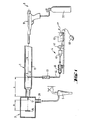
- the device comprises an elongated, essentially cylindrical or tubular pressure chamber 1, a sample chamber 2 adjoining it, a device 3 for generating a pressure surge in the pressure chamber, dosing means 4 for supplying suspension into the pressure chamber and one to the sample chamber connectable suction source e.g. in the form of a water jet vacuum pump 5.
- the device 3 for generating a pressure surge comprises a C0 2 gun 31 connected to the rear end (not shown) and a C02 storage bottle 32 connected to it.
- a compressed air gun could also be used instead a compressed air supply bottle can be provided for the CO2 supply bottle 32.
- the C0 2 pistol can also be designed to be operable with cartridges, in which case the storage bottle 32 can then be omitted. It is only essential that the device is capable of producing very uniform pressure surges of a defined size in the pressure chamber in the range from approximately a few bar to approximately a few hundred bar or possibly even higher.
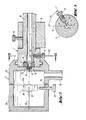
- the structure of the pressure chamber 1 can be seen in detail in FIG. 2. It essentially consists of a relatively thick-walled, pressure-resistant steel tube 11 of about 50 mm in length and about 3 mm in inner diameter, which is clamped in a stationary bearing block 6 essentially horizontally and is rotatable about its longitudinal axis A. A locking screw 61 fixes the tube 11 in its respective position.
- the mouth of the C0 2 gun 31 is directly connected in a suitable manner (not shown).
- a taper ring 12 is inserted in the front end of the tube 11 and sealed by means of an O-ring 13.
- the tapered ring reduces the inner diameter of the steel tube approximately conically in the direction of the tube end to approximately half.
- an essentially cup-shaped base part 21 of the sample chamber 2 which as a whole is essentially cylindrical, is sealingly and detachably fastened by means of a bayonet catch or the like.
- the base part 21 is provided with a cylindrical recess 22, which receives a capillary holder 14 and presses it sealingly against the outer end face of the tapering ring 12 with the interposition of a further O-ring 15.
- a capillary 17 is sealed in the capillary holder 14 and is exactly aligned with the longitudinal axis A of the pressure chamber 1.
- the capillary 17 thus connects the interior of the pressure chamber 1 to the interior of the sample chamber 2.
- the pressure chamber 1 opens into one through the capillary 17 formed restriction.
- a restriction in the form of a flow orifice or generally a pore can also be provided, as will be explained in more detail below.
- the sample chamber 2 consists of the base part 21 already mentioned, which is detachably fastened on the Stalrohr 11, and a further, also essentially cup-shaped wall part 23, which is detachably connected to the base part 21, a further O-ring 24 for the necessary sealing of the both parts.
- the cell support 25 can be adjusted by means of two set screws 27, which are arranged in the removable wall part 23 of the sample chamber 2 two mutually perpendicular directions transverse to the longitudinal axis A of the pressure chamber 1 are adjusted and thus adjusted relative to the restriction or capillary 17.
- the second set screw is perpendicular to the drawing plane.
- the base part 21 of the sample chamber 2 connected to the steel tube 11 is provided with a connecting piece 28 for the water jet pump 5 or another suitable suction source or evacuation device.
- the connection between the base part 21 and the removable wall part 23 is essentially free of play, so that the position of the cell carrier 25 relative to the restriction 17 cannot change when the wall part 23 is removed and put back on.
- a hollow nipple 41 is screwed into the jacket of the steel tube 1, through which a steel cannula 42 leads radially into the interior of the steel tube 11.
- a metal bead 42b formed on the cannula and a sealing ring 42c made of PTFE ("Teflon") are provided for fixing and sealing the steel cannula (outside diameter about 0.75 mm, inside diameter about 0.5 mm).
- the mouth 42a of the steel cannula 42 lies just in front of the longitudinal axis A of the pressure chamber 1, so that a liquid drop T (FIG. 1) emerging from the cannula 42 lies exactly in the longitudinal axis A.
- the hollow nipple 41 and the steel cannula 42 are shown in FIG. 2 vertically opening into the steel tube 11 from below.
- the cannula 42 opens into the pressure chamber 1 obliquely from above at an angle a to the vertical V, as is shown in FIG. 3.
- the angle a can be adjusted according to the requirements by rotating the steel tube 11 in the bearing block 6 (fixation by the locking screw 61).
- the steel cannula 42 is connected via a check valve 43 and a flexible line 44 to a metering unit which consists of a metering syringe 45, a spindle gear (micrometer screw) 46, a stepper motor 47 and an electrical control 49 which can be set in motion via a foot switch 48.
- the metering unit which is conventional per se and therefore requires no further explanation, is capable of reproducibly feeding liquid quantities (suspension) in the microliter range through the cannula 42 into the pressure chamber 1 within wide, adjustable limits, the liquid (suspension) at the cannula mouth 42a emerges drop by drop.
- the sample chamber2 is (partially) evacuated.
- the friction of the mist droplets moving from the restriction 17 onto the cell carrier 25 is reduced, the droplet size is minimized and the directional scatter is kept small.
- the (partial) vacuum tensions the cell walls so that they can penetrate better through the impacting particles.
- Usual water jet pump vacuum about 500 mmHg is normally sufficient, for special applications (e.g. in the case of more resistant cell walls) a higher vacuum (lower pressure) is also possible.
- the cannula 42 ends just before the longitudinal axis A of the pressure chamber 1, so that the suspension drop generated at the cannula mouth 42a comes to lie exactly in the longitudinal axis A. In this way, a droplet cloud symmetrical to the longitudinal axis is achieved, which in turn has a favorable influence on the target accuracy and the distribution of the particles in the impact area.
- the distance a (FIG. 1) between the mouth 42a of the cannula 42 and the inlet opening of the capillary 17 or the diaphragm or pore is relatively critical. If this distance is too small, then the fog, i.e. individual mist droplets, pressed through the restriction, but a closed liquid thread emerges as a jet from the restriction into the sample chamber. Such a beam leads to massive destruction of the cells to be bombarded and must therefore be avoided under all circumstances. In practice, the distance a must therefore be at least about 5-10 mm, this minimum value also being dependent on the dimensions of the other parts of the device and each having to be determined empirically.
- the working distance b (Fig. 1) between the exit end of the capillary 17 or restriction in general and the cell carrier 25, i.e. the distance that the fog droplets travel in free flight in a vacuum is less critical. Practical values are 5 mm to 5 cm, depending on the type of tissue and the type of restriction. The working distance influences the particle speed via the friction (reduced by the partial vacuum) and the effective target surface diameter via the scatter. A value of approx. 10 mm has proven to be favorable.
- both a capillary and a flow orifice or generally pore can be used as a restriction.
- the opening caliber of the diaphragm may, for example from 20 microns to 500 Il m or even be mm to 1. Diameters in the range of approximately 70-300 ⁇ m are preferred. In the case of capillaries, these can consist of glass or metal (eg steel). The same values apply for the inner diameter as for the orifices.
- the length of the capillaries can be approximately 0.1-20 mm, values in the range of approximately 1.0-10 mm are preferred.
- the ratio of the inside diameter to the length of the capillary determines the flow resistance. Longer capillaries therefore usually require larger inner diameters. The longer the capillary, the greater the acceleration distance for the mist droplets and the greater their final speed when entering the sample chamber.
- the angle a at which the cannula 42 opens into the pressure chamber 1 at an angle to the vertical V (FIG. 3), can be adjusted by rotating the tube 1 in the bearing block 6. Since the approximately 1.2 ⁇ m to 1.5 ⁇ m large gold particles suspended in the DNA solution sediment (sink) without stirring, the angle ⁇ should advantageously be set so that with each volume metering essentially the same number of gold particles in the drops on the Exit the cannula 42 mouth. At an unfavorable angle a, the gold particles are otherwise predominantly concentrated in the first drops (a too small) or in the last drops (a too large) of a series. The optimal angle depends on the particle size and the viscosity of the solution and must be determined by trying it out.
- check valve 43 located in the cannula 42 (or possibly a feed line to it). It consists of a valve seat made of quartz and a valve ball made of sapphire and is preferably oriented vertically.
- the check valve 43 like the other parts of the metering device 4, is filled with liquid paraffin (brand 7174 from MERCK, Darmstadt, Germany) without air bubbles.
- the metering unit 45-49 can be implemented as desired, provided that it is able to pump a volume of approximately 1 ⁇ l to 10 ⁇ l over a maximum period of approximately 20 seconds. In a practical version A volume of 1 ⁇ l to a maximum of 4 ⁇ l is metered in pumping steps of approximately 1 nl to approximately 50 nl.
- a 3-way valve is preferably provided, via which a 1 ml syringe can be activated so that the paraffin can be conveniently refilled and the volume can be adjusted.
- the suspension containing the gold particles is filled into the cannula 42.
- the cannula is temporarily removed from the pressure chamber 1.
- the suspension is conveyed indirectly by displacement by the metered pumped liquid paraffin.
- the filling volume of the cannula 42 with suspension is, for example, approximately 3-4 ⁇ l.
- the atomizing effect i.e. the size of the mist droplets depends on the size of the pressure surge in the pressure chamber 1.
- the size of the pressure surge also determines the gas velocity in the restriction and thus the particle velocity or its impulse.
- the pressure surge can be between about a few bar and a few thousand bar, practical values are a few ten bar to a few hundred bar, in particular a value of about 50 bar.
- the particle size has a linear influence on the momentum of the particles via the mass. In principle, small particles are cheaper for the survival of the hit cells. On the other hand, larger particles can penetrate the cells better.
- the optimal particle size must therefore be determined experimentally for each cell type. Practical particle sizes are in the range of 20 nm to 5 ⁇ m, in particular in the range of about 1-2 ⁇ m, especially about 1.2-1.5 ⁇ m.
- the particle material is secondary in itself. However, a high specific density and high inertia in chemical reactions (inert material) are favorable. It is also expedient if the particles are within a narrow size range, that is to say all the particles are essentially of the same size. In practice, it is also advantageous if particles are used which are easy to produce in a wide range of sizes with good reproducibility and a narrow range of sizes. Gold is therefore preferably used as the material for the particles. Gold particles of uniform size can be produced reproducibly from carbon tetrachloride by reduction with photographic developers. By diluting the starting solutions, particles between 5 ⁇ m in diameter down to the colloidal range (less than 0.5 ⁇ m in diameter) can be produced. It is critical to stop the development process with a fixative for easily reproducible gold particle sizes and for easily water-soluble reaction products that have to be removed by centrifugation and washing with water. The finished gold suspensions are autoclaved.
- a relatively critical size is the particle density in the suspension. Stagnant suspensions cannot be handled. Heavily diluted suspensions give too many empty droplets and too few hits in the cells. In between is an optimum that must be determined for the corresponding cell types. The aim is to hit as many cells as possible with just a single particle, since further particles drastically reduce the chances of survival of the cells hit. A practical value is 10 10 particles / ml.
- the suspension volume that is possible per "shot”, i.e. the volume of the drop provided should be as large as possible. However, if the suspension volume presented per shot is too high, there is a build-up of liquid in the restriction and a closed liquid thread escapes, which severely injures the cells.
- a practical value for a restriction inner diameter of around 100 ⁇ m is e.g. about 0.1 ⁇ l, with diameters around 300 ⁇ m a drop volume of about 0.2 ⁇ l is favorable. In this case, a value of 0.5 ⁇ l has proven to be too high.
- drop volumes between 10 nl and 500 nl can be used.
- a droplet volume between 50 nl and 150 nl is particularly preferred.
- the DNA concentration in the suspension can be chosen within wide limits from saturation down to extreme dilutions.
- the plasmids pBI221 and pHP 23 for example, values around 0.3 ⁇ g / ⁇ l are suitable.
- the plasmids can be either in linearized or supercoiled form. Basically, a higher transformation rate can be expected from a higher DNA concentration.
- the size of the mist droplets has a minimum for a suspension drop volume of 0.2 .mu.l with an inner diameter of about 70 gm of the aperture.
- Small droplets are essential because of the friction during flight and because of the braking effect on the particles on impact and because of the risk of injury at the point of impact. The latter of course also applies to restrictions in the form of a capillary.
- the size of the mist droplets also depends on the volume of the suspension drop and can therefore also be influenced by it.
- the DNA to be introduced into the cells is usually freely dissolved in the liquid phase of the suspension. In certain cases, however, it may also be advantageous to mount the plasmids on the gold particles e.g. with the help of spermidine or lactoferin.
- the size of the target area ie the area in which more than 80% of the particles hit, depends on the size and type of restriction (inner diameter, capillary length, etc.), the working distance b and the vacuum.
- an extremely small target surface diameter of at most 0.7 mm can be achieved with the device described above.
- the effective area in which cells are hit and the gold particles enter the cells is even smaller. It also depends on the resistance (cohesion) of the cell walls.
- the particle density on the target surface is a function of the working distance, vacuum (scattering), suspension density of the template, internal restriction diameter and capillary length.
- the particle density on the target surface should be set so that as many cells as possible are hit by exactly 1 particle. The other parameters must be adjusted accordingly.
- a secure mounting of the cells on the cell carrier is essential.
- 2% agarose on Thermanox (LAB-TEK Division, Miles Laboratories, Naperville IL 60540, USA) can be used for this purpose.
- the agarose is poured out 1 mm thick and contains 10 mM CaC1 2 .
- the cells are glued to the agarose with 4% alginate.
- the alginate hardens in the presence of Ca 2+ at room temperature.
- the polymerization is complete for 1 hour. Cells assembled in this way are not blown away by the gas flow. This type of assembly can be carried out easily sterile and is quick to use and ensures an adequate water supply for the cells until they are transplanted back to the medium.
- the method according to the invention is carried out under sterile conditions.
- Gold particles, DNA solution and all solutions or device parts with which the cells come into contact are kept sterile by autoclaving, sterile filtration or wiping or rinsing with 70% ethanol.
- the whole device is under a sterile bench. Pressure chamber and aperture or capillary are also flushed from time to time (with frequent use 1 to 2 times a day) with 70% ethanol.
- the suspension cannula is also occasionally autoclaved. In principle, no further precautions regarding sterility are required.
- the wall part 23 of the sample chamber 2 together with the cell carrier 25 and the set screws 27 can be removed.
- the adjustment of the cells to be bombarded relative to the reduction or to the longitudinal axis A is very simple.
- a test shot in 2% agar marks the target area.
- the wall part 23 of the sample chamber is then removed and oriented in a defined manner and positioned on a cross table under a stereomicroscope. Now the cross table is adjusted so that the target spot lies centrally in the crosshair of the eyepiece.
- the cells can now be aligned with the 2 setscrews on the crosshairs and thus on the target area.
- the adjustment can also be made in a different way.
- the advantages of the method and device according to the invention are evident: an even distribution of individual particles on an extremely small target area is achieved.
- the particle density on the target surface or the bombarded cells, the momentum of the particles and the diameter of the target surface can be finely adjusted within wide limits.
- DNA although possible, does not have to be coupled to the particles or precipitated onto the particles.
- the device is very easy to use and structurally inexpensive.
- the method according to the invention is universally applicable to cells of all plants, regardless of their taxonomic position.
- Particularly suitable and therefore preferred within the scope of this invention is the use of cells in tissues, in particular in small-cell tissue associations, but preferably meristematic tissue associations, such as those e.g. present in the shoot meristems of the plants, in proembryons and embryos or in embryogenic cell cultures.
- any other suitable plant material can also be used in the process according to the invention, such as Single cells, zygotes, cell aggregates, plant organs, tissues, callus, etc.
- the method according to the invention is also applicable to other eukaryotic cells such as animal cells or cells of fungi, which can either be isolated or be part of a higher organized unit, furthermore cells from algae or from unicellular protozoa, etc.
- eukaryotic cells such as animal cells or cells of fungi, which can either be isolated or be part of a higher organized unit, furthermore cells from algae or from unicellular protozoa, etc.
- Bacterial cells are preferably selected from the group consisting of enterobacterial cells, in particular E. coli and Serratia cells, Agrobacterium cells, Bacillus cells, in particular Bacillus thuringiensis and Bacillus cereus cells, Streptomycete cells, Pseudomonas cells, etc.
- These are preferably recombinant DNA molecules which contain one or more gene sequences, which encode a useful and desirable property and which are under the regulatory control of expression signals active in plants, so that expression of said gene sequences is ensured in the transformed plant cell .
- genes which are expressed in the plant cell and which impart a useful and / or desired property to the plant such as e.g. increased resistance to pathogens (e.g. phytophathogenic fungi, bacteria, viruses etc.), resistance to chemicals [e.g. herbicides (e.g. triazines, sulfonylureas, imidazolinones, triazole pyrimidines, bialaphos, glyphosates, etc.), insecticides or other biocides] ; Resistance to adverse (endaphic or atmospheric) environmental influences (e.g.
- Desirable substances that can be produced by transgenic plants include, for example, proteins, starches, sugars, amino acids, alkaloids, fragrances, colors, fats, etc.
- genes can be used in the method according to the invention which contain pharmaceutically acceptable active substances, e.g. Encode alkaloids, steroids, hormones, immunomodulators, and other physiologically active substances.
- pharmaceutically acceptable active substances e.g. Encode alkaloids, steroids, hormones, immunomodulators, and other physiologically active substances.
- Resistance to cytotoxins can be achieved by transferring a gene that encodes and expresses an enzyme in the plant cell that detoxifies the cytotoxin, e.g. the type 11 neomycin phosphotransferase or the type IV aminoglycoside phosphotransferase, which contribute to detoxification of kanamycin, hygromycin and other aminoglycoside antibiotics, or a glutathione-S-transferase, cytochrome P-450 or other catabolically active enzymes known to be triazines, sulfonylsulfonines or detoxify other herbicides.
- an enzyme in the plant cell that detoxifies the cytotoxin
- the type 11 neomycin phosphotransferase or the type IV aminoglycoside phosphotransferase which contribute to detoxification of kanamycin, hygromycin and other aminoglycoside antibiotics
- glutathione-S-transferase cytochrome P
- Resistance to cytotoxins can also be mediated by a gene that expresses in a plant a certain form of a 'target enzyme' (target of the cytotoxin effect) that is resistant to the activity of the cytotoxin, e.g. a variant of acetohydroxy acid synthase which is insensitive to the inhibitory effect of sulfonylureas, imidazolinones or other herbicides which interact with this specific metabolic step; or a variant of EPSP synthase, which proves to be insensitive to the inhibitory effects of glyphosate. It may prove advantageous to express these altered target enzymes in a form that will transport them to the correct cellular compartment, e.g. in the chloroplasts allowed in the above case.
- a 'target enzyme' target of the cytotoxin effect
- a variant of acetohydroxy acid synthase which is insensitive to the inhibitory effect of sulfonylureas, imidazolinones or
- the gene products may also be advantageous to direct the gene products into the mitochondria, the vacuoles, the endoplasmic reticulum or into other cell regions, possibly even into the intercellular spaces (apoplasts).
- Resistance to certain classes of fungi can be achieved, for example, by introducing a gene that expresses chitinase in the plant tissues.
- Numerous phytopathogenic fungi contain chitin as an integral part of their hyphae and spore structures, e.g. the Basidiomycetes (smut and rust fungi), Ascomycetes and Fungi Imperfecti (including Altemaria and Bipolaris, Exerophilum turcicum, Colletotricum, Gleocercospora and Cercospora).
- Chitinase is able to inhibit the mycelium growth of certain pathogens in vitro.
- a plant leaf or a root that expresses chitinase constitutively or in response to the invasion of a pathogen is protected against the attack of a large number of different fungi.
- constitutive expression can be advantageous compared to inducible expression, which occurs in numerous plants as a normal reaction to a pathogen attack, since the chitinase is immediately present in high concentration without having to wait for a lag phase for the new synthesis .
- Resistance to insects can be transmitted, for example, by a gene encoding a polypeptide that is toxic to insects and / or their larvae, e.g. the crystalline protein of Bacillus thuringiensis.
- a second class of proteins that confer insect resistance are the protease inhibitors.
- Protease inhibitors are a common part of plant storage structures. It has been demonstrated that a Bowman-Birk protease inhibitor isolated and purified from soybeans inhibits the intestinal protease of Tenebrio larvae [Birk et al (1963)]. The gene encoding the trypsin inhibitor from the cow pea is described in Hilder et al (1987).
- Suitable for use in the method according to the invention are therefore primarily all those genes which lead to a protective effect in the transformed plant cells and the tissues developing therefrom and in particular in the plants, such as, for example, increased resistance to pathogens (for example to phytopathogenic) Fungi, bacteria, viruses, etc.); resistance to chemicals [for example herbicides (such as triazines, sulfonylureas, imida zolinones, triazole pyrimidines, bialaphos, glyphosate, etc,), insecticides or other biocides]; a resistance to adverse (endaphic or atmospheric) environmental influences (e.g. heat, cold, wind, unfavorable soil conditions, moisture, dryness, etc.).
- Genes which can be used in the context of the present invention also include, for example, those which lead to an increased formation of reserve or storage substances in leaves, seeds, tubers, roots, stems, etc.
- Desirable substances that can be produced by transgenic plants include, for example, proteins, starches, sugars, amino acids, vitamins, alkaloids, flavins, fragrances and colors, fats, etc.
- Structural genes can also be associated with the regulatory DNA sequence according to the invention, which pharmaceutically acceptable active substances, such as e.g. encode certain alkaloids, steroids, hormones, immunomodulators and other physiologically active substances.
- pharmaceutically acceptable active substances such as e.g. encode certain alkaloids, steroids, hormones, immunomodulators and other physiologically active substances.
- genes that can be considered in the context of this invention therefore include, but are not limited to, known genes, for example plant-specific genes such as maize cell, oat avenue, rice gluten gene, etc., mammals -specific genes such as insulin gene, somatostatin gene, interleucing genes, the t-PA gene, etc., or genes of microbial origin such as the NPT II gene, etc., and synthetic genes such as insulin gene, etc.
- genes which have been specifically modified beforehand with the aid of chemical or genetic engineering methods can also be used in the context of this invention.
- the broad concept of the present invention also includes genes which are produced entirely by chemical synthesis. Both homologous and heterologous gene (s) or DNA and synthetic gene (s) or DNA are thus suitable as genes or DNA sequences which can be used in the context of the present invention. Insulin gene should be mentioned here as an example of a synthetic gene.
- so-called 'anti-sense' DNA can also be used in the context of the present invention which, in operable linkage with expression signals active in plant cells, leads to the production of an RNA molecule which is complementary to at least part of an mRNA encoded by a 'sense' DNA and is therefore able to bind them.
- RNA molecule which is complementary to at least part of an mRNA encoded by a 'sense' DNA and is therefore able to bind them.
- the DNA sequence which can be used in the context of the present invention can be constructed exclusively from genomic, from cDNA or synthetic DNA. Another possibility is to construct a hybrid DNA sequence consisting of both cDNA and genomic DNA and / or synthetic DNA.
- the cDNA can come from the same gene as the genomic DNA or else, both the cDNA and the genomic DNA can come from different genes. In any case, however, both the genomic DNA and / or the cDNA, each individually, can be produced from the same or from different genes.
- DNA sequence contains portions of more than one gene
- these genes can either be from one and the same organism, from several organisms belonging to different strains or varieties of the same species or different species of the same genus, or from organisms which have more than one Belonging to the same or another taxonomic unit (Reich).
- the coding gene sequences are first operably linked to expression sequences which are functional in plant cells.
- Any promoter and terminator capable of inducing expression of a coding DNA sequence can be used as part of the hybrid gene sequence.
- Expression signals which originate from genes of plants or plant viruses are particularly suitable. Examples of suitable promoters and terminators are e.g. those of the Cauliflower Mosaic Virus Genes (CaMV) or homologous DNA sequences that still have the characteristic properties of the expression signals mentioned.
- Bacterial expression signals are also suitable, but especially the expression signals of the nopaline synthase genes (nos) or the octopine synthase genes (ocs) from the Ti plasmids of Agrobacterium tumefaciens.
- homologs of the 35S and 19S expression signals are understood to mean sequences which, despite small sequence differences, are essentially homologous to the starting sequences and which continue to perform the same function as these.
- the starting material for the 35S transcription control sequences can be e.g. the Scal fragment of the CaMV strain "S", which comprises nucleotides 6808-7632 of the gene map [Frank G et al (1980)].
- the 19S promoter and 5 'untranslated region is located on a genome fragment between the Pstl site (position 5386) and the Hindlll site (position 5850) of the CaMV gene map [Hohn et al (1982)].
- the corresponding terminator and 3 'untranslated region lies on an EcoRV / BglII fragment between positions 7342 and 7643 of the CaMV genome.
- Another effective representative of a plant promoter that can be used is an over-producing plant promoter.
- This type of promoter provided that it is operably linked to the gene sequence encoding a desired gene product, should be able to mediate the expression of said gene sequence.
- Overproducing plant promoters that can be used in the context of the present invention include the promoter of the small subunit (ss) of ribulose-1,5-bis-phosphate carboxylase from soybeans and the promoter of chlorophyll-a / b- Binding protein. These two promoters are known to be induced by light in eukaryotic plant cells [see e.g. Genetic Engineering of Plants, an Agricultural Perspective, Cashmore A (1983)].
- chimeric genes include, for example, those sequences which are able to regulate the transcription of an associated DNA sequence in plant tissues in the sense of induction or repression.
- ABS abscissic acid
- G3 gibberellic acid
- glucanase and chitinase in bean leaves can be markedly increased by treatment with the stress hormone ethylene.
- this induction effect is controlled via the chitinase gene promoter, which could be shown by reporter gene experiments using a promoter from the chitinase gene of beans (Phaseolus vulgaris).
- soybean protein genes sensitive to heat shock has been studied in detail. Treating the plants for several hours at a temperature of 40 ° C results in the de novo synthesis of so-called heat shock proteins. Many of these genes have now been isolated and their regulation analyzed in detail. The expression of these genes is primarily controlled at the level of transcription. If, for example, the promoter of the hps70 gene is fused to the neomycin phosphotransferase 11 (NPT II) gene, the chimeric gene which is produced in this way can be induced by heat shock (Spena et al, 1985).
- NPT II neomycin phosphotransferase 11
- Another class of plant-inducible genes includes the light-regulated genes, particularly the nuclear-encoded gene of the small subunit of ribulose-1,5-bisphosphate carboxylase (RUBISCO).
- RUBISCO ribulose-1,5-bisphosphate carboxylase
- the alcohol dehydrogenase (adh) genes in maize have been the subject of intensive research.
- the maize adh1-s gene was isolated and it was demonstrated that part of the 5'-flanking DNA was capable of expressing a chimeric reporter gene. (e.g. chloramphenicol acetyl transferase; CAT) when the temporarily transformed tissue has been exposed to anaerobic conditions [Howard et al (1987)].
- CAT chloramphenicol acetyl transferase
- regulatable DNA sequences relate to chemically regulatable sequences, e.g. are present in the PR ("pathogenesis related proteins") protein genes of tobacco and can be induced with the help of chemical regulators.
- PR pathogenesis related proteins
- the regulatable DNA sequences mentioned above by way of example can be both natural and syn be of theoretical origin or consist of a mixture of natural and synthetic DNA sequences.
- the various sequence sections can be linked to one another to form a complete coding DNA sequence with the aid of methods known per se. Suitable methods include, for example, the in vivo recombination of DNA sequences which have homologous sections and the in vitro linkage of restriction fragments.
- Hybrid gene constructions can be amplified very quickly and easily by splicing them into a suitable cloning vector and then transforming a suitable host cell.
- Plasmid or virus (bacteriophage) vectors with replication and control sequences derived from species that are compatible with the host cell are generally used as cloning vectors.
- the cloning vector usually has an origin of replication, as well as specific genes which lead to phenotypic selection features in the transformed host cell, in particular to resistance to antibiotics or to certain herbicides.
- the transformed vectors can be selected on the basis of these phenotypic markers after transformation in a host cell.
- Selectable phenotypic markers which can be used in the context of this invention include, for example, resistance to ampicillin, tetracycline, hygromycin, kanamycin, methotrexate, G418 and neomycin, without this exemplary list being a limitation of the subject matter of the invention.
- Prokaryotes including bacterial hosts, such as e.g. A.tumefaciens, E. coli, S. typhimurium and Serratia marcescens, as well as cyanobacteria.
- bacterial hosts such as e.g. A.tumefaciens, E. coli, S. typhimurium and Serratia marcescens, as well as cyanobacteria.
- eukaryotic hosts such as yeasts, mycelium-forming fungi and plant cells can also be used in the context of this invention.
- hybrid gene construction is spliced into a suitable cloning vector using standard methods such as in Maniatis et al (1982).
- Suitable restriction enzymes are e.g. those that provide blunt-ended fragments, such as Smal, Hpal and EcoRV, or enzymes that form cohesive ends, e.g. EcoRI, Sacl and BamHl.
- Both fragments with smooth ends as well as those with cohesive ends that are complementary to one another can be linked again with the aid of suitable DNA ligases to form a uniform, continuous DNA molecule.
- Blunt ends can also be made by treating DNA fragments that have overhanging cohesive ends with the Klenow fragment of E. coli DNA polymerase by filling in the gaps with the corresponding complementary nucleotides.
- cohesive ends can also be produced artificially, e.g. by adding complementary homopolymer tails to the ends of a desired DNA sequence and the cut vector molecule using a terminal deoxynucleotide transferase or by adding synthetic oligonucleotide sequences (linkers) which carry a restriction site and then cutting with the corresponding enzyme.
- the cloning vector and the host cell transformed with this vector are typically used to increase the copy number of the vector. With an increased number of copies it is possible to isolate the vector carrying the hybrid gene construction and e.g. prepare for the introduction of the chimeric gene sequence into the plant cell.
- these plasmids are used to introduce the structural genes encoding a desired gene product or non-coding DNA sequences with a regulatory function, such as 'anti-sense' DNA, into the plant cell and, if necessary, integrating them into the plant genome.
- Another object of the present invention therefore relates to the production of plant recipient cells which contain said structural gene or other desirable genes or gene fragments or other useful DNA sequences built into their genome.
- transgenic plants but in particular transgenic fertile plants which have been transformed with the aid of the method according to the invention described above, and their asexual and / or sexual offspring, which are still the new ones caused by the transformation of the mother plant (s) and desirable property (s).
- asexual and / or sexual progeny of transgenic plants by definition also includes all mutants and variants within the scope of this invention which can be obtained with the aid of known methods, such as cell fusions or mutant selection, and which still have the characteristic properties of the transformed starting plant , as well as all crosses tion and fusion products with the transformed plant material.
- Another object of this invention relates to the propagation material of transgenic plants.
- propagation material of transgenic plants should be understood to mean any plant material which can be reproduced sexually or asexually or in vivo or in vitro.
- Protoplasts, cells, calli are particularly preferred in the context of this invention , Tissues, organs, seeds, embryos, pollen, egg cells, zygotes, as well as any other propagation material that can be obtained from transgenic plants.
- Parts of plants e.g. Flowers, stems, fruits, leaves, roots, which originate from transgenic plants or their progeny, which have previously been transformed with the aid of the method according to the invention and which are thus at least partially constructed from transgenic cells, are also the subject of this invention.
- the method according to the invention is suitable for the transformation of all plants, in particular those of the systematic groups angiospermae and gymnospermae.
- Gymnospermae are the plants of the Coniferae class.
- angiosperms in addition to deciduous trees and shrubs of particular interest plants of the families Solanaceae, Cruciferae, Compositae, Liliaceae, Vitaceae, Chenopodiaceae, Rutaceae, Alliaceae, Amaryllidaceae, Asparagaceae, Orchidaceae, Palmae, Bromeliaceae, Rubiaceae, Theaceae, Musaceae, Malvaceae or Gramineae and the order Leguminosae and especially the family Papilionaceae.
- Representatives of the Solanaceae, Cruciferae and Gramineae families are preferred.
- the target cultures within the scope of the present invention also include, for example, those selected from the series: Fragaria, Lotus, Medicago, Onobrychis, Trifolium, Trigonella, Vigna, Citrus, Linum, Geranium, Manihot, Daucus, Arabidopsis, Brassica, Raphanus, Sinapis, Atropa, Capsicum, Datura, Hyoscyamus, Lycopersion, Nicotiana, Solanum, Petunia, Digitalis, Majorana, Cichorium, Helianthus, Lactuca, Bromus, Gossypium, Asparagus, Antirrhinum, Hemerocallis, Nemesia, Pelargonium, Panicum, Pennisigecis, Ranunc Cucumis, Browallia, Glycine, Lolium, Zea, Triticum, Sorghum, Ipomoea, Passiflora, Cyclamen, Malus, Prunus, Rosa, Rubus, Populus, Santa
- embryonic and / or meristematic structures which can either be isolated or in association with the whole plant. Since regeneration of entire plants based on embryonic and / or meristematic structures is now also possible for a large number of monocotyledonous plants, the following plants can also be used in the context of the present invention: Lolium, Zea, Triticum, Sorghum, Saccharum, Bromus, Oryzae, Avena, Hordeum, Secale and Setaria.
- the mature plants grown from transformed plant cells are crossed with themselves to produce seeds.
- Some of the seeds contain the genes that code for a useful and desirable trait in a ratio that obeys the established laws of inheritance. These seeds can be used to produce transgenic plants.
- Homozygous lines can be obtained by repeated self-pollination and inbred lines. These inbred lines can then be used to develop hybrids. In this method, an inbred line that contains said foreign gene is crossed with another inbred line for production.
- the plasmid pB1221 which expresses a ⁇ -glucuronidase enzyme, is used in the following transformation experiments.
- This plasmid is available from CLONTECH, Palo Acto CA, USA and from GENOFIT in Geneva. Detailed information on its construction and composition can be found in a publication by Jefferson et al. (1986) included.
- the plasmid pB1221 is used in a 'super-coiled' configuration, namely in a concentration of approximately 1.25 ⁇ g DNA / ⁇ l H 2 O. Die DNA solution is stored at -20 ° C and thawed just before use.
- the suspension is then centrifuged for 5 minutes at 2.2 kxg [swing-out rotor, eg Christ Labofuge, HERAEUS], the supernatant is discarded and the remaining residue is resuspended in 1.5 ml H 2 0 and transferred to an Eppendorf tube.
- the remaining fixing salt is washed out with a second centrifugation (3 minutes at 10 kg, Eppendorf centrifuge, fixed-angle rotor).
- the residue is resuspended in 1.1 ml H 2 0 and then autoclaved in two aliquots at 1 bar and 120 ° C.
- the autoclaved suspension contains 0.5 ( ⁇ 0.1) x 10 9 gold particles / ml.
- the mean particle diameter is 1.6 ⁇ m ⁇ 0.01 ⁇ m (standard error of the mean) with a maximum particle diameter of 2.5 ⁇ m (a particle of approx. 50).
- the autoclaved suspension is stored in the refrigerator and resuspended only shortly before use.
- the embryos are prepared shortly before maturity from still unripe corn kernels and on a medium according to Murashige and Skoog (1962) [cf. Table 1] placed in small petri dishes.
- 2% agarose with 10 mM CaCl 2 is poured onto sterile Thermanox plates [22 x 60 mm, Miles Laboratories, Naperville, USA] in such a way that a uniform, approx. 1 mm thick agarose layer is formed.
- the embryos are then removed using a drop ( ⁇ 10 ⁇ l) 4% alginate [eg filter-sterilized sodium alginate, Fluka No. 71238] mounted on the agarose, taking care that the scutellum is directed upwards.
- the alginate is hardened in a moist chamber for about 2-3 hours before bombardment.
- the embryos can be assembled in different ways.
- a method is preferred in which the embryos are removed from their nutrient solution with the aid of a wire loop and, after eliminating the excess liquid with the aid of a filter paper, are stuck onto the agarose base under the stereomicroscope.
- the excess alginate is suctioned off with a sterile filter paper.
- the alginate is then left to harden in a moist chamber for 2-3 hours. In this way, up to 40 embryos and more can be mounted side by side on an agarose pad.
- the agarose base is cut with a slapper so that each embryo together with the agarose base can be placed individually on a sterile slide. This is then introduced into the sample chamber instead of the device 23 of the apparatus described in detail above. By applying a water-jet pump vacuum, the slide with the embryo attached is sucked onto the apparatus, but remains displaceable.
- a fixed crosshair marks the extension of the firing axis.
- the embryo is brought into the firing axis by aiming from the crosshair onto the muzzle and moving the slide.
- the paraffin [MERCK No. 7174], which acts as a displacement liquid in the dosing unit 45-49, is advanced until the meniscus appears at the cannula opening.
- An approx. 1 ⁇ l drop of the finished suspension is placed with the pipette and drawn into the cannula with the aid of the 45-49 metering unit.
- the cannula holds 2 ⁇ l to 3 ⁇ l suspension.
- the embryo After bombardment with the suspension containing DNA / particles, the embryo is detached from the alginate and cultured in a medium according to Murashige and Skoog (see Table 1). 5 to 7 embryos are placed on 0.5 ml medium in wells of tissue culture plates (with lid) [Costar plates with 24 wells (diameter: 16 mm); COSTAR, Cambridge, USA].
- tissue culture plates with lid
- the inner wells are filled with embryos
- the outer wells are filled with 1 ml H 2 0, so that the entire system serves as a moist chamber.
- the embryos are supported for 48 hours at room temperature and daylight [supported by artificial light: OSRAM L36W / 77 Fluora at a distance of 15 cm].
- a transient expression of the ⁇ -gucuronidase gene is detected using a modification of the method described in Mendel et al (1989).
- Substrate solution consisting of: 5 mg 5-bromo-4-chloro-indol-3-yl-ß-D-glucuronic acid [Clontech Laboratories, Palo Alto, USA] dissolved in 50 ⁇ l dimethylformamide. This substrate solution is always freshly prepared.
- the nutrient solution surrounding the embryos is first removed from the wells of the tissue culture plates using a pipette and replaced with 0.5 ml solution (c) (sufficient for 5 to 7 embryos).
- the closed culture plate is then incubated for 24 hours at 37 ° C. in the incubator.
- Escherichia coli cells of the strain JM101 [Yanisch-Perron et al (1985)] are in one of the commonly used media, e.g. an LM medium [Miller JH (1977)], cultivated on nitrocellulose filters.
- the filters are cut into squares of approx. 0.5 cm and a piece of agarose [2%] of the same size is placed on top.
- the DNA concentration and the concentration of the particles in the suspension, furthermore the size of the particles and the working distance are varied according to the information in Table 1 in the course of the experiment.
- the samples are incubated for 1 hour in a liquid medium [LM medium] in order to detach the bacteria from the filters.
- LM medium liquid medium
- the bacterial suspension on a solid LM selection medium plated out, which is enriched with 100 ⁇ g / ml ampicillin and 1.5% agar.
- the colonies are counted [see Table 1. A selection of positive colonies is examined for its plasmid content
- Plasmid DNA is isolated from the bacteria and separated on a gel. The size of the DNA is determined using a molecular weight marker [BRL; Bethseda Research Laboratories Life Technologies; # 5615 SAISB] and a standard plasmid [pUC18 cut with BamHl; 2.7 Kbp]. All positive colonies tested received the correct pUC18 plasmid.
- the controls are bombarded only with the particles, but without DNA, or they are incubated in an excess of DNA without bombarding them beforehand. All controls were negative.
- the diameter of the bacteria is smaller than the particle size, it is unlikely that a cell into which such a particle penetrates will be able to survive. It can therefore be assumed that in the event of a transgenic event of the particles, the cell wall and the existing membranes have only been injured to such an extent that the DNA molecules can enter the cell through small, reversible openings, while the gold particle itself outside the cell remains.
- Tobacco callus is transformed with the neomycin phosphotransferase gene in analogy to the methods described in Examples 1 to 5.
- the stable integration of the gene into the plant genome could be verified using Southern blot data.
Landscapes
- Health & Medical Sciences (AREA)
- Life Sciences & Earth Sciences (AREA)
- Engineering & Computer Science (AREA)
- Genetics & Genomics (AREA)
- Biotechnology (AREA)
- Chemical & Material Sciences (AREA)
- Organic Chemistry (AREA)
- Biomedical Technology (AREA)
- Bioinformatics & Cheminformatics (AREA)
- Zoology (AREA)
- Wood Science & Technology (AREA)
- General Engineering & Computer Science (AREA)
- Microbiology (AREA)
- Biochemistry (AREA)
- General Health & Medical Sciences (AREA)
- Molecular Biology (AREA)
- Biophysics (AREA)
- Physics & Mathematics (AREA)
- Cell Biology (AREA)
- Plant Pathology (AREA)
- Sustainable Development (AREA)
- Mechanical Engineering (AREA)
- Apparatus Associated With Microorganisms And Enzymes (AREA)
- Preparation Of Compounds By Using Micro-Organisms (AREA)
- Micro-Organisms Or Cultivation Processes Thereof (AREA)
- Breeding Of Plants And Reproduction By Means Of Culturing (AREA)
- Immobilizing And Processing Of Enzymes And Microorganisms (AREA)
Abstract
Description
- Die Erfindung betrifft ein Verfahren zur genetischen Transformation von Zellen, insbesondere Pflanzenzellen gemäss dem Oberbegriff des Anspruchs 1 sowie eine zur Ausführung dieses Verfahrens geeignete Vorrichtung zum Einbringen von Partikeln in Zellen gemäss dem Oberbegriff des Anspruchs 14. Ein derartiges Verfahren und eine entsprechende Vorrichtung sind zum Beispiel in der EP-A-0 270 356 beschrieben.
- Weiterhin betrifft die vorliegende Erfindung die Verwendung des erfindungsgemässen Verfahrens zur Herstellung transgener Pflanzen sowie die mit Hilfe dieses Verfahrens erhältlichen transgenen Pflanzen selbst und deren Nachkommen.
- Für die genetische Manipulation des pflanzlichen Erbgutes mit Hilfe der rekombinanten DNA Technologie stehen mittlerweile eine Vielzahl von Verfahren und Techniken zur Verfügung, die in vielen Laboratorien bereits routinemässig angewendet werden.
- Zu den am besten untersuchten und am häufigsten verwendeten Verfahren zählt zweifellos das Agrobacterium-Transformationssystem.
- Agrobacterium-Zellen besitzen auf ihrem Ti-Plasmid ein grosses DNA-Fragment, die sogenannte T-DNA-Region, das bei der natürlichen Transformation pflanzlicher Zellen in das Pflanzengenom integriert wird.
- Dieses natürliche Gen-Transfer-System kann nach Ausführung verschiedener Modifikationen als Gen-Vektor-System für die gezielte Transformation von Pflanzen verwendet werden [Chilton, MD, 1983].
- Das Agrobacterium-Transformationssystem hat aber den entscheidenden Nachteil, dass der Wirtsbereich der Agrobakterlen auf bestimmte dikotyle Pflanzen sowie auf einige wenige Vertreter der Monokotyledonen (Hernalsteens et al, 1984 ; Hookas-Van-Slogteren et al., 1984), die aber aus agrarökonomischer Sicht unbedeutend sind, beschränkt ist. Das bedeutet, dass die wichtigsten Kulturpflanzen für einen effektiven Gentransfer nicht zugänglich sind.
- Darüberhinaus handelt es sich bei den verwendeten Agrobakterien um Pathogene, die bei ihren Wirtspflanzen charakteristische Krankheitssymptome in Form von krebsartigen Gewebewucherungen auslösen und daher nur unter Wahrung strenger Sicherheitsauflagen im Labor gehandhabt werden dürfen.
- Alternative Transformationssysteme, die entwickelt wurden, um diese Nachteile des Agrobacterium Transformationssystems auszugleichen und die auf eine Einschleusung exogener DNA in pflanzliche Protoplasten abzielen, wie der direkte Gentransfer Vektorfreier DNA in Protoplasten (Paszkowski et al., 1984, Potrykus et al.. 1986) sowie die Mikroinjektion Vektor-freier DNA in Protoplasten (Steinbiss and Stabel, 1983 ; Morikawa and Yamada, 1985) oder Zellen (Nomura and Komamine, 1986), müssen insofern als problematisch angesehen werden, als die Regeneration ganzer Pflanzen aus pflanzlichen Protoplasten einer Vielzahl von Pflanzenspezies, insbesondere aus der Gruppe der Gramineen, zur Zeit noch zahlreiche Probleme mit sich bringt.
- Ein weiterer Nachteil dieser alternativen Transformations-Systeme betrifft die nach wie vor relativ geringen Transformationsraten, die zur Zeit etwa bei Werten zwischen 1 % und 5% liegen.
- Diese niedrigen Transformationsraten machen es weiterhin notwendig, die einzuschleusende DNA mit Markem (z.B. Antibiotika-Resistenzgene) zu versehen, die eine rasche Selektionierung der Transformanten aus der grossen Zahl nichttransformierter Zellen ermöglichen.
- Dies bedeutet aber, dass zur Zeit kein befriedigendes Transformations-Verfahren zur Verfügung steht, das eine auch unterkommerziellen Gesichtspunkten effiziente und kostengünstige Produktion transgener Pflanzen mit neuen und nützlichen Eigenschaften erlaubt, insbesondere was die Pflanzen aus der Gruppe der Monocotyledoneae angeht.
- Es muss daher als eine vordringliche Aufgabe angesehen werden, Verfahren zu entwickeln, die eine schnelle, effiziente und reproduzierbare Transformation aller Pflanzen, unabhängig von ihrer taxonomischen Stellung und den damit verbundenen Besonderheiten, erlauben und somit eine auch unter kommerziellen Gesichtspunkten effektive und wirtschaftliche Produktion transgener Pflanzen gewährleisten.
- In besonderem Masse trifft dies auf Pflanzen aus der Gruppe der Monocotyledoneae zu, insbesondere auf solche aus der Familie Gramineae. in der die aus agrarökonomischer Sicht bedeutendsten Kulturpflanzen wie Weizen, Gerste, Roggen, Hafer, Mais, Reis, Hirse u.a.m. enthalten sind und die daher von ganz besonderem wirtschaftlichem Interesse sind, insbesondere da für die Herstellung transgener monokotyler Pflanzen bisher noch keine befriedigenden Verfahren zur Verfügung stehen.
- Erste Ansätze in dieser Richtung liefem verschiedene, erst in jüngster Zeit entwickelte Transformations-Verfahren, die auf einer Einschleusung von DNA in pflanzliche Zellen beruhen, die innerhalb einer höher organisierten Einheit vorliegen, wie z.B. einem intakten Gewebeverband, einem Embryo oder einer ganzen, bereits vollständig entwickelten Pflanze.
- Dabei handelt es sich zum einen um die Injektion exogener DNA in die jungen Blütenstände von Roggenpflanzen (de la Pena et al., 1987), zum anderen um eine Agrobacterium-vermittelte Virusinfektion von Mais-Pflanzen mit "Maize Streak Virus" (Grimsley et al., 1987). Doch auch diese neu entwickelten Verfahren sind mit Nachteilen verbunden ; so hat sich beispielsweise das zuerst genannte Verfahren als bisher nicht reproduzierbar erwiesen.
- Ein alternatives Verfahren, das ebenfalls die Transformation von pflanzlichen Zellen innerhalb einer höher organisierten Einheit zum Ziel hat, basiert auf dem Beschuss dieser Zellen mit Partikeln, die mit der zu transformierenden DNA assoziiert sind. Durch den Aufprall dieser hochbeschleunigten Partikel werden Löcher in die Zellwände der getroffenen Zellen geschlagen, durch die die Partikel einschliesslich der mit diesen assoziierten DNA in die Zelle gelangen.
- Mit diesen sogenannten Mikroprojektilen lassen sich sehr schnell eine Vielzahl von Zellen erreichen. Mikroprojektile sind in der Vergangenheit schon zum Gentransfer benutzt worden (Klein et aL. 1988 ; Christou st al., 1988; EP-A-0 270 356) und haben sich für gewisse Fragestellungen bewährt. Zum Beschuss von kleinen Gewebspartien mit entsprechend kleinen Zellen, wie dies z.B. bei Meristemen der Fall ist, eignen sich die käuflichen ballistischen Apparaturen wenig. Da die Metallpartikeln bei ballistischen Verfahren trocken geschossen werden, schiesst man fast stets Aggregate aus mehreren bis vielen Partikeln, die auf der Probe tiefe Wunden reissen. Durch die Bindung der DNA auf den Partikeln wird die Neigung zu Aggregation noch gefördert.
- Die generell sehr hohe Partikelgeschwindigkeit der ballistischen Verfahren erfordert einen hohen Arbeitsabstand, der zu einergrossen Streuung der Partikeln führt. Die Partikelgeschwindigkeit kann bei den bekannten ballistischen Verfahren nur in grossen Stufen beeinflusstwerden. Die starke Streuung der Partikeln kann daher kaum verbessert werden. Kleine Gewebe mit kleinen Zellen erfordern für hohe Transformationsraten jedoch eine dichte Belegung der Probe mit möglichst einzelnen, gleichmässig verteilten Partikeln auf einem eng begrenzten Zielfeld. Dazu sollte der Impuls der Partikeln möglichst ähnlich sein, d.h. Geschwindigkeit und Masse, die Partikeldichte auf der Probe und die Partikelgeschwindigkeit sollten sich möglichst fein regeln lassen, um an verschiedene Gewebe anpassungsfähig zu bleiben.
- Diese Anforderungen werden durch das durch die Merkmale des Anspruchs 1 gekennzeichnete erfindungsgemässe Verfahren bzw. durch die durch die Merkmale des Anspruchs 14 gekennzeichnete erfindungsgemässe Vorrichtung erfüllt Vorteilhafte Ausgestaltungen und Weiterbildungen sind in den abhängigen Ansprüchen beschrieben.
- Gemäss dem erfindungsgemässen Verfahren werden Mikroprojektile in Form von Partikeln, insbesondere Goldpartikeln, sehr definierter Grösse in Suspension mit einer DNA-Lösung mit einem Druckstoss in einen feinen Nebel zerstäubt. Die Tröpfchen des Nebels enthalten die Partikeln und die DNA und sind nurwenig grösser als die Partikeln selbst. Der Nebel wird dann mit demselben Druckstoss durch eine feine Pore oder Kapillare gepresst und dabei beschleunigt Beim Auftreffen auf den Zellen schlagen die Partikeln Löcher in die Zellwände und die Plasmamembran, durch welche die DNA in dem mitgeführten Nebeltröpfchen in die Zellen eintreten kann. Auf einer Zielfläche kleiner als 1 mm Durchmesser kann die Partikeldichte auf der Probe sowie die Geschwindigkeit der Partikeln in weiten Grenzen fein geregelt werden. Die erfindungsgemässe Vorrichtung ist technisch sehr einfach und relativ kostengünstig herzustellen und funktioniert zuverlässig.
- Besonders geeignet und damit bevorzugt für die Verwendung in dem erfindungsgemässen Transformationsverfahren sind wenig-zellige Gewebeverbände, insbesondere aber meristematische Gewebeverbände, wie sie z.B. in den Sprossmeristemen von Pflanzen, in Proembryonen und Embryonen oder aber in embryogenen Zellkulturen vorliegen.
- Im folgenden wird die Erfindung anhand der Zeichnung näher erläutert. Es zeigen :
- Fig. 1 eine Prinzipskizze eines Ausführungsbeispiels der erfindungsgemässen Vorrichtung,
- Fig. 2 einen Längsschnitt durch die wesentlichsten Teile der Vorrichtung in grösserem Massstab und
- Fig. 3 einen Schnitt nach der Linie III-III der Fig. 2.
- Darstellungsgemäss umfasst die erfindungsgemässe Vorrichtung eine langgestreckte, im wesentlichen etwa zylindrische bzw. rohrförmige Druckkammer 1, eine sich daran anschliessende Probenkammer 2, eine Einrichtung 3 zur Erzeugung eines Druckstosses in der Druckkammer, Dosiermittel 4 zur Zufuhr von Suspension in die Druckkammer und eine an die Probenkammer anschliessbare Saugquelle z.B. in Form einer Wasserstrahlvakuumpumpe 5.
- Die Einrichtung 3 zur Erzeugung eines Druckstosses umfasst eine an das hintere Ende (nicht dargestellt) angeschlossene C02-Pistole 31 sowie eine mit dieser in Verbindung stehende C02-Vorratsflasche 32. Anstelle einer C02-Pistole könnte auch eine Druckluft-pistole und entsprechend anstelle der CO2-Vorratsflasche 32 eine Druckluft-Vorratsflasche vorgesehen sein. Ferner kann die C02-Pistole auch mit Patronen betreibbar ausgebildet sein, wobei die Vorratsflasche 32 dann entfallen kann. Wesentlich ist lediglich, dass die Einrichtung dazu befähigt ist, in der Druckkammer sehr gleichmässige Druckstösse definierter Grösse im Bereich von etwa einigen bar bis etwa einigen hundert bar oder gegebenenfalls auch höher zu erzeugen. Ausserdem sollen vorzugsweise auch eine Vielzahl von Druckstössen hintereinander mit einer relativ hohen Repetitionsfrequenz (etwa 1 Schuss/s) erzeugbar sein.
- Der Aufbau der Druckkammer 1 ist in Fig. 2 im Detail erkennbar. Sie besteht im wesentlichen aus einem relativ dickwandigen, druckfesten Stahlrohr 11 von etwa 50 mm Länge und etwa 3 mm Innendurchmesser, welches in einem ortsfesten Lagerblock 6 im wesentlichen etwa horizontal eingespannt und um sein Längsachse A drehbar angeordnet ist Eine Feststellschraube 61 fixiert das Rohr 11 in seiner jeweiligen Position.
- Am hinteren, in der Zeichnung rechten Ende des Stahlrohrs 11 ist die Mündung der C02-Pistole 31 in geeigneter Weise direkt angeschlossen (nicht dargestellt). Im vorderen Ende des Rohrs 11 ist ein Verjüngungsring 12 eingesetzt und mittels eines O-Rings 13 abgedichtet. Der Verjüngungsring reduziert den Innendurchmesser des Stahlrohrs etwa konisch in Richtung auf das Rohrende hin auf etwa die Hälfte.
- Auf dem vorderen Ende des Stahlrohrs 11 bzw. der Druckkammer ist ein im wesentlichen becherförmiger Basisteil 21 der als Ganzes im wesentlichen etwa zylindrischen Probenkammer 2 mittels eines Bajonettverschlusses oder dgl. dichtend und lösbar befestigt. Der Basisteil 21 ist mit einer zylindrischen Vertiefung 22 versehen, welche einen Kapillarenhalter 14 aufnimmt und diesen unter Zwischenlage eines weiteren O-Rings 15 dichtend gegen die äussere Stirnfläche des Verjüngungsrings 12 presst. In den Kapillarenhalter 14 ist eine Kapillare 17 dicht und mit der Längsachse A der Druckkammer 1 exakt fluchtend eingesetzt Die Kapillare 17 verbindet somit den Innenraum der Druckkammer 1 mit dem Innenraum der Probenkammer 2. Anders ausgedrückt, mündet die Druckkammer 1 in eine durch die Kapillare 17 gebildete Restriktion aus. Anstelle der Kapillare 17 kann, wie weiter unten noch näher erläutert, auch eine Restriktion in Form einer Strömungsblende oder allgemein einer Pore vorgesehen sein.
- Die Probenkammer 2 besteht aus dem schon genannten, auf dem Stalrohr 11 lösbar befestigten Basisteil 21 und einem weiteren, ebenfalls im wesentlichen etwa becherförmigen Wandteil 23, welcher lösbar mit dem Basisteil 21 verbunden ist, wobei ein weiterer O-Ring 24 für die nötige Abdichtung der beiden Teile sorgt. Im vom Basisteil 21 abnehmbaren Wandteil 23 befindet sich ein plattenförmiger Zellenträger 25, welcheraufeinem elastischen Tragarm 26 aus Federstahl montiert ist. Seine ebene Stirnfläche 25a, die zur Fixierung der mit der Vorrichtung zu beschiessenden Zellen dient, steht im wesentlichen senkrecht auf die Längsachse A der Druckkammer 1. Der Zellenträger 25 kann mittels zweier Stellschrauben 27, die im abnehmbaren Wandteil 23 der Probenkammer 2 angeordnet sind, in zwei zueinander senkrechten Richtungen quer zur Längsachse A der Druckkammer 1 verstellt und damit relativ zur Restriktion bzw. Kapillare 17 justiert werden. Die zweite Stellschraube steht senkrecht zur Zeichenebene. Der mit dem Stahlrohr 11 verbundene Basisteil 21 der Probenkammer 2 ist mit einem Anschlussstutzen 28 für die Wasserstrahlpumpe 5 oder eine andere geeignete Saugquelle bzw. Evakuationseinrichtung versehen. Die Verbindung von Basisteil 21 und abnehmbarem Wandteil 23 ist im wesentlichen spielfrei ausgebildet, so dass sich die Position des Zellenträgers 25 relativ zur Restriktion 17 nicht verändern kann, wenn der Wandteil 23 abgenommen und wieder aufgesetzt wird.
- Im vorderen Teil der Druckkammer 1 ist in den Mantel des Stahlrohrs 1 ein Hohlnippel 41 eingeschraubt, durch den eine Stahlkanüle 42 radial in das Innere des Stahlrohrs 11 führt. Zur Fixierung und Abdichtung der Stahlkanüle (Aussendurchmesser etwa 0,75 mm, Innendurchmesser etwa 0,5 mm) sind ein an der Kanüle angeformter Metallwulst 42b und ein Dichtungsring 42c aus PTFE ("Teflon") vorgesehen. Die Mündung 42a der Stahlkanüle 42 liegt knapp vor der Längsachse A der Druckkammer 1, so dass ein aus der Kanüle 42 austretender Flüssigkeitstropfen T (Fig. 1) exakt in der Längsachse A liegt
- Aus zeichnerischen Gründen sind der Hohlnippel 41 und die Stahlkanüle 42 in Fig. 2 vertikal von unten in das Stahlrohr 11 einmündend dargestellt. Im Betrieb der Vorrichtung mündet die Kanüle 42 jedoch schräg von oben unter einem Winkel a zur Vertikalen V in die Druckkammer 1 ein, so wie dies in der Fig. 3 dargestellt ist. Der Winkel a kann durch Verdrehen des Stahlrohrs 11 im Lagerblock 6 den Erfordernissen entsprechend justiert werden (Fixierung durch die Feststellschraube 61).
- Die Stahlkanüle 42 ist über ein Rückschlagventil 43 und eine flexible Leitung 44 an ein Dosieraggregat angeschlossen, welches aus einer Dosierspritze 45, einem Spindelgetriebe (Mikrometerschraube) 46, einem Schrittmotor 47 und einer über einen Fussschalter 48 in Gang setzbaren elektrischen Steuerung 49 besteht. Das an sich konventionelle und deshalb keiner näheren Erläuterung bedürfende Dosieraggregat ist befähigt, in reproduzierbarer Weise innerhalb weiter, einstellbarer Grenzen Flüssigkeitsmengen (Suspension) im Mikroliterbereich durch die Kanüle 42 in die Druckkammer 1 einzuspeisen, wobei die Flüssigkeit (Suspension) an der Kanülen-Mündung 42a tropfenweise austritt.
- Die generelle Funktions- bzw. Betriebsweise der Vorrichtung ist wie folgt :
- Die zu beschiessenden Zellen werden bei abgenommenem Wandteil 23 der Probenkammer 2 in weiter unten noch näher erläuterter Weise auf der Oberfläche 25a des Zellenträgers 25 befestigt. Danach wird der Wandteil 23 auf den Basisteil 21 aufgesetzt und die Probenkammer 2 mittels der Wasserstrahlpumpe 5 evakuiert. Hierauf wird die mit einer DNA-Lösung und darin suspendierten Mikroprojektilen in Form von feinsten Goldpartikeln geladene Dosiereinrichtung 4 in Gang gesetzt und so an der Mündung 42a der Kanüle 42 ein Suspensions-Tropfen T geeigneter Grösse (siehe folgende Detailedäuternng) bereitgestellt. Daraufhin wird die CO2-Pistole 31 aktiviert und damit in der Druckkammer 1 ein sich im wesentlichen in Längsrichtung A der Kammer fortpflanzender Druckstoss definierter Grösse erzeugt. Dieser Druckstoss zerstäubt den an der Kanülen-mündung 42a bereitgehaltenen Suspensions-Tropfen T in einen feinen Nebel, der die Goldpartikel und daran anhaftende DNA enthält Die Goldpartikel reissen somit die DNA aus der flüssigen Phase heraus und führen sie auf diese Weise mit sich. Dieser feine Nebel wird nun durch den Druckstoss durch die durch die Kapillare 17 gebildete Restriktion gepresst und dabei erheblich beschleunigt Die aus der Kapillare 17 austretenden Nebeltröpfchen, welche die Goldpartikel mit der daran haftenden DNA enthalten, treffen nun innerhalb eines sehr kleinen Streukegels mit grosser Geschwindigkeit und definiertem Impuls auf die auf dem Zellenträger 25 fixierten Zellen auf und dringen in diese ein. Bei geeigneter Dimensionierung der Vorrichtung und der Verfahrensparameter kann dabei erreicht werden, dass jeweils nur ein Partikel oder höchstens einige wenige Partikel in die Zellen eindringen und in diesen auch tatsächlich verbleiben. Ferner ist durch die Vorrichtung eine extrem hohe Zielgenauigkeit (geringe Streuwirkung) gewährleistet.
- Die Probenkammer2 ist (teil-)evakuiert. Dadurch wird die Reibung der sich von der Restriktion 17 auf den Zellenträger 25 hin bewegenden Nebeltröpfchen herabgesetzt, die Tröpfchengrösse minimiert und die Richtungsstreuung klein gehalten. Ausserdem spannt das (Teil-)Vakuum die Zellwände, so dass sie sich von den auftreffenden Partikeln besser durchschlagen lassen. Uebliches Wasserstrahlpumpen-Vakuum (etwa 500 mmHg) ist im Normalfall ausreichend, für spezielle Anwendungen (z.B. im Falle von widerstandsfähigeren Zellwänden) ist auch höheres Vakuum (geringerer Druck) möglich.
- Wie schon erwähnt, endet die Kanüle 42 knapp vor der Längsachse A der Druckkammer 1, so dass der an der Kanülen-Mündung 42a erzeugte Suspensions-Tropfen genau in der Längsachse A zu liegen kommt. Auf diese Weise wird eine zur Längsachse symmetrische Tröpfchenwolke erzielt, die wiederum die Zielgenauigkeit und die Verteilung der Partikeln im Auftreffbereich günstig beeinflusst.
- Der Abstand a (Fig. 1) zwischen der Mündung 42a der Kanüle 42 und der Eintrittsöffnung der Kapillare 17 bzw. der Blende oder Pore ist relativ kritisch. Ist dieser Abstand zu gering, dann wird nicht der Nebel, d.h. einzelne Nebeltröpfchen, durch die Restriktion gepresst, sondern es tritt ein geschlossener Flüssigkeitsfaden als Strahl aus der Restriktion aus in die Probenkammer. Ein solcher Strahl führt zu massiven Zerstörungen der zu beschiessenden Zellen und muss daher unter allen Umständen vermieden werden. In der Praxis muss daher der Abstand a mindestens etwa 5-10 mm betragen, wobei dieser Mindestwert auch von den Dimensionen der übrigen Teile der Vorrichtung abhängt und jeweils empirisch ermittelt werden muss.
- Der Arbeitsabstand b (Fig. 1) zwischen dem Austrittsende der Kapillare 17 bzw. Restriktion allgemein und dem Zellenträger 25, d.h. diejenige Strecke, welche die Nebeltröpfchen im freien Flug im Vakuum zurücklegen, istweniger kritisch. Praktische Werte sind 5 mm bis 5 cm, abhängig vom Gewebetyp und von der Art der Restriktion. Der Arbeitsabstand beeinflusst über die (durch das Teilvakuum reduzierte) Reibung die Partikelgeschwindigkeit und über die Streuung den effektiven Zielflächendurchmesser. Ein Wert von ca. 10 mm hat sich als günstig erwiesen.
- Wie schon erwähnt, kann als Restriktion sowohl eine Kapillare als auch eine Strömungsblende oder allgemein Pore eingesetzt werden. Als Blende kommt z.B. eine solche aus Platin-Iridium in Frage, wie sie in der Elektronenmikroskopie verwendet wird. Der Oeffnungsdurchmesser der Blenden kann beispielsweise von 20 µm bis 500 Ilm oder sogar bis zu 1 mm betragen. Bevorzugt werden Durchmesser im Bereich von etwa 70-300 um. Im Falle von Kapillaren können diese aus Glas oder Metall (z.B. Stahl) bestehen. Für den Innendurchmesser gelten dieselben Werte wie für die Blenden. Die Länge der Kapillaren kann etwa 0,1-20 mm betragen, bevorzugt werden Werte im Bereich von etwa 1,0-10 mm. Das Verhältnis von Innendurchmesser zu Länge der Kapillare bestimmt den Strömungswiderstand. Längere Kapillaren erfordern daher in der Regel grössere Innendurchmesser. Je länger die Kapillare ist, desto grösser ist die Beschleunigungsstrecke für die Nebeltröpfchen und umso grösser ist ihre Endgeschwindigkeit beim Eintritt in die Probenkammer.
- Der Winkel a, unter dem die Kanüle 42 zur Vertikalen V geneigt in die Druckkammer 1 einmündet (Fig. 3), ist durch Verdrehen des Rohrs 1 im Lagerblock 6 einstellbar. Da die etwa 1,2 µm bis 1,5 µm grossen, in der DNA-Lösung suspendierten Goldpartikeln ohne Rühren sedimentieren (absinken), ist der Winkel α vorteilhafterweise so einzustellen, dass bei jeder Volumendosierung im wesentlichen gleich viele Goldpartikeln in den Tropfen an der Mündung der Kanüle 42 austreten. Bei ungünstigem Winkel a sind sonst die Goldpartikeln vorwiegend in den ersten Tropfen (a zu klein) oder in den letzten Tropfen (a zu gross) einer Serie konzentriert. Der optimale Winkel hängt von der Partikelgrösse und der Viskosität der Lösung ab und muss durch Ausprobieren ermittelt werden.
- Ein wesentliches Element der Vorrichtung ist das in der Kanüle 42 (oder ev. einer Zuleitung zu dieser) befindliche Rückschlagventil 43. Es besteht aus einem Ventilsitz aus Quarz und einer Ventilkugel aus Saphir und ist vorzugsweise vertikal orientiert. Das Rückschlagventil 43 ist wie die übrigen Teile der Dosiereinrichtung 4 mit flüssigem Paraffin (Marke 7174 der Firma MERCK, Darmstadt, BRD) luftblasenfrei gefüllt.
- Das Dosieraggregat 45-49 kann an sich beliebig realisiert sein, sofern es im Stande ist über einen Zeitraum von maximal etwa 20 Sekunden ein Volumen von etwa 1 µl bis 10 µl zu pumpen. In einer praktischen Ausführung wird ein Volumen von 1 µl bis maximal 4 µl in Pumpschritten von etwa 1 nl bis etwa 50 nl dosiert. Vorzugsweise ist ein 3-Weg-Ventil vorgesehen, über das eine 1 ml-Spritze zuschaltbar ist, damit das Paraffin bequem nachgefüllt und das Volumen justiert werden kann.
- Die die Goldpartikeln enthaltende Suspension wird in die Kanüle 42 eingefüllt. (Zu diesem Zweck wird die Kanüle vorübergehend aus der Druckkammer 1 entfernt.) Die Förderung der Suspension erfolgt indirekt durch Verdrängung durch das dosiert gepumpte flüssige Paraffin. Das Füllvolumen der Kanüle 42 mit Suspension beträgt beispielsweise etwa 3-4 µl.
- Die Zerstäubungswirkung, d.h. die Grösse der Nebeltröpfchen, hängt von der Grösse des Druckstosses in der Druckkammer 1 ab. Anderseits bestimmt die Grösse des Druckstosses auch die Gasgeschwindigkeit in der Restriktion und damit die Partikelgeschwindigkeit bzw. deren Impuls. Der Druckstoss kann zwischen etwa einigen bar und einigen tausend bar liegen, praktische Werte sind einige zehn bar bis einige hundert bar, insbesondere ein Wert von ungefähr 50 bar.
- Die Partikelgrösse hat über die Masse einen linearen Einfluss auf den Impuls der Partikeln. Für das Ueberleben der getroffenen Zellen sind prinzipiell kleine Partikeln günstiger. Anderseits können grössere Partikeln besser in die Zellen eindringen. Die optimale Partikelgrösse muss daher für jeden Zelltyp experimentell ermittelt werden. Praktische Partikelgrössen liegen im Bereich von 20 nm bis 5 µm, insbesondere im Bereich von etwa 1-2 µm, speziell etwa 1,2-1,5 µm.
- Das Partikelmaterial ist an sich sekundär. Günstig ist jedoch eine hohe spezifische Dichte und grosse Trägheit bei chemischen Reaktionen (inertes Material). Günstig ist weiterhin, wenn die Partikeln untereinander in einem engen Grössenbereich liegen, also alle Partikeln im wesentlichen etwa gleich gross sind. Für die Praxis ist es weiterhin günstig, wenn Partikeln verwendet werden, die bei guter Reproduzierbarkeit eines engen Grössenspielraums in einem weiten Grössenbereich einfach herstellbar sind. Vorzugsweise wird daher als Material für die Partikeln Gold verwendet Goldpartikeln einheitlicher Grösse lassen sich aus Tetrachlorgoldsäure durch Reduktion mit photographischen Entwicklern gut reproduzierbar herstellen. Durch Verdünnung der Ausgangslösungen lassen sich Partikeln zwischen 5 µm Durchmesser bis hinab in den kolloidalen Bereich (kleiner als 0,5 µm Durchmesser) herstellen. Kritisch ist das Abstoppen des Entwicklungsvorgangs mit einem Fixativ für gut reproduzierbare Goldpartikelgrössen sowie für leicht wasserlösliche Reaktionsprodukte, die durch Zentrifugation und Waschen mit Wasser entfernt werden müssen. Die fertigen Goldsuspensionen werden autoclaviert.
- Eine relativ kritische Grösse ist die Partikeldichte in der Suspension. Stockende Suspensionen kann man nicht handhaben. Stark verdünnte Suspensionen geben zu viele leere Tröpfchen und zu wenige Treffer in den Zellen. Dazwischen liegt ein Optimum, das für die entsprechenden Zelltypen ermittelt werden muss. Ziel ist es, möglichst viele Zellen mit nur einem einzigen Partikel zu treffen, da weitere Partikeln die Ueberlebenschancen der getroffenen Zellen drastisch reduzieren. Ein praktischer Wert liegt bei 1010 Partikeln/ml.
- Das Suspensionsvolumen, das pro "Schuss" möglich ist, d.h. das Volumen des bereitgestellten Tropfens sollte so gross wie möglich sein. Ist das vorgelegte Suspensionsvolumen pro Schuss jedoch zu hoch, so kommt es zu einer Flüssigkeitsansammlung in der Restriktion und zum Austritt eines geschlossenen Flüssigkeitsfadens, der die Zellen stark verletzt Ein praktischer Wert bei Restriktionsinnendurchmessem um 100 µm ist z.B. etwa 0,1 µl, bei Durchmessern um 300 µm ist ein Tropfenvolumen von etwa 0,2 µl günstig. Ein Wert von 0,5 µl hat sich in diesem Fall als zu hoch erwiesen. Im allgemeinen können Tropfenvolumina zwischen 10 nl und 500 nl verwendet werden. Besonders bevorzugt ist ein Tröpfchenvolumen zwischen 50 nl und 150 nl.
- Die DNA-Konzentration in der Suspension kann in weiten Grenzen zwischen Sättigung bis hinunter zu extremen Verdünnungen gewähltwerden. Für die Plasmide pBI221 und pHP 23 sind beispielsweise Werte um 0,3 µg/µl geeignet. Die Plasmide können dabei entweder in linearisierter oder überspiralisierter ("supercoiled") Form vorliegen. Grundsätzlich kann von einer höheren DNA-Konzentration eine höhere Transformationsrate erwartet werden.
- Wird eine Restriktion in Form einer Blende verwendet, so hat die Grösse der Nebeltröpfchen für ein Suspensionstropfenvolumen von 0,2 µl bei ca. 70 gm Innendurchmesser der Blende ein Minimum. Kleine Tröpfchen sind essentiell wegen der Reibung beim Flug und wegen der Bremswirkung auf die Partikeln beim Aufschlag sowie wegen der Verletzungsgefahr am Aufschlagpunkt. Letzteres gilt natürlich auch für Restriktionen in Form einer Kapillare. Die Grösse der Nebeltröpfchen hängt auch vom Volumen des Suspensionstropfens ab und kann daher auch dadurch beeinflusst werden.
- Ueblicherweise ist die in die Zellen einzubringende DNA frei in der flüssigen Phase der Suspension gelöst. In gewissen Fällen kann es jedoch auch von Vorteil sein, die Montage der Plasmide auf den Goldpartikeln z.B. mit Hilfe von Spermidin oder Lactoferin zu modifizieren.
- Die Grösse der Zielfläche, d.h. derjenigen Fläche, in der mehr als 80% der Partikel auftreffen, hängt von der Grösse und der Art der Restriktion (Innendurchmesser, Kapillarenlänge etc.), vom Arbeitsabstand b und vom Vakuum ab. Mit einer Kapillare von 300 µm Innendurchmesser und 10 mm Länge sowie einem Arbeitsabstand von 10 mm und dem genannten Wasserstrahlpumpenvakuum kann mitdervorstehend beschriebenen Vorrichtung ein extrem kleiner Zielflächendurchmesser von maximal 0,7 mm erreicht werden. Der effektive Bereich, in dem Zellen getroffen werden und die Goldpartikeln in die Zellen eindringen, ist sogar noch kleiner. Er hängt auch von der Widerstandfähigkeit (Kohäsion) der Zellwände ab.
- Die Partikeldichte auf der Zielfläche ist eine Funktion aus Arbeitsabstand, Vakuum (Streuung), Suspensionsdichte der Vorlage, Restriktionsinnendurchmesser und Kapillarenlänge. Die Partikeldichte auf der Zielfläche sollte so eingestellt werden, das möglichst viele Zellen von genau 1 Partikel getroffen werden. Die übrigen Parameter müssen darauf abgestimmt werden.
- Da beim Beschiessen der Zellen ein Gasstrom aus der Restriktion austritt, der die Zellen trifft, ist eine sichere Montage derselben auf dem Zellenträger essentiell. Beispielsweise kann dazu als Unterlage 2% Agarose auf Thermanox (LAB-TEK Division, Miles Laboratories, Naperville IL 60540, USA) verwendet werden. Die Agarose wird 1 mm dick ausgegossen und enthält 10 mM CaC12. Die Zellen werden auf der Agarose mit 4% Alginat festgeklebt. Das Alginat härtet in Gegenwart von Ca2+ bei Zimmertemperatur. Nach ca.
- 1 Stunde ist die Polymerisation abgeschlossen. So montierte Zellen werden vom Gasstrom nicht weggeweht Diese Montageart lässt sich leicht steril durchführen und geht rasch in der Handhabung und sichert eine ausreichende Wasserversorgung der Zellen bis zu ihrer Rücktransplantation auf das Medium.
- Das erfindungsgemässe Verfahren wird unter sterilen Bedingungen durchgeführt Goldpartikeln, DNA-Lösung und alle Lösungen bzw. Vorrichtungsteile, mit denen die Zellen in Berührung kommen, werden steril gehalten durch Autoklavieren, Sterilfiltration oder Abwischen bzw. Durchspülen mit 70% Aethanol. Die ganze Vorrichtung steht unter einer Sterilbank. Druckkammer und Blende bzw. Kapillare werden ebenfalls von Zeit zu Zeit (bei häufiger Benützung 1 bis 2 mal täglich) mit 70% Aethanol gespült. Die Suspensionskanüle wird darüberhinaus gelegentlich autoklaviert. Weitere Vorkehrungen zur Sterilität sind im Prinzip nicht erforderlich.
- Wie schon erwähnt, kann derwandteil 23 der Probenkammer2 mitsamt dem Zellenträger25 und der Stellschrauben 27 abgenommen werden. Auf diese Weise ist die Justierung der zu beschiessenden Zellen relativ zur Reduktion bzw. zur Längsachse A (Hauptschiessrichtung) sehr einfach. Ein Probeschuss in 2% Agar markiert die Zielfläche. Anschliessend wird der Wandteil 23 der Probenkammer abgenommen und definiert orientiert und positioniert auf einen Kreuztisch unter einem Stereomikroskop montiert. Jetzt wird der Kreuztisch so justiert, dass der Zielfleck zentral im Fadenkreuz des Okkulars liegt. Die Zellen können jetzt mit den 2 Stellschrauben auf das Fadenkreuz bzw. damit auf die Zielfläche ausgerichtetwerden. Selbstverständlich kann die Justierung auch in anderer Weise erfolgen.
- Die Vorteile des erfindungsgemässen Verfahrens und der erfindungsgemässen Vorrichtung sind evident: Es wird eine gleichmässige Verteilung einzelner Partikeln auf einer extrem kleinen Zielfläche erreicht. Die Partikeldichte auf der Zielfläche bzw. den beschossenen Zellen, der Impuls der Partikeln und der Durchmesser der Zielfläche sind in weiten Grenzen fein regelbar. DNA muss - obwohl möglich―weder an die Partikeln gekoppelt noch auf die Partikeln präzipitiertwerden. Zudem ist die Vorrichtung sehr einfach in der Handhabung und konstruktiv wenig aufwendig.
- Das zuvor beschriebene Verfahren zur Herstellung transgener Pflanzen ist mit allen seinen Teilschritten Bestandteil der vorliegenden Erfindung.
- Das erfindungsgemässe Verfahren ist universell auf Zellen aller Pflanzen anwendbar, unabhängig von deren taxonomischer Stellung. Besonders geeignet und damit bevorzugt im Rahmen dieser Erfindung ist die Verwendung von Zellen in Geweben, insbesondere in wenig-zelligen Gewebeverbänden, vorzugsweise aber meristematischen Gewebeverbänden, wie sie z.B. in den Sprossmeristemen der Pflanzen, in Proembryonen und Embryonen oder aber in embryogenen Zellkulturen vorliegen. Selbstverständlich kann aber auch jedes beliebige andere geeignete pflanzliche Material in dem erfindungsgemässen Verfahren verwendet werden, wie z.B. Einzelzellen, Zygoten, Zellaggregate, pflanzliche Organe, Gewebe, Kallus, etc..
- Das erfindungsgemässe Verfahren ist ebenfalls anwendbar auf andere eukaryontische Zellen wie beispielsweise tierische Zellen oder Zellen von Pilzen, die entweder isoliert oder als Bestandteil einer höher organisierten Einheit vorliegen können, desweiteren Zellen von Algen oder von einzelligen Protozoen, etc.
- Das erfindungsgemässe Verfahren ist ebenfalls anwendbar auf prokaryontische Zellen wie bakterielle Zellen und Zellen von Cyanobakterien. Bevorzugt sind bakterielle Zellen ausgewählt aus der Gruppe bestehend aus enterobakteriellen Zellen, insbesondere E. Coli und Serratia-Zellen, Agrobakterium-Zellen, Bacillus-Zellen, insbesondere Bacillus thuringiensis-und Bacillus cereus-Zellen, Streptomyceten-Zellen, Pseudomonaden-Zellen, etc.
- Als transformierende DNA können sowohl natürliche DNA-Sequenzen als artifiziell mit Hilfe der rekombinanten DNA-Technologie erzeugte hybride Genkonstruktionen verwendet werden.
- In erster Linie umfasst vom breiten Umfang der vorliegenden Erfindung sind rekombinante DNA-Moleküle, die DNA-Sequenzen enthalten, welche bei den pflanzlichen Transformanten zu nützlichen und wünschenswerten Eigenschaften führen.
- Dabei handelt es sich vorzugsweise um rekombinante DNA-Moleküle, die eine oder mehrere Gensequenzen beinhalten, die eine nützliche und wünschenswerte Eigenschaft kodieren und die unter der regulatorischen Kontrolle von in Pflanzen aktiven Expressionssignalen stehen, sodass eine Expression besagter Gensequenzen in der transformierten pflanzlichen Zelle gewährleistet ist.
- Für die Verwendung in dem erfindungsgemässen Verfahren sind somit in erster Linie alle diejenigen Gene geeignet, die in der pflanzlichen Zelle exprimiert werden und die der Pflanze eine nützliche und/oder gewünschte Eigenschaft verleihen, wie z.B. eine erhöhte Resistenz gegenüber Pathogenen (beispielsweise gegenüber phytophathogenen Pilzen, Bakterien, Viren etc.), eine Resistenz gegenüber Chemikalien [beispielsweise gegenüber Herbiziden (wie z.B. Triazinen, Sulfonylharnstoffen, lmidazolinonen, Triazolpyrimidinen, Bialaphos, Glyphosate, etc.), Insektiziden oder anderen Bioziden] ; Resistenz gegenüber nachteiligen (endaphischen oder atmosphärischen) Umwelteinflüssen (beispielsweise gegenüber Hitze, Kälte, Wind, besondere, extreme Bodenbeschaffenheit, Feuchtigkeit, Trockenheit, osmotischer Stress etc.) ; oder aber zu einer erhöhten oder aber qualitativ besseren Bildung von Reserve- oderspeicherstoffen in Blättern, Samen, Knollen, Wurzel, Stengeln, etc. führen. Zu den wünschenswerten Substanzen, die von transgenen Pflanzen produziert werden können, zählen beispielsweise Proteine, Stärken, Zucker, Aminosäuren, Alkaloide, Riechstoffe, Farben, Fette, etc.
- Ebenso können in dem erfindungsgemässen Verfahren Gene eingesetzt werden, die pharmazeutisch akzeptable Wirksubstanzen, wie z.B. Alkaloide, Steroide, Hormone, Immunmodulatoren, und andere physiologisch aktive Substanzen kodieren.
- Eine Resistenz gegenüber Cytotoxinen beispielsweise kann durch Übertragung eines Gens erreicht werden, das ein Enzym kodiert und in der pflanzlichen Zelle exprimiert, welches das Cytotoxin detoxifiziert, wie z.B. die Neomycinphosphotransferase Typ 11 oder die Aminoglycosidphosphotransferase Typ IV, die zu einer Detoxifikation von Kanamycin, Hygromycin und anderen Aminoglykosidantibiotika beitragen oder eine Glutathion-S-Transferase, Cytochrom P-450 oder andere katabolisch wirksame Enzyme, von denen bekannt ist, dass sie Triazine, Sulfonylharnstoffe oder andere Herbizide detoxifizieren. Eine Resistenz gegenüber Cytotoxinen kann auch durch ein Gen vermittelt werden, das in einer Pflanze eine bestimmte Form eines 'Zielenzyms' (Angriffspunkt der Cytotoxinwirkung) exprimiert, die resistent ist gegen die Aktivität des Cytotoxins, wie z.B. eine Variante der Acetohydroxysäuresynthase, die gegenüber der inhibitorischen Wirkung von Sulfonylharnstoffen, Imidazolinonen oder anderen Herbiziden, die mit diesem spezifischen Stoffwechselschritt interagieren, insensitiv ist; oder eine Variante der EPSP Synthase, die sich gegenüber der Hemmwirkung von Glyphosate als insensitv erweist. Es kann sich als vorteilhaft erweisen, diese veränderten Zielenzyme in einer Form zu exprimieren, die ihren Transport in das korrekte zelluläre Kompartiment, wie z.B. im obigen Fall in die Chloroplasten, erlaubt.
- In bestimmten Fällen kann es darüberhinaus von Vorteil sein, die Genprodukte in die Mitochondrien, die Vakuolen, das endoplasmatische Retikulum oder in andere Zellregionen, möglicherweise sogar in die interzellulären Räume (Apoplasten) zu dirigieren.
- Eine Resitenz gegenüber bestimmten Pilzklassen kann beispielsweise durch die Einschleusung eines Gens erreicht werden, das Chitinase in den pflanzlichen Geweben exprimiert. Zahlreiche pflanzenpathogene Pilze enthalten Chitin als integralen Bestandteil ihrer Hyphen- und Sporenstrukturen, so z.B. die Basidiomyceten (Brand- und Rostpilze), Ascomyceten und Fungi Imperfecti (einschliesslich Altemaria und Bipolaris, Exerophilum turcicum, Colletotricum, Gleocercospora und Cercospora). Chitinase ist in der Lage das Mycelwachstum bestimmter Pathogene in-vitro zu hemmen. Ein pflanzliches Blatt oder eine Wurzel, die Chitinase konstitutiv oder aber als Antwort auf das Eindringen eines Pathogens exprimiert, ist gegen den Angriff einer grossen Zahl verschiedener Pilze geschützt. Je nach Situation kann eine konstitutive Expression vorteilhaft sein im Vergleich zu einer induzierbaren Expression, die bei zahlreichen Pflanzen als normale Reaktion auf einen Pathogenbefall auftritt, da die Chitinase unmittelbar in hoher Konzentration vorliegt, ohne dass erst eine lag-Phase für die Neusynthese abgewartet werden muss.
- Eine Resistenz gegenüber Insekten kann beispielsweise durch ein Gen übertragen werden, das ein Polypeptid kodiert, welches toxisch ist für Insekten und/oder deren Larven, wie z.B. das kristalline Protein von Bacillus thuringiensis. Eine zweite Klasse von Proteinen, die eine Insektenresistenz vermitteln, sind die Proteaseinhibitoren. Proteaseinhibitoren bilden einen gewöhnlichen Bestandteil von pflanzlichen Speicherstrukturen. Es konnte nachgewiesen werden, dass ein aus Sojabohnen isolierter und gereinigter Bowman-Birk Proteaseinhibitor die Darmprotease von Tenebrio Larven hemmmt [Birk et al (1963)]. Das Gen, welches den Trypsininhibitor aus der Kuherbse kodiert, ist bei Hilder et al (1987) beschrieben.
- Für die Verwendung in dem erfindungsgemässen Verfahren sind somit in erster Linie all diejenigen Gene geeignet, die bei den transformierten pflanzlichen Zellen sowie den daraus sich entwickelnden Geweben und insbesondere aber den Pflanzen zu einem Schutzeffektführen, wie z.B. zu einer erhöhten Resistenz gegenüber Pathogenen (beispielsweise gegenüber phytopathogenen Pilzen, Bakterien, Viren, etc.); einer Resistenz gegenüber Chemikalien [beispielsweise gegenüber Herbiziden (wie z.B. Triazinen, Sulfonylarnstoffen, Imidazolinonen, Triazolpyrimidinen, Bialaphos, Glyphosate, etc,), Insektiziden oder anderen Bioziden] ; einer Resistenz gegenüber nachteiligen (endaphischen oder atmosphärischen) Umwelteinflüssen (beispielsweise gebenüber Hitze, Kälte, Wind, ungünstigen Bodenverhältnissen, Feuchtigkeit, Trockenheit, etc.).
- Gene, die im Rahmen der vorliegenden Erfindung Verwendung finden können umfassen beispielsweise auch solche, die zu einer erhöhten Bildung von Reserve- oder Speicherstoffen in Blättern, Samen, Knollen, Wurzel, Stengeln, etc. führen. Zu den wünschenswerten Substanzen, die von transgenen Pflanzen produziert werden können, zählen beispielsweise Proteine, Stärken, Zucker, Aminosäuren, Vitamine, Alkaloide, Flavine, Riech-und Farbstoffe, Fette, etc..
- Ebenso können Strukturgene mit der erfindungsgemässen, regulatorischen DNA-Sequenz assoziiert werden, die pharmazeutisch akzeptable Wirksubstanzen, wie z.B. bestimmte Alkaloide, Steroide, Hormone, Immunmodulatoren und andere physiologisch akitve Substanzen kodieren.
- Zu den Genen, die im Rahmen dieser Erfindung in Betracht gezogen werden können, gehören daher bekannte Gene, ohne jedoch darauf beschränkt zu sein, beispielsweise pflanzenspezifische Gene wie das Zeingen aus Mais, das Aveningen aus Hafer, das Glutelingen aus Reis, etc., Säuger-spezifische Gene wie das Insulingen, das Somatostatingen, die Interleucingene, das t-PA Gen, etc., oder aber Gene mikrobiellen Ursprungs wie das NPT II Gen, etc. sowie synthetische Gene wie das Insulingen, etc.
- Neben natürlicherweise vorkommenden Strukturgenen, die eine nützliche und wünschenswerte Eigenschaft kodieren, können im Rahmen dieser Erfindung auch Gene verwendet werden, die zuvor mit Hilfe chemischer oder gentechnologischer Methoden gezielt modifiziert wurden.
- Weiterhin sind von dem breiten Konzept der vorliegenden Erfindung auch solche Gene umfasst, die vollständig durch chemische Synthese hergestellt werden. Als Gene oder DNA Sequenzen die im Rahmen der vorliegenden Erfindung Verwendung finden können, kommen somit sowohl homologe als auch heterologe Gen(e) oder DNA sowie synthetische Gen(e) oder DNA in Betracht. Als Beispiel für ein synthetisches Gen sein an dieser Stelle das Insulingen genannt.
- Weiterhin kann im Rahmen der vorliegenden Erfindung auch sog.'anti-sense' DNA verwendet werden, die in operabler Verknüpfung mit in pflanzlichen Zellen aktiven Expressionssignalen zur Produktion eines RNA Moleküls führt, das zumindest einem Teil einer von einer' sense' DNA kodierten mRNA komplementär ist und diese daher zu binden vermag. Auf diese Weise kann die Translation einer bestimmten mRNA in das korrespondierende Protein verhindert oder aber zumindest eingeschränkt werden, sodass man hiermit ein Instrumentarium in Händen hat mit dessen Hilfe eine effektive Kontrolle der Genexpression von ausgesuchten Genen in der Pflanze möglich wird.
- Die im Rahmen der vorliegenden Erfindung verwendbaren DNA Sequenz können ausschliesslich aus genomischer, aus cDNA bzw. synthetischer DNA konstruiert sein. Eine andere Möglichkeit besteht in der Konstruktion einer hybriden DNA-Sequenz bestehend sowohl aus cDNA als auch aus genomischer DNA und/oder synthetischer DNA.
- In diesem Fall kann die cDNA aus demselben Gen stammen wie die genomische DNA oder aber, sowohl die cDNA als auch die genomische DNA können aus verschiedenen Genen stammen. In jedem Fall können aber sowohl die genomische DNA und/oder die cDNA, jede für sich, aus dem gleichen oder aus verschiedenen Genen hergestellt sein.
- Wenn die DNA-Sequenz Anteile von mehr als einem Gen beinhaltet, können diese Gene entweder von ein und demselben Organismus, von mehreren Organismen, die verschiedenen Stämmen oder Varietäten derselben Art oder verschiedenen Spezies derselben Gattung angehören, oder aber von Organismen, die mehr als einer Gattung derselben oder einer anderen taxonomischen Einheit (Reich) angehören, abstammen.
- Um die Expression besagter Strukturgene in der pflanzlichen Zelle zu gewährleisten, ist es vorteilhaft, wenn die kodierenden Gensequenzen zunächst in operabler Weise mit in pflanzlichen Zellen funktionsfähigen Expressions-Sequenzen verknüpft werden.
- Jeder Promotor und jeder Terminator, der in der Lage ist, eine Induktion der Expression einer kodierenden DNA-Sequenz (Strukturgen) zu bewirken, kann als Bestandteil der hybriden Gensequenz verwendet werden. Besonders geeignet sind Expressionssignale, die aus Genen von Pflanzen oder Pflanzenviren stammen. Beispiele geeigneter Promotoren und Terminatoren sind z.B. solche der Cauliflower Mosaik Virus Gene (CaMV) oder aber homologe DNA-Sequenzen, die noch die charakteristischen Eigenschaften der genannten Expressionssignale aufweisen. Ebenfalls geeignet sind bakterielle Expressionssignale, insbesondere aber die Expressionssignale der Nopalin-Synthase-Gene (nos) oder der Octopin-Synthase-Gene (ocs) aus den Ti-Plasmiden von Agrobacterium tumefaciens.
- Bevorzugt im Rahmen dieser Erfindung sind die 35S und 19S Expressions-Signale des CaMV Genoms oder deren Homologe, die mit Hilfe molekularbiologischer Methoden, wie sie z.B. bei Maniatis et al,(1982) beschrieben sind, aus besagtem Genom isoliert und mit der kodierenden DNA-Sequenz verknüpft werden können.
- Unter Homologen der 35S und 19S Expressionssignale sind im Rahmen dieser Erfindung Sequenzen zu verstehen, die trotz geringer Sequenzunterschiede den Ausgangssequenzen im wesentlichen homolog sind und die nach wie vor die gleiche Funktion wie diese erfüllen.
- Als Ausgangsmaterial für die 35S-Transkriptionskontroll-Sequenzen kann erfindungsgemäss z.B. das Scal-Fragment des CaMV Stammes "S", das die Nukleotide 6808-7632 der Genkarte umfasst [Frank G et al (1980)], verwendet werden.
- Die 19S Promotor- und 5'nicht-translatierte Region befindet sich auf einem Genomfragment zwischen der Pstl Stelle (Position 5386) und der Hindlll-Stelle (Position 5850) der CaMV Genkarte [Hohn et al (1982)]. Die entsprechende Terminator- und 3'nicht-translatierte Region liegt auf einem EcoRV/Bglll-Fragment zwischen Position 7342 und 7643 des CaMV Genoms.
- Weiterhin bevorzugt im Rahmen dieser Erfindung sind die Expressionssignale des CaMV Stammes CM 1841, dessen komplette Nukleotidsequenz bei Gardner RC et al (1981) beschrieben ist.
- Ein weiterer wirksamer Vertreter eines Pflanzenpromotors, der Verwendung finden kann, ist ein überproduzierender Pflanzenpromotor. Diese Art von Promotoren sollte, sofern sie in operabler Weise mit der Gensequenz, welche ein gewünschtes Genprodukt kodiert, verknüpft ist, in der Lage sein, die Expression besagter Gensequenz zu vermitteln.
- Ueberproduzierende Pflanzenpromotoren, die im Rahmen der vorliegenden Erfindung zur Anwendung kommen können, schliessen den Promotor der kleinen Untereinheit (small subunit ; ss) der Ribulose-1,5-bis- phosphat-Carboxylase aus Sojabohnen sowie den Promotor des Chlorophyll-a/b- Bindungsproteins ein. Diese beiden Promotoren sind dafür bekannt, dass sie in eukaryontischen Pflanzenzellen durch Licht induziert werden [siehe z.B. Genetic Engineering of Plants, an Agricultural Perspective, Cashmore A (1983)].
- Weitere regulatorische DNA-Sequenzen, die für die Konstruktion chimärer Gene Verwendung finden können umfassen beispielsweise solche Sequenzen, die in der Lage sind die Transkription einer assoziierten DNA-Sequenz in pflanzlichen Geweben im Sinne einer Induktion oder Repression zu regulieren.
- So gibt es beispielsweise einzelne Pflanzengene, von denen bekannt ist, dass sie durch verschiedene interne und externe Faktoren wie Pflanzenhormone, Hitzeschock, Chemikalien, Pathogene, Sauerstoffmangel, Licht, etc. induziert werden.
- Als ein Beispiel für eine Genregulation durch ein Pflanzenhormon soll hier die Abszissinsäure (ABS) erwähnt werden, von der bekannt ist, dass sie den während der späten Embryonalphase auftretenden Überschuss an mRNAs in Baumwolle induziert. Ein weiteres Beispiel liefert die Gibberellinsäure (GA3), die in Rizinussamen Malatsynthasetranskripte sowie in den Aleuronschichten von Gerste Isoenzyme der a-Amylase induziert.
- Die Aktivität von Glucanase und Chitinase in Bohnenblättem kann durch Behandlung mit dem Stresshormon Ethylen markant erhöht werden. Für Chitinase wird dieser Induktions-Effekt über den Promotor des Chitinasegens gesteuert, was durch Reportergenversuche unter Verwendung eines Promotors aus dem Chitinasegen von Bohnen (Phaseolus vulgaris) gezeigt werden konnte.
- Die Regulation von Hitzeschock empfindlichen Proteingenen der Sojabohne wurde im Detail untersucht. Eine mehrstündige Behandlung der Pflanzen bei einer Temperatur von 40°C resultiert in der de novo Synthese von sogenannten Hitzeschock-Proteinen. Zahlreiche dieser Gene wurden inzwischen isoliert und ihre Regulation im einzelnen analysiert. Die Expression dieser Gene wird in erster Linie auf der Ebene der Transkription kontrolliert. Fusioniert man beispielsweise den Promotor des hps70 Gens mit dem Neomycinphosphotransferase 11 (NPT II) Gen, so kann das auf diese Weise entstandene chimäre Gen durch einen Hitzeschock induziert werden (Spena et al, 1985).
- Eine andere Klasse von in Pflanzen induzierbaren Genen beinhaltet die Licht-regulierten Gene, insbesondere das nukleär kodierte Gen der kleinen Untereinheit der Ribulose-1,5-bisphosphatcarboxylase (RUBISCO). Morelli et al (1985) haben nachgewiesen, dass die 5'-flankierende Sequenz eines RUBISCO-Gens aus der Erbse in der Lage ist, die Licht-induzierbarkeit auf ein Reportergen zu übertragen, sofern dies in chimärer Form mit dieser Sequenz verknüpft ist Diese Beobachtung konnte auch auf andere Licht-induzierte Gene ausgedeht werden, wie z.B. das Chlorophyll a/b-Bindungsprotein.
- Die Alkoholdehydrogenase-Gene (adh-Gene) des Mais waren Gegenstand intensiver Untersuchungen. Das adh1-s Gen aus Mais wurde isoliert und es wurde nachgewiesen, dass ein Teil der 5'-flankierenden DNA in der Lage ist, die Expression eines chimären Reportergens. (z.B. Chloramphenicolacetyltransferase ; CAT) zu induzieren, wenn das vorübergehend transformierte Gewebe anaeroben Bedingungen ausgesetzt wurde [Howard et al (1987)].
- Eine weitere Gruppe regulierbarer DNA-Sequenzen betrifft chemisch regulierbare Sequenzen, die z.B. in den PR-("pathogenesis related proteine")Proteingenen des Tabaks vorliegen und mit Hilfe chemischer Regulatoren induzierbar sind.
- Die zuvor beispielhaft genannten regulierbaren DNA-Sequenzen können sowohl natürlichen als auch synthetischen Ursprungs sein oder aber aus einem Gemisch von natürlichen und synthetischen DNA-Sequenzen bestehen.
- Die verschiedenen Sequenzabschnitte können mit Hilfe an sich bekannter Methoden miteinander zu einer vollständigen kodierenden DNA-Sequenz verknüpft werden. Geeignete Methoden schliessen beispielsweise die in vivo Rekombination von DNA-Sequenzen, die homologe Abschnitte aufweisen sowie die in vitro Verknüpfung von Restriktionsfragmenten mit ein.
- Hybride Genkonstruktionen lassen sich durch Einspleissen in einen geeigneten Klonierungsvektor und anschliessende Transformation einer geeigneten Wirtszelle sehr schnell und einfach amplifizieren.
- Als Klonierungsvektoren verwendet man im allgemeinen Plasmid- oder Virus-(Bakteriophage)-Vektoren mit Replikations- und Kontrollsequenzen, die von Spezies stammen, die mit der Wirtszelle kompatibel sind.
- Der Klonierungsvektor trägt in der Regel einen Replikationsursprung, ausserdem spezifische Gene, die zu phaenotypischen Selektionsmerkmalen in der transformierten Wirtszelle führen, insbesondere zu Resistenzen gegenüber Antibiotika oder gegenüber bestimmten Herbiziden. Die transformierten Vektoren können anhand dieser phaenotypischen Marker nach einer Transformation in einer Wirtszelle selektiert werden.
- Selektierbare phaenotypische Marker, die im Rahmen dieser Erfindung Anwendung finden können, umfassen beispielsweise Resistenzen gegen Ampicillin, Tetracyclin, Hygromycin, Kanamycin, Methotrexat, G418 und Neomycin, ohne das diese beispielhafte Aufzählung eine Limitierung des Erfindungsgegenstandes darstellt.
- Als Wirtszellen kommen im Rahmen dieser Erfindung Prokaryonten in Frage, einschliesslich bakterieller Wirte, wie z.B. A.tumefaciens, E. coli, S. typhimurium und Serratia marcescens, sowie Cyanobakterien. Ferner können auch eukaryontische Wirte wie Hefen, mycelbildende Pilze und Pflanzenzellen im Rahmen dieser Erfindung verwendet werden.
- Das Einspleissen der hybriden Genkonstruktion in einen geeigneten Klonierungsvektor erfolgt mit Hilfe von Standardmethoden wie sie z.B. bei Maniatis et al (1982) beschrieben sind.
- Dabei wird in der Regel der Vektor und die einzuspleissende DNA Sequenz zunächst mit geeigneten Restriktions-Enzymen geschnitten. Geeignete Restriktionsenzyme sind z.B. solche, die Fragmente mit glatten Enden liefern, wie z.B. Smal, Hpal und EcoRV, oder aber Enzyme, die kohäsive Enden bilden, wie z.B. EcoRI, Sacl und BamHl.
- Sowohl Fragmente mit glatten Enden wie auch solche mit kohäsiven Enden, die einander komplementär sind, können mit Hilfe geeigneter DNA-Ligasen wieder zu einem einheitlichen durchgehenden DNA-Molekül verknüpft werden.
- Glatte Enden können auch durch Behandlung von DNA-Fragmenten, die überhängende kohäsive Enden aufweisen, mit dem Klenow-Fragment der E.coli DNA-Polymerase durch Auffüllen der Lücken mit den entsprechenden komplementären Nukleotiden hergestellt werden.
- Anderseits lassen sich auch kohäsive Enden künstlich herstellen, z.B. durch Anfügen komplementärer homopolymerer Schwänze an die Enden einer gewünschten DNA-Sequenz sowie des geschnittenen Vektormoleküls unter Verwendung einer terminalen Desoxynukleotidyl-Transferase oder aber durch Anfügen synthetischer Oligonukleotid-Sequenzen (Linker), die eine Restriktionsschnittstelle tragen und anschliessendes Schneiden mit dem entsprechenden Enzym.
- Der Klonierungsvektor und die mit diesem Vektor transformierte Wirtszelle werden in der Regel dazu verwendet, die Kopienzahl des Vektors zu erhöhen. Mit einer erhöhten Kopienzahl ist es möglich, den Vektor, der die hybride Genkonstruktion trägt, zu isolieren und z.B. für die Einschleusung der chimären Gensequenz in die pflanzliche Zelle vorzubereiten.
- In einem weiteren Verfahrensschritt werden diese Plasmide dazu verwendet, die ein gewünschtes Genprodukt kodierenden Strukturgene oder aber nicht-kodierende DNA-Sequenzen mit regulatorischer Funktion, wie z.B.'anti-sense' DNA, in die pflanzliche Zelle einzuschleusen und gegebenenfalls in das Pflanzengenom zu integrieren.
- Ein weiterer Gegenstand der vorliegenden Erfindung betrifft daher die Herstellung von pflanzlichen Rezipienten-Zellen, welche besagtes Strukturgen oder sonstige wünschenswerte Gene bzw. Genfragmente oder sonstige nützliche DNA-Sequenzen in ihr Genom eingebaut enthalten.
- Ebenfalls umfasst vom breiten Konzept dieser Erfindung sind somittransgene Pflanzen, insbesondere aber transgene fertile Pflanzen, die mit Hilfe des zuvor beschriebenen erfindungsgemässen Verfahrens transformiert worden sind sowie deren asexuelle und/oder sexuelle Nachkommenschaft, welche noch die durch die Transformation der Mutterpflanze bedingte(n) neue(n) und wünschenswerte(n) Eigenschaft(en) aufweisen.
- Unter den Begriff der asexuellen und/oder sexuellen Nachkommenschaft transgener Pflanzen fallen definitionsgemäss im Rahmen dieser Erfindung somit auch alle Mutanten und Varianten die mit Hilfe bekannter Verfahren, wie z.B. durch Zellfusionen oder Mutantenselektion gewonnen werden können, und welche noch die charakteristischen Eigenschaften der transformierten Ausgangspflanze aufweisen, sowie sämtliche Kreuzungs- und Fusionsprodukte mit dem transformierten Pflanzenmaterial.
- Ein weiterer Gegenstand dieser Erfindung betrifft das Vermehrungsgut transgener Pflanzen.
- Unter Vermehrungsgut transgener Pflanzen soll im Rahmen dieser Erfindung jedes beliebige pflanzliche Material verstanden werden, das sich auf sexuellem oder asexuellem Wege bzw. in-vivo oder in-vitro vermehren lässt Als besonders bevorzugt sind im Rahmen dieser Erfindung in erster Linie Protoplasten, Zellen, Kalli, Gewebe, Organe, Samen, Embryonen, Pollen, Eizellen, Zygoten anzusehen, sowie jedes beliebige andere Vermehrungsgut das von transgenen Pflanzen erhalten werden kann.
- Pflanzenteile, wie z.B. Blüten, Stengel, Früchte, Blätter, Wurzeln, die von transgenen Pflanzen oder deren Nachkommen stammen, die zuvor mit Hilfe des erfindungsgemässen Verfahrens transformiert worden sind und die somit wenigstens zum Teil aus transgenen Zellen aufgebaut sind, sind ebenfalls Gegenstand dieser Erfindung.
- Das erfindungsgemässe Verfahren eignet sich für die Transformation aller Pflanzen, insbesondere solchen der systematischen Gruppen Angiospermae und Gymnospermae.
- Unter den Gymnospermae sind von besonderem Interesse die Pflanzen der Klasse Coniferae.
- Unter den Angiospermae sind neben den Laubbäumen und Sträuchern von besonderem Interesse Pflanzen der Familien Solanaceae, Cruciferae, Compositae, Liliaceae, Vitaceae, Chenopodiaceae, Rutaceae, Alliaceae, Amaryllidaceae, Asparagaceae, Orchidaceae, Palmae, Bromeliaceae, Rubiaceae, Theaceae, Musaceae, Malvaceae oder Gramineae und der Ordnung Leguminosae und hier vor allem der Familie Papilionaceae. Bevorzugt sind Vertreter der Familien Solanaceae, Cruciferae und Gramineae.
- Zu den Zielkulturen im Rahmen der vorliegenden Erfindung zählen beispielsweise auch jene, ausgewählt aus der Reihe : Fragaria, Lotus, Medicago, Onobrychis, Trifolium, Trigonella, Vigna, Citrus, Linum, Geranium, Manihot, Daucus, Arabidopsis, Brassica, Raphanus, Sinapis, Atropa, Capsicum, Datura, Hyoscyamus, Lycopersion, Nicotiana, Solanum, Petunia, Digitalis, Majorana, Cichorium, Helianthus, Lactuca, Bromus, Gossypium, Asparagus, Antirrhinum, Hemerocallis, Nemesia, Pelargonium, Panicum, Pennisetum, Ranunculus, Senecio, Salpiglossis, Cucumis, Browallia, Glycine, Lolium, Zea, Triticum, Sorghum, Ipomoea, Passiflora, Cyclamen, Malus, Prunus, Rosa, Rubus, Populus, Santalum, Allium, Lilium, Narcissus, Ananas, Arachis, Phaseolus und Pisum.
- Besonders geeignet und damit bevorzugt für die Verwendung in dem erfindungsgemässen Verfahren sind embryonale und/oder meristematische Strukturen, die entweder isoliert oder im Verband der Gesamtpflanze vorliegen können. Da eine Regeneration ganzer Pflanzen ausgehend von embryonalen und/oder meristematischen Strukturen auch für eine Vielzahl monokotyler Pflanzen mittlerweile möglich ist, können im Rahmen der vorliegenden Erfindung auch die folgenden Pflanzen verwendet werden : Lolium, Zea, Triticum, Sorghum, Saccharum, Bromus, Oryzae, Avena, Hordeum, Secale und Setaria.
- Die reifen Pflanzen, die aus transformierten Pflanzenzellen herangezogen wurden, werden zur Samenproduktion mit sich selbst gekreuzt. Einige der Samen enthalten die Gene, die für eine nützliche und wünschenswerte Eigenschaft kodieren in einem Verhältnis, das genau den etablierten Gesetzen der Vererbung gehorcht. Diese Samen können zur Produktion transgener Pflanzen verwendet werden.
- Homozygote Linien können durch wiederholte Selbstbestäubung und Herstellung von Inzuchtlinien gewonnen werden. Diese Inzuchtlinien können dann wiederum zur Entwicklung von Hybriden verwendet werden. Bei diesem Verfahren wird eine Inzuchtlinie, die besagtes Fremdgen enthält mit einer anderen Inzuchtlinie zur Produktion gekreuzt.
- Nach der allgemeinen Beschreibung der vorliegenden Erfindung soll nun zum besseren Verständnis auf spezifische Ausführungsbeispiele Bezug genommen werden, die zum Zwecke der Illustration in die Beschreibung mitaufgenommen werden, und die keinen limitierenden Charakter haben, es sei denn, es wird speziell darauf hingewiesen.
- Im Rahmen der nachfolgenden Transformationsexperimente wird das Plasmid pB1221 verwendet, welches ein β-Glucuronidase-Enzym exprimiert. Dieses Plasmid ist bei CLONTECH, Palo Acto CA, USA sowie bei der GENOFIT in Genf erhältlich. Detaillierte Angaben zu dessen Konstruktion und Zusammensetzung sind in einer Publikation von Jefferson et al. (1986) enthalten.
- Für die nachfolgend im Detail beschriebenen Transformationsexperimente wird das Plasmid pB1221 in einer'super-coiled' Konfiguration verwendet und zwar in einer Konzentration von ca. 1.25 µg DNA/µl H2O. Die DNA-Lösung wird bei -20°C gelagert und erst kurz vor Gebrauch aufgetaut.
- Zu 10 ml einer wässrigen Lösung von 1% Tetrachlorgoldsäure [H(AuC)2)-3H2O ; Merck No. 1582] werden in einem spitz auslaufenden 15 ml Plastik-Zentrifugenröhrchen 200 µl eines photographischen Entwicklers [z.B.'Rondial', unverdünnt (AGFA)] rasch (< 10 s) zupipettiert. Der gesamte Ansatz wird anschliessend einmal kurz geschüttelt. Nach einer Inkubationszeit von 30 s bei Raumtemperatur wird die Reduktionsreaktion durch Zugabe von 2 ml photographischem Fixierer [z.B.'llfospeed', käufliche Stammlösung 1 + 4 mit H20 dest. verdünnt; Ilford Foto AG] gestoppt.
- Die Suspension wird anschliessend 5 Minuten bei 2.2 k x g zentrifugiert [Ausschwingrotor, z.B. Christ Labofuge, HERAEUS], der Überstand verworfen und der verbleibende Rückstand in 1.5 ml H20 resuspendiert und in ein Eppendorfgefäss überführt. Mit einer zweiten Zentrifugation (3 Minuten bei 10 k g, Eppendorfzentrifuge, Festwinkelrotor) wird das restliche Fixiersalz ausgewaschen. Der Rückstand wird in 1.1 ml H20 resuspendiert und anschliessend in zwei Aliquots bei 1 bar und 120°C autoklaviert.
- Die autoklavierte Suspension enthät 0.5 (± 0.1) x 109 Gold- Partikel/mI. Der mittlere Partikeldurchmesser beträgt 1.6 µm ± 0.01 µm (Standardfehler des Mittelwertes) mit einem maximalen Partikeldurchmesservon 2.5 µm (ein Partikel aus ca. 50). Die autoklavierte Suspension wird im Kühlschrank aufbewahrt und erst kurz vor Gebrauch resuspendiert.
- Unmittelbar vor Gebrauch werden die folgenden Komponenten zusammenpipettiert:

- Die Embryonen werden kurz vor der Reife aus noch unreifen Maiskörnern freipräpariert und auf einem Medium nach Murashige und Skoog (1962) [vergl. Tabelle 1] in kleinen Petrischalen abgelegt.
- 2% Agarose mit 10 mM CaCl2 wird auf sterile Thermanoxplättchen [22 x 60 mm, Miles Laboratories, Naperville, USA] so ausgegossen, dass eine gleichmässige, ca. 1 mm starke Agaroseschicht entsteht Die Embryonen werden anschliessend mit Hilfe eines Tropfens (< 10 µl) 4% Alginat [z.B. Filter-sterilisiertes Natrium-Alginat, Fluka No. 71238] auf der Agarose montiert, wobei darauf zu achten ist, dass das Scutellum nach oben gerichtet ist. Das Alginat wird vor dem Beschiessen ca. 2-3 Stunden in einer feuchten Kammer gehärtet.
- Die Montage der Embryonen kann auf verschiedene Art und Weise durchgeführt werden. Bevorzugt ist ein Verfahren, bei dem die Embryonen mit Hilfe einer Drahtschlinge aus ihrer Nährlösung entnommen und, nach Beseitigung des vorhandenen Flüssigkeitsüberschusses mit Hilfe eines Filterpapiers, unter dem Stereomikroskop auf die Agaroseunterlage aufgeklebt werden. Der Alginatüberschuss wird mit einem sterilen Filterpapier abgesaugt Anschliessend lässt man das Alginat 2-3 Stunden in einer feuchten Kammer aushärten. Auf eine Agaroseunterlage können auf diese Weise bis zu 40 Embryonen und mehr nebeneinander montiert werden.
- Unmittelbar vor dem Beschiessen wird die Agaroseunterlage mit mit einem Sklapell zerschnitten, so dass jeder Embryo mitsamt der Agaroseunterlage einzeln auf einen sterilen Objekttäger aufgesetzt werden kann. Dieser wird dann an die Probenkammer anstelle der Vorrichtung 23 der zuvor im Detail beschriebenen Apparatur eingebracht Durch das Anlegen eines Wasserstrahlpumpenvakuums wird der Objektträger mit dem aufgesetzten Embryo an der Apparatur angesaugt, wobei er aber verschiebbar bleibt.
- Ein fest markiertes Fadenkreuz markiert die Verlängerung der Schussachse. Durch Peilen vom Fadenkreuz auf die Mündung und verschieben des Objektträgers wird der Embryo in die Schussachse gebracht.
- Zum Laden der zuvor im Detail beschriebenen Kanüle wird diese vorübergehend aus der Druckkammer 1 entfernt. Das Paraffin [MERCK No. 7174], das als Verdrängungsflüssigkeit im Dosieraggregat 45-49 fungiert, wird vorgetrieben bis der Meniskus an der Kanülenöffnung erscheint. Ein ca. 1 µl umfassender Tropfen der fertigen Suspension wird mit der Pipette aufgesetzt und mit Hilfe des Dosieraggregats 45-49 in die Kanüle hereingezogen. Die Kanüle fasst 2 µl bis 3 µl Suspension. Wenn der letzte der auf die zuvor beschriebene Weise aufgesetzten Tropfen ganz in der Kanüle verschwunden ist, wird der Suspensionsmeniskus soweit vorgeschoben, bis er mit dem Kanülenende bündig ist und die Kanüle wieder in die Druckkammer 1 eingeschraubt
- Für das Einschiessen der DNA- und Goldpartikel-haltigen Suspension in die Maisembryonen werden die folgenden Paramter an der erfindungsgemässen Vorrichtung eingestellt:
- - Evakuieren der Probenkammer 2 mittels einer Wasserstrahlpumpe (ca. 500 mbar).
- - CO2-Druck beim Schuss : 57 bar bei 20°C.
- - Dauer des einzelnen Schusses: 2 ms
- - Arbeitsabstand (Mündung 42a der Kanüle 42-Probe) : 10 mm
- - Kapillare (17) : Glaskapillare mit einer Länge von 10 mm und einem Durchmesser von 300 µm.
- - Winkel a zwischen Kanüle und der Vertikalen : 90°
- - Anzahl Schüsse pro Embryo : 1 oder 5 (gemäss Tabelle 2)
- - Volumen Ladung/Embryo : 0.2 gl
- - Modus :

- Nach dem Beschuss mit der DNA-/Partikel-haltigen Suspension wird der Embryo aus dem Alginat herausgelöst und in einem Medium nach Murashige und Skoog (vergl. Tabelle 1) kultiviert. Dabei werden je 5 bis 7 Embryonen auf 0.5 ml Medium in Vertiefungen von Gewebekulturplatten (mit Deckel) [Costar-Platten mit 24 Vertiefungen (Durchmesser: 16 mm) ; COSTAR, Cambridge, USA] gegeben. Es werden vorteilhafterweise nur die inneren Vertiefungen mit Embryonen belegt, während die äusseren mit je 1 ml H20 gefüllt werden, sodass das gesamte System als feuchte Kammer dient Die Embryonen werden für einen Zeitraum von 48 Stunden bei Zimmertemperatur und Tageslicht [unterstütz durch Kunstlicht : OSRAM L36W/77 Fluora in einem Abstand von 15 cm] kultiviert.
- Der Nachweis einer vorübergehenden Expression ('transient expression') des β-Gucuronidase-Gens erfolgt mit Hilfe einer Modifikation des bei Mendel et al (1989) beschriebenen Verfahrens.
-
- Lösung (a) :

- Substratlösung bestehend aus : 5 mg 5-Brom-4-chlor-indol-3-yl-ß-D-glucuronsäure [Clontech Laboratories, Palo Alto, USA] gelöst in 50 µl Dimethylformamid. Diese Substratlösung wird stets frisch angesetzt.
- Lösung (c) :
- Die Lösungen (a) und (b) werden miteinander vermischt und sofort für den GUS-Nachweis verwendet. Dies führt in Abweichung von Mendel et al (1989) zu einer Substratkonzentration von 0.1%.
- Für den GUS-Nachweis wird zunächst die die Embryonen umgebende Nährlösung mit Hilfe einer Pipette aus den Vertiefungen der Gewebekulturplatten entfernt und durch jeweils 0.5 ml Lösung (c) ersetzt (ausreichend für jeweils 5 bis 7 Embryonen). Die geschlossene Kulturplatte wird dann 24 Stunden bei 37°C im Brutschrank inkubiert.
- Nach 24 Stunden sind blaue Flecken auf den Embryonen zu erkennen, die das Vorliegen einer GUS-Aktivität in den embryonalen Zellen anzeigen. Die Flecken werden unter dem Stereomikroskop ausgezählt. Die Tabelle 2 gibt die Ergebnisse eines repräsentativen Versuches wieder, wobei bei positiven Embryonen bis zu 14 Flecken gezählt werden konnten. Die Kontrollen waren dagegen ausnahmslos negativ.
- Escherichia coli Zellen des Stammes JM101 [Yanisch-Perron et al (1985)] werden in einem der üblicherweise verwendeten Medien, z.B. einem LM-Medium [Miller JH (1977)], auf Nitrozellulosefiltern kultiviert. Die Filter werden in Quadrate von ca. 0.5 cm zerschnitten und ein Agarosestückchen [2%] gleicher Grösse aufgelegt.
- Dies wird anschliessend in die Probenkammer eingebracht, wie in Beispiel 2.2. im Detail beschrieben. Für das Einschiessen der pUC18 [Plasmid-DNA- und Goldpartikel-haltigen Suspension in die Bakterienzellen werden die folgenden Paramter, die während des gesamten Experiments unverändert bleiben, an der erfindungsgemässen Vorrichtung eingestellt :
- - Evakuieren der Probenkammer 2 mittels einer Wasserstrahlpumpe (ca. 900 mbar).
- - CO2-Druck beim Schuss : 55 bar bei 20°C.
- - Dauer des einzelnen Schusses : 2 ms
- - Arbeitsabstand (Mündung 42a der Kanüle 42-Probe) : siehe Tabelle 1
- - Kapillare (17) : Glaskapillare mit einer Länge von 10 mm und einem Durchmesser von 200 pm.
- - Winkel a zwischen Kanüle und der Vertikalen : 45°
- - Modus : Die Schüsse werden an drei verschiedene Stellen des Filterquadrates plaziert, wobei pro Stelle jeweils drei Schüsse [20 nl DNA/Partikel Suspension pro Schuss] abgegeben werden.
- Die DNA-Konzentration sowie die Konzentration der Partikel in der Suspension, desweiteren die Grösse der Partikel und der Arbeitsabstand werden gemäss den Angaben in Tabelle 1 im Verlaufe des Experiments variiert.
- Nach Beendigung des Schiessvorganges werden die Proben 1 Stunde in einem Flüssigmedium [LM-Medium] inkubiert um die Bakterien von den Filtem zu lösen. Danach wird die bakterielle Suspension auf einem festen LM-Selektionsmedium ausplattiert, das mit 100 µg/ml Ampicillin und 1.5% Agar angereichert ist. Nach einer 24 stündigen Inkubation auf besagtem Medium werden die Kolonien gezählt [siehe Tabelle 1 Eine Auswahl positiver Kolonien wird auf seinen Plasmidgehalt hin untersucht
- Plasmid-DNA wird von den Bakterien isoliert und auf einem Gel aufgetrennt. Die Grösse der DNA wird bestimmt anhand eines Molekulargewichts-Markers [BRL; Bethseda Research Laboratories Life Technolgies; # 5615 SAISB] sowie eines Standard-Plasmids [pUC18 geschnitten mit BamHl ; 2.7 Kbp]. Alle getesteten positiven Kolonien erhielten das korrekte pUC18 plasmid.
- Die Kontrollen werden nur mit den Partikeln, aber ohne DNA beschossen oder sie werden ohne vorheriges Beschiessen in einem Überschuss von DNA inkubiert. Sämtliche Kontrollen waren negativ.
- Da der Durchmesser der Bakterien kleiner ist als die Partikelgrösse, ist es unwahrscheinlich, dass eine Zelle, in die ein solcher Partikel eindringt, überlebensfähig ist. Man kann daher davon ausgehen, dass im Falle eines transgenen Ereignisse der Partikel die Zellwand sowie die vorhandenen Membranen nur soweit verletzt hat, dass es den DNA Molekülen möglich ist durch kleine, reversible Öffnungen in die Zelle zu gelangen, während der Goldpartikel selbst ausserhalb der Zelle verbleibt.
- Bei den hier beschriebenen Verfahren zur Kultivierung von E. coli sowie zur Isolierung und Charakterisierung von E. coli Plasmiden handelt es sich um Standardverfahren, die dem Fachmann auf diesem Gebiet bestens bekannt sind und die z.B. bei Maniatis et al (1982) im Detail beschrieben sind.
- Tabak-Kallus wird in Analogie zu den in den Beispielen 1 bis 5 beschriebenen Verfahren mit dem Neomycinphosphotransferase-Gen transformiert._
- Die stabile Integration des Gens ins pflanzliche Genom konnte anhand von Southern Blot Daten verifiziert werden.
-


-
- 1. Birk et al, Biochim. Biophys. Acta, 67: 326-238, 1963
- 2. Cashmore A, "Genetic Engineering of Plants, an Agricultural Perspective", Plenum, New York, 1983, Seite 29-38
- 3. Chilton M-D, Scientific American, 248 : 50-59, 1983
- 4. Christon et al, Plant Physiol., 87 : 671-674, 1988
- 5. De La Pena et al, Nature, 325 : 274-276, 1987
- 6. Frank G et al, Cell, 21 : 285-294, 1980
- 7. Gardner RC et al, Nucl. Acids Res., 9: 2871-2888, 1981
- 8. Grimsley NH et al, Nature, 325 : 177-179, 1987
- 9. Hernalsteens JP et al, EMBO J., 3 : 3039-3041,1984
- 10. Hilder VA et al, Nature, 330: 160-163, 1987
- 11. Hohn T et al, "Molecular Biology of Plant Tumors", Academic Press, Seite 549-560, 1982
- 12. Hooykaas-Van-Slogteren et al, Nature, 311 : 763-764,1984
- 13. Howard et al, Planta, 170 : 535, 1987
- 14. Jefferson et al, Proc. Natl. Acad. Sci., USA, 83: 8447-8451, 1986
- 15. Klein et al, Proc. Natl. Acad. Sci., USA, 85: 4305-4309, 1988
- 16. Maniatis et al, Molecular Cloning, Cold Spring Harbor Laboratories, 1982
- 17. Mendel et al, Theor. Appl. Genet., 78: 31-34,1989
- 18. Miller JH, Experiments in Molecular Genetics, 1972, Cold Spring Harbor Laboratory, New York, 3rd ed., 1977, p. 433
- 19. Morelli et al, Nature, 315 : 200, 1985
- 20. Morikawa H und Yamada Y, Plant Cell Physiol., 26: 229-236, 1985
- 21. Murashige und Skoog, Physiol. Plant., 15 : 473,1962
- 22. Nomura K und Komamine A, Plant Sci., 44 : 53-58, 1986
- 23. Paszkowski J et al, EMBO J, 3 : 2717-2722, 1984
- 24. Potrykus I et al, "Direct Gene Transfer to Protoplasts : An Efficient and Generally Applicable Method for Stable Alterations of Plant Genoms" in : Freeling M (ed.), Plant Genetics, A.R. Liss Inc., New York, pp. 181-199, 1986
- 25. Spena et al, EMBO J, 4 : 2736, 1985
- 26. Steinbiss HH und Stable P, Protoplasma, 116: 223-227, 1983
- 27. Vieira and Messing, Gene 19: 259-268,1982
- 28. Yanisch-Perron et al, Gene 33: 103, 1985
- 29. EP-A 0 270 356
Claims (72)
Applications Claiming Priority (2)
| Application Number | Priority Date | Filing Date | Title |
|---|---|---|---|
| CH4562/89 | 1989-12-19 | ||
| CH456289 | 1989-12-19 |
Publications (2)
| Publication Number | Publication Date |
|---|---|
| EP0434616A1 true EP0434616A1 (de) | 1991-06-26 |
| EP0434616B1 EP0434616B1 (de) | 1995-11-15 |
Family
ID=4278390
Family Applications (1)
| Application Number | Title | Priority Date | Filing Date |
|---|---|---|---|
| EP90810970A Expired - Lifetime EP0434616B1 (de) | 1989-12-19 | 1990-12-11 | Verfahren und Vorrichtung zur genetischen Transformation von Zellen |
Country Status (12)
| Country | Link |
|---|---|
| US (2) | US5976880A (de) |
| EP (1) | EP0434616B1 (de) |
| JP (1) | JPH0568575A (de) |
| AT (1) | ATE130371T1 (de) |
| AU (1) | AU636422B2 (de) |
| CA (1) | CA2032443A1 (de) |
| DE (1) | DE59009881D1 (de) |
| ES (1) | ES2079467T3 (de) |
| HU (1) | HUT56141A (de) |
| IE (1) | IE904582A1 (de) |
| IL (1) | IL96689A0 (de) |
| NZ (1) | NZ236486A (de) |
Cited By (31)
| Publication number | Priority date | Publication date | Assignee | Title |
|---|---|---|---|---|
| WO1993007256A1 (en) * | 1991-10-07 | 1993-04-15 | Ciba-Geigy Ag | Particle gun for introducing dna into intact cells |
| US6093557A (en) * | 1997-06-12 | 2000-07-25 | Regents Of The University Of Minnesota | Electrospraying apparatus and method for introducing material into cells |
| WO2001059140A1 (en) | 2000-02-09 | 2001-08-16 | The University Of York | Transgenic cells expressing glucosyltransferase nucleic acids |
| WO2001038514A3 (en) * | 1999-11-29 | 2002-01-31 | Midwest Oilseeds Inc | Methods, media and apparatus for the introduction of molecules into plant cells and bacteria using aerosol beams |
| US6498011B2 (en) | 1998-07-24 | 2002-12-24 | Novartis Ag | Method for transformation of animal cells |
| WO2002044391A3 (en) * | 2000-11-28 | 2003-01-23 | Midwest Oilseeds Inc | Methods and compositions for the introduction of molecules into cells |
| US6764720B2 (en) | 2000-05-16 | 2004-07-20 | Regents Of The University Of Minnesota | High mass throughput particle generation using multiple nozzle spraying |
| US7247338B2 (en) | 2001-05-16 | 2007-07-24 | Regents Of The University Of Minnesota | Coating medical devices |
| EP1818399A1 (de) * | 2006-01-23 | 2007-08-15 | National Yang-Ming University | Verfahren zum Transport von extrazellularen Targets in Zellen |
| US7314969B2 (en) | 1999-11-29 | 2008-01-01 | Midwest Oilseeds, Inc. | Methods and compositions for the introduction of molecules into cells |
| WO2008142364A2 (en) | 2007-05-22 | 2008-11-27 | Plant Bioscience Limited | Rhd6 and its use in modulating plant root hair development |
| EP2036984A2 (de) | 2002-07-26 | 2009-03-18 | BASF Plant Science GmbH | Revertierung der negativ-selektiven Wirkung von negativen Markerproteinen als Selektionsverfahren |
| WO2010061187A2 (en) | 2008-11-25 | 2010-06-03 | Algentech Sas | Plant mitochondria transformation method |
| WO2010061186A2 (en) | 2008-11-25 | 2010-06-03 | Algentech Sas | Plant plastid transformation method |
| WO2010084331A2 (en) | 2009-01-26 | 2010-07-29 | Algentech Sas | Gene targeting in plants |
| WO2010146359A1 (en) | 2009-06-15 | 2010-12-23 | Plant Bioscience Limited | Production of viral capsids |
| WO2011017288A1 (en) | 2009-08-05 | 2011-02-10 | Chromocell Corporation | Improved plants, microbes, and organisms |
| US7951428B2 (en) | 2006-01-31 | 2011-05-31 | Regents Of The University Of Minnesota | Electrospray coating of objects |
| EP2357239A1 (de) | 2009-10-29 | 2011-08-17 | Universität zu Köln | Verfahren und Mittel für ein auswählbares Markierungssystem bei Pflanzen |
| WO2011148135A1 (en) | 2010-05-25 | 2011-12-01 | The University Court Of The University Of Aberdeen | Translocation across eukaryotic cell membranes based on oomycete protein sequence motifs |
| US8153863B2 (en) | 2007-03-23 | 2012-04-10 | New York University | Transgenic plants expressing GLK1 and CCA1 having increased nitrogen assimilation capacity |
| WO2014070646A1 (en) | 2012-10-31 | 2014-05-08 | Pioneer Hi-Bred International, Inc. | Transformed plants having increased beta-carotene levels, increased half-life and bioavailability and methods of producing such |
| US8790928B2 (en) | 2003-07-31 | 2014-07-29 | Greenovation Biotech Gmbh | Utilisation of constructs comprising recombination sequence motifs for enhancing gene expression in moss |
| WO2015067943A1 (en) | 2013-11-11 | 2015-05-14 | Plant Bioscience Limited | Methods of modulating seed and organ size in plants |
| US9040816B2 (en) | 2006-12-08 | 2015-05-26 | Nanocopoeia, Inc. | Methods and apparatus for forming photovoltaic cells using electrospray |
| US9108217B2 (en) | 2006-01-31 | 2015-08-18 | Nanocopoeia, Inc. | Nanoparticle coating of surfaces |
| US9248217B2 (en) | 2006-01-31 | 2016-02-02 | Nanocopocia, LLC | Nanoparticle coating of surfaces |
| US9822376B2 (en) | 2002-07-19 | 2017-11-21 | University Of South Carolina | Compositions and methods for the modulation of gene expression in plants |
| EP3260542A1 (de) | 2016-06-20 | 2017-12-27 | Algentech | Proteinproduktion in pflanzenzellen |
| EP3470420A1 (de) | 2013-08-14 | 2019-04-17 | Institute Of Genetics And Developmental Biology | Verfahren zur modulation der samen- und organgrösse bei pflanzen |
| WO2019185129A1 (en) | 2018-03-27 | 2019-10-03 | The University Court Of The University Of Glasgow | Bacterial pathogen derived resistance in plants |
Families Citing this family (55)
| Publication number | Priority date | Publication date | Assignee | Title |
|---|---|---|---|---|
| US5550318A (en) * | 1990-04-17 | 1996-08-27 | Dekalb Genetics Corporation | Methods and compositions for the production of stably transformed, fertile monocot plants and cells thereof |
| US7705215B1 (en) | 1990-04-17 | 2010-04-27 | Dekalb Genetics Corporation | Methods and compositions for the production of stably transformed, fertile monocot plants and cells thereof |
| US6803499B1 (en) | 1989-08-09 | 2004-10-12 | Dekalb Genetics Corporation | Methods and compositions for the production of stably transformed, fertile monocot plants and cells thereof |
| JPH0376568A (ja) * | 1989-08-16 | 1991-04-02 | Minoru Igari | 細胞処理用噴射装置及び同装置のピストン |
| US6946587B1 (en) * | 1990-01-22 | 2005-09-20 | Dekalb Genetics Corporation | Method for preparing fertile transgenic corn plants |
| US6025545A (en) | 1990-01-22 | 2000-02-15 | Dekalb Genetics Corporation | Methods and compositions for the production of stably transformed, fertile monocot plants and cells thereof |
| US6329574B1 (en) | 1990-01-22 | 2001-12-11 | Dekalb Genetics Corporation | High lysine fertile transgenic corn plants |
| JP3209744B2 (ja) | 1990-01-22 | 2001-09-17 | デカルブ・ジェネティクス・コーポレーション | 結実能力のある遺伝子変換コーン |
| US6777589B1 (en) | 1990-01-22 | 2004-08-17 | Dekalb Genetics Corporation | Methods and compositions for the production of stably transformed, fertile monocot plants and cells thereof |
| US6395966B1 (en) | 1990-08-09 | 2002-05-28 | Dekalb Genetics Corp. | Fertile transgenic maize plants containing a gene encoding the pat protein |
| US6326527B1 (en) | 1993-08-25 | 2001-12-04 | Dekalb Genetics Corporation | Method for altering the nutritional content of plant seed |
| US6118047A (en) | 1993-08-25 | 2000-09-12 | Dekalb Genetic Corporation | Anthranilate synthase gene and method of use thereof for conferring tryptophan overproduction |
| US6586661B1 (en) | 1997-06-12 | 2003-07-01 | North Carolina State University | Regulation of quinolate phosphoribosyl transferase expression by transformation with a tobacco quinolate phosphoribosyl transferase nucleic acid |
| US6284345B1 (en) | 1997-12-08 | 2001-09-04 | Washington University | Designer particles of micron and submicron dimension |
| US6153811A (en) * | 1997-12-22 | 2000-11-28 | Dekalb Genetics Corporation | Method for reduction of transgene copy number |
| US6307123B1 (en) | 1998-05-18 | 2001-10-23 | Dekalb Genetics Corporation | Methods and compositions for transgene identification |
| DE19926216A1 (de) * | 1999-06-09 | 2001-02-22 | Metallgesellschaft Ag | Verfahren zur Herstellung von Bariumsulfat, Bariumsulfat und Verwendung des Bariumsulfats |
| GB0008494D0 (en) | 2000-04-07 | 2000-05-24 | Secr Defence | Microprojectile delivery system |
| WO2002018607A2 (en) | 2000-08-30 | 2002-03-07 | North Carolina State University | Transgenic plants containing molecular decoys that alter protein content therein |
| EP1368467B1 (de) | 2000-11-07 | 2007-04-25 | North Carolina State University | Putrescin-n-methyltransferasepromotor |
| SG135907A1 (en) | 2001-03-15 | 2007-10-29 | Sumitomo Chemical Co | Analysis of agonist-activity and antagonist-activity to cytokinin receptor |
| SG132542A1 (en) * | 2001-06-08 | 2007-06-28 | Vector Tobacco Ltd | Modifying nicotine and nitrosamine levels in tobacco |
| US20060157072A1 (en) * | 2001-06-08 | 2006-07-20 | Anthony Albino | Method of reducing the harmful effects of orally or transdermally delivered nicotine |
| KR101291006B1 (ko) | 2001-10-19 | 2013-07-30 | 스미또모 가가꾸 가부시키가이샤 | 잡초 방제제 대사 단백질, 그의 유전자 및 그의 용도 |
| CA2481167A1 (en) * | 2002-04-09 | 2003-10-23 | Vector Tobacco Ltd. | Tobacco having reduced nicotine and nitrosamines |
| US20060005282A1 (en) * | 2002-04-23 | 2006-01-05 | Activx Biosciences, Inc | Production and use of salt tolerant and culture density tolerant organisms |
| DE602004027403D1 (de) | 2003-11-10 | 2010-07-08 | Icon Genetics Ag | Von rna-virus abgeleitetes pflanzenexpressionssystem |
| EP1616959A1 (de) | 2004-07-07 | 2006-01-18 | Icon Genetics AG | Biologisch sichere transiente Proteinexpression in Pflanzen |
| US7957507B2 (en) | 2005-02-28 | 2011-06-07 | Cadman Patrick F | Method and apparatus for modulating a radiation beam |
| US8232535B2 (en) | 2005-05-10 | 2012-07-31 | Tomotherapy Incorporated | System and method of treating a patient with radiation therapy |
| US7773788B2 (en) | 2005-07-22 | 2010-08-10 | Tomotherapy Incorporated | Method and system for evaluating quality assurance criteria in delivery of a treatment plan |
| JP2009506800A (ja) | 2005-07-22 | 2009-02-19 | トモセラピー・インコーポレーテッド | 線量デリバリを予測する方法およびシステム |
| US20070195922A1 (en) * | 2005-07-22 | 2007-08-23 | Mackie Thomas R | System and method of monitoring the operation of a medical device |
| WO2007014091A2 (en) | 2005-07-22 | 2007-02-01 | Tomotherapy Incorporated | System and method of generating contour structures using a dose volume histogram |
| US7567694B2 (en) * | 2005-07-22 | 2009-07-28 | Tomotherapy Incorporated | Method of placing constraints on a deformation map and system for implementing same |
| JP5060476B2 (ja) * | 2005-07-22 | 2012-10-31 | トモセラピー・インコーポレーテッド | 放射線療法を受けている患者の呼吸位相を検出するシステムおよび方法 |
| US7639854B2 (en) * | 2005-07-22 | 2009-12-29 | Tomotherapy Incorporated | Method and system for processing data relating to a radiation therapy treatment plan |
| CN101268474A (zh) * | 2005-07-22 | 2008-09-17 | 断层放疗公司 | 用于估算实施剂量的方法和系统 |
| US7839972B2 (en) * | 2005-07-22 | 2010-11-23 | Tomotherapy Incorporated | System and method of evaluating dose delivered by a radiation therapy system |
| WO2007014106A2 (en) * | 2005-07-22 | 2007-02-01 | Tomotherapy Incorporated | System and method of delivering radiation therapy to a moving region of interest |
| US7574251B2 (en) * | 2005-07-22 | 2009-08-11 | Tomotherapy Incorporated | Method and system for adapting a radiation therapy treatment plan based on a biological model |
| US8442287B2 (en) | 2005-07-22 | 2013-05-14 | Tomotherapy Incorporated | Method and system for evaluating quality assurance criteria in delivery of a treatment plan |
| EP3175886B1 (de) | 2005-07-23 | 2018-06-27 | TomoTherapy, Inc. | Strahlungstherapiebildgebung und abgabe mittels koordinierter bewegung von gantry und liege |
| US20070164133A1 (en) * | 2006-01-18 | 2007-07-19 | Hao-Jan Lin | Low pressure gas accelerated gene gun |
| US8491670B2 (en) * | 2007-06-21 | 2013-07-23 | Suntava, Llc | Anthocyanin pigment/dye compositions and method of providing composition through extraction from corn |
| US8945653B2 (en) * | 2007-06-21 | 2015-02-03 | Suntava, Llc | Extracted whole corn kernels and improved processed and processable corn produced thereby |
| WO2012095841A1 (en) | 2011-01-10 | 2012-07-19 | State Of Israel, Ministry Of Agriculture And Rural Development, A.R.O. - Volcani Center | Improved tomato plants |
| HUE068220T2 (hu) | 2012-02-29 | 2024-12-28 | Syngenta Crop Protection Ag | Magéleterõ modulálása |
| CN105027227B (zh) | 2013-02-26 | 2017-09-08 | 安科锐公司 | 电磁致动的多叶准直器 |
| EP2976428B1 (de) | 2013-03-22 | 2019-11-27 | Fraunhofer Gesellschaft zur Förderung der Angewand | Kits mit einsträngigen rna-virenvektoren mit plus-polarität und verfahren zur herstellung von polypeptiden unter verwendung der kits |
| CN107206015A (zh) | 2014-10-24 | 2017-09-26 | 阿维塔斯有限公司 | 透细胞质膜的传递 |
| EP3397760A2 (de) | 2015-12-30 | 2018-11-07 | Avectas Limited | Vektorfreie abgabe von geneditierenden proteinen und zusammensetzungen an zellen und geweben |
| KR20250021598A (ko) * | 2017-12-20 | 2025-02-13 | 에스큐지 바이오테크놀로지스 컴퍼니 | 페이로드를 세포 내로 전달하기 위한 시스템 |
| US12398360B2 (en) * | 2018-06-01 | 2025-08-26 | Avectas Limited | Cell engineering platform |
| EP4158039A4 (de) * | 2020-05-26 | 2024-11-13 | Transcytos, LLC | Vorrichtungen und verfahren zur transfektion |
Citations (2)
| Publication number | Priority date | Publication date | Assignee | Title |
|---|---|---|---|---|
| EP0301749A2 (de) * | 1987-07-29 | 1989-02-01 | Agracetus, Inc. | Transformation von Sojabohnenpflanzen und Zellinien mit Hilfe von Partikeln |
| WO1991000915A1 (en) * | 1989-07-11 | 1991-01-24 | Biotechnology Research & Development Corporation | Aerosol beam microinjector |
Family Cites Families (5)
| Publication number | Priority date | Publication date | Assignee | Title |
|---|---|---|---|---|
| US4945050A (en) * | 1984-11-13 | 1990-07-31 | Cornell Research Foundation, Inc. | Method for transporting substances into living cells and tissues and apparatus therefor |
| IL84459A (en) * | 1986-12-05 | 1993-07-08 | Agracetus | Apparatus and method for the injection of carrier particles carrying genetic material into living cells |
| US5141131A (en) * | 1989-06-30 | 1992-08-25 | Dowelanco | Method and apparatus for the acceleration of a propellable matter |
| US5240842A (en) * | 1989-07-11 | 1993-08-31 | Biotechnology Research And Development Corporation | Aerosol beam microinjector |
| JPH0376568A (ja) * | 1989-08-16 | 1991-04-02 | Minoru Igari | 細胞処理用噴射装置及び同装置のピストン |
-
1990
- 1990-12-11 AT AT90810970T patent/ATE130371T1/de not_active IP Right Cessation
- 1990-12-11 EP EP90810970A patent/EP0434616B1/de not_active Expired - Lifetime
- 1990-12-11 DE DE59009881T patent/DE59009881D1/de not_active Expired - Fee Related
- 1990-12-11 ES ES90810970T patent/ES2079467T3/es not_active Expired - Lifetime
- 1990-12-17 CA CA002032443A patent/CA2032443A1/en not_active Abandoned
- 1990-12-17 NZ NZ236486A patent/NZ236486A/en unknown
- 1990-12-17 AU AU68182/90A patent/AU636422B2/en not_active Ceased
- 1990-12-17 IL IL96689A patent/IL96689A0/xx not_active IP Right Cessation
- 1990-12-18 HU HU908323A patent/HUT56141A/hu unknown
- 1990-12-18 US US07/629,689 patent/US5976880A/en not_active Expired - Fee Related
- 1990-12-18 IE IE458290A patent/IE904582A1/en unknown
- 1990-12-19 JP JP2412223A patent/JPH0568575A/ja active Pending
-
1995
- 1995-06-07 US US08/478,389 patent/US5877023A/en not_active Expired - Fee Related
Patent Citations (2)
| Publication number | Priority date | Publication date | Assignee | Title |
|---|---|---|---|---|
| EP0301749A2 (de) * | 1987-07-29 | 1989-02-01 | Agracetus, Inc. | Transformation von Sojabohnenpflanzen und Zellinien mit Hilfe von Partikeln |
| WO1991000915A1 (en) * | 1989-07-11 | 1991-01-24 | Biotechnology Research & Development Corporation | Aerosol beam microinjector |
Non-Patent Citations (4)
| Title |
|---|
| BIOTECHNOLOGY, Band 6, Nr. 5, Mai 1988, Seiten 559-563, New York, US; T.M. KLEIN et al.: "Factors influencing gene delivery into zea mays cells by high-velocity microprojectiles" * |
| NATURE, Band 327, Nr. 6117. 7. - 13. Mai 1987, Seiten 70-73, London, GB; T.M. KLEIN et al.: "High-velocity miroprojectiles for delivering nucleic acids into living cells" * |
| PROCEEDINGS OF THE NATIONAL ACADEMY OF SCIENCES OF THE USA, Band 86, Nr. 19, Oktober 1989, Seiten 7500-7504, Washington, DC, US; P. CHRISTOU et al.: "Inheritance and expression of foreign genes in transgenic soybean plants" * |
| TRENDS IN BIOTECHNOLOGY, Band 6, Nr. 12, Dezember 1988, Seiten 299-302, Elsevier Science Publishers Ltd, GB; J.C. SANFORD: "The biolistic process" * |
Cited By (51)
| Publication number | Priority date | Publication date | Assignee | Title |
|---|---|---|---|---|
| WO1993007256A1 (en) * | 1991-10-07 | 1993-04-15 | Ciba-Geigy Ag | Particle gun for introducing dna into intact cells |
| US7279322B2 (en) | 1997-06-12 | 2007-10-09 | Regents Of The University Of Minnesota | Electrospraying apparatus and method for coating particles |
| US6093557A (en) * | 1997-06-12 | 2000-07-25 | Regents Of The University Of Minnesota | Electrospraying apparatus and method for introducing material into cells |
| US6399362B1 (en) | 1997-06-12 | 2002-06-04 | Regents Of The University Of Minnesota | Electrospraying apparatus and method for introducing material into cells |
| US7972661B2 (en) | 1997-06-12 | 2011-07-05 | Regents Of The University Of Minnesota | Electrospraying method with conductivity control |
| US6746869B2 (en) | 1997-06-12 | 2004-06-08 | Regents Of The University Of Minnesota | Electrospraying apparatus and method for coating particles |
| US6498011B2 (en) | 1998-07-24 | 2002-12-24 | Novartis Ag | Method for transformation of animal cells |
| WO2001038514A3 (en) * | 1999-11-29 | 2002-01-31 | Midwest Oilseeds Inc | Methods, media and apparatus for the introduction of molecules into plant cells and bacteria using aerosol beams |
| US7638115B2 (en) | 1999-11-29 | 2009-12-29 | Midwest Oilseeds, Inc. | Methods and compositions for the introduction of molecules into cells |
| US6809232B1 (en) | 1999-11-29 | 2004-10-26 | Midwest Oilseeds, Inc. | Methods and compositions for the introduction of molecules into cells |
| US7314969B2 (en) | 1999-11-29 | 2008-01-01 | Midwest Oilseeds, Inc. | Methods and compositions for the introduction of molecules into cells |
| WO2001059140A1 (en) | 2000-02-09 | 2001-08-16 | The University Of York | Transgenic cells expressing glucosyltransferase nucleic acids |
| US7498063B2 (en) | 2000-05-16 | 2009-03-03 | Regents Of The University Of Minnesota | High mass throughput particle generation using multiple nozzle spraying |
| US6764720B2 (en) | 2000-05-16 | 2004-07-20 | Regents Of The University Of Minnesota | High mass throughput particle generation using multiple nozzle spraying |
| US9050611B2 (en) | 2000-05-16 | 2015-06-09 | Regents Of The University Of Minnesota | High mass throughput particle generation using multiple nozzle spraying |
| WO2002044391A3 (en) * | 2000-11-28 | 2003-01-23 | Midwest Oilseeds Inc | Methods and compositions for the introduction of molecules into cells |
| US7247338B2 (en) | 2001-05-16 | 2007-07-24 | Regents Of The University Of Minnesota | Coating medical devices |
| US8028646B2 (en) | 2001-05-16 | 2011-10-04 | Regents Of The University Of Minnesota | Coating medical devices |
| US9822376B2 (en) | 2002-07-19 | 2017-11-21 | University Of South Carolina | Compositions and methods for the modulation of gene expression in plants |
| EP2036984A2 (de) | 2002-07-26 | 2009-03-18 | BASF Plant Science GmbH | Revertierung der negativ-selektiven Wirkung von negativen Markerproteinen als Selektionsverfahren |
| US8790928B2 (en) | 2003-07-31 | 2014-07-29 | Greenovation Biotech Gmbh | Utilisation of constructs comprising recombination sequence motifs for enhancing gene expression in moss |
| EP1818399A1 (de) * | 2006-01-23 | 2007-08-15 | National Yang-Ming University | Verfahren zum Transport von extrazellularen Targets in Zellen |
| US7951428B2 (en) | 2006-01-31 | 2011-05-31 | Regents Of The University Of Minnesota | Electrospray coating of objects |
| US10252289B2 (en) | 2006-01-31 | 2019-04-09 | Nanocopoeia, Inc. | Nanoparticle coating of surfaces |
| US9642694B2 (en) | 2006-01-31 | 2017-05-09 | Regents Of The University Of Minnesota | Device with electrospray coating to deliver active ingredients |
| US9248217B2 (en) | 2006-01-31 | 2016-02-02 | Nanocopocia, LLC | Nanoparticle coating of surfaces |
| US9108217B2 (en) | 2006-01-31 | 2015-08-18 | Nanocopoeia, Inc. | Nanoparticle coating of surfaces |
| US9040816B2 (en) | 2006-12-08 | 2015-05-26 | Nanocopoeia, Inc. | Methods and apparatus for forming photovoltaic cells using electrospray |
| US9464296B2 (en) | 2007-03-23 | 2016-10-11 | New York University | Methods of affecting nitrogen assimilation in plants |
| US8153863B2 (en) | 2007-03-23 | 2012-04-10 | New York University | Transgenic plants expressing GLK1 and CCA1 having increased nitrogen assimilation capacity |
| EP2471931A2 (de) | 2007-05-22 | 2012-07-04 | Plant Bioscience Limited | Zusammensetzung und Verfahren zur Modulierung der Entwicklung von Pflanzenwurzelhaaren |
| EP2471934A2 (de) | 2007-05-22 | 2012-07-04 | Plant Bioscience Limited | Zusammensetzung und Verfahren zur Modulierung der Entwicklung von Pflanzenwurzelhaaren |
| EP2471932A2 (de) | 2007-05-22 | 2012-07-04 | Plant Bioscience Limited | Zusammensetzung und Verfahren zur Modulierung der Entwicklung von Pflanzenwurzelhaaren |
| EP2471933A2 (de) | 2007-05-22 | 2012-07-04 | Plant Bioscience Limited | Zusammensetzung und Verfahren zur Modulierung der Entwicklung von Pflanzenwurzelhaaren |
| EP2471935A2 (de) | 2007-05-22 | 2012-07-04 | Plant Bioscience Limited | Zusammensetzung und Verfahren zur Modulierung der Entwicklung von Pflanzenwurzelhaaren |
| WO2008142364A2 (en) | 2007-05-22 | 2008-11-27 | Plant Bioscience Limited | Rhd6 and its use in modulating plant root hair development |
| WO2010061186A2 (en) | 2008-11-25 | 2010-06-03 | Algentech Sas | Plant plastid transformation method |
| WO2010061187A2 (en) | 2008-11-25 | 2010-06-03 | Algentech Sas | Plant mitochondria transformation method |
| WO2010084331A2 (en) | 2009-01-26 | 2010-07-29 | Algentech Sas | Gene targeting in plants |
| WO2010146359A1 (en) | 2009-06-15 | 2010-12-23 | Plant Bioscience Limited | Production of viral capsids |
| WO2011017288A1 (en) | 2009-08-05 | 2011-02-10 | Chromocell Corporation | Improved plants, microbes, and organisms |
| EP2357239A1 (de) | 2009-10-29 | 2011-08-17 | Universität zu Köln | Verfahren und Mittel für ein auswählbares Markierungssystem bei Pflanzen |
| WO2011148135A1 (en) | 2010-05-25 | 2011-12-01 | The University Court Of The University Of Aberdeen | Translocation across eukaryotic cell membranes based on oomycete protein sequence motifs |
| WO2014070646A1 (en) | 2012-10-31 | 2014-05-08 | Pioneer Hi-Bred International, Inc. | Transformed plants having increased beta-carotene levels, increased half-life and bioavailability and methods of producing such |
| EP3470420A1 (de) | 2013-08-14 | 2019-04-17 | Institute Of Genetics And Developmental Biology | Verfahren zur modulation der samen- und organgrösse bei pflanzen |
| EP4667564A2 (de) | 2013-08-14 | 2025-12-24 | Institute Of Genetics And Developmental Biology, Chinese Academy of Sciences | Verfahren zur modulation der samen- und organgrösse bei pflanzen |
| WO2015067943A1 (en) | 2013-11-11 | 2015-05-14 | Plant Bioscience Limited | Methods of modulating seed and organ size in plants |
| EP4269600A2 (de) | 2013-11-11 | 2023-11-01 | Plant Bioscience Limited | Verfahren zur modulation der samen- und organgrösse bei pflanzen |
| EP3260542A1 (de) | 2016-06-20 | 2017-12-27 | Algentech | Proteinproduktion in pflanzenzellen |
| WO2017220539A1 (en) | 2016-06-20 | 2017-12-28 | Algentech | Protein production in plant cells |
| WO2019185129A1 (en) | 2018-03-27 | 2019-10-03 | The University Court Of The University Of Glasgow | Bacterial pathogen derived resistance in plants |
Also Published As
| Publication number | Publication date |
|---|---|
| DE59009881D1 (de) | 1995-12-21 |
| HUT56141A (en) | 1991-07-29 |
| JPH0568575A (ja) | 1993-03-23 |
| NZ236486A (en) | 1992-04-28 |
| CA2032443A1 (en) | 1991-06-20 |
| US5976880A (en) | 1999-11-02 |
| US5877023A (en) | 1999-03-02 |
| AU6818290A (en) | 1991-06-27 |
| IE904582A1 (en) | 1991-06-19 |
| AU636422B2 (en) | 1993-04-29 |
| IL96689A0 (en) | 1991-09-16 |
| ES2079467T3 (es) | 1996-01-16 |
| EP0434616B1 (de) | 1995-11-15 |
| ATE130371T1 (de) | 1995-12-15 |
Similar Documents
| Publication | Publication Date | Title |
|---|---|---|
| EP0434616B1 (de) | Verfahren und Vorrichtung zur genetischen Transformation von Zellen | |
| US7067716B2 (en) | Methods and compositions for the introduction of molecules into cells | |
| US5994624A (en) | In planta method for the production of transgenic plants | |
| DE69325389T3 (de) | Verfahren zur stabilen Transformation von Weizen | |
| DE69429012T2 (de) | Transformation von musa-arten durch verwendung von agrobacterium tumefaciens | |
| DD283646A5 (de) | Verfahren zur herstellung transgener pflanzen | |
| DE69824832T2 (de) | Verfahren zur verbesserung der transformationseffizienz. | |
| DE69729489T2 (de) | Herstellung von transgenen leguminosen die exogene sna enthalten | |
| EP0400553A1 (de) | Verfahren zur Herstellung transgener Pflanzen | |
| DE69018139T2 (de) | Methode und Apparat, um Material in biologische Zellen einzufügen. | |
| Mikuła et al. | Ultrastructural changes in zygotic embryos of Gentiana punctata L. during callus formation and somatic embryogenesis | |
| US7314969B2 (en) | Methods and compositions for the introduction of molecules into cells | |
| AU2002239343B2 (en) | Methods and compositions for the introduction of molecules into cells | |
| AU2002239343A1 (en) | Methods and compositions for the introduction of molecules into cells | |
| KAYA et al. | GENE TRANSFER METHODS IN AGRICULTURAL PRODUCTION |
Legal Events
| Date | Code | Title | Description |
|---|---|---|---|
| PUAI | Public reference made under article 153(3) epc to a published international application that has entered the european phase |
Free format text: ORIGINAL CODE: 0009012 |
|
| 17P | Request for examination filed |
Effective date: 19901213 |
|
| AK | Designated contracting states |
Kind code of ref document: A1 Designated state(s): AT BE CH DE DK ES FR GB GR IT LI LU NL SE |
|
| 17Q | First examination report despatched |
Effective date: 19940623 |
|
| RBV | Designated contracting states (corrected) |
Designated state(s): AT BE CH DE ES FR GB LI |
|
| GRAA | (expected) grant |
Free format text: ORIGINAL CODE: 0009210 |
|
| AK | Designated contracting states |
Kind code of ref document: B1 Designated state(s): AT BE CH DE ES FR GB LI |
|
| REF | Corresponds to: |
Ref document number: 130371 Country of ref document: AT Date of ref document: 19951215 Kind code of ref document: T |
|
| ET | Fr: translation filed | ||
| REF | Corresponds to: |
Ref document number: 59009881 Country of ref document: DE Date of ref document: 19951221 |
|
| REG | Reference to a national code |
Ref country code: ES Ref legal event code: FG2A Ref document number: 2079467 Country of ref document: ES Kind code of ref document: T3 |
|
| REG | Reference to a national code |
Ref country code: CH Ref legal event code: NV Representative=s name: CIBA-GEIGY AG |
|
| GBT | Gb: translation of ep patent filed (gb section 77(6)(a)/1977) |
Effective date: 19960216 |
|
| PLBE | No opposition filed within time limit |
Free format text: ORIGINAL CODE: 0009261 |
|
| STAA | Information on the status of an ep patent application or granted ep patent |
Free format text: STATUS: NO OPPOSITION FILED WITHIN TIME LIMIT |
|
| 26N | No opposition filed | ||
| REG | Reference to a national code |
Ref country code: CH Ref legal event code: PFA Free format text: CIBA-GEIGY AG;SCHWEIZERISCHE EIDGENOSSENSCHAFT EIDGENOESSISCHE TECHNISCHE HOCHSCHULE (ETH) TRANSFER- SCHWEIZERISCHE EIDGENOSSENSCHAFT EIDGENOESSISCHE TECHNISCHE HOCHSCHULE (ETH);NOVARTIS AG |
|
| REG | Reference to a national code |
Ref country code: CH Ref legal event code: NV Representative=s name: NOVARTIS AG |
|
| REG | Reference to a national code |
Ref country code: GB Ref legal event code: 732E |
|
| REG | Reference to a national code |
Ref country code: FR Ref legal event code: TP |
|
| REG | Reference to a national code |
Ref country code: ES Ref legal event code: PC2A |
|
| REG | Reference to a national code |
Ref country code: GB Ref legal event code: IF02 |
|
| REG | Reference to a national code |
Ref country code: ES Ref legal event code: PC2A |
|
| PGFP | Annual fee paid to national office [announced via postgrant information from national office to epo] |
Ref country code: GB Payment date: 20051207 Year of fee payment: 16 |
|
| PGFP | Annual fee paid to national office [announced via postgrant information from national office to epo] |
Ref country code: FR Payment date: 20051208 Year of fee payment: 16 |
|
| PGFP | Annual fee paid to national office [announced via postgrant information from national office to epo] |
Ref country code: DE Payment date: 20051209 Year of fee payment: 16 |
|
| PGFP | Annual fee paid to national office [announced via postgrant information from national office to epo] |
Ref country code: AT Payment date: 20051213 Year of fee payment: 16 |
|
| PGFP | Annual fee paid to national office [announced via postgrant information from national office to epo] |
Ref country code: CH Payment date: 20051215 Year of fee payment: 16 |
|
| PGFP | Annual fee paid to national office [announced via postgrant information from national office to epo] |
Ref country code: ES Payment date: 20060118 Year of fee payment: 16 |
|
| PGFP | Annual fee paid to national office [announced via postgrant information from national office to epo] |
Ref country code: BE Payment date: 20060216 Year of fee payment: 16 |
|
| PG25 | Lapsed in a contracting state [announced via postgrant information from national office to epo] |
Ref country code: CH Free format text: LAPSE BECAUSE OF NON-PAYMENT OF DUE FEES Effective date: 20061231 Ref country code: LI Free format text: LAPSE BECAUSE OF NON-PAYMENT OF DUE FEES Effective date: 20061231 Ref country code: BE Free format text: LAPSE BECAUSE OF NON-PAYMENT OF DUE FEES Effective date: 20061231 |
|
| PG25 | Lapsed in a contracting state [announced via postgrant information from national office to epo] |
Ref country code: DE Free format text: LAPSE BECAUSE OF NON-PAYMENT OF DUE FEES Effective date: 20070703 |
|
| REG | Reference to a national code |
Ref country code: CH Ref legal event code: PL |
|
| GBPC | Gb: european patent ceased through non-payment of renewal fee |
Effective date: 20061211 |
|
| REG | Reference to a national code |
Ref country code: FR Ref legal event code: ST Effective date: 20070831 |
|
| PG25 | Lapsed in a contracting state [announced via postgrant information from national office to epo] |
Ref country code: AT Free format text: LAPSE BECAUSE OF NON-PAYMENT OF DUE FEES Effective date: 20061211 Ref country code: GB Free format text: LAPSE BECAUSE OF NON-PAYMENT OF DUE FEES Effective date: 20061211 |
|
| BERE | Be: lapsed |
Owner name: *NOVARTIS A.G. Effective date: 20061231 Owner name: SCHWEIZERISCHE EIDGENOSSENSCHAFT EIDGENOSSISCHE TE Effective date: 20061231 |
|
| REG | Reference to a national code |
Ref country code: ES Ref legal event code: FD2A Effective date: 20061212 |
|
| PG25 | Lapsed in a contracting state [announced via postgrant information from national office to epo] |
Ref country code: FR Free format text: LAPSE BECAUSE OF NON-PAYMENT OF DUE FEES Effective date: 20070102 Ref country code: ES Free format text: LAPSE BECAUSE OF NON-PAYMENT OF DUE FEES Effective date: 20061212 |