EP0433130A2 - Verfahren zur Abscheidung von Vinylidenchlorid aus 1,1-Dichlor-1-fluorethan - Google Patents
Verfahren zur Abscheidung von Vinylidenchlorid aus 1,1-Dichlor-1-fluorethan Download PDFInfo
- Publication number
- EP0433130A2 EP0433130A2 EP19900403439 EP90403439A EP0433130A2 EP 0433130 A2 EP0433130 A2 EP 0433130A2 EP 19900403439 EP19900403439 EP 19900403439 EP 90403439 A EP90403439 A EP 90403439A EP 0433130 A2 EP0433130 A2 EP 0433130A2
- Authority
- EP
- European Patent Office
- Prior art keywords
- vinylidene chloride
- cfc
- dichloro
- fluoroethane
- ppm
- Prior art date
- Legal status (The legal status is an assumption and is not a legal conclusion. Google has not performed a legal analysis and makes no representation as to the accuracy of the status listed.)
- Granted
Links
Images
Classifications
-
- C—CHEMISTRY; METALLURGY
- C07—ORGANIC CHEMISTRY
- C07C—ACYCLIC OR CARBOCYCLIC COMPOUNDS
- C07C19/00—Acyclic saturated compounds containing halogen atoms
- C07C19/08—Acyclic saturated compounds containing halogen atoms containing fluorine
-
- C—CHEMISTRY; METALLURGY
- C07—ORGANIC CHEMISTRY
- C07C—ACYCLIC OR CARBOCYCLIC COMPOUNDS
- C07C17/00—Preparation of halogenated hydrocarbons
- C07C17/38—Separation; Purification; Stabilisation; Use of additives
- C07C17/389—Separation; Purification; Stabilisation; Use of additives by adsorption on solids
-
- C—CHEMISTRY; METALLURGY
- C07—ORGANIC CHEMISTRY
- C07C—ACYCLIC OR CARBOCYCLIC COMPOUNDS
- C07C17/00—Preparation of halogenated hydrocarbons
- C07C17/38—Separation; Purification; Stabilisation; Use of additives
Definitions
- This invention relates to the purification of 1,1-dichloro-1-fluoroethane, also designated by CFC-141b, which is of particular interest as a replacement for chlorofluorocarbons having similar physical properties, in particular CFC-11, CFC-12 and CFC-113.
- CFC-141b can be prepared by reacting vinylidene chloride or trichloroethane with HF. These methods are described, for example, in U.S. Patents 2,894,044 and 3,833,676.
- Vinylidene chloride can be present in CFC-141b in concentrations of about 200 to 900 ppm by weight, depending on the degree of conversion to CFC-141b and any previous separation steps.
- the vinylidene chloride can be removed by the invention up to about 95%, leaving about 50 to 200 ppm by weight in CFC-141b.
- the stream of CFC-141b is passed over a carbonaceous molecular sieve having an average pore size of about 4.2 to 4.5 angstroms at a temperature of about -20 ° C to 60 ° C and under a pressure of '' about 100 to 500 kPa.
- these molecular sieves have little or no capacity, which makes the removal of vinylidene chloride very selective. .
- the process can be carried out with CFC-141b in the liquid or vapor phase.
- CFC-141b vapor is passed over the particles with an hourly space velocity of gas of about 130 to 1500 h ⁇ 1.
- the corresponding liquid space velocity for a liquid phase operation would be approximately 1 to 15 h ⁇ 1.
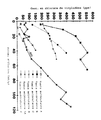
- the only figure is a graph showing the adsorption of vinylidene chloride on various carbonaceous molecular sieves.
- Vinylidene chloride is present in CFC-141b in amounts of between about 200 and 900 ppm by weight, depending on the conversion to CFC-141b and the preliminary purification steps.
- vinylidene chloride is not removed to a significant extent by many molecular sieves, including silicalite, CaX, CaY and calcium chabazite (AW-500).
- molecular sieves including silicalite, CaX, CaY and calcium chabazite (AW-500).
- carbon molecular sieves having a pore size of about 4.2 ⁇ to 4.5 ⁇ are an effective and selective means of separating vinylidene chloride from CFC-141b.
- Carbon molecular sieves are commercially available. They are usually derived from natural sources such as coal. An example is the carbon molecular sieves described in an article by Juntgen et al. from Bergbau-Forschung GmbH in FUEL , 1981, vol. 60, September, p. 817-822.
- Another carbonaceous molecular sieve which can be used for the purification of fluorinated hydrocarbons is produced by a particular process described in US Pat. No. 4,820,681 and cited here for reference.
- This manufacturing process can be broadly characterized as comprising three stages: (1) polymerization of a non-oxygenated monomer in the presence of a crosslinking agent not oxygenated; (2) formation of particles of the polymer resulting in the desired shape; and then (3) carbonization of the material formed in an essentially oxygen-free environment.
- the monomer can be chosen from a number of different monomers. They must be easily polymerizable, essentially non-oxygenated in their molecular structure and preferably consist basically of hydrogen, a halogen and carbon.
- substances which can be used as monomer are acrylonitrile (AN), vinylidene fluoride (PVDF), chlorotrifluoroethylene (HALAR), vinylidene chloride (PVCD), mixtures of two or more monomers, such as mixtures of vinylidene chloride and vinyl chloride, vinylidene chloride and acrylonitrile, and a mixture of styrene and divinylbenzene.
- Suitable monomers are vinyl fluoride, vinyl bromide, chlorinated ethylene, chlorofluoroethylene, vinylchlorobenzene, vinylidene bromide and vinylidene fluoride-chlorotrifluoroethylene.
- the preferred monomer is vinylidene chloride.
- the polymers produced in the initial polymerization step must be crosslinked with a substantially non-oxygenated crosslinking agent.
- the crosslinking agent will typically be present during the polymerization in a concentration equal to or less than 10 mol% of the monomer.
- a preferred crosslinking agent is divinylbenzene.
- Other possible crosslinking agents include trivinylbenzene, divinylacetylene and divinyl sulfide.
- the polymerization initiator is also preferably a non-oxygenated compound. Therefore, preferably a carbonaceous or azo initiator is used rather than oxygenated.
- the polymeric substance is carbonized by heating to an elevated temperature in an essentially oxygen-free environment. Before carbonization at high temperature, the precursor substance is subjected to a gentle heating step during which its temperature is raised above 150 ° C., for example to 240 ° C., and maintained at this value until that there is no more weight loss. The substance is then preferably subjected to a programmed rise in temperature to a temperature above 700 ° C, preferably above 800 ° C, in particular above 900 ° C.
- Sieve precursors derived from polymeric substances are essentially free from mineral substances such as metals and mineral oxides which may be present when the precursor substance is made from a natural substance such as coal, coconut husks, peat or wood.
- the preferred sieves, on a non-hydrogenated and non-oxygenated basis, should contain at least 99.5% by weight of carbon and preferably at least 99.8% by weight of carbon.
- Yet another method requires measuring the isosteric heat of adsorption of one or more gases.
- the size of the pores is given by the intersection of a line drawn at this energy with the Lennard-Jones potential curve for this gas.
- An example of the latter technique is given by K. Chihara et al., In the Journal of Colloids and Interface Science , 64 , 584 (1978), in which it is found that the pore size of the molecular sieve MSC-5A is 4 , 4 ⁇ .
- CFC-141b When CFC-141b is produced by catalytic hydrofluorination of vinylidene chloride, the conversion to CFC-141b is only partial and many by-products are produced. Therefore, the reactor effluent is distilled off to concentrate the CFC-141b product and to produce a recycle stream of the unreacted feed.
- the resulting impure CFC-141b stream contains HF and chloride unreacted vinylidene, as well as minor amounts of impurities as by-products.
- HF and HCl can be selectively removed by a technique described by others and not part of the present invention. Once this is done, CFC-141b still contains impurities which must be removed, including about 200 to 900 ppm by weight of vinylidene chloride.
- the purpose of the present process is to remove vinylidene chloride to a proportion of less than 200 ppm by weight in CFC-141b, preferably less than 50 ppm by weight.
- CFC-141b can be carried out in the liquid phase or in the gas phase, although the liquid phase is preferred to avoid the cost of vaporization and subsequent condensation.
- Various techniques known to those skilled in the art can be used to bring the stream of CFC-141b into contact with the carbonaceous molecular sieve forming the adsorbent, such as fluid or mobile beds, but, typically, a fixed bed of particles is used. adsorbent.
- the choice of particle size, bed shape and space velocity of the CFC-141b stream is determined according to known principles, depending on the requirements to achieve the desired removal of vinylidene chloride. Generally, the hourly gas space velocity of the CFC-141b stream is approximately 130 to 1500 h ⁇ 1 when operating in the gas phase.
- the corresponding liquid space velocity would be approximately 1 to 15 h ⁇ 1.
- the adsorption is carried out at a suitable temperature, generally between approximately -20 ° C. and 60 ° C. and under a pressure, which depends on whether it is desired to bring it into liquid or vapor contact, of approximately 100 to 500 kPa.
- the adsorbent bed must provide an optimal capacity for vinylidene chloride, taking into account the costs of the installation and the adsorbent compared to the regeneration costs.
- the adsorbent is regenerated by heating the bed with a gas stream to remove vinylidene chloride.
- the CFC-141b remaining in the container and on the adsorbent is first separated and recovered, then the regeneration process is carried out. After having completely heated the bed and removed the vinylidene chloride, it is cooled and it is reintroduced into the circuit.
- the conditions necessary for optimally regenerating the adsorbent will be determined according to the adsorbent used and the utilities available. Typically, it is expected that heating the adsorbent bed to about 200 ° C-500 ° C with a stream of nitrogen will produce satisfactory regeneration.
- the adsorption capacity of vinylidene chloride is studied for a number of potential adsorbents.
- 1.0 g of the adsorbent to be studied and a 15 ml sample of impure CFC-141b containing 576 ppm by weight of vinylidene chloride, 16 ppm by weight of dichloroacetylene, 840 ppm are placed in a 20 ml flask.
Landscapes
- Chemical & Material Sciences (AREA)
- Organic Chemistry (AREA)
- Solid-Sorbent Or Filter-Aiding Compositions (AREA)
- Organic Low-Molecular-Weight Compounds And Preparation Thereof (AREA)
Applications Claiming Priority (2)
| Application Number | Priority Date | Filing Date | Title |
|---|---|---|---|
| US450654 | 1989-12-14 | ||
| US07/450,654 US4940824A (en) | 1989-12-14 | 1989-12-14 | Process for removing vinylidene chloride from 1,1-dichloro-1-fluoroethane |
Publications (3)
| Publication Number | Publication Date |
|---|---|
| EP0433130A2 true EP0433130A2 (de) | 1991-06-19 |
| EP0433130A3 EP0433130A3 (en) | 1991-10-23 |
| EP0433130B1 EP0433130B1 (de) | 1993-10-27 |
Family
ID=23788974
Family Applications (1)
| Application Number | Title | Priority Date | Filing Date |
|---|---|---|---|
| EP90403439A Expired - Lifetime EP0433130B1 (de) | 1989-12-14 | 1990-12-04 | Verfahren zur Abscheidung von Vinylidenchlorid aus 1,1-Dichlor-1-fluorethan |
Country Status (7)
| Country | Link |
|---|---|
| US (1) | US4940824A (de) |
| EP (1) | EP0433130B1 (de) |
| JP (1) | JPH03291245A (de) |
| KR (1) | KR930003663B1 (de) |
| AU (1) | AU638651B2 (de) |
| CA (1) | CA2031982A1 (de) |
| DE (1) | DE69004230D1 (de) |
Families Citing this family (11)
| Publication number | Priority date | Publication date | Assignee | Title |
|---|---|---|---|---|
| FR2651775B1 (fr) * | 1989-09-12 | 1993-02-19 | Atochem | Purification du dichloro-1,1 fluoro-1 ethane. |
| US5087778A (en) * | 1990-04-10 | 1992-02-11 | Allied-Signal Inc. | Regeneration of zeolites used for purifying 1,1,1,2-tetrafluoroethane |
| GB9105421D0 (en) * | 1991-03-14 | 1991-05-01 | Ici Plc | Purification of 1,1,1,2-tetrafluoroethane |
| JPH0656713A (ja) * | 1991-04-27 | 1994-03-01 | Hoechst Ag | クロロフルオロ炭化水素の精製方法 |
| US5105035A (en) * | 1991-05-29 | 1992-04-14 | Allied-Signal Inc. | Process for removing vinylidene chloride and other unsaturated compounds from 1,1-dichloro-1-fluoroethane by hydrogenation |
| EP0630362B1 (de) * | 1992-03-10 | 1996-08-21 | E.I. Du Pont De Nemours And Company | Reinigung von hexafluorethanprodukten |
| US5600040A (en) * | 1992-07-17 | 1997-02-04 | E. I. Du Pont De Nemours And Company | Separation of tetrafluoroethane isomers |
| US5261948A (en) * | 1992-09-10 | 1993-11-16 | University Of Delaware | Carbon molecular sieve for the kinetic separation of acid gases and fluorocarbons |
| US6544319B1 (en) * | 2002-01-16 | 2003-04-08 | Air Products And Chemicals, Inc. | Purification of hexafluoro-1,3-butadiene |
| GB201307327D0 (en) | 2013-04-23 | 2013-05-29 | Mexichem Amanco Holding Sa | Process |
| GB201410174D0 (en) | 2014-06-09 | 2014-07-23 | Mexichem Amanco Holding Sa | Process |
Family Cites Families (9)
| Publication number | Priority date | Publication date | Assignee | Title |
|---|---|---|---|---|
| US2894044A (en) * | 1956-02-16 | 1959-07-07 | Monsanto Chemicals | Preparation of 1, 1-dichloro-1-fluoroethane |
| US2917556A (en) * | 1958-06-09 | 1959-12-15 | Du Pont | Process for separating vinylidene fluoride from vinyl fluoride |
| JPS505681B1 (de) * | 1970-07-28 | 1975-03-06 | ||
| JP2542394B2 (ja) * | 1987-08-06 | 1996-10-09 | イー・アイ・デユポン・ドウ・ヌムール・アンド・カンパニー | ヘキサフロロプロピレンの精製方法 |
| US4820681A (en) * | 1987-12-24 | 1989-04-11 | Allied-Signal Inc. | Preparation of hydrophobic carbon molecular sieves |
| US4849558A (en) * | 1988-06-30 | 1989-07-18 | Allied-Signal Inc. | Purification of chlorofluorocarbons |
| US4906796A (en) * | 1989-03-08 | 1990-03-06 | Allied Signal Inc. | Process for purifying 1,1,1,2-tetrafluoroethane |
| CA2004709A1 (en) * | 1989-03-23 | 1990-09-23 | Stephen F. Yates | Process for purifying 1,1,1,2-tetrafluoroethane |
| US4940825A (en) * | 1989-12-14 | 1990-07-10 | Allied-Signal Inc. | Process for removing dichloroacetylene from 1,1-dichloro-1-fluoroethane and/or vinylidene chloride |
-
1989
- 1989-12-14 US US07/450,654 patent/US4940824A/en not_active Expired - Fee Related
-
1990
- 1990-11-29 JP JP2336960A patent/JPH03291245A/ja active Pending
- 1990-12-04 EP EP90403439A patent/EP0433130B1/de not_active Expired - Lifetime
- 1990-12-04 DE DE90403439T patent/DE69004230D1/de not_active Expired - Lifetime
- 1990-12-11 CA CA002031982A patent/CA2031982A1/en not_active Abandoned
- 1990-12-13 AU AU68049/90A patent/AU638651B2/en not_active Ceased
- 1990-12-14 KR KR1019900020629A patent/KR930003663B1/ko not_active Expired - Fee Related
Also Published As
| Publication number | Publication date |
|---|---|
| AU638651B2 (en) | 1993-07-01 |
| US4940824A (en) | 1990-07-10 |
| CA2031982A1 (en) | 1991-06-15 |
| EP0433130A3 (en) | 1991-10-23 |
| DE69004230D1 (de) | 1993-12-02 |
| EP0433130B1 (de) | 1993-10-27 |
| JPH03291245A (ja) | 1991-12-20 |
| AU6804990A (en) | 1991-06-20 |
| KR930003663B1 (ko) | 1993-05-08 |
| KR910011716A (ko) | 1991-08-07 |
Similar Documents
| Publication | Publication Date | Title |
|---|---|---|
| EP0433130B1 (de) | Verfahren zur Abscheidung von Vinylidenchlorid aus 1,1-Dichlor-1-fluorethan | |
| US4820318A (en) | Removal of organic compounds from gas streams using carbon molecular sieves | |
| EP2303819B1 (de) | Verfahren zur aufreinigung von 2,3,3,3-tetrafluor-1-propen (hfo-1234yf) | |
| EP0389334B1 (de) | Verfahren zur Reinigung von 1,1,1,2-Tetrafluorethan | |
| JP2014534181A (ja) | 固体吸着剤を用いて2−クロロ−1,1,1,2−テトラフルオロプロパンからハロゲン化オレフィンを分離する方法 | |
| JPH04503066A (ja) | クロロフルオロカーボン精製用の炭素分子篩 | |
| EP0490003B1 (de) | Verfahren zur Abscheidung von Dichloracetylen aus 1,1-Dichlor-1-fluorethan und/oder Vinylidenchlorid | |
| WO2017050686A1 (fr) | Procede de purification et de sechage d'un flux d'hydrofluoroolefines | |
| FR2751641A1 (fr) | Procede de separation isoalcanes/n-alcanes par adsorption en phase gazeuse utilisant une modulation de pression et quatre adsorbeurs | |
| EP0600536B1 (de) | Verfahren zur Reinigung von 1,1-Difluorethan | |
| JP2542394B2 (ja) | ヘキサフロロプロピレンの精製方法 | |
| JP4057103B2 (ja) | ハロゲン化炭化水素流からパーフルオロイソブチレンを選択的に除去する方法 | |
| EP0618181B1 (de) | Azeotrope bestehend aus Wasser und aus einem Fluorkohlenwasserstoff, Verfahren zur Entfernung von Wasser aus einer Lösung durch Azeotrop destillation und Verfahren zur Herstellung eines Fluorkohlenwasserstoffs | |
| EP0703206B1 (de) | Verfahren zur Reinigung von Difluormethan | |
| CA2141657A1 (fr) | Procede de purification du pentafluoroethane | |
| CA2128274A1 (en) | Process for separating components of a liquid mixture | |
| FR2695635A1 (fr) | Procédé d'isomérisation de n-butane combinant une étape de déisobutanisation et une étape d'adsorption. | |
| JP3894714B2 (ja) | オクタフルオロプロパンの精製方法及び製造方法、高純度オクタフルオロプロパン並びにその用途 | |
| EP0394350A1 (de) | Hydrophobe kohlenstoffmolekularsiebe. | |
| FR2786766A1 (fr) | Procede de sechage du difluoromethane | |
| WO2001062693A1 (fr) | Procede de conversion selectif du perfluoroisobutene contenu dans un courant d'hydrocarbures halogenes |
Legal Events
| Date | Code | Title | Description |
|---|---|---|---|
| PUAI | Public reference made under article 153(3) epc to a published international application that has entered the european phase |
Free format text: ORIGINAL CODE: 0009012 |
|
| 17P | Request for examination filed |
Effective date: 19901207 |
|
| AK | Designated contracting states |
Kind code of ref document: A2 Designated state(s): BE DE ES FR GB GR IT NL |
|
| PUAL | Search report despatched |
Free format text: ORIGINAL CODE: 0009013 |
|
| AK | Designated contracting states |
Kind code of ref document: A3 Designated state(s): BE DE ES FR GB GR IT NL |
|
| RAP3 | Party data changed (applicant data changed or rights of an application transferred) |
Owner name: ELF ATOCHEM S.A. |
|
| 17Q | First examination report despatched |
Effective date: 19930323 |
|
| GRAA | (expected) grant |
Free format text: ORIGINAL CODE: 0009210 |
|
| AK | Designated contracting states |
Kind code of ref document: B1 Designated state(s): BE DE ES FR GB GR IT NL |
|
| PG25 | Lapsed in a contracting state [announced via postgrant information from national office to epo] |
Ref country code: GR Free format text: LAPSE BECAUSE OF FAILURE TO SUBMIT A TRANSLATION OF THE DESCRIPTION OR TO PAY THE FEE WITHIN THE PRESCRIBED TIME-LIMIT Effective date: 19931027 Ref country code: GB Effective date: 19931027 Ref country code: ES Free format text: THE PATENT HAS BEEN ANNULLED BY A DECISION OF A NATIONAL AUTHORITY Effective date: 19931027 Ref country code: DE Effective date: 19931027 |
|
| ITF | It: translation for a ep patent filed | ||
| REF | Corresponds to: |
Ref document number: 69004230 Country of ref document: DE Date of ref document: 19931202 |
|
| GBV | Gb: ep patent (uk) treated as always having been void in accordance with gb section 77(7)/1977 [no translation filed] |
Effective date: 19931027 |
|
| PLBE | No opposition filed within time limit |
Free format text: ORIGINAL CODE: 0009261 |
|
| STAA | Information on the status of an ep patent application or granted ep patent |
Free format text: STATUS: NO OPPOSITION FILED WITHIN TIME LIMIT |
|
| 26N | No opposition filed | ||
| PGFP | Annual fee paid to national office [announced via postgrant information from national office to epo] |
Ref country code: FR Payment date: 19941209 Year of fee payment: 5 |
|
| PGFP | Annual fee paid to national office [announced via postgrant information from national office to epo] |
Ref country code: NL Payment date: 19941231 Year of fee payment: 5 |
|
| PGFP | Annual fee paid to national office [announced via postgrant information from national office to epo] |
Ref country code: BE Payment date: 19950207 Year of fee payment: 5 |
|
| PG25 | Lapsed in a contracting state [announced via postgrant information from national office to epo] |
Ref country code: BE Effective date: 19951231 |
|
| BERE | Be: lapsed |
Owner name: S.A. ELF ATOCHEM Effective date: 19951231 |
|
| PG25 | Lapsed in a contracting state [announced via postgrant information from national office to epo] |
Ref country code: NL Effective date: 19960701 |
|
| PG25 | Lapsed in a contracting state [announced via postgrant information from national office to epo] |
Ref country code: FR Effective date: 19960830 |
|
| NLV4 | Nl: lapsed or anulled due to non-payment of the annual fee |
Effective date: 19960701 |
|
| REG | Reference to a national code |
Ref country code: FR Ref legal event code: ST |
|
| PG25 | Lapsed in a contracting state [announced via postgrant information from national office to epo] |
Ref country code: IT Free format text: LAPSE BECAUSE OF NON-PAYMENT OF DUE FEES Effective date: 20051204 |