EP0409009B1 - Verfahren zur Herstellung von 2- und 4-Amino-thiophenolen - Google Patents
Verfahren zur Herstellung von 2- und 4-Amino-thiophenolen Download PDFInfo
- Publication number
- EP0409009B1 EP0409009B1 EP90112890A EP90112890A EP0409009B1 EP 0409009 B1 EP0409009 B1 EP 0409009B1 EP 90112890 A EP90112890 A EP 90112890A EP 90112890 A EP90112890 A EP 90112890A EP 0409009 B1 EP0409009 B1 EP 0409009B1
- Authority
- EP
- European Patent Office
- Prior art keywords
- alkali metal
- several
- aftertreatment
- carried out
- amino
- Prior art date
- Legal status (The legal status is an assumption and is not a legal conclusion. Google has not performed a legal analysis and makes no representation as to the accuracy of the status listed.)
- Expired - Lifetime
Links
- WCDSVWRUXWCYFN-UHFFFAOYSA-N 4-aminobenzenethiol Chemical class NC1=CC=C(S)C=C1 WCDSVWRUXWCYFN-UHFFFAOYSA-N 0.000 title claims description 7
- 238000004519 manufacturing process Methods 0.000 title claims 2
- YXFVVABEGXRONW-UHFFFAOYSA-N Toluene Chemical compound CC1=CC=CC=C1 YXFVVABEGXRONW-UHFFFAOYSA-N 0.000 claims description 39
- 238000000034 method Methods 0.000 claims description 25
- HEMHJVSKTPXQMS-UHFFFAOYSA-M Sodium hydroxide Chemical compound [OH-].[Na+] HEMHJVSKTPXQMS-UHFFFAOYSA-M 0.000 claims description 24
- BFCFYVKQTRLZHA-UHFFFAOYSA-N 1-chloro-2-nitrobenzene Chemical compound [O-][N+](=O)C1=CC=CC=C1Cl BFCFYVKQTRLZHA-UHFFFAOYSA-N 0.000 claims description 20
- XLYOFNOQVPJJNP-UHFFFAOYSA-N water Substances O XLYOFNOQVPJJNP-UHFFFAOYSA-N 0.000 claims description 12
- 239000003638 chemical reducing agent Substances 0.000 claims description 10
- 150000001875 compounds Chemical class 0.000 claims description 9
- 125000002924 primary amino group Chemical group [H]N([H])* 0.000 claims description 9
- 239000002904 solvent Substances 0.000 claims description 9
- 150000008044 alkali metal hydroxides Chemical class 0.000 claims description 8
- CXWXQJXEFPUFDZ-UHFFFAOYSA-N tetralin Chemical compound C1=CC=C2CCCCC2=C1 CXWXQJXEFPUFDZ-UHFFFAOYSA-N 0.000 claims description 8
- NPDACUSDTOMAMK-UHFFFAOYSA-N 4-Chlorotoluene Chemical compound CC1=CC=C(Cl)C=C1 NPDACUSDTOMAMK-UHFFFAOYSA-N 0.000 claims description 6
- ZAMOUSCENKQFHK-UHFFFAOYSA-N Chlorine atom Chemical compound [Cl] ZAMOUSCENKQFHK-UHFFFAOYSA-N 0.000 claims description 6
- WMFOQBRAJBCJND-UHFFFAOYSA-M Lithium hydroxide Chemical compound [Li+].[OH-] WMFOQBRAJBCJND-UHFFFAOYSA-M 0.000 claims description 6
- KWYUFKZDYYNOTN-UHFFFAOYSA-M Potassium hydroxide Chemical compound [OH-].[K+] KWYUFKZDYYNOTN-UHFFFAOYSA-M 0.000 claims description 6
- MVPPADPHJFYWMZ-UHFFFAOYSA-N chlorobenzene Chemical compound ClC1=CC=CC=C1 MVPPADPHJFYWMZ-UHFFFAOYSA-N 0.000 claims description 6
- VLKZOEOYAKHREP-UHFFFAOYSA-N n-Hexane Chemical compound CCCCCC VLKZOEOYAKHREP-UHFFFAOYSA-N 0.000 claims description 6
- 125000000449 nitro group Chemical group [O-][N+](*)=O 0.000 claims description 6
- 229920001021 polysulfide Polymers 0.000 claims description 6
- 239000005077 polysulfide Substances 0.000 claims description 6
- 150000008117 polysulfides Polymers 0.000 claims description 6
- 229910052783 alkali metal Inorganic materials 0.000 claims description 5
- 239000008346 aqueous phase Substances 0.000 claims description 5
- 238000000605 extraction Methods 0.000 claims description 5
- 239000003444 phase transfer catalyst Substances 0.000 claims description 5
- RFFLAFLAYFXFSW-UHFFFAOYSA-N 1,2-dichlorobenzene Chemical compound ClC1=CC=CC=C1Cl RFFLAFLAYFXFSW-UHFFFAOYSA-N 0.000 claims description 4
- 229910052977 alkali metal sulfide Inorganic materials 0.000 claims description 4
- 238000006243 chemical reaction Methods 0.000 claims description 4
- 239000000460 chlorine Substances 0.000 claims description 4
- 229910052801 chlorine Inorganic materials 0.000 claims description 4
- 229910052979 sodium sulfide Inorganic materials 0.000 claims description 4
- GRVFOGOEDUUMBP-UHFFFAOYSA-N sodium sulfide (anhydrous) Chemical compound [Na+].[Na+].[S-2] GRVFOGOEDUUMBP-UHFFFAOYSA-N 0.000 claims description 4
- IBSQPLPBRSHTTG-UHFFFAOYSA-N 1-chloro-2-methylbenzene Chemical compound CC1=CC=CC=C1Cl IBSQPLPBRSHTTG-UHFFFAOYSA-N 0.000 claims description 3
- WKBOTKDWSSQWDR-UHFFFAOYSA-N Bromine atom Chemical compound [Br] WKBOTKDWSSQWDR-UHFFFAOYSA-N 0.000 claims description 3
- XDTMQSROBMDMFD-UHFFFAOYSA-N Cyclohexane Chemical compound C1CCCCC1 XDTMQSROBMDMFD-UHFFFAOYSA-N 0.000 claims description 3
- URLKBWYHVLBVBO-UHFFFAOYSA-N Para-Xylene Chemical group CC1=CC=C(C)C=C1 URLKBWYHVLBVBO-UHFFFAOYSA-N 0.000 claims description 3
- 239000007795 chemical reaction product Substances 0.000 claims description 3
- IVSZLXZYQVIEFR-UHFFFAOYSA-N m-xylene Chemical compound CC1=CC=CC(C)=C1 IVSZLXZYQVIEFR-UHFFFAOYSA-N 0.000 claims description 3
- 125000000956 methoxy group Chemical group [H]C([H])([H])O* 0.000 claims description 3
- 125000002496 methyl group Chemical group [H]C([H])([H])* 0.000 claims description 3
- 238000000926 separation method Methods 0.000 claims description 3
- SRRKNRDXURUMPP-UHFFFAOYSA-N sodium disulfide Chemical compound [Na+].[Na+].[S-][S-] SRRKNRDXURUMPP-UHFFFAOYSA-N 0.000 claims description 3
- NVIFVTYDZMXWGX-UHFFFAOYSA-N sodium metaborate Chemical compound [Na+].[O-]B=O NVIFVTYDZMXWGX-UHFFFAOYSA-N 0.000 claims description 3
- OSOUNOBYRMOXQQ-UHFFFAOYSA-N 1-chloro-3-methylbenzene Chemical compound CC1=CC=CC(Cl)=C1 OSOUNOBYRMOXQQ-UHFFFAOYSA-N 0.000 claims description 2
- LTJSXGVQCAVSJW-UHFFFAOYSA-N [K+].[K+].[S-][S-] Chemical compound [K+].[K+].[S-][S-] LTJSXGVQCAVSJW-UHFFFAOYSA-N 0.000 claims description 2
- GDTBXPJZTBHREO-UHFFFAOYSA-N bromine Substances BrBr GDTBXPJZTBHREO-UHFFFAOYSA-N 0.000 claims description 2
- 229910052794 bromium Inorganic materials 0.000 claims description 2
- 229910052739 hydrogen Inorganic materials 0.000 claims description 2
- 239000001257 hydrogen Substances 0.000 claims description 2
- AUHZEENZYGFFBQ-UHFFFAOYSA-N mesitylene Substances CC1=CC(C)=CC(C)=C1 AUHZEENZYGFFBQ-UHFFFAOYSA-N 0.000 claims description 2
- 125000001827 mesitylenyl group Chemical group [H]C1=C(C(*)=C(C([H])=C1C([H])([H])[H])C([H])([H])[H])C([H])([H])[H] 0.000 claims description 2
- DPLVEEXVKBWGHE-UHFFFAOYSA-N potassium sulfide Chemical compound [S-2].[K+].[K+] DPLVEEXVKBWGHE-UHFFFAOYSA-N 0.000 claims description 2
- 150000001340 alkali metals Chemical class 0.000 claims 4
- DGAQECJNVWCQMB-PUAWFVPOSA-M Ilexoside XXIX Chemical compound C[C@@H]1CC[C@@]2(CC[C@@]3(C(=CC[C@H]4[C@]3(CC[C@@H]5[C@@]4(CC[C@@H](C5(C)C)OS(=O)(=O)[O-])C)C)[C@@H]2[C@]1(C)O)C)C(=O)O[C@H]6[C@@H]([C@H]([C@@H]([C@H](O6)CO)O)O)O.[Na+] DGAQECJNVWCQMB-PUAWFVPOSA-M 0.000 claims 1
- ZLMJMSJWJFRBEC-UHFFFAOYSA-N Potassium Chemical compound [K] ZLMJMSJWJFRBEC-UHFFFAOYSA-N 0.000 claims 1
- 125000004435 hydrogen atom Chemical class [H]* 0.000 claims 1
- 229910052700 potassium Inorganic materials 0.000 claims 1
- 239000011591 potassium Substances 0.000 claims 1
- 229910052708 sodium Inorganic materials 0.000 claims 1
- 239000011734 sodium Substances 0.000 claims 1
- VEXZGXHMUGYJMC-UHFFFAOYSA-N Hydrochloric acid Chemical compound Cl VEXZGXHMUGYJMC-UHFFFAOYSA-N 0.000 description 10
- CZGCEKJOLUNIFY-UHFFFAOYSA-N 4-Chloronitrobenzene Chemical class [O-][N+](=O)C1=CC=C(Cl)C=C1 CZGCEKJOLUNIFY-UHFFFAOYSA-N 0.000 description 8
- 239000003513 alkali Substances 0.000 description 6
- VRVRGVPWCUEOGV-UHFFFAOYSA-N 2-aminothiophenol Chemical class NC1=CC=CC=C1S VRVRGVPWCUEOGV-UHFFFAOYSA-N 0.000 description 5
- 238000004821 distillation Methods 0.000 description 5
- 239000000203 mixture Substances 0.000 description 5
- 239000012071 phase Substances 0.000 description 5
- 239000000047 product Substances 0.000 description 5
- 238000002360 preparation method Methods 0.000 description 4
- 238000003756 stirring Methods 0.000 description 4
- GFAZHVHNLUBROE-UHFFFAOYSA-N 1-hydroxybutan-2-one Chemical compound CCC(=O)CO GFAZHVHNLUBROE-UHFFFAOYSA-N 0.000 description 3
- RWSOTUBLDIXVET-UHFFFAOYSA-N Dihydrogen sulfide Chemical class S RWSOTUBLDIXVET-UHFFFAOYSA-N 0.000 description 3
- JCXJVPUVTGWSNB-UHFFFAOYSA-N Nitrogen dioxide Chemical class O=[N]=O JCXJVPUVTGWSNB-UHFFFAOYSA-N 0.000 description 3
- CTQNGGLPUBDAKN-UHFFFAOYSA-N O-Xylene Chemical compound CC1=CC=CC=C1C CTQNGGLPUBDAKN-UHFFFAOYSA-N 0.000 description 3
- 229910001854 alkali hydroxide Inorganic materials 0.000 description 3
- -1 alkali metal hydrogen sulfides Chemical class 0.000 description 3
- WGCNASOHLSPBMP-UHFFFAOYSA-N hydroxyacetaldehyde Natural products OCC=O WGCNASOHLSPBMP-UHFFFAOYSA-N 0.000 description 3
- 239000011541 reaction mixture Substances 0.000 description 3
- 239000008096 xylene Substances 0.000 description 3
- CIWBSHSKHKDKBQ-JLAZNSOCSA-N Ascorbic acid Chemical compound OC[C@H](O)[C@H]1OC(=O)C(O)=C1O CIWBSHSKHKDKBQ-JLAZNSOCSA-N 0.000 description 2
- WQZGKKKJIJFFOK-QTVWNMPRSA-N D-mannopyranose Chemical compound OC[C@H]1OC(O)[C@@H](O)[C@@H](O)[C@@H]1O WQZGKKKJIJFFOK-QTVWNMPRSA-N 0.000 description 2
- SRBFZHDQGSBBOR-IOVATXLUSA-N D-xylopyranose Chemical compound O[C@@H]1COC(O)[C@H](O)[C@H]1O SRBFZHDQGSBBOR-IOVATXLUSA-N 0.000 description 2
- RTZKZFJDLAIYFH-UHFFFAOYSA-N Diethyl ether Chemical compound CCOCC RTZKZFJDLAIYFH-UHFFFAOYSA-N 0.000 description 2
- LYCAIKOWRPUZTN-UHFFFAOYSA-N Ethylene glycol Chemical compound OCCO LYCAIKOWRPUZTN-UHFFFAOYSA-N 0.000 description 2
- WQZGKKKJIJFFOK-GASJEMHNSA-N Glucose Natural products OC[C@H]1OC(O)[C@H](O)[C@@H](O)[C@@H]1O WQZGKKKJIJFFOK-GASJEMHNSA-N 0.000 description 2
- 239000012431 aqueous reaction media Substances 0.000 description 2
- PYMYPHUHKUWMLA-UHFFFAOYSA-N arabinose Natural products OCC(O)C(O)C(O)C=O PYMYPHUHKUWMLA-UHFFFAOYSA-N 0.000 description 2
- SRBFZHDQGSBBOR-UHFFFAOYSA-N beta-D-Pyranose-Lyxose Natural products OC1COC(O)C(O)C1O SRBFZHDQGSBBOR-UHFFFAOYSA-N 0.000 description 2
- 238000001816 cooling Methods 0.000 description 2
- RXKJFZQQPQGTFL-UHFFFAOYSA-N dihydroxyacetone Chemical compound OCC(=O)CO RXKJFZQQPQGTFL-UHFFFAOYSA-N 0.000 description 2
- 239000008103 glucose Substances 0.000 description 2
- XLSMFKSTNGKWQX-UHFFFAOYSA-N hydroxyacetone Chemical compound CC(=O)CO XLSMFKSTNGKWQX-UHFFFAOYSA-N 0.000 description 2
- 238000005191 phase separation Methods 0.000 description 2
- 238000003408 phase transfer catalysis Methods 0.000 description 2
- 239000010695 polyglycol Substances 0.000 description 2
- 229920000151 polyglycol Polymers 0.000 description 2
- NTBYINQTYWZXLH-UHFFFAOYSA-N 1,2-dichloro-4-nitrobenzene Chemical compound [O-][N+](=O)C1=CC=C(Cl)C(Cl)=C1 NTBYINQTYWZXLH-UHFFFAOYSA-N 0.000 description 1
- RZKKOBGFCAHLCZ-UHFFFAOYSA-N 1,4-dichloro-2-nitrobenzene Chemical compound [O-][N+](=O)C1=CC(Cl)=CC=C1Cl RZKKOBGFCAHLCZ-UHFFFAOYSA-N 0.000 description 1
- ORPVVAKYSXQCJI-UHFFFAOYSA-N 1-bromo-2-nitrobenzene Chemical compound [O-][N+](=O)C1=CC=CC=C1Br ORPVVAKYSXQCJI-UHFFFAOYSA-N 0.000 description 1
- ZDFBKZUDCQQKAC-UHFFFAOYSA-N 1-bromo-4-nitrobenzene Chemical compound [O-][N+](=O)C1=CC=C(Br)C=C1 ZDFBKZUDCQQKAC-UHFFFAOYSA-N 0.000 description 1
- HISHUMDTGXICEZ-UHFFFAOYSA-N 1-chloro-4-methoxy-2-nitrobenzene Chemical compound COC1=CC=C(Cl)C([N+]([O-])=O)=C1 HISHUMDTGXICEZ-UHFFFAOYSA-N 0.000 description 1
- NWESJZZPAJGHRZ-UHFFFAOYSA-N 1-chloro-4-methyl-2-nitrobenzene Chemical compound CC1=CC=C(Cl)C([N+]([O-])=O)=C1 NWESJZZPAJGHRZ-UHFFFAOYSA-N 0.000 description 1
- NXCKJENHTITELM-UHFFFAOYSA-N 1-nitro-2-[(2-nitrophenyl)disulfanyl]benzene Chemical compound [O-][N+](=O)C1=CC=CC=C1SSC1=CC=CC=C1[N+]([O-])=O NXCKJENHTITELM-UHFFFAOYSA-N 0.000 description 1
- QSNSCYSYFYORTR-UHFFFAOYSA-N 4-chloroaniline Chemical compound NC1=CC=C(Cl)C=C1 QSNSCYSYFYORTR-UHFFFAOYSA-N 0.000 description 1
- JGLMVXWAHNTPRF-CMDGGOBGSA-N CCN1N=C(C)C=C1C(=O)NC1=NC2=CC(=CC(OC)=C2N1C\C=C\CN1C(NC(=O)C2=CC(C)=NN2CC)=NC2=CC(=CC(OCCCN3CCOCC3)=C12)C(N)=O)C(N)=O Chemical compound CCN1N=C(C)C=C1C(=O)NC1=NC2=CC(=CC(OC)=C2N1C\C=C\CN1C(NC(=O)C2=CC(C)=NN2CC)=NC2=CC(=CC(OCCCN3CCOCC3)=C12)C(N)=O)C(N)=O JGLMVXWAHNTPRF-CMDGGOBGSA-N 0.000 description 1
- WQZGKKKJIJFFOK-IVMDWMLBSA-N D-allopyranose Chemical compound OC[C@H]1OC(O)[C@H](O)[C@H](O)[C@@H]1O WQZGKKKJIJFFOK-IVMDWMLBSA-N 0.000 description 1
- MNQZXJOMYWMBOU-VKHMYHEASA-N D-glyceraldehyde Chemical compound OC[C@@H](O)C=O MNQZXJOMYWMBOU-VKHMYHEASA-N 0.000 description 1
- HMFHBZSHGGEWLO-SOOFDHNKSA-N D-ribofuranose Chemical compound OC[C@H]1OC(O)[C@H](O)[C@@H]1O HMFHBZSHGGEWLO-SOOFDHNKSA-N 0.000 description 1
- RUPBZQFQVRMKDG-UHFFFAOYSA-M Didecyldimethylammonium chloride Chemical compound [Cl-].CCCCCCCCCC[N+](C)(C)CCCCCCCCCC RUPBZQFQVRMKDG-UHFFFAOYSA-M 0.000 description 1
- 206010056474 Erythrosis Diseases 0.000 description 1
- 229930091371 Fructose Natural products 0.000 description 1
- RFSUNEUAIZKAJO-ARQDHWQXSA-N Fructose Chemical compound OC[C@H]1O[C@](O)(CO)[C@@H](O)[C@@H]1O RFSUNEUAIZKAJO-ARQDHWQXSA-N 0.000 description 1
- 239000005715 Fructose Substances 0.000 description 1
- IAJILQKETJEXLJ-UHFFFAOYSA-N Galacturonsaeure Natural products O=CC(O)C(O)C(O)C(O)C(O)=O IAJILQKETJEXLJ-UHFFFAOYSA-N 0.000 description 1
- UFHFLCQGNIYNRP-UHFFFAOYSA-N Hydrogen Chemical compound [H][H] UFHFLCQGNIYNRP-UHFFFAOYSA-N 0.000 description 1
- SECXISVLQFMRJM-UHFFFAOYSA-N N-Methylpyrrolidone Chemical compound CN1CCCC1=O SECXISVLQFMRJM-UHFFFAOYSA-N 0.000 description 1
- 239000002202 Polyethylene glycol Substances 0.000 description 1
- PYMYPHUHKUWMLA-LMVFSUKVSA-N Ribose Natural products OC[C@@H](O)[C@@H](O)[C@@H](O)C=O PYMYPHUHKUWMLA-LMVFSUKVSA-N 0.000 description 1
- NINIDFKCEFEMDL-UHFFFAOYSA-N Sulfur Chemical compound [S] NINIDFKCEFEMDL-UHFFFAOYSA-N 0.000 description 1
- LSNNMFCWUKXFEE-UHFFFAOYSA-N Sulfurous acid Chemical compound OS(O)=O LSNNMFCWUKXFEE-UHFFFAOYSA-N 0.000 description 1
- UCKMPCXJQFINFW-UHFFFAOYSA-N Sulphide Chemical compound [S-2] UCKMPCXJQFINFW-UHFFFAOYSA-N 0.000 description 1
- ATJFFYVFTNAWJD-UHFFFAOYSA-N Tin Chemical compound [Sn] ATJFFYVFTNAWJD-UHFFFAOYSA-N 0.000 description 1
- HCHKCACWOHOZIP-UHFFFAOYSA-N Zinc Chemical compound [Zn] HCHKCACWOHOZIP-UHFFFAOYSA-N 0.000 description 1
- 239000002253 acid Substances 0.000 description 1
- 150000001298 alcohols Chemical class 0.000 description 1
- IAJILQKETJEXLJ-QTBDOELSSA-N aldehydo-D-glucuronic acid Chemical compound O=C[C@H](O)[C@@H](O)[C@H](O)[C@H](O)C(O)=O IAJILQKETJEXLJ-QTBDOELSSA-N 0.000 description 1
- HMFHBZSHGGEWLO-UHFFFAOYSA-N alpha-D-Furanose-Ribose Natural products OCC1OC(O)C(O)C1O HMFHBZSHGGEWLO-UHFFFAOYSA-N 0.000 description 1
- WQZGKKKJIJFFOK-PHYPRBDBSA-N alpha-D-galactose Chemical compound OC[C@H]1O[C@H](O)[C@H](O)[C@@H](O)[C@H]1O WQZGKKKJIJFFOK-PHYPRBDBSA-N 0.000 description 1
- SRBFZHDQGSBBOR-STGXQOJASA-N alpha-D-lyxopyranose Chemical compound O[C@@H]1CO[C@H](O)[C@@H](O)[C@H]1O SRBFZHDQGSBBOR-STGXQOJASA-N 0.000 description 1
- PYMYPHUHKUWMLA-WDCZJNDASA-N arabinose Chemical compound OC[C@@H](O)[C@@H](O)[C@H](O)C=O PYMYPHUHKUWMLA-WDCZJNDASA-N 0.000 description 1
- 125000003118 aryl group Chemical group 0.000 description 1
- 229960005070 ascorbic acid Drugs 0.000 description 1
- 235000010323 ascorbic acid Nutrition 0.000 description 1
- 239000011668 ascorbic acid Substances 0.000 description 1
- WQZGKKKJIJFFOK-VFUOTHLCSA-N beta-D-glucose Chemical compound OC[C@H]1O[C@@H](O)[C@H](O)[C@@H](O)[C@@H]1O WQZGKKKJIJFFOK-VFUOTHLCSA-N 0.000 description 1
- 239000003610 charcoal Substances 0.000 description 1
- 239000003795 chemical substances by application Substances 0.000 description 1
- 238000004140 cleaning Methods 0.000 description 1
- 238000011083 clear filtration Methods 0.000 description 1
- 150000003983 crown ethers Chemical class 0.000 description 1
- 239000012043 crude product Substances 0.000 description 1
- 238000002425 crystallisation Methods 0.000 description 1
- 230000008025 crystallization Effects 0.000 description 1
- 150000001983 dialkylethers Chemical class 0.000 description 1
- MTHSVFCYNBDYFN-UHFFFAOYSA-N diethylene glycol Chemical compound OCCOCCO MTHSVFCYNBDYFN-UHFFFAOYSA-N 0.000 description 1
- 229940120503 dihydroxyacetone Drugs 0.000 description 1
- WBZKQQHYRPRKNJ-UHFFFAOYSA-L disulfite Chemical compound [O-]S(=O)S([O-])(=O)=O WBZKQQHYRPRKNJ-UHFFFAOYSA-L 0.000 description 1
- 239000003814 drug Substances 0.000 description 1
- 239000000975 dye Substances 0.000 description 1
- 230000007613 environmental effect Effects 0.000 description 1
- 238000003912 environmental pollution Methods 0.000 description 1
- 239000003822 epoxy resin Substances 0.000 description 1
- 229930182830 galactose Natural products 0.000 description 1
- 229940097043 glucuronic acid Drugs 0.000 description 1
- 150000002334 glycols Chemical class 0.000 description 1
- LNEPOXFFQSENCJ-UHFFFAOYSA-N haloperidol Chemical compound C1CC(O)(C=2C=CC(Cl)=CC=2)CCN1CCCC(=O)C1=CC=C(F)C=C1 LNEPOXFFQSENCJ-UHFFFAOYSA-N 0.000 description 1
- 229910001385 heavy metal Inorganic materials 0.000 description 1
- 150000002402 hexoses Chemical class 0.000 description 1
- 150000002431 hydrogen Chemical group 0.000 description 1
- 229910000037 hydrogen sulfide Inorganic materials 0.000 description 1
- 229910052500 inorganic mineral Inorganic materials 0.000 description 1
- 238000002955 isolation Methods 0.000 description 1
- 239000011707 mineral Substances 0.000 description 1
- 238000006386 neutralization reaction Methods 0.000 description 1
- 230000003472 neutralizing effect Effects 0.000 description 1
- 239000003921 oil Substances 0.000 description 1
- 150000002972 pentoses Chemical class 0.000 description 1
- 150000004714 phosphonium salts Chemical class 0.000 description 1
- 229920000647 polyepoxide Polymers 0.000 description 1
- 229920001223 polyethylene glycol Polymers 0.000 description 1
- ZOCLAPYLSUCOGI-UHFFFAOYSA-M potassium hydrosulfide Chemical compound [SH-].[K+] ZOCLAPYLSUCOGI-UHFFFAOYSA-M 0.000 description 1
- 239000011814 protection agent Substances 0.000 description 1
- 125000001453 quaternary ammonium group Chemical class 0.000 description 1
- HYHCSLBZRBJJCH-UHFFFAOYSA-M sodium hydrosulfide Chemical compound [Na+].[SH-] HYHCSLBZRBJJCH-UHFFFAOYSA-M 0.000 description 1
- 239000007858 starting material Substances 0.000 description 1
- 238000001256 steam distillation Methods 0.000 description 1
- 235000000346 sugar Nutrition 0.000 description 1
- 150000008163 sugars Chemical class 0.000 description 1
- 150000004763 sulfides Chemical class 0.000 description 1
- CSABAZBYIWDIDE-UHFFFAOYSA-N sulfino hydrogen sulfite Chemical class OS(=O)OS(O)=O CSABAZBYIWDIDE-UHFFFAOYSA-N 0.000 description 1
- LSNNMFCWUKXFEE-UHFFFAOYSA-L sulfite Chemical class [O-]S([O-])=O LSNNMFCWUKXFEE-UHFFFAOYSA-L 0.000 description 1
- 239000011593 sulfur Substances 0.000 description 1
- 229910052717 sulfur Inorganic materials 0.000 description 1
- 238000003786 synthesis reaction Methods 0.000 description 1
- 238000003419 tautomerization reaction Methods 0.000 description 1
- 150000003538 tetroses Chemical class 0.000 description 1
- 239000012485 toluene extract Substances 0.000 description 1
- 238000006276 transfer reaction Methods 0.000 description 1
- 238000004065 wastewater treatment Methods 0.000 description 1
Classifications
-
- C—CHEMISTRY; METALLURGY
- C07—ORGANIC CHEMISTRY
- C07C—ACYCLIC OR CARBOCYCLIC COMPOUNDS
- C07C319/00—Preparation of thiols, sulfides, hydropolysulfides or polysulfides
- C07C319/02—Preparation of thiols, sulfides, hydropolysulfides or polysulfides of thiols
Definitions
- the present invention relates to a new, high-yielding process for the preparation of 2- and 4-amino-thiophenols.
- the aminothiophenols are isolated from the strongly alkaline aqueous reaction medium by neutralization with a mineral acid in the presence of 1.5 to 2.5 mol of a water-soluble sulfite or 0.75 to 1.25 mol of a water-soluble disulfite per mol of chloronitrobenzene used at 0-30 ° C and pH values of 5-7. Yields of 60% of theory of 4-aminothiophenol, based on 4-chloronitrobenzene, and 71% of theory Theory of 2-aminothiophenol, based on 2-chloronitrobenzene, achieved, in each case after distillation of the initially highly contaminated crude products.
- 2-Aminothiophenol can also be reduced by reducing bis- (2-nitrophenyl) -Disulfan accessible with zinc dust or tin (eg Houben-Weyl, Methods of Organic Chemistry, Volume E 11, p. 48 (1985)), but these methods are disadvantageous due to the high environmental pollution caused by the heavy metals used.
- reaction of the compounds of the general formula II with alkali metal sulfides, hydrogen sulfides or polysulfides is preferably carried out at temperatures from 40 to 150 ° C., particularly preferably at 60 to 120 ° C., it also being possible to work under pressure. Preferred pressure ranges are 1 - 6 bar.
- Solvents which are readily or difficult to mix with water can also be added to the aqueous reaction medium, for example.
- solvents are toluene, 1,2-, 1,3- or 1,4-xylene, mesizylene, cyclohexane, chlorobenzene, 2-chlorotoluene, 4-chlorotoluene, tetralin, alcohols, glycols, polyglycols, glycol mono- and - dialkyl ether, polyglycol mono- and diglycol ether, N-methylpyrrolidone.
- Preferred alkali sulfides, hydrogen sulfides and polysulfides are, for example, sodium sulfide, potassium sulfide, sodium hydrogen sulfide, potassium hydrogen sulfide, disodium disulfide and dipotassium disulfide.
- reaction products with solvents which are sparingly soluble in water preferably takes place at pH values from 5 to 7, suitable solvents being, for example, hexane, cyclohexane, toluene, 2-, 3- or 4-chlorotoluene, 1,2-, 1,3 - or 1,4-xylene, mesitylene, tetralin, chlorobenzene or o-dichlorobenzene.
- suitable solvents being, for example, hexane, cyclohexane, toluene, 2-, 3- or 4-chlorotoluene, 1,2-, 1,3 - or 1,4-xylene, mesitylene, tetralin, chlorobenzene or o-dichlorobenzene.
- the aftertreatment following extraction and separation of the aqueous phase is preferably carried out at from 70 to 180.degree. C., particularly preferably at 100 to 150.degree. C., it also being possible to work under pressure.
- Preferred pressure ranges are 1-6 bar.
- Preferred alkali hydroxides are lithium hydroxide, sodium hydroxide and potassium hydroxide, which are preferably added in amounts of 0.5 to 2 mol, particularly preferably 0.7 to 1.5 mol, per mol of chloronitrobenzene used.
- non-sulfidic reducing agents from the series of the a-hydroxycarbonyl compounds or sodium boranate, if appropriate in the presence of phase transfer catalysts, to the aqueous alkali metal hydroxides in the aftertreatment mentioned.
- the non-sulfidic reducing agents are preferably used in an amount of up to 0.3 mol per mol of chloronitrobenzene used. A higher use of these reducing agents is possible, but not necessary to achieve optimal yields.
- a-hydroxyaldehydes and a-hydroxyketones are suitable as non-sulfidic reducing agents from the series of the a-hydroxycarbonyl compounds: glycolaldehyde, glyceraldehyde, hydroxymalondialdehyde, tetroses such as erythrosis, pentoses such as Ribose, lyxose, arabinose and xylose, hexoses such as fructose, glucose, galactose, mannose and allose, hydroxyacetone, dihydroxyacetone, propionylcarbinol, methylacetylcarbinol, glucuronic acid and ascorbic acid.
- Phase transfer catalysts which can be added to the aqueous alkali hydroxides and non-sulfidic reducing agents, come, for example, from the series of quaternary ammonium or phosphonium compounds as well as the crown ethers, polyethylene glycol dialkyl ethers and the cryptates (see, for example, Ch.M. Starks and Ch. Liotta, phase transfer catalysis, Academic Press, 1978; EV Dehmlov, Phase Transfer Reactions, Verlag Chemie, 1980; WP Weber and GW Gokel, Phase Transfer Catalysis in Organic Synthesis, Springer Verlag, 1977).
- the compounds of the general formula 1 are preferably isolated at pH values from 5 to 7.
- Preferred starting products of the general formula II are, for example, 2-chloro-nitrobenzene, 2-bromo-nitrobenzene, 4-chloro-nitrobenzene, 4-bromo-nitrobenzene, 2,5-dichloronitrobenzene, 3,4-dichloro-nitrobenzene, 4-chloro 3-nitrotoluene and 4-chloro-3-nitroanisole.
- the process according to the invention provides the compounds of the general formula I in surprisingly high yields of 85 to 95% of theory, based on the chloronitrobenzene used.
- the purity is so high that in most cases cleaning by distillation or crystallization can be dispensed with.
- the process according to the invention is thus considerably superior to the known process of the prior art in economic, but also in ecological terms, and represents a significant advance.
- the compounds of general formula 1 prepared by the process according to the invention are valuable starting compounds for the preparation of dyes, medicaments, crop protection agents and, for example, aromatic polythioetheramides and epoxy resins.
- the yellow-orange solution is first 5 g Ak- *) (Emulsogen is a registered trademark of Hoechst AG, Frankfurt am Main) added charcoal. A clear filtration is then carried out, 350 ml of toluene are added at 20-25 ° C. and a pH of 6 is set by adding 164 g of 30% strength hydrochloric acid. The yellow-orange toluene solution is then separated from the aqueous phase. The toluene solution is transferred to a 1.3 I-VA autoclave and mixed with 270 ml of water and 140 ml of 10 N sodium hydroxide solution. The mixture is then heated to 130 ° C. with good stirring and stirred at 130 ° C. for 4 hours (pressure: 3.0 bar). The reaction mixture obtained is adjusted to pH 6 with 143 g of 30% hydrochloric acid after cooling to 20-25 ° C. Phase separation is carried out and toluene is removed from the organic toluene phase by distillation.
- Ak- * Emulsogen
- the toluene solution of the primary reduction product is prepared from 157.6 g of 4-chloro-nitrobenzene as described in Example 1.
- a solution of 7.1 g of sodium boranate in 30 ml of 10 N sodium hydroxide solution and 45 ml of water is then metered in with good stirring at 50-55 ° C.
- the mixture is stirred for 4 hours at 50-55 ° C, then cooled to 20-25 ° C and mixed with 152 g of 30% hydrochloric acid to a pH of 6.
- the primary reduction product is prepared from 157.6 g of 4 chloronitrobenzene as described in Example 1, the extraction being carried out with 350 ml of xylene instead of 350 ml of toluene.
- the xylene solution separated from the aqueous phase is transferred to a 1.3 I VA autoclave and mixed with 270 ml of water, 140 ml of 10 N sodium hydroxide solution and 31.2 g of glucose. The mixture is then heated to 130 ° C. with good stirring and stirred at 130 ° C. for 4 hours (pressure: 3.0 bar). After cooling to 20-25 ° C, the reaction mixture is adjusted to pH 6 with 139.2 g of 30% hydrochloric acid.
- the solvent is then removed by distillation from the separated xylene phase.
- Example 1 The procedure of Example 1 is followed, but 157.6 g of 2-chloronitrobenzene are used instead of 157.6 g of 4-chloronitrobenzene.
- the toluene solution of the primary reductin product is after-treated in a 1.3 I VA autoclave with 140 ml of 10 N sodium hydroxide solution and 270 ml of water at 130 ° (4 hours) under pressure (3 bar).
Landscapes
- Chemical & Material Sciences (AREA)
- Organic Chemistry (AREA)
- Organic Low-Molecular-Weight Compounds And Preparation Thereof (AREA)
Description
- Die vorliegende Erfindung betrifft ein neues, mit hoher Ausbeute verlaufendes Verfahren zur Herstellung von 2- und 4-Amino-thiophenolen.
- Es sind bereits verschiedene Verfahren bekannt, 2- und 4-Amino-thiophenole durch Umsetzung von 2-oder 4-Chlornitrobenzolen mit sulfidischen Reduktionsmitteln herzustellen.
- Beispielsweise erfolgt nach DE 2127898 die Isolierung der Aminothiophenole aus dem stark alkalischen wäßrigen Reaktionsmedium durch Neutralisation mit einer Mineralsäure in Gegenwart von 1,5 bis 2,5 mol eines wasserlöslichen Sulfits oder 0,75 bis 1,25 mol eines wasserlöslichen Disulfits pro mol eingesetztem Chlornitrobenzol bei 0-30°C und pH-Werten von 5-7. Dabei werden Ausbeuten von 60% d.Theorie an 4-Aminothiophenol, bezogen auf 4-Chlornitrobenzol, und 71 % d. Theorie an 2-Aminothiophenol, bezogen auf 2-Chlornitrobenzol, erzielt, jeweils nach Destillation der zunächst erhaltenen, stark verunreinigten Rohprodukte.
- Durch den Einsatz hoher Mengen an wasserlöslichen Sulfiten bzw. Disulfiten als Reduktionsmittel vor der Isolierung der Aminothiophenole und durch die relativ geringe Ausbeute ist nach diesem Verfahren eine hohe Umweltbelastung gegeben, wodurch kostenintensive Abwasseraufarbeitungsmaßnahmen erforderlich sind. Weitere bekannte Verfahren (J. Am. Chem. Soc. 71, 1747 (1949); J. Pharm. Soc. Japan 73, 725 (1953» liefern z.B. 4-Aminothiophenol durch Umsetzung von 4-Chlor-nitrobenzol mit Natriumsulfid in einer Ausbeute von 69% d. Theorie bzw. 72% d. Theorie (Houben-Weyl, Methoden der Organischen Chemie, Band E 11, S. 34 (1985)). 2-Aminothiophenol ist ferner durch Reduktion von Bis-(2-nitrophenyl)-disulfan mit Zinkstaub oder Zinn zugänglich (z.B. Houben-Weyl, Methoden der Organischen Chemie, Band E 11, S. 48 (1985)), jedoch sind diese Methoden nachteilig durch die hohe Umweltbelastung, welche die eingesetzten Schwermetalle verursachen.
- Aufgabe vorliegender Erfindung ist es somit, ein Verfahren bereitzustellen, das die genannten Nachteile nicht aufweist und mit hohen Ausbeuten abläuft.
- Vorliegende Erfindung betrifft somit ein Verfahren zur Herstellung von 2- bzw. 4-Amino-thiophenolen der allgemeinen Formel I

- R Wasserstoff, Methyl, Methoxy oder Chlor bedeutet und
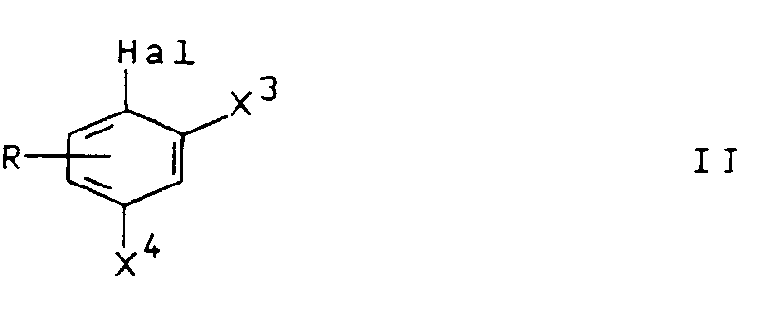
- X1 und X2 Amino bedeuten oder wie R definiert sind, wobei X1 wie R definiert ist, wenn X2 für Amino steht und X2 wie R definiert ist, wenn X1 für Amino steht, dadurch gekennzeichnet, daß man 2- bzw. 4-Halogennitrobenzole der allgemeinen Formel II,

- R wie oben definiert ist und
- X3 und X4 Nitro bedeuten oder wie R definiert sind, wobei X3 wie R definiert ist, wenn X4 für Nitro steht und X4 wie R definiert ist, wenn X3 für Nitro steht, mit Alkalisulfiden, Alkalihydrogensulfiden oder Alkalipolysulfiden in wäßrigem alkalischen Medium umsetzt, die Reaktionsprodukte bei pH-Werten von 4 bis 8 mit einem in Wasser schwer löslichen Lösungsmittel extrahiert, nach Abtrennen der wäßrigen Phase mit wäßrigen Alkalihydroxiden nachbehandelt und die Verbindungen der allgemeinen Formel bei pH-Werten von 4 bis 8 isoliert.
- Die Umsetzung der Verbindungen der allgemeinen Formel II mit Alkalisulfiden, -hydrogensulfiden oder - polysulfiden wird bevorzugt bei Temperaturen von 40 bis 150°C, besonders bevorzugt bei 60 bis 120°C, ausgeführt, wobei gegebenenfalls auch unter Druck gearbeitet werden kann. Bevorzugte Druckbereiche sind 1 - 6 bar.
- Dem wäßrigen Reaktionsmedium können beispielsweise auch mit Wasser gut oder schwer mischbare Lösungsmittel zugesetzt werden. Solche Lösungsmittel sind beispielsweise Toluol, 1,2-, 1,3- oder 1,4-Xylol, Mesizylen, Cyclohexan, Chlorbenzol, 2-Chlortoluol, 4-Chlortoluol, Tetralin, Alkohole, Glykole, Polyglykole, Glykol-mono- und -dialkylether, Polyglykol-mono- und -diglykolether, N-Methylpyrrolidon.
- Bevorzugte Alkalisulfide, -hydrogensulfide und -polysulfide sind beispielsweise Natriumsulfid, Kaliumsulfid, Natriumhydrogensulfid, Kaliumhydrogensulfid, Dinatriumdisulfid and Dikaliumdisulfid.
- Die Extraktion der Reaktionsprodukte mit in Wasser schwer löslichen Lösungsmitteln geschieht bevorzugt bei pH-Werten von 5 bis 7, wobei geeignete Lösungsmittel beispielsweise Hexan, Cyclohexan, Toluol, 2-, 3-oder 4-Chlor toluol, 1,2-, 1,3- oder 1,4-Xylol, Mesitylen, Tetralin, Chlorbenzol oder o-Dichlorbenzol sind.
- Die sich an Extraktion und Abtrennen der wäßrigen Phase anschließende Nachbehandlung wird bevorzugt bei Temperaturen von 70 bis 180°C, besonders bevorzugt bei 100 bis 150°C, ausgeführt, wobei gegebenenfalls auch unter Druck gearbeitet werden kann. Bevorzugte Druckbereiche sind 1 - 6 bar.
- Bevorzugte Alkalihydroxide sind Lithiumhydroxid, Natriumhydroxid und Kaliumhydroxid, die bevorzugt in Mengen von 0,5 bis 2 Mol, besonders bevorzugt 0,7 bis 1,5 Mol, pro Mol eingesetztes Chlornitrobenzol zugesetzt werden.
- Es kann vorteilhaft sein, den wäßrigen Alkalihydroxiden bei der genannten Nachbehandlung nicht- sulfidische Reduktionsmittel aus der Reihe der a-Hydroxycarbonylverbindungen oder Natriumboranat, gegebenenfalls in Gegenwart von Phasentransferkatalysatoren zuzusetzen. Dabei werden die nichtsulfidischen Reduktionsmittel bevorzugt in einer Menge bis zu 0,3 Mol pro Mol eingesetztes Chlornitrobenzol eingesetzt. Ein höherer Einsatz dieser Reduktionsmittel ist möglich, jedoch zur Erzielung optimaler Ausbeuten nicht erforderlich. Als nichtsulfidische Reduktionsmittel aus der Reihe der a-Hydroxycarbonylverbindungen kommen beispielsweise folgende a-Hydroxyaldehyde und a-Hydroxyketone sowie eine Reihe von Zuckern in Betracht, die zur Keto-Enol-Tautomerie befähigt sind: Glykolaldehyd, Glycerinaldehyd, Hydroxymalondialdehyd, Tetrosen wie Erythrose, Pentosen wie Ribose, Lyxose, Arabinose und Xylose, Hexosen wie Fructose, Glucose, Galaktose, Mannose und Allose, Hydroxyaceton, Dihydroxyaceton, Propionylcarbinol, Methylacetylcarbinol, Glucuronsäure und Ascorbinsäure.
- Phasentransferkatalysatoren, die den wäßrigen Alkalihydroxiden und nichtsulfidischen Reduktionsmitteln zugesetzt werden können, kommen beispielsweise aus der Reihe der quaternären Ammonium- bzw. Phosphoniumverbindungen sowie der Kronenether, Polyethylenglykoldialkylether sowie der Kryptate (s. z.B. Ch.M. Starks u. Ch. Liotta, Phase Transfer Catalysis, Academic Press, 1978; E.V. Dehmlov, Phase Transfer Reactions, Verlag Chemie, 1980; W.P. Weber u. G.W. Gokel, Phase Transfer Catalysis in Organic Synthesis, Springer Verlag, 1977).
- Die Isolierung der Verbindungen der allgemeinen Formel 1 geschieht bevorzugt bei pH-Werten von 5 bis 7.
- Bevorzugte Ausgangsprodukte der allgemeinen Formel II sind beispielsweise 2-Chlor-nitrobenzol, 2-Brom-nitrobenzol, 4-Chlor-nitrobenzol, 4-Brom-nitrobenzol, 2,5-Dichlornitrobenzol, 3,4-Dichlor-nitrobenzol, 4-Chlor-3-nitrotoluol und 4-Chlor-3-nitroanisol.
- Diese Verbindungen sind bekannt, nach allgemein bekannten Methoden herstellbar und/oder käuflich.
- Das erfindungsgemäße Verfahren liefert die Verbindungen der allgemeinen Formel I in überraschend hohen Ausbeuten von 85 bis 95% d.Theorie, bezogen auf eingesetztes Chlornitrobenzol. Dabei ist die Reinheit so hoch, daß in den meisten Fällen auf eine Reinigung durch Destillation oder Kristallisation verzichtet werden kann. Das erfindungsgemäße Verfahren ist somit dem bekannten Verfahren des Standes der Technik in wirtschaftlicher, aber auch in ökologischer Hinscht, erheblich überlegen und stellt einen wesentlichen Fortschritt dar.
- Die nach dem erfindungsgemäßen Verfahren hergestellten Verbindungen der allgemeinen Formel 1 sind wertvolle Ausgangsverbindungen zur Herstellung von Farbstoffen, Arzneimitteln, Pflanzenschutzmitteln sowie beispielsweise von aromatischen Polythioetheramiden und Epoxyharzen.
- 157,6 g (1 mol) 4-Chlornitrobenzol werden in eine Mischung von 200 ml Wasser und 2,5 g Emulsogen® *) EL eingetragen und unter gutem Rühren auf 70°C geheizt. Dann wird im Verlauf von 4 Stunden eine vorher aus 221 g Natrium-sulfid, 54,4 g Schwefel und 125 ml 10 N Natronlauge in 500 ml Wasser bereitete Dinatriumdisulfid-Lösung zugegeben. Nach der Zugabe rührt man 2 Stunden bei 100°C nach und entfernt geringe Mengen an 4-Chloranilin durch Wasserdampfdestillation. Der gelborangen Lösung werden zunächst 5 g Ak-
*) (Emulsogen ist ein eingetragenes Warenzeichen der Hoechst AG, Frankfurt am Main) tivkohle zugesetzt. Dann führt man eine Klarfiltration durch, setzt bei 20-25°C 350 ml Toluol zu und stellt durch Zugabe von 164 g 30%iger Salzsäure einen pH-Wert von 6 ein. Anschließend trennt man die gelborange Toluollösung von der wäßrigen Phase ab. Die Toluollösung wird in einen 1,3 I-VA-Autoklaven überführt und mit 270 ml Wasser sowie 140 ml 10 N Natronlauge versetzt. Anschließend heizt man unter gutem Rühren auf 130°C und rührt 4 Stunden bei 130°C nach (Druck: 3,0 bar). Das erhaltene Reaktionsgemisch wird nach Abkühlen auf 20-25°C mit 143 g 30%iger Salzsäure auf pH 6 gestellt. Man führt eine Phasentrennung durch und entfernt Toluol aus der organischen Toluolphase durch Destillation.
- Die Herstellung der Toluol-Lösung des Primärreduktionsproduktes aus 157,6 g 4-Chlor-nitrobenzol erfolgt nach den Angaben des Beispiels 1.
- Der Toluollösung werden 70 ml 10 N Natronlauge, 100 ml Wasser und 1 g Dimethyl-didecyl-ammoniumchlorid als Phasentransferkatalysator zugesetzt.
- Anschließend dosiert man unter gutem Rühren bei 50-55°C eine Lösung von 7,1 g Natriumboranat in 30 ml 10 N Natronlauge und 45 ml Wasser zu. Man rührt 4 Stunden bei 50-55°C nach, kühlt dann auf 20-25°C und versetzt mit 152 g 30%iger Salzsäure bis zu einem pH-Wert von 6.
- Nach Phasentrennung wird aus dem Toluol-Extrakt das Lösungsmittel durch Destillation entfernt.

- Die Herstellung des Primär-Reduktionsproduktes aus 157,6 g 4 Chlornitrobenzol erfolgt nach den Angaben des Beispiels 1, wobei die Extraktion mit 350 ml Xylol statt 350 ml Toluol erfolgt.
- Die von der wäßrigen Phase abgetrennte Xylollösung wird in einen 1,3 I VA-Autoklaven übergeführt und mit 270 ml Wasser, 140 ml 10 N Natronlauge und 31,2 g Glucose versetzt. Anschließend heizt man unter gutem Rühren auf 130°C und rührt 4 Stunden bei 130°C nach (Druck: 3,0 bar). Nach dem Abkühlen auf 20-25°C wird das Reaktionsgemisch mit 139,2 g 30%iger Salzsäure auf pH 6 gestellt.
- Aus der abgetrennten Xylolphase wird anschließend das Lösungsmittel durch Destillation entfernt.

- Man verfährt nach den Angaben des Beispiels 1, setzt jedoch statt 157,6 g 4-Chlornitrobenzol 157,6 g 2-Chlornitrobenzol ein.
- Die Toluollösung des Primär-Reduktinsproduktes wird analog Beispiel 1 in einem 1,3 I VA-Autoklaven mit 140 ml 10 N Natronlauge und 270 ml Wasser bei 130° (4 Stunden) unter Druck (3 bar) nachbehandelt.
- Nach Neutralisation des Reaktionsgemisches mit 30%iger Salzsäure bis zu einem pH-Wert von 5,5 und Abtrennen der Toluolphase gewinnt man 2-Aminothiophenol nach Abdestillieren des Lösungsmittels als gelbes Öl.

- Der folgenden Tabelle sind weitere Beispiele zur Herstellung von Verbindungen der allgemeinen Formel nach dem Verfahren des Beispiels 1 zu entnehmen, wobei in
- Spalte 2 das eingesetzte Chlornitrobenzol, in
- Spalte 3 die Menge an Alkalisulfid, Alkalihydrogensulfid oderAlkalipolysulfid pro mol Chlornitrobenzol, in
- Spalte 4 die Menge Alkalihydroxid bei der Nachbehandlung in mol pro mol Chlornitrobenzol, in
A - Spalte 5 das eingesetzte Reduktionsmittel in mol pro mol Chlornitrobenzol, in
- Spalte 6 der eingesetzte Phasentransferkatalysator in g pro mol Chlornitrobenzol, in
- Spalte 7 die Reaktionstemperatur und Zeit bei der Alkalinachbehandlung, in
- Spalte 8 das Produkt und in
- Spalte 9 die Ausbeute in % d.Theorie, bezogen auf eingesetztes Chlornitrobenzol angegeben ist.
-


Claims (10)

Applications Claiming Priority (2)
| Application Number | Priority Date | Filing Date | Title |
|---|---|---|---|
| DE3923894 | 1989-07-19 | ||
| DE3923894A DE3923894A1 (de) | 1989-07-19 | 1989-07-19 | Verfahren zur herstellung von 2- und 4-amino-thiophenolen |
Publications (2)
| Publication Number | Publication Date |
|---|---|
| EP0409009A1 EP0409009A1 (de) | 1991-01-23 |
| EP0409009B1 true EP0409009B1 (de) | 1993-11-10 |
Family
ID=6385387
Family Applications (1)
| Application Number | Title | Priority Date | Filing Date |
|---|---|---|---|
| EP90112890A Expired - Lifetime EP0409009B1 (de) | 1989-07-19 | 1990-07-06 | Verfahren zur Herstellung von 2- und 4-Amino-thiophenolen |
Country Status (2)
| Country | Link |
|---|---|
| EP (1) | EP0409009B1 (de) |
| DE (2) | DE3923894A1 (de) |
Families Citing this family (1)
| Publication number | Priority date | Publication date | Assignee | Title |
|---|---|---|---|---|
| CN119034284B (zh) * | 2024-08-20 | 2025-06-06 | 吉林普瑞特生物科技有限公司 | 一种高纯邻氨基苯硫酚的制备方法 |
Family Cites Families (3)
| Publication number | Priority date | Publication date | Assignee | Title |
|---|---|---|---|---|
| DE2127898C3 (de) * | 1971-06-04 | 1973-11-08 | Farbwerke Hoechst Ag, Vormals Meister Lucius & Bruening, 6000 Frankfurt | Verfahren zur Herstellung von ge gebenenfalls inert substituierten o und p Aminothiophenolen |
| DE2706104A1 (de) * | 1977-02-12 | 1978-08-17 | Bayer Ag | Verfahren zur herstellung von aminophenylthioaethern |
| US5157142A (en) * | 1986-06-17 | 1992-10-20 | Hoechst Celanese Corporation | Thiocarbamates and their derivatives |
-
1989
- 1989-07-19 DE DE3923894A patent/DE3923894A1/de not_active Withdrawn
-
1990
- 1990-07-06 DE DE90112890T patent/DE59003424D1/de not_active Expired - Fee Related
- 1990-07-06 EP EP90112890A patent/EP0409009B1/de not_active Expired - Lifetime
Also Published As
| Publication number | Publication date |
|---|---|
| EP0409009A1 (de) | 1991-01-23 |
| DE3923894A1 (de) | 1991-01-31 |
| DE59003424D1 (de) | 1993-12-16 |
Similar Documents
| Publication | Publication Date | Title |
|---|---|---|
| EP0632022B1 (de) | Verfahren zur Herstellung von aminosubstituierten Thioethern | |
| DE2855764C2 (de) | ||
| EP0297028B1 (de) | Verfahren zur Herstellung chlorierter Diphenylether | |
| EP0025843B1 (de) | Herstellung von Monoalkylethern von Hydroxyphenolen und deren Umwandlung zu Hydroxycumaranen | |
| DE1014989B (de) | Verfahren zur Herstellung von aromatischen Dithiophosphinsaeuren bzw. deren Salzen | |
| DE2330589A1 (de) | Verfahren zur herstellung eines salzes einer omega-nitrocarbonsaeure | |
| DE2305217C3 (de) | Neue Sulfone mit 1,6-Dimethylhexadien-(l,5)-ylen-Verkettung und Verfahren zu ihrer Herstellung | |
| EP0279388B1 (de) | Verfahren zur Herstellung von 4,4'-dichlordiphenylsulfonen | |
| EP0089517B1 (de) | Verfahren zur Herstellung von Diphenyläthern | |
| DE69100196T2 (de) | Verfahren zur Herstellung von Benzylaminen. | |
| EP0409009A1 (de) | Verfahren zur Herstellung von 2- und 4-Amino-thiophenolen | |
| EP0237480B1 (de) | Verfahren zur Herstellung von 2-Alkoxybenzosulfonamiden | |
| DE19829357A1 (de) | Verfahren zur Herstellung von 2-Nitro-5-(phenylthio)-anilinen | |
| EP0212301B1 (de) | Verfahren zur Herstellung von 2-Aminophenyl-thioethern | |
| DE3043230A1 (de) | Herstellung von monoalkylaethern von hydroxyphenolen | |
| EP0051782B1 (de) | Verfahren zur Herstellung von m-halogensubstituierten Anilinen | |
| DE2416722A1 (de) | Verfahren zur herstellung von nitrohalogenophenolen | |
| CH665638A5 (de) | Verfahren zur herstellung von 2,3-dihydro-7-aminobenzofuranen. | |
| EP0375617A1 (de) | Verfahren zur Herstellung von Pyrimidinderivaten | |
| DE2614825C3 (de) | Verfahren zur Herstellung von Aminonitrophenolen | |
| DE2450883B2 (de) | Verfahren zur Herstellung von 1-substituierten Anthrachinonen | |
| EP0095067B1 (de) | Verfahren zur Herstellung gegebenenfalls substituierter 1,2,3,4-Tetrahydro-9-cyanmethyl-carbazol-1-onen | |
| DE2503164A1 (de) | Verfahren zur herstellung von dithiodianilinen | |
| EP0002526A1 (de) | Verfahren zur gleichzeitigen Herstellung von 1,3-disubstituierten Harnstoffen und 1,2-Diolen | |
| DE2127898C3 (de) | Verfahren zur Herstellung von ge gebenenfalls inert substituierten o und p Aminothiophenolen |
Legal Events
| Date | Code | Title | Description |
|---|---|---|---|
| PUAI | Public reference made under article 153(3) epc to a published international application that has entered the european phase |
Free format text: ORIGINAL CODE: 0009012 |
|
| AK | Designated contracting states |
Kind code of ref document: A1 Designated state(s): CH DE FR GB IT LI |
|
| 17P | Request for examination filed |
Effective date: 19901224 |
|
| 17Q | First examination report despatched |
Effective date: 19920827 |
|
| GRAA | (expected) grant |
Free format text: ORIGINAL CODE: 0009210 |
|
| AK | Designated contracting states |
Kind code of ref document: B1 Designated state(s): CH DE FR GB IT LI |
|
| ITF | It: translation for a ep patent filed | ||
| REF | Corresponds to: |
Ref document number: 59003424 Country of ref document: DE Date of ref document: 19931216 |
|
| GBT | Gb: translation of ep patent filed (gb section 77(6)(a)/1977) |
Effective date: 19940117 |
|
| ET | Fr: translation filed | ||
| PGFP | Annual fee paid to national office [announced via postgrant information from national office to epo] |
Ref country code: GB Payment date: 19940707 Year of fee payment: 5 |
|
| PGFP | Annual fee paid to national office [announced via postgrant information from national office to epo] |
Ref country code: FR Payment date: 19940713 Year of fee payment: 5 |
|
| PGFP | Annual fee paid to national office [announced via postgrant information from national office to epo] |
Ref country code: CH Payment date: 19940810 Year of fee payment: 5 |
|
| PLBE | No opposition filed within time limit |
Free format text: ORIGINAL CODE: 0009261 |
|
| STAA | Information on the status of an ep patent application or granted ep patent |
Free format text: STATUS: NO OPPOSITION FILED WITHIN TIME LIMIT |
|
| 26N | No opposition filed | ||
| PG25 | Lapsed in a contracting state [announced via postgrant information from national office to epo] |
Ref country code: GB Effective date: 19950706 |
|
| PG25 | Lapsed in a contracting state [announced via postgrant information from national office to epo] |
Ref country code: LI Effective date: 19950731 Ref country code: CH Effective date: 19950731 |
|
| PGFP | Annual fee paid to national office [announced via postgrant information from national office to epo] |
Ref country code: DE Payment date: 19950804 Year of fee payment: 6 |
|
| GBPC | Gb: european patent ceased through non-payment of renewal fee |
Effective date: 19950706 |
|
| REG | Reference to a national code |
Ref country code: CH Ref legal event code: PL |
|
| PG25 | Lapsed in a contracting state [announced via postgrant information from national office to epo] |
Ref country code: FR Effective date: 19960430 |
|
| REG | Reference to a national code |
Ref country code: FR Ref legal event code: ST |
|
| REG | Reference to a national code |
Ref country code: FR Ref legal event code: ST |
|
| REG | Reference to a national code |
Ref country code: FR Ref legal event code: ST |
|
| PG25 | Lapsed in a contracting state [announced via postgrant information from national office to epo] |
Ref country code: DE Effective date: 19970402 |
|
| PG25 | Lapsed in a contracting state [announced via postgrant information from national office to epo] |
Ref country code: IT Free format text: LAPSE BECAUSE OF NON-PAYMENT OF DUE FEES;WARNING: LAPSES OF ITALIAN PATENTS WITH EFFECTIVE DATE BEFORE 2007 MAY HAVE OCCURRED AT ANY TIME BEFORE 2007. THE CORRECT EFFECTIVE DATE MAY BE DIFFERENT FROM THE ONE RECORDED. Effective date: 20050706 |