EP0408887A2 - Oligosaccharidalditole mit Amidbindung sowie Verfahren zu ihrer Herstellung - Google Patents
Oligosaccharidalditole mit Amidbindung sowie Verfahren zu ihrer Herstellung Download PDFInfo
- Publication number
- EP0408887A2 EP0408887A2 EP90111015A EP90111015A EP0408887A2 EP 0408887 A2 EP0408887 A2 EP 0408887A2 EP 90111015 A EP90111015 A EP 90111015A EP 90111015 A EP90111015 A EP 90111015A EP 0408887 A2 EP0408887 A2 EP 0408887A2
- Authority
- EP
- European Patent Office
- Prior art keywords
- alditol
- amide bond
- formula
- mono
- oligosaccharide
- Prior art date
- Legal status (The legal status is an assumption and is not a legal conclusion. Google has not performed a legal analysis and makes no representation as to the accuracy of the status listed.)
- Ceased
Links
- 0 *[C@@]([C@@]([C@@](CO[C@](C(C1O)O)OC(CN=O)[C@]1O)O)O)C(N[C@](CN=O)[C@]([C@@](C(CO[C@](C(C1O)O)O[C@](CO)[C@]1O)O)N=O)O)=O Chemical compound *[C@@]([C@@]([C@@](CO[C@](C(C1O)O)OC(CN=O)[C@]1O)O)O)C(N[C@](CN=O)[C@]([C@@](C(CO[C@](C(C1O)O)O[C@](CO)[C@]1O)O)N=O)O)=O 0.000 description 2
Classifications
-
- C—CHEMISTRY; METALLURGY
- C07—ORGANIC CHEMISTRY
- C07H—SUGARS; DERIVATIVES THEREOF; NUCLEOSIDES; NUCLEOTIDES; NUCLEIC ACIDS
- C07H15/00—Compounds containing hydrocarbon or substituted hydrocarbon radicals directly attached to hetero atoms of saccharide radicals
- C07H15/02—Acyclic radicals, not substituted by cyclic structures
- C07H15/04—Acyclic radicals, not substituted by cyclic structures attached to an oxygen atom of the saccharide radical
-
- C—CHEMISTRY; METALLURGY
- C07—ORGANIC CHEMISTRY
- C07C—ACYCLIC OR CARBOCYCLIC COMPOUNDS
- C07C235/00—Carboxylic acid amides, the carbon skeleton of the acid part being further substituted by oxygen atoms
- C07C235/02—Carboxylic acid amides, the carbon skeleton of the acid part being further substituted by oxygen atoms having carbon atoms of carboxamide groups bound to acyclic carbon atoms and singly-bound oxygen atoms bound to the same carbon skeleton
- C07C235/04—Carboxylic acid amides, the carbon skeleton of the acid part being further substituted by oxygen atoms having carbon atoms of carboxamide groups bound to acyclic carbon atoms and singly-bound oxygen atoms bound to the same carbon skeleton the carbon skeleton being acyclic and saturated
- C07C235/08—Carboxylic acid amides, the carbon skeleton of the acid part being further substituted by oxygen atoms having carbon atoms of carboxamide groups bound to acyclic carbon atoms and singly-bound oxygen atoms bound to the same carbon skeleton the carbon skeleton being acyclic and saturated having the nitrogen atom of at least one of the carboxamide groups bound to an acyclic carbon atom of a hydrocarbon radical substituted by singly-bound oxygen atoms
Definitions
- the present invention relates to oligosaccharidalditols with an amide bond, hereinafter called amido-oligosaccharides, corresponding to formulas I, II, III, IV mentioned in claim 1 and claims 2 to 4, and to the preparation thereof by known N-acylation of aminopolyols derived from saccharides with glyconic acids, the acid component being activated at the carboxyl function.
- amidooligosaccharides formed by the reaction of these aminopolyols with the glyconic acids, are a class of compounds not yet described in the literature.
- Aminopolyols e.g. Glucamine, mannamine, maltamine or isomaltamine are obtained by reductive amination of reducing mono-, di- or oligosaccharides such as glucose, mannose, fructose, sorbose, arabinose, maltose, isomaltose, maltulose, isomaltulose, trehalulose, lactose, cellobiose and higher oligosaccharides as well reducing deoxy sugars, such as rhamnose and C-branched carbohydrates in ammonia or hydrazine with hydrogen with nickel catalysis (cf. DE 35 38 451 and DE 36 25 931).
- reducing mono-, di- or oligosaccharides such as glucose, mannose, fructose, sorbose, arabinose, maltose, isomaltose, maltulose, isomaltulose, trehalulose, lactose,
- Glyconic acids are easily accessible from various carbohydrates using various oxidative processes, e.g. gluconic acid, arabic acid or glucopyranosylarabonic acid (see overview: J. Stanek, M. Cern , J. Kocourek and J. Pacák, "The Monosaccharides", Academic Press, New York, 1963, p. 138 ff., And cited there. Literature, as well as meth. Carbohydr. Chem. II, 11-26 (1963); Spengler, - O., Pfannenstiel, A .: Z. Zuckerind. 85 (1935), 546; DRP 618 164, 62o248 (1934); DE-OS 32 48 404, EP O 114 954).
- the acid component To react to the amidooligosaccharide, the acid component must be activated on the carboxyl function; this can e.g. B. as an ester, acid halide or lactone.
- the linking reaction takes place in alcoholic solution (preferably methanol) or in aprotic polar solvents (preferably dimethylformamide) at temperatures between 20 ° and 120 ° C., preferably at 60 ° C.
- alcoholic solution preferably methanol
- aprotic polar solvents preferably dimethylformamide
- the residue can be separated by chromatography after evaporation of the solvent.
- Gel chromatography with water as the eluent has proven particularly useful since the claimed compounds elute as the first fraction according to their molecular size, while unreacted starting products have longer retention times and can be recovered separately.
Landscapes
- Chemical & Material Sciences (AREA)
- Organic Chemistry (AREA)
- Crystallography & Structural Chemistry (AREA)
- Health & Medical Sciences (AREA)
- Life Sciences & Earth Sciences (AREA)
- Engineering & Computer Science (AREA)
- Biochemistry (AREA)
- Biotechnology (AREA)
- General Health & Medical Sciences (AREA)
- Genetics & Genomics (AREA)
- Molecular Biology (AREA)
- Saccharide Compounds (AREA)
Abstract

R₁ = Alditolteil eines Mono-, Di- oder Oligosaccharidalditols, in dem der Alditolteil 2 bis 6 Kohlenstoffatome aufweist,
R₂ = Alditolteil eines Mono-, Di- oder Oligosaccharidaltols, in dem der Alditolteil 3 bis 7 Kohlenstoffatome aufweist und mit dem endständigen oder einem anderen Kohlenstoffatom verknüpft ist.
Description
- Die vorliegende Erfindung betrifft Oligosaccharidalditole mit Amidbindung, im folgenden Amidooligosaccharide genannt, entsprechend der in Anspruch 1 sowie in den Ansprüchen 2 bis 4 genannten Formeln I, II, III, IV sowie die Herstellung derselben durch an sich bekannte N-Acylierung von aus Sacchariden abgeleiteten Aminopolyolen mit Glyconsäuren, wobei die Säurekomponente an der Carboxylfunktion aktiviert ist. Amidooligosaccharide, gebildet durch Reaktion von diesen Aminopolyolen mit den Glyconsäuren, sind eine in der Literatur noch nicht beschriebene Verbindungsklasse. Amidooligosaccharide entsprechen der allgemeinen Formel

R₁ = Alditolteil eines Mono-, Di- oder Oligosaccharidalditols, in dem der Alditolteil 2 bis 6 Kohlenstoffatome aufweist,
R₂ = Alditolteil eines Mono-, Di- oder Oligosaccharidalditols, in dem der Alditolteil 3 bis 7 Kohlenstoffatome aufweist und mit dem endständigen oder einem anderen Kohlenstoffatom verknüpft ist. - Die Konstitution der erhaltenen und beanspruchten Verbindungen entsprechend den Formeln

- Aminopolyole, wie z.B. Glucamin, Mannamin, Maltamin oder Isomaltamin, werden durch reduktive Aminierung von reduzierenden Mono-, Di- oder Oligosacchariden wie beispielsweise Glucose, Mannose, Fructose, Sorbose, Arabinose, Maltose, Isomaltose, Maltulose, Isomaltulose, Trehalulose, Laktose, Cellobiose und höhere Oligosaccharide sowie reduzierende Desoxyzucker, wie beispielsweise Rhamnose und C-verzweigte Kohlenhydrate in Ammoniak oder Hydrazin mit Wasserstoff unter Nickel-Katalyse erhalten (vgl. DE 35 38 451 und DE 36 25 931).
- Glyconsäuren sind über verschiedene oxidative Verfahren aus reduzierenden Kohlenhydraten leicht zugänglich, z.B. Gluconsäure, Arabonsäure oder Glucopyranosylarabon säure (vgl. Übersicht: J. Stanek, M. Cern, J. Kocourek und J. Pacák, "The Monosaccharides", Academic Press, New York, 1963, S. 138 ff., und dort zit. Literatur, sowie Meth. Carbohydr. Chem. II, 11-26 (1963); Spengler, - O., Pfannenstiel, A.: Z. Zuckerind. 85 (1935), 546; D.R.P. 618 164, 62o 248 (1934); DE-OS 32 48 404, EP O 114 954).

- Zur Reaktion zum Amidooligosaccharid muß die Säurekomponente an der Carboxylfunktion aktiviert werden; dies kann z. B. als Ester, Säurehalogenid oder Lacton erfolgen.
- Die Verknüpfungsreaktion erfolgt in alkoholischer Lösung (vorzugsweise Methanol) oder in aprotisch polaren Lösungsmitteln (vorzugsweise Dimethylformamid) bei Temperaturen zwischen 20° und 120°C, vorzugsweise bei 60°C.
- Die Additionsprodukte, entsprechend der Formel I, fallen während der Reaktion oder beim Abkühlen des Lösungsmittels in fester Form aus und können durch Umkristallisation weiter gereinigt werden.
- Im Falle, daß kein abtrennbares Produkt in fester Form ausfällt, kann nach Verdampfung des Lösungsmittels der Rückstand durch chromatographische Verfahren aufgetrennt werden. Hierbei hat sich besonders die Gelchromatographie mit Wasser als Eluens bewährt, da die beanspruchten Verbindungen entsprechend ihrer Molekulargröße als erste Fraktion eluieren, während nicht umgesetzte Ausgangsprodukte längere Retentionszeiten aufweisen und getrennt wiedergewonnen werden können.
- Die Konstitution der erhaltenen Amidooligosaccharide ist durch ¹³C-NMR-spektroskopische Daten abgesichert.
-

- Je 5,3 g (30 mmol) Glucamin und Gluconsäurelacton werden zusammen in 100 ml wasserfreiem Methanol unter Erwärmung gelöst. Der Reaktionsansatz wird ca. 8 h unter Rückflußkühlung erhitzt, wobei nach einigen Stunden kristallines Disaccharid ausfällt. Der Niederschlag wird abgesaugt, mit kaltem Methanol gewaschen und im Vakuum bei 40°C getrocknet. Die Ausbeute betrug 8 g (76 %). Es wurde ein Schmelzpunkt von 145-148°C und eine optische Drehung von [α]

-

- 0,5 g (3,0 mmol) Mannamin und 1 g (3,0 mmol) Glucopyranosylarabonsäurelacton werden zusammen in 15 ml wasserfreiem Methanol gelöst und unter Rückflußkühlung erhitzt. Nach 8 h Reaktionszeit werden die farblosen Kristalle des Trisaccharides abgesaugt, aus heißem Methanol umkristallisiert und im Vakuum bei 40°C getrocknet. Die Ausbeute betrug 0,7 g (47 %). Es wurde ein Schmelzpunkt von 191-195°C und eine optische Drehung von[α]

-

- Zur Abtrennung des Tetrasaccharides wird eine Gelchromatographie durchgeführt. Man erhält nach dem Einengen und Trocknen einen nichtkristallinen Schaum. Die Ausbeute betrug 13,2 g (46 %). Es wurde ein Schmelzpunkt von 70-72°C und eine optische Drehung von[α]

Claims (5)
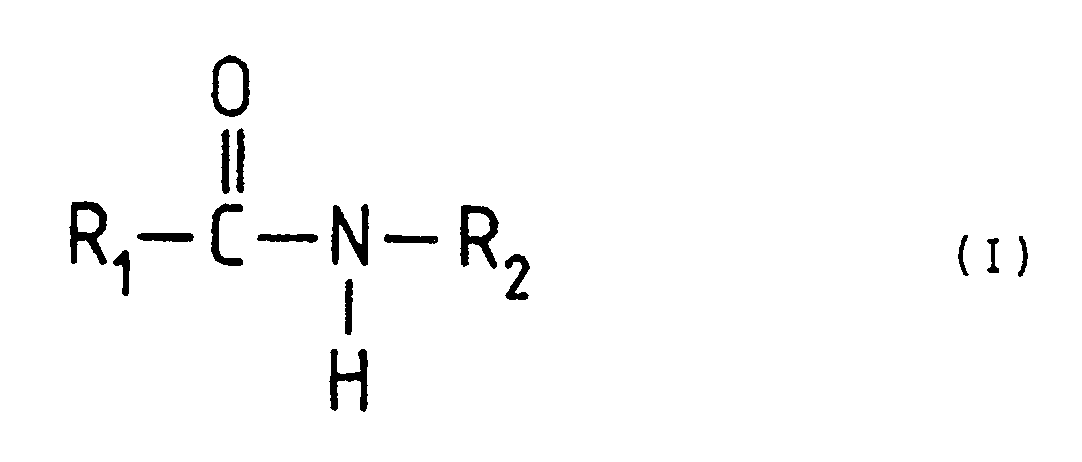
R₁ = Alditolteil eines Mono-, Di- oder Oligosaccharidalditols, in dem der Alditolteil 2 bis 6 Kohlenstoffatome aufweist,
R₂ = Alditolteil eines Mono-, Di- oder Oligosaccharidalditols, in dem der Alditolteil 3 bis 7 Kohlenstoffatome aufweist und mit dem endständigen oder einem anderen Kohlenstoffatom verknüpft ist.


N-Acylierung von Aminopolyolen, die in an sich bekannter Weise über eine reduktive Aminierung von reduzierenden Mono-, Di- oder Oligosacchariden gewonnen wurden, in einem Lösungsmittel wie Methanol oder in aprotisch polaren Lösungsmitteln, wie Dimethylformamid, mit einem Glyconsäureanhydrid, -ester, -halogenid oder -lacton,
ggfs. in Gegenwart einer basischen Substanz, bei Temperaturen zwischen 20°C und 120°C, vorzugsweise bei 60°C, mit anschließender Isolierung und Reinigung der so erhaltenen Verbindungen entweder durch Fällung, Kristallisation, Extraktion oder durch chromatographische Verfahren.
Applications Claiming Priority (2)
| Application Number | Priority Date | Filing Date | Title |
|---|---|---|---|
| DE3923365 | 1989-07-14 | ||
| DE3923365A DE3923365A1 (de) | 1989-07-14 | 1989-07-14 | Oligosaccharidalditole mit amidbindung sowie verfahren zu ihrer herstellung |
Publications (2)
| Publication Number | Publication Date |
|---|---|
| EP0408887A2 true EP0408887A2 (de) | 1991-01-23 |
| EP0408887A3 EP0408887A3 (en) | 1991-03-20 |
Family
ID=6385066
Family Applications (1)
| Application Number | Title | Priority Date | Filing Date |
|---|---|---|---|
| EP19900111015 Ceased EP0408887A3 (en) | 1989-07-14 | 1990-06-11 | Oligosaccharide alditols with an amide bond and process for their preparation |
Country Status (3)
| Country | Link |
|---|---|
| US (1) | US5120839A (de) |
| EP (1) | EP0408887A3 (de) |
| DE (1) | DE3923365A1 (de) |
Family Cites Families (6)
| Publication number | Priority date | Publication date | Assignee | Title |
|---|---|---|---|---|
| DE3274330D1 (en) * | 1982-08-02 | 1987-01-08 | Unitika Ltd | An intravenous nutrient |
| DE3248404A1 (de) * | 1982-12-28 | 1984-06-28 | Süddeutsche Zucker AG, 6800 Mannheim | Derivate und reduktionsprodukte der d-glucopyranosyl-(alpha)(1->5)-d-arabonsaeure, deren herstellung und verwendung |
| US4719294A (en) * | 1985-09-06 | 1988-01-12 | Monsanto Company | Isolation of unreduced oligosaccharides |
| DE3538451A1 (de) * | 1985-10-29 | 1987-05-07 | Sueddeutsche Zucker Ag | Fettsaeureamide von aminopolyolen als nichtionogene tenside |
| DE3625931A1 (de) * | 1986-07-31 | 1988-02-04 | Sueddeutsche Zucker Ag | Isomaltamine sowie deren n-acylderivate, verfahren zu deren herstellung und ihre verwendung |
| EP0342599A3 (de) * | 1988-05-17 | 1991-07-17 | Fuji Photo Film Co., Ltd. | Polyacetyloligosaccharid-Derivate |
-
1989
- 1989-07-14 DE DE3923365A patent/DE3923365A1/de not_active Withdrawn
-
1990
- 1990-06-11 EP EP19900111015 patent/EP0408887A3/de not_active Ceased
- 1990-06-19 US US07/540,060 patent/US5120839A/en not_active Expired - Fee Related
Also Published As
| Publication number | Publication date |
|---|---|
| EP0408887A3 (en) | 1991-03-20 |
| US5120839A (en) | 1992-06-09 |
| DE3923365A1 (de) | 1991-01-24 |
Similar Documents
| Publication | Publication Date | Title |
|---|---|---|
| DE3625931C2 (de) | ||
| DE68922241T2 (de) | Verfahren zur Herstellung von Erythromcin A-oxim oder eines Salzes davon. | |
| EP0306650B1 (de) | Verfahren zur Herstellung von Alkyloligoglycosiden | |
| EP0220676A1 (de) | Fettsäureamide von Aminopolyolen als nichtionogene Tenside | |
| DE19705664B4 (de) | Verfahren zur Herstellung 1,1-GPM angereicherter Phasen mit über 75 Gew.-% a.TS bis über 99 Gew.-% a.TS 1,1-GPM und 1,6-GPS angereicherter Phasen mit über 80 Gew.-% a.TS bis über 99 Gew.-% a.TS 1,6 GPS | |
| DE2104620C3 (de) | Verfahren zur Herstellung von a -L-Aspartyl-Lphenylalanin-und a -L- Aspartyl-L-ryrosin-C,. bis C 3-alkylestern | |
| EP0426176B1 (de) | 5-(alpha-D-Glucopyranosyloxymethyl)-furan-2-carboxaldehyd und dessen Derivate und Folgeprodukte sowie Verfahren zur Herstellung der Verbindungen und deren Verwendung | |
| EP0328959A2 (de) | Verfahren zur Reinigung von langkettigen Alkylglucosiden | |
| DE3235372C2 (de) | ||
| DE69211756T2 (de) | Verfahren zur Herstellung von alpha-L-aspartyl-L-phenylalaninmethylester | |
| DE3923365A1 (de) | Oligosaccharidalditole mit amidbindung sowie verfahren zu ihrer herstellung | |
| DD297167A5 (de) | Oligosaccharidalditole mit amidbindung sowie verfahren zu ihrer herstellung | |
| DE1543203A1 (de) | Neue Furanoside und Verfahren zu ihrer Herstellung | |
| DE2340114C2 (de) | Verfahren zur Herstellung von Aminoanthrachinonen | |
| AT392474B (de) | Verfahren zur herstellung von glucosylmoranolin | |
| WO1999024390A1 (de) | Herstellung von aminohalogencrotonaten | |
| DE69727680T2 (de) | Stereospezifische Mannosylierung mit hoher Ausbeute | |
| EP0086258B1 (de) | Verfahren zur Trennung des Racemats (R,S)-Cystein | |
| DE1543811B1 (de) | Verfahren zur Trennung von racemischem Carnitinnitril in seine optisch aktiven Antipoden | |
| AT390959B (de) | Verfahren zur herstellung von moranolinderivaten | |
| DE2730846A1 (de) | Neue acylierte beta-d-1-(6-amino- 9h-purin-9-yl)-1-deoxyribofuranuronsaeureaethylamide, verfahren zu deren herstellung und sie enthaltende arzneimittel | |
| DE3874291T2 (de) | Reines kristallines methyl-2-acryl-amino-2-methoxy-acetat und verfahren zu dessen herstellung. | |
| DE69818460T2 (de) | Verfahren zur herstellung von etoposid | |
| DE2227504C3 (de) | Verfahren zur Herstellung von trans-4-Aminomethylcyclohexan-i-carbonsäure oder deren Salzen | |
| DE69407180T2 (de) | Fluoro-nukleosid-reinigung |
Legal Events
| Date | Code | Title | Description |
|---|---|---|---|
| PUAI | Public reference made under article 153(3) epc to a published international application that has entered the european phase |
Free format text: ORIGINAL CODE: 0009012 |
|
| AK | Designated contracting states |
Kind code of ref document: A2 Designated state(s): AT BE CH DE DK ES FR GB GR IT LI NL SE |
|
| PUAL | Search report despatched |
Free format text: ORIGINAL CODE: 0009013 |
|
| AK | Designated contracting states |
Kind code of ref document: A3 Designated state(s): AT BE CH DE DK ES FR GB GR IT LI NL SE |
|
| 17P | Request for examination filed |
Effective date: 19910905 |
|
| 17Q | First examination report despatched |
Effective date: 19911125 |
|
| STAA | Information on the status of an ep patent application or granted ep patent |
Free format text: STATUS: THE APPLICATION HAS BEEN REFUSED |
|
| 18R | Application refused |
Effective date: 19941120 |