EP0405593A2 - Hochfrequenzmesseinrichtung mit verkabelter Messwerterfassung und Signal-Kompandierung - Google Patents
Hochfrequenzmesseinrichtung mit verkabelter Messwerterfassung und Signal-Kompandierung Download PDFInfo
- Publication number
- EP0405593A2 EP0405593A2 EP90112480A EP90112480A EP0405593A2 EP 0405593 A2 EP0405593 A2 EP 0405593A2 EP 90112480 A EP90112480 A EP 90112480A EP 90112480 A EP90112480 A EP 90112480A EP 0405593 A2 EP0405593 A2 EP 0405593A2
- Authority
- EP
- European Patent Office
- Prior art keywords
- signal
- output
- gain
- variable gain
- preamplifier
- Prior art date
- Legal status (The legal status is an assumption and is not a legal conclusion. Google has not performed a legal analysis and makes no representation as to the accuracy of the status listed.)
- Granted
Links
Images



Classifications
-
- G—PHYSICS
- G01—MEASURING; TESTING
- G01R—MEASURING ELECTRIC VARIABLES; MEASURING MAGNETIC VARIABLES
- G01R27/00—Arrangements for measuring resistance, reactance, impedance, or electric characteristics derived therefrom
- G01R27/28—Measuring attenuation, gain, phase shift or derived characteristics of electric four pole networks, i.e. two-port networks; Measuring transient response
Definitions
- the present invention generally relates to a high frequency signal measuring equipment and, more particularly, to a high frequency signal measuring equipment having a cabled detector.
- a high-frequency signal measuring apparatus detector having a cabled detector such as a network analyzer or a level measuring device, generally has the following unique problems. That is, since a cabled detector is naturally, easily affected by signal attenuation or external noise, a dynamic range is limited and the measuring result has a large amount of errors.
- a high-precision measuring technique applied to a scalar network analyzer for measuring a value of transmission or impedance of a circuit (circuit element) as a function of the frequency of an input signal is disclosed in U.S. Patent No. 4,647,845.
- a cabled detector is arranged as an AC/DC detector used by switching two detector modes, i.e., a DC detector mode for a continuous wave input signal and an AC detector mode for a high-frequency pulse input signal.
- An output from the AC/DC detector is added to an AC network analyzer as a test signal through a cable line.
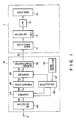
- the scalar network analyzer on only an AC/DC detector side serving as a cabled detector, measuring error mixing caused by the signal attenuation or the external noise is prevented to realize high-precision measurement, and the scalar network analyzer has an arrangement shown in Fig. 1.
- An AC/DC detector 18 includes an RF detector 40 that is connected to a chopper 44.
- the RF detector 40 detects an RF signal 28 supplied on a line 16 and transforms it into a rectified signal supplied on a line 42.
- the magnitude of the rectified signal supplied on the line 42 is proportional to the amplitude of the RF signal 28.
- the chopper 44 modulates the rectified signal supplied on the line 42 to produce a modulated signal supplied on a line 46.
- the chopper 44 simply supplies the modulated signal, unaltered, on the line 42.
- the chopper 44 does not modulate the rectified signal because when a pulsed RF signal is rectified, that rectified signal is already a modulated signal.
- the modulated signal supplied on the line 46 is amplified by a preamplifier 48 to produce an amplified signal supplied on a line 50.
- this amplified signal supplied on the line 50 is sampled by a sampler 52 to produce a sampled signal, supplied on a line 54. Sampling is done to eliminate any feed generated by the chopper 44. In the AC detection mode, no sampling is needed since no chipping has taken place.
- the sampler 52 simply supplies the amplified signal on the line 54 as the sampled signal.
- a buffer-compensator 56 buffers the sampled signal supplied on the line 54 and removes from the sampled signal supplied on the line 54 an unwanted signal due to a parasitic capacitance of the sampler 52. This produces modulated signal 30 supplied on a line 20.
- An oscillator and timing logic 58 controls both the chopper 44 and the sampler 52.
- the chopper 44 is controlled by a first control signal supplied on a line 60 and a second control signal supplied on a line 62.
- the sampler 52 is controlled by a third control signal supplied on a line 64 As described in greater detail later, the first control signal and the second control signal open and close the chopper 44.
- the third control signal opens and closes the sampler 52.
- the oscillator and timing logic 58 is controlled by a mode selector 59.
- the mode selector 59 establishes in which the mode AC/DC detector 18 will be set. While set in the AC detection mode, the timing and oscillator logic 58 provides the first and second control signals to the chopper 44 and the third control signal to the sampler 52 such that no chopping or sampling is done. While set in the DC detection mode, the timing and oscillator logic 58 provides the chopper 44 with the first and second control signals which open and close the chopper 44 at a frequency of 27.77 kHz, and the sampler 52 with the third control signal which opens and closes the sampler at a frequency of 55.55 kHz. Both modes supply the modulated signal 30 on the cable line 20.
- the chopper 44 is provided to convert a DC signal into a pulse signal having a predetermined frequency and to suppress an influence of current level variation in the preamplifier 48.
- the signal to be measured converted into a pulse signal input to an AC detecting network analyzer (measuring equipment body) 1 is amplified by a main amplifier 11 again, detected by a detector 12; and converted into a DC signal again.
- the signal to be measured converted into the DC signal is input to an analyzer 14 through a low-pass filter 13.
- the analyzer 14 performs predetermined analysis for the DC signal to be measured which is input, and the result is displayed on, e.g., a display screen of an operation panel (not shown).
- the signal to be measured input from the signal detecting terminal or connector 6 is detected and amplified by an AC/DC detector 18 and transmitted to the measuring equipment body 1 through the cable line 20, a decrease in S/N ratio due to attenuation of the signal to be measured or noise in the cable line 20 can be prevented compared with a case wherein the signal to be measured is input from the signal detecting terminal or connector 6 through the cable line 20 to the measuring equipment body 1.
- the preamplifier 48 is a simple linear amplifier, and a log amplifier is used as the main amplifier 11 to perform a dB display.
- a linear amplitude characteristic in which a gain is constant independently of a signal level of an input signal.
- Fig. 2 is graph showing a relationship between an input signal level V I and an output signal level V O of the preamplifier 48 installed in the AC/DC detector 18.
- a dynamic range is limited so that an excessive signal is input to saturate an output signal.
- a signal level of the input signal corresponding to a saturation level V OH of the output signal is a maximum input value V IH .
- a minimum input value V IL is a signal level of an input signal corresponding to a lower limit level V OL which can assure an S/N ratio having a predetermined value or more.
- an allowable range of the input signal level V I to the preamplifier 48 is limited within the range of V IL to V IH an allowable measuring range of the signal to be measured of the whole scalar network analyzer is limited within the range of V IL to V IH .
- variable gain preamplifier having first and second gains representing amplification factors which are decreased according to an increase in input signal level arranged on a cabled detector side
- a small input signal can be amplifed to have a large magnitude
- a large input signal can be amplified to have a small magnitude
- an allowable range of an input signal level to the preamplifier can be largely widened
- a variable gain main amplifier having first and second gains representing amplification factors of which are increased according to an increase in an input signal level is arranged on a measuring equipment body side
- an allowable measuring range of the signal to be measured of the whole measuring equipment can be largely widened, thereby widening a measuring dynamic range and improving measuring precision.
- a high frequency signal measuring apparatus comprising: a signal detector comprising:
- variable gain preamplifier incorporated in the signal detector has an amplitude characteristic in which a gain is decreased according to an increase in input signal level. Therefore, when a signal to be measured input from a signal detecting terminal is small, the signal is largely amplified to increase an output level of the preamplifier, thereby preventing a decrease in S/N ratio during transmission of the signal through the cable line.
- variable gain main amplifier incorporated in the measuring equipment body has amplitude characteristics to be corrected and expanded to those of the variable gain preamplifier. Therefore, the signal to be measured having a signal level compressed by the variable gain preamplifier is returned to an original signal level. A dynamic range as the whole equipment is widened. The signal to be measured having a level returned to the original signal level is correctly signal-analyzed by the analyzer.
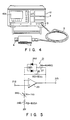
- Fig. 3 is a block diagram showing a schematic arrangement of a high frequency signal measuring equipment according to the embodiment of the present invention.
- Fig. 4 is a perspective view showing the whole measuring equipment.
- a connector 3 is arranged on an operation panel 2 arranged on the front surface of a measuring equipment body 10.
- a signal detector 4 called a probe is detachably connected to the connector 3 through a cable line 5 having, e.g., a length of 1 to 2 m.
- a signal detecting terminal or connector 6 for inputting a signal is provided at the distal end of the signal detector 4.
- the signal detector 4 is separated from the measuring equipment body 10 by the cable line 5, an operator can extract a signal at an arbitrary point in a complicate electric circuit or part through the signal detecting terminal or connector 6.
- Fig. 3 is a block diagram showing a schematic arrangement of the above high frequency signal measuring equipment. Note that Fig. 3 shows a measuring equipment for measuring signal level characteristics of a high frequency signal having a frequency component of, e.g., 0.01 to 32 GHz.
- a high frequency signal as a signal to be measured input from the signal detecting terminal or connector 6 is temporarily converted into a DC signal having a signal level corresponding to the amplitude of the signal to be measured.
- the signal to be measured converted into the DC signal is converted into a pulse signal having a predetermined frequency of, e.g., 27 kHz by a chopper 8. That is, the signal level of the signal to be measured input from the signal detecting terminal or connector 6 is converted into an amplitude of each pulse.
- sampling signal having a frequency of 27 kHz is supplied from an oscillator 9 arranged in the measuring equipment body 10 through the cable line 5.
- the pulse signal output from the chopper 8 is amplified by a variable gain preamplifier 21 (to be described later), and then the pulse signal is supplied to the measuring equipment body 10 through the cable line 5.
- a signal to be measured constituted by a high frequency signal having a frequency component of, e.g., 0.01 to 32 GHz input from the signal detecting terminal or connector 6 is converted into a DC signal having a signal level corresponding to the amplitude at a detector 7 and converted into an AC signal having a constant frequency of, e.g., 27 kHz at the chopper 8.
- the 27-kHz sampling signal is supplied from the oscillator 9 arranged in the measuring equipment body 10 through the cable line 5.
- the AC signal output from the chopper 8 is amplified by the variable gain preamplifier 21 and supplied to the measuring equipment body 10 through the cable line 5.
- the signal to be measured converted into the AC signal input to the measuring equipment body 10 is amplified by a variable main amplifier 22 and synchronously detected by the 27-kHz sampling signal output from the oscillator 9 by a detector 120 and is converted into a DC signal again.
- the signal to be measured converted into the DC signal is input through a low-pass filter 130 to an analyzer 140 including a display.
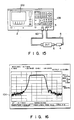
- the analyzer 140 performs a predetermined analyzing process to the input DC signal to be measured, and the analysis result is displayed on, e.g., a display screen 10a of the operation panel (Figs. 15 and 16).
- Fig. 5 shows a circuit diagram showing the variable gain preamplifier 21.
- An input terminal 21a to which the AC signal output from the chopper 8 is applied is connected to the noninverting (+) input terminal of a differential amplifier 23, and the inverting (-) input terminal of the differential amplifier 23 is grounded through a variable resistor 24a and a resistor 24b.
- the resistances R1 and R2 of the resistors 24a and 24b are set at, e.g., 1 k ⁇ and 800 ⁇ , respectively.
- variable gain preamplifier 21 when a signal level V I of an input signal applied to the input terminal 21a is less than a level V P of 0.6 V defined by a voltage value as a dropped voltage during the ON time of the diodes 26a and 26b, a feedback current is not supplied to the second feedback resistor 27. Therefore, a gain G of the variable gain preamplifier 21 is defined by the resistances (R1 + R2) and R3 of the ground resistors 24a and 24b and the first feedback resistor 25. Note that the gain G can be adjusted by the variable resistor 24a.
- a gain GL1 of the variable gain preamplifier 21 is defined by the resistances (R1 + R2), R3, and R4 of the ground resistors 24a and 24b and the first and second feedback resistors 25 and 27.
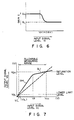
- an amplitude characteristic curve representing a relationship between the input signal level V I at the input terminal 21a and an output signal level V O at the output terminal 21b is a nonlinear characteristic curve indicated by a solid curve in Fig. 7.
- the input signal level V I is amplified with a gain GH1 in the region where the input level V I is low, and the input signal level V I is amplified with a gain GL1 in the region where the input signal level V I is high.
- characteristic curve indicated by a broken line in Fig. 7 is an amplitude characteristic curve of the conventional linear preamplifier 48 shown in Fig. 2.
- a saturation level V OH and a lower limit level V OL of the output signal level V O of the preamplifier 21 are equal to those of the conventional preamplifier 48, a minimum value V IL , of the input signal level V I is smaller than the V IL of the conventional preamplifier 48. Even if an input signal of a signal level lower than a level corresponding to the minimum value of the conventional preamplifier 48 is input, the output signal level V O is not lower than the lower level V OL . Therefore, it is prevented that an S/N ratio of the signal to be measured output to the measuring equipment body 1 is decreased by mixing of external noise during transmission of the signal through the cable line 5. As a result, an allowable measuring range of the signal to be measured is widened by about 10 dB in the high frequency signal measuring equipment, as a whole compared with that of the conventional equipment, thereby improving a dynamic range and measuring precision.
- Figs. 8A and 8B are circuit diagrams showing the variable gain main amplifier 22 incorporated in the measuring equipment body 10.
- the variable gain main amplifier 22 comprises a plurality of amplifiers 28a, 28b, 28c, ..., as shown in Fig. 8A, which are connected in series with each other and which are constituted by a kind of log amplifiers and a pair of inverting adders 42 and 43 for adding output voltages from the amplifiers 28a, 28b, 28c, ..., as shown in Fig. 8B. Note that the eight amplifiers are used in this embodiment.
- the input terminal 22a to which a signal to be measured input through the cable line 5 is supplied is connected to the noninverting (+) input terminal of a differential amplifier 30 in the amplifier 28a through a resistor 29 and is grounded through a pair of parallel-connected, reverse-biased diodes 31a and 31b.
- a feedback resistor 32 and diodes 33a and 33b are connected between the inverting (-) input terminal and the output terminal of the differential amplifier 30.
- a resistor 34 is connected between the inverting (-) input terminal of the amplifier 30 and ground, and a coupling capacitor 35 connected to the second amplifier 28b is connected to the output terminal of the differential amplifier 30.
- a relationship between an input signal level at the input terminal 22a and an output signal level at the output terminal of the differential amplifier 30 is represented by a characteristic curve A in Fig. 9.
- the output signal level is higher than a predetermined level V S defined by the diodes 31a and 31b, the output signal level is saturated at a voltage V A .
- the slope of the amplitude characteristic curve Aa until reaching the predetermined level V S is defined by resistances of the resistors 32 and 34.
- the whole main amplifier 22 is a circuit in which saturation voltages of the first stage (input stage) to the last stage are sequentially decreased depending on an increase in input signal level.
- output signals from terminals 221, 222, 223, 224, ... of the stages are added to each other by the inverting adders 42 and 43, thereby obtaining an output signal obtained by log-amplifying the input signal.
- Fig. 8B output signals from terminals 221, 222, 223, 224, ... of the stages are added to each other by the inverting adders 42 and 43, thereby obtaining an output signal obtained by log-amplifying the input signal.
- a sum amplitude characteristic curve X at this time is set amplitude characteristics which can be corrected and expanded to the amplitude characteristics of the variable gain preamplifier 21, and the input signal compressed by the variable gain preamplifier 21 can be obtained as an output having log characteristics corresponding to the original level.
- the output signal level of the whole variable gain main amplifier 22 as a function of the input signal level i.e., an amplitude characteristic curve is defined by the resistances of the resistors 32, 34, 32b, 34b, ... of the amplifiers 28a, 28b, ... and a resistance defining the gains of the inverting adders 42 and 43.
- the slope of a sum characteristic curve is increased toward the previous stages, and the amplitude characteristic curve X indicated by the broken line in Fig. 9 can be finally obtained. That is, when an input signal level is low, an output signal level is amplified to have a low level. When the output signal level is high, the output signal level is amplified to have a high level.
- the amplitude characteristic curve X of the variable gain main amplifier 22 constituted by the log amplifiers is set to be corrected and expanded to the amplitude characteristic curve of the variable gain preamplifier 21, and the input signal level compressed by the variable gain preamplifier 21 can be returned to the original level. Therefore, the analyzer 140 can perform an analyzing process for the signal to be measured returned to the original input signal level.
- the dynamic range of the high frequency measuring equipment can be widened as a whole, and an S/N ratio and measuring precision can be improved.
- Fig. 10 is a block diagram showing a variable gain main amplifier 22A installed in a measuring equipment body 1 according to another embodiment of the present invention.
- the variable gain main amplifier 22A is arranged as a kind of log amplifier and comprises a plurality of amplifiers 44 to 46 and 28a to 28k connected in series with each other and an adder 42 for adding output voltages A1 to A12 of the amplifiers 44 to 46 and 28a to 28k.
- Each of the amplifiers 28a to 28k and 44 to 46 is to be saturated at a predetermined level, and the amplifiers 28h, 28g, ... 28a, 46, 45 and 44 are sequentially saturated from the last stage depending on an increase in input level.
- a signal to be measured having a low level of, e.g., about -60 dBm is input from a signal detecting terminal or connector 6 through a cable line 5, the input signal is sequentially amplified by the amplifiers 44 to 46 and 28a to 28h, thereby obtaining an output A12 from the last amplifier 28h.
- each of the amplifiers 44 to 46 and 28a to 28h has an output level corresponding to the input level although it is very low.
- the amplifiers 44 to 46 and 28a to 28h are sequentially saturated from the last amplifier 28h, thereby obtaining an output voltage Al is output from the first stage finally. All the amplifiers 44 to 46 and 28a to 28h are saturated at an upper limit value V IH of the input level.
- the outputs from the amplifiers are added to each other by the amplifier 42 and output to an output terminal 22b of the main amplifier 22A.
- the output signals A1 to A12 of the stages are added to obtain an output signal obtained by logarithmically amplifying an input signal from the variable gain main amplifier 22A.
- a sum gain X at this time is adjusted to correct a nonlinear amplitude characteristic curve of a variable gain preamplifier 21 to obtain a linear output, and an output having better linearity, as shown in Fig. 11, than that in a dynamic range of an input signal level applied to an input terminal 6 and compressed by the variable gain preamplifier 21.
- an amplitude characteristic is defined by resistances R1 to R13 defining gains of the amplifiers 44 to 46 and 28a to 28h and the adder 42.
- variable gain main amplifier 22A adjusts the gains of outputs A1 to A12 during addition to expand and correct a signal having compressing characteristics and output from the variable gain preamplifier 21, thereby finally obtaining an amplitude characteristic curve X indicated by a solid curve in Fig. 11.
- the signal compressed by the variable gain amplifier 21 has a level higher than that of the prior art. Therefore, the signal has a good resistance against noise transmitted through the cable line, and an S/N ratio is increased, thereby obtaining a highly sensitive equipment.
- an analyzer 14 can perform an analyzing process corresponding to a dynamic range of the input signal.
- Fig. 12 shows still another embodiment.
- the variable gain main amplifiers 22 and 22A function as log amplifiers.
- linearity can be obtained by using a variable gain preamplifier 21 and a variable gain main amplifier 22B as a whole.
- variable gain preamplifier 21 is identical to that shown in Fig. 5 and has a high gain GH1 indicated by a broken curve in Fig. 13 in a range where its level is lower than the level V P and has a low gain GL1 in a range where its level is higher than the level L P indicated by a broken curve in Fig. 13.
- the variable gain main amplifier 22B has a low gain GL2 indicated by a solid line in Fig. 13 in a range where its level is lower than the level V P and has a high gain GH2 in a range where its level is higher than the level L P indicated by a solid curve in Fig. 13.
- variable gain preamplifier 21 and the variable gain main amplifier 22B are compensated for each other to obtain linear amplification having linearity as a whole, as indicated by the alternate long and short dashed line.
- Fig. 14 shows an arrangement wherein a high frequency signal measuring equipment according to the present invention is applied to a scalar network analyzer for measuring frequency characteristics of a device to be measured (e.g., band-pass filter) (DUT).
- a scalar network analyzer for measuring frequency characteristics of a device to be measured (e.g., band-pass filter) (DUT).
- DUT band-pass filter
- a measuring equipment body 10B comprises elements included in the measuring equipment body 10 shown in Fig. 3, a sweep signal generator 60, and a measuring signal generator 61.
- the measuring equipment body 10B is connected to the DUT (device under test) through a cable line 5, a detector 4, and a connector 6.
- the measuring signal generator 61 supplies a measuring signal which has a frequency changed in accordance with a sweep signal to the device under test (DUT) via a cable 63.
- the sweep signal is supplied to the measuring signal generator 61 and supplies frequency data to the measuring equipment body 10.
- the DUT amplifies (losses) a signal level in accordance with a signal frequency from the measuring signal generator 61 and outputs it.
- the output signal level is changed in accordance with frequency characteristics of the DUT.
- the detector 4 detects, modulates, and amplifies a high frequency signal from the DUT and supplies it to the measuring body 10 as a signal corresponding to the high frequency signal.
- the measuring equipment body 10 detects (analyzes) a signal (changed in accordance with the frequency characteristics of the device under test) supplied from the detector 4 and causes a display section 10a (e.g., a cathode-ray tube) to display the signal (Fig. 16).
- the sweep signal supplied from the sweep signal generator 60 is used as an axis of a frequency during displaying.
- analytic contents in the measuring equipment body 10 are as follows:
- variable gain preamplifier having a gain decreased in accordance with an increase in input signal level on a cable detector side and a variable gain amplifier for correcting a gain on the variable gain preamplifier side so that the gain is increased in accordance with an increase in input signal level are used.
- a low input signal can be amplified to have a large amplitude by the variable gain preamplifier, and a high input signal can be amplified to have a small amplitude. Therefore, an allowable lower limit level for contributing to prevention of a decrease in S/N ratio due to mixing of noise during transmission of the signal through the cable line is lowered, and the minimum value of the input signal level can be decreased.
- an allowable range of the input signal level at the preamplifier on the cabled detector side can be largely widened, and an allowable measuring range of a signal to be measured in the whole measuring equipment can be largely widened.
- a measuring dynamic range can be widened, and measuring precision and sensitivity can be improved.
Landscapes
- Physics & Mathematics (AREA)
- General Physics & Mathematics (AREA)
- Amplifiers (AREA)
- Measurement Of Resistance Or Impedance (AREA)
- Tone Control, Compression And Expansion, Limiting Amplitude (AREA)
Applications Claiming Priority (2)
| Application Number | Priority Date | Filing Date | Title |
|---|---|---|---|
| JP169377/89 | 1989-06-30 | ||
| JP16937789 | 1989-06-30 |
Publications (3)
| Publication Number | Publication Date |
|---|---|
| EP0405593A2 true EP0405593A2 (de) | 1991-01-02 |
| EP0405593A3 EP0405593A3 (en) | 1991-12-27 |
| EP0405593B1 EP0405593B1 (de) | 1995-05-17 |
Family
ID=15885467
Family Applications (1)
| Application Number | Title | Priority Date | Filing Date |
|---|---|---|---|
| EP90112480A Expired - Lifetime EP0405593B1 (de) | 1989-06-30 | 1990-06-29 | Hochfrequenzmesseinrichtung mit verkabelter Messwerterfassung und Signal-Kompandierung |
Country Status (4)
| Country | Link |
|---|---|
| US (1) | US5083080A (de) |
| EP (1) | EP0405593B1 (de) |
| JP (1) | JPH0394178A (de) |
| DE (1) | DE69019422T2 (de) |
Cited By (4)
| Publication number | Priority date | Publication date | Assignee | Title |
|---|---|---|---|---|
| WO2007137659A1 (de) * | 2006-05-26 | 2007-12-06 | Rohde & Schwarz Gmbh & Co. Kg | Messvorrichtung und messverfahren zum messen der leistung eines hochfrequenzsignals |
| WO2007137660A1 (de) * | 2006-05-26 | 2007-12-06 | Rohde & Schwarz Gmbh & Co. Kg | Messvorrichtung mit gegengekoppeltem gleichspannungsverstärker |
| CN102680406A (zh) * | 2012-05-18 | 2012-09-19 | 成都安可信电子股份有限公司 | 一种红外气体传感器的探头信号处理方法及电路 |
| EP3700082A4 (de) * | 2017-10-17 | 2021-05-26 | Mitsuba Corporation | Rauschunterdrückungsschaltung, rauschunterdrückungsverfahren und motorsteuervorrichtung |
Families Citing this family (8)
| Publication number | Priority date | Publication date | Assignee | Title |
|---|---|---|---|---|
| US5479610A (en) * | 1993-11-01 | 1995-12-26 | Northrop Grumman Corporation | System interface fault isolator test set |
| KR100424408B1 (ko) * | 2002-02-18 | 2004-03-25 | 전자부품연구원 | 고주파 신호 전송선로의 특성 측정 장치 및 방법 |
| DE102006038031A1 (de) * | 2006-05-26 | 2007-11-29 | Rohde & Schwarz Gmbh & Co. Kg | Messvorrichtung und Messverfahren zum Messen der Hüllkurvenleistung und des Leistungsmittelwerts |
| TWI401435B (zh) * | 2010-01-13 | 2013-07-11 | Chroma Ate Inc | Master - slave type detection device and its sensing module of the high - temperature riser |
| JP5744712B2 (ja) * | 2011-12-15 | 2015-07-08 | サムソン エレクトロ−メカニックス カンパニーリミテッド. | 電力検波回路 |
| DE102013202903A1 (de) * | 2013-02-22 | 2014-09-11 | Rohde & Schwarz Gmbh & Co. Kg | Leistungsmessgerät mit interner Kalibrierung von Diodendetektoren |
| US9392479B2 (en) * | 2014-12-01 | 2016-07-12 | Fluke Corporation | Pocket-size PIM inspector |
| EP3208620B8 (de) * | 2016-02-19 | 2023-03-01 | Rohde & Schwarz GmbH & Co. KG | Messsystem für funkleistungsmessungen |
Family Cites Families (9)
| Publication number | Priority date | Publication date | Assignee | Title |
|---|---|---|---|---|
| US3041535A (en) * | 1959-01-12 | 1962-06-26 | Hewlett Packard Co | Electrical measuring instrument |
| NL291523A (de) * | 1962-04-11 | |||
| NO142768C (no) * | 1974-01-26 | 1980-10-08 | Licentia Gmbh | Kopling for automatisk dynamikk-kompresjon eller -ekspansjon |
| US4114115A (en) * | 1976-11-04 | 1978-09-12 | California Microwave, Inc. | Compandor apparatus |
| US4123711A (en) * | 1977-01-24 | 1978-10-31 | Canadian Patents And Development Limited | Synchronized compressor and expander voice processing system for radio telephone |
| JPS592349B2 (ja) * | 1979-03-31 | 1984-01-18 | アンリツ株式会社 | 電力測定装置 |
| US4628256A (en) * | 1983-06-27 | 1986-12-09 | Weinschel Engineering Co., Inc. | Thermocouple power meter |
| US4647845A (en) * | 1984-09-20 | 1987-03-03 | Hewlett-Packard Company | Apparatus and method for utilizing an AC detection scalar network analyzer with a CW signal source |
| DE3525066C1 (de) * | 1985-07-13 | 1986-11-06 | ANT Nachrichtentechnik GmbH, 7150 Backnang | Verstaerker mit steuerbarer Verstaerkung |
-
1990
- 1990-06-26 US US07/544,119 patent/US5083080A/en not_active Expired - Fee Related
- 1990-06-29 DE DE69019422T patent/DE69019422T2/de not_active Expired - Fee Related
- 1990-06-29 JP JP2169988A patent/JPH0394178A/ja active Pending
- 1990-06-29 EP EP90112480A patent/EP0405593B1/de not_active Expired - Lifetime
Cited By (6)
| Publication number | Priority date | Publication date | Assignee | Title |
|---|---|---|---|---|
| WO2007137659A1 (de) * | 2006-05-26 | 2007-12-06 | Rohde & Schwarz Gmbh & Co. Kg | Messvorrichtung und messverfahren zum messen der leistung eines hochfrequenzsignals |
| WO2007137660A1 (de) * | 2006-05-26 | 2007-12-06 | Rohde & Schwarz Gmbh & Co. Kg | Messvorrichtung mit gegengekoppeltem gleichspannungsverstärker |
| US7825839B2 (en) | 2006-05-26 | 2010-11-02 | Rohde & Schwarz Gmbh & Co. Kg | Measuring device and measuring method for measuring the power of a high-frequency signal |
| US8174254B2 (en) | 2006-05-26 | 2012-05-08 | Rohde & Schwarz Gmbh & Co. Kg | Measuring device with negative-feedback DC voltage amplifier |
| CN102680406A (zh) * | 2012-05-18 | 2012-09-19 | 成都安可信电子股份有限公司 | 一种红外气体传感器的探头信号处理方法及电路 |
| EP3700082A4 (de) * | 2017-10-17 | 2021-05-26 | Mitsuba Corporation | Rauschunterdrückungsschaltung, rauschunterdrückungsverfahren und motorsteuervorrichtung |
Also Published As
| Publication number | Publication date |
|---|---|
| JPH0394178A (ja) | 1991-04-18 |
| DE69019422T2 (de) | 1996-03-07 |
| DE69019422D1 (de) | 1995-06-22 |
| EP0405593B1 (de) | 1995-05-17 |
| EP0405593A3 (en) | 1991-12-27 |
| US5083080A (en) | 1992-01-21 |
Similar Documents
| Publication | Publication Date | Title |
|---|---|---|
| US6046594A (en) | Method and apparatus for monitoring parameters of an RF powered load in the presence of harmonics | |
| EP0405593B1 (de) | Hochfrequenzmesseinrichtung mit verkabelter Messwerterfassung und Signal-Kompandierung | |
| CN102095904B (zh) | 具有补偿数字滤波器的信号采集系统 | |
| US6313640B1 (en) | System and method for diagnosing and measuring partial discharge | |
| US4272719A (en) | Electric field intensity measuring apparatus | |
| US4663586A (en) | Device with automatic compensation of an ac attenuator | |
| US4507618A (en) | Compensation method and apparatus for an RC attenuator | |
| US8228054B2 (en) | Method and apparatus for amplifying a signal and test device using same | |
| US6392219B1 (en) | Discrete filter-less optical reference receiver and output amplifier | |
| JPH0149903B2 (de) | ||
| CN110988490A (zh) | 一种电源滤波器差损时域测量系统及方法 | |
| US7164995B2 (en) | Differential termination and attenuator network for a measurement probe | |
| EP1305643A1 (de) | Signalmessung | |
| JPH1164405A (ja) | 変調解析装置及びスペクトラムアナライザ | |
| CN115097223B (zh) | 一种周期脉冲辐射场场强的峰值检波测量方法 | |
| US4503544A (en) | Device for pulse measurement and conversion | |
| JPS60225068A (ja) | 高電位の微弱信号を測定する方法およびその測定用電子回路 | |
| CN222994565U (zh) | 一种射频探头电路 | |
| USH1619H (en) | Frequency-modulated monitor hydrophone system | |
| EP0176019A1 (de) | Apparatur die die Anwendung eines skalaren Wechselstromdetektor-Netzwerkanalysators mit einer ungedämpften Wellensignalquelle ermöglicht | |
| US6154037A (en) | System and method for testing distortion in transformers | |
| EP0443835B1 (de) | Schaltungselementmessapparat und -verfahren | |
| JP3000746B2 (ja) | 半導体装置の特性測定方法 | |
| SU879788A1 (ru) | Устройство дл измерени амплитудно-частотных характеристик четырехполюсника | |
| JPH0718908B2 (ja) | 電力ケ−ブルの絶縁試験装置 |
Legal Events
| Date | Code | Title | Description |
|---|---|---|---|
| PUAI | Public reference made under article 153(3) epc to a published international application that has entered the european phase |
Free format text: ORIGINAL CODE: 0009012 |
|
| 17P | Request for examination filed |
Effective date: 19900629 |
|
| AK | Designated contracting states |
Kind code of ref document: A2 Designated state(s): DE GB |
|
| PUAL | Search report despatched |
Free format text: ORIGINAL CODE: 0009013 |
|
| AK | Designated contracting states |
Kind code of ref document: A3 Designated state(s): DE GB |
|
| 17Q | First examination report despatched |
Effective date: 19930916 |
|
| GRAA | (expected) grant |
Free format text: ORIGINAL CODE: 0009210 |
|
| AK | Designated contracting states |
Kind code of ref document: B1 Designated state(s): DE GB |
|
| REF | Corresponds to: |
Ref document number: 69019422 Country of ref document: DE Date of ref document: 19950622 |
|
| PLBE | No opposition filed within time limit |
Free format text: ORIGINAL CODE: 0009261 |
|
| STAA | Information on the status of an ep patent application or granted ep patent |
Free format text: STATUS: NO OPPOSITION FILED WITHIN TIME LIMIT |
|
| 26N | No opposition filed | ||
| PGFP | Annual fee paid to national office [announced via postgrant information from national office to epo] |
Ref country code: GB Payment date: 19960620 Year of fee payment: 7 |
|
| PGFP | Annual fee paid to national office [announced via postgrant information from national office to epo] |
Ref country code: DE Payment date: 19960730 Year of fee payment: 7 |
|
| PG25 | Lapsed in a contracting state [announced via postgrant information from national office to epo] |
Ref country code: GB Free format text: LAPSE BECAUSE OF NON-PAYMENT OF DUE FEES Effective date: 19970629 |
|
| GBPC | Gb: european patent ceased through non-payment of renewal fee |
Effective date: 19970629 |
|
| PG25 | Lapsed in a contracting state [announced via postgrant information from national office to epo] |
Ref country code: DE Free format text: LAPSE BECAUSE OF NON-PAYMENT OF DUE FEES Effective date: 19980303 |