EP0402866A2 - Organischer mikrofibrillierter Werkstoff für Filter - Google Patents
Organischer mikrofibrillierter Werkstoff für Filter Download PDFInfo
- Publication number
- EP0402866A2 EP0402866A2 EP90111109A EP90111109A EP0402866A2 EP 0402866 A2 EP0402866 A2 EP 0402866A2 EP 90111109 A EP90111109 A EP 90111109A EP 90111109 A EP90111109 A EP 90111109A EP 0402866 A2 EP0402866 A2 EP 0402866A2
- Authority
- EP
- European Patent Office
- Prior art keywords
- filter
- fibers
- microfibrilated
- flow rate
- pressure
- Prior art date
- Legal status (The legal status is an assumption and is not a legal conclusion. Google has not performed a legal analysis and makes no representation as to the accuracy of the status listed.)
- Granted
Links
- 239000000463 material Substances 0.000 title claims abstract description 89
- 239000000835 fiber Substances 0.000 claims abstract description 39
- 229920002678 cellulose Polymers 0.000 claims description 14
- 239000001913 cellulose Substances 0.000 claims description 14
- 238000000034 method Methods 0.000 claims description 11
- 229920001131 Pulp (paper) Polymers 0.000 claims description 9
- 229920000642 polymer Polymers 0.000 claims description 9
- 238000004519 manufacturing process Methods 0.000 claims description 4
- 239000000084 colloidal system Substances 0.000 claims description 2
- 239000002245 particle Substances 0.000 description 22
- 238000011282 treatment Methods 0.000 description 16
- 239000000725 suspension Substances 0.000 description 14
- XLYOFNOQVPJJNP-UHFFFAOYSA-N water Substances O XLYOFNOQVPJJNP-UHFFFAOYSA-N 0.000 description 13
- 238000001914 filtration Methods 0.000 description 12
- 239000002657 fibrous material Substances 0.000 description 11
- 239000007788 liquid Substances 0.000 description 11
- 239000006185 dispersion Substances 0.000 description 9
- 230000000903 blocking effect Effects 0.000 description 8
- 239000000706 filtrate Substances 0.000 description 8
- OKTJSMMVPCPJKN-UHFFFAOYSA-N Carbon Chemical compound [C] OKTJSMMVPCPJKN-UHFFFAOYSA-N 0.000 description 7
- 238000010009 beating Methods 0.000 description 7
- 229910052799 carbon Inorganic materials 0.000 description 7
- 239000010425 asbestos Substances 0.000 description 6
- 230000006835 compression Effects 0.000 description 6
- 238000007906 compression Methods 0.000 description 6
- 230000005484 gravity Effects 0.000 description 6
- 238000011085 pressure filtration Methods 0.000 description 6
- 229910052895 riebeckite Inorganic materials 0.000 description 6
- 239000005909 Kieselgur Substances 0.000 description 5
- VYPSYNLAJGMNEJ-UHFFFAOYSA-N Silicium dioxide Chemical compound O=[Si]=O VYPSYNLAJGMNEJ-UHFFFAOYSA-N 0.000 description 5
- 230000000052 comparative effect Effects 0.000 description 5
- 230000035699 permeability Effects 0.000 description 5
- 238000005259 measurement Methods 0.000 description 4
- 239000002861 polymer material Substances 0.000 description 4
- 239000002994 raw material Substances 0.000 description 4
- 229920003043 Cellulose fiber Polymers 0.000 description 3
- 239000004760 aramid Substances 0.000 description 3
- 229920003235 aromatic polyamide Polymers 0.000 description 3
- 125000003118 aryl group Chemical group 0.000 description 3
- 239000011148 porous material Substances 0.000 description 3
- 239000007858 starting material Substances 0.000 description 3
- 239000000126 substance Substances 0.000 description 3
- 229920002994 synthetic fiber Polymers 0.000 description 3
- 239000012209 synthetic fiber Substances 0.000 description 3
- 241000894006 Bacteria Species 0.000 description 2
- 230000015572 biosynthetic process Effects 0.000 description 2
- 239000004744 fabric Substances 0.000 description 2
- 239000000203 mixture Substances 0.000 description 2
- -1 poly(p-phenylenebenz bisoxazol) Polymers 0.000 description 2
- 229920000728 polyester Polymers 0.000 description 2
- 238000002360 preparation method Methods 0.000 description 2
- 230000000007 visual effect Effects 0.000 description 2
- 239000002699 waste material Substances 0.000 description 2
- JMHSCWJIDIKGNZ-UHFFFAOYSA-N 4-carbamoylbenzoic acid Chemical compound NC(=O)C1=CC=C(C(O)=O)C=C1 JMHSCWJIDIKGNZ-UHFFFAOYSA-N 0.000 description 1
- 229920000271 Kevlar® Polymers 0.000 description 1
- 241001249542 Leonia <angiosperm> Species 0.000 description 1
- 229920001410 Microfiber Polymers 0.000 description 1
- 150000001408 amides Chemical class 0.000 description 1
- 239000012736 aqueous medium Substances 0.000 description 1
- 238000003889 chemical engineering Methods 0.000 description 1
- 238000007599 discharging Methods 0.000 description 1
- 238000009826 distribution Methods 0.000 description 1
- 238000001035 drying Methods 0.000 description 1
- 239000000428 dust Substances 0.000 description 1
- 230000000694 effects Effects 0.000 description 1
- 239000000839 emulsion Substances 0.000 description 1
- 230000007613 environmental effect Effects 0.000 description 1
- 238000003912 environmental pollution Methods 0.000 description 1
- 230000002349 favourable effect Effects 0.000 description 1
- 238000007663 fining method Methods 0.000 description 1
- 239000002778 food additive Substances 0.000 description 1
- 235000013373 food additive Nutrition 0.000 description 1
- 239000011521 glass Substances 0.000 description 1
- 239000012535 impurity Substances 0.000 description 1
- 239000004761 kevlar Substances 0.000 description 1
- 239000004816 latex Substances 0.000 description 1
- 229920000126 latex Polymers 0.000 description 1
- 239000002609 medium Substances 0.000 description 1
- 239000003658 microfiber Substances 0.000 description 1
- 210000005036 nerve Anatomy 0.000 description 1
- 244000144985 peep Species 0.000 description 1
- 239000012466 permeate Substances 0.000 description 1
- 229920003190 poly( p-benzamide) Polymers 0.000 description 1
- 239000000047 product Substances 0.000 description 1
- 230000001737 promoting effect Effects 0.000 description 1
- 238000003860 storage Methods 0.000 description 1
- 239000004094 surface-active agent Substances 0.000 description 1
- 238000010998 test method Methods 0.000 description 1
Images

Classifications
-
- B—PERFORMING OPERATIONS; TRANSPORTING
- B01—PHYSICAL OR CHEMICAL PROCESSES OR APPARATUS IN GENERAL
- B01D—SEPARATION
- B01D39/00—Filtering material for liquid or gaseous fluids
- B01D39/14—Other self-supporting filtering material ; Other filtering material
- B01D39/16—Other self-supporting filtering material ; Other filtering material of organic material, e.g. synthetic fibres
- B01D39/1607—Other self-supporting filtering material ; Other filtering material of organic material, e.g. synthetic fibres the material being fibrous
- B01D39/1623—Other self-supporting filtering material ; Other filtering material of organic material, e.g. synthetic fibres the material being fibrous of synthetic origin
-
- B—PERFORMING OPERATIONS; TRANSPORTING
- B01—PHYSICAL OR CHEMICAL PROCESSES OR APPARATUS IN GENERAL
- B01D—SEPARATION
- B01D61/00—Processes of separation using semi-permeable membranes, e.g. dialysis, osmosis or ultrafiltration; Apparatus, accessories or auxiliary operations specially adapted therefor
-
- B—PERFORMING OPERATIONS; TRANSPORTING
- B01—PHYSICAL OR CHEMICAL PROCESSES OR APPARATUS IN GENERAL
- B01D—SEPARATION
- B01D39/00—Filtering material for liquid or gaseous fluids
- B01D39/14—Other self-supporting filtering material ; Other filtering material
- B01D39/16—Other self-supporting filtering material ; Other filtering material of organic material, e.g. synthetic fibres
-
- B—PERFORMING OPERATIONS; TRANSPORTING
- B01—PHYSICAL OR CHEMICAL PROCESSES OR APPARATUS IN GENERAL
- B01D—SEPARATION
- B01D39/00—Filtering material for liquid or gaseous fluids
- B01D39/14—Other self-supporting filtering material ; Other filtering material
- B01D39/16—Other self-supporting filtering material ; Other filtering material of organic material, e.g. synthetic fibres
- B01D39/18—Other self-supporting filtering material ; Other filtering material of organic material, e.g. synthetic fibres the material being cellulose or derivatives thereof
-
- D—TEXTILES; PAPER
- D21—PAPER-MAKING; PRODUCTION OF CELLULOSE
- D21H—PULP COMPOSITIONS; PREPARATION THEREOF NOT COVERED BY SUBCLASSES D21C OR D21D; IMPREGNATING OR COATING OF PAPER; TREATMENT OF FINISHED PAPER NOT COVERED BY CLASS B31 OR SUBCLASS D21G; PAPER NOT OTHERWISE PROVIDED FOR
- D21H11/00—Pulp or paper, comprising cellulose or lignocellulose fibres of natural origin only
- D21H11/16—Pulp or paper, comprising cellulose or lignocellulose fibres of natural origin only modified by a particular after-treatment
- D21H11/18—Highly hydrated, swollen or fibrillatable fibres
Definitions
- the present invention relates to an organic microfibrous material capable of forming an interlaced sheet layer.
- a microfibrous material is useful, for example, when a liquid containing extremely minute impurities is filtered.
- Some fibrous materials are employed in the form of interlaced sheet layers.
- One of the representatives of such fibrous materials is paper. Papers having various properties are manufactured according to the purposes for which they are used. An example of porous paper is filter paper. Further, a certain fibrous material is employed after being dispersed into water and forming an interlaced sheet layer on a base material immediately before the employment. Filter aid is an example of such a fibrous material.
- the interlaced sheet layer composed of fibrous material is required to have both of a blocking function according to the diameter of particles to be separated out and a medium permeating function.
- a blocking function according to the diameter of particles to be separated out
- a medium permeating function it is difficult to reconcile pores of such sizes that can perfectly block minute particles, for example, bacteria, and such a liquid permeating function that can maintain a filtration rate in a practically satisfactory range.
- asbestos which has been also used as a filter aid.
- asbestos has been recognized to be harmful to the human body, and attempts have been made to replace the asbestos with an organic fibrous material.
- the organic fibrous material does not possess fineness and nerve equivalent to those of asbestos.
- the liquid permeating function is satisfactory, but minute particles such as bacteria can not be blocked perfectly.
- the filter aid obtained by wet beating of linter (Published Examined Japanese Patent Application No. 59003/85) being superior to crushed cellulose in the function to block minute particles, it is not well satisfied in all cases.
- the microfiber manufactured by passing wood pulp through a high-pressure homogenizer is disclosed as an organic fibrous material which is thought to have a fine structure, in Published Examined Japanese Patent Application No 44763/88.
- Diatomaceous earth is now being widely used as a filter aid.
- a large precoat amount of, for example, 700 to 1000 g/m2 is required to raise a blocking rate, whereby waste treatment costs a great deal.
- the diatomaceous earth has a problem of environmental pollution caused by dust.
- GB 2 066 145 corresponding to JP-A 56-100801 discloses a process for microfibrilating cellulose fibers.
- U.S. patent 4 481 076 corresponding to JP-A 59-189141 discloses re-dispersible, microfibrilated cellulose.
- the invention provides an organic microfibrilated material which comprises fibers having a variety of thicknesses, having a Shopper's Rieglar of 40 degree SR or greater, having a T value of 15 or greater when the fibers are formed in a filter sheet.
- the fibers are tangled with one another and can be formed into a sheet thereof.
- the fibers may be made of cellulose or a polymer of rigid straight chains.
- the invention provides a filter composed of the material as defined above; a filter device comprises a support and a filter layer formed on the support by accumulating the material as defined above; a filter paper comprising the material as defined above and another material for filter, such as paper pulp, cellulose not being microfibrilated, fiber of a rigid straight chain-having polymer not being microfibrilated.
- the invention provides a process for preparing an organic microfibrilated material, which comprises fibers having a variety of thicknesses, having a Shopper fileration index of 50 degree SR or greater, having a T value of 15 or greater when the fibers are formed in a filter sheet, which process comprises the steps of fibrilating crude fibers until microfibrilated partly.
- the microfibrilation may be conducted by the use of a high pressure homogenizer, a refiner, a colloid mill or a beater.
- the material has a Shopper's Rieglar of 40 degree SR or greater, preferably 50 degree SR or greater.
- Shopper's Rieglar may be called hereinafter Schopper filtration index or Schopper freeness.
- the fibers may be interlaced with one another or tangled with one another.
- the material may be resistant to compression.
- the polymer of rigid straight chains includes aromatic polyamides such as poly(p-phenyleneterephthalic amide), being available in the tradename of Kevlar, poly(p-benzamide), poly(p-phenylenebenz bisoxazol), poly(amidehydrazide), being available in the tradename of X-500 from Monsanto, and poly(p-phenyleneterephthalic amide-3,4-diphenylether terephthalic amide, being available in the tradename of HM-50 from Teijin, polyhidrazide, aromatic thiazols, aromatic oxazols, aromatic polyesters and ladder-type polymers.
- aromatic polyamides such as poly(p-phenyleneterephthalic amide), being available in the tradename of Kevlar, poly(p-benzamide), poly(p-phenylenebenz bisoxazol), poly(amidehydrazide), being available in the tradename of X-500 from Monsanto, and poly(p-phen
- the objects of the invention can be attained by an organic microfibrous material having the ability to form an interlaced sheet layer which is resistant to compression, the microfibrous material having a Schopper freeness of 50° SR or above and a T-value of 15 or more.
- the T-value which characterizes the microfibrous material of the invention can be measured by the following test method.
- Example 2 using a pressure filter (diameter of filter: 40 mm), a suspension of the organic microfibrous material in water (0.237 g/l) is allowed to flow at a flow rate of 40 ml/minute, thereby forming an interlaced sheet layer (188 g/m2).
- the T-value is an indication of the ability to form an interlaced sheet layer which is resistant to compression, and the T-value is a magnification of the thickness of the sheet layer to a theoretical which can be calculated from the true specific gravity of a substance constituting the fiber.
- the Schopper freeness which characterizes the microfibrous material of the invention together with the T-value can be measured by the Schopper measuring method described in JIS 8121-1976 "Method of Test for Freeness of Pulp".
- the fineness of the fibers is required to be enhanced to a Schopper freeness of 50° SR or above, preferably 70° SR or above and more preferably 80° SR or above.
- the Schopper freeness measured with a Schopper tester is an indication of the water filtering capability of pulp.
- materials having high Schopper freeness namely, materials poor in water filtering capability are not thought to be favorable as filter materials.
- the materials having high Schopper freeness are considered to have enhanced beating degree, fine interlaced structures are expected to be formed. Under conditions where compressive force is applied as in the case of filtration, however, skeletal structures of fine fibers are bent, and skeleton configurations holding sufficient spaces can not be formed, whereby media come to be unable to permeate. Accordingly, there has been known no material having enhanced beating degree, which is capable of forming a filter layer suited for pressure filtration.
- microfibrous material according to the invention examples include a cellulosic microfibrous material obtained by the treatment of linter as a starting material using a high-pressure homogenizer, and a synthetic high polymer microfibrous material obtained by the treatment of Kebler (brand name) pulp as a starting material using a high-pressure homogenizer.
- High polymer material having a high crystallinity is generally preferable as the microfibrous material of the invention.
- the material obtained using linter as a starting material is preferable to the material from wood pulp, as the cellulosic microfibrous material.
- proper material may be obtained by pretreatment, etc. of the material derived from wood pulp and employed.
- Natural high polymer materials and synthetic high polymer materials other than cellulose may be used.
- Proper material can be selected on the basis of, for example, the crystallinity, Young's modulus, flexural rigidity, etc. of the high polymer material itself.
- Examples of the proper material include aromatic polyamides, aromatic polyesters, etc.
- the fibrous material is usually fined in the state of dispersion in water.
- the fining method may be selected among fibrous material fining techniques available at the time of practice, including a high-pressure homogenizer, disc refiner, jordan and beater, judging that the material having the desired beating degree can be obtained.
- the high-pressure homogenizer is an especially effective means.
- the high-pressure homogenizer available in the invention is on the market, for example, as a Manton-Gaulin (brand name) homogenizer.
- This homogenizer is ordinarily an apparatus used for the production of homogeneous liquid emulsions, which comprising a high pressure pump; valve means discharging a solution to be treated, from the high pressure pump at high speed; valve seat means with which the discharged solution collides; and a passage circulating the treated solution to the inlet side of the high pressure pump.
- This kind of apparatus and the operation thereof are described in publicly known literatures (e.g., Chemical Engineering, May 13, 1974, p. 86-92).
- the treatment with the high-pressure homogenizer is essentially continuous.
- the treatment may be performed with batch type charging of the solution to be treated, namely by a semi-continuous operation.
- the number of treatments can be obtained by means of calculation according to the ratio of the discharge to charge of the solution.
- Treatment pressure, and the number of treatments can be easily determined by comparison of the properties of the treated solution obtained with the desired properties. The higher the treatment pressure, the more is expected the same level of fining effect, even with a small number of treatments.
- the treatment with the high-pressure homogenizer it is effective to perform an appropriate pretreatment so as to accommodate the apparatus, according to the properties of the material.
- the degree of beating is thought to be generally excessive.
- the excessive treatment with the high-pressure homogenizer lowers the permeability of liquids, which eventually makes the measurement of the T-value impossible, whereby the material of the invention can not be obtained.
- the number of treatments and treatment conditions should be within appropriate regions in view of the properties of raw materials and products.
- wood-pulp paper, linter paper, crushed wood pulp, wet beaten linter, etc. have been employed in the industries connected with filtration. These materials have Schopper freeness of, for example, 30° SR or below, the beating degree of which being not so enhanced as that of the material according to the invention. Further, the materials can not block extremely minute particles though they are capable of forming porous interlaced sheets excellent in the permeability of liquids.
- cellulosic microfibrous material excellent in water retentivity and dispersion stability can be obtained by the treatment of wood pulp using she high-pressure homogenizer.
- the material has Schopper freeness of 90° SR, which being the same level as that of the material according to the invention, it can not form a porous interlaced sheet excellent in the permeability of liquids, and the T-value can not be measured.
- synthetic high polymer microfibrous materials there has not been really known the material having both of the T-value and Schopper freeness characterizing the invention.
- the microfibrous material of the invention When the microfibrous material of the invention is supplied onto a base material, in the form of a dispersion liquid, it forms a sheet layer having a skeleton configuration due to interlacement of fibers. Although media can pass through spaces in the skeleton, particles are captured by the fine skeleton configuration.
- the material of the invention which forming the configuration, has sufficient fineness to block minute particles effectively, and resistivity to compression, and ensures excellent permeability of media at the time of pressure filtration.
- the material of the invention can be used for precoat and body feed as a filter aid. Since the material of the invention is usually produced in the form of a dispersion in water, it may be used as such after the adjustment concentration, or the material after going through a step of concentration or drying for convenience for storage and distribution may be adjusted to the prescribed concentration and used. However, the dried material may sometimes pose a problem in redissociability. Accordingly, the material is advantageously handled as a composition containing more than 50 % of a sterilized aqueous medium, or a composition containing an auxiliary for promoting the redissociability, for example, a surface active agent. Further, the material of the invention can be used in a state where an interlaced sheet is formed in advance, as is the case of filter paper.
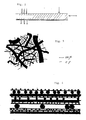
- Fig. 1 shows cellulose fiber which is processed by the invention.
- A is a view of the starting cellulose fiber.
- B is a view of the fiber in which microfibrilation starts.
- C is a view of the completely microfibrilated fiber.
- Fig. 2 shows a crosssectional view of the filter of the invention.
- Fig. 3 is a microscopically enlarged view of the structure of tangled fibers having different thicknesses in the filter of the invention.
- Fig. 4 is a microscopically enlarged view of the structure of accumulated fibers to form a filter of the invention, fibers having different thicknesses.
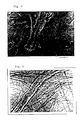
- Fig. 5 is a microscopic picture of an actually microbibrilated fiber according to the invention, standing in the stage shown in Fig. 1B.
- Fig. 6 is a microscopic picture of an actually microbibrilated fiber according to the invention, standing in the stage shown in Fig. 1c.
- a 2 % suspension of cellulose in water is obtained by pretreatment so that it can pass through the nozzle of an apparatus.
- the suspension is charged into a high-pressure homogenizer (Gaulin 15M-8TA) at ordinary temperature (25 °C), and treated at a pressure of 500 kg/cm2G for four times.
- the resultant suspension of microfibrous material is diluted to a concentration of 0.2 %, followed by measurement of the Schopper freeness (° SR).
- the Schopper freeness is 92° SR.
- the outline of the Schopper freeness measuring method is as follows. 1000 ml sample is poured into a filter cylinder, and fallen into a measuring funnel through a screen placed at the bottom with a conical valve raised. Although the filtrate is discharged from sm bottom pores, the filtrate exceeding a capacity for discharge from the bottom pores is overflown and discharged from a bypass. The Schopper freeness is a percentage of the amount of the filtrate discharged from the bypass to 1000 ml.
- the microfibrous material suspension obtained in Example 1 is diluted to a concentration of 0.237 g/l, and supplied into a pressure filter with a filtration area of 12.6 cm2 at a rate of 40 ml/minute (flow rate: 1900 l/hr.m2) using a diaphragm pump, to thereby obtain a precoat layer (188 g/m2) formed by the interlacement of fibers.
- the final pressure is 0.12 kg/cm2G, and the thickness (t) of the sheet layer is 2.62 mm.
- Precoat amount 125 188 250 Flow rate 1200 0.2 0.5 0.8 Flow rate 1900 0.4 1.5 3.1 Flow rate 3000 1.8 4.0 5 or more
- a precoat layer is formed in a similar manner as in Example 2.
- 1 l solution of 10 ppm standard particles is pressure-filtered through the precoat layer at the same flow rate as in the precoating. Although the pressure loss is very small (less than 150 mm of water column), the particle blocking rate is low.
- a precoat layer (188 g/m2) is formed in a similar manner as in Example 2.
- the thickness (t) of the sheet layer is 1.33 mm.
- Kebler brand name pulp
- a 2 % suspension of aromatic polyamide fiber in water is obtained by pretreatment so that it can pass through the nozzle of an apparatus.
- the suspension is treated with a high-pressure homogenizer for 10 times.
- the resultant suspension of microfibrous material is diluted to a concentration of 0.2 %, followed by measurement of the Schopper freeness.
- the Schopper freeness is 92° SR.
- the microfibrous material suspension obtained in Example 7 is supplied into a pressure filter under the same conditions as in Example 2, to thereby obtain a precoat layer (188 g/m2) formed by the interlacement of fibers.
- the filtration is finished without a pressure loss so that the pressure of 5 kg/cm2G can be read by a Bourdon type pressure gage.
- the thickness (t) of the sheet layer is 4.90 mm.
- Example 3 pressure filtration is performed through the precoat layer (188 g/m2) of synthetic fiber microfibrous material obtained in Example 8, at the same flow rate as in the precoating.
- the final pressure is 0.3 kg/cm2G
- the concentration of particles in the filtrate is 0.6 ppm
- the blocking rate is 94 %.
- Example 4 Using the same procedure as in Example 4, a dispersion solution of active carbon is pressure-filtered through the synthetic fiber microfibrous material obtained in Example 8, at the same flow rate as in the precoating.
- the final pressure is 0 to 0.3 kg/cm2G when the precoat amount and flow rate are changed in the same ranges as in Example
- no carbon leakage is observed in all cases.
- a 4 % suspension of cellulose in water is obtained by pretreatment so that it can pass through the nozzle of an apparatus.
- the suspension is charged into a high-pressure homogenizer, and treated at a pressure of 500 kg/cm2G for 10 times.
- the resultant suspension of microfibrous material (Schopper freeness: 90° SR) is adjusted to the prescribed concentration, and supplied into a pressure filter in a similar manner as in Example 2. As a result, the pressure becomes more than 5 kg/cm2G instantly, and the desired precoat layer can not be formed.
- Dispersion solution of filter layer forming material (1.9 g/1 l water) is filled into a Buchner funnel (diameter: 11 cm, depth: 4 cm) with filter cloth placed in the bottom, the funnel being sucked by an aspirator, thereby forming a filter layer (200 g/cm2).
- the filter layer is separated from the filter cloth, followed by measurement of the thickness t B (mm) with calipers.
- the material of the invention has a relatively high T B -value like the T-value in the case of pressure filtration.
Landscapes
- Chemical & Material Sciences (AREA)
- Chemical Kinetics & Catalysis (AREA)
- Engineering & Computer Science (AREA)
- Water Supply & Treatment (AREA)
- Filtering Materials (AREA)
- Paper (AREA)
Applications Claiming Priority (2)
| Application Number | Priority Date | Filing Date | Title |
|---|---|---|---|
| JP15002789 | 1989-06-14 | ||
| JP150027/89 | 1989-06-14 |
Publications (3)
| Publication Number | Publication Date |
|---|---|
| EP0402866A2 true EP0402866A2 (de) | 1990-12-19 |
| EP0402866A3 EP0402866A3 (de) | 1991-05-08 |
| EP0402866B1 EP0402866B1 (de) | 1994-03-30 |
Family
ID=15487897
Family Applications (1)
| Application Number | Title | Priority Date | Filing Date |
|---|---|---|---|
| EP90111109A Expired - Lifetime EP0402866B1 (de) | 1989-06-14 | 1990-06-12 | Organischer mikrofibrillierter Werkstoff für Filter |
Country Status (10)
| Country | Link |
|---|---|
| EP (1) | EP0402866B1 (de) |
| JP (1) | JP2784083B2 (de) |
| KR (1) | KR920007852B1 (de) |
| AR (1) | AR245248A1 (de) |
| AT (1) | ATE103620T1 (de) |
| BR (1) | BR9002816A (de) |
| CA (1) | CA2018867A1 (de) |
| DE (1) | DE69007684T2 (de) |
| DK (1) | DK0402866T3 (de) |
| ES (1) | ES2054149T3 (de) |
Cited By (8)
| Publication number | Priority date | Publication date | Assignee | Title |
|---|---|---|---|---|
| GB2288825A (en) * | 1994-04-29 | 1995-11-01 | Pall Corp | Synthetic fibre filtration sheet |
| WO1997000347A3 (en) * | 1995-06-19 | 1997-03-20 | Pall Corp | Fibrous nonwoven web |
| AT405847B (de) * | 1996-09-16 | 1999-11-25 | Zellform Ges M B H | Verfahren zur herstellung von rohlingen oder formkörpern aus zellulosefasern |
| WO2010149711A2 (en) | 2009-06-24 | 2010-12-29 | Interface International B.V. Et Al | Method and apparatus for defibrillating cellulose fibres |
| WO2011055148A1 (en) | 2009-11-05 | 2011-05-12 | Interface International B.V. | Apparatus and method for the processing of cellulose fibres |
| WO2013121083A3 (en) * | 2012-02-13 | 2013-10-31 | Upm-Kymmene Corporation | Method for concentrating fibril cellulose and fibril cellulose product |
| WO2020043368A1 (en) * | 2018-08-29 | 2020-03-05 | Arcelik Anonim Sirketi | A filtration system |
| US12371856B2 (en) | 2019-06-04 | 2025-07-29 | Lenzing Aktiengesellschaft | Process for preparing a broken-up, cellulose-containing, starting material with a predefined fibre-length distribution |
Families Citing this family (5)
| Publication number | Priority date | Publication date | Assignee | Title |
|---|---|---|---|---|
| DE20200972U1 (de) | 2002-01-24 | 2002-05-16 | Melitta Haushaltsprodukte GmbH & Co. KG, 32427 Minden | Aus Mikrofasern hergestelltes, papierartiges Filtermaterial |
| JPWO2008004703A1 (ja) | 2006-07-05 | 2009-12-10 | 三菱製紙株式会社 | シート状物および加工物 |
| US20090178970A1 (en) * | 2008-01-16 | 2009-07-16 | Ahlstrom Corporation | Coalescence media for separation of water-hydrocarbon emulsions |
| JP5981359B2 (ja) * | 2013-01-25 | 2016-08-31 | 住友ゴム工業株式会社 | ゴム組成物及び空気入りタイヤ |
| CN114452717A (zh) * | 2022-01-29 | 2022-05-10 | 杭州科百特过滤器材有限公司 | 一种深层过滤介质及其制备方法 |
Family Cites Families (6)
| Publication number | Priority date | Publication date | Assignee | Title |
|---|---|---|---|---|
| IT1074822B (it) * | 1977-01-21 | 1985-04-20 | Montedison Spa | Preparazione di filtri con l'impiego di fibre sintetiche |
| GB1567714A (en) * | 1977-12-28 | 1980-05-21 | Vn Proizv Ob Celljuloszno | Filter material and process for producing same |
| JPS5633018A (en) * | 1979-08-24 | 1981-04-03 | Takeda Chem Ind Ltd | Composite for filtration and clarifying method for liquid |
| GB8523179D0 (en) * | 1985-09-19 | 1985-10-23 | Wiggins Teape Group Ltd | Thermal transfer printing paper |
| JPS631584A (ja) * | 1986-06-20 | 1988-01-06 | Canon Inc | 被記録材 |
| JPH0798129B2 (ja) * | 1987-03-20 | 1995-10-25 | ダイセル化学工業株式会社 | 精密濾紙 |
-
1990
- 1990-06-12 EP EP90111109A patent/EP0402866B1/de not_active Expired - Lifetime
- 1990-06-12 DE DE69007684T patent/DE69007684T2/de not_active Expired - Fee Related
- 1990-06-12 DK DK90111109.6T patent/DK0402866T3/da active
- 1990-06-12 ES ES90111109T patent/ES2054149T3/es not_active Expired - Lifetime
- 1990-06-12 AT AT90111109T patent/ATE103620T1/de not_active IP Right Cessation
- 1990-06-13 CA CA002018867A patent/CA2018867A1/en not_active Abandoned
- 1990-06-13 BR BR909002816A patent/BR9002816A/pt unknown
- 1990-06-14 KR KR1019900008737A patent/KR920007852B1/ko not_active Expired
- 1990-06-14 JP JP2156896A patent/JP2784083B2/ja not_active Expired - Fee Related
- 1990-06-14 AR AR90317114A patent/AR245248A1/es active
Cited By (19)
| Publication number | Priority date | Publication date | Assignee | Title |
|---|---|---|---|---|
| GB2288825B (en) * | 1994-04-29 | 1998-05-27 | Pall Corp | Aromatic polyamide fibre filtration sheet |
| FR2719237A1 (fr) * | 1994-04-29 | 1995-11-03 | Pall Corp | Feuille de filtration en fibre aramide, procédé pour sa préparation, procédé de réduction du diamètre d'une fibre aramide et fibre ainsi obtenue, élément de filtre, procédé de traitement d'un fluide l'utilisant. |
| US5529844A (en) * | 1994-04-29 | 1996-06-25 | Pall Corporation | Aramid fiber filtration sheet |
| GB2288825A (en) * | 1994-04-29 | 1995-11-01 | Pall Corp | Synthetic fibre filtration sheet |
| NL1000257C2 (nl) * | 1994-04-29 | 1997-05-30 | Pall Corp | Aramidevezel filtratievel. |
| US5702616A (en) * | 1994-04-29 | 1997-12-30 | Pall Corporation | Aramid fiber filtration sheet |
| US5954962A (en) * | 1995-06-19 | 1999-09-21 | Pall Corporation | Fibrous nonwoven web |
| US5709798A (en) * | 1995-06-19 | 1998-01-20 | Pall Corporation | Fibrous nonwoven web |
| WO1997000347A3 (en) * | 1995-06-19 | 1997-03-20 | Pall Corp | Fibrous nonwoven web |
| AT405847B (de) * | 1996-09-16 | 1999-11-25 | Zellform Ges M B H | Verfahren zur herstellung von rohlingen oder formkörpern aus zellulosefasern |
| US6379594B1 (en) | 1996-09-16 | 2002-04-30 | Zellform Gesellschaft M.B.H. | Process for producing workpieces and molded pieces out of cellulose and/or cellulose-containing fiber material |
| WO2010149711A2 (en) | 2009-06-24 | 2010-12-29 | Interface International B.V. Et Al | Method and apparatus for defibrillating cellulose fibres |
| WO2010149711A3 (en) * | 2009-06-24 | 2011-04-28 | Interface International B.V. Et Al | Method and apparatus for defibrillating cellulose fibres |
| US8833681B2 (en) | 2009-06-24 | 2014-09-16 | Basf Se | Method and apparatus for defibrillating cellulose fibers |
| WO2011055148A1 (en) | 2009-11-05 | 2011-05-12 | Interface International B.V. | Apparatus and method for the processing of cellulose fibres |
| WO2013121083A3 (en) * | 2012-02-13 | 2013-10-31 | Upm-Kymmene Corporation | Method for concentrating fibril cellulose and fibril cellulose product |
| US9663588B2 (en) | 2012-02-13 | 2017-05-30 | Upm-Kymmene Corporation | Method for concentrating fibril cellulose and fibril cellulose product |
| WO2020043368A1 (en) * | 2018-08-29 | 2020-03-05 | Arcelik Anonim Sirketi | A filtration system |
| US12371856B2 (en) | 2019-06-04 | 2025-07-29 | Lenzing Aktiengesellschaft | Process for preparing a broken-up, cellulose-containing, starting material with a predefined fibre-length distribution |
Also Published As
| Publication number | Publication date |
|---|---|
| JPH03174091A (ja) | 1991-07-29 |
| DE69007684D1 (de) | 1994-05-05 |
| ES2054149T3 (es) | 1994-08-01 |
| DE69007684T2 (de) | 1994-07-14 |
| AR245248A1 (es) | 1993-12-30 |
| EP0402866A3 (de) | 1991-05-08 |
| BR9002816A (pt) | 1991-08-20 |
| JP2784083B2 (ja) | 1998-08-06 |
| ATE103620T1 (de) | 1994-04-15 |
| EP0402866B1 (de) | 1994-03-30 |
| CA2018867A1 (en) | 1990-12-14 |
| DK0402866T3 (da) | 1994-06-20 |
| KR910000219A (ko) | 1991-01-29 |
| KR920007852B1 (ko) | 1992-09-18 |
Similar Documents
| Publication | Publication Date | Title |
|---|---|---|
| US4859340A (en) | Filter sheet | |
| US4309247A (en) | Filter and method of making same | |
| EP0402866B1 (de) | Organischer mikrofibrillierter Werkstoff für Filter | |
| CA1044537A (en) | Filter medium and process | |
| US4288462A (en) | Method for removing cationic contaminants from beverages | |
| US4305782A (en) | Filter and method of making same | |
| US5114537A (en) | Dry sheet-like filtering material for liquid depth filtration | |
| US20200254367A1 (en) | Filter media with fibrillated fibers | |
| US4366068A (en) | Filter and method of making same | |
| EP0593814B1 (de) | Filtermedium für Flüssigkeitsfiltration | |
| DE2910289C2 (de) | ||
| US4645567A (en) | Filter media and method of making same | |
| EP3725387A1 (de) | Glasfreie brennstofffiltermedien und brennstofffilter mit hoher leistung und hoher kapazität sowie verfahren zur verwendung davon | |
| US6120643A (en) | Aramid and glass fiber absorbent papers | |
| GB2045828A (en) | Filter and method of making same | |
| US7228973B2 (en) | Nonwoven fibrous media especially useful for the separation of blood constituents | |
| EP0109169B1 (de) | Filterpapier | |
| US3796659A (en) | Filter pad and filtration process | |
| GB2098590A (en) | Filter aid | |
| JPH0549924A (ja) | 濾過助剤 | |
| JP3400017B2 (ja) | 自販機用コーヒー濾紙 | |
| DE2801685A1 (de) | Verfahren zur herstellung von filtern ausgehend von synthetischen fasern | |
| MXPA02011183A (es) | Proceso para producir papel. | |
| CA1119105A (en) | Filter and method of making same | |
| JP3127217B2 (ja) | 内燃機関用バイパスオイルフィルタ−用濾材 |
Legal Events
| Date | Code | Title | Description |
|---|---|---|---|
| PUAI | Public reference made under article 153(3) epc to a published international application that has entered the european phase |
Free format text: ORIGINAL CODE: 0009012 |
|
| AK | Designated contracting states |
Kind code of ref document: A2 Designated state(s): AT BE CH DE DK ES FR GB GR IT LI LU NL SE |
|
| PUAL | Search report despatched |
Free format text: ORIGINAL CODE: 0009013 |
|
| AK | Designated contracting states |
Kind code of ref document: A3 Designated state(s): AT BE CH DE DK ES FR GB GR IT LI LU NL SE |
|
| 17P | Request for examination filed |
Effective date: 19910529 |
|
| 17Q | First examination report despatched |
Effective date: 19921208 |
|
| GRAA | (expected) grant |
Free format text: ORIGINAL CODE: 0009210 |
|
| AK | Designated contracting states |
Kind code of ref document: B1 Designated state(s): AT BE CH DE DK ES FR GB GR IT LI LU NL SE |
|
| REF | Corresponds to: |
Ref document number: 103620 Country of ref document: AT Date of ref document: 19940415 Kind code of ref document: T |
|
| REF | Corresponds to: |
Ref document number: 69007684 Country of ref document: DE Date of ref document: 19940505 |
|
| ET | Fr: translation filed | ||
| REG | Reference to a national code |
Ref country code: DK Ref legal event code: T3 |
|
| ITF | It: translation for a ep patent filed | ||
| EPTA | Lu: last paid annual fee | ||
| REG | Reference to a national code |
Ref country code: ES Ref legal event code: FG2A Ref document number: 2054149 Country of ref document: ES Kind code of ref document: T3 |
|
| REG | Reference to a national code |
Ref country code: GR Ref legal event code: FG4A Free format text: 3012403 |
|
| EAL | Se: european patent in force in sweden |
Ref document number: 90111109.6 |
|
| PLBE | No opposition filed within time limit |
Free format text: ORIGINAL CODE: 0009261 |
|
| STAA | Information on the status of an ep patent application or granted ep patent |
Free format text: STATUS: NO OPPOSITION FILED WITHIN TIME LIMIT |
|
| 26N | No opposition filed | ||
| PGFP | Annual fee paid to national office [announced via postgrant information from national office to epo] |
Ref country code: DK Payment date: 19950609 Year of fee payment: 6 |
|
| PGFP | Annual fee paid to national office [announced via postgrant information from national office to epo] |
Ref country code: CH Payment date: 19950614 Year of fee payment: 6 |
|
| PGFP | Annual fee paid to national office [announced via postgrant information from national office to epo] |
Ref country code: SE Payment date: 19950615 Year of fee payment: 6 |
|
| PGFP | Annual fee paid to national office [announced via postgrant information from national office to epo] |
Ref country code: NL Payment date: 19950628 Year of fee payment: 6 |
|
| PGFP | Annual fee paid to national office [announced via postgrant information from national office to epo] |
Ref country code: GR Payment date: 19950630 Year of fee payment: 6 |
|
| PGFP | Annual fee paid to national office [announced via postgrant information from national office to epo] |
Ref country code: LU Payment date: 19950701 Year of fee payment: 6 |
|
| PGFP | Annual fee paid to national office [announced via postgrant information from national office to epo] |
Ref country code: BE Payment date: 19950809 Year of fee payment: 6 |
|
| PG25 | Lapsed in a contracting state [announced via postgrant information from national office to epo] |
Ref country code: LU Free format text: LAPSE BECAUSE OF NON-PAYMENT OF DUE FEES Effective date: 19960612 Ref country code: DK Effective date: 19960612 |
|
| REG | Reference to a national code |
Ref country code: DK Ref legal event code: EBP |
|
| PG25 | Lapsed in a contracting state [announced via postgrant information from national office to epo] |
Ref country code: SE Effective date: 19960613 |
|
| PG25 | Lapsed in a contracting state [announced via postgrant information from national office to epo] |
Ref country code: LI Effective date: 19960630 Ref country code: CH Effective date: 19960630 Ref country code: BE Effective date: 19960630 |
|
| BERE | Be: lapsed |
Owner name: DAICEL CHEMICAL INDUSTRIES LTD Effective date: 19960630 |
|
| PG25 | Lapsed in a contracting state [announced via postgrant information from national office to epo] |
Ref country code: GR Free format text: THE PATENT HAS BEEN ANNULLED BY A DECISION OF A NATIONAL AUTHORITY Effective date: 19961231 |
|
| PG25 | Lapsed in a contracting state [announced via postgrant information from national office to epo] |
Ref country code: NL Effective date: 19970101 |
|
| REG | Reference to a national code |
Ref country code: GR Ref legal event code: MM2A Free format text: 3012403 |
|
| REG | Reference to a national code |
Ref country code: CH Ref legal event code: PL |
|
| EUG | Se: european patent has lapsed |
Ref document number: 90111109.6 |
|
| NLV4 | Nl: lapsed or anulled due to non-payment of the annual fee |
Effective date: 19970101 |
|
| PGFP | Annual fee paid to national office [announced via postgrant information from national office to epo] |
Ref country code: GB Payment date: 19980603 Year of fee payment: 9 |
|
| PGFP | Annual fee paid to national office [announced via postgrant information from national office to epo] |
Ref country code: FR Payment date: 19980609 Year of fee payment: 9 |
|
| PGFP | Annual fee paid to national office [announced via postgrant information from national office to epo] |
Ref country code: AT Payment date: 19980615 Year of fee payment: 9 |
|
| PGFP | Annual fee paid to national office [announced via postgrant information from national office to epo] |
Ref country code: ES Payment date: 19980619 Year of fee payment: 9 |
|
| PGFP | Annual fee paid to national office [announced via postgrant information from national office to epo] |
Ref country code: DE Payment date: 19980622 Year of fee payment: 9 |
|
| PG25 | Lapsed in a contracting state [announced via postgrant information from national office to epo] |
Ref country code: GB Free format text: LAPSE BECAUSE OF NON-PAYMENT OF DUE FEES Effective date: 19990612 Ref country code: AT Free format text: LAPSE BECAUSE OF NON-PAYMENT OF DUE FEES Effective date: 19990612 |
|
| PG25 | Lapsed in a contracting state [announced via postgrant information from national office to epo] |
Ref country code: ES Free format text: LAPSE BECAUSE OF NON-PAYMENT OF DUE FEES Effective date: 19990614 |
|
| PG25 | Lapsed in a contracting state [announced via postgrant information from national office to epo] |
Ref country code: FR Free format text: THE PATENT HAS BEEN ANNULLED BY A DECISION OF A NATIONAL AUTHORITY Effective date: 19990630 |
|
| GBPC | Gb: european patent ceased through non-payment of renewal fee |
Effective date: 19990612 |
|
| PG25 | Lapsed in a contracting state [announced via postgrant information from national office to epo] |
Ref country code: DE Free format text: LAPSE BECAUSE OF NON-PAYMENT OF DUE FEES Effective date: 20000503 |
|
| REG | Reference to a national code |
Ref country code: FR Ref legal event code: ST |
|
| REG | Reference to a national code |
Ref country code: ES Ref legal event code: FD2A Effective date: 20010503 |
|
| PG25 | Lapsed in a contracting state [announced via postgrant information from national office to epo] |
Ref country code: IT Free format text: LAPSE BECAUSE OF NON-PAYMENT OF DUE FEES;WARNING: LAPSES OF ITALIAN PATENTS WITH EFFECTIVE DATE BEFORE 2007 MAY HAVE OCCURRED AT ANY TIME BEFORE 2007. THE CORRECT EFFECTIVE DATE MAY BE DIFFERENT FROM THE ONE RECORDED. Effective date: 20050612 |