EP0401751B1 - Kletter-Roboter, bewegbar längs eines Gerüstes, insbesondere eines Mastes für Hochspannungs-Überlandleitungen - Google Patents
Kletter-Roboter, bewegbar längs eines Gerüstes, insbesondere eines Mastes für Hochspannungs-Überlandleitungen Download PDFInfo
- Publication number
- EP0401751B1 EP0401751B1 EP90110617A EP90110617A EP0401751B1 EP 0401751 B1 EP0401751 B1 EP 0401751B1 EP 90110617 A EP90110617 A EP 90110617A EP 90110617 A EP90110617 A EP 90110617A EP 0401751 B1 EP0401751 B1 EP 0401751B1
- Authority
- EP
- European Patent Office
- Prior art keywords
- robot
- pole
- clamping finger
- slide
- main
- Prior art date
- Legal status (The legal status is an assumption and is not a legal conclusion. Google has not performed a legal analysis and makes no representation as to the accuracy of the status listed.)
- Expired - Lifetime
Links
- 230000009194 climbing Effects 0.000 title claims description 16
- 230000000903 blocking effect Effects 0.000 claims 1
- 230000006870 function Effects 0.000 description 2
- 238000013459 approach Methods 0.000 description 1
- 230000006399 behavior Effects 0.000 description 1
- 239000012212 insulator Substances 0.000 description 1
- 235000000396 iron Nutrition 0.000 description 1
- 230000000750 progressive effect Effects 0.000 description 1
Images




Classifications
-
- B—PERFORMING OPERATIONS; TRANSPORTING
- B62—LAND VEHICLES FOR TRAVELLING OTHERWISE THAN ON RAILS
- B62D—MOTOR VEHICLES; TRAILERS
- B62D57/00—Vehicles characterised by having other propulsion or other ground- engaging means than wheels or endless track, alone or in addition to wheels or endless track
- B62D57/02—Vehicles characterised by having other propulsion or other ground- engaging means than wheels or endless track, alone or in addition to wheels or endless track with ground-engaging propulsion means, e.g. walking members
- B62D57/024—Vehicles characterised by having other propulsion or other ground- engaging means than wheels or endless track, alone or in addition to wheels or endless track with ground-engaging propulsion means, e.g. walking members specially adapted for moving on inclined or vertical surfaces
Definitions
- the invention concerns a robot apt to climb along a trestle structure, particularly the trestle of a pole for high-voltage overhead electric lines, in order to carry work-tools from the base to the top of the pole. More specifically, the robot according to the invention has been studied to carry up to the pole brackets for instance an equipment to wash the insulator chains, of the type described in EP-A1-0360012, filed by the same Applicant. For this reason, and also to make the description shorter, reference will be made hereinafter to the trestle structure of an electric line pole; it is however understood that the robot according to the invention can easily be used to perform different operations, on trestle structures other than those indicated hereabove, or on fixed or temporary trestlework or tubular scaffolding.
- a movable robot which works in an environment of this kind, known as a partially structured environment , must have a structure which be able to overcome these difficulties.
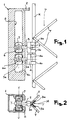
- the gripping hand 3 comprises two pairs of clamping fingers 3a and 3b, essentially in the form of hooks, and a dihedral bearing seat 3c; onto the seat 3c bears the corner edge Mc of the angle bar forming the upright M, while the hook ends of the clamping fingers 3a, 3b, hold onto the free edges Ma and Mb of its sides.
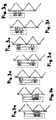
- the slide 7 moves from the bottom to the top end of the guide 8.
- the sensor 2 scans the surface of the upright M and, as said, supplies the consent signal to stop the slide 7 in a position along said upright where there are no obstacles, represented for example by the connections of the ledgers T or by the joints of the angle bars forming the upright.
- the positions - or, rather, the coordinates of the positions - along the trestle structure, where obstacles are detected by the sensor 2, as well as the positions in which the gripping hand 3 is authorized by the sensor to hold onto said structure, are stored into the processing unit so as to be subsequently used again for positioning the other gripping hand 4 in the climbing up step or, viceversa, for positioning both hands 3 and 4 as the robot climbs down the pole.
- this downclimb is controlled by the processing unit thanks to the position data acquired and stored during the climbing up step, - as already said - or else by placing another position sensor (not shown in the drawings) in correspondence of the bottom end of the body 1 of the robot.
- the body 1 can thus reach the position shown in full lines in fig. 5, according to the new inclination of the upright M′. In this position, the arm 5a can be moved forward to cause the hand 4 to grip onto the upright M.
- the processing unit substantially produces a coordinate rotation of the cores 6, 6a - and thereby a shifting of the slides 7, 7a, and of the arms 5, 5a - such as to prevent any interference of the body 1 with the pole structure and, at the same time, keep the hands 3 and 4 always parallel and in a correct gripping position onto the pole upright.
- a slide 17 is slidably mounted on the body 10 of the robot and gripping hands are associated both to the body 10 and to the slide 17.
- gripping hands are associated both to the body 10 and to the slide 17.
- use is made of two separate gripping hands 13, 13a, associated to the slide 17 and, respectively, of two gripping hands 14, 14a, associated to the body 1.
- At least one of the two hands of each pair is mounted on a slider movable lengthwise, that is, parallely to the motion direction of the slide 7; thanks to this assembly, the two hands of each pair are apt to move one in respect of the other, with possibility to draw close or apart.
- the gripping hand 14a is mounted on a slider (better described hereinafter) slidable into a guide 11 of the body 10, while the gripping hand 13 is mounted on a slider sliding into a guide 12 of the slide 17.
- This arrangement allows said hands to each grip onto a different ledger T, the ledgers normally being quite spaced apart and, furthermore, at varying mutual distances along the pole height.
- a position sensor 17A is associated to the upper end of the slide 17, and is apt to detect and store the positions of the ledgers T and possibly also their inclination.
- a second sensor 10A is associated to the upper end of the body 10.
- At least the general data and/or part of the position coordinates of the trestle configuration can be previously stored in the memory of the processing unit, starting from the data resulting from the pole project design.
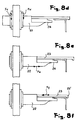
- the angle bars forming the ledgers are positioned with a first flange on the plane of the pole surface and with a second flange perpendicular to said surface. Furthermore, to realize a proper crossing of the ledgers, the second flange of a set of such ledgers - all having a first equal inclination - projects outwardly of the pole, while the second flange of another set of such ledgers - all having a second equal inclination - projects inwardly of the pole, so as to properly cross with the first set. As described more clearly hereinafter, with reference to the details of figs. 8a to 8f, the hands of this robot are apt to grip onto the horizontal flanges of the ledgers T projecting outwardly of the pole.
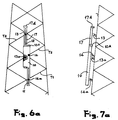
- this robot holds with the lower hand 14a of the body 10 onto the ledger T1, with the upper hand 14 of the body 10 and with the lower hand 13a of the slide 17 onto the ledger T2, and with the upper hand 13 of the slide 17 onto the ledger T3.
- the body 10 slides upward until its sensor 10A - which detects the presence of the ledger T3 - causes the upper hand 14 to stop in correspondence of said ledger T3 and hold onto the same (figs. 6c and 7c).
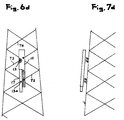
- the body 10 being thus anchored, the gripping hand 14a is caused to slide along the guide 11 up to stopping in correspondence of the ledger T2 and hold onto the same (figs. 6d and 7d).
- the successive step (not shown) provides for: the release of hands 13, 13a; the upward shifting of the slide 17 until the sensor 17A detects the ledger T4; the gripping of the upper hand 13 onto the ledger T4; the further sliding of the hand 13 in respect of its guide 12 and, consequently, the simultaneous shifting, by reaction, of the slide 17, up to carrying the hand 13a in correspondence of the ledger T3, whereon it grips.
- This position corresponds to that shown in figs. 6a and 7a, except that the robot is now at a higher level along the pole.
- the lower hand 13a of the slide 17 is movable into a short transversal guide 12a, substantially perpendicular to the guide 12 and shown very diagrammatically in fig. 6c.
- This transversal movement is used just before operating the slide, or also while the body 10 is moving upward (in any case, when the gripping hands of the body 10 are disengaged from the respective ledgers T), in order to control the perfect vertical alignment of the robot. The same operation can be performed when the robot climbs down the pole.
- FIGS 8 show, quite diagrammatically, a possible embodiment of a gripping hand to be used in a robot according to the embodiment of figures 5 and 6.
- This hand comprises:
Landscapes
- Engineering & Computer Science (AREA)
- Chemical & Material Sciences (AREA)
- Combustion & Propulsion (AREA)
- Transportation (AREA)
- Mechanical Engineering (AREA)
- Manipulator (AREA)
Claims (14)
- Ein Kletter-Roboter, bewegbar längs eines Gerüstes, insbesondere eines Gerüstes von einem Mast für Hochspannungs-Überlandleitungen, wobei der Mast eine Vielzahl von Winkelstangen besitzt, die aufrechte Elemente wechselnder Neigung bilden und auf Sprossen mit veränderlichen jeweiligen Abständen bilden, wobei der Roboter umfaßt:a) einen Hauptkörper (1; 10),b) vier Klemmfingermittel (3a, 3b, 4a, 4b; 13, 13a, 14, 14a) jeder zum Greifen einer der Vielzahl der Winkelstangen (M, T, T1, T2, T3),c) Verschiebemittel (5, 6, 7, 5a, 6a, 7a; 17, 22, 23, 24) um jedes der Klemmfingermittel entsprechend einer einer Hauptbewegungsachse zu bewegen, im wesentlichen vertikal und parallel zu der Mastoberfläche und jeweils entsprechend einer Querachse im wesentlichen rechtwinklig zur Mastoberfläche,d) wenigstens einem Positionssensor (2; 17A), um Daten über die Position der Winkelstangen und/oder der sich verändernden jeweiligen Abstände zwischen den Sprossen zu erfassen,e) einem Verarbeitungssystem, das die Verschiebemittel steuert, und das zusätzlich die Signale benutzt, die von den Sensoren ausgesandt werden,dadurch gekennzeichnet, daßf) ein Hauptschlitten (7, 17) beweglich entlang des Hauptkörpers (1, 10) parallel zu der Hauptbewegungsachse befestigt ist,g) zwei der Klemmfingermittel (4a, 4b; 14, 14a) an dem Hauptkörper (1, 10) befestigt sind, wobei wenigstens eines dieser (4a, 4b; 14a) in seiner Stellung relativ zum Hauptkörper justierbar ist, undh) zwei weitere Klemmfingermittel (3a, 3b; 13, 13a) auf dem Hauptschlitten (7, 17) befestigt sind, wobei wenigstens eines von diesen (3a, 3b; 13, 13a) in der Stellung relativ zum Hauptschlitten justierbar ist,i) wobei die Positionssensoren (2, 17A) Mittel zur Erfassung von Daten über die sich verändernde Neigung auf der Mastoberfläche umfassen,l) wodurch der Roboter auf dem Mastgerüst auf und ab und über die wechselnde Neigung von dessen Oberfläche klettert, indem wechselweise jeweils zwei Klemmfingermittel, die zum Hauptkörper gehöhren oder zwei Fingermittel, die zum Hauptschlitten gehören, festgesetzt werden, während die anderen zwei Klemmfingermittel frei sind, um gleichzeitig entlang des Mastgerüsts sich zu bewegen.
- Roboter nach Anspruch 1, wobei die Klemmfingermittel einen zweiflächigen Lagersitz (3c) und zwei Paare von Fingerhaken (3a, 3b, 4a, 4b) umfassen, wobei die Finger jedes Paare an den zwei Seiten des zweiflächigen Sitzes angeordnet sind, wobei letzterer dazu eingerichtet ist, die Ecke (Mc) der Winkelstange, die ein aufrechtes Element (M) der Gerüststruktur bildet, aufzunehmen, und die zwei Hakenfinger dazu eingerichtet sind, an die gegenüberliegenden Kanten (Ma, Mb) der Winkelstange zu greifen.
- Roboter nach Anspruch 2, wobei der zweiflächige Lagersitz (3c) durch den Kopf eines Kolbens getragen wird, der sich rechtwinklig zu der Winkelstange bewegt, die ein aufrechtes Element bildet, und die Hakenfinger drehbar in einander entgegengesetzten Richtungen auf dem Gehäuse, das den Kolben umgibt, befestigt sind.
- Roboter nach Anspruch 1, wobei die Schiebemittel einen Arm (5, 5a) umfassen, der die Klemmfingermittel unterstützt, wobei der Arm (5, 5a) verschieblich in einem entsprechenden Sitz auf einem Unterstützungsrumpf (6, 6a) befestigt ist, entsprechend zu der Transversalachse (Y-Y) rechtwinklig zur Mastoberfläche.
- Roboter nach Anspruch 4, wobei der Unterstützungsrumpf (6, 6a) wiederum drehbar um eine Horizontalachse (X-X) quer zu dem Arm (5, 5a) ist, der die Klemmfingermittel unterstützt.
- Roboter nach Anspruch 5, wobei der Unterstützungsrumpf (6, 6a) auf dem beweglichen Schlitten (7, 7a) drehbar relativ zu dem Hauptunterstützungskörper (1) ist.
- Roboter nach Anspruch 1, wobei zum Hauptunterstützungskörper (10) zwei jeweils voneinander beabstandete Klemmfingermittel (14, 14a) vorgesehen sind, während zwei weitere Klemmfingermittel (13, 13a) dem Hauptschlitten (17) zugeordnet sind, der relativ zum Hauptunterstützungskörper verschiebbar ist.
- Roboter nach Anspruch 7, wobei das eine Klemmfingermittel (14) in einer festen Position auf dem Hauptunterstützungskörper (10) befestigt ist, während das andere Klemmfingermittel (14a) auf einem Zweitschlitten (20) befestigt ist, der in einer im wesentlichen vertikalen Führung (11) verschiebbar ist, die in dem Unterstützungskörper (10) gebildet ist.
- Roboter nach Anspruch 7, wobei ein Klemmfingermittel (13a) in einer festen Position auf dem Hauptschlitten (17) befestigt ist und das andere Klemmfingermittel (13) auf einem Zweitschlitten (20) befestigt ist, der im wesentlichen in einer vertikalen Führung (12), die in dem Hauptschlitten (17) gebildet ist, verschiebbar ist.
- Roboter nach Anspruch 7, wobei wenigstens eines der Klemmfingermittel (13, 13a, 14, 14a) zusätzlich auf einem Zweitschlitten (22) befestigt ist, der in einer im wesentlichen horizontalen Führung (21) verschiebbar ist, die in dem Unterstützungskörper und/oder in dem Hauptschlitten verschieblich ist.
- Roboter nach Anspruch 7, wobei die greifenden Hände jeweils einen Hakenfinger (23) umfassen, der in Relation zu einem festen Gegenfinger (24) in der Transversalrichtung im wesentlichen rechtwinklig zu der Mastoberfläche verschiebbar ist, wobei dar Gegenfinger (24) dazu in der Lage ist, eine untere Lagerfläche für den Horizontalabschnitt der Winkelstange (T) zu bilden, die eine Sproße des Mastgerüstes bildet, und der Fingerhaken dazu in der Lage ist, die Winkelstange an ihrer Kante zu fassen.
- Roboter nach Anspruch 11, wobei der verschiebbare Hakenfinger (23) und der feste Gegenfinger (24) der Klemmfingermittel (13, 13a, 14, 14a) auf einem Körper (22) befestigt sind, der auch in Querrichtung relativ zu einem Unterstützungsring (21) verschiebbar ist.
- Roboter nach Anspruch 12, wobei der Unterstützungsring (21) des Klemmfingermittels drehbar um eine Achse parallel zur Querrichtung ist.
- Roboter nach Anspruch 13, wobei der drehbare Unterstützungsring (21) auf dem Zweitschlitten (20) befestigt ist.
Applications Claiming Priority (2)
| Application Number | Priority Date | Filing Date | Title |
|---|---|---|---|
| IT8920829A IT1230248B (it) | 1989-06-08 | 1989-06-08 | Robot arrampicatore, mobile lungo una struttura a traliccio, in particolare di un palo di linea elettrica di alta tensione. |
| IT2082989 | 1989-06-08 |
Publications (2)
| Publication Number | Publication Date |
|---|---|
| EP0401751A1 EP0401751A1 (de) | 1990-12-12 |
| EP0401751B1 true EP0401751B1 (de) | 1995-11-02 |
Family
ID=11172666
Family Applications (1)
| Application Number | Title | Priority Date | Filing Date |
|---|---|---|---|
| EP90110617A Expired - Lifetime EP0401751B1 (de) | 1989-06-08 | 1990-06-05 | Kletter-Roboter, bewegbar längs eines Gerüstes, insbesondere eines Mastes für Hochspannungs-Überlandleitungen |
Country Status (5)
| Country | Link |
|---|---|
| US (1) | US5213172A (de) |
| EP (1) | EP0401751B1 (de) |
| CA (1) | CA2018489A1 (de) |
| DE (1) | DE69023278D1 (de) |
| IT (1) | IT1230248B (de) |
Cited By (1)
| Publication number | Priority date | Publication date | Assignee | Title |
|---|---|---|---|---|
| CN102621425A (zh) * | 2012-03-31 | 2012-08-01 | 山东鲁能智能技术有限公司 | 水平绝缘子串带电检测机器人 |
Families Citing this family (29)
| Publication number | Priority date | Publication date | Assignee | Title |
|---|---|---|---|---|
| EP0873963A1 (de) * | 1997-04-25 | 1998-10-28 | Inventio Ag | Linearantrieb für eine Transporteinrichtung |
| ES2161184B1 (es) | 1999-12-28 | 2002-07-01 | Consejo Superior Investigacion | Un dispositivo de un elemento de trabajo con dos grados de movilidad. |
| ES2230953B2 (es) * | 2002-07-16 | 2006-06-16 | Universidad Politecnica De Madrid | Robot paralelo trepador y deslizante para trabajos en estructuras y superficies. |
| US7260499B2 (en) * | 2002-08-20 | 2007-08-21 | Fe Petro Inc. | Fuel delivery system with enhanced functionality and diagnostic capability |
| US20040099478A1 (en) * | 2002-11-27 | 2004-05-27 | Xerox Corporation | Climbing apparatus and method |
| US7086502B2 (en) * | 2004-02-24 | 2006-08-08 | Palo Alto Research Center Incorporated | Transport apparatus and method having conformable gripping capability |
| GB0500619D0 (en) * | 2005-01-13 | 2005-02-23 | Severfield Rowen Plc | Improvements relating to construction |
| US9162719B2 (en) * | 2007-12-28 | 2015-10-20 | The Invention Science Fund I, Llc | Limbed vehicles, systems and methods using same, and post networks on which limbed vehicles travel |
| US9168963B2 (en) * | 2007-12-28 | 2015-10-27 | The Invention Science Fund I, Llc | Systems and methods employing limbed vehicle and spaced posts |
| US20090166105A1 (en) * | 2007-12-28 | 2009-07-02 | Searete Llc | Limbed vehicles, systems and methods using same, and post networks on which limbed vehicles travel |
| FR2929228B1 (fr) * | 2008-03-28 | 2010-06-18 | Thales Sa | Robot grimpeur de poteau. |
| CN102060058B (zh) * | 2009-11-17 | 2013-01-23 | 赵德志 | 驻足爬杆机器人 |
| US8640558B2 (en) * | 2011-09-12 | 2014-02-04 | Honeywell International Inc. | System for the automated inspection of structures at height |
| CN102490804B (zh) * | 2011-11-15 | 2013-02-13 | 西华大学 | 一种越障爬杆机器人 |
| CN103926489B (zh) * | 2014-04-17 | 2015-06-24 | 国家电网公司 | 输电线路零值绝缘子带电检测机器人 |
| JP6410174B2 (ja) * | 2014-10-17 | 2018-10-24 | 本田技研工業株式会社 | 移動ロボット |
| JP6593991B2 (ja) * | 2014-12-25 | 2019-10-23 | 三菱重工業株式会社 | 移動ロボット及び先端ツール |
| CN107310650A (zh) * | 2016-04-26 | 2017-11-03 | 广西大学 | 一种爬杆攀壁两用侦查机器人爬杆机构 |
| GB2553271B (en) * | 2016-07-19 | 2019-03-13 | Kongsberg Ferrotech As | Pipeline maintenance and inspection vehicle |
| CN106258794B (zh) * | 2016-08-31 | 2019-08-09 | 墙煌新材料股份有限公司 | 一种自动立柱机器人 |
| CN108340364B (zh) * | 2017-01-24 | 2020-09-15 | 南京原觉信息科技有限公司 | 爬行机器装置与其部署方法 |
| CN107161230A (zh) * | 2017-05-08 | 2017-09-15 | 江南大学 | 一种自动爬杆机器装置及其方法 |
| CN108945141B (zh) * | 2018-07-11 | 2023-08-15 | 西南交通大学 | 一种攀爬机器人复合足端以及攀爬机器人 |
| CN109367639B (zh) * | 2018-11-15 | 2024-02-23 | 国网湖南省电力有限公司 | 一种爬杆机器人及其应用方法 |
| CN109249366B (zh) * | 2018-11-28 | 2020-09-04 | 惠安县崇武镇阳璐广告设计中心 | 电工用辅助攀爬工具箱 |
| CN109895114B (zh) * | 2019-03-12 | 2024-02-27 | 广东机电职业技术学院 | 一种气动肌肉驱动的多边形结构的攀爬机器人 |
| CN110712208B (zh) * | 2019-10-23 | 2021-06-18 | 长沙理工大学 | 带有子机的变电站巡检机器人及其应用方法 |
| CN113843765A (zh) * | 2021-10-22 | 2021-12-28 | 山西菲特智能装备科技股份有限公司 | 开关室操作机器人任务工具总成 |
| CN118539353B (zh) * | 2024-05-13 | 2025-10-14 | 广州番禺电缆集团有限公司 | 高压电缆维修装置及高压电缆维修方法 |
Family Cites Families (7)
| Publication number | Priority date | Publication date | Assignee | Title |
|---|---|---|---|---|
| US3811320A (en) * | 1973-03-12 | 1974-05-21 | Rockwell International Corp | Surface scaler apparatus |
| SU713752A1 (ru) * | 1978-03-13 | 1980-02-05 | Государственный Научно-Исследовательский Институт Машиноведения Им. Академика А.А.Благонравова | Шагающа машина |
| SU713967A1 (ru) * | 1978-08-10 | 1980-02-05 | Карагандинский Научно-Исследовательский Проектно-Конструкторский Экспериментальный Институт Гипроуглегормаш | Шагающий механизм |
| FR2519576B1 (fr) * | 1982-01-11 | 1985-11-29 | Int Robotic Engineerin | Robot a pattes grimpeur |
| US4637494A (en) * | 1983-11-15 | 1987-01-20 | Kabushiki Kaisha Toshiba | Apparatus for moving carriages along ladders |
| WO1986002121A1 (en) * | 1984-09-27 | 1986-04-10 | Stellingsbygg A/S | Service suspension basket arrangement |
| US4738583A (en) * | 1986-09-30 | 1988-04-19 | The United States Of America As Represented By The Administrator Of The National Aeronautics And Space Administration | Space spider crane |
-
1989
- 1989-06-08 IT IT8920829A patent/IT1230248B/it active
-
1990
- 1990-06-05 EP EP90110617A patent/EP0401751B1/de not_active Expired - Lifetime
- 1990-06-05 DE DE69023278T patent/DE69023278D1/de not_active Expired - Lifetime
- 1990-06-07 CA CA002018489A patent/CA2018489A1/en not_active Abandoned
- 1990-06-18 US US07/539,864 patent/US5213172A/en not_active Expired - Fee Related
Cited By (1)
| Publication number | Priority date | Publication date | Assignee | Title |
|---|---|---|---|---|
| CN102621425A (zh) * | 2012-03-31 | 2012-08-01 | 山东鲁能智能技术有限公司 | 水平绝缘子串带电检测机器人 |
Also Published As
| Publication number | Publication date |
|---|---|
| IT8920829A0 (it) | 1989-06-08 |
| DE69023278D1 (de) | 1995-12-07 |
| US5213172A (en) | 1993-05-25 |
| CA2018489A1 (en) | 1990-12-08 |
| EP0401751A1 (de) | 1990-12-12 |
| IT1230248B (it) | 1991-10-18 |
Similar Documents
| Publication | Publication Date | Title |
|---|---|---|
| EP0401751B1 (de) | Kletter-Roboter, bewegbar längs eines Gerüstes, insbesondere eines Mastes für Hochspannungs-Überlandleitungen | |
| US20180050448A1 (en) | Live working robot | |
| EP4032660B1 (de) | Bauroboter und verfahren zum automatischen anbringen von bausteinen an einer vertikalen wand | |
| US4657438A (en) | Advancing mechanism and system utilizing same for raising and lowering a work platform | |
| CN111502313A (zh) | 人机协作砌墙机器人及系统 | |
| JPH0455276A (ja) | エレベータ塔内機器据付方法およびその装置 | |
| GB2023704A (en) | Bracket for forming a free standing scaffolding | |
| US20060157302A1 (en) | Scaffold, and girder intended for such a scaffold, and method for building a scaffold | |
| KR102227995B1 (ko) | 브리지 패널 정렬 시스템 및 방법 | |
| CN212613863U (zh) | 人机协作砌墙机器人及系统 | |
| JPH047614Y2 (de) | ||
| CN113369739B (zh) | 一种搭接焊系统及其搭接焊方法 | |
| JP2905750B2 (ja) | ボード把持装置 | |
| CN212613788U (zh) | 人机协作砌墙机器人 | |
| CN214187239U (zh) | 夹爪装置及自动化设备 | |
| JPH07328973A (ja) | ロボット用把持装置及びこれを用いた部材把持方法 | |
| US12139976B2 (en) | Stabilization manipulator for moving drilling elements in a drilling rig, manipulation system and drilling rig | |
| JPH01263384A (ja) | 建設作業ロボットによる重量長尺物の据付け方法 | |
| CN111622508A (zh) | 人机协作砌墙机器人及砌墙方法 | |
| CN216175508U (zh) | 一种铝排加工用全自动折弯机 | |
| CN113843561B (zh) | 一种用于搭接焊的辅助装置及系统 | |
| CN110270794B (zh) | 管接头焊接抓取定位装置、焊接方法及热水器 | |
| SU764911A1 (ru) | Стенд дл сборки под сварку | |
| SU1710337A1 (ru) | Манипул тор | |
| JPH0652320U (ja) | ケ−ブルラック用固定具 |
Legal Events
| Date | Code | Title | Description |
|---|---|---|---|
| PUAI | Public reference made under article 153(3) epc to a published international application that has entered the european phase |
Free format text: ORIGINAL CODE: 0009012 |
|
| AK | Designated contracting states |
Kind code of ref document: A1 Designated state(s): CH DE ES FR GB IT LI SE |
|
| 17P | Request for examination filed |
Effective date: 19910511 |
|
| 17Q | First examination report despatched |
Effective date: 19930211 |
|
| GRAA | (expected) grant |
Free format text: ORIGINAL CODE: 0009210 |
|
| AK | Designated contracting states |
Kind code of ref document: B1 Designated state(s): CH DE ES FR GB IT LI SE |
|
| PG25 | Lapsed in a contracting state [announced via postgrant information from national office to epo] |
Ref country code: LI Effective date: 19951102 Ref country code: FR Effective date: 19951102 Ref country code: ES Free format text: THE PATENT HAS BEEN ANNULLED BY A DECISION OF A NATIONAL AUTHORITY Effective date: 19951102 Ref country code: CH Effective date: 19951102 |
|
| REF | Corresponds to: |
Ref document number: 69023278 Country of ref document: DE Date of ref document: 19951207 |
|
| ITF | It: translation for a ep patent filed | ||
| PG25 | Lapsed in a contracting state [announced via postgrant information from national office to epo] |
Ref country code: SE Effective date: 19960202 |
|
| PG25 | Lapsed in a contracting state [announced via postgrant information from national office to epo] |
Ref country code: DE Effective date: 19960203 |
|
| EN | Fr: translation not filed | ||
| REG | Reference to a national code |
Ref country code: CH Ref legal event code: PL |
|
| PGFP | Annual fee paid to national office [announced via postgrant information from national office to epo] |
Ref country code: GB Payment date: 19960603 Year of fee payment: 7 |
|
| PLBE | No opposition filed within time limit |
Free format text: ORIGINAL CODE: 0009261 |
|
| STAA | Information on the status of an ep patent application or granted ep patent |
Free format text: STATUS: NO OPPOSITION FILED WITHIN TIME LIMIT |
|
| 26N | No opposition filed | ||
| PG25 | Lapsed in a contracting state [announced via postgrant information from national office to epo] |
Ref country code: GB Free format text: LAPSE BECAUSE OF NON-PAYMENT OF DUE FEES Effective date: 19970605 |
|
| GBPC | Gb: european patent ceased through non-payment of renewal fee |
Effective date: 19970605 |
|
| PG25 | Lapsed in a contracting state [announced via postgrant information from national office to epo] |
Ref country code: IT Free format text: LAPSE BECAUSE OF NON-PAYMENT OF DUE FEES Effective date: 20050605 |