EP0396608B1 - Mutated subtilisin genes - Google Patents
Mutated subtilisin genes Download PDFInfo
- Publication number
- EP0396608B1 EP0396608B1 EP89901711A EP89901711A EP0396608B1 EP 0396608 B1 EP0396608 B1 EP 0396608B1 EP 89901711 A EP89901711 A EP 89901711A EP 89901711 A EP89901711 A EP 89901711A EP 0396608 B1 EP0396608 B1 EP 0396608B1
- Authority
- EP
- European Patent Office
- Prior art keywords
- subtilisin
- amino acid
- gene
- enzyme
- mutant
- Prior art date
- Legal status (The legal status is an assumption and is not a legal conclusion. Google has not performed a legal analysis and makes no representation as to the accuracy of the status listed.)
- Expired - Lifetime
Links
- 108090000787 Subtilisin Proteins 0.000 title claims abstract description 116
- 125000003275 alpha amino acid group Chemical group 0.000 claims abstract description 27
- 108091028043 Nucleic acid sequence Proteins 0.000 claims abstract description 12
- 125000000539 amino acid group Chemical group 0.000 claims abstract description 9
- 108020004511 Recombinant DNA Proteins 0.000 claims abstract 4
- 108010020132 microbial serine proteinases Proteins 0.000 claims description 45
- 239000003599 detergent Substances 0.000 claims description 16
- 125000003295 alanine group Chemical group N[C@@H](C)C(=O)* 0.000 claims description 14
- 102000053602 DNA Human genes 0.000 claims description 10
- WHUUTDBJXJRKMK-UHFFFAOYSA-N Glutamic acid Natural products OC(=O)C(N)CCC(O)=O WHUUTDBJXJRKMK-UHFFFAOYSA-N 0.000 claims description 10
- 125000001360 methionine group Chemical group N[C@@H](CCSC)C(=O)* 0.000 claims description 10
- 238000006467 substitution reaction Methods 0.000 claims description 10
- 241000193422 Bacillus lentus Species 0.000 claims description 9
- XUJNEKJLAYXESH-REOHCLBHSA-N L-Cysteine Chemical group SC[C@H](N)C(O)=O XUJNEKJLAYXESH-REOHCLBHSA-N 0.000 claims description 9
- 239000000203 mixture Substances 0.000 claims description 9
- 150000007523 nucleic acids Chemical group 0.000 claims description 9
- 239000002773 nucleotide Substances 0.000 claims description 7
- 125000003729 nucleotide group Chemical group 0.000 claims description 7
- 235000004279 alanine Nutrition 0.000 claims description 6
- XUJNEKJLAYXESH-UHFFFAOYSA-N cysteine Natural products SCC(N)C(O)=O XUJNEKJLAYXESH-UHFFFAOYSA-N 0.000 claims description 6
- 235000018417 cysteine Nutrition 0.000 claims description 6
- 239000007800 oxidant agent Substances 0.000 claims description 6
- 230000001590 oxidative effect Effects 0.000 claims description 6
- QNAYBMKLOCPYGJ-REOHCLBHSA-N L-alanine Chemical group C[C@H](N)C(O)=O QNAYBMKLOCPYGJ-REOHCLBHSA-N 0.000 claims description 4
- 235000013922 glutamic acid Nutrition 0.000 claims description 4
- 239000004220 glutamic acid Substances 0.000 claims description 4
- 125000000291 glutamic acid group Chemical group N[C@@H](CCC(O)=O)C(=O)* 0.000 claims description 4
- 125000003630 glycyl group Chemical group [H]N([H])C([H])([H])C(*)=O 0.000 claims description 3
- 238000004519 manufacturing process Methods 0.000 claims description 2
- 125000000151 cysteine group Chemical group N[C@@H](CS)C(=O)* 0.000 claims 2
- 102000004190 Enzymes Human genes 0.000 abstract description 49
- 108090000790 Enzymes Proteins 0.000 abstract description 49
- 238000003780 insertion Methods 0.000 abstract description 8
- 230000037431 insertion Effects 0.000 abstract description 8
- 238000012217 deletion Methods 0.000 abstract description 4
- 230000037430 deletion Effects 0.000 abstract description 4
- RKLXDNHNLPUQRB-TVJUEJKUSA-N chembl564271 Chemical compound C([C@@H](C(=O)N[C@@H](CC(C)C)C(=O)N[C@@H](CCC(N)=O)C(=O)N[C@@H]1C(=O)N[C@@H](CC(C)C)C(=O)N[C@@H]2C(C)SC[C@H](N[C@@H](CC(N)=O)C(=O)NC(=O)[C@@H](NC2=O)CSC1C)C(=O)N[C@@H](CCCCN)C(=O)N[C@@H]([C@@H](C)CC)C(=O)NC(=C)C(=O)N[C@@H](CCCCN)C(O)=O)NC(=O)[C@H]1NC(=O)C(=C\C)/NC(=O)[C@H](CCC(N)=O)NC(=O)[C@H](CC(C)C)NC(=O)[C@H](C)NC(=O)CNC(=O)[C@@H](NC(=O)[C@@H](NC(=O)[C@H]2NC(=O)CNC(=O)[C@@H]3CCCN3C(=O)[C@@H](NC(=O)[C@H]3N[C@@H](CC(C)C)C(=O)NC(=O)C(=C)NC(=O)CC[C@H](NC(=O)[C@H](NC(=O)[C@H](CCCCN)NC(=O)[C@@H](N)CC=4C5=CC=CC=C5NC=4)CSC3)C(O)=O)C(C)SC2)C(C)C)C(C)SC1)C1=CC=CC=C1 RKLXDNHNLPUQRB-TVJUEJKUSA-N 0.000 abstract 1
- 108010082567 subtilin Proteins 0.000 abstract 1
- 108010056079 Subtilisins Proteins 0.000 description 55
- 102000005158 Subtilisins Human genes 0.000 description 55
- 230000035772 mutation Effects 0.000 description 55
- 229940088598 enzyme Drugs 0.000 description 48
- 108090000623 proteins and genes Proteins 0.000 description 43
- 239000013612 plasmid Substances 0.000 description 41
- 238000000034 method Methods 0.000 description 38
- 102000035195 Peptidases Human genes 0.000 description 34
- 108091005804 Peptidases Proteins 0.000 description 33
- 239000004365 Protease Substances 0.000 description 30
- 108020004414 DNA Proteins 0.000 description 29
- 239000012634 fragment Substances 0.000 description 28
- 235000001014 amino acid Nutrition 0.000 description 23
- 235000019419 proteases Nutrition 0.000 description 23
- 229940024606 amino acid Drugs 0.000 description 20
- 150000001413 amino acids Chemical group 0.000 description 19
- 230000000694 effects Effects 0.000 description 18
- 230000014509 gene expression Effects 0.000 description 16
- MTCFGRXMJLQNBG-REOHCLBHSA-N (2S)-2-Amino-3-hydroxypropansäure Chemical compound OC[C@H](N)C(O)=O MTCFGRXMJLQNBG-REOHCLBHSA-N 0.000 description 15
- 239000000758 substrate Substances 0.000 description 14
- 230000003647 oxidation Effects 0.000 description 13
- 238000007254 oxidation reaction Methods 0.000 description 13
- 239000000126 substance Substances 0.000 description 13
- 235000014469 Bacillus subtilis Nutrition 0.000 description 12
- 102000004594 DNA Polymerase I Human genes 0.000 description 11
- 108010017826 DNA Polymerase I Proteins 0.000 description 11
- 239000000047 product Substances 0.000 description 11
- 230000002797 proteolythic effect Effects 0.000 description 11
- 238000012360 testing method Methods 0.000 description 11
- 239000000243 solution Substances 0.000 description 10
- MTCFGRXMJLQNBG-UHFFFAOYSA-N Serine Natural products OCC(N)C(O)=O MTCFGRXMJLQNBG-UHFFFAOYSA-N 0.000 description 9
- 102000012479 Serine Proteases Human genes 0.000 description 9
- 108010022999 Serine Proteases Proteins 0.000 description 9
- 238000005406 washing Methods 0.000 description 9
- 241000894006 Bacteria Species 0.000 description 8
- 241000588724 Escherichia coli Species 0.000 description 8
- BDAGIHXWWSANSR-UHFFFAOYSA-N methanoic acid Natural products OC=O BDAGIHXWWSANSR-UHFFFAOYSA-N 0.000 description 8
- 102000004169 proteins and genes Human genes 0.000 description 8
- 108091008146 restriction endonucleases Proteins 0.000 description 8
- 239000013598 vector Substances 0.000 description 8
- 241000193830 Bacillus <bacterium> Species 0.000 description 7
- DHMQDGOQFOQNFH-UHFFFAOYSA-N Glycine Chemical compound NCC(O)=O DHMQDGOQFOQNFH-UHFFFAOYSA-N 0.000 description 7
- 108091034117 Oligonucleotide Proteins 0.000 description 7
- 239000000872 buffer Substances 0.000 description 7
- 239000013604 expression vector Substances 0.000 description 7
- 235000018102 proteins Nutrition 0.000 description 7
- XLYOFNOQVPJJNP-UHFFFAOYSA-N water Substances O XLYOFNOQVPJJNP-UHFFFAOYSA-N 0.000 description 7
- QTBSBXVTEAMEQO-UHFFFAOYSA-N Acetic acid Chemical compound CC(O)=O QTBSBXVTEAMEQO-UHFFFAOYSA-N 0.000 description 6
- 108091026890 Coding region Proteins 0.000 description 6
- DCXYFEDJOCDNAF-REOHCLBHSA-N L-asparagine Chemical compound OC(=O)[C@@H](N)CC(N)=O DCXYFEDJOCDNAF-REOHCLBHSA-N 0.000 description 6
- WHUUTDBJXJRKMK-VKHMYHEASA-N L-glutamic acid Chemical compound OC(=O)[C@@H](N)CCC(O)=O WHUUTDBJXJRKMK-VKHMYHEASA-N 0.000 description 6
- KFSLWBXXFJQRDL-UHFFFAOYSA-N Peracetic acid Chemical compound CC(=O)OO KFSLWBXXFJQRDL-UHFFFAOYSA-N 0.000 description 6
- 108020004682 Single-Stranded DNA Proteins 0.000 description 6
- FAPWRFPIFSIZLT-UHFFFAOYSA-M Sodium chloride Chemical compound [Na+].[Cl-] FAPWRFPIFSIZLT-UHFFFAOYSA-M 0.000 description 6
- JLCPHMBAVCMARE-UHFFFAOYSA-N [3-[[3-[[3-[[3-[[3-[[3-[[3-[[3-[[3-[[3-[[3-[[5-(2-amino-6-oxo-1H-purin-9-yl)-3-[[3-[[3-[[3-[[3-[[3-[[5-(2-amino-6-oxo-1H-purin-9-yl)-3-[[5-(2-amino-6-oxo-1H-purin-9-yl)-3-hydroxyoxolan-2-yl]methoxy-hydroxyphosphoryl]oxyoxolan-2-yl]methoxy-hydroxyphosphoryl]oxy-5-(5-methyl-2,4-dioxopyrimidin-1-yl)oxolan-2-yl]methoxy-hydroxyphosphoryl]oxy-5-(6-aminopurin-9-yl)oxolan-2-yl]methoxy-hydroxyphosphoryl]oxy-5-(6-aminopurin-9-yl)oxolan-2-yl]methoxy-hydroxyphosphoryl]oxy-5-(6-aminopurin-9-yl)oxolan-2-yl]methoxy-hydroxyphosphoryl]oxy-5-(6-aminopurin-9-yl)oxolan-2-yl]methoxy-hydroxyphosphoryl]oxyoxolan-2-yl]methoxy-hydroxyphosphoryl]oxy-5-(5-methyl-2,4-dioxopyrimidin-1-yl)oxolan-2-yl]methoxy-hydroxyphosphoryl]oxy-5-(4-amino-2-oxopyrimidin-1-yl)oxolan-2-yl]methoxy-hydroxyphosphoryl]oxy-5-(5-methyl-2,4-dioxopyrimidin-1-yl)oxolan-2-yl]methoxy-hydroxyphosphoryl]oxy-5-(5-methyl-2,4-dioxopyrimidin-1-yl)oxolan-2-yl]methoxy-hydroxyphosphoryl]oxy-5-(6-aminopurin-9-yl)oxolan-2-yl]methoxy-hydroxyphosphoryl]oxy-5-(6-aminopurin-9-yl)oxolan-2-yl]methoxy-hydroxyphosphoryl]oxy-5-(4-amino-2-oxopyrimidin-1-yl)oxolan-2-yl]methoxy-hydroxyphosphoryl]oxy-5-(4-amino-2-oxopyrimidin-1-yl)oxolan-2-yl]methoxy-hydroxyphosphoryl]oxy-5-(4-amino-2-oxopyrimidin-1-yl)oxolan-2-yl]methoxy-hydroxyphosphoryl]oxy-5-(6-aminopurin-9-yl)oxolan-2-yl]methoxy-hydroxyphosphoryl]oxy-5-(4-amino-2-oxopyrimidin-1-yl)oxolan-2-yl]methyl [5-(6-aminopurin-9-yl)-2-(hydroxymethyl)oxolan-3-yl] hydrogen phosphate Polymers Cc1cn(C2CC(OP(O)(=O)OCC3OC(CC3OP(O)(=O)OCC3OC(CC3O)n3cnc4c3nc(N)[nH]c4=O)n3cnc4c3nc(N)[nH]c4=O)C(COP(O)(=O)OC3CC(OC3COP(O)(=O)OC3CC(OC3COP(O)(=O)OC3CC(OC3COP(O)(=O)OC3CC(OC3COP(O)(=O)OC3CC(OC3COP(O)(=O)OC3CC(OC3COP(O)(=O)OC3CC(OC3COP(O)(=O)OC3CC(OC3COP(O)(=O)OC3CC(OC3COP(O)(=O)OC3CC(OC3COP(O)(=O)OC3CC(OC3COP(O)(=O)OC3CC(OC3COP(O)(=O)OC3CC(OC3COP(O)(=O)OC3CC(OC3COP(O)(=O)OC3CC(OC3COP(O)(=O)OC3CC(OC3COP(O)(=O)OC3CC(OC3CO)n3cnc4c(N)ncnc34)n3ccc(N)nc3=O)n3cnc4c(N)ncnc34)n3ccc(N)nc3=O)n3ccc(N)nc3=O)n3ccc(N)nc3=O)n3cnc4c(N)ncnc34)n3cnc4c(N)ncnc34)n3cc(C)c(=O)[nH]c3=O)n3cc(C)c(=O)[nH]c3=O)n3ccc(N)nc3=O)n3cc(C)c(=O)[nH]c3=O)n3cnc4c3nc(N)[nH]c4=O)n3cnc4c(N)ncnc34)n3cnc4c(N)ncnc34)n3cnc4c(N)ncnc34)n3cnc4c(N)ncnc34)O2)c(=O)[nH]c1=O JLCPHMBAVCMARE-UHFFFAOYSA-N 0.000 description 6
- 238000010367 cloning Methods 0.000 description 6
- 239000000463 material Substances 0.000 description 6
- 238000012216 screening Methods 0.000 description 6
- SRBFZHDQGSBBOR-IOVATXLUSA-N D-xylopyranose Chemical group O[C@@H]1COC(O)[C@H](O)[C@H]1O SRBFZHDQGSBBOR-IOVATXLUSA-N 0.000 description 5
- CKLJMWTZIZZHCS-REOHCLBHSA-N L-aspartic acid Chemical compound OC(=O)[C@@H](N)CC(O)=O CKLJMWTZIZZHCS-REOHCLBHSA-N 0.000 description 5
- 239000005018 casein Substances 0.000 description 5
- 239000003795 chemical substances by application Substances 0.000 description 5
- 238000002703 mutagenesis Methods 0.000 description 5
- 231100000350 mutagenesis Toxicity 0.000 description 5
- ZWLUXSQADUDCSB-UHFFFAOYSA-N phthalaldehyde Chemical compound O=CC1=CC=CC=C1C=O ZWLUXSQADUDCSB-UHFFFAOYSA-N 0.000 description 5
- 230000000704 physical effect Effects 0.000 description 5
- 230000010076 replication Effects 0.000 description 5
- 125000003607 serino group Chemical group [H]N([H])[C@]([H])(C(=O)[*])C(O[H])([H])[H] 0.000 description 5
- BTUDGPVTCYNYLK-UHFFFAOYSA-N 2,2-dimethylglutaric acid Chemical compound OC(=O)C(C)(C)CCC(O)=O BTUDGPVTCYNYLK-UHFFFAOYSA-N 0.000 description 4
- OSWFIVFLDKOXQC-UHFFFAOYSA-N 4-(3-methoxyphenyl)aniline Chemical compound COC1=CC=CC(C=2C=CC(N)=CC=2)=C1 OSWFIVFLDKOXQC-UHFFFAOYSA-N 0.000 description 4
- 239000000020 Nitrocellulose Substances 0.000 description 4
- IOVCWXUNBOPUCH-UHFFFAOYSA-N Nitrous acid Chemical compound ON=O IOVCWXUNBOPUCH-UHFFFAOYSA-N 0.000 description 4
- 108010076504 Protein Sorting Signals Proteins 0.000 description 4
- DWAQJAXMDSEUJJ-UHFFFAOYSA-M Sodium bisulfite Chemical compound [Na+].OS([O-])=O DWAQJAXMDSEUJJ-UHFFFAOYSA-M 0.000 description 4
- PYMYPHUHKUWMLA-UHFFFAOYSA-N arabinose Natural products OCC(O)C(O)C(O)C=O PYMYPHUHKUWMLA-UHFFFAOYSA-N 0.000 description 4
- 238000003556 assay Methods 0.000 description 4
- SRBFZHDQGSBBOR-UHFFFAOYSA-N beta-D-Pyranose-Lyxose Natural products OC1COC(O)C(O)C1O SRBFZHDQGSBBOR-UHFFFAOYSA-N 0.000 description 4
- BECPQYXYKAMYBN-UHFFFAOYSA-N casein, tech. Chemical compound NCCCCC(C(O)=O)N=C(O)C(CC(O)=O)N=C(O)C(CCC(O)=N)N=C(O)C(CC(C)C)N=C(O)C(CCC(O)=O)N=C(O)C(CC(O)=O)N=C(O)C(CCC(O)=O)N=C(O)C(C(C)O)N=C(O)C(CCC(O)=N)N=C(O)C(CCC(O)=N)N=C(O)C(CCC(O)=N)N=C(O)C(CCC(O)=O)N=C(O)C(CCC(O)=O)N=C(O)C(COP(O)(O)=O)N=C(O)C(CCC(O)=N)N=C(O)C(N)CC1=CC=CC=C1 BECPQYXYKAMYBN-UHFFFAOYSA-N 0.000 description 4
- 235000021240 caseins Nutrition 0.000 description 4
- 238000006243 chemical reaction Methods 0.000 description 4
- 239000013611 chromosomal DNA Substances 0.000 description 4
- 238000005520 cutting process Methods 0.000 description 4
- 230000029087 digestion Effects 0.000 description 4
- 235000019253 formic acid Nutrition 0.000 description 4
- WQYVRQLZKVEZGA-UHFFFAOYSA-N hypochlorite Chemical compound Cl[O-] WQYVRQLZKVEZGA-UHFFFAOYSA-N 0.000 description 4
- 238000011534 incubation Methods 0.000 description 4
- MAMOLWXGDKFYIC-CQSZACIVSA-N methyl (2r)-2-amino-5-(diaminomethylideneamino)-2-(4-methylphenyl)sulfonylpentanoate Chemical compound NC(=N)NCCC[C@](N)(C(=O)OC)S(=O)(=O)C1=CC=C(C)C=C1 MAMOLWXGDKFYIC-CQSZACIVSA-N 0.000 description 4
- 239000003471 mutagenic agent Substances 0.000 description 4
- 229920001220 nitrocellulos Polymers 0.000 description 4
- 108020004707 nucleic acids Proteins 0.000 description 4
- 102000039446 nucleic acids Human genes 0.000 description 4
- 125000002924 primary amino group Chemical group [H]N([H])* 0.000 description 4
- 238000000746 purification Methods 0.000 description 4
- 235000020183 skimmed milk Nutrition 0.000 description 4
- 235000010267 sodium hydrogen sulphite Nutrition 0.000 description 4
- 235000020384 spinach juice Nutrition 0.000 description 4
- DCXYFEDJOCDNAF-UHFFFAOYSA-N Asparagine Natural products OC(=O)C(N)CC(N)=O DCXYFEDJOCDNAF-UHFFFAOYSA-N 0.000 description 3
- 101150076489 B gene Proteins 0.000 description 3
- 241000194103 Bacillus pumilus Species 0.000 description 3
- 108010001478 Bacitracin Proteins 0.000 description 3
- UXVMQQNJUSDDNG-UHFFFAOYSA-L Calcium chloride Chemical compound [Cl-].[Cl-].[Ca+2] UXVMQQNJUSDDNG-UHFFFAOYSA-L 0.000 description 3
- KCXVZYZYPLLWCC-UHFFFAOYSA-N EDTA Chemical compound OC(=O)CN(CC(O)=O)CCN(CC(O)=O)CC(O)=O KCXVZYZYPLLWCC-UHFFFAOYSA-N 0.000 description 3
- 108010067770 Endopeptidase K Proteins 0.000 description 3
- LFQSCWFLJHTTHZ-UHFFFAOYSA-N Ethanol Chemical compound CCO LFQSCWFLJHTTHZ-UHFFFAOYSA-N 0.000 description 3
- 241000233866 Fungi Species 0.000 description 3
- KFZMGEQAYNKOFK-UHFFFAOYSA-N Isopropanol Chemical compound CC(C)O KFZMGEQAYNKOFK-UHFFFAOYSA-N 0.000 description 3
- COLNVLDHVKWLRT-QMMMGPOBSA-N L-phenylalanine Chemical compound OC(=O)[C@@H](N)CC1=CC=CC=C1 COLNVLDHVKWLRT-QMMMGPOBSA-N 0.000 description 3
- OUYCCCASQSFEME-QMMMGPOBSA-N L-tyrosine Chemical compound OC(=O)[C@@H](N)CC1=CC=C(O)C=C1 OUYCCCASQSFEME-QMMMGPOBSA-N 0.000 description 3
- KDXKERNSBIXSRK-UHFFFAOYSA-N Lysine Natural products NCCCCC(N)C(O)=O KDXKERNSBIXSRK-UHFFFAOYSA-N 0.000 description 3
- OKKJLVBELUTLKV-UHFFFAOYSA-N Methanol Chemical compound OC OKKJLVBELUTLKV-UHFFFAOYSA-N 0.000 description 3
- HEMHJVSKTPXQMS-UHFFFAOYSA-M Sodium hydroxide Chemical compound [OH-].[Na+] HEMHJVSKTPXQMS-UHFFFAOYSA-M 0.000 description 3
- 101710173714 Subtilisin amylosacchariticus Proteins 0.000 description 3
- BGRWYDHXPHLNKA-UHFFFAOYSA-N Tetraacetylethylenediamine Chemical compound CC(=O)N(C(C)=O)CCN(C(C)=O)C(C)=O BGRWYDHXPHLNKA-UHFFFAOYSA-N 0.000 description 3
- 235000009582 asparagine Nutrition 0.000 description 3
- 229960001230 asparagine Drugs 0.000 description 3
- 235000003704 aspartic acid Nutrition 0.000 description 3
- 230000003190 augmentative effect Effects 0.000 description 3
- 229960003071 bacitracin Drugs 0.000 description 3
- 229930184125 bacitracin Natural products 0.000 description 3
- CLKOFPXJLQSYAH-ABRJDSQDSA-N bacitracin A Chemical compound C1SC([C@@H](N)[C@@H](C)CC)=N[C@@H]1C(=O)N[C@@H](CC(C)C)C(=O)N[C@H](CCC(O)=O)C(=O)N[C@@H]([C@@H](C)CC)C(=O)N[C@@H]1C(=O)N[C@H](CCCN)C(=O)N[C@@H]([C@@H](C)CC)C(=O)N[C@H](CC=2C=CC=CC=2)C(=O)N[C@@H](CC=2N=CNC=2)C(=O)N[C@H](CC(O)=O)C(=O)N[C@@H](CC(N)=O)C(=O)NCCCC1 CLKOFPXJLQSYAH-ABRJDSQDSA-N 0.000 description 3
- 230000001580 bacterial effect Effects 0.000 description 3
- OQFSQFPPLPISGP-UHFFFAOYSA-N beta-carboxyaspartic acid Natural products OC(=O)C(N)C(C(O)=O)C(O)=O OQFSQFPPLPISGP-UHFFFAOYSA-N 0.000 description 3
- KGBXLFKZBHKPEV-UHFFFAOYSA-N boric acid Chemical compound OB(O)O KGBXLFKZBHKPEV-UHFFFAOYSA-N 0.000 description 3
- 239000004327 boric acid Substances 0.000 description 3
- 239000001110 calcium chloride Substances 0.000 description 3
- 229910001628 calcium chloride Inorganic materials 0.000 description 3
- 230000003197 catalytic effect Effects 0.000 description 3
- 210000004027 cell Anatomy 0.000 description 3
- 229920002301 cellulose acetate Polymers 0.000 description 3
- 238000010790 dilution Methods 0.000 description 3
- 239000012895 dilution Substances 0.000 description 3
- 229960001484 edetic acid Drugs 0.000 description 3
- 238000002474 experimental method Methods 0.000 description 3
- 230000002538 fungal effect Effects 0.000 description 3
- 238000009396 hybridization Methods 0.000 description 3
- 229930182817 methionine Natural products 0.000 description 3
- 244000005700 microbiome Species 0.000 description 3
- 230000035484 reaction time Effects 0.000 description 3
- 230000006798 recombination Effects 0.000 description 3
- 238000005215 recombination Methods 0.000 description 3
- 230000028327 secretion Effects 0.000 description 3
- 239000011780 sodium chloride Substances 0.000 description 3
- 108010031354 thermitase Proteins 0.000 description 3
- 229920001817 Agar Polymers 0.000 description 2
- 102000013142 Amylases Human genes 0.000 description 2
- 108010065511 Amylases Proteins 0.000 description 2
- 239000004475 Arginine Substances 0.000 description 2
- 108091005658 Basic proteases Proteins 0.000 description 2
- 239000006171 Britton–Robinson buffer Substances 0.000 description 2
- 229920000742 Cotton Polymers 0.000 description 2
- 102000012410 DNA Ligases Human genes 0.000 description 2
- 108010061982 DNA Ligases Proteins 0.000 description 2
- 241000192125 Firmicutes Species 0.000 description 2
- 239000004471 Glycine Substances 0.000 description 2
- RPTUSVTUFVMDQK-UHFFFAOYSA-N Hidralazin Chemical compound C1=CC=C2C(NN)=NN=CC2=C1 RPTUSVTUFVMDQK-UHFFFAOYSA-N 0.000 description 2
- AGPKZVBTJJNPAG-WHFBIAKZSA-N L-isoleucine Chemical compound CC[C@H](C)[C@H](N)C(O)=O AGPKZVBTJJNPAG-WHFBIAKZSA-N 0.000 description 2
- ROHFNLRQFUQHCH-YFKPBYRVSA-N L-leucine Chemical compound CC(C)C[C@H](N)C(O)=O ROHFNLRQFUQHCH-YFKPBYRVSA-N 0.000 description 2
- FFEARJCKVFRZRR-BYPYZUCNSA-N L-methionine Chemical compound CSCC[C@H](N)C(O)=O FFEARJCKVFRZRR-BYPYZUCNSA-N 0.000 description 2
- AYFVYJQAPQTCCC-GBXIJSLDSA-N L-threonine Chemical compound C[C@@H](O)[C@H](N)C(O)=O AYFVYJQAPQTCCC-GBXIJSLDSA-N 0.000 description 2
- KZSNJWFQEVHDMF-BYPYZUCNSA-N L-valine Chemical compound CC(C)[C@H](N)C(O)=O KZSNJWFQEVHDMF-BYPYZUCNSA-N 0.000 description 2
- ROHFNLRQFUQHCH-UHFFFAOYSA-N Leucine Natural products CC(C)CC(N)C(O)=O ROHFNLRQFUQHCH-UHFFFAOYSA-N 0.000 description 2
- 239000004472 Lysine Substances 0.000 description 2
- 108010006035 Metalloproteases Proteins 0.000 description 2
- 102000005741 Metalloproteases Human genes 0.000 description 2
- 108020005187 Oligonucleotide Probes Proteins 0.000 description 2
- ONIBWKKTOPOVIA-UHFFFAOYSA-N Proline Natural products OC(=O)C1CCCN1 ONIBWKKTOPOVIA-UHFFFAOYSA-N 0.000 description 2
- 101150090155 R gene Proteins 0.000 description 2
- 229920005654 Sephadex Polymers 0.000 description 2
- 239000012507 Sephadex™ Substances 0.000 description 2
- 229920002684 Sepharose Polymers 0.000 description 2
- DBMJMQXJHONAFJ-UHFFFAOYSA-M Sodium laurylsulphate Chemical compound [Na+].CCCCCCCCCCCCOS([O-])(=O)=O DBMJMQXJHONAFJ-UHFFFAOYSA-M 0.000 description 2
- AYFVYJQAPQTCCC-UHFFFAOYSA-N Threonine Natural products CC(O)C(N)C(O)=O AYFVYJQAPQTCCC-UHFFFAOYSA-N 0.000 description 2
- 239000004473 Threonine Substances 0.000 description 2
- QIVBCDIJIAJPQS-UHFFFAOYSA-N Tryptophan Natural products C1=CC=C2C(CC(N)C(O)=O)=CNC2=C1 QIVBCDIJIAJPQS-UHFFFAOYSA-N 0.000 description 2
- KZSNJWFQEVHDMF-UHFFFAOYSA-N Valine Natural products CC(C)C(N)C(O)=O KZSNJWFQEVHDMF-UHFFFAOYSA-N 0.000 description 2
- 239000002253 acid Substances 0.000 description 2
- 150000007513 acids Chemical class 0.000 description 2
- 238000007792 addition Methods 0.000 description 2
- 239000008272 agar Substances 0.000 description 2
- 235000019418 amylase Nutrition 0.000 description 2
- 238000000137 annealing Methods 0.000 description 2
- ODKSFYDXXFIFQN-UHFFFAOYSA-N arginine Natural products OC(=O)C(N)CCCNC(N)=N ODKSFYDXXFIFQN-UHFFFAOYSA-N 0.000 description 2
- 229960003121 arginine Drugs 0.000 description 2
- 239000007853 buffer solution Substances 0.000 description 2
- 230000008859 change Effects 0.000 description 2
- 239000013599 cloning vector Substances 0.000 description 2
- 239000002299 complementary DNA Substances 0.000 description 2
- OPTASPLRGRRNAP-UHFFFAOYSA-N cytosine Chemical compound NC=1C=CNC(=O)N=1 OPTASPLRGRRNAP-UHFFFAOYSA-N 0.000 description 2
- 230000002950 deficient Effects 0.000 description 2
- 239000004744 fabric Substances 0.000 description 2
- 238000000855 fermentation Methods 0.000 description 2
- 230000004151 fermentation Effects 0.000 description 2
- 239000000706 filtrate Substances 0.000 description 2
- 238000009472 formulation Methods 0.000 description 2
- 230000006870 function Effects 0.000 description 2
- ZDXPYRJPNDTMRX-UHFFFAOYSA-N glutamine Natural products OC(=O)C(N)CCC(N)=O ZDXPYRJPNDTMRX-UHFFFAOYSA-N 0.000 description 2
- 230000012010 growth Effects 0.000 description 2
- 125000001475 halogen functional group Chemical group 0.000 description 2
- HNDVDQJCIGZPNO-UHFFFAOYSA-N histidine Natural products OC(=O)C(N)CC1=CN=CN1 HNDVDQJCIGZPNO-UHFFFAOYSA-N 0.000 description 2
- 238000001727 in vivo Methods 0.000 description 2
- 229960000310 isoleucine Drugs 0.000 description 2
- AGPKZVBTJJNPAG-UHFFFAOYSA-N isoleucine Natural products CCC(C)C(N)C(O)=O AGPKZVBTJJNPAG-UHFFFAOYSA-N 0.000 description 2
- 108010003855 mesentericopeptidase Proteins 0.000 description 2
- 231100000707 mutagenic chemical Toxicity 0.000 description 2
- 230000036438 mutation frequency Effects 0.000 description 2
- 230000007935 neutral effect Effects 0.000 description 2
- 239000002751 oligonucleotide probe Substances 0.000 description 2
- 230000003287 optical effect Effects 0.000 description 2
- COLNVLDHVKWLRT-UHFFFAOYSA-N phenylalanine Natural products OC(=O)C(N)CC1=CC=CC=C1 COLNVLDHVKWLRT-UHFFFAOYSA-N 0.000 description 2
- 239000013600 plasmid vector Substances 0.000 description 2
- 108010064037 prorennin Proteins 0.000 description 2
- 235000019833 protease Nutrition 0.000 description 2
- 229940024999 proteolytic enzymes for treatment of wounds and ulcers Drugs 0.000 description 2
- 238000002741 site-directed mutagenesis Methods 0.000 description 2
- 235000019333 sodium laurylsulphate Nutrition 0.000 description 2
- 241000894007 species Species 0.000 description 2
- 230000028070 sporulation Effects 0.000 description 2
- 239000012085 test solution Substances 0.000 description 2
- -1 transition state Substances 0.000 description 2
- 230000014621 translational initiation Effects 0.000 description 2
- 239000004474 valine Substances 0.000 description 2
- 108700026215 vpr Genes Proteins 0.000 description 2
- LKDMKWNDBAVNQZ-WJNSRDFLSA-N 4-[[(2s)-1-[[(2s)-1-[(2s)-2-[[(2s)-1-(4-nitroanilino)-1-oxo-3-phenylpropan-2-yl]carbamoyl]pyrrolidin-1-yl]-1-oxopropan-2-yl]amino]-1-oxopropan-2-yl]amino]-4-oxobutanoic acid Chemical compound OC(=O)CCC(=O)N[C@@H](C)C(=O)N[C@@H](C)C(=O)N1CCC[C@H]1C(=O)N[C@H](C(=O)NC=1C=CC(=CC=1)[N+]([O-])=O)CC1=CC=CC=C1 LKDMKWNDBAVNQZ-WJNSRDFLSA-N 0.000 description 1
- NRTLIYOWLVMQBO-UHFFFAOYSA-N 5-chloro-1,3-dimethyl-N-(1,1,3-trimethyl-1,3-dihydro-2-benzofuran-4-yl)pyrazole-4-carboxamide Chemical compound C=12C(C)OC(C)(C)C2=CC=CC=1NC(=O)C=1C(C)=NN(C)C=1Cl NRTLIYOWLVMQBO-UHFFFAOYSA-N 0.000 description 1
- 239000004382 Amylase Substances 0.000 description 1
- CKLJMWTZIZZHCS-UHFFFAOYSA-N Aspartic acid Chemical compound OC(=O)C(N)CC(O)=O CKLJMWTZIZZHCS-UHFFFAOYSA-N 0.000 description 1
- 108090000145 Bacillolysin Proteins 0.000 description 1
- 241000193744 Bacillus amyloliquefaciens Species 0.000 description 1
- 108020000946 Bacterial DNA Proteins 0.000 description 1
- LSNNMFCWUKXFEE-UHFFFAOYSA-M Bisulfite Chemical compound OS([O-])=O LSNNMFCWUKXFEE-UHFFFAOYSA-M 0.000 description 1
- 101000583086 Bunodosoma granuliferum Delta-actitoxin-Bgr2b Proteins 0.000 description 1
- 101100016363 Caenorhabditis elegans his-67 gene Proteins 0.000 description 1
- BHPQYMZQTOCNFJ-UHFFFAOYSA-N Calcium cation Chemical compound [Ca+2] BHPQYMZQTOCNFJ-UHFFFAOYSA-N 0.000 description 1
- 102000005701 Calcium-Binding Proteins Human genes 0.000 description 1
- 108010045403 Calcium-Binding Proteins Proteins 0.000 description 1
- 102000005575 Cellulases Human genes 0.000 description 1
- 108010084185 Cellulases Proteins 0.000 description 1
- 108090000317 Chymotrypsin Proteins 0.000 description 1
- 108020004705 Codon Proteins 0.000 description 1
- GUBGYTABKSRVRQ-WFVLMXAXSA-N DEAE-cellulose Chemical compound OC1C(O)C(O)C(CO)O[C@H]1O[C@@H]1C(CO)OC(O)C(O)C1O GUBGYTABKSRVRQ-WFVLMXAXSA-N 0.000 description 1
- 238000001712 DNA sequencing Methods 0.000 description 1
- 101100364969 Dictyostelium discoideum scai gene Proteins 0.000 description 1
- 108090000204 Dipeptidase 1 Proteins 0.000 description 1
- 101710178665 Error-prone DNA polymerase Proteins 0.000 description 1
- 241001524679 Escherichia virus M13 Species 0.000 description 1
- 108060002716 Exonuclease Proteins 0.000 description 1
- 230000005526 G1 to G0 transition Effects 0.000 description 1
- AVXURJPOCDRRFD-UHFFFAOYSA-N Hydroxylamine Chemical compound ON AVXURJPOCDRRFD-UHFFFAOYSA-N 0.000 description 1
- ONIBWKKTOPOVIA-BYPYZUCNSA-N L-Proline Chemical compound OC(=O)[C@@H]1CCCN1 ONIBWKKTOPOVIA-BYPYZUCNSA-N 0.000 description 1
- ODKSFYDXXFIFQN-BYPYZUCNSA-P L-argininium(2+) Chemical compound NC(=[NH2+])NCCC[C@H]([NH3+])C(O)=O ODKSFYDXXFIFQN-BYPYZUCNSA-P 0.000 description 1
- ZDXPYRJPNDTMRX-VKHMYHEASA-N L-glutamine Chemical compound OC(=O)[C@@H](N)CCC(N)=O ZDXPYRJPNDTMRX-VKHMYHEASA-N 0.000 description 1
- HNDVDQJCIGZPNO-YFKPBYRVSA-N L-histidine Chemical compound OC(=O)[C@@H](N)CC1=CN=CN1 HNDVDQJCIGZPNO-YFKPBYRVSA-N 0.000 description 1
- KDXKERNSBIXSRK-YFKPBYRVSA-N L-lysine Chemical compound NCCCC[C@H](N)C(O)=O KDXKERNSBIXSRK-YFKPBYRVSA-N 0.000 description 1
- QIVBCDIJIAJPQS-VIFPVBQESA-N L-tryptophane Chemical compound C1=CC=C2C(C[C@H](N)C(O)=O)=CNC2=C1 QIVBCDIJIAJPQS-VIFPVBQESA-N 0.000 description 1
- 102000003960 Ligases Human genes 0.000 description 1
- 108090000364 Ligases Proteins 0.000 description 1
- 239000004367 Lipase Substances 0.000 description 1
- 102000004882 Lipase Human genes 0.000 description 1
- 108090001060 Lipase Proteins 0.000 description 1
- 239000006142 Luria-Bertani Agar Substances 0.000 description 1
- 101000638484 Malbranchea cinnamomea Thermomycolin Proteins 0.000 description 1
- 102000016943 Muramidase Human genes 0.000 description 1
- 108010014251 Muramidase Proteins 0.000 description 1
- 101100364971 Mus musculus Scai gene Proteins 0.000 description 1
- 108010062010 N-Acetylmuramoyl-L-alanine Amidase Proteins 0.000 description 1
- 108091005507 Neutral proteases Proteins 0.000 description 1
- 102000035092 Neutral proteases Human genes 0.000 description 1
- 229910019142 PO4 Inorganic materials 0.000 description 1
- 241001523956 Parengyodontium album Species 0.000 description 1
- BELBBZDIHDAJOR-UHFFFAOYSA-N Phenolsulfonephthalein Chemical compound C1=CC(O)=CC=C1C1(C=2C=CC(O)=CC=2)C2=CC=CC=C2S(=O)(=O)O1 BELBBZDIHDAJOR-UHFFFAOYSA-N 0.000 description 1
- 101710194948 Protein phosphatase PhpP Proteins 0.000 description 1
- 102000006382 Ribonucleases Human genes 0.000 description 1
- 108010083644 Ribonucleases Proteins 0.000 description 1
- 238000012300 Sequence Analysis Methods 0.000 description 1
- 102000003667 Serine Endopeptidases Human genes 0.000 description 1
- 108090000083 Serine Endopeptidases Proteins 0.000 description 1
- 239000004115 Sodium Silicate Substances 0.000 description 1
- VMHLLURERBWHNL-UHFFFAOYSA-M Sodium acetate Chemical compound [Na+].CC([O-])=O VMHLLURERBWHNL-UHFFFAOYSA-M 0.000 description 1
- 241000219315 Spinacia Species 0.000 description 1
- 235000009337 Spinacia oleracea Nutrition 0.000 description 1
- 229920002472 Starch Polymers 0.000 description 1
- 206010042566 Superinfection Diseases 0.000 description 1
- 108010046334 Urease Proteins 0.000 description 1
- 241001672648 Vieira Species 0.000 description 1
- 230000002378 acidificating effect Effects 0.000 description 1
- 230000009471 action Effects 0.000 description 1
- 239000004480 active ingredient Substances 0.000 description 1
- 239000008186 active pharmaceutical agent Substances 0.000 description 1
- 230000002411 adverse Effects 0.000 description 1
- 239000011543 agarose gel Substances 0.000 description 1
- 230000004075 alteration Effects 0.000 description 1
- 150000001408 amides Chemical class 0.000 description 1
- 229940025131 amylases Drugs 0.000 description 1
- 238000004458 analytical method Methods 0.000 description 1
- 238000013459 approach Methods 0.000 description 1
- 125000000613 asparagine group Chemical group N[C@@H](CC(N)=O)C(=O)* 0.000 description 1
- 230000000721 bacterilogical effect Effects 0.000 description 1
- 102000006635 beta-lactamase Human genes 0.000 description 1
- 230000015572 biosynthetic process Effects 0.000 description 1
- 210000004899 c-terminal region Anatomy 0.000 description 1
- 229910001424 calcium ion Inorganic materials 0.000 description 1
- 244000309466 calf Species 0.000 description 1
- 238000005341 cation exchange Methods 0.000 description 1
- 239000006285 cell suspension Substances 0.000 description 1
- 210000002421 cell wall Anatomy 0.000 description 1
- 238000007385 chemical modification Methods 0.000 description 1
- 239000003153 chemical reaction reagent Substances 0.000 description 1
- WIIZWVCIJKGZOK-RKDXNWHRSA-N chloramphenicol Chemical compound ClC(Cl)C(=O)N[C@H](CO)[C@H](O)C1=CC=C([N+]([O-])=O)C=C1 WIIZWVCIJKGZOK-RKDXNWHRSA-N 0.000 description 1
- 229960005091 chloramphenicol Drugs 0.000 description 1
- YTRQFSDWAXHJCC-UHFFFAOYSA-N chloroform;phenol Chemical compound ClC(Cl)Cl.OC1=CC=CC=C1 YTRQFSDWAXHJCC-UHFFFAOYSA-N 0.000 description 1
- 229960002376 chymotrypsin Drugs 0.000 description 1
- 238000003776 cleavage reaction Methods 0.000 description 1
- 150000001875 compounds Chemical class 0.000 description 1
- 239000012141 concentrate Substances 0.000 description 1
- 238000012790 confirmation Methods 0.000 description 1
- 238000010276 construction Methods 0.000 description 1
- 238000007796 conventional method Methods 0.000 description 1
- 229940104302 cytosine Drugs 0.000 description 1
- 230000007547 defect Effects 0.000 description 1
- 239000008367 deionised water Substances 0.000 description 1
- 229910021641 deionized water Inorganic materials 0.000 description 1
- 239000003398 denaturant Substances 0.000 description 1
- 238000004925 denaturation Methods 0.000 description 1
- 230000036425 denaturation Effects 0.000 description 1
- 238000011161 development Methods 0.000 description 1
- 230000018109 developmental process Effects 0.000 description 1
- MUCZHBLJLSDCSD-UHFFFAOYSA-N diisopropyl fluorophosphate Chemical compound CC(C)OP(F)(=O)OC(C)C MUCZHBLJLSDCSD-UHFFFAOYSA-N 0.000 description 1
- 229940042399 direct acting antivirals protease inhibitors Drugs 0.000 description 1
- YNPKJCSIKJCODK-UHFFFAOYSA-N disodium boric acid hydrogen borate decahydrate Chemical compound O.O.O.O.O.O.O.O.O.O.[Na+].[Na+].OB(O)O.OB(O)O.OB(O)O.OB([O-])[O-] YNPKJCSIKJCODK-UHFFFAOYSA-N 0.000 description 1
- 238000001035 drying Methods 0.000 description 1
- 238000005516 engineering process Methods 0.000 description 1
- 230000009088 enzymatic function Effects 0.000 description 1
- 238000006911 enzymatic reaction Methods 0.000 description 1
- 150000002148 esters Chemical group 0.000 description 1
- 238000011156 evaluation Methods 0.000 description 1
- 230000001747 exhibiting effect Effects 0.000 description 1
- 102000013165 exonuclease Human genes 0.000 description 1
- 239000003925 fat Substances 0.000 description 1
- 238000011049 filling Methods 0.000 description 1
- 229960005051 fluostigmine Drugs 0.000 description 1
- 235000013305 food Nutrition 0.000 description 1
- 230000004927 fusion Effects 0.000 description 1
- 230000002068 genetic effect Effects 0.000 description 1
- 238000010438 heat treatment Methods 0.000 description 1
- 229960002474 hydralazine Drugs 0.000 description 1
- 230000007062 hydrolysis Effects 0.000 description 1
- 238000006460 hydrolysis reaction Methods 0.000 description 1
- 230000002209 hydrophobic effect Effects 0.000 description 1
- 238000000338 in vitro Methods 0.000 description 1
- 230000002779 inactivation Effects 0.000 description 1
- 125000000741 isoleucyl group Chemical group [H]N([H])C(C(C([H])([H])[H])C([H])([H])C([H])([H])[H])C(=O)O* 0.000 description 1
- 238000005304 joining Methods 0.000 description 1
- 125000001909 leucine group Chemical group [H]N(*)C(C(*)=O)C([H])([H])C(C([H])([H])[H])C([H])([H])[H] 0.000 description 1
- 235000019421 lipase Nutrition 0.000 description 1
- 239000007788 liquid Substances 0.000 description 1
- 239000004325 lysozyme Substances 0.000 description 1
- 229960000274 lysozyme Drugs 0.000 description 1
- 235000010335 lysozyme Nutrition 0.000 description 1
- 239000003550 marker Substances 0.000 description 1
- 230000007246 mechanism Effects 0.000 description 1
- 239000002609 medium Substances 0.000 description 1
- 239000012528 membrane Substances 0.000 description 1
- 108020004999 messenger RNA Proteins 0.000 description 1
- 238000002156 mixing Methods 0.000 description 1
- 238000012986 modification Methods 0.000 description 1
- 230000004048 modification Effects 0.000 description 1
- 230000003505 mutagenic effect Effects 0.000 description 1
- 210000004897 n-terminal region Anatomy 0.000 description 1
- ZBJVLWIYKOAYQH-UHFFFAOYSA-N naphthalen-2-yl 2-hydroxybenzoate Chemical compound OC1=CC=CC=C1C(=O)OC1=CC=C(C=CC=C2)C2=C1 ZBJVLWIYKOAYQH-UHFFFAOYSA-N 0.000 description 1
- 235000015097 nutrients Nutrition 0.000 description 1
- 238000002515 oligonucleotide synthesis Methods 0.000 description 1
- 238000000424 optical density measurement Methods 0.000 description 1
- HWGNBUXHKFFFIH-UHFFFAOYSA-I pentasodium;[oxido(phosphonatooxy)phosphoryl] phosphate Chemical compound [Na+].[Na+].[Na+].[Na+].[Na+].[O-]P([O-])(=O)OP([O-])(=O)OP([O-])([O-])=O HWGNBUXHKFFFIH-UHFFFAOYSA-I 0.000 description 1
- 239000000137 peptide hydrolase inhibitor Substances 0.000 description 1
- 229960003531 phenolsulfonphthalein Drugs 0.000 description 1
- NBIIXXVUZAFLBC-UHFFFAOYSA-K phosphate Chemical compound [O-]P([O-])([O-])=O NBIIXXVUZAFLBC-UHFFFAOYSA-K 0.000 description 1
- 239000010452 phosphate Substances 0.000 description 1
- 238000000053 physical method Methods 0.000 description 1
- 238000007747 plating Methods 0.000 description 1
- 238000002264 polyacrylamide gel electrophoresis Methods 0.000 description 1
- 239000000843 powder Substances 0.000 description 1
- 239000002244 precipitate Substances 0.000 description 1
- 238000002360 preparation method Methods 0.000 description 1
- 108090000765 processed proteins & peptides Proteins 0.000 description 1
- 102000004196 processed proteins & peptides Human genes 0.000 description 1
- 238000012545 processing Methods 0.000 description 1
- 239000011541 reaction mixture Substances 0.000 description 1
- 238000011160 research Methods 0.000 description 1
- 238000012552 review Methods 0.000 description 1
- 239000000523 sample Substances 0.000 description 1
- 230000007017 scission Effects 0.000 description 1
- 230000003248 secreting effect Effects 0.000 description 1
- 239000000344 soap Substances 0.000 description 1
- 239000001632 sodium acetate Substances 0.000 description 1
- 235000017281 sodium acetate Nutrition 0.000 description 1
- 229940083575 sodium dodecyl sulfate Drugs 0.000 description 1
- NTHWMYGWWRZVTN-UHFFFAOYSA-N sodium silicate Chemical compound [Na+].[Na+].[O-][Si]([O-])=O NTHWMYGWWRZVTN-UHFFFAOYSA-N 0.000 description 1
- 229910052911 sodium silicate Inorganic materials 0.000 description 1
- 235000019832 sodium triphosphate Nutrition 0.000 description 1
- 238000001179 sorption measurement Methods 0.000 description 1
- 238000010561 standard procedure Methods 0.000 description 1
- 235000019698 starch Nutrition 0.000 description 1
- 238000003860 storage Methods 0.000 description 1
- 239000006228 supernatant Substances 0.000 description 1
- 239000013589 supplement Substances 0.000 description 1
- 239000000725 suspension Substances 0.000 description 1
- 238000003786 synthesis reaction Methods 0.000 description 1
- 125000000341 threoninyl group Chemical group [H]OC([H])(C([H])([H])[H])C([H])(N([H])[H])C(*)=O 0.000 description 1
- 238000013518 transcription Methods 0.000 description 1
- 230000035897 transcription Effects 0.000 description 1
- 230000001131 transforming effect Effects 0.000 description 1
- 230000007704 transition Effects 0.000 description 1
- 230000032258 transport Effects 0.000 description 1
- YNJBWRMUSHSURL-UHFFFAOYSA-N trichloroacetic acid Chemical compound OC(=O)C(Cl)(Cl)Cl YNJBWRMUSHSURL-UHFFFAOYSA-N 0.000 description 1
- 125000000430 tryptophan group Chemical group [H]N([H])C(C(=O)O*)C([H])([H])C1=C([H])N([H])C2=C([H])C([H])=C([H])C([H])=C12 0.000 description 1
- 230000007306 turnover Effects 0.000 description 1
- OUYCCCASQSFEME-UHFFFAOYSA-N tyrosine Natural products OC(=O)C(N)CC1=CC=C(O)C=C1 OUYCCCASQSFEME-UHFFFAOYSA-N 0.000 description 1
- 238000000108 ultra-filtration Methods 0.000 description 1
- 210000002700 urine Anatomy 0.000 description 1
- DGVVWUTYPXICAM-UHFFFAOYSA-N β‐Mercaptoethanol Chemical compound OCCS DGVVWUTYPXICAM-UHFFFAOYSA-N 0.000 description 1
Images



Classifications
-
- C—CHEMISTRY; METALLURGY
- C11—ANIMAL OR VEGETABLE OILS, FATS, FATTY SUBSTANCES OR WAXES; FATTY ACIDS THEREFROM; DETERGENTS; CANDLES
- C11D—DETERGENT COMPOSITIONS; USE OF SINGLE SUBSTANCES AS DETERGENTS; SOAP OR SOAP-MAKING; RESIN SOAPS; RECOVERY OF GLYCEROL
- C11D3/00—Other compounding ingredients of detergent compositions covered in group C11D1/00
- C11D3/16—Organic compounds
- C11D3/38—Products with no well-defined composition, e.g. natural products
- C11D3/386—Preparations containing enzymes, e.g. protease or amylase
-
- C—CHEMISTRY; METALLURGY
- C12—BIOCHEMISTRY; BEER; SPIRITS; WINE; VINEGAR; MICROBIOLOGY; ENZYMOLOGY; MUTATION OR GENETIC ENGINEERING
- C12N—MICROORGANISMS OR ENZYMES; COMPOSITIONS THEREOF; PROPAGATING, PRESERVING, OR MAINTAINING MICROORGANISMS; MUTATION OR GENETIC ENGINEERING; CULTURE MEDIA
- C12N9/00—Enzymes; Proenzymes; Compositions thereof; Processes for preparing, activating, inhibiting, separating or purifying enzymes
- C12N9/14—Hydrolases (3)
- C12N9/48—Hydrolases (3) acting on peptide bonds (3.4)
- C12N9/50—Proteinases, e.g. Endopeptidases (3.4.21-3.4.25)
- C12N9/52—Proteinases, e.g. Endopeptidases (3.4.21-3.4.25) derived from bacteria or Archaea
- C12N9/54—Proteinases, e.g. Endopeptidases (3.4.21-3.4.25) derived from bacteria or Archaea bacteria being Bacillus
Definitions
- the present invention relates to mutations of the subtilisin gene which result in changes in the chemical characteristics of subtilisin enzyme. Mutations at specific nucleic acids of the subtilisin gene result in amino acid substitutions and consequently, altered enzyme function. Some of these mutant enzymes exhibit physical properties advantageous to industrial applications, particularly in the detergent industry, providing subtilisin which is more stable to oxidation, possesses greater protease activity, and exhibits improved washability.
- Enzymes cleaving the amide linkages in protein substrates are classified as proteases, or (interchangeably) peptidases (See Walsh, 1979, Enzymatic Reaction Mechanisms. W.H. Freeman and Company, San Francisco, Chapter 3).
- Bacteria of the Bacillus species secrete two extracellular species of protease, a neutral, or metalloprotease, and an alkaline protease which is functionally a serine endopeptidase, referred to as subtilisin. Secretion of these proteases has been linked to the bacterial growth cycle, with greatest expression of protease during the stationary phase, when sporulation also occurs. Joliffe et al. (1980, J. Bacterial 141 :1199-1208) has suggested that Bacillus proteases function in cell wall turnover.
- a serine protease is an enzyme which catalyzes the hydrolysis of peptide bonds, in which there is an essential serine residue at the active site (White, Handler, and Smith, 1973 "Principles of Biochemistry,” Fifth Edition, McGraw-Hill Book Company, NY, pp. 271-272).
- the serine proteases have molecular weights in the 25,000 to 30,000 range. They are inhibited by diisopropylfluorophosphate, but in contrast to metalloproteases, are resistant to ethylenediamine-tetra acetic acid (EDTA) (although they are stabilized at high temperatures by calcium ion). They hydrolyze simple terminal esters and are similar in activity to eukaryotic chymotrypsin, also a serine protease.
- EDTA ethylenediamine-tetra acetic acid
- alkaline protease reflects the high pH optimum of the serine proteases, from pH 9.0 to 11.0 (for review, see Priest, 1977, Bacteriological Rev. 41 :711-753).
- a subtilisin is a serine protease produced by Gram-positive bacteria or fungi.
- subtilisins A wide variety of subtilisins have been identified, and the amino acid sequences of at least eight subtilisins have been determined. These include six subtilisins from Bacillus strains, namely, subtilisin 168, subtilisin BPN', subtilisin Carlsberg, subtilisin DY, subtilisin amylosacchariticus, and mesentericopeptidase (Kurihara at al., 1972, J. Biol. Chem. 247 :5629-5631; Stahl and Ferrari, 1984, J. Bacteriol. 158 : 411-418; Vasantha et al., 1984, J. Bacteriol.
- subtilisins are well-characterized physically and chemically.
- primary structure amino acid sequence
- subtilisin amino acid sequence
- over 50 high resolution X-ray structures of subtilisin have been determined which delineate the binding of substrate, transition state, products, three different protease inhibitors, and define the structural consequences for natural variation (Kraut, 1971, Ann. Rev. Biochem. 46:331- 358).
- Random and site-directed mutations of the subtilisin gene have both arisen from knowledge of the physical and chemical properties of the enzyme and contributed information relating to subtilisin's catalytic activity, substrate specificity, tertiary structure, etc. (Wells et al., 1981, Proc. Natl. Acad. Sci. U.S.A.
- subtilisins have found much utility in industry, particularly detergent formulations, as they are useful for removing proteinaceous stains. To be effective, however, these enzymes must not only possess activity under washing conditions, but must also be compatible with other detergent components during storage.
- subtilisin may be used in combination with amylases, which are active against starches; cellulases which will digest cellulosic materials; lipases, which are active against fats; peptidases, which are active on peptides, and ureases, which are effective against urine stains.
- amylases which are active against starches
- cellulases which will digest cellulosic materials
- lipases which are active against fats
- peptidases which are active on peptides, and ureases, which are effective against urine stains.
- subtilisin must be stable with respect to the oxidizing power, calcium binding properties, detergency and high pH of nonenzymatic detergent components. The ability of the enzyme to remain stable in their presence is often referred to
- the present invention relates to mutations of the subtilisin gene, some of which result in changes in the chemical characteristics of subtilisin enzyme. Mutations are created at specific nucleic acids of the subtilisin gene, and, in various specific embodiments, the mutant enzymes possess altered chemical properties including, but not limited to, increased stability to oxidation, augmented proteolytic ability, and improved washability.
- the present invention also relates, but is not limited to the amino acid and DNA sequences for protease mutants derived from Bacillus lentus variant, subtilisin 309.
- Site-directed mutation can efficiently produce mutant subtilisin enzymes which can be tailored to suit a multitude of industrial applications particularly in the areas of detergent and food technology.
- the present invention relates, in part, but is not limited to, mutants of the subtilisin 309 gene which exhibit improved stability to oxidation, augmented protease activity, and/or improved washability.
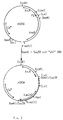
- Figure 1 illustrates the insertion of a subset of fragments, ranging from 1.5kb to 6.5kb in length, generated by partial digestion of Bacillus lentus strain 309 DNA with Sau 3A restriction endonuclease, into Bam HI cut plasmid pSx50.
- the two resulting plasmids, pSx86 and psx88, containing the subtilisin 309 gene in opposite orientations, are also shown.
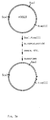
- Figure 2 illustrates the insertion of Bacillus lentus strain 147 DNA fragments into plasmid pSx56. Partial digestion of strain 147 DNA was performed using Sau 3A restriction endonuclease. Fragments ranging in size from 1.5 to 6.5 kb were then ligated into Bam HI cleaved plasmid pSx56. The product, pSx94, contains the subtilisin 147 gene.
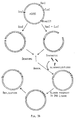
- Figure 3 illustrates gapped duplex mutagenesis, using the method of Morinaga et al., (1984, Biotechnology 2: 636-639). It featured two plasmids, pSx93 and pSx119, both derived from puC13.
- pSX93 contains an XbaI - HindIII fragment of the subtilisin 309 gene
- pSx119 contains the remainder of the subtilisin 309 gene in an EcoRI - XbaI fragment.
- plasmid pSX93 is cleaved with Xba I and Cla I, and the gapped molecules are mixed with pSX93 cut with ScaI, denatured, and allowed to reanneal so as to generate plasmids with a region of single-stranded DNA extending within the subtilisin 309 coding sequence.
- a synthetic oligonucleotide, homologous to the subtilisin 309 gene but containing a mutation, is allowed to anneal to the single stranded gap, which is then filled in using the Klenow fragment of DNA polymerase I and T4 DNA ligase.
- double-stranded mutants of the subtilisin 309 gene are generated.
- the same procedure is performed in (B), using plasmid pSX119 and EcoRI and XbaI enzymes, to create mutations in the corresponding region of the subtilisin 309 gene.
- Figure 4 illustrates plasmid pSX92, which is a derivative of plasmid pSXS2, bearing the subtilisin 309 gene. Mutated fragments (i.e. , Xba I - Cla I, Xba I- Hind III, or Eco RI - Xba l), excised from mutation plasmid pSX93 or pSX119 (see Figure 3) using the appropriate restriction endonucleases, were inserted into plasmid pSX92 for expression in B. subtilis strain DR 497.
- Mutated fragments i.e. , Xba I - Cla I, Xba I- Hind III, or Eco RI - Xba l
- Figure 5 illustrates plasmid pSX143, which contains truncated forms of both subtilisin 309 and subtilisin 147 genes. In vivo recombination between homologous regions of the two genes can result in active protease.
- the invention relates to mutations of the subtilisin gene, some of which result in changes in the chemical characteristics of subtilisin enzyme. Mutations at specific nucleic acids may be generated, and thus, forms of subtilisin can be designed so as to meet the needs of industrial application.
- the invention is based, in part, upon the discovery that mutations of specific nucleic acids in the subtilisin gene can result in enzymes with altered properties.
- enzymes with improved stability to oxidation, augmented protease activity, or improved washing ability can be generated.
- subtilisins and subtilisin 147 and 309 for purposes of clarity in description, and not by way of limitation, the invention will be described in four parts: (a) the chemical structure of known subtilisins and subtilisin 147 and 309; (b) methods for producing mutations in the subtilisin gene; (a) expression of mutants of subtilisin and (d) screening of subtilisin mutants for desirable chemical properties.
- subtilisin from various sources can reveal the functional significance of the primary amino acid sequence, and can direct the creation of new mutants with deliberately modified functions. Comparing the amino acid sequence of different forms of subtilisin, while contrasting their physical, or chemical properties, may reveal specific target regions which are likely to produce useful mutant enzymes.
- subtilisins The amino acid sequences of at least eight subtilisins are known. These include six subtilisins from Bacillus strains, namely, subtilisin 168, subtilisin BPN', subtilisin Carlsberg, subtilisin DY, subtilisin amylosacchariticus and mesenticopeptidase (Kurihara et al., 1972, J. Biol. Chem. 247 :5629-5631; Stahl and Ferrari, 1984, J. Bacteriol. 158 :411-418; Vasantha et al., 1984, J. Bacteriol. 159 :811-819; Jacobs et al., 1985, Nucl. Acids Res.
- proteases were derived from two Bacillus lentus variants, C303 and C360, which have been deposited with NCIB and designated the accession Nos. NCIB 10147 and NCIB 10309, respectively.
- subtilisin 147 and subtilisin 309 are designated subtilisin 147 and subtilisin 309, respectively, and the genes encoding these proteins are referred to as the subtilisin 147 and 309 genes.
- subtilisin material refers to a proteinaceous material which contains a subtilisin as its active ingredient.
- subtilisin material any serine protease is a subtilisin which has at least 30%, preferably 50%, and more preferably 80% amino acid sequence homology with the sequences referenced above for subtilisin 147, subtilisin 309, subtilisin 168, subtilisin BPN', subtilisin Carlsberg, subtilisin DY, subtilisin amylosacchariticus mesentericopeptidase, thermitase, proteinase K and thermomycolase.
- subtilisin material refers to a proteinaceous material which contains a subtilisin as its active ingredient.
- any serine protease is a subtilisin which has at least 30%, preferably 50%, and more preferably 80% amino acid sequence homology with the sequences referenced above for subtilisin 147, subtilisin 309, subtilisin 168, subtilisin BPN', subtilisin Carlsberg, subtilis
- Table I compares the deduced amino acid sequences of subtilisin 309, subtilisin 147, subtilisin BPN', subtilisin Carlsberg and subtilisin 168 (Spizizen, et al., 1958, Proc. Natl. Acad. Sci. U.S.A. 44:1012-1078).
- Table II presents the nucleic acid sequence of the subtilisin 309 gene
- Table III presents the nucleic acid sequence of the subtilisin 147 gene.
- the sequences of subtilisin 309 or 147, or their functional equivalents, can be used in accordance with the invention.
- subtilisin 309 or 147 depicted in Tables I, II or III can be altered by substitutions, additions or deletions that provide for functionally equivalent molecules.
- other DNA sequences which encode substantially the same amino acid sequence as depicted in Table I may be used in the practice of the present invention. These include but are not limited to nucleotide sequences comprising all or portions of the subtilisin 309 or 147 sequences depicted in Tables II or III which are altered by the substitution of different codons that encode the same or a functionally equivalent amino acid residues within the sequence, thus producing a silent change.
- one or more amino acid residues within the sequence can be substituted by another amino acid of a similar polarity which acts as a functional equivalent.
- Substitutes for an amino acid within the sequence may be selected from other members of the class to which the amino acid belongs.
- the non-polar (hydrophobic) amino acids include alanine, leucine, isoleucine, valine, proline, phenylalanine, tryptophan and methionine.
- the polar neutral amino acids include glycine, serine, threonine, cysteine, tyrosine, asparagine, and glutamine.
- the positively charged (basic) amino acids include arginine, lysine, and histidine.
- the negatively charged (acidic) amino acids include aspartic and glutamic acid.
- sequences determined for subtilisins 309 and 147 can be compared with sequences of known subtilisins (see Table I) or newly discovered subtilisins in order to deduce sites for desirable mutations. To do this, the closeness of relation of the subtilisins being compared must be determined.
- subtilisins 309 and 147 were compared with one another and with the sequences of other subtilisins (see Table II). Residues that varied between subtilisin 309 or 147 and other subtilisins were identified.
- subtilisin 309 contains a serine residue
- subtilisin 147, BPN', Carlsberg and 168 contain an alanine residue. Therefore, if the serine 153 residue of subtilisin 309 were changed to an alanine residue, the physical properties of subtilisin 309 might be altered in a desired direction.
- subtilisin 147 contains a serine residue at position 218, whereas the other subtilisins expressed an asparagine residue. Because subtilisin 147 has improved thermal stability relative to the other subtilisins, mutating the asparagine 218 at subtilisin 309 to a serine residue might improve the thermal stability of subtilisin 309.
- subtilisin As another example, it was reasoned that, since Thr 71 is close to the active site, the introduction of a negatively charged amino acid, such as aspartic acid, might suppress oxidative attack by electrostatic repulsion.
- the sites that are most likely to be relevant to the physical properties of subtilisin are those in which there is conservation of amino residues between most subtilisins, for example Asp-153 and Asn-218 discussed above, and also Trp-6, Arg-170, Pro-168, His-67, Met-175, Gly-219, Arg-275.
- subtilisin substrate specificity The catalytic activities of various subtilisins can differ markedly against selected substrates.
- Wells has shown that only three amino acid substitutions can cause B. amyloliquefaciens subtilisin substrate specificity to approach that of B. lichenformis subtilisin, enzymes that differ by factors of 10-50 in catalytic efficiency in their native state.
- subtilisin 147 and 309 Comparison analysis between subtilisin 147 and 309 and other subtilisins has indicated that mutation of the following sites may alter the physical or chemical properties of subtilisin: 6, 9, 11-12,19, 25, 36-38, 53-59, 67, 71, 89, 104, 111, 115, 120, 121-122, 124, 128, 131, 140, 153-166, 168, 169-170, 172, 175, 180, 182, 186, 187, 191, 194, 195, 199, 218, 219, 222, 226, 234-238, 241, 260-262, 265, 268, or 275.
- Deletions occur at the following sites in subtilisins 147 and/or 309; insertion of appropriate amino acid residues into these sights might enhance the stability of the parent enzymes: 1, 36, 56, 159, 164-166. According to the method illustrated by these examples, which are not limiting, a number of potential mutation sites become apparent.
- subtilisin genes Many methods for introducing mutations into genes are well known in the art. After a brief discussion of cloning subtilisin genes, methods for generating mutations in both random sites, and specific sites, within the subtilisin gene will be discussed.
- subtilisin may be cloned from any Gram-positive bacteria or fungus by various methods, well known in the art. First a genomic, and/or cDNA library of DNA must be constructed using chromosomal DNA or messenger RNA from the organism that produces the subtilisin to be studied. Then, if the amino-acid sequence of the subtilisin is known, homologous, labelled oligonucleotide probes may be synthesized and used to identify subtilisin-encoding clones from a genomic library of bacterial DNA, or from a fungal cDNA library.
- a labelled oligonucleotide probe containing sequences homologous to subtilisin from another strain of bacteria or fungus could be used as a probe to identify subtilisin-encoding clones, using hybridization and washing conditions of lower stringency.
- subtilisin-producing clones would involve inserting fragments of genomic DNA into an expression vector, such as a plasmid, transforming protease-negative bacteria with the resulting genomic DNA library, and then plating the transformed bacteria onto agar containing a substrate for subtilisin, such as skim milk. Those bacteria containing subtilisin-bearing plasmid will produce colonies surrounded by a halo of clear agar, due to digestion of the skim milk by excreted subtilisin.
- an expression vector such as a plasmid
- transforming protease-negative bacteria with the resulting genomic DNA library
- subtilisin gene has been cloned into a suitable vector, such as a plasmid, several methods can be used to introduce random mutations into the gene.
- One method would be to incorporate the cloned subtilisin gene, as part of a retrievable vector, into a mutator strain of Eschericia coli .
- Another method would involve generating a single stranded form of the subtilisin gene, and then annealing the fragment of DNA containing the subtilisin gene with another DNA fragment such that a portion of the subtilisin gene remained single stranded.
- This discrete, single stranded region could then be exposed to any of a number of mutagenizing agents, including, but not limited to, sodium bisulfite, hydroxylamine, nitrous acid, formic acid, or hydralazine.
- mutagenizing agents including, but not limited to, sodium bisulfite, hydroxylamine, nitrous acid, formic acid, or hydralazine.
- a specific example of this method for generating random mutations is described by Shortle and Nathans (1978, Proc. Natl. Acad. Sci. U.S.A., 75 :2170-2174).
- the plasmid bearing the subtilisin gene would be nicked by a restriction enzyme that cleaves within the gene. This nick would be widened into a gap using the exonuclease action of DNA polymerase I. The resulting single-stranded gap could then be mutagenized using any one of the above mentioned mutagenizing agents.
- subtilisin gene from a Bacillus species including the natural promoter and other control sequences could be cloned into a plasmid vector containing replicons for both E. coli and B. subtilis , a selectable phenotypic marker and the M13 origin of replication for production of single-stranded plasmid DNA upon superinfection with helper phage IR1.
- Single-stranded plasmid DNA containing the cloned subtilisin gene is isolated and annealed with a DNA fragment containing vector sequences but not the coding region of subtilisin, resulting in a gapped duplex molecule.
- Mutations are introduced into the subtilisin gene either with sodium bisulfite, nitrous acid or formic acid or by replication in a mutator strain of E. coli as described above. Since sodium bisulfite reacts exclusively with cytosine in a single-stranded DNA, the mutations created with this mutagen are restricted only to the coding regions. Reaction time and bisulfite concentration are varied in different experiments such that from one to five mutations are created per subtilisin gene on average. Incubation of 10 ⁇ g of gapped duplex DNA in 4 M Na-bisulfite, pH.
- reaction time is varied from about 4 minutes (to produce a mutation frequency of about one in 200) to about 20 minutes (about 5 in 200).
- the gapped molecules are treated in vitro with DNA polymerase I (Klenow fragment) to make fully double-stranded molecules and to fix the mutations.
- Competent E. coli are then transformed with the mutagenized DNA to produce an amplified library of mutant subtilisins.
- Amplified mutant libraries can also be made by growing the plasmid DNA in a Mut D strain of E. coli which increases the range of mutations due to its error prone DNA polymerase.
- the mutagens nitrous acid and formic acid may also be used to produce mutant libraries. Because these chemicals are not as specific for single-stranded DNA as sodium bisulfite, the mutagenesis reactions are performed according to the following procedure. The coding portion of the subtilisin gene is cloned in M13 phage by standard methods and single stranded phage DNA prepared. The single-stranded DNA is then reacted with 1 M nitrous acid pH. 4.3 for 15-60 minutes at 23°C or 2.4 M formic acid for 1-5 minutes at 23°C. These ranges of reaction times produce a mutation frequency of from 1 in 1000 to 5 in 1000.
- a universal primer is annealed to the M13 DNA and duplex DNA is synthesized using the mutagenized single-stranded DNA as a template so that the coding portion of the subtilisin gene becomes fully double-stranded.
- the coding region can be cut out of the M13 vector with restriction enzymes and ligated into an unmutagenized expression vector so that mutations occur only in the restriction fragment.
- mutations can be generated by allowing two dissimilar forms of subtilisin to undergo recombination in vivo .
- homologous regions within the two genes lead to a cross-over of corresponding regions resulting in the exchange of genetic information.
- the generation of hybrid amylase molecules according to this technique is fully described in U.S. patent application serial number 67,992, filed on June 29, 1987, which in incorporated by reference in its entirety herein.
- An example of a plasmid which can generate hybrid forms of subtilisin is depicted in Figure 5. Both the subtilisin 309 and 147 genes, incorporated into plasmid pSX143, are truncated, and therefore cannot themselves lead to subtilisin expression.
- subtilisin 309 if recombination occurs between the two genes so as to correct the defect produced by truncation, i.e. , the N terminal region of the subtilisin 309 gene becomes linked to the C terminal region of the subtilisin 147 gene, then active, mutant subtilisin can be produced. If pSX143 is incorporated into a protease-negative strain of bacteria, and then bacteria who develop a protease positive phenotype are selected, then various mutants, subtilisin 309/147 chimeras, can be identified.
- subtilisin gene Once the subtilisin gene has been cloned, and desirable sites for mutation identified, these mutations can be introduced using synthetic oligo nucleotides. These oligonucleotides contain nucleotide sequences flanking the desired mutation sites; mutant nucleotides are inserted during oligonucleotide synthesis.
- a single stranded gap of DNA, bridging the subtilisin gene is created in a vector bearing the subtilisin gene.
- the synthetic nucleotide, bearing the desired mutation is annealed to a homologous portion of the single-stranded DNA. The remaining gap is then filled in by DNA polymerase I (Klenow fragment) and the construct is ligated using T4 ligase.
- Morinaga et al. (1984, Biotechnology 2:646-639).
- a fragment within the gene is removed using restriction endonuclease.
- the vector/gene, now containing a gap is then denatured and hybridized to vector/gene which, instead of containing a gap, has been cleaved with another restriction endonuclease at a site outside the area involved in the gap.
- a single-stranded region of the gene is then available for hybridization with mutated oligonucleotides, the remaining gap is filled in by the Klenow fragment of DNA polymerase I, the insertions are ligated with T4 DNA ligase, and, after one cycle of replication, a double-stranded plasmid bearing the desired mutation is produced.
- the Morinaga method obviates the additional manipulation of construction new restriction sites, and therefore facilitates the generation of mutations at multiple sites.
- Patent number 4,760,025, by Estelle et al., issued July 26, 1988, is able to introduce oligonucleotides bearing multiple mutations by performing minor alterations of the cassette, however, an even greater variety of mutations can be introduced at any one time by the Morinaga method, because a multitude of oligonucleotides, of various lengths, can be introduced.
- a mutated subtilisin gene produced by methods described above, or any alternative methods known in the art can be expressed, in enzyme form, using an expression vector.
- An expression vector generally falls under the definition of a cloning vector, since an expression vector usually includes the components of a typical cloning vector, namely, an element that permits autonomous replication of the vector in a microorganism independent of the genome of the microorganism, and one or more phenotypic markers for selection purposes.
- An expression vector includes control sequences encoding a promoter, operator, ribosome binding site, translation initiation signal, and, optionally, a repressor gene.
- nucleotides encoding a "signal sequence" may be inserted prior to the coding sequence of the gene.
- a target gene to be treated according to the invention is operably linked to the control sequences in the proper reading frame.
- Promoter sequences that can be incorporated into plasmid vectors, and which can support the transcription of the mutant subtilisin gene include but are not limited to the prokaryotic ⁇ lactamase promoter (Villa-Kamar off, et al., 1978, Proc. Natl. Acad. Sci. U.S.A. 75 :3727-3731) and the tac promoter (DeBoer, et al., 1983, Proc. Natl. Acad. Sci. U.S.A. 80 :21-25). Further references can also be found in "Useful proteins from recombinant bacteria" in Scientific American, 1980, 242 :74-94.
- B. subtilis is transformed by an expression vector carrying the mutated DNA. If expression is to take place in a secreting microorganism such as B . subtilis a signal sequence may follow the translation initiation signal and precede the DNA sequence of interest. The signal sequence acts to transport the expression product to the cell well where it is cleaved from the product upon secretion.
- control sequences as defined above is intended to include a signal sequence, when it is present.
- transformed B. subtilis can be cultivated in the presence of a filter material (such as nitrocellulose) to which the secreted expression product (e.g. enzyme) binds.
- a filter material such as nitrocellulose
- the secreted expression product e.g. enzyme
- filter bound expression product is subjected to conditions which distinguish expression product of interest from wild-type expression product.
- the filter-bound expression product can be subjected to conditions which would inactivate a wild-type product.
- Preserved enzyme activity following adverse treatment suggests that the mutation confers enhanced stability on the enzyme, and is therefore a useful mutation.
- screening for stable variants is accomplished using a protease deficient B. subtilis strain transformed with the variant plasmid and plated out as follows: a nitrocellulose filter is placed on a nutrient base in a petri dish, and a cellulose acetate filter is placed on top of the nitrocellulose. Colonies are grown on the cellulose acetate, and protease from individual colonies is secreted through the cellulose acetate onto the nitrocellulose filter where it is stably bound. Protease from hundreds of colonies is bound to a single filter allowing subsequent screening of thousands of different variants by processing multiple filters.
- the filters can be incubated in buffer solutions at temperatures which would inactivate substantially all wild-type activity. Variants of enhanced stability or activity retain activity after this step.
- the suitably treated filter then is soaked in a solution containing Tosyl-L-Arg methyl ester (TAME) Benzoly-Arg-ethyl-ester (BAEE), Acetyl-Tyr-ethyl-ester (ATEE) (Sigma) or similar compounds. Because TAME, BAEE, and ATEE are substrates for the proteases they are cleaved in zones on the filter containing variant subtilisins which remain active after treatment. As cleavage occurs, protons are released in the reaction and cause phenol red to change in color from red to yellow in areas retaining protease activity.
- the filters could be treated at high temperature, at high pH, with denaturants, oxidizing agents, or under other conditions which normally inactivate an enzyme such as a protease to find resistant variants.
- Variants with altered substrate specificity could be screened by replacing TAME, BAEE, or ATEE with other substrates which are normally not cleaved by wild-type subtilisin.
- the colony from which the variant is derived is isolated and the altered subtilisin is purified.
- Experiments can be performed on the purified enzyme to determine conditions of stability towards oxidation, thermal inactivation, denaturation temperature, kinetic parameters as well as other physical measurements.
- the altered gene can also be sequenced to determine the amino acid changes responsible for the enhanced stability. Using this procedure, variants with increased washing abilities have been isolated.
- B. subtilis 309 and 147 are variants of Bacillus lentus , deposited with the NCIB and accorded the accession numbers NCIB 10147 and NCIB 10309, and described in U.S. Patent No. 3,723,250, issued March 27, 1973, and incorporated in its entirety by reference herein.
- B. subtilis DN 497 is described in U. S. Serial No. 039,298, also incorporated by reference herein, and is an aro+ transformant of RUB 200 with chromosomal DNA from SL 438, a sporulation and protease deficient strain obtained from Dr. Kim Hardy of Biogen.
- E. coli MC 1000 r ⁇ m+ (Casa-daban, M.J. and Cohen, S.N. (1980), J. Mol. Biol. 138 :179-207, was made r ⁇ m+ by conventional methods and is also described in U. S. Serial No. 039,298.
- pSX50 (described in U.S. patent application serial No. 039,298 filed April 17, 1987, and incorporated by reference herein) is a derivative of plasmid pDN 1050, comprising the promoter-operator P1O1, the B. pumilus xyn B gene and the B. subtilis xyl R gene.
- pSX65 (described in U.S. patent application serial No. 039,298, supra ) is a derivative of plasmid pDN 1050, comprising the promotor-operator P2O2, the B. pumilus xyn B gene, and the B. subtilis xyl R gene.
- pSX93 shown in Figure 3a, is puC13 (Vieira and Messing, 1982, Gene 19 :259-268) comprising a 0.7kb XbaI-Hind III fragment of the subtilisin 309 gene including the terminator inserted in a polylinker sequence.
- pSX119 is pUC13 harboring an EcoRI-XbaI fragment of the subtilisin 309 gene inserted into the polylinker.
- pSX62 (described in U.S. patent application serial No. 039,298, supra ) is a derivative of pSX52 ( ibid ), which comprises a fusion gene between the calf prochymosin gene and the B. pumilus xyn B gene inserted into pSX50 (supra). pSX62 was generated by inserting the E. coli rrn B terminator into pSX52 behind the prochymosin gene.
- pSX92 was produced by cloning the subtilisin 309 into plasmid pSX62 ( supra ) cut at Cla I and Hind III and filled prior to the insertion of the fragments DraI-NheI and NheI-Hind III from the cloned subtilisin 309 gene.
- the procedure relates to a typical purification of a 10 liter scale fermentation of the Subtilisin 147 enzyme, the Subtilisin 309 enzyme or mutants thereof.
- the filtrates were concentrated to approximately 400 ml using an Amicon CH2A UF unit equipped with an Amicon S1Y10 UF cartridge.
- the UF concentrate was centrifuged and filtered prior to adsorption on a Bacitracin affinity column at pH 7.
- the protease was eluted from the Bacitracin column using 25% 2-propanol and 1 M sodium chloride in a buffer solution with 0.01 dimethylglutaric acid, 0.1 M boric acid and 0.002 M calcium chloride adjusted to pH 7.
- the fractions with protease activity from the Bacitracin purification step were combined and applied to a 750 ml Sephadex G25 column (5 cm dia.) equilibrated with a buffer containing 0.01 dimethylglutaric acid, 0.2 M boric acid and 0.002 M calcium chloride adjusted to pH 6.5.
- the protease was eluted using a linear gradient of 0-0.1 M sodium chloride in 2 liters of the same buffer (0-0.2 M sodium chloride in case of sub 147).
- protease containing fractions from the CM Sepharose column were combined and concentrated in an Amicon ultrafiltration cell equipped with a GR81P membrane (from the Danish Sugar Factories Inc.).
- the purified enzyme is diluted to an enzyme content of approximately 0.1 mg/ml in 0.01 M dimethylglutaric acid pH 7 and in the same buffer with 0.01 M peracetic acid (pH 7).
- Both sets of dilutions were heated to 50°C for 20 minutes. Proteolytic activity was measured in the dilutions before and after the heat treatment.
- Casein Protease Unit CPU
- CPU Casein Protease Unit
- reaction mixtures were kept for 20 minutes in the water bath, whereupon they were filtered through Vhatman® 42 paper filters.
- OPA o -phthaldialdehyde
- Disodium tetraborate decahydrate (7.62 g) and sodium dodecylsulfate (2.0 g) was dissolved in 150 ml of water.
- OPA 160 mg
- 4 ml of methanol was then added together with 400 ⁇ l of beta-mercaptoethanol, whereafter the solution was made up to 200 ml with water.
- the OPA test was also performed with a serine standard containing 10 mg of serine in 100 ml of Britton-Robinson buffer (pH 9.5). The buffer was used as a blank.
- CPU/g of enzyme preparation CPU/ml: b wherein OD t , OD b , OD ser and OD B is the optical density of the test solution, blank, serine standard, and buffer, respectively, C ser the concentration of serine in mg/ml in the standard, MW ser the molecular weight of serine.
- Q is the dilution factor (in this instance equal to 8) for the enzyme solution, and t i is the incubation time in minutes.
- Test cloths (7 cm x 7 cm, approximately 1 g) were produced by passing desized cotton (100% cotton, DS 71) cloth through the vessel in a Mathis Washing and Drying Unit type TH (Werner Mathis AG, Zurich, Switzerland) containing spinach juice (produced from fresh spinach) and then through the pressure roll of the machine in order to remove excess spinach juice.
- Tests were performed at enzyme concentrations of: 0, 0.05 CPU/1 and 0.1 CPU/1 and two independent sets of tests were performed for each of the mutants.
- ⁇ R As a measure of the washing ability differential remission, ⁇ R, was used, ⁇ R being equal to the remission after wash with enzyme added minus the remission after wash with no enzyme added.
- thermostability of the mutants produced was estimated, by performing the test at temperatures of 40°C and 60°C, respectively.
- Chromosomal DNA from the "309" strain was isolated by treating a cell suspension with Lysozyme for 30 minutes at 37°C, and then with SDS for 5 minutes at 60°C. Subsequently, the suspension was extracted with phenolchloroform (50:50), precipitated with ethanol, and the precipitate redissolved in TE. This solution was treated with RNase for 1 hour at 37°C.
- chromosomal DNA was partially digested with restriction enzyme Sau 3A (New England Biolabs) and fragments from about 1.5 kb to about 6.5 kb were isolated on DEAE cellulose paper from a 1% agarose gel (the subtilisin gene in other species is approximately 1.2Kb in length).
- the cells were then spread on LB agar plates with 10 mM phosphate pH 7, 6 ⁇ g/ml chloramphenicol, and 0.2% xylose to induce the xyn-promoter in the plasmid.
- the plates also contained 1% skim milk so the protease producing transformants could be detected by the clear halo where the skim milk had been degraded.
- Protease expressing clones were produced at a frequency of 10 ⁇ 4. Two clones were found that harboured plasmids carrying the gene for subtilisin 309, pSX86 and pSX88. The gene was then sequenced using the method of Maxam and Gilbert. The deduced nucleotide sequence of subtilisin 309 is presented in Table II.
- subtilisin 147 The same procedure as above was used for the cloning of the subtilisin 147 gene except that the DNA fragments were ligated into the plasmid pSX56 (also described in US serial No. 039,298 supra ), which as indicated in Figure 2 instead of the xyn promotor harbours the xyl promotor.
- pSX94 plasmid carrying the gene for subtilisin 147. The sequence for this gene is shown in table III below.
- pSX93 Gapped duplex mutagenesis was performed using the plasmid pSX93 as template.
- pSX93 is shown in Figure 3a and 3b, and is pUC13 (Vieira, J. and Messing, J.: 1982, Gene 19: 259-268) harbouring an 0.7 kb XbaI-HindIII fragment of the subtilisin 309 gene including the terminator inserted in the polylinker.
- the terminator and the HindIII site are not shown in Table II.
- pSX119 is pUC13 harbouring an EcoRI-XbaI fragment of the subtilisin 309 gene inserted into the polylinker.
- the templates pSX93 and pSX119 thus cover the whole of the subtilisin 309 gene.
- the mutations a), b), and e) were performed by cutting pSX93 with XbaI and ClaI as indicated in Figure 3a; c), d), f), and h) were performed by cutting pSX93 with XbaI and HindIII as indicated in Figure 3b.
- Mutation g was performed correspondingly in pSX119 by cutting with EcoRI and XbaI.
- the double mutants i) and j) were produced by cutting the 0.7 kb Xba-HindIII fragment from a) partially with HgiAI (HgiAI also cuts in SacI, which was introduced by the mutation). This 180 bp XbaI-HgiAI fragment and the 0.5 kb HgiAI fragment from the c) and d) mutants, respectively, were ligated to the large HindIII-XbaI fragment from pSX93.
- the double mutant k) was produced as above by combining mutants e) and f).
- Plasmid pSX92 is shown in Figure 4 and was produced by cloning the Sub 309 gene into plasmid pSX62 cut at ClaI, filled in with the Klenow fragment of DNA polymerase I, and cut with HindIII prior to the insertion of the fragments DraI-NheI and Nhei-HindIII from the cloned Sub 309 gene.
- mutants the mutated fragments (XbaI-ClaI, XbaI-HindIII, or EcoRI-XbaI) were excised from the appropriate mutation plasmid pSX93 or pSX119, respectively, and inserted into pSX92.
- the mutated pSX92 was then used to transform B. subtilis strain DN497, which was then grown in the same medium and under the same conditions as used for the cloning of the parent gene.
- mutants a) and d) were tested for their oxidation stability in 0.01 M peracetic acid after 20 minutes at 50°C and pH 7.
- the parent strain NCIB 10309 protease was used as reference.
- mutants c), d), i), and j) (all Met-222) could resist 3 - 5 times more hypochlorite than the other mutants.
- mutant f When tested in a liquid detergent of the usual built type it was found that mutant f) exhibited superior stability compared to both the other mutants and the "parent" enzyme.
- mutant a exhibits enhanced activity compared to the parent. It is also seen that the Met-222 mutants have lower activity than the parent, but due to their improved oxidation stability their application in detergent compositions containing oxidants is not precluded.
- TABLE V Proteolytic Activity of Mutant Subtilisins Mutant Relative Activity None 100 a) 120 b) 100 c) 30 d) 20 e) 100 f) 100 i) 20 j) 30
- mutant f The thermostability of mutant f) was tested against the wild type enzyme by using the washability test at 40°C and 60°C, respectively. The results are shown in Table VII. From the table it is seen that mutant f) at 60°C shows a much improved washability compared to the wild type enzyme, whereas at 40°C the washability of mutant f) is only slightly better than wild type enzyme. TABLE VII Washability at Different Temperatures ⁇ R ⁇ Mutant Concentration (CPU/1) 0.05 0.1 none (40°C) 14.4 20.4 f) (40°C) 16.6 19.3 none (60°C) 15.1 24.9 f) (60°C) 30.4 31.3 95% confidence interval ⁇ 0.9 (40°C) and ⁇ 0.7 (60°)
- Subtilisin genes were cloned from the 147 and 309 variants of the bacterium Bacillus lentus , and the cloned genes were sequenced. By comparing the deduced amino acid sequences of subtilisins 147 and 309 one with the other and with sequences of other subtilisins, sites which, upon mutation, might alter the physical properties of the parent enzyme were identified. Site-directed mutagenesis was used to generate mutations at several of these sites in the subtilisin 309 gene. The resulting mutant enzymes were then expressed in a Bacillus strain, and tested against various physical and chemical parameters. Several of the mutants were shown to have improved stability to oxidation, increased proteolytic ability, or improved washability when compared with parent subtilisin 309 enzyme. These mutants exhibit properties desirable in enzymes comprised in detergent compositions.
Landscapes
- Chemical & Material Sciences (AREA)
- Life Sciences & Earth Sciences (AREA)
- Organic Chemistry (AREA)
- Health & Medical Sciences (AREA)
- Engineering & Computer Science (AREA)
- Wood Science & Technology (AREA)
- Genetics & Genomics (AREA)
- Bioinformatics & Cheminformatics (AREA)
- Zoology (AREA)
- General Engineering & Computer Science (AREA)
- Oil, Petroleum & Natural Gas (AREA)
- Biotechnology (AREA)
- Biomedical Technology (AREA)
- Biochemistry (AREA)
- Molecular Biology (AREA)
- General Health & Medical Sciences (AREA)
- Medicinal Chemistry (AREA)
- Chemical Kinetics & Catalysis (AREA)
- Microbiology (AREA)
- Enzymes And Modification Thereof (AREA)
- Detergent Compositions (AREA)
- Micro-Organisms Or Cultivation Processes Thereof (AREA)
- Saccharide Compounds (AREA)
- Amplifiers (AREA)
- Immobilizing And Processing Of Enzymes And Microorganisms (AREA)
- Breeding Of Plants And Reproduction By Means Of Culturing (AREA)
- Preparation Of Compounds By Using Micro-Organisms (AREA)
- Peptides Or Proteins (AREA)
Abstract
Description
- The present invention relates to mutations of the subtilisin gene which result in changes in the chemical characteristics of subtilisin enzyme. Mutations at specific nucleic acids of the subtilisin gene result in amino acid substitutions and consequently, altered enzyme function. Some of these mutant enzymes exhibit physical properties advantageous to industrial applications, particularly in the detergent industry, providing subtilisin which is more stable to oxidation, possesses greater protease activity, and exhibits improved washability.
- Enzymes cleaving the amide linkages in protein substrates are classified as proteases, or (interchangeably) peptidases (See Walsh, 1979, Enzymatic Reaction Mechanisms. W.H. Freeman and Company, San Francisco, Chapter 3). Bacteria of the Bacillus species secrete two extracellular species of protease, a neutral, or metalloprotease, and an alkaline protease which is functionally a serine endopeptidase, referred to as subtilisin. Secretion of these proteases has been linked to the bacterial growth cycle, with greatest expression of protease during the stationary phase, when sporulation also occurs. Joliffe et al. (1980, J. Bacterial 141:1199-1208) has suggested that Bacillus proteases function in cell wall turnover.
- A serine protease is an enzyme which catalyzes the hydrolysis of peptide bonds, in which there is an essential serine residue at the active site (White, Handler, and Smith, 1973 "Principles of Biochemistry," Fifth Edition, McGraw-Hill Book Company, NY, pp. 271-272).
- The serine proteases have molecular weights in the 25,000 to 30,000 range. They are inhibited by diisopropylfluorophosphate, but in contrast to metalloproteases, are resistant to ethylenediamine-tetra acetic acid (EDTA) (although they are stabilized at high temperatures by calcium ion). They hydrolyze simple terminal esters and are similar in activity to eukaryotic chymotrypsin, also a serine protease. The alternative term, alkaline protease, reflects the high pH optimum of the serine proteases, from pH 9.0 to 11.0 (for review, see Priest, 1977, Bacteriological Rev. 41:711-753).
- A subtilisin is a serine protease produced by Gram-positive bacteria or fungi. A wide variety of subtilisins have been identified, and the amino acid sequences of at least eight subtilisins have been determined. These include six subtilisins from Bacillus strains, namely, subtilisin 168, subtilisin BPN', subtilisin Carlsberg, subtilisin DY, subtilisin amylosacchariticus, and mesentericopeptidase (Kurihara at al., 1972, J. Biol. Chem. 247:5629-5631; Stahl and Ferrari, 1984, J. Bacteriol. 158: 411-418; Vasantha et al., 1984, J. Bacteriol. 159:811-819, Jacobs et al., 1985, Nucl. Acids Res. 13:8913-8926; Nedkov et al., 1985, Biol. Chem. Hoppe-Seyler 366:421-430; Svendsen et al., 1986, FEBS Lett 196:225-232), and two fungal subtilisins, subtilisin thermitase from Thermoactinymyces vulgaris (Meloun et al., 1985, FEBS. Lett. 183:195-200) and proteinase K from Tritirachium album (Jany and Mayer, 1985, Biol. Chem. Hoppe-Seyler 366:584-492).
- Subtilisins are well-characterized physically and chemically. In addition to knowledge of the primary structure (amino acid sequence) of these enzymes, over 50 high resolution X-ray structures of subtilisin have been determined which delineate the binding of substrate, transition state, products, three different protease inhibitors, and define the structural consequences for natural variation (Kraut, 1971, Ann. Rev. Biochem. 46:331- 358). Random and site-directed mutations of the subtilisin gene have both arisen from knowledge of the physical and chemical properties of the enzyme and contributed information relating to subtilisin's catalytic activity, substrate specificity, tertiary structure, etc. (Wells et al., 1981, Proc. Natl. Acad. Sci. U.S.A. 84; 1219-1223 Wells et al., 1986, Phil. Trans. R. Soc. Lond. A. 317:415-423; Hwang and Warshel, 1987, Biochem. 26:2669-26?3; Rao et al., 1987, Nature 328:551-554).
- A publication (Estell et al., 1985, J. Biol. Chem. 260:6518-6521) describes site-directed mutagenesis employed to substitute all 19 amino acid substitutions for the methionine in the 222 position of subtilisin BPN'. It was found that upon substitution the relative specific activities towards the substrate N-succinyl-L-Ala-L-Ala-L-Pro-L-Phe-p-nitroanilide differed from 138% to 0.3% in relation to wildtype subtilisin BPN' with the Cys substitution exhibiting the highest activity. The Ala and Ser substitutions were 53% and 35%, respectively, as active as the wildtype enzyme. At the same time it was found that the Ala and Ser substituents exhibited improved resistance towards oxidation by H₂O₂
- Subtilisins have found much utility in industry, particularly detergent formulations, as they are useful for removing proteinaceous stains. To be effective, however, these enzymes must not only possess activity under washing conditions, but must also be compatible with other detergent components during storage. For example, subtilisin may be used in combination with amylases, which are active against starches; cellulases which will digest cellulosic materials; lipases, which are active against fats; peptidases, which are active on peptides, and ureases, which are effective against urine stains. Not only must the formulation protect other enzymes from digestion by subtilisin, but subtilisin must be stable with respect to the oxidizing power, calcium binding properties, detergency and high pH of nonenzymatic detergent components. The ability of the enzyme to remain stable in their presence is often referred to as its washing ability or washability
- US Patent No. 3,770,587 relating to chemical modification of of proteolytic enzymes thus uses comparisons between the parent and modified enzyme in detergents for determining the usefulness of the modified proteolytic enzymes.
- The present invention relates to mutations of the subtilisin gene, some of which result in changes in the chemical characteristics of subtilisin enzyme. Mutations are created at specific nucleic acids of the subtilisin gene, and, in various specific embodiments, the mutant enzymes possess altered chemical properties including, but not limited to, increased stability to oxidation, augmented proteolytic ability, and improved washability.
- The present invention also relates, but is not limited to the amino acid and DNA sequences for protease mutants derived from Bacillus lentus variant,
subtilisin 309. - Site-directed mutation can efficiently produce mutant subtilisin enzymes which can be tailored to suit a multitude of industrial applications particularly in the areas of detergent and food technology. The present invention relates, in part, but is not limited to, mutants of the subtilisin 309 gene which exhibit improved stability to oxidation, augmented protease activity, and/or improved washability.
-
- A = Ala = Alanine
- V = Val = Valine
- L = Leu = Leucine
- I = Ile = Isoleucine
- P = Pro = Proline
- F = Phe = Phenylalanine
- W = Trp = Tryptophan
- M = Met = Methionine
- G = Gly = Glycine
- S = Ser = Serine
- T = Thr = Threonine
- C = Cys = Cysteine
- Y = Tyr = Tryosine
- N = Asn = Asparagine
- Q = Gln = Glutamine
- D = Asp = Aspartic Acid
- E = Glu = Glutamic Acid
- K = Lys = Lysine
- R = Arg = Arginine
- H = His = Histidine
- Figure 1 illustrates the insertion of a subset of fragments, ranging from 1.5kb to 6.5kb in length, generated by partial digestion of
Bacillus lentus strain 309 DNA with Sau 3A restriction endonuclease, into Bam HI cut plasmid pSx50. The two resulting plasmids, pSx86 and psx88, containing thesubtilisin 309 gene in opposite orientations, are also shown. - Figure 2 illustrates the insertion of
Bacillus lentus strain 147 DNA fragments into plasmid pSx56. Partial digestion ofstrain 147 DNA was performed using Sau 3A restriction endonuclease. Fragments ranging in size from 1.5 to 6.5 kb were then ligated into Bam HI cleaved plasmid pSx56. The product, pSx94, contains thesubtilisin 147 gene. - Figure 3 illustrates gapped duplex mutagenesis, using the method of Morinaga et al., (1984, Biotechnology 2: 636-639). It featured two plasmids, pSx93 and pSx119, both derived from puC13. pSX93 contains an XbaI-HindIII fragment of the
subtilisin 309 gene, and pSx119 contains the remainder of thesubtilisin 309 gene in an EcoRI-XbaI fragment. In (A), plasmid pSX93 is cleaved with XbaI and ClaI, and the gapped molecules are mixed with pSX93 cut with ScaI, denatured, and allowed to reanneal so as to generate plasmids with a region of single-stranded DNA extending within thesubtilisin 309 coding sequence. A synthetic oligonucleotide, homologous to thesubtilisin 309 gene but containing a mutation, is allowed to anneal to the single stranded gap, which is then filled in using the Klenow fragment of DNA polymerase I and T4 DNA ligase. Upon replication of the plasmid, double-stranded mutants of thesubtilisin 309 gene are generated. The same procedure is performed in (B), using plasmid pSX119 and EcoRI and XbaI enzymes, to create mutations in the corresponding region of thesubtilisin 309 gene. - Figure 4 illustrates plasmid pSX92, which is a derivative of plasmid pSXS2, bearing the
subtilisin 309 gene. Mutated fragments (i.e., XbaI - ClaI, XbaI-HindIII, or Eco RI-Xbal), excised from mutation plasmid pSX93 or pSX119 (see Figure 3) using the appropriate restriction endonucleases, were inserted into plasmid pSX92 for expression in B. subtilis strain DR 497. - Figure 5 illustrates plasmid pSX143, which contains truncated forms of both
subtilisin 309 andsubtilisin 147 genes. In vivo recombination between homologous regions of the two genes can result in active protease. - The invention relates to mutations of the subtilisin gene, some of which result in changes in the chemical characteristics of subtilisin enzyme. Mutations at specific nucleic acids may be generated, and thus, forms of subtilisin can be designed so as to meet the needs of industrial application.
- The invention is based, in part, upon the discovery that mutations of specific nucleic acids in the subtilisin gene can result in enzymes with altered properties. In various embodiments, enzymes with improved stability to oxidation, augmented protease activity, or improved washing ability can be generated.
- For purposes of clarity in description, and not by way of limitation, the invention will be described in four parts: (a) the chemical structure of known subtilisins and
subtilisin - Sequence analysis of subtilisin from various sources can reveal the functional significance of the primary amino acid sequence, and can direct the creation of new mutants with deliberately modified functions. Comparing the amino acid sequence of different forms of subtilisin, while contrasting their physical, or chemical properties, may reveal specific target regions which are likely to produce useful mutant enzymes.
- The amino acid sequences of at least eight subtilisins are known. These include six subtilisins from Bacillus strains, namely, subtilisin 168, subtilisin BPN', subtilisin Carlsberg, subtilisin DY, subtilisin amylosacchariticus and mesenticopeptidase (Kurihara et al., 1972, J. Biol. Chem. 247:5629-5631; Stahl and Ferrari, 1984, J. Bacteriol. 158:411-418; Vasantha et al., 1984, J. Bacteriol. 159:811-819; Jacobs et al., 1985, Nucl. Acids Res. 13:8913-8926; Nedkov et al., 1985, Biol. Chem. Hoppe-Seyler 366:421-430; Svendsen et al., 1986, FEBS Lett. 196:228-232), and two fungal subtilisins, subtilisin thermitase from Thermoactinymyces vulgaris (Meloun et al., 1985, FEBS Lett. 183:195-200), and proteinase K from Tritirichium album limber (Janny and Mayer, 1985, Biol. Chem. Hoppe-Seyler 366:485-492).
- In connection with this invention the amino acid and DNA sequences for two further serine proteases are revealed. These proteases were derived from two Bacillus lentus variants, C303 and C360, which have been deposited with NCIB and designated the accession Nos. NCIB 10147 and NCIB 10309, respectively.
- The deposits were made on 26 January 1968 and 9 September 1968, respectively, and in respect of the Budapest Treaty the date of deposit is regarded as 31 March 1982.
- For convenience the proteases produced by these strains are designated
subtilisin 147 andsubtilisin 309, respectively, and the genes encoding these proteins are referred to as thesubtilisin - As used in this invention the term "subtilisin material" refers to a proteinaceous material which contains a subtilisin as its active ingredient. As used herein, and under the definition of subtilisin material, any serine protease is a subtilisin which has at least 30%, preferably 50%, and more preferably 80% amino acid sequence homology with the sequences referenced above for
subtilisin 147,subtilisin 309, subtilisin 168, subtilisin BPN', subtilisin Carlsberg, subtilisin DY, subtilisin amylosacchariticus mesentericopeptidase, thermitase, proteinase K and thermomycolase. These serine proteases are also described herein as "homologous serine proteases". - Table I compares the deduced amino acid sequences of
subtilisin 309,subtilisin 147, subtilisin BPN', subtilisin Carlsberg and subtilisin 168 (Spizizen, et al., 1958, Proc. Natl. Acad. Sci. U.S.A. 44:1012-1078). Table II presents the nucleic acid sequence of thesubtilisin 309 gene, and Table III presents the nucleic acid sequence of thesubtilisin 147 gene. The sequences ofsubtilisin subtilisin subtilisin - Closeness of relation can be measured by comparison of amino-acid sequences. There are many methods of aligning protein sequences, but the differences are only manifest when the degree of relatedness is quite small. The methods described in Atlas of Protein Sequence and Structure, Margaret O. Dayhoff editor, vol. 5, supplement 2, 1976, National Biomedical Research Foundation, Georgetown University Medical Center, Washington, D.C., p. 3 ff., entitled SEARCH and ALIGN, define relatedness. As is well known in the art, related proteins can differ in number of amino acids as well as identity of each amino acid along the chain. That is, there can be deletions or insertions when two structures are aligned for maximum identity. For example, subtilisin Carlsberg has only 274 amino acids while subtilisin BPN' has 275 amino acids. Aligning the two sequences shows that Carlsberg has no residue corresponding to Asn56 of subtilisin BPN'. Thus the amino acid sequence of Carlsberg would appear very different from BPN' unless a gap is recorded at location 56. Therefore, one can predict with a high degree of confidence that substituting Ser for Asn at location 218 of subtilisin Carlsberg will increase thermal stability provided that the residues in Carlsberg are numbered by homology to BPN'.
- According to the invention, the sequences determined for
subtilisins - Experiments to determine the relationship between the primary structure of subtilisin and its physical properties have revealed the significance of the methionine-222 residue as well as the amino acids functional in the active site, namely, aspartic acid-32, histidine-64, and serine-221. Asparagine-155 and Serine-221 are within the oxyanion binding site. Mutations at these positions are likely to diminish proteolytic activity. According to the present invention, the amino acid sequences of
subtilisins subtilisin subtilisin 309 contains a serine residue, whereassubtilisin 147, BPN', Carlsberg and 168 contain an alanine residue. Therefore, if the serine 153 residue ofsubtilisin 309 were changed to an alanine residue, the physical properties ofsubtilisin 309 might be altered in a desired direction. Likewise,subtilisin 147 contains a serine residue at position 218, whereas the other subtilisins expressed an asparagine residue. Becausesubtilisin 147 has improved thermal stability relative to the other subtilisins, mutating the asparagine 218 atsubtilisin 309 to a serine residue might improve the thermal stability ofsubtilisin 309. As another example, it was reasoned that, since Thr 71 is close to the active site, the introduction of a negatively charged amino acid, such as aspartic acid, might suppress oxidative attack by electrostatic repulsion. The sites that are most likely to be relevant to the physical properties of subtilisin are those in which there is conservation of amino residues between most subtilisins, for example Asp-153 and Asn-218 discussed above, and also Trp-6, Arg-170, Pro-168, His-67, Met-175, Gly-219, Arg-275. By mutating the nucleic acid sequence such that a amino acid which differs from other subtilisins is substituted with an amino acid that conforms, a more stable form of subtilisin may result. - Wells et al. (1987, Proc. Natl. Acad. Sci. U.S.A. 84:1219-1223) have used comparison of amino acid sequences and site-directed mutation to engineer subtilisin substrate specificity. The catalytic activities of various subtilisins can differ markedly against selected substrates. Wells has shown that only three amino acid substitutions can cause B. amyloliquefaciens subtilisin substrate specificity to approach that of B. lichenformis subtilisin, enzymes that differ by factors of 10-50 in catalytic efficiency in their native state. Comparison analysis between
subtilisin subtilisins 147 and/or 309; insertion of appropriate amino acid residues into these sights might enhance the stability of the parent enzymes: 1, 36, 56, 159, 164-166. According to the method illustrated by these examples, which are not limiting, a number of potential mutation sites become apparent.


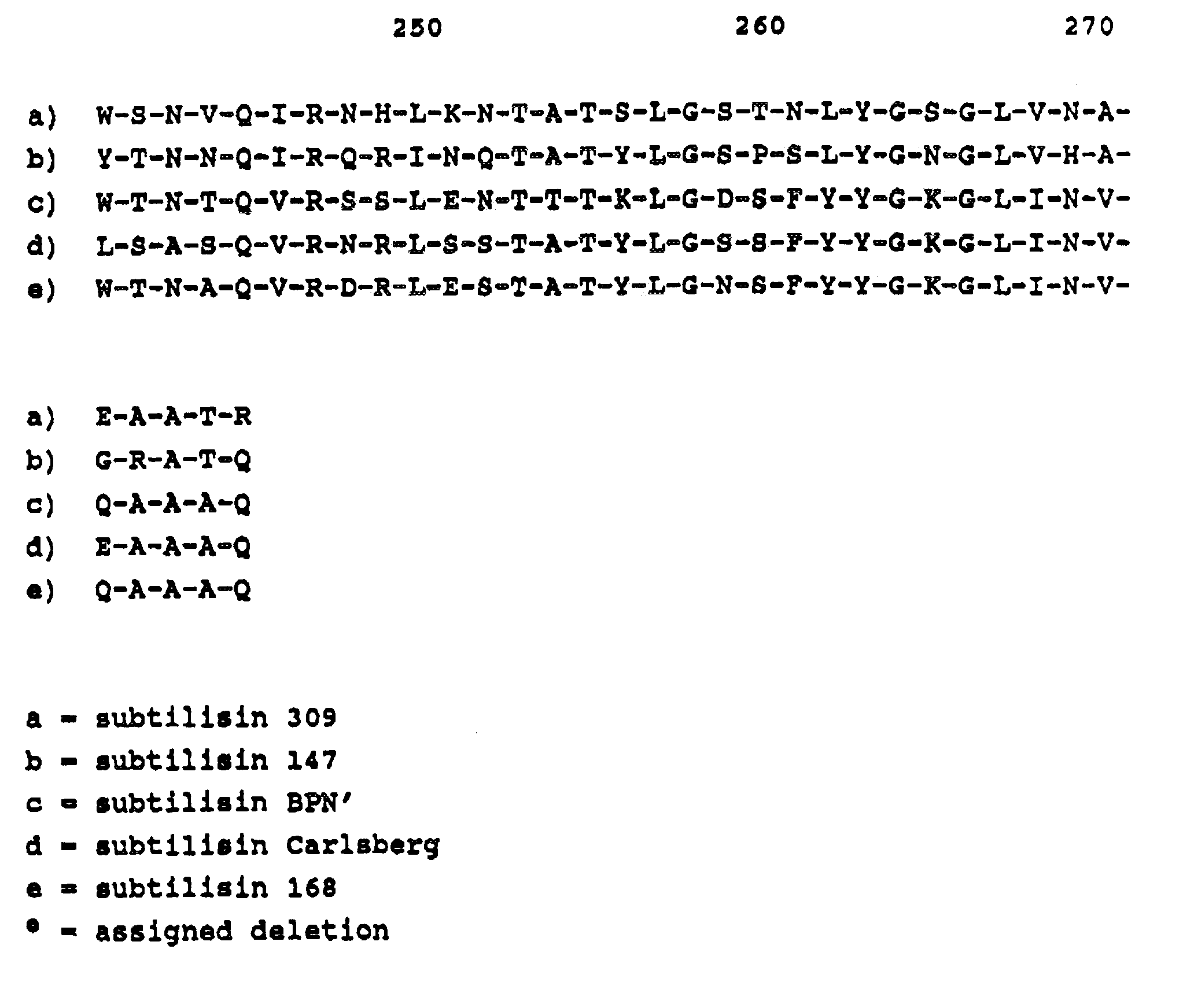
- Many methods for introducing mutations into genes are well known in the art. After a brief discussion of cloning subtilisin genes, methods for generating mutations in both random sites, and specific sites, within the subtilisin gene will be discussed.
- The gene encoding subtilisin may be cloned from any Gram-positive bacteria or fungus by various methods, well known in the art. First a genomic, and/or cDNA library of DNA must be constructed using chromosomal DNA or messenger RNA from the organism that produces the subtilisin to be studied. Then, if the amino-acid sequence of the subtilisin is known, homologous, labelled oligonucleotide probes may be synthesized and used to identify subtilisin-encoding clones from a genomic library of bacterial DNA, or from a fungal cDNA library. Alternatively, a labelled oligonucleotide probe containing sequences homologous to subtilisin from another strain of bacteria or fungus could be used as a probe to identify subtilisin-encoding clones, using hybridization and washing conditions of lower stringency.
- Yet another method for identifying subtilisin-producing clones would involve inserting fragments of genomic DNA into an expression vector, such as a plasmid, transforming protease-negative bacteria with the resulting genomic DNA library, and then plating the transformed bacteria onto agar containing a substrate for subtilisin, such as skim milk. Those bacteria containing subtilisin-bearing plasmid will produce colonies surrounded by a halo of clear agar, due to digestion of the skim milk by excreted subtilisin.
- Once the subtilisin gene has been cloned into a suitable vector, such as a plasmid, several methods can be used to introduce random mutations into the gene.
- One method would be to incorporate the cloned subtilisin gene, as part of a retrievable vector, into a mutator strain of Eschericia coli.
- Another method would involve generating a single stranded form of the subtilisin gene, and then annealing the fragment of DNA containing the subtilisin gene with another DNA fragment such that a portion of the subtilisin gene remained single stranded. This discrete, single stranded region could then be exposed to any of a number of mutagenizing agents, including, but not limited to, sodium bisulfite, hydroxylamine, nitrous acid, formic acid, or hydralazine. A specific example of this method for generating random mutations is described by Shortle and Nathans (1978, Proc. Natl. Acad. Sci. U.S.A., 75:2170-2174). According to the Shortle and Nathans method, the plasmid bearing the subtilisin gene would be nicked by a restriction enzyme that cleaves within the gene. This nick would be widened into a gap using the exonuclease action of DNA polymerase I. The resulting single-stranded gap could then be mutagenized using any one of the above mentioned mutagenizing agents.
- Alternatively, the subtilisin gene from a Bacillus species including the natural promoter and other control sequences could be cloned into a plasmid vector containing replicons for both E. coli and B. subtilis, a selectable phenotypic marker and the M13 origin of replication for production of single-stranded plasmid DNA upon superinfection with helper phage IR1. Single-stranded plasmid DNA containing the cloned subtilisin gene is isolated and annealed with a DNA fragment containing vector sequences but not the coding region of subtilisin, resulting in a gapped duplex molecule. Mutations are introduced into the subtilisin gene either with sodium bisulfite, nitrous acid or formic acid or by replication in a mutator strain of E. coli as described above. Since sodium bisulfite reacts exclusively with cytosine in a single-stranded DNA, the mutations created with this mutagen are restricted only to the coding regions. Reaction time and bisulfite concentration are varied in different experiments such that from one to five mutations are created per subtilisin gene on average. Incubation of 10 µg of gapped duplex DNA in 4 M Na-bisulfite, pH. 6.0, for 9 minutes at 37°C in a reaction volume of 400 µl, deaminates about 1% of cytosines in the single-stranded region, The coding region of mature subtilisin contains about 200 cytosines, depending on the DNA strand. Advantageously, the reaction time is varied from about 4 minutes (to produce a mutation frequency of about one in 200) to about 20 minutes (about 5 in 200).
- After mutagenesis the gapped molecules are treated in vitro with DNA polymerase I (Klenow fragment) to make fully double-stranded molecules and to fix the mutations. Competent E. coli are then transformed with the mutagenized DNA to produce an amplified library of mutant subtilisins. Amplified mutant libraries can also be made by growing the plasmid DNA in a Mut D strain of E. coli which increases the range of mutations due to its error prone DNA polymerase.
- The mutagens nitrous acid and formic acid may also be used to produce mutant libraries. Because these chemicals are not as specific for single-stranded DNA as sodium bisulfite, the mutagenesis reactions are performed according to the following procedure. The coding portion of the subtilisin gene is cloned in M13 phage by standard methods and single stranded phage DNA prepared. The single-stranded DNA is then reacted with 1 M nitrous acid pH. 4.3 for 15-60 minutes at 23°C or 2.4 M formic acid for 1-5 minutes at 23°C. These ranges of reaction times produce a mutation frequency of from 1 in 1000 to 5 in 1000. After mutagenesis, a universal primer is annealed to the M13 DNA and duplex DNA is synthesized using the mutagenized single-stranded DNA as a template so that the coding portion of the subtilisin gene becomes fully double-stranded. At this point the coding region can be cut out of the M13 vector with restriction enzymes and ligated into an unmutagenized expression vector so that mutations occur only in the restriction fragment. (Myers at al., Science 229:242-257 (1985)).
- By yet another method, mutations can be generated by allowing two dissimilar forms of subtilisin to undergo recombination in vivo. According to this method, homologous regions within the two genes lead to a cross-over of corresponding regions resulting in the exchange of genetic information. The generation of hybrid amylase molecules according to this technique is fully described in U.S. patent application serial number 67,992, filed on June 29, 1987, which in incorporated by reference in its entirety herein. An example of a plasmid which can generate hybrid forms of subtilisin is depicted in Figure 5. Both the
subtilisin subtilisin 309 gene becomes linked to the C terminal region of thesubtilisin 147 gene, then active, mutant subtilisin can be produced. If pSX143 is incorporated into a protease-negative strain of bacteria, and then bacteria who develop a protease positive phenotype are selected, then various mutants,subtilisin 309/147 chimeras, can be identified. - Once the subtilisin gene has been cloned, and desirable sites for mutation identified, these mutations can be introduced using synthetic oligo nucleotides. These oligonucleotides contain nucleotide sequences flanking the desired mutation sites; mutant nucleotides are inserted during oligonucleotide synthesis. In a preferred method, a single stranded gap of DNA, bridging the subtilisin gene, is created in a vector bearing the subtilisin gene. Then the synthetic nucleotide, bearing the desired mutation, is annealed to a homologous portion of the single-stranded DNA. The remaining gap is then filled in by DNA polymerase I (Klenow fragment) and the construct is ligated using T4 ligase. A specific example of this method is described in Morinaga et al., (1984, Biotechnology 2:646-639). According to Morinaga et al., a fragment within the gene is removed using restriction endonuclease. The vector/gene, now containing a gap, is then denatured and hybridized to vector/gene which, instead of containing a gap, has been cleaved with another restriction endonuclease at a site outside the area involved in the gap. A single-stranded region of the gene is then available for hybridization with mutated oligonucleotides, the remaining gap is filled in by the Klenow fragment of DNA polymerase I, the insertions are ligated with T4 DNA ligase, and, after one cycle of replication, a double-stranded plasmid bearing the desired mutation is produced. The Morinaga method obviates the additional manipulation of construction new restriction sites, and therefore facilitates the generation of mutations at multiple sites. U.S. Patent number 4,760,025, by Estelle et al., issued July 26, 1988, is able to introduce oligonucleotides bearing multiple mutations by performing minor alterations of the cassette, however, an even greater variety of mutations can be introduced at any one time by the Morinaga method, because a multitude of oligonucleotides, of various lengths, can be introduced.
- According to the invention, a mutated subtilisin gene produced by methods described above, or any alternative methods known in the art, can be expressed, in enzyme form, using an expression vector. An expression vector generally falls under the definition of a cloning vector, since an expression vector usually includes the components of a typical cloning vector, namely, an element that permits autonomous replication of the vector in a microorganism independent of the genome of the microorganism, and one or more phenotypic markers for selection purposes. An expression vector includes control sequences encoding a promoter, operator, ribosome binding site, translation initiation signal, and, optionally, a repressor gene. To permit the secretion of the expressed protein, nucleotides encoding a "signal sequence" may be inserted prior to the coding sequence of the gene. For expression under the direction of control sequences, a target gene to be treated according to the invention is operably linked to the control sequences in the proper reading frame. Promoter sequences that can be incorporated into plasmid vectors, and which can support the transcription of the mutant subtilisin gene, include but are not limited to the prokaryotic βlactamase promoter (Villa-Kamar off, et al., 1978, Proc. Natl. Acad. Sci. U.S.A. 75:3727-3731) and the tac promoter (DeBoer, et al., 1983, Proc. Natl. Acad. Sci. U.S.A. 80:21-25). Further references can also be found in "Useful proteins from recombinant bacteria" in Scientific American, 1980, 242:74-94.
- According to one embodiment B. subtilis is transformed by an expression vector carrying the mutated DNA. If expression is to take place in a secreting microorganism such as B. subtilis a signal sequence may follow the translation initiation signal and precede the DNA sequence of interest. The signal sequence acts to transport the expression product to the cell well where it is cleaved from the product upon secretion. The term "control sequences" as defined above is intended to include a signal sequence, when it is present.
- For screening mutants, transformed B. subtilis can be cultivated in the presence of a filter material (such as nitrocellulose) to which the secreted expression product (e.g. enzyme) binds. In order to screen for an expression product having a desired characteristic, filter bound expression product is subjected to conditions which distinguish expression product of interest from wild-type expression product. For example, the filter-bound expression product can be subjected to conditions which would inactivate a wild-type product. Preserved enzyme activity following adverse treatment suggests that the mutation confers enhanced stability on the enzyme, and is therefore a useful mutation.
- In one embodiment of the invention, screening for stable variants is accomplished using a protease deficient B. subtilis strain transformed with the variant plasmid and plated out as follows: a nitrocellulose filter is placed on a nutrient base in a petri dish, and a cellulose acetate filter is placed on top of the nitrocellulose. Colonies are grown on the cellulose acetate, and protease from individual colonies is secreted through the cellulose acetate onto the nitrocellulose filter where it is stably bound. Protease from hundreds of colonies is bound to a single filter allowing subsequent screening of thousands of different variants by processing multiple filters.
- To identify colonies producing subtilisin of enhanced thermal stability, the filters can be incubated in buffer solutions at temperatures which would inactivate substantially all wild-type activity. Variants of enhanced stability or activity retain activity after this step. The suitably treated filter then is soaked in a solution containing Tosyl-L-Arg methyl ester (TAME) Benzoly-Arg-ethyl-ester (BAEE), Acetyl-Tyr-ethyl-ester (ATEE) (Sigma) or similar compounds. Because TAME, BAEE, and ATEE are substrates for the proteases they are cleaved in zones on the filter containing variant subtilisins which remain active after treatment. As cleavage occurs, protons are released in the reaction and cause phenol red to change in color from red to yellow in areas retaining protease activity.
- This procedure can be used to screen for different classes of variants with only slight modifications. For example, the filters could be treated at high temperature, at high pH, with denaturants, oxidizing agents, or under other conditions which normally inactivate an enzyme such as a protease to find resistant variants. Variants with altered substrate specificity could be screened by replacing TAME, BAEE, or ATEE with other substrates which are normally not cleaved by wild-type subtilisin.
- Once a variant of enhanced stability is identified by screening, the colony from which the variant is derived is isolated and the altered subtilisin is purified. Experiments can be performed on the purified enzyme to determine conditions of stability towards oxidation, thermal inactivation, denaturation temperature, kinetic parameters as well as other physical measurements. The altered gene can also be sequenced to determine the amino acid changes responsible for the enhanced stability. Using this procedure, variants with increased washing abilities have been isolated.
-
B. subtilis - pSX50 (described in U.S. patent application serial No. 039,298 filed April 17, 1987, and incorporated by reference herein) is a derivative of plasmid pDN 1050, comprising the promoter-operator P₁O₁, the B. pumilus xyn B gene and the B. subtilis xyl R gene.
- pSX65 (described in U.S. patent application serial No. 039,298, supra) is a derivative of plasmid pDN 1050, comprising the promotor-operator P₂O₂, the B. pumilus xyn B gene, and the B. subtilis xyl R gene.
- pSX93, shown in Figure 3a, is puC13 (Vieira and Messing, 1982, Gene 19:259-268) comprising a 0.7kb XbaI-Hind III fragment of the
subtilisin 309 gene including the terminator inserted in a polylinker sequence. - pSX119 is pUC13 harboring an EcoRI-XbaI fragment of the
subtilisin 309 gene inserted into the polylinker. - pSX62 (described in U.S. patent application serial No. 039,298, supra) is a derivative of pSX52 (ibid), which comprises a fusion gene between the calf prochymosin gene and the B. pumilus xyn B gene inserted into pSX50 (supra). pSX62 was generated by inserting the E. coli rrn B terminator into pSX52 behind the prochymosin gene.
- pSX92 was produced by cloning the
subtilisin 309 into plasmid pSX62 (supra) cut at Cla I and Hind III and filled prior to the insertion of the fragments DraI-NheI and NheI-Hind III from the clonedsubtilisin 309 gene. - The procedure relates to a typical purification of a 10 liter scale fermentation of the
Subtilisin 147 enzyme, theSubtilisin 309 enzyme or mutants thereof. - Approximately 8 liters of fermentation broth were centrifuged at 5000 rpm for 35 minutes in 1 liter beakers. The supernatants were adjusted to pH 6.5 using 10% acetic acid and filtered on Seitz Supra S100 filter plates.
- The filtrates were concentrated to approximately 400 ml using an Amicon CH2A UF unit equipped with an Amicon S1Y10 UF cartridge. The UF concentrate was centrifuged and filtered prior to adsorption on a Bacitracin affinity column at pH 7. The protease was eluted from the Bacitracin column using 25% 2-propanol and 1 M sodium chloride in a buffer solution with 0.01 dimethylglutaric acid, 0.1 M boric acid and 0.002 M calcium chloride adjusted to pH 7.
- The fractions with protease activity from the Bacitracin purification step were combined and applied to a 750 ml Sephadex G25 column (5 cm dia.) equilibrated with a buffer containing 0.01 dimethylglutaric acid, 0.2 M boric acid and 0.002 M calcium chloride adjusted to pH 6.5.
- Fractions with proteolytic activity from the Sephadex G25 column were combined and applied to a 150 ml CM Sepharose CL 6B cation exchange column (5 cm dia.) equilibrated with a buffer containing 0.01 dimethylglutaric acid, 0.2 M boric acid and 0.002 M calcium chloride adjusted to pH 6.5.
- The protease was eluted using a linear gradient of 0-0.1 M sodium chloride in 2 liters of the same buffer (0-0.2 M sodium chloride in case of sub 147).
- In a final purification step protease containing fractions from the CM Sepharose column were combined and concentrated in an Amicon ultrafiltration cell equipped with a GR81P membrane (from the Danish Sugar Factories Inc.).
-
Subtillisin 309 and mutants - Met 222 to Ala
- Gly 195 to Glu
- Asn 218 to Ser
- Arg 170 to Tyr
- Gly 195 to Glu, Arg 170 to Tyr
- Gly 195 to Glu, Met 222 to Ala
- All mismatch primers were synthesized on an Applied Biosystems 380 A DNA synthesizer and purified by polyacrylamide gel electrophoresis (PAGE).
- The purified enzyme is diluted to an enzyme content of approximately 0.1 mg/ml in 0.01 M dimethylglutaric acid pH 7 and in the same buffer with 0.01 M peracetic acid (pH 7).
- Both sets of dilutions were heated to 50°C for 20 minutes. Proteolytic activity was measured in the dilutions before and after the heat treatment.
- Proteolytic activity was determined using casein as the substrate. One Casein Protease Unit (CPU) is defined as the amount of enzyme liberating 1 millimole of primary amino groups (determined by comparison with a serine standard) per minute under standard conditions, i.e. incubation for 30 minutes at 25°C and pH 9.5.
- A 2% (w/v) solution of casein (Hammarstein, supplied by Merck A.G., West Germany) was prepared with the Universal Buffer described by Britton and Robinson (Journ.Chem.Soc. 1931, p. 1451), adjusted to pH 9.5.
- Two ml of substrate solution was preincubated in a water bath for 10 minutes at 23°C. 1 ml of enzyme solution containing about 0.2 - 0.3 CPU/ml of Britton-Robinson buffer (pH 9.5), was added. After 30 minutes of incubation at 25°C the reaction was terminated by the addition of a stopping agent (5 ml of a solution containing trichloroacetic acid (17.9 g), sodium acetate (29.9 g), and acetic acid (19.8 g), filled up to 500 ml with deionized water). A blank was prepared in the same manner as the test solution, except that the stopping agent was added prior to the enzyme solution.
- The reaction mixtures were kept for 20 minutes in the water bath, whereupon they were filtered through Vhatman® 42 paper filters.
- Primary amino groups were determined by their colour development with o-phthaldialdehyde (OPA).
- Disodium tetraborate decahydrate (7.62 g) and sodium dodecylsulfate (2.0 g) was dissolved in 150 ml of water. OPA (160 mg) dissolved in 4 ml of methanol was then added together with 400 µl of beta-mercaptoethanol, whereafter the solution was made up to 200 ml with water.
- To the OPA reagent (3 ml) was added 40 µl of the above-mentioned filtrates with mixing. The optical density (OD) at 340 nm was measured after about 5 minutes.
- The OPA test was also performed with a serine standard containing 10 mg of serine in 100 ml of Britton-Robinson buffer (pH 9.5). The buffer was used as a blank.
- The protease activity was calculated from the optical density measurements by means of the following formula:


- In the following Table V, results from the above assay are shown relative to the parent enzyme.
- Test cloths (7 cm x 7 cm, approximately 1 g) were produced by passing desized cotton (100% cotton, DS 71) cloth through the vessel in a Mathis Washing and Drying Unit type TH (Werner Mathis AG, Zurich, Switzerland) containing spinach juice (produced from fresh spinach) and then through the pressure roll of the machine in order to remove excess spinach juice.
- Finally the cloth was dried in a strong air stream at room temperature, stored at room temperature for 3 weeks, and subsequently kept at -18°C prior to use.
- The tests were performed in a Terg-O-tometer test washing machine (described in Jay C. Harris "Detergency Evaluation and Testing", Interscience Publishers Ltd., 1954, p. 60-61) isothermally for 10 minutes at 100 rpm. As detergent the following standard powder detergent was used:
LAS, Nansa S 80 0.4 g/l AE, Berol 0 65 0.15 g/l Soap 0.15 g/l STPP 1.75 g/l Sodium silicate 0.40 g/l CMC 0.05 g/l EDTA 0.01 g/l NasSO₄ 2.10 g/l Perborate 1.00 g/l TAED 0.10 g/l - Tests were performed at enzyme concentrations of: 0, 0.05 CPU/1 and 0.1 CPU/1 and two independent sets of tests were performed for each of the mutants.
- Eight cloths were used for each testing using one beaker (800 ml) of detergent. Of the cloths, four were clean and four were stained with spinach juice. Subsequent to the washing the cloths were flushed in running water for 25 minutes in a bucket.
- The cloths were then air dryed overnight (protected against day light) and the remission, R, determined on a ElREPHO 2000 spectrophotometer from Datacolor S.A., Dietkikon, Switzerland at 460 nm.
- As a measure of the washing ability differential remission, Δ R, was used, Δ R being equal to the remission after wash with enzyme added minus the remission after wash with no enzyme added.
- The same procedure as above for washability was used for estimating the thermostability of the mutants produced, by performing the test at temperatures of 40°C and 60°C, respectively.
- Chromosomal DNA from the "309" strain was isolated by treating a cell suspension with Lysozyme for 30 minutes at 37°C, and then with SDS for 5 minutes at 60°C. Subsequently, the suspension was extracted with phenolchloroform (50:50), precipitated with ethanol, and the precipitate redissolved in TE. This solution was treated with RNase for 1 hour at 37°C.
- Approximately 30 µg of the chromosomal DNA was partially digested with restriction enzyme Sau 3A (New England Biolabs) and fragments from about 1.5 kb to about 6.5 kb were isolated on DEAE cellulose paper from a 1% agarose gel (the subtilisin gene in other species is approximately 1.2Kb in length).
- As outlined in Figure 1 the fragments were annealed and ligated to BamHI cut plasmid pSX50 (described in US patent application No. 039,298 filed April 17, 1987, which is hereby included for reference). The plasmids were then transformed into competent B. subtilis DN 497.
- The cells were then spread on LB agar plates with 10 mM phosphate pH 7, 6 µg/ml chloramphenicol, and 0.2% xylose to induce the xyn-promoter in the plasmid. The plates also contained 1% skim milk so the protease producing transformants could be detected by the clear halo where the skim milk had been degraded.
- Protease expressing clones were produced at a frequency of 10⁻⁴. Two clones were found that harboured plasmids carrying the gene for
subtilisin 309, pSX86 and pSX88. The gene was then sequenced using the method of Maxam and Gilbert. The deduced nucleotide sequence ofsubtilisin 309 is presented in Table II.

- The same procedure as above was used for the cloning of the
subtilisin 147 gene except that the DNA fragments were ligated into the plasmid pSX56 (also described in US serial No. 039,298 supra), which as indicated in Figure 2 instead of the xyn promotor harbours the xyl promotor. One clone was found harbouring a plasmid, pSX94, carrying the gene forsubtilisin 147. The sequence for this gene is shown in table III below.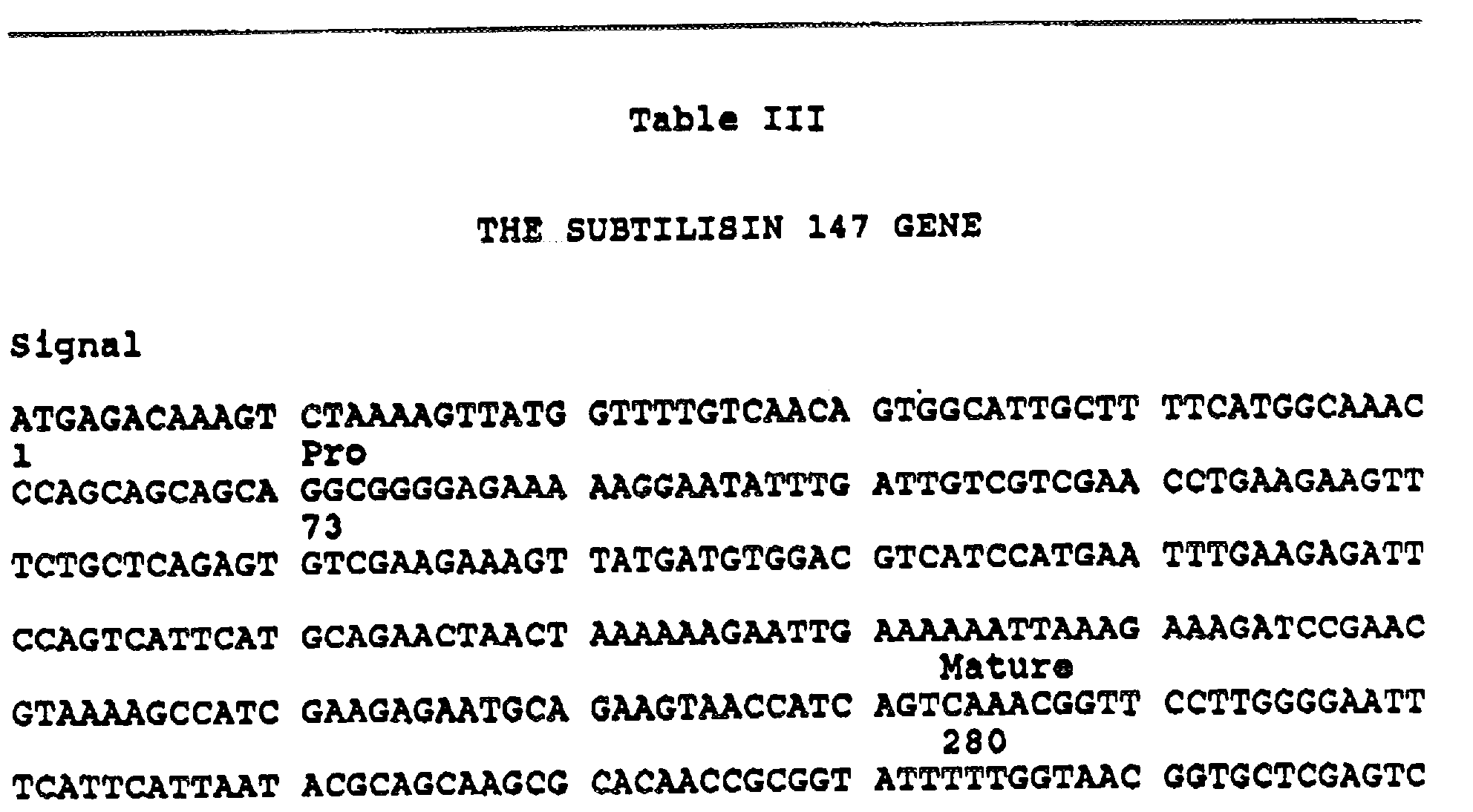

- Site specific mutations were performed by the method of Morinaga at al. (Biotechnology, supra). The following oligonucleotides were used for introducing the mutations:
- A 27-mer mismatch primer, Nor-237, which also generates a novel SacI restriction site

- A 23-mer mismatch primer, NOR-323, which also generates a novel BgIII site

- A 24-mer mismatch primer, NOR-236

- A 22-mer mismatch primer, NOR-235Both of these primers destroy the unique ClaI site

- An 18-mer mismatch primer, NOR-324, which also generates a novel PvuII site

- A 23-mer mismatch primer, NOR-325, which also generates a novel MspI site

- A 23-mer mismatch primer, NOR-483,

- A 32-mer mismatch, NOR-484,i + j) Gly-195 Glu and Met-222 Ala or Met-222 Cys:

- For these double mutants combinations of NOR-237 and NOR-235 or NOR-236 were performed by joining the single mutant DNA-fragments.
- A combination of NOR-324 and NOR-325 was performed in analogy with the above.
- Gapped duplex mutagenesis was performed using the plasmid pSX93 as template. pSX93 is shown in Figure 3a and 3b, and is pUC13 (Vieira, J. and Messing, J.: 1982, Gene 19: 259-268) harbouring an 0.7 kb XbaI-HindIII fragment of the
subtilisin 309 gene including the terminator inserted in the polylinker. The terminator and the HindIII site are not shown in Table II. - For the introduction of mutations in the N-terminal part of the enzyme the plasmid pSX119 was used. pSX119 is pUC13 harbouring an EcoRI-XbaI fragment of the
subtilisin 309 gene inserted into the polylinker. The templates pSX93 and pSX119 thus cover the whole of thesubtilisin 309 gene. - The mutations a), b), and e) were performed by cutting pSX93 with XbaI and ClaI as indicated in Figure 3a; c), d), f), and h) were performed by cutting pSX93 with XbaI and HindIII as indicated in Figure 3b.
- Mutation g) was performed correspondingly in pSX119 by cutting with EcoRI and XbaI.
- The double mutants i) and j) were produced by cutting the 0.7 kb Xba-HindIII fragment from a) partially with HgiAI (HgiAI also cuts in SacI, which was introduced by the mutation). This 180 bp XbaI-HgiAI fragment and the 0.5 kb HgiAI fragment from the c) and d) mutants, respectively, were ligated to the large HindIII-XbaI fragment from pSX93.
- The double mutant k) was produced as above by combining mutants e) and f).
- Subsequent to annealing, filling and ligation the mixture was used to transform E. coli MC 1000 r⁻m⁺. Mutants among the transformants were screened for by colony hybridization as described in Vlasuk et al.: 1983, J.Biol.Chem., 258: 7141-7148 and in Vlasuk, G.P. and Inouye, S.: p. 292-303 in "Experimental Manipulation of Gene Expression" Inouye, M. (ed.) Academic Press, New York. The mutations were confirmed by DNA sequencing.
- Subsequent to sequence confirmation of the correct mutation the mutated DNA fragments were inserted into plasmid pSX92, which was used for producing the mutants.
- Plasmid pSX92 is shown in Figure 4 and was produced by cloning the
Sub 309 gene into plasmid pSX62 cut at ClaI, filled in with the Klenow fragment of DNA polymerase I, and cut with HindIII prior to the insertion of the fragments DraI-NheI and Nhei-HindIII from the clonedSub 309 gene. - To express the mutants the mutated fragments (XbaI-ClaI, XbaI-HindIII, or EcoRI-XbaI) were excised from the appropriate mutation plasmid pSX93 or pSX119, respectively, and inserted into pSX92.
- The mutated pSX92 was then used to transform B. subtilis strain DN497, which was then grown in the same medium and under the same conditions as used for the cloning of the parent gene.
- After appropriate growth the mutated enzymes were recovered and purified.
- The mutants a) and d) were tested for their oxidation stability in 0.01 M peracetic acid after 20 minutes at 50°C and pH 7. The parent strain NCIB 10309 protease was used as reference.
- The results are indicated in Table IV below, which presents the residual proteolytic activity in the heat treated samples relative to samples untreated by oxidant or heat.
Table IV Oxidation Stability Towards Peracetic Acid Enzyme Residual Activity after 20 min. at 50°C without oxidant with oxidant sub 309 89% 48% mutant a 83% 45% mutant d 92% 93% - All the mutants except g) and h) have also been tested qualitatively in 100 - 500 ppm hypochlorite at room temperature and 35°C, pH 6.5 and 9.0, for from 15 minutes to 2 hours.
- These tests showed that mutants c), d), i), and j) (all Met-222) could resist 3 - 5 times more hypochlorite than the other mutants.
- When tested in a liquid detergent of the usual built type it was found that mutant f) exhibited superior stability compared to both the other mutants and the "parent" enzyme.
- The proteolytic activity of various mutants was tested against casein as protein substrate, according to methods detailed supra. The results are presented in Table V.
- From the table it is seen that mutant a) exhibits enhanced activity compared to the parent. It is also seen that the Met-222 mutants have lower activity than the parent, but due to their improved oxidation stability their application in detergent compositions containing oxidants is not precluded.
TABLE V Proteolytic Activity of Mutant Subtilisins Mutant Relative Activity None 100 a) 120 b) 100 c) 30 d) 20 e) 100 f) 100 i) 20 j) 30 - The washability of various mutants was tested against spinach juice according to methods detailed supra. The results are presented in Table VI.
- From the table it is seen that all of the tested mutants exhibited an improved washing ability compared to the parent enzyme, and that mutants c), d), i), and j) are markedly superior.
TABLE VI Washing Ability of Mutant 
Mutant Concentration (CPU/1) 0.05 0.1 none 14.4 20.4 a) 18.8 21.5 b) 16.9 19.7 c) 21.8 23.8 d) 22.2 23.4 e) 15.4 21.8 f) 16.6 19.3 i) 21.6 22.1 j) 20.6 22.6 95% confidence interval: ±0.9 - The thermostability of mutant f) was tested against the wild type enzyme by using the washability test at 40°C and 60°C, respectively. The results are shown in Table VII. From the table it is seen that mutant f) at 60°C shows a much improved washability compared to the wild type enzyme, whereas at 40°C the washability of mutant f) is only slightly better than wild type enzyme.
TABLE VII Washability at Different Temperatures 
Mutant Concentration (CPU/1) 0.05 0.1 none (40°C) 14.4 20.4 f) (40°C) 16.6 19.3 none (60°C) 15.1 24.9 f) (60°C) 30.4 31.3 95% confidence interval ±0.9 (40°C) and ±0.7 (60°) - Subtilisin genes were cloned from the 147 and 309 variants of the bacterium Bacillus lentus, and the cloned genes were sequenced. By comparing the deduced amino acid sequences of
subtilisins subtilisin 309 gene. The resulting mutant enzymes were then expressed in a Bacillus strain, and tested against various physical and chemical parameters. Several of the mutants were shown to have improved stability to oxidation, increased proteolytic ability, or improved washability when compared withparent subtilisin 309 enzyme. These mutants exhibit properties desirable in enzymes comprised in detergent compositions.
Claims (9)
- A detergent composition comprising an oxidant and a mutant of subtilisin enzyme having an amino acid sequence at least 80% homologous to the amino acid sequence of subtilisin 309 as depicted in Table I(a) and obtainable from B. lentus C360 (NCIB 10309), and wherein the methionine residue in position 222, is changed by substitution with another amino acid residue.
- The detergent composition of claim 1, wherein also the amino acid residue in position 195 of said mutant subtilisin enzyme, is changed by substitution with another amino acid residue.
- The detergent composition of claim 1, wherein the methionine residue at position 222 is substituted with cysteine or alanine.
- The detergent composition of claim 2, wherein the glycine residue at position 195 is substituted with glutamic acid and the methionine residue at position 222 is substituted with alanine or cysteine.
- A mutant subtilisin enzyme comprising an amino acid sequence at least 80% homologous to the amino acid sequence of subtilisin 309 as depicted in Table I(a) and obtainable from B. lentus C360 (NCIB 10309), and wherein the methionine residue at position 222 is substituted with cysteine or alanine.
- A mutant subtilisin enzyme comprising an amino acid sequence at least 80% homologous to the amino acid sequence of subtilisin 309 as depicted in Table I(a) and obtainable from B. lentus C360 (NCIB 10309), and wherein the glycine residue at position 195 is substituted with glutamic acid and the methionine residue at position 222 is substituted with alanine or cysteine.
- A recombinant DNA molecule comprising a nucleotide sequence coding for a subtilisin enzyme comprising an amino acid sequence having at least 80% homology with the amino acid sequence as depicted in Table I(a), in which the nucleic acid sequence has been altered such that the amino acid sequence encoded thereby corresponds to a mutant subtilisin enzyme according to claim 5 or 6.
- A recombinant DNA molecule comprising a nucleotide sequence coding for the subtilisin 309 enzyme substantially as depicted in Table II, in which the nucleic acid sequence has been altered such that the amino acid sequence encoded thereby corresponds to a mutant subtilisin enzyme 309 according to claim 5 or 6.
- Use of a recombinant DNA molecule of claim 7 or 8 for the production of a subtilisin enzyme.
Priority Applications (3)
| Application Number | Priority Date | Filing Date | Title |
|---|---|---|---|
| EP95107678A EP0675196A3 (en) | 1988-01-07 | 1989-01-06 | Mutated subtilizingenes. |
| EP04025116A EP1498481A1 (en) | 1988-01-07 | 1989-01-06 | Mutated subtilisin genes |
| EP05004172A EP1538204A3 (en) | 1988-01-07 | 1989-01-06 | Mutated subtilisin genes |
Applications Claiming Priority (3)
| Application Number | Priority Date | Filing Date | Title |
|---|---|---|---|
| DK006488A DK6488D0 (en) | 1988-01-07 | 1988-01-07 | ENZYMES |
| DK64/88 | 1988-01-07 | ||
| PCT/DK1989/000002 WO1989006279A1 (en) | 1988-01-07 | 1989-01-06 | Mutated subtilisin genes |
Related Child Applications (1)
| Application Number | Title | Priority Date | Filing Date |
|---|---|---|---|
| EP95107678.5 Division-Into | 1989-01-06 |
Publications (2)
| Publication Number | Publication Date |
|---|---|
| EP0396608A1 EP0396608A1 (en) | 1990-11-14 |
| EP0396608B1 true EP0396608B1 (en) | 1996-04-03 |
Family
ID=8089323
Family Applications (4)
| Application Number | Title | Priority Date | Filing Date |
|---|---|---|---|
| EP05004172A Withdrawn EP1538204A3 (en) | 1988-01-07 | 1989-01-06 | Mutated subtilisin genes |
| EP89901711A Expired - Lifetime EP0396608B1 (en) | 1988-01-07 | 1989-01-06 | Mutated subtilisin genes |
| EP95107678A Ceased EP0675196A3 (en) | 1988-01-07 | 1989-01-06 | Mutated subtilizingenes. |
| EP04025116A Withdrawn EP1498481A1 (en) | 1988-01-07 | 1989-01-06 | Mutated subtilisin genes |
Family Applications Before (1)
| Application Number | Title | Priority Date | Filing Date |
|---|---|---|---|
| EP05004172A Withdrawn EP1538204A3 (en) | 1988-01-07 | 1989-01-06 | Mutated subtilisin genes |
Family Applications After (2)
| Application Number | Title | Priority Date | Filing Date |
|---|---|---|---|
| EP95107678A Ceased EP0675196A3 (en) | 1988-01-07 | 1989-01-06 | Mutated subtilizingenes. |
| EP04025116A Withdrawn EP1498481A1 (en) | 1988-01-07 | 1989-01-06 | Mutated subtilisin genes |
Country Status (7)
| Country | Link |
|---|---|
| US (6) | US5741694A (en) |
| EP (4) | EP1538204A3 (en) |
| JP (3) | JPH0675504B2 (en) |
| AT (1) | ATE136329T1 (en) |
| DE (1) | DE68926163T2 (en) |
| DK (3) | DK6488D0 (en) |
| WO (1) | WO1989006279A1 (en) |
Cited By (1)
| Publication number | Priority date | Publication date | Assignee | Title |
|---|---|---|---|---|
| EP2258837A1 (en) | 2004-09-10 | 2010-12-08 | Novozymes North America, Inc. | Methods for preventing, removing, reducing, or disrupting biofilm |
Families Citing this family (755)
| Publication number | Priority date | Publication date | Assignee | Title |
|---|---|---|---|---|
| US5185258A (en) * | 1984-05-29 | 1993-02-09 | Genencor International, Inc. | Subtilisin mutants |
| DK6488D0 (en) * | 1988-01-07 | 1988-01-07 | Novo Industri As | ENZYMES |
| US6287841B1 (en) | 1988-02-11 | 2001-09-11 | Genencor International, Inc. | High alkaline serine protease |
| CN1056187C (en) * | 1988-02-11 | 2000-09-06 | 金克克国际有限公司 | Proteolytic enzymes and their use in detergents |
| US5324653A (en) * | 1988-02-11 | 1994-06-28 | Gist-Brocades N.V. | Recombinant genetic means for the production of serine protease muteins |
| US5116741A (en) * | 1988-04-12 | 1992-05-26 | Genex Corporation | Biosynthetic uses of thermostable proteases |
| US5665587A (en) | 1989-06-26 | 1997-09-09 | Novo Nordisk A/S | Modified subtilisins and detergent compositions containing same |
| BR9006832A (en) * | 1989-06-26 | 1991-08-06 | Unilever Nv | ENZYMATIC DETERGENT COMPOSITION |
| ES2227508T3 (en) * | 1989-06-26 | 2005-04-01 | Unilever N.V. | ENZYMATIC DETERGENT COMPOSITIONS. |
| DK316989D0 (en) * | 1989-06-26 | 1989-06-26 | Novo Nordisk As | ENZYMES |
| US5658871A (en) * | 1989-07-07 | 1997-08-19 | Lever Brothers Company, Division Of Conopco, Inc. | Microbial lipase muteins and detergent compositions comprising same |
| ES2144990T3 (en) * | 1989-08-25 | 2000-07-01 | Henkel Of America Inc | ALKALINE PROTEOLYTIC ENZYME AND PRODUCTION METHOD. |
| DE4023458A1 (en) * | 1989-08-31 | 1991-03-07 | Kali Chemie Ag | NEW HIGH ALKALINE PROTEASES |
| US5352603A (en) * | 1989-08-31 | 1994-10-04 | Kali-Chemie Ag | Highly alkaline proteases |
| US6271012B1 (en) * | 1989-10-11 | 2001-08-07 | Genencor International, Inc. | Protease muteins and their use in detergents |
| US5541062A (en) * | 1990-02-23 | 1996-07-30 | Arch Development Corporation | Methods and compositions for preparing protein processing enzymes |
| DK97190D0 (en) * | 1990-04-19 | 1990-04-19 | Novo Nordisk As | OXIDATION STABLE DETERGENT ENZYMER |
| US5733473A (en) * | 1990-11-14 | 1998-03-31 | The Procter & Gamble Company | Liquid detergent composition containing lipase and protease |
| DK271490D0 (en) * | 1990-11-14 | 1990-11-14 | Novo Nordisk As | detergent composition |
| CA2095852C (en) * | 1990-12-05 | 2001-05-08 | Uffe Lovborg | Proteins with changed epitopes and methods for the production thereof |
| US6967080B1 (en) * | 1990-12-05 | 2005-11-22 | Novozymes A/S | Proteins with changed epitopes and methods for the production thereof |
| US5766898A (en) * | 1990-12-05 | 1998-06-16 | Novo Nordisk A/S | Proteins with changed epitopes and methods for the production thereof |
| US5482849A (en) * | 1990-12-21 | 1996-01-09 | Novo Nordisk A/S | Subtilisin mutants |
| DK0563169T3 (en) * | 1990-12-21 | 1998-05-18 | Novo Nordisk As | Enzyme mutants with little variation in molecular charge in a pH range |
| GB9027836D0 (en) * | 1990-12-21 | 1991-02-13 | Unilever Plc | Enzymes and enzymatic detergent compositions |
| US5340735A (en) | 1991-05-29 | 1994-08-23 | Cognis, Inc. | Bacillus lentus alkaline protease variants with increased stability |
| US5646028A (en) * | 1991-06-18 | 1997-07-08 | The Clorox Company | Alkaline serine protease streptomyces griseus var. alkaliphus having enhanced stability against urea or guanidine |
| EP0995801A1 (en) * | 1991-07-27 | 2000-04-26 | Genencor International GmbH | Process for increasing the stability of enzymes and stabilized enzymes |
| US5275945A (en) * | 1991-10-08 | 1994-01-04 | Vista Chemical Company | Alkaline proteases stable in heavy-duty detergent liquids |
| BR9206636A (en) * | 1991-10-16 | 1995-10-24 | Unilever Nv | Enzymatic detergent composition and process for the preparation of an aqueous enzymatic detergent composition |
| US5371198A (en) * | 1991-12-16 | 1994-12-06 | Novo Nordisk A/S | Method for protection of proteolysis-susceptible protein during protein production in a fluid medium |
| US5623059A (en) * | 1992-03-09 | 1997-04-22 | Novo Nordisk A/S | Method for protection of proteolysis-susceptible protein during protein production in a fluid medium |
| EP0571014B1 (en) * | 1992-05-18 | 2004-03-31 | Genencor International, Inc. | Bacteria producing alkaline proteases, and production of these alkaline proteases |
| AU682314B2 (en) * | 1992-07-17 | 1997-10-02 | Genencor International, Inc. | High alkaline serine proteases |
| JPH0763377B2 (en) * | 1992-09-03 | 1995-07-12 | 大阪府 | Heat-resistant alkaline protease gene, recombinant plasmid pABT17, Bacillus subtilis plasmid vector pABTts14 and transformant of the Bacillus subtilis plasmid vector pABTts14 |
| DE4231726A1 (en) * | 1992-09-23 | 1994-03-24 | Cognis Bio Umwelt | Mutated subtilisin-like serine proteases |
| GB9220669D0 (en) * | 1992-09-30 | 1992-11-11 | Unilever Plc | Detergent composition |
| US6436690B1 (en) | 1993-09-15 | 2002-08-20 | The Procter & Gamble Company | BPN′ variants having decreased adsorption and increased hydrolysis wherein one or more loop regions are substituted |
| US6440717B1 (en) | 1993-09-15 | 2002-08-27 | The Procter & Gamble Company | BPN′ variants having decreased adsorption and increased hydrolysis |
| DE69434962T2 (en) * | 1993-10-14 | 2008-01-17 | The Procter & Gamble Company, Cincinnati | PROTEASE-CONTAINING DETERGENTS |
| ES2199978T3 (en) * | 1993-10-14 | 2004-03-01 | THE PROCTER & GAMBLE COMPANY | WHITENING COMPOSITIONS INCLUDING PROTEASA ENZYMES. |
| MA23346A1 (en) | 1993-10-14 | 1995-04-01 | Genencor Int | VARIANTS OF THE SUB-USE |
| US5837458A (en) * | 1994-02-17 | 1998-11-17 | Maxygen, Inc. | Methods and compositions for cellular and metabolic engineering |
| US6335160B1 (en) | 1995-02-17 | 2002-01-01 | Maxygen, Inc. | Methods and compositions for polypeptide engineering |
| US6406855B1 (en) | 1994-02-17 | 2002-06-18 | Maxygen, Inc. | Methods and compositions for polypeptide engineering |
| US6599730B1 (en) * | 1994-05-02 | 2003-07-29 | Procter & Gamble Company | Subtilisin 309 variants having decreased adsorption and increased hydrolysis |
| CA2190349A1 (en) * | 1994-06-23 | 1996-01-04 | James William Gordon | Dishwashing compositions |
| US6066611A (en) * | 1994-10-13 | 2000-05-23 | The Procter & Gamble Company | Bleaching compositions comprising protease enzymes |
| US6455295B1 (en) | 1995-03-08 | 2002-09-24 | The Procter & Gamble Company | Subtilisin Carlsberg variants having decreased adsorption and increased hydrolysis |
| US6475765B1 (en) | 1995-03-09 | 2002-11-05 | Procter & Gamble Company | Subtilisin DY variants having decreased adsorption and increased hydrolysis |
| IL117350A0 (en) | 1995-03-09 | 1996-07-23 | Procter & Gamble | Proteinase k variants having decreased adsorption and increased hydrolysis |
| DE69637907D1 (en) * | 1995-05-05 | 2009-06-04 | Novozymes As | PROTEASE VARIANTS AND CONNECTIONS |
| US20120165241A1 (en) * | 1995-05-05 | 2012-06-28 | Unilever Plc | Subtilase Variants |
| US5837517A (en) | 1995-05-05 | 1998-11-17 | Novo Nordisk A/S | Protease variants and compositions |
| US6682924B1 (en) | 1995-05-05 | 2004-01-27 | Novozymes A/S | Protease variants and compositions |
| US6936289B2 (en) | 1995-06-07 | 2005-08-30 | Danisco A/S | Method of improving the properties of a flour dough, a flour dough improving composition and improved food products |
| CN1530443A (en) * | 1996-11-04 | 2004-09-22 | ŵ����÷������˾ | subtilase variants and compositions |
| AU4772697A (en) | 1996-11-04 | 1998-05-29 | Novo Nordisk A/S | Subtilase variants and compositions |
| US6077662A (en) * | 1996-11-27 | 2000-06-20 | Emory University | Virus-like particles, methods and immunogenic compositions |
| EP1433852B1 (en) * | 1997-04-09 | 2006-06-28 | Danisco A/S | Use of lipase for improving doughs and baked products |
| US6140475A (en) | 1997-04-11 | 2000-10-31 | Altus Biologics Inc. | Controlled dissolution crosslinked protein crystals |
| WO1999011768A1 (en) | 1997-08-29 | 1999-03-11 | Novo Nordisk A/S | Protease variants and compositions |
| BR9811412A (en) | 1997-08-29 | 2000-08-22 | Novo Nordisk As | Subtilase enzyme variant having improved detergent washing performance, isolated DNA sequence, expression vector, microbial host cell, processes for producing a variant and for identifying a protease variant, composition, and, use of a subtilase variant |
| EP0913458B1 (en) * | 1997-10-22 | 2004-06-16 | The Procter & Gamble Company | Liquid hard-surface cleaning compositions |
| AR016969A1 (en) * | 1997-10-23 | 2001-08-01 | Procter & Gamble | PROTEASE VARIANTE, ADN, EXPRESSION VECTOR, GUEST MICROORGANISM, CLEANING COMPOSITION, ANIMAL FOOD AND COMPOSITION TO TREAT A TEXTILE |
| ES2367505T3 (en) | 1997-10-23 | 2011-11-04 | Danisco Us Inc. | PROTEASE VARIANTS WITH MULTIPLE SUBSTITUTIONS WITH ALTERED NET LOAD FOR USE IN DETERGENTS. |
| US6780629B2 (en) | 1997-11-21 | 2004-08-24 | Novozymes A/S | Subtilase enzymes |
| US6773907B2 (en) | 1997-11-21 | 2004-08-10 | Peter Kamp Hansen | Subtilase enzymes |
| ATE298791T1 (en) | 1997-11-21 | 2005-07-15 | Novozymes As | PROTEASE VARIANTS AND COMPOSITIONS |
| US6642011B2 (en) | 1998-04-15 | 2003-11-04 | Genencor International, Inc. | Human protease and use of such protease for pharmaceutical applications and for reducing the allergenicity of non-human proteins |
| US6936249B1 (en) | 1998-04-15 | 2005-08-30 | Genencor International, Inc. | Proteins producing an altered immunogenic response and methods of making and using the same |
| US6835550B1 (en) | 1998-04-15 | 2004-12-28 | Genencor International, Inc. | Mutant proteins having lower allergenic response in humans and methods for constructing, identifying and producing such proteins |
| DK1098988T4 (en) | 1998-07-21 | 2007-09-03 | Danisco | Food |
| US6461849B1 (en) * | 1998-10-13 | 2002-10-08 | Novozymes, A/S | Modified polypeptide |
| US6831053B1 (en) | 1998-10-23 | 2004-12-14 | The Procter & Gamble Company | Bleaching compositions comprising multiply-substituted protease variants |
| US6376450B1 (en) | 1998-10-23 | 2002-04-23 | Chanchal Kumar Ghosh | Cleaning compositions containing multiply-substituted protease variants |
| CA2715086A1 (en) | 1998-11-27 | 2000-06-08 | Novozymes A/S | Lipolytic enzyme variants |
| EP1147196A4 (en) | 1998-12-08 | 2002-10-16 | Childrens Hosp Medical Center | LOCI POLYMORPHS ALLOWING TO DISTINGUISH ESCHERICHIA COLI 0157: H7 FROM OTHER STRAINS |
| ATE504651T1 (en) | 1998-12-18 | 2011-04-15 | Novozymes As | SUBTILASE ENZYMES OF THE I-S1 AND I-S2 SUBGROUPS WITH AN ADDITIONAL AMINO ACID RESIDUE IN AN ACTIVE LOOP REGION |
| WO2000060058A2 (en) | 1999-03-31 | 2000-10-12 | Novozymes A/S | Polypeptides having alkaline alpha-amylase activity and nucleic acids encoding same |
| ES2532606T3 (en) | 1999-03-31 | 2015-03-30 | Novozymes A/S | Polypeptides with alkaline alpha-amylase activity and nucleic acids encoding them |
| KR20000065867A (en) | 1999-04-09 | 2000-11-15 | 손경식 | Alkaline Protease Vapk Useful as Washing Detergent, vapk Gene, Recombinant Expression Vector, and Transformed Microorganism |
| WO2000071690A1 (en) | 1999-05-20 | 2000-11-30 | Novozymes A/S | Subtilase enzymes of the i-s1 and i-s2 sub-groups having at least one additional amino acid residue between positions 128 and 129 |
| AU4392700A (en) | 1999-05-20 | 2000-12-12 | Novozymes A/S | Subtilase enzymes of the i-s1 and i-s2 sub-groups having at least one additionalamino acid residue between positions 129 and 130 |
| EP1183341B2 (en) | 1999-05-20 | 2012-05-02 | Novozymes A/S | Subtilase enzymes of the i-s1 and i-s2 sub-groups having at least one additional amino acid residue between positions 127 and 128 |
| EP1183337B1 (en) | 1999-05-20 | 2008-09-17 | Novozymes A/S | Subtilase enzymes of the i-s1 and i-s2 sub-groups having at least one additional amino acid residue between positions 132 and 133 |
| AU4392800A (en) | 1999-05-20 | 2000-12-12 | Novozymes A/S | Subtilase enzymes of the i-s1 and i-s2 sub-groups having at least one additionalamino acid residue between positions 126 and 127 |
| WO2000071691A1 (en) | 1999-05-20 | 2000-11-30 | Novozymes A/S | Subtilase enzymes of the i-s1 and i-s2 sub-groups having at least one additional amino acid residue between positions 125 and 126 |
| CA2376045A1 (en) * | 1999-07-22 | 2001-02-01 | The Procter & Gamble Company | Subtilisin protease variants having amino acid substitutions in defined epitope regions |
| NZ517409A (en) | 1999-08-31 | 2004-05-28 | Novozymes As | RP-II properties with amino acid substitutions used in detergent compositions and additives |
| US6727085B2 (en) | 1999-12-15 | 2004-04-27 | Fanoe Tina Sejersgaard | Subtilase variants having an improved wash performance on egg stains |
| US6777218B1 (en) | 2000-03-14 | 2004-08-17 | Novozymes A/S | Subtilase enzymes having an improved wash performance on egg stains |
| US6902922B2 (en) * | 2000-04-03 | 2005-06-07 | Novozymes A/S | Subtilisin variants |
| CA2406621A1 (en) * | 2000-04-28 | 2001-11-08 | Novozymes A/S | Protein variants having modified immunogenicity |
| WO2002016547A2 (en) | 2000-08-21 | 2002-02-28 | Novozymes A/S | Subtilase enzymes |
| US6541234B1 (en) * | 2000-09-11 | 2003-04-01 | University Of Maryland Biotechnology Institute | Calcium free subtilisin mutants |
| US6541235B1 (en) * | 2000-09-29 | 2003-04-01 | University Of Maryland Biotechnology Institute | Calcium free subtilisin mutants |
| EP1975229A3 (en) | 2000-10-13 | 2009-03-18 | Novozymes A/S | Alpha-amylase variant with altered properties |
| US6893855B2 (en) * | 2000-10-13 | 2005-05-17 | Novozymes A/S | Subtilase variants |
| WO2002031133A1 (en) | 2000-10-13 | 2002-04-18 | Novozymes A/S | Subtilase variants |
| US6673580B2 (en) | 2000-10-27 | 2004-01-06 | Genentech, Inc. | Identification and modification of immunodominant epitopes in polypeptides |
| EP1201753B1 (en) * | 2000-10-31 | 2008-04-23 | Boehringer Mannheim Gmbh | Methods for the analysis of non-proteinaceous components using a protease from a bacillus strain |
| EP1201752A1 (en) * | 2000-10-31 | 2002-05-02 | Roche Diagnostics GmbH | Methods for the analysis of non-proteinaceous components using a protease from a Bacillus strain |
| AU758744B2 (en) * | 2000-10-31 | 2003-03-27 | F. Hoffmann-La Roche Ag | Methods for the analysis of non-proteinaceous components using a protease from a bacillus strain |
| US7303907B2 (en) | 2001-01-08 | 2007-12-04 | Health Protection Agency | Degradation and detection of TSE infectivity |
| PL210859B1 (en) | 2001-03-23 | 2012-03-30 | Genencor Int | Proteins producing an altered immunogenic response and methods of making and using the same |
| DE10121463A1 (en) * | 2001-05-02 | 2003-02-27 | Henkel Kgaa | New alkaline protease variants and washing and cleaning agents containing these new alkaline protease variants |
| US7498158B2 (en) | 2001-05-15 | 2009-03-03 | Novozymes A/S | Alpha-amylase variant with altered properties |
| NZ528260A (en) | 2001-05-18 | 2005-09-30 | Danisco | Method of improving dough and bread quality with the addition of an enzyme that hydrolyses a glycolipid and a phospholipid and incapable of hydrolysing a triglyceride or monoglyceride |
| DK2277997T3 (en) | 2001-06-26 | 2013-12-02 | Novozymes As | Polypeptides with cellobiohydrolase I activity and the same coding polynucleotides |
| DK200101090A (en) | 2001-07-12 | 2001-08-16 | Novozymes As | Subtilase variants |
| DE10153792A1 (en) | 2001-10-31 | 2003-05-22 | Henkel Kgaa | New alkaline protease variants and washing and cleaning agents containing these new alkaline protease variants |
| DE10162727A1 (en) | 2001-12-20 | 2003-07-10 | Henkel Kgaa | New alkaline protease from Bacillus gibsonii (DSM 14391) and washing and cleaning agents containing this new alkaline protease |
| DE10162728A1 (en) | 2001-12-20 | 2003-07-10 | Henkel Kgaa | New alkaline protease from Bacillus gibsonii (DSM 14393) and washing and cleaning agents containing this new alkaline protease |
| DE10163884A1 (en) | 2001-12-22 | 2003-07-10 | Henkel Kgaa | New alkaline protease from Bacillus sp. (DSM 14392) and detergents and cleaning agents containing this new alkaline protease |
| BR0215383A (en) * | 2001-12-31 | 2006-11-28 | Genencor Int | proteases that produce altered immunogenic response and methods of manufacture and use thereof |
| DK1523553T3 (en) * | 2002-01-16 | 2010-04-19 | Genencor Int | Multi-substituted protease variants |
| WO2003062380A2 (en) * | 2002-01-16 | 2003-07-31 | Genencor International, Inc. | Multiply-substituted protease variants |
| ATE378595T1 (en) | 2002-02-26 | 2007-11-15 | Genencor Int | POPULATION-BASED ASSESSMENTS AND MEANS FOR DETERMINING THE RANKING OF THE RELATIVE IMMUNOGENICITY OF PROTEINS |
| AU2003214037A1 (en) | 2002-03-27 | 2003-10-08 | Novozymes A/S | Granules with filamentous coatings |
| EP1495128B1 (en) | 2002-03-29 | 2014-05-07 | Genencor International, Inc. | Ehanced protein expression in bacillus |
| ATE420161T1 (en) | 2002-07-01 | 2009-01-15 | Novozymes As | MONOPROPYLENE GLYCOL AS A FERMENTATION ADDITIVE |
| DK1539089T3 (en) | 2002-07-30 | 2017-11-13 | Danisco Us Inc | REDUCED AEROSOL-GENERATING FORMULATIONS |
| EP1549745B1 (en) | 2002-10-01 | 2011-01-05 | Novozymes A/S | Family gh 61 polypeptides |
| MXPA05003493A (en) * | 2002-10-02 | 2005-09-30 | Catalyst Biosciences | Methods of generating and screenign for porteases with altered specificity. |
| US7888093B2 (en) | 2002-11-06 | 2011-02-15 | Novozymes A/S | Subtilase variants |
| TWI319007B (en) | 2002-11-06 | 2010-01-01 | Novozymes As | Subtilase variants |
| US20060035800A1 (en) | 2002-12-11 | 2006-02-16 | Novozymes A/S | Detergent composition |
| US7348168B2 (en) | 2002-12-20 | 2008-03-25 | Novozymes A/S | Polypeptides having cellobiohydrolase II activity and polynucleotides encoding same |
| US20050196766A1 (en) | 2003-12-24 | 2005-09-08 | Soe Jorn B. | Proteins |
| MXPA05007654A (en) * | 2003-01-17 | 2005-09-30 | Danisco | Method. |
| US7955814B2 (en) | 2003-01-17 | 2011-06-07 | Danisco A/S | Method |
| DE602004026032D1 (en) | 2003-01-27 | 2010-04-29 | Novozymes As | ENZYME STABILIZATION |
| US7294499B2 (en) * | 2003-01-30 | 2007-11-13 | Novozymes A/S | Subtilases |
| EP1597344A2 (en) | 2003-02-18 | 2005-11-23 | Novozymes A/S | Detergent compositions |
| DK2228440T3 (en) | 2003-05-02 | 2013-01-02 | Novozymes Inc | Variants of beta-glucosidases |
| CN102766545B (en) | 2003-05-07 | 2014-08-06 | 诺维信公司 | Variant subtilisin enzymes (subtilases) |
| AU2004252572B2 (en) | 2003-06-25 | 2011-09-08 | Novozymes A/S | Polypeptides having alpha-amylase activity and polypeptides encoding same |
| EP2377931B1 (en) | 2003-08-25 | 2013-05-08 | Novozymes Inc. | Variants of glycoside hydrolases |
| WO2005040372A1 (en) | 2003-10-23 | 2005-05-06 | Novozymes A/S | Protease with improved stability in detergents |
| EP1682656B1 (en) | 2003-10-28 | 2013-09-18 | Novozymes Inc. | Polypeptides having beta-glucosidase activity and polynucleotides encoding same |
| DE602004022967D1 (en) | 2003-10-30 | 2009-10-15 | Novozymes As | CARBOHYDRATE-BONDING MODULES |
| US7906307B2 (en) | 2003-12-24 | 2011-03-15 | Danisco A/S | Variant lipid acyltransferases and methods of making |
| US7718408B2 (en) | 2003-12-24 | 2010-05-18 | Danisco A/S | Method |
| GB0716126D0 (en) | 2007-08-17 | 2007-09-26 | Danisco | Process |
| WO2005066339A2 (en) | 2004-01-06 | 2005-07-21 | Novozymes A/S | Polypeptides of alicyclobacillus sp. |
| ES2468366T3 (en) | 2004-01-30 | 2014-06-16 | Novozymes Inc. | Polypeptides with cellulolytic enhancement activity and polynucleotides that encode them |
| EP2305821A3 (en) | 2004-02-13 | 2011-04-13 | Novozymes A/S | Protease variants |
| GB0405637D0 (en) | 2004-03-12 | 2004-04-21 | Danisco | Protein |
| EP1735433B1 (en) * | 2004-04-02 | 2010-12-08 | Novozymes A/S | Subtilase variants having altered immunogenicity |
| WO2006033668A2 (en) * | 2004-04-09 | 2006-03-30 | Genencor International, Inc. | Pcka modifications and enhanced protein expression in bacillus |
| US7148404B2 (en) | 2004-05-04 | 2006-12-12 | Novozymes A/S | Antimicrobial polypeptides |
| WO2005113773A1 (en) * | 2004-05-20 | 2005-12-01 | Warnex Research Inc. | Polynucleotides for the detection of escherichia coli 0157:h7 and escherichia coli 0157:nm verotoxin producers |
| US20090060933A1 (en) * | 2004-06-14 | 2009-03-05 | Estell David A | Proteases producing an altered immunogenic response and methods of making and using the same |
| EP3620523A3 (en) | 2004-07-05 | 2020-08-19 | Novozymes A/S | Alpha-amylase variants with altered properties |
| EA014985B1 (en) * | 2004-07-16 | 2011-04-29 | Даниско А/С | A process of enzymatic degumming edible oils by hydration and use lipid acyltransferase for carrying out the process |
| EP1794295B1 (en) | 2004-09-21 | 2011-11-16 | Novozymes A/S | Subtilases |
| ATE499439T1 (en) | 2004-09-21 | 2011-03-15 | Novozymes As | SUBTILATE |
| DK1794296T3 (en) | 2004-09-21 | 2012-07-30 | Novozymes As | subtilases |
| EP2298872A3 (en) | 2004-09-30 | 2011-08-10 | Novozymes A/S | Polypeptides having lipase activity and polynucleotides encoding same |
| EP1877551B2 (en) | 2005-04-27 | 2014-02-26 | Novozymes, Inc. | Polypeptides having endoglucanase activity and polynucleotides encoding same |
| ATE529505T1 (en) | 2005-07-08 | 2011-11-15 | Novozymes As | SUBTLE VARIANTS |
| WO2007019859A2 (en) | 2005-08-16 | 2007-02-22 | Novozymes A/S | Polypeptides of strain bacillus sp. p203 |
| CN101243182B (en) | 2005-08-16 | 2014-08-06 | 诺维信公司 | Subtilases |
| EP2385110A3 (en) | 2005-09-30 | 2011-11-16 | Novozymes, Inc. | Methods for enhancing the degradation or conversion of cellulosic material |
| US9303256B2 (en) | 2005-09-30 | 2016-04-05 | Novozymes A/S | Immobilization of enzymes |
| EP1998793A1 (en) | 2006-03-22 | 2008-12-10 | Novozymes A/S | Use of polypeptides having antimicrobial activity |
| EP2383330A1 (en) | 2006-03-31 | 2011-11-02 | Novozymes A/S | A stabilized liquid enzyme composition |
| US20100029538A1 (en) | 2006-04-14 | 2010-02-04 | Anna-Liisa Auterinen | One-Step Treatment of Textiles |
| JP2009534022A (en) | 2006-04-20 | 2009-09-24 | ノボザイムス アクティーゼルスカブ | A sabinase variant with improved detergency against egg stains |
| EP2041278B1 (en) | 2006-06-21 | 2017-08-09 | Novozymes North America, Inc. | Desizing and scouring process |
| US8546106B2 (en) | 2006-07-21 | 2013-10-01 | Novozymes, Inc. | Methods of increasing secretion of polypeptides having biological activity |
| US8383097B2 (en) | 2006-08-11 | 2013-02-26 | Novozymes Biologicals, Inc | Bacteria cultures and compositions comprising bacteria cultures |
| US20080057528A1 (en) * | 2006-08-30 | 2008-03-06 | Kimberly-Clark Worldwide, Inc. | Detection of hydrogen peroxide released by enzyme-catalyzed oxidation of an analyte |
| ES2419234T5 (en) | 2006-10-06 | 2017-05-05 | Novozymes A/S | Detergent compositions and use of enzyme combinations in them |
| US20080090745A1 (en) * | 2006-10-13 | 2008-04-17 | Fox Bryan P | Expression of Streptomyces subtilism inhibitor (SSI) proteins in Bacillus and Streptomyces sp. |
| EP2089065B1 (en) | 2006-10-27 | 2015-01-21 | E.I. Du Pont De Nemours And Company | Method for prion decontamination |
| BRPI0722093A2 (en) | 2006-12-21 | 2014-04-01 | Danisco Us Inc Genencor Div | COMPOSITIONS AND USES FOR A BACILLUS ALPHA AMILASE POLYPEPTIDE 195 |
| AU2007344910B2 (en) | 2007-01-25 | 2013-03-28 | Dupont Nutrition Biosciences Aps | Production of a lipid acyltransferase from transformed Bacillus licheniformis cells |
| CN101617035A (en) | 2007-02-20 | 2009-12-30 | 诺维信公司 | Enzyme Foam Treatment for Laundry |
| WO2008112459A2 (en) | 2007-03-09 | 2008-09-18 | Danisco Us Inc., Genencor Division | Alkaliphilic bacillus species a-amylase variants, compositions comprising a-amylase variants, and methods of use |
| WO2008112258A2 (en) | 2007-03-12 | 2008-09-18 | Danisco Us Inc. | Modified proteases |
| JP5427041B2 (en) | 2007-03-23 | 2014-02-26 | ノボザイムス バイオロジカルズ,インコーポレイティド | Prevention and reduction of biofilm formation and plankton-like growth |
| DE102007016139A1 (en) | 2007-03-30 | 2008-10-02 | Jenabios Gmbh | Method for regioselective oxygenation of N-heterocycles |
| KR101522042B1 (en) | 2007-04-30 | 2015-05-20 | 다니스코 유에스 인크. | Use of protein hydrolysates to stabilize metalloprotease detergent formulations |
| US8343735B2 (en) | 2007-05-10 | 2013-01-01 | Danisco Us Inc. | Modified secretion system to increase expression of polypeptides in bacteria |
| SG148934A1 (en) | 2007-06-11 | 2009-01-29 | Novozymes As | A process for combined biopolishing and bleach clean-up |
| DE102007047433A1 (en) | 2007-10-04 | 2009-04-09 | Lanxess Deutschland Gmbh | Liquid washing and liquid cleaning agents |
| EP2215110B1 (en) | 2007-11-05 | 2025-07-16 | Danisco US Inc. | Alpha-amylase variants with altered properties |
| JP5520828B2 (en) | 2007-11-05 | 2014-06-11 | ダニスコ・ユーエス・インク | Bacillus sp. TS-23 alpha-amylase variants with altered characteristics |
| JP5629584B2 (en) | 2007-12-21 | 2014-11-19 | ダニスコ・ユーエス・インク | Accelerated protein production in Bacillus |
| US20110034367A1 (en) | 2008-02-01 | 2011-02-10 | Novozymes A/S | Liquid Enzyme Composition |
| CA2713582C (en) | 2008-02-04 | 2017-02-21 | Danisco Us Inc. | Ts23 alpha-amylase variants with altered properties |
| BRPI0909707A2 (en) * | 2008-02-29 | 2015-08-25 | Procter & Gamble | Detergent composition comprising lipase. |
| EP2247720A2 (en) * | 2008-02-29 | 2010-11-10 | The Procter & Gamble Company | Detergent composition comprising lipase |
| MX2010010348A (en) | 2008-03-26 | 2010-11-09 | Novozymes As | COMPOSITIONS OF STABILIZED LIQUID ENZYMES. |
| MX2010010310A (en) | 2008-03-28 | 2010-10-08 | Danisco Us Inc | Method for amplifying locus in bacterial cell. |
| JP5702714B2 (en) | 2008-04-30 | 2015-04-15 | ダニスコ・ユーエス・インク | Novel chimeric alpha amylase mutant |
| WO2009140481A1 (en) | 2008-05-14 | 2009-11-19 | Novozymes A/S | Liquid detergent compositions |
| WO2009149283A1 (en) | 2008-06-06 | 2009-12-10 | Danisco Us Inc. | Saccharification enzyme composition |
| WO2009149130A2 (en) | 2008-06-06 | 2009-12-10 | Danisco Us Inc. | Geobacillus stearothermophilus alpha-amylase (amys) variants with improved properties |
| JP5560266B2 (en) | 2008-06-06 | 2014-07-23 | ダニスコ・ユーエス・インク | Production of glucose from starch using alpha-amylase from B. subtilis |
| WO2009149419A2 (en) | 2008-06-06 | 2009-12-10 | Danisco Us Inc. | Variant alpha-amylases from bacillus subtilis and methods of use, thereof |
| PL2310483T3 (en) | 2008-07-07 | 2016-09-30 | Enzyme composition comprising enzyme containing polymer particles | |
| EP2149786A1 (en) | 2008-08-01 | 2010-02-03 | Unilever PLC | Improvements relating to detergent analysis |
| CN202181298U (en) | 2008-09-12 | 2012-04-04 | 荷兰联合利华有限公司 | Dispenser and preconditioner for viscous liquids |
| EP2337837B2 (en) | 2008-09-25 | 2016-10-26 | Danisco US Inc. | Alpha-amylase blends and methods for using said blends |
| ES2667812T3 (en) | 2008-11-20 | 2018-05-14 | Novozymes Inc. | Polypeptides having amylolytic enhancing activity and polynucleotides encoding them |
| WO2010065830A1 (en) | 2008-12-04 | 2010-06-10 | Novozymes, Inc. | Polypeptides having cellulolytic enhancing activity and polynucleotides encoding same |
| US20110296557A1 (en) | 2008-12-12 | 2011-12-01 | Novozymes, Inc. | Polypeptides Having Lipase Activity And Polynucleotides Encoding Same |
| EP2202290A1 (en) | 2008-12-23 | 2010-06-30 | Unilever PLC | A flowable laundry composition and packaging therefor |
| EP2213723A1 (en) | 2009-01-30 | 2010-08-04 | Novozymes A/S | Isomaltose for fungus fermentation |
| EP2401371A1 (en) | 2009-02-27 | 2012-01-04 | Novozymes A/S | Mutant cells having reduced expression of metallopeptidase, suitable for recombinant polypeptide production |
| US20120172275A1 (en) | 2009-03-10 | 2012-07-05 | Danisco Us Inc. | Bacillus Megaterium Strain DSM90-Related Alpha-Amylases, and Methods of Use, Thereof |
| CA2757343A1 (en) | 2009-04-01 | 2010-10-07 | Danisco Us Inc. | Compositions and methods comprising alpha-amylase variants with altered properties |
| US8877479B2 (en) | 2009-04-08 | 2014-11-04 | Danisco Us Inc. | Halomonas strain WDG195-related alpha-amylases, and methods of use, thereof |
| AR076941A1 (en) | 2009-06-11 | 2011-07-20 | Danisco Us Inc | BACILLUS CEPA FOR A GREATER PROTEIN PRODUCTION |
| WO2011035027A2 (en) | 2009-09-17 | 2011-03-24 | Novozymes, Inc. | Polypeptides having cellulolytic enhancing activity and polynucleotides encoding same |
| CN102648277B (en) | 2009-09-25 | 2015-05-20 | 诺维信公司 | Use of protease variants |
| MX339581B (en) | 2009-09-25 | 2016-06-01 | Novozymes As | Subtilase variants. |
| DK2483295T3 (en) | 2009-09-29 | 2016-02-22 | Novozymes Inc | Polypeptides having cellulolytic enhancing activity and polynucleotides encoding them |
| CN102666846A (en) | 2009-09-30 | 2012-09-12 | 诺维信公司 | Polypeptides having cellulolytic enhancing activity and polynucleotides encoding same |
| CN108165542A (en) | 2009-09-30 | 2018-06-15 | 诺维信股份有限公司 | Polypeptide with cellulolytic enhancing activity and the polynucleotides for encoding the polypeptide |
| IN2012DN02731A (en) | 2009-10-23 | 2015-09-11 | Danisco Us Inc | |
| US20110150955A1 (en) | 2009-12-23 | 2011-06-23 | Shannon Elizabeth Klingman | Products and Methods for Reducing Malodor from the Pudendum |
| WO2011080267A2 (en) | 2009-12-29 | 2011-07-07 | Novozymes A/S | Polypetides having detergency enhancing effect |
| CA2785624A1 (en) | 2010-01-22 | 2011-07-28 | Dupont Nutrition Biosciences Aps | Methods for producing amino-substituted glycolipid compounds |
| CN102884197A (en) | 2010-01-29 | 2013-01-16 | 诺维信公司 | Biogas production process with enzymatic pre-treatment |
| WO2011100667A1 (en) | 2010-02-14 | 2011-08-18 | Ls9, Inc. | Surfactant and cleaning compositions comprising microbially produced branched fatty alcohols |
| WO2011102933A1 (en) | 2010-02-18 | 2011-08-25 | Danisco Us Inc. | Amylase from nesterenkonia and methods of use, thereof |
| EP2539447B1 (en) | 2010-02-25 | 2017-07-26 | Novozymes A/S | Variants of a lysozyme and polynucleotides encoding same |
| MX2012012096A (en) | 2010-04-26 | 2012-12-17 | Novozymes As | Enzyme granules. |
| CN103069014B (en) | 2010-06-22 | 2016-06-08 | 诺维信公司 | Enzymatic dehairing of skins and hides |
| WO2012022777A1 (en) | 2010-08-19 | 2012-02-23 | Novozymes A/S | Induced sporulation screening method |
| BR112013003845A2 (en) | 2010-08-30 | 2016-07-05 | Novozymes As | "two-immersion object cleaning method" |
| EP2611898A1 (en) | 2010-08-30 | 2013-07-10 | Novozymes A/S | A concentrated soak wash |
| EP2616483A1 (en) | 2010-09-16 | 2013-07-24 | Novozymes A/S | Lysozymes |
| GB201015672D0 (en) | 2010-09-20 | 2010-10-27 | Unilever Plc | Improvements relating to fabric treatment compositions comprising targeted benefit agents |
| CN103237891B (en) | 2010-09-30 | 2017-07-14 | 诺维信股份有限公司 | Polypeptide variants having cellulolytic enhancing activity and polynucleotides encoding the same |
| WO2012044835A1 (en) | 2010-09-30 | 2012-04-05 | Novozymes, Inc. | Variants of polypeptides having cellulolytic enhancing activity and polynucleotides encoding same |
| BR112013010129A2 (en) | 2010-11-18 | 2016-07-05 | Novozymes Inc | isolated chimeric gh61 polypeptide, isolated polynucleotide, host cell, methods for producing a chimeric gh61 polypeptide, for degrading or converting a cellulostic material, for synthesizing a fermentation product, for fermenting a cellulosic material and for cleaning or washing a hard surface or clothing for washing, transgenic plant, part of plant or plant cell, use of chimeric gh61 polypeptide, detergent composition, and broth formulation or whole cell culture composition |
| EP2661499A1 (en) | 2011-01-04 | 2013-11-13 | Novozymes A/S | Process for producing biogas from pectin and lignocellulose containing material |
| WO2012101149A1 (en) | 2011-01-26 | 2012-08-02 | Novozymes A/S | Storage-stable enzyme granules |
| US9347080B2 (en) | 2011-01-31 | 2016-05-24 | Novozymes A/S | Use of browned glucose as a feed substrate |
| KR102004375B1 (en) | 2011-02-15 | 2019-07-29 | 노보자임스 바이오로지컬스 인코포레이티드 | Mitigation of odor in cleaning machines and cleaning processes |
| MX2013009178A (en) | 2011-02-16 | 2013-08-29 | Novozymes As | Detergent compositions comprising metalloproteases. |
| CN103476916A (en) | 2011-02-16 | 2013-12-25 | 诺维信公司 | Detergent compositions comprising M7 or M35 metalloproteases |
| JP2014511409A (en) | 2011-02-16 | 2014-05-15 | ノボザイムス アクティーゼルスカブ | Detergent composition containing metalloprotease |
| GB201102865D0 (en) | 2011-02-18 | 2011-04-06 | Danisco | Feed additive composition |
| GB201102857D0 (en) | 2011-02-18 | 2011-04-06 | Danisco | Feed additive composition |
| MX2013007997A (en) | 2011-02-23 | 2013-08-21 | Novozymes Inc | Polypeptides having cellulolytic enhancing activity and polynucleotides encoding same. |
| US9410136B2 (en) | 2011-03-31 | 2016-08-09 | Novozymes, Inc. | Methods for enhancing the degradation or conversion of cellulosic material |
| US20140031272A1 (en) | 2011-04-08 | 2014-01-30 | Danisco Us Inc. | Compositions |
| DE102011007313A1 (en) | 2011-04-13 | 2012-10-18 | Henkel Ag & Co. Kgaa | expression methods |
| CN103797126A (en) | 2011-04-29 | 2014-05-14 | 诺维信股份有限公司 | Methods for enhancing the degradation or conversion of cellulosic material |
| CN107475235B (en) | 2011-06-20 | 2022-09-13 | 诺维信公司 | Particulate composition |
| EP2537918A1 (en) | 2011-06-20 | 2012-12-26 | The Procter & Gamble Company | Consumer products with lipase comprising coated particles |
| EP2723858B1 (en) | 2011-06-24 | 2017-04-12 | Novozymes A/S | Polypeptides having protease activity and polynucleotides encoding same |
| MX2013014236A (en) | 2011-06-28 | 2014-01-23 | Novozymes As | Biogas from enzyme-treated bagasse. |
| CN103703124B (en) | 2011-06-30 | 2021-01-15 | 诺维信公司 | Method for screening alpha-amylase |
| ES2834102T3 (en) | 2011-06-30 | 2021-06-16 | Novozymes As | Alpha-amylase variants |
| IN2014CN00700A (en) | 2011-07-01 | 2015-04-03 | Novozymes As | |
| WO2013004635A1 (en) | 2011-07-01 | 2013-01-10 | Novozymes A/S | Liquid detergent composition |
| EP2732018B1 (en) | 2011-07-12 | 2017-01-04 | Novozymes A/S | Storage-stable enzyme granules |
| DK2734633T3 (en) | 2011-07-22 | 2019-06-11 | Novozymes North America Inc | PROCEDURES FOR PREPARING CELLULOSE MATERIALS AND IMPROVING HYDROLYSIS THEREOF |
| US9000138B2 (en) | 2011-08-15 | 2015-04-07 | Novozymes A/S | Expression constructs comprising a Terebella lapidaria nucleic acid encoding a cellulase, host cells, and methods of making the cellulase |
| ES2628190T3 (en) | 2011-09-22 | 2017-08-02 | Novozymes A/S | Polypeptides with protease activity and polynucleotides encoding them |
| US9670614B2 (en) | 2011-09-23 | 2017-06-06 | Novozymes A/S | Color modification of textile |
| CN103917642A (en) | 2011-10-28 | 2014-07-09 | 丹尼斯科美国公司 | Variant into maltohexaose alpha-amylase variant |
| EP3597736A1 (en) | 2011-11-21 | 2020-01-22 | Novozymes A/S | Gh61 polypeptide variants and polynucleotides encoding same |
| EP2782988A1 (en) | 2011-11-25 | 2014-10-01 | Novozymes A/S | Subtilase variants and polynucleotides encoding same |
| CN103957929B (en) | 2011-11-25 | 2017-06-30 | 诺维信公司 | Polypeptides having lysozyme activity and polynucleotides encoding said polypeptides |
| WO2013083801A2 (en) | 2011-12-09 | 2013-06-13 | Novozymes A/S | Biogas from substrates comprising animal manure and enzymes |
| WO2013087027A1 (en) | 2011-12-16 | 2013-06-20 | Novozymes, Inc. | Polypeptides having laccase activity and polynucleotides encoding same |
| MX2014006815A (en) | 2011-12-19 | 2014-10-24 | Novozymes Bioag As | Bio-pestcide methods and compositions. |
| EP2607468A1 (en) | 2011-12-20 | 2013-06-26 | Henkel AG & Co. KGaA | Detergent compositions comprising subtilase variants |
| CN104011204A (en) | 2011-12-20 | 2014-08-27 | 诺维信公司 | Subtilase Variants And Polynucleotides Encoding Same |
| EP2794867A1 (en) | 2011-12-22 | 2014-10-29 | Danisco US Inc. | Variant alpha-amylases and methods of use, thereof |
| CN104024407A (en) | 2011-12-22 | 2014-09-03 | 丹尼斯科美国公司 | Compositions and methods comprising lipolytic enzyme variant |
| US9809787B2 (en) | 2011-12-29 | 2017-11-07 | Novozymes A/S | Detergent compositions comprising lipase |
| MX2014008764A (en) | 2012-01-26 | 2014-08-27 | Novozymes As | Use of polypeptides having protease activity in animal feed and detergents. |
| EP2628785B1 (en) | 2012-02-17 | 2016-05-18 | Henkel AG & Co. KGaA | Detergent compositions comprising subtilase variants |
| EP2814956B1 (en) | 2012-02-17 | 2017-05-10 | Novozymes A/S | Subtilisin variants and polynucleotides encoding same |
| EP2823026A1 (en) | 2012-03-07 | 2015-01-14 | Novozymes A/S | Detergent composition and substitution of optical brighteners in detergent compositions |
| US10087401B2 (en) | 2012-03-16 | 2018-10-02 | Monosol, Llc | Water soluble compositions incorporating enzymes, and method of making same |
| US20150291922A1 (en) | 2012-03-29 | 2015-10-15 | Novozymes A/S | Use of Enzymes For Preparing Water Soluble Films |
| US9394092B2 (en) | 2012-04-16 | 2016-07-19 | Monosol, Llc | Powdered pouch and method of making same |
| CN119193513A (en) | 2012-04-27 | 2024-12-27 | 诺维信股份有限公司 | GH61 polypeptide variants and polynucleotides encoding the same |
| US9458441B2 (en) | 2012-05-07 | 2016-10-04 | Novozymes A/S | Polypeptides having xanthan degrading activity and polynucleotides encoding same |
| JP2015518707A (en) | 2012-05-11 | 2015-07-06 | ダニスコ・ユーエス・インク | Use of ASPERGILLUSCLAVATUS-derived alpha amylase for saccharification |
| CN104302753A (en) | 2012-05-16 | 2015-01-21 | 诺维信公司 | Compositions comprising lipase and methods of use thereof |
| DK4026902T3 (en) | 2012-06-08 | 2025-07-14 | Danisco Us Inc | VARIANT ALPHA-AMYLASES WITH INCREASED ACTIVITY ON STARCH POLYMERS |
| EP2861749A1 (en) | 2012-06-19 | 2015-04-22 | Novozymes Bioag A/S | Enzymatic reduction of hydroperoxides |
| BR112014031882A2 (en) | 2012-06-20 | 2017-08-01 | Novozymes As | use of an isolated polypeptide, polypeptide, composition, isolated polynucleotide, nucleic acid construct or expression vector, recombinant expression host cell, methods for producing a polypeptide, for enhancing the nutritional value of an animal feed, and for the treatment of protein, use of at least one polypeptide, animal feed additive, animal feed, and detergent composition |
| US9150841B2 (en) | 2012-06-29 | 2015-10-06 | Shire Human Genetic Therapies, Inc. | Cells for producing recombinant iduronate-2-sulfatase |
| KR101380740B1 (en) | 2012-06-29 | 2014-04-11 | 쉐어 휴먼 제네텍 세러피스, 인코포레이티드 | Purification of iduronate-2-sulfatase |
| EP2885405B1 (en) | 2012-08-16 | 2019-04-17 | Novozymes A/S | Method for treating textile with endoglucanase |
| MX2015001818A (en) | 2012-08-16 | 2015-05-07 | Danisco Inc | Process for producing glucose from starch employing the aspergillus clavatus alpha-amylase and a pullulanase. |
| EP2888361A1 (en) | 2012-08-22 | 2015-07-01 | Novozymes A/S | Metalloprotease from exiguobacterium |
| CN104603265A (en) | 2012-08-22 | 2015-05-06 | 诺维信公司 | Detergent compositions comprising metalloproteases |
| MX357022B (en) | 2012-08-22 | 2018-06-25 | Novozymes As | Metalloproteases from alicyclobacillus sp. |
| US20150291656A1 (en) | 2012-11-01 | 2015-10-15 | Novozymes A/S | Method for removal of dna |
| EP2922951B1 (en) | 2012-11-20 | 2017-08-23 | Danisco US Inc. | Amylase with maltogenic properties |
| WO2014087011A1 (en) | 2012-12-07 | 2014-06-12 | Novozymes A/S | Preventing adhesion of bacteria |
| WO2014092960A1 (en) | 2012-12-11 | 2014-06-19 | Danisco Us Inc. | Trichoderma reesei host cells expressing a glucoamylase from aspergillus fumigatus and methods of use thereof |
| WO2014090940A1 (en) | 2012-12-14 | 2014-06-19 | Novozymes A/S | Removal of skin-derived body soils |
| US9765374B2 (en) | 2012-12-14 | 2017-09-19 | Danisco Us Inc | Method of using α-amylase from Aspergillus fumigatus and isoamylase for saccharification |
| US20160010128A1 (en) | 2012-12-20 | 2016-01-14 | Danisco Us Inc. | Method of using alpha-amylase from aspergillus terreus and pullulanase for saccharification |
| US9551042B2 (en) | 2012-12-21 | 2017-01-24 | Novozymes A/S | Polypeptides having protease activity and polynucleotides encoding same |
| DK3354728T3 (en) | 2012-12-21 | 2020-07-27 | Danisco Us Inc | ALPHA-amylase variants |
| WO2014099525A1 (en) | 2012-12-21 | 2014-06-26 | Danisco Us Inc. | Paenibacillus curdlanolyticus amylase, and methods of use, thereof |
| US9902946B2 (en) | 2013-01-03 | 2018-02-27 | Novozymes A/S | Alpha-amylase variants and polynucleotides encoding same |
| EP2970931B1 (en) | 2013-03-11 | 2017-12-06 | Danisco US Inc. | Alpha-amylase combinatorial variants |
| EP2970830B1 (en) | 2013-03-14 | 2017-12-13 | Novozymes A/S | Enzyme and inhibitor contained in water-soluble films |
| EP3569611A1 (en) | 2013-04-23 | 2019-11-20 | Novozymes A/S | Liquid automatic dish washing detergent compositions with stabilised subtilisin |
| EP2992076B1 (en) | 2013-05-03 | 2018-10-24 | Novozymes A/S | Microencapsulation of detergent enzymes |
| MY192746A (en) | 2013-05-14 | 2022-09-06 | Novozymes As | Detergent compositions |
| WO2014183921A1 (en) | 2013-05-17 | 2014-11-20 | Novozymes A/S | Polypeptides having alpha amylase activity |
| US20160122690A1 (en) | 2013-05-30 | 2016-05-05 | Novozymes A/S | Particulate Enzyme Composition |
| US10538751B2 (en) | 2013-06-06 | 2020-01-21 | Novozymes A/S | Alpha-amylase variants and polynucleotides encoding same |
| AU2014280111B2 (en) | 2013-06-12 | 2018-04-05 | Earth Alive Clean Technologies Inc. | Dust suppressant |
| WO2014200657A1 (en) | 2013-06-13 | 2014-12-18 | Danisco Us Inc. | Alpha-amylase from streptomyces xiamenensis |
| WO2014200656A1 (en) | 2013-06-13 | 2014-12-18 | Danisco Us Inc. | Alpha-amylase from streptomyces umbrinus |
| WO2014200658A1 (en) | 2013-06-13 | 2014-12-18 | Danisco Us Inc. | Alpha-amylase from promicromonospora vindobonensis |
| US20160130571A1 (en) | 2013-06-17 | 2016-05-12 | Danisco Us Inc. | Alpha-Amylase from Bacillaceae Family Member |
| EP3013955A1 (en) | 2013-06-27 | 2016-05-04 | Novozymes A/S | Subtilase variants and polynucleotides encoding same |
| US10378001B2 (en) | 2013-06-27 | 2019-08-13 | Novozymes A/S | Subtilase variants and compositions comprising same |
| CA2915717A1 (en) | 2013-07-03 | 2015-01-08 | Basf Se | Solid polymer composition obtained by polymerization of an acid group-containing monomer in the presence of a polyether compound |
| RU2015156280A (en) | 2013-07-04 | 2017-08-09 | Новозимс А/С | POLYEPEPTIDES HAVING AN EFFECT AGAINST RESETITATION AND POLYNUCLEOTIDES CODING THEM |
| CN105339492A (en) | 2013-07-09 | 2016-02-17 | 诺维信公司 | Polypeptides having lipase activity and polynucleotides encoding them |
| EP3696264B1 (en) | 2013-07-19 | 2023-06-28 | Danisco US Inc. | Compositions and methods comprising a lipolytic enzyme variant |
| US9926550B2 (en) | 2013-07-29 | 2018-03-27 | Novozymes A/S | Protease variants and polynucleotides encoding same |
| CN117904081A (en) | 2013-07-29 | 2024-04-19 | 诺维信公司 | Protease variants and polynucleotides encoding the same |
| EP2832853A1 (en) | 2013-07-29 | 2015-02-04 | Henkel AG&Co. KGAA | Detergent composition comprising protease variants |
| US20160160199A1 (en) | 2013-10-03 | 2016-06-09 | Danisco Us Inc. | Alpha-amylases from exiguobacterium, and methods of use, thereof |
| US20160186102A1 (en) | 2013-10-03 | 2016-06-30 | Danisco Us Inc. | Alpha-amylases from exiguobacterium, and methods of use, thereof |
| WO2015049370A1 (en) | 2013-10-03 | 2015-04-09 | Novozymes A/S | Detergent composition and use of detergent composition |
| UA119331C2 (en) | 2013-11-08 | 2019-06-10 | Новозімес Біоаґ А/С | COMPOSITIONS AND METHODS FOR TREATMENT OF PESTS |
| AR098482A1 (en) | 2013-11-20 | 2016-06-01 | Novozymes Bioag As | COMPOSITIONS AND METHODS THAT INCLUDE CHROMOBACTERIUM FOR THE CONTROL OF NEMATODES AND INSECTS PLANT PESTS |
| JP6560214B2 (en) | 2013-11-20 | 2019-08-14 | ダニスコ・ユーエス・インク | Mutant α-amylase with reduced sensitivity to protease cleavage and method of use thereof |
| WO2015094809A1 (en) | 2013-12-19 | 2015-06-25 | Danisco Us Inc. | Chimeric fungal alpha-amylases comprising carbohydrate binding module and the use thereof |
| CN105814200A (en) | 2013-12-20 | 2016-07-27 | 诺维信公司 | Polypeptides having protease activity and polynucleotides encoding same |
| WO2015102814A1 (en) | 2013-12-31 | 2015-07-09 | Danisco Us Inc. | Enhanced protein expression |
| US10463701B2 (en) | 2013-12-31 | 2019-11-05 | DuPont Nutrition BioScience ApS | Blends of Bacillus strains and enzymes |
| WO2015109972A1 (en) | 2014-01-22 | 2015-07-30 | Novozymes A/S | Polypeptides with lipase activity and polynucleotides encoding same |
| US20160348035A1 (en) | 2014-03-05 | 2016-12-01 | Novozymes A/S | Compositions and Methods for Improving Properties of Non-Cellulosic Textile Materials with Xyloglucan Endotransglycosylase |
| EP3114272A1 (en) | 2014-03-05 | 2017-01-11 | Novozymes A/S | Compositions and methods for improving properties of cellulosic textile materials with xyloglucan endotransglycosylase |
| WO2015135464A1 (en) | 2014-03-12 | 2015-09-17 | Novozymes A/S | Polypeptides with lipase activity and polynucleotides encoding same |
| BR112016022447A2 (en) * | 2014-03-28 | 2017-10-10 | Novozymes As | resolubilization of low protein ph crystals |
| EP3126479A1 (en) | 2014-04-01 | 2017-02-08 | Novozymes A/S | Polypeptides having alpha amylase activity |
| RU2737535C2 (en) | 2014-04-11 | 2020-12-01 | Новозимс А/С | Detergent composition |
| EP3131921B1 (en) | 2014-04-15 | 2020-06-10 | Novozymes A/S | Polypeptides with lipase activity and polynucleotides encoding same |
| WO2015181119A2 (en) | 2014-05-27 | 2015-12-03 | Novozymes A/S | Lipase variants and polynucleotides encoding same |
| CN106459937B (en) | 2014-05-27 | 2024-09-10 | 诺维信公司 | Method for producing lipase |
| CN106414729A (en) | 2014-06-12 | 2017-02-15 | 诺维信公司 | Alpha-amylase variants and polynucleotides encoding same |
| WO2016001319A1 (en) | 2014-07-03 | 2016-01-07 | Novozymes A/S | Improved stabilization of non-protease enzyme |
| EP3739029A1 (en) | 2014-07-04 | 2020-11-18 | Novozymes A/S | Subtilase variants and polynucleotides encoding same |
| EP3140399B1 (en) | 2014-07-04 | 2018-03-28 | Novozymes A/S | Subtilase variants and polynucleotides encoding same |
| KR102544927B1 (en) | 2014-10-03 | 2023-06-16 | 모노졸, 엘엘씨 | Degradable materials and packaging made from same |
| US20170306360A1 (en) | 2014-10-24 | 2017-10-26 | Danisco Us Inc. | Method for producing alcohol by use of a tripeptidyl peptidase |
| WO2016079110A2 (en) | 2014-11-19 | 2016-05-26 | Novozymes A/S | Use of enzyme for cleaning |
| WO2016079305A1 (en) | 2014-11-20 | 2016-05-26 | Novozymes A/S | Alicyclobacillus variants and polynucleotides encoding same |
| US10457921B2 (en) | 2014-12-05 | 2019-10-29 | Novozymes A/S | Lipase variants and polynucleotides encoding same |
| PL3608403T3 (en) | 2014-12-15 | 2025-06-23 | Henkel Ag & Co. Kgaa | Detergent composition comprising subtilase variants |
| CN107002049A (en) | 2014-12-16 | 2017-08-01 | 诺维信公司 | Polypeptide with N acerylglucosamine oxidase actives |
| US10683528B2 (en) | 2014-12-16 | 2020-06-16 | Danisco Us Inc | Enhanced protein expression |
| EP3234123B1 (en) | 2014-12-19 | 2020-06-03 | Novozymes A/S | Protease variants and polynucleotides encoding same |
| US20170369537A1 (en) | 2014-12-19 | 2017-12-28 | Danisco Us Inc. | Enhanced protein expression |
| WO2016097352A1 (en) | 2014-12-19 | 2016-06-23 | Novozymes A/S | Protease variants and polynucleotides encoding same |
| CA2975814C (en) | 2015-03-30 | 2023-06-27 | Nestec S.A. | Milk-based protein hydrolysates and compositions made thereof |
| AU2016244755B2 (en) | 2015-04-06 | 2020-11-26 | International N&H Denmark Aps | Proteases for high protein fermented milk products |
| CN107636134A (en) | 2015-04-10 | 2018-01-26 | 诺维信公司 | Detergent composition |
| EP3280791A1 (en) | 2015-04-10 | 2018-02-14 | Novozymes A/S | Laundry method, use of dnase and detergent composition |
| CN107835853B (en) | 2015-05-19 | 2021-04-20 | 诺维信公司 | Odor reduction |
| BR112017025607B1 (en) | 2015-06-02 | 2022-08-30 | Unilever Ip Holdings B.V. | DETERGENT COMPOSITION FOR WASHING CLOTHES AND DOMESTIC FABRIC TREATMENT METHOD |
| EP3287513A1 (en) | 2015-06-04 | 2018-02-28 | The Procter & Gamble Company | Hand dishwashing liquid detergent composition |
| ES2712459T3 (en) | 2015-06-04 | 2019-05-13 | Procter & Gamble | Liquid detergent composition for dishwashing by hand |
| PL3101100T3 (en) | 2015-06-05 | 2018-07-31 | The Procter And Gamble Company | Compacted liquid laundry detergent composition |
| EP3101107B1 (en) | 2015-06-05 | 2019-04-24 | The Procter and Gamble Company | Compacted liquid laundry detergent composition |
| EP3101102B2 (en) | 2015-06-05 | 2023-12-13 | The Procter & Gamble Company | Compacted liquid laundry detergent composition |
| BR112017026234B1 (en) | 2015-06-11 | 2022-10-04 | Unilever Ip Holdings B.V. | DETERGENT COMPOSITION FOR WASHING CLOTHES AND DOMESTIC FABRIC TREATMENT METHOD |
| EP3310908B1 (en) | 2015-06-16 | 2020-08-05 | Novozymes A/S | Polypeptides with lipase activity and polynucleotides encoding same |
| WO2016202785A1 (en) | 2015-06-17 | 2016-12-22 | Novozymes A/S | Container |
| BR112017027402B1 (en) | 2015-06-26 | 2022-05-10 | Unilever Ip Holdings B.V. | Detergent composition for washing clothes and method of domestic treatment of a fabric |
| US20180171271A1 (en) | 2015-06-30 | 2018-06-21 | Novozymes A/S | Laundry detergent composition, method for washing and use of composition |
| CA3175255A1 (en) | 2015-07-01 | 2017-01-05 | Novozymes A/S | Methods of reducing odor |
| EP3320089B1 (en) | 2015-07-06 | 2021-06-16 | Novozymes A/S | Lipase variants and polynucleotides encoding same |
| WO2017046260A1 (en) | 2015-09-17 | 2017-03-23 | Novozymes A/S | Polypeptides having xanthan degrading activity and polynucleotides encoding same |
| ES2794837T3 (en) | 2015-09-17 | 2020-11-19 | Henkel Ag & Co Kgaa | Detergent Compositions Comprising Polypeptides Having Xanthan Degrading Activity |
| BR112018006212B1 (en) | 2015-10-01 | 2022-04-12 | Unilever Ip Holdings B.V. | Powder detergent composition formed by phosphate-free carbonate and method of domestic treatment of a fabric |
| WO2017060475A2 (en) | 2015-10-07 | 2017-04-13 | Novozymes A/S | Polypeptides |
| EP3362556B1 (en) | 2015-10-14 | 2024-07-10 | Novozymes A/S | Polypeptide variants |
| CN108367251A (en) | 2015-10-14 | 2018-08-03 | 诺维信公司 | The cleaning of water filtration membrane |
| CN108291215A (en) | 2015-10-14 | 2018-07-17 | 诺维信公司 | Polypeptide with proteinase activity and encode their polynucleotides |
| MX388896B (en) | 2015-10-28 | 2025-03-20 | Novozymes As | DETERGENT COMPOSITION INCLUDING VARIANTS OF AMYLASE AND PROTEASE. |
| CN121533465A (en) | 2015-11-09 | 2026-02-17 | 国际N&H丹麦有限公司 | Feed additive composition |
| EP3380608A1 (en) | 2015-11-24 | 2018-10-03 | Novozymes A/S | Polypeptides having protease activity and polynucleotides encoding same |
| WO2017093318A1 (en) | 2015-12-01 | 2017-06-08 | Novozymes A/S | Methods for producing lipases |
| BR112018011567A2 (en) | 2015-12-09 | 2018-11-27 | Basf Se | purification method of a protein of interest, and, use of a method. |
| EP3901257A1 (en) | 2015-12-09 | 2021-10-27 | Danisco US Inc. | Alpha-amylase combinatorial variants |
| WO2017117089A1 (en) | 2015-12-28 | 2017-07-06 | Novozymes Bioag A/S | Heat priming of bacterial spores |
| CN119120430A (en) | 2015-12-30 | 2024-12-13 | 诺维信公司 | Enzyme variants and polynucleotides encoding them |
| CA3007148A1 (en) | 2016-01-29 | 2017-08-03 | Novozymes A/S | Beta-glucanase variants and polynucleotides encoding same |
| EP3205392A1 (en) | 2016-02-12 | 2017-08-16 | Basf Se | Microcapsules and process for preparation of microcapsules |
| EP3205393A1 (en) | 2016-02-12 | 2017-08-16 | Basf Se | Process for preparation of microcapsules |
| BR112018016129B1 (en) | 2016-02-17 | 2022-06-07 | Unilever Ip Holdings B.V. | Detergent composition for washing clothes and domestic method of treating a fabric |
| CN108603140B (en) | 2016-02-17 | 2020-09-08 | 荷兰联合利华有限公司 | whitening composition |
| BR112018068068B1 (en) | 2016-03-21 | 2023-04-18 | Unilever Ip Holdings B.V. | LIQUID AQUEOUS COMPOSITION OF DETERGENT FOR WASHING CLOTHES AND DOMESTIC METHOD OF TREATMENT OF A FABRIC |
| BR112018069220A2 (en) | 2016-03-23 | 2019-01-22 | Novozymes As | use of polypeptide that has dnase activity for tissue treatment |
| WO2017173190A2 (en) | 2016-04-01 | 2017-10-05 | Danisco Us Inc. | Alpha-amylases, compositions & methods |
| WO2017173324A2 (en) | 2016-04-01 | 2017-10-05 | Danisco Us Inc. | Alpha-amylases, compositions & methods |
| WO2017174251A1 (en) | 2016-04-08 | 2017-10-12 | Unilever Plc | Laundry detergent composition |
| CN109312270B (en) | 2016-04-08 | 2022-01-28 | 诺维信公司 | Detergent composition and use thereof |
| WO2017182295A1 (en) | 2016-04-18 | 2017-10-26 | Basf Se | Liquid cleaning compositions |
| MX391044B (en) | 2016-04-29 | 2025-03-21 | Novozymes As | DETERGENT COMPOSITIONS AND THEIR USES. |
| CN109415421B (en) | 2016-05-03 | 2023-02-28 | 诺维信公司 | Alpha-amylase variants and polynucleotides encoding same |
| US11186833B2 (en) | 2016-05-09 | 2021-11-30 | Novozymes A/S | Variant polypeptides with improved performance and use of the same |
| EP3464538A1 (en) | 2016-05-31 | 2019-04-10 | Novozymes A/S | Stabilized liquid peroxide compositions |
| CN114381342A (en) | 2016-06-23 | 2022-04-22 | 诺维信公司 | Uses, compositions and methods for soil removal of enzymes |
| US11203732B2 (en) | 2016-06-30 | 2021-12-21 | Novozymes A/S | Lipase variants and compositions comprising surfactant and lipase variant |
| WO2018002261A1 (en) | 2016-07-01 | 2018-01-04 | Novozymes A/S | Detergent compositions |
| CN109715794A (en) | 2016-07-05 | 2019-05-03 | 诺维信公司 | Pectin lyase enzyme variants and the polynucleotides for encoding them |
| WO2018007573A1 (en) | 2016-07-08 | 2018-01-11 | Novozymes A/S | Detergent compositions with galactanase |
| WO2018011277A1 (en) | 2016-07-13 | 2018-01-18 | Novozymes A/S | Bacillus cibi dnase variants |
| DK3484996T3 (en) | 2016-07-14 | 2020-12-07 | Basf Se | FERMENTATION MEDIUM INCLUDING A CHELATING AGENT |
| WO2018015295A1 (en) | 2016-07-18 | 2018-01-25 | Novozymes A/S | Lipase variants, polynucleotides encoding same and the use thereof |
| RU2019106488A (en) | 2016-08-08 | 2020-09-14 | Басф Се | LIQUID WASHING COMPOSITION |
| EP3284805B1 (en) | 2016-08-17 | 2020-02-19 | The Procter & Gamble Company | Cleaning composition comprising enzymes |
| WO2018037061A1 (en) | 2016-08-24 | 2018-03-01 | Novozymes A/S | Xanthan lyase variants and polynucleotides encoding same |
| AU2017317563B8 (en) | 2016-08-24 | 2023-03-23 | Henkel Ag & Co. Kgaa | Detergent compositions comprising xanthan lyase variants I |
| WO2018037065A1 (en) | 2016-08-24 | 2018-03-01 | Henkel Ag & Co. Kgaa | Detergent composition comprising gh9 endoglucanase variants i |
| US11072765B2 (en) | 2016-08-24 | 2021-07-27 | Novozymes A/S | GH9 endoglucanase variants and polynucleotides encoding same |
| CN109790491B (en) | 2016-09-27 | 2021-02-23 | 荷兰联合利华有限公司 | Household washing method |
| US20190284647A1 (en) | 2016-09-29 | 2019-09-19 | Novozymes A/S | Spore Containing Granule |
| CN110023474A (en) | 2016-09-29 | 2019-07-16 | 诺维信公司 | Purposes, washing methods and utensil washing composition of the enzyme for washing |
| WO2018077938A1 (en) | 2016-10-25 | 2018-05-03 | Novozymes A/S | Detergent compositions |
| US11753605B2 (en) | 2016-11-01 | 2023-09-12 | Novozymes A/S | Multi-core granules |
| MX2019006425A (en) | 2016-12-01 | 2019-08-14 | Basf Se | Stabilization of enzymes in compositions. |
| EP3551740B1 (en) | 2016-12-12 | 2021-08-11 | Novozymes A/S | Use of polypeptides |
| EP3555255B1 (en) | 2016-12-15 | 2020-06-24 | Unilever PLC | Laundry detergent composition |
| EP3585910B1 (en) | 2017-02-24 | 2024-03-20 | Danisco US Inc. | Compositions and methods for increased protein production in bacillus licheniformis |
| EP3601552A4 (en) | 2017-03-31 | 2022-01-12 | Novozymes A/S | POLYPEPTIDES EXHIBITING DNASE ACTIVITY |
| EP3601551A1 (en) | 2017-03-31 | 2020-02-05 | Novozymes A/S | Polypeptides having rnase activity |
| CN110662836B (en) | 2017-03-31 | 2024-04-12 | 丹尼斯科美国公司 | Alpha-amylase combination variants |
| US11208639B2 (en) | 2017-03-31 | 2021-12-28 | Novozymes A/S | Polypeptides having DNase activity |
| WO2018177936A1 (en) | 2017-03-31 | 2018-10-04 | Novozymes A/S | Polypeptides having dnase activity |
| US20200109388A1 (en) | 2017-04-03 | 2020-04-09 | Novozymes A/S | Recovery Process |
| CN114480034A (en) | 2017-04-04 | 2022-05-13 | 诺维信公司 | Glycosyl hydrolase |
| US20200109352A1 (en) | 2017-04-04 | 2020-04-09 | Novozymes A/S | Polypeptide compositions and uses thereof |
| WO2018185150A1 (en) | 2017-04-04 | 2018-10-11 | Novozymes A/S | Polypeptides |
| EP3385361B1 (en) | 2017-04-05 | 2019-03-27 | Henkel AG & Co. KGaA | Detergent compositions comprising bacterial mannanases |
| EP3385362A1 (en) | 2017-04-05 | 2018-10-10 | Henkel AG & Co. KGaA | Detergent compositions comprising fungal mannanases |
| EP3607043A1 (en) | 2017-04-06 | 2020-02-12 | Novozymes A/S | Cleaning compositions and uses thereof |
| CN110651030B (en) | 2017-04-06 | 2023-10-13 | 诺维信公司 | Cleaning compositions and their uses |
| EP3967756B1 (en) | 2017-04-06 | 2025-03-05 | Novozymes A/S | Detergent compositions and uses thereof |
| DK3478811T3 (en) | 2017-04-06 | 2020-01-27 | Novozymes As | Cleaning compositions and uses thereof |
| EP3607037A1 (en) | 2017-04-06 | 2020-02-12 | Novozymes A/S | Cleaning compositions and uses thereof |
| EP3607042A1 (en) | 2017-04-06 | 2020-02-12 | Novozymes A/S | Cleaning compositions and uses thereof |
| WO2018184818A1 (en) | 2017-04-06 | 2018-10-11 | Novozymes A/S | Cleaning compositions and uses thereof |
| CN110662829B (en) | 2017-04-06 | 2022-03-01 | 诺维信公司 | Cleaning compositions and their uses |
| CN110651038B (en) | 2017-05-05 | 2025-02-18 | 诺维信公司 | Composition comprising lipase and sulfite |
| WO2018206535A1 (en) | 2017-05-08 | 2018-11-15 | Novozymes A/S | Carbohydrate-binding domain and polynucleotides encoding the same |
| EP3622063A1 (en) | 2017-05-08 | 2020-03-18 | Novozymes A/S | Mannanase variants and polynucleotides encoding same |
| EP3622064B1 (en) | 2017-05-08 | 2025-05-14 | Novozymes A/S | Mannanase variants and polynucleotides encoding same |
| EP3401385A1 (en) | 2017-05-08 | 2018-11-14 | Henkel AG & Co. KGaA | Detergent composition comprising polypeptide comprising carbohydrate-binding domain |
| WO2018224544A1 (en) | 2017-06-08 | 2018-12-13 | Novozymes A/S | Compositions comprising polypeptides having cellulase activity and amylase activity, and uses thereof in cleaning and detergent compositions |
| EP3645692B1 (en) | 2017-06-30 | 2025-12-31 | Novozymes A/S | ENZYME SLUDGE COMPOSITION |
| WO2019008036A1 (en) | 2017-07-07 | 2019-01-10 | Unilever Plc | Whitening composition |
| EP3649221B8 (en) | 2017-07-07 | 2024-05-29 | Unilever IP Holdings B.V. | Laundry cleaning composition |
| EP3665267A1 (en) | 2017-08-07 | 2020-06-17 | Novozymes A/S | Use of fca control based on ph |
| AR112778A1 (en) | 2017-08-07 | 2019-12-11 | Novozymes As | FERMENTER EQUIPPED WITH EJECTOR |
| MX2020001606A (en) | 2017-08-18 | 2020-08-03 | Danisco Us Inc | Alpha-amylase variants. |
| US11879127B2 (en) | 2017-08-23 | 2024-01-23 | Danisco Us Inc. | Methods and compositions for efficient genetic modifications of Bacillus licheniformis strains |
| WO2019038058A1 (en) | 2017-08-24 | 2019-02-28 | Novozymes A/S | Gh9 endoglucanase variants and polynucleotides encoding same |
| US11624059B2 (en) | 2017-08-24 | 2023-04-11 | Henkel Ag & Co. Kgaa | Detergent compositions comprising GH9 endoglucanase variants II |
| EP3673060A1 (en) | 2017-08-24 | 2020-07-01 | Henkel AG & Co. KGaA | Detergent composition comprising xanthan lyase variants ii |
| CA3071078A1 (en) | 2017-08-24 | 2019-02-28 | Novozymes A/S | Xanthan lyase variants and polynucleotides encoding same |
| US20210032639A1 (en) | 2017-09-13 | 2021-02-04 | Danisco Us Inc. | Modified 5'-untranslated region (utr) sequences for increased protein production in bacillus |
| EP3684897A1 (en) | 2017-09-20 | 2020-07-29 | Novozymes A/S | Use of enzymes for improving water absorption and/or whiteness |
| EP3684899A1 (en) | 2017-09-22 | 2020-07-29 | Novozymes A/S | Novel polypeptides |
| CA3072932C (en) | 2017-09-27 | 2023-09-26 | The Procter & Gamble Company | Detergent compositions comprising lipases |
| CA3073362A1 (en) | 2017-09-27 | 2019-04-04 | Novozymes A/S | Lipase variants and microcapsule compositions comprising such lipase variants |
| US11732221B2 (en) | 2017-10-02 | 2023-08-22 | Novozymes A/S | Polypeptides having mannanase activity and polynucleotides encoding same |
| CN111417725A (en) | 2017-10-02 | 2020-07-14 | 诺维信公司 | Polypeptides having mannanase activity and polynucleotides encoding same |
| WO2019076833A1 (en) | 2017-10-16 | 2019-04-25 | Novozymes A/S | Low dusting granules |
| WO2019076800A1 (en) | 2017-10-16 | 2019-04-25 | Novozymes A/S | Cleaning compositions and uses thereof |
| CN111542589A (en) | 2017-10-16 | 2020-08-14 | 诺维信公司 | Low powdering particles |
| US11866748B2 (en) | 2017-10-24 | 2024-01-09 | Novozymes A/S | Compositions comprising polypeptides having mannanase activity |
| CN111542604A (en) | 2017-10-27 | 2020-08-14 | 诺维信公司 | DNase variants |
| PL3476936T3 (en) | 2017-10-27 | 2022-04-11 | The Procter & Gamble Company | Detergent compositions comprising polypeptide variants |
| DE102017125560A1 (en) | 2017-11-01 | 2019-05-02 | Henkel Ag & Co. Kgaa | CLEANSING COMPOSITIONS CONTAINING DISPERSINE III |
| BR112020008737A2 (en) | 2017-11-01 | 2020-10-13 | Novozymes A/S | polypeptides and compositions comprising such polypeptides |
| EP3704220B1 (en) | 2017-11-01 | 2026-04-15 | Novozymes A/S | Methods for cleaning medical devices |
| DE102017125559A1 (en) | 2017-11-01 | 2019-05-02 | Henkel Ag & Co. Kgaa | CLEANSING COMPOSITIONS CONTAINING DISPERSINE II |
| DE102017125558A1 (en) | 2017-11-01 | 2019-05-02 | Henkel Ag & Co. Kgaa | CLEANING COMPOSITIONS CONTAINING DISPERSINE I |
| CN111479919A (en) | 2017-11-01 | 2020-07-31 | 诺维信公司 | Polypeptides and compositions comprising such polypeptides |
| EP3703661A1 (en) | 2017-11-02 | 2020-09-09 | Danisco US Inc. | Freezing point depressed solid matrix compositions for melt granulation of enzymes |
| WO2019091822A1 (en) | 2017-11-09 | 2019-05-16 | Basf Se | Coatings of enzyme particles comprising organic white pigments |
| JP2021504541A (en) | 2017-11-29 | 2021-02-15 | ビーエイエスエフ・ソシエタス・エウロパエアBasf Se | Storage stability enzyme preparations, their production and methods of using them |
| EP3717616B1 (en) | 2017-11-30 | 2021-10-13 | Unilever IP Holdings B.V. | Detergent composition comprising protease |
| US11725197B2 (en) | 2017-12-04 | 2023-08-15 | Novozymes A/S | Lipase variants and polynucleotides encoding same |
| CN111670244B (en) | 2018-01-03 | 2023-08-01 | 丹尼斯科美国公司 | Mutant and genetically modified bacillus cells and methods for increasing protein production |
| EP3749761A1 (en) | 2018-02-08 | 2020-12-16 | Novozymes A/S | Lipases, lipase variants and compositions thereof |
| CN111757930A (en) | 2018-02-08 | 2020-10-09 | 诺维信公司 | Lipase variants and compositions thereof |
| US20210102184A1 (en) | 2018-02-23 | 2021-04-08 | Henkel Ag & Co. Kgaa | Detergent composition comprising xanthan lyase and endoglucanase variants |
| US20210002588A1 (en) | 2018-03-13 | 2021-01-07 | Novozymes A/S | Microencapsulation Using Amino Sugar Oligomers |
| EP3775190A1 (en) | 2018-03-29 | 2021-02-17 | Novozymes A/S | Mannanase variants and polynucleotides encoding same |
| EP3781660A1 (en) | 2018-04-17 | 2021-02-24 | Novozymes A/S | Polypeptides comprising carbohydrate binding activity in detergent compositions and their use in reducing wrinkles in textile or fabric |
| CN118460512A (en) | 2018-04-19 | 2024-08-09 | 诺维信公司 | Stabilized cellulase variants |
| CN118530973A (en) | 2018-04-19 | 2024-08-23 | 诺维信公司 | Stabilized cellulase variants |
| US11732250B2 (en) | 2018-04-26 | 2023-08-22 | Basf Se | Lipase enzymes |
| WO2019211143A1 (en) | 2018-05-03 | 2019-11-07 | Basf Se | Amylase enzymes |
| EP3775127B1 (en) | 2018-05-17 | 2022-07-20 | Unilever IP Holdings B.V. | Cleaning composition |
| WO2019238761A1 (en) | 2018-06-15 | 2019-12-19 | Basf Se | Water soluble multilayer films containing wash active chemicals and enzymes |
| EP3814472A1 (en) | 2018-06-28 | 2021-05-05 | Novozymes A/S | Detergent compositions and uses thereof |
| WO2020002255A1 (en) | 2018-06-29 | 2020-01-02 | Novozymes A/S | Subtilase variants and compositions comprising same |
| WO2020002608A1 (en) | 2018-06-29 | 2020-01-02 | Novozymes A/S | Detergent compositions and uses thereof |
| EP3818139A1 (en) | 2018-07-02 | 2021-05-12 | Novozymes A/S | Cleaning compositions and uses thereof |
| PL3818138T3 (en) | 2018-07-03 | 2025-11-03 | Henkel Ag & Co. Kgaa | Cleaning compositions and uses thereof |
| EP3818140A1 (en) | 2018-07-06 | 2021-05-12 | Novozymes A/S | Cleaning compositions and uses thereof |
| WO2020008024A1 (en) | 2018-07-06 | 2020-01-09 | Novozymes A/S | Cleaning compositions and uses thereof |
| MX2021001213A (en) | 2018-07-31 | 2021-08-24 | Danisco Us Inc | VARIANTS OF ALPHA-AMYLASES THAT HAVE AMINO ACID SUBSTITUTIONS THAT LOWER THE PKA OF THE GENERAL ACID. |
| WO2020030623A1 (en) | 2018-08-10 | 2020-02-13 | Basf Se | Packaging unit comprising a detergent composition containing an enzyme and at least one chelating agent |
| WO2020058024A1 (en) | 2018-09-17 | 2020-03-26 | Unilever Plc | Detergent composition |
| US20210340466A1 (en) | 2018-10-01 | 2021-11-04 | Novozymes A/S | Detergent compositions and uses thereof |
| WO2020070209A1 (en) | 2018-10-02 | 2020-04-09 | Novozymes A/S | Cleaning composition |
| EP3861094A1 (en) | 2018-10-02 | 2021-08-11 | Novozymes A/S | Cleaning composition |
| WO2020070014A1 (en) | 2018-10-02 | 2020-04-09 | Novozymes A/S | Cleaning composition comprising anionic surfactant and a polypeptide having rnase activity |
| CN113056476A (en) | 2018-10-03 | 2021-06-29 | 诺维信公司 | Polypeptides having alpha-mannan degrading activity and polynucleotides encoding same |
| WO2020070249A1 (en) | 2018-10-03 | 2020-04-09 | Novozymes A/S | Cleaning compositions |
| EP3677676A1 (en) | 2019-01-03 | 2020-07-08 | Basf Se | Compounds stabilizing amylases in liquids |
| MX2021003932A (en) | 2018-10-05 | 2021-06-04 | Basf Se | Compounds stabilizing hydrolases in liquids. |
| BR112021006317A2 (en) | 2018-10-05 | 2021-07-06 | Basf Se | enzyme preparation, process for making a stable enzyme preparation, methods of reducing loss of amyolytic activity, of preparing a detergent formulation, of removing amylase sensitive stains, and of increasing the storage stability of a liquid detergent formulation, uses of a compound and enzyme preparation, and detergent formulation |
| EP3861115A1 (en) | 2018-10-05 | 2021-08-11 | Basf Se | Compounds stabilizing hydrolases in liquids |
| US20220033739A1 (en) | 2018-10-11 | 2022-02-03 | Novozymes A/S | Cleaning compositions and uses thereof |
| CN113166745B (en) | 2018-10-12 | 2025-07-18 | 丹尼斯科美国公司 | Alpha-amylase with mutations that enhance stability in the presence of chelators |
| ES2981999T3 (en) | 2018-10-31 | 2024-10-14 | Henkel Ag & Co Kgaa | Cleaning compositions containing dispersins V |
| EP3647397A1 (en) | 2018-10-31 | 2020-05-06 | Henkel AG & Co. KGaA | Cleaning compositions containing dispersins iv |
| WO2020099491A1 (en) | 2018-11-14 | 2020-05-22 | Novozymes A/S | Oral care composition comprising a polypeptide having dnase activity |
| WO2020104231A1 (en) | 2018-11-19 | 2020-05-28 | Basf Se | Powders and granules containing a chelating agent and an enzyme |
| WO2020104155A1 (en) | 2018-11-20 | 2020-05-28 | Unilever Plc | Detergent composition |
| WO2020104158A1 (en) | 2018-11-20 | 2020-05-28 | Unilever Plc | Detergent composition |
| CN113056548B (en) | 2018-11-20 | 2023-05-02 | 联合利华知识产权控股有限公司 | Detergent composition |
| WO2020104156A1 (en) | 2018-11-20 | 2020-05-28 | Unilever Plc | Detergent composition |
| JP7569523B2 (en) | 2018-11-20 | 2024-10-18 | インターナショナル エヌアンドエイチ デンマーク エーピーエス | Modified robust high Tm-phytase clade-group polypeptides and fragments thereof |
| EP3884026B1 (en) | 2018-11-20 | 2024-06-26 | Unilever Global Ip Limited | Detergent composition |
| WO2020114965A1 (en) | 2018-12-03 | 2020-06-11 | Novozymes A/S | LOW pH POWDER DETERGENT COMPOSITION |
| WO2020114968A1 (en) | 2018-12-03 | 2020-06-11 | Novozymes A/S | Powder detergent compositions |
| EP3898919A1 (en) | 2018-12-21 | 2021-10-27 | Novozymes A/S | Detergent pouch comprising metalloproteases |
| US11959111B2 (en) | 2018-12-21 | 2024-04-16 | Novozymes A/S | Polypeptides having peptidoglycan degrading activity and polynucleotides encoding same |
| US20220186234A1 (en) | 2019-02-20 | 2022-06-16 | Basf Se | Industrial Fermentation Process for Bacillus Using Defined Medium and Trace Element Feed |
| WO2020169563A1 (en) | 2019-02-20 | 2020-08-27 | Basf Se | Industrial fermentation process for bacillus using defined medium and magnesium feed |
| EP3702452A1 (en) | 2019-03-01 | 2020-09-02 | Novozymes A/S | Detergent compositions comprising two proteases |
| CA3122942A1 (en) | 2019-03-21 | 2020-09-24 | Novozymes A/S | Alpha-amylase variants and polynucleotides encoding same |
| WO2020193534A2 (en) | 2019-03-25 | 2020-10-01 | Basf Se | Amylase enzymes |
| US20220162576A1 (en) | 2019-03-25 | 2022-05-26 | Basf Se | Amylase enzymes |
| EP3947668A4 (en) * | 2019-04-02 | 2023-04-19 | Novozymes A/S | COMPOSITIONS OF LIQUID DETERGENT FOR WASHING DISHES |
| US20220169953A1 (en) | 2019-04-03 | 2022-06-02 | Novozymes A/S | Polypeptides having beta-glucanase activity, polynucleotides encoding same and uses thereof in cleaning and detergent compositions |
| EP3953462A1 (en) | 2019-04-10 | 2022-02-16 | Novozymes A/S | Polypeptide variants |
| MX2021012289A (en) | 2019-04-12 | 2021-11-12 | Novozymes As | Stabilized glycoside hydrolase variants. |
| WO2020229480A1 (en) | 2019-05-14 | 2020-11-19 | Basf Se | Compounds stabilizing hydrolases in liquids |
| BR112021022167A2 (en) | 2019-05-16 | 2022-01-18 | Unilever Ip Holdings B V | Laundry auxiliary composition, method of delivering enzymes to fabrics, method of enhancing the softening benefit of a fabric conditioner, and use of an auxiliary laundry composition |
| US12371635B2 (en) | 2019-05-16 | 2025-07-29 | Conopco, Inc. | Laundry composition |
| EP3983425B1 (en) | 2019-06-13 | 2025-10-01 | Basf Se | Method of recovering a protein from fermentation broth using a divalent cation |
| US20220306791A1 (en) | 2019-06-14 | 2022-09-29 | Basf Se | Aqueous polymer dispersions suitable as opacifiers in liquid formulations |
| WO2020259948A1 (en) | 2019-06-28 | 2020-12-30 | Unilever Plc | Detergent composition |
| WO2020260038A1 (en) | 2019-06-28 | 2020-12-30 | Unilever Plc | Detergent composition |
| US20220372408A1 (en) | 2019-06-28 | 2022-11-24 | Conopco, Inc., D/B/A Unilever | Detergent composition |
| WO2020260006A1 (en) | 2019-06-28 | 2020-12-30 | Unilever Plc | Detergent compositions |
| WO2020259947A1 (en) | 2019-06-28 | 2020-12-30 | Unilever Plc | Detergent composition |
| CN114008184B (en) | 2019-06-28 | 2024-12-06 | 联合利华知识产权控股有限公司 | Detergent composition |
| EP3994148A1 (en) | 2019-07-01 | 2022-05-11 | Basf Se | Peptide acetals for stabilising enzymes |
| EP3994273A1 (en) | 2019-07-02 | 2022-05-11 | Basf Se | Method for preparing a fermentation medium |
| WO2021001400A1 (en) | 2019-07-02 | 2021-01-07 | Novozymes A/S | Lipase variants and compositions thereof |
| WO2021004830A1 (en) | 2019-07-05 | 2021-01-14 | Basf Se | Industrial fermentation process for microbial cells using a fed-batch pre-culture |
| MX2022000355A (en) | 2019-07-09 | 2022-03-17 | Dupont Nutrition Biosci Aps | Fat coated particulate enzyme compositions. |
| WO2021009067A1 (en) | 2019-07-12 | 2021-01-21 | Novozymes A/S | Enzymatic emulsions for detergents |
| EP4013236A1 (en) | 2019-08-16 | 2022-06-22 | DuPont Nutrition Biosciences ApS | Compositions for gut health comprising combinations of lactobacillus strains |
| BR112022000573A2 (en) | 2019-08-22 | 2022-03-15 | Basf Se | Isolated, synthetic or recombinant polypeptide with alpha-amylase activity, isolated, synthetic or recombinant nucleic acid, nucleic acid construct, expression vector, host cell, composition, method of producing isolated, synthetic or recombinant polypeptide, method of preparing a mass or a bakery product, and, methods for using the isolated, synthetic or recombinant polypeptide and a c domain of a first amylase |
| WO2021037878A1 (en) | 2019-08-27 | 2021-03-04 | Novozymes A/S | Composition comprising a lipase |
| WO2021037895A1 (en) | 2019-08-27 | 2021-03-04 | Novozymes A/S | Detergent composition |
| CN114364776A (en) | 2019-09-02 | 2022-04-15 | 联合利华知识产权控股有限公司 | detergent composition |
| WO2021046073A1 (en) | 2019-09-05 | 2021-03-11 | Dupont Nutrition Biosciences Aps | Feed composition |
| US20220315866A1 (en) | 2019-09-19 | 2022-10-06 | Novozymes A/S | Detergent Composition |
| US20220372399A1 (en) | 2019-09-19 | 2022-11-24 | Conopco, Inc., D/B/A Unilever | Detergent compositions |
| WO2021064068A1 (en) | 2019-10-03 | 2021-04-08 | Novozymes A/S | Polypeptides comprising at least two carbohydrate binding domains |
| AR120142A1 (en) | 2019-10-07 | 2022-02-02 | Unilever Nv | DETERGENT COMPOSITION |
| US20240132808A1 (en) | 2019-10-18 | 2024-04-25 | Basf Se | Storage-Stable Hydrolase Containing Liquids |
| CN114828642B (en) | 2019-10-21 | 2024-12-13 | 国际N&H丹麦有限公司 | Compositions for digestive health |
| US20220403359A1 (en) | 2019-10-24 | 2022-12-22 | Danisco Us Inc | Variant maltopentaose/maltohexaose-forming alpha-amylases |
| WO2021102238A1 (en) | 2019-11-20 | 2021-05-27 | Dupont Nutrition Biosciences Aps | Thermostable phytase variants |
| BR112021021050A2 (en) | 2019-11-29 | 2022-09-13 | Basf Se | COMPOSITION, USE OF A COMPOSITION, POLYMER, PROCESS FOR PREPARING POLYMERS, AND, METHOD FOR IMPROVING CLEANING PERFORMANCE OF A LIQUID DETERGENT COMPOSITION |
| WO2021115912A1 (en) | 2019-12-09 | 2021-06-17 | Basf Se | Formulations comprising a hydrophobically modified polyethyleneimine and one or more enzymes |
| CN115103602B (en) | 2019-12-19 | 2025-02-28 | 国际N&H丹麦有限公司 | Diet formulations |
| AU2020404593B2 (en) | 2019-12-20 | 2026-05-14 | Henkel Ag & Co. Kgaa | Cleaning compositions comprising dispersins VI |
| CN114829563A (en) | 2019-12-20 | 2022-07-29 | 汉高股份有限及两合公司 | Cleaning compositions comprising dispersed protein IX |
| EP4077656A2 (en) | 2019-12-20 | 2022-10-26 | Novozymes A/S | Polypeptides having proteolytic activity and use thereof |
| KR20220121235A (en) | 2019-12-20 | 2022-08-31 | 헨켈 아게 운트 코. 카게아아 | Cleaning Composition Comprising Dispersin and Carbohydrase |
| EP4077617B1 (en) | 2019-12-20 | 2026-03-18 | Novozymes A/S | Stabilized liquid boron-free enzyme compositions |
| JP7787077B2 (en) | 2020-01-15 | 2025-12-16 | ダニスコ・ユーエス・インク | Compositions and methods for enhanced protein production in Bacillus licheniformis |
| BR112022015120A2 (en) | 2020-01-29 | 2022-12-13 | Unilever Ip Holdings B V | TRANSPARENT PLASTIC CONTAINER AND TRANSPARENT PLASTIC CONTAINER MANUFACTURING PROCESS |
| EP4097227A1 (en) | 2020-01-31 | 2022-12-07 | Novozymes A/S | Mannanase variants and polynucleotides encoding same |
| US12497606B2 (en) | 2020-01-31 | 2025-12-16 | Novozymes A/S | Mannanase variants and polynucleotides encoding same |
| WO2021158927A1 (en) | 2020-02-07 | 2021-08-12 | Dupont Nutrition Biosciences Aps | Feed compositions for animal health |
| US12534735B2 (en) | 2020-02-14 | 2026-01-27 | Basf Se | Mannanase variants |
| WO2021173974A1 (en) | 2020-02-28 | 2021-09-02 | Dupont Nutrition Biosciences Aps | Feed compositions |
| EP3892708A1 (en) | 2020-04-06 | 2021-10-13 | Henkel AG & Co. KGaA | Cleaning compositions comprising dispersin variants |
| EP4133066A1 (en) | 2020-04-08 | 2023-02-15 | Novozymes A/S | Carbohydrate binding module variants |
| US20230167384A1 (en) | 2020-04-21 | 2023-06-01 | Novozymes A/S | Cleaning compositions comprising polypeptides having fructan degrading activity |
| EP3907271A1 (en) | 2020-05-07 | 2021-11-10 | Novozymes A/S | Cleaning composition, use and method of cleaning |
| US20230212548A1 (en) | 2020-05-26 | 2023-07-06 | Novozymes A/S | Subtilase variants and compositions comprising same |
| CN115698246A (en) | 2020-06-08 | 2023-02-03 | 联合利华知识产权控股有限公司 | Methods for Improving Protease Activity |
| EP4168523B1 (en) | 2020-06-18 | 2024-07-03 | Basf Se | Compositions and their use |
| WO2021259099A1 (en) | 2020-06-24 | 2021-12-30 | Novozymes A/S | Use of cellulases for removing dust mite from textile |
| EP3936593A1 (en) | 2020-07-08 | 2022-01-12 | Henkel AG & Co. KGaA | Cleaning compositions and uses thereof |
| CN115485360A (en) | 2020-07-09 | 2022-12-16 | 巴斯夫欧洲公司 | Composition and its application |
| WO2022008732A1 (en) | 2020-07-10 | 2022-01-13 | Basf Se | Enhancing the activity of antimicrobial preservatives |
| WO2022023250A1 (en) | 2020-07-27 | 2022-02-03 | Unilever Ip Holdings B.V. | Use of an enzyme and surfactant for inhibiting microorganisms |
| US20230332124A1 (en) | 2020-08-24 | 2023-10-19 | Novozymes A/S | Oral care composition comprising a fructanase |
| EP4204551B1 (en) | 2020-08-25 | 2025-09-17 | Novozymes A/S | Variants of a family 44 xyloglucanase |
| WO2022043042A1 (en) | 2020-08-28 | 2022-03-03 | Unilever Ip Holdings B.V. | Detergent composition |
| WO2022043138A1 (en) | 2020-08-28 | 2022-03-03 | Unilever Ip Holdings B.V. | Surfactant and detergent composition |
| EP4204526B1 (en) | 2020-08-28 | 2024-04-24 | Unilever IP Holdings B.V. | Surfactant and detergent composition |
| CN116018396B (en) | 2020-08-28 | 2024-11-12 | 联合利华知识产权控股有限公司 | Detergent composition |
| WO2022042977A1 (en) | 2020-08-28 | 2022-03-03 | Unilever Ip Holdings B.V. | Detergent composition |
| WO2022043563A1 (en) | 2020-08-28 | 2022-03-03 | Novozymes A/S | Polyester degrading protease variants |
| EP4213641A1 (en) | 2020-09-15 | 2023-07-26 | Novozymes A/S | Animal feed comprising insects or insect meal |
| EP4217367A1 (en) | 2020-09-22 | 2023-08-02 | Basf Se | Liquid composition comprising peptide aldehyde |
| US20250346879A1 (en) | 2020-10-07 | 2025-11-13 | Novozymes A/S | Alpha-amylase variants |
| US20240008511A1 (en) | 2020-10-16 | 2024-01-11 | Dupont Nutrition Biosciences | Feed compositions for animal health |
| WO2022083949A1 (en) | 2020-10-20 | 2022-04-28 | Basf Se | Compositions and their use |
| WO2022084303A2 (en) | 2020-10-20 | 2022-04-28 | Novozymes A/S | Use of polypeptides having dnase activity |
| EP4237525A1 (en) | 2020-10-28 | 2023-09-06 | Novozymes A/S | Use of lipoxygenase |
| US20240035005A1 (en) | 2020-10-29 | 2024-02-01 | Novozymes A/S | Lipase variants and compositions comprising such lipase variants |
| WO2022103725A1 (en) | 2020-11-13 | 2022-05-19 | Novozymes A/S | Detergent composition comprising a lipase |
| WO2022106400A1 (en) | 2020-11-18 | 2022-05-27 | Novozymes A/S | Combination of immunochemically different proteases |
| US20240010951A1 (en) | 2020-12-07 | 2024-01-11 | Conopco Inc., D/B/A Unilever | Detergent compositions |
| US20240010950A1 (en) | 2020-12-07 | 2024-01-11 | Conopco Inc., D/B/A Unilever | Detergent compositions |
| EP4015629A1 (en) | 2020-12-18 | 2022-06-22 | Basf Se | Polymer mixtures for increasing stability and performance of hydrolase-containing detergents |
| EP4032966A1 (en) | 2021-01-22 | 2022-07-27 | Novozymes A/S | Liquid enzyme composition with sulfite scavenger |
| EP4284905A1 (en) | 2021-01-28 | 2023-12-06 | Novozymes A/S | Lipase with low malodor generation |
| WO2022169933A2 (en) | 2021-02-03 | 2022-08-11 | Dupont Nutrition Biosciences Aps | Compositions for gut health |
| EP4039806A1 (en) | 2021-02-04 | 2022-08-10 | Henkel AG & Co. KGaA | Detergent composition comprising xanthan lyase and endoglucanase variants with im-proved stability |
| US20250075152A1 (en) | 2021-02-12 | 2025-03-06 | Novozymes A/S | Stabilized biological detergents |
| EP4291646A2 (en) | 2021-02-12 | 2023-12-20 | Novozymes A/S | Alpha-amylase variants |
| EP4305146A1 (en) | 2021-03-12 | 2024-01-17 | Novozymes A/S | Polypeptide variants |
| US20240060061A1 (en) | 2021-03-15 | 2024-02-22 | Novozymes A/S | Dnase variants |
| EP4060036A1 (en) | 2021-03-15 | 2022-09-21 | Novozymes A/S | Polypeptide variants |
| CN117083370A (en) | 2021-03-26 | 2023-11-17 | 诺维信公司 | Detergent compositions with reduced polymer content |
| EP4359518A1 (en) | 2021-06-23 | 2024-05-01 | Novozymes A/S | Alpha-amylase polypeptides |
| WO2023023644A1 (en) | 2021-08-20 | 2023-02-23 | Danisco Us Inc. | Polynucleotides encoding novel nucleases, compositions thereof and methods thereof for eliminating dna from protein preparations |
| EP4405450B1 (en) | 2021-09-20 | 2025-01-29 | Unilever IP Holdings B.V. | Detergent composition |
| US20250120417A1 (en) | 2021-09-27 | 2025-04-17 | International N&H Denmark Aps | Feed additive compositions and methods for using the same |
| CN118202030A (en) | 2021-10-13 | 2024-06-14 | 巴斯夫欧洲公司 | Compositions comprising polymers, polymers and uses thereof |
| WO2023066741A1 (en) | 2021-10-20 | 2023-04-27 | Basf Se | Phosphate-free composition and methods for their manufacture and use |
| EP4437075B1 (en) | 2021-11-22 | 2025-09-24 | Basf Se | Compositions comprising polymers and their use |
| JP2024543103A (en) | 2021-11-22 | 2024-11-19 | ビーエーエスエフ ソシエタス・ヨーロピア | Compositions containing polymers, polymers, and uses thereof |
| WO2023088777A1 (en) | 2021-11-22 | 2023-05-25 | Basf Se | Compositions comprising polymers, polymers, and their use |
| WO2023114988A2 (en) | 2021-12-16 | 2023-06-22 | Danisco Us Inc. | Variant maltopentaose/maltohexaose-forming alpha-amylases |
| MX2024007407A (en) | 2021-12-17 | 2024-07-04 | Basf Se | Compositions and their applications. |
| EP4453160A1 (en) | 2021-12-21 | 2024-10-30 | Novozymes A/S | Composition comprising a lipase and a booster |
| EP4206309A1 (en) | 2021-12-30 | 2023-07-05 | Novozymes A/S | Protein particles with improved whiteness |
| MX2024009542A (en) | 2022-02-04 | 2024-08-19 | Basf Se | COMPOSITIONS COMPRISING POLYMERS, POLYMERS AND THEIR USE. |
| EP4234664A1 (en) | 2022-02-24 | 2023-08-30 | Evonik Operations GmbH | Composition comprising glucolipids and enzymes |
| WO2023165507A1 (en) | 2022-03-02 | 2023-09-07 | Novozymes A/S | Use of xyloglucanase for improvement of sustainability of detergents |
| WO2023165950A1 (en) | 2022-03-04 | 2023-09-07 | Novozymes A/S | Dnase variants and compositions |
| JP2025511813A (en) | 2022-04-08 | 2025-04-16 | ノボザイムス アクティーゼルスカブ | Hexosaminidase variants and compositions |
| WO2023227421A1 (en) | 2022-05-27 | 2023-11-30 | Unilever Ip Holdings B.V. | Laundry liquid composition comprising a surfactant, an alkoxylated zwitterionic polyamine polymer, and a fragrance |
| WO2023227332A1 (en) | 2022-05-27 | 2023-11-30 | Unilever Ip Holdings B.V. | Laundry liquid composition comprising a surfactant, an alkoxylated zwitterionic polyamine polymer and a protease |
| WO2023227335A1 (en) | 2022-05-27 | 2023-11-30 | Unilever Ip Holdings B.V. | Liquid composition comprising linear alkyl benzene sulphonate, methyl ester ethoxylate and alkoxylated zwitterionic polyamine polymer |
| EP4532652B1 (en) | 2022-05-27 | 2025-12-03 | Unilever IP Holdings B.V. | Composition comprising a specific methyl ester ethoxylate surfactant and a lipase |
| WO2023227375A1 (en) | 2022-05-27 | 2023-11-30 | Unilever Ip Holdings B.V. | Laundry liquid composition comprising a surfactant, an aminocarboxylate, an organic acid and a fragrance |
| CN119365577A (en) | 2022-05-27 | 2025-01-24 | 联合利华知识产权控股有限公司 | Compositions comprising enzymes |
| CN114836408B (en) * | 2022-05-28 | 2023-09-19 | 湖北大学 | Alkaline protease containing propeptide mutant and application thereof |
| WO2023233026A1 (en) | 2022-06-03 | 2023-12-07 | Unilever Ip Holdings B.V. | Laundry detergent product |
| WO2023247348A1 (en) | 2022-06-21 | 2023-12-28 | Novozymes A/S | Mannanase variants and polynucleotides encoding same |
| US20250368924A1 (en) | 2022-06-24 | 2025-12-04 | Novozymes A/S | Lipase variants and compositions comprising such lipase variants |
| EP4555061A1 (en) | 2022-07-15 | 2025-05-21 | Basf Se | Alkanolamine formates for enzyme stabilization in liquid formulations |
| US20260085256A1 (en) | 2022-09-13 | 2026-03-26 | Conopco, Inc., D/B/A Unilever | Washing machine and washing method |
| WO2024056331A1 (en) | 2022-09-13 | 2024-03-21 | Unilever Ip Holdings B.V. | Washing machine and washing method |
| CN119895017A (en) | 2022-09-13 | 2025-04-25 | 联合利华知识产权控股有限公司 | Washing machine and washing method |
| CN119895022A (en) | 2022-09-13 | 2025-04-25 | 联合利华知识产权控股有限公司 | Washing machine and washing method |
| EP4349945A1 (en) | 2022-10-05 | 2024-04-10 | Unilever IP Holdings B.V. | Laundry liquid composition |
| EP4349946A1 (en) | 2022-10-05 | 2024-04-10 | Unilever IP Holdings B.V. | Unit dose fabric treatment product |
| EP4349943A1 (en) | 2022-10-05 | 2024-04-10 | Unilever IP Holdings B.V. | Laundry liquid composition |
| EP4349948A1 (en) | 2022-10-05 | 2024-04-10 | Unilever IP Holdings B.V. | Laundry liquid composition |
| EP4349947A1 (en) | 2022-10-05 | 2024-04-10 | Unilever IP Holdings B.V. | Laundry liquid composition |
| EP4349944A1 (en) | 2022-10-05 | 2024-04-10 | Unilever IP Holdings B.V. | Laundry liquid composition |
| EP4349942A1 (en) | 2022-10-05 | 2024-04-10 | Unilever IP Holdings B.V. | Laundry liquid composition |
| WO2024083589A1 (en) | 2022-10-18 | 2024-04-25 | Basf Se | Detergent compositions, polymers and methods of manufacturing the same |
| WO2024088706A1 (en) | 2022-10-25 | 2024-05-02 | Unilever Ip Holdings B.V. | Composition |
| EP4361239A1 (en) | 2022-10-25 | 2024-05-01 | Unilever IP Holdings B.V. | Laundry liquid composition |
| EP4608955A1 (en) | 2022-10-25 | 2025-09-03 | Unilever IP Holdings B.V. | Composition |
| AU2023405411A1 (en) | 2022-11-29 | 2025-04-24 | Unilever Global Ip Limited | Composition |
| WO2024115754A1 (en) | 2022-12-02 | 2024-06-06 | Basf Se | Aqueous compositions containing polyalkoxylates, polyalkoxylates, and use |
| CN120225643A (en) | 2022-12-05 | 2025-06-27 | 诺维信公司 | Compositions comprising lipase and peptide |
| EP4629840A1 (en) | 2022-12-09 | 2025-10-15 | International N&H Denmark ApS | Feed formulations comprising a phytase for dairy ruminant animals |
| EP4634355A1 (en) | 2022-12-14 | 2025-10-22 | Novozymes A/S | Improved lipase (gcl1) variants |
| EP4389864A1 (en) | 2022-12-20 | 2024-06-26 | Basf Se | Cutinases |
| WO2024133344A1 (en) | 2022-12-20 | 2024-06-27 | Novozymes A/S | A method for providing a candidate biological sequence and related electronic device |
| JP2026501223A (en) | 2022-12-23 | 2026-01-14 | ノボザイムス アクティーゼルスカブ | Detergent composition containing catalase and amylase |
| EP4655371A1 (en) | 2023-01-23 | 2025-12-03 | Novozymes A/S | Cleaning compositions and uses thereof |
| WO2024193937A1 (en) | 2023-03-17 | 2024-09-26 | Unilever Ip Holdings B.V. | Machine dishwash filter cleaner |
| CN120813673A (en) | 2023-03-17 | 2025-10-17 | 联合利华知识产权控股有限公司 | Composition |
| WO2024194098A1 (en) | 2023-03-21 | 2024-09-26 | Unilever Ip Holdings B.V. | Detergent unit dose |
| CN120882843A (en) | 2023-03-21 | 2025-10-31 | 诺维信公司 | Detergent compositions based on biosurfactants |
| WO2024213428A1 (en) | 2023-04-11 | 2024-10-17 | Unilever Ip Holdings B.V. | Composition |
| CN120835924A (en) | 2023-04-11 | 2025-10-24 | 联合利华知识产权控股有限公司 | Composition |
| WO2024213376A1 (en) | 2023-04-11 | 2024-10-17 | Unilever Ip Holdings B.V. | Composition |
| EP4695363A1 (en) | 2023-04-11 | 2026-02-18 | Unilever IP Holdings B.V. | Composition |
| WO2024213430A1 (en) | 2023-04-11 | 2024-10-17 | Unilever Ip Holdings B.V. | Composition |
| WO2024213513A1 (en) | 2023-04-12 | 2024-10-17 | Novozymes A/S | Compositions comprising polypeptides having alkaline phosphatase activity |
| WO2024226643A1 (en) | 2023-04-25 | 2024-10-31 | International N&H Denmark Aps | Animal diet comprising phytase, thereby obviating the need for mineral supplementation |
| WO2024223218A1 (en) | 2023-04-25 | 2024-10-31 | Unilever Ip Holdings B.V. | Composition |
| AU2024263329A1 (en) | 2023-04-26 | 2025-09-25 | Novozymes A/S | Cleaning composition and cleaning method |
| EP4461795A1 (en) | 2023-05-10 | 2024-11-13 | Novozymes A/S | Detergent composition comprising laccase |
| EP4461796A1 (en) | 2023-05-10 | 2024-11-13 | Novozymes A/S | Detergent composition comprising laccase |
| EP4709830A1 (en) | 2023-05-11 | 2026-03-18 | Novozymes A/S | Automatic dishwashing detergent compositions comprising a lipase |
| EP4728032A1 (en) | 2023-06-13 | 2026-04-22 | Basf Se | Stabilized cleaning compositions comprising edds and enzymes and their use |
| WO2025002934A1 (en) | 2023-06-28 | 2025-01-02 | Novozymes A/S | Detergent composition comprising lipases |
| CN121420051A (en) | 2023-07-07 | 2026-01-27 | 诺维信公司 | Washing methods for removing protein stains |
| CN121569016A (en) | 2023-07-11 | 2026-02-24 | 联合利华知识产权控股有限公司 | Method for treating fabrics |
| EP4662299A1 (en) | 2023-07-11 | 2025-12-17 | Unilever IP Holdings B.V. | Method for treating fabric |
| WO2025012293A1 (en) | 2023-07-13 | 2025-01-16 | Unilever Ip Holdings B.V. | Washing machine and method |
| WO2025016669A1 (en) | 2023-07-19 | 2025-01-23 | Unilever Ip Holdings B.V. | Laundry capsule |
| CN121773188A (en) | 2023-08-02 | 2026-03-31 | 联合利华知识产权控股有限公司 | Composition |
| WO2025031925A1 (en) | 2023-08-04 | 2025-02-13 | Unilever Ip Holdings B.V. | Composition |
| CN121605174A (en) | 2023-08-04 | 2026-03-03 | 联合利华知识产权控股有限公司 | Composition and method for producing the same |
| WO2025031865A1 (en) | 2023-08-08 | 2025-02-13 | Basf Se | Improved bacillus cell with inactivated metalloprotease |
| WO2025036642A1 (en) | 2023-08-15 | 2025-02-20 | Evonik Operations Gmbh | Improved method for cleaning |
| EP4509589A1 (en) | 2023-08-16 | 2025-02-19 | Unilever IP Holdings B.V. | Unit dose product |
| WO2025059013A1 (en) | 2023-09-11 | 2025-03-20 | International N&H Denmark Aps | Bacillus-based components for inhibiting or delaying the growth of enterococcus spp. in animals |
| WO2025088003A1 (en) | 2023-10-24 | 2025-05-01 | Novozymes A/S | Use of xyloglucanase for replacement of optical brightener |
| WO2025093368A1 (en) | 2023-11-02 | 2025-05-08 | Basf Se | Enzyme stabilization in compositions containing a protease inhibitor |
| WO2025103765A1 (en) | 2023-11-17 | 2025-05-22 | Novozymes A/S | Lytic polysaccharide monooxygenases and their use in detergent |
| WO2025114053A1 (en) | 2023-11-30 | 2025-06-05 | Novozymes A/S | Biopolymers for use in detergent |
| WO2025124811A1 (en) | 2023-12-14 | 2025-06-19 | Unilever Ip Holdings B.V. | Composition |
| EP4570890A1 (en) | 2023-12-14 | 2025-06-18 | Unilever IP Holdings B.V. | Composition |
| WO2025132258A1 (en) | 2023-12-20 | 2025-06-26 | Basf Se | Stabilized enzyme composition comprising a protease |
| WO2025153645A1 (en) | 2024-01-18 | 2025-07-24 | Unilever Ip Holdings B.V. | Use for fabric shape retention |
| WO2025153644A1 (en) | 2024-01-18 | 2025-07-24 | Unilever Ip Holdings B.V. | Composition |
| WO2025214720A1 (en) | 2024-04-11 | 2025-10-16 | Unilever Ip Holdings B.V. | Washing machine and washing method |
| WO2025214659A1 (en) | 2024-04-11 | 2025-10-16 | Unilever Ip Holdings B.V. | Washing method |
| WO2025257254A1 (en) | 2024-06-12 | 2025-12-18 | Novozymes A/S | Lipases and lipase variants and the use thereof |
| EP4663728A1 (en) | 2024-06-13 | 2025-12-17 | Unilever IP Holdings B.V. | Method for treating fabrics |
| EP4663738A1 (en) | 2024-06-13 | 2025-12-17 | Unilever IP Holdings B.V. | Laundry unit dose product |
| EP4663737A1 (en) | 2024-06-13 | 2025-12-17 | Unilever IP Holdings B.V. | Laundry unit dose product |
| EP4663729A1 (en) | 2024-06-13 | 2025-12-17 | Unilever IP Holdings B.V. | Method for treating fabrics |
| WO2026012788A1 (en) | 2024-07-08 | 2026-01-15 | Unilever Ip Holdings B.V. | Composition |
| WO2026012789A1 (en) | 2024-07-08 | 2026-01-15 | Unilever Ip Holdings B.V. | Composition |
| WO2026017636A1 (en) | 2024-07-17 | 2026-01-22 | Novozymes A/S | Compositions comprising combination of enzymes |
| WO2026032783A1 (en) | 2024-08-06 | 2026-02-12 | Evonik Operations Gmbh | Bacillus velezensis strains in cleaning and animal feeding |
| EP4692292A1 (en) | 2024-08-06 | 2026-02-11 | Evonik Operations GmbH | Improved method for germinating bacterial spores |
| WO2026046881A1 (en) | 2024-08-26 | 2026-03-05 | Novozymes A/S | Compositions comprising a hexosaminidase and a protease |
| WO2026061874A1 (en) | 2024-09-20 | 2026-03-26 | Basf Se | Cleaning composition comprising ketal or acetal diamines and its use |
Family Cites Families (41)
| Publication number | Priority date | Publication date | Assignee | Title |
|---|---|---|---|---|
| GB1234445A (en) | 1967-10-03 | 1971-06-03 | ||
| US3929887A (en) | 1970-05-18 | 1975-12-30 | Endo Lab | Alkylenepoly(aralkylamines) and the salts thereof |
| US4760025A (en) | 1984-05-29 | 1988-07-26 | Genencor, Inc. | Modified enzymes and methods for making same |
| NZ208612A (en) * | 1983-06-24 | 1991-09-25 | Genentech Inc | Method of producing "procaryotic carbonyl hydrolases" containing predetermined, site specific mutations |
| US5763257A (en) * | 1984-05-29 | 1998-06-09 | Genencor International, Inc. | Modified subtilisins having amino acid alterations |
| US5972682A (en) * | 1984-05-29 | 1999-10-26 | Genencor International, Inc. | Enzymatically active modified subtilisins |
| US4752585A (en) * | 1985-12-17 | 1988-06-21 | Cetus Corporation | Oxidation-resistant muteins |
| WO1987004461A1 (en) * | 1986-01-15 | 1987-07-30 | Amgen | THERMALLY STABLE AND pH STABLE SUBTILISIN ANALOGS AND METHOD FOR PRODUCTION THEREOF |
| WO1987005050A1 (en) * | 1986-02-12 | 1987-08-27 | Genex Corporation | Mutagenesis and screening method and product |
| US5013657A (en) * | 1988-04-12 | 1991-05-07 | Bryan Philip N | Subtilisin mutations |
| US4980288A (en) * | 1986-02-12 | 1990-12-25 | Genex Corporation | Subtilisin with increased thermal stability |
| US4990452A (en) * | 1986-02-12 | 1991-02-05 | Genex Corporation | Combining mutations for stabilization of subtilisin |
| DE3750916T2 (en) * | 1986-04-30 | 1995-06-01 | Genencor Int | Mutant of a non-human carbonyl hydrolase, DNA sequences and vectors coding therefor and hosts transformed by these vectors. |
| KR0127560B1 (en) * | 1987-02-27 | 1997-12-29 | 마가렛트 에이.호른 | Molecular cloning and expression of genes encoding proteolytic enzymes |
| ES2135386T3 (en) * | 1987-02-27 | 1999-11-01 | Genencor Int | TRANSFORMATION OF STRAINS OF ALCALOFILAS BACILLUS. |
| WO1988008028A1 (en) * | 1987-04-06 | 1988-10-20 | Genex Corporation | The engineering of electrostatic interactions at metal ion binding sites for the stabilization of proteins |
| US4914031A (en) * | 1987-04-10 | 1990-04-03 | Amgen, Inc. | Subtilisin analogs |
| DK6488D0 (en) * | 1988-01-07 | 1988-01-07 | Novo Industri As | ENZYMES |
| US5116741A (en) * | 1988-04-12 | 1992-05-26 | Genex Corporation | Biosynthetic uses of thermostable proteases |
| US5122449A (en) * | 1988-10-07 | 1992-06-16 | Eastman Kodak Company | Use of a protease in the extraction of chlamydial, gonococcal and herpes antigens |
| US5665587A (en) * | 1989-06-26 | 1997-09-09 | Novo Nordisk A/S | Modified subtilisins and detergent compositions containing same |
| DK97190D0 (en) * | 1990-04-19 | 1990-04-19 | Novo Nordisk As | OXIDATION STABLE DETERGENT ENZYMER |
| US5766898A (en) * | 1990-12-05 | 1998-06-16 | Novo Nordisk A/S | Proteins with changed epitopes and methods for the production thereof |
| ES2121014T3 (en) * | 1991-05-01 | 1998-11-16 | Novo Nordisk As | STABILIZED ENZYMES AND DETERGENT COMPOSITIONS. |
| US5837517A (en) * | 1995-05-05 | 1998-11-17 | Novo Nordisk A/S | Protease variants and compositions |
| US6682924B1 (en) * | 1995-05-05 | 2004-01-27 | Novozymes A/S | Protease variants and compositions |
| CN1530443A (en) * | 1996-11-04 | 2004-09-22 | ŵ����÷������˾ | subtilase variants and compositions |
| BR9811412A (en) * | 1997-08-29 | 2000-08-22 | Novo Nordisk As | Subtilase enzyme variant having improved detergent washing performance, isolated DNA sequence, expression vector, microbial host cell, processes for producing a variant and for identifying a protease variant, composition, and, use of a subtilase variant |
| WO1999011768A1 (en) * | 1997-08-29 | 1999-03-11 | Novo Nordisk A/S | Protease variants and compositions |
| US6773907B2 (en) * | 1997-11-21 | 2004-08-10 | Peter Kamp Hansen | Subtilase enzymes |
| US6780629B2 (en) * | 1997-11-21 | 2004-08-24 | Novozymes A/S | Subtilase enzymes |
| ATE298791T1 (en) * | 1997-11-21 | 2005-07-15 | Novozymes As | PROTEASE VARIANTS AND COMPOSITIONS |
| US6777218B1 (en) * | 2000-03-14 | 2004-08-17 | Novozymes A/S | Subtilase enzymes having an improved wash performance on egg stains |
| US6902922B2 (en) * | 2000-04-03 | 2005-06-07 | Novozymes A/S | Subtilisin variants |
| CA2406621A1 (en) * | 2000-04-28 | 2001-11-08 | Novozymes A/S | Protein variants having modified immunogenicity |
| US6799287B1 (en) | 2000-05-01 | 2004-09-28 | Hewlett-Packard Development Company, L.P. | Method and apparatus for verifying error correcting codes |
| US7109016B2 (en) * | 2000-08-21 | 2006-09-19 | Novozymes A/S | Subtilase enzymes |
| US6893855B2 (en) * | 2000-10-13 | 2005-05-17 | Novozymes A/S | Subtilase variants |
| DK200101090A (en) * | 2001-07-12 | 2001-08-16 | Novozymes As | Subtilase variants |
| US7888093B2 (en) * | 2002-11-06 | 2011-02-15 | Novozymes A/S | Subtilase variants |
| US20070161531A1 (en) * | 2005-07-08 | 2007-07-12 | Novozymes A/S | Subtilase variants |
-
1988
- 1988-01-07 DK DK006488A patent/DK6488D0/en not_active Application Discontinuation
-
1989
- 1989-01-06 EP EP05004172A patent/EP1538204A3/en not_active Withdrawn
- 1989-01-06 WO PCT/DK1989/000002 patent/WO1989006279A1/en not_active Ceased
- 1989-01-06 EP EP89901711A patent/EP0396608B1/en not_active Expired - Lifetime
- 1989-01-06 JP JP1501511A patent/JPH0675504B2/en not_active Expired - Fee Related
- 1989-01-06 EP EP95107678A patent/EP0675196A3/en not_active Ceased
- 1989-01-06 EP EP04025116A patent/EP1498481A1/en not_active Withdrawn
- 1989-01-06 AT AT89901711T patent/ATE136329T1/en not_active IP Right Cessation
- 1989-01-06 DE DE68926163T patent/DE68926163T2/en not_active Expired - Fee Related
-
1990
- 1990-07-04 DK DK199001612A patent/DK175697B1/en not_active IP Right Cessation
-
1994
- 1994-02-10 JP JP6016202A patent/JP2726799B2/en not_active Expired - Lifetime
-
1995
- 1995-06-07 US US08/486,415 patent/US5741694A/en not_active Expired - Lifetime
- 1995-06-07 US US08/486,846 patent/US6506589B1/en not_active Expired - Lifetime
-
1996
- 1996-03-29 DK DK199600361A patent/DK176102B1/en not_active IP Right Cessation
-
1997
- 1997-10-01 JP JP9268984A patent/JPH10113179A/en active Pending
-
2002
- 2002-11-27 US US10/306,089 patent/US6808913B2/en not_active Expired - Fee Related
- 2002-12-05 US US10/310,730 patent/US6835821B2/en not_active Expired - Fee Related
- 2002-12-06 US US10/313,853 patent/US6908991B2/en not_active Expired - Fee Related
-
2004
- 2004-07-21 US US10/896,177 patent/US20050003986A1/en not_active Abandoned
Non-Patent Citations (1)
| Title |
|---|
| J Biol Chem 260 (1985) 6518-21 * |
Cited By (2)
| Publication number | Priority date | Publication date | Assignee | Title |
|---|---|---|---|---|
| EP2258837A1 (en) | 2004-09-10 | 2010-12-08 | Novozymes North America, Inc. | Methods for preventing, removing, reducing, or disrupting biofilm |
| EP2258836A1 (en) | 2004-09-10 | 2010-12-08 | Novozymes North America, Inc. | Methods for preventing, removing, reducing, or disrupting biofilm |
Also Published As
| Publication number | Publication date |
|---|---|
| DK161290A (en) | 1990-09-07 |
| EP0675196A2 (en) | 1995-10-04 |
| EP0396608A1 (en) | 1990-11-14 |
| JP2726799B2 (en) | 1998-03-11 |
| EP1538204A3 (en) | 2007-07-04 |
| US6506589B1 (en) | 2003-01-14 |
| US20030148495A1 (en) | 2003-08-07 |
| EP0675196A3 (en) | 1995-11-22 |
| DK36196A (en) | 1996-03-29 |
| US20050003986A1 (en) | 2005-01-06 |
| JPH10113179A (en) | 1998-05-06 |
| JPH06292577A (en) | 1994-10-21 |
| US6808913B2 (en) | 2004-10-26 |
| DK175697B1 (en) | 2005-01-24 |
| US6835821B2 (en) | 2004-12-28 |
| EP1538204A2 (en) | 2005-06-08 |
| US20030175933A1 (en) | 2003-09-18 |
| DK176102B1 (en) | 2006-06-12 |
| US6908991B2 (en) | 2005-06-21 |
| DE68926163T2 (en) | 1996-10-02 |
| JPH0675504B2 (en) | 1994-09-28 |
| DK6488D0 (en) | 1988-01-07 |
| JPH03503477A (en) | 1991-08-08 |
| US20030186378A1 (en) | 2003-10-02 |
| WO1989006279A1 (en) | 1989-07-13 |
| ATE136329T1 (en) | 1996-04-15 |
| US5741694A (en) | 1998-04-21 |
| DK161290D0 (en) | 1990-07-04 |
| EP1498481A1 (en) | 2005-01-19 |
| DE68926163D1 (en) | 1996-05-09 |
Similar Documents
| Publication | Publication Date | Title |
|---|---|---|
| US6506589B1 (en) | Useful mutations of bacterial alkaline protease | |
| EP0328229B2 (en) | Novel proteolytic enzymes and their use in detergents | |
| JP3471797B2 (en) | Stabilizing enzymes and detergents | |
| DE69033644T2 (en) | MUTTED SUBTILISIN PROTEASE | |
| EP0932667B1 (en) | Subtilase variants and compositions | |
| KR100561826B1 (en) | Subtilase variants and compositions | |
| KR100767710B1 (en) | Subtilase enzymes of subgroups I-S1 and I-S2 having at least one additional amino acid residue between positions 97 and 98 | |
| EP1141260A1 (en) | Subtilase enzymes of the i-s1 and i-s2 sub-groups having an additional amino acid residue in an active site loop region | |
| MXPA99004150A (en) | Subtilase variants and compositions |
Legal Events
| Date | Code | Title | Description |
|---|---|---|---|
| PUAI | Public reference made under article 153(3) epc to a published international application that has entered the european phase |
Free format text: ORIGINAL CODE: 0009012 |
|
| 17P | Request for examination filed |
Effective date: 19900704 |
|
| AK | Designated contracting states |
Kind code of ref document: A1 Designated state(s): AT BE CH DE FR GB IT LI LU NL SE |
|
| RAP1 | Party data changed (applicant data changed or rights of an application transferred) |
Owner name: NOVO NORDISK A/S |
|
| 17Q | First examination report despatched |
Effective date: 19930506 |
|
| GRAH | Despatch of communication of intention to grant a patent |
Free format text: ORIGINAL CODE: EPIDOS IGRA |
|
| GRAA | (expected) grant |
Free format text: ORIGINAL CODE: 0009210 |
|
| AK | Designated contracting states |
Kind code of ref document: B1 Designated state(s): AT BE CH DE FR GB IT LI LU NL SE |
|
| REF | Corresponds to: |
Ref document number: 136329 Country of ref document: AT Date of ref document: 19960415 Kind code of ref document: T |
|
| XX | Miscellaneous (additional remarks) |
Free format text: TEILANMELDUNG 95107678.5 EINGEREICHT AM 06/01/89. |
|
| REG | Reference to a national code |
Ref country code: CH Ref legal event code: NV Representative=s name: R. A. EGLI & CO. PATENTANWAELTE |
|
| REF | Corresponds to: |
Ref document number: 68926163 Country of ref document: DE Date of ref document: 19960509 |
|
| ET | Fr: translation filed | ||
| ITF | It: translation for a ep patent filed | ||
| PLBE | No opposition filed within time limit |
Free format text: ORIGINAL CODE: 0009261 |
|
| STAA | Information on the status of an ep patent application or granted ep patent |
Free format text: STATUS: NO OPPOSITION FILED WITHIN TIME LIMIT |
|
| 26N | No opposition filed | ||
| REG | Reference to a national code |
Ref country code: CH Ref legal event code: PUE Owner name: NOVO NORDISK A/S TRANSFER- NOVOZYMES A/S |
|
| REG | Reference to a national code |
Ref country code: FR Ref legal event code: TP |
|
| REG | Reference to a national code |
Ref country code: GB Ref legal event code: 732E |
|
| NLS | Nl: assignments of ep-patents |
Owner name: NOVOZYMES A/S |
|
| REG | Reference to a national code |
Ref country code: GB Ref legal event code: IF02 |
|
| PGFP | Annual fee paid to national office [announced via postgrant information from national office to epo] |
Ref country code: GB Payment date: 20050105 Year of fee payment: 17 |
|
| PGFP | Annual fee paid to national office [announced via postgrant information from national office to epo] |
Ref country code: SE Payment date: 20050107 Year of fee payment: 17 |
|
| PGFP | Annual fee paid to national office [announced via postgrant information from national office to epo] |
Ref country code: FR Payment date: 20050110 Year of fee payment: 17 |
|
| PGFP | Annual fee paid to national office [announced via postgrant information from national office to epo] |
Ref country code: LU Payment date: 20050113 Year of fee payment: 17 |
|
| PGFP | Annual fee paid to national office [announced via postgrant information from national office to epo] |
Ref country code: CH Payment date: 20050117 Year of fee payment: 17 |
|
| PGFP | Annual fee paid to national office [announced via postgrant information from national office to epo] |
Ref country code: DE Payment date: 20060103 Year of fee payment: 18 |
|
| PG25 | Lapsed in a contracting state [announced via postgrant information from national office to epo] |
Ref country code: GB Free format text: LAPSE BECAUSE OF NON-PAYMENT OF DUE FEES Effective date: 20060106 |
|
| PG25 | Lapsed in a contracting state [announced via postgrant information from national office to epo] |
Ref country code: SE Free format text: LAPSE BECAUSE OF NON-PAYMENT OF DUE FEES Effective date: 20060107 |
|
| PGFP | Annual fee paid to national office [announced via postgrant information from national office to epo] |
Ref country code: AT Payment date: 20060111 Year of fee payment: 18 |
|
| PG25 | Lapsed in a contracting state [announced via postgrant information from national office to epo] |
Ref country code: LI Free format text: LAPSE BECAUSE OF NON-PAYMENT OF DUE FEES Effective date: 20060131 Ref country code: CH Free format text: LAPSE BECAUSE OF NON-PAYMENT OF DUE FEES Effective date: 20060131 Ref country code: LU Free format text: LAPSE BECAUSE OF NON-PAYMENT OF DUE FEES Effective date: 20060131 Ref country code: FR Free format text: LAPSE BECAUSE OF NON-PAYMENT OF DUE FEES Effective date: 20060131 |
|
| PGFP | Annual fee paid to national office [announced via postgrant information from national office to epo] |
Ref country code: IT Payment date: 20060131 Year of fee payment: 18 |
|
| REG | Reference to a national code |
Ref country code: CH Ref legal event code: PL |
|
| EUG | Se: european patent has lapsed | ||
| GBPC | Gb: european patent ceased through non-payment of renewal fee |
Effective date: 20060106 |
|
| REG | Reference to a national code |
Ref country code: FR Ref legal event code: ST Effective date: 20060929 |
|
| PG25 | Lapsed in a contracting state [announced via postgrant information from national office to epo] |
Ref country code: DE Free format text: LAPSE BECAUSE OF NON-PAYMENT OF DUE FEES Effective date: 20070801 |
|
| PG25 | Lapsed in a contracting state [announced via postgrant information from national office to epo] |
Ref country code: AT Free format text: LAPSE BECAUSE OF NON-PAYMENT OF DUE FEES Effective date: 20070106 |
|
| PGFP | Annual fee paid to national office [announced via postgrant information from national office to epo] |
Ref country code: NL Payment date: 20080103 Year of fee payment: 20 |
|
| PGFP | Annual fee paid to national office [announced via postgrant information from national office to epo] |
Ref country code: BE Payment date: 20080403 Year of fee payment: 20 |
|
| NLV7 | Nl: ceased due to reaching the maximum lifetime of a patent |
Effective date: 20090106 |
|
| PG25 | Lapsed in a contracting state [announced via postgrant information from national office to epo] |
Ref country code: NL Free format text: LAPSE BECAUSE OF EXPIRATION OF PROTECTION Effective date: 20090106 |
|
| PG25 | Lapsed in a contracting state [announced via postgrant information from national office to epo] |
Ref country code: IT Free format text: LAPSE BECAUSE OF NON-PAYMENT OF DUE FEES Effective date: 20070106 |