EP0381121B1 - High-strength heat-resistant steel with improved workability - Google Patents
High-strength heat-resistant steel with improved workability Download PDFInfo
- Publication number
- EP0381121B1 EP0381121B1 EP90101750A EP90101750A EP0381121B1 EP 0381121 B1 EP0381121 B1 EP 0381121B1 EP 90101750 A EP90101750 A EP 90101750A EP 90101750 A EP90101750 A EP 90101750A EP 0381121 B1 EP0381121 B1 EP 0381121B1
- Authority
- EP
- European Patent Office
- Prior art keywords
- content
- steel
- strength
- creep rupture
- resistant steel
- Prior art date
- Legal status (The legal status is an assumption and is not a legal conclusion. Google has not performed a legal analysis and makes no representation as to the accuracy of the status listed.)
- Expired - Lifetime
Links
Images


Classifications
-
- C—CHEMISTRY; METALLURGY
- C22—METALLURGY; FERROUS OR NON-FERROUS ALLOYS; TREATMENT OF ALLOYS OR NON-FERROUS METALS
- C22C—ALLOYS
- C22C38/00—Ferrous alloys, e.g. steel alloys
- C22C38/18—Ferrous alloys, e.g. steel alloys containing chromium
- C22C38/40—Ferrous alloys, e.g. steel alloys containing chromium with nickel
-
- C—CHEMISTRY; METALLURGY
- C22—METALLURGY; FERROUS OR NON-FERROUS ALLOYS; TREATMENT OF ALLOYS OR NON-FERROUS METALS
- C22C—ALLOYS
- C22C38/00—Ferrous alloys, e.g. steel alloys
- C22C38/18—Ferrous alloys, e.g. steel alloys containing chromium
- C22C38/40—Ferrous alloys, e.g. steel alloys containing chromium with nickel
- C22C38/54—Ferrous alloys, e.g. steel alloys containing chromium with nickel with boron
-
- C—CHEMISTRY; METALLURGY
- C22—METALLURGY; FERROUS OR NON-FERROUS ALLOYS; TREATMENT OF ALLOYS OR NON-FERROUS METALS
- C22C—ALLOYS
- C22C30/00—Alloys containing less than 50% by weight of each constituent
-
- C—CHEMISTRY; METALLURGY
- C22—METALLURGY; FERROUS OR NON-FERROUS ALLOYS; TREATMENT OF ALLOYS OR NON-FERROUS METALS
- C22C—ALLOYS
- C22C38/00—Ferrous alloys, e.g. steel alloys
- C22C38/18—Ferrous alloys, e.g. steel alloys containing chromium
- C22C38/40—Ferrous alloys, e.g. steel alloys containing chromium with nickel
- C22C38/50—Ferrous alloys, e.g. steel alloys containing chromium with nickel with titanium or zirconium
-
- C—CHEMISTRY; METALLURGY
- C22—METALLURGY; FERROUS OR NON-FERROUS ALLOYS; TREATMENT OF ALLOYS OR NON-FERROUS METALS
- C22C—ALLOYS
- C22C38/00—Ferrous alloys, e.g. steel alloys
- C22C38/18—Ferrous alloys, e.g. steel alloys containing chromium
- C22C38/40—Ferrous alloys, e.g. steel alloys containing chromium with nickel
- C22C38/58—Ferrous alloys, e.g. steel alloys containing chromium with nickel with more than 1.5% by weight of manganese
Definitions
- the present invention relates to heat-resistant steels which exhibit high strength even at high temperatures of 700 - 1150 °C and which also exhibit superior formability.
- HK 40 steels 25Cr-20Ni Heat-Resistant Cast Steels
- they have been widely used in the chemical industry in high-temperature devices. For example, they have been used as tubes for cracking furnaces of ethylene-manufacturing plants and tubes for reforming furnaces for producing hydrogen gas.
- tubes are produced by centrifugal casting, it is rather difficult to manufacture small diameter tubes, thin-walled tubes, and lengthy tubes, and the resulting tubes suffer from poor ductility and toughness.
- Alloy 800H (0.08C-20Cr-32Ni-0.4Ti-0.4Al) has been known as a material for making forged tubing. However this alloy does not have a satisfactory high-temperature strength.
- Ni-based alloys such as Hastelloy X (0.06C-21Cr-9Mo-1Co-bal.Ni), Inconel 617 (0.06C-21Cr-8.5Mo-12Co-1Al-bal.Ni), and Inconel 625 (0.04C-21Cr-9Mo-3.5Nb-bal.Ni).
- Hastelloy X (0.06C-21Cr-9Mo-1Co-bal.Ni)
- Inconel 617 (0.06C-21Cr-8.5Mo-12Co-1Al-bal.Ni
- Inconel 625 0.04C-21Cr-9Mo-3.5Nb-bal.Ni
- centrifugally cast tubes have unsatisfactory ductility and toughness, although centrifugally cast tubes with a high carbon content (0.4 - 0.5%) have excellent creep rupture strength. This is because eutectic carbide precipites along the grain boundaries.
- the inventors of the present invention proposed a heat-resistant forging steel in which high strength is achieved by utilizing grain boundary-strengthening elements as well as solid solution-strengthening elements.
- the proposed steel can exhibit greater high-temperature strength than forged tubing material such as Alloy 800H and centrifugally cast tubing material such as HK40.
- Japanese Unexamined Patent Application Disclosure No. 21922/1975 discloses steel compositions similar to those mentioned above.
- 0.005-0.05% of magnesium is added to further improve high-temperature properties, and there is no mention of the nitrogen content.
- the resulting creep rupture strength is only at most 45.08 N/mm2 (4.6 kgf/mm2) after 103 hours and at most 29.4 N/mm2 (3.0 kgf/mm2) after 104 hours at 900°C. Based on these data it is estimated that the creep rupture time at 1000°C and 19.6 N/mm2 (2 kgf/mm2) is 391 hours (minimum) - 2185 hours (maximum).
- the creep rupture time is 391 hours (minimum) - 966 hours (maximum) for the steel (0.20C-0.52Si-1.1Mn-22.8Cr-25.1Ni-0.53Ti-0.56Al-0.005B-0.012Mg-bal.Fe).
- US-A-4 530 720 discloses an austenitic steel consisting essentially of the following alloying elements: C: not greater than 0.10%; Si: more than 1%, but not greater than 5.0%; Mn: not greater than 3.0%; Ni: 10-15%; Cr: 15-25%; the amounts of said alloying elements being adjusted to result in an austenitic microstructure, and a balance of iron and impurities of which sulphur is restricted to not greater than 0.003%.
- the grain size number is also not indicated in this document.
- An object of the present invention is to provide a high-strength, heat-resistant steel which has excellent formability and is economical.
- Another object is to provide a steel with improved high-temperature strength in which expensive elements such as Mo, W, and Ni, which are required to stabilize the structure are added in lesser amounts than in the past.
- Still another object of the present invention is to provide a high-strength, heat-resistant steel in which the amounts of impurities and grain size number are controlled so as to further improve high-temperature strength, ductility, and formability.
- a further object of the present invention is to provide a high-strength, heat-resistant steel which has a creep rupture time of 2000 hours or more at 1000°C and 19.6 N/mm2 (2.0 kgf/mm2), and which is less expensive but superior with respect to creep rupture elongation, and formability at high temperatures and room temperature.
- the steel comprises 0.001-0.01% of B and/or 0.001-0.10% of Zr together with at least one of 0.05-1.0% of Ti, 0.1-2.0% of Nb, and 0.05-1.0% of Al.
- the addition of Mo and W which are effective as strengthening elements is suppressed or restricted so as to improve formability and to make the steel economical while the content of impurities such as oxygen, and nitrogen is restricted to not greater than 50 ppm and 200 ppm, respectively, and the grain size number of austenite is restricted to not greater than 4 in order to give an excellent high-temperature strength at extremely high temperatures of about 700-1150°C.
- Carbon (C) is effective for increasing tensile strength as well as creep rupture strength to a level required for heat-resistant steels.
- it is necessary to incorporate 0.05% or more of carbon.
- the carbon content is restricted to 0.05 - 0.30%.
- it is 0.08 - 0.27%, within which there are included two groups; C:0.08 - 0.20%, and C: 0.15 - 0.27%.
- Si is necessary as a deoxidizing element, and ii is also effective for improving the resistance to oxidation and carburization.
- the Si content is restricted to not greater than 3.0%.
- the Si content be 1% or more.
- Manganese (Mn) is a deoxidizing element which is also effective for improving formability.
- Mn is an austenite-former, and Ni may be partially replaced by Mn.
- excess addition of Mn degrades formability, so the Mn content is restricted to 10.0% or less.
- Chromium (Cr) is important for assuring the resistance to oxidation.
- the higher the Cr content the better.
- formability as well as stabilization in structure are degraded.
- the Cr content is restricted to 15 - 35%, and preferably to 20 - 30%. The most desirable range is 23 - 27%.
- Nickel (Ni) is an austenite former which is added in an amount determined by considering the total amount of ferrite formers such as Cr, Si, Mo, and W so as to form a stable austenite phase.
- the addition of a large amount of Ni makes the resulting steel uneconomical.
- the Ni content is defined as 15 - 50% by weight.
- the Ni content is 23 - 42%, within which there are included three groups; Ni:23 - 27%, Ni:30 - 40%, and Ni:32 - 42%.
- Titanium (Ti), niobium (Nb), and aluminum (Al) are effective for improving high-temperature strength, and particularly creep rupture strength.
- Ti titanium
- Nb niobium
- Al aluminum
- the amounts of Ti, Nb, and Al are defined as 0.05-1.0%, 0.1-2.0%, and 0.05-1.0%, respectively. Any one of these elements can be added alone or in combination with one or two of the others.
- Boron (B) and zirconium (Zr) are effective for strengthening grain boundaries.
- fracture is dominated (or mainly caused) by intergranular fracture in a high temperature range of about 700 °C and higher, and the addition of these elements is effective for supressing the occurrence of intergranular fracture.
- any one of these elements be added in an amount of 0.001% or more each.
- the addition of an excess amount of these elements results in degradation in weldability, so the content of B is defined as 0.001-0.01%, and Zr as 0.001-0.10%.
- Magnesium (Mg) is effective for improving formability. It can also improve creep rupture strength. In order to improve such properties, it is necessary to add Mg in an amount of 0.001% or more. However, when Mg is added in an amount of higher than 0.02%, the creep rupture strength decreases again, so the Mg content is defined as 0.001-0.02%.
- P and S are present as inevitable impurities. It is preferable that P be present in an amount of 0.015% or less and S in an amount of 0.003% or less.
- the restriction of the amounts of oxygen and nitrogen as impurities is crucial to the present invention.
- a decrease in the content of oxygen is extremely effective for improving creep rupture strength and creep rupture ductility.
- the above-noted properties can be improved remarkably. It is thought on the basis of the observation of structure after fracture that intergranular fracture decreases drastically as the oxygen content decreases. It is hypothesized that this is because the grain boundaries are strengthened by a decrease in the oxygen content.
- nitrogen is contained in an amount of 250-400 ppm for this type of steel.
- the nitrogen content is reduced to 200 ppm or less, creep rupture strength as well as ductility are markedly improved.
- the steel of the present invention contains Ti, Nb, and Al as strengthening elements, the formation of nonmetallic inclusions is suppressed when the content of nitrogen is reduced to a lower level, and the amount of effective Ti, Nb, and Al is increased remarkably, resulting in further strengthening of steel. It is desirable that the nitrogen content be restricted to 150 ppm or less.
- Molybdenum (Mo) and tungsten (W) are optional elements which function as solid solution hardening elements and which are also effective for improving high-temperature strength.
- Mo molybdenum
- W tungsten
- Mo is optional elements which function as solid solution hardening elements and which are also effective for improving high-temperature strength.
- Mo molybdenum
- W tungsten
- the content of Mo is defined as 0.5 - 3.0% and W as 0.5 - 6.0%.
- Mo + 1/2W is 0.5 - 3.0%.
- austenite grain size When steels of this type are heated at 700 °C or higher, creep rupture is dominated by intergranular fracture. Thus, in order to increase the creep rupture strength, it is desirable that the austenite grain size be coarse. On the basis of a series of experiments, it was found that when the austenite grain size is defined as No. 4 or less (ASTM grain size number), a satisfactory level of high-temperature strength can be achieved for steel having a steel composition defined in the present invention.
- the austenite grain size number can be adjusted by changing the solid solution treatment tempetature, for example.
- Figure 1 is a graph showing the relationship of creep rupture strength and creep rupture elongation to the oxygen content for three types of steel compositions.
- steels of the present invention having an oxygen content of 50 ppm or less exhibited a creep rupture time as well as creep rupture elongation which were markedly improved compared with those of the comparative steel which contained more than 50 ppm of oxygen.
- Such advantages as those achieved by decreasing the oxygen content are apparent from Table 2 for other types of steel of the present invention. See Steels L through R of the present invention and Comparative Steel Nos. 9 through 15.
- the creep rupture time of the conventional steel (0.27C-0.52Si-1.16Mn-0.016P-0.005S-24.42Cr-24.8Ni-0.48Ti-0.34Al-0.0040B-bal.Fe) of Japanese Unexamined Patent Application Disclosure No.23050/1982 is said to be 1000 hours at 1000°C and 16.66 N/mm2 (1.7 kgf/mm2). It is noted that Steel S of the present invention has a much superior creep rupture time even though the stress applied to Steel S is greater than that of this conventional steel by 4.9 N/mm2 (0.5 kgf/mm2). Thus, the creep properties of the steel of the present invention are clearly superior to those of this conventional steel as well.
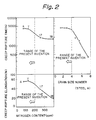
- Figure 2 is a graph showing the relationship of the creep rupture strength and creep rupture elongation and the nitrogen content. Figure 2 also indicates the relationship between the crystal grain size number and creep rupture time for Steel A.
- Figure 3 shows the effectiveness of the addition of Mg at improving the creep rupture time. It is apparent from Figure 3 that when the Mg content is 0.001% or more, the creep rupture life is improved. When the Mg content is over 0.02%, the life is decreased again. An effective range for the Mg content is therefore 0.001 - 0.02%.
- Table 3 shows the results of tests which were carried out to evaluate formability under hot and cold conditions of steels of the present invention and comparative steels.
- Test pieces (diameter of 10 mm and length of 130 mm) were cut from 17 kg ingots manufactured by vacuum melting. These test pieces were subjected to the Greeble test at 1200°C at a strain rate of 5 s ⁇ 1. Cold workability was evaluated on the basis of the tensile rupture elongation during a tensile test carried out at room temperature for test pieces (diameter of 6 mm, gauge distance of 30 mm) obtained after cold rolling followed by solid solution treatment.
Landscapes
- Chemical & Material Sciences (AREA)
- Engineering & Computer Science (AREA)
- Materials Engineering (AREA)
- Mechanical Engineering (AREA)
- Metallurgy (AREA)
- Organic Chemistry (AREA)
- Heat Treatment Of Steel (AREA)
Description
- The present invention relates to heat-resistant steels which exhibit high strength even at high temperatures of 700 - 1150 °C and which also exhibit superior formability.
-
HK 40 steels (25Cr-20Ni Heat-Resistant Cast Steels) have been widely used in the chemical industry in high-temperature devices. For example, they have been used as tubes for cracking furnaces of ethylene-manufacturing plants and tubes for reforming furnaces for producing hydrogen gas. However, since such tubes are produced by centrifugal casting, it is rather difficult to manufacture small diameter tubes, thin-walled tubes, and lengthy tubes, and the resulting tubes suffer from poor ductility and toughness. - Alloy 800H (0.08C-20Cr-32Ni-0.4Ti-0.4Al) has been known as a material for making forged tubing. However this alloy does not have a satisfactory high-temperature strength.
- Recently, cracking furnaces of etylene plants are being operated at higher temperatures than in the past so as to increase the yields of the products. Therefore, the materials which constitute cracking furnaces must have greater high-temperature strength than in the past.
- There are many new materials for use in centrifugally cast tubing which have a higher level of strength than
HK 40 steels. Some examples of these alloys are HP, HP-Nb, HP-Nb,W, and BST. Forged tubing materials which correspond to these new alloys are nickel-based alloys such as Hastelloy X (0.06C-21Cr-9Mo-1Co-bal.Ni), Inconel 617 (0.06C-21Cr-8.5Mo-12Co-1Al-bal.Ni), and Inconel 625 (0.04C-21Cr-9Mo-3.5Nb-bal.Ni). However, since these Ni-based alloys contain a great amount of the very expensive elements Mo and Ni, these alloy have problems with respect to economy and formability. - In order to increase reaction efficiency and perform reactions under stable conditions in various high-temperature apparatuses, there is a need for a forged tubing material which has excellent high-temperature strength and which can be used to manufacture lengthy piping with a small diameter.
- Materials for use in cracking furnaces and reforming furnaces must have high-temperature strength and a particulary high creep rupture strength, since such materials are used at extremely high temperatures of about 700 - 1150°C. Therefore, a centrifugally cast tube has been used for such purposes because it exhibits satisfactory high-temperature strength and is economical.
- However, it is difficult to manufacture a lengthy tube with a thin wall and a small diameter by centrifugal casting. Furthermore, centrifugally cast tubes have unsatisfactory ductility and toughness, although centrifugally cast tubes with a high carbon content (0.4 - 0.5%) have excellent creep rupture strength. This is because eutectic carbide precipites along the grain boundaries.
- In forged tubes with a high carbon content, such precipitated eutectic carbides are broken during working including forging and extrusion, resulting in a large amount of undissolved carbides remaining in the matrix without in any way improving the creep rupture strength. In other words, it is necessary to carry out a different type of strengthening for forged piping material, since the presence of these eutectic carbides cannot be used for strengthening.
- In Japanese Unexamined Patent Application Disclosure No. 23050/1982, the inventors of the present invention proposed a heat-resistant forging steel in which high strength is achieved by utilizing grain boundary-strengthening elements as well as solid solution-strengthening elements. The proposed steel can exhibit greater high-temperature strength than forged tubing material such as Alloy 800H and centrifugally cast tubing material such as HK40. Its creep rupture strength is a maximum of 21.56 N/mm² (2.20 kgf/mm²) at 1000 °C after 1000 hours, and in particular the strength is 16.66 N/mm² (1.70 kgf/mm²) for the steel (0.27C-0.52Si-1.16Mn-24.42Cr-24.8Ni-0.48Ti-0.34Al-0.0040B-bal.Fe). In addition, it can also exhibit satisfactory toughness, and it can be used to produce long, thin-walled tubes with a small diameter. However, it is necessary to increase the content of Mo and W to further strengthen the steel, although the formability is degraded by increasing the content of these elements. Therefore, the Ni content must be increased to achieve a stabilized structure and as a result, the alloy is less economical. In the above-described patent publication, there is no reference to the nitrogen content at all.
- Japanese Unexamined Patent Application Disclosure No. 21922/1975 discloses steel compositions similar to those mentioned above. In this application. 0.005-0.05% of magnesium is added to further improve high-temperature properties, and there is no mention of the nitrogen content. The resulting creep rupture strength is only at most 45.08 N/mm² (4.6 kgf/mm²) after 10³ hours and at most 29.4 N/mm² (3.0 kgf/mm²) after 10⁴ hours at 900°C. Based on these data it is estimated that the creep rupture time at 1000°C and 19.6 N/mm² (2 kgf/mm²) is 391 hours (minimum) - 2185 hours (maximum). In particular, the creep rupture time is 391 hours (minimum) - 966 hours (maximum) for the steel (0.20C-0.52Si-1.1Mn-22.8Cr-25.1Ni-0.53Ti-0.56Al-0.005B-0.012Mg-bal.Fe).
- GB-A-2 138 446 discloses an austenitic heat-resistant alloy consisting of (by weight): 0.02-0.15% C, 0.3-2.0% Si, 0.3-1.5% Mn, 18-25% Cr, 20.5-50% Ni, 0.5-3.0% Mo, 0.03-0.3% Ti, 0.05-0.6% Nb, 0.003-0.01% B, no more than 0.04% P, and no more than 0.005% S, with the balance being iron and unavoidable impurities, and satisfying the conditions Nb/Ti = 0.5-3 (atomic ratio) and (Nb + Ti)/(C + N) = 0.2-0.85 (atomic ratio). It is said that the alloy is particularly useful as a boiler material. The grain size number is not mentioned in this document.
- US-A-4 530 720 discloses an austenitic steel consisting essentially of the following alloying elements:
C: not greater than 0.10%; Si: more than 1%, but not greater than 5.0%; Mn: not greater than 3.0%; Ni: 10-15%; Cr: 15-25%; the amounts of said alloying elements being adjusted to result in an austenitic microstructure, and a balance of iron and impurities of which sulphur is restricted to not greater than 0.003%. The grain size number is also not indicated in this document. - An object of the present invention is to provide a high-strength, heat-resistant steel which has excellent formability and is economical.
- Another object is to provide a steel with improved high-temperature strength in which expensive elements such as Mo, W, and Ni, which are required to stabilize the structure are added in lesser amounts than in the past.
- Still another object of the present invention is to provide a high-strength, heat-resistant steel in which the amounts of impurities and grain size number are controlled so as to further improve high-temperature strength, ductility, and formability.
- A further object of the present invention is to provide a high-strength, heat-resistant steel which has a creep rupture time of 2000 hours or more at 1000°C and 19.6 N/mm² (2.0 kgf/mm²), and which is less expensive but superior with respect to creep rupture elongation, and formability at high temperatures and room temperature.
- Accordingly, the present invention provides a high-strength, heat-resistant steel with improved formability which consists of, by weight %:
C: 0.05 - 0.30%, Si: not greater than 3.0%, Mn: not greater than 10%, Cr: 15 - 35%, Ni: 15 - 50%, Mg: 0.001 - 0.02%, B: 0.001 - 0.01% and/or Zr: 0.001 - 0.10%, at least one of Ti: 0.05 - 1.0%, Nb: 0.1 - 2.0%, and Al: 0.05 - 1.0%, Mo: 0 - 3.0%, W: 0 - 6.0%, (Mo + 1/2 W = 3.0% or less) a balance of Fe and incidental impurities, of the impurities, oxygen and nitrogen being restricted to 50 ppm or less and 200 ppm or less, respectively, and the austenite grain size number being restricted to No. 4 or coarser. - According to a preferred embodiment of the present invention, the steel comprises 0.001-0.01% of B and/or 0.001-0.10% of Zr together with at least one of 0.05-1.0% of Ti, 0.1-2.0% of Nb, and 0.05-1.0% of Al.
- In another preferred embodiment of the present invention, the steel further comprises 0.5-3.0% of Mo and/or 0.5-6.0% of W (Mo + 1/2 W= 0.5-3.0%).
- Thus, according to the present invention, the addition of Mo and W which are effective as strengthening elements is suppressed or restricted so as to improve formability and to make the steel economical while the content of impurities such as oxygen, and nitrogen is restricted to not greater than 50 ppm and 200 ppm, respectively, and the grain size number of austenite is restricted to not greater than 4 in order to give an excellent high-temperature strength at extremely high temperatures of about 700-1150°C.
- Figure 1 is a graph showing the relationship between the oxygen content of steel and creep rupture time at 1000°C and 19.6 N/mm² (2.0 kgf/mm²) and rupture elongation;
- Figure 2 is a graph showing the relationship of the nitrogen content and the grain size of steel to creep rupture time and rupture elongation under the same conditions as in Figure 1; and
- Figure 3 is a graph showing the relationship between the Mg content of steel and the creep rupture time under the same conditions as if Figure 1.
- The reasons for defining the steel composition as well as the austenite grain size number of the present invention as described above are as follows.
- Carbon (C) is effective for increasing tensile strength as well as creep rupture strength to a level required for heat-resistant steels. In the present invention, it is necessary to incorporate 0.05% or more of carbon. However when the carbon content is over 0.30%, undissolved carbides remain even after solid solution heat treatment without in any way strengthening the steel, and the growth of grains is also suppressed. Therefore, the carbon content is restricted to 0.05 - 0.30%. Preferably, it is 0.08 - 0.27%, within which there are included two groups; C:0.08 - 0.20%, and C: 0.15 - 0.27%.
- Silicon (Si) is necessary as a deoxidizing element, and ii is also effective for improving the resistance to oxidation and carburization. However when the Si content is over 3.0%, the formability as well as weldability and stabilization of structure are degraded. Therefore, according to the present invention, the Si content is restricted to not greater than 3.0%. In particular, when the resistance to carburization should be further improved, it is preferable that the Si content be 1% or more.
- Manganese (Mn) is a deoxidizing element which is also effective for improving formability. Mn is an austenite-former, and Ni may be partially replaced by Mn. However, excess addition of Mn degrades formability, so the Mn content is restricted to 10.0% or less.
- Chromium (Cr) is important for assuring the resistance to oxidation. For this purpose it is necessary to incorporate at least 15% of Cr, and preferably not less than 20%. In order to improve the resistance to oxidation and carburization, the higher the Cr content the better. However, when it is higher than 35%, formability as well as stabilization in structure are degraded. Thus, according to the present invention, the Cr content is restricted to 15 - 35%, and preferably to 20 - 30%. The most desirable range is 23 - 27%.
- Nickel (Ni) is an austenite former which is added in an amount determined by considering the total amount of ferrite formers such as Cr, Si, Mo, and W so as to form a stable austenite phase. However, the addition of a large amount of Ni makes the resulting steel uneconomical. Thus, according to the present invention the Ni content is defined as 15 - 50% by weight. Preferably, the Ni content is 23 - 42%, within which there are included three groups; Ni:23 - 27%, Ni:30 - 40%, and Ni:32 - 42%.
- Titanium (Ti), niobium (Nb), and aluminum (Al) are effective for improving high-temperature strength, and particularly creep rupture strength. In order to be effective, it is necessary that Ti be added in an amount of 0.05% or more, Nb in an amount of 0.1% or more, and Al in an amount of 0.05% or more. However, when more than 1% of Ti or Al is added or more than 2.0% of Nb is added, there is no further improvement in high-temperature strength while formability as well as weldability are degraded. Therefore, the amounts of Ti, Nb, and Al are defined as 0.05-1.0%, 0.1-2.0%, and 0.05-1.0%, respectively. Any one of these elements can be added alone or in combination with one or two of the others.
- Boron (B) and zirconium (Zr) are effective for strengthening grain boundaries. In particular, fracture is dominated (or mainly caused) by intergranular fracture in a high temperature range of about 700 °C and higher, and the addition of these elements is effective for supressing the occurrence of intergranular fracture. For this purpose it is desirable that any one of these elements be added in an amount of 0.001% or more each. However, the addition of an excess amount of these elements results in degradation in weldability, so the content of B is defined as 0.001-0.01%, and Zr as 0.001-0.10%. These elements can be added alone or in combination.
- Magnesium (Mg) is effective for improving formability. It can also improve creep rupture strength. In order to improve such properties, it is necessary to add Mg in an amount of 0.001% or more. However, when Mg is added in an amount of higher than 0.02%, the creep rupture strength decreases again, so the Mg content is defined as 0.001-0.02%.
- P and S are present as inevitable impurities. It is preferable that P be present in an amount of 0.015% or less and S in an amount of 0.003% or less.
- In addition to these impurities, the restriction of the amounts of oxygen and nitrogen as impurities is crucial to the present invention. A decrease in the content of oxygen is extremely effective for improving creep rupture strength and creep rupture ductility. As shown in detail in the following examples, when the oxygen content is restricted to not greater than 50 ppm, the above-noted properties can be improved remarkably. It is thought on the basis of the observation of structure after fracture that intergranular fracture decreases drastically as the oxygen content decreases. It is hypothesized that this is because the grain boundaries are strengthened by a decrease in the oxygen content.
- Usually nitrogen is contained in an amount of 250-400 ppm for this type of steel. However, according to the present invention, it was found that when the nitrogen content is reduced to 200 ppm or less, creep rupture strength as well as ductility are markedly improved. Because the steel of the present invention contains Ti, Nb, and Al as strengthening elements, the formation of nonmetallic inclusions is suppressed when the content of nitrogen is reduced to a lower level, and the amount of effective Ti, Nb, and Al is increased remarkably, resulting in further strengthening of steel. It is desirable that the nitrogen content be restricted to 150 ppm or less.
- The above findings are unexpected because it has been thought that the addition of nitrogen would be effective for further improving high-temperature properties including creep properties when nitrogen is dissolved in steel or is precipitated as fine carbides.
- Molybdenum (Mo) and tungsten (W) are optional elements which function as solid solution hardening elements and which are also effective for improving high-temperature strength. For this purpose it is necessary that at least one of these elements be added in an amount of 0.5% or more each. In order to improve high-temperature strength, the higher the content of these elements the better. However, the addition of these elements results in a degradation in formability, and it is also necessary to increase the Ni content so as to stabilize an austenite phase, making the resulting steel less economical. Thus, according to the present invention, the content of Mo is defined as 0.5 - 3.0% and W as 0.5 - 6.0%. When both are added, Mo + 1/2W is 0.5 - 3.0%.
- When steels of this type are heated at 700 °C or higher, creep rupture is dominated by intergranular fracture. Thus, in order to increase the creep rupture strength, it is desirable that the austenite grain size be coarse. On the basis of a series of experiments, it was found that when the austenite grain size is defined as No. 4 or less (ASTM grain size number), a satisfactory level of high-temperature strength can be achieved for steel having a steel composition defined in the present invention.
- The austenite grain size number can be adjusted by changing the solid solution treatment tempetature, for example.
- The present invention will now be further described in conjunction with working examples which are presented merely for illustrative purposes.
- Chemical compositions of specimens used in this example are shown in Table 1, in which Steels A through T are the steels of the present invention, and Steels Nos. 1 through 18 are comparative ones. These steels were melted using a vacuum melting furnace with a capacity of 17 kg. After forging and cold rolling, solid solution treatment was performed. The solid solution treatment was carried out at a temperature at which the austenite grain size number became No.4 or smaller numbers, i.e., coarser. For Steel A, the temperature was adjusted to achieve a grain size number of No.4 or smaller or greater numbers. For the other steels the grain size number was set at smaller than No.4, i.e., coarser.
- The resulting specimens were subjected to a creep rupture test at 1000 °C at a load of 1.96 N/mm² (2.0 kgf/mm²). The test results are shown in Table 2 and in Figure 1. The symbols of Figure 1 are the same as those in Table 2.
- Figure 1 is a graph showing the relationship of creep rupture strength and creep rupture elongation to the oxygen content for three types of steel compositions. As is apparent from Figure 1, steels of the present invention having an oxygen content of 50 ppm or less exhibited a creep rupture time as well as creep rupture elongation which were markedly improved compared with those of the comparative steel which contained more than 50 ppm of oxygen. Such advantages as those achieved by decreasing the oxygen content are apparent from Table 2 for other types of steel of the present invention. See Steels L through R of the present invention and Comparative Steel Nos. 9 through 15.
- In order to demonstrate the superiority of the present invention over prior art steel, the properties of the before mentioned steel (0.20C-0.52Si-1.1Mn-22.8Cr-25.1Ni-0.53Ti-0.56Al-0.005B-0.012Mg-bal.Fe) of Japanese Unexamined Patent Application Disclosure No.21922/1975 were compared with those of Steel S of the present invention. As mentioned before, the ruputure time of this prior art steel is estimated to be at most 966 hours at 1000 °C and 1.96 N/mm² (2.0 kgf/mm²), and that of Steel S is 2423 hours. Thus, the creep properties of the steel of the present invention are clearly superior to those of the prior art steel.
- As mentioned before, the creep rupture time of the conventional steel (0.27C-0.52Si-1.16Mn-0.016P-0.005S-24.42Cr-24.8Ni-0.48Ti-0.34Al-0.0040B-bal.Fe) of Japanese Unexamined Patent Application Disclosure No.23050/1982 is said to be 1000 hours at 1000°C and 16.66 N/mm² (1.7 kgf/mm²). It is noted that Steel S of the present invention has a much superior creep rupture time even though the stress applied to Steel S is greater than that of this conventional steel by 4.9 N/mm² (0.5 kgf/mm²). Thus, the creep properties of the steel of the present invention are clearly superior to those of this conventional steel as well.
- Figure 2 is a graph showing the relationship of the creep rupture strength and creep rupture elongation and the nitrogen content. Figure 2 also indicates the relationship between the crystal grain size number and creep rupture time for Steel A.
- It is apparent from Figure 2 that when the nitrogen content is restricted to not greater than 200 ppm, creep rupture time as well as creep rupture elongation are markedly improved and that when the crystal grain size number is restricted to not larger than 4, creep rupture time is increased.
- Figure 3 shows the effectiveness of the addition of Mg at improving the creep rupture time. It is apparent from Figure 3 that when the Mg content is 0.001% or more, the creep rupture life is improved. When the Mg content is over 0.02%, the life is decreased again. An effective range for the Mg content is therefore 0.001 - 0.02%.
- Table 3 shows the results of tests which were carried out to evaluate formability under hot and cold conditions of steels of the present invention and comparative steels. Test pieces (diameter of 10 mm and length of 130 mm) were cut from 17 kg ingots manufactured by vacuum melting. These test pieces were subjected to the Greeble test at 1200°C at a strain rate of 5 s⁻¹. Cold workability was evaluated on the basis of the tensile rupture elongation during a tensile test carried out at room temperature for test pieces (diameter of 6 mm, gauge distance of 30 mm) obtained after cold rolling followed by solid solution treatment.
- It is apparent from Table 3 that formability under hot conditions and cold conditions of the steel of the present invention is much improved compared with that for comparative steels.


Claims (9)
- A high-strength, heat-resistant steel with improved formability which consists of, by weight %:
C: 0.05 - 0.30%, Si: not greater than 3.0%, Mn: not greater than 10%, Cr: 15 - 35%, Ni: 15 - 50%, Mg: 0.001 0.02%, B: 0.001 - 0.01% and/or Zr: 0.001 - 0.10%, at least one of Ti: 0.05 - 1.0%, Nb: 0.1 - 2.0%, and Al: 0.05 - 1.0%, Mo: 0 - 3.0%, W: 0 - 6.0%, (Mo + 1/2 W = 3.0% or less) a balance of Fe and incidental impurities, of the impurities, oxygen and nitrogen being restricted to 50 ppm or less and 200 ppm or less, respectively, and the austenite grain size number being restricted to No. 4 or coarser. - The high-strength, heat-resistant steel with improved formability as set forth in claim 1 which is free of Mo and W.
- The high-strength, heat-resistant steel with improved formability as set forth in claim 1, wherein:
Mo: 0.5 - 3.0% and/or W: 0.5 - 6.0%,
(Mo + 1/2 W = 0.5 - 3.0%). - The high-strength, heat-resistant steel with improved formability as set forth in Claims 1-3, wherein the nitrogen content is 150 ppm or less.
- The high-strength, heat-resistant steel with improved formability as set forth in Claims 1-3, wherein the Cr content is 20 - 30%.
- The high-strength, heat-resistant steel with improved formability as set forth in Claims 1-3, wherein the C content is 0.08 - 0.27%, the Cr content is 20 - 30%, and the Ni content is 23 - 42%.
- The high-strength, heat-resistant steel with improved formability as set forth in Claim 2 wherein the C content is 0.15 - 0.27%, the Cr content is 23 - 27%, and the Ni content is 23 - 27%.
- The high-strength, heat-resistant steel with improved formability as set forth in Claim 2 wherein the C content is 0.08 - 0.20%, the Si content is 1.0 - 3.0%, the Cr content is 23 - 27%, and the Ni content is 30 - 40%.
- The high-strength, heat-resistant steel with improved formability as set forth in Claim 3 wherein the C content is 0.08 - 0.20%, the Si content is 1.0 - 3.0%, the Cr content is 23 - 27%, and the Ni content is 32 - 42%.
Applications Claiming Priority (2)
| Application Number | Priority Date | Filing Date | Title |
|---|---|---|---|
| JP1022032A JP2760004B2 (en) | 1989-01-30 | 1989-01-30 | High-strength heat-resistant steel with excellent workability |
| JP22032/89 | 1989-01-30 |
Publications (2)
| Publication Number | Publication Date |
|---|---|
| EP0381121A1 EP0381121A1 (en) | 1990-08-08 |
| EP0381121B1 true EP0381121B1 (en) | 1995-04-19 |
Family
ID=12071633
Family Applications (1)
| Application Number | Title | Priority Date | Filing Date |
|---|---|---|---|
| EP90101750A Expired - Lifetime EP0381121B1 (en) | 1989-01-30 | 1990-01-29 | High-strength heat-resistant steel with improved workability |
Country Status (5)
| Country | Link |
|---|---|
| US (1) | US5021215A (en) |
| EP (1) | EP0381121B1 (en) |
| JP (1) | JP2760004B2 (en) |
| KR (1) | KR920010120B1 (en) |
| DE (1) | DE69018658T2 (en) |
Cited By (1)
| Publication number | Priority date | Publication date | Assignee | Title |
|---|---|---|---|---|
| CN110423951A (en) * | 2019-09-02 | 2019-11-08 | 铜陵学院 | A method of improving Cr series austenite heat-resistance stainless steel high temperature oxidation resistance |
Families Citing this family (41)
| Publication number | Priority date | Publication date | Assignee | Title |
|---|---|---|---|---|
| DE4130139C1 (en) * | 1991-09-11 | 1992-08-06 | Krupp-Vdm Ag, 5980 Werdohl, De | |
| JPH0593239A (en) * | 1991-09-30 | 1993-04-16 | Kubota Corp | Tube for thermal cracking and reforming reaction for hydrocarbons |
| US5160382A (en) * | 1992-01-17 | 1992-11-03 | Inco Alloys International, Inc. | Heater sheath alloy |
| US5217545A (en) * | 1992-01-17 | 1993-06-08 | Inco Alloys International, Inc. | Heater sheath alloy |
| US5330590A (en) * | 1993-05-26 | 1994-07-19 | The United States Of America, As Represented By The Administrator Of The National Aeronautics & Space Administration | High temperature creep and oxidation resistant chromium silicide matrix alloy containing molybdenum |
| US5474737A (en) * | 1993-07-01 | 1995-12-12 | The United States Of America As Represented By The Secretary Of Commerce | Alloys for cryogenic service |
| US5393487A (en) * | 1993-08-17 | 1995-02-28 | J & L Specialty Products Corporation | Steel alloy having improved creep strength |
| JPH07216511A (en) * | 1994-01-31 | 1995-08-15 | Sumitomo Metal Ind Ltd | High chromium austenitic heat resistant alloy with excellent high temperature strength |
| CN1037535C (en) * | 1994-03-23 | 1998-02-25 | 冶金工业部钢铁研究总院 | Austenitic high temperature resistant carburizing steel |
| JPH09125205A (en) * | 1995-09-01 | 1997-05-13 | Mitsubishi Heavy Ind Ltd | Neutron-resistant irradiation deterioration High Ni austenitic stainless steel |
| US5873950A (en) * | 1996-06-13 | 1999-02-23 | Inco Alloys International, Inc. | Strengthenable ethylene pyrolysis alloy |
| US5928442A (en) * | 1997-08-22 | 1999-07-27 | Snap-On Technologies, Inc. | Medium/high carbon low alloy steel for warm/cold forming |
| US6103383A (en) * | 1998-01-27 | 2000-08-15 | Jeneric/Pentron Incorporated | High tungsten, silicon-aluminum dental alloy |
| JP4379753B2 (en) * | 1999-04-05 | 2009-12-09 | 日立金属株式会社 | Exhaust system component, internal combustion engine using the same, and method of manufacturing exhaust system component |
| RU2194788C2 (en) * | 2000-06-27 | 2002-12-20 | Байдуганов Александр Меркурьевич | Heat-resistant alloy |
| RU2194789C2 (en) * | 2000-06-27 | 2002-12-20 | Байдуганов Александр Меркурьевич | Heat-resistant alloy |
| PL365626A1 (en) * | 2000-08-17 | 2005-01-10 | Ati Properties, Inc. | Oxidation and corrosion resistant austenitic stainless steel including molybdenum |
| US20040156737A1 (en) * | 2003-02-06 | 2004-08-12 | Rakowski James M. | Austenitic stainless steels including molybdenum |
| US6352670B1 (en) | 2000-08-18 | 2002-03-05 | Ati Properties, Inc. | Oxidation and corrosion resistant austenitic stainless steel including molybdenum |
| US6475310B1 (en) * | 2000-10-10 | 2002-11-05 | The United States Of America As Represented By The United States Department Of Energy | Oxidation resistant alloys, method for producing oxidation resistant alloys |
| KR100532877B1 (en) | 2002-04-17 | 2005-12-01 | 스미토모 긴조쿠 고교 가부시키가이샤 | Austenitic stainless steel excellent in high temperature strength and corrosion resistance, heat resistant pressurized parts, and the manufacturing method thereof |
| JP4985941B2 (en) * | 2004-04-19 | 2012-07-25 | 日立金属株式会社 | High Cr high Ni austenitic heat-resistant cast steel and exhaust system parts comprising the same |
| JP4386364B2 (en) * | 2005-07-07 | 2009-12-16 | 株式会社日立製作所 | Steam turbine piping, its manufacturing method, main steam piping and reheat piping for steam turbine and steam turbine power plant using the same |
| EP1947207B1 (en) * | 2005-10-31 | 2010-12-15 | Kubota Corporation | HEAT-RESISTANT ALLOY CAPABLE OF DEPOSITING FINE Ti-Nb-Cr CARBIDE OR Ti-Nb-Zr-Cr CARBIDE |
| CN100415926C (en) * | 2006-01-20 | 2008-09-03 | 烟台百思特炉管厂 | Micro-alloyed nickel-chromium superalloy material and preparation method thereof |
| US7815848B2 (en) * | 2006-05-08 | 2010-10-19 | Huntington Alloys Corporation | Corrosion resistant alloy and components made therefrom |
| DE102007005605B4 (en) * | 2007-01-31 | 2010-02-04 | Thyssenkrupp Vdm Gmbh | Iron-nickel-chromium-silicon alloy |
| US7985304B2 (en) | 2007-04-19 | 2011-07-26 | Ati Properties, Inc. | Nickel-base alloys and articles made therefrom |
| JP4979563B2 (en) * | 2007-12-13 | 2012-07-18 | 中国電力株式会社 | Creep life evaluation method |
| WO2009154161A1 (en) | 2008-06-16 | 2009-12-23 | 住友金属工業株式会社 | Heat-resistant austenitic alloy, heat-resistant pressure-resistant member comprising the alloy, and process for producing the same |
| FR2939808B1 (en) * | 2008-12-16 | 2011-01-07 | Air Liquide | HIGH-TEMPERATURE STABLE-NICKEL-CHROME ALLOY ALLOYS |
| JP4780189B2 (en) | 2008-12-25 | 2011-09-28 | 住友金属工業株式会社 | Austenitic heat-resistant alloy |
| JP4631986B1 (en) * | 2009-09-16 | 2011-02-16 | 住友金属工業株式会社 | Ni-based alloy product and manufacturing method thereof |
| WO2011071054A1 (en) | 2009-12-10 | 2011-06-16 | 住友金属工業株式会社 | Austenitic heat-resistant alloy |
| JP5212533B2 (en) | 2011-11-15 | 2013-06-19 | 新日鐵住金株式会社 | Seamless austenitic heat-resistant alloy tube |
| JP5273266B2 (en) | 2012-02-08 | 2013-08-28 | 新日鐵住金株式会社 | Double pipe and welded structure using the same |
| JP6224378B2 (en) * | 2013-08-20 | 2017-11-01 | 日本特殊陶業株式会社 | Gas sensor |
| KR20190065352A (en) * | 2016-10-05 | 2019-06-11 | 닛폰세이테츠 가부시키가이샤 | NiCrFe alloy |
| CN113061802B (en) * | 2021-02-07 | 2022-05-31 | 中国科学院金属研究所 | High-strength austenitic aged stainless steel resistant to corrosion of concentrated nitric acid containing oxidative ions and preparation method thereof |
| DE102022110383A1 (en) | 2022-04-28 | 2023-11-02 | Vdm Metals International Gmbh | Using a nickel-iron-chromium alloy with high resistance in carburizing and sulfiding and chlorinating environments while maintaining good workability and strength |
| DE102022110384A1 (en) | 2022-04-28 | 2023-11-02 | Vdm Metals International Gmbh | Using a nickel-iron-chromium alloy with high resistance in highly corrosive environments while maintaining good workability and strength |
Family Cites Families (16)
| Publication number | Priority date | Publication date | Assignee | Title |
|---|---|---|---|---|
| GB1049379A (en) * | 1963-08-21 | 1966-11-23 | United Steel Compagnies Ltd | Chromium-nickel-manganese steel |
| US3303023A (en) * | 1963-08-26 | 1967-02-07 | Crucible Steel Co America | Use of cold-formable austenitic stainless steel for valves for internal-combustion engines |
| GB993613A (en) * | 1963-11-22 | 1965-06-02 | Sandvikens Jernverks Ab | Alloy steels and articles made therefrom |
| FR2225536B1 (en) * | 1973-04-12 | 1976-04-09 | Creusot Loire | |
| DE2458213C2 (en) * | 1973-12-22 | 1982-04-29 | Nisshin Steel Co., Ltd., Tokyo | Use of an oxidation-resistant austenitic stainless steel |
| JPS53133524A (en) * | 1977-04-26 | 1978-11-21 | Kobe Steel Ltd | Austenitic stainless steel for cold forging |
| JPS5456018A (en) * | 1977-10-12 | 1979-05-04 | Sumitomo Metal Ind Ltd | Austenitic steel with superior oxidation resistance for high temperature use |
| JPS5929104B2 (en) * | 1980-05-20 | 1984-07-18 | 愛知製鋼株式会社 | Austenitic heat-resistant steel with excellent hot workability and oxidation resistance |
| DE3020844C2 (en) * | 1980-06-02 | 1984-05-17 | Kernforschungszentrum Karlsruhe Gmbh, 7500 Karlsruhe | Use of high-temperature, corrosion-resistant, austenitic iron-nickel-chromium alloys with high long-term stability |
| JPS5723050A (en) * | 1980-07-18 | 1982-02-06 | Sumitomo Metal Ind Ltd | Heat resistant steel with excellent high temp. strength |
| JPS5923855A (en) * | 1982-07-28 | 1984-02-07 | Nippon Kokan Kk <Nkk> | Steel having high strength at high temperature containing carbide forming element |
| JPS59173249A (en) * | 1983-03-19 | 1984-10-01 | Nippon Steel Corp | Austenite type heat resistance alloy |
| JPS6033345A (en) * | 1983-08-05 | 1985-02-20 | Sumitomo Metal Ind Ltd | Nitric acid resistant austenite stainless steel |
| JPS60155653A (en) * | 1984-01-25 | 1985-08-15 | Hitachi Ltd | Iron-base super alloy and its production |
| JPS616257A (en) * | 1984-06-21 | 1986-01-11 | Toshiba Corp | 12% cr heat resisting steel |
| JPS61179835A (en) * | 1985-01-10 | 1986-08-12 | Sumitomo Metal Ind Ltd | High-strength and highly corrosion resistant austenitic stainless steel |
-
1989
- 1989-01-30 JP JP1022032A patent/JP2760004B2/en not_active Expired - Lifetime
-
1990
- 1990-01-29 DE DE69018658T patent/DE69018658T2/en not_active Expired - Lifetime
- 1990-01-29 EP EP90101750A patent/EP0381121B1/en not_active Expired - Lifetime
- 1990-01-30 KR KR1019900001001A patent/KR920010120B1/en not_active Expired
- 1990-01-30 US US07/472,165 patent/US5021215A/en not_active Expired - Lifetime
Cited By (1)
| Publication number | Priority date | Publication date | Assignee | Title |
|---|---|---|---|---|
| CN110423951A (en) * | 2019-09-02 | 2019-11-08 | 铜陵学院 | A method of improving Cr series austenite heat-resistance stainless steel high temperature oxidation resistance |
Also Published As
| Publication number | Publication date |
|---|---|
| JP2760004B2 (en) | 1998-05-28 |
| KR920010120B1 (en) | 1992-11-16 |
| DE69018658D1 (en) | 1995-05-24 |
| KR900011910A (en) | 1990-08-02 |
| US5021215A (en) | 1991-06-04 |
| DE69018658T2 (en) | 1996-01-04 |
| EP0381121A1 (en) | 1990-08-08 |
| JPH02200756A (en) | 1990-08-09 |
Similar Documents
| Publication | Publication Date | Title |
|---|---|---|
| US5021215A (en) | High-strength, heat-resistant steel with improved formability and method thereof | |
| US4564392A (en) | Heat resistant martensitic stainless steel containing 12 percent chromium | |
| JP5000805B2 (en) | Heat resistant austenitic stainless steel | |
| EP1471158B1 (en) | Austenitic stainless steel | |
| US4799972A (en) | Process for producing a high strength high-Cr ferritic heat-resistant steel | |
| EP0505732B1 (en) | Low-alloy heat-resistant steel having improved creep strength and toughness | |
| US5746843A (en) | Low Mn-low Cr ferritic heat resistant steel excellent in strength at elevated temperatures | |
| EP0806490B1 (en) | Heat resisting steel and steam turbine rotor shaft | |
| US5798082A (en) | High-strength and high-toughness heat-resistant cast steel | |
| US5591391A (en) | High chromium ferritic heat-resistant steel | |
| US5084238A (en) | High strength heat-resistant low alloy steels | |
| US4842823A (en) | Austenitic steel having improved high-temperature strength and corrosion resistance | |
| US4892704A (en) | Low Si high-temperature strength steel tube with improved ductility and toughness | |
| JPH08127848A (en) | High chromium austenitic heat resistant alloy with excellent high temperature strength | |
| RU2383649C2 (en) | Precipitation hardening steel (versions) and item out of steel (versions) | |
| JP2000204434A (en) | Ferritic heat-resistant steel excellent in high-temperature strength and its manufacturing method | |
| JP3422658B2 (en) | Heat resistant steel | |
| JPH1096038A (en) | High Cr austenitic heat-resistant alloy | |
| JP2819906B2 (en) | Ni-base alloy for tools with excellent room and high temperature strength | |
| KR100268708B1 (en) | Method of manufacturing high cr ferritic heat resisting steel for high temperature,high pressure parts | |
| JPH1161342A (en) | High chromium ferritic steel | |
| JP3387145B2 (en) | High Cr ferritic steel with excellent high temperature ductility and high temperature strength | |
| JPH11106860A (en) | Ferritic heat resistant steel excellent in creep characteristic in heat-affected zone | |
| JP2002180169A (en) | Ni-base heat-resistant alloy | |
| JPH0931600A (en) | Steam turbine rotor material for high temperature use |
Legal Events
| Date | Code | Title | Description |
|---|---|---|---|
| PUAI | Public reference made under article 153(3) epc to a published international application that has entered the european phase |
Free format text: ORIGINAL CODE: 0009012 |
|
| AK | Designated contracting states |
Kind code of ref document: A1 Designated state(s): DE FR GB SE |
|
| 17P | Request for examination filed |
Effective date: 19900803 |
|
| 17Q | First examination report despatched |
Effective date: 19930924 |
|
| GRAA | (expected) grant |
Free format text: ORIGINAL CODE: 0009210 |
|
| AK | Designated contracting states |
Kind code of ref document: B1 Designated state(s): DE FR GB SE |
|
| REF | Corresponds to: |
Ref document number: 69018658 Country of ref document: DE Date of ref document: 19950524 |
|
| ET | Fr: translation filed | ||
| PLBE | No opposition filed within time limit |
Free format text: ORIGINAL CODE: 0009261 |
|
| STAA | Information on the status of an ep patent application or granted ep patent |
Free format text: STATUS: NO OPPOSITION FILED WITHIN TIME LIMIT |
|
| 26N | No opposition filed | ||
| REG | Reference to a national code |
Ref country code: GB Ref legal event code: IF02 |
|
| PGFP | Annual fee paid to national office [announced via postgrant information from national office to epo] |
Ref country code: DE Payment date: 20090123 Year of fee payment: 20 |
|
| PGFP | Annual fee paid to national office [announced via postgrant information from national office to epo] |
Ref country code: GB Payment date: 20090128 Year of fee payment: 20 |
|
| PGFP | Annual fee paid to national office [announced via postgrant information from national office to epo] |
Ref country code: SE Payment date: 20090108 Year of fee payment: 20 |
|
| PGFP | Annual fee paid to national office [announced via postgrant information from national office to epo] |
Ref country code: FR Payment date: 20090113 Year of fee payment: 20 |
|
| REG | Reference to a national code |
Ref country code: GB Ref legal event code: PE20 Expiry date: 20100128 |
|
| EUG | Se: european patent has lapsed | ||
| PG25 | Lapsed in a contracting state [announced via postgrant information from national office to epo] |
Ref country code: GB Free format text: LAPSE BECAUSE OF EXPIRATION OF PROTECTION Effective date: 20100128 |
|
| PG25 | Lapsed in a contracting state [announced via postgrant information from national office to epo] |
Ref country code: DE Free format text: LAPSE BECAUSE OF EXPIRATION OF PROTECTION Effective date: 20100129 |