EP0378207B1 - Cyclische Aminverbindungen und ihre Verwendung - Google Patents
Cyclische Aminverbindungen und ihre Verwendung Download PDFInfo
- Publication number
- EP0378207B1 EP0378207B1 EP90100473A EP90100473A EP0378207B1 EP 0378207 B1 EP0378207 B1 EP 0378207B1 EP 90100473 A EP90100473 A EP 90100473A EP 90100473 A EP90100473 A EP 90100473A EP 0378207 B1 EP0378207 B1 EP 0378207B1
- Authority
- EP
- European Patent Office
- Prior art keywords
- compound
- formula
- group
- defined above
- acid
- Prior art date
- Legal status (The legal status is an assumption and is not a legal conclusion. Google has not performed a legal analysis and makes no representation as to the accuracy of the status listed.)
- Expired - Lifetime
Links
- 0 C*1C(C)(*)CCCC1 Chemical compound C*1C(C)(*)CCCC1 0.000 description 27
Classifications
-
- C—CHEMISTRY; METALLURGY
- C07—ORGANIC CHEMISTRY
- C07D—HETEROCYCLIC COMPOUNDS
- C07D401/00—Heterocyclic compounds containing two or more hetero rings, having nitrogen atoms as the only ring hetero atoms, at least one ring being a six-membered ring with only one nitrogen atom
- C07D401/02—Heterocyclic compounds containing two or more hetero rings, having nitrogen atoms as the only ring hetero atoms, at least one ring being a six-membered ring with only one nitrogen atom containing two hetero rings
- C07D401/10—Heterocyclic compounds containing two or more hetero rings, having nitrogen atoms as the only ring hetero atoms, at least one ring being a six-membered ring with only one nitrogen atom containing two hetero rings linked by a carbon chain containing aromatic rings
-
- C—CHEMISTRY; METALLURGY
- C07—ORGANIC CHEMISTRY
- C07D—HETEROCYCLIC COMPOUNDS
- C07D231/00—Heterocyclic compounds containing 1,2-diazole or hydrogenated 1,2-diazole rings
- C07D231/02—Heterocyclic compounds containing 1,2-diazole or hydrogenated 1,2-diazole rings not condensed with other rings
- C07D231/10—Heterocyclic compounds containing 1,2-diazole or hydrogenated 1,2-diazole rings not condensed with other rings having two or three double bonds between ring members or between ring members and non-ring members
- C07D231/12—Heterocyclic compounds containing 1,2-diazole or hydrogenated 1,2-diazole rings not condensed with other rings having two or three double bonds between ring members or between ring members and non-ring members with only hydrogen atoms, hydrocarbon or substituted hydrocarbon radicals, directly attached to ring carbon atoms
-
- A—HUMAN NECESSITIES
- A61—MEDICAL OR VETERINARY SCIENCE; HYGIENE
- A61P—SPECIFIC THERAPEUTIC ACTIVITY OF CHEMICAL COMPOUNDS OR MEDICINAL PREPARATIONS
- A61P25/00—Drugs for disorders of the nervous system
- A61P25/28—Drugs for disorders of the nervous system for treating neurodegenerative disorders of the central nervous system, e.g. nootropic agents, cognition enhancers, drugs for treating Alzheimer's disease or other forms of dementia
-
- A—HUMAN NECESSITIES
- A61—MEDICAL OR VETERINARY SCIENCE; HYGIENE
- A61P—SPECIFIC THERAPEUTIC ACTIVITY OF CHEMICAL COMPOUNDS OR MEDICINAL PREPARATIONS
- A61P9/00—Drugs for disorders of the cardiovascular system
-
- C—CHEMISTRY; METALLURGY
- C07—ORGANIC CHEMISTRY
- C07D—HETEROCYCLIC COMPOUNDS
- C07D211/00—Heterocyclic compounds containing hydrogenated pyridine rings, not condensed with other rings
- C07D211/04—Heterocyclic compounds containing hydrogenated pyridine rings, not condensed with other rings with only hydrogen or carbon atoms directly attached to the ring nitrogen atom
- C07D211/06—Heterocyclic compounds containing hydrogenated pyridine rings, not condensed with other rings with only hydrogen or carbon atoms directly attached to the ring nitrogen atom having no double bonds between ring members or between ring members and non-ring members
- C07D211/08—Heterocyclic compounds containing hydrogenated pyridine rings, not condensed with other rings with only hydrogen or carbon atoms directly attached to the ring nitrogen atom having no double bonds between ring members or between ring members and non-ring members with hydrocarbon or substituted hydrocarbon radicals directly attached to ring carbon atoms
- C07D211/18—Heterocyclic compounds containing hydrogenated pyridine rings, not condensed with other rings with only hydrogen or carbon atoms directly attached to the ring nitrogen atom having no double bonds between ring members or between ring members and non-ring members with hydrocarbon or substituted hydrocarbon radicals directly attached to ring carbon atoms with substituted hydrocarbon radicals attached to ring carbon atoms
- C07D211/26—Heterocyclic compounds containing hydrogenated pyridine rings, not condensed with other rings with only hydrogen or carbon atoms directly attached to the ring nitrogen atom having no double bonds between ring members or between ring members and non-ring members with hydrocarbon or substituted hydrocarbon radicals directly attached to ring carbon atoms with substituted hydrocarbon radicals attached to ring carbon atoms with hydrocarbon radicals, substituted by nitrogen atoms
-
- C—CHEMISTRY; METALLURGY
- C07—ORGANIC CHEMISTRY
- C07D—HETEROCYCLIC COMPOUNDS
- C07D211/00—Heterocyclic compounds containing hydrogenated pyridine rings, not condensed with other rings
- C07D211/04—Heterocyclic compounds containing hydrogenated pyridine rings, not condensed with other rings with only hydrogen or carbon atoms directly attached to the ring nitrogen atom
- C07D211/06—Heterocyclic compounds containing hydrogenated pyridine rings, not condensed with other rings with only hydrogen or carbon atoms directly attached to the ring nitrogen atom having no double bonds between ring members or between ring members and non-ring members
- C07D211/08—Heterocyclic compounds containing hydrogenated pyridine rings, not condensed with other rings with only hydrogen or carbon atoms directly attached to the ring nitrogen atom having no double bonds between ring members or between ring members and non-ring members with hydrocarbon or substituted hydrocarbon radicals directly attached to ring carbon atoms
- C07D211/18—Heterocyclic compounds containing hydrogenated pyridine rings, not condensed with other rings with only hydrogen or carbon atoms directly attached to the ring nitrogen atom having no double bonds between ring members or between ring members and non-ring members with hydrocarbon or substituted hydrocarbon radicals directly attached to ring carbon atoms with substituted hydrocarbon radicals attached to ring carbon atoms
- C07D211/30—Heterocyclic compounds containing hydrogenated pyridine rings, not condensed with other rings with only hydrogen or carbon atoms directly attached to the ring nitrogen atom having no double bonds between ring members or between ring members and non-ring members with hydrocarbon or substituted hydrocarbon radicals directly attached to ring carbon atoms with substituted hydrocarbon radicals attached to ring carbon atoms with hydrocarbon radicals, substituted by doubly bound oxygen or sulfur atoms or by two oxygen or sulfur atoms singly bound to the same carbon atom
- C07D211/32—Heterocyclic compounds containing hydrogenated pyridine rings, not condensed with other rings with only hydrogen or carbon atoms directly attached to the ring nitrogen atom having no double bonds between ring members or between ring members and non-ring members with hydrocarbon or substituted hydrocarbon radicals directly attached to ring carbon atoms with substituted hydrocarbon radicals attached to ring carbon atoms with hydrocarbon radicals, substituted by doubly bound oxygen or sulfur atoms or by two oxygen or sulfur atoms singly bound to the same carbon atom by oxygen atoms
-
- C—CHEMISTRY; METALLURGY
- C07—ORGANIC CHEMISTRY
- C07D—HETEROCYCLIC COMPOUNDS
- C07D211/00—Heterocyclic compounds containing hydrogenated pyridine rings, not condensed with other rings
- C07D211/04—Heterocyclic compounds containing hydrogenated pyridine rings, not condensed with other rings with only hydrogen or carbon atoms directly attached to the ring nitrogen atom
- C07D211/68—Heterocyclic compounds containing hydrogenated pyridine rings, not condensed with other rings with only hydrogen or carbon atoms directly attached to the ring nitrogen atom having one double bond between ring members or between a ring member and a non-ring member
- C07D211/70—Heterocyclic compounds containing hydrogenated pyridine rings, not condensed with other rings with only hydrogen or carbon atoms directly attached to the ring nitrogen atom having one double bond between ring members or between a ring member and a non-ring member with only hydrogen atoms, hydrocarbon or substituted hydrocarbon radicals, directly attached to ring carbon atoms
-
- C—CHEMISTRY; METALLURGY
- C07—ORGANIC CHEMISTRY
- C07D—HETEROCYCLIC COMPOUNDS
- C07D213/00—Heterocyclic compounds containing six-membered rings, not condensed with other rings, with one nitrogen atom as the only ring hetero atom and three or more double bonds between ring members or between ring members and non-ring members
- C07D213/02—Heterocyclic compounds containing six-membered rings, not condensed with other rings, with one nitrogen atom as the only ring hetero atom and three or more double bonds between ring members or between ring members and non-ring members having three double bonds between ring members or between ring members and non-ring members
- C07D213/04—Heterocyclic compounds containing six-membered rings, not condensed with other rings, with one nitrogen atom as the only ring hetero atom and three or more double bonds between ring members or between ring members and non-ring members having three double bonds between ring members or between ring members and non-ring members having no bond between the ring nitrogen atom and a non-ring member or having only hydrogen or carbon atoms directly attached to the ring nitrogen atom
- C07D213/24—Heterocyclic compounds containing six-membered rings, not condensed with other rings, with one nitrogen atom as the only ring hetero atom and three or more double bonds between ring members or between ring members and non-ring members having three double bonds between ring members or between ring members and non-ring members having no bond between the ring nitrogen atom and a non-ring member or having only hydrogen or carbon atoms directly attached to the ring nitrogen atom with substituted hydrocarbon radicals attached to ring carbon atoms
- C07D213/36—Radicals substituted by singly-bound nitrogen atoms
- C07D213/38—Radicals substituted by singly-bound nitrogen atoms having only hydrogen or hydrocarbon radicals attached to the substituent nitrogen atom
-
- C—CHEMISTRY; METALLURGY
- C07—ORGANIC CHEMISTRY
- C07D—HETEROCYCLIC COMPOUNDS
- C07D213/00—Heterocyclic compounds containing six-membered rings, not condensed with other rings, with one nitrogen atom as the only ring hetero atom and three or more double bonds between ring members or between ring members and non-ring members
- C07D213/02—Heterocyclic compounds containing six-membered rings, not condensed with other rings, with one nitrogen atom as the only ring hetero atom and three or more double bonds between ring members or between ring members and non-ring members having three double bonds between ring members or between ring members and non-ring members
- C07D213/04—Heterocyclic compounds containing six-membered rings, not condensed with other rings, with one nitrogen atom as the only ring hetero atom and three or more double bonds between ring members or between ring members and non-ring members having three double bonds between ring members or between ring members and non-ring members having no bond between the ring nitrogen atom and a non-ring member or having only hydrogen or carbon atoms directly attached to the ring nitrogen atom
- C07D213/24—Heterocyclic compounds containing six-membered rings, not condensed with other rings, with one nitrogen atom as the only ring hetero atom and three or more double bonds between ring members or between ring members and non-ring members having three double bonds between ring members or between ring members and non-ring members having no bond between the ring nitrogen atom and a non-ring member or having only hydrogen or carbon atoms directly attached to the ring nitrogen atom with substituted hydrocarbon radicals attached to ring carbon atoms
- C07D213/44—Radicals substituted by doubly-bound oxygen, sulfur, or nitrogen atoms, or by two such atoms singly-bound to the same carbon atom
- C07D213/46—Oxygen atoms
- C07D213/50—Ketonic radicals
-
- C—CHEMISTRY; METALLURGY
- C07—ORGANIC CHEMISTRY
- C07D—HETEROCYCLIC COMPOUNDS
- C07D233/00—Heterocyclic compounds containing 1,3-diazole or hydrogenated 1,3-diazole rings, not condensed with other rings
- C07D233/54—Heterocyclic compounds containing 1,3-diazole or hydrogenated 1,3-diazole rings, not condensed with other rings having two double bonds between ring members or between ring members and non-ring members
- C07D233/56—Heterocyclic compounds containing 1,3-diazole or hydrogenated 1,3-diazole rings, not condensed with other rings having two double bonds between ring members or between ring members and non-ring members with only hydrogen atoms or radicals containing only hydrogen and carbon atoms, attached to ring carbon atoms
-
- C—CHEMISTRY; METALLURGY
- C07—ORGANIC CHEMISTRY
- C07D—HETEROCYCLIC COMPOUNDS
- C07D249/00—Heterocyclic compounds containing five-membered rings having three nitrogen atoms as the only ring hetero atoms
- C07D249/02—Heterocyclic compounds containing five-membered rings having three nitrogen atoms as the only ring hetero atoms not condensed with other rings
- C07D249/08—1,2,4-Triazoles; Hydrogenated 1,2,4-triazoles
Definitions
- the present invention relates to pharmaceutical agents and more particularly to novel cyclic amine compounds which are effective in treating various symptoms due to brain hypoxia or ischemia, particularly cerebral edema.
- the current therapeutic modality for the cerebral edema associated with increased intracranial pressure due to compression by a brain neoplasm or trauma or that associated with cerebral ischemia comprises a massive administration of corticosteroids and the ethylene glycol therapy utilizing its osmotic pressure but no therapeutic drug is available that is satisfactory in efficacy or in the aspect of side effects.
- the object of the present invention is to provide a novel class of compounds which are useful as therapeutic drugs for cerebral edema.
- B means a saturated or unsaturated 5- to 7-membered aza-heterocyclic group which may be substituted
- A means a bond or a two- or three-valent aliphatic hydrocarbon residue which may be substituted by hydrocarbon residues, oxo, hydroxyimino and/or hydroxyl ⁇ means either a single bond or a double bond (provided that when A means a bond, ⁇ means a single bond)
- R2 and R3 independently mean a hydrogen atom or a hydrocarbon residue which may be substituted (provided that both of R2 and R3 are not hydrogen atoms) or jointly form a cyclic amino group together with the adjacent nitrogen atom; n is 0, 1 or 2; and p is 1 or 2 [hereinafter referred to sometimes as compound (I)
- the present invention is, therefore, directed, in one aspect, to a cyclic amine compound of formula (I) as well as a salt thereof and, in another aspect, to a therapeutic agent for cerebral edema, acute symptoms in cerebral apoplexy or stroke and a brain/nerve cell protecting agent, both containing said compound or salt.
- the present invention relates to a cyclic amine compound of the formula wherein B means a group of the formula: wherein R1 is 1 a hydrogen atom, 2 a C1 ⁇ 6 alkyl, C2 ⁇ 4 alkenyl or C2 ⁇ 4 alkynyl group which may be substituted by a halogen, C1 ⁇ 3 alxoxy, cyano, amino, mono- or di-C1 ⁇ 6 alkylamino, 5- to 7-membered cyclic amino or hydroxy, 3 an aryl group selected from phenyl and naphthyl or an aralkyl group selected from benzyl, diphenylmethyl, phenylethyl, naphthylmethyl and naphthylethyl which may be substituted on the ring by one to three substituents selected from the group consisting of a C1 ⁇ 3 alkoxy, C1 ⁇ 3 alkyl, cyano, amino, mono- or di- C1 ⁇ 6 alkylamino, 5- to 7
- R1'' is a hydrogen atom or a benzyl group which may be substituted
- l is an integer of 0 to 4
- D' is a group of the formula or -CH2-and R2′ and R3′ are independently a C1 ⁇ 6alkyl group or jointly form a cyclic amino group together with the adjacent nitrogen atom [hereinafter referred to sometimes as compound (I′)] and salts thereof.
- the "saturated or unsaturated 5- to 7-membered aza-heterocyclic group which may be substituted" denoted by B includes various nitrogen-containing 5- to 7-membered heterocycles, saturated and unsaturated.
- Particularly desirable heterocycles include, among others, saturated or unsaturated 5- through 7-membered heterocycles each containing one nitrogen atom such as those represented by the formula wherein R1 is a hydrogen atom, a hydrocarbon residue which may be substituted or an acyl group which may be substituted and m is 0, 1 or 2.
- R1 means said hydrogen atom, hydrocarbon residue which may be substituted or acyl group which may be substituted only when the ring is attached to -A- in a position other than the N-position, that is to say in a carbon position, and is either saturated or partially unsaturated without involvement of N.
- R1 ⁇ in the formula (I′) is a hydrogen atom or a benzyl group among the definition of R.
- hydrocarbon residue of the "hydrocarbon residue which may be substituted" as denoted by R1, R2 and R3 and that as a substituent group on the "alkylene or alkenylene group which may be substituted by hydrocarbon residues, oxo and/or hydroxy" as denoted by A includes, among others, C1 ⁇ 6 alkyl groups (e.g.
- C2 ⁇ 4 alkenyl groups such as vinyl, allyl, 2-butenyl, etc.
- C2 ⁇ 4 alkynyl groups such as propargyl, 2-butynyl, etc.
- aryl groups such as phenyl, naphthyl, etc.
- aralkyl groups such as benzyl, diphenylmethyl, phenylethyl, naphthylmethyl and naphthylethyl.
- the aryl or aralkyl group (including the benzyl group, as denoted by R1 ⁇ ) for R1, R2 and R3 may have 1 to 3 substituents on the ring, such as, for example, C1 ⁇ 3 alkoxy groups (e.g. methoxy, ethoxy), C1 ⁇ 3 alkyl groups (e.g. methyl, ethyl, propyl), cyano, amino, mono- or di-C1 ⁇ 6alkylamino; 5- to 7-membered cyclic amino, hydroxy, nitro, halogens (e.g. chlorine, fluorine, bromine) and so on.
- the alkyl moiety of said aralkyl group may be substituted by oxo or hydroxy.
- the substituent groups which may substitue the alkyl, alkenyl and alkynyl groups mentioned for R1, R2 and R3 include, among others, the above-mentioned halogen, C1 ⁇ 3 alkoxy cyano, amino, mono- or di-C1 ⁇ 6 alkylamino, 5- to 7-membered cyclic amino and hydroxy.
- the acyl moiety of "the acyl group which may be substituted", denoted by R1, includes carboxylic acid acyl groups (e.g. C2 ⁇ 6 alkylcarbonyl groups such as acetyl, propionyl, butyryl, etc.) and substituted oxycarbonyl groups (e.g. C2 ⁇ 8 alkyl- or aralkyloxycarbonyl groups such as methoxycarbonyl, tert-butoxycarbonyl, benzyloxycarbonyl, etc.), for instance.
- carboxylic acid acyl groups e.g. C2 ⁇ 6 alkylcarbonyl groups such as acetyl, propionyl, butyryl, etc.
- substituted oxycarbonyl groups e.g. C2 ⁇ 8 alkyl- or aralkyloxycarbonyl groups such as methoxycarbonyl, tert-butoxycarbonyl, benzyloxycarbonyl, etc.
- the substituent groups which may substitute such acyl groups include, among others, halogens (e.g. iodine, bromine, fluorine, chlorine), amino, and primary or secondary amino having C1 ⁇ 6 alkyl substituents (e.g. methyl, ethyl, propyl, hexyl).
- halogens e.g. iodine, bromine, fluorine, chlorine
- amino e.g. iodine, bromine, fluorine, chlorine
- primary or secondary amino having C1 ⁇ 6 alkyl substituents e.g. methyl, ethyl, propyl, hexyl.
- the acyl groups may respectively have 1 to 3, preferably 1 to 2, such substituents.
- the cyclic amino group which is formed by R2 and R3, and R2′ and R3′ together with the adjacent nitrogen atom includes various nitrogen-containing 5- through 7-membered heterocyclic groups, such as those of the formula those of the formula those of the formula and those of the formula In the above formulas, s is 0, 1 or 2, t is 1 or 2; R4 is a hydrogen atom or a substituent group which may substitute the cyclic amino group formed by R2 and R3, which substituent group may for example be C1 ⁇ 3 alkyl (e.g. methyl, ethyl, propyl), C1 ⁇ 3 alkylcarbonyl (e.g.
- A two- or three-valent hydrocarbon residue which may be substituted by hydrocarbon residues, oxo, hydroxyimino or/and hydroxy
- Preferred types of compound (I) include the following, for instance.
- R1 is preferably a hydrogen atom, a C1 ⁇ 4 alkyl group or a benzyl group which may be substituted, and more desirably a hydrogen atom, a C1 ⁇ 2 alkyl group or a benzyl group which may be substituted.
- Compounds in which R1 is a benzyl group tend to be superior in terms of anticholinesterase activity and those in which R1 is a hydrogen atom or an alkyl group tend to be superior in terms of therapeutic efficacy for cerebral edema.
- R1 and R3 independently mean a C1 ⁇ 4 alkyl group or phenylmethyl, or jointly constitute a cyclic amino group together with the adjacent nitrogen atom.
- R2 and R3 independently mean a C1 ⁇ 3 alkyl group or a group of the formula where s is 0, 1 or 2 and R4 means hydrogen, phenyl or benzyl.
- B is piperidyl, pyrrolidyl, pyrrolyl or pyridyl. Particularly preferred is piperidyl.
- A is hydroxymethylene, a group of the formula (where R5 and R6 respectively mean a hydrogen atom or a C1 ⁇ 3 alkyl group; q is 1 or 2; and the total number of carbon atoms is not more than 6) or a group of the formula (wherein l is an integer of 0 to 4; this group is attached to the benzene ring through ). More desirably, A is methylene, hydroxymethylene or Preferably, m is 1 or 2, and more desirably, m is 1. Preferably, n is 0 or 1, and more desirably n is 0.
- the more desirable compounds are compounds of the formula (I) wherein R1 ⁇ is a benzyl group and D′ is - CO-, that is, compounds of the formula wherein l, R2′ and R3′ are as defined hereinbefore [hereinafter referred to as compound (I ⁇ )] and the salts thereof.
- the compounds of the formula (I′) wherein R1 ⁇ is a hydrogen atom, l is 0 and D′ is -CH2-, and the salts thereof are particularly useful in terms of therapeutic efficacy for cerebral edema and acute symptoms in stroke.
- the compounds according to the present invention may be provided not only as the compounds of the formula (I) but also in the form of an acid addition salts, thereof particularly a physiologically acceptable acid addition salt.
- acid addition salt include inorganic acid salts (e.g. salts with hydrochloric acid, sulfuric acid, nitric acid, phosphoric acid, hydrobromic acid) and organic acid salts (e.g. salts with acetic acid, propionic acid, fumaric acid, maleic acid, tartaric acid, citric acid, malic acid, oxalic acid, benzoic acid, methanesulfonic acid, benzenesulfonic acid).
- inorganic acid salts e.g. salts with hydrochloric acid, sulfuric acid, nitric acid, phosphoric acid, hydrobromic acid
- organic acid salts e.g. salts with acetic acid, propionic acid, fumaric acid, maleic acid, tartaric acid, citric acid, malic acid,
- compounds of the formula wherein R7 means a substituent group in the N-position when the ring is saturated, and means an acyl group which may be substituted, which is included in the definition of R1;
- D means either a bond or an C1 ⁇ 5 alkylene group which may be substituted by hydrocarbon residues, oxo or/and hydroxy;
- R2, R3, m and p are respectively as defined hereinbefore [these compounds are collectively referred to as compound (Ia)] can each be produced by reacting, for example, a compound of formula (II) wherein D, R7 and m are respectively as defined hereinbefore and
- X means a halogen (e.g.
- the compound of formula (II) can be prepared by a known method or a method analogous thereto.
- compound (II) can be prepared in accordance with the process described in Chemical Pharmaceutical Bulletin 34 , 3747-3761, 1986.
- reaction between compound (II) and compound (III) can be carried out by a per se known method.
- compound (II) is reacted with compound (III), either in the absence of a solvent or in a solvent, if necessary in the presence of an acid or the like.
- the acid may be a Lewis acid such as aluminum chloride, zinc chloride, titanium chloride or the like.
- the solvent may be any of the common solvents unless it interferes with the reaction.
- the reaction can be conducted in dichloromethane, dichloroethane, nitrobenzene, carbon disulfide or the like at a temperature of generally about -30°C to 150°C and preferably about 20 to 100°C.
- compound (III) is generally used in a proportion of about 1 to 20 moles, preferably about 2 to 5 moles.
- the reaction between compound (IV) and compound (V) can also be conducted by a per se known method.
- compound (IV) is reacted with compound (V), either in the absence of a solvent or in a solvent, at a temperature of about -50°C to 300°C, preferably about 20 to 200°C.
- the solvent may be any of the common solvents, such as water, methanol, ethanol, propanol, chloroform, dichloromethane, benzene, toluene, xylene, acetonitrile, dimethylformamide, N-methylpyrrolidone, dimethyl sulfoxide and so on.
- this reaction can be conducted in the presence of an organic base, such as pyridine, 4-dimethylaminopyridine, triethylamine, triethylenediamine, tetramethylethylenediamine, etc., an inorganic base, such as sodium hydrogen carbonate, potassium hydrogen carbonate, sodium carbonate, potassium carbonate, sodium hydroxide, potassium hydroxide, etc., sodium hydride, potassium hydride and so on.
- an organic base such as pyridine, 4-dimethylaminopyridine, triethylamine, triethylenediamine, tetramethylethylenediamine, etc.
- an inorganic base such as sodium hydrogen carbonate, potassium hydrogen carbonate, sodium carbonate, potassium carbonate, sodium hydroxide, potassium hydroxide, etc., sodium hydride, potassium hydride and so on.
- compound (V) is used in a proportion of generally about 1 to 10 moles and preferably about 2 to 4 moles.
- the reaction time is generally about 1 to 48 hours and preferably about 10 to
- compounds of formula (Ib) wherein D, R2, R3, m and p are respectively as defined hereinbefore, provided that the hydrogen atom in the N-position of ring is available only when the ring is saturated can each be prepared by treating the above-mentioned compound (Ia) with an acid or a base.
- compound (Ia) is treated in an aqueous solution of mineral acid (e.g. nitric acid, hydrochloric acid, hydrobromic acid, iodic acid, sulfuric acid, etc.) or an aqueous solution of alkali metal hydroxide (e.g.
- Generally 10 to 100 equivalents, preferably 20 to 40 equivalents, of the acid or base is used relative to compound (Ia).
- the strength of the acid or base is preferably about 1 to 10N and preferably about 4 to 10N. Though it depends on reaction temperature, the reaction time is generally about 1 to 24 hours and preferably about 2 to 10 hours.
- the compounds of formula (Ic) wherein D, R2, R3, R7, m and p are respectively as defined hereinbefore can each be prepared by reducing a compound of formula (Ia) by a per se known procedure.
- compound (Ia) is subjected to catalytic reduction in a solvent using hydrogen in the presence of a catalyst.
- the solvent may be any of the common solvents for chemical reactions unless the intended reaction is adversely affected.
- the reaction can be conducted in water, methanol, ethanol, dimethylformamide, tetrahydrofuran, dioxane or the like with the aid of a palladium, rhodium, platinum, Raney nickel or other catalyst at a temperature of generally about -10°C to 100°C and preferably about 20 to 50°C, at a hydrogen pressure of 1 to 100 atmospheres, preferably 1 to 5 atmospheres, if necessary in the presence of an acid.
- the acid may be a mineral acid (e.g. hydrochloric acid, nitric acid, phosphoric acid, hydrobromic acid) or an organic acid (e.g.
- the compound (Ic) can also be produced by treating compound (Ia) with a metal hydride (e.g. diisobutylaluminum hydride, triphenyltin hydride, etc.), a metal hydrogen complex compound (e.g. lithium aluminum hydride, sodium aluminum hydride, sodium triethoxyaluminum hydride, etc.), diborane or a substituted borane (e.g. sodium borohydride).
- a metal hydride e.g. diisobutylaluminum hydride, triphenyltin hydride, etc.
- a metal hydrogen complex compound e.g. lithium aluminum hydride, sodium aluminum hydride, sodium triethoxyaluminum hydride, etc.
- diborane or a substituted borane e.g. sodium borohydride
- the solvent may be any of the common solvents for chemical reactions unless it interferes with the intended reaction.
- the reaction can be carried out in a protic solvent (e.g. water, methanol, ethanol, propanol, etc.) or an aprotic solvent (e.g. ethyl ether, tetrahydrofuran, dioxane, etc.) at a temperature of -10°C to 200°C, preferably 20 to 100°C.
- a protic solvent e.g. water, methanol, ethanol, propanol, etc.
- an aprotic solvent e.g. ethyl ether, tetrahydrofuran, dioxane, etc.
- Compounds of formula (Id) wherein D, R2, R3, m and p are respectively as defined hereinbefore can each be produced by treating a compound of formula (Ic) with an acid or a base or by reducing a compound of formula (Ib) by a per se known procedure.
- the acid or base which can be used in the above treatment of compound (Ic) includes mineral acids (e.g. nitric acid, hydrochloric acid, hydrobromic acid, iodic acid, sulfuric acid, etc.) and alkali metal hydroxides (e.g. sodium hydroxide, potassium hydroxide, barium hydroxide, lithium hydroxide, etc.).
- This treatment can be carried out in an aqueous solution of the acid or base at a temperature of 10 to 150°, preferably 50 to 100°C.
- the strength of the acid or base is generally about 1 to 10N and preferably 4 to 10N.
- the acid or base is generally used in a proportion of about 20 to 40 equivalents. Though it depends on the reaction temperature used, the reaction time is generally about 1 to 24 hours and preferably about 2 to 10 hours.
- the solvent may be any of the solvents commonly used for chemical reactions unless it interferes with the intended reaction. Thus, for example, water, methanol, ethanol, dimethylformamide, tetrahydrofuran, dioxane, etc.
- the catalyst may for example be a palladium, rhodium, platinum or Raney nickel catalyst.
- the reaction can be conducted in the presence of such catalyst at a temperature of about -10°C to 100°C, preferably about 20 to 50°C, under the hydrogen pressure of 1 to 100 atmospheres, preferably 1 to 5 atmospheres, if necessary in the presence of an acid.
- the acid may be a mineral acid (e.g. hydrochloric acid, nitric acid, phosphoric acid, hydrobromic acid, etc.) or an organic acid (e.g. acetic acid, propionic acid, tartaric acid, benzoic acid, methanesulfonic acid, toluenesulfonic acid, etc.), for instance.
- the compound (Id) can also be produced by treating compound (Ib) with a metal hydride (e.g. diisobutylaluminum hydride, triphenyltin hydride, etc.), a metal hydrogen complex compound (e.g. lithium aluminum hydride, sodium aluminum hydride, sodium triethoxyaluminum hydride), diborane or a substituted borane (e.g. sodium borohydride, etc.) in a solvent.
- a metal hydride e.g. diisobutylaluminum hydride, triphenyltin hydride, etc.
- a metal hydrogen complex compound e.g. lithium aluminum hydride, sodium aluminum hydride, sodium triethoxyaluminum hydride
- diborane or a substituted borane e.g. sodium borohydride, etc.
- a substituted borane e.g. sodium borohydride, etc.
- aprotic solvent e.g ethyl ether, tetrahydrofuran, dioxane, etc.
- the reaction can be conducted in such a solvent with the aid of a catalyst, which may be a palladium, rhodium, platinum or Raney nickel catalyst, at a temperature of generally about -10°C to 100°C and preferably about 20 to 50°C, under the hydrogen pressure of 1 to 100 atmospheres, preferably 1 to 5 atmospheres, if necessary in the presence of an acid.
- the acid may be a mineral acid (e.g. hydrochloric acid, nitric acid, phosphoric acid, hydrobromic acid) or an organic acid (e.g. acetic acid, propionic acid, tartaric acid, benzoic acid, methanesulfonic acid).
- Compounds of formula (If) wherein D, R2, R3, m and p are respectively as defined hereinbefore can each be produced by treating compound (Ie) with an acid or a base.
- compound (Ie) is treated with a mineral acid (e.g. nitric acid, hydrochloric acid, hydrobromic acid, iodic acid, sulfuric acid, etc.) or an alkali metal hydroxide (e.g. sodium hydroxide, potassium hydroxide, barium hydroxide, lithium hydroxide, etc.) at a temperature of generally 10 to 150°C and preferably 50 to 100°C.
- the strength of the acid or base is generally about 1 to 10N and preferably about 4 to 10N. Though it depends on reaction temperature, the reaction time is generally about 1 to 24 hours and preferably about 2 to 10 hours.
- reaction between compound (Ia) and compound (VI) can be conducted in an aprotic solvent such as tetrahydrofuran, ethyl ether, isopropyl ether, dimethoxyethane, benzene or the like at a temperature of generally about -50°C to 100°C and preferably about 0 to 50°C.
- an aprotic solvent such as tetrahydrofuran, ethyl ether, isopropyl ether, dimethoxyethane, benzene or the like
- the catalytic reduction with hydrogen can be carried out in a solvent, such as water, methanol, ethanol, dimethylformamide, tetrahydrofuran, dioxane or the like, in the presence of a catalyst, which may for example be a palladium catalyst, rhodium catalyst or Raney nickel catalyst, at a temperature of about -10°C to 100°C, preferably about 20 to 50°C, under the hydrogen pressure of 1 to 10 atmospheres, preferably 1 to 5 atmospheres, if necessary in the presence of an acid.
- the acid includes mineral acids (e.g. hydrochloric acid, nitric acid, phosphoric acid, hydrobromic acid) or organic acids (e.g. acetic acid, propionic acid, tartaric acid, benzoic acid, methanesulfonic acid, toluenesulfonic acid).
- Compounds of formula (Ih) wherein D, R2, R3, R8, m and p are respectively as defined hereinbefore can each be produced by treating a compound of formula (Ig) with an acid or a base.
- compound (Ie) is treated with an aqueous solution of mineral acid (e.g. nitric acid, hydrochloric acid, hydrobromic acid, iodic acid, sulfuric acid) or an alkali metal hydroxide (e.g. sodium hydroxide, potassium hydroxide, barium hydroxide, lithium hydroxide) at a temperature of generally 10 to 150°C and preferably 50 to 100°C.
- the strength of the acid or base may be 1 to 10N and preferably 4 to 10N.
- the acid or the base is used in a proportion of about 20 to 40 equivalents relative to compound (Ig). Though it depends on reaction temperature, the reaction time is about 1 to 24 hours and preferably about 2 to 10 hours.
- the reaction between compounds (VII) and (VIII) can be conducted in an aprotic solvent, such as ethyl ether, tetrahydrofuran, dioxane or the like, using an alkyllithium (e.g. n-butyllithium, isobutyllithium, etc.) at a temperature of generally about -78°C to 20°C and preferably about -78 to -50°C. Generally, about 1 to 4 moles, preferably 1 to 1.5 moles, of compound (VII) is used to each mole of compound (VIII).
- an alkyllithium e.g. n-butyllithium, isobutyllithium, etc.
- the dehydration reaction can be conducted in a solvent selected from among the common solvents which do not interfere with the reaction, such as aromatic solvents, e.g. benzene, toluene, xylene, etc. and ether solvents, e.g. tetrahydrofuran, dioxane, etc., if necessary in the presence of an acid catalyst such as toluenesulfonic acid, concentrated sulfuric acid, etc. at an elevated temperature of 50 to 150°C.
- This reaction may also be conducted by heating the material compound in a mineral acid (e.g. nitric acid, hydrochloric acid, hydrobromic acid, sulfuric acid) at 50 to 110°C.
- a mineral acid e.g. nitric acid, hydrochloric acid, hydrobromic acid, sulfuric acid
- Compounds of formula (Ij) wherein R2, R3, p and m are respectively as defined hereinbefore can be produced by treating a compound of formula (Ii) with an acid or a base or reducing the same compound (Ii) by a per se known method.
- the acid or base which is used in the above treatment of compound (Ii) includes, among others, mineral acids (e.g. nitric acid, hydrochloric acid, hydrobromic acid, iodic acid, sulfuric acid, etc.) or alkali metal hydroxides (e.g. sodium hydroxide, potassium hydroxide, barium hydroxide, lithium hydroxide, etc.).
- This treatment can be carried out in an aqueous solution of such acid or base at a temperature of 10 to 150°C, preferably 50 to 100°.
- the strength of said acid or base may be about 1 to 10N and is preferably about 4 to 10N.
- the acid or the base is used generally in a proportion of about 20 to 40 equivalents. Though it depends on reaction temperature, the reaction time is generally about 1 to 24 hours and preferably about 2 to 10 hours.
- the solvent may be any of the common solvents for organic reactions, such as water, methanol, ethanol, dimethylformamide, tetrahydrofuran, dioxane, etc., and the reaction can be conducted in such a solvent in the presence of a palladium, rhodium, platinum, Raney nickel or other catalyst at a temperature of about -10 to 100°C, preferably about 20 to 50°C, under the hydrogen pressure of 1 to 100 atmospheres, preferably 1 to 5 atmospheres, if necessary in the presence of an acid.
- the acid mentioned just above may be a mineral acid (e.g.
- hydrochloric acid nitric acid, phosphoric acid, hydrobromic acid
- organic acid e.g. acetic acid, propionic acid, tartaric acid, benzoic acid, methanesulfonic acid, toluenesulfonic acid.
- This dehydration reaction can be conducted in any of the common solvents which do not interfere with the reaction, such as aromatic solvents. e.g. benzene, toluene, xylene, etc. and ether solvents, e.g. tetrahydrofuran, dioxane, etc., at an elevated temperature of 50 to 150°C, if necessary in the presence of an acid catalyst such as toluenesulfonic acid, concentrated sulfuric acid and so on.
- the reaction can also be carried out by heating the mixture at 50 to 110°C in a mineral acid (e.g. sulfuric acid, hydrochloric acid, hydrobromic acid, sulfuric acid, etc.).
- a mineral acid e.g. sulfuric acid, hydrochloric acid, hydrobromic acid, sulfuric acid, etc.
- reaction of compound (Ib), (Id), (Ie), (Ih), (Ij) or (Ik) with compound (IX) can be conducted in any of the common solvents for chemical reactions, i.e. a protic solvent (e.g. water, methanol, ethanol, propanol, etc.) or an aprotic solvent (e.g. ethyl ether, tetrahydrofuran, dioxane, dimethylformamide, acetonitrile) at a temperature of generally -10 to 200°C and preferably 20 to 100°C.
- a protic solvent e.g. water, methanol, ethanol, propanol, etc.
- an aprotic solvent e.g. ethyl ether, tetrahydrofuran, dioxane, dimethylformamide, acetonitrile
- this reaction can be conducted in the presence of an organic base, such as pyridine, 4-dimethylaminopyridine, triethylamine, triethylenediamine, tetramethylethylenediamine, etc., an inorganic base, such as sodium hydrogen carbonate, potassium hydrogen carbonate, sodium carbonate, potassium carbonate, sodium hydroxide, potassium hydroxide, etc., or a metal hydride, such as sodium hydride, potassium hydride and so on.
- an organic base such as pyridine, 4-dimethylaminopyridine, triethylamine, triethylenediamine, tetramethylethylenediamine, etc.
- an inorganic base such as sodium hydrogen carbonate, potassium hydrogen carbonate, sodium carbonate, potassium carbonate, sodium hydroxide, potassium hydroxide, etc.
- a metal hydride such as sodium hydride, potassium hydride and so on.
- the compound of formula (IX) is used in a proportion of generally about 1 to 10 moles and preferably about 1
- the cyclic amine compounds (I), particularly compounds (I′′′), and salts of the present invention exhibit potent antihypoxic activity in mice and brain antiedematic activity in rats.
- the clinical conditions or diseases in which the cyclic amine compound (I) and salt of the present invention may be indicated include, among others, various symptoms associated with cerebral hypoxia and ischemia, various symptoms associated with elevation of intracranial pressure due to neoplasmic or traumatic compression, and other diseases such as cerebral edema, acute symptons and sequelae of cerebral apoplexy, impaired consciousness and dementia. Therefore, the cyclic amine compound (I) and salt of the invention can be used in the prevention and treatment of these symptoms and diseases.
- the present invention provides a useful therapeutic drug for acute symptoms in cerebral apoplexy or sequelae of cerebral apoplexy, particularly a therapeutic drug for cerebral edema and a brain/nerve cell protecting drug.
- the compound of the invention for use of the compound of the invention in the treatment of acute symptoms in cerebral apoplexy and disturbance of microcirculation in the brain (e.g. increase in erythrocyte deformability), or the prevention and treatment of sequelae of cerebral apoplexy, and a protection of neuronal cell death or the like, including the therapy of cerebral edema, it can be administered orally or parenterally to mammals including man in various dosage forms, e.g. tablets, granules, capsules, injections and suppositories. The dosage depends on the type of disease, condition, and other factors.
- the usual adult dosage is generally 0.1 mg - 3 g daily, preferably 0.3 - 300 mg daily, and most desirably 3 - 50 mg daily for administration by injection, or preferably 1 mg - 1 g and most desirably 10-300 mg for oral administration.
- Some of the compounds, for example compounds (I ⁇ ) and their salts of the invention act on the central nervous system of mammals, where they exert potent anticholinesterase activity to show an excellent anti-amnesic action against various types of induced amnesia in man and animals (e.g. mice).
- these compounds are characterized by a distinct separation of its action on central nerves from that on peripheral nerves, scarcely producing peripheral nervous symptoms such as spasm, salivation and diarrhea, if any, at antiamnesically effective doses and being long-acting and low in toxicity. Moreover, these compounds produce remarkable effects on oral administration.
- the compound of the invention is useful as a brain function improving agent for mammals including man.
- the diseases in which the compound of the invention may be indicated are, for example, senile dementia, Alzheimer's disease, Huntington's chorea, hyperkinesia and mania.
- the compound can be used in the prevention or treatment of these diseases.
- the compound of the invention in employing the compound of the invention as a brain function improving agent, it can be administered orally or parenterally to mammals including man in various dosage forms, e.g. tablets, granules, capsules, injections and suppositories.
- dosage forms e.g. tablets, granules, capsules, injections and suppositories.
- the usual daily adult dose is about 0.001-100 mg, preferably about 0.01-30 mg, and most desirably about 0.3-10 mg.
- Example 7 The 1-acetyl-3-(4-piperidinobenzoyl)piperidine prepared in Example 7 was treated in the same manner as Example 15 to give the desired compound, which was converted to the hydrochloride. The procedure gave 1.1 g of a colorless amorphous solid. Elemental analysis C19H29ClN2O Calcd. C, 67.74; H, 8.68; N, 8.31 Found C, 67.91; H, 8.73; N, 8.28
- Example 17 The 1-acetyl-3-(4-piperidinobenzyl)piperidine monohydrochloride (1.40 g) prepareed in Example 17 was treated in the same manner as Example 20 to give 0.8 g of a colorless amorphous solid. Elemental analysis C17H28Cl2N2 Calcd. C, 61.62; H, 8.52; N, 8.45 Found C, 61.40; H, 8.31; N, 8.60
- Example 31 The 1-acetyl-4-[2,4-[bis(dimethylamino)]benzoyl]piperidine (1.8 g) prepared in Example 31 was treated in the same manner as Example 10 to give 1.37 g of the title compound as colorless crystals melting at 211-214°C. Elemental analysis C16H28Cl3N3O Calcd. C, 49.94; H, 7.33; N, 10.92 Found C, 49.80; H, 7.16; N, 10.74
- Example 33 The 1-acetyl-4-[2,4-[bis(dimethylamino)]benzyl]piperidine (2.4 g) prepared in Example 33 was treated in the same manner as Example 20 to give 2.1 g of the title compound as a colorless amorphous solid. Elemental analysis C16H30Cl3N3 Calcd. C, 51.83; H, 8.15; N, 11.33 Found C, 51.87; H, 8.10; N, 11.22
- Example 37 The 1-acetyl-3-(4-dimethylaminobenzyl)piperidine (2.55 g) prepared in Example 37 was treated in the same manner as Example 30 to give 1.3 g of colorless crystals melting at 142°C. Elemental analysis C18H26N2O4 Calcd. C, 64.65; H, 7.84; N, 8.38 Found C, 64.68; H, 7.75; N, 8.24
- Example 41 The 1-acetyl-4-(4-piperidinobenzoylmethyl)piperidine (1.71 g) prepared in Example 41 was treated in the same manner as Example 10 to give 1.93 g of colorless crystals melting at 228-234°C. Elemental analysis C18H25Cl2N2O Calcd. C, 60.16; H, 7.85; N, 7.80 Found C, 59.91; H, 7.65; N, 7.71
- Example 39 The 1-acetyl-4-(4-dimethylaminobenzoylmethyl)piperidine (1.1 g) prepared in Example 39 was treated in the same manner as Example 15 to give 0.7 g of colorless crystals melting at 49-51°C. Elemental analysis C17H26N2O Calcd. C, 74.41; H, 9.55; N, 10.21 Found C, 74.58; H, 9.64; N, 10.09
- Example 43 The 1-acetyl-4-[2-(4-dimethylaminophenyl)ethyl]piperidine (0.5 g) prepared in Example 43 was treated in the same manner as Example 30 to give 0.5 g of colorless crystals melting at 182°C. Elemental analysis C19H28N2O4 Calcd. C, 65.49; H, 8.10; N, 8.04 Found C, 65.32; H, 7.95; N, 8.17
- Example 46 1-Benzyl-4-(4-dimethylaminophenyl)-1,2,3,6-tetrahydropyridine dihydrochloride (3.65 g) prepared in Example 46 was dissolved in a solvent mixture of 20 ml of ethanol and 5 ml of water. Using 10% palladium-on-carbon as the catalyst, the mixture was subjected to catalytic reduction at atmospheric temperature and pressure for 10 hours. The catalyst was then filtered off and the solvent was distilled off. The residual oil was diluted with a saturated aqueous solution of sodium chloride, made basic by addition of solid sodium hydrogen carbonate and extracted with acetonitrile. The extract was dried and 5 ml of 2N-ethanolic hydrochloric acid was added.
- Example 4 The 1-acetyl-4-(4-pyrrolidinobenzoyl)piperidine (2.0 g; Compound 13) prepared in Example 4 was treated in the same manner as Example 44 to give 1-acetyl-4-( ⁇ -hydroxy-4-pyrrolidinobenzyl)piperidine (1.2 g), which was then worked up as in Example 49 to give 1.1 g of an amorphous solid. Elemental analysis C16H24Cl2N2 Calcd. C, 60.95; H, 7.67; N, 8.88 Found C, 60.75; H, 7.61; N, 8.76
- Example 4 The 1-acetyl-4-(4-homopiperidinobenzoyl)piperidine (2.0 g; Compound No. 14) prepared in Example 4 was treated in the same manner as Example 50 to give 1.3 g of a colorless amorphous solid. Elemental analysis C18H28Cl2N2 Calcd. C, 62.97; H, 8.22; N, 8.16 Found C, 62.67; H, 8.13; N, 8.04
- Example 39 Using 26.7 g of (N-acetylpiperidin-4-yl)propionic acid, the procedure of Example 39 was repeated to give 26.1 g of 1-acetyl-4-[2-(4-fluorobenzoyl)ethyl]piperidine as colorless crystals melting at 95-96°C. Elemental analysis C16H20FNO2 Calcd.
- Example 53 The 1-acetyl-4-[2-(4-dimethylaminobenzoyl)ethyl]piperidine prepared in Example 53 was treated in the same manner as Example 10 to give a white solid melting at 182-183°C. Elemental analysis C16H26Cl2N2O Calcd. C, 57.66; H, 7.86; N, 8.40 Found C, 57.53; H, 7.86; N, 8.49
- Example 54 The 1-acetyl-4-[2-(4-pyrrolidinobenzoyl)ethyl]piperidine prepared in Example 54 was treated in the same manner as Example 10 to give colorless crystals melting at 207-209°C. Elemental analysis C18H28Cl2N2O Calcd. C, 60.16; H, 7.85; N, 7.80 Found C, 60.22; H, 7.70; N, 7.71
- Example 57 The 1-acetyl-4-[3-(4-dimethylaminophenyl)propyl]piperidine (2.4 g) prepared in Example 57 was treated in the same manner as Example 30 to give 1.6 g of colorless crystals melting at 158-160°C. Elemental analysis C20H30N2O4 Calcd. C, 66.27; H, 8.34; N, 7.73 Found C, 66.23; H, 8.17; N, 7.74
- Example 59 Using the 4-[2-(4-pyrrolidinobenzoyl)ethyl]piperidine dihydrochloride prepared in Example 56 and p-methoxybenzyl bromide, the p-methoxybenzylation procedure of Example 59 was repeated to give colorless crystals melting at 89-91°C. Elemental analysis C26H34N2O2 Calcd. C, 76.81; H, 8.43; N, 6.89 Found C, 76.64; H, 8.48; N, 6.83
- the 4-(4-dimethylaminobenzoyl)piperidine dihydrochloride (Compound No. 5) prepared in Example 11 was treated with ethyl acetate and aqueous sodium hydroxide solution to give free 4-(4-dimethylaminobenzoyl)piperidine, and 2.04 g of this compound and 2.19 g of 2-bromoacetylnaphthalene were dissolved in n-butanol (30 ml). To this solution were added 0.2 g of potassium iodide and 2.95 g of sodium hydrogen carbonate and the mixture was heated at 100°C with stirring for 3 hours. The solvent was then distilled off and the residue was diluted with water (50 ml) and extracted with chloroform.
- Example 64 Using the 4-(4-dimethylaminobenzyl)piperidine dihydrochloride prepared in Example 20, the procedure of Example 64 was repeated to give colorless crystals melting at 190-193°C. Elemental analysis C30H34N2O5 Calcd. C, 71.69; H, 6.82; N, 5.57 Found C, 71.54; H, 6.87; N, 5.46
- Example 20 The 4-(4-dimethylaminobenzyl)piperidine dihydrochloride prepared in Example 20 was converted to the free compound as in Example 64, and 3.27 g of the resulting 4-(4-dimethylaminobenzyl)piperidine and 2.8 ml of triethylamine were dissolved in dioxane (20 ml). This solution was added dropwise to a dioxane solution (30 ml) containing 3.5 g of p-chlorophenacyl bromide and the mixture was stirred at room temperature for 10 minutes. The solvent was then distilled off and the residue was diluted with 1N-aqueous sodium hydroxide solution (20 ml) and extracted with ethyl acetate.
- Example 52-2 Using 10 g of the above oil, the procedure of Example 52-2) was repeated to give 8.1 g of 4-(N-acetylpiperidin-4-yl)butyric acid as a viscous oil. 3) Then, using 2.15 g of 4-(N-acetylpiperidin-4-yl)butyric acid, the procedure of Example 39 was repeated to give 1.95 g of 1-acetyl-4-[3-(4-fluorobenzoyl)propyl]piperidine as colorless crystals melting at 77-78°C. Elemental analysis, C17H22FNO2 Calcd.
- Example 69-4 1) Using the 1-benzyl-4-[3-(4-fluorobenzoyl)propyl]piperidine synthesized in Example 69-4.), the procedure of Example 69-5) was repeated to give 1-benzyl-4-[3-(4-dimethylaminobenzoyl)propyl]piperidine as colorless crystals melting at 83-85°C. Elemental analysis, C24H32N2O Calcd.
- Example 69-5 1) Using the 1-benzyl-4-[4-(4-fluorobenzoyl)butyl)piperidine synthesized in Example 71-4), the procedure of Example 69-5) was repeated to give 1-benzyl-4-[4-(4-dimethylamino-benzoyl)butyl]piperidine as colorless crystals melting at 121-123°C. Elemental analysis, C25H34N2O Calcd.
- Example 40 The 4-(4-dimethylaminobenzoylmethyl)piperidine dihydrochloride (0.55 g) obtained in Example 40 was benzylated by the same procedure as Example 59-2), followed by treatment with one equivalent of fumaric acid, to give 0.7 g of colorless crystals melting at 245-247°C. Elemental analysis, C22H28N2O ⁇ C4H4O4 Calcd. C, 69.01; H, 7.13; N, 6.19 Found C, 68.95; H, 7.04; N, 6.05
- Example 11-1 The 4-(4-pyrrolidinobenzoyl)piperidine dihydrochloride prepared in Example 11-1) (0.66 g) was benzylated by the same procedure as described in Example 59-2) to give 0.5 g of colorless crystals melting at 154-156°C. Elemental analysis, C23H28N2O Calcd. C, 79.27; H, 8.10; N, 8.04 Found C, 79.23; H, 8.03; N, 8.03
- Example 11-5 The 4-(4-dimethylaminobenzoyl)piperidine dihydrochloride synthesized in Example 11-5) was benzylated by the same procedure as described in Example 59-2) and, then, treated with one equivalent of fumaric acid to give colorless crystals melting at 175-178°C. Elemental analysis, C21H26N2O ⁇ C4H4O4 Calcd. C, 68.47; H, 6.90; N, 6.39 Found C, 68.35; H, 6.74; N, 6.32
- mice Male mice (ICR/Jcl strain, 5-6 weeks old) were divided into two groups, i.e. a control group and a drug-treated group.
- a desiccator was decompressed to an internal pressure of 35 mmHg with a vacuum pump and, then, connected to two desiccators housing mice of the two groups, respectively.
- the time to the onset of respiratory arrest of each mouse in each group was measured and regarded as survival time. Then, taking the mean survival time in the control group as 100, the survival time of the drug-treated group was expressed in percentage (Table 7).
- the test drug was administered intraperitoneally 30 minutes before induction of hypoxia.
- the control group received physiological saline.
- the anti-cholinesterase action of the compound of the present invention was investigated using (acetyl-[3H])-acetylcholine.
- the S1 fraction of the cerebral cortex homogenate from male Wistar rats was used as cholinesterase source, and (acetyl-[3H])-acetylcholine as the substrate and the compound of the invention as the test compound were incubated for 30 minutes and after termination of the reaction, a toluene scintillator was added. The mixture was shaken and the radioactivity of the reaction product [3H]-acetic acid in the toluene layer was measured with a scintillation counter to estimate the cholinesterase-antagonizing activity.
- the anticholinesterase activity of the test compound was expressed as 50% inhibitory concentration (IC50) in Table 9.
- Table 9 Compound (Example No.) Anticholinesterase activity IC50 ( ⁇ M) 59 0.027 60-1 0.052 60-2 0.25 60-3 0.053 60-4 0.098 60-5 0.010 60-6 0.020 60-7 0.0084 60-8 0.15 60-10 0.040 60-11 0.032 60-12 0.028 60-13 0.048 60-14 0.0068 60-15 0.061 60-17 0.0061 60-19 0.0029 60-20 0.015 60-21 0.71 60-22 0.017 60-23 0.15 69 0.22
- the nootropic effect of the compound of the invention was investigated using spontaneous alternation in rats (Murray and Fibiger, Behav Neurosci. 100 , 23-32, 1986) as an indicator.
- rats Muspray and Fibiger, Behav Neurosci. 100 , 23-32, 1986
- Feeding was restricted so that the body weight of the rat would be reduced to about 80% of free-feeding weight.
- training was started. Training consisted of 11 trials. In the first trial one food pellet (45 mg) was placed in each of food receptacles set at ends of two arms and the rat was allowed to select either arm freely for the food reward. In the subsequent 10 trials from the second to the eleventh trial, the diet was placed only on the arm opposite to the arm which had been selected immediately before.
- the selection of the arm where the diet was placed was regarded as a correct response.
- the rat was first placed in a home compartment and 15 seconds later the door was opened to let the animal explore freely and select either arm. The rat was brought back to the home compartment after it had ingested the pellet in the case of a correct response or after it had reached the food receptacle in the case of an incorrect response.
- the rats which had attained the correct response rate of not less than 80% were used.
- Scopolamine bromide was administered intraperitoneally in a dose of 0.3 mg/kg 30 minutes before the beginning of the experiment and the test compound (Example 59) was administered orally 30 minutes before scopolamine administration. The results of the experiment are expressed in correct response rate.
- the compound of the invention (Example 59) dose-dependently antagonised the decrease of correct response rate by scopolamine and showed a significant ameliorative effect at 10 mg/kg.
- (1) and (2) were mixed with 20 g of corn starch and the mixture was granulated using a paste prepared from 15 g of corn starch and 25 ml of water. Then, 15 g of corn starch and (4) were added and the mixture was compression-molded to give 1,000 tablets, 5mm in diameter, each containing 50 mg of (1).
Landscapes
- Chemical & Material Sciences (AREA)
- Organic Chemistry (AREA)
- Health & Medical Sciences (AREA)
- Engineering & Computer Science (AREA)
- Bioinformatics & Cheminformatics (AREA)
- Life Sciences & Earth Sciences (AREA)
- Neurology (AREA)
- General Chemical & Material Sciences (AREA)
- Medicinal Chemistry (AREA)
- Nuclear Medicine, Radiotherapy & Molecular Imaging (AREA)
- Chemical Kinetics & Catalysis (AREA)
- Pharmacology & Pharmacy (AREA)
- Neurosurgery (AREA)
- Animal Behavior & Ethology (AREA)
- General Health & Medical Sciences (AREA)
- Public Health (AREA)
- Veterinary Medicine (AREA)
- Biomedical Technology (AREA)
- Heart & Thoracic Surgery (AREA)
- Hospice & Palliative Care (AREA)
- Cardiology (AREA)
- Psychiatry (AREA)
- Pharmaceuticals Containing Other Organic And Inorganic Compounds (AREA)
- Hydrogenated Pyridines (AREA)
- Pyridine Compounds (AREA)
Claims (17)
- Cyclische Aminverbindung der Formel

 (1) ein Wasserstoffatom,(2) eine C₁₋₆-Alkyl-, C₂₋₄-Alkenyl- oder C₂₋₄-Alkinyl-Gruppe, welche durch ein Halogen, C₁₋₃-Alkoxy, Cyano, Amino, Mono- oder Di-C₁₋₆-alkylamino, 5- bis 7-gliedriges cyclisches Amino oder Hydroxy substituiert sein kann,(3) eine aus Phenyl und Naphthyl ausgewählte Aryl-Gruppe oder eine aus Benzyl, Diphenylmethyl, Phenylethyl, Naphthylmethyl und Naphthylethyl ausgewählte Aralkyl-Gruppe, welche am Ring durch einen bis drei Substituenten substituiert sein kann, welche aus der aus C₁₋₃-Alkoxy, C₁₋₃-Alkyl, Cyano, Amino, Mono- oder Di-C₁₋₆-alkylamino, 5- bis 7-gliedriges cyclisches Amino, Hydroxy, Nitro und Halogen bestehenden Gruppe ausgewählt sind, und am Alkyl-Teil der Aralkyl-Gruppe durch Oxo oder Hydroxy substituiert sein kann, oder(4) C₂₋₆-Alkylcarbonyl, C₂₋₈-Alkyloxycarbonyl oder Benzyloxycarbonyl ist, welche durch einen bis drei Substituenten substituiert sein können, welche aus der aus Halogen, Amino und primärem oder sekundärem Amino mit (einem) C₁₋₆-Alkyl-Substituenten bestehenden Gruppe ausgewählt sind,m 0, 1 oder 2 ist;
A eine Bindung oder einen zwei- oder dreiwertigen aliphatischen Kohlenwasserstoff-Rest bedeutet, welcher durch Kohlenwasserstoff-Reste, Oxo, Hydroxyimino und/oder Hydroxy substituiert sein kann;
--- entweder eine Einfachbindung oder eine Doppelbindung bedeutet (vorausgesetzt, daß wenn A eine Bindung bedeutet,--- eine Einfachbindung bedeutet);
R₂ und R₃ unabhängig(1) ein Wasserstoff-Atom,(2) eine C₁₋₆-Alkyl-, C₂₋₄-Alkenyl- oder C₂₋₄-Alkinyl-Gruppe, welche durch ein Halogen, C₁₋₃-Alkoxy, Cyano, Amino, Mono- oder Di-C₁₋₆-alkylamino, 5- bis 7-gliedriges cyclisches Amino oder Hydroxy substituiert sein kann,(3) eine aus Phenyl und Naphthyl ausgewählte Aryl-Gruppe oder eine aus Benzyl, Diphenylmethyl, Phenylethyl, Naphthylmethyl und Naphthylethyl ausgewählte Aralkyl-Gruppe bedeuten, welche am Ring durch einen bis drei Substituenten substituiert sein kann, welche aus der aus C₁₋₃-Alkoxy, C₁₋₃-Alkyl, Cyano, Amino, Mono- oder Di-C₁₋₆-alkylamino, 5- bis 7-gliedriges cyclisches Amino, Hydroxy, Nitro und Halogen bestehenden Gruppe ausgewählt sind, und am Alkyl-Teil der Aralkyl-Gruppe durch Oxo oder Hydroxy substituiert sein kann (vorausgesetzt, daß R₂ und R₃ nicht beide Wasserstoff-Atome sind) oder gemeinsam zusammen mit dem benachbarten Stickstoff-Atom eine cyclische Amino-Gruppe bilden; n 0, 1 oder 2 ist und p 1 oder 2 ist, oder ein physiologisch annehmbares Salz derselben. - Verbindung des Anspruchs 1, welche durch die Formel


ist und
R₂' und R₃' unabhängig eine C₁₋₆-Alkyl-Gruppe sind oder gemeinsam zusammen mit dem benachbarten Stickstoff-Atom eine cyclische Amino-Gruppe bilden. - Verbindung des Anspruchs 2, worin die durch R₁'' bezeichnete Benzyl-Gruppe unsubstituiert ist oder einen bis drei aus C₁₋₃-Alkoxy-Gruppen, C₁₋₃-Alkyl-Gruppen, Cyano, Hydroxy, Nitro und Halogenen ausgewählte Substituenten besitzt.
- Verbindung des Anspruchs 2, worin R₁'' ein Wasserstoff-Atom ist und 1 0 ist.
- Verbindung des Anspruchs 4, worin D' eine Gruppe der Formel -CH₂- ist.
- Verbindung des Anspruchs 2, worin R₂' und R₃' Methyl-Gruppen sind.
- Verbindung des Anspruchs 4, worin R₂' und R₃' Methyl-Gruppen sind.
- Verbindung des Anspruchs 2, worin R₁'' eine Benzyl-Gruppe ist und D' eine Gruppe der Formel

- Verbindung des Anspruchs 8, worin 1 2 ist.
- Verbindung des Anspruchs 8, worin R₂' und R₃' Methyl-Gruppen sind oder gemeinsam zusammen mit dem benachbarten Stickstoff-Atom eine Piperidino-Gruppe, Pyrrolidino-Gruppe oder Morpholino-Gruppe bilden.
- Verbindung des Anspruchs 1 der Formel

- Verfahren zur Herstellung einer Verbindung der Formel
 1) Umsetzen einer Verbindung der Formel


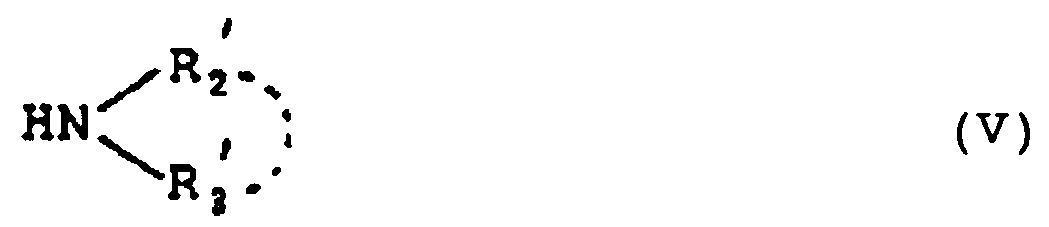
 2) Behandeln einer wie vorstehend definierten Verbindung der Formel (Ia') mit einer Säure oder einer Base unter Erhalten einer Verbindung der Formel
 3) Reduzieren einer wie vorstehend definierten Verbindung der Formel (Ia') unter Erhalten einer Verbindung der Formel
 4) Behandeln einer wie vorstehend definierten Verbindung der Formel (Ic') mit einer Säure oder einer Base oder Reduzieren einer wie vorstehend definierten Verbindung der Formel (Ib') unter Erhalten einer Verbindung der Formel
 5) Reduzieren einer wie vorstehend definierten Verbindung der Formel (Ia') oder (Ic') unter Erhalten einer Verbindung der Formel
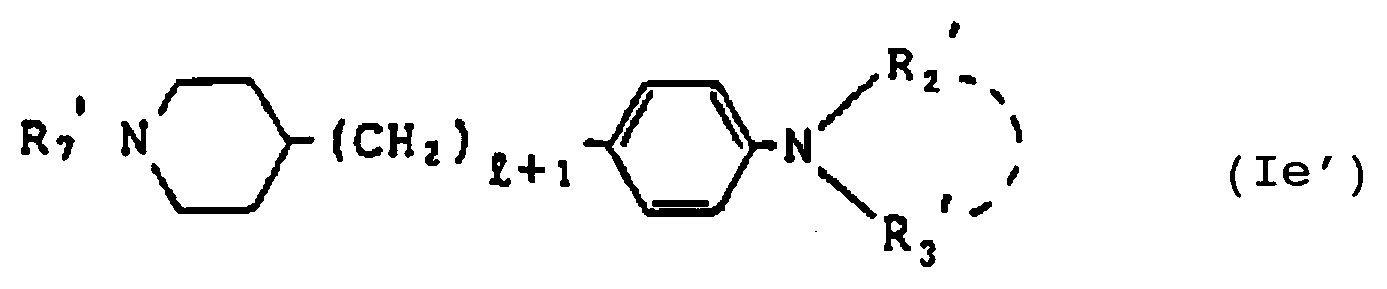 6) Behandeln einer wie vorstehend definierten Verbindung der Formel (Ie') mit einer Säure oder einer Base unter Erhalten einer Verbindung der Formel
 7) Umsetzen einer wie vorstehend in 2) beziehungsweise 4) definierten Verbindung der Formel (Ib'), (Id') oder (If') mit einer Verbindung der Formel
R₁''X (IX)
worin R₁'' und X wie vorstehend definiert sind, unter Erhalten einer Verbindung der Formel
- Zusammensetzung zur Verwendung beim Behandeln eines Gehirnödems und/oder eines akuten Symptoms eines Gehirnschlages, gekennzeichnet durch das Enthalten einer Verbindung des Anspruchs 4.
- Zusammensetzung zur Verwendung beim Schützen von Gehirn- und Nervenzellen, gekennzeichnet durch das Enthalten einer Verbindung des Anspruchs 4.
- Zusammensetzung zur Verwendung beim Hemmen von Cholinesterase, gekennzeichnet durch das Enthalten einer Verbindung des Anspruchs 3.
- Zusammensetzung zur Verwendung beim Verbessern der Gehirnfunktion, gekennzeichnet durch das Enthalten einer Verbindung des Anspruchs 3.
- Zusammensetzung zur Verwendung beim Behandeln von Störungen der Mikrozirkulation im Gehirn, gekennzeichnet durch das Enthalten einer Verbindung des Anspruchs 4.
Priority Applications (1)
| Application Number | Priority Date | Filing Date | Title |
|---|---|---|---|
| AT90100473T ATE94870T1 (de) | 1989-01-13 | 1990-01-11 | Cyclische aminverbindungen und ihre verwendung. |
Applications Claiming Priority (6)
| Application Number | Priority Date | Filing Date | Title |
|---|---|---|---|
| JP6651/89 | 1989-01-13 | ||
| JP665189 | 1989-01-13 | ||
| JP179495/89 | 1989-07-12 | ||
| JP17949589 | 1989-07-12 | ||
| JP25316289 | 1989-09-28 | ||
| JP253162/89 | 1989-09-28 |
Publications (2)
| Publication Number | Publication Date |
|---|---|
| EP0378207A1 EP0378207A1 (de) | 1990-07-18 |
| EP0378207B1 true EP0378207B1 (de) | 1993-09-22 |
Family
ID=27277264
Family Applications (1)
| Application Number | Title | Priority Date | Filing Date |
|---|---|---|---|
| EP90100473A Expired - Lifetime EP0378207B1 (de) | 1989-01-13 | 1990-01-11 | Cyclische Aminverbindungen und ihre Verwendung |
Country Status (11)
| Country | Link |
|---|---|
| US (3) | US5177087A (de) |
| EP (1) | EP0378207B1 (de) |
| JP (1) | JP2969359B2 (de) |
| KR (1) | KR900011756A (de) |
| AU (1) | AU618870B2 (de) |
| CA (1) | CA2007553A1 (de) |
| DE (1) | DE69003397T2 (de) |
| HU (1) | HUT53079A (de) |
| IE (1) | IE63302B1 (de) |
| NO (1) | NO900174L (de) |
| NZ (1) | NZ232084A (de) |
Cited By (2)
| Publication number | Priority date | Publication date | Assignee | Title |
|---|---|---|---|---|
| RU2470017C2 (ru) * | 2007-06-08 | 2012-12-20 | Янссен Фармацевтика Н.В. | Производные пиперидина/пиперазина |
| US11891369B2 (en) | 2016-02-23 | 2024-02-06 | Srx Cardio, Llc | Compounds for binding proprotein convertase subtilisin/kexin type 9 |
Families Citing this family (36)
| Publication number | Priority date | Publication date | Assignee | Title |
|---|---|---|---|---|
| NZ236501A (en) * | 1989-12-21 | 1992-12-23 | Merrell Dow Pharma | Piperidine derivatives and antithrombotic compositions |
| US5292752A (en) * | 1989-12-21 | 1994-03-08 | Merrell Dow Pharmaceuticals Inc. | Antithrombotic compounds |
| US5580883A (en) * | 1990-03-26 | 1996-12-03 | Takeda Chemical Industries, Ltd. | Aminobenzene compounds to prevent nerve cell degradation |
| JP3280040B2 (ja) * | 1990-03-26 | 2002-04-30 | 武田薬品工業株式会社 | アミノベンゼン化合物 |
| US5116846A (en) * | 1990-03-28 | 1992-05-26 | Du Pont Merck Pharmaceutical Company | N-aralkyl piperidine derivatives as psychotropic drugs |
| TW197435B (de) * | 1990-11-22 | 1993-01-01 | Takeda Pharm Industry Co Ltd | |
| US5750542A (en) | 1993-09-28 | 1998-05-12 | Pfizer | Benzisoxazole and benzisothizole derivatives as cholinesterase inhibitors |
| US5106856A (en) * | 1991-06-07 | 1992-04-21 | Hoechst-Roussel Pharmaceuticals Inc. | [(Arylalkylpiperidin-4-yl)methyl]-2a,3,4,5-tetrahydro-1(2H)-acenaphthylen-1-ones and related compounds |
| EP0524846A1 (de) * | 1991-06-27 | 1993-01-27 | Synthelabo | 2-(Piperidin-1-yl)ethanolderivate, ihre Herstellung und ihre Anwendung in der Therapie |
| FR2678265B1 (fr) * | 1991-06-27 | 1994-01-14 | Synthelabo | Derives de 4-(2-phenylethyl)piperidine, leur preparation et leur application en therapeutique. |
| TW263504B (de) * | 1991-10-03 | 1995-11-21 | Pfizer | |
| US5462934A (en) * | 1992-03-09 | 1995-10-31 | Takeda Chemical Industries | Condensed heterocyclic ketone derivatives and their use |
| US5208343A (en) * | 1992-03-24 | 1993-05-04 | Warner-Lambert Company | Tetrahydropyridine oxime compounds |
| EP0567090B1 (de) * | 1992-04-24 | 2000-07-26 | Takeda Chemical Industries, Ltd. | Benzoxazepin-Derivate als Cholinesterase-Inhibitoren |
| AU4566093A (en) * | 1992-07-08 | 1994-01-31 | Shell Internationale Research Maatschappij B.V. | Piperidine derivatives |
| DK0664291T3 (da) * | 1992-10-05 | 2000-10-30 | Ube Industries | Pyrimidinforbindelse |
| US5620973A (en) * | 1993-11-30 | 1997-04-15 | Takeda Chemical Industries, Ltd. | Tetracyclic condensed heterocyclic compounds and their use |
| EP0801650A4 (de) * | 1994-12-22 | 1998-05-06 | Smithkline Beecham Corp | Fibrinogenrezeptor-antagonisten |
| US5795985A (en) * | 1996-03-05 | 1998-08-18 | Ciba Specialty Chemicals Corporation | Phenyl alkyl ketone substituted by cyclic amine and a process for the preparation thereof |
| EP0934941A1 (de) | 1996-08-09 | 1999-08-11 | Eisai Co., Ltd. | Benzopiperdinderivate |
| EP0975624A1 (de) | 1997-04-17 | 2000-02-02 | Takeda Chemical Industries, Ltd. | Thermogenic zusammensetzungen und benzazepin thermogenika |
| US6339096B1 (en) * | 1998-01-29 | 2002-01-15 | Boehringer Ingelheim Pharma Kg | Urethanes derived from azacycloalkanes, the thio and dithio analogues thereof and their use as cholesterol biosynthesis inhibitors |
| CN1535682A (zh) | 1998-09-30 | 2004-10-13 | ����ҩƷ��ҵ��ʽ���� | 改善膀胱排泄能力的药物 |
| WO2000032199A1 (de) * | 1998-12-01 | 2000-06-08 | Sanochemia Pharmazeutika Aktiengesellschaft | Verwendung von galanthamin und galanthaminderivaten bei akuten funktionellen hirnschäden |
| GB0326029D0 (en) * | 2003-11-07 | 2003-12-10 | Astrazeneca Ab | Chemical compounds |
| EP1948629A1 (de) * | 2005-10-31 | 2008-07-30 | Janssen Pharmaceutica N.V. | Substituierte piperazine und piperidine als modulatoren des neuropeptid-y2-rezeptors |
| CA2687918C (en) | 2007-06-08 | 2016-11-08 | Janssen Pharmaceutica N.V. | Piperidine/piperazine derivatives |
| AU2008258549B2 (en) | 2007-06-08 | 2013-11-14 | Janssen Pharmaceutica N.V. | Piperidine/piperazine derivatives |
| JO2972B1 (en) | 2007-06-08 | 2016-03-15 | جانسين فارماسوتيكا ان. في | Piperidine / piperazine derivatives |
| WO2009006185A1 (en) * | 2007-07-03 | 2009-01-08 | Janssen Pharmaceutica, N.V. | Piperazinyl derivatives useful as modulators of the neuropeptide y2 receptor |
| PE20140572A1 (es) | 2008-06-05 | 2014-05-16 | Janssen Pharmaceutica Nv | Combinaciones de drogas que comprenden un inhibidor de dgat y un agonista de ppar |
| MX2012004078A (es) * | 2009-10-09 | 2012-07-25 | Irm Llc | Compuestos y composiciones como moduladores de la actividad de gpr119. |
| US10865185B2 (en) | 2015-08-21 | 2020-12-15 | Srx Cardio, Llc | Composition and methods of use of tetrahydroisoquinoline small molecules to bind and modulate PCSK9 protein activity |
| US10821106B2 (en) | 2015-08-21 | 2020-11-03 | Srx Cardio, Llc | Composition and methods of use of novel phenylalanine small organic compounds to directly modulate PCSK9 protein activity |
| EP3337788A4 (de) | 2015-08-21 | 2019-03-27 | Portola Pharmaceuticals, Inc. | Phenylpiperazin-proprotein-konvertase-subtilisin/-kexin typ 9 p(csk9)-modulatoren und deren verwendung |
| US12115154B2 (en) | 2020-12-16 | 2024-10-15 | Srx Cardio, Llc | Compounds for the modulation of proprotein convertase subtilisin/kexin type 9 (PCSK9) |
Family Cites Families (12)
| Publication number | Priority date | Publication date | Assignee | Title |
|---|---|---|---|---|
| FR12643E (fr) * | 1909-11-22 | 1910-10-20 | Albert Louis Chodorowski | Procédé de régénération du caoutchouc manufacturé |
| US2686784A (en) * | 1950-07-15 | 1954-08-17 | Hoffmann La Roche | Piperidine derivatives |
| US3632767A (en) * | 1968-02-12 | 1972-01-04 | Mallinckrodt Chemical Works | Treatment of depression with 4-substituted piperidines |
| US3931195A (en) * | 1971-03-03 | 1976-01-06 | Mead Johnson & Company | Substituted piperidines |
| BE764238A (fr) * | 1971-03-17 | 1971-09-13 | Lilly Industries Ltd | Derives de phenylalkylamine |
| US3927011A (en) * | 1973-05-10 | 1975-12-16 | Yoshitomi Pharmaceutical | 2-Aminoalkyl-1-(pyridylcarbonylphenyl)imidazole compounds |
| FR2443246A1 (fr) * | 1978-12-05 | 1980-07-04 | Pharmindustrie | Nouveaux medicaments a base de derives de la phenyl-1 (piperidyl-4)-3 propanone-1 |
| CA1280421C (en) * | 1985-07-02 | 1991-02-19 | Albert A. Carr | 1,4-disubstituted piperidinyl derivatives |
| DK623586A (da) * | 1985-12-27 | 1987-06-28 | Eisai Co Ltd | Piperidinderivater eller salte deraf og farmaceutiske kompositioner indeholdende forbindelserne |
| FI95572C (fi) * | 1987-06-22 | 1996-02-26 | Eisai Co Ltd | Menetelmä lääkeaineena käyttökelpoisen piperidiinijohdannaisten tai sen farmaseuttisen suolan valmistamiseksi |
| US5093341A (en) * | 1987-12-17 | 1992-03-03 | Merrell Dow Pharmaceuticals Inc. | N-aralkyl piperidine derivatives useful as antithrombolytic agents |
| US4868194A (en) * | 1988-09-23 | 1989-09-19 | Merrell Dow Pharmaceuticals Inc. | Imidazole antiarrhythmics |
-
1989
- 1989-12-22 JP JP1333719A patent/JP2969359B2/ja not_active Expired - Fee Related
-
1990
- 1990-01-04 US US07/461,114 patent/US5177087A/en not_active Expired - Fee Related
- 1990-01-11 NZ NZ232084A patent/NZ232084A/xx unknown
- 1990-01-11 DE DE90100473T patent/DE69003397T2/de not_active Expired - Fee Related
- 1990-01-11 CA CA002007553A patent/CA2007553A1/en not_active Abandoned
- 1990-01-11 AU AU47911/90A patent/AU618870B2/en not_active Ceased
- 1990-01-11 EP EP90100473A patent/EP0378207B1/de not_active Expired - Lifetime
- 1990-01-12 IE IE14290A patent/IE63302B1/en not_active IP Right Cessation
- 1990-01-12 HU HU90118A patent/HUT53079A/hu unknown
- 1990-01-12 NO NO90900174A patent/NO900174L/no unknown
- 1990-01-13 KR KR1019900000395A patent/KR900011756A/ko not_active Abandoned
-
1992
- 1992-12-18 US US07/964,851 patent/US5294625A/en not_active Expired - Fee Related
-
1993
- 1993-12-22 US US08/171,163 patent/US5441967A/en not_active Expired - Fee Related
Cited By (2)
| Publication number | Priority date | Publication date | Assignee | Title |
|---|---|---|---|---|
| RU2470017C2 (ru) * | 2007-06-08 | 2012-12-20 | Янссен Фармацевтика Н.В. | Производные пиперидина/пиперазина |
| US11891369B2 (en) | 2016-02-23 | 2024-02-06 | Srx Cardio, Llc | Compounds for binding proprotein convertase subtilisin/kexin type 9 |
Also Published As
| Publication number | Publication date |
|---|---|
| JP2969359B2 (ja) | 1999-11-02 |
| NO900174D0 (no) | 1990-01-12 |
| NO900174L (no) | 1990-07-16 |
| IE900142L (en) | 1990-07-13 |
| US5294625A (en) | 1994-03-15 |
| EP0378207A1 (de) | 1990-07-18 |
| IE63302B1 (en) | 1995-04-05 |
| DE69003397D1 (de) | 1993-10-28 |
| US5177087A (en) | 1993-01-05 |
| KR900011756A (ko) | 1990-08-02 |
| HUT53079A (en) | 1990-09-28 |
| HU900118D0 (en) | 1990-03-28 |
| US5441967A (en) | 1995-08-15 |
| AU4791190A (en) | 1990-08-09 |
| NZ232084A (en) | 1991-08-27 |
| JPH03173867A (ja) | 1991-07-29 |
| DE69003397T2 (de) | 1994-01-20 |
| AU618870B2 (en) | 1992-01-09 |
| CA2007553A1 (en) | 1990-07-13 |
Similar Documents
| Publication | Publication Date | Title |
|---|---|---|
| EP0378207B1 (de) | Cyclische Aminverbindungen und ihre Verwendung | |
| US3956296A (en) | 1-Substituted-4-benzylpiperidines | |
| US4001263A (en) | 5-Aryl-1,2,3,4-tetrahydro-γ-carbolines | |
| EP0296560B1 (de) | 1,4-Substituierte Piperidine als Acetylcholinesterase Inhibitoren und ihre Verwendung zur Behandlung von Alzheimer's Erkrankung | |
| US5622951A (en) | Piperazine derivatives as 5-HT antagonists | |
| EA007225B1 (ru) | Производные n-[фенил(пиперидин-2-ил)метил]бензамида и их применение в терапии | |
| US4072686A (en) | 1-(3,3,3-Triarylalkyl)-4-phenyl-piperidinealkanols | |
| NO754179L (de) | ||
| HU194208B (en) | Process for preparing piperidine derivatives and pharmaceuticals comprising these compounds | |
| US4147872A (en) | 3-[2-Hydroxy-4-(substituted)-phenyl]azacycloalkanes and derivatives thereof as analgesic agents and intermediates therefor | |
| US4292321A (en) | 1,3,8-Triazaspirodecane-4-ones, pharmaceutical compositions thereof and method of use thereof | |
| EP0275696A1 (de) | Piperidinderivate | |
| US4263438A (en) | 3-[2,4-(Disubstituted)-phenyl]azacycloalkanones as analgesics | |
| US4032642A (en) | 1-Substituted-4-benzylpiperidines | |
| US5760035A (en) | Therapeutic agents | |
| CA1086742A (en) | Preparation of 1-substituted-4-aroyl-4-hydroxy and -4- acyloxypiperidines | |
| US4650874A (en) | N-(aralkoxybenzyl)-4(benzhydryl) piperidines | |
| US4994617A (en) | Aminoalcohols, their preparation process and their applications, particularly in therapeutics | |
| US4411904A (en) | Diphenylpropanamines, compositions thereof and use thereof | |
| EP0508988A1 (de) | Muscarin-rezeptor-antagonisten. | |
| US4304911A (en) | Benzoylphenyl lower alkanoyl piperidines | |
| US4339576A (en) | Anti-asthmatic, anti-allergic, anti-cholinergic, bronchodilator and anti-inflammatory 1-[(benzoylphenyl)-lower-alkyl]piperidines and analogs thereof | |
| EP0052311A1 (de) | 1-(Benzoylphenyl-niederalkyl)-piperidine und entsprechende Carbinole und ihre Herstellung | |
| RU2021989C1 (ru) | Циклическое аминосоединение или его физиологически приемлемая аддитивная соль кислоты | |
| US5057524A (en) | 4-[diaryl)hydroxymethyl]-1-piperidinealkylcarboxylic acids, salts and esters useful in the treatment of allergic disorders |
Legal Events
| Date | Code | Title | Description |
|---|---|---|---|
| PUAI | Public reference made under article 153(3) epc to a published international application that has entered the european phase |
Free format text: ORIGINAL CODE: 0009012 |
|
| AK | Designated contracting states |
Kind code of ref document: A1 Designated state(s): AT BE CH DE DK ES FR GB GR IT LI LU NL SE |
|
| 17P | Request for examination filed |
Effective date: 19900914 |
|
| 17Q | First examination report despatched |
Effective date: 19920211 |
|
| RAP3 | Party data changed (applicant data changed or rights of an application transferred) |
Owner name: TAKEDA CHEMICAL INDUSTRIES, LTD. |
|
| GRAA | (expected) grant |
Free format text: ORIGINAL CODE: 0009210 |
|
| AK | Designated contracting states |
Kind code of ref document: B1 Designated state(s): AT BE CH DE DK ES FR GB GR IT LI LU NL SE |
|
| PG25 | Lapsed in a contracting state [announced via postgrant information from national office to epo] |
Ref country code: SE Effective date: 19930922 Ref country code: NL Effective date: 19930922 Ref country code: GR Free format text: LAPSE BECAUSE OF FAILURE TO SUBMIT A TRANSLATION OF THE DESCRIPTION OR TO PAY THE FEE WITHIN THE PRESCRIBED TIME-LIMIT Effective date: 19930922 Ref country code: ES Free format text: THE PATENT HAS BEEN ANNULLED BY A DECISION OF A NATIONAL AUTHORITY Effective date: 19930922 Ref country code: DK Effective date: 19930922 Ref country code: BE Effective date: 19930922 Ref country code: AT Effective date: 19930922 |
|
| REF | Corresponds to: |
Ref document number: 94870 Country of ref document: AT Date of ref document: 19931015 Kind code of ref document: T |
|
| REF | Corresponds to: |
Ref document number: 69003397 Country of ref document: DE Date of ref document: 19931028 |
|
| ITF | It: translation for a ep patent filed | ||
| ET | Fr: translation filed | ||
| PG25 | Lapsed in a contracting state [announced via postgrant information from national office to epo] |
Ref country code: LU Free format text: LAPSE BECAUSE OF NON-PAYMENT OF DUE FEES Effective date: 19940131 |
|
| NLV1 | Nl: lapsed or annulled due to failure to fulfill the requirements of art. 29p and 29m of the patents act | ||
| PLBE | No opposition filed within time limit |
Free format text: ORIGINAL CODE: 0009261 |
|
| STAA | Information on the status of an ep patent application or granted ep patent |
Free format text: STATUS: NO OPPOSITION FILED WITHIN TIME LIMIT |
|
| 26N | No opposition filed | ||
| PGFP | Annual fee paid to national office [announced via postgrant information from national office to epo] |
Ref country code: FR Payment date: 19971127 Year of fee payment: 9 |
|
| PGFP | Annual fee paid to national office [announced via postgrant information from national office to epo] |
Ref country code: DE Payment date: 19971222 Year of fee payment: 9 |
|
| PGFP | Annual fee paid to national office [announced via postgrant information from national office to epo] |
Ref country code: GB Payment date: 19980102 Year of fee payment: 9 |
|
| PGFP | Annual fee paid to national office [announced via postgrant information from national office to epo] |
Ref country code: CH Payment date: 19980119 Year of fee payment: 9 |
|
| PG25 | Lapsed in a contracting state [announced via postgrant information from national office to epo] |
Ref country code: GB Free format text: LAPSE BECAUSE OF NON-PAYMENT OF DUE FEES Effective date: 19990111 |
|
| PG25 | Lapsed in a contracting state [announced via postgrant information from national office to epo] |
Ref country code: LI Free format text: LAPSE BECAUSE OF NON-PAYMENT OF DUE FEES Effective date: 19990131 Ref country code: CH Free format text: LAPSE BECAUSE OF NON-PAYMENT OF DUE FEES Effective date: 19990131 |
|
| GBPC | Gb: european patent ceased through non-payment of renewal fee |
Effective date: 19990111 |
|
| REG | Reference to a national code |
Ref country code: CH Ref legal event code: PL |
|
| PG25 | Lapsed in a contracting state [announced via postgrant information from national office to epo] |
Ref country code: FR Free format text: LAPSE BECAUSE OF NON-PAYMENT OF DUE FEES Effective date: 19990930 |
|
| PG25 | Lapsed in a contracting state [announced via postgrant information from national office to epo] |
Ref country code: DE Free format text: LAPSE BECAUSE OF NON-PAYMENT OF DUE FEES Effective date: 19991103 |
|
| REG | Reference to a national code |
Ref country code: FR Ref legal event code: ST |
|
| PG25 | Lapsed in a contracting state [announced via postgrant information from national office to epo] |
Ref country code: IT Free format text: LAPSE BECAUSE OF NON-PAYMENT OF DUE FEES;WARNING: LAPSES OF ITALIAN PATENTS WITH EFFECTIVE DATE BEFORE 2007 MAY HAVE OCCURRED AT ANY TIME BEFORE 2007. THE CORRECT EFFECTIVE DATE MAY BE DIFFERENT FROM THE ONE RECORDED. Effective date: 20050111 |