EP0377688B1 - Method for forming a chewing-gum into a rolled tape - Google Patents
Method for forming a chewing-gum into a rolled tape Download PDFInfo
- Publication number
- EP0377688B1 EP0377688B1 EP89904920A EP89904920A EP0377688B1 EP 0377688 B1 EP0377688 B1 EP 0377688B1 EP 89904920 A EP89904920 A EP 89904920A EP 89904920 A EP89904920 A EP 89904920A EP 0377688 B1 EP0377688 B1 EP 0377688B1
- Authority
- EP
- European Patent Office
- Prior art keywords
- rolled
- sheet
- flat sheet
- leading edge
- rolling
- Prior art date
- Legal status (The legal status is an assumption and is not a legal conclusion. Google has not performed a legal analysis and makes no representation as to the accuracy of the status listed.)
- Expired - Lifetime
Links
- 238000000034 method Methods 0.000 title claims abstract description 18
- 235000015218 chewing gum Nutrition 0.000 title claims description 41
- 229940112822 chewing gum Drugs 0.000 title claims description 41
- 238000005096 rolling process Methods 0.000 claims description 32
- 238000005520 cutting process Methods 0.000 claims description 7
- 101000801619 Homo sapiens Long-chain-fatty-acid-CoA ligase ACSBG1 Proteins 0.000 abstract description 13
- 102100033564 Long-chain-fatty-acid-CoA ligase ACSBG1 Human genes 0.000 abstract description 13
- 235000010634 bubble gum Nutrition 0.000 abstract description 13
- 238000000926 separation method Methods 0.000 abstract 1
- 238000010410 dusting Methods 0.000 description 4
- 238000009472 formulation Methods 0.000 description 4
- 239000000203 mixture Substances 0.000 description 4
- 238000004519 manufacturing process Methods 0.000 description 3
- 235000014594 pastries Nutrition 0.000 description 3
- PEDCQBHIVMGVHV-UHFFFAOYSA-N Glycerine Chemical compound OCC(O)CO PEDCQBHIVMGVHV-UHFFFAOYSA-N 0.000 description 2
- 238000012986 modification Methods 0.000 description 2
- 230000004048 modification Effects 0.000 description 2
- 238000004806 packaging method and process Methods 0.000 description 2
- IIZPXYDJLKNOIY-JXPKJXOSSA-N 1-palmitoyl-2-arachidonoyl-sn-glycero-3-phosphocholine Chemical compound CCCCCCCCCCCCCCCC(=O)OC[C@H](COP([O-])(=O)OCC[N+](C)(C)C)OC(=O)CCC\C=C/C\C=C/C\C=C/C\C=C/CCCCC IIZPXYDJLKNOIY-JXPKJXOSSA-N 0.000 description 1
- 229920000298 Cellophane Polymers 0.000 description 1
- 241000723347 Cinnamomum Species 0.000 description 1
- WQZGKKKJIJFFOK-GASJEMHNSA-N Glucose Natural products OC[C@H]1OC(O)[C@H](O)[C@@H](O)[C@@H]1O WQZGKKKJIJFFOK-GASJEMHNSA-N 0.000 description 1
- 235000006679 Mentha X verticillata Nutrition 0.000 description 1
- 235000002899 Mentha suaveolens Nutrition 0.000 description 1
- 235000001636 Mentha x rotundifolia Nutrition 0.000 description 1
- 241001522316 Pyrrhula pyrrhula Species 0.000 description 1
- 229920002472 Starch Polymers 0.000 description 1
- 239000004809 Teflon Substances 0.000 description 1
- 229920006362 Teflon® Polymers 0.000 description 1
- 235000019506 cigar Nutrition 0.000 description 1
- 235000017803 cinnamon Nutrition 0.000 description 1
- 150000001875 compounds Chemical class 0.000 description 1
- 230000000694 effects Effects 0.000 description 1
- 239000000796 flavoring agent Substances 0.000 description 1
- 235000019634 flavors Nutrition 0.000 description 1
- 235000013305 food Nutrition 0.000 description 1
- 239000008103 glucose Substances 0.000 description 1
- 235000011187 glycerol Nutrition 0.000 description 1
- 238000007373 indentation Methods 0.000 description 1
- 235000010445 lecithin Nutrition 0.000 description 1
- 229940067606 lecithin Drugs 0.000 description 1
- 239000000787 lecithin Substances 0.000 description 1
- 229920003023 plastic Polymers 0.000 description 1
- 239000004033 plastic Substances 0.000 description 1
- 229920002635 polyurethane Polymers 0.000 description 1
- 239000004814 polyurethane Substances 0.000 description 1
- 235000019698 starch Nutrition 0.000 description 1
- 239000008107 starch Substances 0.000 description 1
Images


Classifications
-
- A—HUMAN NECESSITIES
- A23—FOODS OR FOODSTUFFS; TREATMENT THEREOF, NOT COVERED BY OTHER CLASSES
- A23G—COCOA; COCOA PRODUCTS, e.g. CHOCOLATE; SUBSTITUTES FOR COCOA OR COCOA PRODUCTS; CONFECTIONERY; CHEWING GUM; ICE-CREAM; PREPARATION THEREOF
- A23G4/00—Chewing gum
- A23G4/02—Apparatus specially adapted for manufacture or treatment of chewing gum
- A23G4/04—Apparatus specially adapted for manufacture or treatment of chewing gum for moulding or shaping
-
- A—HUMAN NECESSITIES
- A21—BAKING; EDIBLE DOUGHS
- A21C—MACHINES OR EQUIPMENT FOR MAKING OR PROCESSING DOUGHS; HANDLING BAKED ARTICLES MADE FROM DOUGH
- A21C3/00—Machines or apparatus for shaping batches of dough before subdivision
- A21C3/06—Machines for coiling sheets of dough, e.g. for producing rolls
-
- A—HUMAN NECESSITIES
- A23—FOODS OR FOODSTUFFS; TREATMENT THEREOF, NOT COVERED BY OTHER CLASSES
- A23G—COCOA; COCOA PRODUCTS, e.g. CHOCOLATE; SUBSTITUTES FOR COCOA OR COCOA PRODUCTS; CONFECTIONERY; CHEWING GUM; ICE-CREAM; PREPARATION THEREOF
- A23G3/00—Sweetmeats; Confectionery; Marzipan; Coated or filled products
- A23G3/02—Apparatus specially adapted for manufacture or treatment of sweetmeats or confectionery; Accessories therefor
- A23G3/0236—Shaping of liquid, paste, powder; Manufacture of moulded articles, e.g. modelling, moulding, calendering
-
- A—HUMAN NECESSITIES
- A23—FOODS OR FOODSTUFFS; TREATMENT THEREOF, NOT COVERED BY OTHER CLASSES
- A23P—SHAPING OR WORKING OF FOODSTUFFS, NOT FULLY COVERED BY A SINGLE OTHER SUBCLASS
- A23P20/00—Coating of foodstuffs; Coatings therefor; Making laminated, multi-layered, stuffed or hollow foodstuffs
- A23P20/20—Making of laminated, multi-layered, stuffed or hollow foodstuffs, e.g. by wrapping in preformed edible dough sheets or in edible food containers
-
- A—HUMAN NECESSITIES
- A23—FOODS OR FOODSTUFFS; TREATMENT THEREOF, NOT COVERED BY OTHER CLASSES
- A23P—SHAPING OR WORKING OF FOODSTUFFS, NOT FULLY COVERED BY A SINGLE OTHER SUBCLASS
- A23P20/00—Coating of foodstuffs; Coatings therefor; Making laminated, multi-layered, stuffed or hollow foodstuffs
- A23P20/20—Making of laminated, multi-layered, stuffed or hollow foodstuffs, e.g. by wrapping in preformed edible dough sheets or in edible food containers
- A23P20/25—Filling or stuffing cored food pieces, e.g. combined with coring or making cavities
- A23P2020/253—Coating food items by printing onto them; Printing layers of food products
Definitions
- the present invention relates to the field of chewing gum. More particularly; the invention relates to the field of chewing gum which have boon formed into special shapes.
- Confectionary products have been molded, extruded or otherwise shaped into various forms over the years.
- bubble gum has been formed into shapes such as flat sticks, cylinders, cubes, cigars, shredded chew, and the like. It is generally known that providing a confectionary product, such as bubble gum, in novelty shapes or forms can lead to enhanced marketability of such a product, particularly with younger consumers.
- One form for a confectionary product that has been previously known to the assignee of the present invention, is that of a rolled up tape. It has been believed that chewing gum or other confectionary products made in the form of a rolled tape would be well-received. In particular, it was thought that chewing gum in the form of a rolled up tape of between 3 and 6 feet in length would give a consumer the chance to break off the desired size of piece to chew, saving the rest for later.
- US-A-3172372 relates to a method and apparatus for the mass production of swiss rolls.
- a strip of baked sponge is coated with filling and supported on a moving conveyor surface.
- the sponge is rolled transversely to the direction of movement of the conveyor by engagement with guide surfaces.
- the apparatus also includes a rotary cutter blade turning the vertical plane perpendicular to the conveying surface so that a clean cut is made by the rotary cutter after completion of rolling.
- the handling of a sheet of sponge of the thickness required for a swiss roll requires different parameters to the handling of a very thin flat sheet of chewing gum.
- US-A-3225717 relates to a method and apparatus for forming a cylinder of pastry dough which can be divided into individual rolls.
- a conveyor moves the sheet of pastry dough past a series of knives which score the sheet of dough along its length and the individual scored and severed sheets are then separated. The separated sheets are then rolled by a series of drums to form a cylinder of dough. Again, the handling requirements for dough are very different from the requirements for handling chewing gum.
- DE-A-2754459 discloses a method and apparatus for forming fancy pastries, especially cakes having layers wound in a spiral.
- the cakes are produced by two guiding surfaces on which the two ends of a cylinder rest.
- the guiding surfaces run parallel to each other and one end of each rests on the work table.
- the apparatus utilizes a curling plate to effect rolling of the flat sheet.
- a method of forming chewing gum into a rolled tape comprising the steps of: providing a mass of chewing gum; forming said mass into a thin, flat, generally rectangular sheet having a leading edge; rolling said flat sheet about said leading edge; and cutting said rolled flat sheet in planes generally perpendicular to said leading edge to thereby produce a plurality of individual pieces of said chewing gum of a predetermined width in the form of rolled tape.
- the present invention has proven advantageous because it has been found to offer a practical means for producing chewing gum in a form which was previously infeasible, i.e. the form of a rolled up tape. It is particularly advantageous to not separate the individual tapes until after the sheet has been rolled up. It has been found to be less difficult to roll up an entire sheet of confectionary product than it is to roll up individual tapes.
- the invention is also advantageous because it can be implemented by making relatively minor modifications to an otherwise conventional chewing gum rolling and scoring machine.
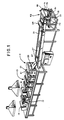
- FIGURE 1 is a perspective view of the most preferred embodiment of the present invention.
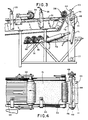
- FIGURE 2 is a side view showing the lateral scoring rollers, the conveyor, and the rolling device of the most preferred embodiment.
- FIGURE 3 is an enlarged side view showing a portion of the conveyor and the rolling drum of the most preferred embodiment.
- FIGURE 4 is a top view of a portion of the conveyor and the rolling drum of the most preferred embodiment.
- FIGURES 5a-d are a series of side views showing the operations of the rotating drum and curling plate as a sheet of bubble gum is rolled around its leading edge.
- FIGURE 6 is a perspective view of a pre-scored, rolled up sheet of bubble gum.
- FIGURE 7 is a perspective view of bubble gum formed into a rolled up tape according to the method of the present invention.
- FIGURE 8 is a perspective view of a preferred package for the product of the present method.
- FIGURE 1 shows the most preferred apparatus of the present invention.
- the apparatus 11 generally comprises means 13 for forming a flat rectangular sheet of chewing gum.
- the flat sheet of chewing-gum is produced by a conventional chewing gum rolling and scoring machine 13 which has been modified in one respect.
- the rolling and scoring machine 13 is one such as that purchased from the Gimpel Manufacturing Company. WLS of West Germany is another company which manufactures a suitable chewing gum rolling and scoring machine. Other machines with the ability to roll or extrude a sheet of chewing-gum can also be used.
- the machine 13 includes an input port 15 into which a mass of the chewing gum is put. It is required that the gum possess sufficient pliability, at least at the time of manufacture, to be formed into a rolled up tape.
- a series of rollers 17 act on the mass of chewing gum to form a relatively thin flat sheet.
- a dusting apparatus 19 is included for dusting the sheet in order to reduce any adhesiveness. Typically, starch is used as the dusting compound.
- the rectangular sheet of chewing gum is preferably scored along lines generally perpendicular to the leading edge before it is rolled up. This longitudinal scoring is accomplished in the same way that it is accomplished in making conventional stick chewing gum. That is, the longitudinal scoring drum 21 engages the sheet of chewing gum as it travels beneath it. Most preferably, the gum is scored longitudinally to a land of about 0.25mm (0.010").
- the means for producing the flat sheet does not score the flat sheet.
- the rolled up sheet is cut into the individual pieces with conventional means such as rotating knives, wires, and the like.
- conventional means such as rotating knives, wires, and the like.
- the outermost blades of the lateral cutting roller 23 are adapted to cut through the sheet to thus trim the sides of the sheet and achieve the desired width for the sheet.
- the width of the sheet is about 247.65mm (9 and 3/4"), and the width between longitudinal scores is about 19.05mm (3/4").
- the sheet will preferably be broken into 13 individual tapes.
- the machine 13 is modified with respect to its lateral scoring operation.
- the lateral scoring drum is designed to score the gum at the desired lengths for individual sticks of gum.
- the lateral cutting rollers 23 are modified so as to score the sheet at much longer intervals, e.g. 1.83 metres (6 feet). Most preferably, this is accomplished by keeping the roller with the lateral blades biased above the flat sheet until the proper time to cut the flat sheet.
- the modification in the lateral scoring increment is accomplished by removing the height adjustment screws which are ordinarily used to adjust the vertical position of the roller 23 with respect to the flat sheet.
- Actuating means such as an air cylinder 25 on each side of the roller, is used to push the roller 23 down at the appropriate time to cut the desired length for the tape.
- the air cylinders are activated at every fourth complete revolution of the lateral cutting roller 23. At this interval, the sheet is scored at 1.83 metres (6 foot) lengths.
- the signal to activate the air cylinders in the depicted embodiment is provided by affixing a protrusion (not shown) to the gear which drives the roller 23.
- the protrusion is adapted to hit a switch.
- the switch is connected to a counter which counts the desired number of revolutions, most preferably 4, and then activates a solenoid valve which, in turn, activates the air cylinders 25.
- the depth of the lateral score is preferably determined by a point on the journal assembly for the roller 23 coming into contact with a stop on each side of the roller.
- the stops as designed for the original machine are at an appropriate height.
- these stops can be replaced by screws or the like to finely adjust the depth of the cut.
- the land left by the lateral score is approximately 0.05mm (0.002").
- the sheet of chewing gum 37 is carried on a conveyor belt 31.
- the conveyor belt 31 is similar to that used conventionally, except that it is required to be long enough to carry the full length of the sheet. In the depicted embodiment which is adapted to make 1.83 metres (6 foot) lengths of tape, the conveyor belt 31 should be at least 2.13 metres (7 feet) long.
- the linear speed of the conveyor belt is intentionally set higher than the linear speed of the sheet coming out of the rollers.
- the linear speed of the sheet is about 27.43 metres (90 feet) per minute as it exits the rollers, while the linear speed of the conveyor is about 39.62 metres (130 feet) per minute.
- the breaking brush is a freely-rotating, cylindrical brush which exerts sufficient downward force on the sheet so that the sheet at that point is positively engaged with the belt 31 below. When this happens, the sheet is pulled at the same speed as the conveyor and the sheet is thus broken at the lateral score line to thereby separate the sheet into the desired length for the rolled up tape.
- the rotating drum is mounted on an arm 75 which pivots about the point 77.
- a double-acting air cylinder 73 moves the rotating drum between a rolling position, as shown in FIGURES 1, 4, and 5a-5d, and an exit position.
- the air cylinder 73 is activated into the rolling position by receiving a signal generated by proximity switch 33, which detects the leading edge 36 of the sheet passing under it.
- the air cylinder is moved to the exit position in response to a signal generated after a specified time, measured by a timer (not shown) has elapsed.
- the rotating drum is driven by a motor and chain (not shown) preferably between about 240 and about 300 r.p.m.
- the surface of the rotating drum is preferably polyurethane which has been roughened to increase the friction between the drum and the sheet to be rolled.
- the diameter of the rotating drum is about 111.1mm (4.315").
- a curling plate 43 which is mounted on an arm 46.
- the arm 46 pivots about the axle 48 for the rotating drum 41.
- the double-acting air cylinder 71 moves the curling plate between a curling position as shown in FIGURES 1, 4, 5a and 5b, and a non-engaged position as shown in FIGURES 5c and 5d.
- the air cylinder 71 is activated into the curling position by receiving a signal generated by the proximity switch 35, which detects the leading edge of the sheet passing under it.
- the air cylinder 71 is moved to the non-engaged position in response to a signal generated after a specified time, measured by a timer (also not shown) has elapsed.
- the curling plate 43 comprises a block of teflon 44 with a groove cut in its length.
- the groove has a radius of 9.53mm (0.375").
- the lowest point on the curling plate 43 is about 9.53mm (0.375") above the highest point on the conveyor 31.
- FIGURES 5a-5d will now be used to explain the operation of the preferred rolling means for the present invention.
- FIGURE 5a shows the rotating drum 41 and the curling plate 43 in place to begin rolling the sheet 37 about its leading edge 36.
- the leading edge is propelled by the conveyor 31 into contact with the rotating drum 41, the leading edge is moved upward.
- the leading edge contacts the curved surface on the curling plate 43, it is moved in the direction opposite that of the conveyor 31.
- FIGURE 5a and 5b as the conveyor and rotating drum continue to push the sheet, the sheet is rolled about the leading edge 36.
- the curling plate 43 is moved into the non-engaged position. This is important because the rolled up sheet will eventually have a diameter larger than would fit between the conveyor and the curling plate. Most preferably, the curling plate is moved back after 0.2 seconds, typically the time for the sheet to be wrapped 3 or 4 revolutions.
- each 1.83 metres (6 foot) sheet is wound with about 17 revolutions.
- sheets of a shorter length would be wound with fewer revolutions.
- the rolling of each sheet takes less than 2.75 seconds to be completed.
- the rolling step of the present invention comprises rolling said flat sheet (37) about a spindle which spindle is removed after the rolling step.
- the rotating drum is pulled back into the exit position whereupon the completed roll 38 is allowed to drop between the end of the conveyor and the drum to the tray 81 below.
- the tray is set at an angle so that the completed rolls can roll away from the point where they first fall. As such, several rolls can be collected on a tray. Once the tray is filled, it is removed and another tray is inserted to receive more falling rolls.
- FIGURE 6 shows a completed roll 38. As shown, the sheet in the roll is prescored along lines 42. It has been found that, when the sheet has been prescored in this way, the individual pieces of the chewing gum are easily separated. Presently, it is preferred to pull the individual pieces of the roll apart manually. Alternatively, apparatus may be designed to perform this task.
- FIGURE 7 shows an individual piece 39 of chewing gum made according to the invention in the form of a rolled up tape.
- this tape is between about 1 and about 3.65 metres (12 feet) long, more preferably is between about 1.83 metres (6') and about 1.88 metres (6'2") long, most preferably, 1.83 metres (6 feet) long.
- the flat sheet is scored laterally only to cut the sheet to the desired length.
- the flat sheet is also scored laterally so as to aid the consumer in breaking off predetermined lengths of the chewing gum.
- the sheet could be scored at lengths from 25.4 to 101.6mm (1 to 4"). Naturally, such additional lateral scoring would be at depths shallower than that of the main lateral score which is used to separate individual flat sheets.
- the width of the piece 39 is preferably the same as that for a conventional stick of chewing gum, i.e. about 19.05mm (0.75"). Alternatively, the width can vary between about 6.35mm (0.25") and about 50.8mm (2").
- a food grade dye or the like is used to print on the chewing gum before it is rolled up.
- printing means can be provided between the rolling and scoring machine 13 and the rolling apparatus.
- Such printing means can, for example, be used to print measuring indicia such as found on a measuring tape.
- Other types of novelty designs can also be printed.
- designs or indicia can be effected on the flat sheet by indentation.
- a plate or wheel can be used to impress a design into the flat sheet of chewing gum before it is rolled up.
- FIGURE 8 shows a preferred package for the chewing gum of the present invention.
- the package comprises a relatively flat cylindrical cup 91 with a lid 93.
- other forms of packaging can be used, such as a more sophisticated plastic dispenser, a fin-sealed cellophane package, or a small box.
- the chewing gum to be formed into a rolled up tape is a bubble gum product.
- the specific formulation of the bubble gum is critical to the performance of the present method.
- the bubble gum formulation should allow for sufficient flexibility and pliability for the sheet of bubble gum to be rolled up.
- the formulation for the bubble gum including the amount and type of dusting, should be selected so as to avoid adhesion of the bubble gum to itself during rolling, packaging, or storing of the product.
- An example of a preferred bubble gum formulation is as follows: (percentages are percent by weight) Gum Base 20 % Powdered Sugar 67.5 % Glucose 8 % Glycerin 3 % Flavor 1 % Lecithin 0.5 %
- the chewing gum can be a mint flavored, or cinnamon flavored gum.
Landscapes
- Life Sciences & Earth Sciences (AREA)
- Engineering & Computer Science (AREA)
- Food Science & Technology (AREA)
- Chemical & Material Sciences (AREA)
- Polymers & Plastics (AREA)
- Confectionery (AREA)
- Manufacturing And Processing Devices For Dough (AREA)
- Formation And Processing Of Food Products (AREA)
- Bakery Products And Manufacturing Methods Therefor (AREA)
Abstract
Description
- The present invention relates to the field of chewing gum. More particularly; the invention relates to the field of chewing gum which have boon formed into special shapes.
- Confectionary products have been molded, extruded or otherwise shaped into various forms over the years. For example, bubble gum has been formed into shapes such as flat sticks, cylinders, cubes, cigars, shredded chew, and the like. It is generally known that providing a confectionary product, such as bubble gum, in novelty shapes or forms can lead to enhanced marketability of such a product, particularly with younger consumers.
- One form for a confectionary product that has been previously known to the assignee of the present invention, is that of a rolled up tape. It has been believed that chewing gum or other confectionary products made in the form of a rolled tape would be well-received. In particular, it was thought that chewing gum in the form of a rolled up tape of between 3 and 6 feet in length would give a consumer the chance to break off the desired size of piece to chew, saving the rest for later.
- Unfortunately though, no practical methods of making such rolled up chewing gum were previously available. Because chewing gum is soft, flexible, ductile, rubbery, easily meltable, and difficult to cut; it has previously been thought to be unfeasible to produce chewing gum in the form of a rolled up tape.
- US-A-3172372 relates to a method and apparatus for the mass production of swiss rolls. A strip of baked sponge is coated with filling and supported on a moving conveyor surface. The sponge is rolled transversely to the direction of movement of the conveyor by engagement with guide surfaces. The apparatus also includes a rotary cutter blade turning the vertical plane perpendicular to the conveying surface so that a clean cut is made by the rotary cutter after completion of rolling. However, the handling of a sheet of sponge of the thickness required for a swiss roll requires different parameters to the handling of a very thin flat sheet of chewing gum.
- US-A-3225717 relates to a method and apparatus for forming a cylinder of pastry dough which can be divided into individual rolls. A conveyor moves the sheet of pastry dough past a series of knives which score the sheet of dough along its length and the individual scored and severed sheets are then separated. The separated sheets are then rolled by a series of drums to form a cylinder of dough. Again, the handling requirements for dough are very different from the requirements for handling chewing gum.
- DE-A-2754459 discloses a method and apparatus for forming fancy pastries, especially cakes having layers wound in a spiral. The cakes are produced by two guiding surfaces on which the two ends of a cylinder rest. The guiding surfaces run parallel to each other and one end of each rests on the work table. The apparatus utilizes a curling plate to effect rolling of the flat sheet.
- A method of forming chewing gum into a rolled tape comprising the steps of:
providing a mass of chewing gum;
forming said mass into a thin, flat, generally rectangular sheet having a leading edge;
rolling said flat sheet about said leading edge; and
cutting said rolled flat sheet in planes generally perpendicular to said leading edge to thereby produce a plurality of individual pieces of said chewing gum of a predetermined width in the form of rolled tape. - The present invention has proven advantageous because it has been found to offer a practical means for producing chewing gum in a form which was previously infeasible, i.e. the form of a rolled up tape. It is particularly advantageous to not separate the individual tapes until after the sheet has been rolled up. It has been found to be less difficult to roll up an entire sheet of confectionary product than it is to roll up individual tapes.
- The invention is also advantageous because it can be implemented by making relatively minor modifications to an otherwise conventional chewing gum rolling and scoring machine.
- These and other objects, advantages, and features or the present invention will be better understood upon review of the following detailed description of the preferred embodiments read in conjunction with the accompanying drawings.
- FIGURE 1 is a perspective view of the most preferred embodiment of the present invention.
- FIGURE 2 is a side view showing the lateral scoring rollers, the conveyor, and the rolling device of the most preferred embodiment.
- FIGURE 3 is an enlarged side view showing a portion of the conveyor and the rolling drum of the most preferred embodiment.
- FIGURE 4 is a top view of a portion of the conveyor and the rolling drum of the most preferred embodiment.
- FIGURES 5a-d are a series of side views showing the operations of the rotating drum and curling plate as a sheet of bubble gum is rolled around its leading edge.
- FIGURE 6 is a perspective view of a pre-scored, rolled up sheet of bubble gum.
- FIGURE 7 is a perspective view of bubble gum formed into a rolled up tape according to the method of the present invention.
- FIGURE 8 is a perspective view of a preferred package for the product of the present method.
- Referring to the drawings, FIGURE 1 shows the most preferred apparatus of the present invention. As shown, the
apparatus 11 generally comprises means 13 for forming a flat rectangular sheet of chewing gum. - In accordance with the preferred embodiment depicted, the flat sheet of chewing-gum is produced by a conventional chewing gum rolling and
scoring machine 13 which has been modified in one respect. Most preferably, the rolling andscoring machine 13 is one such as that purchased from the Gimpel Manufacturing Company. WLS of West Germany is another company which manufactures a suitable chewing gum rolling and scoring machine. Other machines with the ability to roll or extrude a sheet of chewing-gum can also be used. - The
machine 13 includes aninput port 15 into which a mass of the chewing gum is put. It is required that the gum possess sufficient pliability, at least at the time of manufacture, to be formed into a rolled up tape. - A series of
rollers 17 act on the mass of chewing gum to form a relatively thin flat sheet. Adusting apparatus 19 is included for dusting the sheet in order to reduce any adhesiveness. Typically, starch is used as the dusting compound. - The rectangular sheet of chewing gum is preferably scored along lines generally perpendicular to the leading edge before it is rolled up. This longitudinal scoring is accomplished in the same way that it is accomplished in making conventional stick chewing gum. That is, the
longitudinal scoring drum 21 engages the sheet of chewing gum as it travels beneath it. Most preferably, the gum is scored longitudinally to a land of about 0.25mm (0.010"). - Alternatively, the means for producing the flat sheet does not score the flat sheet. In such an embodiment, the rolled up sheet is cut into the individual pieces with conventional means such as rotating knives, wires, and the like. However, because of the relative difficulty in cutting several layers of chewing gum, the method using prescoring is clearly preferable.
- As in the original machine, the outermost blades of the
lateral cutting roller 23 are adapted to cut through the sheet to thus trim the sides of the sheet and achieve the desired width for the sheet. Most preferably, the width of the sheet is about 247.65mm (9 and 3/4"), and the width between longitudinal scores is about 19.05mm (3/4"). As such, the sheet will preferably be broken into 13 individual tapes. - The
machine 13 is modified with respect to its lateral scoring operation. In a conventional rolling and scoring machine, the lateral scoring drum is designed to score the gum at the desired lengths for individual sticks of gum. However, in accordance with the depicted embodiment, thelateral cutting rollers 23 are modified so as to score the sheet at much longer intervals, e.g. 1.83 metres (6 feet). Most preferably, this is accomplished by keeping the roller with the lateral blades biased above the flat sheet until the proper time to cut the flat sheet. - Referring to FIGURE 2, the modification in the lateral scoring increment is accomplished by removing the height adjustment screws which are ordinarily used to adjust the vertical position of the
roller 23 with respect to the flat sheet. Thesprings 27, which are included in the conventional machine for biasing the roller into contact with the height adjusting screw, then pushes theroller 23 completely off of the flat sheet as it passes by. - Actuating means, such as an
air cylinder 25 on each side of the roller, is used to push theroller 23 down at the appropriate time to cut the desired length for the tape. In the most preferred embodiment shown, the air cylinders are activated at every fourth complete revolution of thelateral cutting roller 23. At this interval, the sheet is scored at 1.83 metres (6 foot) lengths. The signal to activate the air cylinders in the depicted embodiment is provided by affixing a protrusion (not shown) to the gear which drives theroller 23. The protrusion is adapted to hit a switch. The switch is connected to a counter which counts the desired number of revolutions, most preferably 4, and then activates a solenoid valve which, in turn, activates theair cylinders 25. - The depth of the lateral score is preferably determined by a point on the journal assembly for the
roller 23 coming into contact with a stop on each side of the roller. Currently, the stops as designed for the original machine are at an appropriate height. Alternatively, these stops can be replaced by screws or the like to finely adjust the depth of the cut. Most preferably, the land left by the lateral score is approximately 0.05mm (0.002"). - After passing under the
roller 23, the sheet of chewinggum 37 is carried on aconveyor belt 31. Theconveyor belt 31 is similar to that used conventionally, except that it is required to be long enough to carry the full length of the sheet. In the depicted embodiment which is adapted to make 1.83 metres (6 foot) lengths of tape, theconveyor belt 31 should be at least 2.13 metres (7 feet) long. - As with conventional stick gum making apparatus, the linear speed of the conveyor belt is intentionally set higher than the linear speed of the sheet coming out of the rollers. Preferably, the linear speed of the sheet is about 27.43 metres (90 feet) per minute as it exits the rollers, while the linear speed of the conveyor is about 39.62 metres (130 feet) per minute. As such, the
conveyor 31 slides under thesheet 37, until the time at which the sheet passes under the breakingbrush 34. The breaking brush is a freely-rotating, cylindrical brush which exerts sufficient downward force on the sheet so that the sheet at that point is positively engaged with thebelt 31 below. When this happens, the sheet is pulled at the same speed as the conveyor and the sheet is thus broken at the lateral score line to thereby separate the sheet into the desired length for the rolled up tape. - Referring now also to FIGURES 3, 4, and 5a-d, after the
leading edge 36 of the sheet passes under the breakingbrush 34, it continues toward arotating drum 41. - The rotating drum is mounted on an
arm 75 which pivots about thepoint 77. A double-actingair cylinder 73 moves the rotating drum between a rolling position, as shown in FIGURES 1, 4, and 5a-5d, and an exit position. Theair cylinder 73 is activated into the rolling position by receiving a signal generated byproximity switch 33, which detects the leadingedge 36 of the sheet passing under it. The air cylinder is moved to the exit position in response to a signal generated after a specified time, measured by a timer (not shown) has elapsed. - The rotating drum is driven by a motor and chain (not shown) preferably between about 240 and about 300 r.p.m. The surface of the rotating drum is preferably polyurethane which has been roughened to increase the friction between the drum and the sheet to be rolled. Preferably, the diameter of the rotating drum is about 111.1mm (4.315").
- Associated with the rotating drum is a curling
plate 43 which is mounted on anarm 46. Thearm 46 pivots about theaxle 48 for therotating drum 41. The double-actingair cylinder 71 moves the curling plate between a curling position as shown in FIGURES 1, 4, 5a and 5b, and a non-engaged position as shown in FIGURES 5c and 5d. As with the rotating drum, theair cylinder 71 is activated into the curling position by receiving a signal generated by theproximity switch 35, which detects the leading edge of the sheet passing under it. Theair cylinder 71 is moved to the non-engaged position in response to a signal generated after a specified time, measured by a timer (also not shown) has elapsed. - Most preferably, the curling
plate 43 comprises a block ofteflon 44 with a groove cut in its length. Most preferably, the groove has a radius of 9.53mm (0.375"). When in the curling position, the lowest point on the curlingplate 43 is about 9.53mm (0.375") above the highest point on theconveyor 31. - FIGURES 5a-5d will now be used to explain the operation of the preferred rolling means for the present invention. FIGURE 5a shows the
rotating drum 41 and the curlingplate 43 in place to begin rolling thesheet 37 about its leadingedge 36. As the leading edge is propelled by theconveyor 31 into contact with therotating drum 41, the leading edge is moved upward. Then, as the leading edge contacts the curved surface on the curlingplate 43, it is moved in the direction opposite that of theconveyor 31. As shown in FIGURE 5a and 5b, as the conveyor and rotating drum continue to push the sheet, the sheet is rolled about the leadingedge 36. - As shown in FIGURE 5c, after sufficient time to get the rolling of the sheet started, the curling
plate 43 is moved into the non-engaged position. This is important because the rolled up sheet will eventually have a diameter larger than would fit between the conveyor and the curling plate. Most preferably, the curling plate is moved back after 0.2 seconds, typically the time for the sheet to be wrapped 3 or 4 revolutions. - After the curling plate is moved back, the sheet is continued to be rolled by virtue of the movement of the conveyor and the rotating drum. Eventually, the sheet will be completely rolled up into a
roll 38. Preferably, each 1.83 metres (6 foot) sheet is wound with about 17 revolutions. Naturally, sheets of a shorter length would be wound with fewer revolutions. At the speeds of the depicted embodiment, the rolling of each sheet takes less than 2.75 seconds to be completed. - In an alternative embodiment the rolling step of the present invention comprises rolling said flat sheet (37) about a spindle which spindle is removed after the rolling step.
- As shown in FIGURE 5d, after the roll is completed, the rotating drum is pulled back into the exit position whereupon the completed
roll 38 is allowed to drop between the end of the conveyor and the drum to the tray 81 below. Preferably, the tray is set at an angle so that the completed rolls can roll away from the point where they first fall. As such, several rolls can be collected on a tray. Once the tray is filled, it is removed and another tray is inserted to receive more falling rolls. - FIGURE 6 shows a completed
roll 38. As shown, the sheet in the roll is prescored along lines 42. It has been found that, when the sheet has been prescored in this way, the individual pieces of the chewing gum are easily separated. Presently, it is preferred to pull the individual pieces of the roll apart manually. Alternatively, apparatus may be designed to perform this task. - FIGURE 7 shows an
individual piece 39 of chewing gum made according to the invention in the form of a rolled up tape. Preferably, this tape is between about 1 and about 3.65 metres (12 feet) long, more preferably is between about 1.83 metres (6') and about 1.88 metres (6'2") long, most preferably, 1.83 metres (6 feet) long. - According to this preferred embodiment, the flat sheet is scored laterally only to cut the sheet to the desired length. In alternative embodiments the flat sheet is also scored laterally so as to aid the consumer in breaking off predetermined lengths of the chewing gum. For example, the sheet could be scored at lengths from 25.4 to 101.6mm (1 to 4"). Naturally, such additional lateral scoring would be at depths shallower than that of the main lateral score which is used to separate individual flat sheets.
- The width of the
piece 39 is preferably the same as that for a conventional stick of chewing gum, i.e. about 19.05mm (0.75"). Alternatively, the width can vary between about 6.35mm (0.25") and about 50.8mm (2"). - In an alternative embodiment, a food grade dye or the like is used to print on the chewing gum before it is rolled up. In particular, printing means can be provided between the rolling and scoring
machine 13 and the rolling apparatus. Such printing means can, for example, be used to print measuring indicia such as found on a measuring tape. Other types of novelty designs can also be printed. - In another alternative embodiment, designs or indicia can be effected on the flat sheet by indentation. In particular, a plate or wheel can be used to impress a design into the flat sheet of chewing gum before it is rolled up.
- FIGURE 8 shows a preferred package for the chewing gum of the present invention. The package comprises a relatively flat
cylindrical cup 91 with alid 93. Alternatively, other forms of packaging can be used, such as a more sophisticated plastic dispenser, a fin-sealed cellophane package, or a small box. - In accordance with the preferred method of the present invention, the chewing gum to be formed into a rolled up tape is a bubble gum product. It is not seen that the specific formulation of the bubble gum is critical to the performance of the present method. In general, the bubble gum formulation should allow for sufficient flexibility and pliability for the sheet of bubble gum to be rolled up. Also, the formulation for the bubble gum, including the amount and type of dusting, should be selected so as to avoid adhesion of the bubble gum to itself during rolling, packaging, or storing of the product.
- An example of a preferred bubble gum formulation is as follows: (percentages are percent by weight)
Gum Base 20 % Powdered Sugar 67.5 % Glucose 8 % Glycerin 3 % Flavor 1 % Lecithin 0.5 % - The chewing gum can be a mint flavored, or cinnamon flavored gum.
Claims (6)
- A method of forming chewing gum into a rolled tape (39) comprising the steps of:
providing a mass of chewing gum;
forming said mass into a thin, flat, generally rectangular sheet (37) having a leading edge (36);
rolling said flat sheet (37) about said leading edge (36); and
cutting said rolled flat sheet in planes generally perpendicular to said leading edge to thereby produce a plurality of individual pieces of said chewing gum of a predetermined width in the form of rolled tape (39). - The method of claim 1 wherein the step of cutting said rolled flat sheet is replaced by the steps of scoring said flat sheet (37) of chewing gum along score lines generally perpendicular to said leading edge (36) prior to rolling said flat sheet (37), and separating said rolled flat sheet (38) along said score lines to produce a plurality of individual pieces of said chewing gum of a predetermined width in the form of a rolled tape (39).
- The method of claims 1 and 2 wherein said rolling step further comprises moving said flat sheet (37) toward a rotating drum (41) whereby when said leading edge (36) contacts said rotating drum (41), and when said flat sheet (37) is continued to be moved toward said rotating drum (41), the flat sheet (37) is rolled about the leading edge (36).
- The method of claim 3 wherein said rolling step further comprises contacting the leading edge (36) with a curling plate means (43) after initial contact with the rotating arm (41) to cause said leading edge (36) to change direction and thereby initiate rolling of the flat sheet (37).
- The method of claim 4 wherein said flat sheet (37) is moved toward said rotating drum (41) on a conveyor belt (31), and wherein said rotating drum (41) is adapted to be moved between a rolling position wherein the flat sheet (37) is rolled, and an exit position wherein the rolled flat sheet (38) is allowed to drop between the conveyor belt (31) and the rotating drum (41).
- The method of claim 1 or claim 2 wherein said rolling step comprises rolling said flat sheet about a spindle which spindle is removed after the rolling step.
Applications Claiming Priority (4)
| Application Number | Priority Date | Filing Date | Title |
|---|---|---|---|
| US07/190,664 US4882175A (en) | 1988-05-05 | 1988-05-05 | Method for forming a confectionary product into a rolled tape |
| US190664 | 1988-05-05 | ||
| PCT/US1989/001059 WO1989010697A1 (en) | 1988-05-05 | 1989-03-14 | Method and apparatus for forming a confectionary product into a rolled tape |
| CN89104836A CN1048648A (en) | 1988-05-05 | 1989-07-13 | Method and equipment for forming rolls of candy products |
Publications (3)
| Publication Number | Publication Date |
|---|---|
| EP0377688A1 EP0377688A1 (en) | 1990-07-18 |
| EP0377688A4 EP0377688A4 (en) | 1990-09-26 |
| EP0377688B1 true EP0377688B1 (en) | 1994-10-26 |
Family
ID=25742566
Family Applications (1)
| Application Number | Title | Priority Date | Filing Date |
|---|---|---|---|
| EP89904920A Expired - Lifetime EP0377688B1 (en) | 1988-05-05 | 1989-03-14 | Method for forming a chewing-gum into a rolled tape |
Country Status (13)
| Country | Link |
|---|---|
| US (1) | US4882175A (en) |
| EP (1) | EP0377688B1 (en) |
| JP (1) | JP2629055B2 (en) |
| CN (1) | CN1048648A (en) |
| AT (1) | ATE113168T1 (en) |
| AU (1) | AU618089B2 (en) |
| CA (1) | CA1325137C (en) |
| DE (1) | DE68919067T2 (en) |
| ES (1) | ES2013883A6 (en) |
| FI (1) | FI92456C (en) |
| NZ (1) | NZ228565A (en) |
| PH (1) | PH26135A (en) |
| WO (1) | WO1989010697A1 (en) |
Families Citing this family (59)
| Publication number | Priority date | Publication date | Assignee | Title |
|---|---|---|---|---|
| US5002791A (en) * | 1988-10-28 | 1991-03-26 | Warner-Lambert Company | Process for forming a confectionary rope having a viscous center |
| US5088391A (en) * | 1989-11-14 | 1992-02-18 | Anderson Edward M | Method and apparatus for cooking food with a moving belt |
| US5133980A (en) * | 1990-10-15 | 1992-07-28 | Wm. Wrigley Jr. Company | Rolled tape-like confectionery product in a dispenser |
| US7112345B1 (en) * | 1993-04-07 | 2006-09-26 | Wm. Wrigley Jr. Company | Multi-Phase sheeted chewing gum and method and apparatus for making |
| US5755077A (en) * | 1994-09-19 | 1998-05-26 | General Mills, Inc. | Food item fabricating apparatus and methods |
| US5569477A (en) * | 1995-04-28 | 1996-10-29 | Mccready Consumer Products, Inc. | Chewing gum containing vitamins or other active materials |
| DE19534973C1 (en) * | 1995-09-20 | 1996-12-19 | Peter Broenner | Dough product, esp for consumption while travelling |
| US5738896A (en) * | 1995-10-27 | 1998-04-14 | Lipton, Division Of Conopco, Inc. | Spiral shaped, dried pasta food composition and a method for making it |
| US6004608A (en) * | 1995-10-27 | 1999-12-21 | Lipton | Method for reducing flexible packaging perforations from dried pasta noodles |
| US5780091A (en) * | 1995-11-13 | 1998-07-14 | Thomas J. Lipton Co., Division Of Conopco, Inc. | Multi layer spiral-shaped, dried pasta/sauce food composition and a method for making the spiral pasta/sauce combination |
| SG83659A1 (en) * | 1996-01-10 | 2001-10-16 | Kibun Shokuhin Kk | Cylindrical food consisting of plurality of concentric cylindrical layers of food material and method and apparatus for making the same |
| US5752364A (en) * | 1996-03-11 | 1998-05-19 | General Mills, Inc. | Food item fabricating apparatus and methods |
| US5971739A (en) | 1996-12-31 | 1999-10-26 | Hoffman; Earl Roger | Gum processing and packaging system |
| US5846588A (en) * | 1997-04-14 | 1998-12-08 | General Mills, Inc. | Food item fabricating apparatus and methods |
| US5972392A (en) * | 1997-06-24 | 1999-10-26 | Wrico Packaging | Embossed chewing gum product and method for manufacturing same |
| US5935613A (en) | 1998-05-21 | 1999-08-10 | General Mills, Inc. | Rotary molding apparatus for molding food |
| WO1999062352A1 (en) * | 1998-05-29 | 1999-12-09 | Warner-Lambert Company | Gum processing and packaging system |
| US6153233A (en) * | 1998-08-12 | 2000-11-28 | General Mills, Inc. | Food item and its fabricating methods |
| US6358060B2 (en) | 1998-09-03 | 2002-03-19 | Jsr Llc | Two-stage transmucosal medicine delivery system for symptom relief |
| US20020098264A1 (en) * | 1998-11-27 | 2002-07-25 | Cherukuri Subraman R. | Medicated chewing gum delivery system for nicotine |
| US7033625B1 (en) * | 1998-09-10 | 2006-04-25 | General Mills, Inc. | Labelless, rolled food item and its fabrication |
| US6200617B1 (en) * | 1999-10-08 | 2001-03-13 | Van Melle Usa Inc. | Method of making a tacked coiled food product |
| US6878390B2 (en) * | 2001-10-12 | 2005-04-12 | Kraft Foods Holdings, Inc. | Segmented rolled food item |
| AU2002951675A0 (en) * | 2001-11-19 | 2002-10-10 | Marek Szymanski | Automated belt cooking machine for pancakes or the like |
| US20030224090A1 (en) * | 2002-02-11 | 2003-12-04 | Edizone, Lc | Snacks of orally soluble edible films |
| US20040043134A1 (en) * | 2002-08-27 | 2004-03-04 | Corriveau Christine Leclair | Rolled edible thin film products and methods of making same |
| US20040096569A1 (en) * | 2002-11-15 | 2004-05-20 | Barkalow David G. | Edible film products and methods of making same |
| US20040111275A1 (en) * | 2002-11-15 | 2004-06-10 | Kroll David B. | Methods for marketing and generating revenue from edible thin films |
| DE10311944A1 (en) * | 2003-03-18 | 2004-10-07 | Back-Frisch Gmbh | Device for producing rolled-up dough products, in particular strudel with fillings |
| US6783786B1 (en) * | 2003-04-03 | 2004-08-31 | Conagra Foods, Inc. | Food winding method |
| DE10358069A1 (en) * | 2003-12-10 | 2005-07-14 | Cfs Kempten Gmbh | Rolled cold cuts |
| US20060196444A1 (en) * | 2005-03-01 | 2006-09-07 | Dad's Products Company, Inc. | Animal treat and method of making same, and containers for holding an improved animal treat |
| US20060251780A1 (en) * | 2005-05-09 | 2006-11-09 | Sainz Jose R | Comestible product dispenser including a cover having multiple movable sections and method of using same |
| CA2625244A1 (en) * | 2005-10-12 | 2007-04-26 | Wm. Wrigley Jr. Company | Multiple phase confectionery article and system and method for preparing same |
| US20070231430A1 (en) * | 2006-01-24 | 2007-10-04 | Brown Matthew P | Extinguisher food product and method of manufacture |
| US20080311254A1 (en) * | 2006-01-24 | 2008-12-18 | Big Bang Ideas, Inc. | Extinguisher Food Product and Method of Manufacture |
| AU2006337627A1 (en) * | 2006-02-07 | 2007-08-16 | Wm. Wrigley Jr. Company | Apparatus and method for preparing a multiple phase confectionery product |
| US20070231427A1 (en) | 2006-03-29 | 2007-10-04 | Wm Wrigley Jr. Company | Spray-formed confectionery product, apparatus and method |
| US8642016B2 (en) | 2006-07-21 | 2014-02-04 | Jsrnti, Llc | Medicinal delivery system, and related methods |
| US20080095899A1 (en) * | 2006-10-13 | 2008-04-24 | Wm. Wrigley Jr. Company | Method and apparatus for producing a multiple phase, confectionery article |
| US8226401B2 (en) | 2009-01-12 | 2012-07-24 | Kraft Foods Global Brands Llc | Gum manufacturing system with loafing and conditioning features |
| JP5643341B2 (en) | 2010-01-21 | 2014-12-17 | インターコンチネンタル グレート ブランズ エルエルシー | Systems and methods for forming and sizing chewing gum and / or systems and methods for changing chewing gum temperature |
| RU2568099C2 (en) * | 2010-03-22 | 2015-11-10 | Вм. Ригли Дж. Компани | Dispenser for consumer goods and method of fabrication of sectioned tape packing |
| US10973238B2 (en) | 2011-03-11 | 2021-04-13 | Intercontinental Great Brands Llc | System and method of forming multilayer confectionery |
| BR112014001304A2 (en) | 2011-07-21 | 2017-02-14 | Intercontinental Great Brands Llc | advanced gum formation |
| BR112014001361A2 (en) | 2011-07-21 | 2017-02-14 | Intercontinental Great Brands Llc | advanced gum formation and cooling |
| EP3738440A1 (en) | 2011-07-21 | 2020-11-18 | Intercontinental Great Brands LLC | Advanced chewing gum forming |
| ITBO20120541A1 (en) | 2012-10-03 | 2014-04-04 | Gd Spa | EQUIPMENT FOR FEEDING PASTRY PASTA IN A MACHINE FOR THE PRODUCTION OF FOOD PASTA. |
| PL4179877T3 (en) * | 2013-12-06 | 2025-03-03 | Perfetti Van Melle Benelux B.V. | System and method for cutting chewing gum |
| CN103704449B (en) * | 2013-12-24 | 2016-06-01 | 李旭文 | The processing unit (plant) of a kind of soft dancy roll and working method thereof |
| EP3131405A1 (en) | 2014-03-03 | 2017-02-22 | Intercontinental Great Brands LLC | Method for manufacturing a comestible |
| EP3142493B1 (en) * | 2014-05-16 | 2020-12-09 | Intercontinental Great Brands LLC | Advanced gum forming |
| WO2015179630A1 (en) * | 2014-05-23 | 2015-11-26 | Intercontinental Great Brands Llc | System and method for manufacturing chewing gum with scoring |
| US12376597B2 (en) * | 2015-03-10 | 2025-08-05 | Hollymatic Corporation | Method of spirally cutting meat slices |
| CN105105301A (en) * | 2015-07-28 | 2015-12-02 | 田林县安圆食品有限公司 | Rice flour sheet jelly rolling-cutting rod |
| CN107117342A (en) * | 2017-05-12 | 2017-09-01 | 商贵龙 | Lap former |
| US11252987B2 (en) * | 2017-11-02 | 2022-02-22 | Solbern Inc. | Apparatus for forming a rolled food product |
| USD897626S1 (en) | 2018-03-14 | 2020-10-06 | Frito-Lay North America, Inc. | Snack food product |
| WO2020096715A1 (en) * | 2018-11-07 | 2020-05-14 | Packaging Progressions, Inc. | Product rolling arrangement |
Family Cites Families (20)
| Publication number | Priority date | Publication date | Assignee | Title |
|---|---|---|---|---|
| US1193423A (en) * | 1916-08-01 | donald pkyok | ||
| US1861285A (en) * | 1931-04-03 | 1932-05-31 | Ritzel Willis Joseph | Elongated tablet package and wrapping |
| GB378231A (en) * | 1931-09-14 | 1932-08-11 | Energen Foods Company Ltd | Improvements in and relating to machines for rolling and cutting dough or the like plastic substances |
| GB509127A (en) * | 1937-12-21 | 1939-07-11 | Hendrik Herman Christiaan Pete | Device for coiling a sheet of dough in or for a loaf forming machine |
| CH255397A (en) * | 1939-06-16 | 1948-06-30 | Verheij Hendrik | Bread shaping machine. |
| US2450033A (en) * | 1945-03-24 | 1948-09-28 | Interstate Bakeries Corp | Means for making jelly rolls or the like |
| US3051583A (en) * | 1959-06-08 | 1962-08-28 | John M Tindall | Bacon package |
| DE1138002B (en) * | 1959-06-10 | 1962-10-18 | Baker Perkins Ltd | Method and device for rolling in a baked strip of dough coated with filling compound |
| US3225717A (en) * | 1962-03-27 | 1965-12-28 | Gen Mills Inc | Dough curling device |
| US3644169A (en) * | 1963-12-31 | 1972-02-22 | L A Dreyfus Co | Laminated slabs of chewing gum base |
| US3861291A (en) * | 1973-01-05 | 1975-01-21 | Itt | Rolling apparatus |
| DE2754459A1 (en) * | 1977-12-07 | 1979-06-13 | Erhard Emrich | Rapid, mechanical prodn. of pastries, esp. cakes - using two guiding surfaces to form rolled up dough layers with fillings |
| US4170914A (en) * | 1978-05-30 | 1979-10-16 | Carrier Vernon J | Chewing gum carrier and cutter |
| US4465208A (en) * | 1980-05-27 | 1984-08-14 | Buban Ray M | Chewing gum dispenser |
| JPS6028259B2 (en) * | 1981-12-25 | 1985-07-03 | 株式会社ロツテ | Sheet chewing gum |
| US4526790A (en) * | 1983-07-29 | 1985-07-02 | Topps Chewing Gum, Incorporated | Chewing gum product |
| JPS61289841A (en) * | 1985-06-14 | 1986-12-19 | Matsuya Seika Kk | Production of rice cake-containing candy with starch base |
| IT1187190B (en) * | 1985-07-31 | 1987-12-16 | Italgel Spa | AUTOMATIC MACHINE FOR ROLLING PIECES OF FOOD LEAF |
| US4675190A (en) * | 1985-12-03 | 1987-06-23 | Warner-Lambert Company | Dispensable chewing gum composition, and method of making same |
| JPS62257347A (en) * | 1986-04-28 | 1987-11-09 | San Ei Chem Ind Ltd | Preparation of nougat or jelly roll candy |
-
1988
- 1988-05-05 US US07/190,664 patent/US4882175A/en not_active Expired - Lifetime
-
1989
- 1989-03-14 DE DE68919067T patent/DE68919067T2/en not_active Expired - Lifetime
- 1989-03-14 EP EP89904920A patent/EP0377688B1/en not_active Expired - Lifetime
- 1989-03-14 WO PCT/US1989/001059 patent/WO1989010697A1/en not_active Ceased
- 1989-03-14 JP JP1504690A patent/JP2629055B2/en not_active Expired - Lifetime
- 1989-03-14 AU AU34296/89A patent/AU618089B2/en not_active Expired
- 1989-03-14 AT AT89904920T patent/ATE113168T1/en not_active IP Right Cessation
- 1989-03-21 CA CA000594376A patent/CA1325137C/en not_active Expired - Lifetime
- 1989-03-31 NZ NZ228565A patent/NZ228565A/en unknown
- 1989-04-05 ES ES8901187A patent/ES2013883A6/en not_active Expired - Lifetime
- 1989-05-03 PH PH38601A patent/PH26135A/en unknown
- 1989-07-13 CN CN89104836A patent/CN1048648A/en active Pending
- 1989-12-19 FI FI896111A patent/FI92456C/en not_active IP Right Cessation
Also Published As
| Publication number | Publication date |
|---|---|
| WO1989010697A1 (en) | 1989-11-16 |
| JPH02504105A (en) | 1990-11-29 |
| FI92456B (en) | 1994-08-15 |
| DE68919067T2 (en) | 1995-05-04 |
| DE68919067D1 (en) | 1994-12-01 |
| CA1325137C (en) | 1993-12-14 |
| FI92456C (en) | 1994-11-25 |
| ES2013883A6 (en) | 1990-06-01 |
| PH26135A (en) | 1992-03-18 |
| EP0377688A1 (en) | 1990-07-18 |
| AU618089B2 (en) | 1991-12-12 |
| FI896111A0 (en) | 1989-12-19 |
| US4882175A (en) | 1989-11-21 |
| EP0377688A4 (en) | 1990-09-26 |
| NZ228565A (en) | 1992-04-28 |
| AU3429689A (en) | 1989-11-29 |
| ATE113168T1 (en) | 1994-11-15 |
| JP2629055B2 (en) | 1997-07-09 |
| CN1048648A (en) | 1991-01-23 |
Similar Documents
| Publication | Publication Date | Title |
|---|---|---|
| US4882175A (en) | Method for forming a confectionary product into a rolled tape | |
| US5205106A (en) | Rolled food item fabricating apparatus and methods | |
| US5538742A (en) | Multi-phase sheeted chewing gum and method and apparatus for making | |
| CA2577414C (en) | Methods and apparatuses for producing alternatively shaped confectionary products | |
| US5493957A (en) | Vertical assembly extrusion ice cream sandwich making machine | |
| US4440072A (en) | Apparatus for making multi-layer cream-filled wafer blocks | |
| JPS639825B2 (en) | ||
| US3129546A (en) | Butter cutting and packaging machine | |
| US4002091A (en) | Method of slicing bakery products | |
| US4051753A (en) | Method and apparatus for assembling items | |
| JP3573516B2 (en) | Confectionery manufacturing equipment | |
| NO172963B (en) | PROCEDURE AND APPARATUS FOR FORMING A SWEET PRODUCT FOR A ROLLED BAND | |
| JPH0657105B2 (en) | Bread dough forming equipment | |
| US2747523A (en) | Pretzel twisting machine |
Legal Events
| Date | Code | Title | Description |
|---|---|---|---|
| PUAI | Public reference made under article 153(3) epc to a published international application that has entered the european phase |
Free format text: ORIGINAL CODE: 0009012 |
|
| 17P | Request for examination filed |
Effective date: 19900105 |
|
| AK | Designated contracting states |
Kind code of ref document: A1 Designated state(s): AT BE CH DE FR GB IT LI LU NL SE |
|
| A4 | Supplementary search report drawn up and despatched |
Effective date: 19900809 |
|
| AK | Designated contracting states |
Kind code of ref document: A4 Designated state(s): AT BE CH DE FR GB IT LI LU NL SE |
|
| TCNL | Nl: translation of patent claims filed | ||
| EL | Fr: translation of claims filed | ||
| ITCL | It: translation for ep claims filed |
Representative=s name: STUDIO TORTA SOCIETA' SEMPLICE |
|
| TCAT | At: translation of patent claims filed | ||
| DET | De: translation of patent claims | ||
| 17Q | First examination report despatched |
Effective date: 19911227 |
|
| GRAA | (expected) grant |
Free format text: ORIGINAL CODE: 0009210 |
|
| AK | Designated contracting states |
Kind code of ref document: B1 Designated state(s): AT BE CH DE FR GB IT LI LU NL SE |
|
| REF | Corresponds to: |
Ref document number: 113168 Country of ref document: AT Date of ref document: 19941115 Kind code of ref document: T |
|
| ET | Fr: translation filed | ||
| REF | Corresponds to: |
Ref document number: 68919067 Country of ref document: DE Date of ref document: 19941201 |
|
| ITF | It: translation for a ep patent filed | ||
| EAL | Se: european patent in force in sweden |
Ref document number: 89904920.9 |
|
| PG25 | Lapsed in a contracting state [announced via postgrant information from national office to epo] |
Ref country code: AT Effective date: 19950314 |
|
| PG25 | Lapsed in a contracting state [announced via postgrant information from national office to epo] |
Ref country code: SE Effective date: 19950315 |
|
| PG25 | Lapsed in a contracting state [announced via postgrant information from national office to epo] |
Ref country code: LU Free format text: LAPSE BECAUSE OF NON-PAYMENT OF DUE FEES Effective date: 19950331 Ref country code: LI Effective date: 19950331 Ref country code: BE Effective date: 19950331 Ref country code: CH Effective date: 19950331 |
|
| PLBE | No opposition filed within time limit |
Free format text: ORIGINAL CODE: 0009261 |
|
| STAA | Information on the status of an ep patent application or granted ep patent |
Free format text: STATUS: NO OPPOSITION FILED WITHIN TIME LIMIT |
|
| BERE | Be: lapsed |
Owner name: WM. WRIGLEY JR. CY Effective date: 19950331 |
|
| PG25 | Lapsed in a contracting state [announced via postgrant information from national office to epo] |
Ref country code: NL Effective date: 19951001 |
|
| 26N | No opposition filed | ||
| REG | Reference to a national code |
Ref country code: CH Ref legal event code: PL |
|
| NLV4 | Nl: lapsed or anulled due to non-payment of the annual fee |
Effective date: 19951001 |
|
| EUG | Se: european patent has lapsed |
Ref document number: 89904920.9 |
|
| REG | Reference to a national code |
Ref country code: GB Ref legal event code: IF02 |
|
| PGFP | Annual fee paid to national office [announced via postgrant information from national office to epo] |
Ref country code: GB Payment date: 20080327 Year of fee payment: 20 |
|
| PGFP | Annual fee paid to national office [announced via postgrant information from national office to epo] |
Ref country code: DE Payment date: 20080430 Year of fee payment: 20 Ref country code: FR Payment date: 20080317 Year of fee payment: 20 |
|
| PGFP | Annual fee paid to national office [announced via postgrant information from national office to epo] |
Ref country code: IT Payment date: 20080329 Year of fee payment: 20 |
|
| REG | Reference to a national code |
Ref country code: GB Ref legal event code: PE20 Expiry date: 20090313 |
|
| PG25 | Lapsed in a contracting state [announced via postgrant information from national office to epo] |
Ref country code: GB Free format text: LAPSE BECAUSE OF EXPIRATION OF PROTECTION Effective date: 20090313 |