EP0357327A2 - Vorrichtung zur verzögerten Freisetzung - Google Patents
Vorrichtung zur verzögerten Freisetzung Download PDFInfo
- Publication number
- EP0357327A2 EP0357327A2 EP89308529A EP89308529A EP0357327A2 EP 0357327 A2 EP0357327 A2 EP 0357327A2 EP 89308529 A EP89308529 A EP 89308529A EP 89308529 A EP89308529 A EP 89308529A EP 0357327 A2 EP0357327 A2 EP 0357327A2
- Authority
- EP
- European Patent Office
- Prior art keywords
- acid
- cement
- sustained release
- release device
- release
- Prior art date
- Legal status (The legal status is an assumption and is not a legal conclusion. Google has not performed a legal analysis and makes no representation as to the accuracy of the status listed.)
- Withdrawn
Links
Images
Classifications
-
- A—HUMAN NECESSITIES
- A61—MEDICAL OR VETERINARY SCIENCE; HYGIENE
- A61K—PREPARATIONS FOR MEDICAL, DENTAL OR TOILETRY PURPOSES
- A61K9/00—Medicinal preparations characterised by special physical form
- A61K9/20—Pills, tablets, discs, rods
- A61K9/2004—Excipients; Inactive ingredients
- A61K9/2022—Organic macromolecular compounds
- A61K9/2027—Organic macromolecular compounds obtained by reactions only involving carbon-to-carbon unsaturated bonds, e.g. polyvinyl pyrrolidone, poly(meth)acrylates
-
- A—HUMAN NECESSITIES
- A61—MEDICAL OR VETERINARY SCIENCE; HYGIENE
- A61K—PREPARATIONS FOR MEDICAL, DENTAL OR TOILETRY PURPOSES
- A61K9/00—Medicinal preparations characterised by special physical form
- A61K9/20—Pills, tablets, discs, rods
- A61K9/2004—Excipients; Inactive ingredients
- A61K9/2009—Inorganic compounds
-
- A—HUMAN NECESSITIES
- A61—MEDICAL OR VETERINARY SCIENCE; HYGIENE
- A61L—METHODS OR APPARATUS FOR STERILISING MATERIALS OR OBJECTS IN GENERAL; DISINFECTION, STERILISATION OR DEODORISATION OF AIR; CHEMICAL ASPECTS OF BANDAGES, DRESSINGS, ABSORBENT PADS OR SURGICAL ARTICLES; MATERIALS FOR BANDAGES, DRESSINGS, ABSORBENT PADS OR SURGICAL ARTICLES
- A61L24/00—Surgical adhesives or cements; Adhesives for colostomy devices
- A61L24/001—Use of materials characterised by their function or physical properties
- A61L24/0015—Medicaments; Biocides
-
- A—HUMAN NECESSITIES
- A61—MEDICAL OR VETERINARY SCIENCE; HYGIENE
- A61L—METHODS OR APPARATUS FOR STERILISING MATERIALS OR OBJECTS IN GENERAL; DISINFECTION, STERILISATION OR DEODORISATION OF AIR; CHEMICAL ASPECTS OF BANDAGES, DRESSINGS, ABSORBENT PADS OR SURGICAL ARTICLES; MATERIALS FOR BANDAGES, DRESSINGS, ABSORBENT PADS OR SURGICAL ARTICLES
- A61L2300/00—Biologically active materials used in bandages, wound dressings, absorbent pads or medical devices
- A61L2300/20—Biologically active materials used in bandages, wound dressings, absorbent pads or medical devices containing or releasing organic materials
- A61L2300/204—Biologically active materials used in bandages, wound dressings, absorbent pads or medical devices containing or releasing organic materials with nitrogen-containing functional groups, e.g. aminoxides, nitriles, guanidines
- A61L2300/208—Quaternary ammonium compounds
-
- A—HUMAN NECESSITIES
- A61—MEDICAL OR VETERINARY SCIENCE; HYGIENE
- A61L—METHODS OR APPARATUS FOR STERILISING MATERIALS OR OBJECTS IN GENERAL; DISINFECTION, STERILISATION OR DEODORISATION OF AIR; CHEMICAL ASPECTS OF BANDAGES, DRESSINGS, ABSORBENT PADS OR SURGICAL ARTICLES; MATERIALS FOR BANDAGES, DRESSINGS, ABSORBENT PADS OR SURGICAL ARTICLES
- A61L2300/00—Biologically active materials used in bandages, wound dressings, absorbent pads or medical devices
- A61L2300/40—Biologically active materials used in bandages, wound dressings, absorbent pads or medical devices characterised by a specific therapeutic activity or mode of action
- A61L2300/404—Biocides, antimicrobial agents, antiseptic agents
-
- A—HUMAN NECESSITIES
- A61—MEDICAL OR VETERINARY SCIENCE; HYGIENE
- A61L—METHODS OR APPARATUS FOR STERILISING MATERIALS OR OBJECTS IN GENERAL; DISINFECTION, STERILISATION OR DEODORISATION OF AIR; CHEMICAL ASPECTS OF BANDAGES, DRESSINGS, ABSORBENT PADS OR SURGICAL ARTICLES; MATERIALS FOR BANDAGES, DRESSINGS, ABSORBENT PADS OR SURGICAL ARTICLES
- A61L2300/00—Biologically active materials used in bandages, wound dressings, absorbent pads or medical devices
- A61L2300/60—Biologically active materials used in bandages, wound dressings, absorbent pads or medical devices characterised by a special physical form
- A61L2300/602—Type of release, e.g. controlled, sustained, slow
Definitions
- This invention relates to sustained release devices; more particularly, this invention relates to such devices which provide sustained release of active substances, especially substances having a medicinal effect.
- the invention is of particular, but not exclusive, relevance to animal husbandry.
- This invention seeks to provide a device which can give sustained release of one or more active substances, especially substances having a medicinal effect in a form preferably, but not necessarily, for oral administration or parenteral implant, not requiring frequent dosing.
- the device may be a shaped cementitious mass or of crushed cementitious material formed into a tablet.
- UK Patent GB 2123693B discloses and claims a sustained release device which comprises a source of at least one trace chemical element, optionally with at least one active substance other than a trace chemical element, incorporated in a cement which comprises a coherent mass formed by reaction between a Bronsted acid and a base and releasable therefrom on contact with an aqueous medium.
- At least one trace chemical element may be an intrinisic component of the cement and/or at least one trace chemical element may be dispersed in the cement.
- Such devices have also been found suitable for uses other than in oral administration or parenteral implant in livestock and where sustained release is desired, for example in the provision of one or more active substances in agriculture or horticulture.
- a sustained release device comprises a shaped cementitious mass or a tablet formed of crushed cementitious material, the cement being an acid-base reaction cement and comprising a pharmaceutically active organic substance.
- An acid-base reaction cement is one in which one cement-forming component is a Bronsted acid such as phosphoric acid (50-90%), poly(acrylic acid) (50.0%), malic acid (50.0%), tricarballylic acid (50.0%), pyruvic acids (50.0%), tartaric acid (50.0%), mellitic acid (50.0%), gallic acid (50.0%), tannic acid (50.0%) or a Lewis acid such as magnesium chloride (35%), zinc chloride (80%), copper (II) chloride (40.0%), cobalt (II) chloride (sat), magnesium sulphate (20.0%), zinc sulphate (30.0%), copper (II) sulphate (12.0%), cobalt (II) sulphate (20.0%), magnesium selenate (sat), zinc sel
- the cement is suitably formed from an acid cement-forming component which comprises a mineral acid, an acid salt, a polyfunctional organic carboxylic acid, a polyfunctional organic phosphoric acid, a polyfunctional phenol, a homo- or co-polymer of an unsaturated carboxylic acid, a homo- or co-polymer of an unsaturated sulphonic acid, or a hydrolysable precursor thereof.
- an acid cement-forming component which comprises a mineral acid, an acid salt, a polyfunctional organic carboxylic acid, a polyfunctional organic phosphoric acid, a polyfunctional phenol, a homo- or co-polymer of an unsaturated carboxylic acid, a homo- or co-polymer of an unsaturated sulphonic acid, or a hydrolysable precursor thereof.
- hydrolysable precursor includes any species, such as an anhydride or an acid chloride, which is transformed on hydrolysis to the required acid cement-forming component.
- Suitable examples of mineral acids include phosphoric acids such as orthophosphoric acid, pyrophosphoric acid and meta-phosphoric acids, sulphuric acid, nitric acid, and hydrohalic acids, such as hydrochloric acid, with phosphoric acids being preferred.
- acid salts include the hydrogen and dihydrogen phosphates; bisulphates and bifluorides, especially the alkali metal hydrogen and dihydrogen phosphates.
- Lewis acids of such may be incorporated with the Bronsted acids, include those metal halides which are Lewis acids, such as aluminium trichloride, aluminium tribromide, magnesium chloride, magnesium iodide, ferric chloride, zinc chloride, zinc iodide and copper chloride.
- polyfunctional organic carboxylic acids such as sulphates, selenates and selenites.
- polyfunctional organic carboxylic acids such as sulphates, selenates and selenites.
- polyfunctional organic carboxylic acids such as sulphates, selenates and selenites.
- polyfunctional organic carboxylic acids such as sulphates, selenates and selenites.
- polyfunctional organic carboxylic acids include the following polybasic acids; malonic, mesoxalic, succinic, glutaric, adipic, pimelic, suberic, azelaic, sebacic, malic, citric, tartaric, tartronic, tricarballylic, maleic, fumaric, citraconic, mesaconic, itaconic, glutaconic, muconic, aconitic, ortho-, iso- and tere-phthalic, gallic, tannic and mellitic acids, phytic acid,
- polyfunctional organic carboxylic acids and phenols which are not polybasic but are suitable as acid cement-forming components include hydroxycarboxylic acids and ketoacids. Examples are lactic, pyruvic, 2-hydroxyisobutyric, 2-hydroxycyclohexane carboxylic, 2-hydroxy-2-phenyl propionic, diphenylhydroxyacetic, 2-hydroxybenzoic, 3-hydroxybenzoic and 4-hydroxybenzoic acids, eugenol and silicylaldehyde.
- homo- or co-polymers of an unsaturated carboxylic acid include those prepared by the homopolymerisation or copolymerisation of aconitic acid, acrylic acid, citraconic acid, fumaric acid, glutaconic acid, itaconic acid, maleic acid, mesaconic acid, methacrylic acid, muconic acid and tiglic acid, and the copolymerisation of these acids with other unsaturated aliphatic monomers for example vinyl monomers, such as vinyl hydrocarbon monomers, vinyl ethers, acrylamide or acrylonitrile.
- homopolymers of acrylic acid and its copolymers particularly copolymers of acrylic acid and itaconic acid, especially those described and claimed in UK 1484454.
- Examples of homo- or co-polymers of an unsaturated sulphonic acid include those prepared by the homopolymerisation and copolymerisation of ethylene sulphonic acid.
- hydrolysable precursor of such polymers for example a poly(carboxylic acid anhydride); furthermore, polyacrylic acids may be prepared by hydrolysis of corresponding polyacrylonitriles.
- the hydrolysable precursor of a poly(carboxylic acid) may be a homopolymer of an unsaturated carboxylic acid anhydride or a copolymer with an above-mentioned other carboxylic acid or anhydride thereof, or a copolymer of an unsaturated carboxylic acid anhydride with an unsaturated aliphatic monomer, for example vinyl monomers, such as vinyl hydrocarbon monomers, linear or cyclic vinyl ethers, acrylamide or acrylonitrile, for example pyran copolymer.
- the acid cement-forming component is in aqueous solution.
- the acid-base reaction cement is also suitably formed from a base cement-forming component which comprises a basic or amphoteric oxide or hydroxide, or a salt of a weak or volatile acid.
- a base cement-forming component which comprises a basic or amphoteric oxide or hydroxide, or a salt of a weak or volatile acid.
- basic or amphoteric oxides or hydroxides which can form cements with at least one of the acid-cement forming components defined above; examples include Li2O (other Group IA oxides or hydroxides tend to give materials which are too soluble in aqueous media, although they can be incorporated in minor amounts to facilitate release in other cements), Group IIA oxides, preferably calcined, such as MgO, "Ti(OH)4", "Zr(OH)4", V2O5, Fe2O3, Cu2O, CuO, ZnO, preferably calcined, Al2O3 x H2O and SnO.
- Salts of weak or volatile acids include carbonates, monocarboxylates, such as acetates, and halides, such as the halides of Mg, Ca, Ba, Th, Ti, Zr, Al and Sn. They also include the extensive class of monomeric and polymeric (alumino)silicates, (alumino)phosphates and (alumino)borates which include the acid-reactive natural and synthetic minerals and ion-leachable glasses.
- (alumino)-silicate is meant herein a silicate or an aluminosilicate; by "(alumino)phosphate” is meant herein a phosphate or an aluminophosphate; by “(alumino)borate” is meant herein a borate or an aluminoborate.
- ion-leachable glasses include those glasses wherein the principal acidic oxide is silica (although the glass may also contain minor amounts of other anhydrides such as phosphorus pentoxide and boric oxide), and wherein the principal basic oxide in the glass is alumina which, although it has amphoteric properties, can be considered for the purposes of the present invention solely as a basic oxide.
- Particularly preferred glasses fall within the composition range of 10 to 65% w/w silica and 15 to 50% w/w alumina.
- the glass desirably contains at least one other basic oxide, preferably calcium oxide, which may be present in the glass composition in an amount from 0 to 50% w/w.
- the calcium oxide may be partly or wholly replaced by sodium oxide or other basic oxide or a mixture of basic oxides. The presence of sodium oxide can be desirable in increasing the solubility of the resulting cement.
- Preferred glasses for use in the present invention containing alumina, silica and calcium oxide are the gehlenite and anorthite glasses, and in general glasses falling within the composition range 10 to 65% w/w silica, 15 to 50% w/w alumina and 0 to 50% w/w calcium oxide.
- glasses suitable for use in the present invention may contain fluoride, suitably up to 15% by weight, preferably less than 10% by weight.
- a class of fluoraluminosilicate glasses particularly suited to this invention are those wherein the ratio by weight of silica to alumina is from 1.5 to 2.0 and the ratio by weight of fluorine to alumina is from 0.6 to 2.5, or wherein the ratio by weight of silica to alumina is from 0.5 to 1.5 and the ratio by weight of fluorine to alumina is from 0.25 to 2.0.
- cement-forming components apart from cement-forming components of unequivocal acidity or basicity, certain components may react as acid cement-forming components under a given set of reaction conditions while reacting as base cement-forming components under a different set of reaction conditions.
- Specific classes of substance having a medicinal effect which may be utilised in a sustained release device of the invention include hypnotics, sedatives, tranquilisers, antipyretics, antiinflammatory agents, antihistamines, antitussives, anticonvulsants, muscle relaxants, topical or dermatological agents, antispasmodics, anti-ulcer agents, preparations containing various substances for the treatment of infection by pathogens including anti-fungal agents, antiparasitic agents such as anthelmintics; for example avermectin and morantel tartrate, and other antimicrobials such as antibiotics; for example oxytetracycline, preparations containing hormones, for example androgenic, estrogenic and progestational hormones, notably steroids, such as progesterone, trenbolone, oestradiol and polypeptide hormones, sympathamimetic agents, hypoglycaemic agents, nutritional agents, preparations containing enzymes of various types of activity, for example chymotry
- weighting agent to raise the density of the device, typically to about 3, although a somewhat lower density may be appropriate.
- the weighting agent may be dispersed throughout the device (e.g. as iron filings) or consolidated (e.g. as an essentially coaxially positioned steel rod).
- the configuration of the sustained release devices of the invention is selected having regard both to the desired release characteristics and ease of administration.
- the devices are most often used in the form of a shaped body such as a hollow or blank cylinder, a sphere, a tablet or a slab and the nature of the shape and its dimensions may be selected appropriately.
- a primary target is to achieve a sustained release over appropriate time period, conveniently of a major proportion, for example 80 or 90%, ofthe active substance.
- Unusual release profiles may, however, be obtained by utilising devices which comprise open cavities, for example hollow cylinders or slabs with one or more holes or hollows in them. It is found that the release profiles of such devices can go through a maximum with time. Such geometric control of release profiles provides very useful additional means of obtaining and controlling improved release profiles.
- the device is a cylindrical dosage form which may be mono- or bis- spherically capped.
- this may be up to 20mm in diameter and 50mm long; for administration orally to cattle this may be up to 35mm in diameter and 160mm long.
- parenteral administration either to sheep or cattle cylinders 3mm in diameter and 5mm long are very suitable. Up to 4 in sheep and 10 in cattle may be incorporated in one implant.
- the cement can be formulated to have either a stable or an erodible matrix and this is one of the factors that govern the kinetics of release of the active species.
- the species can be a constituent of the cement matrix itself or added as a third component.
- An erodible matrix is suitable for the release of insoluble organic species when they are an essential constituent of the cement. Soluble species can be released either from a stable or an erodible matrix. In the former situation the release will most probably be governed by diffusion.
- Drugs can be incorporated easily into these matrices, by adding them during the preparation of the cement before it was gelled.
- Examples 1-45 are all according to the invention. The combinations without a number are not according to the invention, and the reasons are varied.
- Chloroquine prevented the dental silicate and glass-ionomer cements from setting and introduced some hydrolytic instability into the zinc polycarboxylate cement. No suitable cement matrix was found for this drug.
- the two alkaline cements degraded Aspirin, Chloroquine and L-Dopa to a considerable extent.
- the glass-ionomer and zinc polycarboxylate cements caused slight degradation of Ranitidine and L-Dopa.
- the zinc polycarboxylate cement also degraded Chloroquine to some extent.
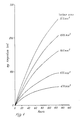
- the abcissa is hours in a dissotester, viz. a vessel wherein the bolus was leached by demineralised water at 37C passed at 1ml/minute.
- the ordinate is cumulative mg of amprolium lost from the bolus.
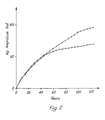
- the cumulative release of the drug from two devices of the same surface area but different volumes was studied. Initially, the rate of release was identical; however, differences later were observed as the cement became depleted of the drug. This is further shown in Figure 2, wherein cumulative loss curves for two magnesium oxysulphate cylinders containing 5 weight % amprolium are plotted.
- the curve x-x is of a 13mm diameter 9mm deep cylinder (volume 1195mm3) while o-o is of a 51 ⁇ 2 mm diameter 34mm deep cylinder (volume 808mm3), both having the identical surface area.
- the abcissa is as explained for Figure 1; after 120 hours, the x-x cylinder had lost 95% of its amprolium and the o-o cylinder had lost 100%.
- the ordinate is as in Figure 1.
Landscapes
- Health & Medical Sciences (AREA)
- Chemical & Material Sciences (AREA)
- Public Health (AREA)
- Veterinary Medicine (AREA)
- Epidemiology (AREA)
- Life Sciences & Earth Sciences (AREA)
- Animal Behavior & Ethology (AREA)
- General Health & Medical Sciences (AREA)
- Medicinal Chemistry (AREA)
- Pharmacology & Pharmacy (AREA)
- Engineering & Computer Science (AREA)
- Materials Engineering (AREA)
- Surgery (AREA)
- Inorganic Chemistry (AREA)
- Medicinal Preparation (AREA)
- Pharmaceuticals Containing Other Organic And Inorganic Compounds (AREA)
- Fodder In General (AREA)
Applications Claiming Priority (2)
| Application Number | Priority Date | Filing Date | Title |
|---|---|---|---|
| GB8820242 | 1988-08-25 | ||
| GB888820242A GB8820242D0 (en) | 1988-08-25 | 1988-08-25 | Sustained release device |
Publications (2)
| Publication Number | Publication Date |
|---|---|
| EP0357327A2 true EP0357327A2 (de) | 1990-03-07 |
| EP0357327A3 EP0357327A3 (de) | 1990-10-03 |
Family
ID=10642725
Family Applications (1)
| Application Number | Title | Priority Date | Filing Date |
|---|---|---|---|
| EP19890308529 Withdrawn EP0357327A3 (de) | 1988-08-25 | 1989-08-23 | Vorrichtung zur verzögerten Freisetzung |
Country Status (2)
| Country | Link |
|---|---|
| EP (1) | EP0357327A3 (de) |
| GB (2) | GB8820242D0 (de) |
Cited By (3)
| Publication number | Priority date | Publication date | Assignee | Title |
|---|---|---|---|---|
| EP0462608A1 (de) * | 1990-06-20 | 1991-12-27 | THERA Patent GmbH & Co. KG Gesellschaft für industrielle Schutzrechte | Implantierbares Wirkstoffdepotmaterial |
| WO2001022943A1 (en) * | 1999-09-29 | 2001-04-05 | H J Davis Fine Chemicals Cc | A slow release pharmaceutical composition comprising a magnesium oxychloride cement |
| US6387412B1 (en) * | 2000-04-14 | 2002-05-14 | Agri-Nutrients Technology Group, Inc. | Storage stable animal mineral granules |
Family Cites Families (8)
| Publication number | Priority date | Publication date | Assignee | Title |
|---|---|---|---|---|
| US3330729A (en) * | 1963-10-04 | 1967-07-11 | Goodrich Co B F | Sustained release tablet containing medicament admixed in a waterinsoluble acrylic acid cross-linked polymer and selected basic magnesium or calcium diluent |
| GB1484454A (en) * | 1973-08-21 | 1977-09-01 | Nat Res Dev | Poly-(carboxylate)cements |
| DE2807132C2 (de) * | 1978-02-20 | 1983-11-03 | Battelle-Institut E.V., 6000 Frankfurt | Implantierbares Pharmaka-Depot |
| GB2123693B (en) * | 1982-07-20 | 1987-05-13 | Nat Res Dev | Sustained release device |
| GB2123690A (en) * | 1982-07-20 | 1984-02-08 | Nat Res Dev | Sustained release device |
| IN162525B (de) * | 1984-02-08 | 1988-06-04 | Pfizer | |
| NL8401062A (nl) * | 1984-04-04 | 1985-11-01 | Stichting Biomaterials Science | Werkwijze voor het bereiden van een implantatiemateriaal dat geneesmiddelen afgeeft in het lichaam. |
| SE8801719D0 (sv) * | 1988-05-06 | 1988-05-06 | Dan W Ericson | Antibakteriella tandfyllnads- och cementeringsmaterial |
-
1988
- 1988-08-25 GB GB888820242A patent/GB8820242D0/en active Pending
-
1989
- 1989-08-23 GB GB8919121A patent/GB2222082A/en not_active Withdrawn
- 1989-08-23 EP EP19890308529 patent/EP0357327A3/de not_active Withdrawn
Cited By (4)
| Publication number | Priority date | Publication date | Assignee | Title |
|---|---|---|---|---|
| EP0462608A1 (de) * | 1990-06-20 | 1991-12-27 | THERA Patent GmbH & Co. KG Gesellschaft für industrielle Schutzrechte | Implantierbares Wirkstoffdepotmaterial |
| US5374427A (en) * | 1990-06-20 | 1994-12-20 | Thera Patent Gmbh & Co. Kg | Implantable active substance depot material |
| WO2001022943A1 (en) * | 1999-09-29 | 2001-04-05 | H J Davis Fine Chemicals Cc | A slow release pharmaceutical composition comprising a magnesium oxychloride cement |
| US6387412B1 (en) * | 2000-04-14 | 2002-05-14 | Agri-Nutrients Technology Group, Inc. | Storage stable animal mineral granules |
Also Published As
| Publication number | Publication date |
|---|---|
| GB8919121D0 (en) | 1989-10-04 |
| EP0357327A3 (de) | 1990-10-03 |
| GB8820242D0 (en) | 1988-09-28 |
| GB2222082A (en) | 1990-02-28 |
Similar Documents
| Publication | Publication Date | Title |
|---|---|---|
| US3074852A (en) | Pharmaceuticals with delayed release | |
| JP3292732B2 (ja) | 溶解度が低い塩基性薬物のための徐放性組成物 | |
| US3574820A (en) | Medicinal dosage forms of unpolymerized thiolated gelatin with a cross-linking accelerating agent providing slowly released medication from a swollen matrix | |
| DE3780222T2 (de) | Pharmazeutische zusammensetzung mit kontrollierter wirkstofffreisetzung. | |
| AU748772B2 (en) | Fast-acting analgesic | |
| BG97458A (bg) | Продукти и методи за лечение на храносмилателнияапарат | |
| EP1041972A1 (de) | Tablette mit instant- und verzögerte freisetzung von einen oder mehrere wirkstoffe | |
| US3330729A (en) | Sustained release tablet containing medicament admixed in a waterinsoluble acrylic acid cross-linked polymer and selected basic magnesium or calcium diluent | |
| EP0430705A1 (de) | Zahnzementzusammensetzung | |
| IE36335B1 (en) | Layered bolus for animal husbandry providing for immediate and sustained release of medicament | |
| EP0357327A2 (de) | Vorrichtung zur verzögerten Freisetzung | |
| EP0199855A1 (de) | Trimethoprim und ein Sulfonamid enthaltende Tabletten | |
| WO1992018111A2 (en) | Pharmaceutical composition for the treatment of gastritis | |
| JPH1036268A (ja) | 経口経路による投与後のチアネプチンナトリウム塩の持続性放出を可能とするマトリックス錠 | |
| JPH0687714A (ja) | 抗菌性セラミックス | |
| JP6260736B1 (ja) | 固形製剤 | |
| AU596639B2 (en) | Veterinary compositions incorporating a water swellable polymer | |
| WO1993024124A1 (en) | Compositions based on histamine h2-receptor antagonists and cationic exchangers complexes | |
| KR101392285B1 (ko) | 이중층 구조를 갖는 위체류성 서방성 제제 | |
| US4880628A (en) | Sustained release composition | |
| GB2123693A (en) | Sustained release device | |
| GB2123690A (en) | Sustained release device | |
| EP0200252B1 (de) | Trimethoprim und ein Sulfonamid enthaltende Tabletten | |
| US20060013893A1 (en) | Bisphosphonates inorganic carriers | |
| Ellis et al. | The formation and properties of metal oxide poly (vinylphosphonic acid) cements |
Legal Events
| Date | Code | Title | Description |
|---|---|---|---|
| PUAI | Public reference made under article 153(3) epc to a published international application that has entered the european phase |
Free format text: ORIGINAL CODE: 0009012 |
|
| AK | Designated contracting states |
Kind code of ref document: A2 Designated state(s): DE FR GB IT NL |
|
| 17P | Request for examination filed |
Effective date: 19900320 |
|
| PUAL | Search report despatched |
Free format text: ORIGINAL CODE: 0009013 |
|
| AK | Designated contracting states |
Kind code of ref document: A3 Designated state(s): DE FR GB IT NL |
|
| STAA | Information on the status of an ep patent application or granted ep patent |
Free format text: STATUS: THE APPLICATION IS DEEMED TO BE WITHDRAWN |
|
| 18D | Application deemed to be withdrawn |
Effective date: 19910404 |