EP0355031A2 - Substituierte Pyrimidinnucleoside, Verfahren zu ihrer Herstellung und sie enthaltende pharmazeutische Mittel - Google Patents
Substituierte Pyrimidinnucleoside, Verfahren zu ihrer Herstellung und sie enthaltende pharmazeutische Mittel Download PDFInfo
- Publication number
- EP0355031A2 EP0355031A2 EP19890115174 EP89115174A EP0355031A2 EP 0355031 A2 EP0355031 A2 EP 0355031A2 EP 19890115174 EP19890115174 EP 19890115174 EP 89115174 A EP89115174 A EP 89115174A EP 0355031 A2 EP0355031 A2 EP 0355031A2
- Authority
- EP
- European Patent Office
- Prior art keywords
- dideoxy
- fluoro
- ribofuranosyl
- pyrimidin
- compounds
- Prior art date
- Legal status (The legal status is an assumption and is not a legal conclusion. Google has not performed a legal analysis and makes no representation as to the accuracy of the status listed.)
- Withdrawn
Links
- 239000002718 pyrimidine nucleoside Substances 0.000 title claims abstract description 8
- 150000001875 compounds Chemical class 0.000 title claims description 21
- 238000002360 preparation method Methods 0.000 title claims description 6
- 238000000034 method Methods 0.000 title claims description 5
- 230000008569 process Effects 0.000 title claims description 4
- -1 hydroxylamino Chemical group 0.000 claims abstract description 10
- 125000004432 carbon atom Chemical group C* 0.000 claims abstract description 9
- 241000700605 Viruses Species 0.000 claims abstract description 7
- 208000015181 infectious disease Diseases 0.000 claims abstract description 7
- RHBTTWULFWNOBZ-XLPZGREQSA-N 1-[(2r,4s,5r)-4-fluoro-5-(hydroxymethyl)oxolan-2-yl]-5-methyl-4-sulfanylidenepyrimidin-2-one Chemical group O=C1NC(=S)C(C)=CN1[C@@H]1O[C@H](CO)[C@@H](F)C1 RHBTTWULFWNOBZ-XLPZGREQSA-N 0.000 claims abstract description 6
- 229910019142 PO4 Inorganic materials 0.000 claims abstract description 6
- 229910052739 hydrogen Inorganic materials 0.000 claims abstract description 6
- 239000001257 hydrogen Substances 0.000 claims abstract description 6
- 125000004435 hydrogen atom Chemical class [H]* 0.000 claims abstract description 6
- 125000002887 hydroxy group Chemical group [H]O* 0.000 claims abstract description 6
- NBIIXXVUZAFLBC-UHFFFAOYSA-K phosphate Chemical compound [O-]P([O-])([O-])=O NBIIXXVUZAFLBC-UHFFFAOYSA-K 0.000 claims abstract description 6
- 239000010452 phosphate Substances 0.000 claims abstract description 6
- 125000000446 sulfanediyl group Chemical group *S* 0.000 claims abstract description 5
- 241001430294 unidentified retrovirus Species 0.000 claims abstract description 5
- 239000008194 pharmaceutical composition Substances 0.000 claims abstract description 4
- 239000004254 Ammonium phosphate Substances 0.000 claims abstract description 3
- 125000000066 S-methyl group Chemical group [H]C([H])([H])S* 0.000 claims abstract description 3
- 125000003342 alkenyl group Chemical group 0.000 claims abstract description 3
- 125000003282 alkyl amino group Chemical group 0.000 claims abstract description 3
- 229910000148 ammonium phosphate Inorganic materials 0.000 claims abstract description 3
- 125000000852 azido group Chemical group *N=[N+]=[N-] 0.000 claims abstract description 3
- 229910052736 halogen Inorganic materials 0.000 claims abstract description 3
- 150000002367 halogens Chemical class 0.000 claims abstract description 3
- 239000002243 precursor Substances 0.000 claims abstract description 3
- UNXRWKVEANCORM-UHFFFAOYSA-N triphosphoric acid Chemical compound OP(O)(=O)OP(O)(=O)OP(O)(O)=O UNXRWKVEANCORM-UHFFFAOYSA-N 0.000 claims abstract description 3
- 229940048102 triphosphoric acid Drugs 0.000 claims abstract description 3
- JUJWROOIHBZHMG-UHFFFAOYSA-N Pyridine Chemical compound C1=CC=NC=C1 JUJWROOIHBZHMG-UHFFFAOYSA-N 0.000 claims description 14
- YXVPBVDWFIHMMF-WCBMZHEXSA-N [C@@H]1(C=C[C@H](O1)CO)N1C(N=C(C=C1)N(C)C)=O Chemical compound [C@@H]1(C=C[C@H](O1)CO)N1C(N=C(C=C1)N(C)C)=O YXVPBVDWFIHMMF-WCBMZHEXSA-N 0.000 claims description 7
- UMJSCPRVCHMLSP-UHFFFAOYSA-N pyridine Natural products COC1=CC=CN=C1 UMJSCPRVCHMLSP-UHFFFAOYSA-N 0.000 claims description 7
- 239000004480 active ingredient Substances 0.000 claims description 6
- CYQAYERJWZKYML-UHFFFAOYSA-N phosphorus pentasulfide Chemical compound S1P(S2)(=S)SP3(=S)SP1(=S)SP2(=S)S3 CYQAYERJWZKYML-UHFFFAOYSA-N 0.000 claims description 6
- GJZPRVLKXZHNPK-DJLDLDEBSA-N 1-[(2r,4s,5r)-4-fluoro-5-(hydroxymethyl)oxolan-2-yl]-5-methyl-4-methylsulfanylpyrimidin-2-one Chemical compound C1=C(C)C(SC)=NC(=O)N1[C@@H]1O[C@H](CO)[C@@H](F)C1 GJZPRVLKXZHNPK-DJLDLDEBSA-N 0.000 claims description 5
- TXCTVUKWPQTUAW-XLPZGREQSA-N 1-[(2r,4s,5r)-4-fluoro-5-(hydroxymethyl)oxolan-2-yl]-4-(hydroxyamino)-5-methylpyrimidin-2-one Chemical compound O=C1N=C(NO)C(C)=CN1[C@@H]1O[C@H](CO)[C@@H](F)C1 TXCTVUKWPQTUAW-XLPZGREQSA-N 0.000 claims description 4
- IBXDXUUOUSLXBN-SHYZEUOFSA-N 1-[(2r,4s,5r)-4-fluoro-5-(hydroxymethyl)oxolan-2-yl]-4-sulfanylidenepyrimidin-2-one Chemical compound C1[C@H](F)[C@@H](CO)O[C@H]1N1C(=O)NC(=S)C=C1 IBXDXUUOUSLXBN-SHYZEUOFSA-N 0.000 claims description 4
- OAKJQQAXSVQMHS-UHFFFAOYSA-N Hydrazine Chemical compound NN OAKJQQAXSVQMHS-UHFFFAOYSA-N 0.000 claims description 4
- AVXURJPOCDRRFD-UHFFFAOYSA-N Hydroxylamine Chemical compound ON AVXURJPOCDRRFD-UHFFFAOYSA-N 0.000 claims description 4
- NDVLTYZPCACLMA-UHFFFAOYSA-N silver oxide Chemical compound [O-2].[Ag+].[Ag+] NDVLTYZPCACLMA-UHFFFAOYSA-N 0.000 claims description 4
- ZVAQUCFETNYFQI-SHYZEUOFSA-N 1-[(2r,4s,5r)-4-fluoro-5-(hydroxymethyl)oxolan-2-yl]-4-(hydroxyamino)pyrimidin-2-one Chemical compound C1[C@H](F)[C@@H](CO)O[C@H]1N1C(=O)N=C(NO)C=C1 ZVAQUCFETNYFQI-SHYZEUOFSA-N 0.000 claims description 3
- AZQWKYJCGOJGHM-UHFFFAOYSA-N 1,4-benzoquinone Chemical class O=C1C=CC(=O)C=C1 AZQWKYJCGOJGHM-UHFFFAOYSA-N 0.000 claims description 2
- RWYRMVKGAYHCPU-DJLDLDEBSA-N 1-[(2r,4s,5r)-4-fluoro-5-(hydroxymethyl)oxolan-2-yl]-5-methylpyrimidin-2-one Chemical compound C1=C(C)C=NC(=O)N1[C@@H]1O[C@H](CO)[C@@H](F)C1 RWYRMVKGAYHCPU-DJLDLDEBSA-N 0.000 claims description 2
- ZXXNWCUWCYQZBU-XLPZGREQSA-N 1-[(2r,4s,5r)-4-fluoro-5-(hydroxymethyl)oxolan-2-yl]pyrimidin-2-one Chemical compound C1[C@H](F)[C@@H](CO)O[C@H]1N1C(=O)N=CC=C1 ZXXNWCUWCYQZBU-XLPZGREQSA-N 0.000 claims description 2
- AMSFVDRQDYZGRS-JGVFFNPUSA-N 1-[(2r,5s)-5-(hydroxymethyl)-2,5-dihydrofuran-2-yl]-5-methyl-4-sulfanylidenepyrimidin-2-one Chemical compound O=C1NC(=S)C(C)=CN1[C@H]1C=C[C@@H](CO)O1 AMSFVDRQDYZGRS-JGVFFNPUSA-N 0.000 claims description 2
- VDYLTVPENKTIPF-RRKCRQDMSA-N 5-chloro-1-[(2r,4s,5r)-4-fluoro-5-(hydroxymethyl)oxolan-2-yl]-4-sulfanylidenepyrimidin-2-one Chemical compound C1[C@H](F)[C@@H](CO)O[C@H]1N1C(=O)NC(=S)C(Cl)=C1 VDYLTVPENKTIPF-RRKCRQDMSA-N 0.000 claims description 2
- KDLHZDBZIXYQEI-UHFFFAOYSA-N Palladium Chemical compound [Pd] KDLHZDBZIXYQEI-UHFFFAOYSA-N 0.000 claims description 2
- ISAKRJDGNUQOIC-UHFFFAOYSA-N Uracil Chemical class O=C1C=CNC(=O)N1 ISAKRJDGNUQOIC-UHFFFAOYSA-N 0.000 claims description 2
- 239000003513 alkali Substances 0.000 claims description 2
- 150000003973 alkyl amines Chemical class 0.000 claims description 2
- 125000005210 alkyl ammonium group Chemical group 0.000 claims description 2
- 235000019289 ammonium phosphates Nutrition 0.000 claims description 2
- 239000003054 catalyst Substances 0.000 claims description 2
- MNNHAPBLZZVQHP-UHFFFAOYSA-N diammonium hydrogen phosphate Chemical compound [NH4+].[NH4+].OP([O-])([O-])=O MNNHAPBLZZVQHP-UHFFFAOYSA-N 0.000 claims description 2
- 125000004170 methylsulfonyl group Chemical group [H]C([H])([H])S(*)(=O)=O 0.000 claims description 2
- 229910001923 silver oxide Inorganic materials 0.000 claims description 2
- 238000011282 treatment Methods 0.000 claims description 2
- NOWPQKRYIWDZKV-POYBYMJQSA-N 4-(hydroxyamino)-1-[(2r,5s)-5-(hydroxymethyl)-2,5-dihydrofuran-2-yl]pyrimidin-2-one Chemical compound C1=C[C@@H](CO)O[C@H]1N1C(=O)N=C(NO)C=C1 NOWPQKRYIWDZKV-POYBYMJQSA-N 0.000 claims 1
- 239000000969 carrier Substances 0.000 claims 1
- 239000003085 diluting agent Substances 0.000 claims 1
- 238000011321 prophylaxis Methods 0.000 claims 1
- VTGOHKSTWXHQJK-UHFFFAOYSA-N pyrimidin-2-ol Chemical class OC1=NC=CC=N1 VTGOHKSTWXHQJK-UHFFFAOYSA-N 0.000 claims 1
- 239000013543 active substance Substances 0.000 abstract description 2
- 229910000318 alkali metal phosphate Inorganic materials 0.000 abstract 1
- OKKJLVBELUTLKV-UHFFFAOYSA-N Methanol Chemical compound OC OKKJLVBELUTLKV-UHFFFAOYSA-N 0.000 description 45
- LFQSCWFLJHTTHZ-UHFFFAOYSA-N Ethanol Chemical compound CCO LFQSCWFLJHTTHZ-UHFFFAOYSA-N 0.000 description 13
- 239000002585 base Substances 0.000 description 12
- 239000000243 solution Substances 0.000 description 12
- QGZKDVFQNNGYKY-UHFFFAOYSA-N Ammonia Chemical compound N QGZKDVFQNNGYKY-UHFFFAOYSA-N 0.000 description 10
- HEDRZPFGACZZDS-UHFFFAOYSA-N Chloroform Chemical compound ClC(Cl)Cl HEDRZPFGACZZDS-UHFFFAOYSA-N 0.000 description 8
- 241000725303 Human immunodeficiency virus Species 0.000 description 8
- 230000000694 effects Effects 0.000 description 8
- 239000002904 solvent Substances 0.000 description 8
- WFDIJRYMOXRFFG-UHFFFAOYSA-N Acetic anhydride Chemical compound CC(=O)OC(C)=O WFDIJRYMOXRFFG-UHFFFAOYSA-N 0.000 description 6
- 210000001744 T-lymphocyte Anatomy 0.000 description 6
- 210000004027 cell Anatomy 0.000 description 6
- 239000003795 chemical substances by application Substances 0.000 description 6
- 239000003480 eluent Substances 0.000 description 6
- 238000010992 reflux Methods 0.000 description 6
- XCPHZUQULRLKQM-XSSZXYGBSA-N 1-[(2r,4r,5r)-4-fluoro-4-hydroxy-5-(hydroxymethyl)oxolan-2-yl]-5-methyl-4-sulfanylidenepyrimidin-2-one Chemical compound O=C1NC(=S)C(C)=CN1[C@@H]1O[C@H](CO)[C@](O)(F)C1 XCPHZUQULRLKQM-XSSZXYGBSA-N 0.000 description 5
- VYPSYNLAJGMNEJ-UHFFFAOYSA-N Silicium dioxide Chemical compound O=[Si]=O VYPSYNLAJGMNEJ-UHFFFAOYSA-N 0.000 description 5
- 229910021529 ammonia Inorganic materials 0.000 description 5
- 238000004440 column chromatography Methods 0.000 description 5
- 239000011541 reaction mixture Substances 0.000 description 5
- 239000000741 silica gel Substances 0.000 description 5
- 229910002027 silica gel Inorganic materials 0.000 description 5
- UUAAKGHLNJKHLG-XSSZXYGBSA-N [[(2r,3r,5r)-3-fluoro-3-hydroxy-5-(5-methyl-2-oxo-4-sulfanylidenepyrimidin-1-yl)oxolan-2-yl]methoxy-hydroxyphosphoryl] phosphono hydrogen phosphate Chemical compound O=C1NC(=S)C(C)=CN1[C@@H]1O[C@H](COP(O)(=O)OP(O)(=O)OP(O)(O)=O)[C@](O)(F)C1 UUAAKGHLNJKHLG-XSSZXYGBSA-N 0.000 description 4
- 230000005764 inhibitory process Effects 0.000 description 4
- 239000000203 mixture Substances 0.000 description 4
- 238000001953 recrystallisation Methods 0.000 description 4
- QTBSBXVTEAMEQO-UHFFFAOYSA-N Acetic acid Chemical compound CC(O)=O QTBSBXVTEAMEQO-UHFFFAOYSA-N 0.000 description 3
- 102000016928 DNA-directed DNA polymerase Human genes 0.000 description 3
- 102000004190 Enzymes Human genes 0.000 description 3
- 108090000790 Enzymes Proteins 0.000 description 3
- 101000599862 Homo sapiens Intercellular adhesion molecule 3 Proteins 0.000 description 3
- 102100037871 Intercellular adhesion molecule 3 Human genes 0.000 description 3
- HEMHJVSKTPXQMS-UHFFFAOYSA-M Sodium hydroxide Chemical compound [OH-].[Na+] HEMHJVSKTPXQMS-UHFFFAOYSA-M 0.000 description 3
- YXFVVABEGXRONW-UHFFFAOYSA-N Toluene Chemical compound CC1=CC=CC=C1 YXFVVABEGXRONW-UHFFFAOYSA-N 0.000 description 3
- ZMANZCXQSJIPKH-UHFFFAOYSA-N Triethylamine Chemical compound CCN(CC)CC ZMANZCXQSJIPKH-UHFFFAOYSA-N 0.000 description 3
- XWAYCAQJNJGTHQ-IVZWLZJFSA-N [(2r,3s,5r)-3-fluoro-5-(5-methyl-2-oxo-4-sulfanylidenepyrimidin-1-yl)oxolan-2-yl]methyl acetate Chemical compound C1[C@H](F)[C@@H](COC(=O)C)O[C@H]1N1C(=O)NC(=S)C(C)=C1 XWAYCAQJNJGTHQ-IVZWLZJFSA-N 0.000 description 3
- 230000001028 anti-proliverative effect Effects 0.000 description 3
- 230000000840 anti-viral effect Effects 0.000 description 3
- 108091092356 cellular DNA Proteins 0.000 description 3
- 239000002777 nucleoside Substances 0.000 description 3
- 230000010076 replication Effects 0.000 description 3
- 229920006395 saturated elastomer Polymers 0.000 description 3
- FVAUCKIRQBBSSJ-UHFFFAOYSA-M sodium iodide Chemical compound [Na+].[I-] FVAUCKIRQBBSSJ-UHFFFAOYSA-M 0.000 description 3
- 239000003826 tablet Substances 0.000 description 3
- UJQBOUAGWGVOTI-XSSZXYGBSA-N 1-[(2r,4s,5r)-4-azido-4-hydroxy-5-(hydroxymethyl)oxolan-2-yl]-5-methylpyrimidine-2,4-dione Chemical compound O=C1NC(=O)C(C)=CN1[C@@H]1O[C@H](CO)[C@](O)(N=[N+]=[N-])C1 UJQBOUAGWGVOTI-XSSZXYGBSA-N 0.000 description 2
- RTZKZFJDLAIYFH-UHFFFAOYSA-N Diethyl ether Chemical compound CCOCC RTZKZFJDLAIYFH-UHFFFAOYSA-N 0.000 description 2
- 241000282412 Homo Species 0.000 description 2
- 241000598436 Human T-cell lymphotropic virus Species 0.000 description 2
- 108010092799 RNA-directed DNA polymerase Proteins 0.000 description 2
- 229920005654 Sephadex Polymers 0.000 description 2
- 239000012507 Sephadex™ Substances 0.000 description 2
- QHLOCMLFTNUWLA-QXFUBDJGSA-N [(2r,3s,5r)-3-fluoro-5-(2-oxo-4-sulfanylidenepyrimidin-1-yl)oxolan-2-yl]methyl acetate Chemical compound C1[C@H](F)[C@@H](COC(=O)C)O[C@H]1N1C(=O)NC(=S)C=C1 QHLOCMLFTNUWLA-QXFUBDJGSA-N 0.000 description 2
- WMYIUWCVITVUTR-IVZWLZJFSA-N [(2r,3s,5r)-3-fluoro-5-[4-(hydroxyamino)-5-methyl-2-oxopyrimidin-1-yl]oxolan-2-yl]methyl acetate Chemical compound C1[C@H](F)[C@@H](COC(=O)C)O[C@H]1N1C(=O)N=C(NO)C(C)=C1 WMYIUWCVITVUTR-IVZWLZJFSA-N 0.000 description 2
- LCGRXOLDJAJHMI-VHSXEESVSA-N [(2s,5r)-5-(5-methyl-2-oxo-4-sulfanylidenepyrimidin-1-yl)-2,5-dihydrofuran-2-yl]methyl acetate Chemical compound C1=C[C@@H](COC(=O)C)O[C@H]1N1C(=O)NC(=S)C(C)=C1 LCGRXOLDJAJHMI-VHSXEESVSA-N 0.000 description 2
- 210000001185 bone marrow Anatomy 0.000 description 2
- PFKFTWBEEFSNDU-UHFFFAOYSA-N carbonyldiimidazole Chemical compound C1=CN=CN1C(=O)N1C=CN=C1 PFKFTWBEEFSNDU-UHFFFAOYSA-N 0.000 description 2
- 230000004663 cell proliferation Effects 0.000 description 2
- 239000013078 crystal Substances 0.000 description 2
- 231100000135 cytotoxicity Toxicity 0.000 description 2
- 230000003013 cytotoxicity Effects 0.000 description 2
- 239000008187 granular material Substances 0.000 description 2
- AFQIYTIJXGTIEY-UHFFFAOYSA-N hydrogen carbonate;triethylazanium Chemical compound OC(O)=O.CCN(CC)CC AFQIYTIJXGTIEY-UHFFFAOYSA-N 0.000 description 2
- 238000000338 in vitro Methods 0.000 description 2
- 239000003112 inhibitor Substances 0.000 description 2
- 239000007924 injection Substances 0.000 description 2
- 238000002347 injection Methods 0.000 description 2
- 125000003835 nucleoside group Chemical group 0.000 description 2
- XHXFXVLFKHQFAL-UHFFFAOYSA-N phosphoryl trichloride Chemical compound ClP(Cl)(Cl)=O XHXFXVLFKHQFAL-UHFFFAOYSA-N 0.000 description 2
- 239000000843 powder Substances 0.000 description 2
- FIAFUQMPZJWCLV-UHFFFAOYSA-N suramin Chemical compound OS(=O)(=O)C1=CC(S(O)(=O)=O)=C2C(NC(=O)C3=CC=C(C(=C3)NC(=O)C=3C=C(NC(=O)NC=4C=C(C=CC=4)C(=O)NC=4C(=CC=C(C=4)C(=O)NC=4C5=C(C=C(C=C5C(=CC=4)S(O)(=O)=O)S(O)(=O)=O)S(O)(=O)=O)C)C=CC=3)C)=CC=C(S(O)(=O)=O)C2=C1 FIAFUQMPZJWCLV-UHFFFAOYSA-N 0.000 description 2
- 239000000725 suspension Substances 0.000 description 2
- 230000001225 therapeutic effect Effects 0.000 description 2
- 239000001226 triphosphate Substances 0.000 description 2
- QZUVUIPORGHWFO-LKEWCRSYSA-N 1-[(2r,4s,5r)-4-fluoro-5-(hydroxymethyl)oxolan-2-yl]-4-methylsulfanylpyrimidin-2-one Chemical compound O=C1N=C(SC)C=CN1[C@@H]1O[C@H](CO)[C@@H](F)C1 QZUVUIPORGHWFO-LKEWCRSYSA-N 0.000 description 1
- BKIUEHLYJFLWPK-SHYZEUOFSA-N 1-[(2r,4s,5r)-4-fluoro-5-(hydroxymethyl)oxolan-2-yl]pyrimidine-2,4-dione Chemical compound C1[C@H](F)[C@@H](CO)O[C@H]1N1C(=O)NC(=O)C=C1 BKIUEHLYJFLWPK-SHYZEUOFSA-N 0.000 description 1
- FLRWGUIHNUCNJN-JGVFFNPUSA-N 1-[(2r,5s)-5-(hydroxymethyl)oxolan-2-yl]-5-methyl-4-sulfanylidenepyrimidin-2-one Chemical compound O=C1NC(=S)C(C)=CN1[C@@H]1O[C@H](CO)CC1 FLRWGUIHNUCNJN-JGVFFNPUSA-N 0.000 description 1
- 208000024893 Acute lymphoblastic leukemia Diseases 0.000 description 1
- 208000014697 Acute lymphocytic leukaemia Diseases 0.000 description 1
- 208000014644 Brain disease Diseases 0.000 description 1
- 208000035473 Communicable disease Diseases 0.000 description 1
- 102000001996 DNA Polymerase beta Human genes 0.000 description 1
- 108010001132 DNA Polymerase beta Proteins 0.000 description 1
- 102000011724 DNA Repair Enzymes Human genes 0.000 description 1
- 108010014303 DNA-directed DNA polymerase Proteins 0.000 description 1
- 102000004163 DNA-directed RNA polymerases Human genes 0.000 description 1
- 108090000626 DNA-directed RNA polymerases Proteins 0.000 description 1
- 208000032274 Encephalopathy Diseases 0.000 description 1
- 229930194076 Germanin Natural products 0.000 description 1
- WQZGKKKJIJFFOK-GASJEMHNSA-N Glucose Natural products OC[C@H]1OC(O)[C@H](O)[C@@H](O)[C@@H]1O WQZGKKKJIJFFOK-GASJEMHNSA-N 0.000 description 1
- 208000031886 HIV Infections Diseases 0.000 description 1
- 108010078851 HIV Reverse Transcriptase Proteins 0.000 description 1
- 241000713772 Human immunodeficiency virus 1 Species 0.000 description 1
- 102100034343 Integrase Human genes 0.000 description 1
- 208000007766 Kaposi sarcoma Diseases 0.000 description 1
- 208000008771 Lymphadenopathy Diseases 0.000 description 1
- 241001465754 Metazoa Species 0.000 description 1
- 208000001388 Opportunistic Infections Diseases 0.000 description 1
- 208000005384 Pneumocystis Pneumonia Diseases 0.000 description 1
- 206010073755 Pneumocystis jirovecii pneumonia Diseases 0.000 description 1
- 208000006664 Precursor Cell Lymphoblastic Leukemia-Lymphoma Diseases 0.000 description 1
- 229940124639 Selective inhibitor Drugs 0.000 description 1
- 241000334946 Volvariella media Species 0.000 description 1
- MWTYZDAPOIPXGH-LNLATYFQSA-N [(2r,3r,5r)-3-fluoro-3-hydroxy-5-(5-methyl-2,4-dioxopyrimidin-1-yl)oxolan-2-yl]methyl acetate Chemical compound C1[C@](F)(O)[C@@H](COC(=O)C)O[C@H]1N1C(=O)NC(=O)C(C)=C1 MWTYZDAPOIPXGH-LNLATYFQSA-N 0.000 description 1
- QIDSTUDQCSMSKL-VHSXEESVSA-N [(2s,5r)-5-(5-methyl-2,4-dioxopyrimidin-1-yl)-2,5-dihydrofuran-2-yl]methyl acetate Chemical compound C1=C[C@@H](COC(=O)C)O[C@H]1N1C(=O)NC(=O)C(C)=C1 QIDSTUDQCSMSKL-VHSXEESVSA-N 0.000 description 1
- WQZGKKKJIJFFOK-VFUOTHLCSA-N beta-D-glucose Chemical compound OC[C@H]1O[C@@H](O)[C@H](O)[C@@H](O)[C@@H]1O WQZGKKKJIJFFOK-VFUOTHLCSA-N 0.000 description 1
- 210000004369 blood Anatomy 0.000 description 1
- 239000008280 blood Substances 0.000 description 1
- 239000002775 capsule Substances 0.000 description 1
- 238000004113 cell culture Methods 0.000 description 1
- 230000030833 cell death Effects 0.000 description 1
- 230000022534 cell killing Effects 0.000 description 1
- 230000001413 cellular effect Effects 0.000 description 1
- 230000001332 colony forming effect Effects 0.000 description 1
- 238000001816 cooling Methods 0.000 description 1
- 239000006071 cream Substances 0.000 description 1
- 239000002178 crystalline material Substances 0.000 description 1
- 238000002425 crystallisation Methods 0.000 description 1
- 230000008025 crystallization Effects 0.000 description 1
- 230000000120 cytopathologic effect Effects 0.000 description 1
- 231100000433 cytotoxic Toxicity 0.000 description 1
- 230000001472 cytotoxic effect Effects 0.000 description 1
- 230000006378 damage Effects 0.000 description 1
- 230000007123 defense Effects 0.000 description 1
- 230000001419 dependent effect Effects 0.000 description 1
- 238000011161 development Methods 0.000 description 1
- 230000018109 developmental process Effects 0.000 description 1
- 229940079593 drug Drugs 0.000 description 1
- 239000003814 drug Substances 0.000 description 1
- 210000002950 fibroblast Anatomy 0.000 description 1
- 239000000796 flavoring agent Substances 0.000 description 1
- 239000006260 foam Substances 0.000 description 1
- 235000013355 food flavoring agent Nutrition 0.000 description 1
- 239000000499 gel Substances 0.000 description 1
- 239000011521 glass Substances 0.000 description 1
- 239000008103 glucose Substances 0.000 description 1
- 210000002443 helper t lymphocyte Anatomy 0.000 description 1
- 210000005260 human cell Anatomy 0.000 description 1
- 239000005457 ice water Substances 0.000 description 1
- 230000036737 immune function Effects 0.000 description 1
- 238000001802 infusion Methods 0.000 description 1
- 230000003834 intracellular effect Effects 0.000 description 1
- 238000007918 intramuscular administration Methods 0.000 description 1
- 238000001990 intravenous administration Methods 0.000 description 1
- INQOMBQAUSQDDS-UHFFFAOYSA-N iodomethane Chemical compound IC INQOMBQAUSQDDS-UHFFFAOYSA-N 0.000 description 1
- 239000007788 liquid Substances 0.000 description 1
- 208000018555 lymphatic system disease Diseases 0.000 description 1
- 238000004519 manufacturing process Methods 0.000 description 1
- YWXCPBOLRPNSNZ-UHFFFAOYSA-N n-(1-hydroxypyridin-4-ylidene)hydroxylamine Chemical compound ON=C1C=CN(O)C=C1 YWXCPBOLRPNSNZ-UHFFFAOYSA-N 0.000 description 1
- 230000000926 neurological effect Effects 0.000 description 1
- 229940127073 nucleoside analogue Drugs 0.000 description 1
- 150000003833 nucleoside derivatives Chemical class 0.000 description 1
- 238000007911 parenteral administration Methods 0.000 description 1
- 239000006072 paste Substances 0.000 description 1
- 239000008177 pharmaceutical agent Substances 0.000 description 1
- 239000002504 physiological saline solution Substances 0.000 description 1
- 201000000317 pneumocystosis Diseases 0.000 description 1
- 229920001467 poly(styrenesulfonates) Polymers 0.000 description 1
- 230000000069 prophylactic effect Effects 0.000 description 1
- 230000002685 pulmonary effect Effects 0.000 description 1
- JUJWROOIHBZHMG-UHFFFAOYSA-O pyridinium Chemical group C1=CC=[NH+]C=C1 JUJWROOIHBZHMG-UHFFFAOYSA-O 0.000 description 1
- 230000035484 reaction time Effects 0.000 description 1
- 235000009518 sodium iodide Nutrition 0.000 description 1
- 159000000000 sodium salts Chemical class 0.000 description 1
- 239000007921 spray Substances 0.000 description 1
- 230000007480 spreading Effects 0.000 description 1
- 238000003892 spreading Methods 0.000 description 1
- 238000007920 subcutaneous administration Methods 0.000 description 1
- 239000000126 substance Substances 0.000 description 1
- 239000000829 suppository Substances 0.000 description 1
- 229960005314 suramin Drugs 0.000 description 1
- 238000002560 therapeutic procedure Methods 0.000 description 1
- 230000000699 topical effect Effects 0.000 description 1
- 231100000331 toxic Toxicity 0.000 description 1
- 230000002588 toxic effect Effects 0.000 description 1
- 231100000419 toxicity Toxicity 0.000 description 1
- 230000001988 toxicity Effects 0.000 description 1
- IMFACGCPASFAPR-UHFFFAOYSA-N tributylamine Chemical class CCCCN(CCCC)CCCC IMFACGCPASFAPR-UHFFFAOYSA-N 0.000 description 1
- WVLBCYQITXONBZ-UHFFFAOYSA-N trimethyl phosphate Chemical compound COP(=O)(OC)OC WVLBCYQITXONBZ-UHFFFAOYSA-N 0.000 description 1
- 230000029812 viral genome replication Effects 0.000 description 1
- XLYOFNOQVPJJNP-UHFFFAOYSA-N water Substances O XLYOFNOQVPJJNP-UHFFFAOYSA-N 0.000 description 1
Classifications
-
- C—CHEMISTRY; METALLURGY
- C07—ORGANIC CHEMISTRY
- C07D—HETEROCYCLIC COMPOUNDS
- C07D405/00—Heterocyclic compounds containing both one or more hetero rings having oxygen atoms as the only ring hetero atoms, and one or more rings having nitrogen as the only ring hetero atom
- C07D405/02—Heterocyclic compounds containing both one or more hetero rings having oxygen atoms as the only ring hetero atoms, and one or more rings having nitrogen as the only ring hetero atom containing two hetero rings
- C07D405/04—Heterocyclic compounds containing both one or more hetero rings having oxygen atoms as the only ring hetero atoms, and one or more rings having nitrogen as the only ring hetero atom containing two hetero rings directly linked by a ring-member-to-ring-member bond
-
- C—CHEMISTRY; METALLURGY
- C07—ORGANIC CHEMISTRY
- C07H—SUGARS; DERIVATIVES THEREOF; NUCLEOSIDES; NUCLEOTIDES; NUCLEIC ACIDS
- C07H19/00—Compounds containing a hetero ring sharing one ring hetero atom with a saccharide radical; Nucleosides; Mononucleotides; Anhydro-derivatives thereof
- C07H19/02—Compounds containing a hetero ring sharing one ring hetero atom with a saccharide radical; Nucleosides; Mononucleotides; Anhydro-derivatives thereof sharing nitrogen
- C07H19/04—Heterocyclic radicals containing only nitrogen atoms as ring hetero atom
- C07H19/06—Pyrimidine radicals
-
- C—CHEMISTRY; METALLURGY
- C07—ORGANIC CHEMISTRY
- C07H—SUGARS; DERIVATIVES THEREOF; NUCLEOSIDES; NUCLEOTIDES; NUCLEIC ACIDS
- C07H19/00—Compounds containing a hetero ring sharing one ring hetero atom with a saccharide radical; Nucleosides; Mononucleotides; Anhydro-derivatives thereof
- C07H19/02—Compounds containing a hetero ring sharing one ring hetero atom with a saccharide radical; Nucleosides; Mononucleotides; Anhydro-derivatives thereof sharing nitrogen
- C07H19/04—Heterocyclic radicals containing only nitrogen atoms as ring hetero atom
- C07H19/06—Pyrimidine radicals
- C07H19/10—Pyrimidine radicals with the saccharide radical esterified by phosphoric or polyphosphoric acids
Definitions
- the invention relates to substituted pyrimidine nucleosides which are effective against infections in humans and animals caused by viruses or retroviruses, in particular HIV infections (AIDS) in humans, their preparation and their use in the form of corresponding pharmaceutical agents.
- viruses or retroviruses in particular HIV infections (AIDS) in humans
- AIDS has been known for a few years and is an infectious disease caused by HIV (HTLV III / LAV, Human T-Lymphotropie Virus Type III / Lymphadenopathy-Associated Virus).
- HIV Human T-Lymphotropie Virus Type III / Lymphadenopathy-Associated Virus
- the cause of the destruction of the T helper cells by the AIDS virus must be considered.
- severe opportunistic infections, Kaposi's sarcoma and a so-called AIDS encephalopathy occur.
- An effective and tolerable antiviral therapy has so far been lacking.
- the target for this can be the virus-coded reserve transcriptase, an enzyme whose inhibition prevents further intracellular virus replication and thus its could prevent spreading in the body.
- the first clinically proven inhibitors of HIV revertase such as suramin (Germanin R ) and HPF 23, have not yet achieved the necessary tolerability and the hoped-for efficacy, only 3'-azidothymidine (N3TdR) (DE-A-35 00 606) has clearly life-prolonging effects in AIDS patients with Pneumocystis carinii pneumonia, which are accompanied by improvements in clinical and neurological findings as well as the temporary restoration of certain immunological functions (Fischl et al., The New England J. of Medicine 317, 185 (1987 )).
- toxic side effects of 3'-azidothymidine on the bone marrow require blood transfusions in about 50% of the treated patients, which particularly indicates the need for more selective inhibitors of HIV reverse transcriptase, while also increasing their effectiveness.
- the invention is based on the object of specifying novel active substances and corresponding pharmaceutical compositions and their production and use which can be used for the prophylactic and therapeutic treatment of AIDS or infections caused by viruses or retroviruses and less toxicity or side effects than the known compositions exhibit.
- the pyrimidine nucleosides according to the invention have the general formula I, II or III in which mean: R1 is hydrogen, halogen, azido, aliphatic alkyl having 1 to 5 carbon atoms, preferably having 1 to 3 carbon atoms, or alkenyl having 2 to 5 carbon atoms, R2 is hydrogen, thio, thiomethyl, hydroxylamino or alkylamino, R3 hydroxyl, O-acetyl, O-palmitoyl, O-alkoxycarbonyl, mono-, di- or triphosphoric acid, alkali phosphate, ammonium phosphate or alkylammonium phosphate or a precursor for the hydroxyl group.
- inventive methods for the preparation of the pyrimidine nucleosides of the formula I, II and III are characterized in that for the preparation of - 4-thio compounds the corresponding (1H, 3H) -pyrimidine-2,4-dione compounds are heated with phosphorus pentasulfide in pyridine (JJ Fox et al, J. Amer. Chem. Soc. (1959), 81, 178-187 ); - 4-hydroxylamino or 4-alkylamino compounds, the corresponding thio compounds are reacted with the corresponding alkylamine or hydroxylamine (JJ Fox et al, J. Amer. Chem. Soc.
- compositions according to the invention contain at least one compound of the general formula I and / or II and / or III as active ingredient together with at least one compatible carrier and, if appropriate, with other therapeutic compositions.
- the agents are manufactured as a unit dose or so that a multiple of the active ingredient is contained.
- Each carrier must be compatible, compatible with the other components of the agent and must not be harmful to the patient.
- the agents include those suitable for oral, rectal, nasal, topical, vaginal or parenteral (including subcutaneous, intramuscular, intravenous and intradermal) administration.
- One or more active ingredient (s) is (are) brought into contact with the carrier, which is composed of one or more accompanying components, and, if necessary, brought into an appropriate form.
- the agents for oral administration are produced in the form of coated tablets, tablets, capsules, powder or granules so that they each contain a certain amount of the active ingredient. They can also be used as Solution or be prepared as a suspension. If necessary, flavoring agents or other customary agents are added.
- Means for rectal administration are made as suppositories with a suitable base.
- Means for vaginal administration are manufactured as pessaries, tampons, creams, gels, pastes, foams or spray products.
- the means for parenteral administration can be provided as a unit dose of the active ingredient or as a multiple dose. They can be stored in ampoules, vials or in a freeze-dried state. Immediately prepared solutions for injection and suspensions can be obtained from sterile powders, granules and tablets. This is done e.g. by dissolving the substance in physiological saline, glucose or other i.v. Media suitable for injection or infusion.
- HIV-RT HIV-associated reverse transcriptase
- an ID 0,3 of 0.3 ⁇ mol / l, for the DNA polymerase, the enzyme responsible for cellular replication, an ID nch of 140 ⁇ mol / l and for the DNA polymerase ß, the cellular DNA repair Enzyme, an ID50 of 7 ⁇ mol / l is determined.
- 3′-Fluoro-4-thiothymidine triphosphate thus inhibits HIV-RT 700 times more than cellular DNA polymerase and thus has a largely selective effect on HIV replication.
- 3'-fluoro-4-thiothymidine in concentrations up to 100 ⁇ mol / l has no growth-impairing effect on the colony-forming cells of the mouse bone marrow (GM-CFU).
- 3'-fluoro-4-thiothymidine can therefore be used as effective inhibitor of HIV replication with very low cytotoxicity.
- table Comparison of the antiviral and antiproliferative activity of nucleoside analogues on MT-4 cells Examined nucleoside 50% antiviral dose (ED50; ⁇ mol / l) 50% cytotoxic dose (CD50; ⁇ mol / l) 1- (2,3-dideoxy-3-fluoro- ⁇ -D-ribofuranosyl) -4-thiothymine 1.8 480 1- (2,3-dideoxy-3-fluoro- ⁇ -D-ribofuranosyl) -4-thiouracil 15 130 1- (2,3-dideoxy-3-fluoro- ⁇ -D-ribofuranosyl) -4-methylmercapto-5-methylpyrimidin-2-one > 1000 > 1000 1- (2,3-dideoxy-3-fluoro- ⁇ -D-ribofuranosyl) -4-methylmercapto-pyrimidin
- Example 4 50 mg of the compound obtained in Example 4 are deacetylated in a conventional manner with ammonia / methanol. The compound is isolated as a glassy residue. MS: m / z 245 (C9H12N3O4F, M+), 127 (C4H5N2O3, base + H), 119 (C6H8O2F, sugar residue).
- the 1- (5-O-acetyl-2,3-dideoxy- ⁇ -D-glyceropent-2-enofuranosyl) thymine which is dried in vacuo, is dissolved in 25 ml of absolute pyridine and heated under reflux with 2 g of phosphorus pentasulfide for 48 h . After cooling, the insoluble matter is decanted and the solution is evaporated to dryness in vacuo. The resulting residue is separated by column chromatography on silica gel 40 using chloroform as the eluent.
Landscapes
- Chemical & Material Sciences (AREA)
- Organic Chemistry (AREA)
- Health & Medical Sciences (AREA)
- Life Sciences & Earth Sciences (AREA)
- Engineering & Computer Science (AREA)
- Biochemistry (AREA)
- Biotechnology (AREA)
- General Health & Medical Sciences (AREA)
- Genetics & Genomics (AREA)
- Molecular Biology (AREA)
- Pharmaceuticals Containing Other Organic And Inorganic Compounds (AREA)
- Saccharide Compounds (AREA)
Abstract

R¹ Wasserstoff, Halogen, Azido, aliphatisches Alkyl mit 1 bis 5 Kohlenstoffatomen, vorzugsweise mit 1 bis 3 Kohlenstoffatomen, oder Alkenyl mit 2 bis 5 Kohlenstoffatomen,
R² Wasserstoff, Thio, Thiomethyl, Hydroxylamino oder Alkylamino,
R³ Hydroxyl, O-Acetyl, O-Palmitoyl, O-Alkoxycarbonyl, Mono-, Di-, oder Triphosphorsäure, -alkaliphosphat, -ammoniumphosphat oder -alkylammoniumphosphat oder eine Vorstufe für die Hydroxylgruppe,
und sie enthaltende pharmazeutische Mittel beschrieben.
Description
- Die Erfindung betrifft substituierte Pyrimidinnucleoside, die gegen durch Viren bzw. Retroviren verursachte Infektionen bei Mensch und Tier, insbesondere HIV-Infektionen (AIDS) beim Menschen wirksam sind, ihre Herstellung und ihre Verwendung in Form entsprechender pharmazeutischer Mittel.
- AIDS ist eine seit wenigen Jahren bekannte, durch das HIV (HTLV III/LAV, Human T-Lymphotropie Virus Type III/Lymphadenopathy-Associated Virus) verursachte und zum Tode führende Infektionskrankheit. Als ursächlich muß die Zerstörung der T-Helfer-Zellen durch das AIDS-Virus angesehen werden. Als Folge der daraus resultierenden Abwehrschwäche treten schwere opportunistische Infektionen, das Kaposi-Sarkom und eine sog. AIDS-Enzephalopathie auf. Eine wirksame und verträgliche antivirale Therapie fehlt bisher. Angriffspunkt dafür kann u.a. die Virus-kodierte Reserve Transcriptase sein, ein Enzym, dessen Hemmung die weitere intrazelluläre Virusvermehrung verhindern und damit seine Ausbreitung im Körper unterbinden könnte. Die ersten klinisch erprobten Hemmstoffe der HIV-Revertase, wie z.B. Suramin (GermaninR) und HPF 23 haben die notwendige Verträglichkeit und die erhoffte Wirksamkeit noch nicht erreicht, lediglich das 3′-Azidothymidin (N₃TdR) (DE-A-35 00 606) besitzt bei AIDS-Patienten mit einer Pneumocystis-carinii-Pneumonie eindeutig lebensverlängernde Wirkungen, die von Verbesserungen klinischer und neurologischer Befunde sowie der zeitweisen Wiederherstellung bestimmter immunologischer Funktionen begleitet sind (Fischl et al., The New England J. of Medicine 317, 185 (1987)). Demgegenüber machen toxische Nebenwirkungen des 3′-Azidothymidins auf das Knochenmark bei etwa 50 % der behandelten Patienten Bluttransfusionen erforderlich, was besonders auf die Notwendigkeit nach selektiveren Hemmstoffen der HIV-Reverse Transcriptase hinweist, während auch deren Wirksamkeit zu erhöhen ist.
- Der Erfindung liegt die Aufgabe zugrunde, neuartige Wirkstoffe und entsprechende pharmazeutische Mittel und deren Herstellung und Verwendung anzugeben, die zur prophylaktischen sowie therapeutischen Behandlung von AIDS bzw. von durch Viren bzw. Retroviren verursachten Infektionen verwendbar sind und gegenüber den bekannten Mitteln geringere Toxizität bzw. Nebenwirkungen aufweisen.
- Die Aufgabe wird gemäß den Ansprüchen 1, 14 und 15 gelöst.
- Vorteilhafte Weiterbildungen sind Gegenstand der abhängigen Ansprüche 2 bis 13.
- Die erfindungsgemäßen Pyrimidinnucleoside besitzen die allgemeine Formel I, II oder III
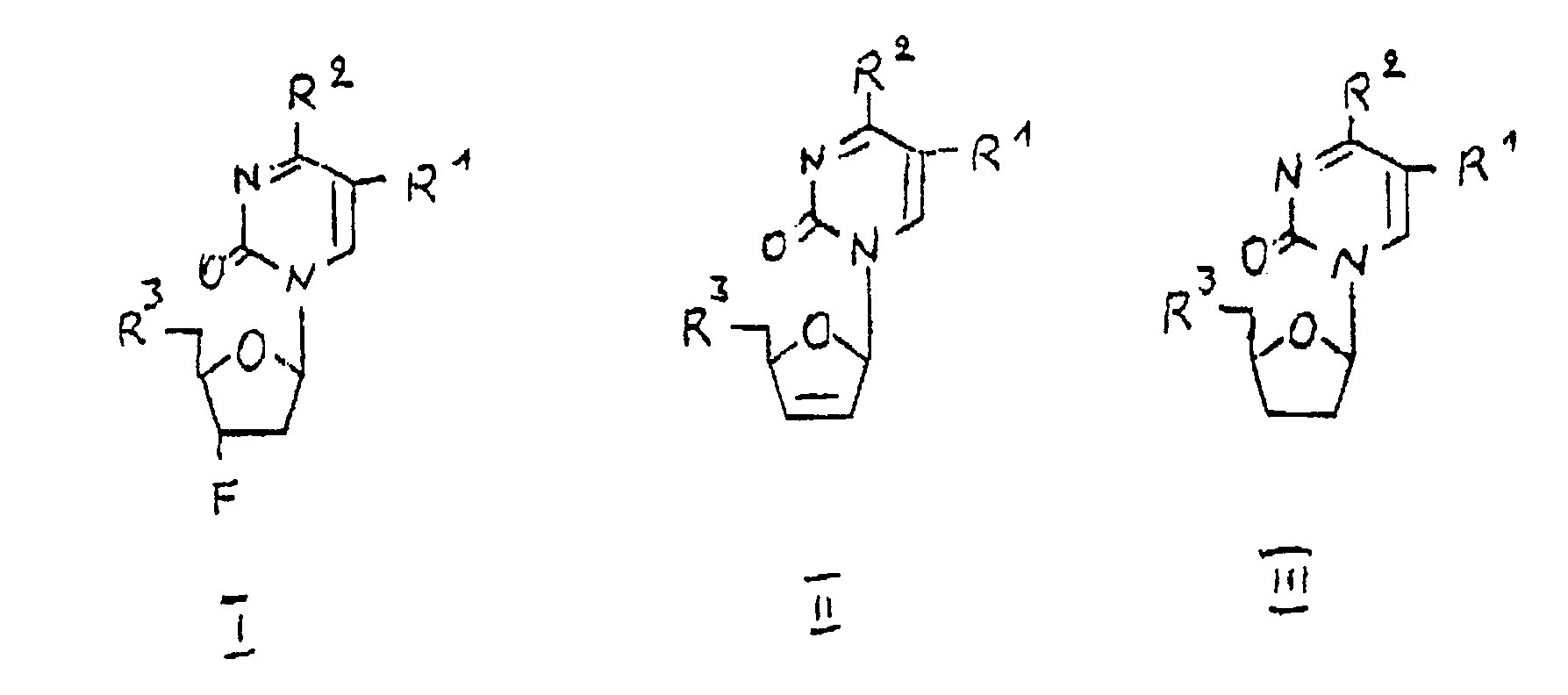
R¹ Wasserstoff, Halogen, Azido, aliphatisches Alkyl mit 1 bis 5 Kohlenstoffatomen, vorzugsweise mit 1 bis 3 Kohlenstoffatomen, oder Alkenyl mit 2 bis 5 Kohlenstoffatomen,
R² Wasserstoff, Thio, Thiomethyl, Hydroxylamino oder Alkylamino,
R³ Hydroxyl, O-Acetyl, O-Palmitoyl, O-Alkoxycarbonyl, Mono-, Di-, oder Triphosphorsäure, -alkaliphosphat, -ammoniumphosphat oder -alkylammoniumphosphat oder eine Vorstufe für die Hydroxylgruppe. - Sie stellen wirksame Mittel gegen durch Viren bzw. Retroviren verursachte Infektionen dar.
- Die erfindungsgemäßen Verfahren zur Herstellung der Pyrimidinnucleoside der Formel I, II und III sind dadurch gekennzeichnet, daß zur Herstellung der
- 4-Thioverbindungen die entsprechenden (1H, 3H)-Pyrimidin-2,4-dion-Verbindungen mit Phosphorpentasulfid in Pyridin erhitzt werden (J.J. Fox et al, J. Amer. Chem. Soc. (1959), 81, 178-187);
- 4-Hydroxylamino- bzw. 4-Alkylaminoverbindungen die entsprechenden Thioverbindungen mit dem entsprechenden Alkylamin bzw. Hydroxylamin umgesetzt werden (J.J. Fox et al, J. Amer. Chem. Soc. (1959) 81, 178-187);
- (1H)-Pyrimidin-2-on-Derivate die entsprechenden 2,4-Dionverbindungen mit Hydrazin zu 4-Hydrazino-Derivaten umgesetzt und mit Silberoxid oxydiert werden;
- 2′,3′-Didexosy-2′,3′-didehydro-Verbindungen aus den entsprechenden 3′,5′-Di-O-mesylverbindungen die Mesylgruppen abgespalten werden (J.P. Horwitz et al, J. Org. Chem. (1966), 31, 205-211);
- 2′,3′-Didesoxynucleoside die entsprechenden ungesättigten Verbindungen mit 10 proz. Palladium/Kohle als Katalysator hydriert werden (J.P. Horwitz et al, J. Org. Chem. (1966), 31, 205-211). - Erfindungsgemäße Verbindungen der Formel I, II und III sind:
1-(2,3-Didesoxy-3-fluor-ß-D-ribofuranosyl)-5-methyl-(1H)-pyrimidin-2-on
1-(2,3-Didesoxy-3-fluor-ß-D-ribofuranosyl)-4-thiothymin
1-(2,3-Didesoxy-3-fluor-ß-D-ribofuranosyl)-4-methylmercapto-5-methyl-(1H)-pyrimidin-2-on
1-(2,3-Didesoxy-3-fluor-ß-D-ribofuranosyl)-4-hydroxylamino-5-methyl-(1H)-pyrimidin-2-on
5-Chlor-1-(2,3-didesoxy-3-fluor-ß-D-ribofuranosyl)-4-thiouracil
1-(2,3-Didesoxy-3-fluor-ß-D-ribofuranosyl)-(1H)-pyrimidin-2-on
1-(2,3-Didesoxy-3-fluor-ß-D-ribofuranosyl)-4-thiouracil
1-(2,3-Didesoxy-3-fluor-ß-D-ribofuranosyl)-4-hydroxylamino-(1H)-pyrimidin-2-on
1-(2,3-Didesoxy-ß-D-glycero-pent-2-enofuranosyl)-4-thiothymin
1-(2,3-Didesoxy-ß-D-glycero-pent-2-enofuranosyl)-5-methyl-(1H)-pyrimidin-2-on
1-(2,3-Didesoxy-ß-D-glycero-pent-2-enofuranosyl)-4-hydroxylamino-(1H)-pyrimidin-2-on
1-(2,3-Didesoxy-ß-D-glycero-pent-2-enofuranosyl)-4-dimethylamino-(1H)-pyrimidin-2-on. - Die erfindungsgemäßen pharmazeutischen Mittel enthalten mindestens eine Verbindung der allgemeinen Formel I und/oder II und/oder III als Wirkstoff zusammen mit mindestens einem verträglichen Träger und ggfs. mit anderen therapeutischen Mitteln. Die Mittel werden als Einheitsdosis hergestellt oder so, daß ein Mehrfaches des Wirkstoffs enthalten ist. Jeder Träger muß verträglich sein, mit den anderen Bestandteilen der Mittel vereinbar und darf für den Patienten nicht schädlich sein.
- Die Mittel schließend solche ein, die für orale, rektale, nasale, topische, vaginale oder parenterale (einschließlich subkutane, intramuskuläre, intravenöse und intradermale) Verabreichung geeignet sind. Ein bzw. mehrere Wirkstoff(e) wird (werden) mit dem Träger, der sich aus einem oder mehreren Begleitbestandteilen zusammensetzt, in Kontakt gebracht und, falls erforderlich, in eine entsprechende Form gebracht.
- Die Mittel für eine orale Verabreichung werden in Form von Dragees, Tabletten, Kapseln, als Pulver oder Granulat so hergestellt, daß sie jeweils eine bestimmte Menge des aktiven Bestandteils enthalten. Ebenso können sie als Lösung oder als Suspension hergestellt werden. Gegebenenfalls werden Geschmacksmittel oder andere übliche Mittel zugesetzt. Mittel für eine rektale Verabreichung werden als Zäpfchen mit einer geeigneten Base hergestellt. Mittel für eine vaginale Verabreichung werden als Pessare, Tampons, Cremes, Gele, Pasten, Schäume oder Spray-Produkte hergestellt.
- Die Mittel für die parenterale Verabreichung können als Einheitsdosis des Wirkstoffs oder als Mehrfachdosis vorgesehen werden. Dafür können sie in Ampullen, Fiolen oder in einem gefriergetrockneten Zustand gelagert werden. Unmittelbar zubereitete Injektionslösungen und Suspensionen können aus sterilen Pulvern, Granulat und Tabletten erhalten werden. Das erfolgt z.B. durch Lösen der Substanz in physiologischer Kochsalzlösung, Glukose oder anderen für die i.v. Injektion bzw. Infusion geeigneten Medien.
- Folgende Verbindungen erwiesen sich als besonders wirksam:
1-(2,3-Didesoxy-3-fluor-ß-D-ribofuranosyl)-5-methyl-(1H)-pyrimidin-2-on (I);
3′-Desoxy-3′-fluor-4-thiothymidin (I);
1-(2,3-Didesoxy-3-fluor-ß-D-ribofuranosyl)-4-methylmercapto-5-methyl-(1H)-pyrimidin-2-on (I);
5-Chlor-1-(2,3-didesoxy-3-fluor-ß-D-ribofuranosyl)-4-thiouracil (I);
1-(2,3-Didesoxy-3-fluor-ß-D-ribofuranosyl)-(1H)-pyrimidin-2-on (I);
1-(2,3-Didesoxy-3-fluor-ß-D-ribofuranosyl)-4-thiouracil (I);
1-(2,3-Didesoxy-ß-D-glycero-pent-2-enofuranosyl)-4-dimethylamino-(1H)-pyrimidin-2-on (II);
1-(2,3-Didesoxy-ß-D-glycero-pent-2-enofuranosyl)-4- hydroxylamino-(1H)-pyrimidin-2-on (II);
3′-Desoxy-4-thiothymidin (III). - Die Wirksamkeit einiger der erfindungsgemäßen Verbindungen wird wie folgt belegt:
- Für diese Untersuchungen wurde die Wirkung der Verbindung auf die Aktivität sowohl der HIV-RT als auch der zellulären DNA-Polymerase entsprechend den von Matthes et al., in Biochem. Biophys. Res. Commun. 148, 78 (1987) beschriebenen Methoden bestimmt. Den Enzymansätzen wurde 3′-Fluor-4-thiothymidintriphosphat in verschiedenen Konzentrationen zugesetzt, aus den erhaltenen Hemmkurven wurden die Konzentrationen von 3′-Fluor-4-thiothymidintriphosphat bestimmt, die die untersuchten Polymerasen zu jeweils 50 % hemmen (ID₅₀). Für die HIV-RT wurde eine ID₅₀ von 0,3 µmol/l, für die DNA-Polymerase, dem für die zelluläre Replikation hauptverantwortlichen Enzym, eine ID₅₀ von 140 µmol/l und für die DNA-Polymerase ß, dem zellulären DNA-Reparatur-Enzym, eine ID₅₀ von 7 µmol/l bestimmt. Damit hemmt 3′-Fluor-4-thiothymidintriphosphat die HIV-RT 700-mal stärker als die zelluläre DNA-Polymerase und besitzt damit eine weitgehend selektive Wirkung auf die HIV-Replikation.
- Eine Infektion von T-Lymphozyten mit HIV führt unter Invitro-Bedingungen innerhalb weniger Tage zum Zelltod. Die von Harada et al., Science 229, 563 (1985) beschriebenen MT-4- Zellen wurden in einem Testsystem (Matthes et al., Biochem. Biophys., Res. Commun. 153, 825 (1988) verwendet, um zu prüfen, inwieweit die erfindungsgemäßen Nucleoside die zelltötende Wirkung von HIV-1 (HTLV IIIa) auf diese T-Zellinie aufheben können. In der Tabelle sind die Konzentrationen wiedergegeben, die zu einem 50-%igen Schutz der MT-4-Zellen führen. Außerdem ist die antiproliferative Wirksamkeit der untersuchten Nucleoside aufgeführt und zwar als die Konzentration, die die Zellvermehrung der MT-4-Zellen um 50 % herabsetzt (CD₅₀).
- Die Ergebnisse an den MT-4-Zellen haben gezeigt, daß 3′-Fluor-4-thiothymidin die Zellvermehrung dieser T-Zelllinie kaum beeinflußt. Eine Reihe weiterer menschlicher Zellinien wurde in die Untersuchung der antiproliferativen Wirkung von 3′-Fluor-4-thiothymidin einbezogen und folgende CD₅₀-Werte gefunden:
- 1. REH, akute lymphatische Leukämie = 500 µmol/l
- 2. HELF1, menschliche embryonale Lungenfibroblasten = 700 µmol/l
- 3. H-8, immortalisierte T-Zellinie = > 800 µmol/l
- 4 Molt-4, immportalisierte T-Zellinie = >1000 µmol/l.
- Darüberhinaus besitzt 3′-Fluor-4-thiothymidin in Konzentrationen bis 100 µmol/l gegenüber den koloniebildenden Zellen des Knochenmarks der Maus (GM-CFU) keinerlei wachstumsbeeinträchtigende Wirkung.
- Zusammenfassend kann 3′-Fluor-4-thiothymidin daher als wirksamer Hemmstoff der HIV-Replikation mit sehr geringer Zytotoxizität charakterisiert werden.
Tabelle Vergleich der antiviralen und antiproliferativen Wirksamkeit von Nucleosidanaloga an MT-4-Zellen Untersuchtes Nucleosid 50 % antivirale Dosis (ED₅₀; µmol/l) 50 % zytotoxische Dosis (CD₅₀; µmol/l) 1-(2,3-Didesoxy-3-fluor-β-D-ribofuranosyl)-4-thiothymin 1,8 480 1-(2,3-Didesoxy-3-fluor-β-D-ribofuranosyl)-4-thiouracil 15 130 1-(2,3-Didesoxy-3-fluor-β-D-ribofuranosyl)-4-methylmercapto-5-methylpyrimidin-2-on >1000 >1000 1-(2,3-Didesoxy-3-fluor-β-D-ribofuranosyl)-4-methylmercapto-pyrimidin-2-on 12 50 1-(2,3-Didesoxy-3-fluor-β-D-ribofuranosyl)-4-hydroxylamino-5-methylpyrimidin-2-on 110 300 1-(2,3-Didesoxy-3-fluor-β-D-ribofuranosyl)-4-hydroxylamino-pyrimidin-2-on 100 100 - Die folgenden Beispiele erläutern die Herstellung der erfindungsgemäßen Verbindungen.
- 1,3 mmol 1-(2,3-Didesoxy-3-fluor-ß-D-ribofuranosyl)-uracil werden in 45 ml Pyridin gelöst und mit 1,1 ml Acetanhydrid versetzt. Das Reaktionsgemisch wird über Nacht bei Raumtemperatur stehengelassen. Die Lösung wird eingeengt, der Rückstand in Toluol gelöst und erneut zur Trockne konzentriert. Der Vorgang wird mehrfach wiederholt. Der schließlich gewonnene Rückstand wird in 80 ml Pyridin gelöst, mit 3,9 mmol Phosphorpentasulfid versetzt und 6 h unter Rückfluß erhitzt. Nach dieser Reaktionszeit werden weitere 1,3 mmol Phosphorpentasulfid zugegeben (J. J. Fox et al., J. Am. Chem. Soc., 1959, 81, 178; G. Kowollik et al. J. Prakt. Chem., 1973, 315, 895) und es wird 6 h unter Rückfluß erhitzt. Nach dem Erkalten des Reaktionsgemisches wird der flüssige Anteil abgetrennt und im Vakuum zur Trockne eingeengt. Der resultierende Rückstand wird an Kieselgel 40 (MERCK) mit Chloroform als Eluiermittel säulenchromatographisch gereinigt. Aus den entsprechenden Fraktionen wird 1-(5-O-Acetyl-2,3-didesoxy-3-fluor-ß-D-ribofuranosyl)-4-thiouracil isoliert und ergibt nach dem umkristallisieren aus 90 % Ethanol 97 mg,
Fp. 140-140,5 °C. 15 mg (0,06 mmol) dieser Verbindung werden in 2 ml Methanol gelöst und mit 2 ml bei 0 °C mit Ammoniak gesättigtem Methanol versetzt. Nach 24 h wird die Lösung zur Trockne eingeengt. Die Verbindung wird als Glas erhalten.
MS: m/z 246 (C₉H₁₁N₂O₃FS, M⁺), 128 (C₄H₄N₂OS, Base + H), 119 (C₅H₈O₂F), Zuckerrest). - 400 mg (1,4 mmol) 5′-O-Acetyl-3′-fluorthymidin werden mit 933 mg Phosphorpentasulfid in 32 ml Pyridin 24 h unter Rückfluß erhitzt. Nach dem Vertreiben des Lösungsmittels wird der Rückstand an Kieselgel 40 säulenchromatographisch getrennt und liefert die gewünschte Verbindung als gelbes Öl.
MS: m/z 302 (C₁₂H₁₅N₂O₄SF, M⁺), 161 (C₇H₁₀O₃F, Zuckerrest), 142 (C₅H₈N₂OS, Base). - 18 mg (0,07 mmol) der im Beispiel 2 erhaltenen Verbindung werden in 2 ml bei 0 °C mit Ammoniak gesättigtem Methanol gelöst und 24 h bei Raumtemperatur stehengelassen. Nach dem Entfernen des Lösungsmittels wird 1-(2,3-Didesoxy-3-fluor-ß-D-ribofuranosyl)-4-thiothymin als glasiger Rückstand isoliert.
MS: m/z 260 (C₁₀H₁₃N₂O₃FS, M⁺), 142 (C₅H₆N₂OS, Base + H), 119 (C₅H₈O₂F, Zuckerrest). - 70 mg (0,24 mmol) 1-(5-O-Acetyl-2,3-didesoxy-3-fluor-ß-D-ribofuranosyl)-4-thiouracil werden in 5 ml Methanol gelöst, mit 1 ml Hydroxylamin in 12 ml Methanol versetzt und 4 h unter Rückfluß erhitzt. Die dünnschichtchromatographische Kontrolle der Reaktionslösung zeigt eine vollständige Reaktion des Ausgangsproduktes. Das Lösungsmittel wird im Vakuum entfernt, der Rückstand wird an Kieselgel 40 mit Chloroform (2 % Methanol) als Eluiermittel gereinigt. Aus den entsprechenden Fraktionen werden 60 mg der gewünschten Verbindung erhalten, die aus 90 % Ethanol Kristalle ergeben. Fp. 192-193 °C.
MS: m/z 287 (C₁₁H₁₄H₃O₅F, M⁺), 161 (C₇H₁₀O₃F, Zuckerrest), 127 (C₄H₅N₂O₃, Base + H). - 50 mg der in Beispiel 4 erhaltenen Verbindung werden in üblicher Weise mit Ammoniak/Methanol entacetyliert. Die Verbindung wird als glasartiger Rückstand isoliert.
MS: m/z 245 (C₉H₁₂N₃O₄F, M⁺), 127 (C₄H₅N₂O₃, Base + H), 119 (C₆H₈O₂F, Zuckerrest). - Eine Lösung von 70 mg (0,23 mmol) 1-(5-O-Acetyl-2,3-didesoxy-3-fluor-ß-D-ribofuranosyl)-4-thiothymin, 0,23 ml 1 n Natronlauge und 0,044 ml Methyljodid in 4 ml 50-%igem Methanol wird 2 h bei Raumtemperatur stehengelassen und dann mit Essigsäure auf einen pH-Wert von 5 gebracht. Nach dem Vertreiben des Lösungsmittels werden aus dem Rückstand 45 mg 1-(2,3-Didesoxy-3-fluor-ß-D-ribofuranosyl)-4-methylmercapto-5-methyl-(1H)-pyrimidin-2-on gewonnen, die nach dem Umkristallisieren aus Ethanol 32 mg des reinen Produkts ergeben. Fp. 192-194 °C.
MS: m/z 274 (C₁₁H₁₅N₂O₃FS, M⁺), 156 (C₈H₈N₂OS, Base + H), 119 (C₅H₈O₂F, Zuckerrest). - 93 mg (0,31 mmol) 1-(5-O-Acetyl-2,3-didesoxy-3-fluor-ß-D-ribofuranosyl)-4-thiothymin werden mit einer Lösung von 1 ml Hydroxylamin in 15 ml Methanol versehen und 4 h unter Rückfluß erhitzt. Der nach dem Entfernen des Lösungsmittels im Vakuum verbleibende Rückstand wird an 75 g Kieselgel 40 mit Chloroform als Eluiermittel säulenchromatographisch gereinigt. Aus den entsprechenden Fraktionen werden insgesamt 51 mg eines Produktes erhalten, das nach dem Umkristallisieren aus Methanol 35 mg 1-(5-O-Acetyl-2,3-didesoxy-3-fluor-ß-D-ribofuranosyl)-4-hydroxylamino- 5-methyl-(1H)-pyrimidin-2-on ergibt. Fp. 180-181 °C.
MS: m/z 301 (C₁₂H₁₆N₃O₅F, M⁺), 161 (C₇H₁₀O₃F, Zuckerrest), 141 (C₅H₇N₃O₂, Base + H). - 45 mg der im Beispiel 7 hergestellten Verbindung werden in herkömmlicher Weise mit Ammoniak/Methanol behandelt und ergeben nach dem Kristallisieren 27 mg 1-(2,3-Didesoxy-3-fluor-ß-D-ribofuranosyl)-4-hydroxylamino-5-methyl-(1H)-pyrimidin-2-on.
MS: m/z 259 (C₁₀H₁₄N₃O₄F, M⁺), 141 (C₅H₇N₃O₂, Base + H), 119 (C₅H₈O₂F, Zuckerrest). - Zu einer Lösung von 450 mg (2 mmol) 3′-Desoxy-2′-Thymidinen in 10 ml Pyridin wird 1 ml Acetanhydrid gegeben. Das Reaktionsgemisch wird 10 h bei Raumtemperatur stehengelassen. Das Lösungsmittel wird im Vakuum vertrieben. Der verbleibende Rückstand wird in absolutem Ethanol gelöst. Die Lösung wird zur Trockne eingeengt. Dieser Vorgang des Lösens in Ethanol und Vertreibens des Lösungsmittels wird solange wiederholt, bis ein kristallines Material erhalten wird, das aus Methanol umkristallisiert wird. Fp. 183 °C.
MS: m/z 266 (C₁₂H₁₄N₂O₆, M⁺), 141 (C₇H₉O₃, Zuckerrest), 126 (C₅H₆N₂O₂, Base + H). - Das im Vakuum getrocknete 1-(5-O-Acetyl-2,3-didesoxy-ß-D-glycero-pent-2-enofuranosyl)-thymin wird in 25 ml absolutem Pyridin gelöst und mit 2 g Phosphorpentasulfid 48 h unter Rückfluß erhitzt. Nach dem Erkalten wird vom Unlöslichen dekantiert und die Lösung im Vakuum zur Trockne eingeengt. Der resultierende Rückstand wird an Kieselgel 40 mit Chloroform als Eluiermittel säulenchromatographisch getrennt. Aus den das Produkt enthaltenden Fraktionen werden nach dem Umkristallisieren aus Methanol 265 mg 1-(5-O-Acetyl-2,3-didesoxy-ß-D-glycero-pent-2-enofuranosyl)-4-thiothymin gewonnen.
MS: m/z 282 (C₁₂H₁₄N₂O₄S, M⁺), 141 (C₇H₉O₃, Zuckerrest), 142 (C₅H₆N₂OS, Base + H). - Zu 100 mg der im Beispiel 9 synthetisierten Verbindung werden 10 ml Methanol, das bei 0 °C mit Ammoniak gesättigt wurde, zugegeben. Das Reaktionsgemisch wird 12 h bei Raumtemperatur stehengelassen und dann zur Trockne eingeengt. Aus Methanol/Ether werden Kristalle erhalten.
Fp. 117-118 °C.
MS: m/z 240 (C₁₀H₁₂N₂O₃S, M⁺), 209 (C₉H₉N₂O₂S, M-H₂O), 142 (C₅H₈N₂OS, Base + H). - 60 mg 1-(2,3-Didesoxy-3-fluor-ß-D-ribofuranosyl)-4-thiothymin (0,21 mmol) werden in 0,5 ml Trimethylphosphat gelöst und bei 0 °C mit 0,0423 ml Phosphoroxychlorid versetzt (Yoshikawa et al., Tetrahedron Lett., 5065 (1967)). Das Reaktionsgemisch wird 2 h bei 0 °C stehengelassen, dann mit 10 ml Eiswasser behandelt und mit Triethylamin neutralisiert. Nach dem Hinzufügen von 300 ml Wasser wird die Reaktionslösung an DEAE-Sephadex säulenchromatographisch mit 0-0.3 mol/l Triethylammoniumhydrogencarbonat als Eluiermittel getrennt. Aus den entsprechenden Fraktionen wird das 5′-Monophosphat isoliert. Dieses Produkt wird mittels DOWEX WX 8 (Pyridinium-Form) in das Tri-n-butyl- ammoniumsalz übergeführt, nach der Entfernung des Lösungsmittels mit N,N′-Carbonyldiimidazol aktiviert und mit Tetra-n-tributylammoniumpyrophosphat in DMF in bekannter Weise (D.E. Hoard et al., J. Am. Chem. Soc. 87, 1785 (1965)), in das 5′-Triphosphat umgewandelt. Die Verbindung wird an DEAE-Sephadex mit einem Gradienten von 0-0,5 mol/l Triethylammoniumhydrogencarbonat eluiert. Aus den entsprechenden Fraktionen wird ein Produkt erhalten, aus dem nach dem Entfernen des Eluiermittels mit Natriumjodid in bekannter Weise das Natriumsalz der Titelverbindung gewonnen wird.
Phosphatbestimmung: 16 %.
Claims (15)

R¹ Wasserstoff, Halogen, Azido, aliphatisches Alkyl mit 1 bis 5 Kohlenstoffatomen, vorzugsweise mit 1 bis 3 Kohlenstoffatomen oder Alkenyl mit 2 bis 5 Kohlenstoffatomen,
R² Wasserstoff, Thio, Thiomethyl, Hydroxylamino oder Alkylamino
R³ Hydroxyl, O-Acetyl, O-Palmitoyl, O-Alkoxycarbonyl, Mono-, Di-, oder Triphosphorsäure, -alkaliphosphat, -ammoniumphosphat oder -alkylammoniumphosphat oder eine Vorstufe für die Hydroxylgruppe.
- zur Herstellung der 4-Thioverbindungen die entsprechenden (1H, 3H)-Pyrimidin-2,4-dion-Verbindungen mit Phosphorpentasulfid in Pyridin erhitzt werden,
- zur Herstellung der 4-Hydroxylamino- oder 4-Alkylaminoverbindungen die entsprechenden Thioverbindungen mit dem entsprechenden Alkylamin oder Hydroxylamin umgesetzt werden,
- zur Herstellung der (1H)-Pyrimidin-2-on-Derivate die entsprechenden 2,4-Dionverbindungen mit Hydrazin und Silberoxid umgesetzt werden,
- zur Herstellung der 2′,3′-Didesoxy-2′,3′-didehydro-Verbindungen aus den entsprechenden 3′,5′-Di-O-mesylverbindungen die Mesylgruppen abgespalten werden,
- zur Herstellung der 2′,3′-Didesoxynucleoside die entsprechenden ungesättigten Verbindungen mit 10 proz. Palladium/Kohle als Katalysator hydriert werden.
Applications Claiming Priority (3)
| Application Number | Priority Date | Filing Date | Title |
|---|---|---|---|
| DD31902388A DD290808A5 (de) | 1988-08-17 | 1988-08-17 | Verfahren zur herstellung eines mittels fuer die behandlung oder prophylaxe von durch retroviren verursachte infektionen bei mensch und tier |
| DD319023 | 1988-08-17 | ||
| US08/227,587 US5496935A (en) | 1988-08-17 | 1994-04-14 | 2',3'-dideoxynucleoside pyrimidine compounds and carbocyclic analogs |
Publications (2)
| Publication Number | Publication Date |
|---|---|
| EP0355031A2 true EP0355031A2 (de) | 1990-02-21 |
| EP0355031A3 EP0355031A3 (de) | 1990-12-27 |
Family
ID=25748224
Family Applications (1)
| Application Number | Title | Priority Date | Filing Date |
|---|---|---|---|
| EP19890115174 Withdrawn EP0355031A3 (de) | 1988-08-17 | 1989-08-17 | Substituierte Pyrimidinnucleoside, Verfahren zu ihrer Herstellung und sie enthaltende pharmazeutische Mittel |
Country Status (2)
| Country | Link |
|---|---|
| US (1) | US5496935A (de) |
| EP (1) | EP0355031A3 (de) |
Cited By (11)
| Publication number | Priority date | Publication date | Assignee | Title |
|---|---|---|---|---|
| EP0340778A3 (de) * | 1988-05-06 | 1990-11-22 | Bristol-Myers Squibb Company | Prodrugs von 2',3'-Didehydro-2',3'-Dideoxynukleosiden |
| WO1991006554A1 (en) * | 1989-11-06 | 1991-05-16 | Nycomed As | Nucleoside derivatives |
| EP0409227A3 (en) * | 1989-07-20 | 1991-12-04 | Akademie Der Wissenschaften Der Ddr | Pyrimidine and purine nucleosides, their preparation and use as medicaments |
| EP0456468A3 (en) * | 1990-05-10 | 1992-02-12 | Dana-Farber Cancer Institute, Inc. | Complex of dideoxynucleoside and phosphonoformic acid |
| WO1991015498A3 (en) * | 1990-04-04 | 1992-06-11 | Holmes Michael John | Nucleoside derivatives |
| EP0502447A1 (de) * | 1991-03-01 | 1992-09-09 | Bristol-Myers Squibb Company | Tetrahydrofuran-Zwischenprodukte |
| FR2677026A1 (fr) * | 1991-05-30 | 1992-12-04 | Univ Paris Curie | Nucleosides a base modifiee. |
| US5496935A (en) * | 1988-08-17 | 1996-03-05 | Max-Delbru/ ck-Centrum | 2',3'-dideoxynucleoside pyrimidine compounds and carbocyclic analogs |
| WO1998050397A3 (de) * | 1997-05-02 | 1999-02-11 | Max Delbrueck Centrum | Chimäre oligonucleotide und ihre verwendung |
| RU2139884C1 (ru) * | 1993-04-05 | 1999-10-20 | Норск Хюдро А.С. | Моноэфирные соединения, фармацевтическая композиция |
| WO2006045616A3 (en) * | 2004-10-21 | 2006-10-19 | Max Delbrueck Centrum | β-L-N4-HYDROXYCYTOSINE DEOXYNUCLEOSIDES AND THEIR USE AS PHARMACEUTICAL AGENTS IN THE PROPHYLAXIS OR THERAPY OF VIRAL DISEASES |
Families Citing this family (9)
| Publication number | Priority date | Publication date | Assignee | Title |
|---|---|---|---|---|
| US5703058A (en) * | 1995-01-27 | 1997-12-30 | Emory University | Compositions containing 5-fluoro-2',3'-didehydro-2',3'-dideoxycytidine or a mono-, di-, or triphosphate thereof and a second antiviral agent |
| US6391859B1 (en) | 1995-01-27 | 2002-05-21 | Emory University | [5-Carboxamido or 5-fluoro]-[2′,3′-unsaturated or 3′-modified]-pyrimidine nucleosides |
| US7115584B2 (en) * | 1999-01-22 | 2006-10-03 | Emory University | HIV-1 mutations selected for by β-2′,3′-didehydro-2′,3′-dideoxy-5-fluorocytidine |
| US7635690B2 (en) | 1999-01-22 | 2009-12-22 | Emory University | HIV-1 mutations selected for by β-2′,3′-didehydro-2′,3′-dideoxy-5-fluorocytidine |
| HUP0600042A3 (en) * | 2006-01-19 | 2012-12-28 | Debreceni Egyetem | New medical use of thiolated pyrimidine-mononucleotides and -nucleosides |
| MX2015005500A (es) * | 2012-10-29 | 2016-02-09 | Cocrystal Pharma Inc | Nucleotidos de pirimidina y sus profarmacos de monofosfato para el tratamiento de infecciones virales y cancer. |
| US9326983B2 (en) | 2013-08-01 | 2016-05-03 | University Of Kentucky Research Foundation | Compositions and methods for treating retinal degradation |
| DK3261644T3 (da) * | 2015-02-26 | 2021-06-28 | Univ Kentucky Res Found | Sammensætninger og fremgangsmåder til behandling af nethindenedbrydning |
| US11219623B2 (en) | 2015-02-26 | 2022-01-11 | University Of Kentucky Research Foundation | Inflammasome inhibition for the treatment of Parkinson's disease, Alzheimer's disease and multiple sclerosis |
Family Cites Families (12)
| Publication number | Priority date | Publication date | Assignee | Title |
|---|---|---|---|---|
| US3817982A (en) * | 1971-12-29 | 1974-06-18 | Syntex Inc | 2{40 ,3{40 -unsaturated nucleosides and method of making |
| US4177348A (en) * | 1977-12-13 | 1979-12-04 | United States Government | Carbocyclic analogs of cytosine nucleosides |
| US4719214A (en) * | 1985-07-25 | 1988-01-12 | Southern Research Institute | Carbocyclic analogues of thymine nucleosides |
| DE3650741T2 (de) * | 1985-09-17 | 2000-10-12 | The Wellcome Foundation Ltd., Greenford | Kombination therapeutische Nukleoside mit weiteren therapeutisch wirksamen Komponenten. |
| DD279407A1 (de) * | 1986-07-24 | 1990-06-06 | Akad Wissenschaften Ddr | Verfahren zur herstellung eines mittels gegen aids |
| US5153180A (en) * | 1986-07-24 | 1992-10-06 | Eckart Matthes | Fluorinated nucleosides and process for treating retrovirus infections therewith |
| KR960001372B1 (ko) * | 1986-09-24 | 1996-01-26 | 예일 유니버시티 | 레트로비루스로 감염된 환자의 치료에 사용되는 2',3'-디디옥시사이티딘-2'-엔(2',3'-디디옥시-2',3'-디디하이드로사이티딘)의 항생물질 |
| US4788181A (en) * | 1986-09-29 | 1988-11-29 | The United States Of America As Represented By The Department Of Health And Human Services | 5-substituted-2',3'-dideoxycytidine compounds with anti-HTLV-III activity |
| US4880782A (en) * | 1986-11-21 | 1989-11-14 | Max-Planck-Gesellschaft Zur Foederung Der Wissenschaften E.V. | Method of treating viral infections in humans and compositions therefor |
| US4954485A (en) * | 1987-10-20 | 1990-09-04 | Sanyo-Kokusaku Pulp Co., Ltd. | 2',3'-dideoxy-4-thio-uridine derivatives, process for their preparation and antivirus agents using them |
| JPH02152976A (ja) * | 1988-05-06 | 1990-06-12 | Bristol Myers Co | 2´,3´―ジデヒドロ―2´,3´―ジデオキシヌクレオシドのプロドラッグ |
| EP0355031A3 (de) * | 1988-08-17 | 1990-12-27 | MATTHES, Eckart, Dr. | Substituierte Pyrimidinnucleoside, Verfahren zu ihrer Herstellung und sie enthaltende pharmazeutische Mittel |
-
1989
- 1989-08-17 EP EP19890115174 patent/EP0355031A3/de not_active Withdrawn
-
1994
- 1994-04-14 US US08/227,587 patent/US5496935A/en not_active Expired - Fee Related
Cited By (12)
| Publication number | Priority date | Publication date | Assignee | Title |
|---|---|---|---|---|
| EP0340778A3 (de) * | 1988-05-06 | 1990-11-22 | Bristol-Myers Squibb Company | Prodrugs von 2',3'-Didehydro-2',3'-Dideoxynukleosiden |
| US5496935A (en) * | 1988-08-17 | 1996-03-05 | Max-Delbru/ ck-Centrum | 2',3'-dideoxynucleoside pyrimidine compounds and carbocyclic analogs |
| EP0409227A3 (en) * | 1989-07-20 | 1991-12-04 | Akademie Der Wissenschaften Der Ddr | Pyrimidine and purine nucleosides, their preparation and use as medicaments |
| WO1991006554A1 (en) * | 1989-11-06 | 1991-05-16 | Nycomed As | Nucleoside derivatives |
| WO1991015498A3 (en) * | 1990-04-04 | 1992-06-11 | Holmes Michael John | Nucleoside derivatives |
| EP0456468A3 (en) * | 1990-05-10 | 1992-02-12 | Dana-Farber Cancer Institute, Inc. | Complex of dideoxynucleoside and phosphonoformic acid |
| US5132414A (en) * | 1990-05-10 | 1992-07-21 | Dana-Farber Cancer Institute, Inc. | Dideoxynucleoside-5'-phosphonoformic acid compounds |
| EP0502447A1 (de) * | 1991-03-01 | 1992-09-09 | Bristol-Myers Squibb Company | Tetrahydrofuran-Zwischenprodukte |
| FR2677026A1 (fr) * | 1991-05-30 | 1992-12-04 | Univ Paris Curie | Nucleosides a base modifiee. |
| RU2139884C1 (ru) * | 1993-04-05 | 1999-10-20 | Норск Хюдро А.С. | Моноэфирные соединения, фармацевтическая композиция |
| WO1998050397A3 (de) * | 1997-05-02 | 1999-02-11 | Max Delbrueck Centrum | Chimäre oligonucleotide und ihre verwendung |
| WO2006045616A3 (en) * | 2004-10-21 | 2006-10-19 | Max Delbrueck Centrum | β-L-N4-HYDROXYCYTOSINE DEOXYNUCLEOSIDES AND THEIR USE AS PHARMACEUTICAL AGENTS IN THE PROPHYLAXIS OR THERAPY OF VIRAL DISEASES |
Also Published As
| Publication number | Publication date |
|---|---|
| US5496935A (en) | 1996-03-05 |
| EP0355031A3 (de) | 1990-12-27 |
Similar Documents
| Publication | Publication Date | Title |
|---|---|---|
| EP0254268B1 (de) | Fluorierte Nucleoside, ihre Herstellung und ihre pharmazeutische Verwendung gegen AIDS | |
| DE69720811T2 (de) | L-Ribavirin und dessen Verwendung | |
| DE69929060T2 (de) | Beta-l-2'-deoxynukleoside für die behandlung von hepatitis b virus | |
| DE69729887T2 (de) | Purin-L-Nukleoside, Analoga und deren Verwendung | |
| DE69806919T2 (de) | Antivirale pyrimidin-nukleosid-analogen | |
| EP0484333B1 (de) | Nucleosid-derivate und deren verwendung als arzneimittel | |
| DE69021242T2 (de) | Antivirale Verbindungen. | |
| DE69111232T2 (de) | 5-benzyl barbitursäurederivate. | |
| DE69031007T2 (de) | Antivirale Nukleosid-Derivate | |
| EP0545966B1 (de) | Neue phospholipid-derivate von nucleosiden, deren herstellung sowie deren verwendung als antivirale arzneimittel | |
| DE3854297T2 (de) | Nucleoside und nucleotide mit antiviraler, antitumoraler, antimetastatischer sowie immunstimulierender wirkung. | |
| DE4207363A1 (de) | Antivirale nucleosidanaloga, ihre herstellung und ihre pharmazeutische verwendung | |
| DE3739366A1 (de) | Desaza-purin-nucleosid-derivate, verfahren zu deren herstellung sowie deren verwendung bei der nucleinsaeure-sequenzierung sowie als antivirale mittel | |
| WO1993016091A1 (de) | Neue liponucleotide, deren herstellung sowie deren verwendung als antivirale arzneimittel | |
| US5496935A (en) | 2',3'-dideoxynucleoside pyrimidine compounds and carbocyclic analogs | |
| EP0409227A2 (de) | Pyrimidinnucleoside, ihre Herstellung und pharmazeutische Mittel | |
| EP0056265B1 (de) | 5'-Ester von Pyrimidinnucleosiden mit antiviraler Wirksamkeit, Verfahren zur Herstellung und daraus hergestellte Arzneimittel | |
| WO1993016092A1 (de) | Neue lipidphosphonsäure-nucleosid-konjugate sowie deren verwendung als antivirale arzneimittel | |
| DE69031340T2 (de) | 3'-azido-2',3'-dideoxy-5-methylcytidin enthaltende antivirale zusammensetzungen | |
| DE3781488T2 (de) | Pharmazeutische zusammensetzung, enthaltend 2',3'-dideoxycytidin-2'-en(2',3'-dideoxy-2',3'-didehydrocytidin) zur behandlung von mit retrovirus infizierten patienten. | |
| EP0817790B1 (de) | Spezifische lipidkonjugate von nucleosid-diphosphaten und deren verwendung als arzneimittel | |
| DE3689221T2 (de) | Hemmung der In-vitro-Infektivität und des zytopathischen Effektes von HTLV-III/LAV durch 2'3'-Dideoxycytidin. | |
| DE69128626T2 (de) | Enzyminaktivatoren | |
| DE2639135C2 (de) | 1-Alkylcarbamoyl-5-Fluoruracil-Derivate, ihre Herstellung und diese enthaltende pharmazeutische Zusammensetzungen | |
| DE68927055T2 (de) | 2',5'-oligoadenylat-derivate zur verwendung als heilmittel |
Legal Events
| Date | Code | Title | Description |
|---|---|---|---|
| PUAI | Public reference made under article 153(3) epc to a published international application that has entered the european phase |
Free format text: ORIGINAL CODE: 0009012 |
|
| AK | Designated contracting states |
Kind code of ref document: A2 Designated state(s): AT BE CH DE ES FR GB GR IT LI NL SE |
|
| RIN1 | Information on inventor provided before grant (corrected) |
Inventor name: LANGEN, PETER, PROF.DR. Inventor name: SCHILDT, JUERGEN Inventor name: VON JANTA-LIPINSKI, MARTIN, DR. Inventor name: LEHMANN, CHRISTINE Inventor name: ROSENTHAL, HANS-ALFRED, PROF.DR. Inventor name: MATTHES, ECKERT, DR.-MED. Inventor name: SCHOLZ, DIETER, DR. Inventor name: GAERTNER, KLAUS |
|
| PUAL | Search report despatched |
Free format text: ORIGINAL CODE: 0009013 |
|
| AK | Designated contracting states |
Kind code of ref document: A3 Designated state(s): AT BE CH DE ES FR GB GR IT LI NL SE |
|
| RAP1 | Party data changed (applicant data changed or rights of an application transferred) |
Owner name: AKADEMIE DER WISSENSCHAFTEN DER DDR |
|
| RIN1 | Information on inventor provided before grant (corrected) |
Inventor name: GAERTNER, KLAUS Inventor name: ROSENTHAL, HANS-ALFRED, PROF.DR. Inventor name: SCHILDT, JUERGEN Inventor name: VON JANTA-LIPINSKI, MARTIN, DR. Inventor name: LANGEN, PETER, PROF.DR. Inventor name: LEHMANN, CHRISTINE Inventor name: SCHOLZ, DIETER, DR. Inventor name: MATTHES, ECKART, DR.-MED. |
|
| 17P | Request for examination filed |
Effective date: 19910620 |
|
| 17Q | First examination report despatched |
Effective date: 19930428 |
|
| RAP1 | Party data changed (applicant data changed or rights of an application transferred) |
Owner name: MATTHES, ECKART, DR. |
|
| STAA | Information on the status of an ep patent application or granted ep patent |
Free format text: STATUS: THE APPLICATION IS DEEMED TO BE WITHDRAWN |
|
| 18D | Application deemed to be withdrawn |
Effective date: 19950620 |