EP0351889B1 - Process for the preparation of a quinoline carboxylic acid - Google Patents
Process for the preparation of a quinoline carboxylic acid Download PDFInfo
- Publication number
- EP0351889B1 EP0351889B1 EP89116178A EP89116178A EP0351889B1 EP 0351889 B1 EP0351889 B1 EP 0351889B1 EP 89116178 A EP89116178 A EP 89116178A EP 89116178 A EP89116178 A EP 89116178A EP 0351889 B1 EP0351889 B1 EP 0351889B1
- Authority
- EP
- European Patent Office
- Prior art keywords
- compound
- formula
- process according
- general formula
- acid
- Prior art date
- Legal status (The legal status is an assumption and is not a legal conclusion. Google has not performed a legal analysis and makes no representation as to the accuracy of the status listed.)
- Expired - Lifetime
Links
- 0 CN(CC1C(O)=O)C([C@]2C=C(*CCN*)C(F)=C3)C23C1=O Chemical compound CN(CC1C(O)=O)C([C@]2C=C(*CCN*)C(F)=C3)C23C1=O 0.000 description 2
Classifications
-
- C—CHEMISTRY; METALLURGY
- C07—ORGANIC CHEMISTRY
- C07D—HETEROCYCLIC COMPOUNDS
- C07D215/00—Heterocyclic compounds containing quinoline or hydrogenated quinoline ring systems
- C07D215/02—Heterocyclic compounds containing quinoline or hydrogenated quinoline ring systems having no bond between the ring nitrogen atom and a non-ring member or having only hydrogen atoms or carbon atoms directly attached to the ring nitrogen atom
- C07D215/16—Heterocyclic compounds containing quinoline or hydrogenated quinoline ring systems having no bond between the ring nitrogen atom and a non-ring member or having only hydrogen atoms or carbon atoms directly attached to the ring nitrogen atom with hetero atoms or with carbon atoms having three bonds to hetero atoms with at the most one bond to halogen, e.g. ester or nitrile radicals, directly attached to ring carbon atoms
- C07D215/48—Carbon atoms having three bonds to hetero atoms with at the most one bond to halogen
- C07D215/54—Carbon atoms having three bonds to hetero atoms with at the most one bond to halogen attached in position 3
- C07D215/56—Carbon atoms having three bonds to hetero atoms with at the most one bond to halogen attached in position 3 with oxygen atoms in position 4
-
- A—HUMAN NECESSITIES
- A61—MEDICAL OR VETERINARY SCIENCE; HYGIENE
- A61P—SPECIFIC THERAPEUTIC ACTIVITY OF CHEMICAL COMPOUNDS OR MEDICINAL PREPARATIONS
- A61P31/00—Antiinfectives, i.e. antibiotics, antiseptics, chemotherapeutics
- A61P31/04—Antibacterial agents
-
- C—CHEMISTRY; METALLURGY
- C07—ORGANIC CHEMISTRY
- C07F—ACYCLIC, CARBOCYCLIC OR HETEROCYCLIC COMPOUNDS CONTAINING ELEMENTS OTHER THAN CARBON, HYDROGEN, HALOGEN, OXYGEN, NITROGEN, SULFUR, SELENIUM OR TELLURIUM
- C07F5/00—Compounds containing elements of Groups 3 or 13 of the Periodic Table
- C07F5/02—Boron compounds
- C07F5/022—Boron compounds without C-boron linkages
-
- C—CHEMISTRY; METALLURGY
- C07—ORGANIC CHEMISTRY
- C07F—ACYCLIC, CARBOCYCLIC OR HETEROCYCLIC COMPOUNDS CONTAINING ELEMENTS OTHER THAN CARBON, HYDROGEN, HALOGEN, OXYGEN, NITROGEN, SULFUR, SELENIUM OR TELLURIUM
- C07F5/00—Compounds containing elements of Groups 3 or 13 of the Periodic Table
- C07F5/02—Boron compounds
- C07F5/04—Esters of boric acids
Definitions
- This invention relates to a new process for the preparation of 1-ethyl-6-fluoro-7-(4-methyl-piperazino)-4-oxo-1,4-dihydroquinoline-3-carboxylic acid of the Formula I wherein R stands for methyl, and pharmaceutically acceptable salts thereof.
- the quinoline-carboxylic acid of the Formula I (wherein R stands for hydrogen) can be prepared by reacting 1-ethyl-6-fluoro-7-chloro-4-oxo-1,4-dihydro-quinoline-3-carboxylic acid and piperazine (Belgian patent specifications Nos. 863,429 and 870,576; Japanese patent specification No. 80-33,543 and J. Med. Chem. 23 , 1358 [1980]) or by subjecting ethyl-1-ethyl-6-fluoro-7-piperazino-4-oxo-1,4-dihydroquinoline-3-carboxylate of the Formula III to hydrolysis (Belgian patent specifications Nos. 879,106 and 890,223).
- a process for producing quinoline-carboxylic acid derivatives is also disclosed by JP-A-59-122 470.
- a serious drawback of this process is that fluoroboric acid and boro-trifluoride are used, which are very corrosive and toxic and thus cause major difficulties in large scale production.
- the quinoline carboxylic acid of the Formula I, wherein R stands for methyl may be prepared by reacting 1-ethyl-6-fluoro-7-chloro-4-oxo-1,4-dihydro-quinoline-3-carboxylic acid of the Formula II with 1-methyl-piperazine (Belgian patents Nos. 870,576 and 870,917; Laid-open Japanese patent application No. 80-33,453 and J. Med. Chem. 23 , 1358 [1980]) or by methylating 1-ethyl-6-fluoro-7-piperazino-4-oxo-1,4-dihydro-quinoline-3-carboxylic acid of the Formula IV (Belgian patent No.
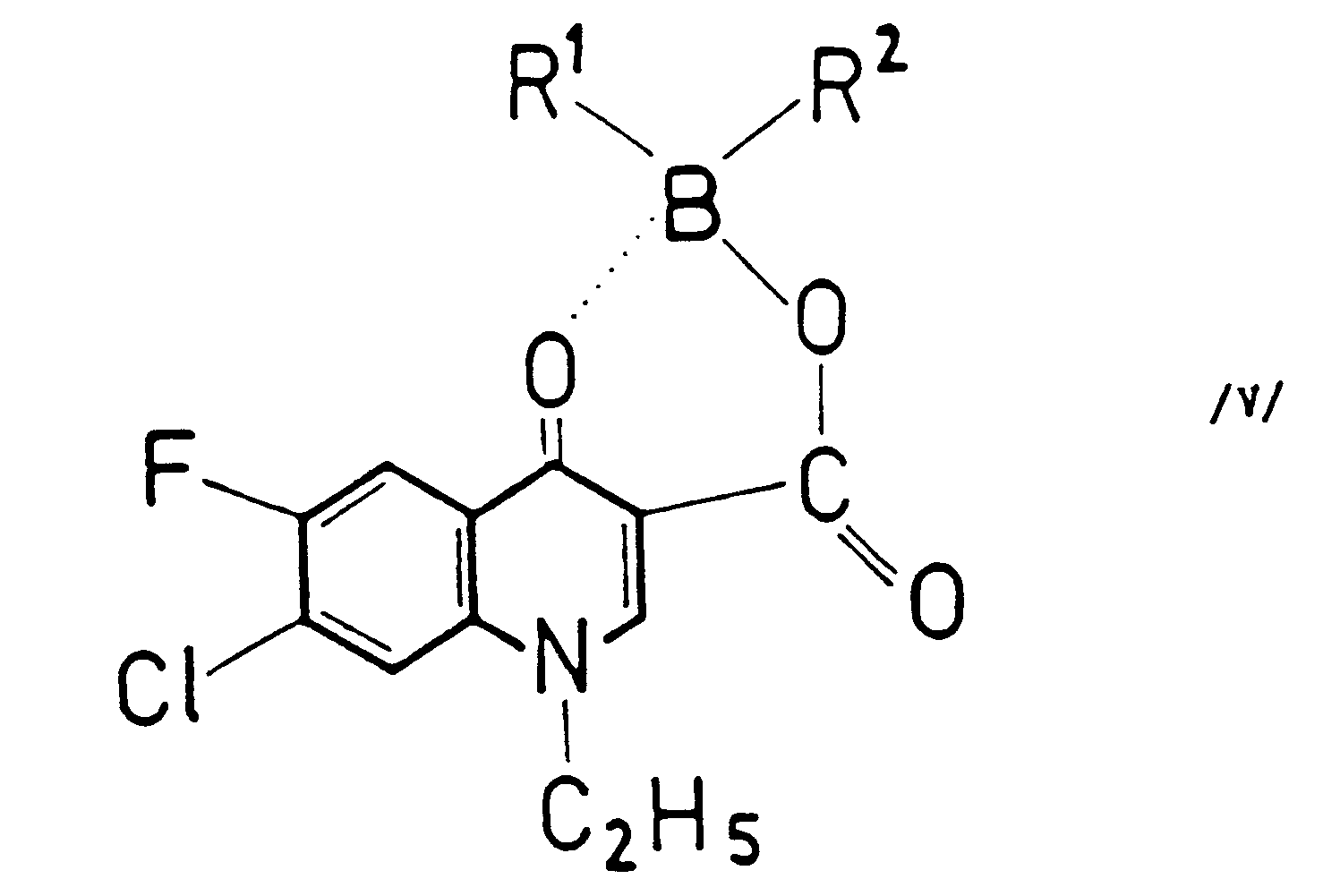
- a new process for the preparation of a compound of the Formula I wherein R stands for methyl, and pharmaceutically acceptable salts thereof, which comprises reacting a compound of the general Formula V (wherein R1 and R2 stand for an aliphatic acyloxy group comprising 2-6 carbon atoms and optionally substituted by halogen; or for an aromatic acyloxy group comprising 7-11 carbon atoms) with an amine of the Formula VI (wherein R has the same meaning as stated above) or a salt thereof and subjecting the compound of the general Formula VII thus obtained (wherein R, R1 and R2 are as stated above) to hydrolysis after or without isolation and, if desired, converting the compound of the Formula I thus obtained into a salt thereof or setting free the same from its salt.
- the advantage of the process of the present invention is that it enables the preparation of the compound of the Formula I in a simple manner, with a very high yield and in a short reaction time.
- R1 and R2 may be the same or different.
- the borate derivatives of the general Formulae V and VII are new compounds.
- the borate derivative of the general Formula VII is converted into the desired quinoline-3-carboxylic acid of the Formula I without isolation.
- the borate derivatives of the general Formula V can be reacted with the amine of the general Formula VI if desired in the presence of an inert organic solvent and an acid binding agent.
- an acid amide e.g. dimethyl formamide, dimethyl acetamide
- a ketone e.g. acetone, methyl ethyl ketone
- an ether e.g. dioxane, tetrahydrofuran, diethyl ether
- an ester e.g. ethyl acetate, methyl acetate, ethyl propionate
- a sulfoxide e.g. dimethyl sulfoxide
- an alcohol e.g. methanol, ethanol, 1-decanol, butanol
- an organic or inorganic base may be used. From the group of organic bases trialkyl amines (e.g. triethyl amine, tributyl amine), cyclic amines (e.g. pyridine, 1,5-diazabicyclo[5.4.0]undec-5-ene, 1,5-diazabicyclo[4.3.0]non-5-ene, 1,4-diazabicyclo-[2.2.2.]octane) can be mentioned, while as inorganic base preferably hydroxides or carbonates of alkali or alkaline earth metals can be applied.
- organic base e.g. triethyl amine, tributyl amine
- cyclic amines e.g. pyridine, 1,5-diazabicyclo[5.4.0]undec-5-ene, 1,5-diazabicyclo[4.3.0]non-5-ene, 1,4-diazabicyclo-[2.2.2.]octane
- the boron derivative of the general Formula V and the amine of the Formula VI can be reacted at a temperature of between 0 and 200°C, depending on the solvent used.
- the reaction time may vary between half an hour and 10 hours. The reaction time depends on the reaction temperature, too. If the reaction is carried out at a higher temperature, the reaction time can be shortened.
- the above reaction conditions are but preferable values and other conditions may be used as well.
- the borates of the general Formula VII can be hydrolysed to the desired quinoline-3-carboxylic acids of the Formula I, after or without isolation, under acidic or basic conditions.
- the compound of the general Formula VII precipitates from the reaction mixture e.g. on cooling and can be separated e.g. by filtration or centrifuging, if desired.
- Basic hydrolysis may be preferably carried out with the aid of a hydroxide or carbonate of an alkali metal or an alkaline earth metal hydroxide, used as aqueous solution.
- a hydroxide or carbonate of an alkali metal or an alkaline earth metal hydroxide used as aqueous solution.
- One may preferably use an aqueous solution of sodium hydroxide, potassium hydroxide, sodium carbonate, potassium hydrogen carbonate, potassium carbonate, calcium hydroxide.
- organic amines e.g. triethyl amine
- Acidic hydrolysis may preferably be accomplished by using an aqueous mineral acid.
- One may preferably proceed by hydrolysing a borate of the general Formula VII by heating with an aqueous solution of hydrochloric acid, hydrogen bromide, sulfuric acid or phosphoric acid.
- Hydrolysis may also be accomplished with the aid of an organic acid (e.g. acetic acid, propionic acid, etc.).
- Hydrolysis of the compounds of the general Formula VII may also be carried out in aqeous medium in the presence of a water-miscible organic solvent.
- alcohols e.g. methanol, ethanol
- a ketone e.g. acetone
- an ether e.g. dioxane
- an acid amide e.g. dimethyl formamide
- a sulfoxide e.g. dimethyl sulfoxide
- pyridine may be used.
- the quinoline-3-carboxylic acid of the Formula I thus obtained may be isolated e.g. by adjusting the pH value of the aqueous solution to a suitable value and separating the precipitated crystals e.g. by filtration or centrifuging by lyophylizing the aqueous reaction mixture.
- the compounds of the Formula I can be converted into pharmaceutically acceptable salts thereof in a known manner.
- acid addition salts can be formed, e.g. salts formed with hydrogen halides, sulfonic acid or organic acids.
- One may form preferably the chlorides, bromides, aryl sulfonates, methane sulfonates, maleates, fumarates, benzoates, etc.
- the compounds of the Formula I form salts with alkali or alkaline earth metals or other metal ions as well. Accordingly the sodium, potassium, magnesium, iron, copper salts, etc. may be prepared.
- the compounds of the Formula I and pharmaceutically acceptable salts thereof can be converted into the hydrates (e.g. hemihydrates, trihydrates, etc.) by methods known per se.
- the starting materials of the general Formula V can be prepared by reacting 1-ethyl-6-fluoro-7-chloro-4-oxo-1,4-dihydro-quinoline-3-carboxylic acid of the Formula II (Belgian patent No. 863,429) with a boron derivative (e.g. with a compound of the general Formula VIII [wherein R3, R4 and R5 stand for an alkyl group having 1-5 carbon atoms and optionally substituted by halogen or an aryl group comprising 6-10 carbon atoms]) optionally in an organic medium.
- a boron derivative e.g. with a compound of the general Formula VIII [wherein R3, R4 and R5 stand for an alkyl group having 1-5 carbon atoms and optionally substituted by halogen or an aryl group comprising 6-10 carbon atoms]
- a mixture of 9.3 g of boric acid and 70 g of propionic anhydride is stirred at 100°C for 15 minutes whereupon the temperature is raised to the boiling point. After half an hour the temperature is lowered to 110°C and 29.8 g of ethyl-1-ethyl-6-fluoro-7-chloro-4-oxo-1,4-dihydro-quinoline-3-carboxylate are added.
- the reaction mixture which turns into a thick suspension within some minutes, is heated at 110°C for 2 hours, cooled to room temperature and diluted with 300 ml of water. The reaction mixture is cooled and the precipitated crystals are filtered.
- reaction mixture is then allowed to cool to 80-90 °C and 126 ml of a 6 % by W/V aqueous solution of sodium hydroxide are added.
- the reaction mixture is mildly boiled for 1.5 hours, whereafter active charcoal is added and filtered.
- the pH of the solution is adjusted to 6.5 by adding 96 % by W/V acetic acid.
- the reaction mixture is kept at 0°C for half a day, whereafter the precipitated crystals are filtered and washed with water and methanol.
- 14.3 g (85.8 %) of 1-ethyl-6-fluoro-7-(4-methyl-piperazino)-4-oxo-1,4-dihydro-quinoline-3-carboxylic acid are obtained.
- the preparation of the starting material 9.3 g of boric acid and 54.1 g of acetic acid anhydride (95 %) are admixed and slowly heated and kept at 100°C for 30 minutes. 29.8 g of ethyl-(1-ethyl-6-fluoro-7-chloro-4-oxo-1,4-dihydro-quinoline-3-carboxylate are then added to the reaction mixture. Within some minutes the first crystals are precipitated, the suspension paste is stirred for 2 hours and cooled to 10°C and 100 ml of cold water are added and the precipitated crystals are filtered.
- reaction mixture 20 ml of an aqueous solution of 6 % by W/V sodium hydroxide are added and the reaction temperature is raised to 110°C within 30 minutes. The mixture is mildly boiled for a further half hour, it is filtered warm and cooled. The pH of the solution is adjusted to 7 by adding 96 % by W/V acetic acid. The reaction mixture is allowed to crystallize overnight in a refrigerator and the precipitated crystals are filtered and washed with some water, and beige crystals are obtained (2.8 g, 84 %).
Landscapes
- Chemical & Material Sciences (AREA)
- Organic Chemistry (AREA)
- Health & Medical Sciences (AREA)
- General Health & Medical Sciences (AREA)
- Veterinary Medicine (AREA)
- General Chemical & Material Sciences (AREA)
- Medicinal Chemistry (AREA)
- Nuclear Medicine, Radiotherapy & Molecular Imaging (AREA)
- Oncology (AREA)
- Pharmacology & Pharmacy (AREA)
- Life Sciences & Earth Sciences (AREA)
- Animal Behavior & Ethology (AREA)
- Communicable Diseases (AREA)
- Public Health (AREA)
- Chemical Kinetics & Catalysis (AREA)
- Pharmaceuticals Containing Other Organic And Inorganic Compounds (AREA)
- Plural Heterocyclic Compounds (AREA)
- Quinoline Compounds (AREA)
- Medicinal Preparation (AREA)
- Organic Low-Molecular-Weight Compounds And Preparation Thereof (AREA)
- Transition And Organic Metals Composition Catalysts For Addition Polymerization (AREA)
- Steroid Compounds (AREA)
- Investigating Or Analysing Biological Materials (AREA)
- Diaphragms For Electromechanical Transducers (AREA)
- Optical Fibers, Optical Fiber Cores, And Optical Fiber Bundles (AREA)
Abstract
Description
- This invention relates to a new process for the preparation of 1-ethyl-6-fluoro-7-(4-methyl-piperazino)-4-oxo-1,4-dihydroquinoline-3-carboxylic acid of the Formula I

wherein R stands for methyl, and pharmaceutically acceptable salts thereof. - It is known that the quinoline carboxylic acid derivatives are widespreadly used due to their high antibacterial activity for the treatment of diseases of the urinary tract and those of systemic bacterial origin (J. Pharm. Sci. 1984, 73, 1379; Eur. J. Chemother. Antibiot. 1983, 3, pages 9 and 47; J. Antimicrob. Chemother. 1984, 13, Suppl., 99, pages 107 and 113).
- The quinoline-carboxylic acid of the Formula I (wherein R stands for hydrogen) can be prepared by reacting 1-ethyl-6-fluoro-7-chloro-4-oxo-1,4-dihydro-quinoline-3-carboxylic acid and piperazine (Belgian patent specifications Nos. 863,429 and 870,576; Japanese patent specification No. 80-33,543 and J. Med. Chem. 23, 1358 [1980]) or by subjecting ethyl-1-ethyl-6-fluoro-7-piperazino-4-oxo-1,4-dihydroquinoline-3-carboxylate of the Formula III

to hydrolysis (Belgian patent specifications Nos. 879,106 and 890,223). - The common disadvantage of the above processes is that the exchange reaction of the chlorine atom in position 7 to piperazine is carried out under vigorous reaction conditions, at a temperature of 115-175°C, for 5-19 hours, optionally even under pressure. Moreover, the reaction is not regioselective and under the above reaction conditions the fluorine atom in position 6 partially reacts with piperazine (J. Med. Chem. 23, 1358[1980]).
- A process for producing quinoline-carboxylic acid derivatives is also disclosed by JP-A-59-122 470. A serious drawback of this process is that fluoroboric acid and boro-trifluoride are used, which are very corrosive and toxic and thus cause major difficulties in large scale production.
- Production of tricyclic oxazine derivatives containing quinoline-carboxylic acid structure within their molecule is disclosed by JP-A 60-78 986.
- The quinoline carboxylic acid of the Formula I, wherein R stands for methyl, may be prepared by reacting 1-ethyl-6-fluoro-7-chloro-4-oxo-1,4-dihydro-quinoline-3-carboxylic acid of the Formula II

with 1-methyl-piperazine (Belgian patents Nos. 870,576 and 870,917; Laid-open Japanese patent application No. 80-33,453 and J. Med. Chem. 23, 1358 [1980]) or by methylating 1-ethyl-6-fluoro-7-piperazino-4-oxo-1,4-dihydro-quinoline-3-carboxylic acid of the Formula IV
(Belgian patent No. 870,917 and FR-OS 2,424,919). The common disadvantage of the above processes is that the reactions are carried out under vigorous and agressive reaction conditions, at a temperature of between 110 and 150°C, during 7-16 hours. The yields vary between 55 % and 66 %. Moreover, the reaction mixture is worked up in a complicated manner. - According to the present invention there is provided a new process for the preparation of a compound of the Formula I, wherein R stands for methyl, and pharmaceutically acceptable salts thereof, which comprises reacting a compound of the general Formula V

(wherein R¹ and R² stand for an aliphatic acyloxy group comprising 2-6 carbon atoms and optionally substituted by halogen; or for an aromatic acyloxy group comprising 7-11 carbon atoms) with an amine of the Formula VI
(wherein R has the same meaning as stated above) or a salt thereof and subjecting the compound of the general Formula VII
thus obtained (wherein R, R¹ and R² are as stated above) to hydrolysis after or without isolation and, if desired, converting the compound of the Formula I thus obtained into a salt thereof or setting free the same from its salt. - The advantage of the process of the present invention is that it enables the preparation of the compound of the Formula I in a simple manner, with a very high yield and in a short reaction time.
- In the Formula V R¹ and R² may be the same or different.
- The borate derivatives of the general Formulae V and VII are new compounds.
- According to a preferred form of realization of the process of the present invention the borate derivative of the general Formula VII is converted into the desired quinoline-3-carboxylic acid of the Formula I without isolation.
- The borate derivatives of the general Formula V can be reacted with the amine of the general Formula VI if desired in the presence of an inert organic solvent and an acid binding agent.
- As inert organic solvent preferably an acid amide (e.g. dimethyl formamide, dimethyl acetamide), a ketone (e.g. acetone, methyl ethyl ketone), an ether ( e.g. dioxane, tetrahydrofuran, diethyl ether), an ester (e.g. ethyl acetate, methyl acetate, ethyl propionate), a sulfoxide (e.g. dimethyl sulfoxide), an alcohol (e.g. methanol, ethanol, 1-decanol, butanol) may be used.
- As acid binding agent an organic or inorganic base may be used. From the group of organic bases trialkyl amines (e.g. triethyl amine, tributyl amine), cyclic amines (e.g. pyridine, 1,5-diazabicyclo[5.4.0]undec-5-ene, 1,5-diazabicyclo[4.3.0]non-5-ene, 1,4-diazabicyclo-[2.2.2.]octane) can be mentioned, while as inorganic base preferably hydroxides or carbonates of alkali or alkaline earth metals can be applied. Thus, as acid binding agent advantageously potassium carbonate, potassium hydrogen carbonate, sodium hydroxide, calcium hydroxide, etc. or an excess of the amine of the Formula VI can be used.
- The boron derivative of the general Formula V and the amine of the Formula VI can be reacted at a temperature of between 0 and 200°C, depending on the solvent used. The reaction time may vary between half an hour and 10 hours. The reaction time depends on the reaction temperature, too. If the reaction is carried out at a higher temperature, the reaction time can be shortened. The above reaction conditions are but preferable values and other conditions may be used as well.
- The borates of the general Formula VII can be hydrolysed to the desired quinoline-3-carboxylic acids of the Formula I, after or without isolation, under acidic or basic conditions. The compound of the general Formula VII precipitates from the reaction mixture e.g. on cooling and can be separated e.g. by filtration or centrifuging, if desired.
- Basic hydrolysis may be preferably carried out with the aid of a hydroxide or carbonate of an alkali metal or an alkaline earth metal hydroxide, used as aqueous solution. One may preferably use an aqueous solution of sodium hydroxide, potassium hydroxide, sodium carbonate, potassium hydrogen carbonate, potassium carbonate, calcium hydroxide. However, organic amines (e.g. triethyl amine) may also be applied in the hydrolysis step.
- Acidic hydrolysis may preferably be accomplished by using an aqueous mineral acid. One may preferably proceed by hydrolysing a borate of the general Formula VII by heating with an aqueous solution of hydrochloric acid, hydrogen bromide, sulfuric acid or phosphoric acid. Hydrolysis may also be accomplished with the aid of an organic acid (e.g. acetic acid, propionic acid, etc.). Hydrolysis of the compounds of the general Formula VII may also be carried out in aqeous medium in the presence of a water-miscible organic solvent. For this purpose e.g. alcohols (e.g. methanol, ethanol), a ketone (e.g. acetone), an ether (e.g. dioxane), an acid amide (e.g. dimethyl formamide), a sulfoxide (e.g. dimethyl sulfoxide), or pyridine may be used.
- The quinoline-3-carboxylic acid of the Formula I thus obtained may be isolated e.g. by adjusting the pH value of the aqueous solution to a suitable value and separating the precipitated crystals e.g. by filtration or centrifuging by lyophylizing the aqueous reaction mixture.
- The compounds of the Formula I can be converted into pharmaceutically acceptable salts thereof in a known manner. Thus, preferably acid addition salts can be formed, e.g. salts formed with hydrogen halides, sulfonic acid or organic acids. One may form preferably the chlorides, bromides, aryl sulfonates, methane sulfonates, maleates, fumarates, benzoates, etc. The compounds of the Formula I form salts with alkali or alkaline earth metals or other metal ions as well. Accordingly the sodium, potassium, magnesium, iron, copper salts, etc. may be prepared.
- The compounds of the Formula I and pharmaceutically acceptable salts thereof can be converted into the hydrates (e.g. hemihydrates, trihydrates, etc.) by methods known per se.
- According to a further aspect of the present invention there are provided new compounds of the general Formula VII (wherein R, R¹ and R² are as stated above).
- The starting materials of the general Formula V can be prepared by reacting 1-ethyl-6-fluoro-7-chloro-4-oxo-1,4-dihydro-quinoline-3-carboxylic acid of the Formula II (Belgian patent No. 863,429) with a boron derivative (e.g. with a compound of the general Formula VIII

[wherein R³, R⁴ and R⁵ stand for an alkyl group having 1-5 carbon atoms and optionally substituted by halogen or an aryl group comprising 6-10 carbon atoms]) optionally in an organic medium. - Further details of the present invention are to be found in the following Examples without limiting the scope of protection to the said Examples.
- 19.5 g of 1-ethyl-6-fluoro-7-chloro-4-oxo-1,4-dihydroquinoline-3-carboxylic acid-boron-di(propionyloxy)-anhydride and 13.3 g of 4-methyl-piperazine are reacted in 72 ml of dimethyl sulfoxide at 110°C for 2 hours. The reaction mixture is cooled to 90°C and 116 ml of a 6 weight/vol. % aqueous sodium hydroxide solution are added. The aqueous reaction mixture is kept for an hour under slight boiling and cooled to room temperature. The pH value of the solution is adjusted to 7 with a 96 weight/vol % acetic acid. The reaction mixture is allowed to crystallize in-a refrigerator, after 5 hours the precipitated crystals are filtered, washed with water and dried at 85°C in vacuo until constant weight. Thus 13.9 g of 1-ethyl-6-fluoro-7-(4-methyl-piperazino)-4-oxo-1,4-dihydro-quinoline-3-carboxylic acid are obtained. (The product decomposes at 269-271°C from a mixture of dimethyl formamide and methanol).
Analysis for the Formula C₁₇H₂₀FN₃O₃ calculated C = 61.25 %, H = 6.05 %, N = 12.60 %; found C = 61.37 %, H = 5.91 %, N = 12.45 %. - 2 g of 1-ethyl-6-fluoro-7-(4-methyl-piperazino)-4-oxo-1,4-dihydro-quinoline-3-carboxylic acid are heated in 30 ml of anhydrous ethanol to boiling and to the boiling solution 0.61 g of methanesulfonic acid are added. From the solution thus obtained the precipitation of crystals begins within some minutes. After 10 minutes the reaction mixture is cooled to 0°C and allowed to crystallize in a refrigerator overnight. Next day the precipitated crystals are filtered, washed with ethanol and dried in vacuo at 90-95°C until constant weight. Thus 2.3 g of the methanesulfonic acid salt of 1-ethyl-6-fluoro-7-(4-methyl-1-piperazino)-4-oxo-1,4-dihydro-quinoline-3-carboxylic acid are obtained, yield 89.3 %. The product decomposes at 285-287°C.
Analysis for the Formula C₁₈H₂₄FN₃O₆S calculated C = 50.34 %, H = 5.63 %, N = 9.78 %; found C = 50.12 %, H = 5.81 %, N = 9.79 %.
The starting material may be prepared as follows: - A mixture of 9.3 g of boric acid and 70 g of propionic anhydride is stirred at 100°C for 15 minutes whereupon the temperature is raised to the boiling point. After half an hour the temperature is lowered to 110°C and 29.8 g of ethyl-1-ethyl-6-fluoro-7-chloro-4-oxo-1,4-dihydro-quinoline-3-carboxylate are added. The reaction mixture, which turns into a thick suspension within some minutes, is heated at 110°C for 2 hours, cooled to room temperature and diluted with 300 ml of water. The reaction mixture is cooled and the precipitated crystals are filtered. Thus 41.5 g of 1-ethyl-6-fluoro-7-chloro-4-oxo-1,4-dihydro-quinoline-3-carboxylic acid-boron-di(propionyloxy)-anhydride are obtained, yield 97.7 %.
The product decomposes at 252°C.Analysis for the Formula C₁₈H₁₈BFClNO₇ calculated C = 50.79 %, H = 4.26 %, N = 3.29 %. found C = 50.94 %, H = 4.15 %, N = 3.41 %. - 19.9 g of (1-ethyl-6-fluoro-7-chloro-4-oxo-1,4-dihydroquinoline-3-carboxylate-0³,0⁴)-bis(acetate-0)-boron and 15.0 g of 1-methyl piperazine are reacted in 100 ml dimethylsulfoxide at 110-115°C for 2 hours.
- The reaction mixture is then allowed to cool to 80-90 °C and 126 ml of a 6 % by W/V aqueous solution of sodium hydroxide are added. The reaction mixture is mildly boiled for 1.5 hours, whereafter active charcoal is added and filtered. After cooling to room temperature the pH of the solution is adjusted to 6.5 by adding 96 % by W/V acetic acid. The reaction mixture is kept at 0°C for half a day, whereafter the precipitated crystals are filtered and washed with water and methanol. Thus 14.3 g (85.8 %) of 1-ethyl-6-fluoro-7-(4-methyl-piperazino)-4-oxo-1,4-dihydro-quinoline-3-carboxylic acid are obtained.
- Decomposition at 268-270°C (from a mixture of dimethylformamide and methanol). No depression of melting point is obtained when admixing the product with the compound obtained according to Example 2.
- The preparation of the starting material:
9.3 g of boric acid and 54.1 g of acetic acid anhydride (95 %) are admixed and slowly heated and kept at 100°C for 30 minutes. 29.8 g of ethyl-(1-ethyl-6-fluoro-7-chloro-4-oxo-1,4-dihydro-quinoline-3-carboxylate are then added to the reaction mixture. Within some minutes the first crystals are precipitated, the suspension paste is stirred for 2 hours and cooled to 10°C and 100 ml of cold water are added and the precipitated crystals are filtered. Thus 38.7 g (97,5 %) of (1-ethyl-6-fluoro-7-chloro-4-oxo-1,4-dihydro-3-quinoline-carboxylate-0³,0⁴)-bis(acetate)-0)-boron are obtained, decomposing at 278°C.Analysis for the formula C₁₆H₁₄BClFNO₇ calculated C = 48.35 % H = 3.55 % N = 3.52 % found C = 48.49 % H = 3.46 % N = 3.71 %. - 3.97 g of (1-ethyl-6-fluoro-7-chloro-4-oxo-1,4-dihydroquinoline-3-carboxylate-0³,0⁴)-bis-(acetate-0)-boron and 3.00 g of 1-methyl-piperazine are reacted in 40 ml of dimethylsulfoxide for 250 hours at 25°C.
- To the reaction mixture 20 ml of an aqueous solution of 6 % by W/V sodium hydroxide are added and the reaction temperature is raised to 110°C within 30 minutes. The mixture is mildly boiled for a further half hour, it is filtered warm and cooled. The pH of the solution is adjusted to 7 by adding 96 % by W/V acetic acid. The reaction mixture is allowed to crystallize overnight in a refrigerator and the precipitated crystals are filtered and washed with some water, and beige crystals are obtained (2.8 g, 84 %). After recrystallization from a mixture of dimethylformamide and methanol 1-ethyl-6-fluoro-4-oxo-7-(1-methyl-piperazino)-1,4-dihydro-quinoline-3-carboxylic acid is obtained, decomposing at 267-269°C after drying to constant weight at 90-95°C in vacuo. No melting point depression is obtained when admixed with the product of Example 1 at any ratio.
Claims (10)
- Process for the preparation of a compound of the Formula I



- Process according to Claim 1 which comprises reacting a compound of the general Formula V with an amine of the Formula VI in the presence of an organic solvent, preferably an acid amide, sulfoxide, ketone, alcohol, ether or ester.
- Process according to Claim 2 which comprises using dimethyl sulfoxide as organic solvent.
- Process according to Claim 1 which comprises carrying out the reaction of the general Formulae V and VI in the presence of an acid binding agent.
- Process according to Claim 4 which comprises using an amine or an excess of the compound of the general Formula VI as acid binding agent.
- Process according to Claim 1 which comprises carrying out hydrolysis in acidic medium.
- Process according to Claim 6 which comprises carrying out the reaction by using an organic or inorganic acid, preferably hydrochloric acid, sulfuric acid or acetic acid.
- Process according to Claim 1 which comprises carrying out hydrolysis in alkaline medium.
- Process according to Claim 8 which comprises using an alkali metal hydroxide, an alkaline earth metal hydroxide or an organic base, preferably an aqueous triethyl amine solution.
- Compounds of the general Formula VII

Applications Claiming Priority (5)
| Application Number | Priority Date | Filing Date | Title |
|---|---|---|---|
| HU854695A HU196783B (en) | 1985-12-09 | 1985-12-09 | Process for production of quinoline carbonic acid |
| HU469485 | 1985-12-09 | ||
| HU469485A HU195801B (en) | 1985-12-09 | 1985-12-09 | Process for producing 1-ethyl-6-fluoro-7-piperazino-4-oxo-1,4-dihydro-quinoline-3-carboxylic acid |
| HU469585 | 1985-12-09 | ||
| EP87900247A EP0249620B1 (en) | 1985-12-09 | 1986-12-09 | Process for the preparation of quinoline carboxylic acids |
Related Parent Applications (1)
| Application Number | Title | Priority Date | Filing Date |
|---|---|---|---|
| EP87900247.5 Division | 1987-06-30 |
Publications (2)
| Publication Number | Publication Date |
|---|---|
| EP0351889A1 EP0351889A1 (en) | 1990-01-24 |
| EP0351889B1 true EP0351889B1 (en) | 1994-06-29 |
Family
ID=26317793
Family Applications (2)
| Application Number | Title | Priority Date | Filing Date |
|---|---|---|---|
| EP89116178A Expired - Lifetime EP0351889B1 (en) | 1985-12-09 | 1986-12-09 | Process for the preparation of a quinoline carboxylic acid |
| EP87900247A Expired - Lifetime EP0249620B1 (en) | 1985-12-09 | 1986-12-09 | Process for the preparation of quinoline carboxylic acids |
Family Applications After (1)
| Application Number | Title | Priority Date | Filing Date |
|---|---|---|---|
| EP87900247A Expired - Lifetime EP0249620B1 (en) | 1985-12-09 | 1986-12-09 | Process for the preparation of quinoline carboxylic acids |
Country Status (13)
| Country | Link |
|---|---|
| US (1) | US4981966A (en) |
| EP (2) | EP0351889B1 (en) |
| JP (1) | JPH0768219B2 (en) |
| KR (1) | KR940008287B1 (en) |
| AT (2) | ATE82569T1 (en) |
| CA (1) | CA1306750C (en) |
| CS (1) | CS264345B2 (en) |
| DK (2) | DK412287A (en) |
| FI (1) | FI86419C (en) |
| NO (1) | NO170154C (en) |
| SU (1) | SU1722228A3 (en) |
| WO (1) | WO1987003587A1 (en) |
| YU (1) | YU45810B (en) |
Families Citing this family (12)
| Publication number | Priority date | Publication date | Assignee | Title |
|---|---|---|---|---|
| US5294712A (en) * | 1985-12-09 | 1994-03-15 | Chinoin Gyogyszer Es Vegyeszeti Termekek Gyara Rt. | Process for the preparation of quinoline carboxylic acids |
| YU46451B (en) * | 1987-04-08 | 1993-10-20 | Chinoin Gyogyszer Es Vegyeszeti Ter Mekek Gyara Rt. | PROCESS FOR PREPARATION OF MIXED ANHYDRIDS OF QUINOLINE-CARBOXYL AND BORIC ACID |
| US5380845A (en) * | 1987-06-24 | 1995-01-10 | Chinoin Gyogyszer- Es Vegyeszeti Termekek Gyara Rt. | Process for the preparation of quinoline carboxylic acid derivatives |
| HU203746B (en) * | 1988-12-22 | 1991-09-30 | Chinoin Gyogyszer Es Vegyeszet | Process for producing quinoline-carboxylic acid derivatives |
| KR900014383A (en) * | 1989-03-29 | 1990-10-23 | 원본미기재 | Pyrroloquinoline derivatives, preparation method thereof and antibacterial agent using same |
| ES2049636B1 (en) * | 1992-04-15 | 1994-12-16 | Genesis Para La Investigacion | PROCEDURE FOR THE PREPARATION OF QUINOLINCARBOXILIC ACID DERIVATIVES. |
| WO1993025545A1 (en) * | 1992-06-09 | 1993-12-23 | Korea Research Institute Of Chemical Technology | Novel quinoline derivatives and processes for preparing the same |
| ES2077490B1 (en) * | 1992-11-18 | 1996-10-16 | Marga Investigacion | TRIMETILSILILIC ESTERS AND SOLVATES OF CHELATES OF QUINOLIN-3-CARBOXYL ACIDS. PREPARATION AND APPLICATION TO THE QUINOLON PROCESS. |
| US5440061A (en) * | 1994-03-29 | 1995-08-08 | The Procter & Gamble Company | Hydrolysis of methyl esters in dimethylsulfoxide for production of fatty acids |
| ES2092963B1 (en) * | 1995-04-12 | 1997-12-16 | Sint Quimica Sa | PROCEDURE FOR THE PREPARATION OF ACID 1-CICLOPROPIL-6-FLUORO-1, 4-DIHIDRO-7- (1S, 4S) -5-METHYL-2,5-DIAZABICICLO (2.2.1) HEPT-2-IL) -4 -OXO-3-QUINOLINCARBOXILICO AND ITS SALTS. |
| CN113135854A (en) * | 2021-04-23 | 2021-07-20 | 海南通用三洋药业有限公司 | Synthesis method and application of pefloxacin mesylate |
| CN119264049A (en) * | 2024-09-30 | 2025-01-07 | 中南大学 | A kind of synthetic method of norfloxacin |
Family Cites Families (22)
| Publication number | Priority date | Publication date | Assignee | Title |
|---|---|---|---|---|
| JPS53141286A (en) * | 1977-05-16 | 1978-12-08 | Kyorin Seiyaku Kk | Novel substituted quinolinecarboxylic acid |
| JPS54138582A (en) | 1978-04-19 | 1979-10-27 | Kyorin Seiyaku Kk | Substituted quinolinecarboxylic acid |
| FR2424919B1 (en) | 1978-05-03 | 1980-10-31 | Kyorin Seiyaku Kk | SUBSTITUTED QUINOLEINECARBOXYLIC ACID AND DERIVATIVES THEREOF AND THEIR USE AS ANTIBACTERIAL AGENTS |
| JPS5533543A (en) | 1978-08-31 | 1980-03-08 | Matsushita Electric Works Ltd | Container for preservation under reduced pressure |
| JPS5533453A (en) | 1978-08-31 | 1980-03-08 | Dainippon Pharmaceut Co Ltd | Preventive and remedy for infectious disease of fish |
| JPS5845426B2 (en) | 1978-09-29 | 1983-10-08 | 杏林製薬株式会社 | Substituted quinoline carboxylic acid derivatives |
| JPS5560906A (en) * | 1978-10-31 | 1980-05-08 | Fujitsu Ltd | Luminous flux matching device |
| JPS5746986A (en) | 1980-09-02 | 1982-03-17 | Dai Ichi Seiyaku Co Ltd | Pyrido(1,2,3-de)(1,4)benzoxazine derivative |
| JPS5762259A (en) | 1980-09-05 | 1982-04-15 | Kyorin Pharmaceut Co Ltd | Preparation of substituted quinolinecarboxylic acid derivative |
| JPS5932767B2 (en) * | 1980-10-27 | 1984-08-10 | 日本電信電話株式会社 | Optical fiber V-groove connector |
| JPS57139711A (en) * | 1981-02-25 | 1982-08-28 | Mitsubishi Rayon Co Ltd | Flat plate optical waveguide |
| JPS5829789A (en) | 1981-08-17 | 1983-02-22 | Dai Ichi Seiyaku Co Ltd | Pyridobenzoxazine derivative and its preparation |
| JPS5843977A (en) | 1981-09-09 | 1983-03-14 | Dai Ichi Seiyaku Co Ltd | Preparation of pyridobenzoxazine derivative |
| JPS58184817A (en) * | 1982-02-26 | 1983-10-28 | Yokogawa Hewlett Packard Ltd | Delay circuit |
| EP0090424B1 (en) * | 1982-03-31 | 1986-05-28 | Sterling Drug Inc. | New quinolone compounds and preparation thereof |
| JPS5921528A (en) * | 1982-07-27 | 1984-02-03 | Sankyo Kasei Kk | Manufacture of iron disulfide |
| JPS5980683A (en) * | 1982-10-30 | 1984-05-10 | Koei Chem Co Ltd | 6-fluoro-1,8-naphthyridine derivative and its preparation |
| JPS59122470A (en) | 1982-12-27 | 1984-07-14 | Dai Ichi Seiyaku Co Ltd | Preparation of quinoline-3-carboxylic acid derivative |
| DE3475229D1 (en) * | 1983-03-28 | 1988-12-22 | Polaroid Corp | An optical component for use in fiber optic communication systems |
| AU553415B2 (en) * | 1983-09-19 | 1986-07-17 | Abbott Japan Co., Ltd. | 6-fluoro-1-4-dihydro-4-oxo-7-substituted piperazinyl- quinoline-3-carboxylic acids |
| JPS6078986A (en) | 1983-10-07 | 1985-05-04 | Dai Ichi Seiyaku Co Ltd | Preparation of oxazine derivative |
| HU196415B (en) * | 1985-12-09 | 1988-11-28 | Chinoin Gyogyszer Es Vegyeszet | Process for preparing quinoline carboxylic acid boric acid anhydrides |
-
1986
- 1986-12-08 CA CA000524724A patent/CA1306750C/en not_active Expired - Lifetime
- 1986-12-09 CS CS869091A patent/CS264345B2/en not_active IP Right Cessation
- 1986-12-09 EP EP89116178A patent/EP0351889B1/en not_active Expired - Lifetime
- 1986-12-09 AT AT87900247T patent/ATE82569T1/en not_active IP Right Cessation
- 1986-12-09 AT AT89116178T patent/ATE107920T1/en not_active IP Right Cessation
- 1986-12-09 WO PCT/HU1986/000069 patent/WO1987003587A1/en not_active Ceased
- 1986-12-09 JP JP62500206A patent/JPH0768219B2/en not_active Expired - Lifetime
- 1986-12-09 YU YU210686A patent/YU45810B/en unknown
- 1986-12-09 KR KR1019870700686A patent/KR940008287B1/en not_active Expired - Fee Related
- 1986-12-09 EP EP87900247A patent/EP0249620B1/en not_active Expired - Lifetime
-
1987
- 1987-08-03 NO NO873248A patent/NO170154C/en unknown
- 1987-08-04 FI FI873380A patent/FI86419C/en not_active IP Right Cessation
- 1987-08-07 SU SU874203111A patent/SU1722228A3/en active
- 1987-08-07 DK DK412287A patent/DK412287A/en not_active Application Discontinuation
-
1989
- 1989-01-10 US US07/295,439 patent/US4981966A/en not_active Expired - Fee Related
- 1989-11-13 DK DK568389A patent/DK568389A/en not_active Application Discontinuation
Also Published As
| Publication number | Publication date |
|---|---|
| FI86419B (en) | 1992-05-15 |
| CS909186A2 (en) | 1988-07-15 |
| DK568389D0 (en) | 1989-11-13 |
| NO873248D0 (en) | 1987-08-03 |
| EP0249620B1 (en) | 1992-11-19 |
| SU1722228A3 (en) | 1992-03-23 |
| CA1306750C (en) | 1992-08-25 |
| WO1987003587A1 (en) | 1987-06-18 |
| DK412287D0 (en) | 1987-08-07 |
| FI873380A7 (en) | 1987-08-04 |
| EP0351889A1 (en) | 1990-01-24 |
| NO170154B (en) | 1992-06-09 |
| DK568389A (en) | 1989-11-13 |
| US4981966A (en) | 1991-01-01 |
| DK412287A (en) | 1987-08-07 |
| YU45810B (en) | 1992-07-20 |
| ATE107920T1 (en) | 1994-07-15 |
| JPS63502428A (en) | 1988-09-14 |
| KR880700793A (en) | 1988-04-12 |
| YU210686A (en) | 1987-12-31 |
| ATE82569T1 (en) | 1992-12-15 |
| EP0249620A1 (en) | 1987-12-23 |
| JPH0768219B2 (en) | 1995-07-26 |
| NO873248L (en) | 1987-08-03 |
| FI873380A0 (en) | 1987-08-04 |
| FI86419C (en) | 1992-08-25 |
| NO170154C (en) | 1992-09-16 |
| KR940008287B1 (en) | 1994-09-10 |
| CS264345B2 (en) | 1989-07-12 |
Similar Documents
| Publication | Publication Date | Title |
|---|---|---|
| EP0249620B1 (en) | Process for the preparation of quinoline carboxylic acids | |
| EP0309537B1 (en) | Process for the preparation of quinoline carboxylic acids | |
| KR970005911B1 (en) | Process for preparing quinoline carboxylic acid derivatives | |
| EP0250535B1 (en) | Norfloxacin intermediate | |
| EP0248876B1 (en) | Process for the preparation of 1-methylamino-quinoline-carboxylic acid derivatives | |
| US5294712A (en) | Process for the preparation of quinoline carboxylic acids | |
| JP2825641B2 (en) | Method for producing quinoline carboxylic acid derivative | |
| US5284950A (en) | Process for the preparation of quinoline carboxyolic acids | |
| RU2049783C1 (en) | Method of synthesis of quinoline carboxylic acid derivatives or their pharmaceutically acceptable salts | |
| NZ224150A (en) | Preparation of piperazinyl-substituted quinoline derivatives | |
| WO1987003594A1 (en) | Amifloxacine intermediate | |
| US5380845A (en) | Process for the preparation of quinoline carboxylic acid derivatives | |
| RU2002744C1 (en) | Method of synthesis of 1-substituted 6-fluoro-4-oxo-7-(1- piperazinyl)-1,4- -dihydroquinoline-3-carboxylic acid | |
| HK1003996B (en) | Process for the preparation of quinoline carboxylic acids | |
| HU195801B (en) | Process for producing 1-ethyl-6-fluoro-7-piperazino-4-oxo-1,4-dihydro-quinoline-3-carboxylic acid | |
| NO172743B (en) | PROCEDURE FOR THE PREPARATION OF QUINOLINCARBOXYLIC ACID DERIVATIVES | |
| HU198728B (en) | Process for the preparation of quinoline carboxylic acid derivatives |
Legal Events
| Date | Code | Title | Description |
|---|---|---|---|
| PUAI | Public reference made under article 153(3) epc to a published international application that has entered the european phase |
Free format text: ORIGINAL CODE: 0009012 |
|
| AC | Divisional application: reference to earlier application |
Ref document number: 249620 Country of ref document: EP |
|
| AK | Designated contracting states |
Kind code of ref document: A1 Designated state(s): AT CH FR IT LI NL SE |
|
| RAP3 | Party data changed (applicant data changed or rights of an application transferred) |
Owner name: CHINOIN GYOGYSZER ES VEGYESZETI TERMEKEK GYARA RT. |
|
| 17P | Request for examination filed |
Effective date: 19900710 |
|
| 17Q | First examination report despatched |
Effective date: 19920615 |
|
| GRAA | (expected) grant |
Free format text: ORIGINAL CODE: 0009210 |
|
| AC | Divisional application: reference to earlier application |
Ref document number: 249620 Country of ref document: EP |
|
| AK | Designated contracting states |
Kind code of ref document: B1 Designated state(s): AT CH FR IT LI NL SE |
|
| REF | Corresponds to: |
Ref document number: 107920 Country of ref document: AT Date of ref document: 19940715 Kind code of ref document: T |
|
| ET | Fr: translation filed | ||
| ITF | It: translation for a ep patent filed | ||
| EAL | Se: european patent in force in sweden |
Ref document number: 89116178.8 |
|
| RAP4 | Party data changed (patent owner data changed or rights of a patent transferred) |
Owner name: CHINOIN GYOGYSZER ES VEGYESZETI TERMEKEK GYARA RT. |
|
| PLBE | No opposition filed within time limit |
Free format text: ORIGINAL CODE: 0009261 |
|
| STAA | Information on the status of an ep patent application or granted ep patent |
Free format text: STATUS: NO OPPOSITION FILED WITHIN TIME LIMIT |
|
| 26N | No opposition filed | ||
| PGFP | Annual fee paid to national office [announced via postgrant information from national office to epo] |
Ref country code: AT Payment date: 19981210 Year of fee payment: 13 |
|
| PGFP | Annual fee paid to national office [announced via postgrant information from national office to epo] |
Ref country code: SE Payment date: 19981215 Year of fee payment: 13 |
|
| PGFP | Annual fee paid to national office [announced via postgrant information from national office to epo] |
Ref country code: FR Payment date: 19981228 Year of fee payment: 13 |
|
| PGFP | Annual fee paid to national office [announced via postgrant information from national office to epo] |
Ref country code: NL Payment date: 19981231 Year of fee payment: 13 |
|
| PGFP | Annual fee paid to national office [announced via postgrant information from national office to epo] |
Ref country code: CH Payment date: 19990318 Year of fee payment: 13 |
|
| PG25 | Lapsed in a contracting state [announced via postgrant information from national office to epo] |
Ref country code: AT Free format text: LAPSE BECAUSE OF NON-PAYMENT OF DUE FEES Effective date: 19991209 |
|
| PG25 | Lapsed in a contracting state [announced via postgrant information from national office to epo] |
Ref country code: SE Free format text: LAPSE BECAUSE OF NON-PAYMENT OF DUE FEES Effective date: 19991210 |
|
| PG25 | Lapsed in a contracting state [announced via postgrant information from national office to epo] |
Ref country code: LI Free format text: LAPSE BECAUSE OF NON-PAYMENT OF DUE FEES Effective date: 19991231 Ref country code: CH Free format text: LAPSE BECAUSE OF NON-PAYMENT OF DUE FEES Effective date: 19991231 |
|
| PG25 | Lapsed in a contracting state [announced via postgrant information from national office to epo] |
Ref country code: NL Free format text: LAPSE BECAUSE OF NON-PAYMENT OF DUE FEES Effective date: 20000701 |
|
| EUG | Se: european patent has lapsed |
Ref document number: 89116178.8 |
|
| PG25 | Lapsed in a contracting state [announced via postgrant information from national office to epo] |
Ref country code: FR Free format text: LAPSE BECAUSE OF NON-PAYMENT OF DUE FEES Effective date: 20000831 |
|
| NLV4 | Nl: lapsed or anulled due to non-payment of the annual fee |
Effective date: 20000701 |
|
| REG | Reference to a national code |
Ref country code: FR Ref legal event code: ST |
|
| PG25 | Lapsed in a contracting state [announced via postgrant information from national office to epo] |
Ref country code: IT Free format text: LAPSE BECAUSE OF NON-PAYMENT OF DUE FEES;WARNING: LAPSES OF ITALIAN PATENTS WITH EFFECTIVE DATE BEFORE 2007 MAY HAVE OCCURRED AT ANY TIME BEFORE 2007. THE CORRECT EFFECTIVE DATE MAY BE DIFFERENT FROM THE ONE RECORDED. Effective date: 20051209 |