EP0349990A2 - Videoplattenspieler mit einer Klemmschaltung für MUSE-Signale - Google Patents
Videoplattenspieler mit einer Klemmschaltung für MUSE-Signale Download PDFInfo
- Publication number
- EP0349990A2 EP0349990A2 EP89112217A EP89112217A EP0349990A2 EP 0349990 A2 EP0349990 A2 EP 0349990A2 EP 89112217 A EP89112217 A EP 89112217A EP 89112217 A EP89112217 A EP 89112217A EP 0349990 A2 EP0349990 A2 EP 0349990A2
- Authority
- EP
- European Patent Office
- Prior art keywords
- signal
- muse
- video disc
- disc player
- clamp
- Prior art date
- Legal status (The legal status is an assumption and is not a legal conclusion. Google has not performed a legal analysis and makes no representation as to the accuracy of the status listed.)
- Withdrawn
Links
- 229940028444 muse Drugs 0.000 title claims abstract description 75
- GMVPRGQOIOIIMI-DWKJAMRDSA-N prostaglandin E1 Chemical group CCCCC[C@H](O)\C=C\[C@H]1[C@H](O)CC(=O)[C@@H]1CCCCCCC(O)=O GMVPRGQOIOIIMI-DWKJAMRDSA-N 0.000 title claims abstract description 71
- 238000001514 detection method Methods 0.000 claims abstract description 7
- 230000006835 compression Effects 0.000 claims description 4
- 238000007906 compression Methods 0.000 claims description 4
- 238000005070 sampling Methods 0.000 claims description 4
- 230000010354 integration Effects 0.000 claims description 2
- 238000010586 diagram Methods 0.000 description 6
- 238000006243 chemical reaction Methods 0.000 description 3
- 230000005540 biological transmission Effects 0.000 description 2
- 230000000694 effects Effects 0.000 description 2
- 239000003990 capacitor Substances 0.000 description 1
- 230000003111 delayed effect Effects 0.000 description 1
- 239000000284 extract Substances 0.000 description 1
- 230000003287 optical effect Effects 0.000 description 1
- 238000000926 separation method Methods 0.000 description 1
Images
Classifications
-
- G—PHYSICS
- G11—INFORMATION STORAGE
- G11B—INFORMATION STORAGE BASED ON RELATIVE MOVEMENT BETWEEN RECORD CARRIER AND TRANSDUCER
- G11B7/00—Recording or reproducing by optical means, e.g. recording using a thermal beam of optical radiation by modifying optical properties or the physical structure, reproducing using an optical beam at lower power by sensing optical properties; Record carriers therefor
-
- H—ELECTRICITY
- H04—ELECTRIC COMMUNICATION TECHNIQUE
- H04N—PICTORIAL COMMUNICATION, e.g. TELEVISION
- H04N9/00—Details of colour television systems
- H04N9/79—Processing of colour television signals in connection with recording
- H04N9/87—Regeneration of colour television signals
-
- H—ELECTRICITY
- H04—ELECTRIC COMMUNICATION TECHNIQUE
- H04N—PICTORIAL COMMUNICATION, e.g. TELEVISION
- H04N9/00—Details of colour television systems
- H04N9/79—Processing of colour television signals in connection with recording
- H04N9/797—Processing of colour television signals in connection with recording for recording the signal in a plurality of channels, the bandwidth of each channel being less than the bandwidth of the signal
Definitions
- the present invention relates generally to a video disc player, and more particularly, to a high-definition video disk player containing a clamping circuit for accurately clamping a clamp level signal multiplexed on a MUSE signal reproduced from a video disc at predetermined timing.
- a high-definition video disc player for optically reproducing high-definition video information recorded on a video disc.
- a high-definition video signal is subjected to bandwidth compression by a TCI (Time Compressed Integration) multiple sub-nyquist sampling encoding system, i.e., a MUSE converting system, to be recorded on such a video disc.
- TCI Time Compressed Integration
- MUSE converting system is described in an article by Y. Ninomiya et al., entitled “BROADCASTING AND TRANSMISSION SYSTEM-MUSE", Technical Papers of Third International Colloquium on Advanced Television systems; HDTV 1987, Ottawa, Canada, October 4-8, 1987.
- a so-called MUSE signal obtained by such a converting system is suitably used in a transmission system and a recording/reproducing system of a high-definition video signal.
- the MUSE signal thus recorded on the video disc is optically reproduced by the high-definition video disc player and further applied to a MUSE decoder.
- the MUSE decoder converts the reproduced MUSE signal into a high-definition video signal, to supply the same to a display device for high-definition video, or the like.
- a clamp level signal is multiplexed on the 563rd horizontal scanning period (line) and the 1125th line in one frame of the MUSE signal so as to define a DC intermediate level of the reproduced MUSE signal.
- Such a clamp level signal is digitally processed in the MUSE decoder, to be accurately clamped.
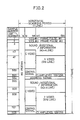
- Fig. 2 is a diagram showing the arrangement corresponding to one frame of the MUSE signal according to the above described standard.
- the MUSE decoder analog-to-digital converts the reproduced MUSE signal and further separates horizontal synchronizing signals.
- the MUSE decoder When the MUSE decoder detects first and second frame synchronizing pulses at the beginning of each frame, the MUSE decoder starts counting of the above described separated horizontal synchronizing signals, generates clamp pulses at the timing of the 563rd line and the 1125th line and accurately clamps the clamp level signal on the above described particular lines, to define the DC intermediate level (128/256) of the reproduced MUSE signal to a predetermined level.
- the above described clamping operation is digitally performed in the MUSE decoder.
- the video disc player itself does not generally contain such a clamping circuit.
- the conversion level of the A/D converter in the first stage of the time base corrector need not be increased to a level more than necessary, so that converting efficiency can be increased.
- an object of the present invention is to provide a video disc player capable of performing a predetermined clamping operation of a clamp level signal multiplexed on a reproduced MUSE signal without providing any complicated circuit.
- Another object of the present invention is to provide a video disc player capable of making high-precision jitter compensation of a reproduced MUSE signal.
- the present invention is directed to a video disc player for optically reproducing high-definition video information recorded on a recording medium.
- An FM video signal obtained by frequency-modulating a MUSE signal obtained by bandwidth compression of a high-definition video signal using a TCI sub-nyquist sampling encoding system after multiplexing a clamp level signal and a Manchester-coded index signal on particular lines of the MUSE signal, and a pilot signal of a constant frequency are frequency-multiplexed, to be recorded on the recording medium.
- the video disc player comprises a circuit for reproducing the MUSE signal from the recording medium, a circuit for reproducing the pilot signal from the recording medium, a circuit for detecting the index signal from the reproduced MUSE signal, a circuit for starting counting of pulses of the pilot signal in response to detection of the index signal and generating a clamp pulse when its count value reaches a predetermined count value corresponding to the timing of detecting the clamp level signal, and a circuit for clamping the clamp level signal multiplexed on the reproduced MUSE signal in response to the clamp pulse.
- the clamp pulse generating circuit may be adapted to generate clamp pulse after a lapse of a constant time period after the index signal is detected.
- a principal advantage of the present invention is that the timing of clamping the clamp level signal multiplexed on the reproduced MUSE signal is determined, beginning at the time of detecting the index signal which is indispensable to, for example, make access to the video disc and is easily detected, so that the reproduced MUSE signal can be accurately clamped in the video disc player without providing any complicated circuit.
- Another advantage of the present invention is that the timing of clamping the clamp level signal multiplexed on the reproduced MUSE signal can be accurately determined by counting pulses of the reproduced pilot signal, beginning at the time of detecting the index signal.
- index signals which are indispensable to access a program such as an address signal, a lead-in signal and a lead-out signal are subjected to Manchester coded processing and then, frequency-modulated, to be recorded on a video disc.
- a signal obtained by FM (Frequency Modulation)-demodulating the index signal has no DC component and thus, is easily detected.
- the index signal and the above described clamp level signal are multiplexed on predetermined lines in any frame of the MUSE signal.
- the timing of generating the clamp level signal is determined, beginning at the timing of detecting the index signal to generate clamp pulses.
- Fig. 2 is a diagram showing the arrangement of the MUSE signal, the concept of the present invention will be described in detail.
- a clamp level signal is multiplexed on the 563th line and the 1125th line in each frame.
- an address signal is multiplexed on the 564th line during a part of a program, a lead-in signal is multiplexed thereon before the start of the program, and a lead-out signal is multiplexed thereon after the end of the program.
- each of the above described index signals which is multiplexed on the 564th line with it being Manchester-coded, comprises 12-bit synchro-pattern data and 20-bit index data and is multiplexed on the 564th line, its DC level being the same as the clamp level.
- a MUSE signal having such an index signal multiplex thereon is frequency-modulated and along with a pilot signal of a constant frequency, is frequency-multiplexed, to be recorded on the video disc.
- the MUSE signal to be recorded includes no jitter, and the frequency of the pilot signal is a fixed frequency sufficiently higher than the line frequency of the MUSE signal.
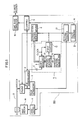
- Fig. 1 is a schematic block diagram showing a video disc player according to an embodiment of the present invention
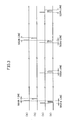
- Fig. 3 is a timing chart for explaining its operation.
- Fig. 1 the above described high-definition video information recorded on a video disc D is optically reproduced by an optical pickup 1, to be applied to an FM demodulating circuit 2 and a pilot signal separating circuit 3.
- the pilot signal separating circuit 3 extracts a pilot signal from reproduction output of the pickup 1, to apply the same to a disc servo circuit 4.
- the disc servo circuit 4 accordingly controls the rotation of a disc motor M.
- the FM demodulating circuit 2 FM-demodulates an FM-MUSE signal reproduced by the pickup 1, to reproduce a MUSE signal.
- This reproduced MUSE signal is applied to a clamping circuit 5 and an index reading circuit 7.
- the reproduced MUSE signal applied thereto is applied to a shift register 9 after its DC component is cut by a capacitor C.
- This shift register 9 receives a clock having a frequency obtained by multiplying the bit frequency of the index signal by a multiplier from a not-shown clock signal source as shift pulses, and has capacity in which a 20-bit index signal can be read in.
- the index signal multiplexed on the 564th line of the MUSE signal comprises 12-bit synchro-pattern data and 20-bit index data as described above.
- the synchro-pattern data is first read in the shift register 9.
- the synchro-pattern data is inherently 12-bit data of a predetermined pattern.
- a synchro-pattern generating circuit 11 generates the predetermined pattern of this synchro-pattern data.
- a synchro-pattern detecting circuit 10 compares the 12-bit synchro-pattern data read in the shift register 9 with the predetermined pattern generated from the synchro-pattern generating circuit 11. If it is confirmed that the read data is the predetermined 12-bit synchro-pattern data, the synchro-pattern detecting circuit 10 generates a synchro-pattern detection output (see Fig. 3 (a)) to apply the same to a first counter 12.
- This first counter 12 defines by counting the clocks the time period from the time when a counting operation is started in response to this synchro-pattern detection output to the time when input of the 20-bit index data is completed.
- the first counter 12 When reading of the 20-bit index data in the shift register 9 is completed, the first counter 12 generates a signal indicating completion of data reading (see Fig. 3 (b)).
- This signal indicating completion of data reading and the index data read in the shift register 9 are applied to a reproduction control microcomputer 6.
- the reproduction control microcomputer 6 performs control such as an address search in accordance with the applied index data.
- the signal indicating completion of data reading outputted from the first counter 12 is applied to a clamp pulse generating circuit 8 as an index detecting signal.
- the pilot signal is supplied to the clamp pulse generating circuit 8 from the pilot signal separating circuit 3.
- This clamp pulse generating circuit 8 comprises a second counter 13. This second counter 13 starts counting of pulses of the reproduced pilot signal in response to the signal indicating completion of data reading.
- the reproduced MUSE signal includes jitter
- the pilot signal which has been frequency-multiplexed on this MUSE signal should also include jitter equal thereto.
- the timing which coincides with the timing of the clamp level signal multiplexed on the 563th line and 1125th line in each frame of the reproduced MUSE signal can be detected. More specifically, the second counter 13 detects such timing to generate a count-up output (see Fig. 3 (c)). This count-up output is applied to a pulse forming circuit 14. This pulse forming circuit 14 generates a high level clamp pulse (see Fig. 3 (d)) during a time period of a clamp level signal detected in response to the count-up of the second counter 13. The clamp pulse is applied to the clamping circuit 5 having the reproduced MUSE signal inputted therein.
- the clamping circuit 5 accurately clamps the clamp level signal at predetermined timing for each frame.
- the reproduced MUSE signal outputted from the clamping circuit 5 is further applied to a time base corrector 15, to be subjected to jitter compensation.
- An output of the time base corrector 15 is applied to a not-shown MUSE decoder as an output of the video disc player.
- the interval between an index signal and a clamp level signal can be accurately detected by counting the reproduced pilot signal even if jitter occurs in the reproduced MUSE signal. Consequently, the clamp level signal can be accurately clamped.
- the index signal is multiplexed on, for example, the 562nd line and the 1124th line (Y video portion in Fig. 2) in place of the above described 564th line in each frame of the MUSE signal
- the interval between the index signal (on the 562nd line and the 1124th line) and the clamp level signal (on the 563rd line and 1125th line) becomes substantially short.
- the clamp level signal can be clamped at correct timing provided clamp pulses are generated at timing delayed from the timing of the above described index detecting signal by a constant time period.
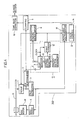
- a monostable multivibrator 16 may be provided in place of the second counter 13 shown in Fig. 1 to drive the pulse forming circuit 14 after a lapse of a constant time period after an index detection output from the first counter 12 is applied thereto, in which case the clamp level signal can be clamped considerably accurately.
- pulses of a reference clock of a constant frequency may be counted by the second counter 13 shown in Fig. 1, to obtain the same effect.
- the signal indicating completion of data reading is utilized as an index detecting signal
- the synchro-pattern data itself may be used as an index detecting signal, to obtain the same effect.
- pulses of the reproduced pilot signal including jitter equal to the jitter in the reproduced MUSE signal are counted, beginning at the index signal which can be easily detected to determine the timing of generating clamp pulses.
- the clamp level signal multiplexed on the reproduced MUSE signal can be accurately clamped in the video disc player.
Landscapes
- Engineering & Computer Science (AREA)
- Multimedia (AREA)
- Signal Processing (AREA)
- Television Signal Processing For Recording (AREA)
- Compression Or Coding Systems Of Tv Signals (AREA)
- Picture Signal Circuits (AREA)
- Television Systems (AREA)
Applications Claiming Priority (2)
| Application Number | Priority Date | Filing Date | Title |
|---|---|---|---|
| JP63167411A JPH0216879A (ja) | 1988-07-05 | 1988-07-05 | クランプ回路 |
| JP167411/88 | 1988-07-05 |
Publications (2)
| Publication Number | Publication Date |
|---|---|
| EP0349990A2 true EP0349990A2 (de) | 1990-01-10 |
| EP0349990A3 EP0349990A3 (de) | 1991-12-11 |
Family
ID=15849199
Family Applications (1)
| Application Number | Title | Priority Date | Filing Date |
|---|---|---|---|
| EP19890112217 Withdrawn EP0349990A3 (de) | 1988-07-05 | 1989-07-04 | Videoplattenspieler mit einer Klemmschaltung für MUSE-Signale |
Country Status (4)
| Country | Link |
|---|---|
| US (1) | US5036404A (de) |
| EP (1) | EP0349990A3 (de) |
| JP (1) | JPH0216879A (de) |
| KR (1) | KR910003594A (de) |
Cited By (6)
| Publication number | Priority date | Publication date | Assignee | Title |
|---|---|---|---|---|
| EP0455205A1 (de) * | 1990-04-28 | 1991-11-06 | Sanyo Electric Co., Ltd. | Doppelseitige Videoplatte mit darauf aufgezeichneten HDTV-Signalen und Verfahren zur Herstellung dieser |
| EP0532276A3 (en) * | 1991-09-09 | 1994-06-08 | Pioneer Electronic Corp | Method of recording information on video disk |
| EP0532279A3 (en) * | 1991-09-09 | 1994-06-08 | Pioneer Electronic Corp | Method of recording information on video disk |
| EP0532277A3 (en) * | 1991-09-09 | 1994-06-08 | Pioneer Electronic Corp | Method of recording information on video disk |
| EP0532278A3 (en) * | 1991-09-09 | 1994-06-08 | Pioneer Electronic Corp | Method of recording information on video disk |
| WO1998054711A1 (en) * | 1997-05-29 | 1998-12-03 | Daewoo Electronics Co., Ltd. | Method and apparatus for outputting video data of a video compact disc player |
Families Citing this family (2)
| Publication number | Priority date | Publication date | Assignee | Title |
|---|---|---|---|---|
| US5378416A (en) * | 1992-07-28 | 1995-01-03 | Nissan Motor Co., Ltd. | Method of and system for manufacturing powder moldings |
| EP1228827A4 (de) | 1999-07-19 | 2002-10-02 | Kobayashi Industry Co Ltd | Verfahren und vorrichtung zur herstellung von pulverformkörper |
Family Cites Families (6)
| Publication number | Priority date | Publication date | Assignee | Title |
|---|---|---|---|---|
| US3723643A (en) * | 1967-11-08 | 1973-03-27 | Victor Co Ltd | System for recording and reproducing a wide-band signal |
| US3571525A (en) * | 1968-09-30 | 1971-03-16 | Ampex | Pilot signal playback clamping during dropouts to prevent spurious time-base errors |
| US3885093A (en) * | 1972-04-03 | 1975-05-20 | Ampex | Fast acting direct current clamping circuit |
| DE3584399D1 (de) * | 1984-07-20 | 1991-11-21 | Hitachi Ltd | Verfahren und geraet zum aufzeichnen und wiedergeben von videosignalen. |
| US4729024A (en) * | 1985-03-19 | 1988-03-01 | Canon Kabushiki Kaisha | Synchronizing pulse signal generation device |
| JPS63102481A (ja) * | 1986-10-18 | 1988-05-07 | Pioneer Electronic Corp | 多重記録方式 |
-
1988
- 1988-07-05 JP JP63167411A patent/JPH0216879A/ja active Pending
-
1989
- 1989-07-03 US US07/375,306 patent/US5036404A/en not_active Expired - Fee Related
- 1989-07-04 EP EP19890112217 patent/EP0349990A3/de not_active Withdrawn
- 1989-07-04 KR KR1019890009493A patent/KR910003594A/ko not_active Withdrawn
Cited By (7)
| Publication number | Priority date | Publication date | Assignee | Title |
|---|---|---|---|---|
| EP0455205A1 (de) * | 1990-04-28 | 1991-11-06 | Sanyo Electric Co., Ltd. | Doppelseitige Videoplatte mit darauf aufgezeichneten HDTV-Signalen und Verfahren zur Herstellung dieser |
| EP0532276A3 (en) * | 1991-09-09 | 1994-06-08 | Pioneer Electronic Corp | Method of recording information on video disk |
| EP0532279A3 (en) * | 1991-09-09 | 1994-06-08 | Pioneer Electronic Corp | Method of recording information on video disk |
| EP0532277A3 (en) * | 1991-09-09 | 1994-06-08 | Pioneer Electronic Corp | Method of recording information on video disk |
| EP0532278A3 (en) * | 1991-09-09 | 1994-06-08 | Pioneer Electronic Corp | Method of recording information on video disk |
| WO1998054711A1 (en) * | 1997-05-29 | 1998-12-03 | Daewoo Electronics Co., Ltd. | Method and apparatus for outputting video data of a video compact disc player |
| US5887108A (en) * | 1997-05-29 | 1999-03-23 | Daewoo Electronics Co., Ltd. | Method and apparatus for outputting video data of a video compact disc player |
Also Published As
| Publication number | Publication date |
|---|---|
| EP0349990A3 (de) | 1991-12-11 |
| JPH0216879A (ja) | 1990-01-19 |
| KR910003594A (ko) | 1991-02-27 |
| US5036404A (en) | 1991-07-30 |
Similar Documents
| Publication | Publication Date | Title |
|---|---|---|
| US4175267A (en) | Method and apparatus of inserting an address signal in a video signal | |
| US5956090A (en) | Television standards converter with time-code conversion function | |
| US4680647A (en) | Method for recording and reproducing video format signal | |
| US4134130A (en) | Method and apparatus of inserting an address signal in a video signal | |
| US4920424A (en) | Method of recording and reproducing multi-channel information on and from recording medium | |
| US4961116A (en) | Method of, and apparatus for, facilitating sychronization of recorded audio and video information | |
| US5351132A (en) | Method of recording and reproducing information on a video disk utilizing table of contents data | |
| US5036404A (en) | Video disc player comprising clamping circuit for muse signal | |
| US4095259A (en) | Video signal converting system having quantization noise reduction | |
| JPS6243394B2 (de) | ||
| US5162922A (en) | Apparatus for multi-channel dividing, recording and reproducing a video signal | |
| US4777539A (en) | Process of recording time codes onto a video disk including periodic adjustment of time codes | |
| JPH01318490A (ja) | 映像信号の欠落補償装置 | |
| GB2139452A (en) | Video signal dropout compensation circuit | |
| KR960011846B1 (ko) | 트래킹 제어 장치 | |
| US4777538A (en) | For stabilizing video image during recorded program changes | |
| JP2724059B2 (ja) | ビデオディスクの信号記録方法 | |
| EP0532276A2 (de) | Verfahren zum Aufzeichnen von Informationen auf einer Videoplatte | |
| US4729042A (en) | Clock signal generating circuit for digital signal recording device | |
| JP2513827B2 (ja) | 記録muse信号読取装置 | |
| JP2527471B2 (ja) | 再生muse信号処理装置 | |
| JP3231463B2 (ja) | 画像信号の再生装置 | |
| US5453965A (en) | Reproducing apparatus and reproducing method | |
| JPH028517B2 (de) | ||
| JP2506731B2 (ja) | 検出窓を用いた同期信号検出方式及び時間軸制御方式 |
Legal Events
| Date | Code | Title | Description |
|---|---|---|---|
| PUAI | Public reference made under article 153(3) epc to a published international application that has entered the european phase |
Free format text: ORIGINAL CODE: 0009012 |
|
| AK | Designated contracting states |
Kind code of ref document: A2 Designated state(s): DE FR GB NL |
|
| 17P | Request for examination filed |
Effective date: 19901228 |
|
| PUAL | Search report despatched |
Free format text: ORIGINAL CODE: 0009013 |
|
| AK | Designated contracting states |
Kind code of ref document: A3 Designated state(s): DE FR GB NL |
|
| STAA | Information on the status of an ep patent application or granted ep patent |
Free format text: STATUS: THE APPLICATION HAS BEEN WITHDRAWN |
|
| 18W | Application withdrawn |
Withdrawal date: 19920313 |
|
| R18W | Application withdrawn (corrected) |
Effective date: 19920313 |