EP0349873B1 - Verfahren zur Herstellung von Vernetzungskomponenten für Lackbindemittel - Google Patents
Verfahren zur Herstellung von Vernetzungskomponenten für Lackbindemittel Download PDFInfo
- Publication number
- EP0349873B1 EP0349873B1 EP89111571A EP89111571A EP0349873B1 EP 0349873 B1 EP0349873 B1 EP 0349873B1 EP 89111571 A EP89111571 A EP 89111571A EP 89111571 A EP89111571 A EP 89111571A EP 0349873 B1 EP0349873 B1 EP 0349873B1
- Authority
- EP
- European Patent Office
- Prior art keywords
- mol
- groups
- resin
- hydroxyl groups
- cross
- Prior art date
- Legal status (The legal status is an assumption and is not a legal conclusion. Google has not performed a legal analysis and makes no representation as to the accuracy of the status listed.)
- Expired - Lifetime
Links
- 239000011230 binding agent Substances 0.000 title claims description 12
- 238000000034 method Methods 0.000 title claims description 7
- 238000004519 manufacturing process Methods 0.000 title description 3
- 239000003431 cross linking reagent Substances 0.000 title 1
- 210000003298 dental enamel Anatomy 0.000 title 1
- 238000004132 cross linking Methods 0.000 claims description 27
- LFQSCWFLJHTTHZ-UHFFFAOYSA-N Ethanol Chemical compound CCO LFQSCWFLJHTTHZ-UHFFFAOYSA-N 0.000 claims description 20
- 238000006243 chemical reaction Methods 0.000 claims description 17
- 125000002887 hydroxy group Chemical group [H]O* 0.000 claims description 17
- 150000001875 compounds Chemical class 0.000 claims description 13
- 150000002148 esters Chemical class 0.000 claims description 11
- 239000003973 paint Substances 0.000 claims description 9
- 230000008569 process Effects 0.000 claims description 6
- 238000005809 transesterification reaction Methods 0.000 claims description 6
- -1 alkylene glycols Chemical class 0.000 claims description 5
- 239000012948 isocyanate Substances 0.000 claims description 4
- 239000002981 blocking agent Substances 0.000 claims description 3
- IQPQWNKOIGAROB-UHFFFAOYSA-N isocyanate group Chemical group [N-]=C=O IQPQWNKOIGAROB-UHFFFAOYSA-N 0.000 claims description 3
- 229920000728 polyester Polymers 0.000 claims description 3
- 239000005056 polyisocyanate Substances 0.000 claims description 3
- 229920001228 polyisocyanate Polymers 0.000 claims description 3
- XSTXAVWGXDQKEL-UHFFFAOYSA-N Trichloroethylene Chemical compound ClC=C(Cl)Cl XSTXAVWGXDQKEL-UHFFFAOYSA-N 0.000 claims description 2
- 125000004432 carbon atom Chemical group C* 0.000 claims description 2
- 150000002513 isocyanates Chemical class 0.000 claims description 2
- 238000002360 preparation method Methods 0.000 claims description 2
- 125000002924 primary amino group Chemical group [H]N([H])* 0.000 claims description 2
- 125000000467 secondary amino group Chemical group [H]N([*:1])[*:2] 0.000 claims description 2
- 238000007056 transamidation reaction Methods 0.000 claims description 2
- 239000011347 resin Substances 0.000 description 39
- 229920005989 resin Polymers 0.000 description 39
- 239000000243 solution Substances 0.000 description 25
- 239000000203 mixture Substances 0.000 description 21
- 239000000047 product Substances 0.000 description 20
- 239000007787 solid Substances 0.000 description 19
- 238000012360 testing method Methods 0.000 description 13
- VLTRZXGMWDSKGL-UHFFFAOYSA-N perchloric acid Chemical compound OCl(=O)(=O)=O VLTRZXGMWDSKGL-UHFFFAOYSA-N 0.000 description 12
- QTBSBXVTEAMEQO-UHFFFAOYSA-N Acetic acid Chemical compound CC(O)=O QTBSBXVTEAMEQO-UHFFFAOYSA-N 0.000 description 11
- 239000007795 chemical reaction product Substances 0.000 description 10
- CSCPPACGZOOCGX-UHFFFAOYSA-N Acetone Chemical compound CC(C)=O CSCPPACGZOOCGX-UHFFFAOYSA-N 0.000 description 8
- 239000004593 Epoxy Substances 0.000 description 8
- LRHPLDYGYMQRHN-UHFFFAOYSA-N N-Butanol Chemical compound CCCCO LRHPLDYGYMQRHN-UHFFFAOYSA-N 0.000 description 8
- 150000001412 amines Chemical class 0.000 description 8
- 239000000523 sample Substances 0.000 description 7
- OKKJLVBELUTLKV-UHFFFAOYSA-N Methanol Chemical compound OC OKKJLVBELUTLKV-UHFFFAOYSA-N 0.000 description 6
- ZJCCRDAZUWHFQH-UHFFFAOYSA-N Trimethylolpropane Chemical compound CCC(CO)(CO)CO ZJCCRDAZUWHFQH-UHFFFAOYSA-N 0.000 description 6
- RRAMGCGOFNQTLD-UHFFFAOYSA-N hexamethylene diisocyanate Chemical compound O=C=NCCCCCCN=C=O RRAMGCGOFNQTLD-UHFFFAOYSA-N 0.000 description 6
- BDAGIHXWWSANSR-UHFFFAOYSA-N methanoic acid Natural products OC=O BDAGIHXWWSANSR-UHFFFAOYSA-N 0.000 description 6
- LYCAIKOWRPUZTN-UHFFFAOYSA-N Ethylene glycol Chemical compound OCCO LYCAIKOWRPUZTN-UHFFFAOYSA-N 0.000 description 5
- 229930040373 Paraformaldehyde Natural products 0.000 description 5
- 229960000583 acetic acid Drugs 0.000 description 5
- 239000003795 chemical substances by application Substances 0.000 description 5
- QOHMWDJIBGVPIF-UHFFFAOYSA-N n',n'-diethylpropane-1,3-diamine Chemical compound CCN(CC)CCCN QOHMWDJIBGVPIF-UHFFFAOYSA-N 0.000 description 5
- 229920002866 paraformaldehyde Polymers 0.000 description 5
- XLYOFNOQVPJJNP-UHFFFAOYSA-N water Substances O XLYOFNOQVPJJNP-UHFFFAOYSA-N 0.000 description 5
- LTMRRSWNXVJMBA-UHFFFAOYSA-L 2,2-diethylpropanedioate Chemical compound CCC(CC)(C([O-])=O)C([O-])=O LTMRRSWNXVJMBA-UHFFFAOYSA-L 0.000 description 4
- OZAIFHULBGXAKX-UHFFFAOYSA-N 2-(2-cyanopropan-2-yldiazenyl)-2-methylpropanenitrile Chemical compound N#CC(C)(C)N=NC(C)(C)C#N OZAIFHULBGXAKX-UHFFFAOYSA-N 0.000 description 4
- YIWUKEYIRIRTPP-UHFFFAOYSA-N 2-ethylhexan-1-ol Chemical compound CCCCC(CC)CO YIWUKEYIRIRTPP-UHFFFAOYSA-N 0.000 description 4
- 239000005058 Isophorone diisocyanate Substances 0.000 description 4
- NQRYJNQNLNOLGT-UHFFFAOYSA-N Piperidine Chemical compound C1CCNCC1 NQRYJNQNLNOLGT-UHFFFAOYSA-N 0.000 description 4
- IISBACLAFKSPIT-UHFFFAOYSA-N bisphenol A Chemical compound C=1C=C(O)C=CC=1C(C)(C)C1=CC=C(O)C=C1 IISBACLAFKSPIT-UHFFFAOYSA-N 0.000 description 4
- 239000004841 bisphenol A epoxy resin Substances 0.000 description 4
- 238000004821 distillation Methods 0.000 description 4
- 239000012362 glacial acetic acid Substances 0.000 description 4
- NIMLQBUJDJZYEJ-UHFFFAOYSA-N isophorone diisocyanate Chemical compound CC1(C)CC(N=C=O)CC(C)(CN=C=O)C1 NIMLQBUJDJZYEJ-UHFFFAOYSA-N 0.000 description 4
- 229920005862 polyol Polymers 0.000 description 4
- 150000003077 polyols Chemical class 0.000 description 4
- LHENQXAPVKABON-UHFFFAOYSA-N 1-methoxypropan-1-ol Chemical compound CCC(O)OC LHENQXAPVKABON-UHFFFAOYSA-N 0.000 description 3
- OSWFIVFLDKOXQC-UHFFFAOYSA-N 4-(3-methoxyphenyl)aniline Chemical compound COC1=CC=CC(C=2C=CC(N)=CC=2)=C1 OSWFIVFLDKOXQC-UHFFFAOYSA-N 0.000 description 3
- YMWUJEATGCHHMB-UHFFFAOYSA-N Dichloromethane Chemical compound ClCCl YMWUJEATGCHHMB-UHFFFAOYSA-N 0.000 description 3
- 229910000831 Steel Inorganic materials 0.000 description 3
- 239000002253 acid Substances 0.000 description 3
- 230000000052 comparative effect Effects 0.000 description 3
- 238000001816 cooling Methods 0.000 description 3
- 230000007797 corrosion Effects 0.000 description 3
- 238000005260 corrosion Methods 0.000 description 3
- ZBCBWPMODOFKDW-UHFFFAOYSA-N diethanolamine Chemical compound OCCNCCO ZBCBWPMODOFKDW-UHFFFAOYSA-N 0.000 description 3
- 239000003822 epoxy resin Substances 0.000 description 3
- 235000019253 formic acid Nutrition 0.000 description 3
- 239000004922 lacquer Substances 0.000 description 3
- 150000002989 phenols Chemical class 0.000 description 3
- 229920000647 polyepoxide Polymers 0.000 description 3
- IWZKICVEHNUQTL-UHFFFAOYSA-M potassium hydrogen phthalate Chemical compound [K+].OC(=O)C1=CC=CC=C1C([O-])=O IWZKICVEHNUQTL-UHFFFAOYSA-M 0.000 description 3
- 239000010959 steel Substances 0.000 description 3
- KMOUUZVZFBCRAM-OLQVQODUSA-N (3as,7ar)-3a,4,7,7a-tetrahydro-2-benzofuran-1,3-dione Chemical compound C1C=CC[C@@H]2C(=O)OC(=O)[C@@H]21 KMOUUZVZFBCRAM-OLQVQODUSA-N 0.000 description 2
- UPGSWASWQBLSKZ-UHFFFAOYSA-N 2-hexoxyethanol Chemical compound CCCCCCOCCO UPGSWASWQBLSKZ-UHFFFAOYSA-N 0.000 description 2
- 239000004971 Cross linker Substances 0.000 description 2
- 239000005057 Hexamethylene diisocyanate Substances 0.000 description 2
- KFZMGEQAYNKOFK-UHFFFAOYSA-N Isopropanol Chemical compound CC(C)O KFZMGEQAYNKOFK-UHFFFAOYSA-N 0.000 description 2
- OFOBLEOULBTSOW-UHFFFAOYSA-N Malonic acid Chemical compound OC(=O)CC(O)=O OFOBLEOULBTSOW-UHFFFAOYSA-N 0.000 description 2
- GSEJCLTVZPLZKY-UHFFFAOYSA-N Triethanolamine Chemical compound OCCN(CCO)CCO GSEJCLTVZPLZKY-UHFFFAOYSA-N 0.000 description 2
- 235000005811 Viola adunca Nutrition 0.000 description 2
- 240000009038 Viola odorata Species 0.000 description 2
- 235000013487 Viola odorata Nutrition 0.000 description 2
- 235000002254 Viola papilionacea Nutrition 0.000 description 2
- 244000172533 Viola sororia Species 0.000 description 2
- WNLRTRBMVRJNCN-UHFFFAOYSA-N adipic acid Chemical compound OC(=O)CCCCC(O)=O WNLRTRBMVRJNCN-UHFFFAOYSA-N 0.000 description 2
- 238000009835 boiling Methods 0.000 description 2
- WERYXYBDKMZEQL-UHFFFAOYSA-N butane-1,4-diol Chemical compound OCCCCO WERYXYBDKMZEQL-UHFFFAOYSA-N 0.000 description 2
- 125000002091 cationic group Chemical group 0.000 description 2
- 238000009833 condensation Methods 0.000 description 2
- 230000005494 condensation Effects 0.000 description 2
- 229920001577 copolymer Polymers 0.000 description 2
- 239000013078 crystal Substances 0.000 description 2
- 238000010790 dilution Methods 0.000 description 2
- 239000012895 dilution Substances 0.000 description 2
- BEPAFCGSDWSTEL-UHFFFAOYSA-N dimethyl malonate Chemical compound COC(=O)CC(=O)OC BEPAFCGSDWSTEL-UHFFFAOYSA-N 0.000 description 2
- 150000002009 diols Chemical class 0.000 description 2
- 230000008030 elimination Effects 0.000 description 2
- 238000003379 elimination reaction Methods 0.000 description 2
- 125000004185 ester group Chemical group 0.000 description 2
- 230000032050 esterification Effects 0.000 description 2
- 238000005886 esterification reaction Methods 0.000 description 2
- 238000009472 formulation Methods 0.000 description 2
- 125000003055 glycidyl group Chemical group C(C1CO1)* 0.000 description 2
- 238000010438 heat treatment Methods 0.000 description 2
- WGCNASOHLSPBMP-UHFFFAOYSA-N hydroxyacetaldehyde Natural products OCC=O WGCNASOHLSPBMP-UHFFFAOYSA-N 0.000 description 2
- 238000002156 mixing Methods 0.000 description 2
- 230000006855 networking Effects 0.000 description 2
- 239000004814 polyurethane Substances 0.000 description 2
- 229920002635 polyurethane Polymers 0.000 description 2
- 239000011541 reaction mixture Substances 0.000 description 2
- 238000010992 reflux Methods 0.000 description 2
- 150000003839 salts Chemical class 0.000 description 2
- 238000000926 separation method Methods 0.000 description 2
- 239000002904 solvent Substances 0.000 description 2
- 239000007921 spray Substances 0.000 description 2
- 238000003756 stirring Methods 0.000 description 2
- 239000000126 substance Substances 0.000 description 2
- DVKJHBMWWAPEIU-UHFFFAOYSA-N toluene 2,4-diisocyanate Chemical compound CC1=CC=C(N=C=O)C=C1N=C=O DVKJHBMWWAPEIU-UHFFFAOYSA-N 0.000 description 2
- 229920002818 (Hydroxyethyl)methacrylate Polymers 0.000 description 1
- QCPKTLDULZJCLB-UHFFFAOYSA-N 2-(1,3-oxazolidin-2-yl)ethanol Chemical compound OCCC1NCCO1 QCPKTLDULZJCLB-UHFFFAOYSA-N 0.000 description 1
- OAYXUHPQHDHDDZ-UHFFFAOYSA-N 2-(2-butoxyethoxy)ethanol Chemical compound CCCCOCCOCCO OAYXUHPQHDHDDZ-UHFFFAOYSA-N 0.000 description 1
- BBBUAWSVILPJLL-UHFFFAOYSA-N 2-(2-ethylhexoxymethyl)oxirane Chemical compound CCCCC(CC)COCC1CO1 BBBUAWSVILPJLL-UHFFFAOYSA-N 0.000 description 1
- GOXQRTZXKQZDDN-UHFFFAOYSA-N 2-Ethylhexyl acrylate Chemical compound CCCCC(CC)COC(=O)C=C GOXQRTZXKQZDDN-UHFFFAOYSA-N 0.000 description 1
- AOBIOSPNXBMOAT-UHFFFAOYSA-N 2-[2-(oxiran-2-ylmethoxy)ethoxymethyl]oxirane Chemical compound C1OC1COCCOCC1CO1 AOBIOSPNXBMOAT-UHFFFAOYSA-N 0.000 description 1
- POAOYUHQDCAZBD-UHFFFAOYSA-N 2-butoxyethanol Chemical compound CCCCOCCO POAOYUHQDCAZBD-UHFFFAOYSA-N 0.000 description 1
- ZNQVEEAIQZEUHB-UHFFFAOYSA-N 2-ethoxyethanol Chemical compound CCOCCO ZNQVEEAIQZEUHB-UHFFFAOYSA-N 0.000 description 1
- WJQOZHYUIDYNHM-UHFFFAOYSA-N 2-tert-Butylphenol Chemical compound CC(C)(C)C1=CC=CC=C1O WJQOZHYUIDYNHM-UHFFFAOYSA-N 0.000 description 1
- XZOYHFBNQHPJRQ-UHFFFAOYSA-N 7-methyloctanoic acid Chemical compound CC(C)CCCCCC(O)=O XZOYHFBNQHPJRQ-UHFFFAOYSA-N 0.000 description 1
- 244000025254 Cannabis sativa Species 0.000 description 1
- 229920000742 Cotton Polymers 0.000 description 1
- RPNUMPOLZDHAAY-UHFFFAOYSA-N Diethylenetriamine Chemical compound NCCNCCN RPNUMPOLZDHAAY-UHFFFAOYSA-N 0.000 description 1
- IYXGSMUGOJNHAZ-UHFFFAOYSA-N Ethyl malonate Chemical compound CCOC(=O)CC(=O)OCC IYXGSMUGOJNHAZ-UHFFFAOYSA-N 0.000 description 1
- IAYPIBMASNFSPL-UHFFFAOYSA-N Ethylene oxide Chemical compound C1CO1 IAYPIBMASNFSPL-UHFFFAOYSA-N 0.000 description 1
- WOBHKFSMXKNTIM-UHFFFAOYSA-N Hydroxyethyl methacrylate Chemical compound CC(=C)C(=O)OCCO WOBHKFSMXKNTIM-UHFFFAOYSA-N 0.000 description 1
- 238000006683 Mannich reaction Methods 0.000 description 1
- VVQNEPGJFQJSBK-UHFFFAOYSA-N Methyl methacrylate Chemical compound COC(=O)C(C)=C VVQNEPGJFQJSBK-UHFFFAOYSA-N 0.000 description 1
- OPKOKAMJFNKNAS-UHFFFAOYSA-N N-methylethanolamine Chemical compound CNCCO OPKOKAMJFNKNAS-UHFFFAOYSA-N 0.000 description 1
- QQWAKSKPSOFJFF-NSHDSACASA-N [(2S)-oxiran-2-yl]methyl 2,2-dimethyloctanoate Chemical compound CCCCCCC(C)(C)C(=O)OC[C@@H]1CO1 QQWAKSKPSOFJFF-NSHDSACASA-N 0.000 description 1
- 239000000654 additive Substances 0.000 description 1
- 239000001361 adipic acid Substances 0.000 description 1
- 235000011037 adipic acid Nutrition 0.000 description 1
- 150000001298 alcohols Chemical class 0.000 description 1
- 125000003277 amino group Chemical group 0.000 description 1
- QDHUQRBYCVAWEN-UHFFFAOYSA-N amino prop-2-enoate Chemical class NOC(=O)C=C QDHUQRBYCVAWEN-UHFFFAOYSA-N 0.000 description 1
- 238000004458 analytical method Methods 0.000 description 1
- 230000015572 biosynthetic process Effects 0.000 description 1
- 125000003178 carboxy group Chemical group [H]OC(*)=O 0.000 description 1
- 230000008859 change Effects 0.000 description 1
- 238000003776 cleavage reaction Methods 0.000 description 1
- 239000011248 coating agent Substances 0.000 description 1
- 238000000576 coating method Methods 0.000 description 1
- 238000010276 construction Methods 0.000 description 1
- 239000008367 deionised water Substances 0.000 description 1
- 229910021641 deionized water Inorganic materials 0.000 description 1
- 230000006866 deterioration Effects 0.000 description 1
- NFKGQHYUYGYHIS-UHFFFAOYSA-N dibutyl propanedioate Chemical compound CCCCOC(=O)CC(=O)OCCCC NFKGQHYUYGYHIS-UHFFFAOYSA-N 0.000 description 1
- 235000014113 dietary fatty acids Nutrition 0.000 description 1
- HPNMFZURTQLUMO-UHFFFAOYSA-N diethylamine Chemical compound CCNCC HPNMFZURTQLUMO-UHFFFAOYSA-N 0.000 description 1
- SBZXBUIDTXKZTM-UHFFFAOYSA-N diglyme Chemical compound COCCOCCOC SBZXBUIDTXKZTM-UHFFFAOYSA-N 0.000 description 1
- 125000005442 diisocyanate group Chemical group 0.000 description 1
- LVTYICIALWPMFW-UHFFFAOYSA-N diisopropanolamine Chemical compound CC(O)CNCC(C)O LVTYICIALWPMFW-UHFFFAOYSA-N 0.000 description 1
- 229940043276 diisopropanolamine Drugs 0.000 description 1
- 239000000539 dimer Substances 0.000 description 1
- 230000000694 effects Effects 0.000 description 1
- 238000004070 electrodeposition Methods 0.000 description 1
- RTZKZFJDLAIYFH-UHFFFAOYSA-N ether Substances CCOCC RTZKZFJDLAIYFH-UHFFFAOYSA-N 0.000 description 1
- 125000004494 ethyl ester group Chemical group 0.000 description 1
- 238000002474 experimental method Methods 0.000 description 1
- 229930195729 fatty acid Natural products 0.000 description 1
- 239000000194 fatty acid Substances 0.000 description 1
- 150000004665 fatty acids Chemical class 0.000 description 1
- 230000002349 favourable effect Effects 0.000 description 1
- 239000000945 filler Substances 0.000 description 1
- VOZRXNHHFUQHIL-UHFFFAOYSA-N glycidyl methacrylate Chemical compound CC(=C)C(=O)OCC1CO1 VOZRXNHHFUQHIL-UHFFFAOYSA-N 0.000 description 1
- XXMIOPMDWAUFGU-UHFFFAOYSA-N hexane-1,6-diol Chemical compound OCCCCCCO XXMIOPMDWAUFGU-UHFFFAOYSA-N 0.000 description 1
- 239000012456 homogeneous solution Substances 0.000 description 1
- 230000007062 hydrolysis Effects 0.000 description 1
- 238000006460 hydrolysis reaction Methods 0.000 description 1
- 239000012442 inert solvent Substances 0.000 description 1
- 239000013067 intermediate product Substances 0.000 description 1
- JEIPFZHSYJVQDO-UHFFFAOYSA-N iron(III) oxide Inorganic materials O=[Fe]O[Fe]=O JEIPFZHSYJVQDO-UHFFFAOYSA-N 0.000 description 1
- 239000007788 liquid Substances 0.000 description 1
- 230000007246 mechanism Effects 0.000 description 1
- 229910052751 metal Inorganic materials 0.000 description 1
- 239000002184 metal Substances 0.000 description 1
- 125000002496 methyl group Chemical group [H]C([H])([H])* 0.000 description 1
- 239000000178 monomer Substances 0.000 description 1
- SYSQUGFVNFXIIT-UHFFFAOYSA-N n-[4-(1,3-benzoxazol-2-yl)phenyl]-4-nitrobenzenesulfonamide Chemical class C1=CC([N+](=O)[O-])=CC=C1S(=O)(=O)NC1=CC=C(C=2OC3=CC=CC=C3N=2)C=C1 SYSQUGFVNFXIIT-UHFFFAOYSA-N 0.000 description 1
- WSTNFGAKGUERTC-UHFFFAOYSA-N n-ethylhexan-1-amine Chemical compound CCCCCCNCC WSTNFGAKGUERTC-UHFFFAOYSA-N 0.000 description 1
- 238000006386 neutralization reaction Methods 0.000 description 1
- 229920003986 novolac Polymers 0.000 description 1
- 239000000049 pigment Substances 0.000 description 1
- 229920001451 polypropylene glycol Polymers 0.000 description 1
- 230000001681 protective effect Effects 0.000 description 1
- 230000009257 reactivity Effects 0.000 description 1
- 230000007017 scission Effects 0.000 description 1
- 230000035945 sensitivity Effects 0.000 description 1
- 239000000758 substrate Substances 0.000 description 1
- 239000003784 tall oil Substances 0.000 description 1
- DPKBAXPHAYBPRL-UHFFFAOYSA-M tetrabutylazanium;iodide Chemical compound [I-].CCCC[N+](CCCC)(CCCC)CCCC DPKBAXPHAYBPRL-UHFFFAOYSA-M 0.000 description 1
- 239000013638 trimer Substances 0.000 description 1
- 150000004072 triols Chemical class 0.000 description 1
- JOYRKODLDBILNP-UHFFFAOYSA-N urethane group Chemical group NC(=O)OCC JOYRKODLDBILNP-UHFFFAOYSA-N 0.000 description 1
- 238000005303 weighing Methods 0.000 description 1
- CHJMFFKHPHCQIJ-UHFFFAOYSA-L zinc;octanoate Chemical compound [Zn+2].CCCCCCCC([O-])=O.CCCCCCCC([O-])=O CHJMFFKHPHCQIJ-UHFFFAOYSA-L 0.000 description 1
Classifications
-
- C—CHEMISTRY; METALLURGY
- C08—ORGANIC MACROMOLECULAR COMPOUNDS; THEIR PREPARATION OR CHEMICAL WORKING-UP; COMPOSITIONS BASED THEREON
- C08G—MACROMOLECULAR COMPOUNDS OBTAINED OTHERWISE THAN BY REACTIONS ONLY INVOLVING UNSATURATED CARBON-TO-CARBON BONDS
- C08G18/00—Polymeric products of isocyanates or isothiocyanates
- C08G18/06—Polymeric products of isocyanates or isothiocyanates with compounds having active hydrogen
- C08G18/70—Polymeric products of isocyanates or isothiocyanates with compounds having active hydrogen characterised by the isocyanates or isothiocyanates used
- C08G18/72—Polyisocyanates or polyisothiocyanates
- C08G18/80—Masked polyisocyanates
-
- C—CHEMISTRY; METALLURGY
- C08—ORGANIC MACROMOLECULAR COMPOUNDS; THEIR PREPARATION OR CHEMICAL WORKING-UP; COMPOSITIONS BASED THEREON
- C08G—MACROMOLECULAR COMPOUNDS OBTAINED OTHERWISE THAN BY REACTIONS ONLY INVOLVING UNSATURATED CARBON-TO-CARBON BONDS
- C08G18/00—Polymeric products of isocyanates or isothiocyanates
- C08G18/06—Polymeric products of isocyanates or isothiocyanates with compounds having active hydrogen
- C08G18/28—Polymeric products of isocyanates or isothiocyanates with compounds having active hydrogen characterised by the compounds used containing active hydrogen
- C08G18/40—High-molecular-weight compounds
- C08G18/62—Polymers of compounds having carbon-to-carbon double bonds
- C08G18/6216—Polymers of alpha-beta ethylenically unsaturated carboxylic acids or of derivatives thereof
- C08G18/622—Polymers of esters of alpha-beta ethylenically unsaturated carboxylic acids
- C08G18/6237—Polymers of esters containing glycidyl groups of alpha-beta ethylenically unsaturated carboxylic acids; reaction products thereof
-
- C—CHEMISTRY; METALLURGY
- C08—ORGANIC MACROMOLECULAR COMPOUNDS; THEIR PREPARATION OR CHEMICAL WORKING-UP; COMPOSITIONS BASED THEREON
- C08G—MACROMOLECULAR COMPOUNDS OBTAINED OTHERWISE THAN BY REACTIONS ONLY INVOLVING UNSATURATED CARBON-TO-CARBON BONDS
- C08G18/00—Polymeric products of isocyanates or isothiocyanates
- C08G18/06—Polymeric products of isocyanates or isothiocyanates with compounds having active hydrogen
- C08G18/28—Polymeric products of isocyanates or isothiocyanates with compounds having active hydrogen characterised by the compounds used containing active hydrogen
- C08G18/40—High-molecular-weight compounds
- C08G18/64—Macromolecular compounds not provided for by groups C08G18/42 - C08G18/63
- C08G18/6415—Macromolecular compounds not provided for by groups C08G18/42 - C08G18/63 having nitrogen
- C08G18/643—Reaction products of epoxy resins with at least equivalent amounts of amines
-
- C—CHEMISTRY; METALLURGY
- C08—ORGANIC MACROMOLECULAR COMPOUNDS; THEIR PREPARATION OR CHEMICAL WORKING-UP; COMPOSITIONS BASED THEREON
- C08G—MACROMOLECULAR COMPOUNDS OBTAINED OTHERWISE THAN BY REACTIONS ONLY INVOLVING UNSATURATED CARBON-TO-CARBON BONDS
- C08G18/00—Polymeric products of isocyanates or isothiocyanates
- C08G18/06—Polymeric products of isocyanates or isothiocyanates with compounds having active hydrogen
- C08G18/70—Polymeric products of isocyanates or isothiocyanates with compounds having active hydrogen characterised by the isocyanates or isothiocyanates used
- C08G18/72—Polyisocyanates or polyisothiocyanates
- C08G18/80—Masked polyisocyanates
- C08G18/8061—Masked polyisocyanates masked with compounds having only one group containing active hydrogen
- C08G18/8064—Masked polyisocyanates masked with compounds having only one group containing active hydrogen with monohydroxy compounds
-
- C—CHEMISTRY; METALLURGY
- C09—DYES; PAINTS; POLISHES; NATURAL RESINS; ADHESIVES; COMPOSITIONS NOT OTHERWISE PROVIDED FOR; APPLICATIONS OF MATERIALS NOT OTHERWISE PROVIDED FOR
- C09D—COATING COMPOSITIONS, e.g. PAINTS, VARNISHES OR LACQUERS; FILLING PASTES; CHEMICAL PAINT OR INK REMOVERS; INKS; CORRECTING FLUIDS; WOODSTAINS; PASTES OR SOLIDS FOR COLOURING OR PRINTING; USE OF MATERIALS THEREFOR
- C09D5/00—Coating compositions, e.g. paints, varnishes or lacquers, characterised by their physical nature or the effects produced; Filling pastes
- C09D5/44—Coating compositions, e.g. paints, varnishes or lacquers, characterised by their physical nature or the effects produced; Filling pastes for electrophoretic applications
-
- C—CHEMISTRY; METALLURGY
- C09—DYES; PAINTS; POLISHES; NATURAL RESINS; ADHESIVES; COMPOSITIONS NOT OTHERWISE PROVIDED FOR; APPLICATIONS OF MATERIALS NOT OTHERWISE PROVIDED FOR
- C09D—COATING COMPOSITIONS, e.g. PAINTS, VARNISHES OR LACQUERS; FILLING PASTES; CHEMICAL PAINT OR INK REMOVERS; INKS; CORRECTING FLUIDS; WOODSTAINS; PASTES OR SOLIDS FOR COLOURING OR PRINTING; USE OF MATERIALS THEREFOR
- C09D5/00—Coating compositions, e.g. paints, varnishes or lacquers, characterised by their physical nature or the effects produced; Filling pastes
- C09D5/44—Coating compositions, e.g. paints, varnishes or lacquers, characterised by their physical nature or the effects produced; Filling pastes for electrophoretic applications
- C09D5/4488—Cathodic paints
- C09D5/4496—Cathodic paints characterised by the nature of the curing agents
Definitions
- the invention relates to a method for producing crosslinking components for water-thinnable paint binders, in particular for cathodically depositable paints.
- the object of the present invention was the formulation of cathodically depositable lacquers which can be crosslinked at baking temperatures of 140 ° C under industrial conditions, the films with regard to their protective properties against chemical or mechanical influences, and also with regard to their surface formation to the wishes of the consumers, in particular the Automotive industry.
- a number of patent specifications such as European patent specifications 00 00 086, 00 40 867 and 00 79 629 or Austrian patent specifications 372 099, 379 602 or 385 039, describe binder systems which are crosslinked by transesterification with active ester groups.
- the systems of the aforementioned AT patents show high stoving reactivity and, when stoved at 130 to 140 ° C., result in paint films with a high crosslinking density with a smooth surface and excellent corrosion protection on zinc-phosphated steel sheets.
- the crosslink density necessary to achieve this corrosion protection effect, the mechanical properties and the adhesion to the substrate, especially if there is no or insufficient pretreatment, negatively affected.
- crosslinking components produced according to the invention produce a much more favorable property profile than mixtures of equivalent composition of the transesterifiable compounds and blocked isocyanate compounds.
- Polyhydroxyl compounds suitable for the construction of the crosslinking components are straight-chain or branched alkylene glycols, trimethylolalkanes and oligomeric polyesters with 2 to 5 hydroxyl groups. Trioles are preferably used. Diols are preferably used when using higher functional transesterification and / or isocyanate compounds.
- the polyols are partially in the first stage with an ester of the formula R1O - CO - R2 - CO - OR1 implemented, the radicals R1 and R2 have the meaning given in the claims.
- the preferred esters are the methyl and ethyl esters of malonic acid and higher-functional compounds obtained from these esters, as described in AT-PS 379 602.
- the progress of the reaction is followed by determining the amount of alcohol split off.
- the reaction is terminated when 1 mol of the esterification alcohol is split off per mole of ester component used. At least 0.25 mol, preferably 0.5 to 2 mol, of the ester components are used per mol of polyol.
- At least one further hydroxyl group of the polyol is reacted with a di- or polyisocyanate compound, the NCO groups of which are blocked with a capping agent except for a maximum of 2, preferably one, remaining free NCO group.
- the commercially available tolylene diisocyanate and the isophorone diisocyanate, and also the hexamethylene diisocyanate or its commercially available dimers and trimers are preferably used as the diisocyanate.
- Monohydroxyl compounds such as alcohols and glycol monoethers, for example n-butanol, 2-ethylhexanol, monoethylene glycol ether, mono- or diethylene glycol butyl ether, monoethylene glycol hexyl ether or methoxypropanol, are preferably used as capping agents.
- the usual capping agents such as phenols, ketoximes, etc., can also be used.
- Capping agents whose deblocking temperature is at most 160 ° C. are preferably used.
- the reaction is carried out up to an NCO value of 0.
- NCO value preferably 0.
- the ratio of the transesterifiable component to the isocyanate component when using triols is preferably 0.5-1.0 mol: 2.5-2 mol per mol of the triol.
- the products are advantageously used as a solution in water-compatible solvents, preferably in glycol ethers.
- the solvents are optionally already used in whole or in part in the individual reaction stages. In this case, of course, only reaction-inert solvents may be used.
- a large number of cationic binders which are used as combination partners for the crosslinking components are known from the literature.
- Other products are based on copolymers that contain amino acrylates as comonomers or on Mannich reaction products of phenols, which can be modified in a variety of ways.
- the crosslinking components produced according to the invention are processed by mixing the combination partners, which is preferably carried out at temperatures up to 60 ° C. If necessary, a partial condensation of the partners at temperatures up to 120 ° C can take place.
- the protonization of the cationic binders is advantageously carried out after mixing with the crosslinking component.
- the further processing of the binders and the selection of the corresponding pigments, fillers, additives and, if appropriate, admixtures of other types of resin are known to the person skilled in the art or can be found in the relevant literature. The same applies to the processing of the paints in a conventional manner or by the electrocoating process and for the testing of the crosslinked films.
- the product obtained has a solid resin content of 80 ⁇ 2% (30 minutes, 120 ° C.) and a viscosity according to GARDNER-HOLDT of K (10 g product + 2 g DGDME).
- the refractive index of the crosslinking component at 20 ° C n D 1.4960 ⁇ 0.001.
- the product obtained with a solid resin content of 80 ⁇ 2% (30 minutes, 120 ° C) has a refractive index n D / 20 of 1.507 ⁇ 0.001 and a viscosity (10 g resin solution + 4 g DGDME) from E - F (Gardner Holdt) on.
- An intermediate product prepared from diethyl malonate and paraformaldehyde in the same way as in B 2 is mixed with 149 g (1 mol) of TROLA and heated until the onset of ethanol cleavage (approx. 110 ° C.).
- a total of 23 g (0.5 mol) of ethanol are distilled off and then diluted with 440 g of DGDME and cooled to 20 ° C.
- 760 g (2.5 mol or 2.5 NCO equivalents) of a reaction product of 2.5 mol TDI and 2.5 mol EHEX are added with cooling in 6 hours and at this temperature up to an NCO Content below 0.01 milliequivalents per g resin solution reacts.
- the product obtained has the following key figures: Solid resin content (120 ° C, 30 minutes) 70 ⁇ 2% Viscosity (10 g resin solution + 2 g DGDME) DE (Gardner-Holdt) Amine number (based on solid resin content) 54 mg KOH / g solid resin Refractive index n D / 20 1.492 ⁇ 0.001
- the end product has the following key figures: Solid resin content (30 minutes, 120 ° C) 70 ⁇ 2% Viscosity (10 g resin solution + 2 g DGDME) H - J Refractive index n D / 20 1.491 ⁇ 0.002
- the product obtained has the following key figures: Solid resin content (30 minutes, 120 ° C) 65 ⁇ 2% Viscosity (10 g resin solution + 2 g DGDME) D - E (Gardner-Holdt) Refractive index n D / 20 1.4807 ⁇ 0.002
- the product has the following key figures: Solid resin content (120 ° C, 30 minutes) 65 ⁇ 2% Viscosity (10 g resin solution + 2 g DGDME) K - L (Gardner-Holdt) Refractive index n D / 20 1.477 ⁇ 0.002
- crosslinking components B 8 and B 9 were produced in the following way:
- Crosslinking component B 8 (component B 2 from AT 372 099)
- a transesterification product is produced from 396 g of dimethyl malonate and 134 g of trimethylolpropane with 1.1 g of zinc octoate (8% metal content). The mixture of substances is reacted at 130 ° C. for about 10 hours, about 90 g of methanol escaping as the distillate.
- the finished polyfunctional ester is a colorless liquid with a hydroxyl number of 16 mg KOH / g.
- Crosslinking component B 9 polyurethane crosslinker
- the product obtained has a solid resin content of 70 ⁇ 2% (30 minutes, 120 ° C) and a viscosity according to Gardner-Holdt from O - P (10 g product + 3 g DGDME).
- the refractive index of the polyurethane crosslinker at 20 ° C n D / 20 1.4860 ⁇ 0.0015.
- a homogeneous solution of 16 g of diisopropanolamine in 20 g of BUGL is quickly added to the reaction mass at 85 ° C., followed by stirring at 90 ° C. for 2 hours.
- the product is diluted at 90 ° C with 13 g EGL and at 40 ° C with 10 g acetone.
- the resin has a solid resin content of 57%, an amine number of 58 mg KOH / g and a hydroxyl number of 250 mg KOH / g.
- an epoxy novolak resin (epoxy equivalent approx. 190) are dissolved in 354 g DGDME and at 80 ° C with 269 g of a half ester of tetrahydrophthalic anhydride and hydroxyethyl oxazolidine, as well as with 37 g diethylamine and 140 g tall oil fatty acid up to an acid number of less than 3 mg KOH / g implemented.
- the resin is then stirred for 3 hours at 65 ° C. after adding 10 millimoles of acetic acid (3 normal) per 100 g of solid resin.
- the product has an OH number corresponding to 270 mg KOH / g.
- 1627 g (3.43 eq) of an epoxy resin based on bisphenol A (epoxy equivalent weight approx. 475) are mixed with 226 g (0.24 COOH-eq) of a polyester made from 3 moles of trimethylolpropane, 2 moles of adipic acid, 1 mole of isononanoic acid and 1 mole of tetrahydrophthalic anhydride (Acid number 65 mg KOH / g, carboxyl equivalent 942 g) in 85% solution in MP at 110 ° C to an acid number of less than 5 mg KOH / g.
- the polymeric amine is obtained by reacting 1 mol of diethylenetriamine with 3.1 mol of 2-ethylhexylglycidyl ether and 0.5 mol of a bisphenol A epoxy resin (epoxy equivalent approx. 190) in 80% MP solution.
- the product has a viscosity (DIN 53211/20 ° C; 100 g resin + 30 g MP) of 60 to 80 seconds.
- a modified epoxy-amine adduct, as described as base resin A 4, is mixed with 5% by weight of polypropylene glycol diglycidyl ether at 90 ° C. in the last phase and reacted at 120 ° C. until all glycidyl groups have reacted.
- the product has an amine number of 76 mg KOH / g and a hydroxyl number (primary OH) of 89 mg KOH / g.
- crosslinking components produced according to the invention were combined with various base resins under the conditions given in Table 1.
- the components are mixed or partially reacted in 70% solution in MP under the conditions given in Table 1.
- the binders were cathodically deposited with a dry film thickness of 18 ⁇ 2 ⁇ m as a clear lacquer onto clean, untreated steel plates and baked at 160 ° C. for 25 minutes.
Landscapes
- Chemical & Material Sciences (AREA)
- Health & Medical Sciences (AREA)
- Organic Chemistry (AREA)
- Chemical Kinetics & Catalysis (AREA)
- Medicinal Chemistry (AREA)
- Polymers & Plastics (AREA)
- Life Sciences & Earth Sciences (AREA)
- Molecular Biology (AREA)
- Engineering & Computer Science (AREA)
- Materials Engineering (AREA)
- Wood Science & Technology (AREA)
- Paints Or Removers (AREA)
- Polyurethanes Or Polyureas (AREA)
- Organic Low-Molecular-Weight Compounds And Preparation Thereof (AREA)
Description
- Die Erfindung betrifft ein Verfahren zur Herstellung von Vernetzungskomponenten für wasserverdünnbare Lackbindemittel, insbesonders für kathodisch abscheidbare Lacke.
- Aufgabe der vorliegenden Erfindung war die Formulierung kathodisch abscheidbarer Lacke, die bei Einbrenntemperaturen von 140°C unter industriellen Bedingungen vernetzt werden können, wobei die Filme sowohl bezüglich ihrer Schutzeigenschaften gegenüber chemischen oder mechanischen Einflüssen, als auch bezüglich ihrer Oberflächenausbildung den Wünschen der Verbraucher, insbesonders der Automobilindustrie, entsprechen müssen.
- Die Erfüllung dieser Anforderungen ist mit den Produkten, wie sie dem Stand der Technik entsprechen, nur teilweise möglich.
- In einer Reihe von Patentschriften, wie den Europäischen Patentschriften 00 00 086, 00 40 867 und 00 79 629 oder den Österreichischen Patentschriften 372 099, 379 602 oder 385 039 werden Bindemittelsysteme beschrieben, die durch Umesterung mit aktiven Estergruppierungen vernetzt werden. Die Systeme der genannten AT-Patentschriften zeigen bei entsprechender Formulierung hohe Einbrennreaktivität und ergeben, bei 130 bis 140°C eingebrannt, Lackfilme mit hoher Vernetzungsdichte bei glatter Oberfläche und ausgezeichnetem Korrosionsschutz auf zinkphosphatierten Stahlblechen. Allerdings werden bei der zur Erzielung dieser Korrosionsschutzwirkung notwendigen Vernetzungsdichte die mechanischen Eigenschaften und die Haftung auf dem Substrat, besonders bei fehlender oder unzureichender Vorbehandlung, negativ beeinflußt.
- In zahlreichen Literaturstellen wird die Vernetzung kathodisch abgeschiedener Lackfilme durch Umurethanisierung über blockierte Isocyanatgruppen beschrieben. Durch die Wahl der geeigneten Blockierungsmittel kannebenfalls der gewünschte Temperaturbereich für die Vernetzung erreicht werden. Solche Vorschläge sind beispielsweise in der EP 02 06 071 und in der EP 01 18 743 zu finden.
- Da die Entblockung der Isocyanatgruppen und damit die Vernetzung bei einer konkreten Temperatur schlagartig erfolgt und dadurch ein Verfließen des Filmes nur beschränkt möglich ist, zeigen "low-bake"-Kombinationen auf dieser Basis eine meist unzulängliche Filmoberfläche. Überdies führt ein höherer Anteil von Urethanstrukturen zu einer Verschlechterung des Löslichkeitsverhaltens dieser Systeme.
- Der Einsatz von Mischungen verschiedener Vernetzungssysteme, wie dies in der DE 34 32 233 A vorgeschlagen wird, ist in den meisten Fällen nicht zielführend, da durch die Unverträglichkeit der Komponenten Separationen in der Bindemittelkombination bzw. den daraus hergestellten Lacken auftreten. Durch eine partielle Kondensation der Umesterungskomponente mit dem Basisbindemittel kann zwar dieser Nachteil überwunden werden, doch wird durch diese Maßnahme die Beschichtungsspannung herabgesetzt und die Hydrolyseempfindlichkeit der übrigen Estergruppen verstärkt.
- Es wurde nun gefunden, daß die gestellte Aufgabe durch Vernetzungskomponenten erfüllt werden kann, die beide Vernetzungsmechanismen in sich vereinigen.
- Die Erfindung betrifft demgemäß ein Verfahren zur Herstellung von Vernetzungskomponenten für Hydroxylgruppen und/oder sekundäre und/oder primäre Aminogruppen aufweisende Lackbindemittel, insbesonders für kathodisch abscheidbare Lacke, die durch Umesterung und/oder Umamidierung und/oder Umurethanisierung vernetzbar sind, welches dadurch gekennzeichnet ist, daß man mindestens 0,25 Mol, vorzugsweise 0,5 Mol, Hydroxylgruppen einer Polyhydroxylverbindung und/oder eines Alkanolamins mit mindestens 2 Hydroxylgruppen mit einem Ester der Formel
R₁O - CO - R₂ - CO - OR₁,
wobei - R₁
- gleiche oder verschiedene Alkylreste mit 1 bis 8 C-Atomen und
- R₂
- eine der Gruppen -CH₂-, -CH=CH- -CH(OH)-CH₂-, -C(OH)=CH-, -CH(OH)-CH(OH)- oder
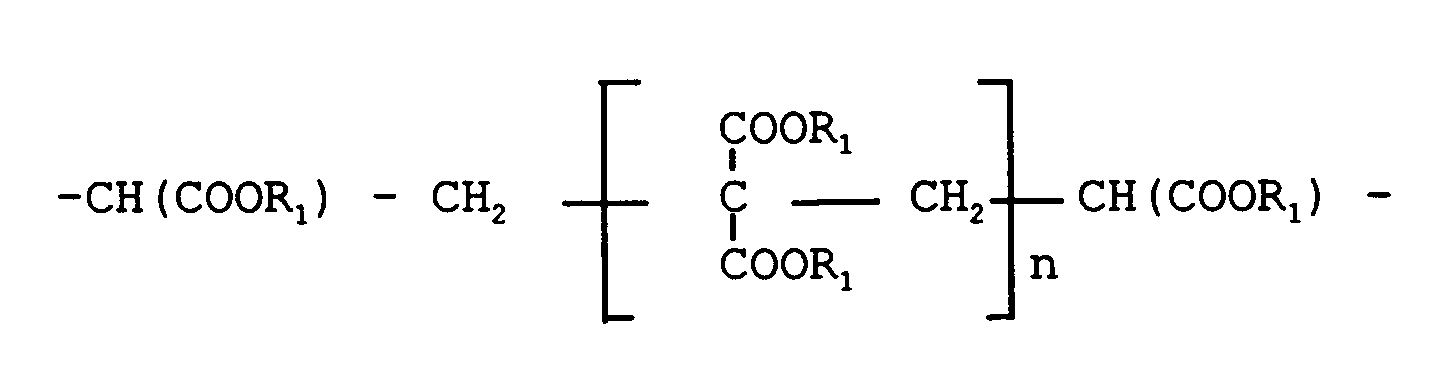
- n
- gleich 0 bis 2 ist,
- Überraschenderweise ergeben die erfindungsgemäß hergestellten Vernetzungskomponenten ein wesentlich günstigeres Eigenschaftsbild als äquivalent zusammengesetzte Mischungen der umesterungsfähigen Verbindungen und blockierten Isocyanatverbindungen.
- Für den Aufbau der Vernetzungskomponenten geeignete Polyhydroxylverbindungen sind geradkettige oder verzweigte Alkylenglykole, Trimethylolalkane sowie oligomere Polyester mit 2 bis 5 Hydroxylgruppen. Vorzugsweise werden Triole herangezogen. Diole werden vorzugsweise beim Einsatz von höherfunktionellen Umesterungs- und/oder Isocyanatverbindungen verwendet.
- Die Polyole werden in erster Stufe partiell mit einem Ester der Formel
R₁O - CO - R₂ - CO - OR₁
umgesetzt, wobei die Reste R₁ und R₂ die in den Ansprüchen angegebene Bedeutung haben. Die bevorzugten Ester sind die Methyl- und Ethylester der Malonsäure sowie aus diesen Estern erhaltene höherfunktionelle Verbindungen, wie sie in der AT-PS 379 602 beschrieben werden. - Der Fortschritt der Reaktion wird durch Bestimmung der Menge des abgespaltenen Alkohols verfolgt. Die Reaktion wird beendet, wenn pro Mol eingesetzter Esterkomponente 1 Mol des Veresterungsalkohols abgespalten ist. Pro Mol Polyol werden mindestens 0,25 Mol, vorzugsweise 0,5 bis 2 Mol, der Esterkomponenten eingesetzt.
- In der zweiten Reaktionsstufe wird mindestens eine weitere Hydroxylgruppe des Polyols mit einer Di- oder Polyisocyanatverbindung umgesetzt, deren NCO-Gruppen bis auf maximal 2, vorzugsweise auf eine verbleibende freie NCO-Gruppe mit einem Verkappungsmittel blockiert sind.
- Als Diisocyanat wird vorzugsweise das handelsübliche Toluylendiisocyanat und das Isophorondiisocyanat, sowie das Hexamethylendiisocyanat bzw. dessen handelsüblichen Dimeren und Trimeren eingesetzt.
- Als Verkappungsmittel dienen vorzugsweise Monohydroxylverbindungen, wie Alkohole und Glykolmonoether, beispielsweise n-Butanol, 2-Ethylhexanol, Monoethylenglykolether, Mono- bzw. Diethylenglykolbutylether, Mono-ethylenglykolhexylether oder Methoxypropanol. Weiters können auch die üblichen Verkappungsmittel, wie Phenole, Ketoxime etc. eingesetzt werden. Vorzugsweise werden Verkappungsmittel verwendet, deren Entblockungstemperatur bei maximal 160°C liegt.
- Die Reaktion wird bis zu einem NCO-Wert von 0 geführt. Zur Erzielung einer ausreichenden Funktionalität der Vernetzungskomponente werden vorzugsweise alle Hydroxylgruppen des Polyols umgesetzt. Das Verhältnis der umesterungsfähigen Komponente zur Isocyanatkomponente beträgt beim Einsatz von Triolen vorzugsweise 0,5 - 1,0 Mol : 2,5 - 2 Mol pro Mol des Triols.
- Die Produkte werden vorteilhaft als Lösung in wasserverträglichen Lösemitteln, vorzugsweise in Glykolethern, eingesetzt. Die Lösemittel werden gegebenenfalls bereits ganz oder anteilig in den einzelnen Reaktionsstufen eingesetzt. Selbstverständlich dürfen in diesem Falle nur reaktionsinerte Lösemittel verwendet werden.
- Kationische Bindemittel, die als Kombinationspartner für die Vernetzungskomponenten eingesetzt werden, sind in großer Zahl aus der Literatur bekannt. Beispielsweise seien hier die sogenannten Epoxidharz-Aminaddukte der verschiedenen Glycidylgruppen tragenden Verbindungen auf Basis von Phenolen, Diolen u. ä. bzw. von Copolymeren genannt. Andere Produkte basieren auf Copolymeren, die Aminoacrylate als Comonomere enthalten oder auf Mannich-Reaktionsprodukten von Phenolen, die in mannigfaltiger Weise modifiziert werden könnnen.
- Die Verarbeitung der erfindungsgemäß hergestellten Vernetzungskomponenten erfolgt durch Mischung der Kombinationspartner, die vorzugsweise bei Temperaturen bis 60°C erfolgt. Gegebenenfalls kann auch eine anteilige Kondensation der Partner bei Temperaturen bis 120°C erfolgen.
- Die Protonisierung der kationischen Bindemittel erfolgt vorteilhaft nach der Mischung mit der Vernetzungskomponente. Die weitere Verarbeitung der Bindemittel, sowie die Auswahl der entsprechenden Pigmente, Füllstoffe, Additive, und gegebenenfalls Zumischungen von anderen Harztypen sind dem Fachmann bekannt oder der einschlägigen Literatur zu entnehmen. Das gleiche gilt auch für die Verarbeitung der Lacke auf konventionelle Weise oder nach dem Elektrotauchlackierverfahren und für die Prüfung der vernetzten Filme.
- Die folgenden Beispiele erläutern die Erfindung, ohne sie in ihrem Umfang zu beschränken. Alle Angaben in Teilen oder Prozenten beziehen sich, soferne nichts anderes angegeben ist, auf Gewichtseinheiten.
- In den Beispielen werden folgende Abkürzungen benützt:
DGDME Diethylenglykoldimethylether EGL Ethylenglykolmonoethylether BUGL Ethylengylkolmonobutylether HGL Ethylenglykolmonohexylether MP Methoxypropanol TDI Toluylendiisocyanat (handelsübliches Isomerengemisch) HMDI Hexamethylendiisocyanat D-HMDI Dimeres HMDI (Tolonat HDB) T-HMDI Trimeres HMDI (Tolonat HDT) IPDI Isophorondiisocyanat EHEX 2-Ethylhexanol DEAPA N,N-Diethylaminopropylamin - 134 g (1 Mol) Trimethylolpropan werden mit 160 g (1 Mol) Malonsäurediethylester versetzt und bis zum Destillationsbeginn (ca. 140 - 150°C) erhitzt. Bei steigender Temperatur (bis 180°C) werden 46 g (1 Mol) Ethanol abdestilliert. Nach beendeter Reaktion wird mit 128 g DGDME verdünnt und auf 60°C gekühlt. Anschließend werden 264 g (1 Mol bzw. 1 NCO-Äquivalent) eines Reaktionsproduktes aus 1 Mol TDI und 1 Mol EGL innerhalb von 4 Stunden zugegeben und bei 60°C auf einen NCO-Gehalt unter 0,02 Milliäquivalente pro g Probe reagiert.
- Das erhaltene Produkt hat einen Festharzgehalt von 80 ± 2 % (30 Minuten, 120°C) und eine Viskosität nach GARDNER-HOLDT von K (10 g Produkt + 2 g DGDME). Der Brechungsindex der Vernetzungskomponente beträgt bei 20°C nD= 1,4960 ± 0,001.
- Zu einer Mischung aus 134,4 g (0,84 Mol) Malonsäurediethylester, 0,286 g (0,0034 Mol) Piperidin und 0,185 g (0,0034 Mol) Ameisensäure 85 % werden bei 80°C 13,86 g (0,42 Mol) Paraformaldehyd 91 % portionsweise zugegeben, sodaß bei Einsetzen der exothermen Reaktion eine Temperatur von 95°C nicht überschritten wird. Das Reaktionsgemisch wird bei 95°C gerührt bis der Paraformaldehyd vollständig gelöst ist. Die Temperatur wird unter einsetzender Wasserabspaltung innerhalb von 2 Stunden auf 110°C erhöht. Nach Erreichen von 110°C werden mit Spezialbenzin (Siedebereich 80 - 120°C) als Schleppmittel insgesamt 9,24 g (0,51 Mol) Wasser abdestilliert. Unter Anlegen von Vakuum wird anschließend das eingesetzte Schleppmittel abdestilliert. Das Produkt weist einen Festkörpergehalt von 78 ± 2 % (30 Minuten, 120°C) auf. Der Brechungsindex ergibt einen Wert von nD/20 = 1,437 ± 0,002.
- Anschließend werden 134 g (1 Mol) Trimethylolpropan zugegeben und bis zum Destillationsbeginn (140 - 150°C) erhitzt. Bei steigender Temperatur werden 23 g (0,5 Mol) Ethanol abdestilliert. Nach Erreichen der Destillatmenge wird mit 263 g DGDME verdünnt und auf 30°C gekühlt. Bei 30°C werden innerhalb von 6 Stunden 800 g (2,5 Mol bzw. 2,5 NCO-Äquivalente) eines Reaktionsproduktes aus 2,5 Mol TDI und 2,5 Mol HGL zugegeben. In weiteren 4 Stunden wird die Temperatur auf 100°C erhöht und bei dieser Temperatur bis zu einem NCO-Gehalt unter 0,01 Milliäquivalente pro g Probe reagiert.
- Das erhaltene Produkt mit einem Festharzgehalt von 80 ± 2 % (30 Minuten, 120°C) weist einen Brechungsindex nD/20 von 1,507 ± 0,001 und eine Viskosität (10 g Harzlösung + 4 g DGDME) von E - F (Gardner Holdt) auf.
- Ein in gleicher Weise wie in B 2 hergestelltes Zwischenprodukt aus Malonsäurediethylester und Paraformaldehyd wird mit 149 g (1 Mol) TROLA versetzt und bis zur einsetzenden Ethanolabspaltung (ca. 110°C) erhitzt. Insgesamt werden 23 g (0,5 Mol) Ethanol abdestilliert und anschließend mit 440 g DGDME verdünnt und auf 20°C gekühlt. Bei 20°C werden unter Kühlen 760 g (2,5 Mol bzw. 2,5 NCO-Äquivalente) eines Reaktionsproduktes aus 2,5 Mol TDI und 2,5 Mol EHEX in 6 Stunden zugegeben und bei dieser Temperatur bis zu einem NCO-Gehalt unter 0,01 Milliäquivalent pro g Harzlösung reagiert.
- Das erhaltene Produkt weist folgende Kennzahlen auf:
Festharzgehalt (120°C, 30 Minuten) 70 ± 2 % Viskosität (10 g Harzlösung + 2 g DGDME) D-E (Gardner-Holdt) Aminzahl (bezogen auf Festharzgehalt) 54 mg KOH/g Festharz Brechnungsindex nD/20 1,492 ± 0,001 - Zu einer Mischung aus 160 g (1 Mol) Malonsäurediethylester, 0,34 g (0,004 Mol) Piperidin und 0,22 g (0,004 Mol) Ameisensäure 85 % werden bei 80°C 16,5 g (0,5 Mol) Paraformaldehyd 91 % portionsweise zugegeben, sodaß bei Einsetzen der exothermen Reaktion eine Temperatur von 95°C nicht überschritten wird. Das Reaktionsgemisch wird bei 95°C gerührt bis der Paraformaldehyd vollständig gelöst ist. Die Temperatur wird unter einsetzender Wasserabspaltung innerhalb von 2 Stunden auf 110°C erhöht. Nach Erreichen von 110°C werden mit Spezialbenzin (Siedebereich 80 - 120°C) als Schleppmittel insgesamt 11 g (0,61 Mol) Wasser abdestilliert. Unter Anlegen von Vakuum wird anschließend das eingesetzte Schleppmittel abdestilliert. Das Produkt weist einen Festkörpergehalt von 78 ± 2 % (30 Minuten, 120°C) auf. Der Brechungsindex ergibt einen Wert von nD/20 = 1,437 ± 0,002. Nach der Zugabe von 90 g (1 Mol) 1,4-Butandiol wird die Temperatur bis zum Destillationsbeginn von Ethanol erhöht und 46 g (1 Mol) Ethanol abdestilliert, mit 117 g DGDME verdünnt und auf 40°C gekühlt. Innerhalb von 4 Stunden werden 258 g (1 Mol bzw. 1,0 NCO-Äquivalente) eines Reaktionsproduktes aus 1 Mol HMDI und 1 Mol n-Butanol zugegeben und 6 Stunden bei 40°C bis zu einem NCO-Gehalt unter 0,01 Milliäquivalente pro g Probe reagiert. Das erhaltene Produkt weist folgende Kennzahlen auf:
Festharzgehalt (120°C, 30 Minuten) 80 ± 2 % Viskosität (10 g Harzlösung + 2 g DGDME) H - I (Gardner Holdt) Brechungsindex nD/20 1,487 ± 0,002 - 118 g (1 Mol) Hexandiol-1,6 und 160 g (1 Mol) Malonsäurediethylester werden bis zur beginnenden Destillation von Ethanol erhitzt und 46 g (1 Mol) Ethanol abdestilliert. Danach wird mit 259 g DGDME verdünnt und auf 50°C gekühlt. Bei 50°C werden anschließend 372 g (1 Mol bzw. 1 NCO-Äquivalent) eines Reaktionsproduktes aus 1 Mol IPDI und 1 Mol tertiär-Butylphenol zugegeben und auf einen NCO-Gehalt unter 0,01 Milliäquivalent pro g Probe reagiert.
- Das Endprodukt weist folgende Kennzahlen auf:
Festharzgehalt (30 Minuten, 120°C) 70 ± 2 % Viskosität (10 g Harzlösung + 2 g DGDME) H - J Brechungsindex nD/20 1,491 ± 0,002 - 149 g (1 Mol) Triethanolamin werden mit 432 g (2 Mol) Malonsäuredibutylester bis zur Destillation von Butanol erhitzt und 148 g (2 Mol) Butanol über eine Kolonne abdestilliert. Anschließend wird mit 385 g DGDME verdünnt und auf 50°C gekühlt. Bei dieser Temperatur werden innerhalb von 4 Stunden 660 g (1 NCO-Äquivalent) eines auf 80 % mit DGDME angelösten Reaktionsproduktes aus 1 Mol D-HMDI und 1 Mol HGL zugegeben und bis auf einen NCO-Gehalt unter 0,01 Milliäquivalente pro g Probe reagiert.
- Das erhaltene Produkt weist folgende Kennzahlen auf:
Festharzgehalt ( 30 Minuten, 120°C) 65 ± 2 % Viskosität (10 g Harzlösung + 2 g DGDME) D - E (Gardner-Holdt) Brechungsindex nD/20 1,4807 ± 0,002 - 134 g (1 Mol) Trimethylolpropan und 264 g (2 Mol) Malonsäuredimethylester werden bis zur einsetzenden Destillation erhitzt und über eine Kolonne werden 64 g (2 Mol) Methanol abdestilliert. Anschließend wird mit 397 g DGDME verdünnt und auf 60°C gekühlt. Innerhalb von 4 Stunden erfolgt die Zugabe von 941 g (1 NCO-Äquivalent) eines auf 80 % mit DGDME angelösten Reaktionsproduktes aus 1 Mol T-HMDI und 2 Mol MP. Die Reaktionstemperatur wird auf 100°C erhöht und bis zu einem NCO-Gehalt unter 0,01 Milliäquivalente gehalten.
- Das Produkt weist folgende Kennzahlen auf:
Festharzgehalt (120°C, 30 Minuten) 65 ± 2 % Viskosität (10 g Harzlösung + 2 g DGDME) K - L (Gardner-Holdt) Brechungsindex nD/20 1,477 ± 0,002 - Für die Vergleichsversuche wurden die Vernetzungskomponenten B 8 und B 9 in folgender Weise hergestellt:
- Es wird ein Umesterungsprodukt aus 396 g Malonsäuredimethylester und 134 g Trimethylolpropan mit 1,1 g Zinkoctoat (8 % Metallgehalt) hergestellt. Das Substanzgemisch wird bei 130°C zirka 10 Stunden lang umgesetzt, wobei etwa 90 g Methanol als Destillat entweichen. Der fertige polyfunktionelle Ester ist eine farblose Flüssigkeit mit einer Hydroxylzahl von 16 mg KOH/g.
- 134 g (1 Mol) Trimethylolpropan werden in 397 g DGDME gelöst. In diese Lösung werden 792 g (3 Mol, bzw. 3 NCO-Äquivalente) eines Reaktionsproduktes aus 3 Mol TDI mit 3 Mol EGL innerhalb von 3 Stunden zugegeben und die Temperatur der exothermen Reaktion durch Kühlen auf 40°C gehalten. Die Reaktion ist beendet, wenn der NCO-Gehalt unter 0,02 Milliäquivalente pro g Probe gesunken ist.
- Das erhaltene Produkt weist einen Festharzgehalt von 70 ± 2 % (30 Minuten, 120°C) auf und eine Viskosität nach Gardner-Holdt von O - P (10 g Produkt + 3 g DGDME). Der Brechungsindex des Polyurethanvernetzers beträgt bei 20°C nD/20 = 1,4860 ± 0,0015.
- Zur Kombination mit den Vernetzungskomponenten wurden folgende Basisharze eingesetzt:
- 190 g eines Bisphenol-A-Epoxidharzes (1 Epoxidäquivalent) und 1425 g eines Bisphenol-A-Epoxidharzes (3 Epoxidäquivalente) werden bei 100°C in 597 g EGL gelöst. Die Lösung wird auf 60°C gekühlt und mit 126 g Diethanolamin versetzt. Man steigert die Temperatur während 2 Stunden langsam auf 80°C. Anschließend werden 169 g DEAPA zugegeben und die Temperatur in 2 Stunden auf 120°C gesteigert. Bei dieser Temperatur werden 478 g Cardura E 10 (SHELL) zugegeben und anschließend 5 Stunden bei 130°C unter Rühren belassen. Man verdünnt mit EGL auf 65 % Harzgehalt. Das Festharz hat eine Aminzahl von 91 mg KOH/g und eine Hydroxylzahl von 265 mg KOH/g.
- 2 g Azobisisobutyronitril werden in 40 g Isopropanol unter Erwärmen gelöst. Zur klaren Lösung wird bei Rückflußtemperatur (ca. 84°C) ein Monomerengemisch, bestehend aus 20 g Glycidylmethacrylat, 20 g Hydroxyethylmethacrylat, 20 g Methylmethacrylat und 40 g 2-Ethylhexylacrylat, in dem 2 g Azobisisobutyronitril klar gelöst sind, während 2 Stunden gleichmäßig zugegeben. Die Reaktionsmasse wird weitere 3 Stunden bei Rückflußtemperatur gerührt. Eine homogene Lösung von 16 g Diisopropanolamin in 20 g BUGL wird der Reaktionsmasse bei 85°C rasch zugegeben, anschließend wird 2 Stunden bei 90°C nachgerührt. Das Produkt wird bei 90°C mit 13 g EGL und bei 40°C mit 10 g Aceton verdünnt.
- Das Harz hat einen Festharzgehalt von 57 %, eine Aminzahl von 58 mg KOH/g und eine Hydroxylzahl von 250 mg KOH/g.
- 380 g eines Epoxidnovolakharzes (Epoxidäquivalent ca. 190) werden in 354 g DGDME gelöst und bei 80°C mit 269 g eines Halbesters aus Tetrahydrophthalsäureanhydrid und Hydroxyethyloxazolidin, sowie mit 37 g Diethylamin und 140 g Tallölfettsäure bis zu einer Säurezahl von unter 3 mg KOH/g umgesetzt. Anschließend wird das Harz nach Zusatz von 10 Millimol Essigsäure (3 normal) pro 100 g Festharz 3 Stunden bei 65°C gerührt. Das Produkt hat eine OH-Zahl entsprechend 270 mg KOH/g.
- 1627 g (3,43 Val) eines Epoxidharzes auf Basis Bisphenol A (Epoxidäquivalentgewicht ca. 475) werden mit 226 g (0,24 COOH-Val) eines Polyesters aus 3 Mol Trimethylolpropan, 2 Mol Adipinsäure, 1 Mol Isononansäure und 1 Mol Tetrahydrophthalsäureanhydrid (Säurezahl 65 mg KOH/g, Carboxyläquivalent 942 g) in 85%iger Lösung in MP bei 110°C bis zu einer Säurezahl von weniger als 5 mg KOH/g umgesetzt.
- Nach Verdünnen des Ansatzes mit MP auf einen Festkörpergehalt von 70 % erfolgt bei 60°C innerhalb von 2 Stunden die Zugabe einer Mischung von 94,5 g (0,9 Val) Diethanolamin, 67,5 g (0,9 Val) Methylethanolamin, 78 g (1,2 Val) DEAPA und 240 g MP. Anschließend wird die Temperatur auf 90°C gesteigert und diese Temperatur für eine Stunde gehalten. Dann wird der Festkörpergehalt mit MP auf 70 % eingestellt.
- 570 g (3 Val) eines Epoxidharzes auf Basis Bisphenol A (Epoxidäquivalent ca. 190) und 317 g MP werden auf 60°C erwärmt und innerhalb von 2 Stunden mit einer Mischung aus 116 g (0,9 Val) Ethylhexylamin und 163 g (0,15 NH-Val) eines polymeren Amins (siehe unten) versetzt und bis zu einem MEQ-Wert von 2,06 reagiert. Anschließend werden 1330 g (2,1 Val) einer 75%igen Lösung eines Bisphenol A-Epoxidharzes (Epoxidäquivalent 475) in MP zugegeben. Bei 60°C wird weiters innerhalb einer Stunde eine Lösung von 189 g (1,8 Val) Diethanolamin in 176 g MP zugegeben und die Reaktion bis zu einem MEQ-Wert von 1,57 geführt. Nach weiterer Zugabe einer Lösung von 78 g (1,2 Val) DEAPA in 54 g MP innerhalb einer Stunde wird bei 60°C bis zu einem MEQ-Wert von 1,46 reagiert. Die Temperatur wird auf 90°C und anschließend innerhalb einer weiteren Stunde auf 120°C gesteigert. Bei Erreichen einer Viskosität (GARDNER-HOLDT; 6 g Harz + 4 g MP) von I - J wird mit MP auf einen Festkörpergehalt von 65 % verdünnt. Das Produkt hat eine Aminzahl von 117 mg KOH/g und eine Hydroxylzahl von 323 mg KOH/g.
- Das polymere Amin wird durch Umsetzung von 1 Mol Diethylentriamin mit 3,1 Mol 2-Ethylhexylglycidylether und 0,5 Mol eines Bisphenol A-Epoxidharzes (Epoxidäquivalent ca. 190) in 80%iger MP-Lösung hergestellt. Das Produkt weist eine Viskosität (DIN 53211/20°C; 100 g Harz + 30 g MP) von 60 bis 80 Sekunden auf.
- 0,2 - 0,4 g Harz werden genau (auf Milligramm) gewogen und in 5 Tropfen Methoxypropanol geschmolzen. Nach Abkühlen werden 25 ml einer Mischung aus Dichlormethan und Eisessig (4:1 Volumsteile) zugegeben und das Harz unter leichtem Erwärmen gelöst. Dann werden bei Zimmertemperatur 0,5 g Tetrabutylammoniumjodid und 3 Tropfen Kristallviolett-Lösung zugegeben. Man titriert mit 0,1 n Perchlorsäure-Lösung in Eisessig von blau-violett nach gras-grün (kein Blauton).
- Ein Blindwert (ohne Harz) wird in gleicher Weise bestimmt.
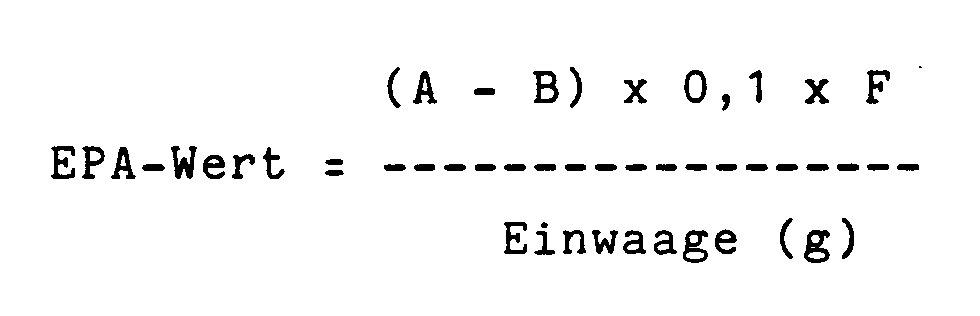
- A =
- ml 0,1 n Perchlorsäure für Probe
- B =
- ml 0,1 n Perchlorsäure für Blindwert
- F =
- Faktor der 0,1 n Perchlorsäure-Lösung
- In einer ERLENMEYER-Flasche werden ca. 200 mg Kaliumhydrogenphthalat (pro analysi) auf 0,1 mg genau eingewogen. Nach Zugabe von 30 ml Eisessig und 3 Tropfen Kristallviolett-Lösung wird mit der ca. 0,1 n Perchlorsäure-Lösung von blau-violett nach grasgrün titriert.

- W =
- Einwaage Kaliumhydrogenphthalat
- C =
- ml der ca. 0,1 n Perchlorsäure-Lösung in Eisessig.
- Ein modifiziertes Epoxid-Amin-Addukt, wie es als Basisharz A 4 beschrieben wurde, wird in der letzten Phase bei 90°C mit 5 Gew.-% Polypropylenglykoldiglycidylether versetzt und bei 120°C bis zur Umsetzung aller Glycidylgruppen reagiert. Das Produkt weist eine Aminzahl von 76 mg KOH/g und eine Hydroxylzahl (prim. OH) von 89 mg KOH/g auf.
- Die erfindungsgemäß hergestellten Vernetzungskomponenten wurden mit verschiedenen Basisharzen unter den in der Tabelle 1 angegebenen Bedingungen kombiniert.
- Dazu werden die Komponenten in 70%iger Lösung in MP unter den in der Tabelle 1 angegebenen Bedingungen gemischt bzw. partiell reagiert.

- Die Bindemittel wurden nach Neutralisation mit 40 bis 60 Millimol Ameisensäure und Verdünnen mit deionisiertem Wasser auf einen Festkörpergehalt von 15 % als Klarlack auf gereinigte, unvorbehandelte Stahlbleche mit einer Trockenfilmstärke von 18 ± 2 µm kathodisch abgeschieden und 25 Minuten bei 160°C eingebrannt.
- Bei den angegebenen Prüfungen wurden für die Beispiele 1 bis 7 folgende Werte gefunden:
Acetontest (1) über 100 Sekunden Schlagtiefung (2) 60 - 80 inch x pound Salzsprühtest (3) 2 - 5 mm VDA-Kennwert (4) 2 - 6 - Bei den Vergleichsbeispielen V1 - V3 ergeben sich folgende Werte:
Beispiel V1 V2 V3 Acetontest über 100 10 über 100 Schlagtest 40 10 60 Salzsprühtest 4 8 5 VDA-Kennwert 3 7 6 - Diese Werte verschlechtern sich wesentlich, sobald die Separation der Komponenten bei den Beispielen 8 und 10 erkennbar wird.
- (1) Reiben mit acetongetränkter Watte, bis Filmerweichung feststellbar
- (2) Prüfung mit Gerät der Fa. Erichsen, BRD (1 inch x pound = 0,113 Joule)
- (3) ASTM 117-64, Testdauer 250 Stunden, Angabe der Unterrostung (beidseitig vom Schnitt) in Millimeter
- (4) Korrosionswechseltest VDA 621-415; Prüfung auf zinkphosphatiertem Stahlblech; Testdauer 10 Zyklen; Kennwert gibt die Unterrostung (beidseitig vom Schnitt) in Millimeter an.
Claims (4)
- Verfahren zur Herstellung von Vernetzungskomponenten für Hydroxylgruppen und/oder sekundäre und/oder primäre Aminogruppen aufweisende Lackbindemittel, insbesonders für kathodisch abscheidbare Lacke, die durch Umesterung und/oder Umamidierung und/oder Umurethanisierung vernetzbar sind, dadurch gekennzeichnet, daß man mindestens 0,25 Mol, vorzugsweise 0,5 Mol, Hydroxylgruppen einer Polyhydroxylverbindung und/oder eines Alkanolamins mit mindestens 2 Hydroxylgruppen mit einem Ester der Formel
R₁O - CO - R₂ - CO - OR₁,
wobeiR₁ gleiche oder verschiedene Alkylreste mit 1 bis 8 C-Atomen undR₂ eine der Gruppen -CH₂-, -CH=CH- -CH(OH)-CH₂-, -C(OH)=CH-, -CH(OH)-CH(OH)- oder n gleich 0 bis 2 ist,partiell bis zur Abspaltung von jeweils 1 Mol des Veresterungsalkohols pro Mol des Esters umestert und in einer zweiten Reaktionsstufe mindestens eine weitere Hydroxylgruppe der Polyhydroxylverbindung mit einer Di- oder Polyisocyanatverbindung, deren NCO-Gruppen bis auf maximal 2, vorzugsweise bis auf eine, mit einem Verkappungsmittel blockiert sind, umsetzt.
 - Verfahren nach Anspruch 1, dadurch gekennzeichnet, daß man als Polyhydroxylverbindung geradkettige oder verzweigte Alkylenglykole und/oder Trimethylolalkane und/oder oligomere Polyester mit 2 bis 5 Hydroxylgruppen einsetzt.
- Verfahren nach Anspruch 1, dadurch gekennzeichnet, daß man zur Blockierung der Isocyanatgruppen Verkappungsmittel mit einer Entblockungstemperatur von maximal 160°C einsetzt.
- Verfahren nach den Ansprüchen 1 bis 3, dadurch gekennzeichnet, daß man pro Mol eines Triols 0,5 bis 1 Mol der umesterungsfähigen Komponente und 2,5 bis 2 Mol der Isocyanatkomponente einsetzt.
Applications Claiming Priority (2)
| Application Number | Priority Date | Filing Date | Title |
|---|---|---|---|
| AT0172188A AT393685B (de) | 1988-07-04 | 1988-07-04 | Vernetzungskomponente fuer lackbindemittel und verfahren zu deren herstellung |
| AT1721/88 | 1988-07-04 |
Publications (3)
| Publication Number | Publication Date |
|---|---|
| EP0349873A2 EP0349873A2 (de) | 1990-01-10 |
| EP0349873A3 EP0349873A3 (de) | 1991-11-13 |
| EP0349873B1 true EP0349873B1 (de) | 1993-06-02 |
Family
ID=3519568
Family Applications (1)
| Application Number | Title | Priority Date | Filing Date |
|---|---|---|---|
| EP89111571A Expired - Lifetime EP0349873B1 (de) | 1988-07-04 | 1989-06-24 | Verfahren zur Herstellung von Vernetzungskomponenten für Lackbindemittel |
Country Status (10)
| Country | Link |
|---|---|
| US (1) | US5059652A (de) |
| EP (1) | EP0349873B1 (de) |
| JP (1) | JPH0267375A (de) |
| KR (1) | KR930007353B1 (de) |
| AT (1) | AT393685B (de) |
| BR (1) | BR8903266A (de) |
| CA (1) | CA1336331C (de) |
| DE (1) | DE58904549D1 (de) |
| ES (1) | ES2058405T3 (de) |
| PL (1) | PL160260B1 (de) |
Families Citing this family (3)
| Publication number | Priority date | Publication date | Assignee | Title |
|---|---|---|---|---|
| GB9011710D0 (en) * | 1990-05-25 | 1990-07-18 | Shell Int Research | Heat-curable thermosetting resin system for cathodic electrodeposition |
| US6423425B1 (en) | 1998-05-26 | 2002-07-23 | Ppg Industries Ohio, Inc. | Article having a chip-resistant electrodeposited coating and a process for forming an electrodeposited coating |
| US6248225B1 (en) | 1998-05-26 | 2001-06-19 | Ppg Industries Ohio, Inc. | Process for forming a two-coat electrodeposited composite coating the composite coating and chip resistant electrodeposited coating composition |
Family Cites Families (8)
| Publication number | Priority date | Publication date | Assignee | Title |
|---|---|---|---|---|
| DE3046409A1 (de) * | 1980-12-10 | 1982-07-15 | Bayer Ag, 5090 Leverkusen | Beschichtungsmittel und ein verfahren zur herstellung von ueberzuegen |
| US4554188A (en) * | 1981-12-28 | 1985-11-19 | Ford Motor Company | Chain-extendable crosslinkable urethane modified polyhydroxy oligomers and coating composition comprising same |
| US4559383A (en) * | 1981-12-28 | 1985-12-17 | Ford Motor Company | Chain-extendable crosslinkable urethane modified polyhydroxy oligomers and coating composition comprising same |
| DE3432233A1 (de) * | 1984-09-01 | 1986-03-13 | Basf Farben + Fasern Ag, 2000 Hamburg | Kathodisch abscheidbares waessriges elektrotauchlackueberzugsmittel und verfahren zum beschichten eines elektrisch leitenden substrats |
| AT381500B (de) * | 1985-05-29 | 1986-10-27 | Vianova Kunstharz Ag | Verfahren zur herstellung von vernetzungskomponenten und deren verwendung fuer lackbindemittel |
| AT383820B (de) * | 1985-09-25 | 1987-08-25 | Vianova Kunstharz Ag | Verfahren zur herstellung selbstvernetzender kathionischer lackbindemittel und deren verwendung |
| AT390808B (de) * | 1986-09-19 | 1990-07-10 | Vianova Kunstharz Ag | Verwendung von zinn-kondensationsprodukten zur katalysierung der vernetzungsreaktionen von kathodisch abscheidbaren lackbindemitteln |
| AT387973B (de) * | 1986-12-15 | 1989-04-10 | Vianova Kunstharz Ag | Verfahren zur herstellung von kationischen lackbindemitteln und deren verwendung |
-
1988
- 1988-07-04 AT AT0172188A patent/AT393685B/de not_active IP Right Cessation
-
1989
- 1989-06-24 ES ES89111571T patent/ES2058405T3/es not_active Expired - Lifetime
- 1989-06-24 EP EP89111571A patent/EP0349873B1/de not_active Expired - Lifetime
- 1989-06-24 DE DE8989111571T patent/DE58904549D1/de not_active Expired - Fee Related
- 1989-07-03 PL PL1989280390A patent/PL160260B1/pl unknown
- 1989-07-03 BR BR898903266A patent/BR8903266A/pt active Search and Examination
- 1989-07-04 KR KR1019890009457A patent/KR930007353B1/ko not_active Expired - Fee Related
- 1989-07-04 JP JP1171325A patent/JPH0267375A/ja active Pending
- 1989-07-04 CA CA000604687A patent/CA1336331C/en not_active Expired - Fee Related
- 1989-07-05 US US07/375,470 patent/US5059652A/en not_active Expired - Fee Related
Also Published As
| Publication number | Publication date |
|---|---|
| KR930007353B1 (ko) | 1993-08-09 |
| ES2058405T3 (es) | 1994-11-01 |
| EP0349873A3 (de) | 1991-11-13 |
| CA1336331C (en) | 1995-07-18 |
| AT393685B (de) | 1991-11-25 |
| KR900001802A (ko) | 1990-02-27 |
| DE58904549D1 (de) | 1993-07-08 |
| EP0349873A2 (de) | 1990-01-10 |
| BR8903266A (pt) | 1990-02-13 |
| JPH0267375A (ja) | 1990-03-07 |
| US5059652A (en) | 1991-10-22 |
| ATA172188A (de) | 1991-05-15 |
| PL160260B1 (pl) | 1993-02-26 |
Similar Documents
| Publication | Publication Date | Title |
|---|---|---|
| EP0642558B1 (de) | Katalysierte kationische lackbindemittel, verfahren zu ihrer herstellung und ihre verwendung | |
| EP0053766B2 (de) | Verfahren zur Herstellung von Ueberzügen | |
| EP0004090B2 (de) | Kathodisch abscheidbares wässriges Elektrotauchlack-Überzugsmittel | |
| EP0082291B1 (de) | Wärmehärtbare kationische wasserverdünnbare Bindemittel | |
| AT391140B (de) | Verfahren zur herstellung von kathodisch abscheidbaren lackbindemitteln und deren verwendung | |
| DE2732902A1 (de) | Verfahren zur herstellung von selbstvernetzenden kationischen emulsionen fuer die elektrotauchlackierung | |
| EP0385293B1 (de) | Hitzehärtbares Überzugsmittel für die kathodische Elektrotauchlackierung | |
| EP0467153B1 (de) | Bindemittelkombination, ihre Verwendung in Einbrennlacken und ein Verfahren zur Herstellung von Überzügen | |
| EP0264609B1 (de) | Ester- und Ethergruppen enthaltende Polyhydroxylverbindungen als Reaktivverdünner | |
| EP0025555A2 (de) | Selbstvernetzendes, hitzehärtbares wässriges Lacküberzugsmittel und dessen Verwendung zur kathodischen Abscheidung auf elektrisch leitenden Oberflächen | |
| EP0449072B1 (de) | Verfahren zur Herstellung von kationischen Lackbindemitteln und deren Verwendung | |
| EP0208867B1 (de) | Vernetzungskomponenten für Lackbindemittel und Verfahren zu deren Herstellung | |
| EP0157102B1 (de) | Verfahren zur Herstellung von kathodisch abscheidbaren Lackbindemitteln | |
| EP0220440A1 (de) | Verfahren zur Herstellung selbstvernetzender kationischer Lackbindemittel | |
| AT393685B (de) | Vernetzungskomponente fuer lackbindemittel und verfahren zu deren herstellung | |
| DE2755538C3 (de) | Verfahren zur Herstellung von wärmehärtbaren Bindemitteln für kathodisch abscheidbare Überzugsmittel | |
| EP0317742B1 (de) | Verfahren zur Herstellung von Einkomponenten-PUR-Einbrennlacken | |
| DE4428505C2 (de) | Verfahren zur Herstellung von organischen Titanverbindungen und deren Verwendung in kathodisch abscheidbaren Elektrotauchlacken | |
| AT378783B (de) | Selbstvernetzendes, hitzehaertbares waesseriges lackueberzugsmittel | |
| AT372100B (de) | Verfahren zur herstellung von bindemitteln fuer die elektrotauchlackierung | |
| AT361587B (de) | Kathodisch abscheidbares waesseriges elektro- tauchlack-ueberzugsmittel | |
| EP0193103B1 (de) | Verfahren zur Herstellung einer Vernetzungskomponente für kationische Lackbindemittel | |
| DE3712910A1 (de) | Verfahren zur herstellung von an der kathode abscheidbaren waessrigen elektrotauchlackueberzugsmitteln | |
| EP0244792B1 (de) | Härterkomponente für ofentrocknende Lackbindemittel und Verfahren zu deren Herstellung | |
| DE3542569A1 (de) | Verfahren zur herstellung von ketl-bindemitteln auf basis von modifizierten epoxidharzen |
Legal Events
| Date | Code | Title | Description |
|---|---|---|---|
| PUAI | Public reference made under article 153(3) epc to a published international application that has entered the european phase |
Free format text: ORIGINAL CODE: 0009012 |
|
| 17P | Request for examination filed |
Effective date: 19890624 |
|
| AK | Designated contracting states |
Kind code of ref document: A2 Designated state(s): BE DE ES FR GB IT NL SE |
|
| PUAL | Search report despatched |
Free format text: ORIGINAL CODE: 0009013 |
|
| AK | Designated contracting states |
Kind code of ref document: A3 Designated state(s): BE DE ES FR GB IT NL SE |
|
| 17Q | First examination report despatched |
Effective date: 19920929 |
|
| GRAA | (expected) grant |
Free format text: ORIGINAL CODE: 0009210 |
|
| AK | Designated contracting states |
Kind code of ref document: B1 Designated state(s): BE DE ES FR GB IT NL SE |
|
| PG25 | Lapsed in a contracting state [announced via postgrant information from national office to epo] |
Ref country code: SE Effective date: 19930602 Ref country code: NL Effective date: 19930602 |
|
| ITF | It: translation for a ep patent filed | ||
| REF | Corresponds to: |
Ref document number: 58904549 Country of ref document: DE Date of ref document: 19930708 |
|
| GBT | Gb: translation of ep patent filed (gb section 77(6)(a)/1977) |
Effective date: 19930622 |
|
| ET | Fr: translation filed | ||
| NLV1 | Nl: lapsed or annulled due to failure to fulfill the requirements of art. 29p and 29m of the patents act | ||
| PLBE | No opposition filed within time limit |
Free format text: ORIGINAL CODE: 0009261 |
|
| STAA | Information on the status of an ep patent application or granted ep patent |
Free format text: STATUS: NO OPPOSITION FILED WITHIN TIME LIMIT |
|
| PGFP | Annual fee paid to national office [announced via postgrant information from national office to epo] |
Ref country code: BE Payment date: 19940517 Year of fee payment: 6 |
|
| PGFP | Annual fee paid to national office [announced via postgrant information from national office to epo] |
Ref country code: GB Payment date: 19940519 Year of fee payment: 6 |
|
| 26N | No opposition filed | ||
| REG | Reference to a national code |
Ref country code: ES Ref legal event code: FG2A Ref document number: 2058405 Country of ref document: ES Kind code of ref document: T3 |
|
| PGFP | Annual fee paid to national office [announced via postgrant information from national office to epo] |
Ref country code: ES Payment date: 19950220 Year of fee payment: 7 |
|
| PGFP | Annual fee paid to national office [announced via postgrant information from national office to epo] |
Ref country code: FR Payment date: 19950510 Year of fee payment: 7 |
|
| PG25 | Lapsed in a contracting state [announced via postgrant information from national office to epo] |
Ref country code: GB Effective date: 19950624 |
|
| PG25 | Lapsed in a contracting state [announced via postgrant information from national office to epo] |
Ref country code: BE Effective date: 19950630 |
|
| BERE | Be: lapsed |
Owner name: VIANOVA KUNSTHARZ A.G. Effective date: 19950630 |
|
| GBPC | Gb: european patent ceased through non-payment of renewal fee |
Effective date: 19950624 |
|
| PG25 | Lapsed in a contracting state [announced via postgrant information from national office to epo] |
Ref country code: ES Free format text: LAPSE BECAUSE OF NON-PAYMENT OF DUE FEES Effective date: 19960625 |
|
| PG25 | Lapsed in a contracting state [announced via postgrant information from national office to epo] |
Ref country code: FR Effective date: 19970228 |
|
| REG | Reference to a national code |
Ref country code: FR Ref legal event code: ST |
|
| PGFP | Annual fee paid to national office [announced via postgrant information from national office to epo] |
Ref country code: DE Payment date: 19970523 Year of fee payment: 9 |
|
| PG25 | Lapsed in a contracting state [announced via postgrant information from national office to epo] |
Ref country code: DE Free format text: LAPSE BECAUSE OF NON-PAYMENT OF DUE FEES Effective date: 19990401 |
|
| REG | Reference to a national code |
Ref country code: ES Ref legal event code: FD2A Effective date: 20000403 |
|
| PG25 | Lapsed in a contracting state [announced via postgrant information from national office to epo] |
Ref country code: IT Free format text: LAPSE BECAUSE OF NON-PAYMENT OF DUE FEES;WARNING: LAPSES OF ITALIAN PATENTS WITH EFFECTIVE DATE BEFORE 2007 MAY HAVE OCCURRED AT ANY TIME BEFORE 2007. THE CORRECT EFFECTIVE DATE MAY BE DIFFERENT FROM THE ONE RECORDED. Effective date: 20050624 |