EP0348718A2 - Flüssigkeit zur Konditionierung von Zahn- oder Knochensubstanz - Google Patents
Flüssigkeit zur Konditionierung von Zahn- oder Knochensubstanz Download PDFInfo
- Publication number
- EP0348718A2 EP0348718A2 EP89110532A EP89110532A EP0348718A2 EP 0348718 A2 EP0348718 A2 EP 0348718A2 EP 89110532 A EP89110532 A EP 89110532A EP 89110532 A EP89110532 A EP 89110532A EP 0348718 A2 EP0348718 A2 EP 0348718A2
- Authority
- EP
- European Patent Office
- Prior art keywords
- conditioning
- liquids
- range
- tooth
- liquids according
- Prior art date
- Legal status (The legal status is an assumption and is not a legal conclusion. Google has not performed a legal analysis and makes no representation as to the accuracy of the status listed.)
- Granted
Links
Classifications
-
- A—HUMAN NECESSITIES
- A61—MEDICAL OR VETERINARY SCIENCE; HYGIENE
- A61K—PREPARATIONS FOR MEDICAL, DENTAL OR TOILETRY PURPOSES
- A61K6/00—Preparations for dentistry
- A61K6/40—Primers
Definitions
- the invention relates to a liquid for conditioning defective tooth or bone substance for a supply with plastic plastic material.
- hardening plastic plastic materials are used as filling materials for the supply of cavities to the tooth or bone substance. Fillings based on acrylate are generally preferred as hardening plastic materials.
- these polymeric fillings have the disadvantage that they adhere poorly to the dentin or the bone. To solve this problem, one has e.g. partial undercuts made so far; for this it was necessary to remove considerable amounts of fresh dentin beyond the affected area.
- the dentin or bone has been pretreated in various ways to increase the adhesion of the plastic material.
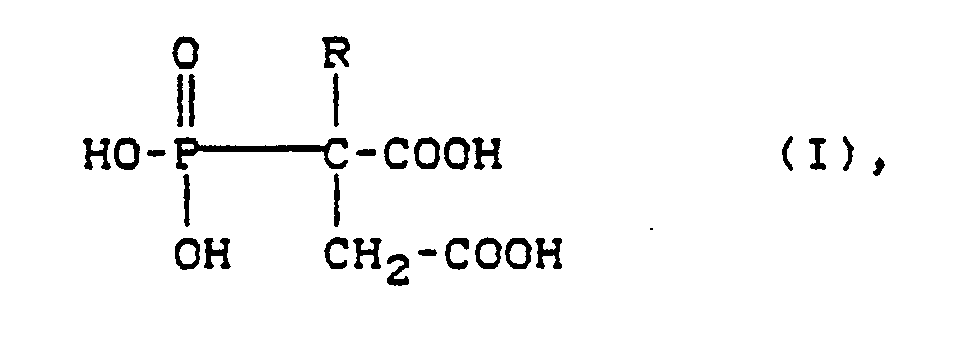
- the phosphonocarboxylic acids of the formula in aqueous solution in the R is hydrogen or optionally substituted by hydroxy, carboxy, substituted C1 to C12 alkyl, C2 to C12 alkenyl, C5 to C8 cycloalkyl, C6 to C12 aryl or C7 to C12 aralkyl and / or the groups and / or -COOR ′ in which R 'represents hydrogen or a C1 to C12 alkyl radical, means and / or their salts, the solution having a pH in the range from 1 to 8, contain.
- the new liquids according to the invention condition the tooth or bone substance before coating with a primer (primer or liner). A firm bond of an applied plastic plastic material occurs on the tooth or bone substance pretreated in this way.
- Alkyl generally represents a straight-chain or branched hydrocarbon radical having 1 to 12 carbon atoms. Lower alkyl having 1 to about 6 carbon atoms is preferred. Examples include methyl, ethyl, propyl, isopropyl, butyl, isobutyl, pentyl, isopentyl, hexyl and isohexyl. Methyl and ethyl are particularly preferred.
- Alkenyl generally represents a straight-chain or branched hydrocarbon radical having 2 to 12 carbon atoms and one or two, preferably one, double bond. Lower alkenyl having 2 to about 6 carbon atoms is preferred. Examples include allyl, vinyl, propenyl, isopropenyl, butenyl, isobutenyl, pentenyl, isopentenyl, hexenyl and isohexenyl.
- Cycloalkyl generally represents a cyclic hydrocarbon radical having 5 to 8 carbon atoms. Examples include cyclopentyl, cyclohexyl, cycloheptyl and cyclooctyl. Cyclopentyl and cyclohexyl are particularly preferred.
- Aryl generally represents an aromatic radical having 6 to about 12 carbon atoms.
- Preferred aryl radicals are phenyl, naphthyl and biphenylyl.
- Aralkyl generally represents an aryl radical having 7 to 12 carbon atoms which is bonded via an alkyl chain.
- Aralkyl radicals having 1 to 5 carbon atoms in the aliphatic and 6 to 12 carbon atoms in the aromatic part are preferred.
- the following aralkyl radicals may be mentioned, for example: benzyl, naphthylmethyl, phenethyl and phenylpropyl.
- phosphonocarboxylic acids of the formula (I) are preferred in which R is hydrogen or, if appropriate, by -COOH or substituted C1 to C6 alkyl means.
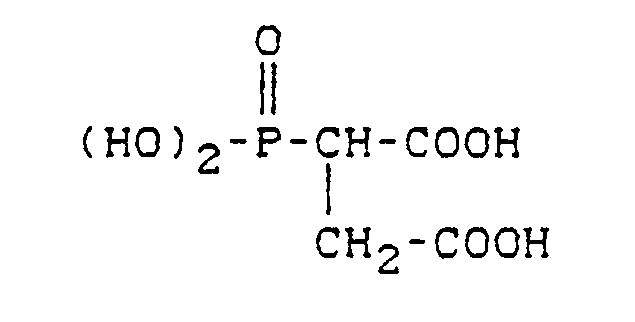
- PBS Phosphonosuccinic acid
- PBTS 2-phosphonobutane-1,2,4-tricarboxylic acid
- DPBD 2,4-diphosphonobutane-1,2-dicarboxylic acid
- the salts of the phosphonocarboxylic acids according to the invention are, in particular, the alkali salts, preferably the sodium and potassium salts.
- the proportion of the phosphonocarboxylic acid or its salts in the liquids according to the invention for the conditioning of tooth or bone substances is determined by the pH.
- the pH is in the range from 1 to 8, preferably in the range from 2 to 7, particularly preferably in the range from 2.5 to 5.
- the pH value can be adjusted by adding alkalis, for example sodium hydroxide or potassium hydroxide.
- alkalis for example sodium hydroxide or potassium hydroxide.
- the measurement of the pH can be carried out in a manner known per se, e.g. with the help of suitable indicators or with the help of potentiometric measurement methods (Ullman, Volume 5, 926 to 936 (1980)).
- aqueous liquids according to the invention for the conditioning of tooth or bone substances can contain organic carboxylic acids with a pKa value of less than 5, preferably in the range of 1 to 4, as a further constituent.
- organic carboxylic acids with a pKa value of less than 5, preferably in the range of 1 to 4, as a further constituent. Examples include the following carboxylic acids: pyruvic acid, citric acid and oxalic acid.
- liquids according to the invention can contain amphoteric amino compounds with a pKa value of 9.0 to 10.6 and a pK B value of 11.5 to 12.5.
- amphoteric amino compounds of the formula (II) in the R1 represents a carboxyl group
- R2 is hydrogen, optionally through hydroxy, mercapto, methylthio, carboxy, carbonamide, amino, phenyl, hydroxyphenyl or the groups substituted lower alkyl
- R3 is hydrogen or phenyl
- R1 and R3 are connected by a propylene radical or in the R1 represents hydrogen
- R2 the group -A-NH3X in the A for an alkylene radical having 1 to 6 carbon atoms and X represents halogen
- R3 means hydrogen, called.
- amphoteric amino compounds are mentioned: glycine, serine, threonine, cysteine, tyrosine, asparagine, glutamine, alanine, valine, leucine, isoleucine, proline, methionine, phenylalanine, tryptophan, lysine, arginine, histidine, N-phenylglycine, ethylene chloride Ethylene diamine hydrobromide, propylene diamine hydrochloride, propylene diamine hydrobromide, butylene diamine hydrochloride and butylene diamine hydrobromide.
- amphoteric amino compounds are glycine, phenylalanine, lysine and ethylenediamine hydrochloride.
- EDTA ethylenediaminetetraacetic acid
- the aqueous liquids according to the invention for conditioning can, for example 1 to 50 parts by weight of phosphonocarboxylic acids, or salts derived therefrom 0 to 15 parts by weight of organic carboxylic acids, 0 to 10 parts by weight of amphoteric amino compounds, 0 to 10 parts by weight of ethylenediaminetetraacetic acid, or salts derived therefrom.
- a process has also been found for the preparation of liquids for conditioning tooth or bone substances, which is characterized in that an aqueous solution of a phosphonocarboxylic acid of the formula in the R is hydrogen or optionally substituted by hydroxy, carboxy, substituted C1 to C12 alkyl, C2 to C12 alkenyl, C5 to C8 cycloalkyl, C6 to C12 aryl or C7 to C12 aralkyl and / or the groups and / or -COOR ′ in which R 'represents hydrogen or a C1 to C12 alkyl radical, means and / or their salts, is produced, a pH value in the range from 1 to 8 being maintained.
- the pH is generally adjusted by adding alkalis, for example sodium hydroxide or potassium hydroxide.
- the components are generally combined in the preparation of the liquids according to the invention with vigorous stirring.
- the components are generally combined at room temperature, for example in the temperature range from 0 to 30.degree.
- the conditioning liquids according to the invention can also contain thickeners or surface-active substances in order to adapt their viscosity or their wetting behavior to special requirements. Addition of polyvinylpyrrolidone or polyethylene glycols is particularly favorable.
- the liquids according to the invention are applied to the defective tooth or bone substance, for example in a cavity. Cavities in tooth enamel (enamel) or dentine (dentin) are preferred.
- liquids according to the invention After application of the liquids according to the invention they are generally, e.g. with warm air, dried.
- the plastic plastic material Before the defective tooth or bone substance is supplied with the plastic plastic material, it is preferably coated with a primer material after conditioning with the liquids according to the invention.
- Primer materials containing an aldehyde or a ketone and an unsaturated monomer with active hydrogen are particularly preferred.
- Aldehydes here are formaldehyde, compounds which can release formaldehyde, acetaldehyde, propionaldehyde, butyraldehyde and glutaraldehyde. Glutaraldehyde is particularly preferred.
- Cyclopentanone, benzophenone, cyclohexanone, 2,4-pentanedione and camperquinone may be mentioned here as ketones.
- Camphorquinone is particularly preferred.
- acrylic acid esters methacrylic acid esters and acrylic acid or methacrylic acid urethanes with OH, NH2, NH, SH or PH groups may be mentioned. Hydroxyethyl methacrylate is particularly preferred.
- primer materials which contain 1 to 50% by weight of an aliphatic aldehyde with 1 to 20 carbon atoms and 5 to 80% by weight of an olefinically unsaturated monomer with at least one active hydrogen atom in the form of OH, NH2 or SH groups and optionally contain water and / or a toxicologically acceptable organic solvent.
- the hardening plastic materials are essentially determined by the area of application. For example, in the dental field, only monomers which are physiologically harmless and which can polymerize in the mouth area can be used for the polymerization. Such tooth filling monomers are known per se (e.g. Ullmann's encyclopedia of industrial chemistry).
- plastics made from acrylic and / or methacrylate monomers suitable catalysts, starters, accelerators and fillers may be mentioned as plastic materials.
- the conditioning of the defective tooth or bone substance with the liquids according to the invention surprisingly provides a basis for the supply of plastic materials, which ensures high durability and strength of the repair.
- the bond strength (tensile strength) between the dentine (dentin) or tooth enamel (enamel) and a commercially available plastic filler is measured.
- Human teeth extracted and stored in a moist state are used for the test.
- the teeth are embedded in epoxy resin by casting; a flat surface is created by wet grinding.
- the final sanding is done with carborundum paper 1000.
- the surface is then treated with a liquid from Example 1 or 2 for 60 seconds each.
- the treated area is then rinsed with distilled water and dried with air.
- the surface conditioned with the liquids of Examples 1 or 2 is then exposed for 60 seconds treated the coating agent from 5 wt .-% glutardialdehyde, 36 wt .-% hydroxyethyl methacrylate and 59 wt .-% water. Then the surface is dried with air.
- a thin film of a solution of 65% by weight bisphenol A diglycidyl methacrylate, 34.3% by weight triethylene glycol dimethacrylate, 0.2% by weight camphorquinone, 0.5% by weight sulfonamide is applied to the mold and then filled in a light-activated plastic filling material (Lumifor, Bayer AG). It is cured for 60 seconds with a photopolymerization lamp. After a further 15 minutes, the Teflon shape is removed and the determination of the bond strength with the aid of an Instron tensile test apparatus (Scand. J. Dent. Res. 88 , 348 to 351 (1981)) at a take-off speed of 5 mm / min. carried out.
- a light-activated plastic filling material Liifor, Bayer AG
- Aqueous conditioning liquids were prepared from 2-phosphonobutane-1,2,4-tricarboxylic acid (PBTS), citric acid (CS), EDTA magnesium salt (Mg-EDTA) and polyethylene glycol-4000 (PEG) and the bond strengths were determined according to Example 3.
- PBTS 2-phosphonobutane-1,2,4-tricarboxylic acid
- CS citric acid
- Mg-EDTA EDTA magnesium salt
- PEG polyethylene glycol-4000
Landscapes
- Health & Medical Sciences (AREA)
- Oral & Maxillofacial Surgery (AREA)
- Public Health (AREA)
- Life Sciences & Earth Sciences (AREA)
- Animal Behavior & Ethology (AREA)
- General Health & Medical Sciences (AREA)
- Epidemiology (AREA)
- Veterinary Medicine (AREA)
- Dental Preparations (AREA)
- Materials For Medical Uses (AREA)
- Medicines Containing Material From Animals Or Micro-Organisms (AREA)
- Medicinal Preparation (AREA)
- Organic Low-Molecular-Weight Compounds And Preparation Thereof (AREA)
Abstract
Description
- Die Erfindung betrifft eine Flüssigkeit zur Konditionierung von defekter Zahn- oder Knochensubstanz für eine Versorgung mit plastischem Kunststoffmaterial.
- Besonders im Dentalbereich werden härtende plastische Kunststoffmaterialien als Füllungsmaterialien bei der Versorgung von Kavitäten an der Zahn- oder Knochensubstanz verwendet. Als härtende Kunststoffmaterialien werden im allgemeinen Füllungen auf Acrylatbasis bevorzugt. Diese polymeren Füllungen haben jedoch den Nachteil, daß sie schlecht auf dem Zahnbein oder dem Knochen haften bleiben. Um dieses Problem zu lösen, hat man z.B. bisher teilweise Unterschneidungen vorgenommen; dazu war es erforderlich, über den angegriffenen Bereich hinaus, beachtliche Mengen an frischem Zahnbein zu entfernen.
- Um diese Nachteile zu vermeiden, hat man das Zahnbein oder den Knochen auf verschiedene Weise vorbehandelt, um die Haftung des Kunststoffmaterials zu erhöhen.
- So ist es bekannt, das Zahnbein oder die Schmelzoberfläche mit starken Säuren, z.B. Phosphorsäure, anzuätzen und dann die Füllung vorzunehmen (Scand. J. Dental Res. 88, 348-351 (1981)). Abgesehen von der Reizwirkung der starken Säure im Mundbereich, ist die Haftung der Füllung unzureichend.
- Es ist außerdem bekannt, das Zahnbein mit Ethylendiamintetraessigsäure (EDTA) vorzubehandeln und dann mit einem Beschichtungsmittel aus einem aliphatischen Aldehyd oder einem Keton und einem olefinisch ungesättigten Monomer, z.B. einem Ester der Acryl- oder Methacrylsäure, zu versehen (EP-A-O 141 324 und EP-A-O 109 057).
- Es wurden Flüssigkeiten zur Konditionierung von Zahn- oder Knochensubstanz gefunden, die in wäßriger Lösung Phosphonocarbonsäuren der Formel

R Wasserstoff oder gegebenenfalls durch Hydroxy, Carboxy, substituiertes C₁- bis C₁₂-Alkyl, C₂- bis C₁₂-Alkenyl, C₅- bis C₈-Cycloalkyl, C₆- bis C₁₂-Aryl oder C₇- bis C₁₂-Aralkyl
und/oder die Gruppen
wobei
R′ für Wasserstoff oder für einen C₁ bis C₁₂-Alkylrest steht, bedeutet,
und/oder deren Salze,
wobei die Lösung einen pH-Wert im Bereich von 1 bis 8 aufweist,
enthalten. - Die neuen erfindungsgemäßen Flüssigkeiten konditionieren die Zahn- oder Knochensubstanz vor einer Beschichtung mit einem Grundierungsmittel (Primer oder Liner). Auf der auf diese Weise vorbehandelten Zahn- oder Knochensubstanz tritt eine feste Bindung eines aufgetragenen plastischen Kunststoffmaterials ein.
- Im Rahmen der vorliegenden Erfindung haben die Reste im allgemeinen die folgende Bedeutung:
- Alkyl steht im allgemeinen für einen geradkettigen oder verzweigten Kohlenwasserstoffrest mit 1 bis 12 Kohlenstoffatomen. Bevorzugt wird Niederalkyl mit 1 bis etwa 6 Kohlenstoffatomen. Beispielsweise seien Methyl, Ethyl, Propyl, Isopropyl, Butyl, Isobutyl, Pentyl, Isopentyl, Hexyl und Isohexyl genannt. Insbesondere bevorzugt werden Methyl und Ethyl.
- Alkenyl steht im allgemeinen für einen geradkettigen oder verzweigten Kohlenwasserstoffrest mit 2 bis 12 Kohlenstoffatomen und einer oder zwei, bevorzugt einer, Doppelbindung. Bevorzugt wird Niederalkenyl mit 2 bis etwa 6 Kohlenstoffatomen. Beispielsweise seien Allyl, Vinyl, Propenyl, Isopropenyl, Butenyl, Isobutenyl, Pentenyl, Isopentenyl, Hexenyl und Isohexenyl genannt.
- Cycloalkyl steht im allgemeinen für einen cyclischen Kohlenwasserstoffrest mit 5 bis 8 Kohlenstoffatomen. Beispielsweise seien Cyclopentyl, Cyclohexyl, Cycloheptyl und Cyclooctyl genannt. Insbesondere bevorzugt werden Cyclopentyl und Cyclohexyl.
- Aryl steht im allgemeinen für einen aromatischen Rest mit 6 bis etwa 12 Kohlenstoffatomen. Bevorzugte Arylreste sind Phenyl, Naphthyl und Biphenylyl.
- Aralkyl steht im allgemeinen für einen über eine Alkylkette gebundenen Arylrest mit 7 bis 12 Kohlenstoffatomen. Bevorzugt werden Aralkylreste mit 1 bis 5 Kohlenstoffatomen im aliphatischen und 6 bis 12 Kohlenstoffatomen im aromatischen Teil. Beispielsweise seien die folgenden Aralkylreste genannt: Benzyl, Naphthylmethyl, Phenethyl und Phenylpropyl.
- Im Rahmen der vorliegenden Erfindung werden Phosphonocarbonsäuren der Formel (I) bevorzugt, worin
R Wasserstoff oder gegebenfalls durch -COOH oder
bedeutet. - Beispielsweise seien die folgenden Phosphonocarbonsäuren genannt:


- Als Salze der erfindungsgemäßen Phosphonocarbonsäuren seien insbesondere die Alkalisalze, bevorzugt die Natrium- und Kaliumsalze, genannt.
- Der Anteil der Phosphonocarbonsäure bzw. deren Salze in den erfindungsgemäßen Flüssigkeiten zur Konditionierung von Zahn- oder Knochensubstanzen wird durch den pH-Wert festgelegt.
- Erfindungsgemäß liegt der pH-Wert im Bereich von 1 bis 8, bevorzugt im Bereich von 2 bis 7, insbesondere bevorzugt im Bereich von 2,5 bis 5.
- Die Einstellung des pH-Wertes ist durch Zusatz von Laugen, beispielsweise von Natriumhydroxid oder Kaliumhydroxid möglich. Die Messung des pH-Wertes kann in an sich bekannter Weise, z.B. mit Hilfe geeigneter Indikatoren oder mit Hilfe von potentiometrischen Meßverfahren (Ullman, Band 5, 926 bis 936 (1980)) erfolgen.
- Die erfindungsgemäßen wäßrigen Flüssigkeiten zur Konditionierung von Zahn- oder Knochensubstanzen können als weiteren Bestandteil organische Carbonsäuren mit einem pKs-Wert von kleiner als 5, bevorzugt im Bereich von 1 bis 4, enthalten. Beispielsweise seien die folgenden Carbonsäuren genannt: Brenztraubensäure, Zitronensäure und Oxalsäure.
- Weiterhin können die erfindungsgemäßen Flüssigkeiten amphotere Aminoverbindungen mit einem pKs-Wert von 9,0 bis 10,6 und einem pKB-Wert von 11,5 bis 12,5 enthalten.
- Vorzugsweise seien amphotere Aminoverbindungen der Formel (II)

R¹ für eine Carboxylgruppe steht,
R² Wasserstoff, gegebenenfalls durch Hydroxy, Mercapto, Methylthio, Carboxy, Carbonamid, Amino, Phenyl, Hydroxy-phenyl oder die Gruppen
R³ Wasserstoff oder Phenyl bedeutet,
R¹ und R³ durch einen Propylenrest verbunden sind
oder in der
R¹ für Wasserstoff steht,
R² die Gruppe
-A-NH₃X
in der
A für einen Alkylenrest mit 1 bis 6 Kohlenstoffatomen und
X für Halogen steht,
bedeutet und
R³ Wasserstoff bedeutet,
genannt. - Beispielsweise seien die folgenden amphoteren Aminoverbindungen genannt: Glycin, Serin, Threonin, Cystein, Tyrosin, Asparagin, Glutamin, Alanin, Valin, Leucin, Isoleucin, Prolin, Methionin, Phenylalanin, Tryptophan, Lysin, Arginin, Histidin, N-Phenylglycin, Ethylendiaminhydrochlorid, Ethylendiaminhydrobromid, Propylendiaminhydrochlorid, Propylendiaminhydrobromid, Butylendiaminhydrochlorid und Butylendiaminhydrobromid.
- Besonders bevorzugte amphotere Aminoverbindungen sind Glycin, Phenylalanin, Lysin und Ethylendiaminhydrochlorid.
- Auch der Zusatz von Komplexbildnern wie Ethylendiamintetraessigsäure (EDTA), und davon abgeleitete Salze ist möglich.
- Die erfindungsgemäßen wäßrigen Flüssigkeiten zur Konditionierung können beispielsweise
1 bis 50 Gew.-Teile Phosphonocarbonsäuren, oder davon abgeleitete Salze
0 bis 15 Gew.-Teile an organischen Carbonsäuren,
0 bis 10 Gew.-Teile an amphoteren Aminoverbindungen,
0 bis 10 Gew.-Teile an Ethylendiamintetraessigsäure, oder davon abgeleitete Salze enthalten. - Es wurde auch ein Verfahren zur Herstellung von Flüssigkeiten zur Konditionierung von Zahn- oder Knochensubstanzen gefunden, das dadurch gekennzeichnet ist, daß eine wäßrige Lösung einer Phosphonocarbonsäure der Formel

R Wasserstoff oder gegebenenfalls durch Hydroxy, Carboxy, substituiertes C₁- bis C₁₂-Alkyl, C₂- bis C₁₂-Alkenyl, C₅- bis C₈-Cycloalkyl, C₆- bis C₁₂-Aryl oder C₇ bis C₁₂-Aralkyl
und/oder die Gruppen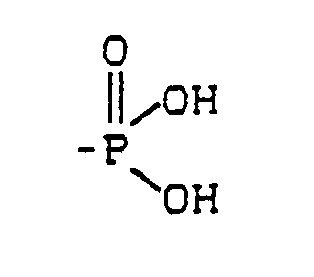
wobei
R′ für Wasserstoff oder für einen C₁ bis C₁₂-Alkylrest steht, bedeutet,
und/oder deren Salze,
hergestellt wird, wobei ein pH-Wert im Bereich von 1 bis 8 eingehalten wird. - Die Einstellung des pH-Wertes erfolgt im allgemeinen durch Zusätze von Laugen, beispielsweise von Natriumhydroxid oder Kaliumhydroxid.
- Die Komponenten werden im allgemeinen bei der Herstellung der erfindungsgemäßen Flüssigkeiten unter kräftigem Rühren zusammengegeben. Die Zusammengabe der Komponenten erfolgt im allgemeinen bei Raumtemperatur, beispielsweise im Temperaturbereich von 0 bis 30°C.
- Die erfindungsgemäßen Konditionierflüssigkeiten können darüber hinaus Verdickungsmittel oder oberflächenaktive Substanzen enthalten, um ihre Viskosität oder ihr Benetzungsverhalten speziellen Anforderungen anzupassen. Besonders günstig ist ein Zusatz von Polyvinylpyrrolidon oder Polyethylenglykolen.
- Bei der Anwendung trägt man die erfindungsgemäßen Flüssigkeiten auf die defekte Zahn- oder Knochensubstanz, beispielsweise in eine Kavität, auf. Bevorzugt seien hier Kavitäten im Zahnschmelz (Enamel) oder Zahnbein (Dentin) genannt.
- Nach dem Auftragen der erfindungsgemäßen Flüssigkeiten werden sie im allgemeinen, z.B. mit warmer Luft, getrocknet.
- Vor der Versorgung der defekten Zahn- oder Knochensubstanz mit dem plastischen Kunststoffmaterial erfolgt nach der Konditionierung mit den erfindungsgemäßen Flüssigkeiten vorzugsweise eine Beschichtung mit einem Grundierungsmaterial.
- Es seien hier besonders Grundierungsmaterialien genannt wie sie in der EP-A-O 141 324 und der EP-A-O 199 057 beschrieben werden.
- Besonders bevorzugt werden Grundierungsmaterialien, die einen Aldehyd oder ein Keton und ein ungesättigtes Monomer mit aktivem Wasserstoff enthalten.
- Als Aldehyde seien hier Formaldehyd, Verbindungen die Formaldehyd freisetzen können, Acetaldehyd, Propionaldehyd, Butyraldehyd und Glutaraldehyd genannt. Insbesondere bevorzugt ist der Glutaraldehyd.
- Als Ketone seien hier Cyclopentanon, Benzophenon, Cyclohexanon, 2,4-Pentandion und Kamperchinon genannt. Insbesondere bevorzugt wird Kampferchinon.
- Als olefinisch ungesättigte Monomere mit aktivem Wasserstoff (Bronsted-Säure) seien Acrylsäureester, Methacrylsäureester und Acrylsäure- bzw. Methacrylsäureurethane mit OH-, NH₂-, NH-, SH- oder PH-Gruppen genannt. Insbesondere bevorzugt wird das Hydroxyethylmethacrylat.
- Insbesondere bevorzugt sind Grundierungsmaterialien, die 1 bis 50 Gew.-% eines aliphatischen Aldehyds mit 1 bis 20 Kohlenstoffatomen und 5 bis 80 Gew.-% eines olefinisch ungesättigten Monomers mit wenigstens einem aktiven Wasserstoffatom in Form von OH-, NH₂- oder SH-Gruppen und gegebenenfalls Wasser und/oder ein toxikologisch akzeptables organisches Lösungsmittel enthalten. Die härtenden Kunststoffmaterialien werden im wesentlichen durch das Anwendungsgebiet bestimmt. So können beispielsweise im Dentalbereich für die Polymerisation nur Monomere eingesetzt werden, die physiologisch unbedenklich sind und die im Mundbereich polymerisieren können. Solche Monomeren für Zahnfüllungen sind an sich bekannt (z.B. Ullmanns Enzyklopädie der Technischen Chemie).
- Als Kunststoffmaterialien seien beispielsweise Massen aus Acrylat- und/oder Methacrylatmonomeren, geeigneten Katalysatoren, Startern, Beschleunigern und Füllstoffen genannt.
- Durch die Konditionierung der defekten Zahn- oder Knochensubstanz mit den erfindungsgemäßen Flüssigkeiten erhält man überraschenderweise eine Basis für die Versorgung mit Kunststoffmaterialien, die eine hohe Haltbarkeit und Festigkeit der Reparatur gewährleistet.
- Aus Phosphonobernsteinsäure (PBS), Glycin und Wasser wurden Lösungen der unten angegebenen Konzentrationen und pH-Werte hergestellt. Die Einstellung des pH-Wertes erfolgte bei den Beispielen B-D mit 4n-NaOH.
Beispiel Nr. PBS [Mol/l] Glycin [Mol/l] pH-Wert 1 A 2,40 0,057 <1 1 B 0,44 0,057 3,5 1 C 0,44 0,057 6,0 1 D 0,44 0,057 8,0 1 E 2,40 0,316 3,5 - Aus 2-Phosphonobutan-1,2,4-tricarbonsäure (PBTS), Glycin und Wasser wurden Lösungen der unten angegebenen Konzentrationen und pH-Werte hergestellt. Die Einstellung des pH-Wertes erfolgte bei den Beispielen B-D mit 4n-NaOH.
Beispiel Nr. PBTS [Mol/l] Glycin [Mol/l] pH-Wert 2 A 2,3 0,057 <1 2 B 0,46 0,057 3,5 2 C 0,46 0,057 6,0 2 D 0,46 0,057 8,0 2 E 2,1 0,323 3,5 - In dem Beispiel wird die Bindungsstärke (Zugfestigkeit) zwischen Zahnbein (Dentin) bzw. Zahnschmelz (Enamel) und einer handelsüblichen Kunststoffüllmasse gemessen.
- Für den Test werden herausgezogene und im feuchten Zustand aufbewahrte Menschenzähne benutzt. Die Zähne werden durch Guß in Epoxidharz eingelagert; durch Naßschleifen wird eine flache Oberfläche erzeugt. Das abschließende Schleifen erfolgt mit Carborundumpapier 1000.
- Daraufhin wird die Oberfläche mit einer Flüssigkeit aus Beispiel 1 oder 2 jeweils 60 Sekunden lang behandelt. Danach wird die behandelte Stelle mit destilliertem Wasser gespült und mit Luft getrocknet.
- Anschließend wird die mit den Flüssigkeiten der Beispiele 1 oder 2 konditionierte Fläche 60 Sekunden lang mit dem Beschichtungsmittel aus 5 Gew.-% Glutardialdehyd, 36 Gew.-% Hydroxyethylmethacrylat und 59 Gew.-% Wasser behandelt. Danach wird die Fläche mit Luft getrocknet.
- Zur Herstellung eines Probekörpers zum Messen der Bindungsstärke wird eine zylindrische, gespaltete Teflonform auf die vorstehend beschriebene, behandelte Oberfläche gespannt (Scand. J. Dent. Res. 88, 348 bis 351 (1981)).
- In die form wird ein dünner Film aus einer Lösung aus 65 Gew.-% Bisphenol-A-diglycidylmethacrylat, 34,3 Gew.-% Triethylenglykoldimethacrylat, 0,2 Gew.-% Kampferchinon, 0,5 Gew.-% Sulfonamid aufgebracht und anschließend ein lichtaktiviertes Kunststoffüllungsmaterial (Lumifor, Bayer AG) eingefüllt. Es wird 60 Sekunden mit einer Fotopolymerisationslampe ausgehärtet. Nach weiteren 15 Minuten wird die Teflonform abgenommen und die Bestimmung der Bindungsstärke mit Hilfe einer Instron-Zugversuchsapparatur (Scand. J. Dent. Res. 88, 348 bis 351 (1981)) bei einer Abzugsgeschwindigkeit von 5 mm/Min. durchgeführt.
- Folgende Zugfestigkeiten an Zahnbein wurden dabei ermittelt:
Konditionierflüssigkeit Zugfestigkeit [N/mm²] 1 A 6,1 ± 0,4 1 B 17,3 ± 2,9 1 C 20,4 ± 2,3 1 D 13,9 ± 3,1 1 E 17,5 ±1,2 2 A 6,0 ± 1,7 2 B 17,6 ± 1,7 2 C 16,7 ± 0,6 2 D 17,8 ± 3,1 2 E 18,1 ± 4,0 - Aus 2,4-Diphosphonobutan-1,2-dicarbonsäure (DPBD), Glycin, 4n-NaOH und Wasser wurde eine Lösung mit folgender Zusammensetzung hergestellt:
DPBD [Mol/l] Glycin [Mol/l] pH-Wert 0,45 0,057 3,5 - Nach der im Beispiel 3 beschriebenen Methode wurde die Bindungsfestigkeit auf Schmelz und Zahnbein ermittelt. Es wurden die folgenden Werte erhalten:
Zahnschmelz: 14,3 N/mm² Zahnbein: 13,5 N/mm² - Aus 2-Phosphonobutan-1,2,4-tricarbonsäure (PBTS), Citronensäure (CS), EDTA-Magnesiumsalz (Mg-EDTA) und Polyethylenglykol-4000 (PEG) wurden wäßrige Konditionierflüssigkeiten hergestellt und Bindungsfestigkeiten nach Beispiel 3 bestimmt.
Beispiel Nr. 5 A 5 B PBTS [Gew.-%] 1 5 MgEDTA [Gew.-%] 1 1 CS [Gew.-%] 5 5 PEG [Gew.-%] 10 10 Bindungsfestigkeit auf Zahnbein [N/mm²] 17,7±1,4 19,8±2,7 Bindungsfestigkeit auf Zahnschmelz [N/mm²] 15,1±4,7 16,0±3,7
Claims (8)

R Wasserstoff oder gegebenenfalls durch Hydroxy, Carboxy, substituiertes C₁- bis C₁₂-Alkyl, C₂- bis C₁₂-Alkenyl, C₅- bis C₈-Cycloalkyl, C₆- bis C₁₂-Aryl oder C₇- bis C₁₂-Aralkyl
und/oder die Gruppen

wobei
R′ für Wasserstoff oder für einen C₁ bis C₁₂-Alkylrest steht, bedeutet,
und/oder deren Salze,
wobei die Lösung einen pH-Wert im Bereich von 1 bis 8 aufweist.
R Wasserstoff oder gegebenenfalls durch Hydroxy, Carboxy, substituiertes C₁- bis C₁₂-Alkyl, C₂- bis C₁₂-Alkenyl, C₅- bis C₈-Cycloalkyl, C₆- bis C₁₂-Aryl oder C₇- bis C₁₂-Aralkyl
und/oder die Gruppen

wobei
R′ für Wasserstoff oder für einen C₁ bis C₁₂-Alkylrest steht, bedeutet,
und/oder deren Salze,
hergestellt wird, wobei ein pH-Wert im Bereich von 1 bis 8 eingehalten wird.
Priority Applications (1)
| Application Number | Priority Date | Filing Date | Title |
|---|---|---|---|
| AT89110532T ATE86848T1 (de) | 1988-06-25 | 1989-06-10 | Fluessigkeit zur konditionierung von zahn- oder knochensubstanz. |
Applications Claiming Priority (2)
| Application Number | Priority Date | Filing Date | Title |
|---|---|---|---|
| DE3821578 | 1988-06-25 | ||
| DE3821578A DE3821578A1 (de) | 1988-06-25 | 1988-06-25 | Fluessigkeit zur konditionierung von zahn- oder knochensubstanz |
Publications (3)
| Publication Number | Publication Date |
|---|---|
| EP0348718A2 true EP0348718A2 (de) | 1990-01-03 |
| EP0348718A3 EP0348718A3 (en) | 1990-09-12 |
| EP0348718B1 EP0348718B1 (de) | 1993-03-17 |
Family
ID=6357311
Family Applications (1)
| Application Number | Title | Priority Date | Filing Date |
|---|---|---|---|
| EP89110532A Expired - Lifetime EP0348718B1 (de) | 1988-06-25 | 1989-06-10 | Flüssigkeit zur Konditionierung von Zahn- oder Knochensubstanz |
Country Status (9)
| Country | Link |
|---|---|
| EP (1) | EP0348718B1 (de) |
| JP (1) | JPH02256603A (de) |
| AT (1) | ATE86848T1 (de) |
| DE (2) | DE3821578A1 (de) |
| DK (1) | DK312889A (de) |
| ES (1) | ES2053873T3 (de) |
| GR (1) | GR3007405T3 (de) |
| IE (1) | IE63269B1 (de) |
| PT (1) | PT90961B (de) |
Cited By (4)
| Publication number | Priority date | Publication date | Assignee | Title |
|---|---|---|---|---|
| WO1993012758A1 (en) * | 1991-12-31 | 1993-07-08 | Minnesota Mining And Manufacturing Company | Adhesive composition and method |
| US5554030A (en) * | 1994-06-30 | 1996-09-10 | Minnesota Mining And Manufacturing Company | Method for bonding non-amalgam restorative materials to dental surfaces |
| US5595487A (en) * | 1994-06-30 | 1997-01-21 | Minnesota Mining And Manufacturing Company | Method for bonding amalgam to dental surfaces |
| US6575752B1 (en) | 1997-04-14 | 2003-06-10 | Dentsply Detrey Gmbh | Tooth surface treatment composition and methods |
Families Citing this family (3)
| Publication number | Priority date | Publication date | Assignee | Title |
|---|---|---|---|---|
| DE4303728C2 (de) * | 1993-02-04 | 1995-05-24 | Richter & Hoffmann Harvard Den | Zahnzement |
| DE10245212B4 (de) * | 2002-09-27 | 2008-01-03 | Ivoclar Vivadent Ag | Verwendung säurehaltiger Mittel zur Desensibilisierung von Zähnen |
| JP6282557B2 (ja) * | 2014-08-01 | 2018-02-21 | 株式会社松風 | 歯科用コンディショニング組成物 |
Family Cites Families (3)
| Publication number | Priority date | Publication date | Assignee | Title |
|---|---|---|---|---|
| DE2360797C2 (de) * | 1973-12-06 | 1985-05-23 | Henkel KGaA, 4000 Düsseldorf | Pharmazeutische Präparate |
| SE431285B (sv) * | 1976-08-16 | 1984-01-30 | Colgate Palmolive Co | Munvardskomposition innehallande en fosfonforening, for minskning av missfergning bildad av ett ingaende kvevehaltigt antibakteriellt plaquehemmande medel |
| DE3414164A1 (de) * | 1984-04-14 | 1985-10-17 | Kulzer & Co GmbH, 6393 Wehrheim | Photopolymerisierbarer dentaler haftvermittler-lack |
-
1988
- 1988-06-25 DE DE3821578A patent/DE3821578A1/de not_active Withdrawn
-
1989
- 1989-06-10 DE DE8989110532T patent/DE58903784D1/de not_active Expired - Fee Related
- 1989-06-10 ES ES89110532T patent/ES2053873T3/es not_active Expired - Lifetime
- 1989-06-10 EP EP89110532A patent/EP0348718B1/de not_active Expired - Lifetime
- 1989-06-10 AT AT89110532T patent/ATE86848T1/de not_active IP Right Cessation
- 1989-06-21 JP JP1156934A patent/JPH02256603A/ja active Pending
- 1989-06-23 PT PT90961A patent/PT90961B/pt not_active IP Right Cessation
- 1989-06-23 IE IE205489A patent/IE63269B1/en not_active IP Right Cessation
- 1989-06-23 DK DK312889A patent/DK312889A/da not_active Application Discontinuation
-
1993
- 1993-03-18 GR GR930400589T patent/GR3007405T3/el unknown
Cited By (4)
| Publication number | Priority date | Publication date | Assignee | Title |
|---|---|---|---|---|
| WO1993012758A1 (en) * | 1991-12-31 | 1993-07-08 | Minnesota Mining And Manufacturing Company | Adhesive composition and method |
| US5554030A (en) * | 1994-06-30 | 1996-09-10 | Minnesota Mining And Manufacturing Company | Method for bonding non-amalgam restorative materials to dental surfaces |
| US5595487A (en) * | 1994-06-30 | 1997-01-21 | Minnesota Mining And Manufacturing Company | Method for bonding amalgam to dental surfaces |
| US6575752B1 (en) | 1997-04-14 | 2003-06-10 | Dentsply Detrey Gmbh | Tooth surface treatment composition and methods |
Also Published As
| Publication number | Publication date |
|---|---|
| DE3821578A1 (de) | 1989-12-28 |
| EP0348718A3 (en) | 1990-09-12 |
| EP0348718B1 (de) | 1993-03-17 |
| DK312889A (da) | 1989-12-26 |
| PT90961B (pt) | 1995-01-31 |
| IE63269B1 (en) | 1995-04-05 |
| ATE86848T1 (de) | 1993-04-15 |
| IE892054L (en) | 1989-12-25 |
| ES2053873T3 (es) | 1994-08-01 |
| DK312889D0 (da) | 1989-06-23 |
| GR3007405T3 (de) | 1993-07-30 |
| DE58903784D1 (de) | 1993-04-22 |
| JPH02256603A (ja) | 1990-10-17 |
| PT90961A (pt) | 1989-12-29 |
Similar Documents
| Publication | Publication Date | Title |
|---|---|---|
| EP0287927B1 (de) | Konditionierflüssigkeiten von Zahn- oder Knochensubstanz | |
| DE3750993T2 (de) | Verfahren zum Grundieren von Hartgewebe. | |
| DE3851736T2 (de) | Verfahren zum Grundieren von Hartgewebe. | |
| EP0394787B1 (de) | Zubereitungen enthaltend Carbonamidgruppen enthaltende (Meth)acrylsäureester, zur Anwendung als Adhäsivkomponenten zur Behandlung kollagenhaltiger Materialien in der Medizin, sowie Herstellung dieser Zubereitungen | |
| EP0499923B1 (de) | Dentaladhäsive | |
| DE3414163A1 (de) | Photopolymerisierbarer phosphathaltiger dentaler haftvermittler-lack | |
| EP0348718B1 (de) | Flüssigkeit zur Konditionierung von Zahn- oder Knochensubstanz | |
| DE3414164A1 (de) | Photopolymerisierbarer dentaler haftvermittler-lack | |
| US5258067A (en) | Liquid for conditioning tooth or bone substance | |
| US4698376A (en) | Coating material for collagen-containing materials | |
| EP0531802B1 (de) | Adhäsivkomponente zur Restaurierung der Zahnhartsubstanz | |
| US5277739A (en) | Process for bonding a material to a collagen-containing material | |
| EP0394792A1 (de) | Formylpiperazingruppen enthaltende (Meth)acrylsäurederivate | |
| EP0418684B1 (de) | Alkandiyl-bis-carbonamide, Adhäsivkomponenten zur Behandlung kollagenhaltiger Materialien zur Anwendung in der Medizin, enthaltend diese Verbindungen | |
| EP0361033B1 (de) | Beschichtungsmittel für kollagenhaltige Materialien | |
| EP0355562B1 (de) | Adhäsivkomponente zur Behandlung kollagenhaltiger Materialien | |
| EP0441187A2 (de) | Carbonsäure-(meth)acryloylaminoalkylester in Adhäsivkomponenten zur Behandlung kollagenhaltiger Materialien | |
| JPH0222364A (ja) | 人体硬組織用表面処理剤 |
Legal Events
| Date | Code | Title | Description |
|---|---|---|---|
| PUAI | Public reference made under article 153(3) epc to a published international application that has entered the european phase |
Free format text: ORIGINAL CODE: 0009012 |
|
| 17P | Request for examination filed |
Effective date: 19890610 |
|
| AK | Designated contracting states |
Kind code of ref document: A2 Designated state(s): AT BE CH DE ES FR GB GR IT LI LU NL SE |
|
| PUAL | Search report despatched |
Free format text: ORIGINAL CODE: 0009013 |
|
| AK | Designated contracting states |
Kind code of ref document: A3 Designated state(s): AT BE CH DE ES FR GB GR IT LI LU NL SE |
|
| 17Q | First examination report despatched |
Effective date: 19911030 |
|
| GRAA | (expected) grant |
Free format text: ORIGINAL CODE: 0009210 |
|
| AK | Designated contracting states |
Kind code of ref document: B1 Designated state(s): AT BE CH DE ES FR GB GR IT LI LU NL SE |
|
| REF | Corresponds to: |
Ref document number: 86848 Country of ref document: AT Date of ref document: 19930415 Kind code of ref document: T |
|
| REF | Corresponds to: |
Ref document number: 58903784 Country of ref document: DE Date of ref document: 19930422 |
|
| GBT | Gb: translation of ep patent filed (gb section 77(6)(a)/1977) |
Effective date: 19930402 |
|
| ITF | It: translation for a ep patent filed | ||
| ET | Fr: translation filed | ||
| REG | Reference to a national code |
Ref country code: GR Ref legal event code: FG4A Free format text: 3007405 |
|
| PLBE | No opposition filed within time limit |
Free format text: ORIGINAL CODE: 0009261 |
|
| STAA | Information on the status of an ep patent application or granted ep patent |
Free format text: STATUS: NO OPPOSITION FILED WITHIN TIME LIMIT |
|
| 26N | No opposition filed | ||
| ITTA | It: last paid annual fee | ||
| EPTA | Lu: last paid annual fee | ||
| EAL | Se: european patent in force in sweden |
Ref document number: 89110532.2 |
|
| NLS | Nl: assignments of ep-patents |
Owner name: HERAEUS KULZER GMBH |
|
| REG | Reference to a national code |
Ref country code: CH Ref legal event code: PUE Owner name: BAYER AKTIENGESELLSCHAFT TRANSFER- HERAEUS KULZER |
|
| REG | Reference to a national code |
Ref country code: ES Ref legal event code: PC2A Owner name: HERAEUS KULZER GMBH & CO.KG |
|
| REG | Reference to a national code |
Ref country code: FR Ref legal event code: TP |
|
| REG | Reference to a national code |
Ref country code: GB Ref legal event code: 732E |
|
| BECA | Be: change of holder's address |
Free format text: 960626 *HERAEUS KULZER G.M.B.H. & CO. K.G.:D-63450 HANAU |
|
| PGFP | Annual fee paid to national office [announced via postgrant information from national office to epo] |
Ref country code: GB Payment date: 20010515 Year of fee payment: 13 |
|
| PGFP | Annual fee paid to national office [announced via postgrant information from national office to epo] |
Ref country code: CH Payment date: 20010517 Year of fee payment: 13 |
|
| PGFP | Annual fee paid to national office [announced via postgrant information from national office to epo] |
Ref country code: AT Payment date: 20010528 Year of fee payment: 13 |
|
| PGFP | Annual fee paid to national office [announced via postgrant information from national office to epo] |
Ref country code: GR Payment date: 20010530 Year of fee payment: 13 |
|
| PGFP | Annual fee paid to national office [announced via postgrant information from national office to epo] |
Ref country code: SE Payment date: 20010531 Year of fee payment: 13 Ref country code: FR Payment date: 20010531 Year of fee payment: 13 |
|
| PGFP | Annual fee paid to national office [announced via postgrant information from national office to epo] |
Ref country code: LU Payment date: 20010606 Year of fee payment: 13 |
|
| PGFP | Annual fee paid to national office [announced via postgrant information from national office to epo] |
Ref country code: DE Payment date: 20010611 Year of fee payment: 13 |
|
| PGFP | Annual fee paid to national office [announced via postgrant information from national office to epo] |
Ref country code: ES Payment date: 20010614 Year of fee payment: 13 |
|
| PGFP | Annual fee paid to national office [announced via postgrant information from national office to epo] |
Ref country code: NL Payment date: 20010618 Year of fee payment: 13 |
|
| PGFP | Annual fee paid to national office [announced via postgrant information from national office to epo] |
Ref country code: BE Payment date: 20010621 Year of fee payment: 13 |
|
| REG | Reference to a national code |
Ref country code: GB Ref legal event code: IF02 |
|
| PG25 | Lapsed in a contracting state [announced via postgrant information from national office to epo] |
Ref country code: LU Free format text: LAPSE BECAUSE OF NON-PAYMENT OF DUE FEES Effective date: 20020610 Ref country code: GB Free format text: LAPSE BECAUSE OF NON-PAYMENT OF DUE FEES Effective date: 20020610 Ref country code: AT Free format text: LAPSE BECAUSE OF NON-PAYMENT OF DUE FEES Effective date: 20020610 |
|
| PG25 | Lapsed in a contracting state [announced via postgrant information from national office to epo] |
Ref country code: SE Free format text: LAPSE BECAUSE OF NON-PAYMENT OF DUE FEES Effective date: 20020611 Ref country code: ES Free format text: LAPSE BECAUSE OF NON-PAYMENT OF DUE FEES Effective date: 20020611 |
|
| PG25 | Lapsed in a contracting state [announced via postgrant information from national office to epo] |
Ref country code: LI Free format text: LAPSE BECAUSE OF NON-PAYMENT OF DUE FEES Effective date: 20020630 Ref country code: CH Free format text: LAPSE BECAUSE OF NON-PAYMENT OF DUE FEES Effective date: 20020630 Ref country code: BE Free format text: LAPSE BECAUSE OF NON-PAYMENT OF DUE FEES Effective date: 20020630 |
|
| BERE | Be: lapsed |
Owner name: *HERAEUS KULZER G.M.B.H. & CO. K.G. Effective date: 20020630 |
|
| PG25 | Lapsed in a contracting state [announced via postgrant information from national office to epo] |
Ref country code: GR Free format text: LAPSE BECAUSE OF NON-PAYMENT OF DUE FEES Effective date: 20021231 |
|
| PG25 | Lapsed in a contracting state [announced via postgrant information from national office to epo] |
Ref country code: NL Free format text: LAPSE BECAUSE OF NON-PAYMENT OF DUE FEES Effective date: 20030101 Ref country code: DE Free format text: LAPSE BECAUSE OF NON-PAYMENT OF DUE FEES Effective date: 20030101 |
|
| GBPC | Gb: european patent ceased through non-payment of renewal fee |
Effective date: 20020610 |
|
| EUG | Se: european patent has lapsed | ||
| REG | Reference to a national code |
Ref country code: CH Ref legal event code: PL |
|
| PG25 | Lapsed in a contracting state [announced via postgrant information from national office to epo] |
Ref country code: FR Free format text: LAPSE BECAUSE OF NON-PAYMENT OF DUE FEES Effective date: 20030228 |
|
| NLV4 | Nl: lapsed or anulled due to non-payment of the annual fee |
Effective date: 20030101 |
|
| REG | Reference to a national code |
Ref country code: FR Ref legal event code: ST |
|
| REG | Reference to a national code |
Ref country code: ES Ref legal event code: FD2A Effective date: 20030711 |
|
| PG25 | Lapsed in a contracting state [announced via postgrant information from national office to epo] |
Ref country code: IT Free format text: LAPSE BECAUSE OF NON-PAYMENT OF DUE FEES Effective date: 20050610 |