EP0347683A2 - Procédé de préparation d'articles moulés en plastique ayant une résistance améliorée aux intempéries - Google Patents
Procédé de préparation d'articles moulés en plastique ayant une résistance améliorée aux intempéries Download PDFInfo
- Publication number
- EP0347683A2 EP0347683A2 EP89110534A EP89110534A EP0347683A2 EP 0347683 A2 EP0347683 A2 EP 0347683A2 EP 89110534 A EP89110534 A EP 89110534A EP 89110534 A EP89110534 A EP 89110534A EP 0347683 A2 EP0347683 A2 EP 0347683A2
- Authority
- EP
- European Patent Office
- Prior art keywords
- plastic
- production
- coated
- molded body
- metal oxides
- Prior art date
- Legal status (The legal status is an assumption and is not a legal conclusion. Google has not performed a legal analysis and makes no representation as to the accuracy of the status listed.)
- Withdrawn
Links
- 238000010137 moulding (plastic) Methods 0.000 title claims abstract description 15
- 238000000034 method Methods 0.000 title claims abstract description 14
- 238000004519 manufacturing process Methods 0.000 title claims abstract 3
- 229910044991 metal oxide Inorganic materials 0.000 claims abstract description 25
- 150000004706 metal oxides Chemical class 0.000 claims abstract description 25
- 239000004417 polycarbonate Substances 0.000 claims abstract description 13
- 229920000515 polycarbonate Polymers 0.000 claims abstract description 13
- 238000000576 coating method Methods 0.000 claims abstract description 11
- 229920001169 thermoplastic Polymers 0.000 claims abstract description 8
- 239000004416 thermosoftening plastic Substances 0.000 claims abstract description 8
- 239000011248 coating agent Substances 0.000 claims abstract description 7
- 229920000412 polyarylene Polymers 0.000 claims abstract description 5
- 150000003568 thioethers Chemical class 0.000 claims abstract description 5
- 239000004033 plastic Substances 0.000 claims description 18
- 229920003023 plastic Polymers 0.000 claims description 18
- 230000005670 electromagnetic radiation Effects 0.000 claims description 3
- 230000005855 radiation Effects 0.000 claims description 2
- 238000010276 construction Methods 0.000 abstract description 2
- GWEVSGVZZGPLCZ-UHFFFAOYSA-N Titan oxide Chemical compound O=[Ti]=O GWEVSGVZZGPLCZ-UHFFFAOYSA-N 0.000 description 21
- 239000010410 layer Substances 0.000 description 18
- 239000000758 substrate Substances 0.000 description 12
- 230000005540 biological transmission Effects 0.000 description 11
- XLOMVQKBTHCTTD-UHFFFAOYSA-N Zinc monoxide Chemical compound [Zn]=O XLOMVQKBTHCTTD-UHFFFAOYSA-N 0.000 description 10
- 238000010894 electron beam technology Methods 0.000 description 10
- 239000011241 protective layer Substances 0.000 description 6
- 238000001704 evaporation Methods 0.000 description 5
- 230000008020 evaporation Effects 0.000 description 4
- 239000010408 film Substances 0.000 description 4
- VYPSYNLAJGMNEJ-UHFFFAOYSA-N Silicium dioxide Chemical compound O=[Si]=O VYPSYNLAJGMNEJ-UHFFFAOYSA-N 0.000 description 3
- QVGXLLKOCUKJST-UHFFFAOYSA-N atomic oxygen Chemical compound [O] QVGXLLKOCUKJST-UHFFFAOYSA-N 0.000 description 3
- 239000007789 gas Substances 0.000 description 3
- 239000011521 glass Substances 0.000 description 3
- 229910052751 metal Inorganic materials 0.000 description 3
- 239000002184 metal Substances 0.000 description 3
- 239000002991 molded plastic Substances 0.000 description 3
- 230000003287 optical effect Effects 0.000 description 3
- 239000001301 oxygen Substances 0.000 description 3
- 229910052760 oxygen Inorganic materials 0.000 description 3
- 239000007787 solid Substances 0.000 description 3
- 238000004544 sputter deposition Methods 0.000 description 3
- 239000010936 titanium Substances 0.000 description 3
- 238000007740 vapor deposition Methods 0.000 description 3
- XKRFYHLGVUSROY-UHFFFAOYSA-N Argon Chemical compound [Ar] XKRFYHLGVUSROY-UHFFFAOYSA-N 0.000 description 2
- PNEYBMLMFCGWSK-UHFFFAOYSA-N aluminium oxide Inorganic materials [O-2].[O-2].[O-2].[Al+3].[Al+3] PNEYBMLMFCGWSK-UHFFFAOYSA-N 0.000 description 2
- IISBACLAFKSPIT-UHFFFAOYSA-N bisphenol A Chemical compound C=1C=C(O)C=CC=1C(C)(C)C1=CC=C(O)C=C1 IISBACLAFKSPIT-UHFFFAOYSA-N 0.000 description 2
- 229910052793 cadmium Inorganic materials 0.000 description 2
- 230000015556 catabolic process Effects 0.000 description 2
- 229910052593 corundum Inorganic materials 0.000 description 2
- 238000006731 degradation reaction Methods 0.000 description 2
- 238000005227 gel permeation chromatography Methods 0.000 description 2
- 150000002484 inorganic compounds Chemical class 0.000 description 2
- 229910010272 inorganic material Inorganic materials 0.000 description 2
- 238000001755 magnetron sputter deposition Methods 0.000 description 2
- 239000000463 material Substances 0.000 description 2
- 150000002736 metal compounds Chemical class 0.000 description 2
- 239000000203 mixture Substances 0.000 description 2
- 235000012239 silicon dioxide Nutrition 0.000 description 2
- 230000003595 spectral effect Effects 0.000 description 2
- 229940071182 stannate Drugs 0.000 description 2
- XOLBLPGZBRYERU-UHFFFAOYSA-N tin dioxide Chemical compound O=[Sn]=O XOLBLPGZBRYERU-UHFFFAOYSA-N 0.000 description 2
- OGIDPMRJRNCKJF-UHFFFAOYSA-N titanium oxide Inorganic materials [Ti]=O OGIDPMRJRNCKJF-UHFFFAOYSA-N 0.000 description 2
- XLYOFNOQVPJJNP-UHFFFAOYSA-N water Chemical compound O XLYOFNOQVPJJNP-UHFFFAOYSA-N 0.000 description 2
- 229910001845 yogo sapphire Inorganic materials 0.000 description 2
- UGFAIRIUMAVXCW-UHFFFAOYSA-N Carbon monoxide Chemical compound [O+]#[C-] UGFAIRIUMAVXCW-UHFFFAOYSA-N 0.000 description 1
- 241000196324 Embryophyta Species 0.000 description 1
- 239000004642 Polyimide Substances 0.000 description 1
- 241001116459 Sequoia Species 0.000 description 1
- 229910003074 TiCl4 Inorganic materials 0.000 description 1
- 238000010521 absorption reaction Methods 0.000 description 1
- 229910052786 argon Inorganic materials 0.000 description 1
- 125000004429 atom Chemical group 0.000 description 1
- 229940106691 bisphenol a Drugs 0.000 description 1
- 239000007795 chemical reaction product Substances 0.000 description 1
- 229910052681 coesite Inorganic materials 0.000 description 1
- 239000000356 contaminant Substances 0.000 description 1
- 229910052906 cristobalite Inorganic materials 0.000 description 1
- 239000013078 crystal Substances 0.000 description 1
- 239000011888 foil Substances 0.000 description 1
- 238000010438 heat treatment Methods 0.000 description 1
- 238000007733 ion plating Methods 0.000 description 1
- 238000005259 measurement Methods 0.000 description 1
- 238000000465 moulding Methods 0.000 description 1
- 230000003647 oxidation Effects 0.000 description 1
- 238000007254 oxidation reaction Methods 0.000 description 1
- TWNQGVIAIRXVLR-UHFFFAOYSA-N oxo(oxoalumanyloxy)alumane Chemical compound O=[Al]O[Al]=O TWNQGVIAIRXVLR-UHFFFAOYSA-N 0.000 description 1
- 125000004430 oxygen atom Chemical group O* 0.000 description 1
- BPUBBGLMJRNUCC-UHFFFAOYSA-N oxygen(2-);tantalum(5+) Chemical compound [O-2].[O-2].[O-2].[O-2].[O-2].[Ta+5].[Ta+5] BPUBBGLMJRNUCC-UHFFFAOYSA-N 0.000 description 1
- SOQBVABWOPYFQZ-UHFFFAOYSA-N oxygen(2-);titanium(4+) Chemical class [O-2].[O-2].[Ti+4] SOQBVABWOPYFQZ-UHFFFAOYSA-N 0.000 description 1
- 239000005022 packaging material Substances 0.000 description 1
- 230000035699 permeability Effects 0.000 description 1
- 238000009832 plasma treatment Methods 0.000 description 1
- 229920001721 polyimide Polymers 0.000 description 1
- 229920000642 polymer Polymers 0.000 description 1
- -1 polytetrafluoroethylene Polymers 0.000 description 1
- 229920001343 polytetrafluoroethylene Polymers 0.000 description 1
- 239000004810 polytetrafluoroethylene Substances 0.000 description 1
- 230000002028 premature Effects 0.000 description 1
- 230000001681 protective effect Effects 0.000 description 1
- 239000010453 quartz Substances 0.000 description 1
- 239000000377 silicon dioxide Substances 0.000 description 1
- 229910052682 stishovite Inorganic materials 0.000 description 1
- 229910001936 tantalum oxide Inorganic materials 0.000 description 1
- 239000010409 thin film Substances 0.000 description 1
- XJDNKRIXUMDJCW-UHFFFAOYSA-J titanium tetrachloride Chemical compound Cl[Ti](Cl)(Cl)Cl XJDNKRIXUMDJCW-UHFFFAOYSA-J 0.000 description 1
- 229910052905 tridymite Inorganic materials 0.000 description 1
- 238000005019 vapor deposition process Methods 0.000 description 1
- 239000011364 vaporized material Substances 0.000 description 1
- 238000004383 yellowing Methods 0.000 description 1
Images
Classifications
-
- C—CHEMISTRY; METALLURGY
- C08—ORGANIC MACROMOLECULAR COMPOUNDS; THEIR PREPARATION OR CHEMICAL WORKING-UP; COMPOSITIONS BASED THEREON
- C08J—WORKING-UP; GENERAL PROCESSES OF COMPOUNDING; AFTER-TREATMENT NOT COVERED BY SUBCLASSES C08B, C08C, C08F, C08G or C08H
- C08J7/00—Chemical treatment or coating of shaped articles made of macromolecular substances
- C08J7/04—Coating
- C08J7/06—Coating with compositions not containing macromolecular substances
-
- C—CHEMISTRY; METALLURGY
- C08—ORGANIC MACROMOLECULAR COMPOUNDS; THEIR PREPARATION OR CHEMICAL WORKING-UP; COMPOSITIONS BASED THEREON
- C08J—WORKING-UP; GENERAL PROCESSES OF COMPOUNDING; AFTER-TREATMENT NOT COVERED BY SUBCLASSES C08B, C08C, C08F, C08G or C08H
- C08J7/00—Chemical treatment or coating of shaped articles made of macromolecular substances
- C08J7/04—Coating
- C08J7/043—Improving the adhesiveness of the coatings per se, e.g. forming primers
-
- C—CHEMISTRY; METALLURGY
- C08—ORGANIC MACROMOLECULAR COMPOUNDS; THEIR PREPARATION OR CHEMICAL WORKING-UP; COMPOSITIONS BASED THEREON
- C08J—WORKING-UP; GENERAL PROCESSES OF COMPOUNDING; AFTER-TREATMENT NOT COVERED BY SUBCLASSES C08B, C08C, C08F, C08G or C08H
- C08J2369/00—Characterised by the use of polycarbonates; Derivatives of polycarbonates
-
- C—CHEMISTRY; METALLURGY
- C08—ORGANIC MACROMOLECULAR COMPOUNDS; THEIR PREPARATION OR CHEMICAL WORKING-UP; COMPOSITIONS BASED THEREON
- C08J—WORKING-UP; GENERAL PROCESSES OF COMPOUNDING; AFTER-TREATMENT NOT COVERED BY SUBCLASSES C08B, C08C, C08F, C08G or C08H
- C08J2381/00—Characterised by the use of macromolecular compounds obtained by reactions forming in the main chain of the macromolecule a linkage containing sulfur with or without nitrogen, oxygen, or carbon only; Polysulfones; Derivatives of such polymers
- C08J2381/02—Polythioethers; Polythioether-ethers
-
- Y—GENERAL TAGGING OF NEW TECHNOLOGICAL DEVELOPMENTS; GENERAL TAGGING OF CROSS-SECTIONAL TECHNOLOGIES SPANNING OVER SEVERAL SECTIONS OF THE IPC; TECHNICAL SUBJECTS COVERED BY FORMER USPC CROSS-REFERENCE ART COLLECTIONS [XRACs] AND DIGESTS
- Y10—TECHNICAL SUBJECTS COVERED BY FORMER USPC
- Y10T—TECHNICAL SUBJECTS COVERED BY FORMER US CLASSIFICATION
- Y10T428/00—Stock material or miscellaneous articles
- Y10T428/26—Web or sheet containing structurally defined element or component, the element or component having a specified physical dimension
- Y10T428/263—Coating layer not in excess of 5 mils thick or equivalent
- Y10T428/264—Up to 3 mils
- Y10T428/265—1 mil or less
-
- Y—GENERAL TAGGING OF NEW TECHNOLOGICAL DEVELOPMENTS; GENERAL TAGGING OF CROSS-SECTIONAL TECHNOLOGIES SPANNING OVER SEVERAL SECTIONS OF THE IPC; TECHNICAL SUBJECTS COVERED BY FORMER USPC CROSS-REFERENCE ART COLLECTIONS [XRACs] AND DIGESTS
- Y10—TECHNICAL SUBJECTS COVERED BY FORMER USPC
- Y10T—TECHNICAL SUBJECTS COVERED BY FORMER US CLASSIFICATION
- Y10T428/00—Stock material or miscellaneous articles
- Y10T428/31504—Composite [nonstructural laminate]
- Y10T428/31507—Of polycarbonate
Definitions
- the present invention relates to a process for coating plastic moldings made of thermoplastic polycarbonates or thermoplastic polyarylene sulfides, which is characterized in that the plastic moldings are coated with metal oxides, the electromagnetic radiation having a wavelength of 250 nm to 400 nm and in particular of 270 nm to 400 nm, absorb.
- Another object of the present invention are the plastic moldings obtainable by the process according to the invention.
- the molded plastic articles produced by the process according to the invention have good resistance to the influences of the outside atmosphere, that is to say to UV light, moisture and temperature fluctuations, and therefore have good weather resistance.
- Inorganic protective layers for plastics are known (see, for example, ID Torbin and Yu. F. Dominov, Soc. J. Opt. Technol., Vol. 41, No. 10, 1974, pages 492-499, in particular page 495, right column , up to page 496, left column), but the inorganic compounds mentioned there do not absorb in the claimed spectral range or also absorb at wavelengths greater than 400 nm, so that there is no transparency.
- These layers serve to improve the scratch resistance, the antistatic and electrical properties as well as the reflection reduction of optical components made of plastics.
- TiO2 coatings that is to say those which absorb in the area according to the invention, in combination with other layers of inorganic compounds in order to obtain a reflection reduction of optical components made of plastics (see, for example, JA 57 194 902).
- EP-A 0 113 555 new packaging materials which consist of various plastics which are coated with metal oxides so that they protect the packed material against oxygen, water vapor and UV light. Neither polycarbonates nor polyarylene sulfides are mentioned as plastics, nor is the aim of EP-A-0 113 555 to protect the plastics against weather influences.
- cadmium stannate is applied to coated plastic substrates as an outer layer, which already contain metal oxides such as TiO2.
- the metal oxides serve to improve the adhesion of cadmium stannate.
- the plastic substrates coated in this way serve as translucent, electrically conductive bodies.
- Polycarbonate is also mentioned as a plastic.
- the coating thus serves in the US patent for light transmission, while according to the present invention the coating serves to absorb electromagnetic radiation.
- glass is coated with titanium oxides in order to produce a layer material with a defined refractive index.
- thermoplastic polycarbonates to be protected are known from the literature and should preferably be weight-average molecular weights M w have from about 10,000 to 200,000, preferably from 20,000 to 100,000, the M w is determined by gel chromatography in a known manner.
- thermoplastic polyarylene sulfides are also known from the literature. (See US Pat. No. 3,354,129 and EP-OS 0 171 021 and the literature cited in EP-OS 0 171 021).
- M w weight average molecular weights
- M w have from about 30,000 to 50,000, where M w is determined in a known manner by high-temperature gel chromatography.
- Suitable metal oxides that absorb in the claimed wavelength range are, for example, TiO2, SnO2 and ZnO.
- the plastic moldings are coated with the metal oxides in a vacuum vapor deposition system, the plastic moldings being fastened to a substrate holder. You work in a vacuum of about 1 x 10 ⁇ 5 mbar maximum.
- the metal oxide is evaporated by means of an electron beam gun, it being important that a movable screen is fitted between the electron beam gun and the attached molded body, which prevents premature vapor deposition of the plastic molded body during the heating phase of the metal oxide.
- Evaporation of the metal oxide takes place at temperatures between about 1500 K and 3000 K.
- the substrate In many cases it is advisable to subject the substrate to a low-pressure plasma treatment in a gas atmosphere, for example argon or O2, at a pressure of approx. 5 x 10 ⁇ 2 mbar before the protective film is evaporated in order to remove any contaminants from the substrate and thereby improving the adhesion of the protective layer to the substrate.
- a gas atmosphere for example argon or O2
- the metal oxide is first heated with the electron beam gun with a power of 4 - 6 kW to bring it to a temperature of approx. 1500 K to 3000 K.
- the pivotable diaphragm between the molded plastic body and the electron beam gun is then removed and the coating of the molded plastic body is initiated.
- the thickness of the protective layer can be checked during the vapor deposition process, for example by means of a quartz crystal thickness gauge.
- the stoichiometric composition of the protective layer can be influenced by adding reactive gases, in the case of TiO2 by O2. Therefore, in the following, whenever one speaks of a TiO2 layer, a layer is to be understood in which the ratio of the number of Ti atoms to the number of oxygen atoms is between 0.5 and 1.
- the layer thicknesses of the metal oxides are between 40 and 2000 nm, preferably between 50 and 1000 nm.
- the swiveling screen is again between the substrate holder and the electrons beam gun introduced and the electron beam gun switched off.
- the metal oxide layer can be applied to the plastic moldings by evaporating the metal alone or a mixture of metal and metal oxide in an oxygen atmosphere, wherein resistance-heated or inductively heated evaporators can be used for the evaporation instead of an electron beam gun.
- a third procedure for applying the metal oxide layer is the so-called DC voltage or high-frequency sputtering of the metal oxide, or the reactive DC voltage or high-frequency sputtering of the corresponding metal. (Sputtering method).
- a fourth method of applying the metal oxide layer is ion plating.
- a fifth procedure for applying the metal oxide layer to the plastic molding is the so-called "plasma-assisted" coating process, the plastic molding being in a high-frequency or microwave plasma, and the metal oxide being produced from an oxidatively degradable metal compound and oxygen.
- Such oxidatively degradable metal compounds are, for example, Ti [O-CH2CH (CH3) 2] 4, Ti (O-iso-C3H7) 4, TiCl4, Sn (CH3) 4 and Zn (C2H5) 2.
- Suitable plastic moldings which can be coated by the process according to the invention are, for example, plates such as solid plates and hollow body plates, foils, window panes for motor vehicles, headlight panes for motor vehicles and moldings of any type and dimension in outdoor use, for example for covers in the construction sector.
- a TiO2 layer of 440 nm is applied as follows:
- the molded body is type L11bold-Heraeus GmbH of the type A1100 on a rotatable Substrate holder attached.
- the chamber of the evaporation plant is closed and evacuated to approx. 1 x 10 ⁇ 5 mbar.
- Ar is let in up to a pressure of 5 x 10 ⁇ 2 mbar and the rotary drive of the substrate holder is switched on, so that it rotates at 20 rpm.
- a voltage of 600 V is applied by applying a voltage to an Al plate connected as a cathode and a low-pressure plasma is ignited.
- the shaped body is treated with a power of 120 W in this plasma for 5 minutes.
- the voltage is then switched off, the Ar addition is ended and the boiler is again evacuated to 1 x 10 ⁇ 5 mbar.
- the electron beam gun is switched on and the TiO2 to be vaporized is heated to a power of 6 kW within 2 minutes to approx. 2500 K. Then the movable diaphragm between the electron beam gun and the substrate holder is removed and the molded body is coated for 440 seconds at an evaporation rate of 1 nm / sec. The movable screen is then inserted again between the electron beam gun and the substrate holder and the coating process is ended. After the electron beam gun has been switched off and the vaporized material has cooled, the chamber of the vapor deposition system is ventilated after 15 minutes and the coated shaped body is removed.
- the polycarbonate molded body coated in this way is weathered with a corresponding uncoated molded body in a weatherometer 306h and 680h.
- the sample is irradiated with a UV radiation source, which has an intensity maximum at approx. 310 nm, and sprayed with 30 ° C cold water at intervals of 20 minutes at an ambient temperature of 35 ° C for approx. 3 minutes.
- a UV radiation source which has an intensity maximum at approx. 310 nm
- 30 ° C cold water at intervals of 20 minutes at an ambient temperature of 35 ° C for approx. 3 minutes.
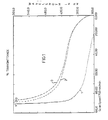
- Figure 1 shows the transmission of the polycarbonate molded body without a protective layer.
- Curve 1 shows the transmission before weathering
- curve 2 shows the transmission after 306h weathering
- curve 3 after 680h weathering.
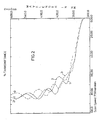
- Figure 2 shows the transmission of the polycarbonate molded body with a 440 nm thick TiO2 protective layer.
- Curve 1 shows the transmission of the sample before weathering, curve 2 the transmission after 306h weathering and curve 3 the transmission after 680h weathering. It can be clearly seen that, in contrast to the transmission curve of the uncoated polycarbonate molded body in FIG. 1, there is no reduction in the transmission between 380 and 420 nm is determined, ie there is no yellowing of the sample which is characteristic of the degradation of the polycarbonate.
- FIGS. 1 and 2 The measurements in FIGS. 1 and 2 were carried out using a Beckman DK-50 spectrophotometer.
Landscapes
- Chemical & Material Sciences (AREA)
- Health & Medical Sciences (AREA)
- Chemical Kinetics & Catalysis (AREA)
- Medicinal Chemistry (AREA)
- Polymers & Plastics (AREA)
- Organic Chemistry (AREA)
- Physical Vapour Deposition (AREA)
- Laminated Bodies (AREA)
- Coating Of Shaped Articles Made Of Macromolecular Substances (AREA)
- Paints Or Removers (AREA)
Applications Claiming Priority (2)
| Application Number | Priority Date | Filing Date | Title |
|---|---|---|---|
| DE3821131 | 1988-06-23 | ||
| DE19883821131 DE3821131A1 (de) | 1988-06-23 | 1988-06-23 | Verfahren zur herstellung von kunststofformkoerpern mit verbesserter witterungsbestaendigkeit |
Publications (2)
| Publication Number | Publication Date |
|---|---|
| EP0347683A2 true EP0347683A2 (fr) | 1989-12-27 |
| EP0347683A3 EP0347683A3 (fr) | 1990-03-28 |
Family
ID=6357038
Family Applications (1)
| Application Number | Title | Priority Date | Filing Date |
|---|---|---|---|
| EP19890110534 Withdrawn EP0347683A3 (fr) | 1988-06-23 | 1989-06-10 | Procédé de préparation d'articles moulés en plastique ayant une résistance améliorée aux intempéries |
Country Status (4)
| Country | Link |
|---|---|
| US (1) | US5008148A (fr) |
| EP (1) | EP0347683A3 (fr) |
| JP (1) | JPH0234772A (fr) |
| DE (1) | DE3821131A1 (fr) |
Cited By (1)
| Publication number | Priority date | Publication date | Assignee | Title |
|---|---|---|---|---|
| EP0436896A3 (en) * | 1990-01-06 | 1992-01-08 | Bayer Ag | Plastic article with improved weather resistance |
Families Citing this family (17)
| Publication number | Priority date | Publication date | Assignee | Title |
|---|---|---|---|---|
| US5792550A (en) * | 1989-10-24 | 1998-08-11 | Flex Products, Inc. | Barrier film having high colorless transparency and method |
| DE4230149A1 (de) * | 1992-09-09 | 1994-03-17 | Heraeus Noblelight Gmbh | Verfahren zur Herstellung von oxydischen Schutzschichten |
| DE19831849A1 (de) * | 1998-07-16 | 2000-01-20 | Aeg Hausgeraete Gmbh | Bedienblendeneinheit für elektrisch betriebene Haushaltsgeräte |
| US6517687B1 (en) * | 1999-03-17 | 2003-02-11 | General Electric Company | Ultraviolet filters with enhanced weatherability and method of making |
| US6426125B1 (en) | 1999-03-17 | 2002-07-30 | General Electric Company | Multilayer article and method of making by ARC plasma deposition |
| US6261694B1 (en) | 1999-03-17 | 2001-07-17 | General Electric Company | Infrared reflecting coatings |
| US6365016B1 (en) | 1999-03-17 | 2002-04-02 | General Electric Company | Method and apparatus for arc plasma deposition with evaporation of reagents |
| US6420032B1 (en) | 1999-03-17 | 2002-07-16 | General Electric Company | Adhesion layer for metal oxide UV filters |
| US6537379B1 (en) * | 2000-01-13 | 2003-03-25 | Hrl Laboratories, Llc | Photocatalytic coating and method for cleaning spacecraft surfaces |
| DE10325437A1 (de) * | 2003-06-05 | 2004-12-23 | Bayer Materialscience Ag | Polycarbonat-Formkörper mit geringer Staubanziehung |
| DE10325436A1 (de) * | 2003-06-05 | 2004-12-23 | Bayer Materialscience Ag | Verfahren zur Herstellung von beschlagsfreien Kratzfest-Schichtsystemen |
| US7679000B2 (en) * | 2003-09-17 | 2010-03-16 | Rauckman James B | Wildlife guard with overmolded conductive material |
| US7276665B1 (en) | 2003-09-17 | 2007-10-02 | Rauckman James B | Wildlife guard for electrical power distribution and substation facilities |
| US7309837B1 (en) * | 2003-09-17 | 2007-12-18 | Rauckman James B | Wildlife guard for electrical power distribution and substation facilities |
| US20060223071A1 (en) * | 2005-04-01 | 2006-10-05 | Wisniewski Michele E | Methods, compositions, and kits for detecting nucleic acids in a single vessel |
| WO2016081513A1 (fr) * | 2014-11-17 | 2016-05-26 | The Regents Of The University Of Colorado, A Body Corporate | Catalyseur, structures, réacteurs et leurs procédés de formation |
| US9787071B1 (en) | 2015-09-08 | 2017-10-10 | Gato Assets Llc | Cover for electrical power distribution equipment |
Family Cites Families (8)
| Publication number | Priority date | Publication date | Assignee | Title |
|---|---|---|---|---|
| US3354129A (en) * | 1963-11-27 | 1967-11-21 | Phillips Petroleum Co | Production of polymers from aromatic compounds |
| CH571068A5 (fr) * | 1973-05-21 | 1975-12-31 | Balzers Patent Beteilig Ag | |
| US4048372A (en) * | 1976-02-27 | 1977-09-13 | American Cyanamid Company | Coating of cadmium stannate films onto plastic substrates |
| US4419399A (en) * | 1981-07-06 | 1983-12-06 | Toyo Boseki Kabushiki Kaisha | Transparent conductive film |
| GR79744B (fr) * | 1982-12-10 | 1984-10-31 | Boc Group Plc | |
| US4552791A (en) * | 1983-12-09 | 1985-11-12 | Cosden Technology, Inc. | Plastic container with decreased gas permeability |
| US4645825A (en) * | 1984-08-07 | 1987-02-24 | Bayer Aktiengesellschaft | Fibres and filaments of polyarylene sulphides |
| US4842941A (en) * | 1987-04-06 | 1989-06-27 | General Electric Company | Method for forming abrasion-resistant polycarbonate articles, and articles of manufacture produced thereby |
-
1988
- 1988-06-23 DE DE19883821131 patent/DE3821131A1/de not_active Withdrawn
-
1989
- 1989-06-10 EP EP19890110534 patent/EP0347683A3/fr not_active Withdrawn
- 1989-06-12 US US07/366,719 patent/US5008148A/en not_active Expired - Lifetime
- 1989-06-19 JP JP1154790A patent/JPH0234772A/ja active Pending
Cited By (1)
| Publication number | Priority date | Publication date | Assignee | Title |
|---|---|---|---|---|
| EP0436896A3 (en) * | 1990-01-06 | 1992-01-08 | Bayer Ag | Plastic article with improved weather resistance |
Also Published As
| Publication number | Publication date |
|---|---|
| DE3821131A1 (de) | 1989-12-28 |
| JPH0234772A (ja) | 1990-02-05 |
| EP0347683A3 (fr) | 1990-03-28 |
| US5008148A (en) | 1991-04-16 |
Similar Documents
| Publication | Publication Date | Title |
|---|---|---|
| EP0347683A2 (fr) | Procédé de préparation d'articles moulés en plastique ayant une résistance améliorée aux intempéries | |
| DE68911350T2 (de) | Film mit niedriger Ausstrahlung zum Vermindern der Erhitzung in Kraftfahrzeugen. | |
| DE3941027C2 (de) | Beschichtetes Verglasungsmaterial und Verfahren zu dessen Beschichtung | |
| EP1415018B1 (fr) | Materiau composite constitue d'un substrat et d'une couche barriere | |
| DE68913068T2 (de) | Neutrale kathodenzerstäubte Metallegierungsoxidfilme. | |
| DE3941026C2 (de) | Beschichtetes Verglasungsmaterial und Verfahren zu dessen Beschichtung | |
| US4022947A (en) | Transparent panel having high reflectivity for solar radiation and a method for preparing same | |
| DE3587078T2 (de) | Zerstaeubte beschichtungen aus metallegierungsoxiden. | |
| US4345000A (en) | Transparent electrically conductive film | |
| DE68915042T2 (de) | Film mit geringerer Emission für Hochtemperaturbehandlung. | |
| DE4328767C2 (de) | Verfahren zum Herstellen von Folienverbunden und die mit diesen Verfahren hergestellten Verbunde | |
| FI74697B (fi) | Foerfarande foer belaeggning av ett genomskinligt substrat. | |
| EP0564709B1 (fr) | Substrat transparent revêtu, son emploi, procédé de fabrication des revêtements et dispositif pour la mise en oeuvre d'un tel procédé et oxynitrure d'hafnium | |
| DE2240409A1 (de) | Filterglas | |
| DE69633369T2 (de) | Verfahren zur Herstellung einer Dünnschicht, und eine durch das Verfahren hergestellte Dünnschicht | |
| EP0529268A2 (fr) | Couche dure antireflet pour lentille en plastique | |
| DE19901834A1 (de) | Verfahren zum Beschichten von Substraten aus Kunststoff | |
| DE2658417A1 (de) | Verfahren zur herstellung von antireflexschichten auf polydiaethylenglycoldiallylcarbonat, nach dem verfahren hergestellter optischer koerper und verwendung des optischen koerpers | |
| EP0698798A2 (fr) | Lentille optique en matière plastique recouverte | |
| DE2138034A1 (de) | Glasgegenstande und Verfahren zu deren Herstellung | |
| EP0759566A1 (fr) | Matériau composite pour le blindage de radiation | |
| WO2009118034A1 (fr) | Procédé pour produire un système de couches multicomposant contenant des polymères et des métaux, dispositif et objet revêtu | |
| DE2853875A1 (de) | Verfahren zur herstellung eines cadmiumstannat-films | |
| DE10307095A1 (de) | Aufdampfmaterial zur Herstellung hochbrechender optischer Schichten | |
| DE2050556C3 (de) | Verfahren zur Herstellung einer hochbrechenden optisch homogenen und absorptionsfreien Oxidschicht |
Legal Events
| Date | Code | Title | Description |
|---|---|---|---|
| PUAI | Public reference made under article 153(3) epc to a published international application that has entered the european phase |
Free format text: ORIGINAL CODE: 0009012 |
|
| 17P | Request for examination filed |
Effective date: 19890610 |
|
| AK | Designated contracting states |
Kind code of ref document: A2 Designated state(s): DE FR GB IT |
|
| PUAL | Search report despatched |
Free format text: ORIGINAL CODE: 0009013 |
|
| AK | Designated contracting states |
Kind code of ref document: A3 Designated state(s): DE FR GB IT |
|
| 17Q | First examination report despatched |
Effective date: 19910507 |
|
| STAA | Information on the status of an ep patent application or granted ep patent |
Free format text: STATUS: THE APPLICATION HAS BEEN WITHDRAWN |
|
| 18W | Application withdrawn |
Withdrawal date: 19910905 |
|
| R18W | Application withdrawn (corrected) |
Effective date: 19910905 |