EP0347638A2 - Gaine de crayon combustible nucléaire revêtue d'un alliage - Google Patents
Gaine de crayon combustible nucléaire revêtue d'un alliage Download PDFInfo
- Publication number
- EP0347638A2 EP0347638A2 EP89110137A EP89110137A EP0347638A2 EP 0347638 A2 EP0347638 A2 EP 0347638A2 EP 89110137 A EP89110137 A EP 89110137A EP 89110137 A EP89110137 A EP 89110137A EP 0347638 A2 EP0347638 A2 EP 0347638A2
- Authority
- EP
- European Patent Office
- Prior art keywords
- boron
- coating
- nickel
- zirconium
- thallium
- Prior art date
- Legal status (The legal status is an assumption and is not a legal conclusion. Google has not performed a legal analysis and makes no representation as to the accuracy of the status listed.)
- Granted
Links
Images
Classifications
-
- G—PHYSICS
- G21—NUCLEAR PHYSICS; NUCLEAR ENGINEERING
- G21C—NUCLEAR REACTORS
- G21C3/00—Reactor fuel elements and their assemblies; Selection of substances for use as reactor fuel elements
- G21C3/02—Fuel elements
- G21C3/04—Constructional details
- G21C3/06—Casings; Jackets
-
- G—PHYSICS
- G21—NUCLEAR PHYSICS; NUCLEAR ENGINEERING
- G21C—NUCLEAR REACTORS
- G21C21/00—Apparatus or processes specially adapted to the manufacture of reactors or parts thereof
- G21C21/02—Manufacture of fuel elements or breeder elements contained in non-active casings
-
- G—PHYSICS
- G21—NUCLEAR PHYSICS; NUCLEAR ENGINEERING
- G21C—NUCLEAR REACTORS
- G21C3/00—Reactor fuel elements and their assemblies; Selection of substances for use as reactor fuel elements
- G21C3/02—Fuel elements
- G21C3/04—Constructional details
- G21C3/06—Casings; Jackets
- G21C3/07—Casings; Jackets characterised by their material, e.g. alloys
-
- G—PHYSICS
- G21—NUCLEAR PHYSICS; NUCLEAR ENGINEERING
- G21C—NUCLEAR REACTORS
- G21C3/00—Reactor fuel elements and their assemblies; Selection of substances for use as reactor fuel elements
- G21C3/02—Fuel elements
- G21C3/04—Constructional details
- G21C3/16—Details of the construction within the casing
- G21C3/18—Internal spacers or other non-active material within the casing, e.g. compensating for expansion of fuel rods or for compensating excess reactivity
-
- G—PHYSICS
- G21—NUCLEAR PHYSICS; NUCLEAR ENGINEERING
- G21C—NUCLEAR REACTORS
- G21C3/00—Reactor fuel elements and their assemblies; Selection of substances for use as reactor fuel elements
- G21C3/02—Fuel elements
- G21C3/04—Constructional details
- G21C3/16—Details of the construction within the casing
- G21C3/20—Details of the construction within the casing with coating on fuel or on inside of casing; with non-active interlayer between casing and active material with multiple casings or multiple active layers
-
- Y—GENERAL TAGGING OF NEW TECHNOLOGICAL DEVELOPMENTS; GENERAL TAGGING OF CROSS-SECTIONAL TECHNOLOGIES SPANNING OVER SEVERAL SECTIONS OF THE IPC; TECHNICAL SUBJECTS COVERED BY FORMER USPC CROSS-REFERENCE ART COLLECTIONS [XRACs] AND DIGESTS
- Y02—TECHNOLOGIES OR APPLICATIONS FOR MITIGATION OR ADAPTATION AGAINST CLIMATE CHANGE
- Y02E—REDUCTION OF GREENHOUSE GAS [GHG] EMISSIONS, RELATED TO ENERGY GENERATION, TRANSMISSION OR DISTRIBUTION
- Y02E30/00—Energy generation of nuclear origin
- Y02E30/30—Nuclear fission reactors
Definitions
- This invention relates to nuclear fuel elements and, in particular, the provisions of fuel elements with a burnable poison coating in the form of a thin layer of a boron-containing alloy on the inside of a cladding tube.
- the burnable poison is deposited as an alloy using an electroless nickel-thallium-boron plating process that utilizes boron-containing reducing agents on the inside of a zirconium-alloy cladding tube.
- a nuclear fuel element of the type involved in the invention is part of a fuel assembly.
- fuel assembly designs have employed fixed lattice burnable poison rods to control early-in-life reactivity and power peaking. These rods have become a necessary design feature for the fuel management of first cores of light water reactors as well as in schemes to achieve extended burnups and reduced radial neutron leakage. Such rods displace fuel rods within the assembly lattice which increases the core average linear heat generation rate and local peaking factors.
- U.S. Patent No. 3,625,821 discloses an electroplated inside tube coating of a matrix meta and boron compound of, for example, nickel, iron manganese or chrome. Boron nitride (BN), titanium boride (TiB2) and zirconium boride (ZiB2) are specifically named. Electroplating boron compounds onto the Zircaloy substrate, as described in U.S. Patent No. 3,625,821, has been shown to cause the substrate to hydride. This pickup of hydrogen causes the material to embrittle effecting its physical properties.
- BN Boron nitride
- TiB2 titanium boride
- ZiB2 zirconium boride
- U.S. Patent No. 4,695,476 shows vapor deposition of volatized boron compounds on the inside of fuel rod cladding.
- the invention involves an improved fuel element with a burnable poison coating which substantially overcomes problems of spalling and coating integrity because of the closely matched thermal expansion coefficients of the substrate and coating material and the action of fission sintering to enhance adhesion of the coating to the substrate.
- the invention includes coating a thin layer of a boron-containing alloy on the inside surface of the zirconium alloy cladding tube of the fuel rod.
- the preferred boron-containing alloy is an electroless nickel-thallium-boron plating or coating known in the art as SAE AMS 2433. It offers a unique combination of hardness, ductility and low coefficient of friction while not having any significant effect on tensile properties of the zirconium alloy cladding tube.
- the adhesion of the nickel-thallium-boron coating to the zirconium alloy cladding tube is dependent on tube preparation, i.e. minimizing surface contamination.
- the substrate material is compatible with the coating and adhesion is excellent. Therefore, the coating is less likely to deteriorate under irradiation than would similar coatings on the UO2 pellets.
- a suitable thin layer or coating of homogeneous amorphous nickel-thallium-boron on the inside surface of the cladding tube is applied by using a method of electroless plating, or chemical deposition using sodium borohydride reducing agents, on the inside of nuclear fuel rod cladding.
- the liquid process bath contains nickel, approximately 5 percent by weight boron, 2.5 to 6 percent by weight thallium, and the reducing agents.
- the boron is preferably initially enriched in the B10 isotope to a level in the range of 50 to 80 percent by weight, typically 50 percent. (However, both natural and enriched boron will work).
- B10F3-dimethylether reassociates more readily so that B11 concentrates in the vapor phase and B10 concentrates in the liquid phase. Any enrichment of B10 can be produced by the Eagle-Picher process.
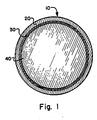
- the numeral 10 generally indicates a fuel element constructed according to the principles of the invention for use in a nuclear reactor.
- the fuel element includes a zirconium-tin alloy cladding tube or substrate 20, a boron-containing compound coating 30 of SAE ASM 2433 electroless nickel-thallium-boron on the inside of the zirconium-tin alloy cladding tube and pellets 40 of fissionable materials such as UO2.
- the zirconium-tin alloy is, typically, Zircaloy-2 or Zircaloy 4.
- the nickel-thallium-boron plating 30 described herein uses an electroless process, and therefore the coating is applied very uniformly over the length of the tube. Also, providing certain process controls are utilized, the size of the tube being processed has no effect on the application of a uniform even coating. This capability permits coating without the characteristic build-up experienced with other plating materials such as hard chrome and nullifies the need for "grinding back" after the plating process.
- the rate of deposition of the nickel boron alloy and the supporting process controls, developed for the plating process permit very precise control over the thickness of the coating. Thickness can be controlled very accurately over the range of 0.0001" to 0.0010".
- the quality of adhesion of the coating to the substrate 20 is dependent on many factors including preparation of tubes and contamination.
- the major one, of course, is the substrate itself, as the nickel-thallium-boron alloy is not necessarily compatible with all metallic substrate materials.
- One such development currently being worked on is plating over chrome to minimize cost.
- adhesion to zirconium alloys is excellent.
- Nickel-thallium-boron coatings are nodular in nature and the size of the nodules increases markedly as the coating thickness is increased.
- the growth of the plated surface takes place in a manner that has the effect of reducing the number of nodules on the surface. Therefore, the structure of the surface of the coating can vary but does not have any real bearing on surface finish quality.
- Hardness tests were conducted at various stages of heat treatment. These testing results indicated an as-plate hardness of Rc58 increasing to a hardness of Rc 72 at 800°F, demonstrating that effective heat treatment enhances hardness of the coating.
- the nickel-thallium-boron alloy coating also provides exceptional wear characteristics when compared to other plating systems which are currently available. Tests have been conducted to evaluate the effectiveness of nickel-thallium-boron coatings which show a marked improvement over a coating such as hard chrome.
- Typical wear scar pattern comparisons have been made for nickel-thallium-boron, hard chrome and nickel phosphorous for the purposes of comparing relative performance under a particular set of conditions.
- the magnitude of the wear scar is an indication of the wear resistance of the coatings.
- the wear scar area was measured using a Brush Surfanalyzer. Several scans were made across each wear area and the area under the curves obtained for each scan were measured with a planimeter in square millimeters. The higher values obtained for hard chrome and nickel phosphorous indicate lower wear resistance.
- the tube 10 is made of a zirconium-tin alloy which is commonly called Zircaloy-2 or Zircaloy-4.
- the compositions of Zircaloy-2 and Zircaloy-4 are shown in Table I, but it should be realized that each will contain some other impurities within tolerance limits known to those skilled in the art.
- Table I shows the alloying constituents and it should be remembered that the remainder is zirconium and that all ranges are given in percent by weight.
- the invention provides a nuclear fuel element having a burnable poison coating in the form of a thin layer of nickel-thallium-boron-containing alloy. The use of these improved elements eliminate the requirement of displacing fuel rods within the assembly lattice and therefore minimizes the fuel material that is displaced in the nuclear reactor core.
- Nircaloy zirconium alloys
- the application of nickel on the zirconium alloys (Zircaloy) also enhances the hydrogen transport from the interior of the fuel rod, thus, preventing the formation of hydride blisters on the Zircaloy clad. Therefore, fuel rods coated with nickel-thallium-boron are able to withstand higher levels of internal hydrogen before the formation of hydride blisters.
Landscapes
- Engineering & Computer Science (AREA)
- Physics & Mathematics (AREA)
- Plasma & Fusion (AREA)
- General Engineering & Computer Science (AREA)
- High Energy & Nuclear Physics (AREA)
- Manufacturing & Machinery (AREA)
- Metallurgy (AREA)
- Chemically Coating (AREA)
- Other Surface Treatments For Metallic Materials (AREA)
- Catalysts (AREA)
- Production Of Liquid Hydrocarbon Mixture For Refining Petroleum (AREA)
Applications Claiming Priority (2)
| Application Number | Priority Date | Filing Date | Title |
|---|---|---|---|
| US07/213,567 US4880597A (en) | 1987-08-05 | 1988-06-24 | Alloy coated fuel cladding |
| US213567 | 2000-06-22 |
Publications (3)
| Publication Number | Publication Date |
|---|---|
| EP0347638A2 true EP0347638A2 (fr) | 1989-12-27 |
| EP0347638A3 EP0347638A3 (en) | 1990-06-13 |
| EP0347638B1 EP0347638B1 (fr) | 1994-01-12 |
Family
ID=22795604
Family Applications (1)
| Application Number | Title | Priority Date | Filing Date |
|---|---|---|---|
| EP89110137A Expired - Lifetime EP0347638B1 (fr) | 1988-06-24 | 1989-06-05 | Gaine de crayon combustible nucléaire revêtue d'un alliage |
Country Status (6)
| Country | Link |
|---|---|
| US (1) | US4880597A (fr) |
| EP (1) | EP0347638B1 (fr) |
| JP (1) | JPH0631742B2 (fr) |
| KR (1) | KR920003951B1 (fr) |
| DE (1) | DE68912213T2 (fr) |
| ES (1) | ES2050184T3 (fr) |
Cited By (1)
| Publication number | Priority date | Publication date | Assignee | Title |
|---|---|---|---|---|
| WO1994000847A1 (fr) * | 1992-06-30 | 1994-01-06 | Combustion Engineering, Inc. | Revetement de protection de barre de combustible |
Families Citing this family (13)
| Publication number | Priority date | Publication date | Assignee | Title |
|---|---|---|---|---|
| US5227129A (en) * | 1990-04-26 | 1993-07-13 | Combustion Engineering, Inc. | Method for applying corrosion resistant metallic coating of zirconium nitride |
| US5268946A (en) * | 1990-09-04 | 1993-12-07 | Combustion Engineering, Inc. | Wear resistant coating for fuel cladding |
| US5243633A (en) * | 1991-09-20 | 1993-09-07 | Combustion Engineering, Inc. | Borate glass containing boron carbide burnable poison coating |
| US5280504A (en) * | 1992-06-30 | 1994-01-18 | Combustion Engineering, Inc. | Zirconium alloy tube with a boron-containing layer |
| US5319690A (en) * | 1992-06-30 | 1994-06-07 | Combustion Engineering Inc. | Internal fuel rod coating comprising metal silicates |
| US5562950A (en) * | 1994-03-24 | 1996-10-08 | Novamax Technologies, Inc. | Tin coating composition and method |
| DE19636563C1 (de) * | 1996-09-09 | 1998-03-26 | Siemens Ag | Kernreaktor-Brennelemente mit hohem Abbrand und Verfahren zu ihrer Fertigung |
| EP1087408B1 (fr) * | 1999-09-27 | 2007-05-09 | Metallveredlung GmbH & Co. KG | Procédé de production d'un revêtement qui absorbe des neutrons |
| KR20010107978A (ko) * | 1999-09-27 | 2001-12-07 | 추후보정 | 방사성 물질의 핵반응 시 발생하는 중성자를 흡수하기위한 층을 제조하는 방법 |
| US6559051B1 (en) | 2000-10-05 | 2003-05-06 | Advanced Micro Devices, Inc. | Electroless deposition of dielectric precursor materials for use in in-laid gate MOS transistors |
| US6465334B1 (en) | 2000-10-05 | 2002-10-15 | Advanced Micro Devices, Inc. | Enhanced electroless deposition of dielectric precursor materials for use in in-laid gate MOS transistors |
| US8792607B2 (en) | 2008-10-14 | 2014-07-29 | General Electric Company | Fuel rod assembly and method for mitigating the radiation-enhanced corrosion of a zirconium-based component |
| FR2989923B1 (fr) * | 2012-04-26 | 2014-05-16 | Commissariat Energie Atomique | Materiau multicouche resistant a l'oxydation en milieu nucleaire. |
Family Cites Families (9)
| Publication number | Priority date | Publication date | Assignee | Title |
|---|---|---|---|---|
| US3085059A (en) * | 1958-10-02 | 1963-04-09 | Gen Motors Corp | Fuel element for nuclear reactors |
| US4029545A (en) * | 1974-11-11 | 1977-06-14 | General Electric Company | Nuclear fuel elements having a composite cladding |
| DE3133871A1 (de) * | 1981-08-27 | 1983-03-10 | M.A.N. Maschinenfabrik Augsburg-Nürnberg AG, 8000 München | Verfahren zur herstellung homogener beschichtungen aus zwei oder mehreren metallen und/oder metallverbindungen |
| US4587087A (en) * | 1983-02-22 | 1986-05-06 | Westinghouse Electric Corp. | Burnable absorber coated nuclear fuel |
| US4582676A (en) * | 1983-02-22 | 1986-04-15 | Westinghouse Electric Corp. | Coating a uranium dioxide nuclear fuel with a zirconium diboride burnable poison |
| US4587088A (en) * | 1983-08-26 | 1986-05-06 | Westinghouse Electric Corp. | Coating a nuclear fuel with a burnable poison |
| US4717534A (en) * | 1985-02-19 | 1988-01-05 | Westinghouse Electric Corp. | Nuclear fuel cladding containing a burnable absorber |
| US4695476A (en) * | 1985-06-06 | 1987-09-22 | Westinghouse Electric Corp. | Process for coating the internal surface of zirconium tubes with neutron absorbers |
| US4824634A (en) * | 1987-08-05 | 1989-04-25 | Combustion Engineering, Inc. | Element with burnable poison coating |
-
1988
- 1988-06-24 US US07/213,567 patent/US4880597A/en not_active Expired - Lifetime
-
1989
- 1989-06-05 DE DE68912213T patent/DE68912213T2/de not_active Expired - Fee Related
- 1989-06-05 EP EP89110137A patent/EP0347638B1/fr not_active Expired - Lifetime
- 1989-06-05 ES ES89110137T patent/ES2050184T3/es not_active Expired - Lifetime
- 1989-06-16 JP JP1152457A patent/JPH0631742B2/ja not_active Expired - Lifetime
- 1989-06-23 KR KR1019890008685A patent/KR920003951B1/ko not_active Expired
Cited By (1)
| Publication number | Priority date | Publication date | Assignee | Title |
|---|---|---|---|---|
| WO1994000847A1 (fr) * | 1992-06-30 | 1994-01-06 | Combustion Engineering, Inc. | Revetement de protection de barre de combustible |
Also Published As
| Publication number | Publication date |
|---|---|
| KR910001788A (ko) | 1991-01-31 |
| JPH0631742B2 (ja) | 1994-04-27 |
| EP0347638B1 (fr) | 1994-01-12 |
| JPH0240595A (ja) | 1990-02-09 |
| US4880597A (en) | 1989-11-14 |
| DE68912213D1 (de) | 1994-02-24 |
| ES2050184T3 (es) | 1994-05-16 |
| KR920003951B1 (ko) | 1992-05-18 |
| DE68912213T2 (de) | 1994-07-07 |
| EP0347638A3 (en) | 1990-06-13 |
Similar Documents
| Publication | Publication Date | Title |
|---|---|---|
| EP0347638B1 (fr) | Gaine de crayon combustible nucléaire revêtue d'un alliage | |
| Cox | Oxidation of Zirconium and its Alloys | |
| Minato et al. | Fission product palladium-silicon carbide interaction in HTGR fuel particles | |
| Sabol et al. | High Burnup | |
| US5023048A (en) | Rod for a fuel assembly of a nuclear reactor resisting corrosion and wear | |
| Stehle et al. | External corrosion of cladding in PWRs | |
| US4268586A (en) | Corrosion resistant zirconium alloy structural components and process | |
| Lefebvre et al. | Irradiation effects on corrosion of zirconium alloy claddings | |
| US3197389A (en) | Method for fabricating self-moderating nuclear reactor fuel element | |
| US5768332A (en) | Nuclear fuel rod for pressurized water reactor | |
| EP0195155B1 (fr) | Tube de gainage pour combustible d'un réacteur refroidi à l'eau | |
| US5319690A (en) | Internal fuel rod coating comprising metal silicates | |
| US4933136A (en) | Water reactor fuel cladding | |
| JP2023525484A (ja) | 原子炉用の燃料棒のための被覆管、燃料棒及び燃料集合体 | |
| US4849160A (en) | Nuclear fuel assembly with coated sheaths and a method of coating such sheaths | |
| Chalder et al. | U3Si as a nuclear fuel | |
| EP0194797A1 (fr) | Tube de gainage pour crayon combustible de réacteur refroidi à l'eau | |
| US5790623A (en) | Composite cladding for nuclear fuel rods | |
| RU2139581C1 (ru) | Композиционный материал для топливных сердечников дисперсионных твэлов | |
| EP0195154B1 (fr) | Tube de gainage pour combustible d'un réacteur refroidi à eau | |
| CA1168769A (fr) | Barre de combustible pour reacteur nucleaire | |
| Walters | The Effect of Chromium Coatings on Hydrogen Uptake in Zirconium Alloy Nuclear Fuel Cladding | |
| US6511556B1 (en) | High strength zirconium alloys containing bismuth and niobium | |
| US6319339B1 (en) | High strength zirconium alloys containing bismuth | |
| JPS6166188A (ja) | 原子炉制御棒 |
Legal Events
| Date | Code | Title | Description |
|---|---|---|---|
| PUAI | Public reference made under article 153(3) epc to a published international application that has entered the european phase |
Free format text: ORIGINAL CODE: 0009012 |
|
| AK | Designated contracting states |
Kind code of ref document: A2 Designated state(s): BE CH DE ES FR GB LI SE |
|
| PUAL | Search report despatched |
Free format text: ORIGINAL CODE: 0009013 |
|
| AK | Designated contracting states |
Kind code of ref document: A3 Designated state(s): BE CH DE ES FR GB LI SE |
|
| 17P | Request for examination filed |
Effective date: 19901106 |
|
| 17Q | First examination report despatched |
Effective date: 19930518 |
|
| GRAA | (expected) grant |
Free format text: ORIGINAL CODE: 0009210 |
|
| AK | Designated contracting states |
Kind code of ref document: B1 Designated state(s): BE CH DE ES FR GB LI SE |
|
| REF | Corresponds to: |
Ref document number: 68912213 Country of ref document: DE Date of ref document: 19940224 |
|
| PGFP | Annual fee paid to national office [announced via postgrant information from national office to epo] |
Ref country code: GB Payment date: 19940324 Year of fee payment: 6 |
|
| PGFP | Annual fee paid to national office [announced via postgrant information from national office to epo] |
Ref country code: FR Payment date: 19940325 Year of fee payment: 6 |
|
| PGFP | Annual fee paid to national office [announced via postgrant information from national office to epo] |
Ref country code: DE Payment date: 19940328 Year of fee payment: 6 |
|
| PGFP | Annual fee paid to national office [announced via postgrant information from national office to epo] |
Ref country code: CH Payment date: 19940330 Year of fee payment: 6 |
|
| PGFP | Annual fee paid to national office [announced via postgrant information from national office to epo] |
Ref country code: SE Payment date: 19940405 Year of fee payment: 6 |
|
| PGFP | Annual fee paid to national office [announced via postgrant information from national office to epo] |
Ref country code: BE Payment date: 19940420 Year of fee payment: 6 |
|
| REG | Reference to a national code |
Ref country code: ES Ref legal event code: FG2A Ref document number: 2050184 Country of ref document: ES Kind code of ref document: T3 |
|
| ET | Fr: translation filed | ||
| PGFP | Annual fee paid to national office [announced via postgrant information from national office to epo] |
Ref country code: ES Payment date: 19940615 Year of fee payment: 6 |
|
| PLBE | No opposition filed within time limit |
Free format text: ORIGINAL CODE: 0009261 |
|
| STAA | Information on the status of an ep patent application or granted ep patent |
Free format text: STATUS: NO OPPOSITION FILED WITHIN TIME LIMIT |
|
| 26N | No opposition filed | ||
| EAL | Se: european patent in force in sweden |
Ref document number: 89110137.0 |
|
| PG25 | Lapsed in a contracting state [announced via postgrant information from national office to epo] |
Ref country code: GB Effective date: 19950605 |
|
| PG25 | Lapsed in a contracting state [announced via postgrant information from national office to epo] |
Ref country code: SE Effective date: 19950606 Ref country code: ES Free format text: LAPSE BECAUSE OF EXPIRATION OF PROTECTION Effective date: 19950606 |
|
| PG25 | Lapsed in a contracting state [announced via postgrant information from national office to epo] |
Ref country code: LI Effective date: 19950630 Ref country code: CH Effective date: 19950630 Ref country code: BE Effective date: 19950630 |
|
| BERE | Be: lapsed |
Owner name: COMBUSTION ENGINEERING INC. Effective date: 19950630 |
|
| GBPC | Gb: european patent ceased through non-payment of renewal fee |
Effective date: 19950605 |
|
| PG25 | Lapsed in a contracting state [announced via postgrant information from national office to epo] |
Ref country code: FR Effective date: 19960229 |
|
| REG | Reference to a national code |
Ref country code: CH Ref legal event code: PL |
|
| PG25 | Lapsed in a contracting state [announced via postgrant information from national office to epo] |
Ref country code: DE Effective date: 19960301 |
|
| EUG | Se: european patent has lapsed |
Ref document number: 89110137.0 |
|
| REG | Reference to a national code |
Ref country code: FR Ref legal event code: ST |
|
| REG | Reference to a national code |
Ref country code: ES Ref legal event code: FD2A Effective date: 19990601 |