EP0346933B1 - Verwendung von elektrisch leitenden Wasser-in-Öl-Mikroemulsionen, die auf perfluorinierten Bestandteilen basiert sind, als Catholyten in elektrochemischen Verfahren - Google Patents
Verwendung von elektrisch leitenden Wasser-in-Öl-Mikroemulsionen, die auf perfluorinierten Bestandteilen basiert sind, als Catholyten in elektrochemischen Verfahren Download PDFInfo
- Publication number
- EP0346933B1 EP0346933B1 EP89111008A EP89111008A EP0346933B1 EP 0346933 B1 EP0346933 B1 EP 0346933B1 EP 89111008 A EP89111008 A EP 89111008A EP 89111008 A EP89111008 A EP 89111008A EP 0346933 B1 EP0346933 B1 EP 0346933B1
- Authority
- EP
- European Patent Office
- Prior art keywords
- molecular weight
- average molecular
- process according
- microemulsions
- end groups
- Prior art date
- Legal status (The legal status is an assumption and is not a legal conclusion. Google has not performed a legal analysis and makes no representation as to the accuracy of the status listed.)
- Expired - Lifetime
Links
Images
Classifications
-
- C—CHEMISTRY; METALLURGY
- C25—ELECTROLYTIC OR ELECTROPHORETIC PROCESSES; APPARATUS THEREFOR
- C25B—ELECTROLYTIC OR ELECTROPHORETIC PROCESSES FOR THE PRODUCTION OF COMPOUNDS OR NON-METALS; APPARATUS THEREFOR
- C25B1/00—Electrolytic production of inorganic compounds or non-metals
- C25B1/01—Products
- C25B1/02—Hydrogen or oxygen
- C25B1/04—Hydrogen or oxygen by electrolysis of water
-
- C—CHEMISTRY; METALLURGY
- C08—ORGANIC MACROMOLECULAR COMPOUNDS; THEIR PREPARATION OR CHEMICAL WORKING-UP; COMPOSITIONS BASED THEREON
- C08J—WORKING-UP; GENERAL PROCESSES OF COMPOUNDING; AFTER-TREATMENT NOT COVERED BY SUBCLASSES C08B, C08C, C08F, C08G or C08H
- C08J3/00—Processes of treating or compounding macromolecular substances
- C08J3/02—Making solutions, dispersions, lattices or gels by other methods than by solution, emulsion or suspension polymerisation techniques
- C08J3/03—Making solutions, dispersions, lattices or gels by other methods than by solution, emulsion or suspension polymerisation techniques in aqueous media
-
- C—CHEMISTRY; METALLURGY
- C25—ELECTROLYTIC OR ELECTROPHORETIC PROCESSES; APPARATUS THEREFOR
- C25B—ELECTROLYTIC OR ELECTROPHORETIC PROCESSES FOR THE PRODUCTION OF COMPOUNDS OR NON-METALS; APPARATUS THEREFOR
- C25B1/00—Electrolytic production of inorganic compounds or non-metals
- C25B1/01—Products
- C25B1/14—Alkali metal compounds
- C25B1/16—Hydroxides
-
- C—CHEMISTRY; METALLURGY
- C25—ELECTROLYTIC OR ELECTROPHORETIC PROCESSES; APPARATUS THEREFOR
- C25B—ELECTROLYTIC OR ELECTROPHORETIC PROCESSES FOR THE PRODUCTION OF COMPOUNDS OR NON-METALS; APPARATUS THEREFOR
- C25B1/00—Electrolytic production of inorganic compounds or non-metals
- C25B1/01—Products
- C25B1/34—Simultaneous production of alkali metal hydroxides and chlorine, oxyacids or salts of chlorine, e.g. by chlor-alkali electrolysis
-
- C—CHEMISTRY; METALLURGY
- C25—ELECTROLYTIC OR ELECTROPHORETIC PROCESSES; APPARATUS THEREFOR
- C25B—ELECTROLYTIC OR ELECTROPHORETIC PROCESSES FOR THE PRODUCTION OF COMPOUNDS OR NON-METALS; APPARATUS THEREFOR
- C25B11/00—Electrodes; Manufacture thereof not otherwise provided for
- C25B11/04—Electrodes; Manufacture thereof not otherwise provided for characterised by the material
- C25B11/051—Electrodes formed of electrocatalysts on a substrate or carrier
- C25B11/073—Electrodes formed of electrocatalysts on a substrate or carrier characterised by the electrocatalyst material
- C25B11/091—Electrodes formed of electrocatalysts on a substrate or carrier characterised by the electrocatalyst material consisting of at least one catalytic element and at least one catalytic compound; consisting of two or more catalytic elements or catalytic compounds
- C25B11/093—Electrodes formed of electrocatalysts on a substrate or carrier characterised by the electrocatalyst material consisting of at least one catalytic element and at least one catalytic compound; consisting of two or more catalytic elements or catalytic compounds at least one noble metal or noble metal oxide and at least one non-noble metal oxide
-
- C—CHEMISTRY; METALLURGY
- C08—ORGANIC MACROMOLECULAR COMPOUNDS; THEIR PREPARATION OR CHEMICAL WORKING-UP; COMPOSITIONS BASED THEREON
- C08J—WORKING-UP; GENERAL PROCESSES OF COMPOUNDING; AFTER-TREATMENT NOT COVERED BY SUBCLASSES C08B, C08C, C08F, C08G or C08H
- C08J2371/00—Characterised by the use of polyethers obtained by reactions forming an ether link in the main chain; Derivatives of such polymers
Definitions
- the present invention relates to the use of perfluorinated water-in-oil (w/o) microemulsions as catholytes in electrolytic processes.
- the perfluorinated oils are preferably of the perfluoropolyether type.
- a possible alternative thereto is a cathodic reaction which - with the anodic reaction being the same - occurs at a lower value of the reversible potential difference.
- a further surprising aspect of the present invention is that - with the current density and the anodic process being the same - the difference between the cathodic potential of a process in a microemulsion (for example the reduction of O2 to OH ⁇ ) and the cathodic potential of a reference process in an aqueous solution (typically the H2 evolution) is such that as compared to the electrolysis in aqueous phase the electrolysis in microemulsion allows to save energy.
- microemulsions employed according to the present invention are of the w/o type, i.e. microemulsions where oil is the continuous phase and water is the dispersed phase.
- object of the present invention is an electrochemical process wherein a gaseous matter is reduced at the cathode and wherein water-in-oil (w/o) microemulsions having an electric conductance (due to ion transfer) of at least 1 millisiemens.cm ⁇ 1 are utilized as catholytes.
- microemulsions of water in perfluoropolyethers of perfluorocarbons having an electric conductance of at least 1 millisiemens.cm ⁇ 1 may be used as catholytes for the cathodic reduction of oxygen.
- Microemulsions employable according to the present invention are described in IT-A-20,910 A/86, 19,494 A/87, 19,495 A/87 (w/o and o/w microemulsions of perfluoropolyethers) and 22,421 A/87 (conductive microemulsions) as well as in the corresponding EP-A-250766, 280312 and 315841, the contents of which are incorporated herein.
- microemulsion also includes systems in which the molecular orientation in the interphase leads to the formation of optically an-isotropic systems, characterized by bi-refraction and probably consisting of oriented structures of the liquid crystal type.
- microemulsions used according to the present invention are mixtures which macroscopically consist of only one limpid or opalescent phase, which is indefinitely stable in the operative temperature range.
- Said mixtures preferably comprise:
- microemulsions used herein may be optically isotropic or birefractive, are of the water-in-oil (w/o) type and are characterized in that they are conductive, their conductance being at least equal to 1 millisiemens.cm ⁇ 1.
- the microemulsions used according to the present invention are of the w/o type, they must contain the (preferred) PFPE or the perfluorocarbon as "continuous phase". Therefore, the PFPE phase should preferably be in excess (as to the volume) with respect to the aqueous phase.
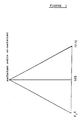
- microemulsions can preferably be described, in general, as the conductive portion of the single-phase areas which are present in the right half of a water/surfactant system/PFPE ternary diagram as shown in Figure 1.
- the bisecting line of the angle opposite to the water-PFPE base side is characterized by a constant W/PFPE ratio of 1.
- W/PFPE ratio of 1
- PFPE Perfluoropolyethers
- non-perfluoroalkyl end groups and of functional groups in the chain there may be mentioned, for example, carboxylate, alcohol, polyoxyalkylene-OH, etc. groups.
- the most suitable functional end groups and functional groups in the chain are the hydrophilic ones,and in particular carboxyl groups.
- the functional end groups as well as the functional groups in the chain mentioned above can be linked to the perfluoropolyether chain through a -CFX-group in which X is F or CF3, optionally followed by a linking group consisting of a divalent non-fluorinated radical of the alkylene or arylene type, containing up to 20 carbon atoms, preferably containing 1 to 3 carbon atoms, according to the sequence: perfluoropolyether chain -CFX- non-fluorinated radical-functional group.
- divalent non-fluorinated radicals are: methylene, ethylene, propylene, butylene, pentylene, hexylene, octylene, phenylene, biphenylene and naphthylene.
- perfluoropolyethers also employable according to the present invention are the ones of classes 1,2 and 3, which may contain peroxy bridges in the chain and have acid end groups, said PFPE being obtainable as crude products of the photo-oxidation process utilized for the synthesis of the above PFPE.
- Perfluoropolyethers of class 1) are commercially available under the trade marks Fomblin® Y or Galden®; the ones of class 2) are marketed under the trade mark Fomblin® Z. All of said products are produced by Montedison S.p.A.
- the products of class 3 may be prepared according to US-A-3,665,041.
- Other suitable perfluoropolyethers are the ones described by Lagow et al. in US-A-4,523,039 or in J. Am. Chem. Soc. 1985 , 107, 1197-1201.
- the fluorinated surfactants contained in the present microemulsions may be ionic or non-ionic.
- Examples of preferred surfactants are:
- the preferred surfactants are those of the ionic type.
- Preferred cations in the salts mentioned above are NH4+ and the cations of alkali and alkaline earth metals, e.g. Na, K, Mg and Ca.
- system may contain one or more surfactants belonging to one of the following classes:
- the aqueous liquid may consist of water or of an aqueous solution of inorganic electrolytes (salts, acids or alkalis).
- the present w/o microemulsions which are utilizable as catholytes for cathodic gas reduction reactions may also comprise, as continuous oil phase, a perfluorocarbon in addition to or (preferably) instead of a perfluoropolyether, provided that such a microemulsion has a conductance of at least 1 millisiemens.cm ⁇ 1.
- Perfluorocarbon microemulsions are well known in the art - see for example EP-A-51,526, the contents of which are incorporated herein.
- Preferred perfluorocarbons for use in the present invention contain from 5 to 15, particularly from 6 to 12, carbon atoms.
- microemulsions to be used as catholytes may be prepared by mixing the individual components. Said microemulsions can be identified, for example, by measuring the specific conductance --(X) variation of the oil/surfactant/co-surfactant system when varying the composition due to the addition of an aqueous solution.
- the possible presence of a composition range corresponding to significant X values is ascertained.
- the conductive microemulsion can be prepared by simply mixing the individual components taken in any order.
- w/o microemulsions having a conductivity of at least 1 millisiemens.cm ⁇ 1 with respect to the electrolytic reactions of any gas that can be reduced at the cathode.
- oxygen has been used as gas and therefore all the voltametric tests reported hereinafter and the corresponding evaluations concern the cathodic reaction: O2+2H2O+4e ⁇ ⁇ 4OH ⁇ , but it is apparent that said evaluations are to be considered as only illustrative.
- the limiting current of O2-reduction indicated in each example is always referred to a cathodic potential which is lower (by 200 mV) than the value at which H2-evolution in the examined system starts.
- the observed limiting current density was 30 »A mm ⁇ 2.
- said comparison was conducted at the same temperature and at a pH of the aqueous electrolyte solution as close as possible to the pH of an aqueous solution of the fluorinated surfactant utilized for preparing the microemulsion.
- microemulsion (ME) thus obtained had a specific conductance of 10.56 millisiemens.cm ⁇ 1 and contained 14.3% by weight of dispersed aqueous phase.
- the circulation of 200 »A mm ⁇ 2 at a cathodic potential of -550 mV in the ME and at -850 mV in the aqueous solution was obtained; that means that, with the current density being the same, the electrolysis in microemulsion allows to save about 35% of the energy in W. In particular, the saving in this case was 0.06 mW of energy per mm ⁇ 2 of electrode surface as compared to the electrolysis in aqueous phase.
- a w/o ME was prepared which contained 32.42 g of PFPE with perfluoroalkyl end groups, belonging to class 1 and having an average molecular weight of about 800; 12 ml of bidistilled water; 47.88 g of ammonium salt of a monocarboxylic acid having a perfluoropolyether structure and belonging to class 1, exhibiting a narrow molecular weight distribution and an equivalent weight of 520; and 20.99 g of a monofunctional alcohol having a perfluoropolyether structure and an average molecular weight of 678.
- X 2.99 millisiemens.cm ⁇ 1 and 10.6% of H2O was obtained.
- a ME was prepared by mixing 55.59 g of a perfluoropolyether having perfluoroalkyl end groups and belonging to class 1, having an average molecular weight of 800, 4 ml of bidistilled water, 0.50 g of isopropyl alcohol and 29.75 g of ammonium salt of a monocarboxylic acid with perfluoropolyether structure having a narrow molecular weight distribution and a mean equivalent weight of 692.
- the limpid and isotropic system contained 4.5% by weight of water and had a specific conductance of 3.72 millisiemens.cm ⁇ 1 and a pH of about 5.5.
- a w/o ME containing 65.14 g of a PFPE having perfluoralkyl end groups, belonging to class 1 and having an average molecular weight of 800, 34.87 g of ammonium salt of the same acid as used in the preceding example, and 3 ml of water.
- the resulting system consisted of a single limpid phase, which was stable in the temperature range of from 25 to 75°C and exhibited the following composition by weight:
- microemulsion showed a conductance of 21 millisiemens.cm ⁇ 1 at a temperature of 25°C. From the voltametric diagrams the following values of the current density of O2-reduction were obtained:
- the ME made possible an energy saving of 0.01 mW/mm2.
- a current density of 100 »A mm ⁇ 2 was obtained at -300 mV as compared to -600 mV necessary in aqueous solution, resulting in a saving of 0.033 mW/mm2.
- a perfluoropolyether having acid end groups belonging to class 1, having an average equivalent weight of 2860 with respect to the acid groups and an average viscosimetric molecular weight of 2080, and being composed of a mixture of polymers having different molecular weights, neutralized with 13 ml of 2.5 M NaOH solution, there were added 20 ml of bidistilled water, 4.5 ml of a carboxylic acid having an equivalent weight of 668 and 18 ml of a carboxylic acid having an equivalent weight of 361, both of said acids having a perfluoropolyether structure and belonging to class 1.
- the resulting system was composed only of a single limpid phase, which was stable in the temperature range from 25 to 75°C and had the following composition by weight:
- microemulsion exhibited a conductance of 10.5 millisiemens.cm ⁇ 1 at a temperature of 25°C.
- At 60°C 150 »A mm ⁇ 2 circulated at a potential of -300 mV in the ME as compared to -725 mV necessary with an aqueous electrolyte, the energy saving being higher than 0.06 mV/mm2.
- a w/o ME consisting of 32.98 g of ammonium salt of the surfactant described in example 1, 58.96 g of a perfluoropolyether having perfluoroalkyl end groups, belonging to class 1 and having an average molecular weight of about 800, and 12 ml of water proved to be a limpid and isotropic system at 20°C and exhibited a specific conductance of 0.2 millisiemens.cm ⁇ 1.
- Conductive microemulsions based on perfluorocarbons 1.26 g of a monocarboxylic acid having a perfluoropolyether structure belonging to class 1 and having a narrow molecular weight distribution and an equivalent weight of 520, allowed to solubilize 0.3 ml of an ammonia solution (10% by weight of NH3) in 3.80 g of perfluorodecaline, in the presence of 0.39 g of isopropyl alcohol.
- the w/o ME contained 5.2% by weight of microdispersed aqueous phase and exhibited a specific conductance of 1.35 millisiemens.cm ⁇ 1 and an acidic pH.
- This system was capable of solubilizing, at room temperature, up to 28% of aqueous phase; at higher concentrations, separation into two phases was observed.
- the w/o ME thus obtained contained 17.92% of aqueous phase and exhibited a specific conductance of 20.6 millisiemens.cm ⁇ 1 at 20°C.
- the system was limpid and isotropic at temperatures lower than 27°C.
- the ME thus prepared was indefinitely stable at 23°C and had a pH of 8.33 and a specific conductance of 44.31 millisiemens. cm ⁇ 1.
- the concentration of the aqueous phase was 15.47% by weight.
- the small current circulating under N2 bubbling may be due to incomplete O2 removal.
- the O2-saturated ME, at ⁇ 1500 rpm, supported a O2-reduction current density that was more than 20 times higher than the one which results from the same electrode reaction in aqueous solution.
Landscapes
- Chemical & Material Sciences (AREA)
- Chemical Kinetics & Catalysis (AREA)
- Organic Chemistry (AREA)
- Engineering & Computer Science (AREA)
- Electrochemistry (AREA)
- Materials Engineering (AREA)
- Metallurgy (AREA)
- Inorganic Chemistry (AREA)
- Dispersion Chemistry (AREA)
- Health & Medical Sciences (AREA)
- Medicinal Chemistry (AREA)
- Polymers & Plastics (AREA)
- Colloid Chemistry (AREA)
- Cosmetics (AREA)
- Electrolytic Production Of Metals (AREA)
- Electrolytic Production Of Non-Metals, Compounds, Apparatuses Therefor (AREA)
- Battery Electrode And Active Subsutance (AREA)
- Inert Electrodes (AREA)
- Compositions Of Macromolecular Compounds (AREA)
- Emulsifying, Dispersing, Foam-Producing Or Wetting Agents (AREA)
- Organic Low-Molecular-Weight Compounds And Preparation Thereof (AREA)
- Secondary Cells (AREA)
- Heterocyclic Carbon Compounds Containing A Hetero Ring Having Nitrogen And Oxygen As The Only Ring Hetero Atoms (AREA)
- Compounds Of Unknown Constitution (AREA)
Claims (9)
- Elektrochemisches Verfahren, in dem eine gasförmige Substanz an einer Kathode reduziert wird und in dem Mikroemulsionen vom Wasser-in-Öl (W/O)-Typ als Katholyte eingesetzt werden, wobei die Mikroemulsionen eine elektrische Konduktanz durch Ionentransfer von mindestens 1 Millisiemens.cm⁻¹ aufweisen.
- Verfahren nach Anspruch 1, in dem das gasförmige Material Sauerstoff ist.
- Verfahren nach irgendeinem der Ansprüche 1 und 2, in dem die Kathode aus einem Metall hergestellt ist, das allgemein in voltametrischen Verfahren verwendet wird.
- Verfahren nach Anspruch 3, in dem die Kathode aus Au, Pt oder Ni hergestellt ist.
- Verfahren nach irgendeinem der Ansprüche 1 bis 4, in dem die (W/O)-Mikroemulsionen mit einer Konduktanz von mindestens 1 Millisiemens.cm⁻¹ aus einem flüssigen, klaren oder opaleszenten, makroskopisch einphasigen Material zusammengesetzt sind, das erhältlich ist durch Mischen:a) einer gegebenenfalls einen oder mehrere Elektrolyte enthaltenden wäßrigen Flüssigkeit;b) eines Perfluorpolyether-Fluids mit Perfluoralkyl- und/oder funktionellen Endgruppen, mit Carboxyl-, Alkohol-, Polyoxyalkylen-OH-, Ester-, Amid- usw. Funktionalität und vorzugsweise funktionellen Gruppen vom hydrophilen Typ;c) eines fluorierten Tensids mit vorzugsweise Perfluorpolyether-Struktur; und/oderd) eines hydrierten C₁₋₁₂-Alkohols und gegebenenfalls eines (teilweise) fluorierten Alkohols (Cotensid).
- Verfahren nach Anspruch 5, in dem das fluorierte Tensid ausgewählt ist aus einem oder mehreren der folgenden Salze:a) Salzen von Perfluoralkylcarbonsäuren mit 5 bis 11 Kohlenstoffatomen;b) Salzen von Perfluorsulfonsäuren mit 5 bis 11 Kohlenstoffatomen;c) Salzen von Mono- und Dicarbonsäuren, die von Perfluorpolyethern abgeleitet sind.
- Verfahren nach Anspruch 5, in dem das fluorierte Tensid vom nicht-ionischen Typ, der durch eine Perfluoralkyl-Kette und durch eine hydrophile Polyoxyalkylen-Abschlußgruppe substituiert ist, ist.
- Verfahren nach irgendeinem der Ansprüche 1 bis 7, in dem das Öl einen Perfluorkohlenstoff umfaßt oder daraus besteht.
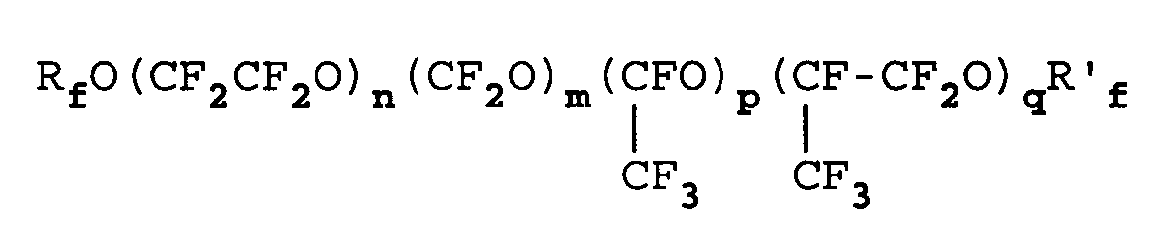
- Verfahren nach irgendeinem der Ansprüche 1 bis 7, in dem das Öl aus einem oder mehreren Perfluorpolyethern besteht oder diese umfaßt, die ausgewählt sind aus:a) PFPE mit einem durchschnittlichen Molekulargewicht von 500 bis 10000 und vorzugsweise 600 bis 6000 und Perfluoralkyl-Endgruppen, zu einer oder mehreren der folgenden Klassen gehörend:1)
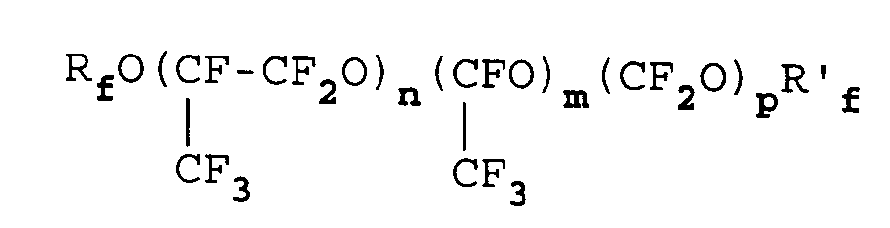 2) RfO(CF₂CF₂O)n(CF₂O)mR′f′ worin die Perfluoroxyalkylen-Einheiten statistisch verteilt sind, Rf und R′f, gleich oder verschieden voneinander, -CF₃ oder -C₂F₅ sind und m und n solche Durchschnittswerte aufweisen, daß sie die obigen Anforderungen hinsichtlich des durchschnittlichen Molekulargewichts erfüllen;3)
 4)
4)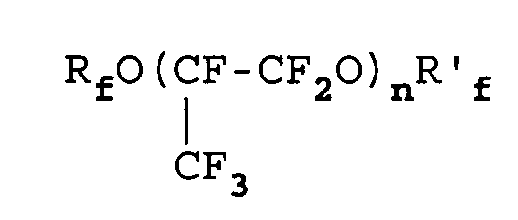 5) RfO(CF₂CF₂O)nR′f, worin Rf und R′f, gleich oder verschieden voneinander, -CF₃ oder -C₂F₅ sind und n einen solchen Durchschnittswert aufweist, daß es die obige Anforderung hinsichtlich des durchschnittlichen Molekulargewichts erfüllt;6) RfO(CF₂CF₂CF₂O)nR′f, worin Rf und R′f, gleich oder verschieden voneinander, -CF₃, -C₂F₅ oder -C₃F₇ sind und n einen solchen Durchschnittswert aufweist, daß es die obige Anforderung hinsichtlich des durchschnittlichen Molekulargewichts erfüllt;7) PFPE mit der Struktur von Klasse 1 oder Klasse 3, worin eine der Endgruppen Rf und R′f ein oder zwei Chloratome enthält;b) PFPE, der zu den obigen Klassen 1) bis 7) gehört und ein durchschnittliches Molekulargewicht von 1500 bis 10000 aufweist, aber im Durchschnitt 0,1 bis 4 Nicht-Perfluoralkyl-Endgruppen pro Polymerkette enthält;c) PFPE mit funktionellen Gruppen entlang der Perfluorpolyether-Kette und Endgruppen vom Perfluoralkyl- oder funktionellen Typ.
Applications Claiming Priority (2)
| Application Number | Priority Date | Filing Date | Title |
|---|---|---|---|
| IT2100488 | 1988-06-17 | ||
| IT21004/88A IT1217838B (it) | 1988-06-17 | 1988-06-17 | Microemulsioni per tipo acqua in olio elettricamente conduttrici,a base di composti perfluorurati usate come catolita in processi elettrochimici |
Publications (3)
| Publication Number | Publication Date |
|---|---|
| EP0346933A2 EP0346933A2 (de) | 1989-12-20 |
| EP0346933A3 EP0346933A3 (de) | 1992-01-08 |
| EP0346933B1 true EP0346933B1 (de) | 1995-08-02 |
Family
ID=11175276
Family Applications (1)
| Application Number | Title | Priority Date | Filing Date |
|---|---|---|---|
| EP89111008A Expired - Lifetime EP0346933B1 (de) | 1988-06-17 | 1989-06-16 | Verwendung von elektrisch leitenden Wasser-in-Öl-Mikroemulsionen, die auf perfluorinierten Bestandteilen basiert sind, als Catholyten in elektrochemischen Verfahren |
Country Status (17)
| Country | Link |
|---|---|
| US (1) | US5045158A (de) |
| EP (1) | EP0346933B1 (de) |
| JP (1) | JP2911482B2 (de) |
| KR (1) | KR960011676B1 (de) |
| CN (1) | CN1038675A (de) |
| AT (1) | ATE125945T1 (de) |
| AU (1) | AU614627B2 (de) |
| BR (1) | BR8902905A (de) |
| CA (1) | CA1338862C (de) |
| DD (1) | DD284058A5 (de) |
| DE (1) | DE68923661T2 (de) |
| FI (1) | FI892967L (de) |
| IL (1) | IL90619A0 (de) |
| IT (1) | IT1217838B (de) |
| NO (1) | NO177027C (de) |
| PT (1) | PT90891B (de) |
| ZA (1) | ZA894535B (de) |
Families Citing this family (9)
| Publication number | Priority date | Publication date | Assignee | Title |
|---|---|---|---|---|
| IT1270703B (it) * | 1994-11-17 | 1997-05-07 | Ausimont Spa | Microemulsioni di fluoropoliossialchileni in miscela con idrocarburi, e loro uso in processi di (co)polimerizzazione di monomeri fluorurati |
| AU4458797A (en) | 1997-09-15 | 1999-04-05 | Sofitech N.V. | Electrically conductive non-aqueous wellbore fluids |
| US6793025B2 (en) * | 1998-01-08 | 2004-09-21 | M-I L. L. C. | Double emulsion based drilling fluids |
| US6405809B2 (en) | 1998-01-08 | 2002-06-18 | M-I Llc | Conductive medium for openhold logging and logging while drilling |
| JP4548420B2 (ja) * | 2004-09-14 | 2010-09-22 | Nokクリューバー株式会社 | 金属表面保護剤 |
| CN101128569B (zh) * | 2005-02-22 | 2012-12-12 | Nok克鲁勃株式会社 | 润滑剂 |
| US7939477B2 (en) * | 2006-04-20 | 2011-05-10 | Nok Kluber Co., Ltd. | Lubricant composition for oil-impregnated sintered bearings |
| CN111101143A (zh) * | 2020-02-24 | 2020-05-05 | 北京化工大学 | 一种用于电解水的电解液及电解水制氢系统 |
| WO2025208137A1 (en) * | 2024-03-29 | 2025-10-02 | Evoqua Water Technologies Llc | Divided electrochemical cell configurations for electrochemical pfas destruction |
Family Cites Families (9)
| Publication number | Priority date | Publication date | Assignee | Title |
|---|---|---|---|---|
| US3048549A (en) * | 1957-05-27 | 1962-08-07 | Carsbie C Adams | Electrode jelly |
| US4012329A (en) * | 1973-08-27 | 1977-03-15 | Marathon Oil Company | Water-in-oil microemulsion drilling fluids |
| IT1002396B (it) * | 1973-12-28 | 1976-05-20 | Montedison Spa | Nn bis ammino alchil ammidi degli acidi poliossaperfluroalcandioici loro derivati e procedimento per la loro preparazione |
| IT1213071B (it) * | 1986-05-07 | 1989-12-07 | Ausimont Spa | Perfluoropolieteri esenti da ossigeno perossidico e contenenti gruppi perfluoroepossidici disposti lungo la catena perfluoropolieterea. |
| IL82308A (en) * | 1986-06-26 | 1990-11-29 | Ausimont Spa | Microemulsions containing perfluoropolyethers |
| IT1203514B (it) * | 1987-02-26 | 1989-02-15 | Ausimont Spa | Microemulsioni a base di tre liquidi immiscibili,comprendenti un perfluoropolietere |
| IT1223324B (it) * | 1987-10-28 | 1990-09-19 | Ausimont Spa | Microemulsioni acquose comprendenti perfluoropolieteri funzionali |
| IT1223325B (it) * | 1987-10-28 | 1990-09-19 | Ausimont Spa | Microemulsioni elettricamente conduttrici a base di perfluoropolieteri |
| IT1217452B (it) * | 1988-05-02 | 1990-03-22 | Ausimont Spa | Perfluoropolieteri contenenti un alogeno diverso da fluoro e aventi un gruppo terminale a funzione acida |
-
1988
- 1988-06-17 IT IT21004/88A patent/IT1217838B/it active
-
1989
- 1989-06-14 ZA ZA894535A patent/ZA894535B/xx unknown
- 1989-06-14 DD DD89329595A patent/DD284058A5/de not_active IP Right Cessation
- 1989-06-14 IL IL90619A patent/IL90619A0/xx not_active IP Right Cessation
- 1989-06-14 AU AU36411/89A patent/AU614627B2/en not_active Ceased
- 1989-06-16 DE DE68923661T patent/DE68923661T2/de not_active Expired - Fee Related
- 1989-06-16 CN CN89104041A patent/CN1038675A/zh active Pending
- 1989-06-16 CA CA000603080A patent/CA1338862C/en not_active Expired - Fee Related
- 1989-06-16 FI FI892967A patent/FI892967L/fi not_active Application Discontinuation
- 1989-06-16 PT PT90891A patent/PT90891B/pt not_active IP Right Cessation
- 1989-06-16 EP EP89111008A patent/EP0346933B1/de not_active Expired - Lifetime
- 1989-06-16 BR BR898902905A patent/BR8902905A/pt not_active Application Discontinuation
- 1989-06-16 JP JP1154416A patent/JP2911482B2/ja not_active Expired - Fee Related
- 1989-06-16 NO NO892520A patent/NO177027C/no unknown
- 1989-06-16 AT AT89111008T patent/ATE125945T1/de not_active IP Right Cessation
- 1989-06-17 KR KR1019890008386A patent/KR960011676B1/ko not_active Expired - Fee Related
- 1989-06-19 US US07/367,860 patent/US5045158A/en not_active Expired - Lifetime
Also Published As
| Publication number | Publication date |
|---|---|
| US5045158A (en) | 1991-09-03 |
| JP2911482B2 (ja) | 1999-06-23 |
| AU3641189A (en) | 1989-12-21 |
| EP0346933A3 (de) | 1992-01-08 |
| NO177027B (no) | 1995-03-27 |
| ATE125945T1 (de) | 1995-08-15 |
| AU614627B2 (en) | 1991-09-05 |
| PT90891B (pt) | 1994-12-30 |
| EP0346933A2 (de) | 1989-12-20 |
| IT1217838B (it) | 1990-03-30 |
| PT90891A (pt) | 1989-12-29 |
| CA1338862C (en) | 1997-01-21 |
| KR900000506A (ko) | 1990-01-30 |
| FI892967A7 (fi) | 1989-12-18 |
| DE68923661D1 (de) | 1995-09-07 |
| DE68923661T2 (de) | 1996-04-18 |
| FI892967A0 (fi) | 1989-06-16 |
| CN1038675A (zh) | 1990-01-10 |
| KR960011676B1 (ko) | 1996-08-29 |
| JPH02111891A (ja) | 1990-04-24 |
| DD284058A5 (de) | 1990-10-31 |
| NO177027C (no) | 1995-07-05 |
| FI892967L (fi) | 1989-12-18 |
| ZA894535B (en) | 1990-03-28 |
| NO892520D0 (no) | 1989-06-16 |
| IT8821004A0 (it) | 1988-06-17 |
| IL90619A0 (en) | 1990-01-18 |
| BR8902905A (pt) | 1990-02-01 |
| NO892520L (no) | 1989-12-18 |
Similar Documents
| Publication | Publication Date | Title |
|---|---|---|
| EP0346933B1 (de) | Verwendung von elektrisch leitenden Wasser-in-Öl-Mikroemulsionen, die auf perfluorinierten Bestandteilen basiert sind, als Catholyten in elektrochemischen Verfahren | |
| EP0315078B1 (de) | Funktionnelle Perfluorpolyäther enthaltende wässrige Mikroemulsionen | |
| US5258137A (en) | Viscoelastic surfactant based foam fluids | |
| US6896996B2 (en) | Perfluoropolyether additives for electrochemical applications | |
| EP0280312A2 (de) | Mikroemulsionen aus drei unmischbaren Flüssigkeiten, die einen Perfluorpolyäther enthält | |
| EP0315841B1 (de) | Auf Perfluorpolyäther basierende elektrisch leitfähige Mikroemulsionen | |
| EP0346932B1 (de) | Verwendung von elektrisch leitenden Wasser-in-Öl-Mikroemulsionen, die auf perfluorinierten Bestandteilen basiert sind, als Catholyten in elektrochemischen Verfahren | |
| JP2609524B2 (ja) | フッ素系イオン交換樹脂膜の加水分解方法 | |
| WO1994009852A1 (en) | Viscoelastic surfactant based foam fluids | |
| EP0970984B1 (de) | Perfluoropolyether-Acylperoxide und deren Herstellung | |
| Dayalan et al. | Diffusion Coefficients of Di-/Tri-isopropyl Naphthalene Sulfonate Micelles—Electrochemical and Light Scattering Measurements | |
| JP2001253916A (ja) | フルオロアルキル基含有ホスホン酸オリゴマー類およびその製造方法、並びにその用途 | |
| RU2030428C1 (ru) | Микроэмульсия |
Legal Events
| Date | Code | Title | Description |
|---|---|---|---|
| PUAI | Public reference made under article 153(3) epc to a published international application that has entered the european phase |
Free format text: ORIGINAL CODE: 0009012 |
|
| AK | Designated contracting states |
Kind code of ref document: A2 Designated state(s): AT BE CH DE ES FR GB GR IT LI NL SE |
|
| PUAL | Search report despatched |
Free format text: ORIGINAL CODE: 0009013 |
|
| AK | Designated contracting states |
Kind code of ref document: A3 Designated state(s): AT BE CH DE ES FR GB GR IT LI NL SE |
|
| 17P | Request for examination filed |
Effective date: 19920623 |
|
| 17Q | First examination report despatched |
Effective date: 19940929 |
|
| ITF | It: translation for a ep patent filed | ||
| GRAA | (expected) grant |
Free format text: ORIGINAL CODE: 0009210 |
|
| RAP1 | Party data changed (applicant data changed or rights of an application transferred) |
Owner name: AUSIMONT S.P.A. |
|
| AK | Designated contracting states |
Kind code of ref document: B1 Designated state(s): AT BE CH DE ES FR GB GR IT LI NL SE |
|
| PG25 | Lapsed in a contracting state [announced via postgrant information from national office to epo] |
Ref country code: ES Free format text: THE PATENT HAS BEEN ANNULLED BY A DECISION OF A NATIONAL AUTHORITY Effective date: 19950802 Ref country code: BE Effective date: 19950802 Ref country code: GR Free format text: LAPSE BECAUSE OF FAILURE TO SUBMIT A TRANSLATION OF THE DESCRIPTION OR TO PAY THE FEE WITHIN THE PRESCRIBED TIME-LIMIT Effective date: 19950802 Ref country code: AT Effective date: 19950802 |
|
| REF | Corresponds to: |
Ref document number: 125945 Country of ref document: AT Date of ref document: 19950815 Kind code of ref document: T |
|
| REF | Corresponds to: |
Ref document number: 68923661 Country of ref document: DE Date of ref document: 19950907 |
|
| ET | Fr: translation filed | ||
| PG25 | Lapsed in a contracting state [announced via postgrant information from national office to epo] |
Ref country code: SE Effective date: 19951102 |
|
| PLBE | No opposition filed within time limit |
Free format text: ORIGINAL CODE: 0009261 |
|
| STAA | Information on the status of an ep patent application or granted ep patent |
Free format text: STATUS: NO OPPOSITION FILED WITHIN TIME LIMIT |
|
| 26N | No opposition filed | ||
| PGFP | Annual fee paid to national office [announced via postgrant information from national office to epo] |
Ref country code: CH Payment date: 19980702 Year of fee payment: 10 |
|
| PG25 | Lapsed in a contracting state [announced via postgrant information from national office to epo] |
Ref country code: CH Free format text: LAPSE BECAUSE OF NON-PAYMENT OF DUE FEES Effective date: 19990630 Ref country code: LI Free format text: LAPSE BECAUSE OF NON-PAYMENT OF DUE FEES Effective date: 19990630 |
|
| REG | Reference to a national code |
Ref country code: CH Ref legal event code: PL |
|
| REG | Reference to a national code |
Ref country code: GB Ref legal event code: IF02 |
|
| PGFP | Annual fee paid to national office [announced via postgrant information from national office to epo] |
Ref country code: FR Payment date: 20030610 Year of fee payment: 15 |
|
| PGFP | Annual fee paid to national office [announced via postgrant information from national office to epo] |
Ref country code: NL Payment date: 20030630 Year of fee payment: 15 |
|
| PG25 | Lapsed in a contracting state [announced via postgrant information from national office to epo] |
Ref country code: NL Free format text: LAPSE BECAUSE OF NON-PAYMENT OF DUE FEES Effective date: 20050101 |
|
| PG25 | Lapsed in a contracting state [announced via postgrant information from national office to epo] |
Ref country code: FR Free format text: LAPSE BECAUSE OF NON-PAYMENT OF DUE FEES Effective date: 20050228 |
|
| NLV4 | Nl: lapsed or anulled due to non-payment of the annual fee |
Effective date: 20050101 |
|
| REG | Reference to a national code |
Ref country code: FR Ref legal event code: ST |
|
| PGFP | Annual fee paid to national office [announced via postgrant information from national office to epo] |
Ref country code: DE Payment date: 20070614 Year of fee payment: 19 |
|
| PGFP | Annual fee paid to national office [announced via postgrant information from national office to epo] |
Ref country code: GB Payment date: 20070613 Year of fee payment: 19 |
|
| PGFP | Annual fee paid to national office [announced via postgrant information from national office to epo] |
Ref country code: IT Payment date: 20070626 Year of fee payment: 19 |
|
| GBPC | Gb: european patent ceased through non-payment of renewal fee |
Effective date: 20080616 |
|
| PG25 | Lapsed in a contracting state [announced via postgrant information from national office to epo] |
Ref country code: DE Free format text: LAPSE BECAUSE OF NON-PAYMENT OF DUE FEES Effective date: 20090101 |
|
| PG25 | Lapsed in a contracting state [announced via postgrant information from national office to epo] |
Ref country code: GB Free format text: LAPSE BECAUSE OF NON-PAYMENT OF DUE FEES Effective date: 20080616 |
|
| PG25 | Lapsed in a contracting state [announced via postgrant information from national office to epo] |
Ref country code: IT Free format text: LAPSE BECAUSE OF NON-PAYMENT OF DUE FEES Effective date: 20080616 |