EP0346925B1 - Privates Funkkommunikationssystem unter Verwendung von optischen Glasfasern - Google Patents
Privates Funkkommunikationssystem unter Verwendung von optischen Glasfasern Download PDFInfo
- Publication number
- EP0346925B1 EP0346925B1 EP89110993A EP89110993A EP0346925B1 EP 0346925 B1 EP0346925 B1 EP 0346925B1 EP 89110993 A EP89110993 A EP 89110993A EP 89110993 A EP89110993 A EP 89110993A EP 0346925 B1 EP0346925 B1 EP 0346925B1
- Authority
- EP
- European Patent Office
- Prior art keywords
- signal
- optical
- radio
- signals
- electrical
- Prior art date
- Legal status (The legal status is an assumption and is not a legal conclusion. Google has not performed a legal analysis and makes no representation as to the accuracy of the status listed.)
- Expired - Lifetime
Links
- 239000013307 optical fiber Substances 0.000 title description 30
- 230000003287 optical effect Effects 0.000 claims description 69
- 230000005540 biological transmission Effects 0.000 claims description 19
- 238000010586 diagram Methods 0.000 description 8
- 230000008054 signal transmission Effects 0.000 description 4
- 238000006243 chemical reaction Methods 0.000 description 3
- 238000000034 method Methods 0.000 description 3
- 230000002411 adverse Effects 0.000 description 2
- 238000004378 air conditioning Methods 0.000 description 1
- 230000001419 dependent effect Effects 0.000 description 1
- 230000002452 interceptive effect Effects 0.000 description 1
- 239000007787 solid Substances 0.000 description 1
Images




Classifications
-
- H—ELECTRICITY
- H04—ELECTRIC COMMUNICATION TECHNIQUE
- H04B—TRANSMISSION
- H04B10/00—Transmission systems employing electromagnetic waves other than radio-waves, e.g. infrared, visible or ultraviolet light, or employing corpuscular radiation, e.g. quantum communication
- H04B10/25—Arrangements specific to fibre transmission
- H04B10/2575—Radio-over-fibre, e.g. radio frequency signal modulated onto an optical carrier
- H04B10/25752—Optical arrangements for wireless networks
- H04B10/25753—Distribution optical network, e.g. between a base station and a plurality of remote units
-
- H—ELECTRICITY
- H04—ELECTRIC COMMUNICATION TECHNIQUE
- H04B—TRANSMISSION
- H04B7/00—Radio transmission systems, i.e. using radiation field
Definitions
- the present invention relates to a radio communication system including a plurality of portable radio transceivers and a plurality of two-way repeater means.
- a radio communication system is generally used to enable personnel to communicate with each other, with each worker carrying a portable radio transceiver while doing his job, and exchanging information with other personnel, as and when required.
- This type of radio communication system utilizes a relatively weak radio wave, this being because if a strong radio wave were to be used, it might interfere with the operation of various electronic devices located on the same premises.
- radio communication is to be performed in a building, especially in a so-called intelligent building in which various systems, such as the air conditioning system, for example, are computer-controlled
- a very weak radio wave e.g., a radio wave having a field intensity of 500 »V/m or less which is measured at, for example, a position 3 m away from a radio wave source
- the transmitting of radio waves tends to be hindered by walls, pillars, and the like.
- radio communication using a weak radio wave can be employed only within a confined area, e.g., within one floor of a building, but not throughout all floors of the building. As a result, the range through which personnel can move and remain in communication is undesirably limited.
- This object is achieved, according to the present invention, by the features of claim 1.
- a particular advantageous embodiment of the invention is described in the dependent claim 2.
- the invention provides for optical signal multiplexing means between a plurality of two-way repeaters for realizing communication between a plurality of portable radio transceivers via pairs of optical transmission lines.
- the multiplexing means according to the invention uses simple signal adding techniques.
- a plurality of two-way repeater means are distributed throughout a plurality of areas and are coupled to signal multiplexing means through an optical transmission medium such as optical fiber cables.
- an optical transmission medium such as optical fiber cables.
- the present invention Since communication between the first and second areas is accomplished not by direct radio transmission but by means of an optical fiber cable, therefore even if the different areas are, for example, different floors in a building, or even different buildings, communication between the first and second areas is free from interference caused by obstacles to transmission, such as walls and pillars in the building or, in the latter case, other buildings in-between. Therefore, even when using a weak radio wave generated by a portable transmitter, the present invention is able to provide excellent private branch radio communication over a wide-ranging area.
- an optical signal transmitted through an optical fiber cable is not an electrical signal, such a signal is therefore free from electrical influences caused by various other electrical signal lines and it, in turn, does not adversely influence such signal lines.
- the system of the present invention is of advantage in a private branch radio communication system and, using a weak radio wave and an optical signal, provides excellent private branch radio communication while at the same time having minimal adverse influence on various other electrical devices and telephone lines.
- a first area P1 represents a specific place in a specific building or site, e.g., a specific floor in a building
- a second area P2 represents a place separated from the first area P1 by a relatively large distance, e.g., another floor in the same building as that of the first area P1, or another place within the same site as that of the first area P1.
- This private branch communication system is designed to transmit a radio signal generated by a portable radio transmitter 1 used in the first area P1 to a portable radio receiver 4 used in the second area P2.
- the portable radio transmitter 1 and a repeater 2 are arranged in the first area P1.
- the radio transmitter 1 is carried by, e.g., a worker and is freely moved in the first area P1.
- the repeater 2 is fixed in a specific place of the first area P1.
- the portable radio receiver 4 and a repeater 3 are arranged in the second area P2.
- the radio receiver 4 can be freely moved in the second area P2, and the repeater 3 is fixed in a specific place of the second area P2.
- the repeaters 2 and 3 are coupled to each other through an optical fiber cable 5.
- the portable radio transmitter 1 comprises a modulator 7 including an oscillator 6, an amplifier 8, and a transmitting antenna 9.
- the radio transmitter 1 modulates a carry signal by a modulation signal to be transmitted, e.g., a speech signal by using the modulator 7, and amplifying the modulated signal by using the amplifier 8, thus radiating the amplified signal in air as a radio signal through the antenna 9.
- the repeater 2 comprises a receiving antenna 10, an amplifier 11, and an optical modulator 12.
- the repeater 2 receives a radio signal output from the radio transmitter 1 through the antenna 10, amplifies the received signal by using the amplifier 11, and converts the signal into an optical signal by using the optical modulator 12, thus supplying the signal to the optical fiber cable 5.
- the repeater 3 comprises an optical detector 13, an amplifier 14, and a transmitting antenna 15.
- the repeater 3 converts the optical signal, which is transmitted from the repeater 2 through the optical fiber cable 5, into an electrical signal by using the optical detector 13, and amplifies the electrical signal by using the amplifier 14, thereby radiating the amplified signal in air as a radio signal through the antenna 15.
- the portable radio receiver 4 comprises a receiving antenna 16, an amplifier 17, and a demodulator 18.
- the radio receiver 4 receives a radio signal output from the repeater 2 through the antenna 16, and amplifies the received signal by using the amplifier 17, thereby demodulating the signal by using the demodulator 18.
- the modulation signal (speech signal in this case) is extracted from the received signal.
- both the radio transmitter 1 and the repeater 2 are present in the first area P1, communication therebetween can be satisfactorily performed by using a weak radio wave (e.g., a radio wave having a field intensity of 500 »V/m or less which is measured at a position separated from the radio transmitter 1 by 3 m).
- a weak radio wave e.g., a radio wave having a field intensity of 500 »V/m or less which is measured at a position separated from the radio transmitter 1 by 3 m.
- a weak radio wave e.g., a radio wave having a field intensity of 500 »V/m or less which is measured at a position separated from the repeater 3 by 3 m.
- an optical signal transmitted through the optical fiber cable 5 is not an electrical signal, the signal is free from electrical influences from various other electrical signal lines and does not influence them.
- a signal to be transmitted by this private branch radio communication system is not limited to a speech signal, but may include image signals or various data signals. In addition, it may include analog or digital signals.
- Fig. 5 shows a detailed arrangement of the repeater 2.
- a circuit including a constant-voltage source 121 and a laser diode 122 is used as the optical modulator of the repeater 2.
- a light-emitting diode may be used in place of the laser diode 122.
- Fig. 6 shows a detailed arrangement of the repeater 3. As shown in Fig. 6, a circuit including a photodiode 131 is used as the optical detector 13 of the repeater 13.
- repeaters 2 and 3 respectively perform only electrical/optical conversion and optical/ electrical conversion, they can be realized by simple circuit arrangements respectively shown in Fig. 5 and Fig. 6.
- Fig. 2 shows a private branch communication system using two-way repeaters. This system is designed to realize duplex simultaneous communication between first and second areas P1 and P2.
- a portable radio transceiver 21 and two-way repeater 22 are arranged in the first area P1.
- the radio transceiver 21 is carried by, e.g., a worker and is moved within the first area P1.
- the repeater 22 is fixed in a specific place of the first area P1.
- a portable radio transceiver 24 and a two-way repeater 23 are arranged in the second area P2.
- the transceiver 24 is moved within the second area P2, and the repeater 23 is fixed in a specific place of the second area P2.
- the repeaters 22 and 23 are coupled to each other through optical fiber cables 5A and 5B.
- the portable radio transceiver 21 includes a transmitting section 21A, a receiving section 21B, and a transmitting/receiving antenna 21C.
- the transmitting and receiving sections 21A and 21B respectively correspond to the transmitter 1 and the receiver 4 shown in Fig. 1.
- the radio transceiver 21 modulates and amplifies a signal to be transmitted, e.g., a speech signal by using the transmitting section 21A, and radiates the resultant signal in air as a radio signal having a carrier frequency f1 through the antenna 21C.
- the radio transceiver 21 receives a radio signal having a carrier frequency f1′ through the antenna 21C, and amplifies and demodulates the received signal by using the receiving section 21B.
- the modulation signal (speech signal in this case) is extracted from the received signal.
- the two-way repeater 22 comprises a transmitting/ receiving antenna 22C, an electrical/optical signal converting section 22A, and an optical/electrical signal converting section 22B.
- the electrical/optical converting section 22A and the optical/electrical modulator 22B respectively correspond to the repeaters 2 and 3 shown in Fig. 1.
- the repeater 22 receives a radio signal output from the transceiver 21 through the antenna 22C, and converts the received signal into an optical signal by using the electrical/optical converting section 22A, thereby supplying the signal to the optical fiber cable 5A.
- the repeater 22 converts an optical signal supplied through the optical fiber cable 5B into an electrical signal by using the optical/electrical converting section 22B, and radiates the converted signal in air as a radio signal having the carrier frequency f1′ through the antenna 22C.
- the two-way repeater 23 comprises a transmitting/ receiving antenna 23C, an optical/electrical converting section 23A and an electrical/optical signal converting section 23B.
- the electrical/optical signal converting section 23B and the optical/electrical modulator 23A respectively correspond to the repeaters 2 and 3 shown in Fig. 1.
- the repeater 23 converts an optical signal supplied through the optical fiber cable 5A into an electrical signal by using the optical/electrical signal converting section 23A, and radiates the converted signal in air as a radio signal having the carrier frequency f1 through the antenna 23C.
- the repeater 23 receives a radio signal having the frequency f1′ output from the transceiver 24 through the antenna 23C, and converts the received signal into an optical signal by using the electrical/optical converting section 23B, thereby supplying the signal to the optical fiber cable 5B.
- the portable radio transceiver 24 comprises a transmitting/receiving antenna 24C, a transmitting section 24A, and a receiving section 24B.
- the transmitting and receiving sections 24A and 24B respectively correspond to the transmitter 1 and the receiver 4 shown in Fig. 1.
- the radio transceiver 24 modulates and amplifies a signal to be transmitted, e.g., a speech signal by using the transmitting section 24A, and radiates the resultant signal in air as a radio signal having the carrier frequency f1′ through the antenna 24C.
- the transceiver 24 receives a radio signal having the carrier frequency f1 through the antenna 24C, and amplifies and demodulates the received signal by using the receiving section 24B.
- the modulation signal (speech signal in this case) is extracted from the received signal.
- Fig. 2 Since the private branch radio communication system of Fig. 2 employs different carrier frequencies for transmission and reception, duplex communication can be realized.
- the two-way repeaters 22 and 23 are respectively distributed in the first and second areas P1 and P2, communication between the portable transceivers 21 and 24 can be performed by using a weak radio wave as in the embodiment of Fig. 1.
- the two optical fiber cables 5A and 5B are used for signal transmission between the repeaters 22 and 23.
- signal transmission between the repeaters can be realized by a single optical fiber cable.
- one-way alternate communication can be realized.
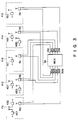
- Fig. 3 shows a private branch radio communication system according to an embodiment of the present invention.
- This system is designed to realize duplex communication between arbitrary areas of a plurality of areas.
- the premises are divided into five areas P11 to P15.
- a two-way repeater and one portable radio transceiver or more are arranged in each area.
- a two-way repeater Ra and two portable radio transceivers Ka1 and Ka2 are arranged in the area P11
- a two-way repeater Rb and two portable radio transceivers Kb1 and Kb2 are arranged in the area P12
- a two-way repeater Rc and a portable radio transceiver Kc1 are arranged in the area P13
- a two-way repeater Rd and two portable radio transceivers Kd1 and Kd2 are arranged in the area P14
- a two-way repeater Re and a portable radio transceiver Ke1 are arranged in the area P15.
- a each range of these areas P11 to P15 is setting so that a weak radio wave can sufficiently propagate in the each area.
- the repeater Ra is coupled to transmitting and receiving optical fiber cables 30a and 31a.
- the repeaters Rb, Rc, Rd, and Re are respectively coupled to transmitting and receiving optical fiber cables 30b and 31b, 30c and 31c, 30d and 31d, and 30e and 31e.
- An optical multiplexer 32 includes input ports coupled to the optical fiber cables 30a to 30e, and output ports coupled to the optical fiber cables 31a to 31e.
- the multiplexer 32 multiplexes all the optical signal supplied through the cables 30a to 30e, and outputs a multiplexed signal to the optical fiber cables 31a to 31e, respectively.
- five channels allowing simultaneous communication are ensured, i.e., a first channel using the frequencies f1 and f1′, a second channel using the frequencies f2 and f2′, a third channel using the frequencies f3 and f3′, a fourth channel using the frequencies f4 and f4′, and a fifth channel using the frequencies f5 and f5′.
- Each of the radio transceivers Ka1 to Ke1 can radiate a radio signal having any one of the frequencies f1 to f5 and f1′ to f5′, and can receive a radio signal having any of the frequencies f1 to f5 and f1′ to f5′.
- each of the units Ka1 to Ke1 has a function of detecting a frequency used by another unit. With this function, each of the units Ka1 to Ke1 can output a radio signal by using an unused frequency, i.e., a free channel, thus preventing radio interference.
- V2 A(1 + sj(t)sin(2 ⁇ f2t))
- V3 A(1 + sk(t)sin(2 ⁇ f3t))
- V4 A(1 + sp(t)sin(2 ⁇ f4t))
- V5 A(1 + sq(t)sin(2 ⁇ f5t))
- V1′ A(1 + si′(t)sin(2 ⁇ f1′t))
- V2′ A(1 + sj
- the radio signal V1 for speech communication which is transmitted from a given transceiver
- the radio signal V1′ is sent back from another transceiver as a response signal.
- the radio signals V2, V3, V4, and V5 the radio signals V2′, V3′, V4′ and V5′ are respectively sent back as response signals.
- the radio signals V1 to V5 are respectively generated in the areas P11 to P15, these signals are respectively converted into optical signals by the repeaters Ra to Re so as to be transmitted to the optical fiber cables 30a to 30e.
- the signals V1 to V5 are multiplexed by the optical multiplexer 32, and the multiplexed signal V1 + V2 + V3 + V4 + V5 is supplied to the optical fiber cables 31a to 31e.
- the multiplexed signals V1 + V2 + V3 + V4 + V5 are received by the repeaters Ra to Re. Thereafter, the multiplexed signals V1 + V2 + V3 + V4 + V5 are generated as radio signals in the areas P11 to P15.
- a signal transmitted from each portable radio transceiver is commonly supplied to the respective areas P11 to P15. Since the transceivers Ka1 to Ke1 can receive radio signals of all the frequencies, a transceiver as a source, i.e., a source operator must specify a transceiver as a destination, i.e., a destination operator. If the source operator transmits a signal for specifying a destination operator, e.g., a specific call code like a telephone number prior to transmission of a radio signal for speech communication in the same manner as in a known normal paging system, this problem can be solved.
- a destination operator e.g., a specific call code like a telephone number prior to transmission of a radio signal for speech communication in the same manner as in a known normal paging system
- the source operator superposes a call signal for specifying a destination operator on the frequency of a free channel (one of the frequencies f1, f2, f3, f4, and f5) and transmits it. Since the call signal is distributed to all the areas P11 to P15, a destination operator in any area can receiver the call signal.
- the called transceiver When a specific portable radio transceiver calls another specific portable radio transceiver in this manner, the called transceiver sends back a response signal. In this case, if the call signal has the carrier frequency f1, the called radio transceiver sends back the response signal V1′ having the carrier frequency f1′. Similarly, the response signal V2′ having the carrier frequency f2′ is sent back with respect to a call signal having carrier frequency f2.
- the response signals V1′ to V5′ thus generated are supplied to the optical multiplexer 32 through the optical fiber cables 30a to 30e and are multiplexed by the multiplexer 32.
- the multiplexed signal V1′ + V2′ + V3′ + V4′ + V5′ is commonly supplied to all the areas P11 to P12.
- duplex communication can be performed between arbitrary areas.
- Fig. 4 shows a detailed arrangement of the optical multiplexer 32.
- the multiplexer 32 comprises optical/ electrical signal converters 33a to 33e, an adder 34 including resistors R1a to R1e and R2, an amplifier 36, and electrical/optical signal converters 35a to 35e.
- the signals V1 to V5 input as optical signals are respectively converted into electrical signals by the converters 33a to 33e, and are added to each other by the adder 34.
- the added signal V1 + V2 + V3 + V4 + V5 is amplified by the amplifier 36.
- the amplified signal is then supplied to converters 35a to 35e, and hence the signals V1 + V2 + V3 + V4 + V5 are supplied to the optical fiber cables 31a to 31e as optical signals, respectively.
- Fig. 7 shows a detailed arrangement of each of the repeaters Ra to Re used in the system shown in Fig. 3. Since the repeaters Ra to Re have the same arrangement, Fig. 7 shows an arrangement corresponding to the repeater Ra.
- a transmitting/receiving antenna 72, a receiving section including an amplifier 73 and an electrical/ optical signal converter 74, and a transmitting section including an amplifier 78 and an optical/electrical signal converter 77 are coupled to a hybrid circuit 71.
- An optical fiber cable 30a is coupled to the electrical/optical signal converter 74.
- An optical fiber cable 31a is coupled to the optical/electrical signal converter 77.
- the amplifiers 73 and 78 are respectively designed to cover all the frequency bands used in this system.
- the hybrid circuit 71 is designed to cause a signal to flow in a direction indicated by a solid arrow and not to flow in a direction indicated by a broken arrow.
- Fig. 8 shows a detailed arrangement of each of the portable radio transceivers Ka1 to Ke1 used in the system shown in Fig. 3.
- Each transceiver includes a hybrid circuit 80, a transmitting/receiving antenna 81, a receiving section 82, and a transmitting section 83.
- the receiving section 82 includes a tuner 87, a detector 84, a call code detector 86, and a channel selecting circuit 88.
- the tuner 87 is constituted by 10 resonators respectively corresponding to the carrier frequencies f1 to f5 and f1′ to f5′, as shown in Fig. 8.
- the tuner 87 selectively outputs a channel selection signal from one of terminals T1 to T5′ in accordance with a received carrier frequency. For example, when a radio signal having the carrier frequency f1 is received, a channel selection signal.is output from the terminal T1 and is supplied to the channel selecting circuit 88.
- the circuit 88 Upon reception of the channel selection signal from the terminal T1, the circuit 88 turns on a lamp (not shown) for indicating that the frequency f1 is used, and at the same time, controls the tuner 87 not to receive signals other than the frequency f1 until the contents of a call code are checked by the call code detector 86. Similarly, when a channel selection signal is supplied from the terminal T2, the circuit 88 turns on a lamp (not shown) indicating that the frequency f2 is used, and at the same time, controls the tuner 87 not to receive signals other than the frequency f2 until the contents of a call code are checked by the call code detector 86.
- Such a control operation for channel selection by the channel selecting circuit 88 can be realized by various methods, e.g., a method of selectively interrupting supply of a power source voltage VC to each portion of a resonator.
- the detector 84 is used to extract a modulation signal such as a speech signal from a signal received by the tuner 87.
- the extracted modulation signal is output to a terminal 85, and at the same time, is supplied to the call code detector 86.
- the call code detector 86 has a pre-assigned self code and compares it with a call code supplied from another radio transceiver. If they coincide with each other, the detector 86 generates a signal for turning on a switch S2 of the transmitting section 83.
- the transmitting section 83 includes an oscillator 90, a transmission frequency switching circuit 89, a modulator 91, and switches S1 and S2.
- the circuit 89 is used to manually select carrier frequencies for transmission. For example, when the lamp for indicating that the carrier frequency f1 is used is turned on by the channel selecting circuit 88, the frequency f1 will not be used (since the frequency f1′ is also used, the frequency f1′ will not be used) and an unused frequency is selected.
- the modulator 91 modulates a carrier wave having a frequency selected by the circuit 89 by using a modulation signal such as a speech signal. The modulated signal is then radiated in air from the transmitting/receiving antenna 81 when one of the switches S1 and S2 is ON.
- the switch S1 is manually operated and is set in an ON state when signal transmission is to be performed.
- the switch S2 is controlled by an output signal from the call code detector 86 and is automatically set in an ON state when a call code is transmitted from another radio transceiver to its own channel.
- the private branch radio communication system of the present invention by combining a transmission medium using radio waves with a transmission medium using optical fibers, excellent communication can be provided in a wide range covering the entire premises even when a weak radio wave is used.
Landscapes
- Engineering & Computer Science (AREA)
- Computer Networks & Wireless Communication (AREA)
- Signal Processing (AREA)
- Physics & Mathematics (AREA)
- Electromagnetism (AREA)
- Mobile Radio Communication Systems (AREA)
- Optical Communication System (AREA)
Claims (2)
- Funkverkehrssystem umfassend eine Vielzahl von tragbaren Funk-Sende-Empfängern (Ka1-Ke1) und eine Vielzahl von Zweiwege-Wiederholvorrichtungen (Ra-Re), dadurch gekennzeichnet, daß
die Zweiwege-Wiederholvorrichtungen (Ra-Re) über eine Vielzahl von Bereichen (P11-P15) innerhalb eines gegebenen Geländes verteilt sind zum Empfang von Funksignalen, die in den entsprechenden Bereichen, auf die die Wiederholvorrichtungen verteilt sind, erzeugt werden, und zur Bereitstellung von optischen Signalen, die den Signalen entsprechen, die empfangen und einer Vielzahl von ersten optischen Übertragungsmedien (30a-30e) zugeführt werden und zum Empfangen optischer Signale, die über eine Vielzahl von zweiten optischen Übertragungsmedien (31a-31e) zugeführt werden, und zum Erzeugen von Funksignalen entsprechend den Signalen, die in den entsprechenden Bereichen empfangen werden; und eine Vorrichtung zum Multiplexbetrieb optischer Signale enthaltend eine Vorrichtung (33a-33e) zum Umwandeln optischer in elektrische Signale, welche die durch die Vielzahl der ersten optischen Übertragungsmedien (30a-30e) übertragen wurden, in elektrische Signale umwandelt, eine Addiervorrichtung (34) zum Addieren der von der Vorrichtung (33a-33e) zum Umwandeln optischer in elektrische Signale umgewandelten elektrischen Signale, eine Vorrichtung (35a-35e) zum Umwandeln elektrischer in optische Signale, welche die aufaddierten elektrischen Signale in ein optisches Signal umwandelt und das optische Signal der Vielzahl von zweiten Übertragungsmedien (31a-31e) zuführt. - Funksystem nach Anspruch 1, dadurch gekennzeichnet, daß die Vielzahl von tragbaren Funk-Sende-Empfängern (Ka1-Ke1) über die Vielzahl von Bereichen (P11-P15) verteilt sind.
Applications Claiming Priority (2)
| Application Number | Priority Date | Filing Date | Title |
|---|---|---|---|
| JP148237/88 | 1988-06-17 | ||
| JP63148237A JPH022727A (ja) | 1988-06-17 | 1988-06-17 | 光ファイバを介した電波送受信方式 |
Publications (3)
| Publication Number | Publication Date |
|---|---|
| EP0346925A2 EP0346925A2 (de) | 1989-12-20 |
| EP0346925A3 EP0346925A3 (de) | 1991-08-21 |
| EP0346925B1 true EP0346925B1 (de) | 1995-04-05 |
Family
ID=15448314
Family Applications (1)
| Application Number | Title | Priority Date | Filing Date |
|---|---|---|---|
| EP89110993A Expired - Lifetime EP0346925B1 (de) | 1988-06-17 | 1989-06-16 | Privates Funkkommunikationssystem unter Verwendung von optischen Glasfasern |
Country Status (4)
| Country | Link |
|---|---|
| US (1) | US5159479A (de) |
| EP (1) | EP0346925B1 (de) |
| JP (1) | JPH022727A (de) |
| DE (1) | DE68922023T2 (de) |
Cited By (8)
| Publication number | Priority date | Publication date | Assignee | Title |
|---|---|---|---|---|
| US7599711B2 (en) | 2006-04-12 | 2009-10-06 | Adc Telecommunications, Inc. | Systems and methods for analog transport of RF voice/data communications |
| US7962111B2 (en) | 2002-02-25 | 2011-06-14 | ADC Wireless, Inc. | Distributed automatic gain control system |
| US8583100B2 (en) | 2007-01-25 | 2013-11-12 | Adc Telecommunications, Inc. | Distributed remote base station system |
| US8737454B2 (en) | 2007-01-25 | 2014-05-27 | Adc Telecommunications, Inc. | Modular wireless communications platform |
| US9001811B2 (en) | 2009-05-19 | 2015-04-07 | Adc Telecommunications, Inc. | Method of inserting CDMA beacon pilots in output of distributed remote antenna nodes |
| US9577922B2 (en) | 2014-02-18 | 2017-02-21 | Commscope Technologies Llc | Selectively combining uplink signals in distributed antenna systems |
| US10505635B2 (en) | 2000-07-19 | 2019-12-10 | Commscope Technologies Llc | Point-to-multipoint digital radio frequency transport |
| USRE49377E1 (en) | 2002-12-03 | 2023-01-17 | Commscope Technologies Llc | Distributed digital antenna system |
Families Citing this family (33)
| Publication number | Priority date | Publication date | Assignee | Title |
|---|---|---|---|---|
| CA2008900C (en) * | 1989-04-04 | 1998-01-20 | Ta-Shing Chu | Optical fiber microcellular mobile radio |
| AU628710B2 (en) * | 1990-02-01 | 1992-09-17 | Alcatel N.V. | Cellular mobile radio system |
| IT1248925B (it) * | 1990-05-31 | 1995-02-11 | Sirti Spa | Ripetitore per telecomunicazioni,in particolare per radiotelefonia |
| US5241410A (en) * | 1990-06-21 | 1993-08-31 | Litephone Systems Ltd. | Enhanced infrared-connected telephone system |
| JP2897492B2 (ja) * | 1991-10-24 | 1999-05-31 | 日本電気株式会社 | 移動通信装置 |
| WO1993012596A1 (en) * | 1991-12-16 | 1993-06-24 | Motorola, Inc. | Optical distribution system |
| KR930020867A (ko) * | 1992-03-02 | 1993-10-20 | 빈센트 비.인그라시아 | 원격 감지 유닛 및 드라이버 |
| US5339184A (en) * | 1992-06-15 | 1994-08-16 | Gte Laboratories Incorporated | Fiber optic antenna remoting for multi-sector cell sites |
| US5627879A (en) * | 1992-09-17 | 1997-05-06 | Adc Telecommunications, Inc. | Cellular communications system with centralized base stations and distributed antenna units |
| DE69527222T2 (de) * | 1994-03-24 | 2003-03-13 | Hitachi Kokusai Electric Inc., Tokio/Tokyo | Relaisstation für ein Funkrufsystem |
| US5917636A (en) * | 1994-07-29 | 1999-06-29 | British Telecommunications Public Limited Company | Generation of radio frequency modulated optical radiation |
| US5809840A (en) * | 1995-02-14 | 1998-09-22 | Shimano, Inc. | Protective cap system for bicycle cable |
| EP0805569B1 (de) * | 1995-08-23 | 2004-04-21 | Ntt Mobile Communications Network Inc. | Faseroptisches übertragungssystem |
| EP0762674A3 (de) * | 1995-09-08 | 2001-03-21 | Siemens Aktiengesellschaft | Verfahren und Schaltungsanordnung zum Übertragen von Empfangssignalen von einer Antenne zu einer Basisstation eines Funksystems |
| KR100221289B1 (ko) * | 1996-11-21 | 1999-09-15 | 서평원 | 시디엠에이 방식 이동통신 기지국 시스템의 음영 지역용 송수신 장치 |
| KR100221287B1 (ko) * | 1996-11-21 | 1999-09-15 | 서평원 | 시디엠에이 방식 이동통신 기지국 시스템의 음영 지역용 분산식 송수신 안테나 장치 |
| US6112086A (en) | 1997-02-25 | 2000-08-29 | Adc Telecommunications, Inc. | Scanning RSSI receiver system using inverse fast fourier transforms for a cellular communications system with centralized base stations and distributed antenna units |
| JP2000147306A (ja) * | 1998-08-31 | 2000-05-26 | Kokusai Electric Co Ltd | 波長領域多重光スタ―カプラ、通信局、及び光伝送システム |
| KR20000042660A (ko) * | 1998-12-26 | 2000-07-15 | 서평원 | 광중계 시스템의 이득제어방법 |
| JP2002185490A (ja) * | 2000-12-19 | 2002-06-28 | Denso Corp | 通信システム及び端末装置 |
| US7263293B2 (en) | 2002-06-10 | 2007-08-28 | Andrew Corporation | Indoor wireless voice and data distribution system |
| US20040017785A1 (en) * | 2002-07-16 | 2004-01-29 | Zelst Allert Van | System for transporting multiple radio frequency signals of a multiple input, multiple output wireless communication system to/from a central processing base station |
| US7103377B2 (en) | 2002-12-03 | 2006-09-05 | Adc Telecommunications, Inc. | Small signal threshold and proportional gain distributed digital communications |
| US7171244B2 (en) | 2002-12-03 | 2007-01-30 | Adc Telecommunications, Inc. | Communication system and method with gain control for signals from distributed antennas |
| US8873585B2 (en) | 2006-12-19 | 2014-10-28 | Corning Optical Communications Wireless Ltd | Distributed antenna system for MIMO technologies |
| BRPI0808632B8 (pt) | 2007-03-07 | 2021-06-22 | Becton Dickinson Co | conjunto de agulha protegível com indicador |
| EP1988650B1 (de) | 2007-05-04 | 2012-09-05 | Mitsubishi Electric R&D Centre Europe B.V. | Radio-über-Faser Umwandler und Übertragungssystem |
| WO2013148986A1 (en) | 2012-03-30 | 2013-10-03 | Corning Cable Systems Llc | Reducing location-dependent interference in distributed antenna systems operating in multiple-input, multiple-output (mimo) configuration, and related components, systems, and methods |
| CN105308876B (zh) | 2012-11-29 | 2018-06-22 | 康宁光电通信有限责任公司 | 分布式天线系统中的远程单元天线结合 |
| US9525472B2 (en) | 2014-07-30 | 2016-12-20 | Corning Incorporated | Reducing location-dependent destructive interference in distributed antenna systems (DASS) operating in multiple-input, multiple-output (MIMO) configuration, and related components, systems, and methods |
| US9729267B2 (en) | 2014-12-11 | 2017-08-08 | Corning Optical Communications Wireless Ltd | Multiplexing two separate optical links with the same wavelength using asymmetric combining and splitting |
| US10499269B2 (en) | 2015-11-12 | 2019-12-03 | Commscope Technologies Llc | Systems and methods for assigning controlled nodes to channel interfaces of a controller |
| US10277331B1 (en) * | 2018-04-03 | 2019-04-30 | T-Mobile Usa, Inc. | Conversion of RF signals to optical signals for passage through impairment mediums in a wireless communication network |
Family Cites Families (7)
| Publication number | Priority date | Publication date | Assignee | Title |
|---|---|---|---|---|
| DE2144676B2 (de) * | 1971-09-07 | 1975-07-31 | Licentia Patent-Verwaltungs-Gmbh, 6000 Frankfurt | Nachrichtenübertragungssystem |
| JPS54113205A (en) * | 1978-02-24 | 1979-09-04 | Daido Shingo | Communication transmitting device and method |
| JPS55143854A (en) * | 1979-04-26 | 1980-11-10 | Nippon Telegr & Teleph Corp <Ntt> | Mobile radio space diversity system using optical fiber |
| US4539706A (en) * | 1983-02-03 | 1985-09-03 | General Electric Company | Mobile vehicular repeater system which provides up-link acknowledgement signal to portable transceiver at end of transceiver transmission |
| US4941207A (en) * | 1984-05-01 | 1990-07-10 | Nihon Musen Kabushiki Kaisha | Structure for wireless communication in an electromagnetically shielded building |
| WO1987000996A1 (fr) * | 1985-08-01 | 1987-02-12 | International Robotic Engineering Inc | Dispositif de transmission simultanee de plusieurs signaux electriques entre deux enplacements |
| US4991925A (en) * | 1988-10-04 | 1991-02-12 | Metricor | Spectrum shifting optical switch |
-
1988
- 1988-06-17 JP JP63148237A patent/JPH022727A/ja active Pending
-
1989
- 1989-06-16 DE DE68922023T patent/DE68922023T2/de not_active Expired - Fee Related
- 1989-06-16 EP EP89110993A patent/EP0346925B1/de not_active Expired - Lifetime
-
1992
- 1992-03-05 US US07/845,356 patent/US5159479A/en not_active Expired - Fee Related
Cited By (9)
| Publication number | Priority date | Publication date | Assignee | Title |
|---|---|---|---|---|
| US10505635B2 (en) | 2000-07-19 | 2019-12-10 | Commscope Technologies Llc | Point-to-multipoint digital radio frequency transport |
| US7962111B2 (en) | 2002-02-25 | 2011-06-14 | ADC Wireless, Inc. | Distributed automatic gain control system |
| USRE49377E1 (en) | 2002-12-03 | 2023-01-17 | Commscope Technologies Llc | Distributed digital antenna system |
| US7599711B2 (en) | 2006-04-12 | 2009-10-06 | Adc Telecommunications, Inc. | Systems and methods for analog transport of RF voice/data communications |
| US8583100B2 (en) | 2007-01-25 | 2013-11-12 | Adc Telecommunications, Inc. | Distributed remote base station system |
| US8737454B2 (en) | 2007-01-25 | 2014-05-27 | Adc Telecommunications, Inc. | Modular wireless communications platform |
| US9585193B2 (en) | 2007-01-25 | 2017-02-28 | Commscope Technologies Llc | Modular wireless communications platform |
| US9001811B2 (en) | 2009-05-19 | 2015-04-07 | Adc Telecommunications, Inc. | Method of inserting CDMA beacon pilots in output of distributed remote antenna nodes |
| US9577922B2 (en) | 2014-02-18 | 2017-02-21 | Commscope Technologies Llc | Selectively combining uplink signals in distributed antenna systems |
Also Published As
| Publication number | Publication date |
|---|---|
| EP0346925A3 (de) | 1991-08-21 |
| JPH022727A (ja) | 1990-01-08 |
| DE68922023T2 (de) | 1995-11-23 |
| US5159479A (en) | 1992-10-27 |
| EP0346925A2 (de) | 1989-12-20 |
| DE68922023D1 (de) | 1995-05-11 |
Similar Documents
| Publication | Publication Date | Title |
|---|---|---|
| US5159479A (en) | Private branch radio communication system using optical fibers | |
| USRE50112E1 (en) | Distributed digital antenna system | |
| JP3131020B2 (ja) | 光トランシーバ装置 | |
| US5969837A (en) | Communications system | |
| US5615034A (en) | Optical micro cell transmission system | |
| USRE35736E (en) | Distributed antenna system | |
| US5844705A (en) | Wireless communications systems employing free-space optical communications links | |
| EP0476569A2 (de) | Mobiles Kommunikationssystem | |
| KR20000074988A (ko) | 인빌딩용 이동 통신 서비스 시스템 및 방법 | |
| JPH02288624A (ja) | 移動ラジオシステム | |
| CA1259718A (en) | Optical local area network using a common optical carrier with separate user angle modulation | |
| NO985372D0 (no) | Kommunikasjonssystem med spektralspredning | |
| WO1998027748A2 (en) | Wireless communications station and system | |
| US4691313A (en) | Wireless talking apparatus | |
| CA2035390A1 (en) | Cellular mobile radio system | |
| JPH0448832A (ja) | 光リンク無線通信方式 | |
| EP0091271A2 (de) | Datenübertragungseinrichtung | |
| JPH04207532A (ja) | 通信装置 | |
| JP3194316B2 (ja) | 移動通信方式 | |
| JP2005094263A (ja) | 固定無線通信用光リモートシステムならびにそれに用いられるセンタ局装置、リモート局装置および通信方法 | |
| JPH09233050A (ja) | 無線ネットワークシステム及び光伝送方法 | |
| JP4933357B2 (ja) | 光ファイバ無線アクセスシステム | |
| KR100333141B1 (ko) | 광 선로를 이용한 시디엠에이 기지국의 송수신 인터페이스장치 | |
| JPH03283725A (ja) | 無線通信方式 | |
| KR20000001105A (ko) | 무선통신 기지국 시스템의 광전송 장치 |
Legal Events
| Date | Code | Title | Description |
|---|---|---|---|
| PUAI | Public reference made under article 153(3) epc to a published international application that has entered the european phase |
Free format text: ORIGINAL CODE: 0009012 |
|
| 17P | Request for examination filed |
Effective date: 19890616 |
|
| AK | Designated contracting states |
Kind code of ref document: A2 Designated state(s): DE FR GB |
|
| PUAL | Search report despatched |
Free format text: ORIGINAL CODE: 0009013 |
|
| RAP1 | Party data changed (applicant data changed or rights of an application transferred) |
Owner name: SMALL POWER COMMUNICATION SYSTEMS RESEARCH LABORAT |
|
| AK | Designated contracting states |
Kind code of ref document: A3 Designated state(s): DE FR GB |
|
| 17Q | First examination report despatched |
Effective date: 19930329 |
|
| GRAA | (expected) grant |
Free format text: ORIGINAL CODE: 0009210 |
|
| AK | Designated contracting states |
Kind code of ref document: B1 Designated state(s): DE FR GB |
|
| ET | Fr: translation filed | ||
| REF | Corresponds to: |
Ref document number: 68922023 Country of ref document: DE Date of ref document: 19950511 |
|
| PLBE | No opposition filed within time limit |
Free format text: ORIGINAL CODE: 0009261 |
|
| STAA | Information on the status of an ep patent application or granted ep patent |
Free format text: STATUS: NO OPPOSITION FILED WITHIN TIME LIMIT |
|
| 26N | No opposition filed | ||
| PGFP | Annual fee paid to national office [announced via postgrant information from national office to epo] |
Ref country code: GB Payment date: 20010613 Year of fee payment: 13 |
|
| PGFP | Annual fee paid to national office [announced via postgrant information from national office to epo] |
Ref country code: DE Payment date: 20010820 Year of fee payment: 13 |
|
| PGFP | Annual fee paid to national office [announced via postgrant information from national office to epo] |
Ref country code: FR Payment date: 20011029 Year of fee payment: 13 |
|
| REG | Reference to a national code |
Ref country code: GB Ref legal event code: IF02 |
|
| PG25 | Lapsed in a contracting state [announced via postgrant information from national office to epo] |
Ref country code: GB Free format text: LAPSE BECAUSE OF NON-PAYMENT OF DUE FEES Effective date: 20020616 |
|
| PG25 | Lapsed in a contracting state [announced via postgrant information from national office to epo] |
Ref country code: DE Free format text: LAPSE BECAUSE OF NON-PAYMENT OF DUE FEES Effective date: 20030101 |
|
| GBPC | Gb: european patent ceased through non-payment of renewal fee |
Effective date: 20020616 |
|
| PG25 | Lapsed in a contracting state [announced via postgrant information from national office to epo] |
Ref country code: FR Free format text: LAPSE BECAUSE OF NON-PAYMENT OF DUE FEES Effective date: 20030228 |
|
| REG | Reference to a national code |
Ref country code: FR Ref legal event code: ST |