EP0346724A1 - Chromanderivate - Google Patents
Chromanderivate Download PDFInfo
- Publication number
- EP0346724A1 EP0346724A1 EP89110177A EP89110177A EP0346724A1 EP 0346724 A1 EP0346724 A1 EP 0346724A1 EP 89110177 A EP89110177 A EP 89110177A EP 89110177 A EP89110177 A EP 89110177A EP 0346724 A1 EP0346724 A1 EP 0346724A1
- Authority
- EP
- European Patent Office
- Prior art keywords
- formula
- dimethyl
- cyan
- pyridon
- oxy
- Prior art date
- Legal status (The legal status is an assumption and is not a legal conclusion. Google has not performed a legal analysis and makes no representation as to the accuracy of the status listed.)
- Withdrawn
Links
- VZWXIQHBIQLMPN-UHFFFAOYSA-N chromane Chemical compound C1=CC=C2CCCOC2=C1 VZWXIQHBIQLMPN-UHFFFAOYSA-N 0.000 title claims abstract description 9
- 150000003839 salts Chemical class 0.000 claims abstract description 21
- 238000011282 treatment Methods 0.000 claims abstract description 12
- 201000004384 Alopecia Diseases 0.000 claims abstract description 6
- 231100000360 alopecia Toxicity 0.000 claims abstract description 5
- -1 pyridazinyl-oxy- Chemical group 0.000 claims description 87
- 150000001875 compounds Chemical class 0.000 claims description 66
- 125000004432 carbon atom Chemical group C* 0.000 claims description 17
- 229910052794 bromium Inorganic materials 0.000 claims description 16
- 229910052801 chlorine Inorganic materials 0.000 claims description 15
- 239000002253 acid Substances 0.000 claims description 14
- 229910052731 fluorine Inorganic materials 0.000 claims description 11
- 238000002360 preparation method Methods 0.000 claims description 10
- 125000000217 alkyl group Chemical group 0.000 claims description 8
- 125000002887 hydroxy group Chemical group [H]O* 0.000 claims description 8
- 238000000034 method Methods 0.000 claims description 8
- 239000004480 active ingredient Substances 0.000 claims description 7
- 238000004519 manufacturing process Methods 0.000 claims description 7
- 208000037265 diseases, disorders, signs and symptoms Diseases 0.000 claims description 6
- 239000003814 drug Substances 0.000 claims description 6
- 239000000825 pharmaceutical preparation Substances 0.000 claims description 6
- 201000010099 disease Diseases 0.000 claims description 5
- 125000003373 pyrazinyl group Chemical group 0.000 claims description 5
- IYWVZSNJTSRDQM-UHFFFAOYSA-N 3-hydroxy-2,2-dimethyl-4-[(6-oxo-1h-pyridazin-3-yl)oxy]-3,4-dihydrochromene-6-carbonitrile Chemical compound OC1C(C)(C)OC2=CC=C(C#N)C=C2C1OC1=CC=C(O)N=N1 IYWVZSNJTSRDQM-UHFFFAOYSA-N 0.000 claims description 4
- 125000002947 alkylene group Chemical group 0.000 claims description 4
- 239000003054 catalyst Substances 0.000 claims description 4
- 239000007788 liquid Substances 0.000 claims description 4
- 125000002098 pyridazinyl group Chemical group 0.000 claims description 4
- 125000004076 pyridyl group Chemical group 0.000 claims description 4
- 125000000714 pyrimidinyl group Chemical group 0.000 claims description 4
- 230000002378 acidificating effect Effects 0.000 claims description 3
- 150000007514 bases Chemical class 0.000 claims description 3
- 125000001589 carboacyl group Chemical group 0.000 claims description 3
- 125000005554 pyridyloxy group Chemical group 0.000 claims description 3
- JREUHESMHXFWEP-UHFFFAOYSA-N 2,7b-dihydro-1ah-oxireno[2,3-c]chromene Chemical compound C1OC2=CC=CC=C2C2C1O2 JREUHESMHXFWEP-UHFFFAOYSA-N 0.000 claims description 2
- 125000003435 aroyl group Chemical group 0.000 claims description 2
- 125000004966 cyanoalkyl group Chemical group 0.000 claims description 2
- 239000002552 dosage form Substances 0.000 claims description 2
- 125000002768 hydroxyalkyl group Chemical group 0.000 claims description 2
- 125000005358 mercaptoalkyl group Chemical group 0.000 claims description 2
- 125000004971 nitroalkyl group Chemical group 0.000 claims description 2
- 239000007787 solid Substances 0.000 claims description 2
- 210000000748 cardiovascular system Anatomy 0.000 abstract description 3
- 230000000694 effects Effects 0.000 abstract description 3
- 206010002383 Angina Pectoris Diseases 0.000 abstract description 2
- 206010019280 Heart failures Diseases 0.000 abstract description 2
- 206010020772 Hypertension Diseases 0.000 abstract description 2
- 238000011321 prophylaxis Methods 0.000 abstract description 2
- 206010021639 Incontinence Diseases 0.000 abstract 1
- YMWUJEATGCHHMB-UHFFFAOYSA-N Dichloromethane Chemical compound ClCCl YMWUJEATGCHHMB-UHFFFAOYSA-N 0.000 description 38
- LFQSCWFLJHTTHZ-UHFFFAOYSA-N Ethanol Chemical compound CCO LFQSCWFLJHTTHZ-UHFFFAOYSA-N 0.000 description 34
- 239000000203 mixture Substances 0.000 description 34
- YXFVVABEGXRONW-UHFFFAOYSA-N Toluene Chemical compound CC1=CC=CC=C1 YXFVVABEGXRONW-UHFFFAOYSA-N 0.000 description 28
- 239000000243 solution Substances 0.000 description 26
- JUJWROOIHBZHMG-UHFFFAOYSA-N Pyridine Chemical compound C1=CC=NC=C1 JUJWROOIHBZHMG-UHFFFAOYSA-N 0.000 description 22
- ZMXDDKWLCZADIW-UHFFFAOYSA-N N,N-Dimethylformamide Chemical compound CN(C)C=O ZMXDDKWLCZADIW-UHFFFAOYSA-N 0.000 description 21
- OKKJLVBELUTLKV-UHFFFAOYSA-N Methanol Chemical compound OC OKKJLVBELUTLKV-UHFFFAOYSA-N 0.000 description 19
- 150000003254 radicals Chemical class 0.000 description 19
- XLYOFNOQVPJJNP-UHFFFAOYSA-N water Substances O XLYOFNOQVPJJNP-UHFFFAOYSA-N 0.000 description 17
- WFDIJRYMOXRFFG-UHFFFAOYSA-N Acetic anhydride Chemical compound CC(=O)OC(C)=O WFDIJRYMOXRFFG-UHFFFAOYSA-N 0.000 description 15
- HEMHJVSKTPXQMS-UHFFFAOYSA-M Sodium hydroxide Chemical compound [OH-].[Na+] HEMHJVSKTPXQMS-UHFFFAOYSA-M 0.000 description 15
- ZMANZCXQSJIPKH-UHFFFAOYSA-N Triethylamine Chemical compound CCN(CC)CC ZMANZCXQSJIPKH-UHFFFAOYSA-N 0.000 description 15
- 125000002485 formyl group Chemical group [H]C(*)=O 0.000 description 13
- IAZDPXIOMUYVGZ-UHFFFAOYSA-N Dimethylsulphoxide Chemical compound CS(C)=O IAZDPXIOMUYVGZ-UHFFFAOYSA-N 0.000 description 12
- XEKOWRVHYACXOJ-UHFFFAOYSA-N Ethyl acetate Chemical compound CCOC(C)=O XEKOWRVHYACXOJ-UHFFFAOYSA-N 0.000 description 12
- 239000002585 base Substances 0.000 description 11
- 239000000460 chlorine Substances 0.000 description 11
- BDAGIHXWWSANSR-UHFFFAOYSA-N methanoic acid Natural products OC=O BDAGIHXWWSANSR-UHFFFAOYSA-N 0.000 description 11
- UMJSCPRVCHMLSP-UHFFFAOYSA-N pyridine Natural products COC1=CC=CN=C1 UMJSCPRVCHMLSP-UHFFFAOYSA-N 0.000 description 11
- QTBSBXVTEAMEQO-UHFFFAOYSA-N Acetic acid Chemical compound CC(O)=O QTBSBXVTEAMEQO-UHFFFAOYSA-N 0.000 description 10
- CSCPPACGZOOCGX-UHFFFAOYSA-N Acetone Chemical compound CC(C)=O CSCPPACGZOOCGX-UHFFFAOYSA-N 0.000 description 10
- RTZKZFJDLAIYFH-UHFFFAOYSA-N Diethyl ether Chemical compound CCOCC RTZKZFJDLAIYFH-UHFFFAOYSA-N 0.000 description 10
- 238000006243 chemical reaction Methods 0.000 description 10
- WEVYAHXRMPXWCK-UHFFFAOYSA-N Acetonitrile Chemical compound CC#N WEVYAHXRMPXWCK-UHFFFAOYSA-N 0.000 description 9
- 239000012442 inert solvent Substances 0.000 description 9
- 241000282414 Homo sapiens Species 0.000 description 8
- QAOWNCQODCNURD-UHFFFAOYSA-N Sulfuric acid Chemical compound OS(O)(=O)=O QAOWNCQODCNURD-UHFFFAOYSA-N 0.000 description 8
- 150000007513 acids Chemical class 0.000 description 8
- 229910052740 iodine Inorganic materials 0.000 description 8
- 239000007858 starting material Substances 0.000 description 7
- 239000003826 tablet Substances 0.000 description 7
- JOXIMZWYDAKGHI-UHFFFAOYSA-N toluene-4-sulfonic acid Chemical compound CC1=CC=C(S(O)(=O)=O)C=C1 JOXIMZWYDAKGHI-UHFFFAOYSA-N 0.000 description 7
- RYHBNJHYFVUHQT-UHFFFAOYSA-N 1,4-Dioxane Chemical compound C1COCCO1 RYHBNJHYFVUHQT-UHFFFAOYSA-N 0.000 description 6
- NHQDETIJWKXCTC-UHFFFAOYSA-N 3-chloroperbenzoic acid Chemical compound OOC(=O)C1=CC=CC(Cl)=C1 NHQDETIJWKXCTC-UHFFFAOYSA-N 0.000 description 6
- VEXZGXHMUGYJMC-UHFFFAOYSA-N Hydrochloric acid Chemical compound Cl VEXZGXHMUGYJMC-UHFFFAOYSA-N 0.000 description 6
- KFZMGEQAYNKOFK-UHFFFAOYSA-N Isopropanol Chemical compound CC(C)O KFZMGEQAYNKOFK-UHFFFAOYSA-N 0.000 description 6
- DKGAVHZHDRPRBM-UHFFFAOYSA-N Tert-Butanol Chemical compound CC(C)(C)O DKGAVHZHDRPRBM-UHFFFAOYSA-N 0.000 description 6
- 235000019253 formic acid Nutrition 0.000 description 6
- BWHMMNNQKKPAPP-UHFFFAOYSA-L potassium carbonate Chemical compound [K+].[K+].[O-]C([O-])=O BWHMMNNQKKPAPP-UHFFFAOYSA-L 0.000 description 6
- 238000003756 stirring Methods 0.000 description 6
- 238000010626 work up procedure Methods 0.000 description 6
- OSWFIVFLDKOXQC-UHFFFAOYSA-N 4-(3-methoxyphenyl)aniline Chemical compound COC1=CC=CC(C=2C=CC(N)=CC=2)=C1 OSWFIVFLDKOXQC-UHFFFAOYSA-N 0.000 description 5
- VYPSYNLAJGMNEJ-UHFFFAOYSA-N Silicium dioxide Chemical compound O=[Si]=O VYPSYNLAJGMNEJ-UHFFFAOYSA-N 0.000 description 5
- 238000004587 chromatography analysis Methods 0.000 description 5
- QZHPTGXQGDFGEN-UHFFFAOYSA-N chromene Chemical compound C1=CC=C2C=C[CH]OC2=C1 QZHPTGXQGDFGEN-UHFFFAOYSA-N 0.000 description 5
- VNWKTOKETHGBQD-UHFFFAOYSA-N methane Chemical compound C VNWKTOKETHGBQD-UHFFFAOYSA-N 0.000 description 5
- 125000002496 methyl group Chemical group [H]C([H])([H])* 0.000 description 5
- 239000000126 substance Substances 0.000 description 5
- 230000000699 topical effect Effects 0.000 description 5
- WSFSSNUMVMOOMR-UHFFFAOYSA-N Formaldehyde Chemical compound O=C WSFSSNUMVMOOMR-UHFFFAOYSA-N 0.000 description 4
- BGRDGMRNKXEXQD-UHFFFAOYSA-N Maleic hydrazide Chemical compound OC1=CC=C(O)N=N1 BGRDGMRNKXEXQD-UHFFFAOYSA-N 0.000 description 4
- RWRDLPDLKQPQOW-UHFFFAOYSA-N Pyrrolidine Chemical compound C1CCNC1 RWRDLPDLKQPQOW-UHFFFAOYSA-N 0.000 description 4
- WYURNTSHIVDZCO-UHFFFAOYSA-N Tetrahydrofuran Chemical compound C1CCOC1 WYURNTSHIVDZCO-UHFFFAOYSA-N 0.000 description 4
- TUCNEACPLKLKNU-UHFFFAOYSA-N acetyl Chemical compound C[C]=O TUCNEACPLKLKNU-UHFFFAOYSA-N 0.000 description 4
- 239000002775 capsule Substances 0.000 description 4
- 239000003795 chemical substances by application Substances 0.000 description 4
- 150000002576 ketones Chemical class 0.000 description 4
- JVTAAEKCZFNVCJ-UHFFFAOYSA-N lactic acid Chemical compound CC(O)C(O)=O JVTAAEKCZFNVCJ-UHFFFAOYSA-N 0.000 description 4
- HQKMJHAJHXVSDF-UHFFFAOYSA-L magnesium stearate Chemical compound [Mg+2].CCCCCCCCCCCCCCCCCC([O-])=O.CCCCCCCCCCCCCCCCCC([O-])=O HQKMJHAJHXVSDF-UHFFFAOYSA-L 0.000 description 4
- UBQKCCHYAOITMY-UHFFFAOYSA-N pyridin-2-ol Chemical compound OC1=CC=CC=N1 UBQKCCHYAOITMY-UHFFFAOYSA-N 0.000 description 4
- 239000012279 sodium borohydride Substances 0.000 description 4
- 229910000033 sodium borohydride Inorganic materials 0.000 description 4
- 125000001424 substituent group Chemical group 0.000 description 4
- DNIAPMSPPWPWGF-GSVOUGTGSA-N (R)-(-)-Propylene glycol Chemical compound C[C@@H](O)CO DNIAPMSPPWPWGF-GSVOUGTGSA-N 0.000 description 3
- RGYKRQIZIXTZDV-UHFFFAOYSA-N 2,2-dimethyl-4-oxo-3h-chromene-6-carbonitrile Chemical compound N#CC1=CC=C2OC(C)(C)CC(=O)C2=C1 RGYKRQIZIXTZDV-UHFFFAOYSA-N 0.000 description 3
- MSTDXOZUKAQDRL-UHFFFAOYSA-N 4-Chromanone Chemical class C1=CC=C2C(=O)CCOC2=C1 MSTDXOZUKAQDRL-UHFFFAOYSA-N 0.000 description 3
- XVMSFILGAMDHEY-UHFFFAOYSA-N 6-(4-aminophenyl)sulfonylpyridin-3-amine Chemical compound C1=CC(N)=CC=C1S(=O)(=O)C1=CC=C(N)C=N1 XVMSFILGAMDHEY-UHFFFAOYSA-N 0.000 description 3
- UHOVQNZJYSORNB-UHFFFAOYSA-N Benzene Chemical compound C1=CC=CC=C1 UHOVQNZJYSORNB-UHFFFAOYSA-N 0.000 description 3
- OFOBLEOULBTSOW-UHFFFAOYSA-N Malonic acid Chemical compound OC(=O)CC(O)=O OFOBLEOULBTSOW-UHFFFAOYSA-N 0.000 description 3
- GRYLNZFGIOXLOG-UHFFFAOYSA-N Nitric acid Chemical compound O[N+]([O-])=O GRYLNZFGIOXLOG-UHFFFAOYSA-N 0.000 description 3
- NQRYJNQNLNOLGT-UHFFFAOYSA-N Piperidine Chemical compound C1CCNCC1 NQRYJNQNLNOLGT-UHFFFAOYSA-N 0.000 description 3
- 235000011054 acetic acid Nutrition 0.000 description 3
- 150000001408 amides Chemical class 0.000 description 3
- 238000009835 boiling Methods 0.000 description 3
- 125000001309 chloro group Chemical group Cl* 0.000 description 3
- 150000008371 chromenes Chemical class 0.000 description 3
- KRKNYBCHXYNGOX-UHFFFAOYSA-N citric acid Chemical compound OC(=O)CC(O)(C(O)=O)CC(O)=O KRKNYBCHXYNGOX-UHFFFAOYSA-N 0.000 description 3
- VAYGXNSJCAHWJZ-UHFFFAOYSA-N dimethyl sulfate Chemical compound COS(=O)(=O)OC VAYGXNSJCAHWJZ-UHFFFAOYSA-N 0.000 description 3
- 125000001495 ethyl group Chemical group [H]C([H])([H])C([H])([H])* 0.000 description 3
- 239000000499 gel Substances 0.000 description 3
- 238000011065 in-situ storage Methods 0.000 description 3
- AFVFQIVMOAPDHO-UHFFFAOYSA-N methanesulfonic acid Substances CS(O)(=O)=O AFVFQIVMOAPDHO-UHFFFAOYSA-N 0.000 description 3
- DNIAPMSPPWPWGF-UHFFFAOYSA-N monopropylene glycol Natural products CC(O)CO DNIAPMSPPWPWGF-UHFFFAOYSA-N 0.000 description 3
- 238000006396 nitration reaction Methods 0.000 description 3
- 229910017604 nitric acid Inorganic materials 0.000 description 3
- 125000000449 nitro group Chemical group [O-][N+](*)=O 0.000 description 3
- 150000002924 oxiranes Chemical class 0.000 description 3
- 235000015320 potassium carbonate Nutrition 0.000 description 3
- 229910000027 potassium carbonate Inorganic materials 0.000 description 3
- 125000002924 primary amino group Chemical group [H]N([H])* 0.000 description 3
- 235000013772 propylene glycol Nutrition 0.000 description 3
- 239000000741 silica gel Substances 0.000 description 3
- 229910002027 silica gel Inorganic materials 0.000 description 3
- 239000002904 solvent Substances 0.000 description 3
- 239000000454 talc Substances 0.000 description 3
- 229910052623 talc Inorganic materials 0.000 description 3
- BJEPYKJPYRNKOW-REOHCLBHSA-N (S)-malic acid Chemical compound OC(=O)[C@@H](O)CC(O)=O BJEPYKJPYRNKOW-REOHCLBHSA-N 0.000 description 2
- ODIGIKRIUKFKHP-UHFFFAOYSA-N (n-propan-2-yloxycarbonylanilino) acetate Chemical compound CC(C)OC(=O)N(OC(C)=O)C1=CC=CC=C1 ODIGIKRIUKFKHP-UHFFFAOYSA-N 0.000 description 2
- XBFYOFWLBKAYPQ-UHFFFAOYSA-N 1a,2,2-trimethyl-7bh-oxireno[2,3-c]chromene-6-carbonitrile Chemical compound C12=CC(C#N)=CC=C2OC(C)(C)C2(C)C1O2 XBFYOFWLBKAYPQ-UHFFFAOYSA-N 0.000 description 2
- HXHLXAGSATUBLF-UHFFFAOYSA-N 2,2,3-trimethylchromene-6-carbonitrile Chemical compound N#CC1=CC=C2OC(C)(C)C(C)=CC2=C1 HXHLXAGSATUBLF-UHFFFAOYSA-N 0.000 description 2
- OBIQNEPESLMSIX-UHFFFAOYSA-N 2,2-dimethyl-3-methylidene-4-oxochromene-6-carbonitrile Chemical compound C1=C(C#N)C=C2C(=O)C(=C)C(C)(C)OC2=C1 OBIQNEPESLMSIX-UHFFFAOYSA-N 0.000 description 2
- ZEZJPIDPVXJEME-UHFFFAOYSA-N 2,4-Dihydroxypyridine Chemical compound OC=1C=CNC(=O)C=1 ZEZJPIDPVXJEME-UHFFFAOYSA-N 0.000 description 2
- ZWEHNKRNPOVVGH-UHFFFAOYSA-N 2-Butanone Chemical compound CCC(C)=O ZWEHNKRNPOVVGH-UHFFFAOYSA-N 0.000 description 2
- XNWFRZJHXBZDAG-UHFFFAOYSA-N 2-METHOXYETHANOL Chemical group COCCO XNWFRZJHXBZDAG-UHFFFAOYSA-N 0.000 description 2
- MGSHXMOLUWTMGP-UHFFFAOYSA-N 3'-carboxy-alpha-chromanol Chemical class C1=CC=C2C(O)CCOC2=C1 MGSHXMOLUWTMGP-UHFFFAOYSA-N 0.000 description 2
- HSZUUVJFZOGAMB-UHFFFAOYSA-N 3-acetyl-4-hydroxybenzonitrile Chemical compound CC(=O)C1=CC(C#N)=CC=C1O HSZUUVJFZOGAMB-UHFFFAOYSA-N 0.000 description 2
- XMIIGOLPHOKFCH-UHFFFAOYSA-N 3-phenylpropionic acid Chemical compound OC(=O)CCC1=CC=CC=C1 XMIIGOLPHOKFCH-UHFFFAOYSA-N 0.000 description 2
- GCNTZFIIOFTKIY-UHFFFAOYSA-N 4-hydroxypyridine Chemical compound OC1=CC=NC=C1 GCNTZFIIOFTKIY-UHFFFAOYSA-N 0.000 description 2
- 125000000339 4-pyridyl group Chemical group N1=C([H])C([H])=C([*])C([H])=C1[H] 0.000 description 2
- HBAQYPYDRFILMT-UHFFFAOYSA-N 8-[3-(1-cyclopropylpyrazol-4-yl)-1H-pyrazolo[4,3-d]pyrimidin-5-yl]-3-methyl-3,8-diazabicyclo[3.2.1]octan-2-one Chemical class C1(CC1)N1N=CC(=C1)C1=NNC2=C1N=C(N=C2)N1C2C(N(CC1CC2)C)=O HBAQYPYDRFILMT-UHFFFAOYSA-N 0.000 description 2
- CIWBSHSKHKDKBQ-JLAZNSOCSA-N Ascorbic acid Chemical compound OC[C@H](O)[C@H]1OC(=O)C(O)=C1O CIWBSHSKHKDKBQ-JLAZNSOCSA-N 0.000 description 2
- CPELXLSAUQHCOX-UHFFFAOYSA-M Bromide Chemical compound [Br-] CPELXLSAUQHCOX-UHFFFAOYSA-M 0.000 description 2
- WKBOTKDWSSQWDR-UHFFFAOYSA-N Bromine atom Chemical compound [Br] WKBOTKDWSSQWDR-UHFFFAOYSA-N 0.000 description 2
- 241000282472 Canis lupus familiaris Species 0.000 description 2
- 241000282693 Cercopithecidae Species 0.000 description 2
- HEDRZPFGACZZDS-UHFFFAOYSA-N Chloroform Chemical compound ClC(Cl)Cl HEDRZPFGACZZDS-UHFFFAOYSA-N 0.000 description 2
- RGHNJXZEOKUKBD-SQOUGZDYSA-N D-gluconic acid Chemical compound OC[C@@H](O)[C@@H](O)[C@H](O)[C@@H](O)C(O)=O RGHNJXZEOKUKBD-SQOUGZDYSA-N 0.000 description 2
- FEWJPZIEWOKRBE-JCYAYHJZSA-N Dextrotartaric acid Chemical compound OC(=O)[C@H](O)[C@@H](O)C(O)=O FEWJPZIEWOKRBE-JCYAYHJZSA-N 0.000 description 2
- XTHFKEDIFFGKHM-UHFFFAOYSA-N Dimethoxyethane Chemical compound COCCOC XTHFKEDIFFGKHM-UHFFFAOYSA-N 0.000 description 2
- 241000282326 Felis catus Species 0.000 description 2
- VZCYOOQTPOCHFL-OWOJBTEDSA-N Fumaric acid Chemical compound OC(=O)\C=C\C(O)=O VZCYOOQTPOCHFL-OWOJBTEDSA-N 0.000 description 2
- CPELXLSAUQHCOX-UHFFFAOYSA-N Hydrogen bromide Chemical compound Br CPELXLSAUQHCOX-UHFFFAOYSA-N 0.000 description 2
- GUBGYTABKSRVRQ-QKKXKWKRSA-N Lactose Natural products OC[C@H]1O[C@@H](O[C@H]2[C@H](O)[C@@H](O)C(O)O[C@@H]2CO)[C@H](O)[C@@H](O)[C@H]1O GUBGYTABKSRVRQ-QKKXKWKRSA-N 0.000 description 2
- 241001465754 Metazoa Species 0.000 description 2
- 241000699670 Mus sp. Species 0.000 description 2
- FXHOOIRPVKKKFG-UHFFFAOYSA-N N,N-Dimethylacetamide Chemical compound CN(C)C(C)=O FXHOOIRPVKKKFG-UHFFFAOYSA-N 0.000 description 2
- LRHPLDYGYMQRHN-UHFFFAOYSA-N N-Butanol Chemical compound CCCCO LRHPLDYGYMQRHN-UHFFFAOYSA-N 0.000 description 2
- PCLIMKBDDGJMGD-UHFFFAOYSA-N N-bromosuccinimide Chemical compound BrN1C(=O)CCC1=O PCLIMKBDDGJMGD-UHFFFAOYSA-N 0.000 description 2
- UFWIBTONFRDIAS-UHFFFAOYSA-N Naphthalene Chemical compound C1=CC=CC2=CC=CC=C21 UFWIBTONFRDIAS-UHFFFAOYSA-N 0.000 description 2
- PVNIIMVLHYAWGP-UHFFFAOYSA-N Niacin Chemical compound OC(=O)C1=CC=CN=C1 PVNIIMVLHYAWGP-UHFFFAOYSA-N 0.000 description 2
- 229910020667 PBr3 Inorganic materials 0.000 description 2
- NBIIXXVUZAFLBC-UHFFFAOYSA-N Phosphoric acid Chemical compound OP(O)(O)=O NBIIXXVUZAFLBC-UHFFFAOYSA-N 0.000 description 2
- NPXOKRUENSOPAO-UHFFFAOYSA-N Raney nickel Chemical compound [Al].[Ni] NPXOKRUENSOPAO-UHFFFAOYSA-N 0.000 description 2
- 241000700159 Rattus Species 0.000 description 2
- CDBYLPFSWZWCQE-UHFFFAOYSA-L Sodium Carbonate Chemical compound [Na+].[Na+].[O-]C([O-])=O CDBYLPFSWZWCQE-UHFFFAOYSA-L 0.000 description 2
- FEWJPZIEWOKRBE-UHFFFAOYSA-N Tartaric acid Natural products [H+].[H+].[O-]C(=O)C(O)C(O)C([O-])=O FEWJPZIEWOKRBE-UHFFFAOYSA-N 0.000 description 2
- 125000002777 acetyl group Chemical group [H]C([H])([H])C(*)=O 0.000 description 2
- 239000008186 active pharmaceutical agent Substances 0.000 description 2
- 230000010933 acylation Effects 0.000 description 2
- 238000005917 acylation reaction Methods 0.000 description 2
- 150000001298 alcohols Chemical class 0.000 description 2
- 239000002168 alkylating agent Substances 0.000 description 2
- 229940100198 alkylating agent Drugs 0.000 description 2
- BJEPYKJPYRNKOW-UHFFFAOYSA-N alpha-hydroxysuccinic acid Natural products OC(=O)C(O)CC(O)=O BJEPYKJPYRNKOW-UHFFFAOYSA-N 0.000 description 2
- 239000007864 aqueous solution Substances 0.000 description 2
- 125000003118 aryl group Chemical group 0.000 description 2
- WPYMKLBDIGXBTP-UHFFFAOYSA-N benzoic acid Chemical compound OC(=O)C1=CC=CC=C1 WPYMKLBDIGXBTP-UHFFFAOYSA-N 0.000 description 2
- 230000015572 biosynthetic process Effects 0.000 description 2
- 230000037396 body weight Effects 0.000 description 2
- GDTBXPJZTBHREO-UHFFFAOYSA-N bromine Substances BrBr GDTBXPJZTBHREO-UHFFFAOYSA-N 0.000 description 2
- 125000001246 bromo group Chemical group Br* 0.000 description 2
- NEHMKBQYUWJMIP-NJFSPNSNSA-N chloro(114C)methane Chemical compound [14CH3]Cl NEHMKBQYUWJMIP-NJFSPNSNSA-N 0.000 description 2
- 239000003086 colorant Substances 0.000 description 2
- 238000009833 condensation Methods 0.000 description 2
- 230000005494 condensation Effects 0.000 description 2
- 238000002425 crystallisation Methods 0.000 description 2
- 230000008025 crystallization Effects 0.000 description 2
- XBDQKXXYIPTUBI-UHFFFAOYSA-N dimethylselenoniopropionate Natural products CCC(O)=O XBDQKXXYIPTUBI-UHFFFAOYSA-N 0.000 description 2
- 239000012154 double-distilled water Substances 0.000 description 2
- 239000008298 dragée Substances 0.000 description 2
- 230000008030 elimination Effects 0.000 description 2
- 238000003379 elimination reaction Methods 0.000 description 2
- GKIPXFAANLTWBM-UHFFFAOYSA-N epibromohydrin Chemical compound BrCC1CO1 GKIPXFAANLTWBM-UHFFFAOYSA-N 0.000 description 2
- 150000002148 esters Chemical class 0.000 description 2
- 239000000706 filtrate Substances 0.000 description 2
- 230000026030 halogenation Effects 0.000 description 2
- 238000005658 halogenation reaction Methods 0.000 description 2
- 229930195733 hydrocarbon Natural products 0.000 description 2
- 150000002430 hydrocarbons Chemical class 0.000 description 2
- XMBWDFGMSWQBCA-UHFFFAOYSA-N hydrogen iodide Chemical compound I XMBWDFGMSWQBCA-UHFFFAOYSA-N 0.000 description 2
- SUMDYPCJJOFFON-UHFFFAOYSA-N isethionic acid Chemical compound OCCS(O)(=O)=O SUMDYPCJJOFFON-UHFFFAOYSA-N 0.000 description 2
- TWBYWOBDOCUKOW-UHFFFAOYSA-N isonicotinic acid Chemical compound OC(=O)C1=CC=NC=C1 TWBYWOBDOCUKOW-UHFFFAOYSA-N 0.000 description 2
- 239000004310 lactic acid Substances 0.000 description 2
- 235000014655 lactic acid Nutrition 0.000 description 2
- 239000008101 lactose Substances 0.000 description 2
- CFHGBZLNZZVTAY-UHFFFAOYSA-N lawesson's reagent Chemical compound C1=CC(OC)=CC=C1P1(=S)SP(=S)(C=2C=CC(OC)=CC=2)S1 CFHGBZLNZZVTAY-UHFFFAOYSA-N 0.000 description 2
- 235000019359 magnesium stearate Nutrition 0.000 description 2
- 239000001630 malic acid Substances 0.000 description 2
- 235000011090 malic acid Nutrition 0.000 description 2
- LVWZTYCIRDMTEY-UHFFFAOYSA-N metamizole Chemical class O=C1C(N(CS(O)(=O)=O)C)=C(C)N(C)N1C1=CC=CC=C1 LVWZTYCIRDMTEY-UHFFFAOYSA-N 0.000 description 2
- 150000002825 nitriles Chemical class 0.000 description 2
- LQNUZADURLCDLV-UHFFFAOYSA-N nitrobenzene Chemical compound [O-][N+](=O)C1=CC=CC=C1 LQNUZADURLCDLV-UHFFFAOYSA-N 0.000 description 2
- 230000003647 oxidation Effects 0.000 description 2
- 238000007254 oxidation reaction Methods 0.000 description 2
- 239000003208 petroleum Substances 0.000 description 2
- 235000011007 phosphoric acid Nutrition 0.000 description 2
- IPNPIHIZVLFAFP-UHFFFAOYSA-N phosphorus tribromide Chemical compound BrP(Br)Br IPNPIHIZVLFAFP-UHFFFAOYSA-N 0.000 description 2
- WLJVNTCWHIRURA-UHFFFAOYSA-N pimelic acid Chemical compound OC(=O)CCCCCC(O)=O WLJVNTCWHIRURA-UHFFFAOYSA-N 0.000 description 2
- 229910052700 potassium Inorganic materials 0.000 description 2
- 229920001592 potato starch Polymers 0.000 description 2
- 238000007363 ring formation reaction Methods 0.000 description 2
- YGSDEFSMJLZEOE-UHFFFAOYSA-N salicylic acid Chemical compound OC(=O)C1=CC=CC=C1O YGSDEFSMJLZEOE-UHFFFAOYSA-N 0.000 description 2
- 125000000467 secondary amino group Chemical group [H]N([*:1])[*:2] 0.000 description 2
- 229910052708 sodium Inorganic materials 0.000 description 2
- 239000011734 sodium Substances 0.000 description 2
- 235000011149 sulphuric acid Nutrition 0.000 description 2
- 235000012222 talc Nutrition 0.000 description 2
- 239000011975 tartaric acid Substances 0.000 description 2
- 235000002906 tartaric acid Nutrition 0.000 description 2
- VZGDMQKNWNREIO-UHFFFAOYSA-N tetrachloromethane Chemical compound ClC(Cl)(Cl)Cl VZGDMQKNWNREIO-UHFFFAOYSA-N 0.000 description 2
- YLQBMQCUIZJEEH-UHFFFAOYSA-N tetrahydrofuran Natural products C=1C=COC=1 YLQBMQCUIZJEEH-UHFFFAOYSA-N 0.000 description 2
- 238000002560 therapeutic procedure Methods 0.000 description 2
- FYSNRJHAOHDILO-UHFFFAOYSA-N thionyl chloride Chemical compound ClS(Cl)=O FYSNRJHAOHDILO-UHFFFAOYSA-N 0.000 description 2
- VZCYOOQTPOCHFL-UHFFFAOYSA-N trans-butenedioic acid Natural products OC(=O)C=CC(O)=O VZCYOOQTPOCHFL-UHFFFAOYSA-N 0.000 description 2
- URAYPUMNDPQOKB-UHFFFAOYSA-N triacetin Chemical compound CC(=O)OCC(OC(C)=O)COC(C)=O URAYPUMNDPQOKB-UHFFFAOYSA-N 0.000 description 2
- QBYIENPQHBMVBV-HFEGYEGKSA-N (2R)-2-hydroxy-2-phenylacetic acid Chemical compound O[C@@H](C(O)=O)c1ccccc1.O[C@@H](C(O)=O)c1ccccc1 QBYIENPQHBMVBV-HFEGYEGKSA-N 0.000 description 1
- DNISEZBAYYIQFB-PHDIDXHHSA-N (2r,3r)-2,3-diacetyloxybutanedioic acid Chemical compound CC(=O)O[C@@H](C(O)=O)[C@H](C(O)=O)OC(C)=O DNISEZBAYYIQFB-PHDIDXHHSA-N 0.000 description 1
- WSLDOOZREJYCGB-UHFFFAOYSA-N 1,2-Dichloroethane Chemical compound ClCCCl WSLDOOZREJYCGB-UHFFFAOYSA-N 0.000 description 1
- LDMOEFOXLIZJOW-UHFFFAOYSA-N 1-dodecanesulfonic acid Chemical compound CCCCCCCCCCCCS(O)(=O)=O LDMOEFOXLIZJOW-UHFFFAOYSA-N 0.000 description 1
- 125000001088 1-naphthoyl group Chemical group C1(=CC=CC2=CC=CC=C12)C(=O)* 0.000 description 1
- MISJXUDJCSZFAH-UHFFFAOYSA-N 1-sulfanylpyridin-2-one Chemical class SN1C=CC=CC1=O MISJXUDJCSZFAH-UHFFFAOYSA-N 0.000 description 1
- VXPMJYCTHGANEV-UHFFFAOYSA-N 2,2,3-trimethyl-4-(2-oxopyrrolidin-1-yl)chromene-6-carbonitrile Chemical compound C12=CC(C#N)=CC=C2OC(C)(C)C(C)=C1N1CCCC1=O VXPMJYCTHGANEV-UHFFFAOYSA-N 0.000 description 1
- HCYIWPLDKSWKGY-UHFFFAOYSA-N 2,2-dimethyl-1a,7b-dihydrooxireno[2,3-c]chromene-6-carbonitrile Chemical compound CC1(C)OC2=CC=C(C#N)C=C2C2C1O2 HCYIWPLDKSWKGY-UHFFFAOYSA-N 0.000 description 1
- XCVDFAAVVGMAOE-UHFFFAOYSA-N 2,2-dimethyl-4-(1-oxoisoquinolin-2-yl)chromene-6-carbonitrile Chemical compound C1=CC2=CC=CC=C2C(=O)N1C1=CC(C)(C)OC2=CC=C(C#N)C=C21 XCVDFAAVVGMAOE-UHFFFAOYSA-N 0.000 description 1
- VSFRIXJNWWGUJE-UHFFFAOYSA-N 2,2-dimethyl-4-(2-oxopyrimidin-1-yl)chromene-6-carbonitrile 3-hydroxy-2,2-dimethyl-4-(2-oxopyrimidin-1-yl)-3,4-dihydrochromene-6-carbonitrile Chemical compound CC1(OC2=CC=C(C=C2C(C1O)N1C(N=CC=C1)=O)C#N)C.CC1(OC2=CC=C(C=C2C(=C1)N1C(N=CC=C1)=O)C#N)C VSFRIXJNWWGUJE-UHFFFAOYSA-N 0.000 description 1
- OXQGTIUCKGYOAA-UHFFFAOYSA-N 2-Ethylbutanoic acid Chemical compound CCC(CC)C(O)=O OXQGTIUCKGYOAA-UHFFFAOYSA-N 0.000 description 1
- KMGUEILFFWDGFV-UHFFFAOYSA-N 2-benzoyl-2-benzoyloxy-3-hydroxybutanedioic acid Chemical compound C=1C=CC=CC=1C(=O)C(C(C(O)=O)O)(C(O)=O)OC(=O)C1=CC=CC=C1 KMGUEILFFWDGFV-UHFFFAOYSA-N 0.000 description 1
- ZWVHTXAYIKBMEE-UHFFFAOYSA-N 2-hydroxyacetophenone Chemical class OCC(=O)C1=CC=CC=C1 ZWVHTXAYIKBMEE-UHFFFAOYSA-N 0.000 description 1
- ICNCZFQYZKPYMS-UHFFFAOYSA-N 2-methylpropanoyl bromide Chemical compound CC(C)C(Br)=O ICNCZFQYZKPYMS-UHFFFAOYSA-N 0.000 description 1
- 125000001216 2-naphthoyl group Chemical group C1=C(C=CC2=CC=CC=C12)C(=O)* 0.000 description 1
- 150000000463 2H-chromenes Chemical class 0.000 description 1
- HBLDKCGIBIGVPC-UHFFFAOYSA-N 3,4-dihydro-2h-chromen-3-ol Chemical class C1=CC=C2CC(O)COC2=C1 HBLDKCGIBIGVPC-UHFFFAOYSA-N 0.000 description 1
- YNJSNEKCXVFDKW-UHFFFAOYSA-N 3-(5-amino-1h-indol-3-yl)-2-azaniumylpropanoate Chemical compound C1=C(N)C=C2C(CC(N)C(O)=O)=CNC2=C1 YNJSNEKCXVFDKW-UHFFFAOYSA-N 0.000 description 1
- BMYNFMYTOJXKLE-UHFFFAOYSA-N 3-azaniumyl-2-hydroxypropanoate Chemical compound NCC(O)C(O)=O BMYNFMYTOJXKLE-UHFFFAOYSA-N 0.000 description 1
- DUIDPKKAXOAIEN-UHFFFAOYSA-N 3-hydroxy-2,2,3-trimethyl-4-[(6-oxo-1h-pyridazin-3-yl)oxy]-4h-chromene-6-carbonitrile Chemical compound CC1(O)C(C)(C)OC2=CC=C(C#N)C=C2C1OC=1C=CC(=O)NN=1 DUIDPKKAXOAIEN-UHFFFAOYSA-N 0.000 description 1
- CTQWNLIUZDHQDD-UHFFFAOYSA-N 3-hydroxy-2,2-dimethyl-4-(1-oxoisoquinolin-2-yl)-3,4-dihydrochromene-6-carbonitrile Chemical compound C1=CC2=CC=CC=C2C(=O)N1C1C2=CC(C#N)=CC=C2OC(C)(C)C1O CTQWNLIUZDHQDD-UHFFFAOYSA-N 0.000 description 1
- UMDKMLKKBGABSS-UHFFFAOYSA-N 3-hydroxy-2,2-dimethyl-4-(1-oxophthalazin-2-yl)-3,4-dihydrochromene-6-carbonitrile Chemical compound N1=CC2=CC=CC=C2C(=O)N1C1C2=CC(C#N)=CC=C2OC(C)(C)C1O UMDKMLKKBGABSS-UHFFFAOYSA-N 0.000 description 1
- NKDQLKKEJPYDNI-UHFFFAOYSA-N 3-hydroxy-2,2-dimethyl-4-(4-oxopyrimidin-1-yl)-3,4-dihydrochromene-6-carbonitrile Chemical compound OC1C(C)(C)OC2=CC=C(C#N)C=C2C1N1C=CC(=O)N=C1 NKDQLKKEJPYDNI-UHFFFAOYSA-N 0.000 description 1
- VBKRMDGHWOQTBX-UHFFFAOYSA-N 3-hydroxy-2,2-dimethyl-4-[(2-oxo-1h-pyridin-4-yl)oxy]-3,4-dihydrochromene-6-carbonitrile Chemical compound OC1C(C)(C)OC2=CC=C(C#N)C=C2C1OC1=CC=NC(O)=C1 VBKRMDGHWOQTBX-UHFFFAOYSA-N 0.000 description 1
- GKXZITARLRLHLZ-UHFFFAOYSA-N 3-hydroxy-2,2-dimethyl-4-[(2-oxo-1h-pyridin-4-yl)oxy]-3,4-dihydrochromene-6-carbothioamide Chemical compound OC1C(C)(C)OC2=CC=C(C(N)=S)C=C2C1OC1=CC=NC(O)=C1 GKXZITARLRLHLZ-UHFFFAOYSA-N 0.000 description 1
- ADTOGQZUQCGXPZ-UHFFFAOYSA-N 3-hydroxy-2,2-dimethyl-4-pyridin-2-yloxy-3,4-dihydrochromene-6-carbonitrile Chemical compound OC1C(C)(C)OC2=CC=C(C#N)C=C2C1OC1=CC=CC=N1 ADTOGQZUQCGXPZ-UHFFFAOYSA-N 0.000 description 1
- IIWPMCZFQABYGP-UHFFFAOYSA-N 4-(3,6-dioxo-1h-pyridazin-2-yl)-3-hydroxy-2,2-dimethyl-3,4-dihydrochromene-6-carbonitrile Chemical compound OC1C(C)(C)OC2=CC=C(C#N)C=C2C1N1NC(=O)C=CC1=O IIWPMCZFQABYGP-UHFFFAOYSA-N 0.000 description 1
- PYIRIAOMJOVDQW-UHFFFAOYSA-N 4-[(3-hydroxy-2,2-dimethyl-6-nitro-3,4-dihydrochromen-4-yl)oxy]-1h-pyridin-2-one Chemical compound OC1C(C)(C)OC2=CC=C([N+]([O-])=O)C=C2C1OC1=CC=NC(O)=C1 PYIRIAOMJOVDQW-UHFFFAOYSA-N 0.000 description 1
- IIBHQTXJTUSHBK-UHFFFAOYSA-N 4-bromo-2,2-dimethyl-3,4-dihydrochromene-6-carbonitrile Chemical compound N#CC1=CC=C2OC(C)(C)CC(Br)C2=C1 IIBHQTXJTUSHBK-UHFFFAOYSA-N 0.000 description 1
- JBZMSGNPDRTQPZ-UHFFFAOYSA-N 4-hydroxy-2,2,3-trimethyl-3,4-dihydrochromene-6-carbonitrile Chemical compound N#CC1=CC=C2OC(C)(C)C(C)C(O)C2=C1 JBZMSGNPDRTQPZ-UHFFFAOYSA-N 0.000 description 1
- ULYAWVILEMYVIZ-UHFFFAOYSA-N 4-hydroxy-2,2-dimethyl-3,4-dihydrochromene-6-carbonitrile Chemical compound N#CC1=CC=C2OC(C)(C)CC(O)C2=C1 ULYAWVILEMYVIZ-UHFFFAOYSA-N 0.000 description 1
- YYROPELSRYBVMQ-UHFFFAOYSA-N 4-toluenesulfonyl chloride Chemical compound CC1=CC=C(S(Cl)(=O)=O)C=C1 YYROPELSRYBVMQ-UHFFFAOYSA-N 0.000 description 1
- NIXOWILDQLNWCW-UHFFFAOYSA-N Acrylic acid Chemical compound OC(=O)C=C NIXOWILDQLNWCW-UHFFFAOYSA-N 0.000 description 1
- 241000416162 Astragalus gummifer Species 0.000 description 1
- 239000005711 Benzoic acid Substances 0.000 description 1
- LSNNMFCWUKXFEE-UHFFFAOYSA-M Bisulfite Chemical compound OS([O-])=O LSNNMFCWUKXFEE-UHFFFAOYSA-M 0.000 description 1
- DQFSSBQKBOWUTQ-UHFFFAOYSA-N CC1(OC2=CC=C(C=C2C(C1O)N1N=CCCC1=O)C#N)C.CC1(OC2=CC=C(C=C2C(=C1)N1N=CCCC1=O)C#N)C Chemical compound CC1(OC2=CC=C(C=C2C(C1O)N1N=CCCC1=O)C#N)C.CC1(OC2=CC=C(C=C2C(=C1)N1N=CCCC1=O)C#N)C DQFSSBQKBOWUTQ-UHFFFAOYSA-N 0.000 description 1
- 101100219382 Caenorhabditis elegans cah-2 gene Proteins 0.000 description 1
- 239000004215 Carbon black (E152) Substances 0.000 description 1
- 206010007559 Cardiac failure congestive Diseases 0.000 description 1
- 241000700198 Cavia Species 0.000 description 1
- ZAMOUSCENKQFHK-UHFFFAOYSA-N Chlorine atom Chemical compound [Cl] ZAMOUSCENKQFHK-UHFFFAOYSA-N 0.000 description 1
- VYZAMTAEIAYCRO-UHFFFAOYSA-N Chromium Chemical group [Cr] VYZAMTAEIAYCRO-UHFFFAOYSA-N 0.000 description 1
- TVZCRIROJQEVOT-CABCVRRESA-N Cromakalim Chemical compound N1([C@@H]2C3=CC(=CC=C3OC([C@H]2O)(C)C)C#N)CCCC1=O TVZCRIROJQEVOT-CABCVRRESA-N 0.000 description 1
- RGHNJXZEOKUKBD-UHFFFAOYSA-N D-gluconic acid Natural products OCC(O)C(O)C(O)C(O)C(O)=O RGHNJXZEOKUKBD-UHFFFAOYSA-N 0.000 description 1
- ZAFNJMIOTHYJRJ-UHFFFAOYSA-N Diisopropyl ether Chemical compound CC(C)OC(C)C ZAFNJMIOTHYJRJ-UHFFFAOYSA-N 0.000 description 1
- 239000004593 Epoxy Substances 0.000 description 1
- 108010010803 Gelatin Proteins 0.000 description 1
- 241000282412 Homo Species 0.000 description 1
- MHAJPDPJQMAIIY-UHFFFAOYSA-N Hydrogen peroxide Chemical class OO MHAJPDPJQMAIIY-UHFFFAOYSA-N 0.000 description 1
- 229910021055 KNH2 Inorganic materials 0.000 description 1
- 239000004166 Lanolin Substances 0.000 description 1
- 241000124008 Mammalia Species 0.000 description 1
- 229910018954 NaNH2 Inorganic materials 0.000 description 1
- CTQNGGLPUBDAKN-UHFFFAOYSA-N O-Xylene Chemical compound CC1=CC=CC=C1C CTQNGGLPUBDAKN-UHFFFAOYSA-N 0.000 description 1
- KDLHZDBZIXYQEI-UHFFFAOYSA-N Palladium on carbon Substances [Pd] KDLHZDBZIXYQEI-UHFFFAOYSA-N 0.000 description 1
- 239000005662 Paraffin oil Substances 0.000 description 1
- 229930040373 Paraformaldehyde Natural products 0.000 description 1
- IWYDHOAUDWTVEP-UHFFFAOYSA-N R-2-phenyl-2-hydroxyacetic acid Natural products OC(=O)C(O)C1=CC=CC=C1 IWYDHOAUDWTVEP-UHFFFAOYSA-N 0.000 description 1
- 239000007868 Raney catalyst Substances 0.000 description 1
- 229910000564 Raney nickel Inorganic materials 0.000 description 1
- 229910006121 SOBr2 Inorganic materials 0.000 description 1
- 229910006124 SOCl2 Inorganic materials 0.000 description 1
- PMZURENOXWZQFD-UHFFFAOYSA-L Sodium Sulfate Chemical compound [Na+].[Na+].[O-]S([O-])(=O)=O PMZURENOXWZQFD-UHFFFAOYSA-L 0.000 description 1
- 229920002125 Sokalan® Polymers 0.000 description 1
- 229920002472 Starch Polymers 0.000 description 1
- KDYFGRWQOYBRFD-UHFFFAOYSA-N Succinic acid Natural products OC(=O)CCC(O)=O KDYFGRWQOYBRFD-UHFFFAOYSA-N 0.000 description 1
- 229930006000 Sucrose Natural products 0.000 description 1
- CZMRCDWAGMRECN-UGDNZRGBSA-N Sucrose Chemical compound O[C@H]1[C@H](O)[C@@H](CO)O[C@@]1(CO)O[C@@H]1[C@H](O)[C@@H](O)[C@H](O)[C@@H](CO)O1 CZMRCDWAGMRECN-UGDNZRGBSA-N 0.000 description 1
- 241000282887 Suidae Species 0.000 description 1
- 229920001615 Tragacanth Polymers 0.000 description 1
- XSTXAVWGXDQKEL-UHFFFAOYSA-N Trichloroethylene Chemical group ClC=C(Cl)Cl XSTXAVWGXDQKEL-UHFFFAOYSA-N 0.000 description 1
- 206010046543 Urinary incontinence Diseases 0.000 description 1
- FDENYULAINFWDI-UHFFFAOYSA-N [3-hydroxy-2,2-dimethyl-4-[(2-oxo-1h-pyridin-4-yl)oxy]-3,4-dihydrochromen-6-yl] acetate Chemical compound C12=CC(OC(=O)C)=CC=C2OC(C)(C)C(O)C1OC=1C=CNC(=O)C=1 FDENYULAINFWDI-UHFFFAOYSA-N 0.000 description 1
- 125000003668 acetyloxy group Chemical group [H]C([H])([H])C(=O)O[*] 0.000 description 1
- 239000000443 aerosol Substances 0.000 description 1
- 125000002723 alicyclic group Chemical group 0.000 description 1
- 125000001931 aliphatic group Chemical group 0.000 description 1
- 229910000272 alkali metal oxide Inorganic materials 0.000 description 1
- 150000001340 alkali metals Chemical class 0.000 description 1
- 229910001860 alkaline earth metal hydroxide Inorganic materials 0.000 description 1
- 125000003545 alkoxy group Chemical group 0.000 description 1
- 150000001350 alkyl halides Chemical class 0.000 description 1
- 230000029936 alkylation Effects 0.000 description 1
- 238000005804 alkylation reaction Methods 0.000 description 1
- 208000004631 alopecia areata Diseases 0.000 description 1
- 125000003277 amino group Chemical group 0.000 description 1
- 239000003708 ampul Substances 0.000 description 1
- 201000002996 androgenic alopecia Diseases 0.000 description 1
- 150000008064 anhydrides Chemical class 0.000 description 1
- 238000010171 animal model Methods 0.000 description 1
- 239000002220 antihypertensive agent Substances 0.000 description 1
- 230000006793 arrhythmia Effects 0.000 description 1
- 206010003119 arrhythmia Diseases 0.000 description 1
- 235000010323 ascorbic acid Nutrition 0.000 description 1
- 239000011668 ascorbic acid Substances 0.000 description 1
- 229960005070 ascorbic acid Drugs 0.000 description 1
- 208000006673 asthma Diseases 0.000 description 1
- SRSXLGNVWSONIS-UHFFFAOYSA-M benzenesulfonate Chemical compound [O-]S(=O)(=O)C1=CC=CC=C1 SRSXLGNVWSONIS-UHFFFAOYSA-M 0.000 description 1
- 229940077388 benzenesulfonate Drugs 0.000 description 1
- SRSXLGNVWSONIS-UHFFFAOYSA-N benzenesulfonic acid Chemical compound OS(=O)(=O)C1=CC=CC=C1 SRSXLGNVWSONIS-UHFFFAOYSA-N 0.000 description 1
- 229940092714 benzenesulfonic acid Drugs 0.000 description 1
- 235000010233 benzoic acid Nutrition 0.000 description 1
- PASDCCFISLVPSO-UHFFFAOYSA-N benzoyl chloride Chemical compound ClC(=O)C1=CC=CC=C1 PASDCCFISLVPSO-UHFFFAOYSA-N 0.000 description 1
- 125000003236 benzoyl group Chemical group [H]C1=C([H])C([H])=C(C([H])=C1[H])C(*)=O 0.000 description 1
- 235000019445 benzyl alcohol Nutrition 0.000 description 1
- 150000003938 benzyl alcohols Chemical class 0.000 description 1
- 150000001649 bromium compounds Chemical class 0.000 description 1
- KDYFGRWQOYBRFD-NUQCWPJISA-N butanedioic acid Chemical compound O[14C](=O)CC[14C](O)=O KDYFGRWQOYBRFD-NUQCWPJISA-N 0.000 description 1
- 125000000484 butyl group Chemical group [H]C([*])([H])C([H])([H])C([H])([H])C([H])([H])[H] 0.000 description 1
- 125000004063 butyryl group Chemical group O=C([*])C([H])([H])C([H])([H])C([H])([H])[H] 0.000 description 1
- MIOPJNTWMNEORI-UHFFFAOYSA-N camphorsulfonic acid Chemical class C1CC2(CS(O)(=O)=O)C(=O)CC1C2(C)C MIOPJNTWMNEORI-UHFFFAOYSA-N 0.000 description 1
- 125000003917 carbamoyl group Chemical group [H]N([H])C(*)=O 0.000 description 1
- 235000014633 carbohydrates Nutrition 0.000 description 1
- 150000001720 carbohydrates Chemical class 0.000 description 1
- BVKZGUZCCUSVTD-UHFFFAOYSA-N carbonic acid Chemical class OC(O)=O BVKZGUZCCUSVTD-UHFFFAOYSA-N 0.000 description 1
- 150000004649 carbonic acid derivatives Chemical class 0.000 description 1
- 125000003178 carboxy group Chemical group [H]OC(*)=O 0.000 description 1
- 125000002843 carboxylic acid group Chemical group 0.000 description 1
- 150000001735 carboxylic acids Chemical class 0.000 description 1
- 239000000969 carrier Substances 0.000 description 1
- 239000012876 carrier material Substances 0.000 description 1
- 230000002490 cerebral effect Effects 0.000 description 1
- 239000007795 chemical reaction product Substances 0.000 description 1
- 239000003153 chemical reaction reagent Substances 0.000 description 1
- 150000008280 chlorinated hydrocarbons Chemical class 0.000 description 1
- 150000001805 chlorine compounds Chemical class 0.000 description 1
- 229960004106 citric acid Drugs 0.000 description 1
- 235000015165 citric acid Nutrition 0.000 description 1
- 239000011248 coating agent Substances 0.000 description 1
- 238000000576 coating method Methods 0.000 description 1
- 239000006071 cream Substances 0.000 description 1
- 229950004210 cromakalim Drugs 0.000 description 1
- 125000004093 cyano group Chemical group *C#N 0.000 description 1
- 239000012024 dehydrating agents Substances 0.000 description 1
- 230000018044 dehydration Effects 0.000 description 1
- 238000006297 dehydration reaction Methods 0.000 description 1
- 238000007269 dehydrobromination reaction Methods 0.000 description 1
- 150000008050 dialkyl sulfates Chemical class 0.000 description 1
- 235000005911 diet Nutrition 0.000 description 1
- 230000037213 diet Effects 0.000 description 1
- DENRZWYUOJLTMF-UHFFFAOYSA-N diethyl sulfate Chemical compound CCOS(=O)(=O)OCC DENRZWYUOJLTMF-UHFFFAOYSA-N 0.000 description 1
- 229940008406 diethyl sulfate Drugs 0.000 description 1
- SBZXBUIDTXKZTM-UHFFFAOYSA-N diglyme Chemical compound COCCOCCOC SBZXBUIDTXKZTM-UHFFFAOYSA-N 0.000 description 1
- LVTYICIALWPMFW-UHFFFAOYSA-N diisopropanolamine Chemical compound CC(O)CNCC(C)O LVTYICIALWPMFW-UHFFFAOYSA-N 0.000 description 1
- 229940043276 diisopropanolamine Drugs 0.000 description 1
- 150000002009 diols Chemical class 0.000 description 1
- 208000035475 disorder Diseases 0.000 description 1
- 239000006185 dispersion Substances 0.000 description 1
- 229940079593 drug Drugs 0.000 description 1
- 239000003995 emulsifying agent Substances 0.000 description 1
- 239000000839 emulsion Substances 0.000 description 1
- 238000006735 epoxidation reaction Methods 0.000 description 1
- AFAXGSQYZLGZPG-UHFFFAOYSA-N ethanedisulfonic acid Chemical compound OS(=O)(=O)CCS(O)(=O)=O AFAXGSQYZLGZPG-UHFFFAOYSA-N 0.000 description 1
- CCIVGXIOQKPBKL-UHFFFAOYSA-M ethanesulfonate Chemical compound CCS([O-])(=O)=O CCIVGXIOQKPBKL-UHFFFAOYSA-M 0.000 description 1
- 150000002170 ethers Chemical class 0.000 description 1
- 125000003754 ethoxycarbonyl group Chemical group C(=O)(OCC)* 0.000 description 1
- NLFBCYMMUAKCPC-KQQUZDAGSA-N ethyl (e)-3-[3-amino-2-cyano-1-[(e)-3-ethoxy-3-oxoprop-1-enyl]sulfanyl-3-oxoprop-1-enyl]sulfanylprop-2-enoate Chemical compound CCOC(=O)\C=C\SC(=C(C#N)C(N)=O)S\C=C\C(=O)OCC NLFBCYMMUAKCPC-KQQUZDAGSA-N 0.000 description 1
- LYCAIKOWRPUZTN-UHFFFAOYSA-N ethylene glycol Natural products OCCO LYCAIKOWRPUZTN-UHFFFAOYSA-N 0.000 description 1
- 238000001704 evaporation Methods 0.000 description 1
- 230000008020 evaporation Effects 0.000 description 1
- 238000001914 filtration Methods 0.000 description 1
- 239000000796 flavoring agent Substances 0.000 description 1
- 235000019634 flavors Nutrition 0.000 description 1
- 239000006260 foam Substances 0.000 description 1
- 230000022244 formylation Effects 0.000 description 1
- 238000006170 formylation reaction Methods 0.000 description 1
- 238000001640 fractional crystallisation Methods 0.000 description 1
- 235000011389 fruit/vegetable juice Nutrition 0.000 description 1
- 239000001530 fumaric acid Substances 0.000 description 1
- 210000001035 gastrointestinal tract Anatomy 0.000 description 1
- 239000008273 gelatin Substances 0.000 description 1
- 229920000159 gelatin Polymers 0.000 description 1
- 239000007903 gelatin capsule Substances 0.000 description 1
- 235000019322 gelatine Nutrition 0.000 description 1
- 235000011852 gelatine desserts Nutrition 0.000 description 1
- 239000000174 gluconic acid Substances 0.000 description 1
- 235000012208 gluconic acid Nutrition 0.000 description 1
- 229950006191 gluconic acid Drugs 0.000 description 1
- 235000013773 glyceryl triacetate Nutrition 0.000 description 1
- 229940093915 gynecological organic acid Drugs 0.000 description 1
- 150000004820 halides Chemical class 0.000 description 1
- 125000005843 halogen group Chemical group 0.000 description 1
- 125000000623 heterocyclic group Chemical group 0.000 description 1
- GNOIPBMMFNIUFM-UHFFFAOYSA-N hexamethylphosphoric triamide Chemical compound CN(C)P(=O)(N(C)C)N(C)C GNOIPBMMFNIUFM-UHFFFAOYSA-N 0.000 description 1
- 125000003104 hexanoyl group Chemical group O=C([*])C([H])([H])C([H])([H])C([H])([H])C([H])([H])C([H])([H])[H] 0.000 description 1
- 125000004051 hexyl group Chemical group [H]C([H])([H])C([H])([H])C([H])([H])C([H])([H])C([H])([H])C([H])([H])* 0.000 description 1
- YPGCWEMNNLXISK-UHFFFAOYSA-N hydratropic acid Chemical compound OC(=O)C(C)C1=CC=CC=C1 YPGCWEMNNLXISK-UHFFFAOYSA-N 0.000 description 1
- 150000004678 hydrides Chemical class 0.000 description 1
- 125000004435 hydrogen atom Chemical group [H]* 0.000 description 1
- 230000007062 hydrolysis Effects 0.000 description 1
- 238000006460 hydrolysis reaction Methods 0.000 description 1
- WGCNASOHLSPBMP-UHFFFAOYSA-N hydroxyacetaldehyde Natural products OCC=O WGCNASOHLSPBMP-UHFFFAOYSA-N 0.000 description 1
- CUILPNURFADTPE-UHFFFAOYSA-N hypobromous acid Chemical compound BrO CUILPNURFADTPE-UHFFFAOYSA-N 0.000 description 1
- 230000001077 hypotensive effect Effects 0.000 description 1
- 239000007943 implant Substances 0.000 description 1
- 238000002347 injection Methods 0.000 description 1
- 239000007924 injection Substances 0.000 description 1
- 229910052500 inorganic mineral Inorganic materials 0.000 description 1
- 239000000543 intermediate Substances 0.000 description 1
- 125000000959 isobutyl group Chemical group [H]C([H])([H])C([H])(C([H])([H])[H])C([H])([H])* 0.000 description 1
- 238000006317 isomerization reaction Methods 0.000 description 1
- 125000001449 isopropyl group Chemical group [H]C([H])([H])C([H])(*)C([H])([H])[H] 0.000 description 1
- 150000003951 lactams Chemical class 0.000 description 1
- 229940039717 lanolin Drugs 0.000 description 1
- 235000019388 lanolin Nutrition 0.000 description 1
- 239000006210 lotion Substances 0.000 description 1
- 239000000314 lubricant Substances 0.000 description 1
- 125000004401 m-toluyl group Chemical group [H]C1=C([H])C(=C([H])C(=C1[H])C([H])([H])[H])C(*)=O 0.000 description 1
- VZCYOOQTPOCHFL-UPHRSURJSA-N maleic acid Chemical compound OC(=O)\C=C/C(O)=O VZCYOOQTPOCHFL-UPHRSURJSA-N 0.000 description 1
- 239000011976 maleic acid Substances 0.000 description 1
- 229960002510 mandelic acid Drugs 0.000 description 1
- 229940126601 medicinal product Drugs 0.000 description 1
- 125000001160 methoxycarbonyl group Chemical group [H]C([H])([H])OC(*)=O 0.000 description 1
- VUQUOGPMUUJORT-UHFFFAOYSA-N methyl 4-methylbenzenesulfonate Chemical compound COS(=O)(=O)C1=CC=C(C)C=C1 VUQUOGPMUUJORT-UHFFFAOYSA-N 0.000 description 1
- 239000011707 mineral Substances 0.000 description 1
- 235000010755 mineral Nutrition 0.000 description 1
- 150000007522 mineralic acids Chemical class 0.000 description 1
- LNOPIUAQISRISI-UHFFFAOYSA-N n'-hydroxy-2-propan-2-ylsulfonylethanimidamide Chemical compound CC(C)S(=O)(=O)CC(N)=NO LNOPIUAQISRISI-UHFFFAOYSA-N 0.000 description 1
- LBHIOVVIQHSOQN-UHFFFAOYSA-N nicorandil Chemical compound [O-][N+](=O)OCCNC(=O)C1=CC=CN=C1 LBHIOVVIQHSOQN-UHFFFAOYSA-N 0.000 description 1
- 229960002497 nicorandil Drugs 0.000 description 1
- 239000011664 nicotinic acid Substances 0.000 description 1
- 229960003512 nicotinic acid Drugs 0.000 description 1
- 235000001968 nicotinic acid Nutrition 0.000 description 1
- 150000002828 nitro derivatives Chemical class 0.000 description 1
- LYGJENNIWJXYER-UHFFFAOYSA-N nitromethane Chemical compound C[N+]([O-])=O LYGJENNIWJXYER-UHFFFAOYSA-N 0.000 description 1
- 125000005441 o-toluyl group Chemical group [H]C1=C([H])C(C(*)=O)=C(C([H])=C1[H])C([H])([H])[H] 0.000 description 1
- 239000003921 oil Substances 0.000 description 1
- 235000019198 oils Nutrition 0.000 description 1
- 239000002674 ointment Substances 0.000 description 1
- 210000000056 organ Anatomy 0.000 description 1
- 150000007524 organic acids Chemical class 0.000 description 1
- 235000005985 organic acids Nutrition 0.000 description 1
- 150000007530 organic bases Chemical class 0.000 description 1
- 239000012074 organic phase Substances 0.000 description 1
- 238000006053 organic reaction Methods 0.000 description 1
- 239000003960 organic solvent Substances 0.000 description 1
- 230000003204 osmotic effect Effects 0.000 description 1
- 239000001301 oxygen Substances 0.000 description 1
- 229910052760 oxygen Inorganic materials 0.000 description 1
- 125000005440 p-toluyl group Chemical group [H]C1=C([H])C(=C([H])C([H])=C1C(*)=O)C([H])([H])[H] 0.000 description 1
- FJKROLUGYXJWQN-UHFFFAOYSA-N papa-hydroxy-benzoic acid Natural products OC(=O)C1=CC=C(O)C=C1 FJKROLUGYXJWQN-UHFFFAOYSA-N 0.000 description 1
- 229920002866 paraformaldehyde Polymers 0.000 description 1
- 239000006072 paste Substances 0.000 description 1
- 125000001147 pentyl group Chemical group C(CCCC)* 0.000 description 1
- 230000002093 peripheral effect Effects 0.000 description 1
- 150000004965 peroxy acids Chemical class 0.000 description 1
- 235000019271 petrolatum Nutrition 0.000 description 1
- 230000000144 pharmacologic effect Effects 0.000 description 1
- 150000008379 phenol ethers Chemical class 0.000 description 1
- 150000002989 phenols Chemical class 0.000 description 1
- 150000003016 phosphoric acids Chemical class 0.000 description 1
- FAIAAWCVCHQXDN-UHFFFAOYSA-N phosphorus trichloride Chemical compound ClP(Cl)Cl FAIAAWCVCHQXDN-UHFFFAOYSA-N 0.000 description 1
- OXNIZHLAWKMVMX-UHFFFAOYSA-N picric acid Chemical class OC1=C([N+]([O-])=O)C=C([N+]([O-])=O)C=C1[N+]([O-])=O OXNIZHLAWKMVMX-UHFFFAOYSA-N 0.000 description 1
- IUGYQRQAERSCNH-UHFFFAOYSA-N pivalic acid Chemical compound CC(C)(C)C(O)=O IUGYQRQAERSCNH-UHFFFAOYSA-N 0.000 description 1
- 229920001223 polyethylene glycol Polymers 0.000 description 1
- LPNYRYFBWFDTMA-UHFFFAOYSA-N potassium tert-butoxide Chemical compound [K+].CC(C)(C)[O-] LPNYRYFBWFDTMA-UHFFFAOYSA-N 0.000 description 1
- 239000004540 pour-on Substances 0.000 description 1
- 239000000843 powder Substances 0.000 description 1
- 239000002244 precipitate Substances 0.000 description 1
- 239000003755 preservative agent Substances 0.000 description 1
- 239000000047 product Substances 0.000 description 1
- RZWZRACFZGVKFM-UHFFFAOYSA-N propanoyl chloride Chemical compound CCC(Cl)=O RZWZRACFZGVKFM-UHFFFAOYSA-N 0.000 description 1
- LJZPPWWHKPGCHS-UHFFFAOYSA-N propargyl chloride Chemical class ClCC#C LJZPPWWHKPGCHS-UHFFFAOYSA-N 0.000 description 1
- 235000019260 propionic acid Nutrition 0.000 description 1
- 125000001501 propionyl group Chemical group O=C([*])C([H])([H])C([H])([H])[H] 0.000 description 1
- 125000001436 propyl group Chemical group [H]C([*])([H])C([H])([H])C([H])([H])[H] 0.000 description 1
- 125000002206 pyridazin-3-yl group Chemical group [H]C1=C([H])C([H])=C(*)N=N1 0.000 description 1
- 125000004940 pyridazin-4-yl group Chemical group N1=NC=C(C=C1)* 0.000 description 1
- 125000000246 pyrimidin-2-yl group Chemical group [H]C1=NC(*)=NC([H])=C1[H] 0.000 description 1
- 125000004527 pyrimidin-4-yl group Chemical group N1=CN=C(C=C1)* 0.000 description 1
- 125000004528 pyrimidin-5-yl group Chemical group N1=CN=CC(=C1)* 0.000 description 1
- IUVKMZGDUIUOCP-BTNSXGMBSA-N quinbolone Chemical compound O([C@H]1CC[C@H]2[C@H]3[C@@H]([C@]4(C=CC(=O)C=C4CC3)C)CC[C@@]21C)C1=CCCC1 IUVKMZGDUIUOCP-BTNSXGMBSA-N 0.000 description 1
- 239000011541 reaction mixture Substances 0.000 description 1
- 238000001953 recrystallisation Methods 0.000 description 1
- 230000002040 relaxant effect Effects 0.000 description 1
- 210000002345 respiratory system Anatomy 0.000 description 1
- 229960004889 salicylic acid Drugs 0.000 description 1
- 210000004761 scalp Anatomy 0.000 description 1
- 238000000926 separation method Methods 0.000 description 1
- 210000002460 smooth muscle Anatomy 0.000 description 1
- ODZPKZBBUMBTMG-UHFFFAOYSA-N sodium amide Chemical compound [NH2-].[Na+] ODZPKZBBUMBTMG-UHFFFAOYSA-N 0.000 description 1
- 229910000029 sodium carbonate Inorganic materials 0.000 description 1
- 235000017550 sodium carbonate Nutrition 0.000 description 1
- 239000001488 sodium phosphate Substances 0.000 description 1
- 229910000162 sodium phosphate Inorganic materials 0.000 description 1
- 229910052938 sodium sulfate Inorganic materials 0.000 description 1
- 235000011152 sodium sulphate Nutrition 0.000 description 1
- 239000007921 spray Substances 0.000 description 1
- 239000003381 stabilizer Substances 0.000 description 1
- 239000008107 starch Substances 0.000 description 1
- 235000019698 starch Nutrition 0.000 description 1
- 239000005720 sucrose Substances 0.000 description 1
- 150000003871 sulfonates Chemical class 0.000 description 1
- 150000003459 sulfonic acid esters Chemical class 0.000 description 1
- 125000000542 sulfonic acid group Chemical group 0.000 description 1
- 150000003462 sulfoxides Chemical class 0.000 description 1
- 239000000829 suppository Substances 0.000 description 1
- 239000000725 suspension Substances 0.000 description 1
- 238000003786 synthesis reaction Methods 0.000 description 1
- 239000006188 syrup Substances 0.000 description 1
- 235000020357 syrup Nutrition 0.000 description 1
- 125000001302 tertiary amino group Chemical group 0.000 description 1
- 230000001225 therapeutic effect Effects 0.000 description 1
- HFRXJVQOXRXOPP-UHFFFAOYSA-N thionyl bromide Chemical compound BrS(Br)=O HFRXJVQOXRXOPP-UHFFFAOYSA-N 0.000 description 1
- 239000000196 tragacanth Substances 0.000 description 1
- 235000010487 tragacanth Nutrition 0.000 description 1
- 229940116362 tragacanth Drugs 0.000 description 1
- 230000017105 transposition Effects 0.000 description 1
- 229960002622 triacetin Drugs 0.000 description 1
- RYFMWSXOAZQYPI-UHFFFAOYSA-K trisodium phosphate Chemical compound [Na+].[Na+].[Na+].[O-]P([O-])([O-])=O RYFMWSXOAZQYPI-UHFFFAOYSA-K 0.000 description 1
- 210000003932 urinary bladder Anatomy 0.000 description 1
- 210000004291 uterus Anatomy 0.000 description 1
- 125000003774 valeryl group Chemical group O=C([*])C([H])([H])C([H])([H])C([H])([H])C([H])([H])[H] 0.000 description 1
- 230000002792 vascular Effects 0.000 description 1
- 208000019553 vascular disease Diseases 0.000 description 1
- 235000015112 vegetable and seed oil Nutrition 0.000 description 1
- 239000008158 vegetable oil Substances 0.000 description 1
- 235000013343 vitamin Nutrition 0.000 description 1
- 239000011782 vitamin Substances 0.000 description 1
- 229940088594 vitamin Drugs 0.000 description 1
- 229930003231 vitamin Natural products 0.000 description 1
- 239000000080 wetting agent Substances 0.000 description 1
- 239000008096 xylene Substances 0.000 description 1
Classifications
-
- C—CHEMISTRY; METALLURGY
- C07—ORGANIC CHEMISTRY
- C07D—HETEROCYCLIC COMPOUNDS
- C07D405/00—Heterocyclic compounds containing both one or more hetero rings having oxygen atoms as the only ring hetero atoms, and one or more rings having nitrogen as the only ring hetero atom
- C07D405/02—Heterocyclic compounds containing both one or more hetero rings having oxygen atoms as the only ring hetero atoms, and one or more rings having nitrogen as the only ring hetero atom containing two hetero rings
- C07D405/04—Heterocyclic compounds containing both one or more hetero rings having oxygen atoms as the only ring hetero atoms, and one or more rings having nitrogen as the only ring hetero atom containing two hetero rings directly linked by a ring-member-to-ring-member bond
-
- A—HUMAN NECESSITIES
- A61—MEDICAL OR VETERINARY SCIENCE; HYGIENE
- A61P—SPECIFIC THERAPEUTIC ACTIVITY OF CHEMICAL COMPOUNDS OR MEDICINAL PREPARATIONS
- A61P17/00—Drugs for dermatological disorders
-
- C—CHEMISTRY; METALLURGY
- C07—ORGANIC CHEMISTRY
- C07D—HETEROCYCLIC COMPOUNDS
- C07D311/00—Heterocyclic compounds containing six-membered rings having one oxygen atom as the only hetero atom, condensed with other rings
- C07D311/02—Heterocyclic compounds containing six-membered rings having one oxygen atom as the only hetero atom, condensed with other rings ortho- or peri-condensed with carbocyclic rings or ring systems
- C07D311/04—Benzo[b]pyrans, not hydrogenated in the carbocyclic ring
- C07D311/22—Benzo[b]pyrans, not hydrogenated in the carbocyclic ring with oxygen or sulfur atoms directly attached in position 4
-
- C—CHEMISTRY; METALLURGY
- C07—ORGANIC CHEMISTRY
- C07D—HETEROCYCLIC COMPOUNDS
- C07D405/00—Heterocyclic compounds containing both one or more hetero rings having oxygen atoms as the only ring hetero atoms, and one or more rings having nitrogen as the only ring hetero atom
- C07D405/02—Heterocyclic compounds containing both one or more hetero rings having oxygen atoms as the only ring hetero atoms, and one or more rings having nitrogen as the only ring hetero atom containing two hetero rings
- C07D405/10—Heterocyclic compounds containing both one or more hetero rings having oxygen atoms as the only ring hetero atoms, and one or more rings having nitrogen as the only ring hetero atom containing two hetero rings linked by a carbon chain containing aromatic rings
-
- C—CHEMISTRY; METALLURGY
- C07—ORGANIC CHEMISTRY
- C07D—HETEROCYCLIC COMPOUNDS
- C07D405/00—Heterocyclic compounds containing both one or more hetero rings having oxygen atoms as the only ring hetero atoms, and one or more rings having nitrogen as the only ring hetero atom
- C07D405/02—Heterocyclic compounds containing both one or more hetero rings having oxygen atoms as the only ring hetero atoms, and one or more rings having nitrogen as the only ring hetero atom containing two hetero rings
- C07D405/12—Heterocyclic compounds containing both one or more hetero rings having oxygen atoms as the only ring hetero atoms, and one or more rings having nitrogen as the only ring hetero atom containing two hetero rings linked by a chain containing hetero atoms as chain links
-
- C—CHEMISTRY; METALLURGY
- C07—ORGANIC CHEMISTRY
- C07D—HETEROCYCLIC COMPOUNDS
- C07D405/00—Heterocyclic compounds containing both one or more hetero rings having oxygen atoms as the only ring hetero atoms, and one or more rings having nitrogen as the only ring hetero atom
- C07D405/14—Heterocyclic compounds containing both one or more hetero rings having oxygen atoms as the only ring hetero atoms, and one or more rings having nitrogen as the only ring hetero atom containing three or more hetero rings
-
- C—CHEMISTRY; METALLURGY
- C07—ORGANIC CHEMISTRY
- C07D—HETEROCYCLIC COMPOUNDS
- C07D493/00—Heterocyclic compounds containing oxygen atoms as the only ring hetero atoms in the condensed system
- C07D493/02—Heterocyclic compounds containing oxygen atoms as the only ring hetero atoms in the condensed system in which the condensed system contains two hetero rings
- C07D493/04—Ortho-condensed systems
Definitions
- the invention relates to new chroman derivatives of the formula I.
- R1 A, R2 and R8 are each H or A, R1 and R2 together also alkylene with 3-6 C atoms, R3 OH or OAc, R4 H, R3 and R4 together also form a bond
- R5 is an unsubstituted or a pyridyl-oxy-, pyridazinyl-oxy-, pyrimidinyl-oxy substituted by A, F, Cl, Br, J, OH, OA, OAc, NO2, NH2 AcNH, HOOC and / or AOOC -, pyrazinyl-oxy-, oxo-dihydro-pyridyl-oxy-, oxo
- the object of the invention was to find new compounds with valuable properties, in particular those which can be used for the production of medicaments.
- the compounds of the formula I and their physiologically acceptable salts have valuable pharmacological properties with good tolerability. For example, they show effects on the cardiovascular system, with a selective attack on the coronary system usually at lower doses and at higher ones a hypotensive effect can be observed. In the coronary system, for example, there is a decrease in resistance and an increase in flow, while the influence on the heart rate remains small.
- the compounds also have a relaxing effect on various smooth muscle organs (gastrointestinal tract, respiratory system and uterus).
- the effects of the compounds can be determined using methods known per se, as described, for example, in EP-A1-76075, EP-A1-173848 or AU-A-45547/85 (Derwent Farmdoc No.
- mice are, for example, mice, rats, guinea pigs, dogs, cats, monkeys or pigs.
- the compounds can therefore be used as active pharmaceutical ingredients in human and veterinary medicine. They can also be used as intermediates for the production of further active pharmaceutical ingredients.
- A denotes a preferably unbranched alkyl group with 1-6, preferably 1-4, in particular 1, 2 or 3 carbon atoms, in particular preferably methyl, further preferably ethyl, propyl, isopropyl, butyl, isobutyl, further preferably sec .-Butyl, tert.-butyl, pentyl, isopentyl (3-methylbutyl), hexyl or isohexyl (4-methylpentyl).
- R1 and R2 together represent alkylene
- the alkylene group is preferably unbranched, in particular preferably - (CH2) n -, where n is 3, 4, 5 or 6.
- alkyl preferably represents -CH2- or -CH2CH2-.
- Ac is preferably alkanoyl with 1-6, in particular 1, 2, 3 or 4 carbon atoms, in particular preferably formyl or acetyl, further preferably propionyl, butyryl, isobutyryl, pentanoyl or hexanoyl, further preferably benzoyl, o-, m- or p-toluyl, 1- or 2-naphthoyl.
- R1 and R2 are preferably each alkyl, in particular each methyl or ethyl, preferably each methyl.
- R3 and R4 are preferably a bond together. If R4 is H, R3 is preferably OH, O-CHO or O-COCH3.
- R5 is preferably unsubstituted 1H-2-pyridon-1-yl, 2-hydroxy-4-pyridyl-oxy or 6-hydroxy-3-pyridazinyl-oxy-, furthermore 2-, 3- or 4-pyridyl-oxy, 3- Hydroxy-1H-6-pyridazinon-1-yl or 1H-4-hydroxy-2-pyridon-1-yl, further preferably unsubstituted 1H-2-pyrazinon-1-yl, 1H-6-pyridazinon-1-yl, 4 , 5-dihydro-1H-6-pyridazinon-1-yl, 1H-2-pyrimidinon-1-yl, 1H-6-pyrimidinon-1-yl, 3H- or 5H-pyrrolinon-1-yl or 1H-2- Thiopyridon-1-yl.
- R5 furthermore preferably denotes unsubstituted 1H-4-pyridon-1-yl, 1H-4-pyridazinon-1-yl, 1H-4-pyrimidinon-1-yl, 1H-2-quinolinon-1-yl, 2H-1-isoquinolinone -2-yl, 2H-1-phthalazinon-2-yl or 3H-4-quinazolinon-3-yl. If R5 represents a substituted pyridone or thiopyridone ring, this ring is preferably substituted once in the 3-, 4- or 5-position or twice in the 3- and 5-position.
- substituents are OH, NO2 and NH2 further AOOC, OA, Cl, Br and NHCOCH3, particularly preferred substituted radicals R5 in particular 4-, further 3-, 5- and 6-hydroxy-, 3-, 4-, 5- or 6-methoxy-, 3-, 4-, 5- or 6-acetoxy-, 3-, 5- or 6-chloro-, 3- or 5-nitro-, 3- or 5-amino-, 3- or 5 -Carboxy-, 3- or 5-methoxycarbonyl-, 3- or 5-ethoxycarbonyl-, 3- or 5-acetamido-, 3,5-dichloro-, 3,5-dibromo-, 3-chloro-5-nitro- , 3-nitro-5-chloro, 3-bromo-5-nitro, 3-nitro-5-bromo, 3,5-dinitro, 3-chloro-5-amino, 3-amino-5- chloro, 3-bromo-5-amino, 3-amino-5-bromo, 3-chloro-5-acetamido, 3-acet
- R5 can also preferably mean: 3,4-dihydro-1H-2-pyridon-1-yl, 2,3-dihydro-6H-2-pyridon-1-yl, 5,6-dihydro-1H2-pyridon-1- yl, 2-piperidinon-1-yl, 2,3-dihydro-1H-6-pyridazinon-1-yl, 1,2-dihydro-5H-6-pyridazinon-1-yl, 4,5-dihydro-1H- 6-pyridazinon-1-yl, 2,3,4,5-tetrahydro-1H-6-pyridazinon-1-yl, 3,4-dihydro-1H-2-pyrimidinon-1-yl, 1,6-dihydro- 3H-2-pyrimidinon-1-yl, 5,6-dihydro-1H-2-pyrimidinon-1-yl, 3,4,5,6-tetrahydro-1H-2-pyrimidinon-1-yl, 2,3- Dihydro
- R6 and R7 preferably mean:
- the radical R7 can furthermore be 2-, 3- or (preferably) 4-pyridyl, furthermore 3- or 4-pyridazinyl, 2-, 4- or 5-pyrimidinyl or pyrazinyl.
- the radicals R6 and R7 are preferably in the 6- and 7-position of the chroman system. However, they can also be in the 5- and 6-, 5- and 7-, 5- and 8-, 6- and 8- and 7- and 8-positions.
- radicals R6 and R7 one is preferably H, while the other is different from H.
- This other radical is preferably in the 6-position, but also in the 5-, 7- or 8-position, and is preferably CN or NO2, further preferably CHO, ACO (in particular acetyl), AOOC (in particular methoxycarbonyl or ethoxycarbonyl), ACOO (especially acetoxy), further preferably F, Cl, Br, J, CF3, H2NCO, H2NCS, NH2 or 4-pyridyl.
- the radical R8 is preferably H, further preferably methyl or ethyl.
- the invention relates in particular to those compounds of the formula I in which at least one of the radicals mentioned has one of the preferred meanings indicated above.
- Some preferred groups of compounds can be expressed by the formulas Ia to Ii below, which correspond to the formula I and in which the radicals not specified have the meaning given for the formula I, but in which
- the compounds of the formula I are otherwise prepared by methods known per se, as described in the literature (for example in the standard works such as Houben-Weyl, Methods of Organic Chemistry, Georg-Thieme-Verlag, Stuttgart; Organic Reactions, John Wiley & Sons , Inc., New York; and in the patent applications cited above) under reaction conditions which are known and suitable for the reactions mentioned. Use can also be made of variants which are known per se and are not mentioned here in detail.
- the starting materials can also be formed in situ in such a way that they are not isolated from the reaction mixture, but instead are immediately reacted further to give the compounds of the formula I.
- the compounds of the formula I are preferably prepared by reacting compounds of the formula IIa or IIb with compounds of the formula III, advantageously in the presence of an inert solvent at temperatures between about 0 and 150 °.
- the bromohydrins of the formula Ve can first be prepared, for example with N-bromosuccinimide in aqueous solution, and HBr can then be split off from them with a base, for example sodium hydroxide solution.
- the "reactive esterified OH groups” are in particular the esters with alkylsulfonic acids (in which the alkyl group contains 1-6 C atoms) or with arylsulfonic acids (in which the aryl group contains 6-10 C atoms).
- Compounds of formula IIb are obtainable from the 4-chromanols of formula IVc by reaction with an inorganic acid halide such as PCl3, PBr3, SOCl2 or SOBr2 or with a sulfonic acid chloride such as methane or p-toluenesulfonic acid chloride.
- an inorganic acid halide such as PCl3, PBr3, SOCl2 or SOBr2
- a sulfonic acid chloride such as methane or p-toluenesulfonic acid chloride.
- Suitable reactive derivatives of III are the corresponding salts, e.g. the Na or K salts, which can also arise in situ.
- the formation of compounds of formula I with an oxygen bridge favors if the compound III contains at least one OH group as a substituent in addition to the lactam or lactim grouping and / or if under relatively mild conditions, for example in the presence of a weak base such as pyridine in an alcohol, is working.
- 2,2-dimethyl-3,4-epoxy-6-cyanochroman and 1H-2-pyridone with NaH in DMSO predominantly produce 2,2-dimethyl-4- (1H-2-pyridone -1-yl) -6-cyan-2H-chromen (“A”) and 2,2-dimethyl-4- (1H-2-pyridon-1-yl) -6-cyan-3-chromanol (“B” ), with pyridine in ethanol, however, "B” in addition to a little 2,2-dimethyl-4- (2-pyridyl-oxy) -6-cyan-3-chromanol.
- reaction conditions can be easily optimized in each individual case.
- the reaction products can be separated and isolated without difficulty, e.g. by crystallization and / or chromatography.
- Suitable bases are e.g. Alkali metal or alkaline earth metal hydroxides, carbonates, alcoholates, hydrides or also amides such as NaOH, KOH, Ca (OH) 2, Na2CO3, K2CO3, Na or K methylate, ethylate or tert-buylate, NaH, KH, CaH2, NaNH2, KNH2, also organic bases such as triethylamine or pyridine, which can also be used in excess and then simultaneously serve as solvents.
- Alcohols such as methanol, ethanol, isopropanol, n-butanol or tert-butanol are particularly suitable as inert solvents; Ethers such as diethyl ether, diisopropyl ether, tetrahydrofuran or dioxane; Glycol ethers such as ethylene glycol monomethyl or monoethyl ether (methyl glycol or ethyl gly kol), ethylene glycol dimethyl ether (diglyme); Ketones such as acetone or butanone; Nitriles such as acetonitrile; Nitro compounds such as nitromethane or nitrobenzene; Esters such as ethyl acetate; Amides such as dimethylformamide (DMF), dimethylacetamide or phosphoric acid hexamethyltriamide; Sulfoxides such as dimethyl sulfoxide (DMSO); chlorinated hydrocarbons such as dichloromethane, chloroform, trichlor
- Epoxy II can also be made in situ, e.g. by the action of a base on the corresponding bromohydrin Ve.
- a dehydrating agent e.g. by the action of one of the specified bases, e.g. NaOH, KOH or NaH in one of the specified solvents, e.g. Tetrahydrofuran, dioxane or DMSO, at temperatures between 0 and 150 °.
- alkylated with corresponding alkyl halides or sulfonates of the formula AE for example A-Cl, A-Br, AJ, A-OSO2A, A-OSO2Aryl such as methyl chloride, bromide, iodide, methanesulfonate, benzenesulfonate, or else with dialkyl sulfates of the formula A2SO4, for example dimethyl sulfate, diethyl sulfate, advantageously in the presence of one of the specified inert solvents such as toluene or DMF and / or in the presence of one of the given bases such as K2CO3 or K-tert-butoxide at temperatures between 0 and 120 °. If further OH groups are present in the molecule at the same time, these can also be alkylated at the same time.
- radicals R3, R5, R6 and / or R7 can be converted into other radicals R3, R5, R6 and / or R7 in a compound of the formula I.
- an H atom by halogenation with a halogen atom or nitration with a nitro group and / or to reduce a nitro group to an amino group and / or to alkylate or acylate an amino or hydroxyl group and / or to use a cyano group (e.g. with HCl in water / methanol at 20-100 °) in a carboxyl group or (e.g. with Raney nickel in water / acetic acid / pyridine in the presence of sodium phosphate) in a formyl group or (e.g. with KOH in tert-butanol) into a carbamoyl group or (e.g.
- Nitration succeeds under normal conditions, e.g. with a mixture of concentrated HNO3 and concentrated H2SO4 at temperatures between 0 and 30 °. If at least one of the substituents R6 and R7 is an electronegative group such as CN or NO2, the nitration takes place predominantly on the radical R5; otherwise one usually obtains mixtures in which the nitro groups can be on the radical R5 or on the chromium ring.
- an electronegative group such as CN or NO2
- halogenation which e.g. can be carried out with elemental chlorine or bromine in one of the customary inert solvents at temperatures between about 0 and 30 °.
- a primary or secondary amino group and / or an OH group can be converted into the corresponding secondary or tertiary amino group and / or alkoxy group by treatment with alkylating agents.
- alkylating agents are compounds of the formulas A-Cl, A-Br or AJ or corresponding sulfuric acid or sulfonic acid esters such as methyl chloride, bromide, iodide, dimethyl sulfate, methyl p-toluenesulfonate.
- one or two methyl groups can be introduced with formaldehyde in the presence of formic acid.
- the alkylation is advantageously carried out in the presence or absence of one of the inert solvents mentioned, for example DMF, at temperatures between about 0 ° and about 120 °, it also being possible for a catalyst to be present, preferably a base such as potassium tert-butoxide or NaH.
- a catalyst preferably a base such as potassium tert-butoxide or NaH.
- Suitable acylating agents for the acylation of amino or hydroxy groups are the halides (e.g. chlorides or bromides) or anhydrides of carboxylic acids of the formula Ac-OH, e.g. Acetic anhydride, propionyl chloride, isobutyryl bromide, formic acid / acetic anhydride, benzoyl chloride.
- a base such as pyridine or triethylamine can be added during the acylation. It is convenient to acylate in the presence or absence of an inert solvent, e.g.
- a hydrocarbon such as toluene, a nitrile such as acetonitrile, an amide such as DMF or an excess of a tertiary base such as pyridine or triethylamine at temperatures between about 0 ° and about 160 °, preferably between 20 ° and 120 °.
- a tertiary base such as pyridine or triethylamine
- a base of the formula I can be converted into the associated acid addition salt using an acid.
- acids that provide physiologically acceptable salts are suitable for this implementation.
- inorganic acids can be used, for example sulfuric acid, nitric acid, hydrohalic acids such as hydrochloric acid or hydrobromic acid, phosphoric acids such as orthophosphoric acid, sulfamic acid, and also organic acids, in particular aliphatic, alicyclic, araliphatic, aromatic or heterocyclic mono- or polybasic carboxylic, sulfonic or sulfuric acids, for example formic acid, acetic acid, propionic acid, pivalic acid, diethylacetic acid, malonic acid, succinic acid, pimelic acid, fumaric acid, maleic acid, lactic acid, tartaric acid, malic acid, benzoic acid, salicylic acid, 2- or 3-phenylpropionic acid, citric acid, gluconic acid, ascorbic acid, nicotinic acid, isonicotin
- the compounds of formula I can have one or more chiral centers. They can therefore be obtained in their preparation as racemates or, if optically active starting materials are used, also in optically active form. If the compounds have two or more chiral centers, they can be obtained in the synthesis as mixtures of racemates from which the individual racemates can be isolated in pure form, for example by recrystallization from inert solvents.
- Racemates obtained can, if desired, be separated mechanically or chemically into their enantiomers by methods known per se.
- diastereomers can be formed from the racemate by reaction with an optically active release agent.
- Suitable release agents for basic compounds of the formula I are, for example, optically active acids, such as the D and L forms of tartaric acid, dibenzoyl tartaric acid, diacetyl tartaric acid, camphorsulfonic acids, mandelic acid, malic acid or lactic acid.
- the various forms of the diastereomers can be separated in a manner known per se, for example by fractional crystallization, and the enantiomers of the formula I can be separated in a manner known per se set free from the diastereomers. Enantiomer separations can also be achieved by chromatography on optically active carrier materials.
- the compounds of formula I and their physiologically acceptable salts can be used for the production of pharmaceutical preparations, in particular in a non-chemical way. They can be brought into a suitable dosage form together with at least one solid, liquid and / or semi-liquid carrier or auxiliary and, if appropriate, in combination with one or more further active ingredients.
- the invention further relates to agents, in particular pharmaceutical preparations, containing at least one compound of the formula I and / or one of its physiologically acceptable salts.
- Suitable carriers are organic or inorganic substances which are suitable for enteral (e.g. oral), parenteral or topical application and do not react with the new compounds, for example water, vegetable oils, benzyl alcohols, polyethylene glycols, glycerol triacetate, gelatin, carbohydrates such as lactose or starch, magnesium stearate, talc, lanolin, petroleum jelly.
- tablets, dragees, capsules, syrups, juices or drops are used, for rectal use suppositories, for parenteral use, solutions, preferably oily or aqueous solutions, furthermore suspensions, emulsions or implants, for topical use, ointments, creams, pastes, Lotions, gels, sprays, foams, aerosols, solutions (e.g. in alcohols such as ethanol or Isopropanol, acetonitrile, DMF, dimethylacetamide, 1,2-propanediol or their mixtures with one another or with water) or powder.
- the new compounds can also be lyophilized and the lyophilizates obtained used, for example, for the preparation of injection preparations.
- Liposomal preparations are also particularly suitable for topical use.
- the specified preparations can be sterilized and / or contain auxiliaries such as lubricants, preservatives, stabilizers and / or wetting agents, emulsifiers, salts for influencing the osmotic pressure, buffer substances, colors and flavors and / or flavorings. If desired, they can also contain one or more further active ingredients, for example one or more vitamins.
- the compounds of the formula I and their physiologically acceptable salts can be administered to humans or animals, in particular mammals such as monkeys, dogs, cats, rats or mice, and can be used in the therapeutic treatment of the human or animal body and in combating diseases, in particular in the case of the therapy and / or prophylaxis of disorders of the cardiovascular system, in particular congestive heart failure, angina pectoris, arrhythmia, peripheral or cerebral vascular diseases, as well as disease states associated with high blood pressure, as well as diseases associated with changes in the non-vascular musculature, e.g. Asthma, urinary bladder incontinence.
- mammals such as monkeys, dogs, cats, rats or mice
- diseases in particular in the case of the therapy and / or prophylaxis of disorders of the cardiovascular system, in particular congestive heart failure, angina pectoris, arrhythmia, peripheral or cerebral vascular diseases, as well as disease states associated with high blood pressure, as well as diseases associated with changes in the non-vascular musculature, e.
- the substances according to the invention are generally analogous to known antianginosa or.
- Hypotensive agents for example Nicorandil or Cromakalim administered, preferably in doses between about 0.01 and 5 mg, in particular between 0.02 and 0.5 mg per Dosage unit.
- the daily dosage is preferably between about 0.0001 and 0.1, in particular between 0.0003 and 0.01 mg / kg body weight.
- the specific dose for each particular patient depends on a wide variety of factors, for example on the effectiveness of the particular compound used, on the age, body weight, general health, sex, on the diet, on the time and route of administration, on the rate of elimination, combination of drugs and severity of the disease to which the therapy applies. Oral application is preferred.
- the compounds of the formula I and their salts are suitable, in particular when used topically, for the treatment of alopecia including androgenic alopecia and alopecia areata.
- pharmaceutical preparations which are suitable for the topical treatment of the scalp and which are mentioned above. They contain about 0.005 to 10, preferably 0.5 to 3% by weight of at least one compound of the formula I and / or at least one of its salts. Otherwise, these compounds can be used against alopecia in analogy to the information in WO 88/00822.
- customary workup means: If necessary, water is added, the mixture is extracted with an organic solvent such as ethyl acetate, the mixture is separated off, the organic phase is dried over sodium sulfate, filtered, evaporated and purified by chromatography and / or crystallization. All temperatures above and below are given in ° C.
- a solution of 0.5 is added dropwise at 20 ° with stirring to a solution of 298 mg of 2,2-dimethyl-4- (1H-2-pyridon-1-yl) -6-nitro-2H-chromene in 8 ml of dichloromethane g of 3-chloroperbenzoic acid in 5 ml of dichloromethane, stirred for 16 hours at 20 °, added a further 0.5 g of 3-chloroperbenzoic acid in 5 ml of dichloromethane, stirred for a further 2 days, filtered, the filtrate worked up as usual and obtained 2.2 -Dimethyl-3,4-epoxy-4- (1H-2-pyridon-1-yl) -6-nitrochroman, mp 130-132 °.
- HCl is passed into a boiling solution of 12.5 g of 2,2-dimethyl-3,4-epoxy-4- (1H-2-pyridon-1-yl) -6-cyanochroman in 100 ml of dioxane for 45 min , cools, the precipitated 2,2-dimethyl-4- (1H-2-pyridon-1-yl) -6-cyan-3-chromanone is filtered off and washed with dioxane, then with ether. F. 188-190 °.
- Example A Analogously to Example A, tablets are pressed, which are then coated in a conventional manner with a coating of sucrose, potato starch, talc, tragacanth and colorant.
- a solution of 100 g of 2,2-dimethyl-4- (6-hydroxy-3-pyridazinyloxy) -6-cyan-3-chromanol in 2000 l of double-distilled water is sterile filtered and filled into ampoules. Each ampoule contains 0.1 mg of active ingredient.
- tablets, dragees, capsules or ampoules which contain one or more of the other active compounds of the formula I and / or their physiologically acceptable salts.
- the gel obtained contains 0.5% by weight of active ingredient.
Landscapes
- Chemical & Material Sciences (AREA)
- Organic Chemistry (AREA)
- Health & Medical Sciences (AREA)
- Pharmacology & Pharmacy (AREA)
- Animal Behavior & Ethology (AREA)
- Chemical Kinetics & Catalysis (AREA)
- General Chemical & Material Sciences (AREA)
- Medicinal Chemistry (AREA)
- Nuclear Medicine, Radiotherapy & Molecular Imaging (AREA)
- Bioinformatics & Cheminformatics (AREA)
- Engineering & Computer Science (AREA)
- Life Sciences & Earth Sciences (AREA)
- Dermatology (AREA)
- General Health & Medical Sciences (AREA)
- Public Health (AREA)
- Veterinary Medicine (AREA)
- Pharmaceuticals Containing Other Organic And Inorganic Compounds (AREA)
- Plural Heterocyclic Compounds (AREA)
- Pyrane Compounds (AREA)
- Heterocyclic Carbon Compounds Containing A Hetero Ring Having Oxygen Or Sulfur (AREA)
- Cosmetics (AREA)
Abstract
Neue Chromanderivate der Formel I <IMAGE> worin X, Y, R¹, R², R<5>, R<6> und R<7> die in Patentanspruch 1 angegebenen Bedeutungen haben, sowie ihre Salze zeigen Wirkungen auf das cardiovaskuläre System und können verwendet werden zur Behandlung bzw. Prophylaxe von Herzinsuffizienz, Angina pectoris, Bluthochdruck, Inkontinenz und Alopezie.
Description
- Die Erfindung betrifft neue Chromanderivate der Formel I

X-Y
R¹ A,
R² und R⁸ jeweils H oder A,
R¹ und R² zusammen auch Alkylen mit 3-6 C-Atomen,
R³ OH oder OAc,
R⁴ H,
R³ und R⁴ zusammen auch eine Bindung,
R⁵ einen unsubstituierten oder einen ein- oder zweifach durch A, F, Cl, Br, J, OH, OA, OAc, NO₂, NH₂ AcNH, HOOC und/oder AOOC substituierten Pyridyl-oxy-, Pyridazinyl-oxy-, Pyrimidinyl-oxy-, Pyrazinyl-oxy-, Oxo-dihydro-pyridyl-oxy-, Oxo-dihydro-pyridazinyl-oxy-, Oxo-dihydropyrimidinyl-oxy-, Oxo-dihydro-pyrazinyl-oxy-, 1H-2- oder 1H-4-Pyridon-1-yl-, 1H-4- oder 1H-6-Pyridazinon-1-yl-, 1H-2-, 1H-4- oder 1H-6-Pyrimidinon-1-yl-, 1H-2-Pyrazinon-1-yl-, 3H- oder 5H-2-Pyrrolinon-1-yl-, 1H-2-Chinolinon-1-yl-, 2H-1-Isochinolinon-2-yl-, 2H-1-Phthalazinon-2-yl-, 3H-4-Chinazolinon-3-yl- oder 1H-2-Thiopyridon-1-yl-rest, wobei diese Reste auch vollständig oder partiell hydriert sein können,
R⁶ und R⁷ jeweils H, A, HO, AO, CHO, ACO, ACS, HOOC, AOOC, AO-CS, ACOO, A-CS-0, Hydroxyalkyl mit 1-6 C-Atomen, Mercaptoalkyl mit 1-6 C-Atomen, NO₂, NH₂, NHA, NA₂, CN, F, Cl, Br, J, CF₃, ASO, ASO₂, AO-SO, AO-SO₂, AcNH, AO-CO-NH, H₂NSO, HANSO, A₂NSO, H₂NSO₂, HANSO₂, A₂NSO₂, H₂NCO, HANCO, A₂NCO, H₂NCS, HANCS, A₂NCS, ASONH, ASO₂NH, AOSONH, AOSO₂NH, ACO-alkyl, Nitro-alkyl, Cyan-alkyl, A-C(=NOH) oder A-C(=NNH₂),
R⁷ auch Pyridyl, Pyridazinyl, Pyrimidinyl oder Pyrazinyl,
A Alkyl mit 1-6 C-Atomen,
alkyl Alkylen mit 1-6 C-Atomen und
Ac Alkanoyl mit 1-8 C-Atomen oder Aroyl mit 7-11 C-Atomen
bedeuten,
sowie deren Salze. - Insbesondere betrifft die Erfindung Verbindungen der obigen Formel I, worin

- Ähnliche Verbindungen sind bekannt aus der EP-A1-76075 und der EP-A1-173848.
- Der Erfindung lag die Aufgabe zugrunde, neue Verbindungen mit wertvollen Eigenschaften aufzufinden, insbesondere solche, die zur Herstellung von Arzneimitteln verwendet werden können.
- Es wurde gefunden, daß die Verbindungen der Formel I und ihre physiologisch unbedenklichen Salze bei guter Verträglichkeit wertvolle pharmakologische Eigenschaften besitzen. So zeigen sie Wirkungen auf das cardiovaskuläre System, wobei in der Regel bei niedrigeren Dosen ein selektiver Angriff am Coronarsystem, bei höheren ein blutdrucksenkender Effekt beobachtet werden kann. Am Coronarsystem treten z.B. Widerstandsabnahme und Flußzunahme auf, wobei der Einfluß auf die Herzfrequenz gering bleibt. Weiterhin zeigen die Verbindungen eine relaxierende Wirkung auf verschiedene glattmuskuläre Organe (Gastrointestinaltrakt, Respirationssystem und Uterus). Die Wirkungen der Verbindungen können mit Hilfe an sich bekannter Methoden ermittelt werden, wie sie z.B. in der EP-A1-76075, der EP-A1-173848 oder der AU-A-45547/85 (Derwent Farmdoc Nr. 86081769) sowie von K.S. Meesmann et al., Arzneimittelforschung 25 (11), 1975, 1770-1776, angegeben sind. Als Versuchstiere eignen sich z.B. Mäuse, Ratten, Meerschweinchen, Hunde, Katzen, Affen oder Schweine.
- Die Verbindungen können daher als Arzneimittelwirkstoffe in der Human- und Veterinärmedizin verwendet werden. Ferner können sie als Zwischenprodukte zur Herstellung weiterer Arzneimittelwirkstoffe verwendet werden.
- In den angegebenen Formeln bedeutet A eine vorzugsweise unverzweigte Alkylgruppe mit 1-6, bevorzugt 1-4, insbesondere 1, 2 oder 3 C-Atomen, im einzelnen vorzugsweise Methyl, ferner bevorzugt Ethyl, Propyl, Isopropyl, Butyl, Isobutyl, weiterhin bevorzugt sek.-Butyl, tert.-Butyl, Pentyl, Isopentyl (3-Methylbutyl), Hexyl oder Isohexyl (4-Methylpentyl).
- Falls R¹ und R² zusammen Alkylen bedeuten, so ist die Alkylengruppe vorzugsweise unverzweigt, im einzelnen bevorzugt -(CH₂)n-, wobei n 3, 4, 5 oder 6 bedeutet.
- Die Gruppe "alkyl" steht vorzugsweise für -CH₂- oder -CH₂CH₂-.
- Ac ist vorzugsweise Alkanoyl mit 1-6, insbesondere 1 ,2, 3 oder 4 C-Atomen, im einzelnen bevorzugt Formyl oder Acetyl, weiterhin bevorzugt Propionyl, Butyryl, Isobutyryl, Pentanoyl oder Hexanoyl, ferner bevorzugt Benzoyl, o-, m- oder p-Toluyl, 1- oder 2-Naphthoyl.
- Die Gruppe X-Y ist vorzugsweise =CR⁴-CR³R⁸-, im einzelnen bevorzugt =CH-CR⁸(OH)- oder =C=CR⁸-, insbesondere bevorzugt =CH-CHOH- oder =C=CH-; sie bedeutet ferner bevorzugt
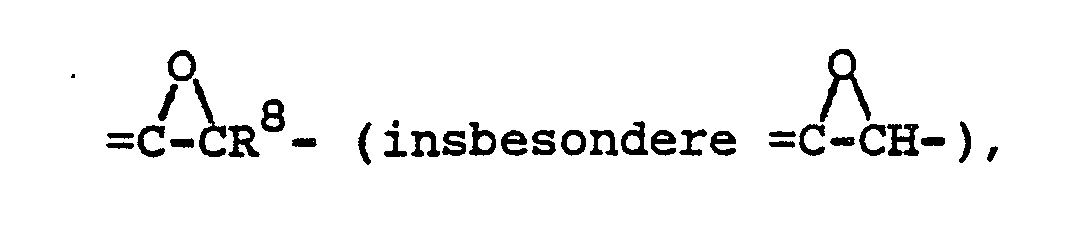
- R¹ und R² sind vorzugsweise jeweils Alkyl, insbesondere jeweils Methyl oder Ethyl, bevorzugt jeweils Methyl.
- R³ und R⁴ sind bevorzugt zusammen eine Bindung. Falls R⁴ H bedeutet, ist R³ bevorzugt OH, O-CHO oder O-COCH₃.
- R⁵ ist bevorzugt unsubstituiertes 1H-2-Pyridon-1-yl, 2-Hydroxy-4-pyridyl-oxy oder 6-Hydroxy-3-pyridazinyl-oxy-, weiterhin 2-, 3- oder 4-Pyridyl-oxy, 3-Hydroxy-1H-6-pyridazinon-1-yl oder 1H-4-Hydroxy-2-pyridon-1-yl, ferner bevorzugt unsubstituiertes 1H-2-Pyrazinon-1-yl, 1H-6-Pyridazinon-1-yl, 4,5-Dihydro-1H-6-pyridazinon-1-yl, 1H-2-Pyrimidinon-1-yl, 1H-6-Pyrimidinon-1-yl, 3H- oder 5H-Pyrrolinon-1-yl oder 1H-2-Thiopyridon-1-yl. Weiterhin bedeutet R⁵ bevorzugt unsubstituiertes 1H-4-Pyridon-1-yl, 1H-4-Pyridazinon-1-yl, 1H-4-Pyrimidinon-1-yl, 1H-2-Chinolinon-1-yl, 2H-1-Isochinolinon-2-yl, 2H-1-Phthalazinon-2-yl oder 3H-4-Chinazolinon-3-yl. Falls R⁵ einen substituierten Pyridon- bzw. Thiopyridonring bedeutet, so ist dieser Ring vorzugsweise einfach in 3-, 4- oder 5-Stellung oder zweifach in 3- und 5-Stellung substituiert. Besonders bevorzugte Substituenten sind OH, NO₂ und NH₂ ferner AOOC, OA, Cl, Br und NHCOCH₃, besonders bevorzugte substituierte Reste R⁵ im einzelnen 4-, ferner 3-, 5- und 6-Hydroxy-, 3-, 4-, 5- oder 6-Methoxy-, 3-, 4-, 5- oder 6-Acetoxy-, 3-, 5- oder 6-Chlor-, 3- oder 5-Nitro-, 3-oder 5-Amino-, 3- oder 5-Carboxy-, 3- oder 5-Methoxycarbonyl-, 3- oder 5-Ethoxycarbonyl-, 3- oder 5-Acetamido-, 3,5-Dichlor-, 3,5-Dibrom-, 3-Chlor-5-nitro-, 3-Nitro-5-chlor-, 3-Brom-5-nitro-, 3-Nitro-5-brom-, 3,5-Dinitro-, 3-Chlor-5-amino-, 3-Amino-5-chlor-, 3-Brom-5-amino-, 3-Amino-5-brom-, 3-Chlor-5-acetamido-, 3-Acetamido-5-chlor-, 3-Brom-5-acetamido- und 3-Acetamido-5-brom-1H-2-pyridon-1-yl bzw. -1H-2-thiopyridon-1-yl, 1H-4- oder 1H-5-Hydroxy-6-pyridazinon-1-yl, 1H-3-, 1H-4- oder 1H-5-Methoxy-6-pyridazinon-1-yl, 1H-3-, 1H-4- oder 1H-5-Ethoxycarbonyl-6-pyridazinon-1-yl, 1H-4-, 1H-5- oder 1H-6-Hydroxy-2-pyrimidinon-1-yl, 1H-2- oder 1H-4-Hydroxy-6-pyrimidinon-1-yl.
- R⁵ kann ferner bevorzugt bedeuten: 3,4-Dihydro-1H-2-pyridon-1-yl, 2,3-Dihydro-6H-2-pyridon-1-yl, 5,6-Dihydro-1H2-pyridon-1-yl, 2-Piperidinon-1-yl, 2,3-Dihydro-1H-6-pyridazinon-1-yl, 1,2-Dihydro-5H-6-pyridazinon-1-yl, 4,5-Dihydro-1H-6-pyridazinon-1-yl, 2,3,4,5-Tetrahydro-1H-6-pyridazinon-1-yl, 3,4-Dihydro-1H-2-pyrimidinon-1-yl, 1,6-Dihydro-3H-2-pyrimidinon-1-yl, 5,6-Dihydro-1H-2-pyrimidinon-1-yl, 3,4,5,6-Tetrahydro-1H-2-pyrimidinon-1-yl, 2,3-Dihydro-1H-6-pyrimidinon-1-yl, 1,2-Dihydro-5H-6-pyrimidinon-1-yl, 4,5-Dihydro-1H-6-pyrimidinon-1-yl, 2,3,4,5-Tetrahydro-1H-6-pyrimidinon-1-yl, 3,4-Dihydro-1H-2-pyrazinon-1-yl, 1,6-Dihydro-3H-2-pyrazinon-1-yl, 5,6-Dihydro-1H-2-pyrazinon-1-yl, 3,4,5,6-Tetrahydro-1H-2-pyrazinon-1-yl-2-Pyrrolidinon-1-yl, 3,4-Dihydro-1H-2-thiopyridon-1-yl, 2,3-Dihydro-6H-2-thiopyridon-1-yl, 5,6-Dihydro-1H-2-thiopyridon-1-yl.
- In R⁶ und R⁷ bedeuten vorzugsweise:


- Der Rest R⁷ kann ferner 2-, 3- oder (bevorzugt) 4-Pyridyl bedeuten, weiterhin 3- oder 4-Pyridazinyl, 2-, 4- oder 5-Pyrimidinyl oder Pyrazinyl.
- Die Reste R⁶ und R⁷ stehen vorzugsweise in 6- und 7-Stellung des Chromansystems. Sie können jedoch auch in 5- und 6-, 5- und 7-, 5- und 8-, 6- und 8- sowie 7- und 8-Stellung stehen.
- Von den Resten R⁶ und R⁷ ist vorzugsweise der eine H, während der andere von H verschieden ist. Dieser andere Rest steht vorzugsweise in 6-Stellung, aber auch in 5-, 7- oder 8-Stellung, und ist vorzugsweise CN oder NO₂, ferner bevorzugt CHO, ACO (insbesondere Acetyl), AOOC (insbesondere Methoxycarbonyl oder Ethoxycarbonyl), ACOO (insbesondere Acetoxy), weiterhin bevorzugt F, Cl, Br, J, CF₃, H₂NCO, H₂NCS, NH₂ oder 4-Pyridyl.
- Der Rest R⁸ ist vorzugsweise H, weiterhin bevorzugt Methyl oder Ethyl.
- Dementsprechend sind Gegenstand der Erfindung insbesondere diejenigen Verbindungen der Formel I, in denen mindestens einer der genannten Reste eine der vorstehend angegebenen bevorzugten Bedeutungen hat. Einige bevorzugte Gruppen von Verbindungen können durch die nachstehenden Formeln Ia bis Ii ausgedrückt werden, die der Formel I entsprechen und worin die nicht näher bezeichneten Reste die bei der Formel I angegebene Bedeutung haben, worin jedoch

- Weiterhin sind bevorzugt Verbindungen der Formeln I′ sowie Ia′ bis Ii′, die den Formeln I sowie Ia bis Ii entsprechen, worin jedoch jeweils zusätzlich -X-Y- =C-CR⁸(OH)- bedeutet.
- Weiterhin sind bevorzugt Verbindungen der Formeln I˝ sowie Ia˝ bis Ii˝, die den Formeln I sowie Ia bis Ii entsprechen, worin jedoch jeweils zusätzlich -X-Y- =C=CR⁸- bedeutet.
- Ferner sind bevorzugt Verbindungen der Formeln I, I′, I, Ia bis Ii, Ia′ bis Ii′ sowie Ia˝ bis Ii, worin jeweils zusätzlich
- (a)
R⁶ von H verschieden ist und
R⁷ H bedeutet; - (b)
R⁶ von H verschieden ist und in 6-Stellung steht und
R⁷ H bedeutet; - (c)
R⁶ NO₂, CN, CHO, ACO, HOOC, AOOC, ACOO, F, Cl, Br, J, CF₃, H₂NCO, H₂NCS oder NH₂ und
R⁷ H bedeutet; - (d)
R⁶ NO₂, CN, CHO, ACO, HOOC, AOOC, ACOO, F, Cl, Br, J, CF₃, H₂NCO, H₂NCS oder NH₂ bedeutet und in 6-Stellung steht und
R⁷ H bedeutet; - (e)
R⁶ NO₂, CN, CHO, CH₃CO, CH₃OOC,C₂H₅OOC oder CH₃COO und
R⁷ H bedeutet; - (f)
R⁶ NO₂, CN, CHO, CH₃CO, CH₃OOC,C₂H₅OOC oder CH₃COO bedeutet und in 6-Stellung steht und
R⁷ H bedeutet; - (g)
R⁶ NO₂ oder CN und
R⁷ H bedeutet; - (h)
R⁶ NO₂ oder CN bedeutet und in 6-Stellung steht und
R⁷ H bedeutet; - (i)
R⁶ CN und
R⁷ H bedeutet; - (j)
R⁶ CN bedeutet und in 6-Stellung steht und
R⁷ H bedeutet. - Insbesondere sind bevorzugt Verbindungen der Formeln I, I′, I˝, Ia bis Ii, Ia′ bis Ii′, Ia˝ bis Ii˝ sowie der übrigen vorstehend als bevorzugt gekennzeichneten Gruppen von Verbindungen, worin zusätzlich R⁸ H bedeutet. Im übrigen haben vor- und nachstehend die Reste R¹ bis R⁸, A, "alkyl" und Ac die bei Formel I angegebenen Bedeutungen, wenn nicht ausdrücklich etwas anderes angegeben ist.
- Gegenstand der Erfindung ist ferner ein Verfahren zur Herstellung von Chromanderivaten der Formel I, dadurch gekennzeichnet, daß man zur Herstellung von Verbindungen der Formel I, worin X-Y =CR⁴-CR³R⁸ oder =CH-CHR⁸- bedeutet, ein 3,4-Epoxychroman der Formel IIa oder ein Chromanderivat der Formel IIb

E Cl, Br, J oder eine reaktionsfähig veresterte OH-Gruppe bedeutet und
R¹, R², R⁶, R⁷ und R⁸ die bei Formel I angegebene Bedeutung haben,
mit einer Verbindung der Formel III
R⁵-H III
worin R⁵ die bei Formel I angegebene Bedeutung hat oder mit einem ihrer reaktionsfähigen Derivate umsetzt
und/oder daß man eine Verbindung der Formel I, worin X-Y =CH-CR⁸(OH)- bedeutet, dehydratisiert oder alkyliert und/oder daß man eine Verbindung der Formel I, worin X-Y =C=CR⁸- bedeutet, epoxidiert und/oder daß man eine Verbindung der Formel I, worin
- Die Verbindungen der Formel I werden im übrigen nach an sich bekannten Methoden hergestellt, wie sie in der Literatur (z.B. in den Standardwerken wie Houben-Weyl, Methoden der organischen Chemie, Georg-Thieme-Verlag, Stuttgart; Organic Reactions, John Wiley & Sons, Inc., New York; sowie in den oben angegebenen Patentanmeldungen) beschrieben sind, und zwar unter Reaktionsbedingungen, die für die genannten Umsetzungen bekannt und geeignet sind. Dabei kann man auch von an sich bekannten, hier nicht näher erwähnten Varianten Gebrauch machen.
- Die Ausgangsstoffe können gewünschtenfalls auch in situ gebildet werden, derart, daß man sie aus dem Reaktionsgemisch nicht isoliert, sondern sofort weiter zu den Verbindungen der Formel I umsetzt.
- Vorzugsweise werden die Verbindungen der Formel I durch Reaktion von Verbindungen der Formel IIa oder IIb mit Verbindungen der Formel III hergestellt, zweckmäßig in Gegenwart eines inerten Lösungsmittels bei Temperaturen zwischen etwa 0 und 150°.
- Die Ausgangsstoffe IIa, IIb und III sind in der Regel bekannt. Sofern sie nicht bekannt sind, können sie nach an sich bekannten Methoden hergestellt werden. So sind die Ausgangsstoffe der Formel IIa erhältlich durch Umsetzung von 2-Hydroxyacetophenonen der Formel 2-HO-R⁶R⁷C₆H₂-COCH₃ mit Ketonen der Formel R¹-CO-R² zu entsprechenden 4-Chromanonen der Formel IVa

- Man kann die Chromene der Formel IVd auch erhalten durch Kondensation von Salicylaldehyden der Formel 2-HO-R⁶R⁷ C₆H₂-CHO mit Ketonen der Formel R¹-CO-CH₂-R⁸ zu Hydroxyketonen der Formel 2-HO-R⁶R⁷C₆H₂-CH=CR⁸-CO-R¹, Umsetzung mit Organo-Li-Verbindungen der Formel R²-Li und nachfolgende Hydrolyse zu Diolen der Formel 2-HO-R⁶R⁷C₆H₂-CH=CR⁸-CR¹R²-OH und Cyclisierung unter Wasserabspaltung.
- Ausgangsstoffe der Formel IIa (R⁸=H) sind ferner erhältlich durch Umsetzung von Propargylchloriden der Formel HC≡C-CR¹R²-Cl mit Phenolen der Formel R⁶R⁷C₆H₃OH zu Phenolethern der Formel R⁶R⁷C₆H₃O-CR¹R²-C≡CH, Cyclisierung zu 2H-Chromenen entsprechend Formel I, worin aber an Stelle der Gruppe -XR⁵-Y- die Gruppe -CH=CH- steht, Anlagerung von HOBr zum Bromhydrin der Formel IVe (R⁸=H) und Dehydrobromierung.
- In den Verbindungen der Formel IIb kommen als "reaktionsfähig veresterte OH-Gruppen" insbesondere die Ester mit Alkylsulfonsäuren (worin die Alkylgruppe 1-6 C-Atome enthält) oder mit Arylsulfonsäuren (worin die Arylgruppe 6-10 C-Atome enthält) in Betracht.
- Verbindungen der Formel IIb sind erhältlich aus den 4-Chromanolen der Formel IVc durch Umsetzung mit einem anorganischen Säurehalogenid wie PCl₃, PBr₃, SOCl₂ oder SOBr₂ oder mit einem Sulfonsäurechlorid wie Methan- oder p-Toluolsulfonsäurechlorid.
- Als reaktionsfähige Derivate von III eignen sich die entsprechenden Salze, z.B. die Na- oder K-Salze, die auch in situ entstehen können.
- Bei der Umsetzung von II mit III können verschiedene Produkte der Formel I entstehen, abhängig insbesondere von der Struktur der Ausgangsstoffe III und von den Reaktionsbedingungen.
- Beispielsweise ist die Bildung von Verbindungen der Formel I mit einer Sauerstoffbrücke (R⁵ = gegebenenfalls substituiertes Pyridyl-oxy, Pyridazinyl-oxy, Pyrimidinyloxy, Pyrazinyl-oxy, Oxo-dihydro-pyridyl-oxy, Oxo-dihydro-pyridazinyl-oxy, Oxo-dihydro-pyrimidinyl-oxy oder Oxo- dihydro-pyrazinyl-oxy) begünstigt, wenn die Verbindung III zusätzlich zu der Lactam- bzw. Lactimgruppierung mindestens eine OH-Gruppe als Substituenten enthält und/oder wenn man unter relativ milden Bedingungen, z.B. in Gegenwart einer schwachen Base wie Pyridin in einem Alkohol, arbeitet. Beispielsweise entstehen aus 2,2-Dimethyl-3,4-epoxy-6-cyan-chroman ("IIc") und 1H-2-Pyridon mit NaH in DMSO überwiegend 2,2-Dimethyl-4-(1H-2-pyridon-1-yl)-6-cyan-2H-chromen ("A") und 2,2-Dimethyl-4-(1H-2-pyridon-1-yl)-6-cyan-3-chromanol ("B"), mit Pyridin in Ethanol dagegen "B" neben wenig 2,2-Dimethyl-4-(2-pyridyl-oxy)-6-cyan-3-chromanol. Aus 2,4-Dihydroxypyridin (= 4-Hydroxy-1H-2-pyridon) und IIc entsteht in Pyridin/Ethanol 2,2-Dimethyl-4-(2-hydroxy-4-pyridyl-oxy)-6-cyan-3-chromanol neben wenig 2,2-Dimethyl-4-(4-hydroxy-1H-2-pyridon-1-yl)-6-cyan-3-chromanol.
- Eine Optimierung der Reaktionsbedingungen gelingt in jedem Einzelfall leicht. Die Reaktionsprodukte können ohne Schwierigkeiten getrennt und isoliert werden, z.B. durch Kristallisation und/oder Chromatographie.
- Es ist zweckmäßig, in Gegenwart einer Base zu arbeiten. Als Basen eignen sich z.B. Alkalimetall- oder Erdalkalimetall-hydroxide, -carbonate, -alkoholate, -hydride oder auch -amide wie NaOH, KOH, Ca(OH)₂, Na₂CO₃, K₂CO₃, Na- oder K-methylat, -ethylat oder -tert.-buylat, NaH, KH, CaH₂, NaNH₂, KNH₂, ferner organische Basen wie Triethylamin oder Pyridin, die auch im Überschuß angewendet werden können und dann gleichzeitig als Lösungsmittel dienen.
- Als inerte Lösungmittel eignen sich insbesondere Alkohole wie Methanol, Ethanol, Isopropanol, n-Butanol oder tert.-Butanol; Ether wie Diethylether, Diisopropylether, Tetrahydrofuran oder Dioxan; Glykolether wie Ethylenglykolmonomethyl- oder -monoethylether (Methylglykol oder Ethylgly kol), Ethylenglykoldimethylether (Diglyme); Ketone wie Aceton oder Butanon; Nitrile wie Acetonitril; Nitroverbindungen wie Nitromethan oder Nitrobenzol; Ester wie Ethylacetat; Amide wie Dimethylformamid (DMF), Dimethylacetamid oder Phosphorsäurehexamethyltriamid; Sulfoxide wie Dimethylsulfoxid (DMSO); chlorierte Kohlenwasserstoffe wie Dichlormethan, Chloroform, Trichlorethylen, 1,2-Dichlorethan oder Kohlenstofftetrachlorid; Kohlenwasserstoffe wie Benzol, Toluol oder Xylol. Weiterhin eignen sich Gemische dieser Lösungsmittel untereinander.
- Das Epoxid II kann auch in situ hergestellt werden, z.B. durch Einwirkung einer Base auf das entsprechende Bromhydrin Ve.
- Eine Verbindung der Formel I, worin -X-Y- =CH-CR⁸(OH)- bedeutet, kann durch Behandeln mit einem Dehydratisierungsmittel in eine Verbindung der Formel I, worin -X-Y- =CH=CR⁸- bedeutet, umgewandelt werden. Das gelingt z.B. durch Einwirkung einer der angegebenen Basen, z.B. NaOH, KOH oder NaH, in einem der angegebenen Lösungsmittel, z.B. Tetrahydrofuran, Dioxan oder DMSO, bei Temperaturen zwischen 0 und 150°.
- Ferner kann eine Verbindung der Formel I, worin -X-Y- =CH-CR⁸(OH)- bedeutet, alkyliert werden, wobei eine 3-Alkoxyverbindung der Formel I, worin -X-Y- =CH-CR⁸(OA)- bedeutet gebildet wird. Man alkyliert vorzügsweise mit entsprechenden Alkylhalogeniden oder -sulfonaten der Formel A-E, z.B. A-Cl, A-Br, A-J, A-OSO₂A, A-OSO₂Aryl wie Methylchorid, -bromid, -jodid, -methansulfonat, -benzolsulfonat, oder auch mit Dialkylsulfaten der Formel A₂SO₄, z.B. Dimethylsulfat, Diethylsulfat, zweckmäßig in Gegenwart eines der angegebenen inerten Lösungsmittel wie Toluol oder DMF und/oder in Gegenwart einer der an gegebenen Basen wie K₂CO₃ oder K-tert.-Butylat bei Temperaturen zwischen 0 und 120°. Falls gleichzeitig weitere OH-Gruppen im Molekül vorhanden sind, so können diese gleichzeitig ebenfalls alkyliert werden.
- Verbindungen der Formel I, worin -X-Y- =C=CR⁸- bedeutet, können epoxidiert werden, wobei Epoxide der Formel I entstehen, worin

- Epoxide der Formel I, worin

- Weiterhin kann man in einer Verbindung der Formel I einen oder mehrere der Reste R³, R⁵, R⁶ und/oder R⁷ in andere Reste R³, R⁵, R⁶ und/oder R⁷ umwandeln.
- Beispielsweise ist es möglich, daß man ein H-Atom mittels einer Halogenierung durch ein Halogenatom oder einer Nitrierung durch eine Nitrogruppe ersetzt und/oder eine Nitrogruppe zu einer Aminogruppe reduziert und/oder eine Amino- oder Hydroxygruppe alkyliert oder acyliert und/oder eine Cyangruppe (z.B. mit HCl in Wasser/Methanol bei 20-100°) in eine Carboxylgruppe oder (z.B. mit Raney-Nickel in Wasser/Essigsäure/Pyridin in Gegenwart von Natriumphosphat) in eine Formylgruppe oder (z.B. mit KOH in tert.-Butanol) in eine Carbamoylgruppe oder (z.B. mit H₂S in Pyridin/Triethylamin) in eine Thiocarbamoylgruppe umwandelt und/oder einen substituierten oder unsubstituierten 1H-2-Pyridon-1-ylrest (z.B. mit P₂S₅ oder mit Lawesson-Reagenz in Toluol) in den entsprechenden 1H-2-Thiopyridon-1-ylrest umwandelt.
- Eine Nitrierung gelingt unter üblichen Bedingungen, z.B. mit einem Gemisch aus konzentrierter HNO₃ und konzentrierter H₂SO₄ bei Temperaturen zwischen 0 und 30°. Falls mindestens einer der Substituenten R⁶ und R⁷ eine elektronegative Gruppe wie CN oder NO₂ bedeutet, erfolgt die Nitrierung überwiegend am Rest R⁵; andernfalls erhält man in der Regel Gemische, bei denen die Nitrogruppen am Rest R⁵ oder am Chromanring stehen können.
- Analoges gilt für die Halogenierung, die z.B. mit elementarem Chlor oder Brom in einem der üblichen inerten Lösungsmittel bei Temperaturen zwischen etwa 0 und 30° durchgeführt werden kann.
- Eine primäre oder sekundäre Aminogruppe und/oder eine OH-Gruppe kann durch Behandeln mit alkylierenden Mitteln in die entsprechende sekundäre oder tertiäre Aminogruppe und/oder Alkoxygruppe umgewandelt werden. Als alkylierende Mittel eignen sich z.B. Verbindungen der Formeln A-Cl, A-Br oder A-J oder entsprechende Schwefelsäure- oder Sulfonsäureester wie Methylchlorid, -bromid, -jodid, Dimethylsulfat, Methyl-p-toluolsulfonat. Ferner kann man z.B. eine oder zwei Methylgruppen mit Formaldehyd in Gegenwart von Ameisensäure einführen. Die Alkylierung wird zweckmäßig in Gegenwart oder Abwesenheit eines der genannten inerten Lösungemittel, z.B. DMF, bei Temperaturen zwischen etwa 0° und etwa 120° vorgenommen, wobei auch ein Katalysator zugegen sein kann, vorzugsweise eine Base wie Kalium-tert.-butylat oder NaH.
- Als acylierende Mittel zur Acylierung von Amino- oder Hydroxygruppen eignen sich zweckmäßig die Halogenide (z.B. Chloride oder Bromide) oder Anhydride von Carbonsäuren der Formel Ac-OH, z.B. Acetanhydrid, Propionylchlorid, Isobutyrylbromid, Ameisensäure/Essigsäureanhydrid, Benzoylchlorid. Der Zusatz einer Base wie Pyridin oder Triethylamin bei der Acylierung ist möglich. Man acyliert zweckmäßig in Gegenwart oder Abwesenheit eines inerten Lösungsmittels, z.B. eines Kohlenwasserstoffs wie Toluol, eines Nitril wie Acetonitril, eines Amids wie DMF oder eines Überschusses einer tertiären Base wie Pyridin oder Triethylamin bei Temperaturen zwischen etwa 0° und etwa 160°, vorzugsweise zwischen 20° und 120°. Eine Formylierung gelingt auch mit Ameisensäure in Gegenwart von Pyridin.
- Eine Base der Formel I kann mit einer Säure in das zugehörige Säureadditionssalz übergeführt werden. Für diese Umsetzung kommen insbesondere Säuren in Frage, die physiologisch unbedenkliche Salze liefern. So können anorganische Säuren verwendet werden, z.B. Schwefelsäure, Salpetersäure, Halogenwasserstoffsäuren wie Chlorwasserstoffsäure oder Bromwasserstoffsäure, Phosphorsäuren wie Orthophosphorsäure, Sulfaminsäure, ferner organische Säuren, insbesondere aliphatische, alicyclische, araliphatische, aromatische oder heterocyclische ein- oder mehrbasige Carbon-, Sulfon- oder Schwefelsäuren, z.B. Ameisensäure, Essigsäure, Propionsäure, Pivalinsäure, Diethylessigsäure, Malonsäure, Bernsteinsäure, Pimelinsäure, Fumarsäure, Maleinsäure, Milchsäure, Weinsäure, Äpfelsäure, Benzoesäure, Salicylsäure, 2- oder 3-Phenylpropionsäure, Citronensäure, Gluconsäure, Ascorbinsäure, Nicotinsäure, Isonicotinsäure, Methan- oder Ethansulfonsäure, Ethandisulfonsäure, 2-Hydroxyethansulfonsäure, Benzolsulfonsäure, p-Toluolsulfonsäure, Naphthalin-mono- und -disulfonsäuren, Laurylschwefelsäure. Salze mit physiologisch nicht unbedenklichen Säuren, z.B. Pikrate, können zur Aufreinigung der Verbindungen der Formel I verwendet werden.
- Die Verbindungen der Formel I können ein oder mehrere chirale Zentren besitzen. Sie können daher bei ihrer Herstellung als Racemate oder, falls optisch aktive Ausgangsstoffe verwendet werden, auch in optisch aktiver Form erhalten werden. Weisen die Verbindungen zwei oder mehr chirale Zentren auf, dann können sie bei der Synthese als Gemische von Racematen anfallen, aus denen man die einzelnen Racemate, beispielsweise durch Umkristallisieren aus inerten Lösungsmitteln, in reiner Form isolieren kann. So haben z.B. Verbindungen der Formel I, worin R¹ = R², R³ = OH und R⁴ = H ist, zwei chirale Zentren; bei der Herstellung durch Reaktion von IIa mit III entsteht jedoch ganz überwiegend nur ein Racemat mit trans-Stellung der Substituenten R³ = OH und R⁵. Erhaltene Racemate können, falls erwünscht, nach an sich bekannten Methoden mechanisch oder chemisch in ihre Enantiomeren getrennt werden. So können aus dem Racemat durch Umsetzung mit einem optisch aktiven Trennmittel Diastereomere gebildet werden. Als Trennmittel für basische Verbindungen der Formel I eignen sich z.B. optisch aktive Säuren, wie die D- und L-Formen von Weinsäure, Dibenzoylweinsäure, Diacetylweinsäure, Camphersulfonsäuren, Mandelsäure, Äpfelsäure oder Milchsäure. Carbinole (I, R³ = OH) können ferner mit Hilfe chiraler Acylierungsreagenzien, z.B. D- oder L-α-Methylbenzylisocyanat, verestert und dann getrennt werden (vgl. EP-A1-120428). Die verschiedenen Formen der Diastereomeren können in an sich bekannter Weise, z.B. durch fraktionierte Kristallisation, getrennt, und die Enantiomeren der Formel I können in an sich bekannter Weise aus den Diastereomeren in Freiheit gesetzt werden. Enantiomerentrennungen gelingen ferner durch Chromatographie an optisch-aktiven Trägermaterialien.
- Die Verbindungen der Formel I und ihre physiologisch unbedenklichen Salze können zur Herstellung pharmazeutischer Zubereitungen verwendet werden, insbesondere auf nicht-chemischem Wege. Hierbei können sie zusammen mit mindestens einem festen, flüssigen und/oder halbflüssigen Träger- oder Hilfstoff und gegebenenfalls in Kombination mit einem oder mehreren weiteren Wirkstoff(en) in eine geeignete Dosierungsform gebracht werden.
- Gegenstand der Erfindung sind ferner Mittel, insbesondere pharmazeutische Zubereitungen, enthaltend mindestens eine Verbindung der Formel I und/oder eines ihrer physiologisch unbedenklichen Salze.
- Diese Zubereitungen können als Arzneimittel in der Human- oder Veterinärmedizin verwendet werden. Als Trägerstoffe kommen organische oder anorganische Substanzen in Frage, die sich für die enterale (z.B. orale), parenterale oder topische Applikation eignen und mit den neuen Verbindungen nicht reagieren, beispielsweise Wasser, pflanzliche Öle, Benzylalkohole, Polyethylenglykole, Glycerintriacetat, Gelatine, Kohlehydrate wie Lactose oder Stärke, Magnesiumstearat, Talk, Lanolin, Vaseline. Zur oralen Anwendung dienen insbesondere Tabletten, Dragees, Kapseln, Sirupe, Säfte oder Tropfen, zur rektalen Anwendung Suppositorien, zur parenteralen Anwendung Lösungen, vorzugsweise ölige oder wässerige Lösungen, ferner Suspensionen, Emulsionen oder Implantate, für die topische Anwendung Salben, Cremes, Pasten, Lotionen, Gele, Sprays, Schäume, Aerosole, Lösungen (z.B. in Alkoholen wie Ethanol oder Isopropanol, Acetonitril, DMF, Dimethylacetamid, 1,2-Propandiol oder deren Gemischen untereinander oder mit Wasser) oder Puder. Die neuen Verbindungen können auch lyophilisiert und die erhaltenen Lyophilisate z.B. zur Herstellung von Injektionspräparten verwendet werden. Insbesondere für die topische Anwendung kommen auch liposomale Zubereitungen in Betracht. Die angegebenen Zubereitungen können sterilisiert sein und/oder Hilfsstoffe wie Gleit-, Konservierungs-, Stabilisierungs- und/oder Netzmittel, Emulgatoren, Salze zur Beeinflussung des osmotischen Druckes, Puffersubstanzen, Farb- und Geschmacks- und/oder Aromastoffe enthalten. Sie können, falls erwünscht, auch einen oder mehrere weitere Wirkstoffe enthalten, z.B. ein oder mehrere Vitamine.
- Die Verbindungen der Formel I und ihre physiologisch unbedenklichen Salze können an Menschen oder Tiere, insbesondere Säugetiere wie Affen, Hunde, Katzen, Ratten oder Mäuse verabreicht und bei der therapeutischen Behandlung des menschlichen oder tierischen Körpers sowie bei der Bekämpfung von Krankheiten verwendet werden, insbesondere bei der Therapie und/oder Prophylaxe von Störungen des cardiovasculären Systems, insbesondere dekompensierter Herzinsuffizienz, Angina pectoris, Arrhythmie, peripheren oder cerebralen Gefäßerkrankungen, sowie Krankheitszuständen, die mit Bluthochdruck verbunden sind, ferner von Erkrankungen, die mit Veränderungen der nicht-vaskulären Muskulatur verbunden sind, z.B. Asthma, Inkontinenz der Harnblase.
- Dabei werden die erfindungsgemäßen Substanzen in der Regel in Analogie zu bekannten Antianginosa bwz. Blutdrucksenkern, z.B. Nicorandil oder Cromakalim verabreicht, vorzugsweise in Dosierungen zwischen etwa 0,01 und 5 mg, insbesondere zwischen 0,02 und 0,5 mg pro Dosierungseinheit. Die tägliche Dosierung liegt vorzugsweise zwischen etwa 0,0001 und 0,1, insbesondere zwischen 0,0003 und 0,01 mg/kg Körpergewicht. Die spezielle Dosis für jeden bestimmten Patienten hängt jedoch von den verschiedensten Faktoren ab, beispielsweise von der Wirksamkeit der eingesetzten speziellen Verbindung, vom Alter, Körpergewicht, dem allgemeinen Gesundheitszustand, Geschlecht, von der Kost, vom Verabfolgungszeitpunkt und -weg, von der Ausscheidungsgeschwindigkeit, Arzneistoffkombination und Schwere der jeweiligen Erkrankung, welcher die Therapie gilt. Die orale Applikation ist bevorzugt.
- Die Verbindungen der Formel I und ihre Salze eignen sich, insbesondere bei topischer Anwendung, ferner zur Behandlung der Alopezie einschließlich der androgenen Alopezie und der Alopecia areata. Hierfür werden insbesondere pharmazeutische Zubereitungen verwendet, die zur topischen Behandlung der Kopfhaut geeignet und die oben genannt sind. Sie enthalten etwa 0,005 bis 10, bevorzugt 0,5 bis 3 Gew.% mindestens einer Verbindung der Formel I und/oder mindestens eines ihrer Salze. Im übrigen können diese Verbindungen gegen Alopezie in Analogie zu den Angaben in der WO 88/00822 verwendet werden.
- In den nachfolgenden Beispielen bedeutet "übliche Aufarbeitung":
Man gibt, falls erforderlich, Wasser hinzu, extrahiert mit einem organischen Lösungsmittel wie Ethylacetat, trennt ab, trocknet die organische Phase über Natriumsulfat, filtriert, dampft ein und reinigt durch Chromatographie und/oder Kristallisation. Vor- und nachstehend sind alle Temperaturen in °C angegeben. - Ein Gemisch von 21,5 g 2,2,3-Trimethyl-3,4-epoxy-6-cyanchroman, 9,5 g 1H-2-Pyridon ("Pyridon"), 3 g einer 80%igen Dispersion von NaH in Paraffinöl und 600 ml DMSO wird 16 Std. bei 20° gerührt, in Wasser gegossen und mit Ethylacetat extrahiert. Man dampft ein und chromatographiert den Rückstand über Kieselgel. Mit Dichlormethan wird 2,2,3-Trimethyl-4-(1H-2-pyridon-1-yl)-6-cyan-2H-chromen (F. 212°) eluiert, anschließend mit Ethylacetat 2,2,3-Trimethyl-4-(1H-2-pyridon-1-yl)-6-cyan-chroman-3-ol (F. 185-186°).
- Herstellung des Ausgangsmaterials:
- (a) Ein Gemisch von 81 g 3-Acetyl-4-hydroxybenzonitril, 48 ml Aceton, 11,8 ml Pyrrolidin und 300 ml Toluol wird 1 Std. bei 20° stehengelassen, dann 2 Std. am Wasserabscheider gekocht und abgekühlt. Nach üblicher Aufarbeitung erhält man 2,2-Dimethyl-6-cyan-4-chromanon, F. 119-120°.
- (b) Eine Lösung von 24 g des Chromanons, 12 g Paraformaldehyd und 24 ml Piperidin in 300 ml Ethanol wird 3 Std. auf 70° erhitzt und eingedampft. Man nimmt den Rückstand in Dichlormethan/Petrolether 1:1 auf, filtriert über Kieselgel, dampft ein und erhält 2,2-Dimethyl-3-methylen-6-cyan-4-chromanon als instabiles Öl.
- (c) Eine Lösung von 25 g des vorstehenden Chromanons in 500 ml Methanol wird mit 6 g NaBH₄ versetzt, 1 Std. bei 20° gerührt und eingedampft. Nach üblicher Aufarbeitung erhält man 2,2,3-Trimethyl-6-cyan-4-chromanol, Isomerengemisch, ölig.
- (d) Eine Lösung von 27 g des vorstehenden Gemischs und 1,2 g p-Toluolsulfonsäure in 400 ml Toluol wird 3 Std. am Wasserabscheider gekocht. Man dampft ein, löst in Dichlormethan/Petrolether 1:1, filtriert über Kieselgel, dampft erneut ein und erhält 2,2,3-Trimethyl-6-cyan-2H-chromen, F. 55°.
- (e) Eine Lösung von 6,4 g m-Chlorperbenzoesäure in 40 ml Dichlormethan wird unter Rühren zu einer Lösung von 6,8 g des vorstehenden Chromens in 100 ml Dichlormethan zugetropft. Man rührt noch 16 Std., filtriert, gibt verdünnte Natronlauge zu, arbeitet wie üblich auf und erhält 2,2,3-Trimethyl-3,4-epoxy-6-cyan-chroman, F. 118°.
- Analog erhält man
2,2-Dimethyl-4-(1H-2-pyridon-1-yl)-6-cyan-2H-chromen ("A"), F. 146-148°
2,2-Dimethyl-4-(1H-2-pyridon-1-yl)-6-cyan-3-chromanol ("B"), F. 224°
2,2-Dimethyl-4-(1H-5-chlor-2-pyridon-1-yl)-6-cyan-2H-chromen, F. 185-188°
2,2-Dimethyl-4-(1H-5-chlor-2-pyridon-1-yl)-6-cyan-3-chromanol, F. 268-270°
2,2-Dimethyl-4-(1H-3-hydroxy-2-pyridon-1-yl)-6-cyan-2H-chromen
2,2-Dimethyl-4-(1H-3-hydroxy-2-pyridon-1-yl)-6-cyan-3-chromanol, F. 262-265°
2,2-Dimethyl-4-(1H-4-hydroxy-2-pyridon-1-yl)-6-cyan-2H-chromen
2,2-Dimethyl-4-(1H-4-hydroxy-2-pyridon-1-yl)-6-cyan-3-chromanol, F. 256-257°
2,2-Dimethyl-4-(1H-5-hydroxy-2-pyridon-1-yl)-6-cyan-2H-chromen
2,2-Dimethyl-4-(1H-5-hydroxy-2-pyridon-1-yl)-6-cyan-3-chromanol, F. 256,5-258°
2,2-Dimethyl-4-(1H-3-methoxy-2-pyridon-1-yl)-6-cyan-2H-chromen
2,2-Dimethyl-4-(1H-3-methoxy-2-pyridon-1-yl)-6-cyan-3-chromanol,, F. 245-248°
2,2-Dimethyl-4-(1H-3-acetoxy-2-pyridon-1-yl)-6-cyan-2H-chromen
2,2-Dimethyl-4-(1H-3-acetoxy-2-pyridon-1-yl)-6-cyan-3-chromanol, F. 260-263°
2,2-Dimethyl-4-(1H-3-nitro-2-pyridon-1-yl)-6-cyan-2H-chromen, F. 148-150°
2,2-Dimethyl-4-(1H-3-nitro-2-pyridon-1-yl)-6-cyan-3-chromanol, F. 240-242°
2,2-Dimethyl-4-(1H-5-nitro-2-pyridon-1-yl)-6-cyan-2H-chromen, F. 214-216°
2,2-Dimethyl-4-(1H-5-nitro-2-pyridon-1-yl)-6-cyan-3-chromanol, F. 249-251°
2,2-Dimethyl-4-(1H-3-amino-2-pyridon-1-yl)-6-cyan-2H-chromen
2,2-Dimethyl-4-(1H-3-amino-2-pyridon-1-yl)-6-cyan-3-chromanol, F. 213-215°
2,2-Dimethyl-4-(1H-5-amino-2-pyridon-1-yl)-6-cyan-2H-chromen, F. 180°
2,2-Dimethyl-4-(1H-5-amino-2-pyridon-1-yl)-6-cyan-3-chromanol, F. 260-264°
2,2-Dimethyl-4-(1H-2-pyridon-1-yl)-6-nitro-2H-chromen, F. 158°
2,2-Dimethyl-4-(1H-2-pyridon-1-yl)-6-nitro-3-chromanol, F. 229-231°
2,2-Dimethyl-4-(1H-2-pyridon-1-yl)-6-acetyl-2H-chromen, F. 148-150°
2,2-Dimethyl-4-(1H-2-pyridon-1-yl)-6-acetyl-3-chromanol, F. 257-269°
2,2-Dimethyl-4-(1H-2-pyridon-1-yl)-6-methoxycarbonyl-2H-chromen, F. 126-127°
2,2-Dimethyl-4-(1H-2-pyridon-1-yl)-6-methoxycarbonyl-3-chromanol, F. 267-267,5°
2,2-Dimethyl-4-(1H-2-pyridon-1-yl)-6-ethoxycarbonyl-2H-chromen,
2,2-Dimethyl-4-(1H-2-pyridon-1-yl)-6-ethoxycarbonyl-3-chromanol, F. 213°
2,2-Tetramethylen-4-(1H-2-pyridon-1-yl)-6-cyan-2H-chromen, F. 181-183°
2,2-Tetramethylen-4-(1H-2-pyridon-1-yl)-6-cyan-3-chromanol, F. 227-230°
2,2-Pentamethylen-4-(1H-2-pyridon-1-yl)-6-cyan-2H-chromen, F. 202-204°
2,2-Pentamethylen-4-(1H-2-pyridon-1-yl)-6-cyan-2H-chromanol, F. 240-242°
2,2-Dimethyl-4-(1H-2-pyridazinon-1-yl)-6-cyan-2H-chromen, F. 136-138°
2,2-Dimethyl-4-(1H-2-pyridazinon-1-yl)-6-cyan-3-chromanol, F. 216-218°
2,2-Dimethyl-4-(4,5-dihydro-1H-6-pyridazinon-1-yl)-6-cyan-2H-chromen
2,2-Dimethyl-4-(4,5-dihydro-1H-6-pyridazinon-1-yl)-6-cyan-3-chromanol, F. 163-164,5°
2,2-Dimethyl-4-(1H-3-ethoxycarbonyl-6-pyridazinon-1-yl)-6-cyan-2H-chromen
2,2-Dimethyl-4-(1H-3-ethoxycarbonyl-6-pyridazinon-1-yl)-6-cyan-3-chromanol, F. 259-260,5°
2,2-Dimethyl-4-(1H-2-pyrimidinon-1-yl)-6-cyan-2H-chromen
2,2-Dimethyl-4-(1H-2-pyrimidinon-1-yl)-6-cyan-3-chromanol, F. 250-252°
2,2-Dimethyl-4-(1H-4-hydroxy-2-pyrimidinon-1-yl)-6-cyan-2H-chromen, F.278-279,5°
2,2-Dimethyl-4-(1H-4-hydroxy-2-pyrimidinon-1-yl)-6-cyan-3-chromanol, kein F. bis 300°
2,2-Dimethyl-4-(1H-6-pyrimidinon-1-yl)-6-cyan-2Hchromen
2,2-Dimethyl-4-(1H-6-pyrimidinon-1-yl)-6-cyan-3-chromanol, F. 207-208°
2,2,3-Trimethyl-4-(1H-2-pyridon-1-yl)-6-cyan-2H-chromen, F. 200°
2,2,3-Trimethyl-4-(1H-2-pyridon-1-yl)-6-cyan-3-chromanol
2,2,3-Trimethyl-4-(2-pyrrolidon-1-yl)-6-cyan-2H-chromen, F. 186°
2,2,3-Trimethyl-4-(2-pyrrolidon-1-yl)-6-cyan-3-chromanol
2,2-Dimethyl-4-(2-pyrrolidon-1-yl)-6-(4-pyridyl)-2H-chromen
2,2-Dimethyl-4-(2-pyrrolidon-1-yl)-6-(4-pyridyl)-3-chromanol, F. 238-239°
2,2-Dimethyl-3-ethyl-4-(1H-2-pyridon-1-yl)-6-cyan-2-H-chromen
2,2-Dimethyl-3-ethyl-4-(1H-2-pyridon-1-yl)-6-cyan-3-chromanol. - Ein Gemisch von 20,1 g IIc, 11,2 g 3,6-Pyridazindiol, 12 ml Pyridin und 600 ml Ethanol wird 72 Std. gekocht. Man destilliert etwa 300 ml ab, kühlt ab, filtriert nicht umgesetztes 3,6-Pyridazindiol ab und dampft ein. Das erhaltene 2,2-Dimethyl-4-(6-hydroxy-3-pyridazinyloxy)-6-cyan-3-chromanol wird aus Isopropanol umkristallisiert. F. 255-256°. Daneben entsteht wenig 2,2-Dimethyl-4-(3-hydroxy-1H-6-pyridazinon-1-yl)-6-cyan-3-chromanol, F. 260-262°.
- Analog erhält man mit den entsprechenden Verbindungen der Formel R⁵-H:
2,2-Dimethyl-4-(1H-4-pyridon-1-yl)-6-cyan-3-chromanol, F. 301°
2,2-Dimethyl-4-(2-hydroxy-4-pyridyloxy)-6-cyan-3-chromanol, F. 249-249,5° (aus Ethanol; daneben wenig
2,2-Dimethyl-4-(4-hydroxy-1H-2-pyridon-1-yl)-6-cyan-3-chromanol, F. 256-257°, aus Aceton)
2,2-Dimethyl-4-(2-hydroxy-4-pyridyloxy)-6-nitro-3-chromanol, F. 224-226°
2,2-Dimethyl-4-(2-hydroxy-4-pyridyloxy)-6-acetoxy-3-chromanol, F. 251-252°
2,2-Dimethyl-4-(2-hydroxy-4-pyridyloxy)-6-thiocarbamoyl-3-chromanol, F. 242°
2,2-Dimethyl-4-(1H-3,5-dichlor-4-pyridon-1-yl)-6-cyan-3-chromanol, F. > 250°
2,2-Dimethyl-4-(1H-2-Methoxy-4-pyridon-1-yl)-6-cyan-3-chromanol, F. 200-202°
2,2-Dimethyl-4-(1H-4-pyrimidinon-1-yl)-6-cyan-3-chromanol, F. 308-310°
2,2-Dimethyl-4-(2H-1-isochinolinon-2-yl)-6-cyan-3-chromanol, F. 135°
2,2-Dimethyl-4-(2H-1-phthalazinon-2-yl)-6-cyan-3-chromanol, F. 205°
2,2-Dimethyl-4-(1H-2-pyridon-1-yl)-6-(4-pyridyl)-3-chromanol, F. 216-218°
2,2,3-Trimethyl-4-(6-hydroxy-3-pyridazinyloxy)-6-cyan-3-chromanol, F. 240°. - Eine Lösung von 2,66 g 2,2-Dimethyl-4-brom-6-cyan-chroman (F. 89-92°; erhältlich durch Reduktion von 2,2-Dimethyl-6-cyan-4-chromanon mit NaBH₄ in CH₃OH zu öligem 2,2-Dimethyl-6-cyan-4-chromanol und Umsetzung mit PBr₃ in Toluol bei 20°) und 2 g 1H-2-Pyridon in 70 ml Dimethylsulfoxid wird mit 1,2 g 80%igem NaH versetzt und 3 Tage bei 20° gerührt. Nach üblicher Aufarbeitung erhält man 2,2-Dimethyl-4-(1H-2-pyridon-1-yl)-6-cyan-chroman, F. 159°.
- Analog erhält man mit den entsprechenden Verbindungen der Formel R⁵-H:
2,2-Dimethyl-4-(1H-4-pyridon-1-yl)-6-cyan-chroman, F. 141-142° (mit 4-Hydroxypyridin = 1H-4-Pyridon);
2,2-Dimethyl-4-(1H-6-hydroxy-3-pyridazinyloxy)-6-cyan-chroman, F. 221-224° (mit 3,6-Pyridazindiol = 3-Hydroxy-1H-6-pyridazinon). - Ein Gemisch von 10 g "B", 3 g Natriumhydroxid und 350 ml Dioxan wird 20 Min. gekocht. Man kühlt ab, filtriert, dampft das Filtrat ein und erhält "A", F. 146-148°.
- Analog erhält man durch Dehydratisierung der entsprechenden 3-Hydroxychromane:
2,2,3-Trimethyl-4-(1H-2-pyridon-1-yl)-6-cyan-2H-chromen, F. 212°
2,2-Dimethyl-4-(1H-4-pyridon-1-yl)-6-cyan-2H-chromen, F. 211°
2,2-Dimethyl-4-(1H-3,5-dichlor-4-pyridon-1-yl)-6-cyan-2H-chromen, F. 298-299°
2,2-Dimethyl-4-(2H-1-isochinolinon-2-yl)-6-cyan-2H-chromen, F. 171-172°
2,2-Dimethyl-4-(1H-2-pyridon-1-yl)-6-(4-pyridyl)-2H-chromen, F. 175-176°. - Zu einer Lösung von 3,13 g 2,2-Dimethyl-4-(1H-3-hydroxy-6-pyridazinon-1-yl)-6-cyan-chroman-3-ol in 160 ml DMF gibt man 9,5 g K₂CO₃ und 6 ml Dimethylsulfat, rührt 16 Std., gießt auf Eis, arbeitet wie üblich auf und erhält 2,2-Dimethyl-3-methoxy-4-(1H-3-methoxy-6-pyridazinon-1-yl)-6-cyan-chroman, F. 190-192°.
- Analog erhält man
2,2-Dimethyl-3-methoxy-4-(1H-2-pyridon-1-yl)-6-cyan-chroman, F. 169-171°. - Zu einer Lösung von 298 mg 2,2-Dimethyl-4-(1H-2-pyridon-1-yl)-6-nitro-2H-chromen in 8 ml Dichlormethan tropft man bei 20° unter Rühren eine Lösung von 0,5 g 3-Chlorperbenzoesäure in 5 ml Dichlormethan, rührt 16 Std. bei 20°, gibt weitere 0,5 g 3-Chlorperbenzoesäure in 5 ml Dichlormethan hinzu, rührt noch 2 Tage, filtriert, arbeitet das Filtrat wie üblich auf und erhält 2,2-Dimethyl-3,4-epoxy-4-(1H-2-pyridon-1-yl)-6-nitrochroman, F. 130-132°.
- Analog erhält man durch Epoxidierung der entsprechenden Chromene:
2,2-Dimethyl-3,4-epoxy-4-(1H-2-pyridon-1-yl)-6-cyan-chroman, F. 130-131°
2,2-Dimethyl-3,4-epoxy-4-(1H-2-pyridon-1-yl)-6-carbamoyl-chroman, F. 162-164°
2,2-Dimethyl-3,4-epoxy-4-(1H-2-pyridon-1-yl)-6-acetoxy-chroman. - Man leitet 45 Min. HCl in eine siedende Lösung von 12,5 g 2,2-Dimethyl-3,4-epoxy-4-(1H-2-pyridon-1-yl)-6-cyan-chroman in 100 ml Dioxan, kühlt ab, filtriert das ausgefallene 2,2-Dimethyl-4-(1H-2-pyridon-1-yl)-6-cyan-3-chromanon ab und wäscht mit Dioxan, dann mit Ether. F. 188-190°.
- Analog erhält man durch Isomerisierung der entsprechenden Epoxide:
2,2-Dimethyl-4-(1H-2-pyridon-1-yl)-6-nitro-3-chromanon 2,2-Dimethyl-4-(1H-2-pyridon-1-yl)-6-carbamoyl-3-chromanon
2,2-Dimethyl-4-(1H-2-pyridon-1-yl)-6-acetoxy-3-chromanon, F. 137-139°. - Ein Gemisch von 2 g "B", 11,7 ml Ameisensäure und 3,3 ml Acetanhydrid wird 16 Std. bei 20° stehengelassen und anschließend 2 Std. auf 40-42° erwärmt. Nach Eindampfen und üblicher Aufarbeitung erhält man 2,2-Dimethyl-3-formyloxy-4-(1H-2-pyridon-1-yl)-6-cyan-chroman, F. 203,5-204°.
- Ein Gemisch von 1 g "B" und 5 ml Acetanhydrid wird 1 Std. gekocht. Man kühlt ab, arbeitet wie üblich auf und erhält 2,2-Dimethyl-3-acetoxy-4-(1H-2-pyridon-1-yl)-6-cyan-chroman, F. 228-228,5°.
- Man suspendiert 2,96 g "B" in 100 ml Wasser und tropft unter Rühren bei 10-20° 3,2 g Brom hinzu. Die Substanz löst sich, 2,2-Dimethyl-4-(1H-3,5-dibrom-2-pyridon-1-yl)-6-cyan-chroman-3-ol fällt aus und wird abfiltriert, F. 207-209°.
- Man löst 2,78 g "A" in einem Gemisch von 10 ml konzentrierter Salpetersäure (68 %ig; D. 1,41) und 12 ml konzentrierter Schwefelsäure, rührt 3 Std. bei 20 °, gießt auf Eis, filtriert, wäscht mit Wasser und erhält ein Gemisch von 2,2-Dimethyl-4-(1H-3- und -5-nitro-pyridon-1-yl)-6-cyan-2H-chromen, das chromatographisch getrennt werden kann.
- Eine Lösung von 1 g 2,2,3-Trimethyl-4-(1H-3-nitro-2-pyridon-1-yl)-6-methoxycarbonyl-chroman-3-ol in 25 ml Methanol wird bei 20° und 1 bar an 0,5 g 5 %igem Pd-C bis zum Stillstand hydriert. Man filtriert, dampft ein und erhält 2,2,3-Trimethyl-4-(1H-3-amino-2-pyridon-1-yl)-6-methoxycarbonyl-chroman-3-ol.
- Eine Lösung von 1 g 2,2,3-Trimethyl-4-(1H-3-amino-2-pyridon-1-yl)-6-cyan-2H-chromen in 15 ml HCOOH und 1 ml Pyridin wird 19 Std. gekocht und eingedampft. Nach üblicher Aufarbeitung erhält man 2,2,3-Trimethyl-4-(1H-3-formamido-2-pyridon-1-yl)-6-cyan-2H-chromen.
- Ein Gemisch von l g 2,2,3-Trimethyl-4-(1H-5-amino-2-pyridon-1-yl)-6-cyan-2H-chromen, 10 ml Acetanhydrid und 10 ml Pyridin wird 16 Std. bei 20°stehengelassen. Man dampft ein, reinigt chromatographisch und erhält 2,2,3-Trimethyl-4-(1H-5-acetamido-2-pyridon-1-yl)-6-cyan-2H-chromen.
- In eine siedende Lösung von 1 g "A" in 50 ml Methanol und 2 ml Wasser wird 14 Std. unter Rühren HCl eingeleitet. Man läßt erkalten und über Nacht stehen. Die ausgefallene 2,2-Dimethyl-4-(1H-2-pyridon-1-yl)-2H-chromen-6-carbonsäure wird abfiltriert, F. 281-284°.
- Ein Gemisch von 2,78 g "A", 31 g Na₃PO₄.12 H₂O, 28 ml Pyridin, 28 ml Wasser, 67 ml Essigsäure und 25 g Raney-Ni (wasserfeucht) wird bei 20°3 Std. gerührt. Nach Filtration arbeitet man wie üblich auf und erhält 2,2-Dimethyl-4-(1H-2-pyridon-1-yl)-6-formyl-2H-chromen, F. 160-162°.
- Man löst 2,78 g "A" in 40 ml tert.-Butanol und gibt unter Rühren 5,6 g gepulvertes KOH hinzu. Nach 1 Std. Kochen und üblicher Aufarbeitung erhält man 2,2-Dimethyl-4-(1H-2-pyridon-1-yl)-6-carbamoyl-2H-chromen.
- In eine Lösung von 2,78 g "A" in einem Gemisch von 20 ml Pyridin und 10 ml Triethylamin leitet man 5 Std. bei 20°H₂S ein, dampft ein, arbeitet wie üblich auf und erhält 2,2-Dimethyl-4-(1H-2-pyridon-1-yl)-6-thiocarbamoyl-2H-chromen, F. 254-257°.
- Ein Gemisch von 310 mg "B", 808 mg Lawesson-Reagenz und 50 ml Toluol wird 1 Std. unter N₂ gekocht. Übliche Aufarbeitung gibt 2,2-Dimethyl-4-(1H-2-thiopyridon-1-yl)-6-cyan-chroman-3-ol.
- Analog erhält man aus "A" das 2,2-Dimethyl-4-(1H-2-thiopyridon-1-yl)-6-cyan-2H-chromen.
- Die nachstehenden Beispiele betreffen pharmazeutische Zubereitungen, die Verbindungen der Formel I oder ihre physiologisch unbedenklichen Salze enthalten:
- Ein Gemisch von 1 kg 2,2-Dimethyl-4-(1H-2-pyridon-1-yl)-6-cyan-2H-chromen ("A"), 400 kg Lactose, 120 kg Kartoffelstärke, 20 kg Talk und 10 kg Magnesiumstearat wird in üblicher Weise zu Tabletten gepreßt, derart, daß jede Tablette 0,1 mg Wirkstoff enthält.
- Analog Beispiel A werden Tabletten gepreßt, die anschließend in üblicher Weise mit einem Überzug aus Saccharose, Kartoffelstärke, Talk, Tragant und Farbstoff überzogen werden.
- Man füllt 1 kg 2,2-Dimethyl-4-(6-hydroxy-3-pyridazinyloxy)-6-cyan-3-chromanol ("B") in üblicher Weise in Hartgelatinekapseln, so daß jede Kapsel 0,5 mg Wirkstoff enthält.
- Eine Lösung von 100 g 2,2-Dimethyl-4-(6-hydroxy-3-pyridazinyloxy)-6-cyan-3-chromanol in 2000 l zweifach destilliertem Wasser wird steril filtriert und in Ampullen abgefüllt. Jede Ampulle enthält 0,1 mg Wirkstoff.
- Analog sind Tabletten, Dragees, Kapseln oder Ampullen erhältlich, die einen oder mehrere der übrigen Wirkstoffe der Formel I und/oder ihrer physiologisch unbedenklichen Salze enthalten.
- Man löst 500 g "A" (oder "B") in einem Gemisch von 5,2 kg 1,2-Propandiol und 15 l Ethanol, füllt mit Ethanol auf 25 l auf, filtriert steril und füllt in Flaschen.
- Man mischt 0,45 g Carbopol 934 P (= Carboxyvinyl-polymer) mit 40 ml zweifach destilliertem Wasser und 27 ml Ethanol, gibt eine Lösung von 0,5 g "A" (oder "B") und 0,45 g Diisopropanolamin in 10 ml 1,2-Propandiol und 13 ml Ethanol hinzu, mischt gut durch, füllt mit Wasser auf 100 ml auf, und mischt erneut gut durch. Das erhaltene Gel enthält 0,5 Gew.% Wirkstoff.
Claims (10)
1. Chromanderivate der Formel I
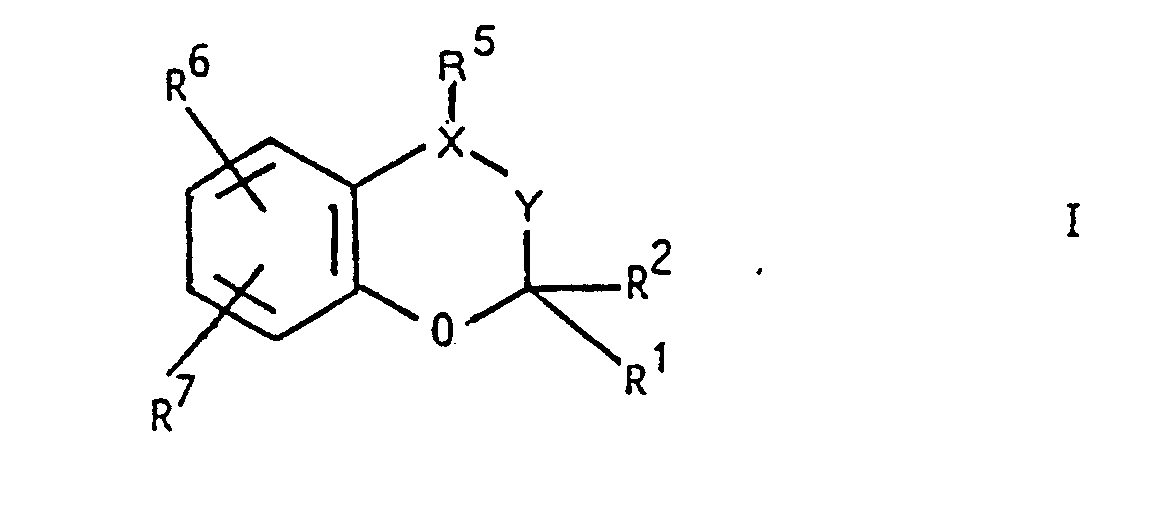
worin
X-Y 
=CH-CO- oder =CH-CHR⁸-, sowie, falls der Rest R⁵ weder vollständig noch partiell hydriert ist, auch =CR⁴-CR³R⁸- oder =CH-CR⁸(OA)-,
R¹ A,
R² und R⁸ jeweils H oder A,
R¹ und R² zusammen auch Alkylen mit 3-6 C-Atomen,
R³ OH oder OAc,
R⁴ H,
R³ und R⁴ zusammen auch eine Bindung,
R⁵ einen unsubstituierten oder einen ein- oder zweifach durch A, F, Cl, Br, J, OH, OA, OAc, NO₂, NH₂ AcNH, HOOC und/oder AOOC substituierten Pyridyl-oxy-, Pyridazinyl-oxy-, Pyrimidinyl-oxy-, Pyrazinyl-oxy-, Oxo-dihydro-pyridyl-oxy-, Oxo-dihydro-pyridazinyl-oxy-, Oxo-dihydro-pyrimidinyl-oxy-, Oxo-dihydro-pyrazinyl-oxy-, 1H-2- oder 1H-4-Pyridon-1-yl-, 1H-4- oder 1H-6-Pyridazinon-1-yl-, 1H-2-, 1H-4- oder 1H-6-Pyrimidinon-1-yl-, 1H-2-Pyrazinon-1-yl-, 3H- oder 5H-2-Pyrrolinon-1-yl-, 1H-2-Chinolinon-1-yl-, 2H-1-Isochinolinon-2-yl-, 2H-1-Phthalazinon-2-yl-, 3H-4-Chinazolinon-3-yl- oder 1H-2-Thiopyridon-1-yl-rest, wobei diese Reste auch vollständig oder partiell hydriert sein können,
R⁶ und R⁷ jeweils H, A, HO, AO, CHO, ACO, ACS, HOOC, AOOC, AO-CS, ACOO, A-CS-O, Hydroxyalkyl mit 1-6 C-Atomen, Mercaptoalkyl mit 1-6 C-Atomen, NO₂, NH₂, NHA, NA₂, CN, F, Cl, Br, J, CF₃, ASO, ASO₂, AO-SO, AO-SO₂, AcNH, AO-CO-NH, H₂NSO, HANSO, A₂NSO, H₂NSO₂, HANSO₂, A₂NSO₂ H₂NCO, HANCO, A₂NCO, H₂NCS, HANCS, A₂NCS, ASONH, ASO₂NH, AOSONH, AOSO₂NH, ACO-alkyl, Nitro-alkyl, Cyanalkyl, A-C(=NOH) oder A-C(=NNH₂),
R⁷ auch Pyridyl, Pyridazinyl, Pyrimidinyl oder Pyrazinyl,
A Alkyl mit 1-6 C-Atomen,
alkyl Alkylen mit 1-6 C-Atomen und
Ac Alkanoyl mit 1-8 C-Atomen oder Aroyl mit 7-11 C-Atomen
bedeuten,
sowie deren Salze.
X-Y
R¹ A,
R² und R⁸ jeweils H oder A,
R¹ und R² zusammen auch Alkylen mit 3-6 C-Atomen,
R³ OH oder OAc,
R⁴ H,
R³ und R⁴ zusammen auch eine Bindung,
R⁵ einen unsubstituierten oder einen ein- oder zweifach durch A, F, Cl, Br, J, OH, OA, OAc, NO₂, NH₂ AcNH, HOOC und/oder AOOC substituierten Pyridyl-oxy-, Pyridazinyl-oxy-, Pyrimidinyl-oxy-, Pyrazinyl-oxy-, Oxo-dihydro-pyridyl-oxy-, Oxo-dihydro-pyridazinyl-oxy-, Oxo-dihydro-pyrimidinyl-oxy-, Oxo-dihydro-pyrazinyl-oxy-, 1H-2- oder 1H-4-Pyridon-1-yl-, 1H-4- oder 1H-6-Pyridazinon-1-yl-, 1H-2-, 1H-4- oder 1H-6-Pyrimidinon-1-yl-, 1H-2-Pyrazinon-1-yl-, 3H- oder 5H-2-Pyrrolinon-1-yl-, 1H-2-Chinolinon-1-yl-, 2H-1-Isochinolinon-2-yl-, 2H-1-Phthalazinon-2-yl-, 3H-4-Chinazolinon-3-yl- oder 1H-2-Thiopyridon-1-yl-rest, wobei diese Reste auch vollständig oder partiell hydriert sein können,
R⁶ und R⁷ jeweils H, A, HO, AO, CHO, ACO, ACS, HOOC, AOOC, AO-CS, ACOO, A-CS-O, Hydroxyalkyl mit 1-6 C-Atomen, Mercaptoalkyl mit 1-6 C-Atomen, NO₂, NH₂, NHA, NA₂, CN, F, Cl, Br, J, CF₃, ASO, ASO₂, AO-SO, AO-SO₂, AcNH, AO-CO-NH, H₂NSO, HANSO, A₂NSO, H₂NSO₂, HANSO₂, A₂NSO₂ H₂NCO, HANCO, A₂NCO, H₂NCS, HANCS, A₂NCS, ASONH, ASO₂NH, AOSONH, AOSO₂NH, ACO-alkyl, Nitro-alkyl, Cyanalkyl, A-C(=NOH) oder A-C(=NNH₂),
R⁷ auch Pyridyl, Pyridazinyl, Pyrimidinyl oder Pyrazinyl,
A Alkyl mit 1-6 C-Atomen,
alkyl Alkylen mit 1-6 C-Atomen und
Ac Alkanoyl mit 1-8 C-Atomen oder Aroyl mit 7-11 C-Atomen
bedeuten,
sowie deren Salze.
2. Verbindungen der Formel I gemäß Patentanspruch 1, worin
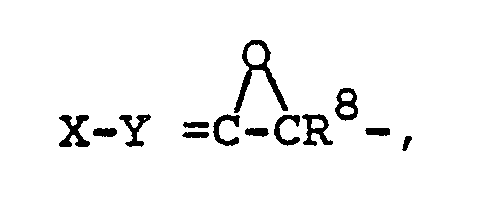
=CH-CO- oder =CH-CHR⁸, sowie, falls R⁵ einen unsubstituierten oder einen ein- oder zweifach durch A, F, Cl, Br, J, OH, OA, OAc, NO₂, NH₂, AcNH, HOOC und/oder AOOC substituierten 1H-4-Pyridon-1-yl-, 1H-4-Pyridazinon-1-yl-, 1H-4-Pyrimidinon-1-yl-, 1H-2-Chinolinon-1-yl-, 2H-1-Isochinolinon-2-yl-, 2H-1-Phthalazinon-2-yl- oder 3H-4-Chinazolinon-3-yl-Rest (wobei diese Reste auch vollständig oder partiell hydriert sein können) und/oder falls R⁷ Pyridyl, Pyridazinyl, Pyrimidinyl oder Pyrazinyl bedeutet, auch =CR⁴-CR³R⁸-, oder, falls der Rest R⁵ weder vollständig noch partiell hydriert ist, auch =CH-CR⁸(OA)- bedeutet.
3.
a) 2,2-Dimethyl-4-(1H-2-pyridon-1-yl)-6-cyan-chroman-3-ol;
b) 2,2-Dimethyl-4-(1H-2-pyridon-1-yl)-6-cyan-2H-chromen;
c) 2,2-Dimethyl-4-(6-hydroxy-3-pyridazinyloxy)-6-cyan-3-chromanol.
4. Verfahren zur Herstellung von Chromanderivaten der Formel I, dadurch gekennzeichnet, daß man zur Herstellung von Verbindungen der Formel I, worin X-Y =CR⁴-CR³R⁸ oder =CH-CHR⁸ bedeutet, ein 3,4-Epoxychroman der Formel IIa oder ein Chromanderivat der Formel IIb

worin
E Cl, Br, J oder eine reaktionsfähig veresterte OH-Gruppe bedeutet und
R¹, R², R⁶, R⁷ und R⁸ die bei Formel I angegebene Bedeutung haben,
mit einer Verbindung der Formel III
R⁵-H III
worin R⁵ die bei Formel I angegebene Bedeutung hat oder mit einem ihrer reaktionsfähigen Derivate umsetzt
und/oder daß man eine Verbindung der Formel I, worin X-Y =CH-CR⁸(OH)- bedeutet, dehydratisiert oder alkyliert und/oder daß man eine Verbindung der Formel I, worin X-Y =C=CR⁸- bedeutet, epoxidiert und/oder daß man eine Verbindung der Formel I, worin 
bedeutet, durch Behandeln mit einem sauren Katalysator zu einer Verbindung der Formel I, worin X-Y =CH-CO- bedeutet, isomerisiert und/oder daß man in einer Verbindung der Formel I einen oder mehrere der Reste R³, R⁵, R⁶ und /oder R⁷ in andere Reste R³, R⁵, R⁶ und/oder R⁷ umwandelt und/oder daß man eine basische Verbindung der Formel I durch Behandeln mit einer Säure in eines ihrer Säureadditionssalze umwandelt.
E Cl, Br, J oder eine reaktionsfähig veresterte OH-Gruppe bedeutet und
R¹, R², R⁶, R⁷ und R⁸ die bei Formel I angegebene Bedeutung haben,
mit einer Verbindung der Formel III
R⁵-H III
worin R⁵ die bei Formel I angegebene Bedeutung hat oder mit einem ihrer reaktionsfähigen Derivate umsetzt
und/oder daß man eine Verbindung der Formel I, worin X-Y =CH-CR⁸(OH)- bedeutet, dehydratisiert oder alkyliert und/oder daß man eine Verbindung der Formel I, worin X-Y =C=CR⁸- bedeutet, epoxidiert und/oder daß man eine Verbindung der Formel I, worin
5. Verfahren zur Herstellung pharmazeutischer Zubereitungen, dadurch gekennzeichnet, daß man eine Verbindung der Formel I und/oder eines ihrer physiologisch unbedenklichen Salze zusammen mit mindestens einem festen, flüssigen oder halbflüssigen Träger- oder Hilfstoff und gegebenenfalls in Kombination mit einem oder mehreren weiteren Wirkstoff(en) in eine geeignete Dosierungsform bringt.
6. Pharmazeutische Zubereitung, gekennzeichnet durch einen Gehalt an mindestens einer Verbindung der Formel I und/oder einem ihrer physiologisch unbedenklichen Salze.
7. Verwendung von Verbindungen der Formel I zur Herstellung eines Arzneimittels.
PAT LOG 5-A 110489
8. Verwendung von Verbindungen der Formel I zur Herstellung eines Arzneimittels zur Behandlung der Alopezie.
9. Verwendung von Verbindungen der Formel I bei der Bekämpfung von Krankheiten.
Applications Claiming Priority (4)
| Application Number | Priority Date | Filing Date | Title |
|---|---|---|---|
| DE3820506A DE3820506A1 (de) | 1988-06-16 | 1988-06-16 | -n-heterocyclisch substituierte chromanderivate und ihre verwendung als arzneimittel |
| DE3820506 | 1988-06-16 | ||
| DE3835011 | 1988-10-14 | ||
| DE3835011A DE3835011A1 (de) | 1988-10-14 | 1988-10-14 | Chromanderivate |
Publications (1)
| Publication Number | Publication Date |
|---|---|
| EP0346724A1 true EP0346724A1 (de) | 1989-12-20 |
Family
ID=25869185
Family Applications (1)
| Application Number | Title | Priority Date | Filing Date |
|---|---|---|---|
| EP89110177A Withdrawn EP0346724A1 (de) | 1988-06-16 | 1989-06-06 | Chromanderivate |
Country Status (11)
| Country | Link |
|---|---|
| EP (1) | EP0346724A1 (de) |
| JP (1) | JPH0240375A (de) |
| KR (1) | KR910000711A (de) |
| AU (1) | AU626549B2 (de) |
| DK (1) | DK296789A (de) |
| FI (1) | FI92824C (de) |
| HU (1) | HUT56096A (de) |
| IL (1) | IL90613A0 (de) |
| NO (1) | NO174391C (de) |
| NZ (1) | NZ229540A (de) |
| PT (1) | PT90864B (de) |
Cited By (6)
| Publication number | Priority date | Publication date | Assignee | Title |
|---|---|---|---|---|
| EP0431741A3 (en) * | 1989-10-30 | 1991-10-23 | Beecham Group P.L.C. | Substituted pyrimidineamino compounds |
| EP0456266A1 (de) * | 1990-05-11 | 1991-11-13 | Yoshitomi Pharmaceutical Industries, Ltd. | Verfahren zur Herstellung von optisch aktiven 3,4-Dihydro-3,4-epoxy-2H-1-benzopyranverbindungen, Zwischenprodukte davon und ihre Anwendung |
| WO1994012493A1 (en) * | 1992-11-25 | 1994-06-09 | Sandoz, Ltd. | 2,2-dialkyl- and 2,2-dialkyl-3,4-dihydro-3-hydroxy-2h-1-benzopyr ans, their use as pharmaceuticals |
| US5574049A (en) * | 1994-07-22 | 1996-11-12 | Sandoz Ltd. | 2,2-dialkyl- and 2,2-dialkyl-3,4-dihydro-3-hydroxy-2H-1-benzopyrans |
| RU2104277C1 (ru) * | 1992-11-25 | 1998-02-10 | Сандос Лтд. | 2-2-диалкил- или транс-2,2-диалкил-3,4-дигидро-3-гидрокси-6-(пиридин-4-ил)-2н-1-бензопиран |
| US5912244A (en) * | 1993-08-04 | 1999-06-15 | Pfizer Inc. | Benzopyrans |
Families Citing this family (9)
| Publication number | Priority date | Publication date | Assignee | Title |
|---|---|---|---|---|
| DE3835011A1 (de) * | 1988-10-14 | 1990-04-19 | Merck Patent Gmbh | Chromanderivate |
| FR2621587B1 (fr) * | 1987-10-12 | 1990-02-09 | Sanofi Sa | Derives du dimethyl-2,2 chromene, procede pour leur preparation et composition pharmaceutiques les contenant |
| AU628331B2 (en) * | 1988-05-06 | 1992-09-17 | Merck Patent Gesellschaft Mit Beschrankter Haftung | Chroman derivatives |
| DE3918041A1 (de) * | 1989-06-02 | 1990-12-06 | Merck Patent Gmbh | Chromanderivate |
| EP0430621A3 (en) * | 1989-11-29 | 1992-03-04 | Beecham Group P.L.C. | Process for the preparation of chiral 3,4-epoxy benzopyrans |
| CA2070243A1 (en) * | 1991-06-14 | 1992-12-15 | Akira Shiozawa | Chroman derivatives |
| CA2122494A1 (en) * | 1992-11-25 | 1994-06-09 | Paul W. Manley | 2,2-dialkyl- and 2,2-dialkyl-3,4-dihydro-3-hydroxy-2h-1- benzopyrans |
| IL108841A0 (en) * | 1993-03-10 | 1994-06-24 | Pfizer Res & Dev | Benzopyrans |
| JP2007000772A (ja) * | 2005-06-23 | 2007-01-11 | Casio Electronics Co Ltd | 二重マイクロカプセル、その製造方法及びマイクロカプセルの表面処理方法 |
Citations (4)
| Publication number | Priority date | Publication date | Assignee | Title |
|---|---|---|---|---|
| EP0107423B1 (de) * | 1982-10-19 | 1986-07-23 | Beecham Group Plc | Chromanen und Chromenen |
| EP0076075B1 (de) * | 1981-09-25 | 1986-11-20 | Beecham Group Plc | Benzopyran-Verbindungen mit pharmazeutischer Wirkung |
| EP0273262A2 (de) * | 1986-12-23 | 1988-07-06 | MERCK PATENT GmbH | Chromanderivate |
| GB2204868A (en) * | 1987-05-16 | 1988-11-23 | Sandoz Ltd | Benzo(6)pyrans and pyranopyridines |
Family Cites Families (3)
| Publication number | Priority date | Publication date | Assignee | Title |
|---|---|---|---|---|
| PT84806B (pt) * | 1986-05-03 | 1989-12-29 | Beecham Group Plc | Processo para a preparacao de benzopiranos |
| FR2621587B1 (fr) * | 1987-10-12 | 1990-02-09 | Sanofi Sa | Derives du dimethyl-2,2 chromene, procede pour leur preparation et composition pharmaceutiques les contenant |
| AU628331B2 (en) * | 1988-05-06 | 1992-09-17 | Merck Patent Gesellschaft Mit Beschrankter Haftung | Chroman derivatives |
-
1989
- 1989-06-06 EP EP89110177A patent/EP0346724A1/de not_active Withdrawn
- 1989-06-14 AU AU36440/89A patent/AU626549B2/en not_active Ceased
- 1989-06-14 PT PT90864A patent/PT90864B/pt not_active IP Right Cessation
- 1989-06-14 NZ NZ229540A patent/NZ229540A/en unknown
- 1989-06-14 IL IL90613A patent/IL90613A0/xx unknown
- 1989-06-15 FI FI892948A patent/FI92824C/fi not_active IP Right Cessation
- 1989-06-15 HU HU893110A patent/HUT56096A/hu unknown
- 1989-06-15 NO NO892494A patent/NO174391C/no unknown
- 1989-06-15 DK DK296789A patent/DK296789A/da not_active Application Discontinuation
- 1989-06-16 KR KR1019890008330A patent/KR910000711A/ko not_active Abandoned
- 1989-06-16 JP JP1152462A patent/JPH0240375A/ja active Pending
Patent Citations (4)
| Publication number | Priority date | Publication date | Assignee | Title |
|---|---|---|---|---|
| EP0076075B1 (de) * | 1981-09-25 | 1986-11-20 | Beecham Group Plc | Benzopyran-Verbindungen mit pharmazeutischer Wirkung |
| EP0107423B1 (de) * | 1982-10-19 | 1986-07-23 | Beecham Group Plc | Chromanen und Chromenen |
| EP0273262A2 (de) * | 1986-12-23 | 1988-07-06 | MERCK PATENT GmbH | Chromanderivate |
| GB2204868A (en) * | 1987-05-16 | 1988-11-23 | Sandoz Ltd | Benzo(6)pyrans and pyranopyridines |
Non-Patent Citations (3)
| Title |
|---|
| CHEMICAL ABSTRACTS * |
| JOURNAL OF MEDICINAL CHEMISTRY * |
| JOURNAL OF THE CHEMICAL SOCIETY, PERKIN TRANSACTIONS I * |
Cited By (7)
| Publication number | Priority date | Publication date | Assignee | Title |
|---|---|---|---|---|
| EP0431741A3 (en) * | 1989-10-30 | 1991-10-23 | Beecham Group P.L.C. | Substituted pyrimidineamino compounds |
| EP0456266A1 (de) * | 1990-05-11 | 1991-11-13 | Yoshitomi Pharmaceutical Industries, Ltd. | Verfahren zur Herstellung von optisch aktiven 3,4-Dihydro-3,4-epoxy-2H-1-benzopyranverbindungen, Zwischenprodukte davon und ihre Anwendung |
| WO1994012493A1 (en) * | 1992-11-25 | 1994-06-09 | Sandoz, Ltd. | 2,2-dialkyl- and 2,2-dialkyl-3,4-dihydro-3-hydroxy-2h-1-benzopyr ans, their use as pharmaceuticals |
| RU2104277C1 (ru) * | 1992-11-25 | 1998-02-10 | Сандос Лтд. | 2-2-диалкил- или транс-2,2-диалкил-3,4-дигидро-3-гидрокси-6-(пиридин-4-ил)-2н-1-бензопиран |
| US5912244A (en) * | 1993-08-04 | 1999-06-15 | Pfizer Inc. | Benzopyrans |
| US6071938A (en) * | 1993-08-04 | 2000-06-06 | Pfizer Inc. | Benzopyrans |
| US5574049A (en) * | 1994-07-22 | 1996-11-12 | Sandoz Ltd. | 2,2-dialkyl- and 2,2-dialkyl-3,4-dihydro-3-hydroxy-2H-1-benzopyrans |
Also Published As
| Publication number | Publication date |
|---|---|
| HUT56096A (en) | 1991-07-29 |
| PT90864B (pt) | 1994-11-30 |
| NO174391B (no) | 1994-01-17 |
| DK296789D0 (da) | 1989-06-15 |
| AU626549B2 (en) | 1992-08-06 |
| IL90613A0 (en) | 1990-01-18 |
| NO892494L (no) | 1989-12-18 |
| FI892948A0 (fi) | 1989-06-15 |
| FI892948A7 (fi) | 1989-12-17 |
| NO892494D0 (no) | 1989-06-15 |
| FI92824C (fi) | 1995-01-10 |
| PT90864A (pt) | 1989-12-29 |
| NO174391C (no) | 1994-04-27 |
| NZ229540A (en) | 1991-03-26 |
| KR910000711A (ko) | 1991-01-30 |
| AU3644089A (en) | 1989-12-21 |
| DK296789A (da) | 1989-12-17 |
| JPH0240375A (ja) | 1990-02-09 |
| FI92824B (fi) | 1994-09-30 |
Similar Documents
| Publication | Publication Date | Title |
|---|---|---|
| EP0340718B1 (de) | Chromanderivate | |
| EP0273262A2 (de) | Chromanderivate | |
| DE68920965T2 (de) | Zentralnervensystem wirksame Chromanderivate, Verfahren zu deren Herstellung und diese enthaltende pharmazeutische Zusammenstellungen. | |
| US5387587A (en) | Chroman derivatives | |
| DE69701298T2 (de) | Hydroxypyridin-Derivate, ihre Herstellung und ihre pharmazeutische Verwendung | |
| EP0400430B1 (de) | Chromanderivate | |
| EP0406656B1 (de) | Chromanderivate | |
| EP0415065B1 (de) | Chromanderivate | |
| EP0410208B1 (de) | Chromanderivate | |
| EP0031885B1 (de) | Basische Äther, diese enthaltende pharmazeutische Zubereitungen und Verfahren zu ihrer Herstellung | |
| AU626549B2 (en) | Chroman derivatives | |
| EP0363883A1 (de) | Chromanderivate | |
| EP0368160A1 (de) | Tetralinderivate | |
| EP0489327A1 (de) | Chromanderivate | |
| DE3923839A1 (de) | Benzopyran-derivate, verfahren zu ihrer herstellung und ihre verwendung sowie die verbindungen enthaltende zubereitungen | |
| EP0308792B1 (de) | Azachromanderivate | |
| EP0860440A1 (de) | Sulfonamid-substituierte Chromane mit Kaliumkanal blockierender Wirkung | |
| DE69016592T2 (de) | 4-Amidino-Chroman und 4-Amidino-Pyrano(3,2-c)pyridinderivate, Verfahren zur Herstellung und diese enthaltende pharmazeutische Zusammenstellungen. | |
| DE2461670A1 (de) | 5,6-benzo-gamma-pyronderivate, verfahren zu ihrer herstellung und ihre verwendung in pharmazeutischen zubereitungen | |
| EP0371312B1 (de) | Benzoxazinderivate | |
| DE3820506A1 (de) | -n-heterocyclisch substituierte chromanderivate und ihre verwendung als arzneimittel | |
| DE3815504A1 (de) | 4-n-heterocyclyl-chromanderivate, verfahren sowie zwischenprodukte zu ihrer herstellung und ihre verwendung in arzneimitteln | |
| EP0422450A2 (de) | Chromanderivate | |
| DE69330581T2 (de) | Diazabicycloalkenderivate |
Legal Events
| Date | Code | Title | Description |
|---|---|---|---|
| PUAI | Public reference made under article 153(3) epc to a published international application that has entered the european phase |
Free format text: ORIGINAL CODE: 0009012 |
|
| AK | Designated contracting states |
Kind code of ref document: A1 Designated state(s): AT BE CH DE ES FR GB GR IT LI LU NL SE |
|
| 17P | Request for examination filed |
Effective date: 19900525 |
|
| 17Q | First examination report despatched |
Effective date: 19920207 |
|
| STAA | Information on the status of an ep patent application or granted ep patent |
Free format text: STATUS: THE APPLICATION IS DEEMED TO BE WITHDRAWN |
|
| 18D | Application deemed to be withdrawn |
Effective date: 19970103 |